Читать книгу: «The Quaker»


Copyright
This is entirely a work of fiction. Any references to real people, living or dead, real events, businesses, organizations and localities are intended only to give the fiction a sense of reality and authenticity. All names, characters and incidents are either the product of the author’s imagination or are used fictitiously, and their resemblance, if any, to real-life counterparts is entirely coincidental.
HarperCollinsPublishers
1 London Bridge Street
London SE1 9GF
www.harpercollins.co.uk
Published by HarperCollinsPublishers 2018
1
Copyright © Liam McIlvanney 2018
Liam McIlvanney asserts the moral right to
be identified as the author of this work
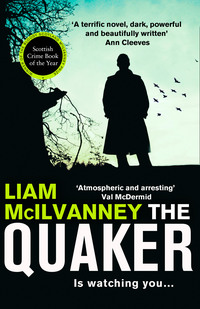
Cover design by Claire Ward © HarperCollinsPublishers Ltd 2019
Cover photographs © Roy Bishop / Arcangel Images (front); Alison Martin (back)
A catalogue record for this book is available from the British Library
All rights reserved under International and Pan-American Copyright Conventions. By payment of the required fees, you have been granted the non-exclusive, non-transferable right to access and read the text of this e-book on-screen. No part of this text may be reproduced, transmitted, down-loaded, decompiled, reverse engineered, or stored in or introduced into any information storage and retrieval system, in any form or by any means, whether electronic or mechanical, now known or hereinafter invented, without the express written permission of HarperCollins e-books
Ebook Edition © JUNE 2018 ISBN: 9780008259938
SOURCE ISBN: 9780008259914
Version: 2019-06-24
Dedication
For Caleb
Surely, he walks among us unrecognized:
Some barber, store clerk, delivery man …
Charles Simic, ‘Master of Disguises’
The houses are all gone under the sea.
The dancers are all gone under the hill.
T. S. Eliot, ‘East Coker’
Table of Contents
Cover
Title Page
Copyright
Dedication
Epigraph
Part I: Men and Bits of Paper
Prologue
Jacquilyn Keevins
Chapter 1
Chapter 2
Chapter 3
Chapter 4
Chapter 5
Chapter 6
Chapter 7
Chapter 8
Chapter 9
Ann Ogilvie
Chapter 10
Chapter 11
Chapter 12
Chapter 13
Marion Mercer
Chapter 14
Chapter 15
Chapter 16
Part II: The Bloody Flesh
Chapter 17
Chapter 18
Chapter 19
Chapter 20
Chapter 21
Chapter 22
Chapter 23
Chapter 24
Chapter 25
Chapter 26
Chapter 27
Chapter 28
Chapter 29
Chapter 30
Chapter 31
Chapter 32
Part III: The Sea Is All About Us
Chapter 33
Chapter 34
Chapter 35
Chapter 36
Chapter 37
Chapter 38
Chapter 39
Chapter 40
Chapter 41
Chapter 42
Chapter 43
Chapter 44
Chapter 45
Part IV: The Door We Never Opened
Chapter 46
Chapter 47
Chapter 48
Chapter 49
Chapter 50
Chapter 51
Chapter 52
Acknowledgements
About the Author
Also by Liam McIlvanney
About the Publisher
I
MEN AND BITS OF PAPER
‘We are suffering from a plethora of surmise, conjecture, and hypothesis.’
Arthur Conan Doyle, ‘Silver Blaze’
Prologue
That winter, posters of a smart, fair-haired young man smirked out from bus stops and newsagents’ doors across the city. The same face looked down from the corkboards of doctors’ waiting rooms and the glass display cases in the public libraries. Everyone had their own ideas about the owner of the face. Rumours buzzed like static. The Quaker worked as a storeman at Bilsland’s Bakery. He was a fitter with the Gas Board, a welder at Fairfield’s. The Quaker waited tables at the old Bay Horse.
Some said he was a Yank from the submarines at the Holy Loch. Others said he was a Russian from off the Klondykers. He was a city councillor. The leader-aff of the Milton Tongs. A parish priest. He had worked with multiple murderer Peter Manuel on the railways. He was Manuel’s half-brother, Manuel’s cellmate, he’d helped Manuel abscond from Borstal in Coventry or Southport or Beverley or Hull. There were Quaker jokes, told in low voices in work-break card-schools and the snugs of pubs. The word was magic-markered on bus shelters, sprayed on the walls of derelict tenements. It rippled through the swaying crowds on the slopes of Ibrox and Celtic Park. QUAKER 3, POLIS 0. His name crept into the street-rhymes of children, the chanted stanzas of lassies skipping ropes or bouncing tennis balls on tenement gables.
And always there was the poster: IF YOU SEE HIM PHONE THE POLICE. The poster looked like someone you knew, like a word on the tip of your tongue. If you looked long enough, if you half-closed your eyes, then the artist’s impression with the slick side-parting would resolve itself into the face of your milkman, your sister’s ex-boyfriend, the man who wrapped your fish supper in the Blue Bird Café.
The face was clean-cut, the features delicate, almost pretty. To some of the city’s older residents he looked like a throwback to a stricter, more disciplined age. A well-turned-out young man. Not like the layabouts and cornerboys who lounged on the back seats of buses, flicking their hair like daft lassies, tugging at their goatee beards.
Jacquilyn Keevins, the first victim, was killed on 13 May 1968. Strangled with her tights. Left in a back lane in Battlefield.
The Ballroom Butcher. The Dance Hall Don Juan with a Taste for Murder. The Quaker was something to talk about when you got tired of talking about football or the weather. That year of 1968, the worst winter in memory set in just after Halloween. On the first day of November a storm battered the city, shouldering down through the banks of tenements, scattering slates and smacking down chimney stacks.
On 2 November, Ann Ogilvie went out to the dancing at the Barrowland Ballroom and failed to come home. She was found two days later in a derelict tenement in Bridgeton.
On through Bonfire Night and St Andrew’s Day the weather stayed bad. The football card was clogged with postponements, unplayed fixtures piling up. The posters on gable ends, where the Quaker’s face had been pasted in threes as though he were a candidate for office, were pulped and defaced by the pelting sleet.
All winter, people wrote to DCI George Cochrane and the Quaker Squad at the Marine Police Station in Anderson Street. The letters waited on Cochrane’s desk each morning. People wrote to denounce their friends and neighbours, relatives, enemies. The Quaker’s names were Highland, Lowland, Irish, Italian. Sometimes the writer was anonymous, sometimes the letters were signed. As December wore on, the missives came in the form of Christmas cards, festive scenes of horse-drawn carriages and starlit stables bearing the names of evildoers in righteous capitals. A team of detectives followed these up, chasing the names across the map of the city.
The city itself was changing, its map revised by the wrecking balls. Slum clearance. Redevelopment. Whole neighbourhoods lost as the buildings came down. Streets cleared. Families dispersed. Some went to the big new schemes on the edge of the city but most of them left. They lit out for the coastal new towns or further afield, to Canada, the States, they took ship as Ten Pound Poms for Adelaide and Wellington. New lives in sunny elsewheres, the grime of the tenements left behind.
For those who stayed, it was the winter of the Quaker. There was no escape from the blond side-parting and the crooked smile. Like a slew of frozen mirrors, the posters threw back to the city its half-familiar face. Men with short fair hair, men with overlapping teeth, men with the thin slightly sensuous lips of the artist’s impression would find themselves scrutinized in pubs and restaurants, underground carriages. Glancing up from the Evening Times as the bus took a bump they’d catch the fierce, unguarded stares of their fellow citizens. Whispers rasped around them, neighbours monitored their movements. Cards were issued by the Chief Constable to men who matched the wanted man’s description: The holder of this card is certified as not being the Quaker.
Another big storm hit the city on 25 January. Burns Night. The morning after the storm was when number three was found, torn and sprawled in a Scotstoun backcourt, like something ransacked by the wind. Marion Mercer’s unwitting smile joined those of Jacquilyn Keevins and Ann Ogilvie on the splashes of the Record, the Tribune, the Daily Express.
Jacquilyn Keevins. Ann Ogilvie. Marion Mercer.
And then, in the weeks since Marion Mercer, nothing. The murders that had gripped a city stopped. The days ticked past, the weeks turned into months. With the warmer weather it was hard to keep the killings in mind, that wintry horror. The frenzy ebbed. The air began to clear. Suddenly it was six months since the Quaker’s last killing. The prospect that he might strike again was like the memory of last year’s snow: you couldn’t picture it. There were queues once more outside the dance halls. Bouncers rocked on their heels outside the Plaza and the Albert. Women stood in line for the coat-check in the Barrowland and the Majestic. Blue-tuxedo’d band-leaders cracked jokes about the Quaker before leaning in to the mic for the next slow ballad. The university cancelled its night-bus service for female students. The city was moving on, looking out. News items from the wider world – riots in Belfast, the Kennedy bother at Chappaquiddick, One Small Step for Man – displaced the local stories in the Tribune and the Record. A new decade was coming, new money, new buildings going up along the central streets, citadels of glass and steel. Dead, imprisoned for another crime, or living somewhere else, the Quaker was fading from the city’s sense of itself, dwindling to a whisper, a half-forgotten melody.
Only the shirtsleeved men in the Murder Room at the Marine Police Station in Partick kept at their task. In a fourteen-by-ten upstairs room, they stalked the Quaker through box files of witness statements. For months these men had been trying to piece it together, searching for motive and meaning in rubbled backcourts. Three endings. Three bodies. Crumpled and sprawled, dumped like rubbish. I thought it was a mannequin, a tailor’s dummy. It looked like a bundle of rags. An old coat or blanket. No one ever thinks that it’s a body. A woman. Someone with a book half-read, a favourite song, bitter secrets, a patch of eczema behind her ear.
Then the newspapers started to turn. Detectives who had been the subject of reverent profiles – George Cochrane pictured in his mackintosh and trilby, gripping his pipe like a Clydeside Sherlock; Chief Constable Arthur Lennox in his pristine blues, flanked by a portrait of the queen – found themselves discussed with scoffing brusqueness. An element of black humour crept into the coverage. The papers had fun with the notion of CID men brushing up their dance moves as they mingled with the punters at the Barrowland Ballroom. In July, the Tribune ran an old photo of the Quaker Squad detectives at the scene of Jacquilyn Keevins’s murder, walking three-abreast down Carmichael Lane, looking for clues. The picture had a caption: Romeo, Foxtrot, Tango: The Marine Formation Dance Team.
Jacquilyn Keevins
Everyone thinks that I changed my mind and that was what got me killed. Shaking their heads at my folly or at the capriciousness of fate. As though changing your mind was so terrible. As though I should have known better. But I didn’t change my mind. I told Mum and Dad that I was going to the Majestic – they were right about that – but that was never the plan. I was going to the Barrowland all along.
I was going to the Barrowland because I was meeting a man.
The shoes that I’d bought in Frasers the previous Saturday were pinching my toes as I walked down the hill to the bus. I was wearing an emerald green crepe dress I’d just re-hemmed. The dress was sleeveless and my arms felt cool against the satin lining of my coat. I was conscious of my perfume – Rive Gauche – filling the lower deck of the bus and I remember noticing that the conductress had a ladder in her tights, all the way down the inside of her left leg, and thinking that she ought to have a spare pair in her bag.
Why did I lie to my parents? I’m not sure. I think it was to make it more complete. The secret, I mean. The man I was meeting was called William. He was tall, with good hair he was forever running a hand through, and strong slim forearms under folded sleeves. I hadn’t known him long. There was something distant about him, something reserved. I wondered if maybe he’d turn out to be married but I didn’t care. It had been a long time since someone had asked me out. The boy was the problem. Wee Alasdair. Just turned six. It puts them off, a kid does.
I got off the bus at Glasgow Cross and walked up the Gallowgate to the Barrowland and joined the queue under the green-and-red neon. Once I’d checked my coat in the foyer I climbed the stairs to the ballroom. That’s the bit I loved, climbing towards everything, the music suddenly loud and the dancers whirling into view. I hurried the last few steps and the ballroom gulped me in. I felt safe there, secret, in the darkness and the lights.
I bought a bitter lemon at the bar and took a seat at a table so that people knew I was waiting for someone.
I lit a cigarette and looked at my watch. William was already fifteen minutes late. Benny Hamlin and the Hi-Hats played ‘Boom Bang-a-Bang’ and I was cross because I always liked to dance to that. I lit another cigarette, watched the smoke drift up towards the shooting stars on the ceiling.
By half-past nine I knew he wasn’t coming. My bitter lemon was finished and I’d smoked all but two of my cigarettes. I remember how angry I felt, close to tears, not because he’d stood me up but because everything was spoiled, the night and the dress and the music and everything. I was sorting my lipstick and getting ready to leave when a shadow fell on my handbag and stayed there. When I turned and looked up, there he was. The lights from the stage were behind him and I couldn’t really see his face. I’d forgotten how tall he was, how well-spoken.
‘I’m so sorry I’m late,’ he said. ‘May I still join you?’
That’s how he spoke. He offered me a cigarette and lit it with a nice gold lighter but he didn’t take one himself. He didn’t smoke, just carried a pack for occasions like this.
He bought me another bitter lemon and got another pack of Embassy Filter from the vending machine and draped his raincoat over a vacant chair. He had a nice woollen scarf that he folded and placed on the chair beside him. He was really good looking with his sharp jaw and his straight nose and his short fair hair in a neat side shed. He wore a regimental tie and a brown chalkstripe suit. Stylish. I couldn’t stop grinning, leaning in to get my cigarette lit, resting my hand on his hand as he held the flame.
The music was loud so it was a struggle to talk but he asked me about my day and he spoke about his job. I wasn’t really listening so much as just enjoying his voice, Glasgow but sort of refined, not like your typical city neds, whining out of the sides of their mouths like someone letting air out of a balloon. He was different altogether. A lot of the guys you’d see in the Barrowland were hard men, or thought they were, always spoiling for a fight. I’d see them in the Vickie on my night shift, carting their sore faces into A&E. I want to say that they didn’t look so clever right then, with their faces gaping open, but the truth is they looked every bit as clever – or every bit as dumb – sitting there with their shirts drenched in blood, pleased as punch, already working out how they’d tell it to their mates. William was different, he seemed older, more sophisticated, somebody who knew things. Good dancer, too.
We left at half-eleven and walked down the Gallowgate to where he’d parked his car. Outside in the streetlights he looked younger than he had in the ballroom. He was twenty-five, maybe twenty-six, though he acted a little older than he was. Even so, I was older by five or six years and I liked it, it made me feel more in control.
His car was a sleek white affair, quite new-looking. He held the passenger door for me while I settled myself in the red leather seat, then he closed the door before walking round to the driver’s side. I leaned against him when the car turned a corner and looked up into his face but he stared straight ahead and kept his hands to himself. He was talking away about decimalization with this earnest look on his face and when the car stopped at a red light I started poking him in the ribs, trying to get him to laugh if nothing else. It was nice he was such a gentleman but he needed to relax a bit. Nothing was going to happen anyway – it was my time of the month – but you’d want some fun from a night at the jiggin.
We got out of the car and he walked me to the closemouth. And now, when we stepped into the darkened close, it all seemed to change, like a switch had flicked. He caught me by the shoulders and pressed his mouth against mine, hard, so that my head bumped against the wall of the close. About time, I thought. Then his hands were busy and his breathing got loud.
‘Not here,’ I told him. ‘Come on.’
I took him down the hill to the lane behind Carmichael Place. I was laughing to myself, because it was like I was fifteen again. This was where you would come with boys, after the pictures or church socials, this is the place you’d winch a little before you went home. I hadn’t been down here in fifteen years, but it was still just the same, the garages and the garden gates.
It was dark in the lane, away from the lights. The ground is all grassy with stones jutting out – not cobbles but ordinary stones, sharp and uneven, and my heel caught on one of the stones and I clutched at his arm, fell against him, really, and I remember I was laughing, I couldn’t stop laughing, it all seemed so funny and my mouth was locked open in this soundless laugh and that’s when he hit me in the mouth.
At first I didn’t know what happened. I thought maybe I’d slipped and bumped his shoulder or maybe someone had come running out of the lane and burst right between us and knocked me out of the way. I staggered backwards and clattered into the double doors of a garage, they rattled and shook. I raised my fingers to my mouth and took them away with something dark and glistening on them. That’s when I looked up and saw him stumping across the lane with his fist raised high. I screamed then but I needed to swallow first and the scream was kind of thin and half-hearted and he stopped it with another punch and there was a kind of judder like you were bumping downstairs and then the ground was scraping my face and I looked up with the eye that could still open and he was standing over me, tugging loose his tie and sawing his head back and forth as he did it.
That was all. Now my father looks like he will never smile again, like he’s forgotten the language of smiling and he’s suddenly old, old, old, he’s a wee small leprechaun, The Incredible Shrinking Man, his collars gaping, his jacket sleeves hanging down past his knuckles, and my mother walks around in a Valium trance. They try to put on happiness for Alasdair’s sake but you can’t fake it, a child isn’t fooled. The boy knows that something’s wrong and of course he thinks it’s his fault.
They worried, when I was out in Germany, Mum and Dad. Anything could happen in a country like that. They were so pleased when I came home, back to the flat in Langside Place, to the numbered buses and the local shops, the streets where nothing bad could happen. It’s hard for them to face the truth: I would have been safer in Germany, in that cramped Army house in Bad Godesberg, tramping through the rain to the NAAFI store.
There are things we need to remember. I tell them to Alasdair, lying weightlessly beside him on the narrow single bed, wishing I could smell his skin. I pour them into his ears while he sleeps and I tell myself that when his eyelids flicker – his transparent eyelids with the red veins down them and the long blond lashes – then the words are getting through. I tell my boy about himself. How he used to be scared of the coalman with his leather apron and his grimy face. How, when I leaned over to say goodnight, he would play with my hair, twist it in his fingers. He did that whenever he was tired. Sitting on my lap, leaning back against my chest, he would throw his wee arm up and clutch at my hair. Now he’ll forget. There’ll be no one to remind him that he did that. Or that he liked the Monkees. Or that he shouted ‘Lollo!’ when a lorry went past or called a helicopter ‘Uppatuptup’. My folks won’t remember. They love him, but they won’t remember those things and it seems hard to think that they’ll be lost.
What could matter more than this? Not revenge, certainly; not catching the man. People think the murdered dead are chewed up by hatred, lusting for vengeance, we can’t rest till our killer is caught. I couldn’t care less. If a man is hanged in Barlinnie Gaol or locked up in Peterhead for the next fifteen years will that help Alasdair sleep at night? Will it give me back my sense of smell?
For a while I thought I was different from the others. Better. Less to blame. I was the first. I had no way of knowing that he even existed. But the others, the second girl and the third: when they walked up those stairs to the noise and the lights and the shooting stars, they knew. They knew a man had picked up a woman on that dance floor and taken her home and killed her. But they went anyway.
And then I saw I was wrong, I was kidding myself. I knew he was out there too. I knew it all along. We all do.
1
DI Duncan McCormack sat at a desk in the empty Murder Room. It was the dead time between shifts. The night shift had knocked off at seven; the day shift wouldn’t start till eight.
McCormack was early, on a point of principle. You’re planning to sit in judgement on a group of your colleagues, you better be early. You better show them all the respect you can.
He lit a cigarette. This early, the Murder Room had a churchly peace. He hadn’t turned on the lights, and the morning sun threw a soft gloss on the hooded typewriters and the glass ashtrays and the grey metal bellies of the wastepaper baskets. It was the usual shabby office, with its jumble of scuffed desks and unmatched chairs and olive drab filing cabinets, but for McCormack such rooms could be magical places. Mysteries were solved here. Murders redeemed. Lives that had been turned upside down could sometimes – with work and skill and the needful visitation of luck – be righted.
Luck, though. Luck wasn’t a word you associated with the Quaker case. Nothing about this case had been lucky.
He rose and crossed to the one long wall that was free of shelving. There were maps here with coloured push-pins marking the murder scenes. There were photographs of three women, the familiar before-and-after shots. You couldn’t look from the oblivious smiles to the sprawled bodies without your stomach dropping. Without feeling personally guilty.
He stopped in front of one of the smiles to acknowledge his own share of guilt. He had worked this one, the first one. Jacquilyn Keevins. Down on the South Side. In the spring of last year. A botch job, a case that was jiggered from the first. Mistakes. Dud intel. Sloppy direction. They’d wound the thing up after only two weeks. Then came Ann Ogilvie over in Bridgeton, and Marion Mercer out west in Scotstoun. That’s when they knew for sure they were dealing with a multiple. That’s when the legend started to form, the dark tales and rumours – a whole city in thrall to the arrogant, Bible-quoting strangler that the papers dubbed the Quaker.
And that’s when the Quaker Squad set up shop in the old Marine, the nearest station to the Mercer locus. And this is where they’d been ever since, as the weeks turned into months and the man from the Barrowland Ballroom refused to be caught.
And now, just to add to the fun and games, they had Detective Inspector Duncan McCormack on their backs. On secondment from the Flying Squad, McCormack was tasked with reviewing the Quaker investigation, learning lessons, making recommendations. Everyone knew what this meant. Scale the thing down. Scale it down before we squander more money. Get us all out of the mess we’ve made.
McCormack was turning from the photos on the wall when the telephone rang. A shrill, tinny jangle in the silent room. He looked at the door as though someone might burst in to answer the phone and then gingerly, frowningly, reached for the receiver.
‘Murder Room. McCormack.’
He felt like a butler in a play. Someone playing a part. There was a soft rasping sound, a kind of shadow-laughter, then the moist, masticating clicks of a man preparing to speak. ‘No nearer, are you?’
‘Say it again?’
‘You’re no nearer catching him. After all this time.’
The voice was local, Glasgow. Nicely spoken. Fifties, McCormack decided. Possibly older.
‘Can you tell me your name, sir?’
‘A year you’ve had. More than a year. Some people might view that as careless. Wasteful, even.’
‘Sir, do you have information you’d like to impart?’
‘Impart?’ The soft laugh. ‘I’ll impart all right, son. I’ll impart the name of the man who did it. How’s that?’
‘On you go, then.’
‘Michael Ferris. Michael Ferris is the bastard you want. F-E-R-R-I-S, 12 Dollar Terrace, Maryhill. Are you writing this down?’
‘Thank you for your help.’
McCormack put the phone down and turned to see a shape in the doorway, broad shoulders blocking the light. Big shaggy head of blond hair. Goldie was the detective’s name. McCormack had pegged him early as a loudmouth. Blowhard. Also, he thought he knew the guy from somewhere.
‘Christ, mate. I never heard you come in.’
Goldie rocked on his heels. ‘Michael Ferris?’
‘How did you know?’
Goldie shrugged. ‘It’s the same nutjob. Phones every three or four days.’
‘Right.’ McCormack nodded. He smiled his crooked smile. ‘Look, I don’t think we’ve met properly. I’m Duncan McCormack.’
‘You think we don’t know your name?’ Goldie didn’t appear to see the proffered hand. ‘You think we don’t know who you are?’
‘Should I take that as a compliment?’
‘Well, it’s the closest you’re gonnae get in this room, buddy.’
‘Fair enough. It’s fucked up, this whole situation. I get it. But look, mate. We all want the same thing here.’
‘Really?’ Goldie chewed his lip. His fists were plunged in the pockets of his raincoat and he spread his arms. ‘You want to get on with catching bad guys? Like, you know, proper police work? Because I thought you wanted something else.’
You could rise to it, McCormack thought. Or you could take a breath, see the job through, write your report and be done with this shit. File this fucker’s face for future reference. Make sure he gets what’s coming at some point down the line.
‘I want what we all want.’
‘Right. My mistake,’ Goldie was saying. ‘I thought you were here to grass us up. Do your wee spy number.’
McCormack smiled tightly. Do you know James Kane? he wanted to ask. James Arthur Kane, the man who ran Dennistoun for John McGlashan? The man who just landed a twelve-stretch at Peterhead? That James Kane? I put him away. I did the police work that nailed him. He’s the fourth of McGlashan’s boys that I’ve nailed in the past year, while you’ve been shuffling your lardy arse in this shitty room. Filing papers. Sticking pins in a corkboard.
But he said nothing and now Goldie was smiling. ‘You don’t even know, do you?’
McCormack tried to keep the tightness out of his voice. ‘Don’t know what, Detective?’
‘Where you know me from? Jesus Christ. We worked the first one together. Jacquilyn Keevins.’
‘Right. Right. Of course.’
It was true. That’s where he’d seen him. How had he missed it? McCormack cursed his own stupidity. It was as if one lapse of memory proved Goldie’s point – there was only one detective present.
Goldie jabbed himself in the chest with a stubby finger. ‘And I’m still working it. Me and the others. What are you doing?’
‘I’m doing my job, Detective. Police work. Same as you are.’
‘Naw, Inspector. Naw.’ Goldie’s teeth were bared in a sneer, eyes bright with scorn above the bunched cheeks. ‘Naw. See, you cannae be the brass’s nark and do good police work. Know why? Because good police work doesnae get done on its own. You need your neighbours to help you. And who’s gonnae help you after this?’
He was using ‘neighbours’ in the special polis sense, meaning your partners, the guys you shared a station with. McCormack watched as Goldie tugged his cigarettes and lighter from his raincoat pocket, tossed them on the desk. Goldie was whistling under his breath and fuck this, McCormack decided, enough was enough.
‘You know a guy called James Kane?’ he asked.
‘Yeah, yeah.’ Goldie was hanging his raincoat on the hat-rack. ‘You put one of Glash’s soldiers away. And that gets you a pass? Maybe in your book. In mine, you need to turn up every day. Be a polis. Earn it all again.’
McCormack shook his head. Be a polis. The fuck would you know about that? McCormack had his finger raised to jab it at Goldie when he heard the smart rap of heels in the corridor.
‘What’s the score here?’ The boss, DCI George Cochrane, was on the threshold, tall and thin and oddly boyish in his belted gabardine. He read the battle stance of Goldie and McCormack. ‘The hell’s going on, DS Goldie?’
‘Friendly discussion, sir.’ Goldie smiled, still looking at McCormack. ‘We’re all friends here.’
‘Fine. Let’s keep it that way.’ Cochrane bustled through to his own office, spreading the cherry scent of pipe tobacco. At the ribbed glass door he paused. ‘And Goldie? We’ll be doing some parades with Nancy Scullion over the coming week. Drop by her flat this evening, would you? Check what times she’ll be free.’
‘Sir.’
Goldie took his seat. McCormack crossed to one of the big sash windows, unsnibbed it, hooked his fingers in the metal lifts and tugged it open. The smell of the river came in on the breeze; the Clyde met the Kelvin just south of the office. He thought about Nancy Scullion. He’d heard the name a lot around the office. If the Murder Room was a cult, its High Priestess, the Delphic Oracle of the Marine Police Station, was Nancy Scullion. Sister of the third victim, she had spent the evening of 25 January in Barrowland Ballroom with her sister and the killer. He sat between them in the taxi on the way back to Scotstoun, where the sisters lived just a few streets apart. Nancy was drunk, blootered, smashed on gin and Babycham, but she’d heard him banging on about caravan holidays in Irvine, growing up in a foster home, getting verses of the Bible off by heart.
Nancy’s description was holy writ. It was the tablets of the law for the men at these desks. They parsed it and probed it, took apart its description of a well-dressed modern man, with his short fair hair and his neat raincoat, his gallantry and his hair-trigger temper. Good manners. Nice diction. A cut above the common ruck of East End hoodlums and toughs. A golfer, no less, whose cousin had recently scored a hole in one. Polite but masterful, a man of strong views, who called for the manager when the cigarette machine malfunctioned and forced him to refund Nancy’s money. A man who spoke darkly about sinful women in the taxi back to Scotstoun. Who professed to spend his New Year’s Eves in prayer while the rest of the world gave itself over to drink and hilarity.
McCormack knew it all. After barely a week he knew the details about as well as if he’d been here all along.
Brown chalkstripe suit, regimental tie. Thick watchstrap. Embassy Filter. Overlapping two front teeth. Suede boots. Dens of iniquity. Woman taken in adultery. Hole in one.
This was the litany and these men blitzed it. Every man on the squad had criss-crossed the city, chasing these leads. In a hundred barber-shops these detectives had traded nods in the mirror with gowned customers as the barber slipped his scissors into a breast pocket and took the artist’s impression in both hands. At specially convened meetings of city golf clubs they watched the blazer-buttons wink like coins as the members passed a laminated image along the rows. They took the picture to all the tailors on Renfield Street and Hope Street. They went to the churches, chapels, gospel halls of all denominations, spoke to priests, lay preachers, ministers. They visited dentists’ surgeries, asked permission to sift their records.
And nothing worked.
The man with the short hair and overlapping teeth, the smartly dressed dancer in the desert boots whose cousin scored a hole in one, the zealot who quoted scripture in the back seat of a taxi, the man who raped and killed Jacquilyn Keevins and Ann Ogilvie and Marion Mercer; that man remained a ghost.
Now, as the day shift straggled in, hooking their fedoras on the hat-rack, shucking out of their blue raincoats, McCormack felt something like pity. This was the prime gig, the career-making case, and it had all turned sour.
There was a smell in the room, a brassy tang beneath the sweat and cigarettes. The smell was embarrassment, McCormack decided. They’re sore at having their shortcomings and befuddlement exposed to an outsider, the brass’s nark from St Andrew’s Street. But it was more than that, too. They were flat out affronted. With the details they had. All the specifics. That litany of ties and teeth and Old Testament imprecations.
Every man in that squad had made arrests on not a tenth of what they had to go on here. So what had gone wrong this time? How had they failed so badly? These were the questions that hung in the air and DCI Cochrane seemed to sense them as he stubbed his Rothmans out in an ashtray and slapped his hand on the side of a filing cabinet to bring the room to order.
We haven’t been thorough enough, he told them. We haven’t been systematic. We missed something the first time round and we need to put it right.
There was a pile of buff folders on top of the filing cabinet, maybe twenty-five or thirty. Cochrane turned and gathered them awkwardly in his arms and leaned over to drop them on the nearest desk.
‘These are men we spoke to after one and two. After Keevins and Ogilvie. Men with records. Sexuals. We may have been too hasty to rule them out. I want you to roust out these individuals, bring them in. We’ll see what Nancy Scullion makes of them.’
McCormack looked along the line and caught Goldie’s eye. Goldie shook his head and looked away.
Cochrane clapped twice, chafed his hands together. ‘Right. Now let’s divvy these up and get cracking.’
The men shuffled forward and each lifted three or four folders, carried them back to their desks.
Ten minutes later Goldie went out for a piss and McCormack sidled over to his desk, started leafing through the folders. He pulled one out. A sorry-looking soul called Robert Kilgour, forty-two years of age, whose vulpine face seemed faintly familiar. Kilgour had been released from Peterhead in ’67 after serving two years for a sexual assault carried out in Mill Street in the East End of Glasgow, about a mile south-east of the Barrowland Ballroom. He’d been interviewed after the first killing, and it was McCormack himself – he remembered it now, and here was the sheet, rattled out on his own trusty Underwood – who’d grilled him in his Cowcaddens flat. Kilgour had a solid alibi – he’d been visiting friends in Ayrshire on the night of the killing and stayed overnight in Kilmarnock – and they’d ruled him out pretty quickly. There was nothing much more in the file, just a record of Kilgour’s flittings. He’d moved around a lot in the past eighteen months. His current address was in Shettleston – a tenement scheduled for demolition.
Goldie was back, standing by the desk, hands on his hips. McCormack looked up. ‘When you get round to this guy here’ – he tapped the Kilgour file – ‘let me know. I want to come along.’
Goldie glanced down at the file, back at McCormack. He dragged his chair out with a scrape, thudded down into it, jockeyed it closer to the desk. ‘Your funeral,’ he said.
2
The sky-blue Vauxhall Velox came nosing round the corner into the empty street. In the closemouth of a gutted tenement, Robert Kilgour watched it pass, gravel crackling under the tyres, the two men hunched on the front bench-seat, the slim passenger, heavyset driver.
Kilgour moved from the shadows towards the open air. He stood in the doorway, watched the pink taillights floating in the dusk. He pinched the bridge of his nose and his fingers came away wet, dripping, he shook the sweat from them. Framed in the back windscreen he could see the two heads in silhouette, twisting to look. They would know he couldn’t have got far. Another fifty yards, another hundred they would stop, turn and come back. He had to move now.
He tried to remember the layout of these streets. His own flat was only three or four streets away but he had run blindly when he spotted the parked Velox as he crossed to his building. As he ran he’d been aware of nothing but the sound of the car’s engine and now he was lost. It was barely three weeks since he’d moved to this district. They kept knocking bits of it down. Every time you went out there was another gap-site, another missing street, you never knew where you were.
Across the street was a block of empty tenements. It struck Kilgour that there was another dead street beyond this and then maybe the main road. Buses, bars, shops. People. Places to hide.
He took a breath, closed his eyes for a second, tugged his sweat-soaked shirt away from his chest. Then he left the closemouth at a sprint, running low with his hands up around his head, as though fearful of falling debris. Without looking he knew the car had stopped. There was a hollow crunch as the driver found reverse and a veering screech as the car swung round. Kilgour made it into the building across the street, feet slapping through the echoey close and he heard the engine’s angry rasp as the driver found first and ramped up through the gears.
Emerging into the dark backcourt Kilgour heard the car suddenly louder, the engine’s whine stretching as the car took the corner and gunned down the straight.
He’d been heading straight across the backcourt but now he sheered off to the left, nearly slamming into a metal clothes-pole. The hard-packed earth was strewn with bricks and rubble and his ankles flexed and buckled as he ran. He ran with his hands out in front of him, feeling for clotheslines and other impediments in the gathering dark and soon a black wall reared up in front of him. He scrambled on to the roof of a midden, hauled himself on to the wall and dropped down into the next backcourt.
He kept running, weaving from side to side like a man dodging bullets. He couldn’t hear the car, the only sound now was Kilgour’s own breathing and then his running foot kicked something, a tin can that sparked and rattled over the broken ground, splitting the night like a burst of gunfire. When he reached the next wall and struggled on to the midden he was losing heart, his legs were heavy, the fight was draining out of him.
Before him was a big patch of waste ground: bricks and rubble, puddles catching the last of the light. He raised his eyes and saw the squat low outline, a building shaped like a shoebox.
Kilgour slipped over the wall. He drew his sleeve across his brow and picked his way through the rubble. His knees almost gave way as he pushed through the double doors.
‘Did you win?’ The barman was smiling as he passed him his change.
Kilgour stared at the red stupid face.
‘What?’
‘The race you were in, did you win it?’
Sweat was dripping from Kilgour’s brow on to the bar-top, spotting a beermat. McEwan’s Export: the Laughing Cavalier, with his foaming tankard of ale. Kilgour shook his head and slipped the change into his pocket and tried to still the tremor in his leg.
He was sick of running. He’d been running – one way or another – for over two years, since he’d walked out of Peterhead on a wet spring morning with his worldly goods in a black BOAC flight bag. He was sick of moving, changing flat every couple of months. But what could you do? It followed a pattern. For a while things would go well in a new flat. Then someone would place him, make the connection. And then it would start. Dogshit through the letter box. Catcalls from the local kids. Crude words scrawled on his door. Rocks through the windows. Getting jostled in the street. That’s when he’d look for another place.
You could change your name, but why give them the satisfaction if you hadn’t done anything wrong?
He heard the pub doors rattle. He didn’t look round. He stared down at the bar-top and in the vertical black groove of a cigarette burn he saw the gable end of a building, a dark street. He saw a woman on the pavement, sitting up now, clutching her throat, choking, retching, her torn blouse hanging open, her skirt shucked up around her waist. Her face was pink and gorged, her eyes bulging and bloodshot, swimming in tears. A rope of snot and saliva swung from her upper lip. He remembered the burst of pain in his head and the ground swinging up to smack him, and a dead weight on his back, a man sitting astride him, forcing his arm up his back. He’d lain there, oddly placid, with his face pressed to the gritty street and the weight on his back until the siren drew closer and gulped to a stop and a pair of black boots filled his line of vision.
Now he watched in the whisky mirror as the burly man shooed the barman away and the thin man shook his head.
Kilgour wiped a hand down his face. The same hand reached for the whisky and then pulled back. He reached into his jacket pocket for his smokes and then changed his mind. The cops watched him. He could see his own face in the gantry mirror, sick and scared, the features obscured by the ‘FIN’ of ‘FINEST SCOTCH WHISKY’. He looked bad, he was sweating, the hair at his temples in damp little spikes.
Then his leg started again, his right leg shaking, the knee joint flexing. He reached out for a drink and his hand knocked the glass, whisky pooling on the sticky bar-top. When he bolted to the Gents he could sense them coming after.
‘Robert Kilgour?’
Piss and carbolic. The bare lightbulb flaring in the scuffed steel of the trough.
‘Kilgour,’ he said. The cop had pronounced it to rhyme with ‘power’: Kilgour rhymed it with ‘poor’.
‘Why did you run?’
The fat cop had backed him up to the trough.
‘Why did you run, Kilgour?’
Kilgour glanced at the other cop, the tall one. He was still looking at the tall one when the fat one kicked his legs from under him and Kilgour slammed on to the dark concrete, his elbow cracking on the floor, the back of his head catching the lip of the trough. Then the fat one reached down and hauled him up like a bag of chaff and dumped him into the trough. Kilgour waggled his arms for balance, his hands paddling in the piss and running water, he felt the cold wet soaking into the arse of his trousers. He struggled to his feet, wiping his hands on the front of his jacket.
‘How did you know it was you we were looking for?’ The tall one had a different voice, softer, not a city accent. Kilgour felt the old injustice welling up again and fought to keep the tremor from his voice.
‘It’s always me. Ever since that lassie on the south side. The Keevins lassie. It’s always me you’re looking for.’
Kilgour’s hand was in his pocket again. The fat one leaned forward and Kilgour flinched but the man gripped Kilgour’s wrist and yanked his hand from his pocket. The cigarette packet flipped out and landed on the tiled floor. The two-tone red stripe: Embassy Filter. The cops exchanged a look.
‘Smile.’
Kilgour looked up, uncertain. His eyes slid to the tall one, Who is this lunatic? and the fat one stepped forward and gripped Kilgour’s jaw in the V of his right hand, thumb and fingers compressing the flesh. ‘I told you to smile. You fucking nonce. Don’t you know how to smile?’
He released his grip. Kilgour’s lips drew back, exposing his teeth in a queasy sneer. They were ordinary teeth, nicotine-brown, averagely crooked.
‘Good enough.’ The fat one tugged the cuffs from his jacket pocket. ‘Turn round.’
The cuffs went on. As they frogmarched Kilgour through the pub they passed a table of four men, near the door. Dominoes. Boiler-makers. Metal ashtray needing emptied.
‘Hey!’ One of the men was on his feet, a stocky man in a grey suit jacket. Pocked face. Rangers scarf. ‘Hey! What’s the score here? Ah’m talking to you. Hi! Fuckin’ Zed Cars.’
The cops stopped. The fat one nodded for the other to take charge of Kilgour and rocked unhurriedly up to the table. He had two or three inches on the man with the scarf.
‘You’ve got something to say?’
‘The boy done nothin’,’ the man was saying. ‘Mindin’ his own fuckin’ business. You think we didnae see that?’
‘Just like you, eh? Mindin’ your business.’
The man snorted. ‘Fuckin’ police state youse are runnin’.’
The cop stepped back and pointed at Kilgour. ‘You know this guy? Is he a friend of yours?’
Rangers scarf kept his eyes locked on the cop’s. ‘I know he was minding his own fuckin’ business. Till you cunts started.’
‘Uh-huh. OK. The missus kick you out or something? Is that what this is about? You needing a bed for the night?’
The man glowered, said nothing.
There was a whisky and a half-pint of heavy on the table in front of the man with the scarf. The cop leaned forward and tipped the half-pint over, just pushed it with three fingers in an oddly camp gesture. ‘Tsk, would you look at that.’ The liquid spread across the tabletop, spilled over the edge in three ropy columns, spattering the lino. ‘I’ve gone and spilled your drink. That was clumsy.’
‘Bud, leave it.’ The man’s friends were grabbing his sleeves, pulling him back down into his chair. ‘Leave it, Bud. It’s not worth it.’
The cop took up the whisky glass and poured it on to the floor, raising the glass smartly as he poured so that the whisky formed a long golden string that hissed on the lino. He replaced the glass on the table, upside down, his fingertip resting on the base.
‘My advice? And I say this in a spirit of reconciliation and public service. Be like your friend over here. Mind your own fucking business.’
Outside on the pavement, Kilgour found his courage. ‘Youse huckled me for the last one. No remember? You’ve done me already. I’m in the clear.’
The night air was cool on their forehead and cheeks.
‘This time’s different.’ A big hand pushed Kilgour towards the car, the Velox parked on the waste ground. When the hand gripped his shoulder, Kilgour tried to shrug it loose.
‘How’s it different?’
The thin one had the door open and the heavy one bundled him into the car.
‘This time there’s a witness.’
Бесплатный фрагмент закончился.