Читать книгу: «The Devil’s Kingdom»
SCOTT MARIANI
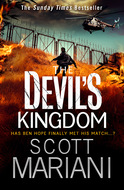
The Devil’s Kingdom

Copyright
Published by Avon
An imprint of HarperCollinsPublishers Ltd
1 London Bridge Street
London SE1 9GF
www.harpercollins.co.uk
First published in Great Britain by HarperCollins 2016
Copyright © Scott Mariani 2016
Cover Design © Henry Steadman 2016
Scott Mariani asserts the moral right to be identified as the author of this work.
A catalogue copy of this book is available from the British Library.
This novel is entirely a work of fiction. The names, characters and incidents portrayed in it are the work of the author’s imagination. Any resemblance to actual persons, living or dead, events or localities is entirely coincidental.
All rights reserved under International and Pan-American Copyright Conventions. By payment of the required fees, you have been granted the non-exclusive, non-transferable right to access and read the text of this e-book on screen. No part of this text may be reproduced, transmitted, down-loaded, decompiled, reverse engineered, or stored in or introduced into any information storage and retrieval system, in any form or by any means, whether electronic or mechanical, now known or hereinafter invented, without the express written permission of HarperCollins.
Source ISBN: 9780007486212
Ebook Edition © November 2016 ISBN: 9780007486403
Version: 2019-12-07
Join the army of fans who LOVE Scott Mariani’s Ben Hope series …
‘Deadly conspiracies, bone-crunching action and a tormented hero with a heart … Scott Mariani packs a real punch’
Andy McDermott, bestselling author of The Revelation Code
‘Slick, serpentine, sharp, and very very entertaining. If you’ve got a pulse, you’ll love Scott Mariani; if you haven’t, then maybe you crossed Ben Hope’
Simon Toyne, bestselling author of the Sanctus series
‘Scott Mariani’s latest page-turning rollercoaster of a thriller takes the sort of conspiracy theory that made Dan Brown’s The Da Vinci Code an international hit, and gives it an injection of steroids … [Mariani] is a master of edge-of-the-seat suspense. A genuinely gripping thriller that holds the attention of its readers from the first page to the last’
Shots Magazine
‘You know you are rooting for the guy when he does something so cool you do a mental fist punch in the air and have to bite the inside of your mouth not to shout out “YES!” in case you get arrested on the train. Awesome thrilling stuff’
My Favourite Books
‘If you like Dan Brown you will like all of Scott Mariani’s work – but you will like it better. This guy knows exactly how to bait his hook, cast his line and reel you in, nice and slow. The heart-stopping pace and clever, cunning, joyfully serpentine tale will have you frantic to reach the end, but reluctant to finish such a blindingly good read’
The Bookbag
‘[The Cassandra Sanction] is a wonderful action-loaded thriller with a witty and lovely lead in Ben Hope … I am well and truly hooked!’
Northern Crime Reviews
‘Mariani is tipped for the top’
The Bookseller
‘Authentic settings, non-stop action, backstabbing villains and rough justice – this book delivers. It’s a romp of a read, each page like a tasty treat. Enjoy!’
Steve Berry, New York Times bestselling author
‘I love the adrenalin rush that you get when reading a Ben Hope story … The Martyr’s Curse is an action-packed read, relentless in its pace. Scott Mariani goes from strength to strength!’
Book Addict Shaun
‘Scott Mariani seems to be like a fine red wine that gets better with maturity!’
Bestselling Crime Thrillers.com
‘Mariani’s novels have consistently delivered on fast-paced action and The Armada Legacy is no different. Short chapters and never-ending twists mean that you can’t put the book down, and the high stakes of the plot make it as brilliant to read as all the previous novels in the series’
Female First
‘Scott Mariani is an awesome writer’
Chris Kuzneski, bestselling author of The Hunters
The adventure began in Star of Africa.
Now, in this thrilling sequel, Ben Hope is in the most desperate situation of his life …
Contents
Cover
Title Page
Copyright
Join the army of fans who LOVE Scott Mariani’s Ben Hope series …
Epigraph
Prologue
Chapter 1
Chapter 2
Chapter 3
Chapter 4
Chapter 5
Chapter 6
Chapter 7
Chapter 8
Chapter 9
Chapter 10
Chapter 11
Chapter 12
Chapter 13
Chapter 14
Chapter 15
Chapter 16
Chapter 17
Chapter 18
Chapter 19
Chapter 20
Chapter 21
Chapter 22
Chapter 23
Chapter 24
Chapter 25
Chapter 26
Chapter 27
Chapter 28
Chapter 29
Chapter 30
Chapter 31
Chapter 32
Chapter 33
Chapter 34
Chapter 35
Chapter 36
Chapter 37
Chapter 38
Chapter 39
Chapter 40
Chapter 41
Chapter 42
Chapter 43
Chapter 44
Chapter 45
Chapter 46
Chapter 47
Chapter 48
Chapter 49
Chapter 50
Chapter 51
Chapter 52
Chapter 53
Chapter 54
Chapter 55
Chapter 56
Chapter 57
Chapter 58
Chapter 59
Chapter 60
Chapter 61
Chapter 62
Chapter 63
Epilogue
The Ben Hope series
Keep Reading …
About the Author
By the same author
About the Publisher
Prologue
Oman
The man stood at the high, broad window and spent a few moments gazing pensively at the view. From the house, the landscaped gardens of the Al Bu Said residence sloped gently down towards the sea. Palm trees swayed in the Indian Ocean breeze. He could see the light dappling the water like liquid gold around the gleaming white hull of the family’s superyacht, moored in its private marina in the distance. It was a late afternoon in November, but the sun was warm through the bulletproof glass of the window.
What a way to live, the man thought. He drank in the spectacular view for a few moments longer before dragging himself away. Dreams were all very well. But it wasn’t his view, and such opulence would remain infinitely beyond his reach if he lived to be a thousand years old. Not everyone could be born into such unimaginable wealth. Maybe that was just as well.
Turning to look back at the rest of the big room, he faced the darker reality of the situation.
And what a way to die, he thought, shaking his head sadly. Their money had done them no good in the end.
Most physical signs of the brutal quadruple murder were long gone, erased since the forensic team had finished their work. The bodies of Hussein Al Bu Said, his wife Najila, and their two children – Chakir, twelve, and seven-year-old Salma – had been housed in a mortuary at the family’s privately owned hospital in Salalah until they had finally been laid to rest yesterday, amid scenes of unbelievable public mourning.
It had been the most shocking incident. Two weeks after the murders, all of Oman was still stunned. Not because the super-wealthy businessman had necessarily been an adored figure – but because if highly protected members of one of the oldest noble family dynasties in all of the Persian Gulf could be targeted by criminals and butchered in their own home like cattle, then who was safe?
Now all that remained was to catch the perpetrators of this terrible crime. That job belonged to the man standing in the window. His name was Zayd Qureshi, and he was one of the most senior detectives of the Royal Oman Police’s Special Task Force. The ROP had pledged that they would not rest until the perpetrators were brought to justice.
The Al Bu Said residence was empty except for Qureshi and his number two, Detective Faheem Bashir, who had served in some slightly mysterious capacity in the Sultan’s Armed Forces before transferring to the police. Qureshi had long ago given up quizzing Bashir about his secretive background. And at this moment, it was the last thing on his mind. He liked to revisit the scene of the crime when all had gone quiet. It helped him to still his thoughts, and get into the head of the criminal. To catch a crook, sometimes you had to think like a crook, see the world through their eyes.
Qureshi’s investigation team had managed to trace certain leads. A car seen racing away from the scene of the murder had been traced to its owner, who told the police it had been stolen; his story was confirmed by CCTV footage of the theft, although the thief’s identity was still unknown. So far, the police had produced no solid results. The only thing they knew for sure was that this was a highly professional robbery to order, evidenced by the fact that the thieves forced Hussein Al Bu Said to open the safe but left a fortune in cash and jewellery unmolested.
‘There’s only one reason why anyone would do that,’ Qureshi said out loud, to nobody in particular. ‘But what did they take?’
Faheem Bashir, who had no better idea of the answer than his superior, said nothing and went on looking around the desolate crime scene as though it might cough up more clues for them.
Neither Qureshi nor Bashir noticed the presence of the third man who had stepped silently into the room behind them.
‘They took the Star of Africa,’ the man said. ‘Hussein’s diamond.’
The detectives turned, startled. It was highly unusual for anyone to be able to sneak up on Bashir like that.
‘Who are you?’ Qureshi demanded. ‘How did you get in here?’
The stranger made no reply. He was about ten years younger than Bashir and twenty years younger than Qureshi; somewhere in his early thirties, lean and compact in build. His black hair was swept back from a high brow and a chiselled face that radiated a brooding, simmering energy. His dark eyes were mournful, and yet filled with a contained fire of rage that Qureshi found unsettling.
The stranger gazed around him, apparently uninterested in the detectives, as though all he’d come for was a last look at the place. Then he turned and left the room without another word.
Qureshi went to go after him, but Bashir stepped into his path, gently pressed a hand to his boss’s chest to block him, and shook his head.
‘What are you doing? Get out of my way, I want to talk to that guy, find out who he is and what he’s talking about. What diamond?’
Bashir let his hand drop, but he was still shaking his head.
‘I could tell you who he is,’ Bashir said. ‘But I’d have to kill you.’
Chapter 1
The Democratic Republic of Congo
It was a rough road that the lone Toyota four-wheel-drive was trying to negotiate, and the going was agonisingly slow. One moment the worn tyres would be slithering and fighting for grip in yet another axle-deep rut of loose reddish earth, the next the creaking, grinding suspension would bump so hard over the rubble and rocks strewn everywhere that the vehicle’s three occupants were bounced out of their seats with a crash that set their teeth on edge.
At this rate, it was going to be several more hours before they reached the remote strip where the light chartered plane was due to pick up the two Americans and fly them and their precious cargo to Kinshasa. Once they got to the airport, the pair intended to waste no time before jumping on the first jet heading back home and getting the hell out of here. But safety and escape still seemed a long way beyond their reach. They were still very much in the danger zone.
The battered, much-repaired old Toyota was one of the few possessions of a local man named Joseph Maheshe who now and then hired himself out as a driver and guide to tourists. Not that many tourists came here anymore, not even the thrill-seeking adventurous ones. It was a precarious place and an even more precarious trade for Joseph, but the only one he knew. He’d been a taxi driver in Kigali, back over the border in neighbouring Rwanda, when the troubles there twenty years earlier had forced him and his wife, both of them of Tutsi ethnicity, to flee their home never to return. Joseph had seen a lot in his time, and knew the dangers of this area as well as anyone. He wasn’t overjoyed that the two Americans had talked him into coming out here. He was liking the grinding sounds coming from his truck’s suspension even less.
While Joseph worried about what the terrible road surface was doing to his vehicle, his two backseat passengers had their own concerns to occupy their minds. They were a man and a woman, both dishevelled and travel-stained, both shining with perspiration from the baking heat inside the car, and both in a state of great excitement.
The man’s name was Craig Munro, and he was a middlingly successful freelance investigative reporter based 7,000 miles from here in Chicago. In his late forties, he was twice the age of his female companion. They weren’t any kind of an item; their relationship was, always had been and would remain professional, even though the lack of privacy when camping out rough for days and nights on end in this wilderness sometimes forced a degree more intimacy on them than either was comfortable with.
The woman’s name was Rae Lee, and she had worked for Munro as an assistant and photographer for the last eighteen months. Rae was twenty-four, second generation Taiwanese-American, and she’d been top of her law class at Chicago University for a year before switching tracks and studying photography at the city’s prestigious Art Institute. She had taken the job with Munro more for the experience, and for ideological reasons, than for the money – money being something that wasn’t always in good supply around her employer’s shabby offices in downtown Chicago. The camera equipment inside the metal cases that jostled about in the back of the Toyota was all hers. But as expensive as it was, its true value at this moment lay in the large number of digital images Rae’s long lens had captured last night and early this morning from their concealed stakeout.
It was an investigative journalist’s dream; everything they could have wished to find. More than they’d dared even hope for, which was the reason for their excitement. It was also the reason for their deep anxiety to get away and home as fast as possible. The kind of information and evidence they’d travelled to the Democratic Republic of Congo to acquire was precisely the kind that could get you killed. And the Congo was a very easy place in which to disappear without a trace, never to be seen again.
The hammering and lurching of the 4x4’s suspension made it impossible to have any kind of conversation, but neither Munro nor Rae Lee needed to speak their thoughts out loud. They were both thinking the same thing: when they got back to the States, their work would begin in earnest. The physical danger would be behind them, but the real grind would await them, and Munro’s endless deskbound hours of writing the sensational article would be just part of it. There would be scores of calls to make, dozens more contacts to chase, many facts to verify before they could go live with this thing. It was serious business. While what they’d found would cause a substantial stir in certain quarters, not everyone would be supportive. Some very wealthy and powerful people would use every ounce of their influence to block the publication of this information in every way possible. But what they had was pure gold, and they knew it. They were going to be able to blow the lid off this whole dirty affair and open a lot of eyes to what was really happening out here.
‘How much further?’ Munro yelled, leaning forwards in the back and shouting close to Joseph’s ear to be heard.
‘It is a very bad road,’ the driver replied, as if this were news to them. He was a French speaker like many Rwandans past a certain age, and spoke English with a heavy accent. ‘Two hours, maybe three.’ Which put them still a long way from anywhere.
‘This is hopeless,’ Munro complained, flopping back in his seat.
Rae’s long hair, normally jet-black, looked red from all the dust. She flicked it away from her face and twisted round to throw an anxious glance over her shoulder at the camera cases behind her. The gear was getting a hell of a jolting back there, though it was well protected inside thick foam. ‘We’ll be okay,’ she said to Munro, as much to reassure herself as him. ‘Everything’s fine.’
But as the Toyota bumped its way around the next corner a few moments later, they knew that everything wasn’t fine at all.
Rae muttered, ‘Oh, shit.’
Munro clamped his jaw tight and said nothing.
The two pickup trucks that blocked the road up ahead were the kind that were called ‘technicals’. Rae had no idea where that name had come from, but she recognised them instantly. The flatbed of each truck was equipped with a heavy machine gun on a swivel mount, drooping with ammunition belts that coiled up on the floor like snakes.
The machine guns were pointed up the road straight at the oncoming Toyota. A soldier stood behind each weapon, ready to fire. Several more soldiers stood in the road, all sporting the curved-magazine Kalashnikov assault rifles that Rae had quickly learned were a ubiquitous sight just about everywhere in the Congo, across a land mass bigger than all of Europe.
‘Could be government troops, maybe,’ Munro said nervously as the Toyota lurched towards the waiting roadblock. In a badly decayed and impoverished state where even regular army could closely resemble the most thrown-together rebel force, sometimes it was hard to tell.
‘Maybe,’ Joseph Maheshe said. He looked uncertain.
There was no driving around them, and certainly no way to double back. Joseph stopped the Toyota as the soldiers marched up and surrounded them, aiming their rifles at the windows. The unit commander was a skinny kid of no more than nineteen. He was draped in cartridge belts like an urban gangsta wraps himself in gold chains and had a semiauto pistol dangling against his ribs in a shoulder holster. A marijuana reefer the size of a small banana dangled from his mouth. His eyes were glassy and his finger was hooked around the trigger of his AK-47.
‘Let me handle this,’ Munro said, throwing open his door.
‘Be very careful, mister,’ Joseph Maheshe cautioned him. Anxiety was in his eyes.
As Munro stepped from the car, two soldiers grabbed his arms and roughly hauled him away from the vehicle. Rae swallowed and emerged from the other passenger door, her heart thudding so hard she could hardly walk. She’d heard the stories. There were a lot of them, and they generally ended the same way.
The soldiers on the trucks and on the ground all spent a second or two eyeing the Oriental woman’s skimpy top, the honey flesh of her bare shoulders and as much of her legs as were made visible by the khaki shorts she was wearing. Her attractiveness was an unexpected bonus for them. A few exchanged grins and nods of appreciation, before the teen commander ordered them to search the vehicle. They swarmed around it, wrenching open the doors and tailgate and poking around inside. Munro and Rae were held at bay with rifles pointed at them. Joseph Maheshe didn’t try to resist as they hauled him out from behind the wheel.
The soldiers instantly took an interest in the flight cases in the back of the Toyota. The unit commander ordered they be opened up.
‘Hey, hey, hold on a minute,’ Munro said, putting on a big smile and brushing past the guns to speak to the commander. ‘You guys speak English, right? Listen, you really don’t need to open those. It’s just a bunch of cameras. What do you say, guys? We can come to an agreement. Nothing simpler, right?’ As he spoke, he reached gently into the pocket of his shorts, careful to let them see he wasn’t hiding a weapon in there, and slipped out a wallet from which he started drawing out banknotes marked banque centrale du congo, the blue hundred-franc ones with the elephant on them.
The commander grabbed the wallet from him, tore out all the Congolese money that was inside as well as the wad of US dollars Munro was carrying, his credit cards and American driver’s licence, and stuffed it all in his combat vest. He tossed away the empty wallet.
‘Hey. I didn’t mean for you to take everything,’ Munro protested.
‘Shut up, motherfucka!’ the commander barked.
‘Give me back my dollars and my cards, okay? The rest you can keep. Come on, guys. Play fair.’
Rifles were pointed at Munro’s head and chest. Beads of sweat were breaking out on his brow and running into his eyes. He held up his palms.
‘What is your business here, American bastard?’ the commander asked.
‘Tourists,’ Munro said, his face reddening. ‘Me and my niece here. So can I have my dollars back, or what?’
Rae was thinking, Please be quiet. Please don’t make this worse. How could she be his niece? For such a gifted investigator, he was a hopeless liar.
The commander shouted orders at his men. Two of them stepped up, grabbed Munro by the arms and flung him on the ground. Rifle muzzles jabbed and stabbed at him, like pitchforks poking hay. Rae screamed out, ‘Don’t shoot him! Please!’
More of the weapons turned to point at her. She closed her eyes, but they didn’t shoot. Instead, all three of them were held at gunpoint while the soldiers went on ransacking the Toyota. They opened up the camera cases, spilled out Rae’s gear and quickly found the Canon EOS with the long lens. The commander turned it on and flicked through the stored images, calmly puffing on his joint, until he’d seen enough to satisfy him. He shook his head gravely.
‘You are not tourists. You are motherfucka spies. We will report this to General Khosa.’
At the mention of the name Khosa, Rae went very cold. That was when she knew that nothing Munro could say or do would make this situation worse. It was already as bad as it could be.
‘Spies? What in hell are you talking about? I tell you we’re tourists!’ But it wasn’t so easy for Munro to rant and protest convincingly while he was being held on the ground with a boot sole planted against his chest and a Kalashnikov to his head.
‘Kill this mkundu,’ the commander said to his soldiers. ‘When you are finished with the whore, cut her throat.’
Rae felt her stomach twist. She was going to be gang-raped and left butchered at the roadside like a piece of carrion for wild animals to dismember and gnaw on her bones. She wanted to throw up.
She had to save herself somehow.
And so she said the first thing that came to her.
‘Wait! My family are rich!’ she yelled.
The commander turned and looked at her languidly. He took another puff from his joint. ‘Rich? How rich?’
‘Richer than you can even imagine.’
He showed her jagged teeth. ‘Rich like Donald Trump?’
‘Richer,’ Rae said. That was an exaggeration, admittedly. It might have been true back in about 1971, twenty years before she was born, but the Lee family fortunes had dwindled somewhat since then. ‘If you don’t harm us, there will be a big, big reward for you.’ She spread her arms out wide, as if to show him just how much would be in it for him.
The commander digested this for a moment, then glanced down at Munro and kicked him in the ribs. ‘This motherfucka says he is your uncle.’
Munro grimaced in pain and clutched his side where he’d been kicked.
‘He’s my friend,’ Rae answered, fighting to keep her voice steady.
The commander seemed to find this hard to believe, but his main concern was money. ‘Is his family rich too?’
‘We’re Americans,’ she said. ‘All Americans are rich. Everybody knows that, right?’
The commander laughed. ‘What about him?’ He pointed at Joseph Maheshe.
‘He is just a stupid farmer,’ another of the soldiers volunteered. ‘How can he pay?’
‘This man is our driver,’ Rae protested. ‘He has nothing to do with this. Leave him out of it.’
The commander stepped closer to Joseph and examined him. Joseph had the classic Tutsi ethnicity, with fine features and a rather narrower nose, slightly hooked, that generally, though not always, distinguished them from Bantu peoples like the Hutu. During the Rwandan genocide it had been the worst curse of the Tutsi people that they could often be recognised at a glance.
‘This one looks like a cockroach,’ the commander said. It wasn’t the first time Joseph had heard his people described that way. Cockroach was what the Hutu death squads had called his brother and their parents, before hacking them all to death.
‘Get on your knees, cockroach.’
Without protest, Joseph Maheshe sank down to his knees in the roadside grass and dirt and bowed his head. He knew what was coming, and accepted it peacefully. He knew the Americans might not be as lucky as this. He was sorry for them, but then they should not have come here.
The commander drew his pistol, pressed it to the side of Joseph’s head and fired. The sound of the shot drowned out Rae’s cry of horror. Joseph went down sideways and crumpled in the long grass with his knees still bent.
‘We will take these American spies to General Khosa,’ the commander said to his men. ‘He will know what to do with them.’
The soldiers tossed the camera equipment into the back of one of the armed pickup trucks. The two prisoners were shoved roughly into the other, where they were forced to crouch low with guns pointed at them.
‘You saved my life,’ Munro whispered to Rae.
Eventually, that would come to be something he would no longer thank her for. But for now they were in one piece. Rae looked back at the abandoned Toyota as the pickup trucks took off down the rough road. Joseph’s body was no more than a dark, inert smudge in the grass. Just another corpse on just another roadside in Africa. The vultures would probably find him first, followed not long afterwards by the hyenas.
As for Munro’s fate and her own, Rae didn’t even want to think about it.
Chapter 2
At various and frequent points throughout the ups and downs of what was turning out to be an unusually eventful existence, Ben Hope was in the habit of pausing to take stock of his life. To evaluate his current situation, to consider the sequences of events – planned or not – that had got him there, to ponder what lay ahead in the immediate and longer-term future, and to reflect on how he was doing generally.
All things considered, he had always thought of himself as being a pretty normal type of guy, and so he figured that this stocktaking exercise must be something most normal folks did, even though most normal folks probably didn’t tend to find themselves in the kinds of situations that invariably seemed to keep cropping up in his path. Just like most normal folks didn’t have to do the kinds of things he had to do in order to get out of those situations in one piece.
In his distant past, Ben’s stocktaking had involved thoughts like: Okay, so passing selection for 22 SAS might be the toughest challenge you’ve ever taken on, but you will not fail. You can do this. You will be fine.
Many years later it had been more along the lines of: All right, so you’ve walked away from the military career you struggled so hard to build and the future looks uncertain. But it’s a big world out there. You have skills. You will make it.
Or, some years further down the line again: So she’s left you for good this time, and you feel like shit. But you won’t always feel this way. You’ll survive, like you always do.
If there was one thing Ben had learned, it was this: that wherever the tide might carry him, whatever fate might throw at him, however desperate his situation, however impossible the task facing him, however dark his future prospects or slim his chances of survival, he would live to fight another day. He would not be defeated or deterred, not by anything, not by anyone. That spirit was what had driven him, bolstered him, enabled him to be the man he was. Or the man he’d thought he was.
But not now. Not anymore.
Everything had changed.
Because at this moment, as he sat there helpless and surrounded by aggressive men with guns, slumped uncomfortably on the dirty open flatbed of an old army truck with his knees drawn up in front of him and his head resting on his hands and every jolt of the big wheels and stiff suspension on this rough road somewhere in the middle of the Congo jarring through his spine, he was fighting a rising black tide of emptiness.
If there was a way out of this one, the plan had yet to come to him. And if there was a tomorrow, it wasn’t one that he was sure he wanted to face.
Sitting next to Ben, staring silently into space with a pensive frown, was his trusted old friend, Jeff Dekker, with whom he’d survived so many narrow scrapes in the past and come through in one piece. Beside Jeff was the tough young Jamaican ex-British army trooper named Tuesday Fletcher, on whom Ben had quickly learned he could absolutely depend.
But Ben was barely even aware of their presence. All he could think about – all that really mattered to him – was that his son Jude Arundel, just at the point in their troubled relationship where it looked as if they were finally bonding, was lost to him and there wasn’t a single thing Ben could do about it. And that riding happily at the front of the irregular militia convoy speeding along this dusty road, wearing a self-satisfied grin and probably smoking another of his huge cigars in victory, was the man who had taken Jude from him.
That man’s name was Jean-Pierre Khosa. Known as ‘the General’ to the army of heavily armed Congolese fighters who both feared and loyally served him, Khosa had every reason to be smiling. Most men would be, when they were carrying inside their pocket a stolen diamond worth countless sums of money and there was nobody to stop them from gaining every bit of power that wealth like that could afford.
Ben knew little about Khosa, but he knew enough, and had seen enough, for the seeds of doubt inside his own heart to grow into a chilling conviction that here, now, at last, was an enemy he couldn’t defeat. That Khosa could beat him.
And that maybe Khosa had already won.
Khosa seemed to know it, too.
There was no telling how many miles they’d driven through this jungle, coming across no sign of human habitation for hour after bruising, spine-jarring, mind-numbing hour. Ben had lost his watch before the start of the journey, and with it all track of time, except for the position of the sun which told him it would soon be evening again. They’d been travelling like this all day, and most of the night before with only a short stop in the middle of nowhere, for the troops to rest, brew coffee and gulp down a bowl of nondescript dried meat, beans, and rice. Ben hadn’t been hungry but he’d taken what he was offered. Military wisdom, left over from his past. Eat when you can, sleep when you can, preserve your strength.
They’d come a long way since then, and they were still in the middle of nowhere. There was an awful lot of nowhere around these parts.
The truck in which Ben and his friends were passengers was a dozen or so vehicles back from the spearhead of the convoy. To the rear, the long procession of armoured pickup trucks and Jeeps stretched out far in their wake like a cobra winding its way between the verdant thickets of wide-bladed leaves and tangled shrubbery that overhung the track and formed a tunnel overhead, blotting out much of the harsh sunlight that would otherwise have been cooking them inside their vehicles. Ben had counted thirty-five vehicles behind them when they’d set off, but the tail end of the snake had soon become obscured by the plume of dust thrown up by so many chunky off-road tyres pounding the rutted, sunbaked surface.
The dirt road seemed to go on and on forever, hardly changing. Now and then they would cross a rickety river bridge, and now and then the endless forest would break to offer views of sweeping plains and mountain valleys and mist-shrouded peaks in the distance. The Congo was a vast territory the size of most of Western Europe’s countries combined, but with barely any paved roads to connect it together and even less chance of running into any kind of major traffic, let alone a contingent of police or government troops. The authorities had the good sense to keep to the cities and give outlying areas a wide berth. Khosa’s small army rode through the jungle as if they owned the place – and to all intents and purposes they did. They were making no secret of their presence as they roared along to the soundtrack of angry African rap music that was blasting from a boombox wired to PA speakers somewhere back along the line, with all the aggressive confidence of two hundred or more pepped-up and hot-blooded young men with enough military hardware to level a town and the will to deploy it at the drop of a hat.
Ben was suddenly aware that Jeff Dekker was watching him, and glanced up to meet his friend’s gaze. Jeff’s face, his dark hair, and the DPM combat jacket he was wearing were all caked in dust. He looked weary and careworn, but there was a twinkle in his eye and his smile was irrepressible. Jeff was like that.
‘Mate, it’s going to be okay. You know that, don’t you?’
Ben said nothing. He tried to smile back, but his face felt numb.
‘Jude’ll be all right,’ Jeff said. ‘He’s as tough as his old man. Tougher.’
Ben didn’t reply. He appreciated his friend’s attempt to reassure him. But he didn’t believe a word he was saying.
‘We’ll get out of this,’ Jeff said. ‘We’ll find him. Hear me? Wherever these bastards have taken him, we’ll find him.’
Ben remained silent. Finding people was something he’d done a lot of in his time. He thought about all the kidnap victims he’d saved in the past, during the years between leaving the military and going into business with Jeff, when he’d called himself a ‘crisis response consultant’ – that catch-all phrase that didn’t quite do justice to the things he’d had to do or the methods he’d employed to help people who needed it.
Many of those he’d rescued had been children. All of them had been someone’s loved one. All of them strangers to him, and yet he’d risked his own life – and taken a good many others – to preserve theirs. And now, the victim incarcerated out there somewhere in conditions Ben didn’t even want to imagine was one of only two people in the world he could call his kin, and he was utterly powerless to help.
Ben couldn’t close out of his head the image of the last time he’d seen Jude, being forced at gunpoint into a black Mercedes limousine and taken away by a well-dressed African named César Masango. General Jean-Pierre Khosa called Masango his ‘political attaché’. Ben could think of better terms to describe him.
Kidnapper. Gangster. Walking dead man. That was just three.
‘Where we are going, you will be too busy to look after your son,’ Khosa had said as Masango took Jude. ‘So my friend César will be looking after him now.’
And that had been it. Jude was gone. Where he was now, Ben had no way of knowing.
And even though it had been only a matter of hours ago, it seemed like weeks had gone by. That final image of Jude disappearing into the car was tearing Ben’s mind apart. Half of him wanted to forget it, erase it, pretend it never happened. The other half of him needed to cling to it, like a fading photograph of a loved one that, once gone, would take the memory of that person with it.
‘I’ll come for you.’ Those had been his last words before they’d parted. It was a promise that Ben did not know if he could keep.
Ben wondered whether he’d ever see Jude again.
Jeff must have been able to tell from Ben’s expression that the reassurance wasn’t working. The optimism seemed to drain from him. When he spoke again, his tone was sullen. ‘It’s all my fault this happened to Jude. Hadn’t been for me, he’d never have set foot on that fucking ship in the first—’
‘It’s not your fault,’ Ben cut in before Jeff could finish. He’d said it before, and he’d say it again. Ben knew all about the ravages of a guilty conscience from his own past. Come what may, he didn’t want Jeff to bear the responsibility for what had happened. When Jeff had pulled strings with his contacts to get Jude the crewman gig with the American merchant vessel MV Svalgaard Andromeda on the East Africa run from Salalah in Oman to Dar es Salaam in Tanzania, he couldn’t have known that the ship would be attacked. Any more than he could have known that one of its secret passengers, a crook named Pender, was carrying a stolen diamond bigger than a man’s fist, which ruthless killers would do anything to acquire. Events had unfolded from there the way they had, nobody could have done anything to prevent them, and only one man still living could be held responsible for the things that had taken place.
Khosa. Ben had the man’s face pinpointed in his mind like a sniper’s target in the crosshairs of a rifle scope. And what a face it was. A demon’s face, bearing the hideous tribal scars that you couldn’t look at without a shiver of apprehension. But as evil as he looked, Khosa’s lunatic mind was the thing Ben feared most.
‘It’s not your fault,’ Ben repeated to Jeff.
One of the soldiers guarding them in the back of the truck reached across with the barrel of his AK-47 and jabbed Ben painfully in the ribs with it. Like many of Khosa’s fighters he was a young guy, no more than twenty or so. He had a red bandana tied around his head and was wearing a faded Legion of the Damned T-shirt with an ammunition belt for a heavy machine gun draped around his lean shoulders like a fashion accessory.
‘Quiet! No talking!’ the young trooper yelled. English was taking over from French as the main European language in the Democratic Republic of Congo, and most of the militia troops spoke it, or something close to it. That made it difficult to have any kind of a private conversation; all the more so when conversation was forbidden altogether.
Ben slapped the rifle barrel away. ‘Watch how you speak to me, sonny. You’re addressing General Khosa’s military advisor.’
Which, technically, was true. That was the essence of the blackmail deal between Ben and the General: in return for Jude’s safety, whenever they got to wherever the hell they were going, Ben was to begin his new role of training Khosa’s troops and impart to them his military skills, with Jeff and Tuesday as his second- and third-in-command. Train them for what purpose, exactly, Ben didn’t yet know. It wasn’t a prospect he relished, but right now his agreement to Khosa’s terms was the only thing keeping them all alive.
‘You listening, you scummy little arsemonger?’ Jeff said, glaring a hole in the soldier with the full authoritative weight of a former Special Boat Service non-com officer. He’d been a Royal Marine Commando before that, and used to a slightly higher calibre of military personnel than Khosa’s army had to offer. ‘So point that weapon somewhere else before I stick it through your left ear and out your right, and ride you up and down this road like a fucking motorbike.’
The soldier moved back and leaned his rifle across his knees, eyeing them with wary uncertainty.
‘Bloody bunch of numpties,’ Tuesday said, giving the soldier a headshake and a look of contempt.
Ben had to smile then. The warmth of their camaraderie touched him like a glimmer of sunshine on a cloudy day. It wasn’t much, but it was good.
Along with Ben, Jeff, and Tuesday Fletcher, there was a fourth prisoner crouched in the back of the lurching truck. Lou Gerber had served as a staff sergeant with the United States Marine Corps many years earlier, before he’d taken to the sea as a merchant mariner. Besides Jude, the white-bearded, bald-headed Gerber was the last surviving crew member of the Svalgaard Andromeda, out of more than twenty men who had set out from Salalah Port in Oman not two weeks earlier.
Ben had spent a lot of time thinking about the men who had died aboard that ship. Some had been killed during the storming of the vessel by Khosa’s men, hired by Pender to pose as Somali pirates. More had died in the aftermath of the attack, while Jude and the other survivors rushed to lock themselves into the safety of the engine room. One, a vicious thug named Scagnetti, Ben had been forced to dispose of himself when he tried to hurt Jude. Soon after that had come the typhoon that had scuppered the ship and drowned all but a handful of the remaining crew.
In the days since the shipwreck they’d been whittled down even further, one by one. Condor, hacked to death by Khosa’s men in an earth-floored hut somewhere in Somalia; Hercules, a gentle giant of a man who had loved his pet bird and his freewheeling life at sea, thrown into a pit with a hungry man-eating lion in a grotesque parody of an ancient Roman gladiatorial spectacle.
Gerber was alone now, and for the first time since Ben had met the guy, he looked all of his sixty-seven years plus a good bit more. Already hit hard by the death of his close shipmate Condor, he’d barely spoken a word since they’d all been forced to witness Hercules’s cruel end. He seemed to have given up. His head was bowed and he stared at the floor of the truck with eyes that looked like holes out of which his soul had leaked away.
‘Gerber,’ Jeff said, trying to catch his attention. ‘Hoi, Gerber, you awake?’
If Gerber could hear him, he made no sign of showing it. Jeff shrugged and sighed.
Ben closed his eyes and tried to relax his muscles into the jarring motion of the truck. He knew how Gerber felt. But if indeed Gerber had given up, that was something Ben couldn’t allow himself to do. The black feeling kept coming and going in tides, like chill surges of floodwater that threatened to overwhelm his defences and drown all the strength and resolve he had left. He clenched his fists and told himself to ride it. He willed himself to believe that he would come through. And so would Jude. Ben didn’t know if he believed it. But he knew that if he didn’t convince himself it was true, he’d go crazy.
Soon afterwards, the convoy arrived at its destination deep in the heart of the jungle.
And soon after that, Ben began to think he really was going crazy.
Chapter 3
Ben was slumped in the back of the truck with his eyes still shut when he sensed that the vehicle’s motion had become smoother and he was no longer being shaken about. He opened his eyes and peered out of the back of the truck. Dusk was melting into evening. He must have been dozing. The headlights of the vehicles behind dazzled him; he shielded his eyes with his hand and saw that the rutted dirt track had either joined, or become, a properly surfaced road. The concrete looked newly-laid. The trees were cut back from the edges and ditches had been dug out on both sides. The clean-cut ends of sawn branches, still fresh, told him that the work must have been done not long ago.
Ben threw a quizzical look at Jeff and Tuesday.
‘Seems like we’re getting somewhere,’ Tuesday commented. ‘Wherever somewhere is.’
‘I don’t know, mate. Looks to me like we’re still in the arsehole of the bloody jungle,’ Jeff said. ‘Who’d build a road like this out here?’
It wasn’t too long after that, maybe twenty minutes, maybe half an hour, before the convoy rolled to a halt. Hot metal ticking, engines growling, exhaust fumes drifting in the headlights. Ignoring the soldiers and guns, Ben clambered to his feet on the flatbed and turned to gaze past the truck’s cab. His legs felt like two planks of wood and his back was aching.
In the bright glare of the convoy’s lights, he saw that Khosa’s Land Rover at the front of the line had stopped at a wire-mesh double perimeter fence that stretched away in both directions until it was lost in the darkness. The convoy had pulled up at a set of steel-mesh gates inset into the outer fence, ten feet high and plastered in warning KEEP OUT signs in English, French, Kituba, Lingala and Swahili, just in case the locals didn’t get the message from the heavily armed guards who were manning the gates on the inside. The inner and outer fences were spaced about ten metres apart, creating a corridor between them in which Ben could see the figures of patrolling guards. In a pool of bright halogen floodlight beyond the chain-link mesh of the inner fence sat a cluster of guard huts, around which more soldiers were standing cradling automatic weapons and squinting into the procession of headlights queued up at the gates. The tall fences themselves were supported by steel posts and topped with spikes and coils of razor wire. High-perched security cameras peered down.
Ben had seen a thousand perimeter fences just like it, around army bases all over the world. More recently, Khosa’s men had taken them to a rundown ex-military airfield in Somalia, another forgotten leftover from another fruitless civil war. There, the fence had been hanging in disrepair, abandoned for many years. This one, like the road leading to it, looked as if it hadn’t been there long at all. Along the perimeter’s length for as far as Ben could see, the trees had been severely cut back in what must have been a major clearing operation involving a large number of men and machines. Such a new and well-constructed installation was an incongruous sight in the midst of this green wilderness with its unmade roads and shambolic wooden bridges.
From this side of the wire it looked as though a large area of jungle had been cleared on the inside of the perimeter as well. Did Khosa really have that kind of manpower? Ben’s initial assumption had been that the man’s army was no different from any number of ragtag tinpot militia forces he’d come across during his SAS days, when his squadron would occasionally be sent to various parts of the African continent to deal with the more troublesome gangs of marauding thugs who stepped out of line by massacring and raping the locals and abducting UN aid workers. But he’d been learning from the outset that his assumption was a shaky one. General Jean-Pierre Khosa was full of surprises. Never pleasant ones.
What Ben didn’t yet realise was that the biggest surprise was yet to come, one he couldn’t have foreseen in a thousand years.
Jeff and Tuesday were on their feet next to him in the truck, following his gaze. Lou Gerber hadn’t moved or even looked up.
‘What do you reckon?’ Jeff said.
Ben shook his head. ‘Whatever it is, we’re about to find out.’
There was a lot of activity going on at the head of the stationary convoy. Doors were opened and soldiers were milling about. Greetings were exchanged, laughter shared, backs slapped. Ben looked for Khosa but couldn’t see him. The General must be still in his Land Rover, puffing on a Gran Cohiba and fondling his diamond, maybe thinking about who he was going to order hacked to death next, or whose head he might blow off on a whim using the magnum revolver he carried on his belt. Those burdensome decisions of leadership.
The soldiers inside the compound opened the outer gates first, followed by those in the inner fence. The men outside returned to their vehicles, slammed their doors, and the convoy slowly began to roll through the gates, waved in by the grinning guards. The convoy accelerated and sped onwards, pushing a bubble of light into the darkness beyond the perimeter.
The concreted road continued for a quarter of a mile up a steep rise that had been completely shorn of vegetation, creating a barren landscape of ploughed earth and craters where countless trees had been ripped out by their roots. The more Ben looked, the more perplexed he was by this place. He could sense Jeff and Tuesday’s growing sense of bewilderment, too. Far behind them, the tail end of the convoy had passed through the inner gates and the soldiers had closed up the perimeter with an air of finality that took away any doubts Ben might have had that this place, whatever it might be, was their final destination.
Ben narrowed his eyes when he saw the glow lighting up the sky from beyond the crest of the rise ahead. If it was a military camp, it was on a grand scale. The biggest he’d seen in Africa, rivalling major NATO bases in Europe. But that was impossible.
Khosa’s Land Rover crested the rise and dropped out of sight. A dozen vehicles later, the truck reached the top of the hill – and then Ben saw it, and his mouth fell open at the sight.
It wasn’t the biggest military camp in Africa. It wasn’t a military camp at all.
The manmade valley below was illuminated across its length and breadth by thousands of lights. The single road swept down the deforested hillside into what, unbelievably and yet undeniably, appeared to be a whole city.
A city enclosed behind a militarised security perimeter.
Khosa’s own city?
Ben blinked. His mouth went dry. He blinked again, tore his gaze from the surreal sight and exchanged looks of bewilderment with Jeff and Tuesday.
The road had widened into a smooth and immaculate double carriageway by the time they reached the final security fence. Blinding halogen spotlamps blazed down from masts. The gate was heavily guarded by a unit of at least a dozen sentries and a six-wheeled armoured personnel carrier with twin machine guns swivelled their way.
‘I’m not believing this,’ Jeff said. ‘Tell me I’m fucking dreaming, guys.’
‘It’s real,’ Ben replied. ‘Don’t ask me how, but it’s real.’
Once more, there were waves and happy greetings as the convoy rolled through the gates. Some three hundred yards down the single straight road that crossed what had once been a valley deep in the jungle, now transformed into a barren no-man’s land, the line of vehicles rumbled past the first buildings. Side streets radiated left and right, forming a geometric grid system of two-hundred-foot-square blocks. Many of them were still empty and undeveloped patches of land; others sprouted semi-erected multi-storey buildings; others again were fully finished with high-rises and office blocks. Signs of recent construction were everywhere, cranes looming into the night sky and heavy plant equipment filling every empty corner. Street after street after empty street, all still, all silent, all lit up but eerily deserted. There were no cars. There was no movement. Not a single civilian to be seen anywhere, as if the entire population had fled or been vaporized by a hydrogen bomb leaving behind only empty buildings.
Like a vision from a post-apocalyptic world, or the most expensive movie set that had ever been built and was waiting for the film crews and herds of extras to move in.
‘What in hell’s name …?’ Jeff muttered.
Tuesday was shaking his head. ‘Please don’t tell me that Khosa built this place.’
‘Whoever built it,’ Ben said, ‘I’ve a feeling you won’t find it on any maps.’
‘Khosa City,’ Jeff grunted. ‘Jesus Christ. Who is this guy?’
The deeper the convoy rolled into the city, the fewer construction sites they passed and the more finished the place appeared to be, as if it had been built from the centre outwards. The main drag had grown into a broad boulevard. The architects had planted neat avenues of maple trees down its length, and laid clipped green lawns either side, and pavements and modern street lighting that glowed off the brand-new buildings.
Here and there they passed small patrol units of militia. Any non-military personnel in the place were either locked down tight in a curfew, or there simply weren’t any in the first place. The streets were lit up but almost every window of every building was dark and empty. The only other vehicle they saw was a six-wheeled APC identical to the one guarding the inner perimeter, which emerged from a side street and rumbled past them in the opposite direction.
Jeff said, shaking his head, ‘Where did they get the workforce? The materials? The money?’
Ben could have added a thousand more questions, but there were no answers to be had. Not yet. All he could do was stare at the surreal scene. Maybe Khosa had had their coffee last night spiked with LSD.
The convoy rumbled on, past empty parks and deserted squares and block after block of high-rise apartment buildings, all giving off the same uninhabited aura. Then the line of trucks and pickups veered across an intersection and rounded a corner, and Ben’s stupefaction racked up to a new level. Because the grandiose eight-storey building he could now see ahead, nestled a little way from the road next to an enormous and extravagantly illuminated plane tree, was the Dorchester Hotel in London’s Park Lane.
The Dorchester, here in the Congo. Complete with its sweeping nineteen-thirties façade and grand entrance and garden frontage of sculpted shrubs, ornamental railings, stone fountains, and flower beds. Ben closed his eyes for a moment. When he reopened them, it was still there.
Not dreaming.
The hotel was the first building they’d seen thus far that showed any sign of life. Light streamed from the entrance and many upper-floor windows were aglow against the night sky. At the head of the convoy, Khosa’s Land Rover turned off the street to park outside the building. The following vehicles kept on going down the street, and for a moment Ben thought the truck was going to do the same – until it too broke from the moving line and pulled to a halt directly behind Khosa’s personal transport.
The soldiers in the back of the truck jumped up and stabbed and poked with their rifles to get the prisoners moving. ‘Keep your panties on, girls,’ Jeff growled at them. Gerber seemed to take no notice of anything much that was happening around him. Ben and Jeff helped him to his feet, and down the wooden ramp from the flatbed to the pavement.
Outside the Dorchester Hotel. In the Congo. If Gerber was having the same hard time as the other three accepting reality, he wasn’t letting it show.
The night air was fresh and still, and fragrant with the scent of the hotel garden flowers whose perfume was strong enough to mask the lingering tang of exhaust fumes left by the convoy. A billion stars twinkled above the silhouetted city skyline. Khosa had stepped down from his Land Rover and paused outside the hotel, his tall bulky outline bathed in golden light shining from the entrance, clasping his hands behind his back in statesmanlike fashion as he exchanged a few words with one of the men who had been riding along with him at the head of the convoy.
While his soldiers looked dusty and tired from the long journey, the General appeared as fresh and energetic as if he’d just finished a leisurely breakfast and donned a crisp new uniform to attend to the first business of the day. His combat boots gleamed as though he’d spent the whole drive polishing them, the gold Rolex on his thick wrist was resplendent under the lights, and the red beret on his head sat at a jaunty angle. If it hadn’t been for the tribal scarring that distorted his face into a monstrous demon’s mask, he might have seemed almost jovial.
As the soldiers prodded and shoved the four prisoners in his direction, Khosa turned to give Ben a beaming white smile that looked like the last thing a shark’s dinner might see before being swallowed up in one bite. It was usual for him to ignore Jeff and Tuesday as the underlings they were. As for Gerber, Khosa viewed the ‘Goat Man’ with as much regard as for an inchworm. Ben had twice had to persuade him not to have the old sailor hacked to death by his men.
‘Ah, it is very good to be home again,’ Khosa said in his deep, resonant voice. ‘Soldier, welcome to my executive headquarters.’
Бесплатный фрагмент закончился.