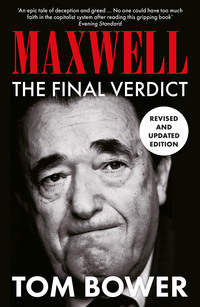
Читать книгу: «Maxwell»
Tom Bower

MAXWELL
THE FINAL VERDICT

Copyright
William Collins
An imprint of HarperCollinsPublishers 1 London Bridge Street London SE1 9GF www.WilliamCollinsBooks.co.uk
This eBook first published in Great Britain by William Collins in 2012; updated version published 2020
Copyright © Tom Bower 1996; 2020
Cover photograph © Getty Images
Tom Bower asserts the moral right to be identified as the author of this work
A catalogue record for this book is available from the British Library
Information on previously published material appears here.
All rights reserved under International and Pan-American Copyright Conventions. By payment of the required fees, you have been granted the non-exclusive, non-transferable right to access and read the text of this e-book on-screen. No part of this text may be reproduced, transmitted, down-loaded, decompiled, reverse engineered, or stored in or introduced into any information storage and retrieval system, in any form or by any means, whether electronic or mechanical, now known or hereinafter invented, without the express written permission of HarperCollins
Source ISBN: 9780007292875
Ebook Edition © July 2020 ISBN: 9780007394999
Version: 2020-06-08
Dedication
To Sophie
Epigraph
You are my teacher and all my life you have tried to demonstrate the principles underlying every action or inaction … Above all, you have given me the sense of excitement of having dozens of balls in the air and the thrill of seeing some of them land right.
KEVIN MAXWELL, written to his father in 1988
The Maxwell Foundation will be one of the richest of its kind in the world.
JOE HAINES, 1988
Contents
Cover
Title Page
Copyright
Dedication
Epigraph
Preface
Introduction
1 The Autopsy – 9 November 1991
2 The Secret – 5 November 1990
3 Hunting for Cash – 19 November 1990
4 Misery – December 1990
5 Fantasies – January 1991
6 Vanity – March 1991
7 Flotation – April 1991
8 A Suicide Pill – May 1991
9 Two Honeymoons – June 1991
10 Buying Silence – July 1991
11 Showdown – August 1991
12 ‘Borrowing from Peter to Pay Paul’ – September 1991
13 Whirlwind – October 1991
14 Death – 2 November 1991
15 Deception – 6 November 1991
16 Meltdown – 21 November 1991
17 The Trial – 30 May 1995
Epilogue
Keep Reading
Notes
Company Plan
Dramatis Personae
Glossary of Abbreviations
Index
Acknowledgements
About the Author
By the Same Author
About the Publisher
Preface
On 12 May 1989, Peter Jay signed a short letter marked ‘Private and Confidential’ addressed to George Potter OBE, a director of Control Risks, one of Britain’s leading private detective agencies. Jay, the chief of staff to Robert Maxwell, thanked Potter, a former police officer, for ‘your letter and for the time you gave to meeting me and preparing it’.
Potter’s letter had described his surveillance of ‘the location and the levels of background radiation in the area’. Potter was referring in cryptic fashion to a surreptitious reconnaissance mission which he had undertaken around my home in Hampstead, north-west London. He continued: ‘Extremely sophisticated equipment does exist which might overcome the technical problems. Its acquisition would cost an estimated £50,000.’ The private detective was describing a scanner which would emit rays capable of penetrating my home and ‘reading’ the contents of my computer’s hard disc.
Wisely, Potter cautioned Jay about the problems. First, the detective wanted to be paid in advance the £50,000 for the equipment and also some fees. Secondly, Potter warned, he had ‘reservations as to the possibility of obtaining the evidence you require and the ability to keep the operation covert’. The detective’s concerns were understandable. A van carrying the scanner would be parked at the bottom of my garden in a narrow service road used by the Hampstead postal sorting office. Remaining unobtrusive for long periods would be difficult.
Jay, who had once basked in the glorious description as one of Britain’s ‘cleverest men’, was not slow to grasp Potter’s cautionary tone but was sensitive to the dissatisfaction that this report would cause his demanding employer. Little had been achieved since, one month earlier, he had received a briefing from Tony Frost, an assistant editor of the Daily Mirror, following his investigation around my Hampstead home.
Frost had accurately noted my address and identified my car, before reporting that ‘neighbours say his working hours are “rather erratic” with frequent trips away’ and that I ‘spent “a full working week” at the offices or studios of the various TV companies who commission his work’. Curiously, he noted that my newsagent ‘seemed to know Bower quite well’. After alluding to my financial status, Frost observed that my road is ‘typical of the more up-market parts of Hampstead’ and flatteringly noted, ‘the house looked to be tastefully and expensively decorated inside’.
Copies of Frost’s memorandum were also sent to Eve Pollard (then editor of the Sunday Mirror), Ernest Burrington, (then editor of the People) and Joe Haines (then a Daily Mirror columnist and a director of the Mirror Group) – all owned by Maxwell’s Mirror Group Newspapers.
Jay filed Frost’s report in his bulging ‘Bower File’, which was marked in large letters ‘Private and Confidential’, reflecting the heading of every document it contained. Each letter on the topic signed by the chief of staff urged its recipient to treat the matter with utmost secrecy. Jay had become rather proficient in conducting the operation.
Ever since his employer had heard in summer 1987 that I was planning to write Maxwell: the Outsider, an unauthorised biography of himself, Peter Jay had been employed as his chief of intelligence to gather and co-ordinate information about my activities and identify those people whom I was interviewing. On one occasion, detectives had clearly followed me to a meeting with Anne Dove, Maxwell’s former secretary, with whom he had enjoyed a close relationship in the 1950s. The results of their work were formalised under Jay’s supervision in sworn statements which would be used to back the avalanche of writs and court hearings, costing £1 million, which obsessed Maxwell until his death.
Initially, Maxwell tried to prevent the book’s publication in February 1988, at the same time publishing his own version written by Joe Haines. When my book hit the top of the bestseller list, Maxwell sought through individual cajolery and writs to prevent every bookshop in Britain selling the title. Eventually he was successful in this endeavour, but he nevertheless continued to hound me and the publishers by pursuing various writs for libel. Jay’s task was to co-ordinate and supervise the unprecedented legal battle.
By spring 1989, one year after publication, when the first of three publishers had agreed to publish the paperback version only to retreat rather than face the subject’s wrath, Maxwell’s anger was increasing in parallel to the secretly developing insolvency of his empire. His fury had shifted from the book’s accurate description of his unaltered dishonesty to something which in his view was more sinister. He believed that I had become a focus for his enemies and a receptacle of damaging information. Just as he was finalising a deceptive annual financial report for the Maxwell Communication Corporation, of which he was chairman, he embarked upon a new venture to humiliate the book’s publisher and bankrupt its author.
Four lawyers were Maxwell’s principal advisers. Lord Mishcon and Anthony Julius were his solicitors and Richard Rampton QC and Victoria Sharp were the barristers. During their frequent court appearances, they betrayed no hint of doubt about their client’s virtues. On the contrary, they pursued his mission with depressing vigour, commitment and pitilessness.
Their client’s anger had by then increased still further. The book had been published in France and his defamation action there had failed. To his fury, a court had ordered that he pay me FFrs 10,000 in costs. The threat that the book might also be published in his beloved New York galvanised him to resort to more draconian measures.
Maxwell had become convinced, in the words of Stephen Nathan, another barrister hired for advice, that I had ‘compiled (and continued to compile) an extensive record of information concerning Mr Maxwell and has put the distillation of that information on to a computer which he keeps at home’. Maxwell’s source was Frost, who, during his gumshoe expedition around Hampstead, had picked up from an ‘unidentified source’ the notion that my study had become a centre for subversive activities against the Chairman.
Nathan had been asked to advise whether I could be prosecuted for failing to register as a data-user under the Data Protection Act 1984 or, better still, whether Maxwell might approach the Director of Public Prosecutions. The DPP, the Chairman hoped, would direct the police to seize the computer without warning. That course, advised Nathan, would be possible only if Maxwell could persuade the DPP of the allegedly dangerous contents of the computer.
Frustrated by Nathan’s wishy-washy advice, Maxwell ordered Lord Mishcon to seek the seizure of my computer on the orders of a judge under an Anton Piller order. Naturally Jay passed on the instruction to Julius. Such an order, suggested Jay, would enable ‘Bower’s computer records to be seized under warrant, without advance notice being given, therefore without Bower having an opportunity to destroy or conceal such records’. In retrospect, the irony of Maxwell mentioning Anton Piller was manifest. The order, as Mishcon explained, is used to obtain the seizure of documents for the investigation of fraud or systematic dishonesty. And Jay, in passing on Mishcon’s advice to the Chairman in another ‘Intermemo’ on 7 April 1989 headed ‘Bower’s Computer’ and marked ‘Strictly Confidential’, noted mournfully, ‘Legally speaking, this is not (quite) the situation with Bower.’
Mishcon urged his client to adopt the customary course and apply to the court for the computer records. But, he cautioned, ‘Our evidence that these records exist is thin.’ Therefore, advised the peer, ‘I recommend that investigations should continue.’ Hence Maxwell ordered Jay to seek the evidence required, and this was why Jay was inspired to ask the detective to place the scanner at the bottom of my garden. But after receiving Potter’s disappointing news, Jay concluded, ‘It is not really practical to proceed along the lines we discussed.’
That was by no means the end of the battle. Until October 1991, Maxwell regularly held meetings with lawyers and with his personal security staff to propel the battle towards my bankruptcy and his vindication. The readiness of Peter Jay, a journalist and former British ambassador, to function as his willing tool was sadly not unique in Britain or elsewhere. He merely epitomised a cravenness common among a horde of self-important personalities and powerbrokers whose self-esteem was boosted by the Chairman’s attentions and deep purse.
Unfortunately, the sort of campaign directed against my book acted as a disincentive for most newspapers against exposing Maxwell in his lifetime. Many blame Britain’s libel laws and lawyers’ fees for protecting him, yet the law and its expense were not the sole reason for British newspapers’ reluctance or inability to uncover his crimes. More important was the environment in which newspapers now operate.
Few newspaper editors and even fewer proprietors nowadays relish causing discomfort to miscreant powerbrokers. By nature anti-Establishment, the so-called ‘investigative’ reporter finds himself working for newspapers which are increasingly pro-Establishment. Only on celluloid, it seems, does an editor smile when listening to a screaming complainant exposed by his journalists.
Proper journalism, as opposed to straightforward reporting or the columnists’ self-righteous sermonising, is an expensive, frustrating and lonely chore. Often it is unproductive. Even the rarity of success earns the ‘investigative’ journalist only the irksome epitaph of being ‘obsessional’ or ‘dangerous’. The final product is often complicated to read, unentertaining and inconclusive. No major City slicker has ever been brought down merely by newspaper articles. Like the Fraud Squad, financial journalists usually need a crash before they can detect and report upon the real defects. Often, only with hindsight does the crime seem obvious. Even though in Maxwell’s case his propensity to commit a fraud had been obvious since 1954, it was almost impossible for any journalist to produce the evidence contemporaneously.
Moreover, many of those who reported Maxwell’s affairs during the 1980s were only vaguely aware of the details of the Pergamon saga in 1969, when his publishing empire had disintegrated amid suspicions of dishonesty which appeared to have terminated his business life. After three damning DTI reports, no one expected Maxwell’s resurrection. However, the DTI inspectors, having found the evidence of fraud and voiced a memorable phrase about his unfitness to manage a public company, had not directly accused him of criminality. It was the inspectors’ cowardly reluctance to publish their real convictions and the police failure to prosecute which permitted Maxwell during the 1980s, when explaining his life, to distort the record of the Pergamon saga.
Accordingly, by 1987, Buckingham Palace, the City, Westminster and Whitehall had forgotten or forgiven the past. In the year in which Maxwell’s final frauds began, most journalists reflected the prevailing sentiment and were willing to afford him the benefit of the doubt.
To have broken through Maxwell’s barrier required not only a brave inside source who was willing to steal documents but also someone who would risk the Chairman’s inevitable writ. But, unlike in America, whistleblowers are castigated in Britain, where secrecy is a virtue. To break those barriers also required expertise and a lot of money, increasingly unavailable to newspapers and to television. So almost until his end Maxwell enjoyed a relatively favourable press, although journalists were not to blame for the canker’s survival.
The real fault for Maxwell’s undiscovered fraud belongs to the policemen employed in the Serious Fraud Office, to the civil servants, especially in IMRO and the DTI, who are empowered to supervise Britain’s trusts and corporations, and to the accountants at Coopers and Lybrand who were his companies’ auditors. As with most of Britain’s financial scandals, those arrogant, idle and ignorant bureaucrats, having failed in their duties, were not embarrassed nor dismissed, because they were protected by self-imposed anonymity. It was their good fortune that many blamed Britain’s libel laws for the failure to expose Maxwell’s fraud. But that was and remains too easy. Maxwell prospered because hundreds of otherwise intelligent people wilfully suspended any moral judgment and succumbed to their avarice and self-interest. To suggest that much will be learned from Maxwell’s story is to ignore past experience, but his story is an extraordinary fable, not least because only now can one read the final verdict.
Introduction
Robert Maxwell had hit rock bottom when I first met him in spring 1973. Damned by government inspectors as a liar and fraudster, he had lost his seat as a Labour MP, had been ejected from Pergamon Press, his lucrative scientific publishing business, and had been cast into the wilderness as a pariah by the City and Wall Street. Few public figures had been so humiliatingly mocked as Captain Bob, otherwise known as the Bouncing Czech. ‘I wonder if I can help you?’ I said to Maxwell as we sat in his makeshift office in Headington Hill Hall, his vast Oxford home acquired for a peppercorn rent from the local council. ‘What do you have in mind?’ growled the man famed for his girth, intimidation and brazenness.
As a twenty-seven-year-old BBC TV producer, I had been tasked to film a fifty-minute documentary about the rise and fall of Britain’s most infamous tycoon, politician and multi-millionaire. ‘Well,’ I replied to the wartime refugee who had been awarded the Military Cross by Field Marshal Montgomery for charging a machine-gun post in Germany in 1945. ‘I wanted to make a film about your remarkable life and achievements. It might help your resurrection.’ As the fifty-year-old pondered the offer, I threw in that my father was also a Czech refugee. That connection sealed our fate. ‘Done,’ he said, and committed himself for the next six weeks to share his life with me and Max Hastings, the reporter.
As we trawled through Maxwell’s astonishing life – the peasant boy who escaped the Holocaust, established his fortune as a black-marketeer and thief while serving as a British army officer in post-war Berlin and, while working for both British and Russian intelligence, became a rich publisher and politician – we encountered an obstacle. ‘Mr Maxwell,’ I said, ‘in the interests of fairness and objectivity, I need to find someone who will say something positive about you. I’ve found lots of your critics but no supporters. Can you suggest someone?’
‘I understand,’ he replied without surprise. ‘Let me think.’
Eventually, Maxwell proposed his former parliamentary agent. ‘I don’t know why you expect me to say anything good about Bob,’ the hapless agent responded.
Universally loathed as a crook, Maxwell unsurprisingly hated the finished film, which portrayed him as the megalomaniac Citizen Kane. His attempt to stop it being broadcast by bribing a BBC employee to steal the soundtrack from the Lime Grove editing suite during the night before transmission failed because fortunately a duplicate soundtrack was stored elsewhere.
Maxwell’s many enemies loved the film and, not surprisingly, our relationship was abruptly terminated. Maxwell appeared destined to be forgotten. Except that fifteen years later, in 1988, his resurrection was complete.
Like Lazarus, the Bouncing Czech had risen from the ashes. Maxwell had not only recovered Pergamon Press, but had created a global media empire which rivalled Rupert Murdoch’s. Once again enjoying fame and fortune, he was regularly photographed with all the world’s leaders – including Margaret Thatcher, Ronald Reagan and Mikhail Gorbachev – brokering deals, dispensing advice and establishing himself as an unchallenged billionaire. True to his habits over the previous forty-three years, the arch deceiver was once again looking with contempt at the deceived. That was the moment to write his biography. The first to be published.
At the time, I could not imagine the profound influence Maxwell would have on my life. Until then, despite his frequent use of libel writs and compliant judges to suppress the truth about himself, the pattern of his lies, frauds and lifestyle had been touched upon in newspapers, especially by the Sunday Times. But no one had established his true venality, and Maxwell intended to preserve that protective secrecy. The publication of Maxwell the Outsider in 1988 was marked by eleven libel writs issued by Maxwell’s lawyers to prevent the book’s sale. After it briefly hit number one, Britain’s booksellers withdrew the book rather than face Maxwell in court. Yet by then, many had read my prediction that his media empire would crash three years later.
On 5 November 1991, while sailing in the Mediterranean, Maxwell had a heart attack and fell dead into the sea. Within days, his empire was crumbling. Dishonestly and secretly, he had plundered the Daily Mirror’s pension fund to support his failing businesses and many of the world’s most famous banks were exposed as his co-conspirators. In total, about £2 billion was missing. Amid widespread anger, not least from thousands of innocent ex-employees whose pensions had been looted by Maxwell, the biography was republished with a major addition about his frauds.
Internationally, Maxwell became the archetype of a criminal tycoon. Britain demanded the prosecution of Kevin and Ian Maxwell, his two sons, who had been intimately involved in the management of his empire, especially the unauthorized use of the pension fund shares to raise loans. This book tells the astonishing story of Maxwell’s furtive activities during the last year of his life and the brothers’ trial.
The brothers’ acquittal in early 1996 sparked outrage. Although Kevin had admitted during his trial that he had lied to bankers and others, he would suffer no retribution for his admitted dishonesty. Instead of being convicted for orchestrating a cunning plot to defraud bankers, shareholders and pensioners to support his father’s fantastic dream of bestriding the world as a media colossus, Kevin successfully presented himself as a victim of his father’s tyranny. Along with his brother, he benefited from the lacklustre intellect of Britain’s law enforcers. Thanks to their incompetence, no one was found guilty for the theft of £2 billion, at the time Britain’s biggest fraud. Maxwell’s victims, the pensioners of his corporations, were bewildered by the failure of Britain’s judicial system.
Scandalously, after Kevin Maxwell’s acquittal, Mr Justice Buckley ruled that he should not face a second trial, for the theft of Berlitz shares worth £112 million from Macmillan Inc, a publicly owned company. There was no ‘public interest’, declared the judge, to launch the new prosecution. Buckley ignored Mr Justice Millet’s judgment about the same circumstances, given during a long civil trial, that Kevin was involved ‘in dishonesty’ and a ‘fraud’ regarding the disposal of the Berlitz shares.
Empowered by his acquittal and Buckley’s ruling, Kevin Maxwell now insists that his father too was innocent of any crime. Ever fewer these days recall the circumstances with sufficient clarity to prove convincingly the opposite. They will not be helped by a government investigation conducted by an accountant and a lawyer employed by the Department of Trade and Industry who finally reported on the saga in 2001, ten years after Maxwell’s death. The inspectors’ crowning achievement was their failure to name a single person involved in the frauds – lawyer, banker, accountant or Maxwell employee – who should be punished. Their salutary conclusion was that ‘high ethical and professional standards must always be put before commercial advantage’. The cover-up was complete. In his celestial banqueting chamber, enjoying his favourite Beluga caviar and Krug champagne, Robert Maxwell must still be chortling about his family’s victory over Britain’s justice system and over the establishment across the globe.
In the first days after his death, statesmen and clergymen praised the monster as a genius and near-saint. Even after the truth was known, legions of awestruck bankers, businessmen, politicians and journalists recounted their individual experiences of a unique man. By size and personality, Maxwell had dominated every room. Only those he could not buy won his respect. The rest were bullied. Among both groups, his death sparked endless speculation about the cause and the consequence of his death but never admissions of their own guilt.
Nearly thirty years after his death, Maxwell should not only be remembered as an extraordinary crook but also as one of an unusual breed of mavericks created in the aftermath of the Second World War. As an eyewitness to extreme suffering and multiple deaths, Maxwell was physically and emotionally courageous. Nothing and nobody caused him any fear. Like a savage, he inhabited and fought in a jungle. His survival instinct was a lodestar. His legacy was the exposure of corruption in the City, the professions and the media – all those who turned a self-interested blind eye to his crimes. In the aftermath, some were embarrassed by their profitable relationships with Maxwell. Reputations were shredded and jobs were lost. But most escaped with just a bruise.
Few will now remember that the Maxwell saga was the climax of the Thatcherite era, which featured staggering excesses of flamboyance, recklessness, nepotism, greed, sex, crime and shameless lust. The litany of spectacular City blowouts – Guinness, Polly Peck, Blue Arrow, BCCI and so many more – revealed sordid abuses by get-rich adventurers and charlatans. And then amnesia struck.
Bewildered spectators watched as so many guilty collaborators in those scams escaped justice while business continued as usual. The supremely ambitious and amoral counted, like Maxwell, on the weakness and vanities of those lesser breeds to climb the greasy pole, and to stay on top. None more than Lord Donoughue, a former Downing Street adviser to prime ministers Harold Wilson and James Callaghan, whose lucrative services to Maxwell are described in this book. Donoughue was subsequently criticized by the government inspectors for failing to ask the right questions about how Maxwell was stealing the pension fund shares [DTI report, v1 p.316]. Pertinently, his employment by Maxwell has been expunged from his biography on the internet.
Maxwell’s success matches Edmund Burke’s observation: ‘For evil to succeed, all that is necessary is for good men to do nothing.’ Good men, however, had repeatedly tried to halt Maxwell’s resurrection but their attempts were crushed by greed. Undaunted by prejudice, humiliation, morality and the truth, Maxwell bulldozed his way through any obstacle to fulfil his ambitions. Retribution was only delivered at the end. Friendless, alone and exhausted on his luxury yacht, the Lady Ghislaine, his fame and fortune had become worthless. The subversive unwillingly faced his Maker. Even in his last moments, death probably sparked no fear. Having suffered a heart attack while urinating over the side, he clung to the yacht’s railing until, unable to support his twenty stone, the muscles ripped under his arm and he fell dead into the sea. No water was found in his lungs by three Spanish pathologists and no bruises or cuts on his corpse. The heart attack, they concluded, had killed him. His legacy was borne by his children.
After their acquittal, Kevin and Ian Maxwell submerged themselves in a series of international communications and property ventures which ended in losses and occasional bankruptcy but from which, like their father, they always re-emerged. And by now, thirty years later, the Maxwell family would have been forgotten had Ghislaine Maxwell, the youngest of Robert’s seven surviving children, not burst into the spotlight.
At the beginning of 1991, Ghislaine was receiving a monthly income from Maxwell’s Liechtenstein trust through the Bank Leumi in New York. No one has been able to gain access to those Liechtenstein bank accounts or understand the flow of money to Ghislaine. After his death, at least £25 million remained unaccounted for from the debris of the Maxwell empire in New York and a lot more disappeared into unknown bank accounts in tax havens. Some of that money financed Ghislaine Maxwell’s lifestyle. The result was clear. Through her father’s considerable presence in New York, not least through his ownership of the New York Daily News, she had met most of the city’s financiers and power brokers. Liberated by Maxwell’s death, Ghislaine bought a house in Manhattan and burst into New York’s gossip columns as a brash, party-hopping socialite. Among those she met was Jeffrey Epstein, an investment manager for the super-rich. Undoubtedly, her attraction to a magnetic man with unusual sexual habits was influenced by her childhood. Rich, domineering men could seduce her.
Until Ghislaine, then aged thirty, arrived in Tenerife to inspect her father’s yacht after his death, she had been relatively invisible except when she disingenuously congratulated a London policeman after being stopped for drunken driving. Known in the Mirror building as arrogant, she was an aspiring status-seeker, enjoying lunch with Mick Jagger and other celebrities who instantly accepted her father’s invitation. Her life had been dominated by her father’s tyranny.
Betty Maxwell, Ghislaine’s mother, would recall that her youngest daughter had been woefully neglected since her birth in 1961. ‘I was devastated,’ Betty would recall of the occasion when her four-year-old daughter had exclaimed, ‘Mummy, I exist.’
During her childhood, Ghislaine had witnessed her father’s merciless bullying, especially at the family’s regular Sunday lunches. Maxwell would question his children about world affairs. In the event that they made a mistake, the meal was interrupted while he physically beat the errant child in front of the others. ‘Bob would shout and threaten and rant at the children until they were reduced to pulp,’ Betty Maxwell wrote about her husband after his death. If a comment in a school report was not perfect, Maxwell caned the child. ‘Remember the three C’s,’ he growled, ‘Concentration, Consideration and Conciseness.’ Ghislaine could expect little protection from her mother even in front of her friends at her birthday party. Betty, who had met Robert during the liberation of France in 1944, collaborated with the beatings of her children just as she connived in her husband’s financial crimes. Except that Maxwell could be particularly protective towards his daughter.
As a teenager, Ghislaine was once summoned to Maxwell’s office in Holborn while he was speaking to Roy Greenslade, editor of the Mirror. ‘What’s this about you nearly drowning?’ he asked his daughter. He had heard about an incident in the sea from Gianni Agnelli, the Italian tycoon with whom Ghislaine had been staying.
‘Oh, you don’t mean that little accident,’ replied Ghislaine. ‘There was no danger.’
‘You’re always taking risks, doing stupid dangerous things,’ said Maxwell.
‘Oh Daddy,’ she exclaimed.
Maxwell became serious: ‘I told you about jumping out of a helicopter with my skis on. It won’t happen again.’
Even while Ghislaine studied at Balliol, she succumbed to her father’s control over her boyfriends. Her reward in 1987 was to push the button for the bottle of champagne to crack on the bow of the newly built Lady Ghislaine, sealing her anointment as the mogul’s favourite child and his obedient servant. Her loyalty during the last year of her father’s life is described in this book. But does that oppression explain why she developed a close relationship with Jeffrey Epstein, a paedophile? Or that she seemingly became his pimp?
In 2013, I met Ghislaine at a summer party in a large compound overlooking the sea in St Tropez. The host was a London property developer. I had last seen Ghislaine forty years earlier while filming the BBC documentary. Not surprisingly, she knew nothing about that venture – or, curiously, about the two books I had written about her father. While we chatted over a drink she seemed uninterested in him. Similarly, she seemed oblivious to the presence inside the glass-walled bar of a naked girl, writhing to the music. Nor did she express any emotion when a rocket from the party’s firework celebration landed on Club 55 on the beach below, setting fire to a hut. The fifty-two-year-old woman was hardened and alone.
By then, her association with Epstein had become notorious and her friendship with Prince Andrew proven by a series of photographs. She did not want to speak about that except to say that her relationship with Epstein had ended years earlier. Subsequently, I was told by a member of her family that she had enjoyed two long-term relationships with other rich men after parting from Epstein in 2001. That was untrue. Their relationship had continued, even if it was not intimate.
In 2019, pursued by the media and women alleging that she had trafficked them on Epstein’s behalf, she disappeared in America. To protect her location, even her family can only reach her – by phone or email – through a third party. Ghislaine Maxwell is a hunted woman, undoubtedly a casualty of her father and mother. While one can declare a final verdict on Robert Maxwell’s life, her ultimate fate is yet to be written – an outcome which her father could not have imagined in 1991.
Maxwell’s death shocked the world. Few will forget the moment that the news was first broadcast. I heard it in Moscow while speaking to the former head of the KGB’s Department S, a man responsible for sending ‘illegal’ agents into the West. During his last months, Maxwell had been a frequent visitor to the Kremlin. Bizarrely, it later transpired that he was negotiating to sell blood donated by Russians in the West – a market inspired by the new HIV crisis. Even thirty years later, the end of Captain Bob’s life remains astonishing, and provides a lesson which should never be forgotten.
ONE The Autopsy – 9 November 1991
The corpse was instantly recognizable. The eye could follow the jet-black hair and bushy eyebrows on the broad Slav head down the huge white torso towards the fat legs. Until four days earlier, the puffy face, recorded thousands of times on celluloid across the world, had been off-white. Now it was an unpleasant dark grey. The body was also disfigured. An incision, 78 cm long, stretched from the neck down the stomach to the crotch. Another incision crossed under the head, from the left shoulder along the collar bone. Firm, black needlework neatly joined the skin to conceal the damage to the deceased’s organs.
Lying on a spotless white sheet in a tiled autopsy room, the corpse was surrounded by eight men and one woman dressed in green smocks. An unusual air of expectancy, even urgency, passed among the living as they stood beneath the fierce light. It was 10.25 on a Saturday night and there was pressure on them to complete their work long before daybreak. Over the past years, thousands of corpses – the victims of the Arab uprising – had passed through that undistinguished stucco building in Tel Aviv. But, for the most part, they had been the remains of anonymous young men killed by bullets, mutilated by bombs or occasionally suffocated by torture.
This cadaver was different. In life, the man had been famous, and in death there was a mystery. Plucked from the Atlantic Ocean off the Canary Islands, he had been flown for burial in Israel. Standing near the corpse for this second autopsy was Dr Iain West, the head of the Department of Forensic Medicine at Guy’s Hospital, London. His hands, encased in rubber gloves, were gently touching the face: ‘He’s been thumped here. That looks genuine. You don’t get that falling just over the edge of a boat. You don’t get this sort of injury.’ West’s Scottish-accented voice sounded aggressive. Retained by the British insurance companies who would have to pay out £21 million if the cause of death were proved to have been accident or murder, he found his adrenalin aroused by a preliminary autopsy report signed two days earlier by Spanish pathologists. After twenty-one years of experience – and 25,000 autopsies – he had concluded that there were no more than two Spanish pathologists who deserved any respect: the remainder were ‘not very good’. The conclusion of Dr Carlos Lopez de Lamela, one of that remainder, that the cause of death was ‘heart failure’ was trite and inconsequential. West was thirsting to find the real cause of death. His first suspicion was murder. Yet he knew that so much of pathology relied upon possibilities or probabilities and not upon certainties. Mysteries often remained unresolved, especially when the evidence was contaminated by incompetence.
The Briton’s position at the autopsy was unusual. Under the insurance companies’ agreement with the Israeli government, he could observe but not actively participate. West regretted that he would not be allowed to follow the contours and patterns of any injuries which might be discovered and privately felt slightly disdainful of his temporary colleague, Dr Yehuda Hiss. He recalled the forty-five-year-old Israeli pathologist – then his junior – learning his craft in Britain in the mid-1980s. He had judged him to be ‘competent’, although unused to the traditional challenges of autopsy reports in Britain. West was nevertheless now gratified to learn that his lack of confidence in the Spaniards was partially shared by Hiss. In the Israeli’s opinion, Dr Lamela’s equivocation about the cause of death was unimpressive.
West watched Hiss dictate his visual observations. Touching the body gently, even sensitively, the Israeli noted small abrasions around the nostrils and rubbed skin under the nose and on the ear, but no signs of fresh epidermal damage anywhere on the head or neck. There were no recently broken bones. Although the body had apparently floated in the sea for up to twelve hours, the skin showed no signs of wrinkling or sunburn. ‘We’ll X-ray the hands and the foot,’ ordered Hiss.
His dictation was interrupted by West: ‘I wonder if they’ve looked at his back?’
‘No, no,’ replied Hiss, going on to note a small scar, thin pubic hair and circumcision.
Again he was interrupted: ‘The teeth are in bad condition.’
‘The dental treatment is poor,’ agreed another Israeli.
‘Very poor’, grunted West, ‘for a man who was so rich.’
‘Are you sure it’s him?’ asked an Israeli. ‘We’d better X-ray the teeth for a dental check.’
‘Well, it looks like him,’ snapped West. ‘The trouble is we’re up against time. He’s being buried tomorrow. I think we’ll take fingerprints.’ Again, he criticized the Spaniards: ‘The fingernails haven’t been cut off. They said they’d done it.’
Midnight passed. It was now the day of the burial. The corpse was turned over. ‘We’ll cut through and wrap it back,’ said West impatiently. The two pathologists had already concurred that the Spanish failure to examine the deceased’s back was a grave omission – it had been a common practice in Britain since the 1930s, as a method of discovering hidden wounds.
There was no sentiment as two scalpels, Hiss’s and an assistant’s, were poised over the vast human mound. None of the doctors contemplated its past: the small baby in the impoverished Czech shtetl or ghetto whose soft back had been rubbed after feeding; or the young man whose muscular back had been hugged by admiring women; or the tycoon whose back five days earlier had been bathed in sunshine on board a luxury yacht worth £23 million. Their scalpels were indiscriminate about emotions. They thought only of the still secret cause of death.
After the scalpels had pierced the skin and sliced through thick, yellow fat on the right side, West’s evident anticipation was initially disappointed: ‘I’m surprised that we didn’t find anything.’ A pattern of bruises was revealed to be only on the surface, the result of slight pressure, but not relevant to the cause of death. More dissections followed, mutilating the body tissue, slitting the fat, carving the flesh inch by inch in the search for the unusual. Minutes later there was a yelp.
‘Do you see that?’ exclaimed Hiss.
‘It’s a massive haematoma!’ gasped West, peering at the discovery. There, nestling among the flesh and muscle in the left shoulder was a large, dark-red blob of congealed blood.
‘Nine and a half by six centimetres,’ dictated Hiss in Hebrew, ‘and about one centimetre thick.’
West prodded the haematoma: ‘There’s a lot of torn muscles – pulled.’ It was those tears which had caused the bleeding.
Here was precisely the critical clue missed by the Spaniards: since there were no suspicious bruises on the skin, they had lazily resisted any probing. Now the new doctors were gazing at violently torn fibres. Yet Hiss was not rushing to the conclusion he sensed was already being favoured by West. ‘The trouble is, it’s also an area where you often hit yourself,’ he observed.
‘It’s not a hit,’ growled West.
There was, they agreed, no pattern of injuries of the kind which usually accompanies murder – no tell-tale grip, kick or punch marks, no small lacerations on the skin which at his age would easily have been inflicted in the course of a struggle or by dragging a heavy, comatose body.
‘There’s tearing,’ insisted West, peering into the corpse. ‘Violent along the muscle.’ The dissecting continued. Another muscle tear was found near the base of the spine and a third haematoma deep in the muscle in the front abdomen. The blood was so localized, they concluded, that the tears must have occurred shortly before death.
By 12.30, as the cadaver steadily ceased to resemble a human being, West became quite certain: ‘The muscle fibres were torn in a desperate attempt to grab something.’ Hiss did not reply. As the legs and each finger were cut open to scour for other secrets, he remained reserved. The embalmer’s formalin, he realized, had destroyed any chance of finding conclusive evidence. ‘It’s well worth doing, isn’t it?’ repeated West as they drank coffee.
‘Yes,’ replied Hiss, still looking for a pattern of injuries and still feeling restrained by a Health Ministry official’s edict that he should be cautious (the edict was possibly a consequence of the friendship between the deceased and the serving minister of health).
The corpse was turned over on to its shredded back. The Spanish stitches were cut by a sharp scalpel. It was just past one o’clock in the morning and the pathologists were about to enter already trodden ground. Swimming in formalin within the distastefully brown chest cavity were the remains of the Spaniards’ handiwork.
Dr Lamela, the senior Spanish pathologist, had carried out his duties in circumstances very different from those enjoyed by the Israelis. Working in a cramped, ill-lit autopsy room, he had lacked important instruments, and had afterwards been denied any laboratory in which to conduct essential scientific tests. Aged thirty-five, he was a reluctant pathologist, obtaining little satisfaction from his task. In his three-and-a-half-hour investigation of the virgin corpse, he had noted that there were no external marks, bruises or perforations of the skin, the obvious signs of murder or violent death. Later tests had confirmed that no poisons were present.
Lamela’s next theory was drowning. But he had noticed no water in the respiratory tracts leading to the lung, which ruled out death by drowning. Nor had he found much water inside the lung tissue. The single, reliable test for judging whether the deceased was alive or dead when he fell into the sea had been frustrated by nature. That proof depended upon traces of the sea’s diatoms (microscopic algae) in the bone marrow. If the person had fallen living into the sea and swallowed water, the diatoms would have entered the bone marrow, providing irrefutable evidence of drowning. Subsequent tests revealed that at the point in the Atlantic where the corpse had been discovered and hoisted into a helicopter, the seawater contained no diatoms. The ‘little’ water in the lungs Lamela ascribed to pulmonary oedema, water which could arise through a heart attack. He therefore relied upon speculation rather than scientific proof when, mistakenly believing that the deceased was a strong swimmer, he excluded drowning and suicide as a cause of death.
Instead, Dr Lamela had concentrated upon the coronary arteries to the enlarged heart. Both were 70 per cent constricted. The evidence of a heart attack seemed strong. The twenty-two-stone man had lived with only one functioning lung and a diseased heart, and the right ventricular muscle of the stricken heart was acutely enlarged. His widow had disclosed a medical report written some years earlier which had noted a lack of oxygen in the blood, a common cause of sudden death. Taking into account the deceased’s complaints to the ship’s crew just before his death about the temperature in his cabin, Lamela concluded that the fatality had been caused by a heart attack. But, by scientific criteria, he was again speculating. He had failed to test whether there was an infarction of the heart muscle (a noticeable scar in the heart tissue), a certain indicator of an attack. Instead he had relied upon the small blemishes which revealed slight attacks in the past. His shortcomings were manifest.
At 1.20 on Sunday morning in Tel Aviv, eight men and one woman peered into the evidential debris bequeathed by Lamela, the stench from the formalin irritating their eyes and noses. As an assistant ladled the liquid out of the cadaver, Hiss complained, ‘There are some bits here you don’t recognize as a human being’s.’ The Spaniards had butchered the evidence. Dissected organs had been thrown into the corpse rather than sealed in a plastic bag. What remained of the lungs was full of water, but whether natural fluids, seawater or formalin was impossible to determine. The dissection of a remnant of the lung revealed some froth. ‘Consistent with both heart attack and drowning,’ the pathologists agreed. Examination of the liver revealed acute sclerosis, consistent with alcoholism. What remained of the other organs was practically worthless.
‘There’s no heart, nothing,’ complained West.
‘I think we should send the bill for this one to the Spanish,’ laughed West.
‘To the King, Juan Carlos,’ agreed the Israeli.
Suddenly, another assistant excitedly announced the discovery of a blood clot in the head. Further examination revealed no bruising. It was just accumulated blood fixed with formalin, West and Hiss agreed, a relic of Lamela’s butchery. A deep bruise near the right ear also contributed nothing to establishing the cause of death but was probably contemporaneous with the tearing of the muscles. The British pathologist’s earlier excited conclusion that ‘He’s been thumped’ had been jettisoned, along with his initial assumption of murder.
At 2.30 a.m., their work was completed. ‘I think it’s been a very bloody dissection,’ mourned West as he lit a cigarette. Stepping into the warm air outside, he walked towards his car. He would drive back to Jerusalem, where he had landed just twelve hours earlier on a Gulfstream jet formerly owned by the man whose corpse he had just abandoned. ‘I’ll look at Jerusalem before I go home,’ he decided as he sat back in the car for the fifty-minute journey to the Holy City.
The body would soon be transferred to the same destination for its funeral after a mortician had performed some rapid repairs. It would be buried with a mystery. Three pathologists – British, Spanish and Israeli – had ruled out murder but disagreed on the cause of death. Both Hiss and West discounted Lamela’s dismissal of drowning. The ambivalent evidence prevented any definite decision. But Hiss supported the Spaniard’s theory of a heart attack.
In the Israeli’s scenario, the deceased had suffered the preliminaries of the attack, left his cabin and walked to the rail overlooking the sea. Either stumbling or in the early stages of the attack, he had fallen forward, toppling over the ship’s rail or under a steel cord in the stern. At the last moment, he had grabbed at the rail, torn his muscles and, in pain, had plunged into the dark wilderness where the heart attack had come to a swift conclusion. ‘I think he drowned with an epidural haematoma,’ said Hiss.
Suicide was ruled out by the Israeli. In those circumstances, he argued, suicides never cause themselves violent harm before their death. Nor do those contemplating suicide jump naked to their death, and the deceased’s body had been found without the nightshirt which he had worn that night.
On reflection, West was dismissive of Lamela and Hiss. The Briton’s conclusions were determined by the torn muscles and coagulated blood. Lamela would say in retrospect that the muscles had torn during the convulsions of the heart attack. Both West and Hiss rejected that as ‘ridiculous’. Both agreed that the muscles had been ripped by a sudden jerk after the deceased’s left hand had grabbed something. The pain in those seconds would have been intense. West discounted a heart attack, although ‘he had a heart disease which was potentially lethal’. He had two reasons: first, because ‘I would expect him to have fallen on to the deck’; second, even if he had toppled over the railing, ‘He would have been acutely breathless, convulsing and unable to grab anything.’
West favoured the theory that the muscle tears were caused in the deceased’s passage towards suicide or by an intervening accident. He had left his cabin and walked to the railing of his yacht. After climbing over, he had held on pondering his fate. Either he had accidentally slipped or he had deliberately jumped. In either event, in a sudden reaction, he had grabbed for the rail to save himself. His twenty-two stone combined with the fall’s momentum had ripped his muscles and within seconds forced him to release his grip. He had fallen into the dark sea where he had drowned. But even that was supposition: ‘I think that probably death was due to drowning. I can’t prove it. Nor can I prove the opposite.’ In an English court, ‘The verdict would be an open verdict.’
Distillation of the pathologists’ opinions leads towards the most reliable conclusion. Feeling unwell, the deceased had been on deck for fresh air. Stumbling, probably from a minor heart attack, he had fallen forward, passing under the steel cord or over the rail and, as he had twisted to grab it, had hit the side of his head against the boat. In double agony, he had lost his grip and dropped into the sea. There he died, some time later, from exhaustion or a heart attack.
But two critical issues remained unresolved. First, the cabin door had apparently been locked from the outside. If true, it pointed either to suicide or to murder, because anyone feeling unwell would be unlikely to lock a door. Secondly, the corpse had been found in seas notorious for strong currents. Twelve hours had elapsed between the deceased’s disappearance and his discovery. In the frequent occurrences of drowning around the Canary Islands, bodies are rarely found if missing for more than nine hours. Dr Lamela, with years of experience of drownings in that area, was puzzled by the condition of this particular corpse, which had allegedly spent twelve hours in the sea. ‘The body’, he recorded, ‘appeared to have been dead longer than it was in the water.’
Lamela’s conjecture spawned tales of intrigue, unidentified frogmen, a mystery ship, satellite photographs, radio intercepts, intelligence-service rivalries, unauthorized weapons deals, stolen gold, secret bank accounts, money laundering, untraceable poisons and ultimately murder. Given the identity of the corpse, nothing was unimaginable. At four o’clock in the morning of 10 November 1991, it was en route to Jerusalem to be fêted by the world’s most enigmatic government as a national hero.
In his lifetime, the deceased had boasted of his final bequest. ‘Billions of pounds’, he had crowed, ‘will be left to charity. My children will inherit nothing.’ The reality, he knew, was very different. He had bequeathed a cataclysm, but the full nature of his criminality was still known only to his youngest son.
TWO The Secret – 5 November 1990
The plan was finalized precisely one year before he mysteriously died.
Concorde landed at New York’s JFK airport six minutes late on 5 November 1990. Among the forty-nine passengers gliding self-assuredly off the supersonic flight from London at 9.26 a.m. was Ghislaine Maxwell, the twenty-eight-year-old daughter of the media billionaire. Elegantly dressed and wearing a distinctive hat, Ghislaine was blessed as Robert Maxwell’s youngest and favourite child. But even to her father’s most loyal employees, the thin, would-be socialite was condemned as arrogant and a beneficiary of her father’s fame and power. ‘She’d ask for a cigarette and walk out with the packet,’ complained Carol Bragoli, a secretary.
That morning she seemed more purposeful than usual. Robert Maxwell had entrusted her with a mission to carry an envelope across the Atlantic. Stepping into a chauffeured limousine, she was whisked to 200 Park Avenue in Manhattan. Awaiting her on the twenty-eighth floor was Ellis Freedman, an elderly lawyer who worshipped her father and had served his interests for nearly forty years. Ushered into the waiting room, the messenger handed over the envelope. There was no reason for the young woman to be suspicious. Yet, unknowingly, she had become enmeshed in a plan, initiated by her father, to steal $200 million.
Eleven days earlier, at 8 a.m. on 25 October, Kevin Maxwell, the thirty-one-year-old joint managing director of the Maxwell empire, had met Albert Fuller, the thirty-nine-year-old accountant responsible for the empire’s treasury. Like all of Maxwell’s most trusted employees, Fuller’s qualification for his well-paid position was his tolerance of abuse dispensed around the clock by the tycoon. Deliberately, even cynically, Maxwell had gathered in his inner sanctum apparatchiks who were not only beholden to him but even adulated him. Although technically competent, they were weak men attracted to a father-figure. Fuller was especially grateful to Maxwell. Two years earlier, he had been involved in the loss of a banker’s draft worth £4.7 million but had been exonerated and allowed to resume work after several weeks’ suspension.
Fuller did not query Kevin’s instruction to fly immediately to New York. His tasks seemed simple. From one office he was to retrieve a share certificate numbered B1001, bearing 10.6 million shares in Berlitz, the famous international language school. Then he was to travel to another office and there exchange the single document, worth over $200 million, for nine certificates of varying denominations. There was little cause for Fuller to be suspicious about that effortless transaction. Kevin’s request was not illegal and his need for discretion was understandable. Berlitz was owned (with 56 per cent of the shares) by the American Macmillan publishing company, which in turn was owned by Maxwell Communication Corporation (MCC) – the public company, still 60 per cent owned by the founder himself, which aspired to dominate the world’s exploding media industry. By 30 October, Fuller had returned to London, his mission accomplished.
Six days later, an hour before Ghislaine’s arrival in New York, Robert Maxwell telephoned Ellis Freedman, his lawyer. The instructions again seemed straightforward. Ghislaine, said Maxwell, would be bringing an envelope with nine share certificates showing Macmillan’s ownership of the Berlitz shares. Freedman was to secure their reissue in twenty new certificates of 500,000 shares each and one for 600,000 shares. But, said Maxwell, there was to be one significant variation. The new certificates should not mention Macmillan’s ownership. Instead, each certificate was to be issued showing the owner as Bishopsgate Investment Trust (BIT), with the inscribed caveat ‘Purely as a nominee’. Even in Maxwell’s strictly compartmentalized world, Freedman ought to have been suspicious. For BIT was a private company owned by Maxwell. To the inquisitive, the laundering would not have been well disguised.
The legal authority for that exchange was to be an executive committee board meeting to be held in Freedman’s office later on the same day. The participants were three Macmillan directors: Robert and Kevin Maxwell, and David Shaffer, Macmillan’s American president and its chief operating officer in New York. None of the three men, however, was in Manhattan.
The ‘meeting’ occurred at 11.15 a.m. New York time. The two Maxwells were ‘present’ by telephone from London while Shaffer spoke from Stouffers’ Hotel in Westchester, New York State. According to the telephone records, the conference call lasted eleven minutes. One year later, Shaffer would claim to have been duped and would dispute Freedman’s official record. ‘Either I was not told the true purpose of the board meeting,’ he protested, ‘or there was a telephone connection but I was not involved.’
At the end of that day, 5 November 1990, Ellis Freedman handed the twenty-one new share certificates to Ghislaine. By then the youngest Maxwell had varied her plan. Robert Maxwell had agreed that his daughter, instead of flying immediately back to London, could stay in New York overnight. After indulging herself in Manhattan’s shops, Ghislaine met friends for dinner. The following morning, she boarded a Jumbo 747 for the return flight. That night, the envelope was deposited in Robert Maxwell’s personal safe, located in the bathroom of his penthouse apartment on the tenth floor of Maxwell House, adjacent to the Daily Mirror building in Holborn (he had bought the Mirror Group in 1984). He now possessed $200 million, the property of unsuspecting shareholders, for his personal use. That had been precisely his intention.
Two days later, on 8 November, Kevin Maxwell sat in his office, smiling at Julie Maitland, a thirty-year-old banker employed by Crédit Suisse. Over the previous months, Kevin had been assiduously wooing the dark-haired woman, who some would judge in retrospect to be naive and lacking imagination. Like most of the banking fraternity in London, Maitland had eagerly offered her services to the Maxwells and had succumbed to flattery when invited to join what Kevin called the ‘inner circle’ of core banks acting for the family group. Like other bankers, she understood that the Maxwell companies were suffering a financial squeeze. But the truth, cleverly disguised by the Maxwells from the star-struck woman, was worse. The empire was hovering on the verge of bankruptcy and Kevin was hunting for gigantic loans to tide it over. His smiles for Julie Maitland, a wilful adjustment to his customary cold demeanour, were designed to perpetuate that deception and to entice the Swiss bank to lend the Maxwells even more money.
Naturally, the young woman could not act independently. Every discussion with Kevin had been carefully noted and reported in detail, first to her London superiors and then to the bank’s head office in Zurich. ‘The Maxwells want us to understand the private companies,’ Maitland had written plaintively six months earlier about the web of 400 different corporate names through which the Maxwells operated. And there was so much to understand.
Robert Maxwell had always yearned to manage a publicly quoted company, not just for the prestige but, more pertinently, to enable him to play with other people’s money. The Maxwell Communication Corporation was that tool, marred though it was for him by a colossal defect: the legal requirement for public accountability. For a man whose love of publicity went hand in hand with a pathological desire for secrecy, the desire for a publicly quoted company seemed illogical. But the sophist’s empire was designed to fool the honest inquirer. MCC sat at the centre of an utterly confusing and ever changing matrix of private and therefore secret companies. At the very top were a group of Liechtenstein trusts, anonymous and unaccountable owners of the majority of MCC’s shares. In reality, they were controlled by Maxwell. Beneath those Liechtenstein trusts and surrounding MCC like a constellation were 400 private companies of varying sizes and activity, trading with MCC and among themselves, not only in all matters of publishing, communications, printing and technology, but also in property, currencies, gilts and shares.
MCC was the corporate name adopted in 1987, replacing the British Printing and Communications Corporation. The reason, said Maxwell’s spokesman, was to shed the image of ‘dark northern printing halls’, but it was not, claimed Maxwell unconvincingly, ‘an ego trip. It was a decision reluctantly taken.’ To boost MCC’s value, Maxwell had incorporated Pergamon Press, his privately owned and profitable international scientific publishing company which was the foundation of his fortune, into the public company. Maxwell’s own shares in MCC were owned by Pergamon Holdings, which in turn was a subsidiary of the Maxwell Foundation, a private Liechtenstein company which in turn also controlled the privately owned Mirror Group, and which in 1991 was renamed the Robert Maxwell Group. In parallel, there was another Maxwell family company called Headington Hill Investments, ultimately owned by Liechtenstein trusts, which controlled the family’s shares in other private companies.
Maxwell’s purpose in creating this constellation of companies was indisputable. Beyond public scrutiny, he could move shares, assets, cash and debts to satisfy any need, increasingly regardless of rules and laws. So long as MCC was recording gigantic profits in its annual glossy brochure, the City experts did not query his netherworld. But recently a new phrase, its implicit rebuke stirring unease, had entered into the experts’ vocabulary – ‘the quality of MCC’s profits’. There was a suggestion that the empire’s finances were not as sound as their conductor desired the world to believe.
The deliberate confusion created by Robert Maxwell had now become a barrier against the sympathy he required. Maitland’s initial proposal for a loan had been rejected by Zurich. There was more than passing concern about the Maxwells’ ‘rush’ for money and there was some doubt about their ability to repay. The astute feared that they might be ambushed by the confusion.
‘Speculative characteristics’ were mentioned in Zurich and were blamed for the recent drop in MCC’s credit rating from BBB to BB, a warning to banks that their loans were marginally less secure. The doubts which this decline reflected had been fuelled by disparaging newspaper reports about Maxwell’s awkward repayment deadlines and the ‘juggling acts’ he was performing in order to pay off $415 million of debt. To find the cash, he had begun dismantling his empire. Businesses worth $500 million had been quickly sold, arousing suspicion and uncertainty and prompting newspaper comments about strange deals set up to channel money from his private companies to MCC. The very bankers who had rubbed their hands in glee at the prospect of earning fees by helping to finance the creation of the Maxwell empire were being approached to earn more money in arranging sales. In return for commission awarded for selling Maxwell businesses, the banks were expected to lend more money. But, increasingly, they wanted safer security for their loans. That was the reason for Kevin’s smiles at Julie Maitland, the banker.
For years, Robert Maxwell had publicly prided himself on the education of his children. In numerous interviews he had extolled the virtues of the ‘Three Cs’ – concentration, consideration and conciseness. But there was an extra, unpublicized lesson he gave Kevin: the unique importance of a businessman’s relationship with his bankers. For Maxwell, it was said, there were only two relationships: master and servant, and customer and supplier. While most suppliers could be treated with disdain, even contempt, Kevin had been nurtured by his father to cultivate and charm those whose money he wanted to use. Banks, he had learnt, survived and prospered by cultivating a certain trick of confidence, lending more money than they possessed. His father responded by perpetrating a succession of confidence tricks.
So Kevin reacted promptly when he heard from Maitland about her superiors’ reluctance to lend money. Oozing apparent sincerity, he promised: ‘We can provide ample security for the loans.’ The names and quantities of the shares he mentioned as a guarantee for the repayments persuaded Maitland’s superiors to abandon their doubts. He was offering shares in the most prestigious companies – seemingly a testament to Maxwell’s personal wealth hoarded in Liechtenstein. On 7 September Crédit Suisse accordingly granted a £50 million loan for six months. The loan was not to Maxwell Communication Corporation, the publicly quoted company, but to the biggest of Maxwell’s private companies, the Robert Maxwell Group (RMG). Simultaneously, Kevin ordered the appropriate share certificates to be hand-delivered to Maitland’s bank. But there was good reason for the bank to be suspicious of these. On each share certificate, the registered owner was shown as Bishopsgate Investment Management (BIM).
BIM was a private company established by Maxwell to manage the nine pension funds of his 23,400 employees pooled in the Common Investment Fund (CIF) and worth about £727 million. In theory, BIM was the trustee of CIF, which included the Mirror Group Pension Trust (MGPT), but because MGPT’s sixteen directors at the beginning of 1991 included Robert, Kevin and Ian Maxwell (and four trade union representatives), who were also directors of BIM, the self-governance of BIM never existed. Under the regime imposed by Robert and Kevin Maxwell, who were respectively chairman and finance director of BIM, the purchase and sale of BIM’s investments and, equally important, the registration of its share certificates and the location of their physical custody were determined by them rather than by Trevor Cook, the company’s manager (who was also a director).
On the Maxwells’ directions, Cook would either loan BIM’s cash to the Robert Maxwell Group or deposit the money in the account of Bishopsgate Investment Trust (BIT), which the Maxwells could draw at their convenience. BIT had been specially created by Maxwell to act as a private nominee owner of shares without any legal relationship to the pension funds, blurring the actual ownership in the eyes of outsiders. As directors of BIM, BIT and RMG, the Maxwells could effectively constitute themselves a board of directors and transfer the ownership of shares from the pension funds to their private company, using them as collateral for private loans without the knowledge of anyone else. That easy access to loans depended on the size of the pensions’ Common Investment Fund.
Ever since the CIF had been created, Maxwell had sought to persuade, cajole and even threaten his employees not to opt out of their employer’s pension funds. A special twenty-one-minute video, fronted by Maxwell himself seated on a large black leather chair, promised them that the pension schemes would ‘provide good benefits, are financially sound and well run’. To his relief, few had dared to withdraw their money. He could continue to use their millions as his own. No company’s affairs received greater attention from Maxwell than BIM’s.
Maitland ought to have appreciated that BIM managed the pension funds of Maxwell’s empire, but she felt no need to make special inquiries. With each share certificate was a transfer form signed by Kevin and others, including Ian, his thirty-four-year-old brother, showing that ownership of the shares had been transferred to RMG. Maitland did not query why the pension funds should agree to that transfer. Indeed, when on one occasion she saw that a share certificate sent by Kevin was still owned by BIM, she returned it for RMG’s name to be inserted on the transfer form. So, by 8 November 1990, £70 million of pension fund shares had been used to raise money for Maxwell personally. On that same day, Kevin asked Maitland for another private loan. She seemed unsurprised when he offered as collateral a share certificate for 500,000 Berlitz shares. It was, he said, ‘owned by the private side’. Again, Maitland and her superiors had reason to be suspicious.
To repay MCC’s debts in December 1989, 44 per cent of Berlitz had been sold to the public for $131 million. No one had ever suggested that the Maxwells themselves had bought any of those Berlitz shares as a private investment. Nor was their name listed among Berlitz’s registered shareholders. But Maitland would insist that no hint of suspicion ever passed through her mind when Kevin said, ‘These Berlitz shares are privately owned.’ The paperwork for transferring the Berlitz certificate to Maitland had been completed by one of Maxwell’s treasury officials. The Berlitz shares, owned by MCC, the public company, were being used by the Maxwells for their private purposes. By any reckoning, it was highly improper.
Robert Maxwell of course understood the impropriety. Later that week, he signed documents promising not to use the Berlitz share certificates brought back by Ghislaine in any manner without Macmillan’s explicit agreement. His indecipherable scribble would adorn many such documents over the next year. In each case, after he had signed, he would more or less forget the deception. Dishonesty did not trouble him. Throughout his life, he had ignored the norms of morality. Indeed his fortune had been constructed, lost and rebuilt by deliberate transgressions, outwitting and outrunning his opponents regardless of any infringement of the laws. According to the ethics he had learnt as a child, watching smugglers in his Ruthenian border town, the goal was survival and profit, and the consequences to the losers were irrelevant. For Maxwell, the Berlitz transaction had been a minor sideshow at the beginning of another hectic week, working in a moral vacuum within a surreal world.
The atmosphere in the citadel of his empire, the £2 million penthouse apartment on the tenth floor of Maxwell House, was suffocatingly imperious. Polished, double doors led across marble floors into a high-ceilinged hall supported by brown marble Doric columns and lit by glass chandeliers. Beyond, the spectacle of a huge living area decked out with expensive mock-Renaissance tapestry-covered furniture and with carpets patterned in a vast ‘M’ design cautioned any visitor who might be contemplating criticism or challenge. Access to the apartment, in common with all the buildings on the Holborn site, could be gained only by coded plastic cards. Even between neighbouring offices movement was monitored by video cameras. Rigorous security was imposed to protect Robert Maxwell’s secrecy and cushion his paranoia.
The twenty-two-stone proprietor, clothed in bright-blue shirts and dazzling ties, intimidated visitors by his gestures as much as his words, his gargantuan performance humbling those physically and financially less well endowed. The theatricality, the egocentricity and the vanity of the man were unsurpassed. Servile staff offered refreshments, earnest secretaries announced incoming calls from the world’s leaders, and bankers, lawyers and accountants did everything they could to please their client, while his deep, gravelly voice issued curt instructions, allowing no questions. Those who attempted to understand his psychology invariably failed, because both his motives and his reasoning were unique. Utterly consumed by his own self-portrayal as a great man, he was certain of his invincibility, sure that his abilities would overcome the natural consequences of any decision he took. ‘Bob believed he was bigger than the City,’ lamented Johnny Bevan, one of his many brokers. To Maxwell’s gratification, enough of his visitors accepted his self-appraisal. Even his most bitter enemies used the sobriquet ‘Cap’n Bob’ – thereby recognizing, as he saw it, his supreme importance.
On the floor below, the communications centre of his universe, other compliant men and women toiled in the service of the Publisher, otherwise known as the Chairman or RM. Visitors knew that, as in a medieval court, the official job descriptions of these employees often bore little similarity to their actual task. And, again as in a medieval court, dozens of those visitors and employees waited patiently for the opportunity of an audience. From outside, invitations arrived hourly. Most were rejected with the standard computer-template reply that the Chairman regretted that his diary was full for two years. The world’s newspapers, television and radio were constantly monitored for every mention of the man, the precise words faithfully reported in regular faxes. Constantly updated handbooks listed the telephone numbers of every employee, business contact and powerbroker across the world – town home, country house and office – and the speed-dial numbers of those included on a special list. The Publisher delighted in calling employees at the most inopportune moments, demanding not only their attention but their immediate presence. Television screens displayed the trade of MCC shares in seven stock exchanges across Europe and Canada – and were the object of his intense scrutiny. The image was intended to match the substance: not a second could be wasted as the workoholic billionaire controlled his worldwide enterprise.
The empire was run on similar lines to those of Nicolae Ceausescu and Todor Zhivkov, the autocratic communist presidents of Romania and Bulgaria whom Robert Maxwell expensively nurtured. His employees knew only a small part of the scenario, unaware of the implications and the background to the letters and telephone calls flowing to and from their master in those nine languages he claimed to speak. None of the secretaries was allowed to remain employed too long – not even the very pretty ones whose employment the Publisher had particularly requested. No one would be permitted to learn too much, despite the effect on the office’s organization. Nevertheless, their loyalty, devotion and discretion were bought by unusually high salaries, and by fear: fear of Maxwell and fear of losing their jobs and being unable to find similarly lucrative employment. Verbal brutality crushed any opposition. In return for exceptional remuneration, they agreed to sing to their employer’s song sheet. The sole exception, and only a partial one, was Kevin. Fear of Robert Maxwell had been instilled in him from childhood, but by November 1990 his father’s passion for secrecy had been offset by the need for an ally. Kevin had become the cog in the machine essential for his father’s survival.
Bankers, brokers and businessmen in London and New York almost unanimously agreed that Kevin was clever, intelligent, talented, astute and, most importantly, not a bully like his father. Eschewing tantrums and verbal abuse, he had at a young age mastered the intricacies, technicalities and jargon of the financial community. But, with hindsight, the perceptive would be struck by the image of a dedicated son: of medium height, thin, dark, humourless, ruthless, efficient, manipulative, cold and amoral. Kevin acknowledged the source of other qualities in a written appreciation sent to his father: ‘You are my teacher and all my life you have tried to demonstrate the principles underlying every action or inaction even if we were playing roulette or Monopoly … you have given me the sense of excitement of having dozens of balls in the air and the thrill of seeing some of them land right.’ Willingly submitting to the Chairman’s daily demand to vet both his diary and his correspondence for approval and alteration, Kevin would tolerate anything from that quarter for the chance to indulge his love of the Game based upon money and power. ‘I don’t think anyone would ever describe me as being a member of the Salvation Army,’ he would later crow, echoing his father’s statement to truculent and threatening printers in the early 1980s.
For the previous three years he had worked under his father’s supervision, accepting his rules as gospel, not least the injunction never to give up. ‘He enjoyed fighting and enjoyed winning,’ Kevin admiringly observed of Maxwell’s achievement in creating an empire within one generation, while Rothermere, Sainsbury and Murdoch had relied upon inherited money. Kevin positively glowed, relishing both his own family’s wealth and the servility shown towards him.
Yet, despite his power and privilege within the organization, Kevin shrank in his father’s presence. Conditioned by the beatings – psychological rather than physical – which he had received as a child, his eyes would dart agitatedly around, nervously sensing his father’s approach, and sometimes at meetings he would slightly raise his hand to stop someone interfering: ‘Let the old man finish.’ Kevin may well have thought that he could manage the family business honestly, but within recent months either he had veered towards dishonesty or his remaining scruples had been distorted by Robert Maxwell. Many would blame his father’s lifelong dominance for that change, while others would point to his mother’s failure to imbue her youngest son with the moral strength to resist her husband’s demands.
Robert Maxwell had become a collector rather than a manager of businesses. Size, measured in billions of pounds, was his criterion. The excitement of the deal – the seduction, the temptation, the haggling, the consummation and the publicity – had fed his appetite for more. By November 1990, he owned interests in newspapers, publishing, television, printing and electronic databases across the world estimated to be worth £4.2 billion. But the cost of his greed was debts of more than £2.2 billion, and the coffers to repay the loans were empty. This was the background to Ghislaine’s flight to New York to bring back the Berlitz share certificates.
The principal cause of indebtedness was the $3.35 billion spent by Maxwell in 1988 on the ‘Big One’, as his excitable American banker Robert Pirie called it. The money had bought Official Airline Guides (OAG) for $750 million and, more importantly, after an intense and successful public battle with Henry Kravis, the famous pixie-like arbitrageur, the Macmillan publishing group for $2.6 billion. Pirie had throughout stoked Maxwell’s burning sense of triumph.
Pirie, the chief executive of Rothschild Inc., had played on Maxwell’s weaknesses. ‘If you want to be in the media business,’ advised the Rothschild banker, ‘you’ve got to be prepared to pay the price.’ He did not add that he would earn higher fees if Maxwell won. Telling his client, ‘You’re paying top dollar,’ Pirie did not discourage him from going for broke. Maxwell’s self-imposed deadline for joining the Big Ten League, alongside his old rival Rupert Murdoch, would expire in just thirteen months. Intoxicated by the publicity of spending $3 billion, he crossed the threshold without considering the consequences. ‘Plays him like a puppet,’ sniped one who was able to observe Pirie’s artful sycophancy. To Pirie, Maxwell had not overpaid. There were, in the jargon of that frenetic era, ‘enormous synergies’ and the Publisher himself did not even consider his plight as a debtor owing $3 billion. After all, Pirie boasted, ‘Maxwell had no credibility problem with the lending banks.’ But the Rothschild banker disclaimed any responsibility for the other deal. ‘He paid too much for OAG,’ he later volunteered, adding unconvincingly, ‘The deal was done by Maxwell, not me.’
Forty-four banks had lent Maxwell $3 billion, hailed by all as proof of his return to respectability. Astonishingly, the giant sum was not initially secured against any assets. He could lose all that cash without more than a blink. The interest rates, moreover, were a derisory 0.5 per cent over base rate. The deal was a phenomenal bargain negotiated through Crédit Lyonnais and Samuel Montagu by Richard Baker, MCC’s gruff deputy managing director, who had been born in Shepherds Bush, west London. Maxwell had inherited Baker when he bought the British Printing Corporation (BPC), Britain’s biggest printers, in an exquisite dawn raid in 1980.
Maxwell’s victory was more than commercial. Despite his infamous branding as a pariah by British government inspectors in 1971, which had cast him into the wilderness, Maxwell had re-established his respectability and acceptability among most in the City. Here was the reincarnation of what had long ago been unaffectionately dubbed ‘The Bouncing Czech’. Leading the supporters was the Nat West Bank, his bankers since 1945, who were impressed by the way their client had crushed the trade unions at BPC, restoring the company to robust profitability. Now the ‘Jumbo Loan’ was the world financial community’s statement of faith in Maxwell. ‘All the banks were clamouring to join the party,’ recalled Ron Woods, Maxwell’s soft-spoken Welsh tax adviser and a director of MCC. Bankers judged MCC to be not only an exciting but a safe company. Former enemies had become allies – and over the years he had collected many enemies. Their numbers had multiplied after 1969 when he had sold Pergamon Press, his scientific publishing company, to Saul Steinberg, a brash young New York tycoon. Since Maxwell was a publicity-seeking, high-profile Labour member of parliament, the deal had attracted unusual attention. Pergamon, Maxwell’s brainchild, was a considerable international success, elevating its owner into the rarefied world of socialist millionaires.
But within weeks the take-over was plunged in crisis. Steinberg’s executives had discovered that Maxwell’s accounts were fraudulent, shamelessly contrived to project high profits and conceal losses. In the ensuing storm of opprobrium, Maxwell was castigated by the Take-Over Panel, lost control of Pergamon and was investigated by two inspectors appointed by the Department of Trade and Industry. In their first report published in 1971, the inspectors, after reminding readers that Maxwell had been censured in 1954 by an official receiver for trading as a book wholesaler while insolvent, revealed that his confidently paraded finances were exercises in systematic dishonesty. Their final conclusion was to haunt Maxwell for the rest of his life:
That March, Maxwell called in Cook twice more. The price of MCC shares was falling despite his prediction two months earlier and he wanted to push it back up. ‘I think it would be beneficial for BIM to buy more MCC shares,’ he said. Two deals were concluded, which were to lose the pension funds £7.4 million. On the 20th, BIM purchased a call option on 10 million MCC shares through Sheinberg at Goldman Sachs. Days before the end of the financial year, BIM paid £20 million for the shares, £2.4 million more than their worth, to boost MCC’s price. On 29 March, BIM sold 7.9 million MCC shares through Goldmans. In the second deal, BIM bought a call option from Goldmans on a further 10 million MCC shares for £18.9 million. One month later, the deal was booked to BIT (Bishopsgate Investment Trust, the nominee company used by Maxwell to retain pension fund shares and cash). The option, exercised on 29 June, cost BIM £5 million.
On 31 March 1990, the end of the financial year, Maxwell’s debt to the pension fund was still £13.5 million, so to remove it from the annual accounts he repaid it. The following day, he withdrew the money again. Thereafter his use of pension fund money rocketed. By 29 June, he had taken £105 million from BIM. To settle that debt, he told Cook that he was ‘selling’ to the pension funds his private stake in Invesco MIM and 5.4 million shares in Scitex, an Israeli high-tech company producing imaging systems for the publishing industry. Maxwell had bought 9.59 million Scitex shares (after rights issue) in December 1988 for $39 million or £24 million. Their value would rise to $220 million. The shares Maxwell offered Cook represented three-quarters of his stake in the company and would be worth £102 million.
Cook accepted this ‘offer’ too. He listed the Scitex and Invesco shares as part of BIM’s management of pension funds and removed Maxwell’s private £105 million debt from the accounts. But he failed to register the shares officially in Israel as owned by the pension fund. This, he explained, was ‘because I had signed a personal agreement with Robert Maxwell that he was holding the shares on BIM’s behalf. Even worse, he did not secure possession of the share certificates.
Maxwell’s complete control over BIM and the pension funds was, to his and Kevin’s increasing irritation, not duplicated at LBI, where a crisis had arisen among the directors. The cause was Mark Tapley, recruited as the new managing director in January 1990. Clean-cut, honest and ambitious to make his fortune in London’s rollicking financial markets, Tapley had been employed in the 1970s at J.P. Morgan and had been lured to LBI from Lehmans by Smith and Lord Donoughue on a generous salary for a three-year contract plus bonuses.
Within days of his arrival, Tapley had become alarmed by LBI’s administrative chaos, for which he blamed Larry Trachtenberg. He was also unhappy with Andrew Smith’s exaggerated claims about past performance and who, moreover, appeared to be trading in shares in what Tapley considered an unacceptable manner. ‘That’s a conflict of interest,’ he cautioned Smith. Soon afterwards, Smith returned to New York to establish LBI Inc. with £10 million capital provided by Maxwell, continuing his collaboration with Trachtenberg and Donoughue, although the latter referred to the American as ‘Adolf Smith’. ‘We must get rid of Trachtenberg,’ Tapley told Donoughue. ‘We must get him out of LBI.’ But Donoughue did not respond. By then, he had become Kevin’s confidant and no week passed without his name featuring in the Maxwell son’s diary.
On 1 April 1990, glancing at LBI’s 1989 accounts, Tapley noticed the high fees LBI was earning from the stock-lending programme. ‘Where are these fees coming from?’ he asked Trachtenberg. The American only replied, ‘It’s all done through Morgan Stanley with their guarantee.’ Tapley’s curiosity was not satisfied. Searching through the records of the stock lending, he came across the name of Thomas Christofferson, of Morgan Stanley. Christofferson was grateful to Kevin for placing LBI’s custodian business with his bank. It was an easy source of income. Until November 1991, Christofferson would, on demand from either Kevin or Trachtenberg, innocently sign letters and release share certificates which diverted the shares belonging to First Tokyo and others.
Although Tapley noticed that Trachtenberg was telephoning Morgan Stanley and ordering them to pledge First Tokyo’s shares to other banks as formal stock lending, reading LBI’s print-outs he was puzzled that they failed to identify the shares loaned. Instead, Trachtenberg’s oral instructions to Morgan Stanley were recorded on the computer only as ‘shares held on order of … bank’. Tapley demanded to know what was the authority for stock lending First Tokyo’s shares. ‘We’re doing it on Maxwell’s orders,’ stated Trachtenberg. He then added disingenuously: ‘We don’t know to whom the stock is being lent.’
Tapley’s initial concern had been that Trachtenberg was carelessly omitting to keep a record of his instructions to Morgan Stanley. By April 1990, he realized it was worse than that. His source was Jonathan Ford, a former Coopers accountant recruited by Maxwell to work in LBI. ‘I’ve been in the investment business for twenty years,’ said Tapley, ‘and I’ve never earned so much from stock lending. How do you do it?’
‘Because it comes from the Mirror Group,’ replied Ford with startling honesty.
Tapley gasped, ‘This is another conflict of interest. It will be forbidden by IMRO.’
Tapley appealed to Kevin. It was an unwelcome approach and Kevin repeatedly cancelled the appointment. When they finally met, Kevin agreed, ‘We must close that stock-lending operation down.’ But he made it clear that Tapley was no longer welcome in his office – he was disrupting the Maxwells’ operation. Of course the stock lending would not stop, but Kevin agreed with his father that it might be dangerous to dismiss the manager in breach of his contract. Better to keep him inside the tent and quiet. For his part, Tapley did not welcome the prospect of litigation with the Maxwells if he himself sought to break his contract, nor would he relish the loss of his high income in the middle of a recession.
Come July 1990, Tapley was still concerned by LBI’s stock lending of First Tokyo shares. ‘Why are you bothered?’ asked Trachtenberg. ‘It’s nothing to do with you!’ By then, Stuart Carson, LBI’s new compliance officer, responsible in the new self-regulatory era for ensuring fulfilment of statutory requirements, had consulted IMRO. The regulatory agency confirmed that IMRO rules did not forbid the conflict of interest prompted by stock lending. ‘It isn’t forbidden,’ reported Carson.
Two palliatives were proposed. Jean-Pierre Anselmini, MCC’s French deputy chairman, was that same July temporarily appointed an LBI director. Tapley’s initial relief disappeared when Anselmini began to postpone important meetings. ‘You’re intransigent,’ he told Tapley in stilted English, ‘making the management more difficult by distressingly insisting upon standards against Smith.’ Tapley’s appeals to Donoughue were also rebuffed. Urging self-restraint, the peer told him, ‘We must try and keep this together. We’re a good team.’ Donoughue was supported by George Willett: ‘Don’t go to IMRO. Stop making distinctions between moral and legal issues.’ Tapley was persuaded to keep quiet by three men whose motives he found unclear. Tapley accorded Donoughue the nickname ‘Manuel’, the character in the television sitcom Fawlty Towers famous for his repeated claim, ‘I know nothing.’
At the end of the day on 3 August 1990, after many cancelled meetings, Tapley was finally admitted once more into Kevin’s office. ‘The stock lending must stop,’ agreed Robert Maxwell. Satisfied that he had got what he wanted, Tapley distributed a memorandum describing a newly reorganized LBI which would exclude Smith and Trachtenberg. Two hours later, Kevin telephoned, his voice betraying deep anger: ‘That memo must be withdrawn. It’s premature.’ During that short interval, Kevin had understood the implications for the empire’s survival of Trachtenberg’s removal.
In the course of successive meetings in late October and November, Tapley was convinced by Kevin and Donoughue that LBI would be reorganized. ‘We’ll get rid of the Max Factor,’ both pledged, referring to the negative influence of Robert Maxwell. Tapley was relieved. But in reality he had been sidelined. The Maxwells’ priority was to silence their critic while they sought cash from any source to sustain their increasing debts. In September Kevin had committed himself to his father’s scheme of arrangement. Searching through BIM’s monthly schedule of shares owned by the pension funds, he had noticed the name Euris, a French investment fund. Euris, he knew, did not issue share certificates. Instead, the only proof of ownership were the records held by the company’s secretary. Transfer of ownership was settled by a simple letter notifying a sale.
On 3 September 1990, Kevin wrote, as a director of BIM, to Euris’s company secretary instructing that 2.2 million shares worth £32 million had been ‘transferred’ from BIM to Pergamon Holdings, a transfer which contravened the trust deed. (The board minutes were signed by Kevin, Ian and Robert Maxwell, with Anselmini as a witness. BIM’s articles required two signatures for a transfer.) On the same day, Kevin pledged the shares to BNP, the French bank, as collateral for a private loan. He then kept silent about the transfer. Trevor Cook, BIM’s manager, was not told, and Euris remained listed on BIM’s schedule as a pension fund share. By any measure, it was unauthorized, but it was a mere curtain-raiser to the increasingly drastic measures undertaken by Kevin to raise cash during October.
His targets were two fund managers of pension fund shares. In October 1990, he asked the managers of Capel Cure Myers and Invesco MIM for the temporary return of shares owned by the pension funds for stock lending. On 8 October, Capel Cure, on Kevin’s instructions, sent shares worth £40 million for stock lending to Lehmans. Capel Cure’s covering letter explicitly informed the bank that the shares were owned by the Mirror Group Pension Scheme. The reason for their action, some suggest, was that an assistant director at Capel Cure appreciated that the pension fund shares were to be used as collateral for a loan rather than for stock lending and sought to protect his position.
The following day, 9 October 1990, Kevin and Cook, acting as BIM directors, instructed Invesco to send its pension fund portfolio worth £30 million to Lehmans. The letter, signed by Kevin on behalf of the Mirror Group Pension Scheme, assured Invesco that the shares would be used for normal stock lending and returned ‘within 30 days’. Lawrence Guest, a Mirror Group director and one of the fund’s trustees, was not told about the ‘stock lending’. He would only discover in November 1991. Initially, there was no reason for the other fund managers to suspect that Kevin’s instruction was not straightforward, but the arrangement did disturb Tim Daily, Invesco’s expert in stock lending. Daily, twenty-seven years old, was an ambitious, working-class trader born in Watford with just six O levels who unashamedly wanted ‘to taste the good things in life’. Hired in April 1990 to expand Invesco’s stock-lending business, he had recently been appointed the chairman of the International Stock Lending Association, the industry’s spokesman in dealing with both the media and the Bank of England. Among his targets for Invesco’s new stock-lending business were the Maxwell pension funds.
The news that Maxwell was intending to use a rival for stock lending was passed to Daily that same day, 9 October, in a panic telephone call from Peter Smith, his subordinate. Daily, in Naples, Florida attending a stock-lending conference, was chastened by the report. ‘It all sounds a little bit fishy,’ Smith told Daily, ‘and not quite as cut and dry as it seems.’ On hearing the news, he added, he had telephoned a friend at Lehmans and had been told that the portfolio was to be used not for stock lending but ‘purely as collateral for a loan’. Smith added that, to his surprise, Trachtenberg had also telephoned asking him not to speak to Lehmans. Daily decided to approach Mark Haas, the bearded and ambitious Lehmans securities executive responsible for negotiating the transaction with Kevin and Trachtenberg, who was also attending the conference in Florida.
Minutes later, Daily found Haas watching a game of pool. ‘Are you taking away our client for stock lending?’
‘No,’ replied Haas. ‘We’re doing a Treasury repo. Not stock lending. Maxwell is having trouble raising cash’ and was using pension fund assets. Haas knew that MCC, under pressure to repay debts, had asked Lehmans for a $15 million loan for one month. His superiors, after reading MCC’s accounts, had vetoed the idea out of fear of Maxwell’s ‘potential for manipulation [of] profits’ and because MCC’s accounts revealed assets of minus $2.2 billion because of the debts. Moreover, at Lehmans, the very nature of the transaction – whereby shares ‘borrowed’ by Kevin were exchanged for the final total of $83.9 million in cash and paid to Maxwell’s private company – enabled the bankers to understand precisely the unusual use that was being made of pension fund assets.
Haas did not reveal those details that day in Florida, but enough had been said to prompt Daily’s comment: ‘I don’t like the sound of it. It’s a bit dodgy.’
‘We haven’t had this conversation,’ replied Haas. ‘I know my half. You know your half. Together we know too much.’ Haas would deny this version of the conversation.
Daily ignored this advice and reported the conversation to Bob Southgate, his superior in London. Southgate’s reaction was, ‘It’s all very sensitive,’ referring not to Maxwell’s financial predicament, but to the fact that Maxwell owned a 20 per cent stake in Invesco MIM and was a friend of the fund’s chairman, Lord Stevens (moreover its president was Lord Rippon, a director of MCC). After a number of huddled conversations, Invesco’s managers agreed to accept Maxwell’s assurances.
In the event, the pension fund shares were exchanged with Lehmans for Treasury bills which were then cashed. The money was paid not to the pension funds but to LBI and then to Headington Hill Investments, Maxwell’s private company. The bankers’ apparent lack of concern that Maxwell might have been using pension fund shares to raise cash was reflected in their confused records. Haas was dealing with LBI, Maxwell’s private investment company, which allegedly was representing BIM, the pension fund managers. Yet in Lehmans’ records the depositor of the shares was recorded as ‘LBIIM’, a different entity, suggesting unusual carelessness by the bank.
Trevor Cook, meanwhile, was not only ignorant of the deal negotiated by Trachtenberg and Kevin with Lehmans, but when on 16 October Daily arrived at a Maxwell office in Shoe Lane to meet him and Trachtenberg, he remained unaware of the Invesco trader’s conversation with Haas. Daily had invited himself to present his expertise in stock lending. Towards the end of the meeting, Trachtenberg explained to Daily that LBI was paying 1.75 per cent for stock-lending fees. Although Daily realized that the figure was higher than normal, he said nothing. Cook also stayed silent: he knew that LBI’s fees might be high but he ‘had no point of reference’. Any doubts were offset by Donoughue’s presence within LBI. ‘I trusted Donoughue and he knew that we were stock lending the pension fund assets. I assumed it was all right,’ recalled Cook.
‘That was a load of rubbish,’ Daily said to his colleagues as they descended in the lift.
‘Don’t say anything here,’ replied one of the other occupants. ‘The lift’s probably bugged.’
Cramped into a small office on their return, Daily told his superiors, ‘It’s all wrong.’ The response was equivocal. To refuse to comply with their client’s request was out of the question, not least because Maxwell was a shareholder and a friend of Lord Stevens. So, on 19 October, after several telephone calls asking, ‘Is it all ready?’, Trachtenberg arrived in Invesco’s entrance hall and personally took the share certificates from Daily, signing a receipt. On one issue Trachtenberg was insistent: the transfer was temporary. The certificates were to be returned in thirty days.
To regularize the arrangement, Kevin and Robert Maxwell signed a contract. Kevin (on behalf of BIM) and his father (on behalf of the Robert Maxwell Group) agreed that RMG could borrow BIM’s stock. Although dated 1 October 1990, it appears to have been formulated at the end of 1990 to cover the Capel Cure and Invesco transactions. It allowed both Kevin and Trachtenberg to reinforce the claim they were making to Cook that pension fund assets were involved in stock lending. But Cook, although he was BIM’s manager, was not suspicious. After he had received a letter from Lehmans stating that the shares and Treasury bills ‘were held for your account’, he assumed that the pension funds were covered by genuine collateral of between 125 and 150 per cent. But he never actually saw any share certificates, nor did he ask to see anything. ‘I just got lists and letters,’ Cook later reflected ruefully, ‘from Trachtenberg on behalf of LBI.’ Everything, he believed, was held by the banks. He did not ask to see the Treasury bills nor did he realize that they had been cashed. ‘I should have checked the share certificates but I didn’t suspect anything. I was fooled.’
The deception was intentional. On returning to his office after meeting Daily, Trachtenberg had sent a revealing memo to Kevin about their arrangement: ‘I assured them [Tim Daily and colleagues] that LBI’s involvement was in a strictly advisory capacity, and that our [LBI’s] involvement in no way involved LBI utilizing stock in security transactions on its own behalf.’ The problem, he realized, was how to orchestrate ‘a clean transfer’ of the pension funds’ shares from BIM to the banks, concealing their true ownership. Kevin’s reply was not preserved.
At the end of this period of frantic activity, Kevin agreed over the weekend of 3 November to play poker with some friends in the City and host a firework party at Hailey, his home near Wallingford. It was a brief interlude before he secured the £50 million loan from Julie Maitland at Crédit Suisse and obtained the Berlitz share certificates.
THREE Hunting for Cash – 19 November 1990
On Monday, 19 November, Kevin flew to New York on the evening Concorde. As usual he stayed at the Carlyle, the choice of many international tycoons as Manhattan’s most discreet yet sumptuous hotel. After shuttling between seventeen meetings with Macmillan executives and bankers the following day, he slept overnight on a British Airways Jumbo back to London. He had every reason to feel satisfied. Everyone he had met had appeared reassured by his self-confident manner, his deep-voiced, decisive tone and his air of efficiency. None would have guessed that the polite, well-dressed Englishman was concealing near-bankruptcy. Punctually at 6.30 a.m. the Jumbo glided on to Heathrow’s runway, and Kevin separated himself from his fellow passengers to be whisked through the special customs facilities, before being helicoptered by Captain Cowley to Maxwell House in Holborn to begin the day meeting Larry Trachtenberg. The pace was unremitting.
Robert Maxwell was at that moment flying to Los Angeles. Since 12 November, the Chairman had been travelling across America in what he called a roadshow to launch the Central and Eastern European Fund, a banking venture concocted with Merrill Lynch to entice financial institutions into investing $250 million on the basis of his expertise in the former communist countries. To Maxwell, short of money yet eager to exert the influence of a billionaire, the Fund was a last effort to grasp large amounts of other people’s money to be used for his own benefit. Over several days, he met bankers, pension fund managers and corporation presidents in an attempt to persuade them to earmark funds. For those like Katherine Pelley, one of the banking aides in his retinue, the roadshow was becoming a harassing adventure. Regularly late to meetings and delivering lacklustre speeches, Maxwell was proving to be a ‘nightmare’, a liability rather than an asset to his own ambitions. The burden of his deception was sapping his self-confident assertions of his financial prowess. Dispirited, he returned to London for an MCC board meeting, which was to be held at 5 p.m. on 23 November.
Regardless of his perceived troubles and bad press, Robert Maxwell believed that he could still count upon the support and sympathy of the six non-family directors who, though acknowledging that he was a difficult man, believed in his genius. Besides the executive directors Jean-Pierre Anselmini, Ron Woods, Richard Baker and Basil Brookes, the young acting finance director recruited from Coopers in 1986, there were two older non-executive directors: Lord Rippon, the former Conservative minister who had negotiated Britain’s entry into the European Union, and Peter Laister, a former managing director of Thorn EMI with a fair reputation in the City.
For all of them, the DTI inspectors’ damning judgment in 1971 that Maxwell could not be ‘relied on to exercise proper stewardship of a publicly quoted company’ was ‘history’. All of them had witnessed the ‘City process’ and tended to feel contempt, even ‘disgust’, for the slickers’ ‘behaviour around the carcass’. Maxwell impressed them on several levels: as a polyglot at the centre of an extraordinary network of relations with world leaders; as a newspaper tycoon who had broken the trade unions; and as a superman able to revive dying companies. Accordingly they were prepared to allow the Chairman near-dictatorial powers.
Of course, these men were well rewarded, especially Rippon. As chairman of Brassey’s, the military publishers owned by Maxwell, he was paid $100,000 per annum, and he drew generous expenses. On one occasion, Maxwell simply wrote a cheque for £10,000 at his request. For his part, Maxwell admired Rippon’s transformation of Invesco MIM, but it was Rippon’s bank, the Robert Fraser Group, which gave him the greatest help. Through Robert Fraser, Maxwell had pumped into MCC and Pergamon Holdings some of the money taken from the pension funds, and had completed three property deals to pump profits into MCC which later investigation would reveal to be dubious. In 1989, no less than 33 per cent of MCC’s profits were ‘one-off’ transactions with Robert Fraser recorded just before the announcement of the interim profits. In 1990, 43 Per cent of the Group profits were one-offs with companies incorporated in Liechtenstein and the Isle of Man or with BIM and Robert Fraser. But although he could count upon Lord Rippon, Maxwell knew that there were tensions with the other directors. Anselmini, the proud French banker, did not appreciate the way the Publisher ignored his title as deputy chairman, and failed to consult him. A newspaper revelation that Maxwell, to boost MCC’s share price, had gambled on a put option with Goldman Sachs had alarmed him. ‘You’re not the regulator’ was Maxwell’s response, surprised that the Frenchman should choose to protest now, since the Publisher had bought a similar option from Goldman Sachs of 10 million MCC shares in March 1990 and another from BIT for £18.9 million.
‘I don’t understand,’ sighed Anselmini. ‘You do not do what you say or say what you do.’ Maxwell had nevertheless abruptly promised not to repeat the ploy.
When eight MCC directors met on 23 November (without Ian Maxwell), Robert Maxwell anticipated some disagreement but, given that around the table were gathered well-paid subordinates whose devotion and above all loyalty had hitherto been unconditional, he expected them to exercise a degree of reticence. All of them had, after all, witnessed how MCC’s profits had been maintained only by his skilful property deals and currency speculation – transactions which had attracted the critics’ scorn and, more recently, some suspicion, but they had provided the company’s only respite from commercial decline. Two items dominated their agenda that day: finalizing the interim accounts, and agreeing the interim dividend.
As always, Maxwell’s priority was to maximize the profits. Only high earnings would support MCC’s share price. Kevin naturally sided with his father, a stance also adopted by the company’s auditors present at the meeting. Both Neil Taberner (for MCC) and Peter Walsh (for RMG), the faithful and all-too-unquestioning accountants from Coopers, were content to be used by the Chairman to fulfil his puff which featured prominently in the partnership’s annual report: ‘Coopers always gives an immediate response and always provides what I want within my deadline.’ In earlier years, Reg Mogg, MCC’s previous finance director, had with Taberner’s help legally transformed the debt-laden company’s accounts so that they boasted profits. Not the least of his successes was persuading Taberner in 1990 that the value of MCC’s ‘intangibles’ (its goodwill and publishing rights) was £2.2 billion. Coopers were not only generous in their valuations but were allowing MCC to retain an ‘intangible’ on its balance sheet even after the sale of a subsidiary. One year later, other accountants valued the ‘intangibles’ at £300 million.
Ron Woods, the tax expert and MCC director, had already seen the in-house accountants’ preliminary treatment. Nearly all the proposed profits had been earned from foreign exchange speculation. Unlike the non-accountants, he noticed that the auditor had bowed to Maxwell’s pressure in allowing the foreign exchange profits to be placed above the line to boost overall profits, while camouflaging losses in the ‘transition account – reserves’. Taberner knew precisely what Maxwell expected from his accountant.
That creative treatment provoked no dissent. Instead, a row erupted over the proposed dividend. Maxwell wanted shareholders – of which he was by far the largest – to receive £44.5 million in cash. One consequence of Coopers’ treatment of MCC’s accounts, certified as ‘fair and true’ for the shareholders and Inland Revenue, was the concealment of the company’s net liabilities: Analysts would later discover that in 1989 the company’s real liabilities had been £684 million, in 1990 they had risen to £859.2 million and during 1991 they would zoom to £950.2 million. But the reality of those debts was not apparent in the published accounts. Anselmini, knowing the company’s precarious state, condemned the notion of a pay-out. He was supported by Richard Baker, the rough managing director. Although Baker’s office walls were covered with Pirelli calendars of semi-nude girls and although visitors had to endure his crude jokes, it was his integrity which had secured Maxwell’s original ‘war chest’ in 1988 to finance the Big One, the acquisition of Macmillan. Bankers trusted Baker, and ten banks had pledged £200 million each, an event celebrated with a champagne party on board the Lady Ghislaine. But in the years since then Baker’s loyalties had frayed. Now, for the first time, he opposed Maxwell’s demand for an increased dividend. The company’s finances, he argued, were too perilous. A lot of the published profits, he knew, were illusory and there was simply no cash to pay for a dividend. To Maxwell’s fury, he was supported by Woods.
After a thirty-minute explosion of emotion, Anselmini gave way, having been assured that Maxwell would take his dividend in shares. But in the vote Baker and Woods remained opposed, though they were outvoted by the other six directors. Over the following three days, Baker and Basil Brookes, the thirty-four-year-old finance director appointed at the board meeting on 23 November, argued for a compromise statement that ‘a satisfactory outcome for the year is dependent upon the disposals’. Much of the empire would need to be sold to raise money to repay the loans – a self-defeating strategy. Both men visited Kevin at home. Baker’s persistence had infuriated the Maxwells and, despite his loyal service, he was instantly excommunicated. He had little option but to take early retirement, allowing Kevin to inherit his powers. Robert Maxwell was delighted. Baker had been too straight. Whenever the Maxwell private companies had bought or sold something from MCC to boost profits, Baker had argued MCC’s case too strongly. A cash dividend would now be paid; and the accounts, without a caution, were approved. Anselmini did not protest. The empire took another lurch towards doom.
With that issue settled, at 9.30 a.m. on 26 November Maxwell flew by helicopter to Farnborough to board the Gulfstream for Vienna. As he gazed at the print-out of the day’s programme, his sense of his own importance was appreciably enhanced. He noted that Charlotte Thornton, his pretty new secretary (‘A diluted successor to Andrea Martin,’ commented Woods), had listed the telephone numbers, much as if he were a head of state, of the two Mercedes which would meet him at Vienna airport. He would be driven to the Imperial Hotel, the capital’s best, to dispense a succession of newspaper interviews before handing over a cheque for £15,000 to the director of the national library at a ceremony attended by Franz Vranitsky, the Austrian prime minister. Altogether, his profile would be raised in that small, former Nazi state.
The highlight of the visit was that evening’s dinner arranged by Ulrike Pöhl, the wife of Germany’s central banker. A private room had been reserved at the Steirer Eck, one of Vienna’s best restaurants, to entertain the Austrian prime minister and his wife. Although Betty was listed among the guests, Maxwell had not bothered to invite her. At the end of an enjoyable meal – it was especially agreeable for Maxwell, who had taken the opportunity to lecture the prime minister about the confidences shared with him by the world’s leaders – he pushed his plate back and announced, ‘Well, I’ve got to get to America.’ The admiring gaze of his hosts was like a tonic, dispelling any doubts: the Austrian politician could not claim to have an executive jet at his beck and call.
At ten o’clock that night, Maxwell boarded the Gulfstream. The divan bed was already prepared. An adventure movie was in the video machine. A bottle of Perrier and one of Dom Pérignon 1982 were ready to be opened, and because Maxwell enjoyed a second dinner the fridge was filled with food prepared by Martin Cheeseman. Clearance was given to Captain Hull to take off. After refuelling at Luton, the Gulfstream headed for Atlanta, Georgia, a ten-hour flight. As usual on the transatlantic flight, Maxwell swallowed a sleeping tablet and slumped into deep unconsciousness.
Awaiting him were endless meetings across the USA, in Florida, Illinois, Washington, New York and Minneapolis, to persuade more bankers and pension fund managers to invest in his Central and Eastern European Fund. Getting control of their money had become important to his survival, but to his irritation Merrill Lynch was failing to deliver eager investors. A telephone call to Kevin reconfirmed their precarious financial position. Supporting MCC’s share price was proving expensive: the £50 million loan from Crédit Suisse had been spent, as had the $84 million raised through Lehmans. Maxwell’s needs seemed limitless. He ignored any suggestion that his strategy was flawed, that he was spending too much to save the company and losing any chance of survival.
FOUR Misery – December 1990
The financial crisis was made worse by his loneliness. On 2 December, Maxwell awoke in the Halekuani Hotel in Hawaii. Anyone else welcomed at the airport by the presentation of garlands around his neck would have gazed at the blue Pacific and at the soft yellow sand and have marvelled at life in that paradise. Maxwell could contemplate only his imminent eight-hour flight to Tokyo, where he was to spend three days peddling his Fund to expressionless Japanese bankers and fund managers. No one cared how he felt. One message from London caused particular anxiety.
John Cowling had just arrived in Dorrington Street to carry out the audit of the 1990 accounts for BIM and the pension funds. A partner in Coopers since 1988, Cowling was accompanied by John Mellet and Clare Gardner. Since their completion of the 1989 accounts, much had changed and it was Maxwell’s fervent hope that those developments would remain concealed. But it was not long since he had praised Coopers for ‘always [providing] what I want within my deadline’, and the omens seemed favourable that he would receive the familiar service.
A tremor at the end of November when two IMRO officials had paid their first visit to BIM’s office had fortunately proved short lived. Although it was flagged as a ‘routine visit’, Cook reportedly was ‘in a bit of a flap’. Robert and Kevin Maxwell had beckoned him to the Chairman’s office at 4.30 p.m. on 21 November to offer reassurance. ‘There’s no need for any concern. Get Stuart Carson in to help,’ Maxwell had advised. LBI’s compliance officer was a lawyer recruited from Lautro, another government regulatory agency. Maxwell hoped that the inspectors could be steered in the right direction if they demanded sight of the pension funds’ share certificates. In the event, the Maxwells’ nonchalance infected Cook and he managed to greet the IMRO officers in an unconcerned manner. Just as the Maxwells anticipated, the bureaucrats proved to be incompetent. The two inspectors – described by both Highfield and Cook as ‘young and inexperienced’ – had stayed for one day. Their only recommendation was that BIM needed to improve its documentation. ‘A bit of an anti-climax,’ concluded Highfield.
Cowling’s visit, Maxwell feared, would be worse. There were good reasons for his concern. Since the last accounts, dated 30 June 1989 and covering the previous eighteen-month period, his private companies’ debt to BIM, despite the recent settlement, had risen to £40 million. Moreover, to any practised accountant, the pension funds’ involvement in Maxwell’s share sales on the eve of the financial year’s end would have suggested questionable window-dressing. Yet Cook’s fear that Cowling would complain about the delay in repaying the debt proved unfounded: he had underestimated Maxwell’s relationship with the partners at Coopers, whose tolerance, understanding and willingness to take the Publisher’s assurances on trust were a great comfort to him.
Taken together, Maxwell’s 400 companies were by far Coopers’ biggest clients, producing annual fees of £5 million. Although he occasionally feigned innocence about taxation, Maxwell possessed an astute understanding of accounts and accountants. Twenty-five years earlier, he had tyrannized John Biggs, the stuttering, alcoholic auditor of Pergamon, into approving his fictitious accounts and concealing the fraudulent management of his first public company. Such tactics were no longer appropriate. Instead, he resorted to a charm offensive, smothering with eyewash John Cowling, Neil Taberner, Stephen Wootten and Peter Walsh, all Coopers accountants responsible for different branches of the empire.
John Walsh had been auditing Maxwell’s companies since 1970 and prided himself as ‘one of the trusted old faces’. In 1991 Walsh explained in a self-congratulatory memo to his colleagues that Coopers’ close relationship with Maxwell was unusual since, though he had ‘used almost every lawyer, every broker and every merchant bank in London, he has been totally loyal to Coopers … because we stood by him in the 1970s when everyone else avoided him (National Westminster Bank is in a similar position)’.
Recognizing the importance of Maxwell’s accounts, Coopers had even established an office in nearby Plumtree Court from where they had easy and continuous access to the Maxwell finance departments. The accountants adopted a trusting approach towards the Maxwell empire – believing that it was the directors’ responsibility to compile the accounts and indicate any problems. ‘An auditor’, Walsh would fondly repeat, ‘is not like a ferret pointed at a rabbit warren just to see how many rabbits come out.’ Walsh would also defend the absence of any discussions between the Coopers auditors working for the empire’s different segments. Maxwell’s canny compartmentalization between MCC, RMG, BIM and many other companies was willingly self-imposed by Coopers upon themselves. ‘I never spoke to Neil Taberner,’ Walsh would admit. That self-denying ordinance was vital to the auditors’ subsequent claims that they had not known of the huge inter-company loans between Maxwell’s public and private companies, including BIM. ‘Auditors are not given crystal balls,’ argued Walsh, in support of his professions of ignorance. Responsibility for the accuracy of the accounts, the Coopers men endlessly repeated, rests with a company’s directors, and that was a responsibility which the Chairman was pleased to accept.
To aid him in that task, he looked out for those weak but ambitious Coopers employees who could be recruited to work directly for him. The presence within the empire of young men like Basil Brookes and Jonathan Ford, and retired senior auditors like David Corsan (who had previously audited the whole Maxwell empire), tempted by higher salaries, made that disingenuous eyewash easier to dispense inside the auditors’ headquarters. The beneficial result was that, consistently in previous years, the value of MCC’s assets and its profits had been wildly inflated. Maxwell’s £49 million losses after the 1987 crash were relegated to an obscure footnote; suspicious currency speculation featured as trading profits; while the valuation of ‘intangibles’ at £2.2 billion was eight times higher than their true value. Coopers’ annual blessing of Maxwell’s fabrications had allowed his regular boast about ‘record profits’ to pump up both MCC’s share price and his own self-esteem.
Pinpointing the chaos in BIM’s accounts should have been an uncomplicated task for Cowling. In 1989, an auditors’ report had mentioned that Maxwell appeared to control BIM – ‘a high-risk company easily influenced by senior management’ – and criticized the supervisory systems as ‘poor’. An internal Coopers memorandum about the pension funds’ investments highlighted the risks of stock lending and the funds’ growing stake in MCC, prompting the auditor’s comment that Maxwell’s management of the fund as his personal vehicle free of any independent, basic controls was ‘risky’. One year later, matters were made worse by the apparent confusion of information sent to Cook by Larry Trachtenberg. Although BIM’s investments, income and payments to pensioners had been systematically recorded, Cook complained to Cowling that he was ‘confused about the income from stock lending. We’re going backwards and forwards, and we’re getting contradictory information.’ He claimed to be puzzled because LBI had not submitted proper accounts to BIM. ‘Nothing they give us makes any sense,’ Cook told Cowling. ‘It’s all late, incomplete or wrong.’ Since Cowling was also LBI’s auditor, it seemed that he was ideally placed to unravel the confusion.
Cowling could be forgiven for thinking that Cook was foolish. After all, Cook had received regular statements from Trachtenberg but admitted not to have calculated BIM’s actual income. Moreover, he claimed to be baffled about the interest accruing to BIM because, to avoid handing over cash, Trachtenberg had told him that he was also investing the interest payments. In the event, Cowling did not criticize either Cook or Trachtenberg.
Imposing not so much a Chinese wall as a concrete one around himself, Cowling had not discussed his task with his Coopers colleagues working on other Maxwell companies’ accounts. Nevertheless, within days he noticed that pension fund money had ‘disappeared’ because the systems, controls and records of BIM and LBI were chaotic. He also discovered that important details about the stock lending were ‘unknown’.
When Maxwell returned to London in the early hours of 7 December, he could only hope that Cowling could be placated if he unearthed any discrepancies. His major concern was that Cowling would ask to see the actual share certificates rather than photocopies. Since many of them were held by the banks, that would pose a tricky problem. Maxwell’s first conversations with Kevin seemed encouraging. To comply with the law governing the formal submission of annual accounts, Cowling had agreed to sign BIM’s accounts immediately, although his work could only be completed over the following weeks.
Relieved by that outcome, in the run-up to the Christmas holidays Maxwell closeted himself with lawyers. Despite the millions spent in legal fees over the years, he had won few victories in the courts, yet his threats of litigation often served his purpose, silencing enemies and deterring creditors. Not surprisingly, his massive expenditure on lawyers galvanized most of the profession to offer him their services unconditionally. But, contrary to his practice with accountants and bankers, he made no effort to retain the services of the large, prestigious partnerships mushrooming around the City. Instead he sought individuals who could be relied upon to devote themselves – personally and professionally – more than wholeheartedly to his cause.
In-house he relied upon Oscar Beuselinck to manage his writs for defamation against the growing number of critics. Although the seventy-one-year-old solicitor had represented Private Eye against Maxwell in 1986, he had agreed to work for the Publisher at a salary twice as large as he had expected.
The second in-house lawyer was Debbie Maxwell. Preoccupied by the need to defend several writs against Maxwell for payment of millions of pounds in unpaid fees and damages for broken contracts, she had become renowned for asking her employer, ‘How shall I describe this: half full or half empty?’ At 10 a.m. on Sunday, 9 December, she was sat discussing a more serious problem with him. Increasingly her name was being used as MCC’s compliance officer, and in three memoranda she had warned the Chairman that his secret purchase of MCC shares broke company law, infringed stock exchange regulations and damaged the interests of the pension funds. Unable to persuade him to cease these transgressions, Debbie Maxwell resigned her compliance duties and was subsequently criticized for not revealing her knowledge to the statutory authorities – the police, IMRO, the Department of Trade and Industry or the stock exchange.
Over lunch that day, Maxwell consulted David Maislish, a thirty-nine-year-old solicitor managing his own small firm. Its slender resources made it eminently suitable for his purposes, for regardless of any other professional or domestic obligations, Maislish was always ready to jump to his bidding. His direct competitors were Dick Russell and David Vogel of Titmuss Sainer and Webb, a medium-sized firm of solicitors linked to Charles Clore, the property developer. An even closer connection was that Vogel had become godfather to one of Kevin’s daughters, and Russell was married to Mandy, Pandora’s sister. Summoned to Maxwell’s office to give advice, the brother-in-law and godfather would rush round from their nearby offices knowing full well that the Publisher had already decided his course of action but wanted assurance that his chosen ploy would escape prosecution. Listening to the most litigious man in the kingdom enjoying the sound of his own voice, the trio of lawyers would console themselves with the reflection that they billed by the hour – and that their income was phenomenal.
In the very nature of Maxwell’s way of business, it was essential to prove that his course of action had been taken only after consultation with and approval by a lawyer. The law, he believed, was nothing less than a weapon – the more lethal the better. The ‘comfort’ letters provided by Maislish and Vogel were Maxwell’s first line of defence against any criticism, and they usually sufficed. In London, lawyers were still blessed with the aura of professionals, apparently bound by a Hippocratic oath to serve the interests of justice rather than Mammon. Throughout the capital, Maislish, on Maxwell’s behalf, had won an unenviable reputation for pulling every legitimate trick in the book to delay and defeat unwelcome writs.
Maislish knew that, should he fail his paymaster, others would be eager replacements – not least Philip Morgenstern, a senior partner at Nicholson Graham and Jones and a confidant of both Kevin and Robert. Unlike Maislish, Morgenstern was something of a sleuth, always hovering quietly in his master’s footsteps, undertaking the more private work, arousing suspicion even eulogizing the Chairman’s qualities in 1995. Like Maislish, although he evinced only circumspect emotional commitment to Maxwell, Morgenstern’s dedication seemed passionate. Maxwell’s was an account which none of those lawyers wanted to lose.
But all the lawyers recognized that Maxwell’s memory and energy were waning. As his affairs grew more complicated, the interlocking and overlapping corporations he had constructed to confuse outsiders were proving difficult even for him to untangle. It was a condition which his vanity would deny as he restlessly drove himself to protect his achievements and sustain his ambitions.
By Tuesday, 11 December, Maxwell’s formidable spirit had risen to the level required if he was to match an exhausting climax of constant meetings. Employees and representatives were flying into London from Moscow, Berlin, Frankfurt, Sofia, Tel Aviv, New York and Hong Kong to bring news of deals, ventures and problems. While the underlings were transported from Heathrow by helicopter to be housed in hotels at his expense, Maxwell was seated in his office, planning new banks in Russia and Bulgaria, media purchases in Israel and Germany, and the development of market research in the Far East. His adrenalin was racing as he burst into the dining room that lunchtime to confront his newspaper editors and senior executives.
As Joseph Pereira, his quiet Portuguese valet, served another unmemorable dish, Maxwell’s dissatisfaction with the Daily Mirror engulfed the room. His target was Roy Greenslade, the newspaper’s editor. Greenslade’s sin was to have refrained from printing Maxwell’s offer of a scoop – that six ministers would resign in protest against Margaret Thatcher’s refusal to stand down after her failure to pass the threshold vote in the Conservative leadership election on 20 November. ‘Just print it!’ Maxwell had shouted. ‘I am your publisher!’ But since there had been no corroboration (the prime minister had resigned two days later), Greenslade had refused, and in Maxwell’s opinion had shown himself to be untrustworthy. During that lunch, the insubordinate editor seemed unrepentant, and Maxwell appealed for support to Charles ‘Gorbals’ Wilson, the former editor of The Times. Wilson, a small, pugnacious Scot, had gratefully accepted the Captain’s shilling to become the editor of the Mirror Group’s Sporting Life after his removal by Rupert Murdoch. It was a road to somewhere for a man who was going nowhere. Naturally, experience had long taught Wilson to satisfy his employer’s whims, even with tongue in cheek: ‘I would have said it sounds like a flier to me, Bob.’
‘What?’ exclaimed Maxwell. ‘A flier. It was a scoop. The scoop of the decade.’
Like most editorial lunches, this one ended on a baffled note. Maxwell astonished his employees by blowing his nose into a napkin, but he had failed to cajole anyone into castigating Greenslade. Even so, the editor would agree to depart shortly afterwards.
Maxwell’s real business followed lunch. Waiting in Kevin’s office were Michael Moore and Andrew Capitman of Bankers Trust. Capitman had more reason than ever to be grateful to Maxwell. Recently, he had flown at his client’s expense to visit him on his yacht in Istanbul and had eaten pounds of the best caviar while exchanging a few sentences which could have been spoken quite safely on a telephone. Despite the largesse, Capitman had become convinced that Maxwell’s finances were worse than precarious. Although the Sunday Times was about to list Maxwell among Britain’s richest men worth £1.2 billion, Capitman suspected the truth. But that, he felt, ‘wasn’t our problem’. Although Bankers Trust was in business to lend money, the loans were always syndicated to other banks, thus avoiding any risk.
‘We need a short-term loan,’ said Maxwell, looking at Moore, a brusque, unrefined Cockney and the bank’s technician. ‘The security is the Mirror Group.’ Both bankers expressed their readiness to oblige. The bank would earn by cross-selling the loan for a small profit to other banks. How the money was repaid was not their problem but Maxwell’s – and the other banks’.
After the bankers had left, Maxwell and Kevin agreed to hold back on this transaction. Loans against the Mirror Group would contaminate any future plans to float it on the stock exchange. The two hoped that the profits from the newspaper’s sale would pay off all the debts incurred by using the pension funds. The sale was already codenamed ‘Project Andy Capp’. The lawyers to be involved would be chosen after a beauty parade later that week, and Maxwell would chair the first meeting with bankers on 14 December.
That night, Maxwell decided to show himself around London. At 7.15 he appeared at Tobacco Dock for the Sunday Times Christmas party. His invitation from Andrew Neil, the editor, followed several conversations and a lunch during which they had discussed Neil’s possible employment by Maxwell. As he shuffled through the crowd towards his host that evening, his face betrayed the satisfaction he derived from being universally recognized. He was a man who loved attention and sought the spotlight. Publicity was his oxygen, and if he was too long absent from the limelight he began to feel suffocated.
From Tobacco Dock, Maxwell was driven to Jeffrey Archer’s penthouse apartment on the Thames embankment. Having powdered his face in the lift in front of the novelist’s son, he entered the party expecting to be greeted like royalty. Unlike other guests, including most members of the Cabinet, who stayed for at least an hour, Maxwell exited after just ten minutes. His entry had not been sufficiently applauded and he had not quickly enough become the centre of attention. Worst of all, the sight of people enjoying themselves had been depressing. Over the next days, he failed to appear at successive parties to which he had accepted invitations, not least those of employees, including LBI’s at Les Ambassadeurs club. Instead, he remained in his penthouse each evening drinking heavily, a habit which had developed with startling speed.
He even missed his own party. Traditionally, Maxwell had hosted a Christmas dinner and dance for senior executives at Oxford. One hundred had been invited on Saturday, 15 December, but despite all the enthusiasm for dispensing hospitality he had shown in previous years, he now felt drained, having exhausted himself that afternoon in meetings with Israelis, Mongolians and Italians. The prospect of smiling at those with their noses in his trough was too much. At the last moment, Betty whispered to the guests, ‘Bob’s sick,’ and the seating arrangements were changed. ‘I bet he’s up there in his room,’ quipped Ernest Burrington, the Mirror Group’s new managing director. ‘He’s in a huff with his family.’ Maxwell was in fact consuming his second bottle of champagne. In the hall at the end of a high-spirited evening, most agreed the party had gone better in the absence of the host.
Everyone, Maxwell told himself, was oblivious to his depression, even his children. Over the following days, his sons and daughters celebrated Ghislaine’s birthday, partied at Joe’s Café in Draycott Avenue and split off to various festivities. There was no plan for the family to gather for a Christmas meal. Maxwell was alone and estranged. Even his youngest son’s Christmas card, a tasteless photograph of anonymous racing horses, was signed with an unemotional message: ‘Bob, many thanks for all your help and kindness – Kevin and Pandora.’ The parents had not bothered to list his four grandchildren. Needless to say, there was no hint of love. The awareness of fractured relationships was painful.
At 7 a.m. on Friday, 21 December, he was seated in his kitchen, switching between the morning television breakfast shows and drinking coffee from a large mug while George Wheeler, his hairdresser for the past twenty-one years, was applying L’Oréal No. 7 to dye his hair black. ‘Have you checked all the roots?’ asked Maxwell as he grabbed for a telephone. ‘Don’t worry,’ laughed Wheeler, well aware of his client’s obsession with banishing the slightest hint of age. ‘A phobia about grey hair’ was the hairdresser’s explanation. ‘Even if he saw a grey eyebrow, he would go berserk.’
His time was ebbing and his failure to own a share of Britain’s growing television industry had come to seem a depressing indictment of his career. Poor finances had compelled the premature sale of a 13.8 per cent stake in Central Television, losing him over £20 million in extra profits, and had prevented him bidding for the licence for Britain’s first satellite channel. Murdoch had now cleaned up on that gravy train. All Maxwell owned in the world of broadcast television was an unprofitable stake in French television and 51 per cent of MTV in Europe, the pop station. MTV was an inspired investment, but it was still losing money. Everything was losing money, and there seemed no respite.
As Wheeler waited for the dye to dry, he hoped that he would be spared a repetition of a previous calamity when the Publisher’s hair had turned the wrong colour. Fraught hours had been spent washing the hair back to its natural grey and reapplying the dye. The sight of Maxwell’s vast, naked girth quivering in underpants had amused some eyewitnesses among his personal staff. ‘How can anyone fear that man?’ thought his valet. Once dressed, Maxwell had resumed his hectoring.
‘Have a good Christmas,’ Maxwell joked to the hairdresser. Ever since Wheeler had complained of not being given a seasonal tip, he had been listed to receive a bottle of Scotch and another of gin. Now an ordeal lay before his employer, his hair freshly blackened. At lunchtime there were Christmas drinks for staff on the tenth floor. Maxwell made a brief appearance, oppressed by the evident happiness of others. The prospect of the holidays was awful.
His delight would have been to rest and recover on the Lady Ghislaine, anchored and awaiting his arrival in the sunshine of the US Virgin Islands. Sleek and towering five decks high, the 155-foot, 430-ton yacht had been designed by Jon Bannenberg for the brother of Adnan Kashoggi, the Saudi arms dealer. The Arab had commissioned a gin palace with maximum internal luxury and volume for pottering around off the South of France rather than a craft suitable for crossing the Atlantic. Visitors to the Lady Ghislaine could only be awed by the sumptuous, white-carpeted state room; the comfortable dining room, the bathrooms with gold-plated fittings, the elaborate kitchen and the sheer scale of private luxury. Maxwell regarded the craft as a most precious possession, one which he was unwilling to share. Yet fearing loneliness, he had impulsively agreed that Betty should join him. The opportunity would be used to complete a chore.
That summer, when relations had collapsed beyond recall, Betty had delivered in writing her terms for a final separation. Her husband was to provide sufficient money to complete her house in Fraytet, in the Dordogne, France, to buy a pied-à-terre in London, to meet her removal expenses, to pay her debts and to transfer a capital sum which would provide her with ‘an adequate income’ for life. Her final request was that they spend eight days together, alone, to discuss the ‘separation in a civilized manner, as two people who have loved each other very much and spent forty-six years together’. They had barely spoken or met since July, yet, lonely and exhausted as Maxwell now was, Betty was better than nothing. He had instructed her to fly to St Thomas.
Maxwell arrived on the islands in the Gulfstream on Christmas Eve. He had not bothered to consider that the aircraft’s crew would be separated from their families over the holiday. That inconvenience was part of the deal, although it would contribute to Captain Hull’s eventual divorce. After all, Maxwell was also missing the wedding of Isabel, his daughter, in San Francisco. ‘It’s her second,’ he had snapped. The news awaiting him at the airport from the Lady Ghislaine’s captain, Stephen Taylor, was infuriating. While the yacht was being manoeuvred into the harbour, a wind had swept the craft on to an uncharted sandbank, damaging her rudder. Hull was dispatched to Miami to fetch an engineer, while the Publisher went on board. But the expert’s verdict was miserable. Without a spare, the Lady Ghislaine could not sail. ‘Maxwell’s upset,’ Hull told his co-pilot with studied understatement.
Stuck motionless on a sandbank watching videos with Betty would not have amused Maxwell at the best of times. He was renowned for having once, in a fit of contemptuous pique, ordered his chauffeur to drive off from a London hotel, abandoning his wife, although she could be seen in the entrance hall. On Boxing Day, he fled from the imprisonment and flew to New York, leaving Betty to open Christmas presents, still wrapped, with the crew. Captain Taylor was fired shortly afterwards.
Maxwell’s depression did not lift in New York, which was disagreeably cold and still attuned to seasonal cheer. Worse, however he looked at the accounts, he could not see an easy escape into profit. The remedy, he decided, was to sell more of the empire and seek temporary relief by raising further loans to buy MCC shares. His telephone call to Kevin at Hailey was calculated to interrupt his son’s holiday. While the father remained in New York, his son would organize the finances.
On 28 December, after spending the morning with Trachtenberg discussing the finances, Kevin lunched with Basil Brookes, Albert Fuller and Robert Bunn at Chez Gerard in Chancery Lane. Their discussion about the group’s finances was for once uninterrupted by telephone calls since Kevin had left his portable in the car. Even so, with so little candour, their conversation produced no result. Three days later, before leaving the office to celebrate the New Year, Kevin and Bunn signed transfers for two more Berlitz share certificates. Both were handed to Lehmans, in exchange for $29.7 million. The Maxwells’ total debt to Lehmans had soared to $113.6 million.
FIVE Fantasies – January 1991
The holiday mood had been forgotten when Robert Maxwell met his son in his penthouse at seven o’clock on Sunday morning, 6 January 1991. Over the previous two weeks, Kevin seemed to Andrew Capitman, the banker, to have matured from gofer into joint manager. In his conversations with bankers, he was giving the impression that his was a major corporation suffering only transitory problems. But the secret purchase of MCC shares to stabilize the price was proving unsuccessful, and newspapers were speculating that an American-led coalition would at any moment launch an attack against Iraq in the Persian Gulf to free Kuwait from occupation, triggering chaos in the world’s financial markets. These were the worst conditions, undermining Maxwell’s hopes of recovery.
Among those who sensed Maxwell’s increasing problems was John Holloran, the manager of BPCC, the former printing division of Maxwell’s empire, who had bought the company in a management buy-out in January 1989. Ever since, Halloran had been pressing for payment of £97 million owed by BIM to the BPCC pension fund. Maxwell had resisted, but the sum was to be paid in July 1991. In the meantime, anxious to get more cash, Maxwell had persuaded Cook that it would be better eventually to pay BPCC in money because share prices would be falling. So BIM began selling shares. As the proceeds arrived, they were deposited on Maxwell’s orders in the account of RMG, his private company. From there they were used to repay his private debts. Halloran, with excellent sources in Maxwell House, detected the crisis and reminded the Publisher that he expected prompt payment with interest in the summer.
The financial crisis was no longer a secret. Jean-Pierre Anselmini recognized the critical sign: bankers were telephoning daily and Kevin was often avoiding their calls. Yet, like so many others, he believed that the Maxwells’ fortune in Liechtenstein could cover the debts. After considerable negotiating effort, Anselmini proudly presented Maxwell with a plan to repurchase MCC’s debt at a 25 per cent discount from certain European banks. ‘Can’t do it,’ said Maxwell. The profitable deal could not be completed because there was no money. Anselmini, like Ron Woods months earlier, was still too gullible to understand. Maxwell instead wanted another deal. Proffering a document written by Robert Bunn explaining all the outstanding loans of the private companies, he asked: ‘Can you arrange to get these restructured? Just as you did for MCC?’
Bunn’s report suggested that those private companies had debts of £1 billion against assets of £2 billion. Naturally, Maxwell did not confide that some of the assets belonged to the pension funds. Even so, Anselmini reported shortly afterwards: ‘It’s impossible.’ Maxwell’s disappointment was only too plain. ‘I don’t have a magic wand,’ added Anselmini. The mood in the City was deteriorating. A wave of financial scandals, the deepening world recession and the threat of a gigantic leap in oil prices because of the Gulf war had made bankers naturally wary. Now Anselmini’s telephone calls to the banking village had sparked suspicion. Bankers began contemplating Maxwell’s stricken finances and noted a crop of adverse newspaper reports. The burden to find a solution was firmly placed upon Kevin.
That month, Kevin began negotiating the extension of loans for MCC and the private companies with dozens of the banks. His negotiations with Julie Maitland persuaded her to write a new strategy paper about MCC (following one composed the previous July). Once again the bank, which had accepted £100 million in collateral for private loans, failed to take account of the fact that the shares were registered in the name of BIM. Some would claim that the omission was proof of negligence. The bank would plead ignorance, insisting that it had no duty to investigate.
Robert Maxwell’s palliative for the problems was to board the Gulfstream. On Sunday, 12 January he flew for dinner to Munich, departing early the following morning for New York to embark on a renewed effort to sell his Central European Fund on the West Coast. By the 20th his absence from London had fractured his relationship with reality. Instead of seeking solutions to MCC’s indebtedness, he flew to Bulgaria and then Croatia with Rudi Perpich, the former governor of Minnesota, to negotiate investing millions of dollars in those countries’ newspapers and television services. His hopes of profits were distant dreams. In London, the reality was increasing turmoil within the Maxwell empire caused by fears that the auditors’ finalization of BIM’s accounts might instigate a new dispute among LBI’s directors.
The trouble had started when Mark Tapley, LBI’s managing director, had returned to work on 2 January to find Larry Trachtenberg sitting in the office. ‘I don’t know what your role is in this firm,’ Tapley said angrily to the fat American, ‘but you’re meant to be out.’ Trachtenberg shrugged; despite Kevin’s promise to halt the stock lending, he had not been removed.
Unknown to Tapley, Maxwell had received a report from John Pole, the head of security, about Trachtenberg’s strange activities. During a routine search for a missing cassette tape of Trachtenberg’s telephoned market dealings, Pole discovered that the American was being threatened by a BIM employee. After some negotiations, a woman deposited the tape at the Mirror headquarters’ reception. Maxwell had clearly decided to ignore the incident, for Trachtenberg had celebrated his fortieth birthday hosting an expensive party at Mossiman’s, the Knightsbridge restaurant.
Trachtenberg was clearly secure within the Maxwell citadel. That very day, 2 January, he had typed a memorandum to the Maxwells setting out his value to them, now that it was time to calculate the 1990 bonus. Not only had he arranged transactions totalling $725 million in the previous year, but, he added in chilling prose, ‘If one were to include stock loans which were ultimately used in cash generation exercises, the total would easily surpass $1 billion.’ There it was, a stark admission of the misuse of the funds. Not surprisingly, his bald statement of facts encouraged Maxwell to increase Trachtenberg’s salary to £200,000 and to add a 10 per cent contribution towards his pension, a performance bonus of £100,000, a car and a rent-free house estimated to cost the London & Bishopsgate Group £78,000 every year.
These favours had not gone through without internal opposition. Gillie Bryson, an accountant, had noted to Kevin that Trachtenberg’s income had risen 154 per cent in two years and that he was ‘earning more than many of the top Chief Executives of the top FT-SE 100 companies’, despite the loss by London & Bishopsgate Holdings (LBH) of ‘a great deal of money’. Although Bryson complained, ‘I am at a loss to understand what possible justification there would be for any bonus to be paid,’ the Maxwells understood Trachtenberg’s value very well. Keen to capitalize on that sentiment, Trachtenberg’s latest proposal was that he exchange his shares in LBH, estimated by himself to be worth £250,000, for his house, which was valued £599,000. Although LBH was actually worthless, the Maxwells had agreed to consider his proposition.
Trachtenberg’s inviolability encouraged Tapley’s anxiety to resign, but he was persuaded by Anselmini, Willett and especially Bernard ‘Manuel’ Donoughue ‘not to rock the boat’. Pointing to the letters from lawyers and accountants approving the stock-lending scheme, Donoughue urged, ‘We’re going to arrange a buy-out of LBI so we can keep it for ourselves.’ Tapley was becalmed. By then, Trachtenberg was concealing the use of the pension fund shares while John Cowling completed BIM’s accounts.
On 5 February, Cowling asked Cook for a detailed explanation of the stock lending. He was answered with a statement of ignorance. Cook replied, ‘I don’t know much about the arrangements except that I have an agreement with LBI.’ In his files was a letter from Trachtenberg sent in early January assuring him that all BIM’s assets were safe. Attached to that letter was a note from the American acknowledging receipt at LBI of another batch of shares owned by BIM. Unknown to Cook, on that very day Trachtenberg had sent those same shares to Crédit Suisse to raise more money.
Cowling’s questions raised doubts in Cook’s mind. Three days later, on 8 February, he met Maxwell and asked for assurances about the stock lending. Since the beginning in December 1988, over £200 million of pension fund shares had been passed over on Maxwell’s orders to Trachtenberg. ‘Everything’s fine,’ said BIM’s chairman, not revealing that at 3 p.m. that day Kevin would telephone Julie Maitland to ask for a further $3 million loan guaranteed as he knew by pension fund shares.
Cook’s sanguine response to this reassurance did not immediately placate Cowling. By mid-February, the auditor had become puzzled by Trachtenberg’s vague replies, especially after he had provided two different lists of the pension fund shares held by LBI. There were other good reasons for Cowling’s unease. He had not seen any written authorization for the stock lending from BIM’s directors; and there was a letter from Mark Haas of Lehmans confirming that the pension fund’s shares handed over by Invesco were held as ‘collateral for loans in connection with the stock-lending agreement’. (Haas would subsequently claim that either Trachtenberg or Cook had composed the letter.)
In an attempt to clarify his confusion, on 13 February Cowling listened to a telephone conversation between Cook and Trachtenberg. ‘Can you put the whole position in writing because it seems you’re doing collateral swaps which aren’t authorized?’ asked Cook. Trachtenberg’s replies clearly contradicted his earlier explanations. Talking about Lehmans, he actually mentioned ‘collateral swap’, a term which should have alarmed Cowling.
Although Trachtenberg did accurately say, ‘There was no stock-lending position with Lehmans on 5 April 1990,’ he confused the auditor by saying of the later agreement, ‘The Treasury bills are held as collateral for the stock’ for BIM’s account. Subsequently Cowling received a similar assurance from Mark Haas, who stated in a letter that the BIM shares were held as collateral under the stock-lending agreement. In fact, Haas knew this was not conventional stock lending, only pure borrowing against collateral.
By then, other matters should also have aroused the auditor’s suspicions: Maxwell had ‘invested’ £5 million of BIM’s money in the Robert Fraser Group, the private bank chaired by Lord Rippon; BIM had ‘deposited’ £69.7 million in cash with LBI; a Maxwell private company had ‘borrowed’ £37.6 million cash from the pension funds; and BIM’s stake in MCC had doubled from 13 to 25 million shares.
There was one simple chore which Cowling should have undertaken to complete his audit. The original certificates for all the shares managed by BIM ought to have been seen and ticked off the inventory. Cowling’s problem was that the certificates were scattered in more than one dozen places and in several countries. Instead of demanding sight of each certificate from Trachtenberg, he was content to be shown photocopies or to listen to the American’s oral explanation that the missing certificates would be produced in the future. ‘Don’t worry, it’s all part of the normal stock-lending arrangements,’ gabbled Trachtenberg, and the auditor was persuaded.
To prove the point, Cowling was shown certificates for 1 million shares in Banco Commercial Portugues. Although owned by BIM, Maxwell had already pledged the shares against a loan. Among other certificates promised was one for 12 million MCC shares ‘lent’ by BIM to LBI. Trachtenberg had pledged those shares with Goldman Sachs and, to cover that discrepancy, he offered a polite letter to Cowling simply stating that LBI ‘held’ the share certificate.
Cowling would return to Cook towards the middle of February: ‘I’ve received all the information I need from LBI. Everything’s fine.’ Since Cook was not an accountant but an administrator, he gladly accepted Cowling’s assurances. ‘It’s miraculous,’ thought Highfield. ‘They say there’s no problem any more.’ He reasoned that after all LBI was staffed by men – Tapley, Donoughue, Ford, Carson and Trachtenberg – of higher qualifications than himself.
Cowling’s only caveat was that he would send a letter to BIM listing the serious problems to be solved. There were, he would write, ‘control deficiencies and weaknesses’ in BIM and confusion because share certificates were kept in Various locations’. He noted a catalogue of errors in BIM’s accounting system and stated that ‘LBI’s systems had collapsed.’ His conclusion was that there was need for a substantive review, ‘due to lack of basic controls’. But he did certify that the pension funds possessed £792 million, adding that the interest earned from lending money to Maxwell was £0.5 million and that ‘this should please the pension fund’. The audit was completed. Maxwell’s special arrangements remained concealed.
Robert Maxwell greeted the news of Cowling’s self-deception by immersing himself among the famous and rich to discuss the world’s problems. Constant travel was not only a distraction from what he still believed were temporary difficulties but immunized him from reality. He flew to Davos in Switzerland to address the World Economic Leaders. After a dinner at the Fluela Hotel, where he reassured the chairman of Crédit Suisse of his empire’s well-being, he basked in the limelight of constant receptions and meals, happily anticipating his own lecture on ‘Acquiring Media in Eastern Europe’. Naturally, when he delivered the lecture, Maxwell did not confess that his own efforts in Berlin, Sofia, Prague, Zagreb and Moscow were proving expensively unprofitable. Instead he boasted about his close relationships with presidents and ministers across the continent, especially with Mikhail Gorbachev. That relationship, cemented in Minneapolis, Minnesota in June 1990 during their joint consecration of the $100 million Gorbachev Maxwell Institute, had propelled Maxwell’s self-esteem to new heights. Although he had unfortunately forgotten to contribute his promised $50 million towards the institute, founded with the lofty intention of uniting the world’s scientists, the pictures and soundbites of Gorbachev praising Maxwell and warmly shaking his hand had been profitably flashed by satellite around the globe.
That impression of influence was the reason for the request by Yitzhak Shamir, Israel’s prime minister, for Maxwell to visit Jerusalem on 12 February. Shamir needed Maxwell’s help in passing a message to Gorbachev about the danger posed by Iraq should the war with Kuwait spread to Israel. The proximity to power and his importance in Israel, where every minister made himself available, gave Maxwell special pleasure. At the end of twenty-four hours of meetings in Jerusalem he flew on to Zagreb to meet Rudi Perpich, in order to finalize preparations for Maxwell’s hoped-for television and newspaper empire in Croatia. Perpich, hired as Croatia’s lobbyist after his defeat in the Minnesota elections, knew how to impress Maxwell. Lunch had been arranged with President Tudjman to celebrate the signing of letters of intent, an encounter which took place on former President Tito’s Mediterranean island, in the breathtaking villa compound. Perpich watched Maxwell’s spirits rise as he savoured the treatment normally accorded to heads of state. By the second day, Perpich was impressed to find that the visitor had, within his first twenty-four hours on the island, learnt sufficient Croatian to speak with the president without an interpreter. On their return flight to London, for Perpich’s benefit Maxwell reflected at length upon his own glory, ignoring the cost of flying 6,000 miles to earn nothing. At £3,500 per hour, the Gulfstream’s journey cost over £90,000 – £50,000 for the flight plus £42,815 for insurance in a war zone.
Maxwell’s distance from reality struck Rupert Murdoch, who had at last fulfilled a long-standing and much postponed visit on 11 February. ‘We are two big publishers,’ Maxwell had boomed on the telephone, ‘and we should talk.’ Murdoch’s secretary had taken the precaution of warning Maxwell that her employer could not be kept waiting and that he had precisely forty minutes before the next appointment. Their recent but rare encounters, thought Murdoch as he ascended to the ninth floor of Maxwell House, had invariably been characterized by Maxwell’s bombast and Murdoch’s teasing response. Ever since he had outwitted Maxwell in 1969 to win the News of the World, Murdoch’s capacity to irritate him had grown.
At ten minutes past four, five minutes into their meeting, Murdoch’s impatience with Maxwell was turning into contempt. With few pauses for breath, Maxwell was boasting about his worldwide diplomacy, especially his intimate relations with the Kremlin and with the leaders of Israel. His self-indulgence had bemused and then silenced his visitor. At the end of forty minutes, Murdoch asked: is there anything else we need to talk about?’
‘No,’ replied Maxwell with a satisfied grin. In his opinion, he had proved his importance to his rival.
As Murdoch descended to the street, he exclaimed, ‘What was all that about? He’s ludicrous.’
Even for Maxwell, the glow was brief. Five days later, at seven o’clock on the morning of 16 February, he was once more sitting in his kitchen, switching television channels while George Wheeler applied L’Oréal to his hair. The Gulf war, one month after the first Allied attacks, dominated the airwaves, especially on Murdoch’s Sky channel. Once again, Maxwell was morose. The previous evening, after landing by helicopter on the roof, he had deliberately stayed away from the cocktail party to mark Richard Baker’s retirement as managing director of MCC: disloyalty was unforgivable. He would also ignore the invitation to Andrew Lloyd Webber’s Berkshire estate that evening to celebrate the composer’s wedding. He struck that idea out of his mind. Betty could go alone. Maxwell’s thoughts were on his journey the following day to Istanbul to meet the president of Turkey. The $40,000 flight would allow him to speak to the president about the country’s participation in the Gulf war for one hour before returning home for dinner with President Zhelev of Bulgaria.
Maxwell’s interest in Bulgaria, that irrelevant and impoverished Balkan people’s republic, was irrational. Although he confided to Sir John Morgan, a former British ambassador who had joined his staff, that he felt sentimental about the country which had helped him during his escape from the Nazis in 1940, his investments in a school for business management, a newspaper, a television station, a hotel chain and a bank were costing millions without any chance of profits. Ognian Doynov, his Bulgarian adviser and a disgraced former member of the Politburo who had replaced Morgan, appeared to some to be encouraging Maxwell’s waste of money. Paid £110,000 annually plus a motor car and free company flat, Doynov could not, however, be blamed for Maxwell’s waning interest in his expensive fantasy. ‘The Bulgarians’, noted Brian Cole, Maxwell’s fixer in that country, ‘did not trust Maxwell. They just wanted his money.’ Among those travelling to Sofia as part of the team to invest MCC’s money was Helen Liddell, a future Labour member of parliament, employed as director of personnel and public affairs at the Scottish Daily Record, part of Mirror Group Newspapers. Maxwell, with Liddell in attendance, paid out millions but received little more than a royal welcome in return.
Maxwell’s reveries about international stardom were disturbed by Kevin, who was about to fly with Anselmini to Zurich on a mission to reassure the bankers that new anxieties about the empire were groundless. Kevin’s solution was radical. More of the empire needed to be sold, he urged, despite the poor prices they might earn. The recent sale of their shares in TFI, the French television station, had prompted, a temporary rise in MCC’s share price – the market had not realized that some of the shares were in fact owned by the Maxwell pension funds. More sales were needed. His father agreed and added another ploy: ‘We’ll have to buy more shares.’ By 19 February, Maxwell officially owned 68.1 per cent of MCC, an increase of about 5 per cent over three months. A genuine market for the shares had practically ceased to exist.
Among those scenting a profit from the dismantlement of the empire was Robert Pirie, the Rothschild Inc. banker blamed by many for his part in the crisis after he had advised on the $2.6 billion purchase of Macmillan. Although Maxwell had insisted in the glory hours of winning the battle that he would never sell any Macmillan asset, the American publisher’s break-up was inevitable. He had begun selling Macmillan assets in December 1989, although the $131 million he received in a public offering for 44 per cent of Berlitz had been a disappointment. This remedy in any case bore a sting: each sale after the Berlitz disposal would attract tax, reducing the proceeds.
On a recent Saturday morning, Pirie had drunk coffee with Maxwell in London. ‘A client wants to buy Pergamon Press,’ he smiled, asking the Publisher whether he would sell.
‘Yes,’ said Maxwell, agreeing that Rothschilds could investigate Pergamon’s accounts on behalf of their client. But before the bank completed their investigation Maxwell told the banker that he was out of the running. The sale of Maxwell’s jewel, the foundation of his fortune, was already under way – codenamed ‘Project Tokyo’ – convincing the dispirited founder of the empire that it was time to contemplate retirement. The purchaser was Elsevier, a Dutch competitor of Pergamon.
The arguments seemed incontrovertible. MCC was suffering from the ‘Max Factor’: his own presence was devaluing his company’s value. Recent resignations had compounded his troubles, and window-dressing was no longer a sufficient cure. Only his retirement would improve the image and the share price.
Kevin’s proposed successor as MCC chairman was Peter Walker, the Conservative member of parliament and former cabinet minister who had earned his millions in the 1960s with Jim Slater. Their controversial partnership had introduced a new era of unit trust investments in Britain, only to culminate in disaster and scandal long after Walker had departed. Walker, however, had secured his fortune and went on to become a successful politician.
The idea of recruiting Walker had first been mooted by Sir Michael Richardson, MCC’s new stockbroker and the chairman of Smith New Court, which also employed Walker. Richardson, who had willingly accepted MCC as a new client after Maxwell had dismissed Laing & Cruickshank for failing to puff his shares, had first dealt with Maxwell twenty-five years before, when he had floated Pergamon shares on the stock exchange. In the decade after the Pergamon scandal in 1969, he had enjoyed only occasional contact with his erstwhile client, but that changed during the 1980s with Maxwell’s resurrection. During those boom years Richardson had established himself in the City’s higher echelons, reputedly becoming close to Margaret Thatcher, and switching to N.M. Rothschild, the bankers, where he earned a fortune. Like so many in the Square Mile, he wanted to believe, when MCC became a client in 1989, that Maxwell was ‘squeaky-clean’. Sensitive, obliging and knighted for his polished performance in the City, Richardson would plead gullibility in the face of Maxwell’s self-salesmanship, coupled with his promise of enormous fees. In recognition of that special relationship, Richardson had given the speech of thanks in 1988 at Maxwell’s grandiose sixty-fifth birthday party for 500 of the great and the good in Oxford – it was ‘the party of the decade’, Richardson had declared extravagantly, before claiming that their relationship with Bob had ‘enriched’ all his guests’ lives.
Peter Walker’s introduction to the Maxwells was undertaken by Richardson, whose admiration for the politician, as for Maxwell, was unconditional: ‘He’s as tough as they come.’ The result had been an invitation for Kevin to dine, on 21 November 1990, at Walker’s home in Cowley Street, Westminster. That evening, Kevin had propositioned the politician to become MCC’s chairman. The notion appealed to Kevin because, as he observed his father’s increasingly erratic performance, he had, with his mother’s encouragement, developed the desire to run the whole show himself. Walker was seriously interested. The two men had found they had enough in common: lean, mean, ambitious, self-admiring and brutally self-interested.
Three months later, at nine o’clock on 12 February 1991, Richardson and Walker visited Robert Maxwell to discuss the terms for what Sir Michael called ‘an ideal solution’. The outline was blessed by Maxwell and, over lunch two days later, Kevin and Walker settled more details. To Kevin, one of the empire’s problems seemed to have been resolved. Walker would be paid £100,000 per year and would, in addition, benefit from the executives’ ‘incentive’ scheme. He was promised, over the following three years, 605,380 MCC shares in three instalments, and he would receive them free. At that date the shares were worth £1,350,000.
Kevin’s thirty-second birthday fell on 20 February. As a treat, he chartered a Falcon jet and invited three other couples to fly at 7.30 in the morning from Heathrow to Venice for lunch, staying overnight at the Pensione Accademia. The cost could be charged to the company because he would briefly attend a board meeting of Panini, a sticker manufacturer which his father had bought in an expansionary fit and which was losing money.
While his son took a break, Robert Maxwell flew to the American southern states, to relaunch his Central European Fund. Within two days he had tired of the seven-day programme, which was costing £140,000 and flew instead to Miami to inspect the Lady Ghislaine after her repairs. Once there, he decided that the new captain was unsuitable. Summoned to the bridge, the American seafarer was fired for dereliction of duty: he and the first officer had been absent from the boat shortly after Maxwell arrived.
Adding to the army of those dismissed caused Maxwell no concern. Once he had tired of people, their departure was convenient. No one, he believed, other than himself, was entitled to any security of employment, an opinion which he probably did not discuss over lunch with Norman Lamont at 11 Downing Street on 27 February – a meeting which the new chancellor of the exchequer could not subsequently find in his diary.
Бесплатный фрагмент закончился.