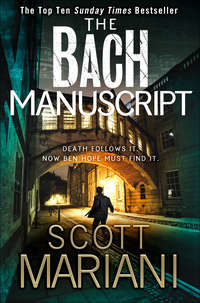
Читать книгу: «The Bach Manuscript»
SCOTT MARIANI
The Bach Manuscript

Copyright

Published by Avon an imprint of HarperCollinsPublishers
1 London Bridge Street,
London SE1 9GF
www.harpercollins.co.uk
First published in Great Britain by HarperCollinsPublishers 2017
Copyright © Scott Mariani 2017
Cover photographs © Shutterstock
Cover design © Henry Steadman, 2017
Scott Mariani asserts the moral right to be identified as the author of this work.
A catalogue copy of this book is available from the British Library.
This novel is entirely a work of fiction. The names, characters and incidents portrayed in it are the work of the author’s imagination. Any resemblance to actual persons, living or dead, events or localities is entirely coincidental.
All rights reserved under International and Pan-American Copyright Conventions. By payment of the required fees, you have been granted the non-exclusive, non-transferable right to access and read the text of this e-book on screen. No part of this text may be reproduced, transmitted, down-loaded, decompiled, reverse engineered, or stored in or introduced into any information storage and retrieval system, in any form or by any means, whether electronic or mechanical, now known or hereinafter invented, without the express written permission of HarperCollins.
Source ISBN: 9780007486236
Ebook Edition © November 2017 ISBN: 9780007486427
Version: 2017-10-27
Join the army of fans who LOVE Scott Mariani’s Ben Hope series …
‘If you like your conspiracies twisty, your action bone-jarring, and your heroes impossibly dashing, then look no farther’
Mark Dawson, bestselling author of the John Milton series
‘Deadly conspiracies, bone-crunching action and a tormented hero with a heart … Scott Mariani packs a real punch’
Andy McDermott, bestselling author of The Revelation Code
‘Slick, serpentine, sharp, and very very entertaining. If you’ve got a pulse, you’ll love Scott Mariani; if you haven’t, then maybe you crossed Ben Hope’
Simon Toyne, bestselling author of the Sanctus series
‘Scott Mariani’s latest page-turning rollercoaster of a thriller takes the sort of conspiracy theory that made Dan Brown’s The Da Vinci Code an international hit, and gives it an injection of steroids … [Mariani] is a master of edge-of-the-seat suspense. A genuinely gripping thriller that holds the attention of its readers from the first page to the last’
Shots Magazine
‘You know you are rooting for the guy when he does something so cool you do a mental fist punch in the air and have to bite the inside of your mouth not to shout out “YES!” in case you get arrested on the train. Awesome thrilling stuff’
My Favourite Books
‘If you like Dan Brown you will like all of Scott Mariani’s work – but you will like it better. This guy knows exactly how to bait his hook, cast his line and reel you in, nice and slow. The heart-stopping pace and clever, cunning, joyfully serpentine tale will have you frantic to reach the end, but reluctant to finish such a blindingly good read’
The Bookbag
‘[The Cassandra Sanction] is a wonderful action-loaded thriller with a witty and lovely lead in Ben Hope … I am well and truly hooked!’
Northern Crime Reviews
‘Mariani is tipped for the top’
The Bookseller
‘Authentic settings, non-stop action, backstabbing villains and rough justice – this book delivers. It’s a romp of a read, each page like a tasty treat. Enjoy!’
Steve Berry, New York Times bestselling author
‘I love the adrenalin rush that you get when reading a Ben Hope story … The Martyr’s Curse is an action-packed read, relentless in its pace. Scott Mariani goes from strength to strength!’
Book Addict Shaun
‘Scott Mariani seems to be like a fine red wine that gets better with maturity!’
Bestselling Crime Thrillers.com
‘Mariani’s novels have consistently delivered on fast-paced action and The Armada Legacy is no different. Short chapters and never-ending twists mean that you can’t put the book down, and the high stakes of the plot make it as brilliant to read as all the previous novels in the series’
Female First
‘Scott Mariani is an awesome writer’
Chris Kuzneski, bestselling author of The Hunters
Contents
Cover
Title Page
Copyright
Praise
Prologue
Chapter 1
Chapter 2
Chapter 3
Chapter 4
Chapter 5
Chapter 6
Chapter 7
Chapter 8
Chapter 9
Chapter 10
Chapter 11
Chapter 12
Chapter 13
Chapter 14
Chapter 15
Chapter 16
Chapter 17
Chapter 18
Chapter 19
Chapter 20
Chapter 21
Chapter 22
Chapter 23
Chapter 24
Chapter 25
Chapter 26
Chapter 27
Chapter 28
Chapter 29
Chapter 30
Chapter 31
Chapter 32
Chapter 33
Chapter 34
Chapter 35
Chapter 36
Chapter 37
Chapter 38
Chapter 39
Chapter 40
Chapter 41
Chapter 42
Chapter 43
Chapter 44
Chapter 45
Chapter 46
Chapter 47
Chapter 48
Chapter 49
Chapter 50
Chapter 51
Chapter 52
Chapter 53
Chapter 54
Chapter 55
Chapter 56
Chapter 57
Chapter 58
Chapter 59
Chapter 60
Chapter 61
Read on for an exclusive extract of The Moscow Cipher
About the Author
By the same author
About the Publisher
PROLOGUE
Nazi-occupied France
July 16th, 1942
All four family members were at home when they came.
Monsieur and Madame Silbermann, or Abel and Vidette, were in the salon, relaxing in a pair of matching Louis XV armchairs after a modest but excellent lunch prepared by Eliane, the family housekeeper. Vidette was immersed in one of the romantic novels into which she liked to escape. Abel, meanwhile, was frowning at an article in the collaborationist newspaper Le Temps, in which he was reading of much more serious matters. Things in France were growing worse. Just a little over two years since the crushing might of the German Wehrmacht had rolled virtually unopposed into the country, each day seemed to bring a fresh round of new horrors.
Seated at the piano, framed by the bright, warm afternoon light that flooded in through the French windows, their seventeen-year-old daughter Miriam was working through the most difficult arpeggiated right-hand passage of the musical manuscript in front of her, pausing now and then to peer at the handwritten notes, some of which were hard to read on the faded paper.
Though she played the piano with a fine touch, Miriam’s particular talent lay with the violin, at which she excelled. The real pianist of the family was her little brother. At age twelve, Gabriel Silbermann’s ability on the keys was already outstripping that of his teachers, even that of his father. Abel had been a respected professor of music at the Paris Conservatoire for over twenty years until the venerable institution’s director, Henri Rabaud, had helped the Nazi regime to ‘cleanse’ it of all Jewish employees under the Premier Statut des Juifs law, which had come into effect the previous year, 1941.
Since losing his post, Abel Silbermann had managed to get by teaching privately. Things were not what they had been, but he had always convinced himself that the family money, dwindling as it was, would get them through these difficult times. Abel was also the proud owner of a fine collection of historically important musical instruments, some of which he’d inherited from his father, others that he had picked up over the years at specialist auctions in France, Switzerland, and Germany – all before the war, of course. It had nearly broken Abel’s heart when, six months earlier, he’d been forced to sell the 1698 Stradivarius cello, one of the most prized items from his collection, to help make ends meet. He often worried that he might have to sell others.
But Abel Silbermann had far worse things to fear. He didn’t know it yet, but they were literally just around the corner.
‘Merde, c’est dur,’ Miriam muttered to herself. Complaining how tough the music was to get her fingers around. Gabriel could rattle through the piece with ease. But then, Gabriel was Gabriel.
‘Miriam, language!’ her mother said sharply, jolted from her reading. Her father permitted himself a smile behind his newspaper.
Miriam asked, ‘Father, may I get a pencil and add some fingering notes? I promise I’d do it very lightly, so they could easily be rubbed out afterwards.’
Abel’s smile fell away. ‘Are you mad, girl? That’s an original manuscript, signed by the composer himself. Have you any idea what it’s worth?’
Miriam reddened, realising the foolishness of her idea. ‘Sorry, Father. I wasn’t thinking.’
‘It shouldn’t even be out of its box, let alone being defaced with pencil marks. Please tell your brother to put it back where he found it, in future. These things are precious. This one most of all.’
‘I’m sure Gabriel knows that, Father. He calls it our family treasure.’
‘Indeed it is,’ Abel said, softening. ‘Where is Gabriel, anyway?’
‘In his cubbyhole, I think.’
Things had been hard for Gabriel at school since the Nazis invaded. He hated having to wear the yellow star when he was out of the house. Some of the non-Jewish kids pushed him around and called him names. As a result, he had become a rather solitary child who, when he wasn’t practising his pieces and scales, liked to spend time alone doing his own things. His cubbyhole was the labyrinth of nooks and crawl-spaces that existed behind the panelled walls of the large house, connecting its many rooms in ways that only Gabriel knew. You could sometimes catch him spying from behind a partition through one of his various peepholes, and you’d call out, ‘Oh, Gabriel, stop that nonsense!’ and he’d appear moments later, as if by magic, and disarm everyone with his laughter. Other times he could stay hidden for hours and you’d have no idea where he was. Like a tunnel rat, his father used to say jokingly. Then they’d started hearing the terrible stories coming from Ukraine and Poland, from everywhere, of Jews hiding under floorboards and in sewers while their people were transported away for forced labour, or worse. Abel had stopped talking about tunnel rats.
‘I do wish he’d come out of there,’ Vidette Silbermann said. ‘He spends too much time hiding away like that.’
‘If he’s happy,’ Miriam said with a shrug, ‘what harm can it do? We all need a little bit of happiness in this terrible, cruel world.’
Vidette lowered her book and started going into one of her ‘In my day, children would never have been allowed to do this or that’ diatribes, which they’d all heard a thousand times before. Miriam’s standard response was to humour her mother by ignoring her. She moved away from the piano and picked her violin up from its stand nearby. Her bow flowed like water over the strings and the notes of the Bach piece sang out melodiously.
That was when they heard the growl of approaching vehicles coming up to the house. Brakes grinding, tyres crunching to a halt on the gravel outside, doors slamming. Voices and the trudge of heavy boots.
Miriam stopped playing and looked with wide eyes at her father, who threw down Le Temps and got to his feet just as the loud thumping knocks on the front door resonated all through the house. Vidette sat as though paralysed in her chair. Miriam was the first to voice what they all knew already. ‘Les Boches. They’re here.’
In that moment, whatever shreds of optimism Abel Silbermann had tried to hang onto, his prayers that this day would never come, that everything would be all right, were shattered.
From the window, the dusty column of vehicles seemed to fill the whole courtyard in front of the house. The open-top black Mercedes staff car was flanked by motorcycle outriders, behind them three more heavily armed Wehrmacht sidecar outfits, a pair of Kübelwagens and a transporter truck. Infantry soldiers were pouring from the sides of the truck, clutching rifles, as Abel hurried to the front door. He took a deep breath, then opened it.
You can still talk your way out of this.
The officer in charge stepped from the Mercedes. He was tall and thin, with a chiselled, severe face like a hawk’s. He wore an Iron Cross at his throat, another on his breast. The dreaded double lightning flash insignia was on his right lapel, the sinister Totenkopf death’s head skull badge above the peak of his cap. Just the sight of those was enough to instil terror.
‘Herr Silbermann? I am SS Obersturmbannführer Horst Krebs. You know why I’m here, don’t you?’
Abel tried to speak, but all that came out was a dry croak. When Krebs produced a document from his pocket, a high-pitched ringing began in Abel’s ears. The paper was a long list of many names. It was the nightmare come true. Some Jewish families had fled ahead of the rumoured purges. Abel, choosing to disbelieve that anything quite so abominable could happen in his dear France, had made what he was now realising with a chill was the worst mistake of his life by staying put.
‘You reside here with your wife, Vidette Silbermann, and your children, Gabriel and Miriam Silbermann, correct? I have here an order for your immediate deportation to the Drancy camp. Any resistance, my men are ordered to shoot without hesitation. Understood?’
Drancy was the transit camp six miles north of Paris that the Germans used as a temporary detention centre for Jews awaiting transportation to the death camps. Abel had heard those rumours, too, and refused to believe. Now it was too late. What good would escape have done them, anyway? All fugitives would be picked up long before they reached the Swiss border.
‘Take me. I care little for my own life. But please spare my family.’
‘Please. Do you think I haven’t heard that before?’ Krebs pushed past Abel and strode into the house. His soldiers clustered around the entrance. Abel found himself looking down the muzzles of several rifles. The hallway of his genteel family home was suddenly filling with troops, their boots crashing on the parquet, the smell of their coarse tunics mixed with leather polish and gun oil a harsh and alien presence. The Obersturmbannführer turned to his second-in-command and said sharply, ‘Captain Jundt, seize everyone whose name appears on the list and have them assembled here in the hall. Make it quick.’
The captain snapped his heels. ‘Jawohl, mein Obersturmbannführer!’
Jundt relayed the command and soldiers surged into the salon to seize both Miriam and her mother, who was mute with horror and virtually fainting as they half carried, half dragged her into the hallway. While his men carried out his orders, Horst Krebs strolled around the downstairs of the house and gazed around him with appreciation for the Silbermanns’ good taste. Krebs did not consider himself a barbarian, like some of his peers. He came from Prussian aristocratic stock, spoke several languages and, before the war, had published three volumes of poetry in his name. By chance, he had studied music at the same Halle Conservatory founded by the father of Reinhard Heydrich, the SS chief whom the Czech resistance had assassinated only the previous month. Reprisals there had been harsh and were ongoing. Krebs intended to pursue his own duties here in France with equal zest.
Noticing the piano at the far end of the salon by the French windows, Krebs strolled over to inspect it. It was a very fine instrument indeed, a Pleyel. His keen musician’s eye passed over it, taking in the beauty of such a magnificent object. Maybe he would take it home to Germany as a trophy of war.
Then Krebs’ eye settled on the manuscript that sat on the piano’s music rest. He raised an eyebrow. He picked it up with a black-gloved hand, and peered at it.
Behind him, the hallway echoed with the cries of Madame Silbermann and her husband’s pleas as the soldiers forced them to line up at gunpoint. Captain Jundt was yelling, ‘Wo is das Gör? Où est the gamin?’ Demanding to know the whereabouts of young Gabriel, whose name was on the list. Jackboots thumped on the stairs and shook the floorboards above as more troops were dispatched to search the rest of the house.
Krebs heard none of it. His attention was completely on the manuscript in his hands as he studied it with rapt fascination. The age-yellowed paper. The signature on the front. Could it be the genuine thing? It was amazing.
Handling it as delicately as though it were some ancient scroll that could crumble at the slightest touch, Krebs replaced the precious manuscript on the music rest, then swept back his long coat and took a seat at the piano. The six flats in the manuscript’s key signature showed that the piece was in the difficult key of G flat major. He removed his gloves, laid his fingers on the keys and sight-read the first couple of bars.
Astonishing. If this was the genuine item, he wanted it for himself.
In fact, on consideration, he could think of an even better use for it. He and the now-deceased Heydrich were not the only high-ranking Nazis with a passion for classical music. What an opportunity for Krebs to ingratiate himself at the very highest level.
‘Entschuldigung, mein Obersturmbannführer—’ Jundt’s voice at his ear, breaking in on his thoughts.
‘What is it, Jundt?’
‘We cannot find the boy. Every room has been searched but he is missing.’
‘What do you mean, you can’t find him? How is that possible?’ Krebs was more irritated by the interruption than the news of a missing brat. ‘He must be hiding somewhere.’
‘The parents and sister refuse to say where, mein Obersturmbannführer.’
‘They do, do they? We will see about that.’ Krebs rose from the piano stool and marched towards the hallway. Moments like these called for a little greater authority than the likes of Jundt could summon up. Krebs drew his service automatic from its flap holster.
As Krebs reached the crowded hallway, he heard a sudden sound behind him and turned in surprise to see the young boy who seemed to have appeared from nowhere and was now racing across the salon, heading for the piano.
Jundt shouted, ‘There he is!’ as though his commanding officer were blind.
Miriam Silbermann screamed, ‘Gabriel!’
Krebs realised that the boy must have been hiding behind the wood panels, watching him as he sat at the piano. Running to the instrument, the twelve-year-old snatched the manuscript off its rest, and clutched it tightly. He yelled, ‘Filthy Boches, you won’t take our family treasure!’
His elder sister screamed, ‘Run, Gabriel!’ One of the soldiers silenced her with a harsh blow from his rifle butt.
And Gabriel ran, still grasping the precious manuscript to his chest as though nothing could persuade him to let it go. He made for the French window and slipped through, dashing towards the lawned garden and the fence at the bottom.
Krebs watched him go. Then calmly, unhurriedly, he walked towards the French window. Stepped through it, feeling the sun’s warmth on his face.
The boy was running fast. If Krebs let him run very much further, he would reach the fence and disappear into the trees, and it might take an entire Waffen SS unit all day to scour the surrounding countryside in search of the brat.
Krebs raised his pistol and took careful aim at the running child’s back. It was a long shot, but Krebs was an accomplished marksman.
The gun’s short, sharp report cracked out across the garden. Inside the house, Vidette Silbermann howled in anguish.
The boy stumbled, ran on two more staggering paces, then fell on his face and lay still.
More screams from the house, once again cut short by the soldiers. The Obersturmbannführer walked over to where Gabriel Silbermann lay dead, hooked the toe of his shiny jackboot under his body and rolled him over. A trickle of blood dribbled from the child’s lips. He was still clutching the music manuscript as if he wouldn’t give it up, even in death.
Krebs bent down and removed it from the boy’s fingers. It sickened him to see that there was blood on it, but not because it was the blood of an innocent child he had just killed. Rather, it was like seeing a rip in an old master painting. The manuscript had survived all these years, just to be indelibly stained by the blood of a filthy Jew. Disgusting. Krebs carefully slipped the precious object inside his coat before more harm could come to it. Then walked back towards the house to resume his duties. A pretty much routine day had turned out to be a lucky one for him.
Soon, the rest of the Silbermann family would be taken to their temporary new home at the Drancy internment facility, along with more than thirteen thousand other Jews rounded up by Nazi troops and French police in what was known as ‘Opération Vent Printanier’, or ‘Operation Spring Breeze’. From Drancy, not long afterwards, Abel, Vidette and Miriam would find themselves on the train that would deliver them to their terrible fate.
Only one of them would ever return.
Chapter 1
Oxfordshire
Many years later
The country estate covered a spread of some thirty acres, a fraction of the grounds it had commanded in former, grander days, but still large enough to keep the big house well secluded from neighbouring farm cottages and the nearby village of Wychstone. The estate was entirely surrounded by a ten-foot-high stone wall, built long ago by an army of local labourers. Its main entrance gates were tall and imposing, all gothic wrought-iron and gilt spikes, set into massive ivied pillars crowned with carved stone heraldic beasts of Olde England that had guarded the gateway since 1759 and bore just the right amount of weathering and moss to convey an impression of grandiosity without looking scabby and decayed.
Neatly hidden among the ivy of the pillars were the electronic black box and mechanism for opening and shutting the gates, as well as the small intercom on which visitors had to announce themselves in order to be let in; the rest of the time, the gates were kept firmly shut. Nor could you see it from the ground, but the walls themselves were topped all the way around with broken glass cemented into the stonework, to deter unwanted callers. Technically illegal without a warning sign, but the property’s owner was little concerned with their duty of care to protect the safety and wellbeing of potential burglars, vandals or other intruders.
Entering the gates and following the long, winding driveway that led through a corridor of fine old oak trees and eventually opened up to reveal the clipped lawns and formal gardens and then the house itself, few people could have failed to be impressed by the scale and majesty of one of the nobler country piles in the region. The manor stood on five floors, comprising over thirty bedrooms and many more reception rooms than were ever in use at any given time. Its multiple gabled roofs sloped this way and that. The red and green ivy that clung thickly about its frontage was kept neatly trimmed away from its dozens upon dozens of leaded windows. Clusters of chimney stacks poked like missiles into the blue Oxfordshire sky, providing a lofty perch for the crows that circled and cawed in the tranquil silence. Down below, parked on the ocean of ornamental gravel surrounding the big house were rows of Aston Martins and Bentleys and classic Porsches, nothing as vulgar as a Ferrari.
The place might have been the personal residence of someone extremely wealthy, a marquis or a viscount, or the ancestor of some Victorian merchant dynasty still reaping the fruits of the family empire. Old money. Or new money, like a dot-com multimillionaire or whizzkid software developer who’d struck lucky with some new gimmick that had set the world on fire. Whatever the case, they would have required a live-in service staff to keep it on an even keel. At least one butler, maybe two, plus the requisite contingent of housekeepers and kitchen staff and gardeners. Or else the fine house might have been open to the public, as a gallery or a museum or a National Trust heritage venue ushering crowds of visitors through its many grandiose rooms during the months of the tourist season.
It was none of those things. Instead, it was a place of business. A going concern, providing a variety of services to its clients. A polished brass plaque above the doorway read, in bold gothic font, THE ATREUS CLUB. Named after a king of ancient Greece, the father of Agamemnon and Menelaus, not that the name bore any connection to the nature and purpose of the establishment. A nature and purpose to which, in turn, few people were ever privy.
The Atreus Club was strictly private, hence the locked gates, and hence the broken glass on the walls. Members only. Expensive to join, and only certain individuals need apply to enjoy the secluded and discreet haven it provided for its exclusive, distinguished membership.
And for good reason, considering some of the activities those pillars of society enjoyed there.
Behind a tall balcony window, up on the fourth floor, one of those activities was currently taking place. The room was large but quite sparsely decorated. It had been a bedroom, and sometimes still was used as such, depending on need. Today, though, it was something else. At its centre stood an antiquated wooden school desk, the kind with the flip-up top and a recess for an inkwell. In front of it was a larger teacher’s desk, behind which stood an equally old-fashioned classroom blackboard, complete with chalk and duster. Scrawled in slanting chalk script across the board were the words, I must not be a naughty boy; I must not be a naughty boy. Over and over.
At the far side of the room, in the light from the tall window, stood a metal frame, seven feet high with a steel bar supported between sturdy mounts either side. Attached to the overhead bar, arms raised above his head by the rubber manacles and rubber chains that bound him firmly in place, stood one of the room’s two occupants. He was naked apart from his socks. A man in his early sixties, grey-haired, tall, slightly stooped, and not in the best of shape physically. His bare buttocks were pinched and somewhat shrivelled and very white, except for where they were striped red from the whipmarks that the room’s other occupant had spent the last few minutes inflicting on him.
She was blonde-haired and attractive in a stern, Slavic kind of way, and at least forty years younger than her client. But not naked, not yet, as specified by the instructions that had to be followed to the exact letter. All part of the expensive services provided by the Atreus Club. And this particular client had specified, as he always specified on his frequent visits here, that the girl be wearing a mortarboard and one of the abbreviated black academic gowns that Oxford University tradition dubbed a Commoners’ gown. Both items duly obtained from the official university outfitters, Shepherd and Woodward’s of the High. No expense spared. Aside from the academic garb and the matching black fishnet stockings, garters and suspender belt, she was wearing nothing else. Again, as per instructions. The instrument of torture was a whippy rattan cane, the type that schoolmasters had once used to inflict corporal punishment on disobedient pupils, back in the day. The client had never been caned at school, however. He had always been a model pupil, set for academic glory.
‘Have you had enough, you bad, bad professor, you?’ the blonde asked with a wicked smile on her red lips. ‘Professor’ was what she was instructed to call him in their fantasy role-play. She spoke with an Eastern European accent that drove him even more crazy.
‘No! Hit me again! Ah!’
The client’s cry of pain and pleasure was drowned out by the whoosh and sharp crack of the cane as she whipped it through the air and added another fresh, livid stripe to his pale rear end. The velvety tassel on her mortarboard swung with the movement.
‘Again! More!’
Whoosh. Crack.
This could go on for quite some time. As the blonde knew very well, because it usually did and she was his regular pick. She had the technique down better than any of the other girls. Something in the wrist action. For some reason, she was a natural at it. He knew her as Angelique, which, needless to say, wasn’t her real name.
Another piece of information the client lacked was that the private session he was currently enjoying was, in fact, anything but.
The tall, mature oak tree on the front lawn was about as close to the house as it was possible for a hidden observer to get without being spotted from the windows, and you could reach it easily enough by darting from hedge to bush. Plenty close enough, for the man who was perched high up in its branches. The only challenging part of his job had been getting over the wall unscathed. The rest was easy. Almost fun. He had an excellent view through the window in question, and at this range the telephoto lens on his camera was capable of producing crystal-clear close-ups of both the client and the girl whipping him.
The watcher wasn’t so interested in the girl. The client was another matter. Just a few more snaps, and the watcher would descend unseen from his perch and make his way back out of the grounds and over the wall to his vehicle.
The watcher permitted himself a smile as he watched the blonde step back to give herself space, then swing the cane and whack the old perv again. He could almost hear the snap of the thin rattan against soft, loose, white flesh. Framed in the viewfinder the client’s eyes were rolled upwards and his mouth was open with a sigh of ecstasy.
The shutter clicked one more time.
A perfect shot.
Someone was going to be happy.
Chapter 2
Ben Hope sat on the edge of the single bed with his old green canvas bag wedged between his feet and gazed around him at his strange, yet so familiar, surroundings.
And wondered, What the hell am I doing back here?
In some ways he felt like much the same person who had once lived in this very room, slept in this very bed, done all the things that a restless nineteen-year-old with the devil inside him and too many troubles for his young mind to bear is wont to do. In other ways, he was a very different person now. Twenty-something years of the kind of existence Ben had led since leaving this place couldn’t but profoundly change a man, if it didn’t kill him altogether.
But one thing was for sure. The place itself had barely changed at all during his long, long absence. Old Library 7 still had the same fusty smell of a building overdue for renovation by a century or longer. The yellowed and chipped woodwork of the ancient bow window was maybe a little more in need of repair. The carpet was still worn in all the same places he remembered. The thinly upholstered armchairs were the same ones he’d sprawled in evening after evening, meant to be reading but usually ending up asleep with the book upturned and dog-eared on his lap. Even the battered desk was original equipment, still bearing the black marks of cigarette burns and the scar from the time he’d smashed a bottle against it in some drunken fit of anger.
He’d been angry a lot of the time back in those days. Drunk even more of the time. Not the best of memories.
The only thing missing from the room was the old piano that had once stood over by the window, its place now taken by a saggy couch. Which seemed to make more sense. Quite why the college authorities had ever seen fit to put a piano in an undergraduate’s room had always been a mystery to him. He’d never even opened the lid, having never attempted to play a musical instrument of any variety in his life before or since.
Ben stood up and walked by where the piano had been. He undid the Victorian sash window latch, painted over so many times that it needed force to open it, and worked the stubborn window frame upwards until it was far open enough to lean out.
The view of the quadrangle below was exactly the same as it had been twenty-something years ago, with the rear façade of Meadow Buildings facing him. The wide open space of Christ Church Meadow lay beyond. Here in the middle of a hundred and sixty thousand people, the college’s nearly forty acres of unspoilt fields and woodland were a tranquil haven for wildlife, and for Ben. He could smell the river and hear the traffic rumble in the distance. It was a crisp and sunny Easter-time morning, in the break between Hilary and Trinity terms, and the usual troop of camera-toting tourists was bustling about the quad. Spanish, judging by the barking narrative of the guide who was busily ushering them around the hallowed college grounds.
It seemed an ironic coincidence that he should have been given his old room. Or was it? Maybe he had Seraphina to thank for it, looking up old records and being over-efficient. Perhaps she thought he’d go all mushy and nostalgic and be forever grateful to her for the gesture. In which case, she obviously didn’t know enough of Ben’s history with the place, or the circumstances under which he’d left it.
Which in turn brought him once again to asking himself the same question that had been in his mind ever since he’d arrived in Oxford early that morning.
What the hell am I doing back here?
Ben knew what.
It had been a spur of the moment thing. A snap decision. Perhaps not, in retrospect, the wisest idea he’d ever had. Perhaps he was getting sentimental, after all. Which wasn’t like him, or so he would have preferred to think. But he was here now. One night, and tomorrow he’d be sixty miles away having his business meeting; then soon after that he’d be home again at Le Val, getting on with life and work.
It was no big deal. He’d survived worse things in his time.
He looked at his watch. They’d still be serving breakfast in Hall, and he needed a coffee. But he felt grubby after the long drive up from Normandy and decided to take a quick shower first. Old Library was, as its name suggested, the oldest block of undergraduate accommodation within the college buildings, and convenience of facilities hadn’t been uppermost in the minds of the architects back then. Each floor had just one communal bathroom, which in Ben’s case was down the musty-smelling corridor from his room, past a series of deep-set oval windows and down a short flight of creaky steps.
The bathroom was still pretty much as scabby and mouldy as Ben remembered, and the plumbing still howled like a werewolf at full moon. He showered in tepid water, dressed quickly, then locked up his room. The oversized door key he’d been issued at the Porter’s Lodge on arrival was the same Victorian affair he’d used back in the day. He slipped it in his pocket and hurried downstairs and out of the iron-studded door of Old Library. The way to the Great Hall was through a small cloistered quad, which until about 1520 had been the site of an eighth-century priory. Lots of history in this place. But right now Ben was more concerned about missing his morning coffee, and he quickened his step up the grand staircase to the Great Hall.
That hadn’t changed either, with its grand vaulted ceiling and richly wood-panelled walls hung with scores of old gilt-framed portraits of Oxford luminaries through the ages whose names Ben had never cared to remember, and the three immensely long tables on which those students brave enough to consume college food took their meals. Ben vaguely remembered hearing a while back that some big movie production had used the hall as a location. Something about a boy wizard, he remembered, but that was all. He didn’t watch a lot of movies.
Breakfast time was winding to a close. A few people were filing along the self-service aisle on the left of the hall, picking up pastries and croissants and being poured coffees by the college staff. Ben got himself a mug of black coffee, nothing to eat, and took it over to sit on his own at the bottom end of one of the long trestle dining tables, not too far from the door, intending to gulp down his coffee and slip away without having to get into conversation with anyone.
He glanced at the faces of the others in the hall. They were mostly about his age, and he supposed they were old members from his year, here like him to attend the college reunion. Some of them knew each other and had bundled together into little groups, their laughter and excited chatter echoing in the huge room. He didn’t remember them.
But he quickly remembered the college coffee at the first swallow. It was just as bad as ever. Something on a par with British army coffee, a comparison Ben hadn’t been able to make back in those days. It was too vile to gulp down in a hurry, so he sat sipping it, alone with his thoughts.
That was when a voice from behind him said, in a tone of astonishment, ‘Ben Hope?’
Ben turned, coffee in hand, and looked at the guy standing there, carrying a tray laden with a pot of tea, cup, saucer, jug of milk, bowl of cereal, glass of orange juice. For a second or two they stared at one another. The guy was a little older than him. Neither short nor tall, thin nor plump. Light brown hair beginning to show a dusting of grey around the temples. The face was very familiar. Even more than the face, the eyes. Sharply green, filled with a mischievous kind of sparkle as they peered closely into Ben’s.
‘Ben Hope, it is you, isn’t it? Of course it is. My God, how long has it been?’
‘Nicholas? Nicholas Hawthorne?’
‘Thank God, you remember. I was beginning to think I must have aged beyond recognition. Not you, though. You haven’t changed a bit.’
‘I know that’s not true,’ Ben said. ‘But thanks anyway.’ He motioned at the empty space next to him at the table. ‘Will you join me, Nicholas?’
‘Why, gladly.’ Nicholas Hawthorne settled himself on the bench seat beside Ben. There was that strange, hesitant uncertainty between them that you got when old friends who had gone their separate ways were reunited after many years, and the ice needed to be rebroken. ‘It’s just Nick these days,’ he said with a smile. ‘I only use Nicholas as a performance name. The agent’s idea. He says the formality of it is more appropriate to the classical market. But never mind boring old me. What about you? You’re the last person I ever expected to see here.’
‘Me too.’
‘What have you been doing with yourself all this time?’
‘Oh, this and that.’ The fact was, very little of what Ben had done in the last couple of decades could be discussed in anything more than the vaguest terms. Even if he could have talked about it, and hadn’t been the kind of person who preferred to keep things to himself, the details would only upset most normal, gentle folks for whom his life of risk, trouble and danger would seem alien, even frightening. He’d come prepared for that. His strategy was to provide the briefest and sketchiest account of himself possible, keep it vague and dodge direct questions. He said, ‘I live in France now.’
‘Business or pleasure?’
‘Bit of both.’
‘Are you married? Children?’
Ben shook his head. The easiest answer. The truth was complicated. Like most things in his life.
‘I wouldn’t have thought so, somehow. Not the children part, anyway. Nor me. Too busy with work.’ Nick paused. ‘Actually, what I heard is, you ran off and joined the army. Did very well there, or so the rumour went.’
‘You shouldn’t listen to rumour,’ Ben said.
‘Very true,’ Nick said, laughing. ‘Not that I was the least bit surprised to hear it.’
‘No?’
‘Absolutely not. I mean, the wild man of Christ Church, the legends of whose exploits still echo around the college walls?’
‘I don’t know about that,’ Ben said. He hoped he wasn’t about to be treated to one of the stories. They weren’t ones he wanted to hear.
He didn’t have to. Nick seemed to pick up on his unwillingness to discuss the legend that had been young Ben Hope, and quickly changed the subject.
‘It’s so good to see you again. What on earth brings you back to Oxford?’
Ben replied, ‘As a matter of fact, you do.’
Chapter 3
Which was true, in a sense. Though only a few days earlier, the name Nick Hawthorne was just the vaguest scrap of a distant memory, a faint echo from another life. But some echoes have a way of coming back to you just when you least expect them.
Ben had been sitting in the prefabricated office building across the yard from the old stone farmhouse, tucked away at the heart of a fenced-off compound deep in the sleepy backwaters of rural Normandy. A place called Le Val, a place he had strayed away from too many times. A place he now felt happy to call home. Spring was springing, the sun was shining, and all was pretty much okay with the world, apart from the fact that he was working on a Sunday, and the stack of paperwork piled on his desk that he had to finish ploughing through by lunchtime.
The joys of running a business. But he couldn’t complain. The enterprise he co-directed from this secluded base along with his partners, Jeff Dekker and Tuesday Fletcher, was growing steadily every quarter. Ben and Jeff had founded it a few years back and it would soon get to the point where they might have to expand to a second location, somewhere suitably remote and isolated, maybe further south where the climate was softer and they could spread out a little more.
For the moment, though, they were rattling on just fine and had established a comfortable, if by necessity slightly detached due to the nature of the business, rapport with the majority of the locals. In an area where most folks were farmers, or cheese makers, or small-scale cider and calvados producers, the idea of a bunch of British ex-servicemen setting up a tactical training centre to instruct military, police, hostage rescue and elite close-protection teams in some of the finer points of their trade must have seemed a little odd. The tall perimeter fences, KEEP OUT signs and roving German shepherd guard dogs might equally have unsettled one or two folks, not to mention the crack of high-velocity gunfire that was often to be heard rolling over the countryside from the safe confines of Le Val’s five-hundred-metre range. They certainly unsettled Jeff’s new fiancée, Chantal Mercier, who taught at a local primary school and frowned upon such gung-ho activities. Ben could see trouble ahead there, but he kept his mouth shut and didn’t interfere with his friend’s affairs.
Right now, Ben had his own affairs to deal with. And he heartily wished someone would come and interfere with those by relieving him of all this damned bureaucratic red tape. Paperasse, they called it in France. Ben had other words to describe it. Jeff often joked that you needed a licence to fart in this country, and he wasn’t far off the mark.
The latest irritation they had to deal with was the need for a special import licence to obtain firearm components, even though the contents of the Le Val armoury were already itemised and catalogued down to the last screw and spring. There was a guy called Lenny Hobart in Surrey making what he claimed were the world’s best, lightest and most stable tactical sniper bipods out of titanium and carbon fibre. Ben and Jeff were interested in trying them out and maybe buying in a few to use on the rifle range, where Tuesday had taken over as head sniper instructor to the SWAT teams who came to Le Val to train.
And so, Ben was due to travel up to Surrey in a few days, meet Hobart at the Stickledown shooting range in Bisley and put one of his prototypes through its paces at twelve hundred yards. At that kind of distance, where the wind was fickle, the very curvature of the earth came into play and even a microscopic amount of rifle cant could knock a bullet’s point of impact way off course, anything you could do to improve the chances of hitting your mark was a definite boon. If the new bipod lived up to the claims of its inventor, Ben planned on coming home with half a dozen, with a view to ordering more.
Enter the French government, who in their wisdom now insisted on making him trawl through an additional raft of forms just to obtain a few inert bits of machined titanium, carbon fibre, spring steel and rubber. Making the world a safer place.
Ridiculous. You could do more hurt to a person with a candlestick.
Ben spent a few more minutes soldiering on through reams of officialese that might as well have been written in Yupik or Pawnee, then decided to give it a break. He was leaning back in his chair and enjoying his fourth untipped Gauloise cigarette of the morning when it occurred to him that he would be more usefully employed working on clearing the backlog of emails in his spam folder.
The Le Val email server had been getting bombarded with a lot of unsolicited mail recently. Offers of cut-price Viagra, phishing scams of one kind or another, and so many messages from prospective Russian brides called Tatiyana or Olga or Mayya, invariably 28 years old and offering to send images of themselves that Ben had been starting to wonder what Tuesday was getting up to online. He was getting almost as fast with the delete button as he was with a pistol.
Working his way through the pile, Ben came across an undeleted message from somebody called Seraphina Lewis. He glanced at the name for a fraction of a second before his finger gave its reflex twitch and got rid of it. Nice try, he thought. An unusual name. Intended to draw attention, maybe, as the scammers and phishers became more sophisticated in their techniques. The part of Ben’s mind that still recalled anything from his theology studies from two decades earlier, before he’d dropped that future life to join the army and then the SAS, flashed up the name Seraphina as being the feminine derivative of the biblical Seraphim from the Book of Isaiah. Why he still retained such information inside his head, he had no idea. The Seraphim were the fiery-winged beings, high-placed in angelic hierarchy, who fluttered around the throne of God in heaven. Maybe the oblique reference to ‘the fiery ones’ was supposed to convey a subconscious image of hot, burning passion. Or maybe it was meant to project a sense of purity and innocence to catch the unwary recipient and lure them to read more.
Either way, by the time those thoughts had flickered through his mind at the speed of light, the email was already in the trash and he was turning his attention back to his paperwork.
But then Ben hesitated. Something else was unusual about the message. More than the name, it was the email address itself. He could see it still imprinted like a ghost image on his retinas: the suffix @chch.ox.ac.uk. The official domain name for Christ Church, Oxford.
Ben’s old college. Which, as strange as that seemed, meant that the email was genuine, and meant for him. Ben hesitated a moment longer, then clicked open the trash folder and saw the unread message there at the top, above the collection of Viagra ads and Tatiyanas and Mayyas waiting to be permanently binned.
‘Okay, Seraphina,’ he muttered to himself, ‘let’s see what it is you wanted.’ Donations to help restore some crumbling part of the college’s architecture, no doubt, or to pay for de-moling the Dean’s private garden or restore the paintings in the art gallery that nobody ever looked at anyway. He clicked again, and the message opened.
Strange indeed, but stranger things had happened in his life.
Бесплатный фрагмент закончился.