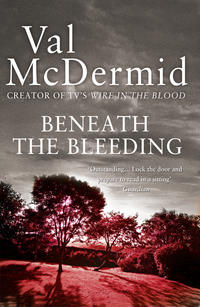
Читать книгу: «Beneath the Bleeding»
Praise for Beneath the Bleeding:
‘McDermid’s previous novels have set the bar vertiginously high but the latest outing for criminal profiler Tony Hill and DCI Carol Jordan has all the craft, panache and pace that we have come to expect from this outstanding writer
… Vintage stuff: unplug the phone, lock the door and prepare to read in a sitting’
Guardian
‘Another intelligent and absorbing offering from one of crime fiction’s most consistent performers’
The Times
‘If Rankin is the king of British crime, Val McDermid is undoubtedly the queen … Hill and Jordan are compelling creations and their encounters fairly crackle. McDermid is a consummate plotter so there are pleasing twists and turns in this first-rate story’
Observer
‘McDermid is at the peak of her murderous craft … on the page, McDermid makes criminal profiler Hill every bit as engaging as [Robson Green]’
Daily Mirror
‘The Queen of serial killers in this country keeps her end up … few can scoop Val on throat-clutching narrative but at the same time she is marvellous on the sub-plot details … I am intrigued by the first appearance of Hill’s monster mother – more of her please’
Daily Mail
‘Peerless … one of the world’s finest crime writers, McDermid is currently at the top of her game’
Glasgow Herald
‘Very good … McDermid is an old hand at making things believable’
Irish Examiner
‘The novel opens explosively … the momentum doesn’t slacken … this is a book which works on more than one level. It fulfils the criteria of a very good contemporary crime novel in terms of excitement, topicality and its sense of authenticity. but it delivers more than this: the complex and unpredictable relationship between Hill and Jordan lies at the heart of the series and is one of its greatest strengths. McDermid’s writing gets better and better’
Spectator
‘McDermid’s usual ingredients of fear, revulsion, ingenuity and heroism … this book is all the more gripping because some holds are barred’
Literary Review
‘McDermid is up there with the best’
Good Reading
VAL McDERMID
Beneath the Bleeding

Copyright
This novel is entirely a work of fiction. The names, characters and incidents portrayed in it are the work of the author’s imagination. Any resemblance to actual persons, living or dead, events or localities is entirely coincidental.
Harper An imprint of HarperCollinsPublishers Ltd. 1 London Bridge Street London SE1 9GF
http://www.harpercollins.co.uk
First published in Great Britain by HarperCollinsPublishers 2007
Copyright © Val McDermid 2008
Lines from Four Quartets: ‘East Coker’ by T.S. Eliot are reproduced by permission of Faber and Faber Ltd
Val McDermid asserts the moral right to be identified as the author of this work
A catalogue record for this book is available from the British Library
FSC is a non-profit international organisation established to promote the responsible management of the world’s forests. Products carrying the FSC label are independently certified to assure consumers that they come from forests that are managed to meet the social, economic and ecological needs of present and future generations.
All rights reserved under International and Pan-American Copyright Conventions. By payment of the required fees, you have been granted the non-exclusive, non-transferable right to access and read the text of this ebook on-screen. No part of this text may be reproduced, transmitted, down-loaded, decompiled, reverse engineered, or stored in or introduced into any information storage and retrieval system, in any form or by any means, whether electronic or mechanical, now known or hereinafter invented, without the express written permission of HarperCollins ebooks.
HarperCollinsPublishers has made every reasonable effort to ensure that any picture content and written content in this ebook has been included or removed in accordance with the contractual and technological constraints in operation at the time of publication.
Source ISBN: 9780007243280
Ebook edition SEPTEMBER 2008 ISBN: 9780007279401
Version: 2018-07-30
This one is for the members of the wedding, who helped to create the best of memories.
Beneath the bleeding hands we feel The sharp compassion of the healer’s art
From Four Quartets: ‘East Coker’
T S Eliot
Contents
Praise Title Page Copyright Dedication Friday List 2 Sunday Monday Tuesday Wednesday Thursday Friday Midnight List 1 Saturday Sunday Monday Tuesday List 3 Chapter Three Months Later Acknowledgements About the Author Series Title About the Publisher
Friday

The phases of the moon have an inexplicable but incontrovertible effect on the mentally ill. Ask any psychiatric nurse. For them, it’s a truth universally acknowledged. None of them volunteers for overtime around the time of the full moon. Not unless they are absolutely desperate. It’s also a truth that makes the behavioural scientists uneasy; it’s not something that can be laid at the door of an abusive childhood or an inability to relate socially. It’s an external rhythm that no amount of treatment can override. It drags the tides and it pulls the deranged out of their hampered orbits.
The internal dynamics of Bradfield Moor Secure Hospital were as susceptible to the undertow of the full moon as its name suggested. According to some of its staff, Bradfield Moor was a warehousing facility for those too dangerously crazy to walk free; to others, it was a haven for minds too fragile for the rough and tumble of life on the outside; and to the rest, it was a temporary refuge that offered the hope of a return to a loosely defined normality. The third group was, unsurprisingly, heavily outnumbered and heartily despised by the other two.
That night, it wasn’t enough that the moon was full. It was also subject to a partial eclipse. The milky shadows of the lunar surface gradually metamorphosed through sickly yellow to dark orange as the earth moved between its satellite and the sun. For most of those observing the eclipse, it possessed a mysterious beauty, provoking awe and admiration. For Lloyd Allen, one of Bradfield Moor’s less grounded inmates, it provided proof absolute of his conviction that the last days were at hand and thus his duty was to bring as many to his maker as he could. He had been hospitalized before he had achieved his goal of spilling as much blood as possible so that the souls of its owners might ascend more easily to heaven at the imminent second coming. His mission burned all the brighter within him for being thwarted.
Lloyd Allen was not a stupid man and this made the task of his keepers that much harder. The psychiatric nurses were well versed in low cunning and found it relatively easy to head off at the pass. It was much harder to spot the machinations of those who were deranged but smart. Recently, Allen had devised a method of avoiding taking his medication. The more experienced nurses were wise to tricks of this sort and knew how to subvert them, but the newly qualified, like Khalid Khan, still lacked the necessary canniness.
On the night of the full moon, Allen had managed to avoid taking both previous doses of the chemical cosh that Khan believed he had administered. By the time the eclipse began to be visible, Allen’s head was filled with a low thrumming mantra. ‘Bring them to me, bring them to me, bring them to me,’ echoed continuously inside his brain. From his room, he could see a corner of the moon, the prophesied sea of blood occluding its face. It was time. It really was time. Agitated, he clenched his fists and jerked his lower arms up and down every couple of seconds like a demented boxer raising and lowering his guard.
He turned to face the door and stumbled awkwardly towards it. He had to get out so he could complete his mission. The nurse would be here soon with his final medication for the night. Then God would give him the strength he needed. God would get him out of this room. God would show him the way. God knew what he had to do. He would bring them to Him. The time was ripe, the moon was bursting with blood. The signs were beginning and he had a task to fulfil. He was chosen, he was the road to salvation for the sinners. He would bring them to God.
The pool of light illuminated a small area on the top of a low-grade institutional desk. A file lay open, a hand holding a pen resting on one side of the page. In the background, Moby yearned plaintively for the spiders. The CD had been a gift, something Dr Tony Hill would never have chosen for himself. But somehow it had become an integral part of the after-hours work ritual.
Tony went to rub his gritty eyes, forgetting about his new reading glasses. ‘Ow,’ he yelped as the nose-pieces bit into his flesh. His little finger caught the edge of the rimless glasses, sending them spinning off his face to land askew on the file he’d been studying. He could picture the look of indulgent amusement the moment would have provoked on the face of Detective Chief Inspector Carol Jordan, the Moby donor. His distracted clumsiness had long been a standing joke between them.
The one thing she couldn’t tease or taunt him about was that he was still at his desk at half past eight on a Friday night. When it came to reluctance to leave the office until everything possible had been dealt with, she was at least his equal. If she’d been around she would have understood why he was still here, going over the brief he’d so painstakingly prepared for the Parole Board. A brief they’d chosen blithely to ignore when they’d released Bernard Sharples into the care of the Probation Service. No longer a danger to the public, his lawyer had persuaded them. A model prisoner who had co-operated with everything the authorities had asked of him. The very exemplar of remorse.
Well, of course Sharples had been a model prisoner, Tony thought bitterly. It was easy to behave when the objects of your desire were so far beyond your reach that even the most obsessed fantasist would struggle to conjure up anything remotely like temptation. Sharples would offend again, he knew it in his bones. And it would be his fault in part because he had failed to make his case strongly enough.
He retrieved his glasses and marked a couple of paragraphs with his pen. He could have, should have stated his case more firmly, left no cracks for the defence to slither through. He would have had to assert as fact what he knew to be conjecture based on years of working with serial offenders plus the gut feeling that came from reading between the lines of his interviews with Sharples. But there was no place for shades of grey in the Parole Board’s world of black and white. It seemed that Tony still had to learn that honesty was seldom the best policy when it came to the criminal justice system.
He pulled a pad of Post-It notes towards him but before he could scribble anything down, a noise from outside penetrated his office. He wasn’t generally disturbed by the miscellaneous noises that made up the soundtrack to life inside Bradfield Moor; the soundproofing was surprisingly effective, and besides, the worst of the anguish was generally acted out far away from the offices where people with degrees and status worked.
More noise. It sounded like a football match or a sectarian riot. Certainly more than he could reasonably ignore. Sighing, Tony stood up, tossing his glasses on the desk as he made for the door. Anything had to be better than this.
Not many people regarded a job at Bradfield Moor as a dream come true. But for Jerzy Golabeck it represented more than he had ever imagined possible growing up in Plock. Nothing much had happened in Plock since the Polish kings decamped in 1138. The only work to be had these days was in the petrochemical refineries where wages were pitiful and industrial disease a way of life. Jerzy’s narrow horizons had widened eye-poppingly when Poland had acceded to the European Union. He’d been one of the first to board a cheap flight from Krakow to Leeds/Bradford Airport and the prospect of a new life. From his perspective, minimum wage approximated a king’s ransom. And working with the inmates of Bradfield Moor wasn’t so different from dealing with a senile grandfather who thought Lech Walesa might still be the coming man.
So Jerzy had bent the truth and manufactured a level of experience of dealing with the mentally ill that bore little relationship to the reality of his past as a production line worker in the pickle-canning factory. So far, it hadn’t been an issue. The nurses and orderlies were more concerned with containment than treatment. They administered drugs and cleared up messes. Any attempts at cure or mitigation were left to doctors, psychiatrists, therapists of varying schools, and clinical psychologists. It appeared that nobody expected much more from Jerzy than that he turned up on time and didn’t shy away from the physical unpleasantnesses that cropped up every shift. That much he could manage with ease.
Along the way, he’d developed a shrewd eye for what was going on around him. Nobody was more surprised at that than he was. But there was no denying that Jerzy seemed to have an instinct for spotting when patients shifted away from the equilibrium that made Bradfield Moor possible. He was one of the few workers in the hospital who would ever have noticed anything amiss with Lloyd Allen. The problem was that he was confident enough by then to believe he could deal with it himself. He wasn’t the first twenty-four-year-old to have an inflated idea of his capabilities. Just one of the few who would die for it.
As soon as he entered Lloyd Allen’s room, the hair on Jerzy’s arms stood on end. Allen was standing in the middle of the cramped space, his big shoulders tensed. The fast flick of his eyes told Jerzy that either the medication had suffered a sudden and spectacular failure or Allen had somehow avoided taking it. Either way, it looked like the voices in his head were the only ones Allen was interested in listening to. ‘Time for your meds, Lloyd,’ Jerzy said, his voice deliberately offhand.
‘Can’t do that.’ Allen’s voice was a strained grunt. He rose slightly on the balls of his feet, his hands sliding over each other as if he were washing them. The muscles of his forearms danced and twitched.
‘You know you need them.’
Allen shook his head.
Jerzy mirrored the movement. ‘You don’t take your meds, I have to report it. Then it gets hard on you, Lloyd. That’s not how we want it to be, is it?’
Allen launched himself at Jerzy, his right elbow catching him under the breastbone and knocking the wind from him. As Jerzy doubled over, retching for air, Allen barged past, knocking him to the floor as he made for the door. In the doorway, Allen came to an abrupt halt then swung round. Jerzy tried to make himself look small and unthreatening, but Allen advanced all the same. He raised his foot and kicked Jerzy in the stomach, emptying his lungs in a dizzying explosion of pain. While Jerzy clawed at his gut, Allen calmly reached down and ripped his keycard from the clip at his waist. ‘I have to bring them to Him,’ he grunted, making for the door again.
Jerzy couldn’t stop the terrible convulsive groans as his body struggled for oxygen. But his brain was still working properly. He knew he had to get to the panic button in the hallway. Armed with Jerzy’s key, Allen could roam almost anywhere in the hospital. He could open the rooms of other inmates. It wouldn’t take long to free enough of his fellows to seriously outnumber the staff on duty at this time of the evening.
Coughing and gagging, strings of spittle trailing down his chin, Jerzy forced himself to his knees and shuffled closer to the bed. Clawing at the frame, he managed to drag himself to his feet. Clutching his guts, he stumbled into the hall. He could see Allen up ahead struggling to swipe the keycard through the reader mounted by the door that would release him into the main part of the building. You had to get the speed of the swipe just right. Jerzy knew that, but Allen, thankfully, did not. Allen thumped the reader and tried again. Swaying, Jerzy tried to cover the distance to the panic button as quietly as he could.
He wasn’t quiet enough. Something alerted Allen and he swung round. ‘Bring them to him,’ he roared, charging. His weight alone was enough to bring Jerzy’s weakened frame to the floor again. Jerzy wrapped his arms around his head. It was no defence. The last thing he felt was a terrible pressure behind his eyes as Allen stamped on his head with all his strength.
Opening his door brought Tony a sudden swell of volume. Voices shouting, swearing and screaming funnelled up the stairwell. The scariest thing about it was that nobody had pushed the emergency alarm. That suggested something so sudden and so violent that no one had had the chance to follow the procedures that were supposedly drummed into them from day one of their training. They were too busy trying to contain whatever was going on.
Tony hustled along the corridor towards the stairs, hitting the panic button as he went. A loud klaxon immediately blasted out. Christ, if you were crazy already, what would this do to your head? He was running by the time he reached the stairs but he slowed his pace enough to look down the stairwell to see what he could see.
Nothing, was the short answer. The raised voices seemed to be coming from the corridor off to the right, but they were distorted by the acoustics and the distance. Suddenly, there was the tinkle and crash of glass breaking. Then a shocking splinter of silence.
‘Oh, fuck,’ someone said clearly, disgust the apparent emotion behind the words. Then the shouting began again, the note of panic unmistakable. A scream, then the sound of scuffling. Without thinking about it, Tony had started down the stairs, trying to see what was going on.
As he rounded the final turn of the stairs, bodies spilled out of the corridor where the noise had come from. Two nurses were backing towards him, supporting a third man. An orderly, judging by the few areas of pale green scrubs left untouched by blood. They were leaving a smudged trail of scarlet behind as they scrambled backwards as fast as they could manage.
Carnage, Tony thought as a burly figure emerged from the corridor, swinging a fire axe in front of himself as if it were a scythe and he a grim reaper. His jeans and polo shirt were spattered with blood; the blade of the axe shed a fine spray with every swing. The burly man was intent on his prey, steadily pursuing them as they retreated. ‘Bring them to him. Nowhere to hide,’ he said in a low monotone. ‘Bring them to him. Nowhere to hide.’ He was gaining on them. Another couple of strides and the axe blade would be slicing through flesh again.
Even though the axeman wasn’t a patient of his, Tony knew who he was. He’d made a point of familiarizing himself with the files of any inmates considered capable of violence. Partly because they interested him, but also because it felt like a kind of insurance policy. Tonight, it looked like he was about to lose his no-claims bonus.
Tony stopped a few steps from the bottom of the staircase. ‘Lloyd,’ he called softly.
Allen didn’t break stride. He swung the axe again, in rhythm with his mantra. ‘Bring them to him. Nowhere to hide,’ he said, sweeping the blade inches from the nurses.
Tony took a deep breath and squared his shoulders. ‘This is not the way to bring them to him,’ he said loudly, with all the authority he could summon. ‘This is not what he wants from you, Lloyd. You’ve got it wrong.’
Allen paused, turning his head towards Tony. He frowned, puzzled as a dog tormented by a wasp. ‘It’s time,’ he snarled.
‘You’re right about that,’ Tony said, moving down a step. ‘It is time. But you’re going about it the wrong way. Now, put down the axe and we’ll figure out a better way of doing it.’ He tried to keep his face stern, not to reveal the fear curdling his stomach. Where the hell was the back-up team? He had no illusions about what he could do here. He could maybe hold Allen up long enough for the nurses and the wounded orderly to get clear. But good as he was with the deranged and the demented, he knew he wasn’t good enough to restore Lloyd Allen to anything like equilibrium. He doubted he could even get him to lower the weapon. He had to try, he knew that. But where the fuck was the cavalry?
Allen stopped swinging the axe through its long arc and raised it at an angle across his body like a baseball player preparing for the strike. ‘It’s time,’ he said again. ‘And you’re not him.’ And he launched himself across the gap between them.
He was so fast that all Tony could register was a slash of red and a glint of polished metal. Then a seam of pain exploded from the middle of his leg. Tony toppled like a felled tree, too shocked even to scream. Inside his head, a light bulb detonated. Then blackness.
List 2
Belladonna
Ricin
Oleander
Strychnine
Cocaine
Taxus Baccata
Sunday
Thomas Denby studied the chart again. He was puzzled. He’d diagnosed a severe chest infection when he’d first examined Robbie Bishop. He’d had no reason to doubt that diagnosis. He’d seen enough chest infections in the twenty years since he’d qualified and chosen to specialize in respiratory ailments. In the twelve hours since the footballer had been admitted, Denby’s team had been administering antibiotics and steroids according to the directions he’d given them. But there had been no improvement in Bishop’s condition. In fact, he had deteriorated to the point where the duty SHO had been prepared to risk wrath by summoning Denby from his bed. Mere House Officers didn’t do that to consultants unless they were very, very nervous.
Denby replaced the chart and gave the young man lying on the bed his casually professional smile, all teeth and dimples. His eyes, however, were not smiling; they were scanning Bishop’s face and his torso. The sweat of his fever had glued the hospital gown to his chest, revealing the outline of well-defined muscles currently straining to drag breath into his lungs. When Denby had first examined him, Bishop had complained of weakness, nausea and pain in his joints as well as the obvious difficulty in breathing. Spasms of coughing had doubled him over, their intensity bringing colour back to his pale face. The X-rays had shown fluid on his lungs; the obvious conclusion was the one that Denby had drawn.
Now, it was beginning to look as if whatever ailed Robbie Bishop was no ordinary chest infection. His heart rate was all over the place. His temperature had climbed a further degree and a half. His lungs were incapable of keeping his blood oxygen levels stable, even with the assistance of the oxygen mask. Now, as Denby watched, his eyelids fluttered and stayed shut. Denby frowned. ‘Has he lost consciousness before?’ he asked the SHO.
She shook her head. ‘He’s been mildly delirious because of the fever – I’m not sure how aware he’s been of where he is. But he’s been responsive until now.’
An insistent beeping kicked in, the screen revealing a new low in Bishop’s blood oxygen level. ‘We need to intubate,’ Denby said, sounding distracted. ‘And more fluids. I think he’s a little dehydrated.’ Not that that would explain the fever, or the cough. The SHO, galvanized by the instruction, hurried out of the small room that was the best Bradfield Cross Hospital could provide for those who required their privacy even in extremis. Denby rubbed his chin, wondering. Robbie Bishop was in peak condition; fit, strong and, according to his club doctor, he had been perfectly well after Friday’s training session. He’d missed Saturday’s game, diagnosed initially by the same club doctor as having some sort of flu bug. Now here he was, eighteen hours later, visibly deteriorating. And Thomas Denby had no idea why, nor how to make it stop.
It wasn’t a position he was accustomed to. He was, he knew, a bloody good doctor. A skilled diagnostician, a cunning and often inspired clinician, and a good enough politician to make sure his department’s needs were seldom frustrated by the bureaucrats. He pretty much sailed through his professional life, rarely given pause by the ailments his patients presented. Robbie Bishop felt like an affront to his talent.
As the SHO returned with the intubation kit and a couple of nurses, Denby sighed. He glanced at the door. On the other side, he knew, was Robbie Bishop’s team manager. Martin Flanagan had spent the night slumped in a chair next to his star player. His expensive suit was rumpled now, his craggy face rendered sinister by a scribble of stubble. They’d already gone head to head when Denby had insisted the pugnacious Ulsterman leave the room while the doctors consulted. ‘Do you know what that lad’s worth to Bradfield Victoria?’ Flanagan had demanded.
Denby had eyed him coldly. ‘He’s worth exactly the same to me as every other patient I treat,’ he’d said. ‘I don’t sit on the touchline telling you what tactics to employ. So let me do my job without interference. I need you to give my patient his privacy while I examine him.’ The manager had left, grumbling, but Denby knew he’d still be waiting, his face pinched and anxious, desperate to hear something that would contradict the deterioration he’d already witnessed.
‘When you’re done with that, let’s start him on AZT,’ he said to his SHO. There was nothing left to try but the powerful retroviral medication that might just give them pause enough to figure out what was wrong with Robbie Bishop.
Monday
‘Remind me again why I let you open that third bottle,’ Detective Chief Inspector Carol Jordan sighed, putting the car in gear and inching forward a few yards.
‘Because it was the first time you’ve graced us with a visit since we moved to the Dales and because I have to be in Bradfield this morning and you don’t have a proper spare room. So there was no point in driving back last night.’ Her brother Michael leaned forward to fiddle with the radio. Carol slapped his hand away.
‘Leave it be,’ she said.
Michael groaned. ‘Bradfield Sound. Who knew my life would come down to this? Local radio at its most parochial.’
‘I need to hear what’s happening on my patch.’
Michael looked sceptical. ‘You run the Major Incident Team. You’re affiliated to the British equivalent of the FBI. You don’t need to know if there’s a burst water main causing problems for traffic on Methley Way. Or that some footballer’s been carted off to hospital with chest problems.’
‘Hey, Mr IT. Wasn’t it you who taught me the “micro becomes macro” mantra? I like to know what’s happening at the bottom of the food chain because it sometimes provokes unexpected events at the other end. And he’s not just “some footballer”. He’s Robbie Bishop. Midfield general of Bradfield Victoria. And a local lad to boot. His female fans will be staking out Bradfield Cross as we speak. Possible public order issues.’
Michael subsided with a pout. ‘Whatever. Have it your own way, Sis. Thank god their reception doesn’t stretch far from the city. I’d have lost my mind if you’d made me listen to this all the way in.’ He rolled his head on his neck, wincing at the crackling it produced. ‘Haven’t you got one of those blue lights that you can slap on the car roof?’
‘Yes,’ Carol said, easing forward with the traffic flow, praying this time it would keep moving. She felt sweaty and faintly sick in spite of the shower she’d had less than an hour ago. ‘But I’m only supposed to use it in emergencies. And before you go there, no. This is not an emergency. This is just the rush hour.’
As she spoke, the clotted traffic suddenly began to flow. Within a couple of hundred yards, it was hard to figure out quite why it had taken twenty minutes to travel half a mile when now they were moving relatively smoothly.
Michael frowned slightly, studying his sister, then said, ‘So, Sis, how’s it going with Tony?’
Carol tried not to let her exasperation show. She thought she’d got away with it. A whole weekend with her parents, her brother and his partner without any of them mentioning that name. ‘It’s working out pretty well, actually. I like the flat. He’s a very good landlord.’
Michael tutted. ‘You know that’s not what I meant.’
Carol sighed, edging in front of a Mercedes who blared his horn at her. ‘We probably saw more of each other when we were living on opposite sides of the city,’ she said.
‘I thought …’
Hands tight on the wheel. ‘You thought wrong. Michael, we’re a pair of workaholics. He loves his nutters and I’ve had a new unit to get up to speed. Not to mention trying to put Paula back together again,’ she added, her face tightening at the thought.
‘That’s a pity.’ The glance he gave her was critical. ‘Neither of you is getting any younger. If I’ve learned anything from being with Lucy it’s that life’s a lot easier when you share the nuts and bolts with somebody on the same wavelength. And I think you and Tony Hill are totally that.’
Carol risked a quick glance to check whether he was taking the piss. ‘The man who once kind of, almost, sort of, maybe thought you might be a serial killer? This is the man you think is on the same wavelength as me?’
Michael rolled his eyes. ‘Stop hiding behind the history.’
‘It’s not about hiding. History like ours, you need crampons and oxygen to get over it.’ Carol found a space in the traffic and edged to the kerb, hazard lights flashing. ‘This is the part where you run away,’ she said in a bad imitation of Shrek.
‘You’re dropping me here?’ Michael sounded mildly outraged.
‘It’ll take me ten minutes to get round to the front of the Institute,’ Carol said, leaning past him to point out of the passenger window. ‘If you cut through the new shopping arcade, you’ll be at your client meeting in three.’
‘God you’re right. We’ve only been away from the city for three months and already I’m losing the mental map.’ He put an arm across her shoulders, gave her cheek a dry kiss then climbed out of the car. ‘Speak to you in the week.’
Ten minutes later, Carol walked into Bradfield Police headquarters. In the short gap between dropping Michael off and leaving the lift on the third floor, where the team she thought of as the ragged misfits was based, she had made the shift from sister to police officer. The only element the two personae shared was the mild hangover.
She carried on down a corridor whose lavender and off-white walls were broken up by doors of plate glass and steel. Their central sections were frosted so it was hard to see any detail of what was going on behind them unless it was happening on the floor or dangling from the ceiling. The tarted-up interiors still reminded her of an advertising agency. But then, modern policing often seemed to have as much to do with image as it did with catching villains. Happily, she’d managed to keep herself as close to the sharp end as was possible for an officer of her rank.
She pushed open the door of 316 and stepped into the land of the dead and the damaged. This early on a Monday morning, the living were thin on the ground. DC Stacey Chen, the team’s IT wizard, barely glanced up from the pair of monitors on her desk, grunting something Carol took to be a greeting. ‘Morning, Stacey,’ Carol said. As she crossed to her office, Detective Sergeant Chris Devine stepped out from behind one of the long whiteboards that encircled their desks like covered wagons keeping the enemy at bay. Startled, Carol stopped in her tracks. Chris held her hands up in a placatory gesture.
‘Sorry, guv. Didn’t mean to freak you out.’
‘No harm done.’ Carol let her breath out in a sigh. ‘We really do need to get those see-through incident boards.’
‘What? Like they have on the telly?’ Chris gave a small snort. ‘Don’t see the point, myself. I’ve always thought they’re a proper bitch to read. All that background interference.’ She fell into step beside Carol as her boss made for the glassed-off cubicle that served as her office. ‘So what’s the latest on Tony? How’s he doing?’
It was, thought Carol, a funny way to put it. She gave a half-shrug and said, ‘As far as I know, he’s fine.’ Her tone was calculated to close the subject.
Chris swung around so she was walking backwards in Carol’s path, checking out her boss’s expression. Her eyes widened. ‘Oh my good god, you don’t know, do you?’
‘Don’t know what?’ Carol felt the clutch of panic in her stomach.
Chris put a hand on Carol’s arm and indicated her office with a jerk of her head. ‘I think we’d better sit down,’ she said.
‘Christ,’ said Carol, allowing herself to be led inside. She made for her chair while Chris closed the door. ‘I’ve only been in the Dales, not the North Pole. What the hell’s been going on? What’s happened to Tony?’
Chris responded to the urgency in her voice. ‘He was attacked. By one of the inmates at Bradfield Moor.’
Carol’s hands came up to her face, covering her cheeks and pushing her mouth into an O. She drew breath sharply. ‘What happened?’ Her voice was raised, almost a shout.
Chris ran a hand through her short salt-and pepper hair. ‘There’s no way to soften it, guv. He got in the way of a madman with a fire axe.’
Chris’s voice sounded as if it was coming from a long way off. Never mind that Carol had inured herself to sights and sounds that would have made most people whimper and gibber. When it came to Tony Hill, she had a unique vulnerability. She might choose not to acknowledge it consciously, but at moments like this, it altered everything. ‘What …?’ Her voice cracked. She cleared her throat. ‘How bad is it?’
‘From what I heard, his leg’s pretty smashed up. He took it in the knee. Lost a lot of blood. It took a while for the paramedics to get to him, on account of there was a madman with an axe on the prowl,’ Chris said.
Bad though this was, it was far less than her imagination had managed to conjure in a matter of seconds. Blood loss and a smashed knee were manageable. No big deal, really, in the great scheme of things. ‘Jesus,’ Carol said, relief in her released breath. ‘What happened?’
‘What I heard was that one of the inmates overpowered an orderly, got his key off him, trampled his head to a bloody pulp then got into the main part of the hospital where he broke the glass and got the axe.’
Carol shook her head. ‘They have fire axes in Bradfield Moor? A secure mental hospital?’
‘Apparently that’s precisely why. It’s secure. Lots of locked doors and wire-reinforced glass. Health and Safety says you have to be able to get the patients out in the event of fire and a failure of the electronic locking systems.’ Chris shook her head. ‘Bollocks, if you ask me.’ She threw up her hands in the face of Carol’s admonitory expression. ‘Yeah, well. Better a few mad bastards burn than we get this kind of shit. One orderly dead, another one on the critical list whose internal organs are never going to be right again and Tony smashed up? I’d shed a few homicidal nutters to avoid that.’ Somehow, the sentiment sounded even worse in Chris’s strong Cockney accent.
‘It’s not an either/or, and you know it, Chris,’ Carol said. Even though her own gut reaction matched that of her sergeant, she knew it was emotion and not common sense talking. But these days, only the reckless and the heedless casually spoke their mind in the workplace. Carol liked her mavericks. She didn’t want to lose any of them because the wrong ears heard them sounding off, so she did her best to curb their excesses. ‘So how did Tony get caught up in it?’ she asked. ‘Was it one of his patients?’
Chris shrugged. ‘Dunno. Apparently he was the hero of the hour, though. Distracted the mad bastard enough for a couple of nurses to drag the injured orderly out of harm’s way.’
But not enough to save himself. ‘Why did nobody contact me? Who was our duty officer this weekend? Sam, wasn’t it?’
Chris shook her head. ‘It was supposed to be Sam, but he swapped with Paula.’
Carol jumped up and opened the door. Scanning the room, she saw DC Paula McIntyre hanging her coat up. ‘Paula? In here a minute,’ she called. As the young detective crossed the room, Carol felt the familiar wash of guilt. Not so long ago, she had put Paula in harm’s way and harm had come running. Never mind that it had been an officially sanctioned operation: Carol had been the one who had promised to protect Paula and had failed. The double whammy of that botched operation and the death of her closest colleague had set Paula teetering on the brink of abandoning her police career. Carol knew that place. She’d been there herself, and for scarily similar reasons. She’d offered what support she could to Paula, but it had been Tony who had talked her back from the edge. Carol had no idea what had passed between them, but it had made it possible for Paula to continue being a cop. And for that she was grateful, even if it meant having that constant reminder of her own inadequacy on her team.
Carol stepped aside to make way for Paula and returned to her chair. Paula leaned against the glass wall, arms folded as if that would disguise the weight she had lost. Her dark blonde hair looked as if she’d forgotten to comb it after towelling it dry and her charcoal trousers and sweater hung baggily on her. ‘How’s Tony?’ she asked.
‘I don’t know, because I’ve only just found out about the attack,’ Carol said, careful not to make it sound like an accusation.
Paula looked stricken. ‘Oh, shit,’ she groaned. ‘It never occurred to me that you wouldn’t know.’ She shook her head in frustration. ‘They didn’t even ring me, actually. The first I knew about it was when I turned on the TV on Saturday morning. I just assumed somebody would have called you …’ her voice trailed off, dismayed.
‘Nobody called me. I was having a family weekend in the Dales with my brother and my parents. So we didn’t have the TV or the radio on. Do we know which hospital he’s in?’
‘Bradfield Cross,’ Paula said. ‘They operated on his knee on Saturday. I checked. They said he’d come out of surgery OK and he was comfortable.’
Carol got to her feet, grabbing her bag. ‘Fine. That’s where I’ll be if you need me. I take it there’s nothing fresh in the overnights that we need to concern ourselves with?’
Chris shook her head. ‘Nothing new.’
‘Just as well. There’s plenty to be going on with.’ She patted Paula’s shoulder as she passed. ‘I’d have made the same assumption,’ she said on her way out. But I’d still have called to make sure.
Dry mouth. Too dry to swallow. That was just about the biggest thought that could make it through the cotton wadding filling his head. His eyelids flickered. Dimly, he knew there was a reason why opening them would be a bad idea, but he couldn’t remember what it was. He wasn’t even sure he could trust this fuzzy warning from his brain. What could be so bad about opening his eyes? People did it all the time and nothing bad happened to them.
The answer came with dizzying speed. ‘About time,’ the voice snapped from somewhere behind his left ear. Its critical edge was familiar but only historically so. It didn’t seem to fit the ragged impression he retained of his current life.
Tony rolled his head to the side. The movement reawakened pain that was hard to locate specifically. It seemed to be a general ache throughout his body. He groaned and opened his eyes. Then he remembered why keeping them shut had been the better option.
‘If I’ve got to be here, the least you could do is make conversation.’ Her mouth clamped tight in the disapproving line he remembered so well. She closed her laptop, put it on the table beside her and crossed one trouser-clad leg over the other. She’d never liked her legs, Tony thought pointlessly.
‘Sorry,’ he croaked. ‘I think it’s the drugs.’ He reached for the glass of water on his tray, but it was beyond his grasp. She didn’t make a move. He tried to pull himself into a sitting position, idiotically forgetting why he was in the hospital bed. His left leg, weighed down in a heavy surgical splint, shifted infinitesimally but delivered a completely disproportionate blast of pain that made him gasp. With the pain came memory. Lloyd Allen bearing down on him, screaming something incomprehensible. The glint of light on blue steel. A moment of paralysing pain, then nothing. Since then, flickers of consciousness. Doctors talking about him, nurses talking over him, the TV talking at him. And her, emanating irritation and impatience. ‘Water?’ he managed, not sure whether she would oblige.
She gave the flouncing sigh of a woman much put upon and lifted the water glass, prodding the straw towards his dry lips so he could drink without having to sit up. He sucked at the water, taking it in small sips, enjoying the sensation as his mouth recovered moistness. Suck, savour, swallow. He repeated the process till he’d drunk half the glass, then let his head fall back on the pillow. ‘You don’t have to be here,’ he said. ‘I’m fine.’
She snorted. ‘You don’t think I’m here from choice, do you? Bradfield Cross is one of my client accounts.’
That she could still let him down so brutally was no surprise but it didn’t stop it hurting. ‘Keeping up appearances, eh?’ he said, unable to keep the bitterness from his voice.
‘When my income and my reputation are at stake? You bet.’ She gave him a sour look, the eyes that were so like his narrowing in appraisal. ‘Don’t pretend you disapprove, Tony. When it comes to keeping up appearances, you could represent England at the Olympics. I bet none of your colleagues has a clue what goes on in your grubby little mind.’
‘I had a good teacher.’ He looked away, pretending to watch the morning magazine show on the TV.
‘All right then, we don’t have to talk. I’ve got work to do and I’m sure we can get someone to bring you some reading material. I’ll stick around for a day or two, just till they get you on your feet. Then I’ll be out of your way.’ He heard her shift in her chair and the tap of fingers on keys.
‘How did you find out?’ he said.
‘Apparently I’m on your personnel records as your next of kin. Either you haven’t updated them for twenty years or you’re still the Billy No Mates you always were. And some clever clogs senior nurse recognized me when I walked in. So I’m stuck here for as long as propriety demands.’
‘I had no idea you had any connection to Bradfield.’
‘Thought you were safe here, did you? Unlike you, Tony, I’m a success story. I have connections all over the country. Business is booming.’ When she boasted, her face softened.
‘You really don’t have to be here,’ he said. ‘I’ll tell them I sent you away.’ He spoke quickly, his words tumbling over themselves in an attempt to minimize the effort of speech.
‘And why exactly should I trust you to tell the truth about me? No thanks. I’ll do my duty.’
Tony stared at the wall. Was there a more depressing sentence in the English language?
Elinor Blessing swirled the whipped cream into her mug of mocha with the wooden stirrer. Starbucks was a two-minute walk from the back entrance of Bradfield Cross, and she reckoned there was a groove in the pavement worn by the feet of junior doctors fixing themselves with caffeine to keep sleep at bay. But this morning she wasn’t trying to stay awake, she was trying to stay out of the way.
A vertical line furrowed between her brows and her grey eyes stared into the middle distance. Thoughts tumbled over each other as she tried to figure out what she should do. She’d been Thomas Denby’s SHO for long enough to have formed a pretty clear opinion of him. He was probably the best diagnostician she’d ever worked with, and he backed it up with solid clinical care. Unlike a lot of consultants she’d seen, he didn’t seem to need to massage his ego by trampling junior doctors and students into the dirt. He encouraged them to take an active role in his ward rounds. When his students answered what was asked of them, he appeared gratified when they got it right and disappointed when they got it wrong. That disappointment was far more of an incentive to learn than the sarcasm and humiliation dealt out by many of his colleagues.
However, like a good barrister, Denby was generally asking questions whose answers he knew already. Would he be quite so generous if one of his underlings had the answer to a problem he had failed to solve? Would he thank the person who interrupted the smooth flow of his ward rounds with a suggestion he hadn’t already considered? Especially if it turned out that they were right?
You could argue that he should be pleased, no matter who came up with the theory. Diagnosis was the first step on the journey of helping the patient. Except when it was a diagnosis of despair. Incurable, intractable, untreatable. Nobody wanted that sort of diagnosis.
Especially when your patient was Robbie Bishop.
There was, Carol thought, something dispiriting about knowing your way round a hospital so well. One way or another, her job had taken her to all the major departments of Bradfield Cross. The one advantage was that she knew which of the congested car parks to aim for.
The woman on duty at the nurses’ station on the men’s surgical ward recognized her. Their paths had crossed several times during the surgery and recovery of a rapist whose victim had miraculously managed to turn his knife against him. They’d both taken a certain amount of pleasure in his pain. ‘It’s Inspector Jordan, isn’t it?’ she said.
Carol didn’t bother correcting her. ‘That’s right. I’m looking for a patient called Hill. Tony Hill?’
The nurse looked surprised. ‘You’re a bit high on the totem pole to be taking statements.’
Carol debated momentarily how to describe her relationship with Tony. ‘Colleague’ was insufficient, ‘landlord’ somehow misleading and ‘friend’ both more and less than the truth. She shrugged. ‘He feeds my cat.’
The nurse giggled. ‘We all need one of those.’ She pointed down the hallway to her right. ‘Past the four-bed wards, there’s a door on the left right at the end. That’s him.’
Anxiety worrying at her like a rat with a bone, Carol followed the directions. Outside the door, she paused. How was it going to be? What was she going to find? She had little experience of dealing with other people’s physical incapacity. She knew from her own experience that when she was hurt the last people she wanted around her were the ones she cared about. Their obvious distress made her feel guilty and she didn’t enjoy having her own vulnerability on display. She would have put money on Tony sharing similar feelings. She cast her mind back to a previous occasion when she’d visited him in hospital. They hadn’t known each other well then, but she remembered it hadn’t exactly been a comfortable encounter. Well, if it turned out that he wanted to be left alone, she wouldn’t stick around. Just show her face so he’d know she was concerned, then bow out graciously, making sure he knew she’d be back if he wanted her.
Deep breath, then a knock. Then the familiar voice, blurred around the edges. ‘Come in if you’ve got drugs.’ Carol grinned. Not that bad, then. She pushed the door open and walked in.
She was immediately aware that there was someone else in the room, but at first she only had eyes for Tony. Three days’ stubble emphasized the grey tinge to his skin. He looked as if he’d lost weight he could ill afford. But his eyes were bright and his smile seemed like the real thing. A contraption of pulleys and wires held his knee braced in its splint at an angle that looked scarcely comfortable. ‘Carol,’ he began before he was interrupted.
‘You must be the girlfriend,’ the woman sitting in the corner of the room said, the accent faint but recognizably local. ‘What kept you?’ Carol looked at her in surprise. She looked to be a well-preserved early sixties, doing a good job of keeping the years at bay. The hair was skilfully dyed golden brown, the makeup impeccable but understated. Her blue eyes held an air of calculation, and the lines that were visible did not speak of a kind and generous nature. On the thin side of slender, she was dressed in a business suit whose cut raised it above the average. Certainly well above what Carol could afford to pay for a suit.
‘Sorry?’ Carol said. She wasn’t often caught on the back foot, but even villains were seldom quite so blunt.
‘She’s not my girlfriend,’ Tony said, irritation apparent. ‘She’s Detective Chief Inspector Carol Jordan.’
The woman’s eyebrows rose. ‘You could have fooled me.’ A thin smile, entirely lacking in humour. ‘I mean about the girlfriend part, not about you being a copper. After all, unless you’re here to arrest him, what’s a senior police officer doing sniffing around this useless article?’
‘Mother.’ It was a snarl through clenched teeth. Tony made a face at Carol, a mix of exasperation and plea. ‘Carol, this is my mother. Carol Jordan, Vanessa Hill.’
Neither woman made a move to shake hands. Carol fought back her surprise. It was true that they’d never spoken much about their families, but she had formed the distinct impression that Tony’s mother was dead. ‘Pleased to meet you,’ Carol said. She turned back to Tony. ‘How are you?’
‘Cram-jammed with drugs. But at least today I can stay awake for more than five minutes at a time.’
‘And the leg? What are they saying about that?’ As she spoke, she realized Vanessa Hill was packing her laptop away in a bright neoprene case.
‘Apparently it was a clean, single break. They’ve done their best to stick it together …’ His voice tailed off. ‘Mother, are you going?’ he asked as Vanessa rounded the end of the bed, coat over her arm, laptop slung over her shoulder alongside her handbag.
‘Bloody right, I’m going. You’ve got your girlfriend to look after you now. I’m off the hook.’ She made for the door.
‘She is not my girlfriend,’ Tony shouted. ‘She’s my tenant, my colleague, my friend. And she’s a woman, not a girl.’
‘Whatever,’ Vanessa said. ‘I’m not abandoning you now. I’m leaving you in good hands. A difference that will be apparent to the nursing staff.’ She sketched a wave as she left.
Carol stared open-mouthed at the disappearing woman. ‘Bloody hell,’ she said, turning back to Tony. ‘Is she always like that?’
He let his head fall back on the pillow, avoiding her eyes. ‘Probably not with other people,’ he said wearily. ‘She owns a very successful consultancy business in HR. Hard to believe, but she oversees personnel decisions and training in some of the country’s top companies. I think I bring out the worst in her.’
Бесплатный фрагмент закончился.