Читать книгу: «Aftertime»

Praise for
SOPHIE LITTLEFIELD
‘Grab a Littlefield pronto.’
—Kirkus Reviews
‘Startling and unputdownable from beginning to end … hands down the best zombie book I’ve read all year.’
—All Things Urban Fantasy
‘… page-turning action and evocative, sensual, harrowing descriptions that bring every paragraph of this thriller to life.’
—Publishers Weekly
‘A fascinating protagonist and some of the scariest zombies I have ever encountered—a doublebarrelled salute.’
—Jess d’Arbonne, The Denver Examiner
‘Stephen King’s The stand in a bra and panties.’ —Paul Goat Allen, BarnesandNoble.com
‘Sophie Littlefield shows considerable skills for delving into the depths of her characters and complex plotting as she disarms the reader.’
—South Florida Sun-Sentinel
‘Psychologically fascinating … a gripping read.’
—The Paperback Dolls
‘Sophie Littlefield has stepped into the male-dominated field of apocalyptic fiction and is making them take notice.’
—Fresh Fiction
‘I did not want to put this book down … for anyone who likes to be on the edge of their seat.’
—The Book Den
‘One of the best zombie books I’ve read … truly interesting Zombies. 9/10’
—Sunshine and Bones
‘… alternately creeped me the hell out and broke my heart repeatedly.’
—The Discriminating Fangirl
‘Littlefield excels at keeping the momentum going and she knows how to inject a huge beating heart into any story, even one in which humanity is barely alive.’
—Pop Culture Nerd
About the Author
SOPHIE LITTLEFIELD grew up in rural Missouri. She writes the post-apocalyptic Aftertime series. She also writes paranormal fiction for young adults. Her first novel, A Bad Day for Sorry, won an Anthony Award for Best First Novel and an RT Award for Best First Mystery. It was also shortlisted for Edgar, Barry, Crimespree and Macavity Awards, and it was named on lists of the year’s best mystery debuts. Sophie lives in Northern California.
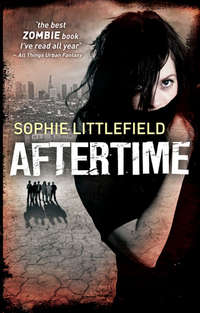
Aftertime
Sophie Littlefield

www.mirabooks.co.uk
For M, with love and regret
There you are and always will be
In your pretty coat
Skating lazy eights
on the frozen pond of my heart
ACKNOWLEDGMENTS
The existence of this book is a testament to the tenacity and vision of two people: my agent, Barbara Poelle, who only accepts “no” when it suits her—and my editor Adam Wilson, who gets it and then some. In the moments when the story shines, it’s because of them.
Thanks, too, to the entire Harlequin team, who made me feel welcome from day one.
01
THAT IT WAS SUMMER WAS NOT IN DOUBT. The nights were much too short and the days too long. Something about the color of the sky said August to Cass. Maybe the blue was bluer. Hadn’t autumn signaled itself that way Before, a gradual intensifying of colors as summer trailed into September?
Once, Cass would have been able to tell from the wildflowers growing in the foothills where she ran. In August petals fell from the wild orange poppies, the stonecrop darkened to purplish brown, and butterweed puffs drifted in lazy breezes. Deer grew bold, drinking from the creek that ran along the road. The earth dried and cracked, and lizards and beetles stared out from their hiding places among the weeds.
But that was two lives ago, so far back that it was like a story that had once been told to Cass, a story maybe whispered by a lover as she drifted off to sleep after one too many Jack and Cokes, ephemeral and hazy at the edges. She might not believe it at all, except for Ruthie. Ruthie had loved the way butterweed silk floated in the air when she blew on the puffs.
Ruthie, who she couldn’t see or touch or hold in her arms. Ruthie, who screamed when the social workers dragged her away, her legs kicking desperately at nothing. Mim and Byrn wouldn’t even look at Cass as she collapsed to the dirty floor of the trailer and wished she was dead.
Ruthie had been two.
Cass pushed herself to go faster, her strides long and sure up over a gentle rise in the road. She was barely out of breath. This was nothing, less than nothing. She dug her hard, sharp nails into the calluses of her thumbs. Hard, harder, hardest. The skin there was built up against her abuse and refused to bleed. To break it she would need something sharper than her nail. Teeth might work, but Cass would not use her teeth. It was enough to use her nails until the pain found an opening into her mind. The pain was enough.
She had covered a lot of ground this moon-bright night. Now it was almost dawn, the light from the rising sun creeping up over the black-blue forest skeletons, a crescent aura of orange glow in the sky. When the first slice of sun was visible she’d leave the road and melt into what was left of the trees. There was cover to be found—some of the native shrubs had survived. Greasewood and creosote still grew neck high in some places.
And it was easy to spot them. You saw them before they saw you, and then you hid, and you prayed. If they saw you at all, if they came close enough to smell you, you were worse than dead.
Cass stayed to the edge of the cracked pavement of what had been Highway 161, weaving around the occasional abandoned car, forcing herself not to look inside. You never knew what you would see. Often nothing, but … it was just better not to look. Chunks of the asphalt had been pushed aside by squat kaysev plants that had managed to root in the cracks. Past the shoulder great drifts of it grew, the dark glossy leaves hiding clusters of pods. The plants were smooth-stemmed without burrs or thorns. Walking among them was not difficult. But walking on pavement allowed Cass, now and then—and never when she was trying—to let her mind go back to another time … and when she was really lucky, to pretend all the way back two lifetimes ago.
Taking Ruthie, barely walking, down the sidewalk to the 7-Eleven, buying her a blue raspberry Slurpee, because Ruthie loved to stick out her blue tongue and look at herself in the mirror. Cutting across the school parking lot on the way home, jumping over the yellow lines, lifting Ruthie’s slight body and swinging her, laughing, through the air.
Yes, pavement was nice. Cass had good shoes, though she didn’t remember where she got them. They seemed like they might have been men’s shoes, plain brown lace-up walking shoes, but they fit her feet. A small man, then. How she’d got the shoes from him … it didn’t bear thinking about. The shoes were good, they were comfortable and hadn’t given her blisters or sores despite the many days of walking.
A movement caught her eye, off in the spiky remains of the woods. Cass stopped abruptly and scanned the tree skeletons and shrubs. A flash of white, was it? Or was it only the way the light was rising in the sky, reflected off … what, though? There were only the bare trunks of the dead cypress and pine trees, a stand of dead manzanita, the low thick growth of kaysev, a few of the boulder formations that dotted the Sierra Foothills.
Snap
Cass whipped her head around and saw the flash again, a fast-moving blur of fabric and oh God it was white, a slip of a little dark-haired girl in a dirty white shirt who was sprinting toward her at a speed that Cass could not imagine anyone moving, Cass who had run thousands of desperate blacktop miles one life ago, trying to erase everything, running until her legs ached and her lungs felt like tearing paper and her mind was almost but never quite empty.
But even Cass had never run like this girl.
She was twelve or thirteen. Maybe even fourteen, it was hard to tell now. Before, the fourteen-year-olds looked like twenty-year-olds, with their push-up bras and eyeliner. But hardly anyone dressed like that anymore.
The girl held the blade the way they taught the kids now, firmly in front of her where it would have the best chance of slicing through a Beater’s flesh. Because that’s what she thought Cass was, a Beater, and the thought hit Cass in the gut and nearly knocked her over with revulsion. Her hands went to her hairline where the hair was just growing back in, soft tufts, an inch at most. She knew how her arms looked, covered with scabs, almost worse now that they were healing, the patches of flesh falling away as the healthy skin pushed to the surface. But that was nothing compared to the ruin of her back.
She hadn’t been able to clean herself in days, and she knew she carried the smell. The long hair on the back of her head, the hair she hadn’t pulled out, was knotted and tangled. Her nails were blackened and broken. Real Beaters usually had no nails left, but how could the girl be expected to notice a detail like that?
In the second or two it took the girl to cross the last dozen yards of scrubby land, Cass considered standing firm, wrists out, chin up, giving her an easy target. They were taught well; any child over the age of five could find the jugular, the femoral, the carotid, the ulnar. They practiced on dummies rigged from dolls and clothes stuffed with straw. Sometimes, they practiced on the dead.
At the last minute Cass stepped out of the way.
She didn’t know why. It would have been easier, so much easier, to welcome the blade, to let it find its path to her vital core and feel the blessed release of her blood, still hot and red despite everything, bubbling over the slice in her flesh, falling to the hardened earth. Maybe her blood would help the land heal faster. Maybe on the spot where her blood fell, one of the plants from Before would return. A delicate mountain bluebell; they had been her favorite, the tiny blossoms shading from pale sky blue to deep lilac.
But Cass stepped out of the way.
Damn her soul.
Three times now it had refused to die, when death would have been so much easier.
Cass watched almost impassively as her foot shot forward, nimbly, her stance steady and her balance near perfect. The girl’s eyes went wide. She tripped, and in the last moment, when the blade flew from her hand and she lurched toward Cass, the terror in her eyes was enough to break Cass’s heart, if only she still had one to break.
02
EVERYONE REMEMBERED THE FIRST TIME THEY saw a Beater. Usually, it was more than one, because even in the early days they gathered in packs, three or four or more of them prowling the edges of town.
Cass saw hers in the QikGo.
Cass worked in the QikGo until the end. Where else would she go? She couldn’t leave Silva, not without Ruthie. But as the world fell apart—as famine crippled Africa and South Asia, as one G8 capital after another fell to panic and riots in the wake of random airbursts, as China went dark and Australia mined its shores—Mim and Byrn held on all the tighter to their granddaughter. Cass had no detailed plan, only to wait until there were no more police, no sheriffs, no social workers, no one willing to come when Mim and Byrn called them to block Cass from seeing her daughter or even setting foot on their property.
When that day came, she would go to their house and she would take Ruthie back. By force if she had to. It would hurt, to see the anger and contempt on her mother’s face, but no more than it had hurt her that Mim refused to acknowledge how far Cass had come, how hard she had worked to be worthy of Ruthie. The ninety-days chip she kept on her key chain. The two-year medallion she’d earned before her single relapse. The job she’d held through it all—maybe managing a convenience store wasn’t the most impressive career in the world, but at least she was helping people in small ways every day rather than fleecing them out of their money, the way Byrn did with his questionable investment strategies. But she and her mother saw things through very different lenses.
It would not hurt Cass to see her stepfather, who was finally weaker than she was, his ex-linebacker frame now old and frail compared to her own body, which she had made lean and hard with her relentless running. She anticipated the look of powerlessness on Byrn’s face as she took away the only thing he could hurt her with. She looked forward even more to the moment when he knew he had lost. She would never forgive him, but maybe once she got Ruthie back, she could start forgetting.
That time was almost upon them. Cell phone service had started to go in the last few days and the landlines hadn’t worked for a week. Televisions had been broadcasting static since the government’s last official communication deputizing power and water workers; that had been such a spectacular failure, skirmishes breaking out in the few remaining places there had been peace before, that the rumor was the government had shut down all the media on purpose. Some said it was the Russian hackers. Now they said the power was out over in Angel’s Camp, and every gas station in town had been looted except for Bill’s Shell, where Bill and his two sons-in-law were taking shifts with a brace of hunting rifles.
Who was going to care about the fate of one little girl now?
Two days earlier Cass had stopped taking money from customers unless it was offered. Some people seemed to find comfort in clinging to routines from what was quickly becoming “Before”—and if people reached for their wallets then Cass made change. People took strange things. There were those who had come early on for the toilet paper and aspirin and bottled water—and all the alcohol, to Cass’s relief. Now people wandered the aisles aimlessly and took random items that would do them no good anymore. A prepaid calling card, a map.
Meddlin, her boss, hadn’t made an appearance for a few days. The QikGo, Cass figured, was all hers. No matter. She didn’t care about Meddlin. The others, the fragile web of workers who staffed the other shifts, had been gone since the media went silent.
On a brisk March morning, a day after the lights started to flicker and fail, Cass was talking to Teddy, a pale boy from the community college who lived in the apartments down the block with a handful of roommates who didn’t seem to like him very much. Cass made coffee, wondering if it would be the last time, and wiped down the counter. There hadn’t been a dairy delivery in weeks, so she set out a can of the powdered stuff.
When the door jangled they both turned and looked.
“Feverish,” Teddy said quietly. Cass nodded. The ones who’d been eating the blueleaf—the ones who’d lived—were unmistakable. The fever made their skin glow with a thin sheen of perspiration. Their movements were clumsy. But most remarkable were their eyes: the pupils contracted to tiny black dots. In dark-eyed people the effect was merely unsettling; in pale-eyed people it was both captivating and frightening.
If everything hadn’t fallen apart, there would have undoubtedly been teams of doctors and scientists gathering the sick and studying and caring for and curing them. As it was, all but those closest to the sick were just happy they kept to themselves.
“Glass over over,” one of them said, a man whose plaid shirt was buttoned wrong so that one side hung farther down than the other, speaking to no one in particular. A second, a woman with lank brown hair that lay around her shoulders in uncombed masses, walked to a rack that held only a few bags of chips and pushed it with a stiff outstretched hand, and as it fell to the floor, she smiled and laughed, not bothering to jump out of the way of the bags which popped and sprayed dry crumbs.
“Gehhhh,” she crowed, and Cass noticed something else strange about her, something she hadn’t seen before. The woman’s arms were raw and red, blood dried in patches, the skin chafed and missing in spots. It almost looked like a metal grater had been run up and down her arms, her shoulders, the tops of her hands. Cass checked the others: their flesh was also covered in scabs.
Cold alarm traveled up Cass’s spine. Something was wrong—very wrong. Something even worse than the fever and the unfocused eyes and the incoherent speech. She thought she recognized one of the group, a short muscular man of about forty, whose complicated facial hair was growing out into a sloppy beard. He used to come in for cigarettes every couple of days. He was wearing filthy tan cargo shorts, and the skin above his knees was covered with the same sort of cuts and scrapes as his forearms.
“Hey,” she said to him. He was standing in front of a shelf that held the few personal products left in the store—bottles of shampoo and mouthwash, boxes of Band-Aids. “Would you like …”
Her voice trailed off as he turned and stared at her with wide unblinking blue eyes. “Dome going,” he said softly, then raised his wounded forearm to his face and, eyes still fixed on her, licked his lips and took a delicate nip at his red, glistening skin. His teeth closed on the damaged flesh and pulled, the raw layers of dermis pulling away from his arm, stretching and then splitting, a shred of flesh about the size of a match tearing away, leaving a bright, tiny spot of blood that glistened and pooled into a larger drop.
For a moment he stared at her, the strip quivering between his teeth, and then his tongue poked out and he drew the ruined skin into his mouth and he chewed.
“Holy fuck, dude,” Teddy exclaimed, stepping back so fast that his foot thudded against the front of the counter. Cass’s stomach turned with revulsion—the man had chewed off his own skin and eaten it. Is that what had happened to his entire arm? Were the scabs and open wounds his own doing?
“Fuck dude,” the man mumbled as he burrowed his teeth along the ruined flesh of his arm, his tongue probing and searching. Looking for undamaged skin, Cass realized, horrified. The pattern of the wounds—covering the forearm and upper arm, fading at the elbow—it was exactly consistent with what he could reach with his own mouth, and, as if to confirm her suspicion, the man twisted his forearm in his mouth, seeking out any bit of flesh that was left undisturbed, finally trailing up to his hand and taking a deep bite from his scabby palm so that blood trickled between his lips and ran down his chin.
“Out,” Cass managed to say. “Get out.” She ran to the thin woman, the one who had toppled the chip stand, and pushed. The woman staggered backward, regarding Cass with faint interest.
“Cass,” she mumbled, as she found her footing. “Cass castle hassle.”
Cass stared at her. Then she made the connection: this was the girl who worked at the bank, on days when Cass took the cash down to deposit. Only Cass hadn’t seen her in a few weeks, since the banks closed, their windows shattered by looters who thought cash might somehow help, cash they found they couldn’t get because it was sealed in vaults no one could open.
The young woman used to wear her hair differently. She curled it every morning, and she favored bright eye shadow, green that shaded to black around her carefully rimmed lashes. She’d worn low-cut tops and dresses in colorful patterns, a far cry from what she wore now, a red knit t-shirt several sizes too big that was only partway tucked into her jeans.
“Do you know me?” Cass demanded, but the girl’s eyes flickered and shifted, and she murmured something that sounded like “yam yam” before shuffling over to where the others stood.
“Something’s fucked up with them,” Teddy said. “Do you hear that? They’re all like … delirious.”
Cass nodded. “We have to get them out.”
Teddy slipped past the little group and held the door open wide. “We were just getting ready to close,” he stammered, and despite her unease Cass noticed the “we” and was glad. Maybe Teddy would stay. Maybe he would keep her company. And when there was nothing left in the store to give away, maybe he would be there to help her figure out what to do next. Cass had been on her own for a long time now, and she had told herself she didn’t want anyone else, even on the days when she felt most alone, when the craving for a drink was almost unbearable.
But maybe, now, she did. A friend. How long since she had a friend?
Buoyed by the thought, she went up to the three feverish people. She put her hands to the back of the girl’s shirt, trying not to look at the raw and weeping flesh of her limbs, and pushed. The girl allowed herself to be guided to the door, and the others followed. When Cass got them outside, she ducked back in and shut the door, twisting the heavy bolt into place.
The day had been warm, but a low layer of clouds made a thin shadow over the sun. The three people she had locked outside looked up at the sun without blinking. Cass wondered if they were slowly going blind.
The girl took a step toward the man with the misbuttoned shirt, and for a moment Cass thought she was kissing him, pushing her face into the back of his neck. He didn’t flinch, but he didn’t turn to embrace her either.
“That’s—he’s—” Teddy said in alarm and Cass looked closer.
The woman shook her head and only then did Cass realize she’d sunk her teeth into the man’s flesh and was tugging at it. Tearing at it. Trying to rip off a shred.
Teddy turned away and vomited on the floor, as a bright trail of blood snaked down to the man’s collar, and the woman began to chew.
03
THE GIRL WITH THE BLADE WAS NAMED SAMMI, but Cass didn’t find that out until later. As dawn broke, they left the road and traveled through the woods. By the time they got to the school, maybe a mile down, the sun was high in the sky. It was the clearest sky yet since Cass had returned, flawless blue, and as they rounded a sharp bend topped by a rock outcropping and what must have once been a beautiful stand of cypress, the school stood out in stark relief against the eye-searing blue.
It had been built in the last few years Before. The architect had gone in for broad stretches of stucco, a roof molded to look like cedar, vaguely Prairie-style window placement and overhanging eaves. The sign still announced, in iron letters against hewn stone, Copper Creek Middle School.
Cass knew this school. They’d built it halfway between Silva and Terryville. She had driven past it a hundred times, thinking about Ruthie going there someday.
She was close to home.
The girl hadn’t spoken a single word. Cass tapped the girl’s blade against her own thigh, loosening her grip on the wind-breaker she’d taken off and looped through the girl’s sleeves as a kind of makeshift harness before remembering the dangers and grabbing it even tighter. I’m sorry, she mouthed, but only because the girl couldn’t see. She led them across the parking lot with sure, quick steps, shoulders held high, and Cass couldn’t help but admire her courage.
For all the girl knew, Cass would have followed through with her threat and sliced her ear to ear. The blade was a good one, a two-edged straight stiletto with a small guard, the blade itself perhaps six inches long. Someone loved this girl. Someone had made sure she had a good weapon, had cared if she lived another day.
She pulled the girl tight against her and bit out the words, hating herself for saying them—and knowing they were lies. “When someone comes out, tell them I’ll kill you,” she murmured. “Tell them that first.”
The girl only nodded.
It made sense to choose a school, of course. The threats of Before seemed minor now. Everyone worried that deranged people would come into schools and steal the children away, harm them, kill them. Or that one of the students would bring a gun to school and take out his classmates. Yes, things like that had happened back then, just often enough to keep everyone vigilant, and the schools had been built with more and greater safety measures until, in the end, they were fortresses, reinforced and sealed and locked down.
In some ways it wasn’t so hard to stay safe, even now. A basic wall could keep Beaters away. A fence, even one that was only ten feet tall, like those that surrounded the school’s courtyard. As long as there were no citizens close by, nothing to attract the Beaters and drive them into a frenzy of flesh-lust, nearly any barrier at all would be enough to make them lose their focus and wander back to their fetid nestlike encampments.
They said—at least, near the end of Cass’s second life—that the Beaters were waning. Cass wasn’t so sure. It was true that they had formed larger and larger groups, nomadic little bands that took over neighborhoods and entire towns, so they weren’t appearing in sporadic places as much. They seemed to have flashes of longing for Before, just as everyone else did. You could see them sometimes, doing homely little things. It was like the bits of speech that sometimes bubbled from their lips, phrases that meant nothing, fragments that tumbled from whatever was left of their minds, dislodged from memory that had given way to the fever and the disease. Cass had seen one trying to ride a bicycle, and falling off when its jerky motions caused the wheel to spin and flip. It tried again and again and then suddenly lost interest and wandered away. Another time she had seen one at a clothesline, taking the pins off one by one and holding them in its ruined hand, then reattaching them.
Cass had known a woman who had been a social worker Before. Her name was Miranda. They had not been friends, exactly, but they had sheltered together in the library before a half-dozen Beaters came through a back door that had been left open one day and dragged her off.
Miranda had once worked with violent offenders, counseling them to look deep inside themselves to find the key to who they were before abuse and anger had changed them. She had been extraordinarily successful, the pride of the Anza County Correctional System’s Anger Replacement Therapy program. Miranda had believed that in those moments when the Beaters appeared to be connecting to a memory, miming some homely everyday task, there was a chance to remind them of who they had once been. That if you could reach them in that moment—if you could reconnect the splintered shards of memory—that you could reverse the process of the disease. That the afflicted would comprehend the horror of what they had become, and choose to come back.
Miranda had wanted to try it. It wouldn’t be so hard to capture just one, she had argued at one of the “town hall” meetings Bobby held every few days. Bobby was the de facto leader of the ragtag group of a few dozen people sheltering in the library. Miranda tried to recruit a few of the men: one who used to be a deputy sheriff, several hard-muscle types who’d worked in construction, and, of course, Bobby. They all listened to Miranda’s plan: capture a Beater, bring it back … restrain it, observe it. Wait until the right moment and then she, trained in the ways of the desperate, the outcast, would speak to it.
Bobby listened, but he could not contain his incredulity. “You think you’re, what, some kind of zombie whisperer? Because you got a few crack whores to give up their babies? Is that it, Miranda, you think a Beater’s like some guy beats his wife on payday?”
Miranda had argued back, passionately. But when the Beaters came for her that day, breaking in that forgotten back door while the kitchen detail was cleaning up from a lunch of kaysev shoots and canned apple pie filling, when Miranda had taken some trash to the back hall by herself, it wasn’t reasoned argument that issued from her lips. It was screaming, as raw and desperate as the screams of any of the others who were taken, screams that echoed in Cass’s mind on nights when sleep wouldn’t come.
The school, though … Cass guessed that they had not lost anyone that way here. In addition to the fences, brick walls surrounded the entire courtyard. The doors would be the type that shut automatically. Guards would be posted. They undoubtedly did all their harvesting and raiding at night. Maybe they even had a few flashlights, some batteries.
Why had they let this girl out on her own? It made no sense. Even though it should have still been safe—the Beaters rarely went hunting before the sun rose high in the sky—what adult, what parent, would allow a child to go out alone? Had she somehow gotten separated from others? Had some greater threat come along?
There was a sudden clang and the door to the school burst open and a woman ran out, wailing. Her flip-flops slapped against the pavement, and she stumbled at the kaysev-choked median that once kept the carpooling moms in orderly lines. A pair of men chased after her, trying to restrain her, but the woman shook them off. “Sammi!” she screamed, but Cass pulled the girl tight against her and held the blade to the soft skin under her chin.
“Stop there,” Cass yelled. And then she added the one thing that might convince them to do as she said. “I am not a Beater!”
She watched them look at her, watched the terror in the woman’s expression and the fury and determination in the men’s slowly tinge with doubt. She felt their gazes on her ragged skin, her scalp where the hair was only now growing back. She waited, holding her breath, until she saw that they knew.
Until they saw that her pupils were like anyone else’s, black and pronounced.
“I don’t want to hurt this girl,” she called, trying to keep her voice steady. “I don’t want any trouble. I am not a Beater and I can …” She had been about to say that she could explain her appearance, but that was a lie. She couldn’t explain, and no one else could either. “I can prove it, if you let me. I’m not asking to come in. I don’t want anything from you except to be allowed to continue into town.”
“Let the girl go,” one of the men said.
The woman sank down to her knees and extended her arms beseechingly. “Please,” she keened. “Please please please please please …”
And something shifted inside Cass. A memory of Ruthie being carried away, screaming, sent to live with Cass’s mother and the man she’d married. The man who’d made her life hell. She remembered her own pleas, how she had gone down on her knees just like the woman before her now, how she’d collapsed on the floor after the front door shut behind Mim and Byrn and the court people carrying her Ruthie away, how she’d cried into the sour-smelling carpet until she could barely breathe.
She released the girl then and watched her go to her mother, jogging across the pavement, but not before glancing back over her shoulder. A defiant glance, sparked with victory. The girl felt she’d won. Well, Cass certainly felt like she’d lost, so maybe that was fitting.
The mother gathered the girl up in her arms as though she wanted to meld her to herself, and Cass had to turn away. The men must have thought she was trying to leave, though, because an instant later she was knocked to the ground and she felt the weight of them crushing her into the gravel-pocked asphalt. The rough pavement smelled like tar and scraped against her cheek. The blade had fallen from her hand. No matter; these men were guards. They would have their own. And it would be a quick death, better than she deserved.
She waited, but after a moment the weight lifted and a strong hand grabbed hers, pulling her up roughly.
“Inside,” he said, and that was the first word she ever heard Smoke say.
04
THEY HAD SET UP A KITCHEN OF SORTS IN THE school’s courtyard, and a small crew was cooking over a fire in a makeshift hearth. Ginger: the scent of sautéed kaysev was in the air. A group of children sat at a table taken from one of the classrooms, eating, and Cass saw that they’d made the kaysev into a sort of pancake. She’d seen that before, when people were figuring out different ways to prepare the plant. After so many weeks of eating it raw, the smell of the cakes—made with a flour ground from the dried beans—prompted a powerful hunger she didn’t know she was capable of anymore.
And there was another smell, one that made her doubt her senses. “Is that—”
“Coffee.” Her escort was a man of medium height, hard-muscled, with broad shoulders and powerful forearms. Sun-streaked brown hair fell into his chambray-blue eyes and he kept pushing it impatiently aside. His mouth was on the generous side, almost sensuous, but his expression was hard. “Once a week, on Sunday. It’s strong but you only get one cup.”
“You know what day it is?” Cass asked, surprised. Who kept track, anymore?
The man didn’t answer, but led her over to a door that stood open, propped with a stack of books. U.S. History, Cass read on the spines. Books, left out to the elements—who would abandon a book outside to be ruined?—but thoughts like that led straight to a spiral of despair.
Whenever something reminded her of Before, it was a quick trip back and it hit her hard. Like now: textbooks had been sacred, once. But books needed readers. And all the teachers were dead from hunger or disease or riots, or dragged off by the Beaters, or desperate, like Cass, just to survive. There was no one left to teach children like Ruthie.
Cass forced those thoughts from her mind as the man guided her into the hallway, his hand at her waist gentler now. Earlier, he’d been rough as he searched her, patting down the ragged and stinking canvas pants and athletic shirt that stuck to her, the same clothes she’d woken up in a couple of weeks earlier. He’d avoided touching her scabbed flesh, and stopped short of searching the folds and crevices of her body, for which she was grateful. He’d lingered at her hair, combing his fingers through its greasy, filthy length while he held the ends bunched in his fist. The stubble at the front had caused him to frown, but he’d said nothing.
It had hurt like hell when his hands moved along her back, and she’d ground her teeth to avoid crying out in pain. There, whole sections of flesh had been ripped from her body and it was taking much longer to heal than the scabs on her arms. An ordinary citizen would have succumbed to infection, blood loss, exposure. But somehow in the days after the things tore into her back, she had developed a freakishly powerful immune system and was healing. How she had recovered from the disease, she had no idea.
But thin layers of skin were slowly building from the scabbed edges. Smoke had not detected anything amiss in the ruined landscape of her back, and for that Cass was grateful. She didn’t want him to see.
Cass blinked as her eyes adjusted from the bright morning sun to the gloom of the interior. A single transom window lit the space; the other windows were covered by miniblinds. They were in what had been the school’s administrative office. The bulletin boards had been stripped bare except up at the top where a few ragged papers were still attached with pushpins. ARTCARVED—ORDER YOUR CLASS RING NOW one read. Another advertised $$CASH$$ FOR PRINTER CARTRIDGES.
A woman came around the corner and stopped short, staring at Cass with shock, processing her appearance.
“We found her outside,” the man said quickly. “She brought Sammi back.”
The woman merely nodded, but Cass could see the relief written plain on her face. A child had been missing. The people sheltering here had been waiting, knowing it was likely that their beautiful young girl would never return. None of them were new to loss now—by most estimates, three-quarters of the population was dead, victims of starvation and fever and suicide and Beaters. You learned to protect yourself. But the cost of steeling yourself against grief was that you had to steel yourself against joy, as well.
“You might as well have some,” the woman said, and only then did Cass notice that she carried a glass carafe of steaming black coffee. “Get her a cup, Smoke.”
The man called Smoke went into the hall, leaving the woman to stare openly at Cass. She was a lean woman with poorly cut hair, pieces of it jutting unevenly at her cheekbones. But she was clean—remarkably so. Her skin looked healthy and her eyes were clear. Cass found herself wondering if she was the man’s lover, and her gaze went to the woman’s fine small hands, the nails trimmed neatly. Her smooth pale legs under the plain denim shorts.
“I’m Nora,” the woman said.
Cass cleared her throat. Until this morning, she hadn’t spoken in many days, and she was out of practice. “I’m Cassandra. Cass.”
Smoke returned carrying a large blue mug. Nora poured from the carafe and Cass accepted the mug and held it near her lips, not sipping, the glazed porcelain almost too hot to bear. Her eyes fluttered closed as she inhaled as deeply as she could, and when she opened them, she saw that Smoke was staring at her with an expression that was part curiosity and part calculation, and no part fear.
She drank.
The taste brought back a sharp memory of the room in the basement where she attended a thousand A.A. meetings. The first time she accepted a cup of coffee only because everyone else was drinking it. She’d never liked it much, drank it only on the occasional morning when she needed a little extra lift to get going, but at that meeting she drank two cups and on the way home she bought a ten-cup model at Wal-Mart, along with two pounds of ground beans.
At work, she made the first pot at 5:30 a.m. when her shift started and the last—dozens of pots later—when whoever was on afternoons arrived at two o’clock.
This coffee was a little odd. It was like the kind her mother used to make before her father left, in an old tin percolator with green enamel flowers worn nearly away. For a moment Cass felt an intense ache for her mother—for who she’d been before she met Byrn, before she started insisting that Cass call her Mim. For the woman who’d once read to her at bedtime, who’d let Cass bury her face in the crook of her neck and breathe the soap and hair spray and perfume and sweat.
Slowly, not trusting her hand not to tremble, Cass lowered the mug to the table. “May I sit?”
“Yes, of course,” Nora said. She exchanged a look with Smoke as he pulled out a chair for her, and Cass was certain that these two were lovers. Only, troubled ones. You could see it in the way his gaze slid warily away.
Cass leaned over the mug and let the steam warm her face. “What’s today’s date?” she asked.
Nora blew out a little breath before she answered. “August twenty-sixth. It’s Sunday.”
August 26. So it had been almost two months since the end of what she’d come to think of as her second life.
She thought about that last day. Not the last moments, which she wouldn’t remember, but what came before.
She’d been sheltering in the library for a couple of months before she went to get Ruthie, determining that there was finally no one left to try to stop her. The first morning she had her baby back, they woke up together on the makeshift bed in Cass’s corner of the library, away from the others, tucked in a narrow corridor behind the periodicals, beneath a water fountain that hadn’t flowed in a month. Cass kept her space clean, her few possessions stacked and folded and arranged with care.
That day, she woke to the sweet scent of Ruthie’s hair, her small body tucked perfectly into her embrace, her head under Cass’s chin. She lay still, breathing happiness in and hope out, watching the sun cast strips of yellow light on the wall through the miniblinds. A week earlier, they’d lost Miranda, and Cass’s mood had faltered. But now that she had Ruthie, life seemed like a possibility once more.
“You going to explain that?” Nora said, not unkindly, pointing at Cass’s arms.
Cass folded them self-consciously. They hurt, but not as much as they had when she first regained consciousness, lying in an empty field. Then, she had been horrified at the way she looked, her wounds raw, the crusty scabs black in some places, leaking clear reddish fluid. Her back had been an agony of shredded flesh and it was still healing, but the wounds on her arms were almost completely healed, marking crisscross scars across her flesh.
“On the road,” she mumbled. “Things happen, you know. I fell … I ran into things.”
“No shit,” Nora said.
“Go easy,” Smoke murmured, a warning in his voice.
“Look at her,” Nora hissed, her voice low and angry. “We’ve seen that before. You know we have.”
Smoke shook his head. “It isn’t the same.”
“Only because you don’t want to see it!”
“The same as what?” Cass demanded.
Smoke looked at the table, wouldn’t meet her eyes. “There’s been a few kids—”
“Not just kids,” Nora interrupted.
“Mostly kids, teenagers, they cut themselves, they pull out their hair.”
“Why would anyone do that?” Cass asked, horrified.
“To look like Beaters,” Nora said. “To look like you. To mock the world. Or to come into settlements and everyone takes off screaming and then they help themselves to whatever they want—water, food, drugs, anything. That is, if they don’t get themselves shot first.”
“You think I—You’re fucking insane.” Cass’d been trying to hold on to her patience, but this—Nora’s implication that she had done this to herself on purpose—it was too much. “So where’s all my stuff, then? If I’ve been terrorizing citizens and stealing from them, where is it? I don’t have anything on me, nothing.”
“I don’t mean to—”
“Just let her tell her story.” Smoke glared at Nora, and after a long moment, the woman gave a faint shrug.
Cass took a breath, let it out slowly, considered how much she wanted to give away. These people could help her, or not. They could let her go, or not. Already she felt certain that they would. There was no cruelty in them, only caution, and who could blame them for that?
“The girl,” she hedged. “Sammi. Why was she out alone?”
“Why don’t you tell us about you first,” Nora said coldly, and this time she refused to acknowledge Smoke’s warning glance.
“All right.” Cass gathered her thoughts. “I lived in Silva. In Tenaya Estates. You know—the trailers.”
Smoke nodded. “I know the place.”
“I lived … alone. I worked at the QikGo off Lone Pine. Back in the spring, during the Siege, I stayed on for a while. I thought … I didn’t want to give up, I guess. But, you know, when they started coming into town more …”
She didn’t add that people stopped showing up at the A.A. meetings, until one day she was the only one in the room. That day, she knew she couldn’t live alone anymore.
“Anyway I went over to the library to shelter.” She dug her fingernails into the callus of her thumb, under the table where they couldn’t see. The next part was hard. “I was there the first time the Beaters came. When they took a friend of mine.”
And the second time.
She couldn’t bring herself to tell it. Not yet. “Are there still … is anyone still over there?”
“Yes, last time anyone was there, they were up to around fifty.” Smoke hesitated and Cass got the impression he wasn’t telling the truth—not all of it, anyway. “They got it reinforced. They haven’t lost anyone … not inside, anyway, in a while. We have eighty here. There’s a few dozen in the firehouse. And you know, you have your folks who are still trying to stay in their own places. More than you’d think, really.”
“Fewer every day,” Nora muttered.
“Not our place to judge,” Smoke said in a voice so low Cass was sure it was meant only for Nora.
“Do you talk to them … the people at the library?” she asked. Now that she was so close, fear bloomed in her heart.
“We did,” Smoke said. “Until … well, we had some trouble. A couple of weeks ago. Since then we’ve stayed local.”
“Seventeen days,” Nora said, with surprising bitterness.
Smoke nodded, acknowledging her point.
“What happened?”
“You don’t know?” The suspicion was back.
Cass looked from one to the other, mystified. “No, I don’t—I told you, I’ve been on my own since I woke up and—”
“Some people would just say that it’s awfully convenient that you can’t remember anything,” Nora said. “And that you just happen to show up after the Rebuilders set up camp over there.”
“Who are—”
“So now you want to accuse her of being a Rebuilder?” Smoke said. “Really, Nora? That’s a little paranoid, even for you.”
Nora scowled. “Freewalkers don’t threaten to kill children.”
“Everyone would have thought she was a—”
“Don’t say it,” Cass interrupted, resisting the urge to clap her hands over her ears. She couldn’t bear to hear the word, to hear the accusation, again. “Please. Look, why don’t I just leave now.”
“No one said anything about that,” Smoke said tiredly. “You’re safe here. Everyone’s just on edge. It’s been hard. Shit, no one needs to tell you that.”
For a moment no one spoke. Cass could feel Nora’s anger clogging the air still.
“All I want to know is how she’s managed not to be attacked,” she said, addressing Smoke alone. “Walking alone as long as she says she has—how does that happen?”
Cass glared back. “I’ve been lucky, I guess.”
“Lucky,” Nora repeated, spitting out the word as though it was poison.
“Listen to me. My daughter was there,” Cass snapped. “In the library. The second time we were attacked. We were outside. She wanted … to be outside.”
What Ruthie had really wanted was to pick dandelions, one of the few plants to survive the Siege. Cass had taught her to hold the blooms under her chin, so that the yellow reflected off her pale creamy skin. Oh, look, you must be made of butter, she teased Ruthie, peppering her sweet face with kisses. And then Ruthie would laugh and laugh and tickle Cass’s chin with bunches of dandelions wilting in her chubby little hands.
Ruthie wanted to pick dandelions, and they were hard to find at dusk, so it was barely twilight when Cass led her outside to the little patch of dead lawn in front of the library, after she looked carefully in every direction.
But not carefully enough. Because the Beaters were learning. And they had learned to hide. They hid behind a panel truck on two flat tires that had been abandoned half a block away … and they waited. And then they moved faster than Cass thought possible, awkward loping strides accompanied by their gurgling breathless moans, and Cass grabbed for Ruthie, who was tracing the path of a caterpillar with a stick and thought it was a game and danced out of the way and darted into the last glorious rays of sun as it slipped down the horizon—
The challenge drained from Nora’s face. “Don’t,” she begged.
Smoke placed a work-roughened hand over Nora’s and didn’t look at Cass.
“Nora,” he said heavily. “She, uh … her nephew. She was watching him.”
“I was supposed to be watching him,” Nora said hollowly. She pulled her hand away and stood, knocking over her chair. She backed out of the room, brushing against the coffeepot on the counter. It fell to the ground, shattering and splashing hot coffee, but she just turned and bolted down the hall.
“She’s …” Smoke said, watching her go. Then he turned back to Cass. “I’m sorry.”
“No need to apologize,” Cass said, but the truth was that she did need it. Not the apology—but the way his voice softened when he spoke to her and the way his eyes narrowed with concern when he looked at her, taking in what had happened to her poor body and not turning away.
That. Most of all she needed that, the not turning away.
“Something did happen to me,” she found herself saying, the words tumbling out as though a trapdoor had been opened inside her. “Something bad.”
Telling was crazy. Telling could get her thrown out of here. Or worse. But Smoke looked at her as though he saw her, saw the real her, and she wanted to hold on to that, wanted him to know the truth and still see her.
The kindness he’d already shown her should have been enough. Settle for that, she willed herself. Settle for good enough.
But Cass could never leave well enough alone. She didn’t know how. She wanted someone—one other human being—to know what had happened, and not turn away.
“Your daughter,” Smoke said softly. “Was she taken?”
“No,” Cass said. “But I was.”
Бесплатный фрагмент закончился.