Читать книгу: «Bones and Silence»
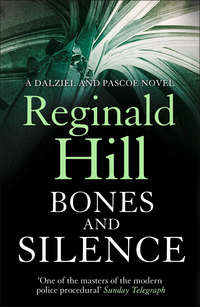
REGINALD HILL
BONES AND SILENCE
A Dalziel and Pascoe novel

Copyright
This novel is entirely a work of fiction.
The names, characters and incidents portrayed
in it are the work of the author’s imagination.
Any resemblance to actual persons, living or dead,
events or localities is entirely coincidental.
Harper An imprint of HarperCollinsPublishers 1 London Bridge Street, London SE1 9GF
First published in Great Britain by
HarperCollins 1990
www.harpercollins.co.uk
Copyright © Reginald Hill 1990
Reginald Hill asserts the moral right to
be identified as the author of this work
A catalogue record for this book
is available from the British Library
All rights reserved under International and Pan-American Copyright Conventions. By payment of the required fees, you have been granted the nonexclusive, nontransferable right to access and read the text of this e-book on-screen. No part of this text may be reproduced, transmitted, downloaded, decompiled, reverse engineered, or stored in or introduced into any information storage and retrieval system, in any form or by any means, whether electronic or mechanical, now known or hereinafter invented, without the express written permission of HarperCollins e-books.
HarperCollinsPublishers has made every reasonable effort to ensure that any picture content and written content in this ebook has been included or removed in accordance with the contractual and technological constraints in operation at the time of publication.
Source ISBN: 9780586211281
Ebook Edition © JUNE 2013 ISBN: 9780007370283
Version 2015-06-19
CONTENTS
Cover
Title Page
Copyright
Epigraph
Part One
Chapter One
Chapter Two
Part Two
Chapter One
Chapter Two
Chapter Three
Chapter Four
Chapter Five
Chapter Six
Chapter Seven
Chapter Eight
Part Three
Chapter One
Chapter Two
Chapter Three
Part Four
Chapter One
Chapter Two
Chapter Three
Chapter Four
Chapter Five
Chapter Six
Chapter Seven
Chapter Eight
Chapter Nine
Chapter Ten
Part Five
Chapter One
Chapter Two
Chapter Three
Part Six
Chapter One
Chapter Two
Chapter Three
Chapter Four
Chapter Five
Chapter Six
Part Seven
Chapter One
Chapter Two
Chapter Three
Chapter Four
Part Eight
Chapter One
Chapter Two
Chapter Three
Keep Reading
About the Author
By Reginald Hill
About the Publisher
Epigraph
We insist, it seems, on living. Then again, indifference descends. The roar of the traffic, the passage of undifferentiated faces, this way and that way, drugs me into dreams: rubs features from faces. People might walk through me … We are only lightly covered with buttoned cloth; and beneath these pavements are shells, bones and silence.
VIRGINIA WOOLF, The Waves
part one
God: First when I wrought this world so wide,
Wood and wind and waters wan,
Heaven and hell was not to hide,
With herbs and grass thus I began.
In endless bliss to be and bide
And to my likeness made I man,
Lord and sire on ilka side
Of all middle earth I made him then.
A woman also with him wrought I,
All in law to lead their life,
I bade them wax and multiply,
To fulfil this world, without strife.
Sithen have men wrought so woefully
And sin is now reigning so rife,
That me repents and rues forthy
That ever I made either man or wife.
The York Cycle of Mystery Plays: ‘The Building of the Ark’
January 1st
Dear Mr Dalziel,
You don’t know me. Why should you? Sometimes I think I don’t know myself. I was walking through the market place just before Christmas when suddenly I stopped dead. People bumped into me but it didn’t matter. You see, I was twelve again, walking across a field near Melrose Abbey, carefully balancing a jug of milk I’d just got from the farm, and ahead of me I could see our tent and our car and my father shaving himself in the wing mirror and my mother stooping over the camp stove, and I could smell bacon frying. It was such a good smell I started thinking about the lovely taste that went with it, and I suppose I started to walk a bit quicker. Next thing, I caught my toe in a tussock of grass, stumbled, and the milk went everywhere. I thought it was the end of the world but they just laughed and made a joke of it and gave me a huge plateful of bacon and eggs and tomatoes and mushrooms, and in the end it almost seemed they loved me more for spilling the milk than fetching it safely.
So there I was, standing like an idiot, blocking the pavement, while inside I was twelve again and feeling so loved and protected. And why?
Because I was passing the Market Caff and the extractor fan was blasting the smell of frying bacon into the cool morning air.
So how can I say I know myself when a simple smell can shift me so far in time and space?
But I know you. No, how arrogant that sounds after what I’ve just written. What I mean is I’ve had you pointed out to me. And I’ve listened to what people say about you. And a lot of it, in fact most of it, wasn’t very complimentary, but this isn’t an abusive letter so I won’t offend you by repeating it. But even your worst detractors had to admit you were good at your job and you weren’t afraid of finding out the truth. Oh, and you didn’t suffer fools gladly.
Well, this is one fool you won’t have to suffer much of. You see, the reason I’m writing to you is I’m going to kill myself.
I don’t mean straightaway. Some time soon, though, certainly in the next twelve months. It’s a sort of New Year Resolution. But in the meantime I want someone to talk to. Clearly anyone I know personally is out of the question. Also doctors, psychiatrists, all the professional helpers. You see, this isn’t the famous cry for help. My mind’s made up. It’s just a question of fixing a date. But I’ve discovered in myself a strange compulsion to talk about it, to drop hints, to wink and nod. Now that’s too dangerous a game to play with friends. What I think I need is a controlled outlet for all my ramblings. And you’ve been elected.
I’m sorry. It’s a big burden to lay on anyone. But one other thing which came out of what people say about you is that my letters will be just like any other case. You might find them irritating but you won’t lose any sleep over them!
I hope I’ve got you right. The last thing I want to do is to cause pain to a stranger – especially knowing as I do that the last thing I will do is cause pain to my friends.
Happy New Year!
CHAPTER ONE
‘I still don’t see why she shot herself,’ said Peter Pascoe obstinately.
‘Because she was bored. Because she was trapped,’ said Ellie Pascoe.
Pascoe used his stick to test the consistency of the chaise-longue over the side of which the dead woman’s magnificently ruined head had dangled thirty minutes earlier. It was as hard as it looked, but his leg was aching and he sat down with a sigh of relief which he turned into a yawn as he felt his wife’s sharp eyes upon him. He knew she distrusted his claims to be fit enough to go back to work tomorrow. He would have gone back today only Ellie had pointed out with some acerbity that February 15th was his birthday, and she wasn’t about to give the police the chance to ruin this one as they had the last half-dozen.
So it had been another day of rest and a series of birthday treats – breakfast in bed, an early gourmet dinner, front row stalls at the Kemble Theatre’s acclaimed production of Hedda Gabler, all rounded off with after-show drinks on the stage, provided by Eileen Chung, the Kemble’s Director.
‘But people don’t do such things,’ Pascoe now asserted with Yorkshire orotundity.
Ellie looked ready to argue but he went on confidentially, ‘I can smell a rotting fish when I see one, lass,’ and belatedly she recognized his parody of his CID boss, Andy Dalziel.
She began to smile and Pascoe smiled back.
‘You two look happy,’ said Eileen Chung, approaching with a new bottle of wine. ‘Which is odd, considering you paid good money to be harrowed.’
‘Oh, we’re harrowed all right, only Peter’s worst instincts tell him Hedda was murdered.’
‘And how right you are, Pete, honey,’ said Chung, easing her seventy-five inches of golden beauty on to the chaise-longue beside him. ‘That’s exactly what I wanted to get across. Let me fill your glass.’
Peter glanced round the stage. The rest of the Kemble team seemed to be taking their leave. He began to ease himself up, saying, ‘I think we should be on our way …’ but Chung drew him down again and said, ‘Why the rush?’
‘No rush,’ he said. ‘I’m not back at the rushing stage yet.’
‘You’ve got a very distinguished limp,’ she said. ‘And I just love the stick.’
‘He’s embarrassed by the stick,’ said Ellie, sitting at his other side so that he felt pleasantly squeezed. ‘I suspect he feels it detracts from his macho image.’
‘Pete. Baby!’ said Chung, putting her hand on his knee and looking deep into his eyes. ‘What’s a stick but a phallic symbol? You want a bigger one maybe? I’ll look in our props cupboard. And think of all the wild, wild men who’ve been lame. There was Oedipus, now he was a real motherfucker. And Byron. God, even his own sister wasn’t safe –’
‘Unhappily Peter is both an orphan and an only child,’ interrupted Ellie.
‘Aw shit. Pete, I’m sorry. I didn’t know. But there’s plenty of others without the family hang-ups. The Devil, for instance. Now he was lame.’
And Peter Pascoe, up to this moment more than content to accept this heavy-handed ribbing as a fair price for the privilege of being sandwiched between Ellie whom he loved, and Chung whom he lusted after, knew that he was betrayed.
He began to rise but Chung was already on her feet, her face alight with a let’s-do-the-show-in-the-barn glow.
‘The Devil,’ she throbbed. ‘Now there’s an idea. Pete, honey, give me a profile. Fan-tastic. And with the limp, per-fection! Ellie, you know him best. Could he do it? Or could he do it?’
‘He’s got many diabolic qualities,’ admitted Ellie.
This had gone far enough. There were some advantages to having a stick. He brought it down savagely on Hedda Gabler’s coffee table, which he could do with a clear conscience as it belonged to him. Chung collected props like old Queen Mary collected antiques – she admired them into gifts. But she wasn’t going to make a gift out of him.
Ellie was much to blame, but not as much as himself. He’d forgotten the golden rule – any friend of Ellie’s was guilty until proven innocent, and probably longer. He’d been as suspicious as Ellie had been enthusiastic when the newly appointed Director of the Civil Theatre had clarioned her commitment to socially significant drama. But her beauty and charisma had made a rapid conquest of him. Her paymasters, the Borough Council, were less easy targets. Their stuff was brass not flesh and there was much concern lest they had taken a lefty viper to their righteous bosoms. But when her Private Lives (transplanted to Skegness and Huddersfield) had been a box office success surpassed only by her Gondoliers of the Grand Union Canal, the city fathers, realizing their clouds of doubt had brass linings, had relaxed and drifted with the cash-flow.
But it was her latest project aimed at God as well as Mammon which should have set his storm warning flashing.
Chung had proposed a huge outdoor production of the Mediaeval Mysteries. It was to be an eclectic version, though with a jingoistic concentration on the York and Wakefield cycles, it would run for seven days in early summer, and all the Powers that Were looked upon the project and saw that it was good. The clergy approved because it would make religion ‘relevant’, the Chamber of Commerce because it would pack the town with tourists, the Community Leaders because it would revitalize cultural identity by employing vast numbers of locals as performers, and the City Council because the locals wouldn’t expect to be paid. Some mutterings about idolatry and blasphemy came from a few inerrantist outposts, but these were drowned in the great surge of approval.
At first it was assumed that Chung would cast her resident company in the main speaking parts, perhaps importing a middling magnitude telly star to give some commercial clout to Jesus, but here she took everyone by surprise.
‘No way,’ she told Ellie. ‘My gang are going to be planted deep in the crowd scenes. That’s where you need the professional stiffening in this kind of caper. Stars I can create!’ So the great hunt had started. Every amateur thespian in the area started sending press-cuttings to the Kemble. Aged Jack Points, stripling King Lears, Lady Macbeths of the Dales, infant prodigies, Freds ’n’ Gingers, Olivier lookalikes, Gielgud soundalikes, Monroe mouealikes, Streep stripalikes, the good, the bad, and the unbelievable were ready to stride and strut, fume and fret, leap and lounge, mouth and mumble, emote and expire before Chung’s most seeing eye.
But for the most of them, their rehearsals were in vain. Chung saw to it that all their cuttings were returned with thanks, for she knew how precious are the records of praise, but the accompanying message was, why don’t you go and get lost in the crowd scenes? For Chung had not been wasting her short time in this city. She was gregarious, went everywhere, forgot nothing. Those who met her were charmed, shocked, intrigued, revolted, amused, amazed, entranced, entramelled, but never indifferent. And though many would have loved it, few realized they had already been on Chung’s casting couch. By the time she broached the Mysteries project, her mental cast list was almost complete.
Her intimates had been invited to help in snaring the more unwilling victims. Pascoe had been vastly amused when Ellie let drop some hilarious hints of Chung’s remorseless quest, never for one moment suspecting that he might be himself a target!
But now his defences were fully aroused. He swung his stick at the coffee table again.
‘No!’ he cried. ‘I won’t do it!’
The women looked at each other with barely concealed amusement.
‘Do what, honey?’ asked Chung with solicitous innocence.
It was time to be clear beyond even the muddying powers of these practised pond-stirrers.
He said slowly, ‘I am not going to be the Devil in your Mysteries. Not now. Not ever. No way.’
He examined his statement carefully. It seemed pretty limpid.
Now the women were looking at each other in amazement.
‘But, Peter, of course you’re not! Where did you get that idea from?’ said Chung with the wide-eyed surprise of one who suspects this is no longer Kansas.
‘Peter, for heaven’s sake, what’s got into you?’ demanded Ellie with the exasperation of a wife being shown up in front of her friends.
It was time for continued firmness. He heard himself saying, ‘But you were talking about my limp … and the Devil being lame … and me fitting the part …’
‘Just a gag. Pete. What do you take me for? Hell, with luck, by the time the show goes on you’ll hardly be limping at all. I mean, you’re going back to work tomorrow, aren’t you? Do you think I’d take the piss out of anyone who was really disabled? Besides, you’re far too nice and amiable. The man I’ve got in mind looks as proud and prickly as Lucifer, not your type at all!’
He had a feeling that, though not yet quite sure what the wrong was, he was sinking deeper and deeper in it. But that didn’t matter. He needed to be absolutely clear that this was no set-up.
‘And you definitely do not want me now, nor ever will want me, to perform an acting role in this or any of your dramatic productions?’
‘Pete, I swear it, hand on heart.’
She performed the oath very solemnly, then observing the direction of his gaze, squeezed her left breast voluptuously and laughed.
‘Happy now, Pete?’ she asked.
‘Chung, I’m sorry, it’s this long convalescence all plastered up. You know, like Jimmy Stewart in Rear Window, you start getting paranoiac.’
‘I forgive, I forgive.’ Then she added in alarm, ‘Hey, but you’re not backing off altogether! Pete, you promised the first thing you did when you got back to work would be to get yourself seconded to my “Mysteries” committee to make sure we get full cooperation with traffic and parking and security, all that shit!’
‘Of course I will,’ said Pascoe expansively. ‘Anything I can do to help, short of acting – well short of acting – you know you’ve only got to ask.’
‘Anything, eh?’ said Chung reflectively. A tiny grin twitched Ellie’s lips, like a Venetian gnat landing in your Campari soda. And it occurred to Pascoe that in Rear Window James Stewart hadn’t been paranoiac, he’d been the one who saw things clearly.
‘Anything within my …’ he began. But it was like a trainee para opting for ground crew after he’d stepped out of the plane.
‘There is one small problem you’re well placed to help me with,’ said Chung.
‘What’s that?’ he asked, not because he wanted to, but because the script demanded it.
‘It’s nothing, really. It’s just that, you know this party I’m having next Sunday, sort of combined thank-you and publicity launch for the Mystery project?’
Pascoe, who knew about it because Ellie had told him they were going, nodded.
‘Well, the thing is, Pete, I sent an invite to your boss, the famous Superintendent Dalziel. It’s about time the two biggest names in town got together. Only he hasn’t replied.’
‘He’s not that keen on formal social occasions,’ said Pascoe, who knew that the constable who sorted Dalziel’s mail had strict instructions to file all invitations that smelled of civic tedium or artyfarty ennui in a large plastic rubbish bag.
‘Well, OK, but I’d really like him to be here, Pete. Could you possibly use your influence to get him to come?’
There was something fishy here. No one could be that keen to get Dalziel to a drinks party. It was like a farmer wanting to lure a fox into his hen coop.
‘Why?’ said Pascoe, suspecting it might be wiser to throw a faint and get carried out rather than pursue the matter further. ‘Why do you want Dalziel? There’s more to this than just a social gesture, isn’t there?’
‘You’re too sharp for me, Pete,’ said Chung admiringly. ‘You’re dead right. Thing is, I want to audition him. You see, honey, with all I’ve heard about him from you, and from Ellie, and from everyone, I think Andy Dalziel might be just about perfect for God!’
And Pascoe had to sit down again suddenly or else he might just have fainted anyway.
CHAPTER TWO
At roughly the same time as this annunciation of his projected apotheosis, Detective-Superintendent Andrew Dalziel was being sick into a bucket.
Between retchings, his mind sought first causes. He counted, and quickly discounted, the six pints of bitter chased by six double whiskies in the Black Bull; scrutinized closely but finally acquitted the Toad-in-the-Hole and Spotted Dick washed down with a bottle of Beaujolais in the Borough Club for Professional Gentlemen; and finally indicted, examined, and condemned a glass of mineral water accepted unthinkingly when one of the pickled onions served with his cheese had gone down the wrong way.
It had probably been French. If so, that put his judgement beyond appeal. They boasted on their bottle that the stuff was untreated, this from a nation whose treated water could fell a healthy horse.
The retching seemed to have stopped. It occurred to him that unless he had also consumed two pairs of socks and a string vest at the Gents, the bucket had not been empty. He raised his eyes and looked around the kitchen. He hadn’t switched on the light, but even in darkness it looked in dire need of redecoration. This was the house he’d moved into when he got married and never found time or energy to move out of. On that very kitchen table he’d found his wife’s last letter. It said Your dinner is keeping warm in the oven. He’d been mildly surprised to discover it was a ham salad. But it wasn’t till next morning, when an insistent knocking roused him from the spare bed which he occupied with reluctant altruism whenever he got home later than 3.00A.M., that he began to suspect something was wrong. Insistent knockings were a wife’s responsibility. He found her bed unslept in, descended, found downstairs equally empty, opened the door and was presented with a telegram. It had been unambiguous in its statement of cause and effect, but it had been its form as much as its content which had convinced Dalziel this was the end. She’d found it easier to let strangers read these words than say them to his face!
Everyone had assumed he would sell the house and find a flat, but inertia had compounded cussedness and he’d never bothered. So now as his gaze slipped to the uncurtained window, it was a totally familiar view that he looked out upon – a small backyard which not even moonlight could beautify, bounded by a brick wall in need of pointing, containing a wooden gate in need of painting, which let into the back lane running between Dalziel’s street and the rear entrances of a street of similar housing whose frequent chimneys castellated the steely night sky.
Only there was something different to look at tonight. A bedroom light went on in the house immediately behind his. A few moments later the curtains were flung aside and a naked woman stood framed in the square of golden light. Dalziel watched with interest. If this were hallucination, the Frogs might be on to something after all. Then as if to prove her reality, the woman pushed the window open and leaned out into the night, taking deep breaths of wintry air which made her small but far from negligible breasts rise and subside most entertainingly.
It seemed to Dalziel that as she’d been courteous enough to remove one barrier of glass, he could hardly do less than dispose of the other.
He moved swiftly to the back door, opened it gently, and stepped out into the night. But his speed was vain. Movement had broken the spell and the gorgeous vision was fled.
‘Serves me bloody right,’ growled Dalziel to himself. ‘Acting like a kid that’s never clapped eyes on a tit before.’
He turned away to re-enter his house but something made him turn again almost immediately. Suddenly from soft porn it was all action movie on the golden screen … a man moving … something in his hand … another man … a sound as explosive as a cough too long suppressed during a pianissimo … and without conscious thought, Dalziel was off and running, cursing with increasing fervour and foulness as he crashed from one pile of household detritus to another.
His gate was unlocked. The gate of the house behind wasn’t, but he went through it as though it was. He was too close now to see up into the first-floor room. It occurred to him as he charged towards the kitchen door that he might be about to meet a gunman equally anxious to get out. On the other hand there might be people inside as yet unshot, whom his approach could keep that way. Not that the debate was anything but abstract, as if an incendiary dropped on Dresden should somehow start considering the morality of tactical bombing as it fell.
The kitchen door flew open at a touch. He assumed the lay-out would be similar to his own house, which it was, saving him the bother of demolishing walls as he rushed through the entrance hall and up the stairs. There was still no sign of life, no noise, no movement. The door of the room he was heading for was ajar, spilling light on to the landing. Now at last he slowed down. If there had been sounds of violence within he would have entered violently, but there was no point in being provocative.
He tapped gently at the door and pushed it fully open.
There were three people in the room. One of them, a tall man in his thirties wearing a dark blue blazer with a brocaded badge on the pocket, was standing by the window. In his right hand was a smoking revolver. It was pointing in the general direction of a younger man in a black sweater crouched against the wall, squeezing his pallid terrified face between his hands. Also present was a naked woman sprawled across a bed. Dalziel paid these last two little attention. The young man looked to have lost the use of his legs and the woman had clearly lost the use of everything. He concentrated on the man with the gun.
‘Good evening, sir,’ said Dalziel genially. ‘I’m a police officer. Is there somewhere we can sit down and have a little chat?’
He advanced slowly as he spoke, his face aglow with that deceptive warmth which, like a hot chestnut in your lap, can pass at first for sensuous delight. But before he got quite within scorching distance, the gun arm moved and the muzzle came round till it was pointing at Dalziel’s midriff.
He was no gun expert but he had experience enough to recognize a large-calibre revolver and to know what it would do to flesh at this range.
He halted. Suddenly the debate had moved from the abstract to the actual. He turned his attention from the weapon to its wielder and to his surprise recognized him, though he had to bang shut his mental criminal files to get a name. There was a connection with the police but it wasn’t professional. Not till now.
‘How do, Mr Swain,’ he said. ‘It is Mr Swain, the builder, isn’t it?’
‘Yes,’ said the man, his eyes focusing properly on Dalziel for the first time. ‘That’s right. Do I know you?’
‘You may have seen me, sir,’ said Dalziel genially. ‘As I’ve seen you a couple of times. It’s your firm that’s extending the garages behind the police station, isn’t it?’
‘Yes. That’s right.’
‘Detective-Superintendent Dalziel.’ He held out his hand, took a small step forward. Instantly the gun was thrust closer to his gut. And in the split second before launching what might have been, one way or another, a fatal attack, he realized it was not being aimed but offered.
‘Thank you,’ he said, taking the barrel gently between two huge fingers and wrapping the weapon in a frayed khaki handkerchief like a small gonfalon.
The transfer of the weapon released the younger man’s tongue. He screamed, ‘She’s dead! She’s dead! It’s your fault, you bastard! You killed her!’
‘Oh God,’ said Swain. ‘She was trying to kill herself … I had to stop her, Waterson … the gun went off … Waterson, you saw what happened … are you sure she’s dead?’
Dalziel glanced at the man called Waterson, but cataplexy seemed to have reasserted its hold. He turned his attention to the woman. She had been shot at very close range. The gun he judged had been held under her chin. It was a powerful weapon, no doubt about that. The bullet had destroyed much of her face, removed the top of her head and still had force enough to blow a considerable hole in the ceiling. The last oozings of blood and brains dripped quietly from her long blonde hair to the carpeted floor.
‘Oh yes,’ said Dalziel. ‘She’s dead all right.’
Interestingly his stomach was feeling much calmer now. Could it be the running that had done it? Mebbe he should take up jogging. On second thoughts, it would be simpler just to avoid mineral water in future.
‘What happens now, Superintendent?’ asked Swain in a low voice.
Dalziel turned back to him and studied his pale narrow face. It occurred to him he didn’t like the man, that on the couple of occasions he’d noticed him around the car park with his ginger-polled partner, he’d felt they were a right matching pair of Doctor Fells.
There are few things more pleasant than the coincidence of prejudice and duty.
‘Impatient are we, sunshine?’ he said amicably. ‘What happens now is, you’re nicked!’
part two
Adam: Alas what have I done? For shame!
Ill counsel, woe worth thee!
Ah Eve, thou art to blame;
To this enticed thou me.
The York Cycle: ‘The Fall of Man’
February 14th
Dear Mr Dalziel,
I want to say I’m sorry. I was wrong to try to involve a stranger in my problems, even someone whose job it is to track down wrongdoers. So please accept this apology and forget I ever wrote.
In case you’re wondering, this doesn’t mean I’ve changed my mind, only that next time I feel in need of an untroubled and untroubling confidant, I’ll ring the Speaking Clock! That might not be such a bad idea either. Time’s the great enemy. You look back and you can just about see the last time you were happy. And you look ahead and you can’t even imagine the next time. You try to see the point of it all in a world so full of self-inflicted pain, and all you can see are the pointless moments piling up behind you. Perhaps counting them is the point. Perhaps the best thing I can do with time is to sit listening to the Speaking Clock, counting off the seconds till I reach the magic number where the counting finally stops.
I’m growing morbid and I don’t want to leave you with a nasty taste, though I’m sure a pint of beer would wash it away. I’m writing this on St Valentine’s Day, the feast of lovers. You probably won’t get it till St Julianna’s day. All I know about her was she specialized in being a virgin and had a long chat with the Devil! Which do you prefer? Silly question. You may be a bit different from other men but you can’t be all that different! So forget Julianna. And forget me too.
Your valedictory Valentine
CHAPTER ONE
Peter Pascoe’s return to work was not the triumphal progress of his fantasies. First he found his parking spot occupied by a heap of sand. For a fraction of time too short to be measured but long enough to excoriate a nerve or two, he read a symbolic message here. But his mind had already registered that the whole of this side of the car park was rendered unusable by a scatter of breeze blocks, hard core, cement bags, and a concrete mixer.
Behind him a horn peeped impatiently. It was an old blue pick-up, squatting low on its axles. Pascoe got out of his car and viewed the scene before him. Once there had been a wall here separating the police car park from the old garden which had somehow clung on behind the neighbouring coroner’s court. There’d been a tiny lawn, a tangle of shrubbery, and a weary chestnut which used to lean over the wall and drop sticky exudations on any vehicle rash enough to park beneath. Now all was gone and out of a desert of new concrete reared a range of unfinished buildings.
The pick-up’s peep became a blast. Pascoe walked towards it. The window wound down and a ginger head, grizzling at the tips, emerged above a legend reading SWAIN & STRINGER Builders, Moscow Farm, Currthwaite. Tel. 33809.
‘Come on,’ said the ginger pate, ‘some of us have got work to do.’
‘Is that right? I’m Inspector Pascoe. It’s Mr Swain, is it?’
‘No, it’s not,’ said the man, manifestly unimpressed by Pascoe’s rank. ‘I’m Arnie Stringer.’
‘What’s going on here, Mr Stringer?’
‘New inspection garages. Where’ve you been?’ demanded the man.
‘Away,’ said Pascoe. ‘Not the best time of year to be working outside.’
It had been unseasonably mild for a couple of weeks but there was still a nip in the air.
‘If bobbies with nowt better to do don’t hold us back talking, we’ll mebbe get finished afore the snow comes.’
Mr Stringer was obviously a graduate of the same charm school as Dalziel.
It was nice to be back.
Retreating to the public car park, Pascoe entered via the main door like any ordinary citizen. The desk area was deserted except for a single figure who observed Pascoe’s entry with nervous alarm. Pascoe sighed deeply. While he hadn’t really expected the Chief Constable to greet him with the Police Medal as journalists jostled and colleagues clapped, he couldn’t help feeling that three months’ absence to mend a leg shattered in pursuit of duty and a murderous miner deserved a welcome livelier than this.
‘Hello, Hector,’ he said.
Police Constable Hector was one of Mid-Yorkshire’s most reliable men. He always got it wrong. He had been everything by turns – beat bobby, community cop, schools’ liaison officer, collator’s clerk – and nothing long. Now here he was on the desk.
‘Morning, sir,’ said Hector with a facial spasm possibly aimed at bright alertness, but probably a simple reaction to the taste of the felt-tipped pen which he licked as he spoke. ‘How can we help you?’
Pascoe looked despairingly into that slack, purple-stained mouth and wondered once more about his pension rights. In the first few weeks of convalescence he had talked seriously about retirement, partly because at that stage he didn’t believe the surgeon’s prognosis of almost complete recovery, but also because it seemed to him in those long grey hospital nights that his very marriage depended on getting out of the police. He even reached the stage where he started broaching the matter to Ellie, not as a marriage-saver, of course, but as a natural consequence of his injury. She had listened with a calmness he took for approval till one day she had cut across his babble of green civilian fields with, ‘I never slept with him, you know that, don’t you?’
It was not a moment for looking blank and asking, ‘Who?’
‘I never thought you did,’ he said.
‘Oh. Why?’ She sounded piqued.
‘Because you’d have told me.’
She considered this, then replied, ‘Yes, I would, wouldn’t I? It’s a grave disadvantage in a relationship, you know, not being trusted to lie.’
They were talking about a young miner who had been killed in the accident which crippled Pascoe and with whom Ellie had had a close and complex relationship.
‘But that’s not the point anyway,’ said Pascoe. ‘We ended up on different sides. I don’t want that.’
‘I don’t think we did,’ she said. ‘On different flanks of the same side, perhaps. But not different sides.’
‘That’s almost worse,’ he said. ‘I can’t even see you face to face.’
‘You want me face to face, then stop whingeing about pensions and start working on that leg.’
Dalziel had come visiting shortly after.
‘Ellie tells me you’re thinking of retiring,’ he said.
‘Does she?’
‘Don’t look so bloody betrayed else they’ll give you an enema! She doesn’t want you to.’
‘She said that to you?’
Dalziel filled his mouth with a bunch of grapes. Was this what Bacchus had really looked like? AA ought to get a picture.
‘Of course she bloody didn’t,’ said Dalziel juicily. ‘But she’d not have mentioned it else, stands to reason. Got any chocolates?’
‘No. About Ellie, I thought …’ He tailed off, not wanting a heart to heart with Dalziel. About many things, yes, but not about his marriage.
‘You thought she’d be dying to get you out of the Force? Bloody right, she’d love it! But not because of her. She wants you to see the light for yourself, lad. They all do. It’s not enough for them to be loved, they’ve got to be bloody right as well! Your mates too mean to bring you chocolates, is that it?’
‘They’re fattening,’ said Pascoe, loyal to Ellie’s embargo.
‘Pity. I like chocolate. So drop this daft idea, eh? Get the years in first. And you’ve got that promotion coming up, they’re just dragging their feet till they’re sure you won’t be dragging yours. Now I’d best be off and finger a few collars. Oh, I nearly forgot. Brought you a bottle of Lucozade.’
He winked as he put it on the bedside locker. The first bottle he’d left, Pascoe had taken at face value and nearly choked when a long swig had revealed pure Scotch.
This time he drank slowly, reflectively. But the only decision he reached after another grey night was that on your back was no place for making decisions.
Now here he was on his feet, thinking that on your back might not be such a bad place after all.
‘Constable Hector,’ he said in a low voice. ‘I work here. DI Pascoe, remember?’
In Hector’s memory a minute was a long time, three months an eternity.
He’s going to ask for identification, thought Pascoe. But happily at that moment, Sergeant Broomfield, chief custodian of the desk, appeared.
‘Mr Pascoe, good to see you back,’ he said, offering his hand.
‘Thanks, George,’ said Pascoe with almost tearful gratitude. ‘I thought I might have been forgotten.’
‘No chance. Hey, have you heard about Mr Dalziel, though? Got himself a killer, single-handed, last night. He says that round here they’re so certain of getting caught, they’ve taken to inviting CID to be present! He doesn’t get any better!’
Chuckling, the sergeant retired to the nether regions while Pascoe, conscious still of Hector’s baffled gaze, made his way upstairs. He had brought his stick, deciding after some debate that it was foolish to abandon it before he felt ready. But as he climbed the stairs he realized he was exaggerating its use. The reason was not far to seek. I’m reminding people I’m a wounded hero! he told himself in amazement. Because there wasn’t a reception committee, and because Fat Andy has somehow contrived to upstage me, I’m flaunting my scars.
Disgusted, he shouldered the stick and tried to run lightly up the last couple of stairs, slipped and almost fell. A strong hand grasped his arm and supported him.
‘I expect you’d like another three months away from here,’ said Detective-Sergeant Wield. ‘But there’s got to be easier ways. Welcome home.’
Wield had the kind of face which must have thronged the eastern gate of Paradise after the eviction, but in those harsh features Pascoe read real concern and welcome.
‘Thanks, Wieldy. I was just trying to prove how fit I am.’
‘Well, if you fancy a miracle cure, come and touch God’s robe. You heard about his little coup last night?’
‘I got a hint from Broomfield.’
‘You’ll get more than a hint up here.’
Dalziel was on the phone but he waved them in expansively.
‘Couldn’t take the risk of hanging about, sir,’ he was saying. ‘He might have been away or we could’ve ended up with one of them hostage situations, tying up men and traffic with reporters and the SAS crawling all over the place!’
He made them both sound like rodents.
‘Thank you, sir. Ten o’clock? That’ll suit me fine. And I’ll make sure them buggers carry on working regardless!’
He replaced the receiver.
‘Good morning, sir,’ said Pascoe. ‘I gather congratulations are in order.’
‘I believe they are,’ said Dalziel complacently. ‘Though Desperate Dan’s got mixed feelings. Doesn’t know whether to pat my back or stab it. Either way he’ll need a box to stand on!’
He was referring to Dan Trimble, Chief Constable, who, though small by police standards, was not a dwarf.
‘Mixed feelings? Why?’
‘Being out of practice at detective work, lad, you likely didn’t notice it’s like a bomb site down there.’ Dalziel had risen and was looking out of his window. ‘That’s Dan’s personal project. Part of his grand modernization plan. Rumour is he set the coroner up with a rent boy to get him to part with his garden. And he probably had to flog his own ring to get those tight bastards at County Hall to allocate the money. Trouble is, if the work’s not finished in March, the money is! That’s why Dan was all set to give me a kiss and a police medal till he heard who it was I’d nicked.’
‘And who was it, sir?’ asked Pascoe.
‘Swain. Philip Swain. Chap whose building firm’s doing the work down there. Or not as the case may be.’
He opened the window, leaned out and shouted, ‘Hey! What are you buggers on? A slow motion replay? If King Cheops had had you lot, we’d be looking at the first bungalow pyramid.’
He closed the window and said, ‘Got to keep ’em at it. At least till I’ve got my hands on Dan’s congratulation Glenmorangie. He wants to see you too, Peter. Nine-thirty sharp.’
‘Oh yes?’ said Pascoe, hope and unease stirring simultaneously.
‘That’s right. By God, it’s good to see you back! We’ve been snowed under these last few weeks. I’ve dumped a few things on your desk just to ease you back in again.’
Pascoe’s heart sank. Dalziel’s few was anyone else’s avalanche.
‘What exactly did happen last night,’ he asked by way of diversion.
‘Nowt much. I happened to see this chap, Swain, blowing his wife’s head off next door, so I went in and disarmed him and brought ’em both back here …’
‘Both? You brought the body as well?’
‘Don’t be daft. There were this other chap there, name of Waterson, it’s his house. He were scared shitless, could hardly move or talk. The quack took one look at him, shot him full of something and got him admitted to the Infirmary. Me and Swain had a little chat, he told a lot of lies, and an hour later I was enjoying the sleep of the just. That’s how neat and tidy we’ve been doing things since you’ve been away, lad, but no doubt now you’re back, you’ll start complicating things again.’
‘I’ll try not to, but I’m still a bit vague as to what precisely happened. This fellow Swain …’
‘Nasty bit of work. Just the type to top his missus,’ said Dalziel.
‘You’ve had other dealings with him?’
‘No. Only ever seen him twice before but some people you can sum up in a second,’ said Dalziel solemnly. ‘I gave him plenty of rope and he’s just about hanged himself, I reckon. Take a look at his statement and you’ll see what I mean.’
He pushed a photocopied sheet across the desk and Pascoe began to read.
I make this statement of my own free will. I have been told I need not say anything unless I wish to do so, and that whatever I say may be given in evidence. Signed: Philip Swain.
My name is Philip Keith Swain. I live at Moscow Farm, Currthwaite, Mid-Yorkshire. I am a partner in the firm of Building Contractors known as Swain and Stringer, working from the same address. I am thirty-eight years old.
A short while ago my company was engaged by Gregory Waterson of 18 Hambleton Road to convert his loft into a draughtsman’s studio. During the course of this work, he visited my premises on several occasions. These visits brought him into contact with my wife, Gail. I saw that they had become very friendly but any suspicions I might have had that the relationship went further I put out of my mind for two reasons. The first was that I simply did not want to risk a confrontation with Gail. For some time she had been behaving in an increasingly irrational fashion, bouts of deep depression alternating with moods of almost manic liveliness. When she was down, she talked sometimes of killing herself, more specifically of blowing her head off. I wanted her to see a doctor but, being American by birth, she had always refused to have anything to do with English doctors whom she regarded as mediaeval in both equipment and attitude. She did however promise to see an American doctor as soon as she returned to the States. And this was the other reason I made no comment about Waterson. I knew Gail was going back to California in the near future.
Early last summer her father had died. She was very close to him and I think it was from this date that her bouts of depression set in. The news that her mother’s health had gone into a rapid decline since Gail had returned to England after her father’s funeral made matters worse. I think she had blamed her mother for her father’s death and had not been careful to conceal her feelings, and now she was feeling guilty herself. These are necessarily amateur observations. All I knew for certain was that her mental state was far from stable, but everything pointed to nothing but good coming from her return to Los Angeles with the opportunity this would afford for sorting things out with her mother and also for consulting her family physician.
She was due to leave on Sunday February 8th. I had offered to drive her down to Heathrow, but despite the mild weather, she said she was worried about bad road conditions and she would go by train. She refused my offer to accompany her, saying she knew how much work I had on my plate, and then, when I persisted, demanding angrily if I didn’t think her capable of making a simple train journey alone. At this point I desisted and in fact went to work on the Sunday morning to take advantage of the continuing good weather, and thus did not even see her out of the house. I was therefore relieved when she rang me the following day, ostensibly from Los Angeles, to say she’d arrived safely.
I heard nothing further from her but a woman rang up a couple of times and asked to speak to her. When I told her Gail was out of the country, she made a sort of disbelieving sound and rang off. Then earlier tonight she rang again. I’m certain it was the same woman, she sounded young, with a Yorkshire accent though not very strong. She asked me if I still believed Gail was in America. I said yes, of course. And she went on to say that I was wrong and if I wanted to see Gail I ought to go round to 18 Hambleton Road. Then she rang off.
I immediately rang Gail’s mother in LA. I got through to the housekeeper-cum-nurse that Mrs Delgado, my mother-in-law, had taken on since her illness. She said Gail had never arrived but had sent a cable to say she was stopping off to see some friends on the East Coast and would get in touch as soon as she knew when she’d definitely arrive. No one was surprised as Gail was notoriously impulsive. I made light of the matter and advised the nurse not to mention my call to Mrs Delgado as I didn’t want her to worry. But I myself was very worried and the only thing I could think of to do was go round to Hambleton Road.
I arrived at 10.30. There were lights on but Mr Waterson took a long time to answer the door. When he saw who it was, at first he looked shocked. Then he said, ‘You know, don’t you?’ And as soon as he said that, I did.
The odd thing was I didn’t get angry, perhaps because I got the feeling he was almost relieved to see me. He said, ‘You’d better come in.’ I said, ‘Where is she?’ He said, ‘She’s upstairs. But don’t go rushing up there. She’s in a very strange mood.’ I asked what he meant and he said she had been drinking heavily and was talking about killing herself. I said something like, ‘So she’s putting you through that hoop too? Tough luck.’ And he said, ‘You mean you’ve seen her like this before? That’s a relief. But that gun scared the shit out of me. Is it really loaded?’
Now this mention of a gun did really upset me. I knew Gail had guns, of course, but I thought they were safely locked up at the Mid-Yorks Gun Club where she was a member. When Waterson saw my reaction, he began to look really worried again. That was an odd thing. We should have been at each other’s throats, I suppose. Instead we were, temporarily at least, united by our concern for Gail.
We went up together. Perhaps this was a mistake, for when Gail saw us, she began laughing and she gabbled something about all the useless men in her life sticking together, and the only good one she’d ever known being dead. She was drunk and naked, sitting on the bed. She had this revolver in her hands. I asked her to give it to me. She laughed again and held it with the muzzle pressed against her chin. I told her not to be silly. It wasn’t the wisest thing to say, but I couldn’t think of anything else. And she just laughed higher and higher and I thought I saw her finger tightening on the trigger. And that’s when I jumped forward to grab at the gun.
What happened then I can’t say precisely, except that the gun went off and then I was standing there holding it, and Gail was lying with her head blown to pieces across the bed, and some time after, I don’t know how long, Mr Dalziel came into the room.
This dreadful accident has devastated my life. I loved my wife. I am sure that it was her dreadful feelings of guilt and unhappiness after her father’s death that drove her to seek solace in infidelity. And I know that despite everything, we could have worked things out.
Signed: Philip Swain.
‘Well,’ said Dalziel. ‘What do you reckon to that?’
‘I don’t know,’ said Pascoe slowly. ‘It’s … odd.’
‘Of course it’s bloody odd. Fairy tales usually are! What he still hasn’t twigged is I saw him with the gun in his hand before I heard the shot. Once we get Mr Gregory Waterson’s version, it’ll be two to one, and then I’ll make the bugger squirm!’
This simple scenario did little to assuage Pascoe’s sense of oddness. But he didn’t want to seem to be muddying Dalziel’s triumph so he held his peace and tried for a congratulatory smile. It lacked conviction, however, for Dalziel said, ‘You’ve not changed, have you, lad? In fact, all them weeks lying in bed playing with yourself have likely set you back. What you need is some good solid meat to get your stomach settled. I’ve got just the thing. Football hooligans.’
He regarded Pascoe complacently and received in return a look of surprise. The big clubs in West and South Yorkshire had their share of maniac supporters, but City, Mid-Yorkshire’s only league side, rattling around the lower divisions for years, rarely attracted serious home-grown trouble.
‘I’ve not read about any bother,’ said Pascoe. ‘And anyway crowd control’s uniformed’s business.’
‘Murder isn’t,’ said Dalziel grimly. ‘Saturday before last, young lad vanished travelling back to Peterborough from a visit to his girlfriend in London. They found him next morning with a broken neck at the bottom of an embankment near Huntingdon.’
‘Sad, but what’s it to do with us?’
‘Hold your horses. City were playing in North London that day and it seems there were a lot of complaints about bevvied-up City supporters on the train the dead lad would have caught from King’s Cross.’
‘But you said he’d been visiting his girl, not attending a match. Why should he get picked on?’
‘Colour of his eyes’d be provocation enough for some of these morons,’ declared Dalziel. ‘But it was more likely the colour of his scarf. Royal blue, which some bright spark in Cambridgeshire spotted was the colour of City’s opponents that afternoon. Could be nowt, but there’s been one or two hints lately that our local loonies are keen to get organized like the big boys, so this could be a good excuse to bang a few heads together before they get properly started, right?’
‘I suppose so,’ said Pascoe reluctantly. It didn’t sound a very attractive assignment. He glanced at Wield in search of sympathy, but Dalziel took it as an attempt to pass the buck.
‘No use trying to delegate, lad. The sergeant here’s going to be busy. How’s your bedside manner, Wieldy? Christ, the sight of you coming through the door would get me back on my feet pretty damn quick! Why don’t you get yourself off down to the Infirmary and take this shrinking violet Waterson’s statement so that I can spoil Mr lying bastard Swain’s lunch? No, better still, I’ll leave it till after lunch and give him indigestion. No reason why we should miss opening time at the Black Bull, is there? Not when it’s celebration drinks all round!’
‘You mean you’re in the chair because of this collar?’ asked Pascoe, trying not to sound surprised.
‘Don’t be daft,’ said Dalziel, who was not notorious for treating his staff. ‘I’ll let Desperate Dan supply the booze for that. No, it’s you who’ll be in the chair. Peter, unless you crap on the Chief’s carpet when he calls you in.’
Wield caught on before Pascoe and shook his hand, grinning broadly and saying, ‘Well done, sir!’ Dalziel followed suit.
‘One thing but,’ he said. ‘When you give Ellie the glad tidings, point out it’ll be a couple of years before it makes any difference to your pension. Now sod off and start earning your Chief Inspector’s pay!’
Бесплатный фрагмент закончился.