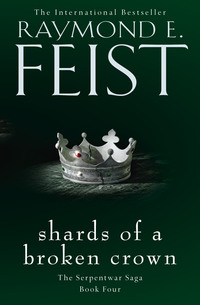
Читать книгу: «The Serpentwar Saga»
RAYMOND E. FEIST
Shards of a Broken Crown
Book Four of The Serpentwar Saga

Copyright
Harper Voyager
An Imprint of HarperCollinsPublishers Ltd
1 London Bridge Street
London SE1 9GF
www.harpercollins.co.uk
First published in Great Britain by Voyager 1998
Copyright © Raymond E. Feist 1998
Raymond E. Feist asserts the moral right to be identified as the author of this work
A catalogue record for this book is available from the British Library
All rights reserved under International and Pan-American Copyright Conventions. By payment of the required fees, you have been granted the non-exclusive, non-transferable right to access and read the text of this e-book on-screen. No part of this text may be reproduced, transmitted, downloaded, decompiled, reverse engineered, or stored in or introduced into any information storage and retrieval system, in any form or by any means, whether electronic or mechanical, now known or hereinafter invented, without the express written permission of HarperCollins e-books.
HarperCollinsPublishers has made every reasonable effort to ensure that any picture content and written content in this ebook has been included or removed in accordance with the contractual and technological constraints in operation at the time of publication.
Source ISBN: 9780006483489
Ebook Edition © SEPTEMBER 2012 ISBN: 9780007385386
Version: 2019-01-15
Dedication
To Jon and Anita Everson, who were with me from the start
Table of Contents
Cover
Title Page
Copyright
Dedication
Map of Midkemia
Character List
Book Four: The Brother’s Tale
Prologue
Chapter One: Winter
Chapter Two: Wilderness
Chapter Three: Confrontations
Chapter Four: Underground
Chapter Five: Confrontations
Chapter Six: Choices
Chapter Seven: Opportunity
Chapter Eight: Preparations
Chapter Nine: Negotiations
Chapter Ten: Investments
Chapter Eleven: Disposition
Chapter Twelve: Gamble
Chapter Thirteen: Calamity
Chapter Fourteen: Consequences
Chapter Fifteen: Betrayal
Chapter Sixteen: Deception
Chapter Seventeen: Assaults
Chapter Eighteen: Revelations
Chapter Nineteen: Decisions
Chapter Twenty: Clash
Chapter Twenty-one: Mysteries
Chapter Twenty-two: Realization
Chapter Twenty-three: Decisions
Chapter Twenty-four: Attacks
Chapter Twenty-five: Confrontation
Chapter Twenty-six: Discovery
Chapter Twenty-seven: Intervention
Chapter Twenty-eight: Division
Epilogue
Keep Reading
Contine the Adventure …
Acknowledgments
About the Author
By The Same Author
About the Publisher
Map

Character List
ACAILA – leader of the eldar, in the Elf Queen’s court
ADELIN – elf in Elvandar
AGLARANNA – Elf Queen in Elvandar, wife of Tomas, mother of Calin and Calis
AKEE – Hidati hillman
AKIER – Lieutenant on Royal Bulldog
ALETA – young disciple in Temple of Acrh-Indar
ASHAM IBIN AL-TUK – Keshian General
AVERY, RUPERT “ROO” – merchant of Krondor
AVERY, KARLI – wife of Roo
BOYSE – Captain of Duko’s forces
BRIAN – Duke of Silden
CALHERN, THOMAS – acting Lieutenant of Palace Guard
CALIN – elf heir to the throne of Elvandar, half-brother to Calis, son of Aglaranna and King Aidan
CALIS – “The Eagle of Krondor,” special agent of the Prince of Krondor, Duke of the Court, son of Aglaranna and Tomas, half brother to Calin
CHALMES – ruling magician at Stardock
CHAPAC – twin brother of Tilac, son of Ellia
D’LYES, ROBERT – magician from Stardock
DE SAVON, LUIS – former soldier, assistant to Roo
DELWIN – constable in Krondor
DESGARDEN – swordsman in Krondor
DOKINS, KIRBY – snitch in Krondor
DOMINIC – Abbot of Ishapian Abbey at Sarth
DUGA – mercenary captain from Novindus
DUKO – General in the Emerald Queen’s Army
DUVAL, MARCEL – squire from Bas-Tyra
ELLIA – elf in Elvandar, mother of Chapac and Tilac
ENARES, MALAR – servant discovered in wilderness
ERLAND – brother to the King and uncle to Prince Patrick
FADAWAH – former general commanding the Emerald Queen’s Army, self-styled “King of the Bitter Sea”
FRANCINE “FRANCIE” – daughter of the Duke of Silden
GREYLOCK, OWEN – Knight-Marshal of the Prince’s Army
HAMMOND – Lieutenant in King’s Army
HERBERT OF RUTHERWOOD – scribe in Port Vykor
JACOBY, HELEN – widow of Randolph Jacoby, mother of Natally and Willem
JALLOM – Captain of Duko’s army
JAMESON, JAMES “JIMMY” – elder son of Arutha, grandson of James
JAMESON, DASHEL “DASH” – younger son of Arutha, grandson of James
KAHIL – Fadawah’s intelligence chief
KALEID – ruling magician at Stardock
LELAND – son of Richard of Mukerlic
LIVIA – daughter of Lord Vasarius
MACKEY – Sergeant of Palace Guard
MATAK – old soldier in Duko’s command
MILO – owner of the Inn of the Pintail in Ravensburg, father of Rosalyn
MIRANDA – magician and ally of Calis and Pug
NAKOR THE ISALANI – gambler, magic-user, friend of Pug
NARDINI – Captain of captured Quegan ship
NORDAN – General in Fadawah’s army
PAHAMAN – Ranger of Natal in Elvandar
PATRICK – Prince of Krondor, son of Prince Erland, nephew to the King and Prince Nicholas
PICKNEY – clerk at Krondor
PUG – magician, Duke of Stardock, cousin to the King, grandfather to Arutha, great-grandfather to Jimmy and Dash
REESE – thief in Krondor
RICHARD – Earl of Mukerlic
RIGGERS, LYSLE – the Upright Man, leader of the Mockers
ROSALYN – Milo’s daughter, wife of Rudolph, mother of Gerd
RUDOLPH – baker in Ravensburg, husband of Rosalyn, stepfather to Gerd
RUNCOR – Captain of Duko’s army
RYANA – dragon shape-changer, friend of Tomas and Pug
SHATI, JADOW – Lieutenant in Erik’s company
SHO PI – former companion of Erik and Roo, student of Nakor
SONGTI – Captain of Duko’s army
STYLES – Captain of Royal Bulldog
SUBAI – captain of the Royal Krondorian Pathfinders
TALWIN – spy for Arutha
TILAC – twin brother of Chapac, son of Ellia
TINKER, GUSTAF – prisoner with Dash, later Constable
TOMAS – Warleader of Elvandar, husband of Aglaranna, father of Calis, inheritor of the powers of Ashen-Shugar
TRINA – female thief, Daymaster of the Mockers
TUPPIN, JOHN – thief with lumpy face, leader of Krondor’s “bashers”
VASARIUS – Quegan noble and merchant
VON DARKMOOR, MATHILDA – Baroness of Darkmoor, grandmother to Gerd
VON DARKMOOR, GERD – Baron of Darkmoor, son of Rosalyn and Stefan von Darkmoor, nephew to Erik
VON DARKMOOR, ERIK – Captain of the Crimson Eagles
WENDELL – Captain in Krondor
WIGGINS – Patrick’s Master of Ceremony
WILKES – soldier in Erik’s army
ZALTAIS – ?
Book Four
The Brothers’ Tale

Duty cannot exist without faith.
– Benjamin Disraeli
Earl of Beaconsfield
TANCRED, BK. II, CH. 1
• Prologue •
THE GENERAL KNOCKED.
“Enter,” said the self-styled King of the Bitter Sea as he looked up from a hastily scribbled note just handed him by his Captain of Intelligence, Kahil.
General Nordan entered and shook off the snow from his cloak. “You found us a cold land to rule, Majesty,” he said with a smile. He gave Kahil the briefest nod of greeting.
Fadawah, former Commanding General of the Army of the Emerald Queen, now ruler of the City of Ylith and the surrounding countryside, said, “At least it’s a cold land with food and firewood.” He waved in a vague fashion to the south. “We’re still getting stragglers in from as far away as Darkmoor who paint a bleak picture about conditions throughout the Western Realm.”
Nordan motioned to a chair and Fadawah nodded. While old companions, they observed the formalities, as Fadawah prepared to launch his spring campaign. The General still wore the ritual scars on his cheeks, marks given him when swearing loyalty to the Pantathians. He had considered attempting to find a witch or healing priest who could remove them, for when he had finally realized that the Pantathians were as much dupes as he was, he had killed their remaining high priest. As far as Fadawah was concerned, he was no longer bound to anyone. He was his own man, and he was in a rich land with an army. But Kahil had reminded him the scars were intimidating and kept the men in awe of him. Kahil had served the Emerald Queen before she had been destroyed by the demon, but he had proven a valuable and trusted advisor since the change in leadership of the invading army.
By last count over thirty thousand men had found their way into the south end of the province of Yabon. He had organized them, stationed them, and now controlled all the lands from Ylith south past Quester’s View, north to the outskirts of Zun, west to the city of Natal, which was now occupied by more of his own men than their own pitiful defenses. He had also captured Hawk’s Hollow, a small town, but one giving him control of a vital pass through the mountains to the east.
“Some of the men don’t like the idea of staying,” said Nordan. The stocky soldier rubbed his bearded chin, and cleared his throat. “They’re talking of finding a ship and going back across the sea.”
“To what?” asked Fadawah. “To a land burned out and overrun by barbarians from the grasslands? Besides the dwarven stronghold in the Ratn’gari Mountains and some surviving Jehsandi in the North, what is there left of civilization? Did we leave a city standing? Is there anything there to support us?” Fadawah scratched his head. He wore a single long fall of hair and shaved the rest of his head, another sign of his devotion to the Emerald Queen’s dark powers. “Tell any of the men who are talking this way that come spring, if they can find a ship and take it, they’re free to leave.” He looked off into space, as if seeing something in the air. “I want no one here who isn’t ready to serve me. We’re going to have a serious fight on our hands.”
“The Kingdom?”
Fadawah said, “You don’t think they’re going to sit idly by and not attempt to regain their lands, do you?”
“No, but they were terribly mauled at Krondor and Darkmoor. The prisoners tell us they don’t have much of an army left to put in the field.”
Fadawah said, “If they don’t bring their Army of the East over from Darkmoor, true. But if they do, we need to be ready.”
“Well,” said Nordan, “we won’t know until spring.”
“That’s only another three months,” said Fadawah. “We need to be prepared.”
“You have a plan?”
“Always,” said the wily old general. “I don’t want a two-front war if I can help it. If I was stupid, I could find myself in a four-front war.” He indicated a map on the wall of the room. They were currently occupying the estate house of the Earl of Ylith, dead by all reports along with the Duke of Yabon and the Earl of LaMut. “If our information is right, we face a boy up in LaMut.” He rubbed his chin. “We need to take LaMut as soon as the spring thaw begins, and I want Yabon in our grasp by midsummer.” He smiled. “Send a message to the leader in Natal …” He turned to Kahil. “What’s his title?”
“The First Councilor,” supplied his Captain of Intelligence.
“Send the First Councilor our thanks for his hospitality in providing billets for our men this winter, and send him some gold. A thousand pieces should do.”
“A thousand?” asked Nordan.
“We have it. And we’ll get more. Then withdraw our men and bring them here.” He looked at his old friend. “That will at least keep the First Councilor on our good side until we return to Natal, take and keep it.”
He pointed to the map. “I want Duko and his men down in Krondor by then.”
Nordan raised an eyebrow in curiosity.
Fadawah said, “Duko makes me uneasy. He’s an ambitious man.” He frowned. “It was only chance that put you and me first and second on the Pantathian’s roles, else we could be taking orders from Duko.”
Nordan nodded. “But he’s a good leader, and he’s always obeyed without question.”
“That he is, which is why I want him at the front. I want you down behind him, in Sarth.”
“But why Krondor?” Nordan shook his head. “There’s nothing there.”
“But there will be,” said Fadawah. “That’s their Western Capital, their Prince’s City, and they will move back there as quickly as they can.” He nodded to himself. “If Duko can keep them busy until we seize all of Yabon, then we can tum our sights on the Free Cities, this Far Coast region.” He pointed to the western coast of the Kingdom. “We’ll reoccupy Krondor and move back toward the old battle line. What’s that place?”
“Nightmare Ridge.”
“Well named.” Fadawah sighed. “I’m not a greedy man. Being King of the Bitter Sea is enough. We’ll let the Kingdom of the Isles keep their Darkmoor and the lands to the east.” Then he smiled. “For now.”
“But first we must retake Krondor.”
Fadawah said, “No, first we must make them think we want to retake Krondor. These Kingdom nobles are not stupid, they are not self-consumed like those of our homeland.” He remembered how shocked the Priest-King of Lananda had been when Fadawah and his army had refused to heed his order to leave his city. “These are smart men, duty-bound men; they will come at us, and they will come hard. We must expect that.
“No, let them think Krondor is the prize, and when they realize we are firm in Yabon, perhaps they will negotiate, or perhaps not, but either way, once we have control of Yabon, we are here for good. Let Duko get punished lest he become ambitious.”
Nordan stood. “If you permit, I’ll tell the men those who wish to leave in the spring may.”
Fadawah waved his permission.
“Majesty,” said Nordan, leaving Fadawah alone with Kahil.
To Kahil, Fadawah said, “Wait, then follow Nordan and see who he speaks with. Mark the men who are the leaders of these dissidents. They will have accidents before the thaw, and then we can put to rest this nonsense about returning to Novindus.”
“Of course, Majesty,” said the Captain of Intelligence. “And I applaud your design in putting Nordan down in Sarth.”
Fadawah said, “Design?”
Kahil leaned over, putting his arm around Fadawah’s shoulder, and he whispered, “Put all your disloyal commanders to the south, to insure that when the enemy exacts their price for our conquest, those we can most afford to lose pay it.”
Fadawah’s eyes became unfocused, as if he was listening to something in the distance. “Yes, that is wise.”
Kahil said, “You need to surround yourself with those who can be trusted, those who are loyal beyond a doubt. You need to return the Immortals to a place of prominence.”
“No!” said Fadawah. “Those madmen served dark powers—”
Kahil interrupted. “Not dark powers, Majesty, but vast powers. Powers that can insure your rule not only in Yabon, but in Krondor, too.”
“Krondor?” asked Fadawah.
Kahil clapped his hands twice, and the door swung open. Two warriors, each with ritual scars on his cheeks that matched Fadawah’s, entered, and Kahil said, “Guard the King with your lives.”
Fadawah repeated, “Krondor.”
Kahil rose and departed, closing the door behind him. A faint smile passed across his face before he turned and left upon his next task, following Nordan and marking those men for death who displayed even the smallest hint of disloyalty.
Fadawah looked at the two soldiers and motioned for them to stand away from him. The scars on their faces reminded him of the dark and distant time he was caught up in the magic of the Emerald Queen and the lost months when the demon had ruled her army. He hated feeling used and would kill anyone who again attempted to use him as the Emerald Queen had.
He moved to the map on the wall and began to plan his spring campaign.
• Chapter One • Winter
THE WIND HAD died.
Dash waited. The frigid bite of the air still brought tears to his eyes as he scanned the road below. The reconstruction of Darkmoor had been tedious, slowed by continuous snows and rain, as the winter proved a fickle one. If slippery ice wasn’t making footing treacherous for those workmen attempting to rebuild the walls around the western portion of the city, then knee-deep mud stalled wagons carrying needed supplies.
Now it was icy again, but at least Dash was thankful there was currently no snow. The sky was clear, the late afternoon sun hinting at warmth that wasn’t really there. Dash knew it was his mood as much as the weather, but this particular winter seemed to have lasted longer than any in his young life.
The sounds of the city carried through the still, icy air as the day wound down. With luck the new gate would be finished before sunset, and an extra modicum of security would be added to the sum of things that needed to be done yesterday.
Dash was tired, fatigued beyond anything he could remember in his twenty years of life. Part of it was from the seemingly endless list of things that needed attention, and the rest was from worry; his brother Jimmy was overdue.
Jimmy was acting the part of exploring officer, a scout behind enemy lines. Prince Patrick of Krondor had decided to move hard and fast against a threat of Keshian expansion into the southern flank of the Kingdom in the spring. That meant that the retaking of lands lost during the invasion the previous summer would be left to Owen Greylock, Knight-Marshal of Krondor, and Erik von Darkmoor, Knight-Captain of the Crimson Eagles, an elite mobile force of handpicked men.
Which had meant the Prince needed information on what the invaders were doing between Darkmoor and Krondor. And Jimmy had volunteered to go see what was going on.
He was now three days overdue.
Dash had come to the edge of the patrolled area, a series of burned-out walls that marked the western edge of the foulbourgh of Darkmoor. The Prince’s army in the city insured that there was little danger within a day’s ride of the city, but these partial walls and piles of tumbled masonry provided ample cover for ambush and had been refuge to more than one band of scavengers or outlaws.
Dash scanned the horizon, watching for his brother. The sounds of the winter woodlands below were few and infrequent. An occasional rustle as snow fell from tree branches, or the crack of ice some miles away as the thaw began. A bird call or the rustle of some animal in the brush. Sound carried for miles in the winter cold.
Then Dash heard something. A faint sound, coming from far away. It wasn’t the sound of hooves striking hard dirt and rock Dash had hoped to hear. Rather it was the rolling crunch of ice underfoot. And whoever made the sound was coming toward him with a methodical step, even and unhurried.
Dash flexed his gloved fingers and slowly pulled his sword from his scabbard. If the previous conflict had taught him nothing else, it was to always be ready. There were no safe positions outside the fortress that was the city of Darkmoor.
In the distance he detected motion, and he focused on it. A single figure trudged along the road. He was moving at a plodding walk, and as Dash watched, he hurried to a slow trot. Dash knew he was walking one hundred paces, then trotting one hundred paces, a practice drilled into Dash and his brother by their arms teachers as boys. For a man without a mount it could cover almost as much distance as a horse could in a day, more over the course of weeks.
Dash watched. The figure resolved itself into a man wrapped, in a heavy grey cloak; clothing designed to make it difficult to see the wearer from any distance in the gloom of winter. Only on the bright days when the sky was clear would the wearer be easy to spot.
As the man on foot came closer, Dash saw he was without a hat, but had his head covered in a thick cloth, a scarf or torn remnant of another piece of clothing. He carried a sword at his side, and his hands were clad in mismatching gloves. His boots were filthy with mud and ice.
The crunching of snow under his tread became louder by the moment, until he stood before Dash. He stopped and looked up, and at last he said, “You’re in my way.”
Dash moved his mount aside and swung the horse’s head around toward Darkmoor. He put his sword away, urged the animal forward and walked beside the man on foot. “Lose your horse?” he asked.
Jimmy, Dash’s brother, hiked his thumb over his shoulder. “Back there.”
“That was pretty careless,” said the younger brother. “That was an expensive horse.”
Jimmy said, “I know. But I didn’t feel like carrying him. He was dead.”
“Pity. That was a really good horse.”
“You don’t miss him nearly as much as I do,” said Jimmy.
“Would you like a ride?” asked Dash.
Jimmy stopped, turned, and regarded his brother. Neither son of Lord Arutha, Duke of Krondor, resembled the other. James looked like his grandmother, slight, blond, and possessing features that could only be called finely drawn, with sapphire eyes. Dash looked like his grandfather, with tight curls of light brown hair, dark eyes, and a mocking expression. In nature, they were as alike as twins. “About time you offered,” said Jimmy, reaching up to take Dash’s hand.
He swung up behind his brother and they rode slowly toward the city. “How bad was it?” asked Dash.
“Worse,” said Jimmy.
“Worse than we thought?”
“Worse than anything we could have imagined.”
Dash said nothing more, knowing his brother would report directly to the Prince, and that Dash would hear every detail.
Jimmy took the hot cup of coffee, sweetened with honey and made rich with cream, and nodded his thanks. The servant quickly departed, closing the door behind him. Jimmy sat in the Prince’s private chamber, while the Prince, the Knight-Marshal Owen Greylock, Duke Arutha of Krondor, and Erik von Darkmoor patiently waited for his report.
Patrick, Prince of Krondor and ruler of the Western Realm of the Kingdom of the Isles, said, “Very well. What did you find?”
Jimmy finished his first sip of the hot drink, and said, “It’s far worse than we feared.”
Patrick had detailed five men to ride into the West, toward Krondor, his capital city, and only three of them had returned so far. The picture he was having painted for him could be called nothing but bleak. “Go on.”
Jimmy put his cup down on the table and started removing his heavy cloak as he said, “I got to Krondor. It took some doing, but most of the remaining soldiers between here and there are nothing more than bandits. After a couple of months of snow, rain, and sleet, they are dug in, hugging their fires and trying hard to stay alive.”
“What of Krondor?” Patrick asked.
Jimmy said, “It’s almost deserted. There were a few people around, but no one wanted to talk to me, and frankly, I wasn’t anxious to strike up many conversations myself. Most of those I caught a glimpse of were soldiers, foraging for what they could find in the rubble.”
Jimmy stretched, as if tired. He took another sip of coffee. “Though what they could possibly find is beyond me.” He looked at Patrick. “Highness, Krondor looks like nothing I’ve seen before or could dream of in my worst nightmare. Every stone blackened, and almost no board unburned. The smell of char still lingers in the air and it’s been months since the fires. Rain and snow have yet to cleanse the city.
“The palace—”
“What of the palace?” asked Patrick, his voice anxious.
“Gone. The outer walls stand in place, but great breaches exist. The inner palace is little more than a huge pile of blackened rubble – the fire was so hot the timbers burned through and some inner walls collapsed. Only the ancient keep still stands, if you use the term ‘stands’ generously. It’s a blackened shell of stones. I climbed the stone steps inside, for no wood remains untouched, and reached the roof. From there I could see the entire city and some distance to the north and west.
“The harbor is a sea of sunken ships, their masts blackened and rotting. The docks are gone. Most of the first street after the docks has been leveled. All the buildings in the western third of the city have been gutted or reduced to rubble, as if the fires burned the hottest there.”
Arutha, Duke of Krondor, nodded. His father, Lord James, who had preceded him in his office, had fired the city to trap the invaders inside the flames, and had died, along with his mother, in doing so. Arutha knew the placement of Quegan fire oil in the sewers below the city would have concentrated the damage where his father would have judged it most appropriate, at the docks, near the ships unloading troops, then throughout the maze that had been the poor quarter of the city, then the merchant quarter.
“The central third of the city is seriously damaged, but there may be a building or two that can be salvaged on every street. The rest will have to be razed before any construction can begin. The easternmost third is also heavily damaged, but many of the buildings there can be restored.”
“What of the outlying estates?” asked Erik, thinking of his friend Rupert’s large house, a day’s ride to the east of Krondor.
“Many burned to the ground; others were sacked and left empty. A few of them were being used as headquarters for what I took to be companies of the invaders, so I didn’t get too close,” answered Jimmy. He sipped at his coffee.
“I was about to leave when things turned interesting.” Patrick and Arutha looked at Jimmy expectantly. Jimmy took another sip of coffee, then continued. “A command of at least a hundred men rode past where I was camped—” He glanced at his brother. “That little inn up the street from Weavers’ Road, where you got into that fight?” Dash nodded. Looking back at the Prince, Jimmy continued, “It’s atop a little rise, and had an intact roof, which was welcome, and best yet, provided an unobstructed view of High Street and Palace Road, as well as several other byways from the north gate.”
“The men?” prompted Owen Greylock.
“If I understand the markings used by the mercenary companies, General Duko is now on his way to Krondor or is already there.”
Erik swore. Then he glanced at Patrick and said, “Sorry, Highness.”
Patrick said, “I understand. All the reports I’ve read tell me Duko is a worthy foe.”
Erik said, “He’s more than a handful. He kept constant pressure on our northern flank along Nightmare Ridge, without wasting soldiers. He’s the closest thing the invaders have to a Kingdom general in his knowledge of tactics and deployment.”
Owen nodded. “If he’s in Krondor, and ordered to hold it, our job just became a great deal more difficult.”
Patrick looked worried but stayed silent a moment. Then he said, “Why would they move into Krondor in strength? There’s nothing left, they don’t need it to protect their southern flank. Could they know of our new base down at Port Vykor?”
“Perhaps,” said Owen. “Or they simply wish to keep us from using Krondor as a forward base.”
Patrick suddenly looked tired, and worried, thought Jimmy. After another long silence, the Prince said, “We need more information than we have.”
The brothers exchanged glances, each acknowledging what the other knew: they were among those most likely to be sent ahead to get that information.
Patrick asked James, “How long did you stay?”
“Long enough to see them start to secure the area, so I made for the eastern gate to get free before they spotted me. I got out of the city, but ran right into a patrol between Krondor and Ravensburg. I managed to get loose from them in the woods, but they killed my horse.”
Patrick said, “Patrol? That far east?”
Owen nodded and said, “Erik?”
Erik’s expression showed he was as perplexed as anyone else in the room. “We’ve gotten reports from refugees that General Fadawah might be pushing south again, or at least is making his presence known. If Duko’s in Krondor, those rumors are true. But to have patrols already that far east means they’re quickly deploying to welcome us should we march home.”
Patrick said, “It’s icy hell out there. What’s he up to?”
“If we knew that,” said Dash dryly, “we wouldn’t have to go slogging about in that icy hell.”
Owen smiled. Duke Arutha tried to hide his own amusement, but failed.
Patrick said, “True,” ignoring the breach of protocol. The winter shared in close quarters had turned this group into a fairly informal band of friends when court wasn’t in session.
The invaders had been defeated at the Battle of Nightmare Ridge, but the destruction done to the Western Realm of the Kingdom of the Isles was unimaginable. As spring approached, and with it the ability to move his forces, Patrick was desperately trying to imagine what had happened to his principality.
• Chapter Two • Wilderness
DASH SIGNALED.
Jimmy took out his sword and ducked behind the boulder. Dash left his own position on the south side of the King’s Highway and dropped into a ditch that ran parallel to the road for several hundred feet.
The brothers had been riding for two days. The thaw had begun and there was actually some warmth in the sunlight when it came out from behind the seemingly constant cloud cover. But the temperature didn’t fall below freezing anymore, and the rain helped melt the snow. As Dash lay in the cold mud he wished for the ice again. The ooze slowed travel and he didn’t seem able to get dry, even when staying close to a fire at night.
They had heard voices in the woods ahead a few minutes ago, had dismounted, tied their horses, and advanced on foot. As the sound of approaching feet grew louder, Dash chanced a glance over the edge of the berm, and saw a ragged band of travelers looking about in a fearful manner as they moved eastward along the King’s Highway. There was a man and woman, and children, three of them, though one – Dash couldn’t tell if it was a girl or boy under the heavy hood – seemed almost of adult height.
Dash stood as Jimmy came from behind the boulder. The man in the van of the small party of refugees pulled a wicked-looking hand scythe from under his ragged cloak and held it in menacing fashion as the others turned as if to flee.
“Hold!” Jimmy shouted. “We’ll not harm you.”
The man looked dubious, the others fearful, but they halted their movement. Jimmy and Dash both put away weapons and slowly approached.
The man didn’t lower his scythe. “Who be you?” he said, his words heavily accented.
Jimmy and Dash exchanged glances, for the man spoke with the accent of one who had come from Novindus. This man at one time had been a soldier with the invading army of the Emerald Queen.
Dash held up his hands to show he was not holding any weapon, and Jimmy stopped moving. Jimmy said, “We’re travelers. Who are you?”
The woman ventured to step from behind the man’s protection. She was gaunt and looked weak. Jimmy glanced to the others and saw that the children were equally underfed. The tallest of the three was a girl, perhaps fifteen years of age, though appearing older for the deep dark circles under her eyes. Jimmy returned his attention to the woman, who looked at him and said, “We were farmers.” She pointed to the east. “We’re trying to reach Darkmoor. We hear there’s food there.”
Jimmy nodded. “Some. Where are you from?”
“Tannerus,” said the woman.
Dash pointed at the man. “He’s not from Tannerus.”
The man nodded. He motioned at himself with his free hand and said, “Markin. From City of the Serpent River.” He glanced around. “Long way from here.”
“You were a soldier of the Emerald Queen?” asked Jimmy.
The man spat on the ground and it looked as if the gesture was taking most of his strength. “I spit on her!” He started to wobble and the woman put her arms around him.
“He’s a farmer,” she said. “He told us his story when he came to us.”
Jimmy looked at Dash, then motioned with his head back toward the horses. Dash didn’t need to be told what was on his brother’s mind. He turned and walked back while Jimmy said, “Why don’t you tell us his story.”
“My man went to fight for the King,” said the woman. “Two years ago.” She glanced back at the three children and said, “My girls are fit to work; Hildi’s almost grown. We did all right for the first year. Then the soldiers came and took the town. Our farm was far enough away we weren’t troubled for a while.”
Dash returned leading the horses. He handed the reins to Jimmy, then went back and opened a saddlebag. He returned a moment later, unwrapping a bundle. Once opened, he revealed some heavy travel bread, thick with honey and nuts and dried fruit, and some jerked beef. Without hesitation the children passed their mother and grabbed what they could.
Dash glanced at Jimmy and nodded slightly. He gave the rest of the bundle to the man, who passed it along to the woman and said, “Thank you.”
“How did an enemy soldier come to be guiding your family to Darkmoor?” asked Dash.
The woman and man both nearly wept in gratitude as they chewed on the heavy bread. After swallowing, the woman said, “When the soldiers came, we hid in the woods, and they took everything. We had only what we had carried away. Then out of spite they burned the roof off our house and broke down the door. Sticks and thatch was all it was, but it was the only home the girls had known.”
She glanced about, afraid other threats might appear suddenly from the surrounding woods. “Markin found us when we were trying to rebuild our house. It was never what you’d call fine, but my man had spent years adding to it, making it more than just a hut. But the soldiers had burned it down and the girls and me had no tools.”
“I find them,” said Markin. “They needed help.”
“He came and he fought for us. Other men came, many with swords and bows, but he kept them from taking me or the girls.” She glanced at him with obvious affection in her eyes. “He’s my man now, and he’s a fair da’ to the girls.”
Jimmy sighed. To Dash he said, “We’ll hear stories like this one a hundred times before we’re through.”
“Why Darkmoor?” asked Jimmy.
“We hear the King’s there and there’s food for the asking.”
Jimmy smiled. “No, the King’s not there, though he was last year. But there’s food for work.”
“I work good,” said the foreign-born soldier.
“Can we go?” asked the woman.
“Yes,” said Dash, motioning for them to pass.
Markin said, “You soldiers?”
Jimmy grinned. “Not if we can help it.”
“But you noble man. Markin can tell.”
Dash said dryly, “I’ve known him all my life and can tell you he’s far from noble most of the time.”
The old soldier studied the two, then said, “If you try to look like common men, you don’t.” He pointed down to Jimmy’s feet. “Dirty, but nobleman’s boots.”
He motioned for the woman and girls to follow him and moved carefully on, not taking his eyes off the brothers until his small band was past. Then he turned and hurried along, taking his position in the van, against any other unexpected encounters.
“First time I regretted having comfortable boots,” said Dash.
Jimmy looked down and said, “Well, we may be muddy, but he’s right.” Glancing around, he added, “This is a place of little food and even less comfort.”
Dash remounted his horse. “I suspect by the time we get to Krondor we won’t look quite so prosperous.”
Jimmy also mounted, and said, “Maybe we should get off this highway.”
Dash said, “The north road?” He referred to an old road his one-time employer, Rupert Avery, used regularly to move goods, avoiding the tolls charged on the King’s Highway.
Jimmy shook his head. “No, that’s almost as busy as this one, and those woods are going to be full of deserters and bandits.”
“The south?”
“Slower going, but there are enough trails along the lakes if we don’t head too far into the southern hills.”
Dash said, “Since Kesh pulled south to the old border, everything from here to their nearest garrison is going to be wilderness.”
Jimmy laughed. “What’s the difference if we run into fifty deserters from the Emerald Queen’s army, or fifty bandits, or fifty Keshian mercenaries …” He shrugged.
Dash made a show of shivering under his heavy cloak. “Let’s hope whoever’s down there is hugging their fires. As any sane man would do.”
Dash urged his horse forward and soon the two brothers were riding south at a steady walk. “Why do we do these things?” he asked.
Jimmy said, “Because our King commands and we obey.”
Dash let out a theatrical sigh. “I thought it was something like that.”
Softly, Jimmy began to sing a very old song:
“To Kesh’s heartland or Queg’s harsh shore,
Our blood, our hearts, our lives and more,
For honor’s sake do we obey,
And go over the hills and far away …”
The sound of cracking ice rang through the cold morning air and both brothers pulled up just before entering a clearing. Using hand signals, Jimmy motioned for Dash to move south along the edge of the clearing while he circled north.
Dash nodded, dismounted, and tied his horse to the branch of a small birch tree. Jimmy did likewise and moved silently away.
Dash moved through the thinning trees, bordering a burned-out farm, he judged from the appearance of tree stumps nearby. The sound resolved itself into a repeated hammering at ice.
Dash saw a man in the distance.
A slender figure, he crouched over the frozen ice on a large pond, perhaps a hundred yards away from where Dash watched, hammering at the ice with a rock. Up and down the rock moved, and Dash couldn’t help but be fascinated with the sight.
Dash couldn’t get a good look at the man, but his clothing seemed a hodgepodge of rags and ill-matched garments. He might have worn boots, but all Dash could see was a collection of rags tied around each foot for warmth.
Dash saw movement in the woods beyond the pond and judged Jimmy was in place. He waited.
Jimmy walked slowly out of the woods and the man leaped to his feet with astonishing speed. He turned away as Jimmy shouted, “Wait! I won’t hurt you!”
Dash slowly took out his sword as the tatters-clad man hurried toward him, trying to keep his movement from alerting the ragged man. As the man reached the first line of trees, Dash stepped out, extending his foot, and tripped him.
The man went down in a tangle of clothes and turned over, scuttling backward as he shouted, “Don’t kill me!”
Dash moved quickly to put the point of his sword before the man’s face, as Jimmy caught up, out of breath.
Dash said, “We’re not going to hurt you.” To demonstrate his good intentions, he quickly sheathed his sword. “Get up.”
The man got up slowly as Jimmy leaned over, hands on knees, and said, “He’s fast.”
Dash grinned. “You’d have caught him had you had another mile or so to overtake him. You’ve always had endurance, if not speed.” Turning his attention to the figure on the ground, he said, “Who are you and what were you doing?”
The man slowly rose, as if ready to bolt at the slightest threat, and said, “I am called Malar Enares, young masters.” He was a slender man, with a hawk nose sticking out over a large rag wrapped around his face. His eyes were dark, and they shifted back and forth between the brothers. “I was fishing.”
Jimmy and Dash exchanged glances, and Dash said, “With a rock?”
“To break the ice, young sir. Then when the fish comes up to sun himself, I would strip bark and make a noose.”
Jimmy said, “You were going to snare a fish?”
“It is easy if you but have patience and a steady hand, young sir.”
Dash said, “I hear Kesh in your speech.”
“Oh, no, mercy, young sir. I am but a humble servant of a great trader of Shamata, Kiran Hessen.”
Jimmy and Dash had both heard the name. A trader with Keshian connections who did a great deal of business with the late Jacob Esterbrook. Since the destruction of Krondor, the boys’ father, Lord Arutha, had pieced together several accounts that had clearly indicated two facts, that Esterbrook had been a long-standing agent of Great Kesh, and that he and his daughter were both dead. Jimmy could see what Dash was thinking: if Esterbrook had been a Keshian agent, so then could Kiran Hessen.
“Where is your master now?” asked James.
“Oh, dead I fear,” said the thin man with a display of regret. “Fourteen years was I his servant, and he a generous master. Now I am alone in this cold place.”
James said, “Well, why don’t you tell us this story.”
“And show us how you planned on catching those fish,” said Dash.
“If I might have some hair from your horses’ manes,” said the ragged man. “Then it would be so much easier.”
“Horses?” asked Dash.
“Two young noblemen such as yourselves didn’t walk into this forsaken wilderness, I am certain,” supplied Malar. “And I heard one of them snorting a moment again.” He pointed. “That way.”
Jimmy nodded. “That’s fair.”
“What do you need hair from their manes for?” asked Dash.
“Let me show you.”
He walked toward the place where Dash’s horse had been tied, and said, “The ice was almost broken when you startled me, young sir. If you would but use the hilt of your sword to break it open, that would be a great service.”
Jimmy nodded and started back toward the icy pond.
Dash asked, “Now, about how you came to be lost in this forsaken wilderness.”
“As you are no doubt aware,” began Malar, “there was much trouble between Kesh and the Kingdom lately, with Shamata for a time being deeded to the Empire.”
“So we had heard,” said Dash.
“My master, being of Kingdom allegiance, decided it wise to visit his holdings in the North, first in Landreth, then Krondor.
“We were traveling to Krondor when we encountered the invaders. We were overtaken and my master and most of his other servants were put to the sword. I and a few others managed to flee into the hills, south of here.” He pointed southward with his chin, as he reached Dash’s horse. Malar reached up and gripped a few hairs from the horse’s mane, yanking expertly, and came away with several long strands of hair. The horse moved at the unexpected pressure, snorting displeasure. Dash reached out and took the reins from the tree branch where they were tied, and Malar yanked out some more hairs. He repeated the procedure twice more. “That is sufficient,” he observed.
“So you’ve been in these hills how long?”
“More than three months, young sir,” said Malar, as he started deftly weaving the hair into a braid. “It has been a bitter time. Some of my companions died from hunger and cold, and two were captured by a band of men – outlaws or invaders, I do not know which. I have been alone for all of three weeks or so, I judge.” He sounded apologetic as he said, “It is difficult to keep track of time.”
“You’ve survived in these woods for three weeks with nothing but your bare hands?” asked Dash.
Malar started walking toward the pond, continuing to weave the horse hair. “Yes, and a terrible thing it has been, sir.”
“How?” asked Dash.
“As a boy I was raised in the hills above Landreth, to the north of the Vale of Dreams. Not as hostile a land as this, but still a place where the unwary can perish easily. My father was a woodsman, who put food on your table with bow and snare, as well as gold in his pouch from guiding men through the hills.”
Dash laughed. “He guided smugglers.”
“Perhaps,” said Malar with a broad shrug. “In any event, while the winters in the hills near my home are nowhere near as inhospitable as here, still a man must have skills to survive.”
Malar moved slowly as he approached the hole. He glanced skyward to see the angle of the sun, then moved to face it. “Do not let your shadow cross the hole,” he instructed.
Dash and Jimmy followed behind. The man from the Vale of Dreams slowly knelt and said, “Fish, I have been taught, see movement, so we must move ever so slowly.”
Dash said, “This I must see.”
Jimmy nodded.
Malar said, “The sun shines through the hole in the ice, and the fish swims up to feel the warmth.”
Jimmy looked over the man’s shoulder and saw a large brook trout lazily circling the hole. Moving slowly, Malar inserted the noose of horsehair into the water, behind the fish. The trout ceased moving for a moment, but Malar resisted the urge to move quickly, instead inching the snare toward the fish’s tail.
After another long minute, the fish darted away, and Malar said, “Another will come. They see the light and think insects may land upon the surface.”
After a silent five minutes, a trout appeared near the edge of the hole. Dash couldn’t tell if it was the same fish or a different one. Malar again started moving the noose slowly and got it around the fish’s tail. With a jerk, he snared the trout and yanked it out of the hole, landing it on the ice, where it flopped.
Dash couldn’t see the man’s face behind the rags that covered it, but the crinkles around his eyes showed Malar was smiling. “If one of you young gentlemen would be so kind as to light a fire, I will catch some more.”
Jimmy and Dash exchanged glances, then Jimmy shrugged. Dash said, “I’ll get some wood. You find a campsite.”
They hurried off while the strange man from the Vale of Dreams sought out another fish for supper.
For three days they moved slowly toward Krondor. Several times they had heard distant voices and the sound of men moving through the woodlands, but they had avoided contact with anyone.
Jimmy and Dash both found Malar an enigma. He had surprising skills for wilderness survival, odd for one claiming to be the servant of a rich trader. On the other hand, Jimmy had confided to his brother, the servant of a rich smuggler might prove in need of such skills. Still, they were pleased to have him along, for he had found several shortcuts through the undergrowth, had identified edible plants that supplemented their stores, and had proven a reliable night sentry. As they were walking their horses, leading them more than half the time, his keeping up had proven to be no difficulty. Jimmy judged they were less than a week’s travel from Krondor.
At midday they heard horses in the distance, from the north. Jimmy spoke at a low conversational level. “Duko’s men moving along the highway?”
Dash nodded. “Probably. If we can hear them from here, we’ve headed back toward the highway.” He turned to Malar. “Do you know of any southern route to Krondor?”
“Only the highway that loops around from Land’s End, young sir. But if we are nearing the King’s Highway, within a few days we should start encountering farms.”
Jimmy was silent for a long moment, then said, “They’ll almost certainly be burned out.”
“But,” suggested Dash, “if they are, no one is likely to be living in them, and we might slip into the city unnoticed.”
“No farmers, you mean,” corrected Jimmy. “But they’d be decent shelter for some very unpleasant men with a fondness for weapons, I bet.”
Dash’s brow furrowed, as if thinking he should have thought of that, but a moment later, his grin returned and he said, “Well, then, we will just blend in. You’ve told me often enough how unpleasant I can be, and I am certainly fond of my weapons.”
Jimmy nodded. “Two more hired swords will scarcely be noticed. And if we can get close to the city, we’ll find a way inside. There are enough holes in the walls, that’s for certain.”
Malar said, “You’ve been to Krondor, then, young sir? Since the war, I mean.”
Jimmy ignored the question, saying, “We’ve heard of the damage.”
Dash agreed. “More than a few people left Krondor and came east.”
“This I know,” said Malar, falling silent.
They moved on through the woods for the rest of the day and made a cold camp that night. Huddled under their blankets, Jimmy and Dash stayed close together while Malar took the first watch. They slept fitfully, coming awake many times.
In the morning, they resumed their journey.
The woods were filled with the sounds of the thaw. In the distance the cracking of ice rang through the suddenly warm air as ponds and lakes began to lose their frozen skins. Large mounds of snow fell from trees in sudden, wet attacks on the travelers, while everywhere water dripped from branches. The footing beneath their feet alternated between crusty patches of ice and thick mud which gripped at boots and horses’ hooves. The constant noise was a backdrop against which the occasional sounds of spring could be heard. The distant call of a bird that had returned from the south early, seeking others of its kind. The faint rustle in the distance of small creatures coming out of their winter’s burrows stilled as they passed, only to resume after a while.
When they paused to rest, Jimmy tied his horse to a low tree branch and motioned for Dash to do likewise. Dash did as he was bid, and said, “Keep an eye out. We’re going to relieve ourselves.” He moved to where Jimmy stood, making a show of urinating into the snow.
Dash did likewise, whispering, “What is it?”
“Have you formed an opinion of our chance companion?” asked the older brother.
Dash shook his head slightly, saying, “Not really. I’m certain he’s more than he claims, but I have no idea what.”
“There’s not a lot of fat on him,” said Jimmy, “but he doesn’t move like a man weak from hunger.”
Dash said, “Do you have a theory?”
Jimmy said, “No. But if he’s not the servant of a rich trader, what’s he doing up here?”
“Smuggler?”
“Maybe,” answered Jimmy, doing up the front of his trousers. “Could be anything we could imagine.”
Remembering what their grandfather had cautioned them over the years about leaping to conclusions, Dash said, “Then we’d best not imagine anything.”
“Wait and see,” agreed Jimmy.
They returned to the horses, and Malar hurried off to relieve himself away from the trail. When he was out of hearing range, they continued. Jimmy asked, “Remember that abandoned farm a day’s walk this side of where we met Malar?”
“The one with half a thatch roof and the fallen-down cow shed?”
“That’s the one. If we bolt, and get separated, meet there.”
Dash nodded. Neither chose to discuss what to do should the other never appear.
Malar returned and they started off. The servant from the Vale of Dreams had been as closemouthed as the brothers. Part of the reason was the environment. The nights were still and even in the day noise carried. They knew they were approaching an area likely to be patrolled by the invaders; they were leading their horses rather than riding them, as, even in the woodlands, a rider presented a much higher profile in the distance than a man on foot or a horse. Periodically they stopped to listen.
Rains came later that afternoon and they sought out what shelter they could, finding a hut of some sort, burned out, but with just enough thatch to give slight respite.
Sitting atop their saddles, hastily removed to get them out of the weather, they took stock.
“We’ve got another day’s grain, then we’re done,” said Dash, knowing his brother was just as aware of supplies as he.
Malar said, “Shouldn’t there be winter grass under the snow, sirs?”
Jimmy nodded. “Not much in it, but the horses will eat it.”
Dash said, “If there are horsemen in Krondor, they’ll have fodder.”
Jimmy said, “The difficulty will be in persuading them to share, brother.”
Dash grinned. “What’s life without a challenge or two?”
The rain stopped and they resumed their trek.
Later that afternoon, Malar said, “Young sirs, I believe I hear something.”
All conversation ceased and the three stopped walking as they listened. The frigid days of winter had given way to a promise of spring, but it was still cold enough they could see their breath in the late afternoon air. After a moment of silence, Dash was about to speak when a voice echoed from ahead. It spoke a language neither brother recognized, but they knew it was the Yabonese-like tongue of the invaders.
Glancing around for a place to hide, Jimmy pointed and mouthed the word, There.
He indicated a large stand of brush that surrounded an outcropping of rocks. Dash wasn’t sure they could secret the horses behind it, but it was the only thing nearby that offered shelter from whoever came their way.
Malar hurried around the upthrust rocks and pulled aside a low branch, allowing Jimmy and Dash to lead their horses around to a relatively sheltered hiding place. In the distance horses could be heard.
Dash’s horse’s nostrils flared and her head came up. Jimmy said, “What?”
“This witchy mare is in heat,” whispered Dash as he tugged hard on her bridle. “Pay attention to me!” he demanded.
Malar said, “You ride a mare?”
“She’s a good horse,” insisted Dash.
“Most of the time!” agreed Jimmy, hissing his words. “But not now!”
Dash tugged on the horse’s bridle, trying to focus her attention on himself. An experienced rider, Dash knew that if he could keep her attention, she might not call out to the horses that were approaching.
Jimmy’s gelding seemed relatively indifferent to the proceedings, though he did look on with some interest as the mare’s excited state built. Dash held tight to the mare’s bridle, rubbing her nose and speaking close to her ear in a reassuring fashion.
The riders came close and Dash judged there must be at least a dozen of them from the clatter. Voices cut through the air and a man laughed. These were men who patrolled a familiar area and expected nothing out of the ordinary.
Dash held tight to the bridle and continued to speak softly to his mare as the horses came to the point of closest approach on the trail. Suddenly Dash’s horse pulled backwards and her head came up.
For an instant there was a tiny hope she might come back to him, but then she called out her greeting, a loud whinny.
Suddenly shouts filled the air and other horses answered the mare’s call. Jimmy didn’t hesitate. “That way!”
Malar shoved through underbrush and ignored scratches from branches as he went where Jimmy had directed. Jimmy came next, leading his gelding, eyes wide and nostrils flaring from excitement. The mare balked and resisted as she screamed her welcome to the other horses. A stallion’s herd cry answered, and Dash knew the only way he could control his mare was from her back. Letting her head come around toward the stallion, he quickly swung up onto her back, exposing himself to view.
He didn’t hesitate, and slammed heels into her flanks. Urging her into a gallop, he seemed to burst from the underbrush toward those riders arrayed on the trail. Then he was past them, moving away from his brother and Malar, and the chase was on.
From a vantage point a short distance off, Jimmy turned and saw the riders wheel and charge after Dash. Malar, almost out of breath, puffed as he said, “Sir, will they catch him?”
Jimmy swore. “Probably. But if they don’t, he should try to get back to that farmhouse. That’s what we planned.”
“Shall we turn around?” asked the servant.
Jimmy was silent. After a moment he said, “No. Dash will either be captured, in which case we can’t help him escape, or he’ll win free. If he gets back to that farmhouse we found the day we met you, he’ll wait one or two days, then return to Darkmoor. If we go now, we’ll have no more information than he will.”
“We go to Krondor?”
“We go to Krondor,” said Jimmy. He glanced around, seeking any sign of other riders in the area. As the sound of Dash and his pursuers faded into the distance, he pointed and said, “That way.”
As quietly as they could, the pair set off.
Dash rode as hard as he could, despite the balky mare, who wanted to turn and greet the stallions behind. Every hint of hesitation from her brought a hard kick to her sides as he used every skill he had to keep her heading down a windy woodland trail made dangerous by mud and ice, overhanging branches, and sudden turns.
Dash knew that if his old riding instructor, the King’s own horsemaster, could see what he was doing, he’d be shouting at the top of his lungs, telling Dash to slow down. Dash knew his race across treacherous footing was unbelievably dangerous and foolhardy.
He couldn’t spare a glance back to see how close his pursuers might be, but the noise behind him told him all he needed to know: they were close. It would take a stroke of luck for him to lose them. He knew that to them he was a dimly-seen figure on a horse moving through the long shadows of the woodlands, but as long as he stayed on the trail, they would be able to stay close and not lose him.
He had a rough idea where he was. There were a dozen or more woodland trails to the east of Krondor that led to farms throughout the area. He knew that eventually – if he outran his pursuers – he’d hit the King’s Highway. A horse’s scream and a panic-stricken rider’s cry told Dash that one of his pursuers’ mounts had lost footing and was down, probably breaking a leg.
Dash glanced to the left and saw the trees thinning as he reached a clutch of farms, open fields that were dotted with burned-out buildings. He hesitated for a moment, but to try to ride across muddy fields would be far worse than staying on the trail. Here the mud was a nuisance, slippery muck over hardpan compacted by years of wagons, riders, and foot traffic. The mud in the fields was deep enough for an adult horse to sink up to the point where it would be unable to move.
The horse labored as Dash pushed her along the trail; lack of grain and fodder had shortened her endurance and she was blowing hard as she struggled to obey his commands. Then he saw a stone path, and a glimmer of hope appeared.
He almost caused her to fall, so abruptly did he pull the mare around, but once she got her feet back under her, she sped off in the desired direction. Dash said a silent prayer to Ruthia, Goddess of Luck, and gathered his horse under him for a jump. The fence along the road was mostly broken down, but he needed to land on a relatively narrow pathway that was blocked by one of the few remaining intact sections and a closed gate.
The horse was tired, but athletic enough to easily clear the fence, landing on the wet stones. The reassuring clatter of hooves on stone told Dash that Ruthia at least didn’t say “no.”
He stole a glance to his left and saw several of the riders attempt to cut him off by veering into the muddy field. He smiled to himself.
Making sure the horse was heading exactly where he wanted, he chanced another look back and saw that the horses in the field were now half buried, attempting to pull their hooves out of the deep, thick muck.
Dash gained precious seconds as the riders who followed on the road chose to double back and work their way around the intact fence. He now had a chance.
The sun was now out of sight behind the trees ahead, as the long shadows of late afternoon crept across the fields. He rode past a burned-out farmhouse and saw the stone path he was on passed the door and continued on toward the foundation of a burned-out bam. He continued to ride, but slowed as he reached the terminus of the path.
Dash could only spare a moment to let the horse rest, as curses from behind told him those trying to reach him were now also mired in the mud. Dash judged the way to his right was more substantial footing than elsewhere – at least he hoped that was the case, and set off, letting his horse move at a trot until she slowed down due to the mud.
The sound of the mare’s hooves hitting tightly compacted sand caused Dash to feel a surge of hope. It was quickly extinguished when he heard riders coming hard behind on the stone path.
The trees were close enough to give the illusion of safety, but Dash knew that if he couldn’t get into them at least a minute ahead of the riders behind him, he wouldn’t be able to shake them.
He urged his mare on to a loping canter and glanced back. The riders were just now reaching the edge of the farmhouse, and again hope rose up within Dash. Their horses were lathered and their nostrils were flaring wide. They were almost as exhausted as his own. They must have been at the end of their patrol, or they weren’t getting enough to eat, but for whatever reason, they didn’t look as if they had enough left to overtake him – as long as he could keep his own exhausted mare moving.
He reached the treeline and ducked under a low-hanging branch. As quickly as he could, he picked his way among the trees, varying his course and trying to keep clear of those behind. He hoped there were no trackers behind, but then, considering the terrain, realized a blind man could follow his trail.
Glancing around he saw a small outcropping of rock that rose up a slight incline and appeared to be flat on top. He turned the horse and walked her up the rise, and found the rock ran off along what appeared to be a smaller trail. He jumped off and led her down the trail.
Exhaustion was curbing her desire to call to the stallion, as she could barely catch enough breath to walk after Dash. He pulled her reins and she reluctantly set out at a fast walk behind him.
Shadows deepened as the sun lowered in the west, and Dash moved deeper into the woods. If Jimmy and Malar had stayed clear of pursuit, they would be approaching the city several miles to the south. Dash wondered if he should attempt to cut back behind his pursuers and try to find his brother and the stranger from the Vale of Dreams.
Dash considered the best that would bring him would be to get him haplessly lost. There couldn’t be so many people in Krondor that if both brothers reached there safely, they couldn’t find one another. At least Dash hoped that was true. Hearing the riders coming closer to the point where he had left the trail below, Dash hurried deeper into the woods.
Jimmy gripped Malar’s arm and said, “We join there.” He indicated a point in the road where a fairly steady stream of travelers had been coming past the woodlands, at the edge of what had once been the foulbourgh outside the walls of Krondor. “I’m a mercenary from Landreth and you’re my servant.”
“Dog robber,” said Malar.
“What?”
“The term is ‘dog robber.’ To feed his master, a mercenary’s servant will steal scraps from a dog if necessary.” The slender man smiled. “I have served as such. You, though, will be obviously false to any Valeman who might happen to be here.”
“You think that likely?”
“It would be better should you be a young man from the East of the Kingdom, who lately served in the Vale. Claim no company. Say you worked for my departed master. I do not know what you expected to find in Krondor, young sir, but in the backwashes of war many things happen. We are seeing that ahead.”
Jimmy was forced to admit that was true. Where he had seen nothing but frost-covered stones and a few fires just weeks before, now he saw dozens of huts and tents, a veritable community springing up almost overnight. As they walked down the road, Malar leading Jimmy’s horse, Jimmy drank in the sights and sounds.
Evening was upon them and fires dotted the landscape. Hawkers shouted from ahead, offering food, drink, the company of a woman. Hard-looking men lounged near fires, watching guardedly as Jimmy and Malar moved past.
A man hurried over holding a steaming pot, and said, “Hot food! Fresh rabbit stew! I have carrots and turnips mixed in!”
From the expressions on the faces of those nearby, Jimmy surmised two things: the “rabbit” was probably a less wholesome dinner item than advertised, and most of the people nearby were hungry.
But some sort of order had been imposed, and armed men who seemed near to the point of killing for food merely watched with fixed expressions as the man passed holding out the meal. “How much?” asked Jimmy, not pausing.
“What have you?” asked the peddler.
Malar elbowed Jimmy to one side. “Begone, O stewer of cats! My master has no use for such foul-smelling garbage,” he shouted.
Instantly the two men were almost nose to nose, screaming insults at one another, and almost equally abruptly a deal had been struck. Malar gave the man a copper coin, a ball of yarn he had been carrying in his pocket, and a very old rusty dagger.
The man gave over the pot and hurried back to his campfire where a woman offered him another crock of the hot stew. He set out to find another customer. Malar motioned for Jimmy to move to the side of the road and squatted, holding the crockery. He held it out and spoke softly, “Eat first and give me what’s left.”
Jimmy squatted, not wishing to sit in the mud, and ate the stew. If it was rabbit, it had been a rabbit of diminutive stature, and even the carrots and turnips had a strange taste. Jimmy decided it best not to consider how long they had sat in some abandoned root cellar before that enterprising peddler had found them.
He ate half the contents of the bowl and gave the rest over to Malar. While his newfound servant ate, Jimmy looked around. He had seen enough military camps to recognize he had blundered into one. Warriors, camp followers, peddlers and thieves, all resting until they had a reason to move on.
Jimmy wondered about the reason for the gathering, and the reason that would make them move on. Many of the warriors were from the invading army that had ravaged the Western Realm the year before, but he saw enough Keshians and a few Quegans mixed in to decide that these were deserters, opportunists, weapons runners, and the dregs washed up in any backwater of a war.
Putting aside the bowl, Malar looked at Jimmy. “Young sir?”
“Let’s head into the city,” said Jimmy.
“And do what?” inquired the Valeman.
“Look for my brother.”
“I thought he was to go back east,” said Malar.
“That’s what he should do, but he won’t.”
“Why?”
“Because he’s …Dash.”
They moved through the tent village and headed toward the city gate.
• Chapter Three • Confrontations
PUG FROWNED.
The Keshian Ambassador’s smile was forced, almost painful, as he finished his latest message from his government.
“My Lord Gadesh,” said the Kingdom’s representative, Baron Marcel d’Greu, his own smile just as false. “That’s impossible.”
Pug glanced at Nakor, who sat to his right. The latest round of negotiations between the Kingdom and the Empire of Great Kesh was proving to be a simple restatement of the last round.
Nakor shook his head and said, “Why don’t we take a small recess, my lords, and give ourselves time to ponder these requests?”
Kalari, a Tsurani Black Robe who was representing his government, the Empire of Tsuranuanni, as a neutral observer, said, “Excellent idea, my friend.”
The two ambassadors retired to the quarters that had been provided to them, and Pug led Nakor and Kalari to another room, where Miranda waited next to Kalied, the leader of the most powerful of the three factions of magicians in Stardock.
Kalied appeared to be older than Pug, despite the fact Pug was nearly twenty years his senior. Pug appeared to be a man in his mid-twenties, his rejuvenation courtesy of the freed life energies that had been trapped in the Lifestone.
Miranda, looking like a woman in her mid-twenties, smiled at her husband. “Any joy?”
“None,” said Pug, taking a mug of ale offered by a student who was acting as servant to those representing the interests of Stardock in the negotiations between the Kingdom and the Empire of Great Kesh.
“I must confess,” observed Kalari, “these negotiations seem far more ritualistic than I anticipated.” He sipped at a hot cup of coffee and nodded in appreciation at the flavor of the brew. He was a bald-headed man of middle age, still slender and fit and possessing a penetrating pair of blue eyes. “Is it my unfamiliarity with the nuances of the King’s Tongue, or some lack of insight into the Keshian culture, or is this simply a restating of previous claims and demands?”
“No,” said Nakor, “there is nothing wrong with your appreciation of this situation.”
“Then what is the point?” asked Kalari. “My own Empire’s traditions include negotiations, but usually it’s between Tsurani Lords. I’m afraid your notion of diplomacy is a little foreign to me.”
Kalari had been sent by the Assembly of Magicians on Kelewan, to insure that whatever interests Tsuranuanni had in Stardock were represented. Trading between the former enemies, the Kingdom of the Isles and the Empire of Tsuranuanni, had been cyclical over the years. For nearly fifty years a major upheaval in Tsurani society had resulted from the rise to prominence of House Acoma and their innovative leader, the Lady Mara, the Servant of the Empire. Her son, Justin, had ruled the Empire despite several political plots to return the Empire to the older traditions Mara had set aside. Turmoil had resulted from many of the changes, at various times limiting trade between the two worlds to a trickle, but currently a stable period had endured almost ten years, and the Empire wished to see nothing disrupt their commerce with Midkemia.
Pug said, “Well, if you consider us to be Thuril, but with more swords, you might consider the needs we face.”
Kalari nodded. Thuril had been the only nation to resist his empire on the homeworld, and had forced the Empire to a guarded peace. “Well, since the Servant of the Empire overturned so many of the Assembly’s prerogatives, we’ve had to constantly relearn things. I think endless babble around a table to no point, though, may be a difficult process to master.”
Nakor laughed. “Actually, it’s really easy. That’s why diplomats do it so much.”
Kalari regarded the strange fellow. Nakor had been given his seat at the negotiations by Pug. Known as Milamber on the Tsurani homeworld, Pug was a figure of legend, almost as awe-inspiring as the Lady Mara. That fact alone had blunted some of the Tsurani Great One’s astonishment at Nakor being included in these sessions. To all outward appearances, the self-styled “High Priest” of some unknown order was nothing more than a ragged vagabond, perhaps a confidence trickster who played the fool. Yet there was something about the odd little man that made Kalari cautious of judging him too quickly. Behind his constant irreverent humor an intellect of great scope was at work, and every fiber of Kalari’s being told him a man of great magical ability also wore the guise of a common gambler recently turned man of religion. He might claim powers that came from the Gods, or merely “tricks” as he often commented, but Kalari sensed this was a being of power second only to Pug’s at the table.
Kalari put aside his nagging suspicions about Nakor. Whatever else, he did find the man from the nation of Isalan in Great Kesh amusing and amiable. “Well, then,” said the magician, “you’ll have to brief me on how best to proceed with this pointless wrangling.”
Nakor said, “Find someone else. I think them just as tedious as you do.” Nakor took a sip of ale. “Besides, the matter of how things end up has already been decided.”
“Really?” said Pug. “Care to share with us your reasoning?”
Nakor grinned, as he always did when about to share the gift of his perceptions and insights with the others. “It’s easy.” He pointed around the room. “You could figure this out, too, if you tried.” Miranda exchanged wry smiles with her husband. Nakor continued, “The Kingdom was hurt, but not fatally. Kesh knows this. They have spies. They know that while the King wants troops back in the East, it’s not because there’s any real trouble there. If Kesh makes trouble, the King orders the Prince to keep the soldiers. And if Kesh waits until the Armies of the East leave, that gives Patrick more time to dig in, get ready, and deal with any Keshian adventures.”
Nakor shook his head. “No, Kesh knows that they lost what the Kingdom gave them when they tried to press their advantage. They know the best they can do is maybe some trade concession or another, but they’ll never get back what they were granted for protecting the Kingdom’s southern flank.” He glanced from face to face. “They’re trying to figure out how to admit publicly they were stupid without admitting they were stupid.”
Kalari laughed. Even the usually taciturn Kalied was forced to smile. Pug said, “So it’s a matter of honor?”
Nakor shrugged. “More a matter of avoiding punishment back home. Generals Rufi ibn Salamon and Behan Solan have much explaining to do to their Emperor when they return to the City of Kesh. They’ve got to be given a really good story to explain how they lost by getting greedy what they had gained by the Emperor being generous. You know they had no authority from Kesh to try to grab all of the vale, don’t you?”
Pug fixed Nakor with a narrow gaze. “And how do you know that?” asked Pug.
Nakor said, “I move around. I listen to things. Generals may keep their mouths shut, but soldiers talk. Soldiers serve in the General’s tent, then they talk to traders and camp girls, and the traders and camp girls talk to wagon drivers, and pretty soon everyone knows what the General’s doing.
“Kesh doesn’t want a war, even if the Kingdom is weak. They’ve never fully pacified the southern nations below the Girdle of Kesh. The Keshian Confederacy would rise up again at any excuse, and your King knows this. So, the Empire doesn’t want war, and the Kingdom doesn’t want another war – they’re busy with the one they have now – and we all sit around while the outcome is already known.”
“Save one thing,” said Pug.
Nakor said, “Stardock.”
Kalied said, “That matter is settled.”
Pug shrugged. “I know it is. I told Nakor to make whatever deal necessary to get you to help save the Kingdom; the threat of you acting against Kesh if they turned aggressor tipped the balance in our favor. But there’s still the matter of explaining to the King how I managed to give away one of his duchies.”
Kalied said, “I am dining with the members of the council. As Robert de Lyes has decided to continue serving in Darkmoor with the Prince, we need to replace him on the council.” He rose and said, “But keep in mind, Pug, despite your legendary power and our abiding respect for what you founded here, Stardock is no longer your personal fiefdom. We have Nakor’s pledge that you would honor the arrangements he made to gain the Kingdom our aid. The council now governs, not on your behalf while you’re off somewhere, but on behalf of all those who reside here. You are entitled to no more or less a voice than any other member of the Academy.”
Pug was silent for a moment, then said, “Very well. I will honor that pledge and insure the Kingdom acknowledges your autonomy.”
“Autonomy?” said Kalied. “That’s an interesting choice of words. We prefer to think of it as independence.”
Nakor waved away the remark. “Don’t be stupid. Pug can convince the King to let you govern yourself, but don’t expect him to make the King accept the proposition of an independent entity located entirely within the boundaries of the Kingdom. Besides, while you protect the Kingdom from Kesh, the Kingdom also protects you from Kesh. Do you think for a moment the Emperor would be as generous?”
Kalied said nothing for a long moment, then said, “Very well. I will present this to the council, and I am sure they will choose not to be ‘stupid’ in this matter.” With a dark look directed at Nakor, he bowed to the others in the room and departed.
Kalari turned to Nakor and said, “I assume your earlier comments on diplomacy are more in the theoretical area rather than from practice?”
Miranda laughed. Pug joined in. “Well, I still have a lot to explain to the Prince, and I think there’s no putting that off. I suspect that Patrick will be even less enchanted with the idea of an autonomous Stardock within his borders than Kalied.”
Miranda said, “We go to Darkmoor?”
Pug nodded. “Nakor?”
Nakor nodded. “I’m done here. The Blue Riders are again ensconced among the students, to make sure magicians who train here don’t get too stuffy. Besides, I need to spend some time with Dominic and some of the other Ishapians who have ended up next to the Prince. Let me fetch Sho Pi, and we’ll all go together.”
He left, and Kalari said, “Pug, a question.”
Pug turned to regard the Tsurani Great One.
“Since coming to Stardock on behalf of the Emperor, I’ve pieced together a view of how things stood here. I’m curious as to why you, yourself, didn’t come to the Assembly and seek our aid in dealing with the threats from this Emerald Queen.” He lowered his voice. “I’m not sure what fully transpired here, but I get the strong impression that a great deal more was at stake than most people understand.”
Miranda and Pug exchanged glances, and Pug said, “Yes, but I am not free to share details.
“As for why we didn’t seek Tsurani aid, our relationships with the Empire have never been the same since Makala.”
Kalari said, “Ah,” and nodded in understanding. A Tsurani Great One, Makala had come to the Prince of Krondor’s court years before, ostensibly to act as a liaison between the Assembly on Kelewan and the Prince, but in fact had come as a self-appointed spy determined to discover the secret of what truly happened at Sethanon at the end of the Riftwar.
He had been motivated by loyalty to the Empire and the fear of some Kingdom plot or weapon of great power, and had actually discovered the secret of the Lifestone. Through agents who chanced upon one another near Sethanon, he had become a party to a conspiracy involving the Brotherhood of the Dark Path. Only the intervention of a renegade moredhel chieftain had prevented a major catastrophe.
Makala and four of his allies from the Tsurani homeworld had ensorceled the great dragon oracle that lived below the city of Sethanon, and were on the verge of unlocking the Lifestone when Pug and his companions had arrived. That secret had died with Makala and his four companions, deep in the chamber below the city. His betrayal of the trust given him had strained relationships between the Kingdom and Empire for a decade. Only members of the Assembly on Kelewan and a few trusted advisors to the Prince of Krondor knew of the incident; it served as a cautionary tale on both sides of the rift. Since then, all business between the Empire of Tsuranuanni and the Kingdom of the Isles had been conducted in the most formal, cautious of fashions. More than once it had been suggested that the rift between the worlds be permanently closed, yet trading between them continued. But it was now limited to the one rift located on Stardock, hence the Empire’s presence at these negotiations. They were anxious that this one passage between the worlds be kept open.
“Yet,” said Kalari, “it seemed prudent to you to request our help in that display of might we arranged for the Keshians?”
Pug shook his head and shrugged. “Nakor.”
Kalari returned the smile. “He is the most unusual fellow.”
Pug agreed.
Miranda said, “What will you tell Patrick?”
Pug let out a long, tired sigh. “Many things; none of which he will enjoy hearing.”
Prince Patrick appeared on the verge of rage. His normally light complexion reddened and his voice rose. “Autonomous? What is that supposed to mean?” he shouted.
Pug sighed. Unlike his predecessor, Prince Arutha, Patrick lacked vision. Pug reminded himself that in most ways the Prince was a young man, and unlike Prince Arutha, who had leadership thrust upon him, a young man untempered in the cauldron of war. While his city had been destroyed, Patrick had been safe in the East, at the King’s insistence. Pug suspected much of Patrick’s ill humor came from frustration and his inability to do other than his father’s bidding.
With even tones, Pug said, “The magicians at Stardock require—”
“Require!” shouted Patrick. “They require?” He stood up from his throne, formerly the state chair of the Baron of Darkmoor, and took a step down to stand directly before Pug. “Let me tell you what their King requires. He requires their unswerving loyalty and obedience!”
Pug looked at his grandson, the Duke Arutha, who gave his head a slight shake, indicating there was little use in talking to the Prince when he was in a rage. Pug didn’t care. He was three times the Prince’s age and had seen more than most men did in a dozen lifetimes and he was tired. “Patrick,” he said evenly. “Sometimes you lose.”
“These are our citizens! They live within the borders of the Kingdom.”
Nakor, who had been silently standing to one side with his student, Sho Pi, said, “Only if the old borders are still there, Highness.”
Patrick’s head came around and he said, “Who gave you leave to talk, Keshian?”
Nakor returned an insolent grin. “Your King, many years ago, if you remember? And I am Isalani.”
Wearying of the scene, Pug said, “Patrick, what’s done is done. It’s an unhappy solution, but at least it’s a solution. You can’t deal with the invaders to the west, Kesh to the south, and the magicians at Stardock. You must start somewhere; Stardock is the easiest. With the community there guaranteed their autonomy, Kesh will have to remove itself back to the old border. That’s two problems solved. Then you can reclaim the West.”
Patrick said nothing, forcing himself to calm down. “I do not like it.”
Nakor said, “The King won’t like it much either, but he’ll understand. Prince Erland spent time in Kesh. He saved the Emperor and knows the Empress well. Very well,” he added with a grin. “Erland will go down and visit again and soon things will be back to normal along this border.”
“Except I’ll have lost Stardock.”
Pug said, “You’ll lose a great deal more unless you agree.” He looked the young prince squarely in the eyes. “Sometimes ruling is hard choices, between bad and worse. Agree that Stardock can rule itself, and you defeat Kesh.”
Pug’s wording made the young Prince pause. After a moment he spoke. “Very well. Prepare documents, my lord duke,” he said, using Pug’s formal rank as Duke of Stardock. “It is your duchy we’re losing. I’m sure Father will have another office or something for you. After all, he did explain you were some sort of royal cousin and need to be treated as such.”
Pug glanced at his wife. She returned a slight shrug. He was young, she seemed to say in agreement with his own thoughts. Pug started to turn away, but Patrick continued to speak. “I think, though, that you’d best explain directly to the King what is at hand here.”
Pug turned back to face Patrick. “You wish me to prepare a report for the King.”
Patrick’s expression showed his temper was still getting the better of him. “No, I wish you to use whatever magic arts you have to take yourself to Rillanon. In fact, I command you to do so, my lord duke! Perhaps being wiser than I, the King can discern how this isn’t some sort of treason.” He glanced at Miranda. “If your wife isn’t an agent of the Empire, I’ll be astounded.”
Pug’s eyes narrowed and he remained silent.
“You’ll need to demonstrate that loyalty I currently find lacking, magician, if you’re to regain this court’s favor.”
“Demonstrate?” said Pug softly. “I have labored to my utmost to prevent the destruction of all we hold dear.”
Patrick said, “I’ve read the reports. I’ve heard the tales. Demons and spawn of the lower hells. Yes, magic to warp the world to darkness, and all the rest of it.”
Arutha looked from one man to the other, saying, “Highness! Grandfather, please! We have much to do and contention in our ranks does us no good.”
Pug looked at his grandson, and slowly he said, “I am not attempting to contend, Arutha. My only purpose has been, from the first, to serve.”
He stepped forward and his voice was filled with menace. “If you command, my prince, I will obey. I will take the time to visit with the King. If you are not satisfied with my performance in recent months, perhaps he will be persuaded that the price I paid demonstrates my commitment.”
“Perhaps!” said Patrick. He spat hot words. “You gave away a duchy that by all reports you have neglected, and I have a city lying in ruins, as well as my entire Principality to the west in thrall to hostile forces. Who between us has lost the most?”
Pug’s throat burned as color rose in his cheeks. In a hoarse whisper he said, “Lost? You dare speak to me of loss?” Stepping up so that he was mere inches from the Prince, Pug looked up at the taller, younger man. “I lost nearly everything, you child! I lost a son and a daughter, and the man she loved who was as another son to me. William, Gamina, and James gave their lives for Krondor and the Kingdom. You sit this throne for a few years, Patrick. When you’ve lived as long as I have, should you be that fortunate, remember what you said here.”
Patrick appeared embarrassed as he realized he had overlooked the death of Pug’s family in the war. Still, his temper got the best of him, and as Pug turned to walk away, Patrick’s voice thundered, “I will not be addressed in that manner, magician! Duke or not, royal cousin or not, you will come back here and beg my pardon!”
Pug spun. Before he could speak, Arutha turned and stood directly before his Prince. “Highness!” He put a restraining hand on Patrick’s shoulder. In a whisper he said, “This brings nothing good! Calm yourself and we’ll revisit this tomorrow.” Whispering, he added, “Patrick, your father will not be pleased at this.”
Before the Prince could speak, Arutha turned and said, “Grandfather. If you and your lady would dine with me tonight, we can discuss exactly what sort of communication with the crown shall be undertaken.” To the remaining courtiers in the hall, he said, “That will be all today. This court is adjourned.”
He hustled Patrick through a door to the apartment set aside for him during his stay in Darkmoor, not allowing the Prince to further inflame the situation. Pug turned to Miranda, who said, “That boy needs some training.”
Pug said nothing, merely offering his arm to his wife and leading her to the rooms put aside for them. He knew his grandson would come to see them as soon as the Prince had been placated.
Arutha looked like a man aged years in a few hours. His eyes, normally bright and alert, were now deeply sunk with dark circles under them. He sighed and nodded thanks as Miranda handed him a goblet of wine.
“The Prince?” asked Pug.
Arutha shrugged. “It’s difficult. During the war he seemed content to follow Father and Uncle William’s lead. The preparations for the city were underway by the time he arrived in Krondor, and he simply agreed to whatever Father wanted.
“Now, he’s out of his element. He is being asked to make decisions that would have taxed the wits of the best generals in this Kingdom’s history.” He sipped his wine. “Partly it’s my fault.”
Pug shook his head. “No, Patrick is responsible for his own actions.”
“But Father would have—”
Pug interrupted. “You are not your father.” He let out a slow sigh. “No one is James. James was unique. As was Prince Arutha. The Western Realm may never again see men as able as them gathered together at one time.” Pug grew reflective. “It all began with Lord Borric. I have never known a man his equal. Arutha was his equal in many ways, perhaps his superior in some, but on the whole, Borric raised two sons the Kingdom needed.
“But from there we are seeing a diminution of the line. King Borric was seasoned in his travels to Kesh, but nothing like his father the Prince.” Pug looked out a window at the distant torchlight along the palisades of the castle. “Perhaps it’s just the years passing, the ability to think back with history’s perspective, but at the time of the Riftwar there was a sense in the West that eventually we should prevail. Now I realize that came from Prince Arutha, your father at his brashest and most reckless, others who led and those who followed.”
Looking at his grandson, Pug said, “You must step forward, Arutha. You will never be the man for whom you were named, and you will never be your father, but nature didn’t intend for you to be either of those men, no matter how worthy they were. You must become the best man you are capable of. I know the war took as much a toll on you as it did me. You alone of all those here know what I feel. Men like Owen Greylock and Erik von Darkmoor must rise to meet the needs of the nation.” He smiled as he added, “You are more capable than you think. You will be a fine Duke of Krondor.”
Arutha nodded. His mother, Gamina, was Pug’s daughter by adoption, but he had loved and treasured her as much as he had his son, William. To lose them both within days of one another had been terrible. “I know that it was worse for you, Grandfather. I mourn my parents. You mourn your children.”
Pug said nothing, swallowing hard and gripping Miranda’s hand. Since the end of the war he had been revisited time and again by a wave of profound sorrow and pain, and as much as he hoped for the sense of loss to pass, it didn’t. It grew muted at times, even forgotten for hours at a stretch, but in any quiet, reflective moment, it returned.
Even his marriage to Miranda had been hastily conducted, as if any delay might steal moments away from them. Pug and his new wife had spent as much time together as possible, dealing with the revelations of their past lives and the need to discuss their future. Yet every moment together, no matter how joyous, was overshadowed by the sense of loss, the sense of work yet undone, and the sense that nothing could ever return to them that which was lost.
Pug nodded at his grandson’s words. He sighed. “Arutha, you and I have never had the opportunity to be close. After my first wife’s death I distanced myself from your mother. Watching her grow old was a fate I tried to avoid.” He looked deep into his grandson’s eyes. “There is much of both your parents in you. I know your father trained you from birth to serve, and your life was never your own, but I also know he would have found a less demanding role for you had he found you lacking; you would not be allowed to follow after him had you been less a man than what you are. So, again I say, you must step forward. Patrick may prove a worthy ruler someday, but that day is not here yet. And it has often been our history that one in the role of advisor limited the choices placed before the rulers.” Remembering the rule of mad King Roderic, Pug said, “Perhaps we could have used more of such men in the past.”
Arutha said, “I’ll try, Grandfather.”
Miranda said, “I don’t presume to advise, as I’ve never done well with obeying rulers in my day, but you’ll have to do more than try before we’re done.”
Arutha looked as if he was ready to wilt. “I know.”
A servant announced supper was ready, and they adjourned to the next room. As Pug preceded his grandson, he knew one of the reasons Arutha was so fatigued: from worry over the whereabouts of his own sons.
Jimmy looked around. A series of patrols had been coming through the area for the last two days. They had tried to enter the city and discovered that no one was being allowed through the established checkpoints. Whoever was in charge inside Krondor, General Duko or someone else, had decided that Kingdom infiltration was a serious threat and had sealed the city.
Those mercenaries and traders who had gathered outside the city walls were not troubled, as long as they didn’t cause trouble. A brawl had erupted the night before at a large bonfire some distance away, over a gambling debt, woman, or insult, Jimmy didn’t know, but it had quickly been quelled by a detachment of warriors from the city who rode out and scattered everyone in sight. There had been nothing gentle or orderly about it, a simple raid to disperse, conducted with speed and efficiency. A half dozen men lay dead, while others were moaning and nursing injuries as the strike force returned to the city, but order had been restored. Most of the men outside the walls had come for booty, the opportunity to loot, or to gain steady pay, not to storm a well-fortified city.
Jimmy had judged the city fairly easy to retake should Patrick and his army be sitting outside the walls, but they weren’t. They were in Darkmoor or en route, and by the time they reached Krondor, the fortifications would be reaching daunting proportions. Workers – freemen or prisoners, Jimmy didn’t know which – were up each day at dawn, repairing the damage from the final assault on the city the previous summer.
He had chanced a leisurely ride past the main eastern gates, and saw that they had been successfully replaced. While not as grand as the originals, the new gates looked stout and well crafted. Accomplished carpenters were among those working for the invaders, as most every man of fighting age on the distant continent of Novindus had been pressed into the army.
It was nearly sundown on their second day when Malar asked, “Young sir, are we to find a safe place to sleep?”
Jimmy shook his head. “I think I’ve seen enough outside. It’s time to go inside the city.”
“Forgive my ignorance, but if each gate and breach is manned in the fashion we have observed so far, how do you propose to do this thing?”
Jimmy said, “There are more ways in and out of Krondor than are apparent. My grandfather knew them all, and he made sure Dash and I knew of every one of them before we left.”
“Is your brother likely to find a similar entrance?”
He motioned for his “servant” to follow him, and they walked slowly past a group of sullen-looking fighting men, getting ready to settle in for another cold night around a campfire with little food or prospects. “Knowing Dash, he’s already in the city.”
Dash sat with his back against the dirty stone wall. The other prisoners did likewise. Men crowded together on both sides, but he didn’t object; the weather was still cold and his captors spared no fuel to keep the slave pen heated. He wore only his undershirt and trousers. His boots, jacket, cloak, and all the other possessions he had carried were taken from him.
He had managed to evade the patrol that had followed him and had ridden to the edge of Krondor. There he had found a thriving community of traders, thieves, camp followers, and others assembled outside the gates of the city. The invaders had closed the city to anyone not among their own forces and an odd truce existed along the eastern wall.
With many breaches in the walls, the peace was kept by patrols riding among those gathered outside the walls: a mix of Kingdom deserters, displaced farmers, workers, and mercenaries looking for employment. Among the invaders and Kingdom soldiers no small number of Keshians, Quegans, and fighters from the Free Cities of Natal were in evidence.
Dash had made the mistake of attempting to sneak into Krondor. If a man could enjoy freedom outside the walls, inside the walls only those who had served in General Duko’s army were freemen. He had managed to stay out of sight for a day, but had run into a patrol and while being chased had ducked into a seemingly empty building which in reality had housed a half-dozen armed soldiers who were off-watch. They held him until the patrol caught up and, without even asking his reasons for being in the city, had beaten, robbed, then incarcerated him.
That had been three days before. Dash was letting his bruised and aching body recover; he had no doubt that given half a chance he could escape, and this time he wouldn’t make the mistake of thinking the city was deserted. It wasn’t. In fact, it was turning into something far more lively than he would have thought from Jimmy’s report.
He had spent two days working on restoring a fortification on the north wall. He had tried to overhear the guards’ gossip, but the fact was he could barely understand them. His brother had the gift for language. Dash could speak passable Keshian and Roldem, after having both languages drilled into him as a boy in the King’s court in Rillanon.
But he had barely been exposed to the Quegan, Natalese, and Yabonese dialects which, although descended from Keshian, were almost other languages to his ear. And this common tongue of Novindus was even more removed from Kesh than those.
Still, he was able to judge that something odd was happening or about to happen. The soldiers on patrol and those inside the city seemed as concerned about what was taking place to the north as they were concerned about what might be coming from the east.
“Time to go,” said a voice next to Dash.
Dash nodded to the man as he stood. The man was named Gustaf Tinker, though his last name suggested a grandfather’s trade, for he had been a mercenary soldier from the Vale of Dreams. Dash had found out the first night that most of the prisoners were hapless locals, townspeople, fishermen, and farmers from nearby. Gustaf was something of an oddity, as the Kingdom soldiers had been segregated from the other prisoners. They didn’t get worked, but they weren’t executed either. Dash had no idea what General Duko thought he might do with them; use them for hostages, perhaps. But as a result of the segregation, Gustaf and perhaps one or two others among the fifty or so men herded nightly into a room designed for a half dozen might prove useful allies when Dash made his break for freedom.
Another of the men, Talwin, was almost certainly a thief, but Dash had avoided too much conversation with him. Once into the sewers of the city, a local thief might prove a useful guide, but as long as they shared a cell together, Talwin would just as likely turn Dash in to the guards as a Kingdom spy as not for an extra ration.
The door opened and the men gratefully left the cramped room and shuffled out into the hallway. They were housed in a half-burned tannery in the North Quarter of the city. Most of the rank-smelling businesses – slaughterhouses, dyers, fish mongers, among others – were clustered here, so the area provided two benefits to invaders: large relatively undamaged buildings, and a close proximity to an area of the wall which badly needed repair. In the East Quarter, Dash suspected the workers were being housed in abandoned stables and sheds.
The guard motioned and the first man in line moved out of the hall, into the cold morning light. As Dash came out into the light, he blinked, and was startled to discover the almost ever-present cloud cover had moved inland. The day promised to be warm, which was a mixed blessing. During the day he barely felt the cold, given the amount of work he was required to do, but at least the next night might be more forgiving.
He followed along and waited until the boy who took care of food and water appeared, and as anxious as his companions, he grabbed the single slab of bread offered. It was a coarse and unappetizing meal; the grain was so illground that men had been known to break teeth on husks or small pieces of gravel. The water ration had been cut with a small amount of wine. Some men had come down with the belly flux a day or two before Dash’s capture, and the invaders were certain a little wine kept it from spreading.
All too quickly the morning meal was over, and they were off to work. Dash joined four other men attempting to move a large wall stone that had fallen during the battle of Krondor. They were to get it over to a makeshift crane, built by an invading engineer more adept at engines of war than civil engineering. Yet Dash had seen the wooden contraption lift larger stones several times in the last two days and he was certain that it would continue to serve for a while.
Why was there so much urgency in the rebuilding of Krondor? For Duko to deny the city to Patrick made sense. For Duko to attempt to hold it for any length of time made little sense. Dash smelled a mystery, and as much as he wanted to escape, he also wanted to discover what exactly was taking place around here before doing so.
A man grunted and the stone was lifted; quickly a net was pulled under. Dash used the moment gained while the other men tied off the net to the crane to turn to Gustaf and ask, “You anxious to stick around?”
The soldier, a quiet man of middle build, showed the slight smile which was his most dramatic expression, and said, “Of course. There’s such an opportunity for advancement.”
Dash said, “Yes. Another dozen deaths and you’ll be first in line for bread and water in the morning.”
“What do you have in mind?” whispered Gustaf.
Noticing they were being watched by Talwin, Dash said, “I’ll tell you later.”
Gustaf nodded and made no comment as the crew moved over to repeat their labors with another large stone.
• Chapter Four • Underground
DASH FLINCHED.
The wind had turned cold again after the previous day’s springlike warmth and he was still sporting many bruises, which seemed to sting more when the cold hit them. Still, the exercise seemed to be keeping him from getting stiff. He hadn’t had the opportunity to talk to Gustaf again since he had mentioned the possibility of escape. Talwin had taken to staying close by, a turn of events which worried Dash. He could only guess at the man’s motives; either he was also looking for escape and judged Dash and Gustaf likely allies in such a break, or he was an informer. Dash decided he could spend another day or two trying to discover which.
The guards shouted for the midday break, and the boys with the bread and watered wine hurried through the ranks, distributing their welcome fare. Dash sat down right where he worked, on the next large rock to be returned to the wall, while Gustaf sat with his back to the wall they were repairing. Dash took a bite and said, “Either I’m getting used to this or they’ve found a better baker.”
Gustaf said, “You’re getting used to it. Remember the old saying, ‘Hunger is the best sauce.’”
Dash studied the warrior from the Vale of Dreams. At first it had seemed his entire conversational repertoire consisted of head nods, grunts, and the occasional “yes” or “no.” But since last night he had opened up a little to Dash.
“How’d you get caught here?”
“I wasn’t,” said Gustaf, finishing his meager meal. He sipped his watery wine and said, “I was a guard on a caravan …” He glanced around. “It’s a long story. The short of it is we were intercepted and captured by Duko’s men and those of us who lived through the fight ended up here.”
“How long has it been?”
“Too damn long.” He frowned. “Must be a couple of months now. The days blur. It was snowing when I got here.”
Dash nodded. “Caravan?”
Gustaf shrugged. “My employer wasn’t the only merchant to think he could steal a profit by being the first one bringing goods into the city. From what I’ve seen around here, this general isn’t interested in trading much. He seems willing to let folks fend for themselves on the other side of the wall, but in here it’s a military camp.”
The order to resume work was passed down the line and Dash said, “I get that impression.”
Gustaf smiled. “You’re not as dumb as you look.”
“Back to work!” shouted a guard, and the four men nearest Dash and Gustaf began moving the rock back into place in the wall.
Jimmy motioned with a slight tilt of his head. Malar nodded that he understood and signaled for the boy to come over. The urchin was filthy, covered from head to toe in soot and grime. He smelled as if he had been swimming in a cesspool, and Jimmy thought him a likely source of information.
Malar spoke with the boy for a few minutes, then gave him a coin, telling him to run off. He returned to where Jimmy leaned against the wall in a pose of indifference and said, “Young sir, the boy was, indeed, working in the sewers. They pay him to crawl into the smaller culverts and pipes, ridding them of burned wood, mud, and the like.”
Jimmy shook his head slightly in irritation. “Damn. What are they doing down there?”
In a low voice, Malar said, “Apparently repairing the sewer, much as they seem to be repairing everything aboveground on the other side of the wall from all reports.”
“But why?” asked Jimmy rhetorically. “The sewers are sufficient for his army. With a little work, he can keep them flowing enough so his men don’t fall ill.” Jimmy scratched an imaginary itch on the side of his face. “But from what we’ve heard, he’s trying to put them back to the state they were in before—” He had been about to say before “Grandfather blew up the city,” but changed it to “the city was taken.”
“Perhaps this General Duko likes things orderly.”
Jimmy shook his head in baffled silence. He had read every report that had reached Darkmoor on the enemy before and after the Battle of Nightmare Ridge.
Duko was probably their best field general, and third in importance after Fadawah and Nordan. Jimmy couldn’t begin to guess what he was up to. Had he been fortifying the city for an attack from the east or south, that might have made some sense, though the defenses would still be less than ideal when Patrick’s army arrived.
Had he continued to rip Krondor apart, adding to the destruction – to deny it to the Kingdom – would have made sense. But repairing the damage done, as if he was going to occupy the city for a long time, that made no sense.
“Unless …” said Jimmy softy.
“Young sir?” asked Malar.
“Never mind.” He looked around. “It’s going to be dark in the next hour. Come with me.”
He led Malar through the busy streets in the tent city and toward an alley, really just a passage between freestanding walls, all that was left of two businesses. He ducked into the alley without waiting to see if he was being watched, and heard Malar follow.
It would be easy to become lost in Krondor, Jimmy knew from his last visit. With all the destruction, landmarks didn’t exist. Yet the patterns were the same, and if one constantly remembered where one was relative to one of the few intact recognizable features in the city, it should be possible to find one’s way. At least Jimmy hoped this was so.
He heard movement before he saw it, and ducked back, almost knocking Malar over. Someone walked along the abandoned street, coming closer. Jimmy and Malar hunkered down, fading into the darkness between the walls.
Shortly, a pair of armed men hurried by, upon what errand Jimmy could only guess. Jimmy waited, to see if they returned or if others followed. When no one else appeared after a few minutes, he moved across the road to a burned-out inn.
Hunkering down behind a section of still-standing wall, Jimmy whispered, “This inn has a Way into the sewers. If it’s not blocked, and if the sewers are still intact, we can get inside the city. Most of the sewer is cut off from out there to in there,” he said pointing toward the city, “but there is an old collapsed wall of a cistern that we can wiggle through.”
“Is that a good idea, young sir?” asked Malar. “From what we’ve heard it seems difficult to remain inside without being pressed into a work gang. At least that seems the general opinion.”
“I don’t plan on being seen,” said Jimmy. “You’re free to make your own way from here on, if you choose.”
“Living by my wits is an old habit of mine, young sir, but I suspect you and your brother are my best opportunity to find something beyond that.” He studied Jimmy for a moment, as if weighing risks against possible rewards, then said, “You and your brother are two men of some position, I suspect. If so, and if I serve you to a good ending, then perhaps I may salvage something from what has so far been a horrible turn of fate.” He fell silent for a moment again, then said, “If you will have me in your service, I will go with you.”
Jimmy half shrugged. “I guess that makes you my servant in fact, then. Tell you what you must do. Should anything happen to me, return as best you may to the East. Long before you reach the Kingdom Army you will almost certainly be apprehended by Kingdom advanced scouts. Probably Hadati hillmen or Krondorian Pathfinders. If it’s Hadatis, see if there’s a man named Akee with them. If Pathfinders, ask for Captain Subati. Have either of those men take you to Owen Greylock or Eric von Darkmoor and tell them everything you’ve seen so far. Without a name, you’ll be taken for a Keshian deserter or looter or something, and it might be a long time before anyone heard your story. And they must know what we’ve seen.”
“But what have we seen?” said Malar, genuinely perplexed.
“I’m not sure, which is why we must get inside the city. But whatever it is, it’s not something we anticipated.”
“That’s bad.”
Jimmy grinned. “Why do you say that?”
“Because the unanticipated is always bad.”
Jimmy’s grin broadened. “Always?”
“Always. There is no such thing as a pleasant surprise.”
“I remember this girl once—”
“Did she end up breaking your heart?”
Jimmy nodded with a smile now rueful. “That she did.”
“You see. If you can anticipate, you can stay beyond harm’s reach.”
“You sound like a man of experience,” suggested Jimmy.
Malar’s eyes narrowed. “More than most men know, young sir.”
Jimmy looked around. The shadows had deepened as the sun had lingered in the west, and now the sky above was turning a stunning shade of violet as night approached. “It’s dark enough we won’t be noticed, I’m thinking.” He led Malar into the rear of the old inn, having to carefully pick his way across a section of timbers, what was left from a collapsed doorway and wall section, as well as part of the ceiling above. The roof was gone, and blackened timbers above showed starkly against the darkening sky. They moved cautiously, then Jimmy said, “It’s around here somewhere.”
He knelt and looked around. He moved some smaller debris covered in thick soot, raising a stench of wet charcoal. “Some of the wood is rotting.”
Malar said, “There is a ring of iron there, young sir.”
“Give me a hand,” said Jimmy as he cleared the top of the trapdoor.
As the two men pulled, Jimmy said, “This used to be the back room at an inn controlled by the Mockers.”
“Mockers?”
“Thieves,” said Jimmy. “I thought their fame reached into the vale.”
“The only thieves with whom I had contact were those who used quill and parchment, not dagger and guile. Businessmen.”
Jimmy laughed. “My brother would agree; he used to work for the worst of the lot, Rupert Avery.”
“That’s a name I have heard, young sir. My late master had cause to curse him more than once.”
They got the trap moved and swung it back, letting it fall. The opening yawned at them like a black pit. Jimmy said, “I wish we had some light.”
“You expect to travel in such gloom?” said Malar, a note of incredulity in his voice.
“There is no light on the brightest day down there.” He found what he was looking for, the ladder down, and as he swung himself down onto the topmost rung, he said, “There are lights down there if one but knows where to look.”
“If you know where to look,” Malar muttered under his breath.
They carefully descended into the darkness.
Dash winced, but not from the cold; rather he flinched at the sound of a lash striking a man down below. He, Gustaf, Talwin, and a few other men he had come to know were laboring atop the wall just to the north of Krondor’s main gate. Dash glanced over at Gustaf, who nodded, indicating everything was all right. Suddenly they both turned. A man screamed a few yards off as he lost his footing; in that brief instant, the man knew with dread certainty he was going to fall and no amount of will or prayer would keep him alive. His anguish and terror filled the afternoon air as he toppled sideways and fell to his death on the cobbles below. Gustaf flinched at the sound of the body striking the unyielding rock. They were repairing the battlements and the footing was treacherous, made doubly so by loose stones and constant fog in the mornings and evenings.
“Keep your wits about you,” said Dash.
“You don’t have to tell me that twice,” said Gustaf.
Dash chanced a look over the wall and saw the usual confusion of the foulbourgh, soldiers milling around, street vendors, and the other human flotsam drawn into this eddy of the previous year’s war. Somewhere out there, he fervently wished, his brother Jimmy was getting the information needed to alert Owen Greylock that something strange was taking place in Krondor.
Given the lack of resources, General Duko was doing an admirable job of restoring the city to its earlier status, at least from a military point of view. The merchants and other residents of Krondor would see years pass before the city came close to returning to its former prosperity. Too much damage had occurred for that to be anything but a distant dream. But from a soldier’s point of view, Krondor would be close to its previous level of defensibility in less than a year’s time, perhaps as quickly as nine or ten months.
Dash wished mightily he could get loose of this work gang, scout around, and find out what was going on, but the reality of the situation was that any man who wasn’t an invader was a slave. Whatever Dash’s father had been thinking, it would have made more sense to have sent along one of the men who had traveled to Novindus with Erik von Darkmoor, someone who spoke the language and had a fair chance of passing for one of the men from the continent across the sea.
Even if he got free, Dash knew his only hope was to get beyond the wall, blend into the populace there, and find his way to the East, where he was certain his father had other agents waiting for sight of either brother.
Dash was certain his father had sent other agents into the city, and throughout the surrounding countryside. It would be unlike him not to. Besides, thought Dash as he helped hoist a large rock up to the battlements, the ghost of Duke Arutha’s father, Lord James, would haunt him if he didn’t. As Dash bruised knuckles on the harsh stone and began putting mortar into place, he thought that his grandfather’s ghost would be welcome about now. Certainly, if anyone could puzzle out what was happening in Krondor it would be the legendary Lord James.
Jimmy cursed in the darkness as he bruised his shins against an unexpected stone. “Is the young gentleman certain he hasn’t lost his way?” came Malar’s voice out of the blackness.
Jimmy said, “Keep quiet. It’s certain we’re not the only ones down here. And yes I know where we are,” he said. “We turn right and another dozen paces on the right should be the place we’re looking for.” As if to prove the point, he turned to the right and moved into a small passage. Malar kept both hands on the right wall as he awkwardly followed.
After a few minutes they moved slowly through the gloom, then suddenly Jimmy said, “We’re here.”
“Where is here, sir?” asked Malar.
“One of the many hiding places for …” A sound of rustling, as if something was being moved, came from where Jimmy stood. Then Malar shielded his eyes as a small spark was struck, blindingly bright after the long time spent in the dark.
The torch was dry and caught at once, and Jimmy said, “Let’s see what we have here.” He rummaged through the contents of the hiding place, a false stone in the wall at waist height.
“How did you know where to look?” asked Malar.
“My grandfather had reason to spend some time in the sewers.” He glanced at Malar. “He was a city employee.”
“A sewer worker?”
“At times,” said Jimmy. “Anyway, he told me that from whatever thieves’ entrance into the city, you move to the first intersection, then to the right, and about twelve paces to the right, a cache would be found. Seems the Mockers wanted to make sure that if they got chased down into the darkness, they could find light and some tools.” He waved at the cache. “Observe.” He patted each item as he named it. “A good length of rope. A large breaker bar. A water skin. A dagger, torches, or a lantern.”
“A lantern with a shutter would prove safer,” said Malar.
“True,” agreed Jimmy, “but as we don’t have one, we must settle for what is at hand. There may be other caches still intact, and perhaps we can find a lantern there.”
He glanced around in the murk and said, “Gods!”
Malar said, “What?” concern obvious in his tone.
“Look at this mess.”
“Sir, it’s a sewer,” replied Malar, irritation in his voice.
“I know that. But look at the walls and the water.”
Malar saw then what Jimmy meant. While expecting moss-covered stones and brackish water, he didn’t expect to see every surface covered in soot. He glanced at his own hands and said, “Sir, I think we must bathe once we get above, else we shall surely be noticed.”
Jimmy glanced at his servant and said, “If I’ve scratched my chin as much as you, it is certain I look like a chimney sweep.”
Malar said, “You’re filthy, sir.”
Jimmy said, “Well, no one said this would be easy.”
As he set off, he heard Malar mutter, “No one said it would be impossible, either.”
Dash nodded and Gustaf jumped. He landed behind the big stone they were attempting to move, and ducked out of sight of the guards. He held a piece of broken crockery he had secreted in his shirt two days before and quickly sawed at a key rope in the net used to haul the stones.
The rope net was a clever device that could be placed around the stone, fitted under the corners as men used levers to raise them. Once hoisted aloft, a quick pass of two ropes beneath the stone put on a second lifting net, and once above the intended destination, the two ropes were removed, and the stone lowered a few inches as the webbing loosened, dropping the stone. Dash knew a practiced crew of stone masons could do this with a tolerance of a mere fraction of an inch. With Dash’s crew, they were happy to get the stone within an inch of ideal tolerance. The only masons in Krondor were Duko’s engineers, and there was a severe language problem with most of the workers.
Gustaf stepped around from behind the stone, nodding to Dash. “Haul away,” he shouted.
Dash stepped back as two men readied the ropes to be passed under the stone, and watched. The stone lifted two feet in the air, then suddenly tilted as a loud snap sounded. The strand Gustaf had cut had parted, and now the stone hung a few feet off the ground, spinning slowly. The two men with the support ropes backed away.
• Chapter Five • Confrontations
ARUTHA FROWNED.
Pug stood at the door studying the Duke of Krondor a moment, before he said softly, “May I speak with you a moment?”
Arutha glanced upward and waved him in. “Grandfather. Please.”
“You appear distracted,” said Pug, sitting in a chair across a large oak table Arutha used for work.
“I was.”
“Jimmy and Dash?”
Arutha nodded as he looked out a window at the warm spring afternoon. His eyes narrowed. They were deep sunk and had dark bags underneath, revealing the lack of sleep that had plagued him since sending his sons into harm’s way. There was grey in Arutha’s hair; Pug hadn’t seen so much just a month before.
Arutha looked at Pug and said, “You needed to see me?”
“We have a problem.”
Arutha nodded. “We have many. Which particular one are we discussing?”
“Patrick.”
Arutha stood and moved around the table to the door and glanced through. A pair of clerks outside were hunched over documents, reviewing reports and requests for supplies, lost in their work.
Arutha closed the door. He returned to his seat and said, “What do you propose?”
“I propose you send a message to the King.”
“And?” Arutha looked directly into the magician’s eyes.
“I think we need another commander in the West.”
Arutha sighed, and in that moment Pug could hear the fatigue, stress, worry, and doubt in the man, expressed in as eloquent a fashion as if an orator had spoken for an hour. Pug instantly knew the outcome of this discussion before Arutha said another word. Yet he allowed the Duke to continue. “History teaches us that we often do not get the best men for a particular job. It also teaches us that if the rest of us do ours, we’ll somehow manage.”
Pug leaned forward and said, “We are this close” – he held forefinger and thumb apart a scant portion of an inch – “to war with Great Kesh. Don’t you think it proper to finish the one we have before we start another?”
“What I think is immaterial,” said Arutha. “I counsel the Prince, but it’s his realm. I’m only allowed to manage it for him.”
Pug remained silent and stared at Arutha a long moment.
Suddenly Arutha allowed his temper to get the better of him, slamming his hand down on the table. “I am not my father, damn it!”
Pug remained silent for another moment, then said, “I never said you were …or that you should be.”
“No, but you were thinking, ‘How would James have dealt with this?’ “
Pug said, “It was your mother that read minds, Arutha, not I.”
Arutha leaned forward. “You’re my grandfather, yet I hardly know you.” He glanced upward toward the ceiling, as if collecting his thoughts, then said, “And that means you hardly know me.”
“You were raised on the other side of the Kingdom, Arutha. We saw each other from time to time …”
Arutha said, “It’s difficult growing up surrounded on all sides by legends. Did you know that?”
Pug shrugged. “I am not sure.”
Arutha said, “My father was ‘Jimmy the Hand,’ the thief who became the most powerful noble in the Kingdom. I was named for the man who is almost unarguably the most brilliant ruler the Western Realm has known.
“The King and I have discussed what it’s like to be the sons of such men, on several occasions.” He pointed his finger at the magician and said, “And you … you look like my son. You look younger now than you did when I was a child. You’re turning into a figure of mystery and fear, Grandfather. ‘Pug, the Eternal Sorcerer!’ The man who saved us during the Riftwar.”
Arutha stopped, weighed his words, and said, “Borric, before he became King, once told me that our roles would be far different than our fathers'. Arutha had been thrust into command in Crydee, a situation demanding action without hesitation, without doubt.
“Father was the brash boy who saved Arutha, then became his most trusted adviser and friend. Between the two of them there was always an answer.”
Pug laughed, and it wasn’t a mocking laugh. “I’m sure they would argue they had their share of doubts and mistakes, Arutha.”
“Perhaps, but the results were there. As a child I grew up hearing the stories in Rillanon, tales told to entertain the eastern nobles who had never seen Krondor, let alone the Far Coast. How Prince Arutha had saved Crydee from the Tsurani host, and had journeyed to Krondor where he found Princess Anita. How father had helped smuggle them both from the city, then later helped get Earl Kasumi to see the King.”
Arutha became more reflective. “I heard the story of the renegade moredhel, and the rogue magician from Kelewan, and I was told of the attack on the Tear of the Gods. I heard of the Crawler and his attempt to take over the Mockers, and the other stories of Father’s more reckless youth.” He looked at Pug. “I wasn’t a noble reading dry reports, but a boy hearing tales from his father.”
Pug said, “What are you telling me? That you don’t feel equal to the task?”
“No man can be equal to the task of putting the Kingdom right, Grandfather.” He narrowed his gaze. “Not even you.”
Pug took a deep breath, then relaxed. “So Patrick won’t give up Stardock?”
“He wants it all back, Grandfather. He wants this city rebuilt in his lifetime to a glory beyond what it was before. He wants Kesh completely out of the vale. He wants the Bitter Sea cleared of Quegan raiders and Keshian pirates, and when Borric finally dies, Patrick wants to go to Rillanon to take the Crown, to be known as the greatest Prince in the history of the West.”
Softly Pug said, “Save us from monarchs with vanity.”
“Not vanity, Pug. Fear.”
Pug nodded. “Young men often fear failure.”
“I understand his fear,” said Arutha. “Maybe if I had been given a different name, George or Harry, Jack or Robert, but no; I was named for the man Father admired above all others.”
“Prince Arutha was a very admirable man. Of all the men I’ve known, he was among the most gifted.”
“A fact of which I’m painfully aware.” Arutha sat back, as if seeking some comfort. “if Arutha were still Prince, and Father still Duke, perhaps Patrick’s dreams of returned glory would prove possible. As it is today …”
Pug said, “What?”
“We are lesser men.”
Pug’s expression turned dark. “You are tired. You are tired and you are worried about the boys.” He stood. “And about Patrick and the Kingdom and everything there is in this life to be worried and tired about.” He leaned over the desk and said, “But know this: you are able. And as long as you’re my grandson, I will not let you forget that. The boys are my great-grandsons. Gamina may not have been the daughter of my body, but she was the daughter of my heart, and I love all her children and grandchildren none the less for this.” He reached across the table and put his hand on Arutha’s shoulder. “Especially you.”
Moisture came unbidden to Arutha’s eyes. “Me?”
Softly Pug said, “You may not be as much like your father as you would wish, but you are more like your mother than you’ll ever know.” He removed his hand and turned to go. “I’ll leave you. Rest, and dine with me tonight when you’ve had a chance to refresh yourself.” He reached the door and said, “Try not to worry too much about the boys. I am sure they are safe.”
He opened the door and left, closing it behind him. Arutha, Duke of Krondor, sat silently and thought about what his grandfather had just said to him. At last he allowed himself the luxury of a long sigh, then turned to the work still before him. Perhaps he would take the opportunity to rest a bit before supper that evening. And as he regarded the report on top of the pile, he thought, The boys are able. Grandfather is most likely right, and the boys are safe.
Jimmy’s head snapped backward as the soldier stepped through the blow. Jimmy’s eyes watered from the pain and his vision turned red for a moment. His knees wobbled and he felt himself start to go, but the other two guards who held him kept him upright.
“All right,” said the interrogator, speaking the King’s Tongue with a very heavy accent. “Again.” He paused. “Let’s start again. Why were you sneaking into Krondor?”
Malar was held by another two soldiers. His nose bled and his right eye was puffy, as he had stood his turn at interrogation. Jimmy was now very pleased that he and Dash had told him nothing.
Jimmy shook his head to clear it, and said, “I told you. I’m a mercenary from the East, and this is my dog robber. I’m looking for work.”
“Wrong answer,” said the man, and he struck Jimmy again. Jimmy collapsed, unable to make his legs obey, and was held entirely by the two soldiers.
Jimmy spat blood, and through rapidly swelling lips said, “What do you want me to say?”
“Every mercenary outside the walls has been told to stay out of Krondor. If you were a freebooter you would know this.” He nodded and the two men moved to the wall, and let Jimmy slump to the floor. The man knelt, putting his own face down near Jimmy’s.
The soldier was a brutish-looking fellow, with a beetle brow and thick black hair that hung down over his shoulders. He sported a short black beard, and at this close quarter, Jimmy could see he bore an assortment of scars on his neck and shoulders. The man grabbed Jimmy’s hair and said, “Either you’re a fool or you’re a spy. Which is it?”
Jimmy paused for dramatic effect, then slowly he said, “I came looking for my brother.”
The soldier stood and motioned and the two other soldiers picked Jimmy up and moved him to a chair. They were gathered in a large bedroom of an inn, converted to a cell of sorts.
Jimmy and Malar had been dragged there the night before and the interrogation had started at once. For an hour they had been routinely questioned and beaten, then left alone. Just as they were able to relax, the door would open and the questioning would begin again. Jimmy knew the oddly timed schedule was deliberate, designed to unnerve them. Despite the overt brutality of the man questioning them, the entire process was very well thought out and subtle. It was designed to disorient him without rendering him incoherent. It was a methodical approach looking to ferret out mistakes and inconsistencies. Jimmy had fought to concentrate to the limit of his ability to prevent any such lapse; he was attempting to turn the situation to his advantage.
One fear of his was that they already had Dash in custody. If so, the admission he was searching for his brother might dovetail into Dash’s arrest if he was already here. In a way, it was the truth, and being the truth, it would prove far more convincing than the most artfully concocted lie.
“Your brother?” said the man, holding a fist cocked to deliver another blow. “What brother?”
“My younger brother.” Jimmy leaned back in the chair, letting his left arm hang over the chair back, keeping him upright. “We were jumped a few miles from the city by bandits and rode toward Krondor.” He paused for a long moment, then as the interrogator started to menace him with his fist, he blurted, “We got separated. The bandits chased him, so we doubled back and followed after. We dodged the bandits, as they came back our way, so we know they didn’t have him – couldn’t see any leading his horse, and it was a good horse so they’d have kept it.” He swallowed. “Can I have some water?” he croaked.
The man in charge nodded and one of the guards stepped out of the room and returned a moment later with water. Jimmy drank eagerly, then nodded toward Malar. The man who had been questioning Jimmy nodded and the servant was given a cup of water to drink.
“Go on,” instructed the interrogator.
“We checked all the camps outside. No one had seen him.”
“Maybe someone already cut his throat.”
“Not my brother,” said Jimmy.
“How do you know?” asked the interrogator.
“Because I’d know. And because whoever cut his throat would be wearing his boots if he was.”
The interrogator looked down at Jimmy’s feet and nodded. “Good boots.” He motioned to one of the men in the room, who ducked out and returned a moment later holding a sack. He opened the sack and dumped the contents on the floor. The interrogator said, “Are these your brother’s?”
Jimmy looked at the boots. He didn’t need to pick them up. They were identical to Dash’s: the same bootmaker in Rillanon had made them for the brothers. Jimmy said, “In the left one you’ll see the mark of the bootmaker, a small bull’s head.”
The man nodded. “I’ve seen it.”
“Is my brother alive?”
The man nodded. “At least he was until two days ago. That’s when he escaped.”
Jimmy couldn’t help but smile. “Escaped?”
“With three others.” The man studied Jimmy a moment, then said, “Bring them.” He turned and walked out of the room; Jimmy and Malar were hurried after him, a guard on each side.
They were taken to what had been the common room of the inn, and Jimmy finally recognized where he was. He was in what was left of a very palatial inn called the Seven Gems, not too far from the heart of the Merchants’ Quarters. He was a few blocks from Barret’s Coffee House, where most of the major financial business of the Western Realm had been conducted. Glancing around the room, Jimmy decided the inn had survived relatively intact. There was ample smoke damage and all of the tapestries that had decorated the place were gone, but the furniture was intact, and the rooms still able to be locked. He had been questioned in one of the back storage rooms, near the kitchen, and was now being led into the far corner of the commons, where a curtain separated a large booth from the rest of the room.
Sitting in the booth was a trio of men, all clearly military from their dress and manner. The man in the center was looking over a parchment, a report of some sort, Jimmy guessed. The interrogator moved to the front of the table and leaned over, speaking in a soft voice. He glanced up at Jimmy, nodded to the interrogator, who departed, leaving Jimmy standing alone with the three men. They seemed intent upon the paperwork before them, and left Jimmy standing for a long time before the centermost man’s attention returned to him.
“Your name?” asked the man in the center.
“I’m called Jimmy,” he answered.
“Jimmy,” repeated the man, as if testing the sound of the name. He studied Jimmy’s face, and Jimmy studied his.
He was a middle-aged man, probably in his late forties or early fifties. He still looked fit, though what once had been hard muscle had been thinned by hardships on campaign and a cold, hungry winter. He had the look of a fighter, from his greying dark hair tied back to keep it from his brown eyes, to the hard set of a jaw kept clean-shaven. Something about him looked familiar to Jimmy, and suddenly it struck him: in manner and voice the man resembled what he remembered of Prince Arutha from Jimmy’s childhood. There was a no-nonsense hardness to him, a calculating intelligence that would be fatal to underestimate.
The man said, “You are a spy, of that I am almost certain.” He spoke the King’s Tongue, but his accent was slight.
Jimmy said nothing.
“But the issue here is are you a bad spy or a terribly clever one.” He sighed, as if thinking on this. “Your brother, if that is really who he is, was a far better spy than I had thought. I had him under observation, yet he managed to escape. We knew of the sewers under the walls, yet didn’t know of that particular entrance. Once he was in there, he was gone.” The soldier looked at Jimmy, as if measuring him, then said, “I won’t make that mistake again.” He reached for a mug nearby and drank what appeared to be water. Jimmy was impressed by the man’s speech, for even with almost no accent, it was clear he had studied the language, for he spoke with the practiced precision of someone not born to the tongue.
He then said, “I have determined that those boots which you claim belong to your brother are made by a particularly well-regarded cobbler in Rillanon, your nation’s capital. Is this correct?”
Jimmy nodded. “It is.”
“Would it be unreasonable to assume that common mercenaries are not likely to acquire a matching set of such boots unless they are not, in fact, common mercenaries?”
“Not unreasonable at all,” said Jimmy. The man speaking to him motioned to one of his two companions, who left the booth, fetched over a chair, and allowed Jimmy to sit. Jimmy nodded his thanks, then said, “Would it be immodest to claim we are uncommon mercenaries?”
“Not in the least,” said the man. “Though it would smack of insincerity.”
Jimmy said, “I am at your mercy. If I’m a spy or not is of little matter. You can kill me at your whim.”
“True, but murder holds little appeal for me. I’ve seen far too much of it over the last twenty years.” He motioned to the remaining man who sat at his side, and the man rose from his seat and offered Jimmy a mug of water. “I’m sorry we don’t have anything more flavorful, but at least it’s clean. One of the major wells to the north has been cleared and is running fresh again. Your Duke James left nothing behind that provides much comfort.”
Jimmy feigned indifference to hearing his grandfather’s name, This invader was very well informed about things in Krondor and the Kingdom to know about Duke James and Rillanon’s better bootmaker.
“But we manage,” said the man. “Feeding the workers is difficult, but the fishing has been good and there are those willing to sell to us for the little booty we’ve found in Krondor.”
Jimmy was intrigued. He was also wary. This man was apparently unconcerned by what he said, and appeared to be someone of some importance among the invaders.
The man stood and said, “Can you walk?”
Jimmy rose and nodded. “I’ll manage.”
“Good. Then come with me.”
Jimmy followed the man out of the door of the inn. Outside the afternoon sun was brilliant and Jimmy squinted. “We must walk, I’m sorry to say. Horses are a staple of our current diet.” He glanced at Jimmy. “Though a few are maintained to carry messages.”
They walked along a busy street. While almost every man was armed and obviously a warrior, a few were workers and a few women were seen here and there. Everyone seemed occupied with some task, and none of the usual idle habitues of the city were in evidence: the drunks, prostitutes, confidence men, and beggars. Also noticeable by their absence, the street urchins who flocked in rowdy gangs through the poor and workers’ quarters of the city.
“If I may ask,” said Jimmy, “where’s my dog robber?”
“He’s comfortable,” said the man. “Don’t worry about him.”
The man who was walking beside him said, “Jimmy, if you are a spy, you’re most likely wondering what it is we’re doing here in Krondor.”
Jimmy said, “It is a question that has crossed my mind. I may not be a spy, but it’s obvious there’s more going on here than a simple staging for a spring offensive. You’ve got soldiers on the outside of the walls anxious to enlist and you’re not enlisting them. You have a great deal of work underway, but some of it” – he pointed to a nearby building where two soldiers were hanging a new door – “clearly not military in nature. It’s as if you’ve come to Krondor to stay.”
The man smiled, and again Jimmy was reminded of the old Prince, for this man had the same cryptic half-smile Arutha had evidenced when amused. “Good observation. Yes, we’re not planning on leaving anytime soon.”
Jimmy nodded, his head still ringing from the beating he had taken. He said, “But you’re turning away swords who will help you hang on to this place when the Prince’s army returns.”
“How many spies are among that band outside?” asked the man.
“I couldn’t begin to guess.” Jimmy shrugged. “Not many, I wager.”
“Why?”
“Because no man of the Kingdom can pass himself off as one of your own. We don’t speak your language.”
“Ah,” said the officer, “but you have. Some of your countrymen have been among us for years. We first became of aware of a group calling itself ‘Calis’s Crimson Eagles’ before the fall of Maharta. We now know they were Kingdom agents. We know they were with us from time to time.” They reached the walls and the man motioned for Jimmy to climb with him up a flight of stairs to the ramparts.
As they climbed, the man continued. “We who were commanding never had a clear picture of this campaign. To understand what we became, you need to know what we were before.” They reached the ramparts, and the man motioned for Jimmy to follow. They reached a section of the wall freshly refurbished, the stones set firmly in place with new mortar. The man motioned beyond the wall, toward the east. “Out there is a nation, your Kingdom.” He turned to regard Jimmy. “In my homeland we have no such nations. There were city-states, ruled by men who were petty or noble, who were acquisitive or generous, wise or foolish. But no ruler’s power existed beyond a week’s ride by his soldiers.” He motioned toward Jimmy. “You people have this thing in your mind. This idea of a nation. It is an idea I am most intrigued by, even captivated by. The notion that men who live more than a month’s travel from a ruler swear to that ruler, are willing to die for that ruler—” He stopped himself. “No, not the ruler, this nation. Now this is an amazing idea.
“I have spent much time this winter speaking with those among our prisoners who could teach me, men and women of some education or experience, who would help me understand this concept of this Kingdom.” He shook his head. “It is a grand thing, this nation of yours.”
Jimmy shrugged. “We tend to take it for granted.”
“I understand, for you have never known otherwise.” The man looked out over the wall. Below was a sea of tents and makeshift shelters, campfies and the sounds of humanity, laughter, shouts of anger, the voices of peddlers, a child crying. “But to me the notion of something larger than what I can take and hold – for my employer or for myself – that is a wondrous notion.”
The wind blew and the afternoon smelled of salt and charcoal. The man said, “Tell me, why is this city built here?” He glanced westward. “If there is a worse harbor in the world, I’ve not seen it.”
Jimmy shrugged. “The story says the first Prince of Krondor liked the view of the sunset from the hill upon which the palace was built.”
“Princes,” said the man, shaking his head. He sighed loudly. “We are dredging that terrible harbor. We have found those who call themselves ‘Wreckers’ and they are using their magic to raise hulks for us. We manage one every three days, and will have the harbor cleared before next winter.”
Jimmy said nothing.
“We know you marshal what’s left of your fleet down in Shandon Bay, in the village you call Port Vykor. We have no fleet, but we will have ships, and we will hold the city.”
Jimmy shrugged. “May I ask why?”
“Because we have nowhere else to go.”
Jimmy looked at the man and said, “If there was a way back to your home …?”
“There is nothing there.” He glanced toward the east. “There is my future, one way or another.” Then he looked toward the west. “Out there is a land ravaged by over twenty years of war. No city of size remains. Those few that do are small backwaters, barely more prosperous in their glory than Krondor is now in her ashes. They are city-states of tiny men with no sense of the future. One day is much like the next.”
He turned toward Jimmy and studied him a long time. “I’m fifty-two years old next Midsummer’s Day, lad. I’ve been a soldier since I was sixteen years of age. For thirty-six years I’ve been fighting.” He glanced at the city as the sun began to lower in the west. “That’s a damn long time to be dealing in blood and slaughter.” He leaned on the parapet as if tired. “For the last twenty I’ve served demons or black gods, I don’t know which, but I know that the Army of the Emerald Queen was made up of men beguiled by dark forces, lured by promises of wealth, power, and immortality.” His voice lowered. “Or propelled by fear.” He looked down, as if reluctant to look Jimmy in the eyes. “I was ambitious when I was young. I was anxious to make a name for myself. I formed my own company when I was eighteen. I was commanding a thousand men by twenty.
“At first I was glad to serve the Emerald Queen. Her army was the greatest my land had known. With conquest came booty, gold, women, more recruits.” He closed his eyes as if remembering. “But after a while the years slip by and you find the string of women hold no interest, and there’s only so much gold you can carry with you. Besides, there’s nothing to do with it but hire more men.”
He looked at Jimmy and pointed with his thumb over his shoulder, to the north. “My old friend Noradan is up there, at my back. If I know Fadawah, I am to be left here to be ground to a fine dust by the returning army of the Prince of Krondor. I am to slow him down and bleed him, while Noradan builds up a barrier across the highway to the north of here, to stand at Sarth.” He glanced over his shoulder, as if somehow able to see to that distant town. “That’s a hell of a defensive position, that abandoned abbey. Once he’s dug in, it will take your Prince all year to dig him out.”
Looking again at Jimmy, he said, “Meanwhile, Fadawah is going to take your city of LaMut. He won’t go on to Yabon this year, being content to throw up a position south of that city and starve it for a year. He has the means to keep reinforcements and supplies from reaching the city while he repulses your forces from the south.”
Jimmy said, “Why are you telling me this?”
“Spy or not, I want you to carry a message for me to the Prince. I believe he’s still in Darkmoor, but have no doubt he has forces no more than a day’s ride to the east. I’ll arrange an escort to a likely point and turn you loose.”
“Why not just send a message?”
“Because I think you are a spy and I think you’re likely to be believed. If I send one of my own men, or a captive who wasn’t known to the Prince or his men, I think it might take too long to convince him of my intent. And time is a commodity neither of us has.”
Jimmy said, “You’re General Duko.”
The man nodded. “And I’ve been sent out by one of my oldest comrades to die. Fadawah and I have served in various campaigns together since we were hardly old enough to shave. But he fears me, and that’s my death warrant.”
“What do you want me to say to Prince Patrick?”
“I have an offer for him.”
“What’s the offer?”
“I wish to negotiate a settlement of our differences.”
“You’re willing to surrender?”
“Nothing that simple, I’m afraid.” The General smiled a half-smile that Jimmy found both reassuring and unsettling. “Patrick would likely throw me and my men into a camp and get around to shipping us back to Novindus when he found the means, and that could be years down the road.”
“You’re turning coat?”
“Not quite. Surrender or take his gold for service, either way I end up a man looking for a boat back to a land that has no place for me. No, Jimmy, I need a different solution. I need a future, for me and my men.”
“What do you wish me to tell the Prince’s men?”
“Tell them that I have handpicked the men with me here in Krondor. Tell them those I had reservations about were left behind with Noradan. I can vouch for my men.” He looked into Jimmy’s eyes a moment. “Tell your Prince of Krondor I will swear fealty to the crown, in exchange for land and titles. Grant me estates and income, and I will lead the army north to visit with my old friends Noradan and Fadawah.”
Jimmy was silent for a moment. He was both astonished at the suggestion and amazed at the logic behind it. He shook his head. “I don’t know what he will say.”
“If we knew what he would say, we wouldn’t have to send you, now, would we?”
Jimmy shook his head.
“Come, get something to eat, and leave at first light.” He led Jimmy down the stairs.
Jimmy watched the man’s back and considered what he wanted. In a single breath he had set a price: forgive the assault on the Western Realm, and more, grant the man a patent of nobility, name him Earl or Baron of some lands in the West, and give him the power to rule over those lands. Jimmy shook his head. Would Patrick do it, or would his temper doom men on both sides of the wall to more useless bloodshed?
Dash sipped at the watery soup and said, “So then what?”
“We stayed in that basement a week or more. Hard to judge being in the gloom all that time.” The old man motioned to put aside his bowl, held in a badly deformed hand, and the young woman moved to take it before it fell to the floor. “Thank you, Trina,” he said.
His voice was as scarred as his face, but after getting used to the sound of it, Dash understood him well enough.
The three men who had come with Dash were still missing, and only Dash, the old man, and the woman thief sat around the simple wooden table.
“What should I call you?” asked Dash.
“Your grandfather insisted on calling me Lysle. It was a name I hadn’t used in more score of years than I can count, but it serves. I’ve had so many in my life I barely know which one is truly mine.”
“Lysle, you were telling me about Grandfather and Grandmother.”
“James set fire to the oil he rigged in the sewers. We knew it would be a close thing and it was. I was in the escape tunnel ahead of them, and when the explosion came I shot from the mouth of the tunnel like a cork from a bottle of sparkling wine. I was badly burned, as you see, and had half my bones broken, but I’m a tough nut.”
The woman named Trina spoke. “And we found a healing priest who worked on him.”
“Damn near killed the man, making him do his healings over me, my merry band of cutthroats did. But they saved me before the poor brother of Killian passed out from exhaustion. He squeezed a few years more of life for me, while I set matters in Krondor right.”
“Grandfather and Grandmother?”
The old man shook his head. “James and Gamina were last in the tunnel, behind me. They never had a chance, boy.”
Dash had known his grandfather and grandmother were dead; his great-grandfather Pug had said so, but upon finding the Upright Man alive, a faint hope had been rekindled in Dash. Now it was extinguished again, and the pain was again felt.
Lysle said, “If it is any comfort, I know they died quickly, and together.”
Dash nodded. “Grandmother would never have wanted to live without Grandfather.”
“I never knew my brother well, Dash. We had met once as young men, and then again a few years ago.” The old man laughed, a dry chuckle. “He put me out of business, actually, and damn near got me killed by some of the more ambitious men in the Mockers.
“But those few days I spent with him and your grandmother, they were my chance to hear the stories. I’m sure you heard most of them. Prince Arutha and the journey to Moraline, the fall of Armengar, where he got the idea for that nasty fire trap that got himself killed. I heard how he had journeyed to Kesh, during that matter with the Crawler, and when Lord Nirome had tried to depose the Empress. He told me of his rise in power and the time he spent ruling in Rillanon.
“I had thought myself something of a man of some accomplishments. When my father had died, one of his most trusted lieutenants had seized control of the Mockers, naming himself the Virtuous Man. I in turn deposed him and called myself the Sagacious Man. And I returned to the name Upright Man to signal an agreement I had with your grandfather and create the false impression I had deposed myself with the members of the Mockers.
“But my accomplishments pale next to those of Jimmy the Hand. The thief who ruled in turn the two mightiest cities in the Kingdom. He who was the most powerful noble in the nation. What a man he was.”
Dash nodded. “When you put it that way, I see what you mean. To me he was Grandfather, and he had lots of wonderful stories. I sometimes forgot they were true.”
The Upright Man said, “Now, the question is, what to do with you?”
“Me?”
“You’re here spying for your father. That’s not a problem, in and of itself, but the fact is you’ve seen me, talked to me, and letting you go is a problem.”
“Would it make a difference if I swore to say nothing about you to anyone?”
The old man laughed his dry chuckle again. “Hardly. You’re who you are, boy, and things might remain on the square between us for a while, but eventually, when things return to something like before around here, the day will come when some Mocker will create a problem that will call a little too much attention to us. It happens from time to time. And then you’ll find yourself wondering just where your loyalties lie, to your Prince or your old Uncle Lysle. Considering our deep family bond, I have no doubt you’d turn me in the first chance you get.”
Dash stood up. “Grandfather taught me better.” He glanced at the girl, and then at his great-uncle. “Besides, the Mockers I’ve seen don’t exactly look a menace to the sovereignty of the nation at the moment, and then there’s the small matter that we don’t presently control Krondor.”
“That’s a matter of some weight, true. And it gives me pause about ordering your death. You don’t presently pose a threat. What do you think you can manage for us if we help you get free and back to your father?”
Dash said, “I can’t promise anything. I don’t have the authority. But I suspect with a little conversation, I can get Father to authorize a general pardon for any of your people who help us retake the city.”
“A little fighting for an amnesty?”
“Something like that. Having a few of you inside the walls at key locations at the right time could save a lot of lives under the walls.”
“Well, let me think on this, and then I’ll tell you what I’ll do tomorrow. Get some rest and don’t try to escape.”
“What of my friends?”
“They’re being cared for. I don’t know how important they are to you, but I’m counting on them having a little call on your loyalties, so I can keep you in line.”
Dash nodded and the old man hobbled to the door. “Trina will keep you company for the night.” Dash tried to look pleased, but the woman’s dark glare made it clear amusing byplay would be lost on her.
After the door closed, Dash sat down on a pile of straw in the corner, obviously his bed for the night. A long moment of silence passed as Trina sat on the chair by the table watching him. Looking at his guard, he said, “Well, then. Do we tell one another our life stories?”
Taking out her dagger, the woman began to clean her fingernails with the point. She put her feet up on the table and said, “No, Puppy. We do not.”
Sighing, Dash lay down and closed his eyes.
• Chapter Six • Choices
NAKOR FROWNED.
He scanned the room of the warehouse in Darkmoor he was currently using as a base of operations, and said, “This will not do.”
Sho Pi, his first disciple, said, “What, master?”
Since becoming self-appointed head of the Church of Arch-Indar, Nakor had ceased objecting to being referred to as “master” by the young former monk of Dala. Nakor pointed to the wagon that was being unloaded outside his new “church,” and said, “We ordered twice that.”
“I know,” shouted the driver of the second wagon as it pulled up. “Hello, Nakor.”
“Hello, Roo!” shouted the former gambler turned high priest. “Where is the rest of our grain?”
“This is all there is, my friend,” said Rupert Avery, once the richest man in the history of the Western Realm, now the proud owner of three wagons, three teams of horses, and an amazing debt owed him by a near-bankrupt Kingdom. “Most of what I can buy goes to the Prince, to feed the soldiers.”
“But I have gold,” said Nakor.
“For which I am eternally grateful, for without your patronage, I would be unable to buy even the meanest grain out there. My credit is overextended in the East, I am forced to sell my holdings there to pay off my debts, and the money that’s owed me is coming from a presently nonexistent Western Realm.”
“You seem unusually happy for a man in such dire straits,” observed Nakor.
“Karli is going to have another baby.”
Nakor laughed. “I thought you were put off by children.”
Roo smiled, his narrow face showing an almost boyish aspect as he nodded. “Once I was, but when we fled Krondor and reached Darkmoor, well, that time cooped up with them almost every day, I came to learn a great deal about my children.” His smile faded and he said, “About myself, as well.”
“Learning about one’s self is always a good thing,” observed Nakor. “After you unload, come inside and I’ll make us some tea.”
“You have tea?” asked Roo. “Where did you get it?”
“A gift from a woman who had hidden it from before the war. It is not very fresh, I’m afraid, but it is tea.”
“Good, I’ll join you when I’m done here.”
Nakor went inside the building, where another disciple was overseeing a class of students, five this time, listening to the introductory lesson on the role of good in the universe. Nakor realized that most, if not all, were there for the meager food his church provided after the lecture, but he was always hopeful someone would answer the call. So far he had recruited five new students, for a total of six counting Sho Pi. Given he had unilaterally decided to create a church for one of the four greatest Gods in the Midkemian universe, it was a very modest beginning.
“Any questions?” asked the disciple, who had himself heard the lecture for the first time only a few weeks before.
Four of the students looked back with expressions showing limited comprehension, but one tentatively raised her hand.
“Yes?” asked the disciple.
“Why are you doing this?”
“Why am I doing what?” said the disciple.
Nakor stopped and listened.
“Not you, all of you. Why are you preaching this message of good?”
The disciple looked at Nakor with near panic on his face. He had never been asked anything so basic, and the simplicity of the question was confounding him.
Nakor grinned. “I’ll answer, but first I must know, why do you ask?”
The girl shrugged. “Most who preach are servants of one of the common gods, looking for something. You seem to be asking for nothing, and I wish to know what is the catch?”
Nakor grinned. “Ah, a cynic! How wonderful. You, come with me. The rest of you, wait here and you’ll eat.”
The girl rose and followed.
Nakor turned as he led her into what had once been a shipping office and now served as his personal quarters. A half-dozen sleeping mats were strewn across the floor, and a small brazier heated a pot of water. “What is your name, girl?”
“Aleta,” answered the young woman. “Why?”
“Because you interest me.”
The girl looked Nakor up and down frankly, and said, “Well, priest, you don’t interest me if you’re looking for a companion.”
Nakor laughed. “That’s funny. No, you interest me because you’re curious.” He poured tea and handed her a small cup. “It’s not very good, but it’s hot.”
She sipped at it and said, “I agree. It is not very good.”
“Now, about your question. I will answer you if you tell me what brought you here.”
“I worked at an inn to the west of here before the war. It is now ashes. I almost starved during the winter. I have managed to stay alive without having to spread my legs or kill anyone, but I’m hungry, and your monk said there’s to be food.”
“A frank answer. Good. There will be food,” said Nakor. “As to why we do this, let me ask you a question. What is the nature of good and evil?”
The girl blinked, and Nakor studied her as she framed her reply. She appeared to be in her middle twenties. She had a plain face, with wide-set eyes that made her appear to be as curious as her questions showed her to be, and her nose was straight. Her mouth was full, and her chin was strong, and the entire effect was more attractive than not, Nakor decided. She wore a heavy cloak over her dress, but Nakor had glimpsed enough of her as she had crossed the former warehouse to judge her slender, perhaps even wiry.
At last she said, “Good and evil are natures. They have no nature. They are what they are.”
“Absolute?”
“What do you mean?”
“I mean do good and evil exist in some absolute sense?”
“I suppose so,” said the girl. “I mean, I think men do what they do and sometimes it’s good and sometimes it’s evil, and sometimes I’m not sure, but out there, somewhere, good and evil exist, I guess.”
“Good guess,” said Nakor, smiling. “How would you like to stay with us?”
“That depends,” she said, skepticism clearly evident. “For what purpose?”
“I need smart men and women. I need people who realize that what we’re doing is important, without taking themselves too importantly.”
Suddenly the girl laughed. “I’ve never taken myself very seriously.”
“Good, neither have I.”
“What is it you’re doing?”
Nakor’s manner and voice turned serious. “Out there are forces beyond your understanding. Beyond mine, too.” He grinned, then returned to a serious demeanor. “Many of those qualities many people think of as being ‘abstractions’ are truly objective entities. Do you understand me?”
The girl shook her head. “I have no idea what you just said.”
Nakor laughed. “Very good. You are honest. Let me put it another way. The Good Goddess is sleeping. She is in a trance caused by evil forces. To awaken her we must do good in her name. If enough of us work on her behalf, she will return to us and evil will be driven back into the shadows where it belongs.”
“I understand that,” said Aleta.
“You don’t believe it.”
The former barmaid said, “I don’t know. I’ve never been much of one for gods and goddesses. But if it will fill my stomach, I’m willing to believe for a while.”
“Fair enough.” Nakor rose as Roo came into the office. “We’ll feed you for as long as you wish to stay here, and you’ll learn to do good in the Lady’s name.”
The girl departed and Roo said, “Another convert?”
“Perhaps,” said Nakor. “Potentially. She’s brighter than most.”
Roo said, “Attractive, too, in a funny way. Not pretty, but attractive.”
Nakor grinned. “I know.”
Roo sat and Nakor offered him a cup of tea. “Sorry the order is short, but everyone is being shorted right now. I just finished a shouting match with Prince Patrick’s quartermaster. The army is ready to march, but they lack stores and I can’t promise as much as I’ve already brought from the East, let alone what they want.” He sipped at the hot liquid and said, “Not good, but it’ll do.” Putting the cup down, he continued, “I can’t even find wagons. I could bring more if I could get wagons, but most of the cartwrights in Salador are building for the army. If Patrick would convince the King to let me have his wagons, I could deliver them stocked with goods, but they’re bringing more equipment – arms, saddles, blankets, and the like.”
Nakor nodded. “You need to get your businesses here back up and running.”
Roo laughed. “If only I could.”
“What about building wagons here?”
“No cartwrights. I know a little about keeping them – I was raised a teamster, after all – but not about building one. I know a little carpentry, but I don’t know the metal work, and turning a wheel is a special skill.”
Nakor said, “If I can find you some cartwrights, would you do something for me?”
“What?”
“A favor.”
Roo smiled. His narrow face showed his own wry sense of humor coming to the surface. “You’re setting me up, aren’t you?”
Nakor laughed. “Never trick a trickster.”
“What is it?”
“If I can get you six cartwrights, I want you to commission a statue to be made for me.”
“A statue? What for?”
“I’ll tell you after I get the men. Will you do it?”
A calculating look crossed Roo’s face, and he said, “Make it six cartwrights, a master smith, and three lumbermen, and I’ll commission two statues.”
“Done,” said Nakor, slapping the table with his hand. “I’ll have them for you tomorrow. Where should I send them?”
“I converted a warehouse outside the city to an office here in Darkmoor. I’ll use it as a base until I can return to Krondor. Go out the eastern gate, and at the first road, turn left. It’s the large green warehouse on the right. You can’t miss it.”
Nakor said, “I’ll find it.”
“There’s something about that girl,” said Roo, indicating where Aleta had gone. “I can’t quite put my finger on what it is.”
“She’s someone important I think.”
Roo laughed. “As long as I’ve known you I’ve never pretended to understand you.”
“That’s as it should be,” replied Nakor. “For I have never understood myself.”
“Can I ask you something, as a friend?”
“Of course.”
“Over the years you’ve claimed you only know tricks, yet you manage the damnedest things that I can only call magic. Now you’re starting a religion. Now, my question is, what are you really up to?”
Nakor grinned. “I’m starting something important. I’m not sure how it will turn out, and I doubt if I’ll be around to see it at the end, but I’m doing something that may be the most important thing I’ve done in my life.”
“And may I ask what that is?”
Nakor used his hand to indicate the poor building in which they sat. “I’m building a church.”
Roo shook his head. “If you say so. Tell me, Nakor, has anyone ever called you mad?”
Nakor laughed. “Often, and most of the time they’re serious.”
Roo rose. “Thanks for the tea. I’ll see what I can do about the grain, and if you get me those workers, I’ll have those statues commissioned for you.”
“I’ll see you tomorrow.”
Sho Pi entered and said, “Master, those who came to hear the lesson are ready for food.”
“Then let us feed them,” said Nakor.
The odd gambler turned religious leader halted at the office door and watched the five who were there a moment. Four of them would be gone after their bellies were full, but the girl, Aleta, would remain. And without knowing why, Nakor knew that a major part of his future path had turned a particular way because she was now here. He didn’t know how he knew, but he was certain that from this time forward, she was the most important person in his newly founded church, and her life must be protected above everyone else, including himself. Keeping his thoughts to himself, he entered the warehouse and helped his disciples feed the hungry.
Erik pointed and said, “What do you see there?”
“Something’s coming along the road,” said Akee, the Hatadi hillman. “A single man, on horseback.”
Erik squinted against the setting sun. Sure enough, what had been a faint movement, a speck of darkness against the bright sky, resolved itself into the figure of a man on horseback, trotting along the King’s Highway.
Erik von Darkmoor, Captain of the Crimson Eagles, and a mixed detachment consisting of members of his own company, Hadati hillmen, and members of the Royal Krondorian Pathfinders were spread out on either side of the highway. “One of ours?” asked Erik.
Akee said, “I think so. I think it’s Jimmy Jamison.”
“How can you tell?”
The Hadati smiled. “You learn to recognize a friend by the way he sits his mount.”
Erik turned to see if the man was joking and saw that he wasn’t. During the winter Erik had spent enough time with the Hadati hillman and his company to come to respect him and even like him as much as one could the somewhat standoffish hill fighters. Akee was a leader in his village and considered an important voice in the council of the Hadati people up in Yabon, that much Erik had come to understand.
He had also discovered the man was the grandson of a companion of the former Prince of Krondor’s, one Baru, called the Serpentslayer, and as a result, Akee was considered very sympathetic to the Kingdom, a quality not universal among the independent and tough-minded hill people of Yabon. Of all the people living within the boundaries of the Kingdom, the Hadati were among those most aloof. The fact that any had answered the Duke of Yabon’s call for scouts was directly related to Akee’s having been among them.
Jimmy rode closer and Erik and Akee left the shelter of the woods and rode toward him. Jimmy reined in until he recognized the two familiar figures, then he raised his hand in greeting.
As they stopped before him, Erik nodded, and Akee said, “You look as if you’ve been through something unpleasant.”
“It could have been worse,” said Jimmy.
Erik asked, “Dash?”
Jimmy shook his head. “He was captured for a while, but he got away. I don’t know if he’s somewhere in the city, or if he got loose. If he’s loose, he’s on his way back here. If he’s in the city and is caught, I’ve got assurances he won’t be harmed.”
“Assurances?” said Erik.
“It’s a long story. One I need to tell Prince Patrick, or at the least Owen Greylock.”
“You’re in luck,” said Erik. “I’m heading back toward Ravensburg, where Owen has his forward command. The Prince is still in Darkmoor, but the roads are ours between here and there, almost as peaceful as before the war. You can reach the Prince in less than a week.”
Jimmy said, “Good. I have grown very tired of the road and would love nothing more than a hot meal, a bath, and a soft bed.”
Erik nodded and said to Akee, “Have your scouts move west for another day and report back.”
Jimmy said, “There’s no need. General Duko is recalling all his patrols. The only thing you need fear are bandits and some bored mercenaries camped under the walls. You can move your entire command to the outlying estates and build your camps there, less than a day’s ride from the city.”
Erik looked curious, but he only said, “I think I had better ride back with you, Jimmy.”
“Where’s your camp?”
“A few miles ahead.” Erik waved good-bye to Akee, and turned his horse around as Jimmy urged his back to a walk. Erik moved his hand in a half-circle and said, “We have control of all the woods for miles on each side of the highway.”
“You haven’t had a lot of problems in the last few weeks, have you?”
“No, actually. A few bandits, some deserters, and a couple of run-ins with some mercenaries from our neighbors to the south, but we’ve seen little of Fadawah’s forces for a while.”
“Duko’s looking to cut a deal with Patrick.”
“He’s willing to turn coat?” asked Erik. Erik had served two tours across the sea and was familiar with the Novindus mercenaries’ tradition of serving the highest bidder. The dependence on such forces was one of the reasons, Erik was convinced, that no one had successfully built an empire down there, until the Emerald Queen had started her conquests.
“Not exactly,” said Jimmy, filling in Erik on Duko’s proposal.
Erik whistled. “I don’t think Patrick is going to be pleased with this one. From what Greylock’s told me and what I saw before I left Darkmoor, the Prince is spoiling for a fight, Kesh, invaders, he doesn’t care who.”
Jimmy said, “I’ll leave it to my father and Owen to convince him. It’s too good a turn of the cards for him to not agree. He saves thousands of lives and accelerates the retaking of the Western Realm by a year if he agrees.”
Erik said nothing, but considering what he had seen of the hot-tempered young Prince, he was not convinced Patrick would see it that way.
Dash regarded the boots, trousers, and jacket that had been secured for him by the Mockers. They were serviceable, but nothing remotely as good as the ones taken from him by his captors.
Lysle Riggers, the Upright Man, looked at him as he rose to leave. “Not yet, boy.” The old man waved away Trina and the others of his company in the room, leaving Dash alone with his great-uncle. When the door was shut behind Trina, the old man said, “You must understand something. I don’t think you’re going to get your amnesty for us, so this conversation may have no meaning. If you do not, shortly I will die. Healing priests can only do so much, and I am an old man, anyway. Another will come forward to take the office I hold. Who he will be I cannot know, though I have a couple of guesses. John Tuppin might take the office – he’s strong and shrewd and many are afraid of him. Trina might, if she’s smart and silent, which she is, and can keep behind the scenes. But whoever it is, the agreements you and I reach will not be binding upon him. As I said, if you can’t get the Prince to agree to giving us pardon for past crimes, it doesn’t matter.
“But if you return with promises, they had best be kept, for if you are forsworn to the Mockers, no matter how high you rise, where you live, or what great office comes to you, eventually one of our brotherhood will find you in the night and your life will end. Do you understand?”
Dash said, “I understand.”
“Know this as well, Dashel Jamison: once you step through that door you have taken blood oath not, by word or deed, to betray what you have seen here, nor may you bear witness against any who you’ve met. It is an oath made by silence, for you may not live to leave Mother’s without such oath.”
Dash didn’t like being threatened, but he had heard enough stories about the Mockers from his grandfather to have no doubt that what Lysle was saying was not an idle threat. Dash said, “I know the rules as well as anyone born here.”
“No doubt you do. My younger brother struck me as being a man with little modesty. I suspect you know as much about the workings of the Mockers as my own men.” The Upright Man waved a bony scarred hand at Dash. “Before he came to my little shop, years ago, to tell me how the land lay and how I would be required to conduct the business of the Mockers, I would have wagered our ways and secrets were inviolate. In moments I learned that Jimmy the Hand had been watching us as we had been watching him, more, he had others watch us while he was not about. In the end, he was a far better Duke than I was leader of the Mockers.”
Dash shrugged. “If Patrick does as I request, it all ends, anyway.”
The old man laughed. “Think you that a pardon will take this ragged brotherhood of ours and set our feet upon the straight and narrow path? Within minutes of such pardon some of our more reckless youth will be cutting purses in the market square or breaking into warehouse cellars, young Dash. The dodgy path is as much a part of who we are as it is a choice in life.
“Some, like your grandfather, find an escape, a way to better themselves, but most are confined to Mother’s and the sewers of the city, the rooftops – the Thieves’ Highway – and a short life ending with a hangman’s rope. It is as much a prison as the one in the basement of the palace, this life, for there is little chance of escape.”
Dash shrugged. “At least everyone, you, Trina, the rest, will have a choice. Most men can’t ask more than that.”
The old man laughed his dry laugh. “You’re wise beyond your years, Dash, if you really understand that and are not merely mouthing words heard at the knee of another. Now go.”
Outside Dash found his three companions from the work gang waiting. Gustaf and Talwin were together, while Reese stood next to some Mockers. “You coming with me?” asked Dash.
Reese shook his head. “Not me. I was a Mocker before they caught me, and these are my people. This is my home.”
Dash nodded. Looking at the other two, he said, “You?”
Gustaf said, “I’m a swordsman without a sword. I need a job. You hiring?”
Dash smiled. “Yes, I’ll hire you.”
Talwin said, “I just want to get out of the city.”
“Then it’s the three of us.”
Trina came and stood before Dash. “Well, Puppy, I’ll show you back to the safest way out. Wait until nightfall, then get out of the outer camps. Rumors are starting to circulate that the Prince’s army is getting close and men are sleeping close to their swords. There aren’t many friends to be found in a place like that.”
Dash nodded and asked, “Weapons?”
“We have some for you,” said the heavyset man who had been his first captor, the man Dash knew as John Tuppin. “We’ll give them to you just before you leave.”
Dash nodded. “Then let’s be off.”
He glanced over his shoulder at the closed door, behind which sat the old man who claimed one of the most mysterious names in the history of Krondor, the Upright Man. Dash wondered if he’d ever see the old man again.
They set off in the gloom.
Pug sat quietly considering the choices that were rapidly approaching. Miranda watched him.
After a few moments, he turned his attention from whatever image hung in the air outside his window and said, “What?”
She laughed. “You were millions of miles away, weren’t you?”
He smiled at her. “Not really. Just a few hundred. But I was years away.”
“What were you thinking of?”
“My past, and my future.”
“Our future, you mean.”
He shook his head. “There are still some choices left to me alone.”
She rose up from her seat next to the fireplace. A small fire, more for comfort than warmth, which had been allowed to burn down to coals, smoked there. She glanced at it, and came to stand before her husband. She settled easily into his lap and said, “Tell me.”
“Gathis’s choice. The Gods’ choice, really.”
“Have you decided what you must do?”
He nodded. “I think for me there is only one choice.”
After a moment of silence, she said, “Care to share it with me?”
He laughed, kissing her on the neck. She squealed appreciatively, then playfully pushed herself away. “You’ll not divert me that easily. What are you thinking?”
Pug smiled. “When I lay in Death’s Hall, I was given the choice to become your father’s heir.”
At mention of Macros the Black, Miranda frowned. She had never had a close relationship with her father, and the primary reason for that had been his association with great powers. His role as human surrogate for Sarig, the lost God of Magic, had reduced his role in her life to a scant decade out of nearly two hundred years she had lived so far.
Pug continued. “I can’t be Sarig’s agent on Midkemia. That’s not my role.”
“From what you told me, your other choices weren’t that appealing.”
Pug looked worried. “I didn’t die, so that narrows my choice down to one: I must live and watch destruction and death and lose that which is most dear to me.”
She returned to his lap, and said, “That has already been fulfilled. Your daughter and son were taken from you, weren’t they?”
Pug nodded, and she could see the echoes of pain still not dulled within his eyes. “But I fear there is more to lose.”
She settled into his arms, resting her head on his shoulder. “There is always the potential for loss, my love. Until we are at last dead, we can lose. That is the irony of life. Nothing is forever.”
Pug said, “I am almost a hundred years old, yet I feel like such a child.”
Miranda laughed and held him close. “We are children, my love, and I’m twice your age. Compared to the Gods we are infants, just learning our first steps.”
“But infants have teachers.”
“You had teachers,” she said. “So did I.”
“I could use one now, I think.”
Miranda said, “I shall teach you.”
Pug looked at her. “You will?”
She kissed him. “And you shall teach me. And we shall teach your students on my father’s island, and they shall teach us. We have books yet to be read and understood, and we have the Hall of Worlds, through which we can reach out to wisdom undreamed of on this tiny orb. And we have ages to do it.”
Pug sighed. “You make me feel as if there’s hope.”
Miranda said, “There is always hope.”
There came a knock at the door and Miranda stood, allowing Pug to rise to answer the door. Outside stood a royal page, and he said, “My lord, the Prince requests your presence at once.”
Бесплатный фрагмент закончился.