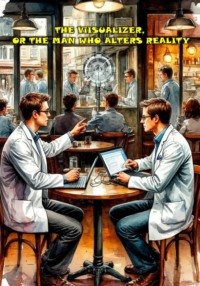
Читать книгу: «The visualizer, or the man who alters reality»
Synopsis for novel "The Visualizer, or the man who alters Reality
What you die of hardly matters
far more impotant is why were born
Omar Khayyam
The novel The Visualizer, or the man who alters reality is the first book in a series published under the collective title The Visualizer, a series devoted to the struggle against the forces of chaos that are trying to tear apart the world order we know. A professional book trailer for the novel has been published on YouTube, capturing the central idea of this philosophical and psychological work. Human beings must never be used as guinea pigs. Those who do so will be made to pay a heavy price: the heroes will find a way to fight back against injustice, and the truth will prevail. It will not be easy, of course — the characters will have to battle for their future and their very lives.
The authors previous series, featuring CIA secret agent Steven Cheeskane and comprising three novels — Gifts of the Gods, The Heavenly Gates of Ta Keo, and Secrets of the Ocean Depths — became a genuine bestseller and attracted an international readership. Those books are currently sold through the leading Russian and foreign retail platforms: Litres (Russia); Altaspera (Canada); Ridero (Russia); Amazon (USA); Tsifrovaya Vitrina (Russia); AliExpress (China); Wildberries (Russia); Ozon (Russia); Google Play (USA); NTV+ (Russia); Livelib (Russia); Bookmix (Russia); and Lulu (USA). You can see this for yourself by visiting the website of the author of this wonderful novel, where many reviews, quotes and illustrations are also available.
Given the climate of military hysteria that has swept the globe, the novels of the new The Visualizer series carry a frankly anti-war message. The first novel in the series, The Visualizer, or The Man Who Alters Reality, is devoted to the dark phenomena that will accompany humanity in the process of developing and deploying psychotronic weapons. I have tried to portray the dangers our generation will face if such a weapon is ever created.
It should be noted that this is the most terrifying non-lethal weapon that could appear on Earth in the very near future. Some experts argue that the force of its impact would surpass the consequences of nuclear warfare.
In this respect my work has much in common with Alexei Tolstoys novel The Hyperboloid of Engineer Garin, which anticipated certain aspects of laser weaponry — technology that emerged almost exactly a hundred years after the books publication. The threats facing the heroes of my novel, however, are far more serious. The plot is more densely packed with events, and the novel moves at a brisker pace.
The action of the novel takes place in our own time. The principal characters of The Visualizer, or The Man Who Alters Reality are patients at the I. M. Rabinovich Psychiatric Clinic, on whom a series of secret experiments aimed at developing and producing PSY weapons is about to be conducted. No one knows where these dangerous trials on human subjects will lead, and everyone is proceeding in the dark.
As a result of these extremely complex experiments, the people being irradiated acquire new abilities that enable them to break free. They want to destroy the dangerous apparatus through which inhumane tests have been conducted on human beings. In the end they succeed in neutralizing a powerful torsion-and-spin-field generator that has been irradiating both them and the entire territory of all the Eastern European countries. This gives the novel an additional detective-story dimension that lends it a unique flavor.
Because the action takes place in our own time, many of the characters have recognizable real-life prototypes, and the events in the novel intersect with those terrible wars that have not ceased for a single moment on the Eurasian continent. In a certain sense the novel is a tracing over reality. Even so, the reader should not assume that the plot has been taken from real life.
It should be treated as a wholly invented work of fiction. There is no need to pursue the author, launch journalistic investigations, write letters to the secret services, or pester me with correspondence. The people depicted do not exist, and all resemblances are coincidental. They are the products of the authors imagination.
I hope you will enjoy this novel and that together with me you will fight for peace and prosperity on the land belonging to our long-suffering peoples — and that you will, of course, follow the heroes of my fantastic works.
Prologue
The one whom life has beaten
will go farther,
The one whos eaten salt will
sweeter find the honey.
The one whos wept will laugh
with truer feeling,
The one whos died will know
what it is to live.
<i>Omar Khayyam</i>
For three months now, Vera Ivanovna Maslova — a certified clinical psychologist — had been unable to find work. Frantically sifting through vacancy listings at employment agencies and HR departments, she was astonished to discover that her specialty had still not become truly marketable.
Demand for professionals in the humanities was weak. Everyone wanted accountants and lawyers, and openings for psychologists were rare. The few positions that did exist came laden with inflated requirements, and the salaries on offer were nowhere near enough for a decent living. They were pittances, and they stirred in her only one feeling: irritation.
This weighed on her deeply — not only as a sensitive person but as a credentialed specialist with years of experience. The culture of seeking professional counseling, so long established in the West, had still not taken root in this country.
There were reasons for that, no doubt. People were afraid of psychologists, and in many ways their fear was justified. In Soviet times, psychiatric hospitals had been instruments of political repression, and people still assumed, by force of habit, that nothing had changed. Russian television bore part of the blame: it kept frightening ordinary viewers with the specter of the psych ward.
But Vera Ivanovna saw things differently. She believed that life never stands still — that people and the world around them are constantly changing, and that the authorities no longer used the methods they had so recently employed against opposition leaders. All of this gave her grounds for hope, and her deep knowledge of psychology helped her believe in her own abilities. And so she kept searching, relentlessly, for steady employment, relying on no one but herself.
Of course, some freelance work remained available. She had long since registered as self-employed on the Gosuslugi portal, and her strong qualifications and professional skills let her take part in paid seminars and symposia as a lecturer or presenter. She did that from time to time. But she had no steady job. The prospect of finding one was dim. Freelance income provided just enough to get by without constantly borrowing from her parents and acquaintances. And the contact with the people who attended her seminars created a sense of being needed.
Some of those who came to her lectures eventually became her private clients. That, too, gave her confidence, and in time it began to bring in modest earnings. Over several years of this kind of work she had built up a fairly broad clientele, made up mostly of young businesspeople who were struggling to find customers.
They were former schoolchildren with burning ambition who believed they were special and could, in a very short time, conquer the financial capital of the country without the help of their fathers connections. But not many of them succeeded. It was hard to find your footing in Moscow. Life in the Russian capital could break anyone. As a rule, it dealt harshly with young people, and they turned to a psychologist in the hope of finding the root of their problems within themselves.
Now she herself was in an equally difficult situation. And perhaps she too needed the services of a more experienced and accomplished psychologist — someone who could instill in her confidence in her own strengths and hope for future success in her search for that elusive position.
Today, though, felt different, and Vera Ivanovna sensed it right away. She had woken up early and seen brilliant sunshine streaming through her window, filling her with a sense of warmth she had been missing for a long time. Every decent person has moments like that in life, when their guardian angel arrives to sort out whatever has been piling up.
Perhaps Vera Ivanovna had such a guardian angel watching over her. She had, after all, graduated with honors from the Psychology Department of Moscow State University, and then spent two years working as a clinical psychology resident at the Pavlov First Saint Petersburg State Medical University in St. Petersburg — surely that counted for something.
Vera Ivanovna switched on her computer and began reading her incoming email. Several messages had come from her former employer. There had been a time when she was proud to hold a staff psychologist position at the Russian representative office of the Friedrich Ebert Foundation. In those days she earned a decent salary in foreign currency, enough to feel like she was living well. The Foundation operated generously, and Vera Ivanovna had assumed it would go on that way forever.
But times had changed. Eastern winds began to blow. First the Foundations activities were declared harmful, and then the Foundation itself was designated a foreign agent. Mutual sanctions were hitting both sides of the conflict, and ordinary citizens who had nothing to do with politics sometimes found themselves caught in the crossfire.
The government had not forgiven the organization for the inconsistent presentations given by Russian schoolchildren before the German parliament — addresses in which, at the behest of their Western handlers, they had argued for revisiting the outcome of the Second World War. The Russian government took careful notice of those presentations. It was a serious blunder by the Foundations leadership, made through sheer thoughtlessness. But it carried equally serious consequences.
Funding dried up significantly, and the Foundation let go of a number of its permanent staff members, including some it had long worked with productively. Non-core managers were the first to be cut. Eventually the psychologist was made redundant too.
Vera Ivanovna had left her well-paid position with regret, but life moved on and she had to think fast. That the Foundation had engaged in activities hostile to the state barely concerned her. She had nothing to do with politics. But that episode was now one of the reasons she could not find new work, despite all her experience and credentials.
Prospective employers who might otherwise have found her professionally and personally suitable looked askance at the glowing references she had received upon leaving her previous job. Nobody wanted to associate with someone who had been tainted by a connection to a foreign organization that the state had officially designated a foreign agent. Most Russian organizations wanted loyal, spotlessly clean employees — people whose biographies were beyond reproach.
She no longer worked for the Friedrich Ebert Foundation, but that fact continued to cast a shadow over her new life, and she regretted having ever decided to take that attractive position at such a well-known foreign firm.
Generally speaking, the only employers who might now offer her work were the major Russian resource-extraction companies. But those companies underwent periodic government inspections, and former foreign agents could become an unwelcome irritant that state officials at various levels might take an interest in. Officials could start poking around in the companys affairs, leading to serious expenditures and even premature bankruptcy. Unnecessary scrutiny from officials was the last thing anyone wanted. There were already more than enough headaches involved in obtaining permits, licenses, and certificates, all of which cost enormous sums.
So employers kept turning her down, even though they showed genuine interest at first, recognizing they were dealing with a top-tier specialist. Interviews almost invariably ended the same way: she was wished every success, but was never invited back for a final meeting with the head of HR or the company director.
Vera Ivanovna surfaced from her gloomy thoughts. She was still looking at her monitor, and she still had not worked through all the mail in her inbox. Several messages were from former clients with whom she stayed in touch by email.
One letter she read twice. A young man was thanking her for the help she had given him the previous year and writing to tell her that his life had finally turned around. My life has changed completely, he wrote. Your lectures pushed me to switch fields. In my new line of work I have achieved remarkable results. Letters like that were easy and pleasant to read. They strengthened her belief in herself and her hope for success — her conviction that she had chosen the right profession, and that the difficulties she was now facing in her job search were only temporary.
As she was clearing her inbox, Vera Ivanovna noticed a message from an unfamiliar address. Normally she deleted such things immediately. This time, for some reason, she decided to do otherwise. She opened the message out of habit, expecting another piece of spam that had wandered into her inbox by mistake. She was already about to delete it, but something stopped her. She looked at the sender and read on, puzzling over this unexpected communication that had somehow found its way to her email address. The message contained a job offer — exactly the kind of offer she had given up hoping for.
At first Vera Ivanovna did not take the offer seriously. She was being invited to work at a private psychological clinic — a psych ward, in common parlance. What was more, the employer needed specifically a psychologist with residency experience who had spent at least two years in a private organization and held a medical qualification or had extensive practical experience as a physician.
Vera Ivanovna skimmed the offer and found herself intrigued. She met most of the listed requirements. True, her experience as a physician had been brief, but she could compensate for that gap with her long track record in the field.
She thought it over. Vera Ivanovna was a workaholic who feared no task. She wanted to help people who had found themselves in difficult psychological situations, and she liked being paid well for doing so. She could calm a senior executive under severe psychological pressure just as easily as a manager whose work life had hit a rough patch. She had been known to guide chronic alcoholics out of drinking binges and help neurotics find their footing. In other words, she had no doubt she could handle the new responsibilities. The pay also seemed to be in order: the salary on offer this time was acceptable, the figure stated in the message was one she could live with. Moreover, the clinic was not looking for an ordinary staff psychologist but for a chief medical officer — a fairly senior medical post that matched her ambitions. Perhaps that is why Vera Ivanovna decided she would go to the interview after all, and take a look at what this private psychiatric hospital on the outskirts of the city was actually like.
She opened her computer to look up the clinics location. With an address in hand that was easy enough: maps available online could pinpoint any object within minutes. Although the institution was situated practically in the Moscow Region — in the new construction zones of New Moscow — that did not put her off. The Mayor was personally overseeing development there; the district was destined to become a new showcase for the city, with attractive new buildings and new metro stations going up. Getting there would not be difficult.
She read online that the district had only just been built up. The hospital occupied a recently completed building. The nearest metro station was within walking distance of the clinic — an important detail, since Ms. Maslova disliked commuting by car. She had no husband yet, and she had not yet learned to drive with any confidence. A metro ride held no terrors for her.
Vera Ivanovna decided to respond positively to the offer that had landed in her inbox by chance, and wrote back. She was honest about herself and her qualifications, since she genuinely met nearly all the requirements of the position described in the offer. She wrote that she was ready to attend an interview for the vacant post of chief medical officer at the earliest opportunity, and was prepared to come to the address given in the message at whatever time suited the administration. She could not wait to hear back from the employer so they could discuss the terms of her employment.
The reply came quickly. That evening a letter arrived from the clinics director, proposing a meeting the following Wednesday at eleven oclock in the morning. The time suited her, even though she was fond of sleeping in. Today was Monday, which left Vera Ivanovna time to think everything through carefully.
Chapter 1
Beneath this sky life is a
chain of torments,
And will the sky take pity on us?
Never.
O you unborn!
If you could learn our
sufferings,
You would not choose to come
down here at all.
<i>Omar Khayyam</i>
The I. M. Rabinovich Private Psychological Clinic occupied a pleasantly picturesque corner of New Moscow. Not so long ago the area had been dense suburban forest where villagers from nearby settlements went mushroom-picking. But New Moscow was expanding at a furious pace, devouring every patch of open land and filling the newly annexed territories with apartment blocks and roads, with the noise and clamor of youth.
Construction was under way everywhere. Workers were laying paving tiles and planting young saplings along the pathways. The building never stopped, not for a minute. The constant noise and dirt did not sit well with everyone. The local residents had at first tried to fight the infill development, but the big money that arrived paid no attention to their wishes or their needs. What was more, the locals were unhappy that a psych ward of all things was going up in their district. But they were powerless to stop construction of this large, closed medical facility.
Several times they had written complaint letters to the local borough administration, and once they had even tried to block the road connecting the new neighborhoods to the city center. Construction continued all the same, and before long a sizeable stretch of their suburban district was fenced off behind a solid three-meter wall, behind which three state-of-the-art six-story buildings were rising, designed to the latest architectural standards.
By the time Vera Ivanovna arrived, the buildings were already finished and fitted out with the most modern medical equipment the domestic market had to offer. A new director had been appointed and a qualified medical staff assembled — people capable of meeting the demands ahead. The clinic had long since opened and was accepting new patients.
Vera Ivanovna looked around. The private medical facility stood near a park zone. It was a well-kept, leafy part of the city. She liked the fact that freshly planted greenery lined the pathways, bringing the surrounding landscape to life and making it more inviting.
Rowan trees had been planted along most of the paths, with young maples, larches, and lindens visible here and there. In the distance a few handsome pines could be made out — survivors of the suburban forest that had stood here until recently, only to be felled without mercy by the construction crews.
The air here was considerably cleaner than in the district where she lived. It was a degree or two cooler than in the city center, but far fresher. The spot was lovely and well-tended. Isaac Moiseevich — the director of the private clinic — must have had connections at City Hall, given that he had managed to build a modern facility in such an outstanding location, next to a metro station, despite the resistance of the local population. These were Vera Ivanovnas thoughts as she approached the gate of the institution that was to become her second home.
Above the locked entrance hung a modern color video intercom, and she pressed the call button. A pleasant male voice asked the purpose of her visit. Vera Ivanovna explained that she had been invited for an interview, and the man asked her to wait a few minutes while Isaac Moiseevich Rabinovich — the clinics director — came down personally to meet her.
The young woman was pleased that the director of the private clinic himself was coming to greet her, rather than some junior member of staff. Evidently he had already made inquiries about her, and Mr. Rabinovich was counting on her becoming his clinics chief medical officer — someone with whom he would be spending a great deal of time. What had become of the previous chief medical officer she did not think to wonder just then. It was not something that concerned her.
Isaac Moiseevich turned out to be a middle-aged man, somewhat shorter than she was. He looked up at the tall, attractive young woman who had come to his clinic in search of work, peering at her through enormous horn-rimmed glasses, and smiled with a childlike, playful grin. The smile was warm and disarming. He tried to be witty, clearly wanting to make a good impression. And although his smile was not entirely genuine, the man as a whole made a favorable impression.
— Allow me to invite you into our humble abode, said Isaac Moiseevich, glancing at the attractive young woman and making a welcoming gesture with his small hands. But first youll need to put on a coat and pull some shoe covers over your footwear — we maintain strict sterile cleanliness throughout.
— I should mention that we are inspected regularly. I have been obliged to hire an entire team of janitors and cleaners who scrub and tidy the hospital grounds from morning to night. We receive foreign visitors from time to time. Our center enjoys serious sponsorship, and we work hard to maintain our standards. The officials who inspect us periodically always speak of the place in glowing terms, though none of them volunteers to become our patients. He paused. We even have a complaints and suggestions book.
— And the complaints in it are far outnumbered by positive reviews.
— Of course, of course, replied Vera Ivanovna, hurrying to pull the coat over her narrow shoulders and reaching for a pair of shoe covers from the pack lying on a small side table beside the door.
— This young lady is with me, Isaac Moiseevich instructed the stern security guard who was standing near the entrance talking into a two-way radio.
Once Vera Ivanovna had passed into the spacious lobby of the hospital, the guard hurried to pull the heavy wooden street door shut behind them. He watched with curiosity as the attractive young woman was personally greeted by Isaac Moiseevich Rabinovich, the clinics director — a rare occurrence. As a rule the director sat in his grand office in the third building and let junior staff or the regular security guards escort visitors to him. He was a rather reserved man with a narrow circle of acquaintances, and he communicated exclusively with people who had caught his interest for one reason or another. Evidently he had good reasons for receiving this particular visitor so graciously.
Isaac Moiseevich glanced once more at Vera Ivanovna and began describing his clinic:
— Our clinic is quite large — it can be compared to a multi-specialty medical center. There are not many facilities of this scale in the world, which is why serious academic circles take a keen interest in our work. That is probably why our physicians are respected in the West and are invited to attend various medical forums and symposia.
— Let me show you around. We have three six-story buildings, all connected to one another at the second-floor level — meaning there is a through corridor on that floor that allows you to move from one building to the next without going outside.
He pointed toward the elevator and pressed the button for the second floor.
— We also have our own landscaped grounds under permanent guard, he continued. Ill show you those a little later.
— The first building houses the registry, the intake wards for new patients, and the consulting rooms for general practitioners. This is where we issue certificates to the public and carry out initial patient assessments. Our clinic serves as a district facility, so anyone who needs documentation for a drivers license or a firearms permit must come to us. The physicians who see walk-in patients are highly experienced — they can identify an unstable individual from just a few words. If that person requires our medical assistance, they are immediately detained and referred to the staff psychologist. If you come to work with us, you too will learn to recognize those who suffer from various mental disorders, he said, looking attentively at his companion.
— On more than one occasion such referrals have led to individuals becoming our permanent patients. And the police have no doubt found themselves short a few serial killers as a result. That is precisely why the authorities pay such close attention to our clinic. No one wants unpleasant surprises, and everyone would prefer to avoid them.
After riding the elevator to the second floor together, the director and the young woman found themselves at the entrance to a long through corridor where a second guard was on duty. The man in a special protective uniform looked sternly at the director — he already knew the physicians were coming up by elevator and did not stop them.
Without a word he opened the turnstile for them using his own smart card. As he did so, the reader played a cheerful little melody from some familiar childrens cartoon.
— Every member of our staff has an identical smart card with a limited access radius, Isaac Moiseevich continued.
It was evident that he had a fondness for digital gadgets: modern color cameras were mounted throughout every floor of the hospital, and the doors were fitted with vandal-proof readers from the NPO Relvest access control and management system.
— If you do not have authorization to enter a particular security zone in any of the three buildings, your personal card will not open the turnstile. Only the chief medical officer and the director have the right to move freely through all three buildings. Other physicians have cards with additional restrictions tied to their professional duties and working hours. If they are not permitted to enter a given building or room, they will not get in, no matter how much they might wish to.
The clinic director then looked carefully at Vera Ivanovna and murmured, just quietly enough that the guards would not hear:
— If you turn out to be a good fit for us, we will make you a card exactly like this one, and you will be able to pass through every turnstile in the building, on whatever floor it may be.
Chapter 2
The sage who speaks of freedom
while in prison — who
counsels all to lose themselves in
wine — Is truly wise: in chains he
still is free, strong as a cliff,
when his soul stays noble.
<i>Omar Khayyam</i>
Kirill had ended up in the psych ward several years ago. He had long since understood that he was born a different kind of child — one who did not quite resemble his peers. After a while his parents noticed it too, unable at first to understand why their son had no interest in playing with children his own age, and why those children ran from him as though from someone carrying the plague.
It was probably connected to the fact that Kirill possessed some kind of innate, very powerful energy that affected other people and pushed them away from him. Or perhaps it was a matter of his character. He was an only child, raised according to the strictest family traditions, and that had its effect on ones psyche.
If he wanted someone elses toy, he would simply walk up to the other child and demand it be handed over — even though it did not belong to him. After receiving this command, the other child would meekly comply and surrender whatever had caught Kirills fancy. As a rule, parents sorted out these scandals as soon as they occurred and returned the pilfered trinket to its owner. But things could not go on that way forever.
As Kirill grew, so did his abilities. It turned out that he possessed a natural gift for hypnosis and could influence even adults. Once, riding a trolleybus, he was approached by an inspector checking tickets. The inspector asked to see his travel pass. Kirill reached into the pocket of his leather jacket. The pass was not there — it had probably been left in another coat, and searching for it was pointless. Kirill thought for a moment and remembered his hidden abilities. He decided to test them in practice.
He did not want to deceive the conductor, but he had no choice. He pulled out the first scrap of paper he could find and tried to convince the conductor that this was the very travel pass he had been asking the schoolboy to produce. It was the kind of thing he did with children in the yard — but up to this point it had only ever been a game. Strangely enough, the conductor saw no difference between the scrap of paper and an ordinary travel pass, and returned it to the young man who had shown it to him. Then he moved on to check the documents of the other passengers.
The boy smiled. His abilities had grown considerably, and they had been proven in practice. He now intended to put them to use in his own interests. At that point he was still considered a normal person, and he paid no particular attention to his gift.
Perhaps his new abilities might have served as a kind of magic wand in difficult life situations, had it not been for the nervous breakdowns that struck him from time to time — something resembling epileptic fits. The stronger his abilities grew, the more severe and prolonged these episodes became, until they began to resemble a serious psychological or neurological disorder.
The first episode occurred when he was twelve years old. The relentlessly negative news broadcast on the main television channels, the high bar he had set for himself in his schoolwork, and the absence of close friends all combined to bring about a deep psychological exhaustion and a severe nervous breakdown.
He did not know how to relieve it and fell into hysterics. His condition did not improve. Kirill could not shake the headaches and the bad moods that dogged him constantly, preventing him from studying or resting. The boy developed insomnia and could sit up through the night playing on his personal computer without sleeping at all. The psychological stress intensified and led to another episode, another bout of hysteria that would not let up for days. He shouted at his father, cried, and could not calm down. Sometimes he raised his voice at his parents out of resentment — out of the feeling that they did not understand him.
His parents grew worried and took the boy to a psychologist they knew. The psychologist listened carefully to the parents and prescribed breathing exercises and regular physical activity. For a time this genuinely helped. Kirill began attending a tennis section, and this held the development of his stress and emotional overload at bay for several years. During that period his episodes almost entirely ceased, and his parents relaxed a little.
But then bad luck struck. Moscow was being built up at breakneck speed, and some investor had set his sights on a small sports complex that stood very close to their home. Builders tried to profit at the residents expense under the cover of the renovation program. Many Muscovites found themselves in exactly this situation, and their complaints went unanswered.
The building was demolished, and within a year and a half a large residential complex had risen in its place, covering every available plot. Almost no open space remained in the yard of his building. The green plantings were felled without mercy and replaced by an enormous parking lot that swallowed every square meter of the surrounding grounds. There was no longer anywhere to meet with his peers — there was simply no room.
The parking lot was used by anyone and everyone, from passing taxi drivers to residents of the neighboring buildings. The new tenants who had moved into the high-rise next door were rough and ill-mannered people who had arrived in Moscow by chance, through personal connections and large sums of money. Many of them had come from the post-Soviet republics and Central Asia. Kirill was forced to give up the sport he had loved so much. And that took its toll on his health.
What was more, new students had arrived at their small school — students who immediately noticed the boy who spent so much time studying and spoke to no one, doing his best to avoid his classmates. They began taunting and bullying the child who differed from them in both his level of knowledge and his upbringing, and this too began to leave its mark on his psyche.
He became highly irritable, and this aggression eventually led to the development of schizophrenia and paranoia. He kept getting into fights with his peers, and sometimes took a heavy beating. The fights did not pass without consequences.
It seemed that someone had struck him hard on the head at some point, for he began to feel as though invisible forces were deliberately sending psychological waves against him, waves that made him feel worse. His accounts of this frightened his parents and acquaintances, and they were obliged to take him to a private psychological clinic for a second evaluation.
This time the doctors prescribed neuroleptics to correct his behavior, and that definitively altered his psyche. Added to the nervous breakdowns that would not cease was a new heaviness, a sluggishness and inattentiveness. He was no longer capable of concentrating even on his regular homework. Where once he had spent no more than an hour and a half on it, it now consumed all of his free time.
Kirills grades declined, and teachers began to take note. The persecution from peers and teachers intensified, while his condition became dependent on the medication. If it was not purchased on time, he would fly into a rage, plunging into a deep depression that could last for days.
The episodes began to recur at regular intervals, and in the end he was placed in the psych ward, transferred to the open inpatient unit in the hope of a quick recovery. He felt a little better at the clinic. But Kirill had not made his peace with his situation and dreamed of escaping from this private psychological clinic, for he considered himself a perfectly normal person and traced all his misfortunes to his parents desire to be rid of him.
Had the facility been any less secure, he would have made good on that dream long ago. His parents were prepared to pay for his care, and the doctors saw no reason to discharge the young man. His parents were exhausted by his constant erratic behavior and nervous episodes. They also wanted some time to themselves — to reach a decision about their sons treatment in a calmer state of mind.
His parents understood that only the doctors could pull him out of this difficult psychological state, correcting his behavior and his relationship to life, to his peers, and to his parents — whether through medication or through some other means.
Chapter 3
To cage one soul, I deem more
worthy far than setting free a
thousand slaves from war;
And by one tender act of
love to bind one heart — than
liberate all humankind.
<i>Omar Khayyam</i>
Walking the length of the corridor that connected the first and second clinic buildings, Vera Ivanovna and Isaac Moiseevich passed through into the second wing of the hospital. This section housed patients in the open inpatient ward.
As the director explained, the closed inpatient ward was located in the third and outermost building — the one with the strictest security of all. The third building also housed the administrative offices: the director's suite and the chief medical officer's office. That office, Vera Ivanovna was told, would soon be hers.
The arrangement was a practical one: only the director and the chief medical officer held the authority to prescribe the powerful psychotropic and narcotic medications that certain patients required. Every such drug was tracked and logged; misuse could — and did — result in heavy administrative fines and criminal liability.
Isaac Moiseevich mentioned, not without a certain rueful pride, that he himself had once been penalized for just such a violation — though he had been entirely innocent. The fine levied against the clinic had been substantial enough to cut directly into staff salaries; several employees had gone without their annual bonuses and had quit. Finding replacements had not been easy.
Patients receiving powerful medications were confined to the third and most heavily guarded building, which was watched around the clock by a private security firm.
The contrast between the first and second buildings was stark. The first received outpatients who came mainly for official paperwork; the second housed people suffering from genuine mental illness — mild forms of psychotic and schizophrenic disorders. As a rule, such patients did not stay long and made reasonably steady progress.
What struck Vera Ivanovna immediately was the absence of doors on the patient rooms. The windows were fitted with anti-vandal security grates, locked with ordinary door locks. Isaac Moiseevich explained the logic: keeping patients in plain sight at all times prevented attacks on staff or other patients, and made it impossible for anyone to attempt suicide — whether by self-harm or by throwing themselves from a window.
Patients could deteriorate without warning, and what followed could be anything — including a suicide attempt. Doctors and orderlies had to respond instantly to any incident or unusual situation anywhere in the building and render immediate assistance. Russian law and the clinic's own internal regulations demanded nothing less.
Security cameras were mounted virtually everywhere; all patient and staff activity was captured by video recorders housed in a small security booth. Most patients wore identical hospital gowns and drifted aimlessly along the long corridor, occasionally exchanging a few words with a nurse or an orderly.
It was plain that the patients had very little to do, and Vera Ivanovna took note of that immediately. She already had ideas — and she knew what her first priority would be. A few patients sat in the common lounge watching television from leather sofas. As the director explained, these were individuals whose illness presented in a milder form; they were even permitted supervised walks in the park adjacent to the second building, within a designated and guarded perimeter. The walks were scheduled at the same time every day, after lunch. A cafeteria was situated at the far end of the corridor. Isaac Moiseevich invited Vera Ivanovna to join him for a meal, but she declined — she had only recently had breakfast.
Making their way down the corridor, they encountered several nurses and one of the ward physicians. Everyone was occupied with their own duties and could spare only a few minutes. Isaac Moiseevich introduced Vera Ivanovna to each of them as the clinic's future chief medical officer — their future boss. He seemed in no doubt that she would accept the position.
The young physician they met on that floor was named Boris Alexandrovich Smirnov. He was a psychologist by training, and had spent years working with advanced and chronic cases of various psychiatric conditions — schizophrenia, dementia, and their complications. Isaac Moiseevich held him in high regard and took pains to introduce him properly to Vera Ivanovna, citing his accomplishments with evident respect. And yet, for reasons the director did not spell out, he had never promoted Smirnov to a higher position. Perhaps, Vera Ivanovna thought, the man was simply too young. Or perhaps there were other reasons — more serious ones.
After they had crossed the second building from end to end, they reached the next connecting corridor — the passage linking the second and third wings. Security here was a level above anything they had passed through before.
Vera Ivanovna had never seen screening equipment like it anywhere. At the start of the corridor stood a transparent airlock booth — an access control and management system that sealed from both sides, forming a pressurized chamber. The only way in or out of the secured area was through this airlock. As Isaac Moiseevich explained, identical units were installed only in the most tightly guarded government medical facilities and cost an almost incomprehensible sum of money.
The patients housed in the third building suffered from severe psychiatric disorders; some of them posed a genuine danger to those around them. If the patients in the second building might realistically expect to be discharged in a month or two, those in the third building were confined there more or less permanently. Only a small number could hope for a transfer back to the second building, and then only after an extended course of treatment.
Any such transfer required the approval of a medical review board, which would formally determine either the patient's complete recovery or meaningful clinical progress. Only from the open inpatient ward of the second building could a patient make it back to the outside world. The system was not arbitrary: certain patients had already contemplated escape, and the layered design was intended to make any such attempt as difficult as possible, despite the already formidable security measures. Board members were chosen from among the most experienced physicians on staff, since some patients had been known to convincingly simulate recovery.
The two physicians passed through the airlock into the third building and made their way toward the director's office, located just inside the entrance of the corridor. Standing directly outside the office door was yet another guard, armed with an electric stun weapon. Isaac Moiseevich clearly wished to feel completely safe at all times, and had granted the security detail broad authority accordingly. While they were in this wing, the guard followed a step behind him like a bodyguard lifted from an American espionage thriller.
"Unfortunately, I have to keep security around me twenty-four hours a day," the director said apologetically, nodding in the guard's direction.
"Your office is directly across the hall from mine, by the way. The two rooms are connected by that metal door right there," he said, turning to face her and pointing. "So you need not worry about your safety. The guard will make sure no one disturbs you while you are here — and that no one harms you, either."
Vera Ivanovna stepped into the director's office. In the center of the room stood a large, elongated conference table that joined Isaac Moiseevich's own desk in a single combined structure shaped like the letter T. Along the right-hand wall stood a cabinet housing a compact personal card index of the most difficult patient files. All the furniture was of fine quality, built from high-grade hardwoods.
As Isaac Moiseevich explained, the card index contained duplicates of the most complex and advanced cases — patients whose care required either his personal involvement or that of a consulting neuropsychologist. The originals were kept in neat folders in the reception office on the first floor of the first building. The registration clerk who managed them served as a model of professional conscientiousness: every file was immaculate, sorted alphabetically by name and surname, forming what amounted to a unified medical records system. The director liked to keep his finger on the pulse of things and would periodically review these files, reflecting on contemporary approaches to treating the many behavioral disorders he encountered in his patients.
On the wall directly above his desk hung a portrait of the President of the Russian Federation. Such portraits invariably adorned the offices of senior officials, and Isaac Moiseevich was not one to be found wanting. Senior bureaucrats visited the clinic from time to time when close relatives were ill, and they were always shown straight to the director's spacious office — a room that looked far more like a government ministry suite than the office of a typical psychiatric facility administrator.
After the tour was complete, Isaac Moiseevich settled into his executive chair and invited Vera Ivanovna to take the wooden chair drawn up to his desk, directly across from him.
"I'd like you to tell me about yourself and your previous work," he said. "Everything interests me. Where you worked before, what you accomplished, what you enjoy doing in your free time, why you're looking for a new position."
With that, he turned his full attention to Vera Ivanovna Maslova. And she began. She told only the truth — she had nothing to conceal from the man who was to be her supervisor, and who had, on the whole, made a good impression on her. There were no skeletons in her closet. Her conduct had always been beyond reproach.
Chspter 4
We drink not out of mirth or
revelry,
Nor do we seek unbridled liberty.
We drink to flee ourselves
for just one hour —
And that is why we yield
to wine's dark power.
Omar Khayyam
John met Winston at a small Irish pub on the outskirts of the city. Years ago they had worked together at the Tavistock Institute of Human Relations — an independent organization, as it styled itself. Both men were psychologists, and the friendship had held, even though John had left the Institute five years earlier to go into private practice.
Anyone who departed the Institute had first to sign a non-disclosure agreement covering all commercial and confidential information acquired during their time there. As a result, the only people either man could speak to freely were those still on the inside. Contacts with journalists or anyone in the creative professions were strongly discouraged. Perhaps that was why they always met at the same Irish pub on the city's edge.
The Tavistock Institute of Human Relations was, by any honest measure, one of the most fashionable and influential groups of researchers in the fields of governance, sociology, and mass psychological influence. Operating behind the cover of a non-profit organization, it had long since become a factory for brainwashing and engineering the so-called color revolutions and acts of sabotage that erupted in various corners of the world — some of them remarkably distant from the dominion that Great Britain still, in its own way, considered itself to be.
Psychophysical and psychotronic techniques were applied both to the Institute's own citizens and to foreign nationals who passed through its doors. Perhaps that was why the place had begun to look rather like a modern medical clinic. Among the Tavistock Institute's clients were major private corporations and foundations, as well as government regulators — including the British foreign intelligence service.
In his time, John had been offered the chance to head a secret laboratory conducting research into the effects of powerful spin and torsion fields on the human brain. It was a tempting proposition. The scientist would have had at his disposal a well-equipped laboratory and a full complement of supporting staff.
But after reviewing the order book, John had felt compelled to refuse. He had no wish to conduct dubious experiments on human beings in service of obscure government programs.
He had resigned. For a long time afterward he could not find work, having received no formal letters of recommendation on his departure. Fortunately, a small oil-and-gas company needed someone with his qualifications and experience, and he was taken on as a field psychologist, initially on a one-month trial. John passed the trial with distinction and was added to the permanent payroll.
The oil workers operated in the most varied regions on earth — restless corners of the world where the conditions were harsh: deserts, permafrost, remote offshore platforms far out at sea. The work was dirty and physically brutal. That took its toll on the men who did it, and John was constantly having to pull exhausted workers back from the edge of the stress states their tight-fisted employer had pushed them into.
Workers could develop severe phobias and bipolar disorders. The employer, naturally, had no desire to be sued and obliged to support seriously ill employees who ended up in hospital with such complex diagnoses. The rates at psychiatric facilities were astronomical. Everyone knew that the fees charged at these closed medical institutions vastly exceeded what an ordinary office psychologist could ever earn.
Unlike John, Winston had stayed on at the Institute and taken up exactly the line of research his friend had declined. From time to time the two men met at this bar to unwind and exchange news. But on this particular occasion a long interval had passed since their last meeting. Both had been buried in urgent matters, and the get-together had kept being postponed. It might have gone on being postponed indefinitely had Winston not phoned and insisted on seeing John here, today, without delay.
John studied his old friend from across the table. They had not seen each other in nearly two years, and in that time Winston had changed dramatically. He looked considerably older and had lost most of his hair. Something was clearly weighing on him — something that was leaving its mark on his health and his appearance. John, by contrast, had barely changed at all. He liked his work, his employer valued him, and the risks were minimal. Even when unexpected incidents arose, they were resolved promptly in the normal course of things and left no lasting impression on his outlook or his sense of well-being. Whatever had done this to Winston was impossible to say.
"Long time," said John, giving his friend a clap on the shoulder. He was glad of the chance to talk about the things that preoccupied both of them as psychologists — things that made a change from the daily routine and the complications of his private life.
"I want to order us two dark beers and some Swiss grilled sausages. I hope you won't turn those down," he said.
The café played soft, pleasant music. Between the tables moved nimble and attractive waitresses, carrying enormous beer mugs foaming with the fizzing dark liquid, and trays loaded with fragrant appetizers.
John waved one of the nearest girls over to place their order. Winston sat in silence, as if sunk in meditation. He was certain John would order exactly what he needed most at that moment. His eyes kept drifting hungrily to the beer the waitresses were drawing from the taps mounted on the long bar at the far end of the room.
Winston wanted to relax and forget — forget the experiments being conducted in his secret laboratory over the past two years. And John understood. They had worked together so long that words between them had become almost unnecessary.
"You look exhausted," John said. "Heavy workload?"
"Yes. Right now we're developing a powerful torsion-field generator — one capable of affecting large groups of people," Winston answered.
"Actually, I've brought a small prototype with me right now, and I'm ready to show you how it works. I think I can surprise you."
John had no time to respond. A pretty waitress appeared at their table with the order they had placed a few minutes before. The bar was packed, but the girls served quickly and with a decent measure of courtesy. The psychologist pushed two mugs of beer toward his friend and suggested they sit for a while and have a drink first. John was in no hurry, and there would be time to talk afterward. Winston had to agree. He looked at his friend, apologized, and said:
"Let's drink to seeing each other again. It really has been a long time, and we have plenty to talk about and catch up on."
He patted the worn brown briefcase resting on his knees — the one he had brought along tonight for some reason, and had not set down for a single moment.
Winston raised his pint of dark beer to his lips, hoping to drown the memory of the experiments, and of the complications in his personal life that nagged at him just as persistently, never letting him rest.
To steal even this one evening out, he had been forced to deceive his superiors, telling them he was going to meet a client. He did not regret it. Every person needed to talk sometimes. That was why, in psychological circles, it was considered important to have close friends. And he trusted John completely — they had known each other for what felt like a lifetime. John never informed on the people he was close to; beyond that, he was an excellent specialist who had a genuine feel for the many nuances of scientific work.
Chapter 5
We are the wellspring of all joy
— and grief's own mine.
We hold the vilest filth —
and waters crystalline.
Man sees the world reflected,
many-faced, in glass:
He is both nothing — and
magnificently vast.
<i> Omar Khayyam</i>
Vera Ivanovna sank into her armchair with a weary sigh and switched on the television. Her first day on the job had been dense with events that had left the psychologist thoroughly drained. She closed her eyes and tried to relax, letting her thoughts drift back over everything that had happened. Just as Isaac Moiseevich had hoped, she had accepted his offer of a position at the inpatient clinic. On balance, the work suited her — the facility's status notwithstanding.
Part of the day had been taken up with a meeting with the head of human resources, who walked her through the terms of her employment. All clinic staff were required to pass a polygraph interview. The questions covered harmful habits, personal life, and attitudes toward seriously ill patients. In the director's view, anyone holding a senior position had to demonstrate honesty and transparency — they were expected to be beyond reproach, with no skeletons hidden away in any closet.
The interview had lasted only thirty minutes, but it left her drained — drained by the HR officer herself and by the unpleasant questions she had been asked. Vera Ivanovna recalled the procedure she had just endured: wires with sensors attached to their ends had been clipped all over her body, and then came the "foolish questions." She was not afraid of a polygraph — she had gone through a similar procedure at her previous job — and she had no reason to blush for her behavior. Work occupied all her time. She disliked noisy parties and had never gone looking for trouble.
Beyond the polygraph, the HR officer had other instruments for assessing staff and patients alike. Installed on her desktop computer was a specialized program that transmitted particular visual signals to the person being tested, while sensors fixed to the subject measured heart rate and the dilation or contraction of the pupils. In this way the program identified individuals with a tendency toward drug use or toward violent behavior.
Once the results had been processed, the HR specialist put only a handful of additional questions — and then set down a written statement confirming that Vera Ivanovna was ready to assume her duties. The vetting had gone smoothly. No one doubted that she could begin immediately as chief medical officer of this large institution, staffed by some of the country's finest specialists.
After that, Ms. Maslova sat through a briefing on fire safety and occupational health regulations and signed the relevant log, which was promptly locked away in the director's safe.
"I understand these procedures have tired you out, and I can send you home right now if you like," the director offered, studying her with a slightly melancholy look, aware that all of it must have been exhausting.
But Vera Ivanovna declined. She was not the type to give up, and she was ready to get started on her very first day. She was eager to see the clinic's patients — the people she would be working with over the long term.
"Well then, if you're ready to get to work, you'll need to familiarize yourself with the files of our most complex patients," said Isaac Moiseevich, and slid across to her a thick pile of case files he had specially selected from his card index the day before.
Isaac Moiseevich wanted to assess her competence, and the only way to do that was to discuss the actual clinical picture of these unusual patients. Vera Ivanovna opened the top file and looked at the photograph of the person depicted on it.
"What on earth is this?" she asked, and held the photograph up for the director.
"Here is your first patient — the one you'll need to take charge of," said Isaac Moiseevich. "This is Sanyok — Alexander Anatolyevich Fursov, also known as Alexandra Anatolyevna Fursova. From childhood he presented with severe psychiatric disorders that led to a split personality. To feel like something whole, he persuaded himself he was an extraterrestrial being without gender and began striving toward that end, modifying his body. Over time, the constant experiments on his own physical form produced paradoxical results: he came to resemble some kind of mystical character from a horror film, and people genuinely began to take him for an alien who had descended to Earth from another planet or arrived from another galaxy. You'll agree his appearance is rather extraordinary?" he asked.
Vera Ivanovna looked at the photograph again. The entire face of this individual was tattooed. He had stuck out his tongue — a tongue that writhed and resembled something serpentine, having been split down the middle into two halves. From either side of his tattooed forehead jutted two enormous bony protrusions. The man's appearance was so extravagant that it drew a look of genuine surprise even from Vera Ivanovna, despite everything she had seen during her clinical residency, which she had completed not long ago in Saint Petersburg.
"Do we have many patients like this?" she asked Isaac Moiseevich.
"We have about a hundred patients in the closed inpatient ward, but the great majority of them look perfectly normal and are indistinguishable in appearance from ordinary Russian citizens," the director replied, and asked Vera Ivanovna to look through the files of the clinic's other patients, of whom there were still a very great many.
Vera Ivanovna decided to take the next file — partly to satisfy herself that Mr. Rabinovich was not exaggerating.
The photograph of the next patient was a striking contrast to Fursov's. It showed a distinguished-looking man — the sort you might find behind a desk in any corporate office — who appeared to be no more than forty. He had been photographed in profile. The man wore an elegant, clearly foreign-cut jacket, and above his collar a fashionable bow tie. He was clean-shaven, and had Vera Ivanovna been shown the photograph anywhere else, she would never have suspected for a moment that this was a patient in a closed psychiatric ward. He looked far more like a symphony conductor or a well-known entertainer.
"This is Anatoly Petrovich Ziberman," Isaac Moiseevich began. "For a long time he worked as the chief systems architect for the entire global infrastructure of Sberbank. The director of that institution still holds out hope that this patient will recover and be able to return to his duties without delay.
"Before his illness, Anatoly Petrovich had brought the bank to the very top of the rankings in digitization and virtualization. The systems he managed to introduce and deploy in practice — specifically at that bank — elevated this major state-owned holding to the leading position in the international ranking of the world's most technology-advanced companies. It is fair to say he is a genius; there are only a handful of people like him in the world."
"And how did he end up with us?" Vera Ivanovna asked.
"The thing is," the director began, "Anatoly Petrovich was also responsible for the bank's virtualization infrastructure. One day the idea came to him to transfer his own consciousness into virtual reality. But at the precise moment he was conducting this dangerous and highly unpredictable experiment, he was let down by the most ordinary electrical fault — someone had failed to insulate the contacts properly. There was a short circuit, and his consciousness transferred itself into the computer network. Or at any rate," he added, "that is what he believes happened."
"And so now he pesters the doctors and the junior nursing staff for a mobile phone, trying to track down his consciousness, which he believes is hidden somewhere deep inside the computer network. So far he has been unable to connect to his personal account, since all settings were reset during the incident — including his password. He asked me for my own phone as well, but I had learned from bitter experience with patients of this kind and turned him down. The doctors told me about his condition and I didn't fall for his persuasions," the clinic director noted, displaying, it had to be said, a rare degree of practical wisdom.
"So far, unfortunately, no one has been able to help this patient — whose professional specialty is so much in demand on the market. I suspect we will have many more such cases referred to us, particularly from the ranks of the most zealous employees at various banks and large IT companies.
"As you know, our patients are not permitted to use mobile devices, and we are treating this patient — who is without question suffering from an acute form of schizophrenia — using entirely different methods, including sedative medications. But we have not yet found the right drug. And so he remains in the closed inpatient ward, even though at times he seems to all appearances to be a perfectly healthy man."
Chapter 6
In this faithless world,
don't play the fool,
Don't think to lean on
those around you as a rule.
With clear eyes look even
on your closest friend —
A friend, perhaps, may
prove your worst foe in the end.
<i>Omar Khayyam</i>
Winston had a weakness for dark unfiltered beer. The mild touch of alcohol calmed him and put him in a better mood. He looked across the table at his friend, who was working his way through a light beer in a tall half-litre glass. John had probably been right to turn down the chance to lead the new laboratory and take part in the questionable experiments that the foreign intelligence service of Great Britain — along with a number of private non-governmental foundations — had been pushing the Tavistock Institute of Human Relations to conduct.
He had no idea of the pangs of conscience that were tormenting Winston right now and eating away at his health. Carrying this information alone was unbearable, and that was precisely why he had agreed to meet his old friend and come to this small café on the edge of the city.
He needed to talk, and there was genuinely no one to talk to. His wife had left him several years ago, and apart from John he had no close friends. She had taken their only child with her after the divorce and refused to let Winston see the boy. All his free time now went into the work in his closed laboratory — work he was growing less and less fond of.
The Institute maintained a strict professional atmosphere that discouraged close acquaintances. Beyond that, the security service had been given explicit instructions to limit this particular scientist's outside contacts so that no information about his activities could leak to the press or reach the general public. In short, there was no one to talk to — really talk to.
Apparently John sensed Winston's mood, because he said: "I can see you want to get something off your chest and tell me something. How is the work on the torsion-field generator coming along — the one you mentioned five minutes ago?"
Although John had left the Institute, he had kept up with the scientific publications of the staff who remained, so he had a general sense of the nature of the research his old friend — a man he had known for several decades — was currently engaged in.
"You remember we used to dream about developing a small device that could turn any ordinary citizen into a superhuman being," Winston reminded him.
"As it turns out, we were wrong. A superhuman can only be made from a person who already possesses primary abilities and a strong electromagnetic field of his own. We have given such a person the name visualizer," said Winston, and looked at his old friend with a quiet sadness.
"The generator has very little effect on ordinary people, but if a person already possesses strong energy, then it is possible — likely, even — that his energy will enter into resonance with the powerful electromagnetic and spin waves produced by our generator. In that case we can alter the natural abilities of that individual. He will come to possess capabilities so far beyond the reach of ordinary mortals that they could astonish anyone — including me personally," he continued.
"In the conventional sense, this will represent a new stage in the evolution of Homo sapiens, and those people who manage to pass through this trial successfully will thereafter be able to occupy a higher position in society, since they will possess abilities that were previously unavailable to ordinary human beings," he went on.
"As you can imagine, all this research was classified immediately, and I can't so much as sneeze without their permission," Winston complained, pointing a finger toward the ceiling to suggest that government officials had begun to fancy themselves gods.
"So you're saying this device affects everyone, but only produces a specific transformative effect — one that changes a person's fundamental nature — in certain individuals? Have I understood correctly?" John asked his companion.
"Yes, you've understood it exactly right," Winston confirmed, pleased that John had grasped the details of the project so quickly.
"And how does the device affect ordinary people — those who don't possess such abilities?" John asked, watching his companion carefully.
"Yes — I forgot to explain that. The generator does affect ordinary people as well," Winston continued. "But the reactions of people with lower energy will be weaker in expression and far less predictable. For example, we can provoke a person into some minor action that he carries out without any conscious awareness."
"For instance, I could start a fight right here in this café, or I could make that girl — the waitress — dance a striptease to the music right in front of the customers sitting here drinking their dark unfiltered beer," he said, clearly making a pointed reference to himself.
Winston glanced at the girls carrying the pale and dark ales and licked his lips. He had not been with a woman in a long time, and the waitresses were stirring dark, carnal desires in him.
"And you've brought a prototype of this device here tonight, to show it to me?" John asked, his eyes moving to the brown briefcase that had been resting on Winston's knees since they arrived — the one he had not parted with for a single moment.
"That is exactly what I intend to do," Winston answered. The beer was beginning to take effect, and with it came a growing sense of confidence in his own powers and unlimited possibilities.
Winston set the brown briefcase on the table and began wrestling with the combination locks that kept the lid from opening and revealing the high-technology device inside to his friend.
John fell into thought. If everything Winston had described was true, it was possible to build devices that could reshape the familiar world in a matter of months. He did not even want to think about what abilities a visualizer might acquire once he had crossed over to a new stage of human evolution. The human brain was poorly understood. And as certain neuropsychologists of his acquaintance had said, it operated at only ten percent of the internal hidden potential that nature had built into it.
At last Winston sorted out the combination locks and opened the briefcase lid. Inside were several silver-coloured rectangular boxes connected to one another by dark cables.
A large, elongated Toshiba laptop was joined by a thick patch cord to these boxes, which bore an unmistakable resemblance to a standard electromagnetic wave generator. Connected to the generator in turn was a directional antenna that looked, outwardly, like a standard Wi-Fi antenna.
Winston laid all of these components out on the table and switched on the laptop, intending to demonstrate the operation of the special spin-wave generator, which ran on torsion fields. Once the psychologist had loaded the program he set about calibrating the generator, explaining its inner workings to John as he went. All of these steps were necessary to demonstrate its operation through what was, in truth, a fairly complex piece of software.
John had a weak grasp of physics and so listened to Winston's commentary with only half an ear. Once Winston had calibrated the device, he pointed the antenna toward the other patrons of the café.
"What would you like them to do?" he asked, and smiled at his friend.
John had also had a fair amount to drink by this point and so did not object to his old friend's proposal — something he would later deeply regret. Had he been sober, he would never have allowed Winston to use the café's customers as guinea pigs. Instead, he played along, joining in what looked, on the surface, like nothing more than a circus act.
"Let's have that big fellow over there pour his beer on his young lady," he said, laughing. The alcohol was doing its work, and even someone as cautious as John could, in this state, do a great many foolish things. And those foolish things would later cast a long shadow over both his fate and his friend's.
Winston directed the antenna toward a large man sitting in the corner of the establishment, chatting with a smile and talking to his girlfriend. The girl was quite pretty and clearly pleased her companion. She smiled back at the young man with genuine warmth, all unaware of what he was about to do.
"Give me five minutes to load my program," Winston said. "I need to reconfigure the generator's parameters. What do you think the distance to his table is?" asked the mad psychologist, his eyes burning with the same bright fever as a man who has just taken a powerful narcotic.
"I'd say no more than twelve, maybe thirteen metres," John replied. He did not believe the device would do anything at all to the situation in the café, or have any effect on the people sitting so close to them drinking beer. He had heard of devices like this but had never seen one in operation.
At last Winston finished calibrating the program and reported that he was ready to begin. He switched the generator on and it emitted a low hum, confirming that the device was running. John noticed that the device had begun producing ozone, and that the quality of the air in the room had subtly shifted. Several minutes passed and nothing happened. John had already stopped worrying about the young couple who were having such a pleasant conversation at the neighbouring table. Apparently nothing threatened them.
Then, without warning, the man sitting just a few tables away from them rose to his feet and, as calmly as if it were the most natural thing in the world, tipped a full pint of beer over his companion. She froze for an instant from sheer shock, then stood up, slapped him across the face, and bolted out of the café. Through the window came the sounds of the offended and humiliated woman arguing with her companion, unable to understand what had possessed him to do such a thing. The man tried to defend himself, but his explanations were not accepted, and the quarrel went on just outside the window.
The waitstaff exchanged glances. They had never seen anything like it. The man appeared to have lost his mind. A cleaner appeared from somewhere, swiftly mopping up the spilled drink with a long-handled mop.
"Enough," said John, who had sobered up in an instant and now understood that everything Winston had told him was true.
Chapter 7
Do no evil — it will come
back like a boomerang,
Don't foul the well from
which you'll drink one day.
Don't scorn the man who
stands below your rung —
You may have need of him,
come what may.
<i>Omar Khayyam</i>
Kirill noticed the new chief medical officer the moment she arrived. He had never gotten along with her predecessor, who had done everything in his power to have Kirill transferred from the open inpatient ward to the closed one. Kirill never understood exactly why. Perhaps it was because certain people are simply not susceptible to hypnosis or neurolinguistic programming.
The man Vera Ivanovna had replaced disliked the fact that Kirill could make other people do things against their will. More than that, he had shared his suspicions with the clinic's director, Isaac Moiseevich Rabinovich, and the patient had been moved, over his own strong objections, to the closed inpatient ward — a section guarded far more strictly than anywhere he had been held before.
His chances of escaping from the psych ward had evaporated, and that made Kirill furious. He was determined to get out at any cost, regardless of the formidable security system installed throughout the building.
In due course he found a way to settle the score with his enemy. Using his hidden abilities, Kirill managed to turn the most seriously ill patients against the chief medical officer. Each of those patients began looking for ways to do the man harm, though before Kirill's intervention no such impulses had ever occurred to them.
Eventually one of the most severely ill patients — a woman suffering from acute schizophrenia — crept up behind him and seized him by the throat, trying to strangle him with her strong, unyielding hands. The woman possessed remarkable physical strength, having worked on the railways in her earlier life. Pulling her off took considerable effort, and the doctor spent several minutes lying on the floor, struggling to recover. The incident left him in no doubt that the next attempt would be fatal.
Had the woman not been dragged away from the terrified chief medical officer, he would in all likelihood have died of asphyxiation. It was this that compelled his predecessor to hand in his resignation, leaving Isaac Moiseevich to search for a new chief medical officer of sufficient clinical standing.
Kirill had got what he wanted. Yet his situation had not improved in any fundamental way. He was still confined to the closed inpatient ward, from which escape was virtually impossible. The staff continued to dose him with serious medications, and the young man's condition was deteriorating day by day.
Vera Ivanovna's approach to Kirill was quite different from his predecessor's — although she did not transfer him back to the open ward. Every evening the young woman sat with him and talked, trying to understand his inner world and gently reshape his behaviour. And that work produced results: his condition began to improve. She convinced him that his situation was not as bleak and hopeless as it had seemed at first. And it was true — after their conversations, Kirill would find himself looking at his circumstances in a new light. Beyond that, he began to see the other patients around him differently — the ones who shared the closed ward with him and were now a constant presence in his daily life. Friendships began to form, though Kirill had never had a single friend before. The director took note of the changes and updated the patients' files accordingly.
Shared hardship and a shared way of life drew Kirill closer to those among the patients who caught his interest. In time a loose group took shape around him, and they began spending their free hours together. This brightened Kirill's days considerably, making them far less grey and cheerless than they had been before Vera Ivanovna's arrival. He was grateful to her for it and never tired of saying so. The pleasant young woman also stirred something warmer in him, and he tried to do small things to please her whenever he could.
The group that formed around Kirill was a motley one, its members strikingly different from one another. Kirill was the spark — the unifying force that had drawn these severely ill patients to him, after which they began talking not only to him but to each other. That, too, was good for their mental state, and the chief medical officer raised no objection to the friendship, finding it genuinely beneficial for their health.
The group included the following patients:
Sanyok — Alexander Anatolyevich Fursov, who believed himself to be a genderless being;
Arthur — the "human crab," who had lost his mind over environmental protection and green energy;
Faya, a young woman who had once attempted suicide after immersing herself in novels about vampires, ghouls, and dark worlds;
And Mr. Ziberman, who spent his days trying to coax a mobile phone out of the orderlies so he could retrieve his lost identity from somewhere deep inside the computer network where it had gone missing long ago.
Something in each of these people had caught Kirill's attention. That was why he had drawn them into his small circle, with whom he now spent every hour the clinic's treatment schedule left free. In time Kirill became a kind of fixed point for these people — because he alone was capable of meaningfully changing their lives.
Chapter 8
Betray no friends — you'll
never find their like,
Don't lose your love — she
will not come back twice.
Don't lie to yourself —
time will prove the truth:
That very lie will be your
own undoing in the end.
<i>Omar Khayyam</i>
John was staggered. The experiment Winston had just demonstrated had made an overwhelming impression on him.
"And how far have you actually got?" he asked his companion. "Have you managed to find a visualizer — the one who is supposed to represent the next rung on the ladder of human evolution?"
"Unfortunately, people with truly powerful energy fields are far fewer than we initially assumed. Besides, the prototype was only finished recently, and so experiments of that kind have not yet been conducted," Winston replied. He was relieved that his old friend had shared with him this portion of the classified information that had been tormenting him for the past two years.
At last he had been able to unburden himself — to tell someone the secret material that had turned into his own personal nightmare and haunted him day and night. This meeting gave him the chance to speak freely and shed the nervous tension that had been building inside him for years.
"And aren't you afraid of conducting forbidden experiments on people?" John asked — the very question that had, not long ago, driven him to leave the Tavistock Institute of Human Relations.
"Experiments like these are being conducted all over the world, and whoever achieves practical results first will gain a decisive global advantage over every other state. In essence, this is the PSY weapon we have been working toward for so many years," Winston replied.
"If you build a large installation capable of generating spin impulses at a specific frequency, you will be able to irradiate enormous territories — for instance, the territory of a potential adversary — from aircraft flying overhead, influencing the psychological state of its population.
"In essence, a war could be won without firing a single shot, in a very short space of time, while leaving the material results of the population's productive activity entirely untouched. This is precisely the kind of weapon Hitler once dreamed of when he was planning his surprise attack on the USSR. Now our own leadership has begun thinking along the same lines.
"And it seems to me that hatred toward other peoples lies at the root of it. That is probably why this non-lethal weapon receives such close attention from our Government — which, like that dictator, is not exactly known for its restraint. And of course they want us to lead the field, pulling ahead of our potential adversaries and nearest competitors — the Americans included — by many, many years."
"I even have the feeling that my staff are being watched. There are a great many people who would like to get their hands on this device. And that could mean the Chinese, the Russians, or representatives of the major information-analytical conglomerates that talk about a world government and are reaching for global dominance.
"Generals want to win wars sitting at their office desks, and they are not the least bit troubled by the fact that some portion of the population of our shared little planet will suffer. They have no regard for human life. That is precisely why they keep raising the question of overpopulation — a question that, in reality, has no genuine foundation whatsoever.
"Unfortunately, classified information about the fact that we are conducting these complex neuropsychological experiments has made its way into the press, and that has drawn entirely unnecessary attention to our work. Now I fear for my life," Winston said, and glanced around the room.
He looked frightened, and his psychological state spoke of a serious nervous strain that could easily land his friend in a psychiatric hospital. He was not far from a breakdown, and so John did his best to give him the space to keep talking.
The café had an intimate feel to it. The lamps fixed along the edges of the room were dimmed low, barely illuminating the wide hall where the two men now sat. Outside, evening had fully fallen, and the interior was correspondingly dark. All of it created a particular atmosphere that produced very different impressions on different people.
It unsettled Winston, but John rather liked it. This kind of atmosphere was made for people in love, or for close friends who wanted to unburden themselves or talk quietly from the heart.
"By the way, this is one of the reasons I wanted to meet you," Winston continued. He was about to share something else with his old friend but did not know quite where to begin.
"And how can I help you?" John asked.
He had no particular desire to be drawn into someone else's problems, but the conversation had caught his interest. The professional dimension was certainly engaging — yet the information he had received could prove extremely dangerous. He was well aware that carriers of classified information could be eliminated by their own intelligence services just as readily as by agents of an adversary.
"The thing is," Winston said, "in order for the generator to function correctly, certain initial data need to be entered into the program. This data can only be obtained through experimentation, at the cost of a great deal of time and resources.
"Beyond that, a number of countries have enacted legislative bans on conducting experiments of this kind on human beings, and that complicates the intelligence services' work enormously. Russia, for instance, has such a prohibition in place at present. Although I personally believe that work of this nature is being carried out there as well. They are not so very different from you and me."
At that, Winston spread his hands, as if to say that all the world's intelligence services operate by the same methods — and that the work he was engaged in was simply necessary for maintaining the state's defence capacity.
"The hardware alone could turn out to be useless if it falls into non-professional hands. In essence this is a software-hardware complex, and the experimental data entered into the program are no less important than the full inventory of electronics that make up this advanced generator," he said, and fell silent.
After they had finished the fragrant sausages that had been brought alongside the beer, Winston continued his substantive account.
"In fact, this data exists inside my head," and Winston tapped himself on his large bald head, which occupied a considerable expanse of his skull. "But as a precaution I have also written the data onto a flash drive. And naturally I would like to ask you to keep that flash drive at your home.
"Nobody knows that we meet, so you will remain above suspicion," he said. "I don't want it to fall into the hands of people who have no moral principles whatsoever," Winston went on, looking his companion in the eye. At that moment he resembled a stray dog from whom someone had snatched a piece of sausage.
"That includes the leadership of the Tavistock Institute of Human Relations, which has no appreciation of the full danger of our research. But you understand that perfectly well yourself."
With that he slipped the flash drive containing the classified data into his friend's breast pocket.
"Please — keep this information hidden from everyone, somewhere well out of sight," Winston asked. "I have a bad feeling about things, and as you know, my feelings have never led me astray. Anything could happen to me. I think about that constantly while I'm at work, and I'm becoming terribly suspicious and absentminded."
The two friends then said their goodbyes. It was time to head home. Winston packed the hardware back into his briefcase and walked toward the exit. John decided to stay on at the café a little longer — to finish his beer and turn over his friend's words in his mind.
The experiment had exceeded all his expectations and made such a powerful impression on him that it was visible to the naked eye. He sat thinking about the capabilities of the device his companion had just demonstrated here in this bar. It was dangerous — it could reach into people's minds, into their thoughts and their actions.
John said goodbye to Winston and sank into reflection. The world they all lived in was an extraordinarily fragile place, and all it would take was the appearance of some powerful trigger for humanity to slide back into savagery.
That was probably why, several years ago, he had declined the rather lucrative offer that the leadership of the Tavistock Institute of Human Relations and a number of Her Majesty's secret agents had pressed upon him. He had written his resignation letter then. He did not regret it now. He had done the right thing.
Without warning, loud shouting erupted outside, followed by the sound of a vehicle striking something solid. The noise pulled John out of his grim reflections, and he decided to step outside for some fresh air and to see what had happened. He beckoned to a waitress, settled the bill for himself and for his friend who had left a few minutes earlier, and then looked out through the window. Directly in front of the café entrance a sizeable crowd had gathered around a car, and around a man who had been caught up in an accident.
John went out onto the street and saw a girl crouching over a man who had been struck by the passing vehicle just minutes before. The girl kneeling beside the figure on the pavement was frantically trying to call an ambulance. John was a doctor, and so he stepped forward to help. He bent down to check the man's pulse and confirm that he was still alive.
The man lay face down, pressed against the asphalt, making it impossible to get a clear look at him. Evening was coming on, which made identification harder still. Yet there was something remarkably familiar about him — he had the same enormous bald patch as John's friend. John turned the man onto his back. And froze.
He had not been mistaken. Lying on the asphalt was Winston, from whom he had parted just minutes before. The pulse was weak, but John managed to bring Winston around. His eyes opened and he murmured: "John — is that you? Where is my briefcase?"
"Don't worry," John said. He was far more frightened for his old friend's life than for the fate of some piece of hardware.
"I'll get it for you right now," he said, and turned to look for the thing Winston had asked him to find.
But the brown briefcase was nowhere to be seen. Someone among the bystanders who had reached the scene of the accident before him had apparently taken the opportunity of the commotion to make off with someone else's property — without the faintest idea what was inside it, or what danger it posed to the world.
Chapter 9
A plucked flower must be
given away,
A poem begun must be seen
to its end,
And a woman you love must
be made happy —
Or don't take on what lies
beyond your hand.
<i>Omar Khayyam</i>
Vera Ivanovna had been wrong. The director had not passed over Boris Alexandrovich Smirnov for promotion because of his youth. He had taken Smirnov on in the first place because serving FSB officers had recommended him, and it would have been awkward to refuse. The clinic needed a doctor, and so Boris Alexandrovich had arrived at this large psychiatric treatment centre by way of that recommendation. The director made a careful study of the files of his colleagues and his patients alike. With every person he dealt with he used their first name and patronymic — a habit rooted in his own biography. He had spent a long time as an ordinary physician before being put forward for a more senior post, an appointment he had accepted without hesitation, being a man of considerable ambition. That was precisely why he scrutinised his colleagues' and workmates' files with such thoroughness.
Boris Alexandrovich's biography was anything but ordinary, and it had caught the director's attention. He was the son of a high-ranking Soviet general in counter-intelligence who had been purged immediately after the war. The prominent Soviet military commander was later rehabilitated — but not before suffering a heart attack in an investigator's office and dying without regaining consciousness.
At some point Boris Alexandrovich had been given his mother's surname. The times were difficult. Children of enemies of the people aroused hostility among the population, and the name of a prominent Soviet official who had been branded an enemy of the state could attract unwanted attention — attention that might lead to a serious incident or scandal. The child was blameless, and people had tried to shield him from unnecessary scrutiny by his peers, friends, and acquaintances. But while things were manageable on that front, the atmosphere at home had grown toxic. The events of those years had affected the health and mental state of everyone in the family.
His mother was the first to feel the strain. While his father was somewhere in a heavily guarded Siberian prison, she was confined to a hospital bed, suffering from the stress of what she had endured. She remained gravely ill even now, and Boris Alexandrovich worried constantly about her health.
It was his grandmother who raised him — a woman from an old noble family. It must be said that she raised Boris Alexandrovich well. Like all true Russians, he grew into a genuine patriot of his country, despite the way that country had treated him and his parents. Unfortunately, certain less admirable qualities developed in him alongside the good ones: arrogance, disrespect for his teachers, and a compulsion to occupy himself with something secret and insufficiently understood.
At school Boris Alexandrovich was a good student — fours and fives. In her day his grandmother had taught at a gymnasium, and she helped him with his homework. He loved this woman and spent every free moment in her company. In due course Boris Alexandrovich had no difficulty gaining admission to the Peoples' Friendship University of Russia. He wanted to become a doctor and help people. Probably some unspoken desire to help his own mother was at work in him — he wanted to ease her state of mind, and so he had chosen the appropriate specialty: medical psychology.
His diligence and thirst for knowledge, however, attracted the attention not only of his professors but of intelligence service agents on the lookout for specialists across the widest possible range of scientific disciplines. It was they who recruited the young and ambitious psychology student and proposed that he serve the interests of the state. At first he reported to his superiors on the interests of his fellow students and the atmosphere prevailing in the study group. Then the assignments grew more complex, and he was asked to conduct specialised psychological research. From that point on Boris Alexandrovich carried out minor commissions for FSB Colonel Vasily Vsevolodovich Morozov, who had been appointed his handler. And as Vasily Vsevolodovich advanced up the chain of command, so too did his protégé's opportunities expand.
The intelligence services needed staff psychologists. That was precisely why Vasily Vsevolodovich had asked Isaac Moiseevich to take Smirnov on and keep a close eye on his scientific activity. Boris Alexandrovich, for his part, periodically carried out small commissions for Vasily Vsevolodovich and therefore paid a visit to the Lubyanka once a month.
And so it was on this occasion: Boris Alexandrovich knocked at his handler's door, hoping that the visit to this senior office would not take long. He had been planning for some time to buy tickets to the theatre — to a Mussorgsky opera. But today his wishes were not to be granted. There were particular reasons for that.
"Ah, it's you," said Vasily Vsevolodovich, meeting his charge right at the door to his enormous office and making an inviting sweep with his broad, peasant-strong hands.
He was genuinely glad to see his charge, for he had been tasked with making sense of a very complicated device that had recently been delivered from the British capital through secret diplomatic channels.
It was a generator of powerful spin fields capable of affecting the human psyche. The device was contained in a brown briefcase together with a laptop and represented a genuine financial asset.
It had been purchased for a substantial sum from a Polish farmer who had been present at a car accident near a well-known Irish pub on the outskirts of London — a pub frequented by diplomats and scientists working for the British Government, men and women who might well be in possession of state secrets. That was precisely why the item had attracted the sharp attention of those who had seized it and of those who had subsequently purchased it from them for a considerable amount of money.
Intelligence services from several countries had been hunting for this device, and had Russia's agents missed their chance, it would have fallen into other hands — most likely those of Chinese specialists, who were capable of reverse-engineering anything from a mobile phone to an aircraft carrier.
"Do you know anything about the effects of torsion-field generators on people?" Vasily Vsevolodovich asked the young doctor, who had turned up at exactly the right moment.
Boris Alexandrovich read foreign scientific literature from time to time and was familiar with the research being conducted in Great Britain. Beyond that, acquaintances from his university days had told him stories — legends, really — about torsion-field generators capable of influencing the functioning of the human brain.
He knew well that from the mid-1980s onwards the Soviet Union's defence establishment and the KGB had been funding scattered pseudo-scientific closed research projects revolving around problems of communications, weaponry, and non-pharmacological influence on people.
At the end of the 1980s, various scientific groups had been consolidated into a single collective. Funding for this collective was written into a Resolution of the Council of Ministers of the USSR and was designated one of the priority directions in the development of psychoanalysis. A Centre for Non-Traditional Technologies was established at that time, headed by its General Director, Candidate of Technical Sciences Anatoly Evgenyevich Akimov.
From that point on a unified ideology was adopted, employing the terms 'spin fields' or 'torsion fields' — sometimes used in combination with the well-known concept of bioenergy. It was this collective that laid the groundwork for scientific research in the field. Had the Soviet Union not collapsed, they would have achieved very significant results. As it was, the scientific collective broke apart, and some of the brightest minds ended up abroad. After their departure, serious scientific research into this highly promising direction began in those countries as well.
"Have you considered approaching those who previously worked at the Centre for Non-Traditional Technologies?" Boris Alexandrovich asked, and shared what he knew about this rather closed field of scientific knowledge, which had been developing both in the Russian Federation and abroad.
"Unfortunately, a great deal of time has passed and the Centre for Non-Traditional Technologies has long since ceased to exist," Vasily Vsevolodovich lamented. "Some of the staff scattered to other research institutes, and some emigrated and are now beyond the reach of our jurisdiction.
"Of course, we'll track some of them down, but others we'll simply have to forget. Beyond that, our potential adversaries moved ahead of us long ago, and our own research in this area was halted on the personal order of Mikhail Sergeyevich Gorbachev, who wanted to curry favour with the Americans and handed over the secrets of his own country with such reckless ease. We are still dealing with the consequences of his actions as they affect the work of the Russian intelligence services," he said with feeling.
After that he turned to the question that troubled him most.
"We would never have paid any attention to this area at all had information about a certain breakthrough in this line of research not begun reaching us from our agents abroad," Vasily Vsevolodovich noted.
"Just think what will happen if this direction continues to develop intensively in Great Britain, say, and practical results are actually achieved. The enemy will be able to fight our army using special generators mounted on armoured vehicles or carried aboard aircraft overhead, and will be able to take us with their bare hands. This weapon could prove more terrible even than a nuclear bomb," said Vasily Vsevolodovich, hoping to hear the visiting scientist-psychologist's assessment.
But the man was silent, and so the FSB colonel went on.
"We were wrong, in our time, not to give this area the close attention it deserved," he said.
"And how can I be of use to you?" Boris Alexandrovich ventured, trying to manoeuvre out of the situation.
He had no desire to engage with scientific research in which he was not a specialist, nor with experiments that could not be expected to yield quick and unambiguous results.
"Do you see this briefcase?" Vasily Vsevolodovich asked, pointing to a small brown briefcase lying on his desk. "Inside it is a generator of those mysterious fields we are now calling torsion fields.
"I am proposing that you take up research in this direction. As needed, we are prepared to bring in other relevant specialists to support your work — physicists, programmers, electronics engineers. And I will help you personally. You know my number, and I have never yet deceived you or refused you assistance.
"By the way, you are welcome to conduct experiments on your patients at the clinic. I will arrange this with the clinic's director, Isaac Moiseevich Rabinovich, and he will give you every support possible," the FSB colonel concluded, and fixed his subordinate with a stern look.
Boris Alexandrovich knew that look from the old FSB man. Refusing was simply not an option. That was why he silently picked up the briefcase from the desk and walked out of the office. He understood that the task ahead of him would not be easy, and he wanted to get straight to work studying the mysterious device inside the combination-locked case.
"By the way, the combination is simple — five ones," Vasily Vsevolodovich called after him by way of farewell. "It took our cryptologists a whole week to crack it."
Бесплатный фрагмент закончился.