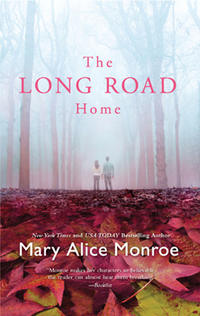
Читать книгу: «The Long Road Home»
Dear Reader,
It’s been fifteen years since this book marked my debut as a fiction writer. The Long Road Home was first published in 1995. Reading it again, I was amazed to see the similarities of personal impact between the bank scandals of the nineties and the scandals that have made headlines in the past year. The old adage is true: what goes around comes around. Yet, the struggles and triumphs of the heart remain ageless.
I chose not to revise the novel, rather to let it stand as written. I did, however, change a few anachronisms for this reprint. It was amusing to remove the Walkman cassette and public coin-operated telephones. No matter how much time passes though, this novel will always be special to me. It’s my first novel. I began writing it when I was put on bed rest during the pregnancy of my third child. When I finished writing the story, I had given birth to both a book and a baby. It was an amazing journey, one in which I learned that what is at first perceived as an obstacle can be a serendipitous turning point.
I hope you enjoy reading the timeless message of love and second chances in The Long Road Home.
Mary Alice
The Long Road Home
Mary Alice Monroe

www.mirabooks.co.uk
I dedicate this book to my mother,
Elayne Monogue Cryns.
For he hears the lamb’s innocent call,
And he hears the ewe’s tender reply;
He is watchful while they are in peace,
For they know when their Shepherd is nigh.
—William Blake, “The Shepherd”
Contents
Prologue
Chapter One
Chapter Two
Chapter Three
Chapter Four
Chapter Five
Chapter Six
Chapter Seven
Chapter Eight
Chapter Nine
Chapter Ten
Chapter Eleven
Chapter Twelve
Chapter Thirteen
Chapter Fourteen
Chapter Fifteen
Chapter Sixteen
Chapter Seventeen
Chapter Eighteen
Chapter Nineteen
Chapter Twenty
Chapter Twenty-One
Chapter Twenty-Two
Chapter Twenty-Three
Chapter Twenty-Four
Chapter Twenty-Five
Chapter Twenty-Six
Chapter Twenty-Seven
Chapter Twenty-Eight
Chapter Twenty-Nine
Chapter Thirty
Chapter Thirty-One
Chapter Thirty-Two
Chapter Thirty-Three
Chapter Thirty-Four
PROLOGUE
THE DAY HAD BEGUN as so many others. An early arrival at the bank, quick signatures on urgent papers, Mrs. Baldwin presenting the day’s schedule; nothing unusual. Yet outside the Manhattan skyscraper, the weather had turned. Blue skies had grown black, and an arctic wind was blowing in an un-seasonable cold front. It was still early on Wall Street. Lights flickered through the dark morning mist like candles.
On the streets below, a drunk peed on the corner of the bank. Above, the sky did the same, releasing a pelting rain that left angry streaks against the windows and sent the people below scurrying into buildings, ducking under newspapers, or disappearing, shivering, down the pavement.
Charles Walker Blair looked out from his window at the gray sky and the gray-cloaked figures on the pavement and had the singular thought that his whole world had turned gray. It was a rare, trivial thought for the level-headed banker, owner of the Blair Bank.
From the hallway, angry shouts seeped into his office: the low drunken slurs of a man and the shrill opposition of his secretary. His mouth tightened in annoyance. Suddenly, the door flung open and the drunk lurched in.
Charles Blair turned from the window and stared at death in the eyes of Michael MacKenzie.
MacKenzie wobbled at the entry, his arms outstretched in a steadying gesture and his feet spread eighteen inches apart. He was a big man: broad shouldered, wide jawed, and ham fisted. His usually impeccable suit was soiled and had probably been slept in, his customary red tie with the corporate logo had vanished long ago, and his thick ruddy-brown hair was as unkempt as the hair on his cheeks.
“So this is where you’re hiding out, eh, Blair?”
Charles Blair rose from his polished mahogany desk and discreetly indicated for his secretary to leave. Her large frame hovered at the door, looking expectantly at the angry drunk, then she lowered her head in resignation and silently closed the door behind her. Charles knew that she would race to the phone as fast as her arthritic legs could get her there and place a call to security.
Charles eyed the weaving drunk suspiciously. The man reeked of sour booze, and MacKenzie’s sneering face made it clear he was a mean drunk. Charles casually walked around to the front of his desk and lightly tapped a green leather chair with his long fingers.
“I’m not hiding anywhere, Mike. You always know where to find me. Sit down. Let’s talk.”
“Talk!” shouted the other man. MacKenzie staggered forward and grabbed the opposite side of the high-backed chair. “You don’t want to talk to me. Last week, you wouldn’t even see me. Sicced your army of lawyers and execs out to do your dirty work, didn’t ya?”
Charles Blair leaned against his desk in a leisurely stance but kept a wary eye on the other man. MacKenzie had a reputation for being a mean mule with a hard kick. With a will of iron and the genius of a maverick, he had built his financial empire up from a single grocery unit in New Jersey. He was young. A man of action. Which made his drunken state all the more foreboding.
“I don’t know what you’re talking about.”
“You’re a liar.”
Charles narrowed his eyes. He wasn’t lying, yet MacKenzie was convinced. Every instinct in his body screamed alert. There was too much hatred here for mere confrontation; too much anger for reason. Michael MacKenzie wanted blood.
“Mike, sit down,” Charles tried again, speaking slowly. “It’s obvious you’re upset.”
“Upset?” Mike slapped his knee and laughed till he coughed and spit out upon the oriental carpet. He rubbed the spittle into the wool with his dirty heel.
A muscle twitched in Blair’s cheek, but he neither spoke nor moved. He watched as Mackenzie, with halting steps, paced a muddy trail across his office, eyeing the diplomas, trophies, and personal photographs on the walls.
“Well, look at you,” he slurred. “Got yourself a picture with every president since you were in diapers. Now ain’t that sweet. An’ lookee here.” Mackenzie pointed to a wall of diplomas. “Harvard… Harvard again… A Rhodes scholar? The old-boy network oughta love that.”
Suddenly the young man twisted to face him, a small pistol grasped in his fist. Blair snapped to attention.
“Give me the gun, Mike,” he said, holding out his hand. His voice was low and deliberate. He dared not even blink. “Give it to me, then sit and tell me more.”
MacKenzie waved the gun in front of Blair. The metal shone in the artificial light. MacKenzie’s lips twisted into a sinister grin.
“Why?” Charles asked, realizing the death he saw in MacKenzie’s eyes was his own.
Michael MacKenzie teetered, pointing his free hand toward the diplomas. His voice fell to a flat tone. “When did I get the chances you got, huh? I slaved in the back of a grocery store since I could walk. Chased rats as big as a cat. My dad didn’t hand over a bank. The only thing he handed out was a cuff to the ear.” He winced as though the slap had just now reached his head. “Oh, Ma.” He moaned, and his whole face contorted.
Blair’s muscles relaxed as he watched the burly man bring his hands to his face and release his death grip on the pistol. He no longer saw a dangerous, belligerent drunk. He saw a broken man. Although he did not know what had broken him, he did know that he had refused MacKenzie any loan from his bank. He’d protected his bank from a high risk. Now, for the first time, he questioned whether his prudence was worth the price.
“Look, Mike,” he began. His voice was conciliatory and he took a step forward. His mistake was to reveal pity.
“Get your goddamn filthy hands offa me!” shouted MacKenzie as he swung his shoulder away from Blair’s reach. Blood-red anger rushed to MacKenzie’s face and his eyes bulged, making him look like a bull on the charge. Suddenly he swung around and with amazing speed slammed the pistol against Charles’s face.
Charles saw the blow coming, but not soon enough. He heard the crack of metal against bone, heard a rush of air expel from his own lips, and felt a blackening pain that sent him catapulting against his desk. Blood flowed from his nose and he knew that it was broken.
The force of his swing threw MacKenzie off balance and sent him reeling into a crumpled heap in the corner.
The room was silent except for the muffled, drunken moans from the corner. Charles drew himself up, one hand leaning against his desk, the other holding his nose with a handkerchief. The stale smell of whiskey singed Blair’s raw olfactory nerves, but it was his own bile that made his stomach churn. Staring at the defeated man, the only pain he felt was shame. How many businesses had he crushed, he asked himself? So many he had lost count. They had all been figures in a ledger, pawns on a chessboard. Until now. The human predicament had never figured in his calculations. Until now. And now, the rules of the game had changed.
He was about to tell MacKenzie that he’d get his loan. He was about to reach out a hand to a fellow man. But he was too late.
The world seemed to slow down in those tragic few moments. Blair saw the pistol rise again, but this time it pointed not at his head, but the other man’s. MacKenzie’s eyes rolled up to meet his, red and goggling—like the desperate eyes of a fish on a hook. Blair reached out and lunged forward, his mouth open in a silent scream.
A roar sounded in his ears. Blood spattered across his face, blurring his vision of Mackenzie’s body jerking its lifeblood across the priceless oriental. The red staining the gold silk-papered walls, blotching the gilt-framed portrait, splattering the green leather chairs, and tainting forever the soul of Charles Walker Blair.
1
NORA MACKENZIE SLIPPED a complacent smile on her face. It was a look that she had mastered over the past year. A mask she donned to protect herself from the horde of lawyers, accountants, and other corporate hit men who had invaded her life since Mike’s death. Most of them were here now, assembled around the massive oak conference table in Mike’s office, shuffling papers, murmuring, jotting notes. Their work was done. Like jurors, they were poised to deliver a verdict.
She sat alone at the far end of the table, one against so many. Nora felt the bulk of her dark wool suit, the high blouse collar like a cinch around her neck. She had chosen the respectable outfit deliberately. Despite the gossip, she would show them that Michael MacKenzie’s widow was a lady.
There was a chill in the morning air. No one had offered her coffee. Clasping her hands tight in her lap, Nora peered from behind her mask to study the men and women who would decide her fate. A few had the air of pompous boredom that she long ago discovered hid incompetence. She recognized those that had played the role of her supporter and those that had taken the attack. There were more of them. A few she had talked to daily for almost a year. Today, however, she was universally ignored. Dismissal was clear in their eyes.
Ralph Bellows sat across the length of polished wood, his gray hair flowing from his broad forehead like a periwig. Nora knew he would act as judge. Bellows relished the role. A clearing of his throat served as a gavel, and he called his court to order with a firm “Shall we begin?”
Nora’s shoulders tensed. She had no doubt Mike would be found guilty in the eyes of his peers. He had committed the worst of crimes: bungled his finances, destroyed his businesses, and left them without a profit. Yet the one to serve the sentence would be her.
Straightening in the stiff leather chair, Nora appeared calm and dignified. She offered Bellows a gracious nod.
“Mrs. MacKenzie…well, we are not strangers in this room. We have endured together a long, arduous year. May I address you as Nora?”
His smile revealed teeth the color of ripe bananas. Nora nodded again. They’d endured? Nora clenched her hands in bitterness. She had endured. They’d conducted business as usual. No matter how disastrous her estate, they would be assured their pay before creditors got a dime.
“The untangling of Mike’s business dealings has been more complicated than we originally envisioned,” Bellows began gravely. “Our work is not yet completed.”
A short gasp escaped from Nora’s lips. It had been a year since Mike’s suicide. What more could they need to accomplish before settling the estate?
Reading her frustration, Bellows continued in a conciliatory tone. “No one realizes the futility of further delays more than I. However, to put it bluntly, Michael MacKenzie left behind a mess. No one, least of all family, understood the extent of his holdings. We are doing our best to put together the pieces of his myriad dealings, but some critical bits of information are still missing.”
From under his bushy brows, Bellows’s pale eyes searched hers intently. Nora felt like the prey of an owl. She paled, yet steadfastly returned his gaze with the wide eyes of innocence.
You bet they’re missing, she thought from behind her mask. There wasn’t a man or a woman at this table who hadn’t rifled through every nook and cranny she and Mike possessed. Who hadn’t read every personal letter they could find. Who had bothered to ask her permission. There was a frenzy to their search that raised her suspicions and her ire. Even the break-in at her New York apartment disturbed her less than their blatant disregard. Nothing had been stolen, but Mike’s desk had been ripped apart.
“Don’t trust anyone.” Those were Mike’s final words to her, whispered urgently the night before he died. Nora had heeded his words and hidden every paper she could find on his desk.
Bellows cleared his throat again with a frustrated staccato, glancing at the papers on the table. When he looked up again, his gray eyes were as cold as the rainy sky outside the windows.
“Even without further information the result is clear.” Bellows tapped the report with finality.
Nora leaned forward, focused on his lips.
“The bottom line is, the estate is bankrupt.”
Nora blinked. “You mean his business is bankrupt.”
Bellows screwed up his lips under his red bulbous nose.
“No, I mean you are bankrupt. For all that we loved Mike, he did a stupid thing. He made himself personally liable for his debts.”
Bellows’s voice ended abruptly, leaving everyone to finish his thought: and then blew his brains out before pulling himself out of it.
“What do you mean, personally liable?” Nora asked, reality taking hold. She was fighting to maintain her composure. Suddenly she loathed the alcoholic nose that Bellows peered over.
“Mr. MacKenzie put up his personal estate as collateral for loans,” contributed a young clean-shaven accountant. His voice shook and he fingered his papers nervously. “The family’s seventy-five percent stake in MacCorp., personal property—he pledged it all. Mike was so deep in hock he was unable to make the repayment schedule.”
Nora did not acknowledge him. The family’s stock? What family? There was only her. She had a name. Nora remained rigid in her chair and continued to stare at Bellows.
“Ralph, what does this mean to me?”
Bellows’s features softened as he laced his fingers together and rested them on the stack of papers before him. Nora wasn’t fooled for a moment. Bellows had nothing to lose by offering kindness now.
“What this means, Nora, is that Mike left you with nothing. Worse than nothing, actually. We have paid back as many of the loans as possible, but you still owe a great deal of money. You will have to sell everything—and even then you may still owe.”
“Owe? If everything is gone, how will I pay it?” Her voice was a whisper.
“The company is in receivership. Your goods will be auctioned off in October by a reputable house. Fortunately, your antiques and art collections are quite rare. Properly managed, the auction should bring in a satisfactory amount.”
“Enough to pay off the debts?”
“Hopefully. With enough left over to give you a start. These are estimates,” he said, opening up the collection of papers in front of him. Immediately, the dozen other people opened their packets. With dread, Nora followed suit.
“If you direct your attention to the bottom of page three,” Bellows continued, “you will see the amount I believe we can salvage for you from the estate.”
Nora quickly flipped to the third page and read, then reread the dollar figure they had allotted for her. It was less than she had imagined, and she had imagined a scant amount. Surely there was an error somewhere. She scanned the other fourteen pages of notes carefully, ignoring the impatient sighs and tapping fingers. The report listed, with astonishing accuracy, her personal possessions and their estimated worth: houses, cars, jewels, furniture, art.
“You even list the few personal possessions that I brought to the marriage.” She indicated the report with an exasperated flip of her hand. “My grandmother’s jewelry, for example. It may not be worth much monetarily, but to me—” her voice almost cracked and she swallowed hard “—to me, they are priceless.”
“I’m sorry, Nora.” Bellows shrugged, running his fingers down the columns. “Maybe we could take out a few…less valuable items.” He seemed embarrassed now.
“This is wrong,” Nora said, deeply feeling the injustice.
“It was Mike’s doing.”
A familiar ache gripped Nora’s heart. Her feelings lay somewhere between anguish and anger. They made her breath come short. Calm yourself, she told herself. Get through this last step and you will be free from the lot of them forever.
“I don’t blame Mike,” she lied. “What I don’t understand is how he could appear so successful and suddenly I learn he is bankrupt. How did it get this bad?”
Bellows’s look implied all that he did not say, all that everyone already knew. That she had left Mike. How, their eyes accused, could she expect to know about Mike’s finances after she walked out on him? Left him in his hour of need? Nora knew they saw her as the New York socialite who collected antiques and art. A pretty blonde who couldn’t be bothered with bank balances.
Nora looked at the accusing eyes and despite her vow, shrank inward. Guilt was an unwelcome shroud for a widow to bear. It kept one mourning without resolved grief. Deserved or not, it was a heavy burden. If Mike had died naturally, perhaps she could have escaped it. He had chosen suicide, however, and with that final act he had completed his seven-year campaign of verbal abuse. Nora’s hand moved to rub her brow, but she arrested the gesture in her lap. She tightened her fists and raised her chin.
“He took a new direction in his last year,” Bellows explained.
“This ‘new direction’ is not detailed in the report,” she replied icily.
Bellows raised his brows. “Quite right. The purpose of today’s meeting is only to explain the status of your estate prior to settlement.”
“Since my money seems to have been lost as well, I should think I am entitled to a full disclosure.”
Mumbles sounded at the table. Nora still focused on Bellows. Always work at the top, Mike had said.
She sensed a new appreciation in Bellows’s eyes. Up until now, her encounters with him had been purely social. Despite his gentlemanly facade, his hand always seemed to find a way to her waist. In what might have appeared a mindless motion, the broad expanse of his palm would caress her ribs while his long thumb would nudge upward toward her breast. Beneath his fastidious apparel, Nora always found him dirty.
“I’d be happy to set up a private meeting to outline Mike’s past projects, Nora.” Bellows’s voice projected the cooperating attorney. His rheumy eyes spoke of another project he had in mind, and to emphasize his intent, he presented her with a magnanimous smile. Be good to me, the smile said, and I’ll be good to you.
“That won’t be necessary,” she replied firmly. “A report in the mail should suffice. I plan to leave town as soon as possible.”
Thirteen pairs of brows rose in unison.
“Leave? To where, my dear?” Bellows asked.
Truth was, she didn’t know. Anywhere but here, Nora thought, her gaze traveling across the impassive faces surrounding her. She’d had enough of false friendship. She’d had her fill of dismissal and rejection, of sympathy with strings attached. Somewhere along the line, she’d lost sight of her values. Looking back, she couldn’t remember what it was she had hoped to achieve by thirty.
This was a turning point. Nora wanted to go somewhere she could work hard, earn her own living, and reevaluate her values. Somewhere, she wanted to build a life that mattered.
Nora’s hand stilled in her lap. An entry from the report came to mind with a flash. Such a place existed, she realized, a smile escaping from her rigid control. Excitement bubbled. She knew exactly where that place was.
Leaving Bellows’s question hanging, Nora dove into the report and began flipping quickly through the pages.
“I assure you we went through everything thoroughly,” an attractive woman lawyer commented.
“I’m sure you have,” Nora replied tersely. She remembered the blonde from the “attack” team. Nora ran her finger along the listed property, unconsciously holding her breath. When she spotted what she was looking for, her breath exhaled with a satisfying gasp. The estimated value was fairly low.
“Looking for anything in particular?” asked Bellows, his interest clearly piqued.
“Just one moment, please,” Nora replied without looking up. Grabbing a pencil she made notations, referring back to page three. Always facile with numbers, Nora reviewed the estimated values, made a few more notations, and calculated an alternative plan.
When she looked up again, the twelve lawyers and accountants were slouched in their chairs in exaggerated poses of boredom. Their noses seemed to have grown inches, the way they peered down at her from behind them. Nora coughed back a laugh. Only Bellows viewed her with intense interest.
“I’ll take the Vermont farm instead of the cash,” she announced.
Twelve chairs creaked as the men and women snapped to attention and shuffled through their papers.
Bellows seemed both amused and curious. “The sheep farm? But why, Nora? It is a small operation, risky at best. Its only purpose for Mike was as a tax write-off.”
“All true,” she replied, holding back her excitement.
His eyes narrowed. “I believe the house is unfinished. Have you and Mike ever lived there?”
“No,” she said emphatically. “Never.”
“I see,” he replied, leaning back in his chair. His eyes never left her. “Then why the farm?”
“Why not?” She wasn’t about to confide in Uncle Ralph. “I want it,” she said bluntly, “and according to my calculations, I can have it—plus enough to establish an interest-bearing account of about three hundred thousand dollars. That should give me enough to eke out a living.”
“A meager living, to be sure.”
“I’m not afraid,” she lied again. As he went through her figures, adding a few of his own, Nora maintained her icy composure. She could not let on how much this meant to her.
“I don’t want any surprises,” she said. “Not without a cushion. I assume your calculations are correct?” An indignant harumph sounded from her left as an accountant’s face mottled. Nora focused only on Bellows. This was between the two of them, Mike’s personal lawyer and his widow.
She could sense the growing surprise and antagonism of the men and women around her. These were Mike’s people. She, his wife, was the outsider.
And that was the way she wanted it. Her foot began tapping beneath the heavy table as she put together the pieces of her new, even radical plan. In her mind she could envision the farm the last time she saw it—what was it—three years ago? The verdant lushness of the Vermont mountains, the fat red raspberries hanging ripe on the bush, fields of oxeye daisies, Queen Anne’s lace and clover sprouting up between rocks, dark woods with cool breezes, and the bucolic bleating of the lambs. It could all be hers. She could make something of her life there, she felt sure of it.
A heady kind of enthusiasm raced through her no-longer-complacent veins. An excitement that ran slipshod over her rational constraints, delivering a new confidence. The kind that in the past had inspired her to impulsively buy a piece of furniture, or a painting. Though based on knowledge, the decision was instinct. She was born with what some people called “a knack.”
She had to have the farm, she thought with quiet desperation. It was right. And it was all she had to hold on to.
Bellows cleared his throat, once again bringing his court into session. “Well,” he said with both resignation and mirth. “I see no reason why this can’t be arranged.”
Amid the grumbling of disapproval at the table, Nora beamed.
“Only one more contingency,” he warned.
Nora stiffened.
“Remember that nothing is final until after the auction. That gives you two months to determine if you can make a go of it at this sheep farm of yours. And even if you do, you can still lose it to Mike’s creditors.”
“But that is unlikely. You said yourself the auction should be a success.”
“Should be and will be are worlds apart.” Like a consummate judge, he glared at every man and woman that sat around the table, no one longer than at Nora herself. “The status of the MacKenzie estate is confidential. This is absolute. Should word of MacKenzie’s bankruptcy leak out, the auction will be ruined. Mrs. MacKenzie cannot set a minimum bid. And if the auction doesn’t bring in the bacon—” he paused to close the report with grand effect “—then all of you go home hungry.”
Not a paper rustled.
“That’s it,” Bellows concluded. Instantly the table was covered with expensive leather attaché cases of every color considered understated yet elegant. As papers were shuffled in and people shuffled out, Bellows came around the table and offered his hand to Nora.
She took it warily.
He held her hand for a moment, looking at the lone gold band on her ring finger, then said with surprising sincerity, “Good luck, Mrs. MacKenzie.”
Nora detected none of his earlier lecherousness. A small smile eased across her face. “Thank you, Mr. Bellows. I’m sure I’ll need it.”
Bellows released her hand with a glint of amusement in his eyes. After an urbane nod of his head, he strolled from the room.
Relief flooded her. Good-bye, old boy! she mouthed as she watched his retreating back. Good-bye all of you, she thought, addressing the empty chairs around the table. The images before her changed. Instead of furniture, Nora envisioned mountains. Instead of oak, she saw maple.
I’m going home, she realized, still not believing. Home. The word felt strange upon her lips; distant yet full of promise. It was fall; the farm would be ripening with color. Warm days and cool nights. Harvests coming in. New lambs.
So much new. So much to learn. Instinct would carry her only so far. Could she manage? What did she know about farming or caring for sheep? No one would be there to pull her out of trouble. To casually write the check. Her hand hesitated on her bag as doubt pressed. It would take hard work, tons of it, and daily prayer to pull this off. Was she up to it?
Nora raised her chin defiantly and gave the zipper a firm tug. She’d better be. The farm was all she had left. She was on her own. If she didn’t make it there, she had nowhere else to go. Hoisting her purse, Nora took one farewell look at Mike’s office.
The recessed lights cast small shadows upon the cleared oak table and the empty credenza. It gave off a ghostly sheen. Memories stirred, producing goose bumps along her arms. Nora rubbed them quickly, brushing the memories away.
“Good-bye,” she whispered, taking one last look before turning out the light. The words sounded hollow in the empty room. As she closed the door tight behind her and hurried away, Nora had the ominous feeling that Mike’s ghost was right behind her.
2
DAWN ROSE OVER MANHATTAN. Its reach stretched for miles in reflection against steel and glass. The morning light pressed relentlessly against rows of window shades, curtains, and blinds closed as tight as eyelids. They seemed to squint against the brightness.
Forty-four stories up, Nora stood, arms folded, coffee cup in hand, allowing herself a farewell to her city. She could feel the heat of a new day against the glass. She leaned her cheek against it. How quiet the city was at this hour, she thought. A sleeping giant. Yet Nora could feel the energy awakening beneath her. The sun was stirring the beast, and soon, within the hour, it would be fully awake, belching out the sounds of shouts, honks, and whistles. A hungry city.
She shuddered. This city had always intimidated her. Only her wealth had protected her from the harsh realities of the streets below. Now, she’d lost her cocoon, she thought. She’d been booted out.
Oh well, she decided, gulping her coffee and closing the blinds with a snap. “Sweetie, it’s time to fly.” She said it aloud, encouraged by the sassy tone in her voice. If she wanted to be out of the city today, she had a lot of work to do. The auction house people were due here soon.
At the thought, her stomach churned. This was it. She was really leaving the city. Even though she wanted to go—was eager to go—the leave-taking was hard.
She surveyed her home with a critical eye. The rooms she had hated yesterday were comforting today in the memories they held. The apartment was gracious and inviting; eight rooms full of rare antiques, intricate oriental rugs, and paintings that museums coveted.
Things, she told herself. They’re just things. Trappings of a lifestyle. Yet, she loved them. Over the past several years, each time she walked through these rooms she would get a small thrill of delight at the sight of these beautiful things. Not that she was greedy, or even cared for the dollar value of any of them. No, she simply enjoyed being surrounded by the intrinsic beauty of the pieces. The flair of a Chippendale, the vibrant color of a rug, or the focus of a Satsuma ware pattern. The art touched her, and her life had been so hard the past several years that she sought simple pleasures wherever she could find them. So she had pursued her art and antiques collections with a vengeance, earning for herself a reputation for a keen eye and a handy checkbook.
Nora ran her hand across the French high-gloss finish of a table. Her unpolished nails seemed so mortal against the ageless wood. These things, these precious things, she thought with sadness. Now they were her champions. It was up to them to bring in enough cash to pay back the debts and to keep her going. She had depended upon Mike for so long, and in the end, it would be her own abilities that could save her. How ironic life could be, she thought.
From one room to the next, Nora strolled through memories. In here, she thought, gazing at the Sheraton dining table, at this table she had presided over countless dinners. Seemingly effortless soirees that displayed Mike as the successful financier and herself as the stable dot beneath the exclamation point. Her husband used to smile his approval from across the long damask-covered table. His Irish blue eyes had sparkled beneath his heavy dark brows. He’d seemed so handsome then, so powerful, so hers. In recent years, she remembered with a pang, he had awarded his approving smile to the lovely lady he had selected to sit at his right.
In those Victorian chairs, she thought, entering the morning room, she and Mike would lean back and read the newspapers. In the early days of their marriage they’d blurt out comments and questions that always sparked remarks or laughter. Later, however, only she would persist, making comments that never brought a response.
Her heels clicked upon the polished parquet as she completed her rounds. The coordinating patterns of fabrics, the dominating pieces of art, the soft-hued paint and carpet, and the lemony smell of polish and soap enveloped her in their security. Each room was perfect.
Mike had hated them all. He hated every detail of the small, well-appointed apartment. He wanted a house as big and brawling as he was. Full of unruly children, a basketball hoop in the driveway, and a big hairy dog in the yard. He had expected a family in the suburbs—he had demanded an heir.
“If you spent as much time trying to have a baby as you did buying furniture,” he’d mutter, cutting her to the quick.
Nora paused, the pain as sharp now as it had been when spoken. So many mean comments, so many slurs. She shook her head, loosening pain’s hold. Oh yes, it was time to go.
Nora went directly to her bedroom to gather her suitcase. She had to get out of here. Let the movers fend for themselves. At the door to her bedroom, however, Nora froze. The trip through memories was not yet over. A farewell was due to this room as well. This room, where dreams had been dashed, battles waged, and a marriage lost. Her eyes roaming over the heavy four-poster, Nora wondered for the hundredth time how so much love could have engendered so much hate? Despite her resolve, old questions nagged. When had Mike begun to loathe the sight of her? To find her too repulsive to touch? In how many ways had she failed?
Mike was everywhere. He haunted every room in this place. Still mocking, relentlessly accusing her.
“Please, Mike,” she muttered. “Let me go.”
Nora heard the front door unlatch and after a hasty wipe at her eyes, she checked her watch. It was only 8:00 a.m. Could the movers be arriving so soon? She peeked out from behind the bedroom door. Down the hall she spied a stocky, robust figure impatiently jerking her arm from a too-long coat. With a sigh of relief, Nora flung wide the door.
“Trude, what are you doing here?” Nora walked swiftly down the long hall to take her maid’s hands. “Yesterday was your last day. I thought we said our good-byes.”
Trude puffed herself up. “I no could stand think of you, here in this place, by yourself.” She looked around then jerked her shoulders. “He still here, you know? Bad feeling. You go through too much.” She sniffed loudly. It had never been any secret how Trude felt about Mike. Trude stepped back and surveyed the coffee cup in Nora’s hand. “You have no breakfast, right?”
Nora smiled, knowing it was futile to argue. “I’ve been busy. I’ll catch something on the road.”
Trude took the coffee cup. “I know you. You forget. Look at you. All bones. I go make something.”
“No, really. I couldn’t eat. I’ve got too much on my mind.”
Trude shook her head and Nora read worry rather than irritation on the older woman’s face. In fact, Trude couldn’t be more than forty-five, but she was the type to mother, regardless of who or what age. Nora had been her special project for seven years.
The intercom buzzer rang.
“Oh boy, look out. Here they come now!” Trude called with hand raised. “I go get some coffee going.” Trude’s answer to all problems was a cup of coffee.
The apartment was soon crowded with men and women of all shapes, sizes, and nationalities. Nora could smell the different spices, as well as the common scent of fast food, in the close air of the apartment. There was no more time for sentiment. It was time to pack up and go.
The day sped by as she worked alongside the crew. Some of the men were efficient, others had to be hawked. Nora cataloged her furniture, checking it without emotion against the computer list. She watched, impressed, as the men slipped her heavy glass-front antiques into specially constructed, padded crates as easily as a hand fit into a glove. Trude backed her up, offering fluids and snacks and cleaning floors as soon as they were bared. Room after room was emptied, leaving emptiness behind.
“You wanna check this out?”
Nora bobbed her head up toward Mike’s breakfront desk where a mover was waving her over. “We were lifting this top piece off when this panel here broke open. We didn’t do nothin’.”
Nora stuck her pencil behind her ear and hurried over to the desk, disassembled now for the crate. One side panel, disguised as molding, had popped open to reveal a thin niche. Nora hid her shock. Mike had purchased this desk, and all these years she had never known this hiding place existed. She knelt beside the open panel and, turning her body, reached far in. The wood was raw, unfinished, and dusty. Something was in there, she realized with a sudden intake of breath. Grabbing hold, she eased out a burgundy leather notebook. She stared at the leather volume, worn in spots to a dull luster, and knew with every fiber in her body that this held secrets.
She looked over her shoulder at the two men huddled together, staring in curiosity. “Oh, my goodness. My diary! I forgot all about it.”
She tucked the notebook under her arm, then forced an airy laugh. “Thank God you found it. I’d hate to think of some stranger reading it!”
“Yeah. Bet it’s loaded with good stuff,” one of the men jeered. Nora cast him a wary glance, unsure if he was complimenting or insulting her. Without response she turned heel and immediately hurried to her bedroom and closed the door. The furniture had already been removed and the carpets rolled. Only her suitcase sat square in the middle of the floor, under a brass and crystal light fixture. Nora plopped down Indian-style beside the suitcase and looked long and hard at the notebook. Around her, she could feel Mike’s presence, hear his voice inside her head. “Open it. Read it.” She obeyed.
The notebook was filled with pages and pages of numbers; more a bank ledger than a diary. Notes were scattered here and there in Mike’s distinctive, heavy script. Leafing through the pages, a pattern of desperation emerged. Neat lines and columns filled the early pages. As the pages progressed through the months, the nature of the writing changed. Instead of neatness, quick notes were scribbled in an illegible hand. Crossed-out computations and many underlined words and dashes scrawled across the final pages. An artist, Nora recognized the design of mania.
She closed the book and rested her hand upon it, as though to force quiet memories of the last months of Mike’s life. He had gone through a period of marked deterioration. Although he had once taken a vain interest in his appearance, he became unkempt. In the few weeks before he died, Mike grew argumentative, obsessed, even erratic.
The parallels with his handwriting were too strong. She needed time, away from prying eyes, to decipher the message held here. Time to hear Mike’s final words and time to decide if she should give this notebook to Ralph Bellows. Bellows was Mike’s closest colleague. Executor of the estate. And it was clear he was searching for something.
Three short raps sounded on the door. Nora scrambled to her knees and stuffed the notebook into her suitcase just as a high nasal voice sang out from the doorway.
“Oh, there you are!”
Nora bristled. Whoever it was didn’t have the courtesy to wait to be allowed in. Turning, she saw a tall, emaciated-looking man with pale skin and the brightest, most unnatural shade of red hair she’d ever seen. Another player in today’s circus, she thought with a sigh of resignation.
“Can I help you?” she asked. Her tone would, she hoped, give him a clue to her mood.
“I’m from Sotheby’s,” he replied, as though that was enough introduction. “I’m glad we caught you before you left.”
“Caught me?” Something in his tone raised her ire.
“We went over the inventory of your jewelry for the auction and a few things are missing.” His singsong voice implied naughty, naughty.
“Whatever are you talking about?” Nora’s voice was brusque as she rose.
He began flipping through the pages clipped to his board. It was filled with computer entries. Did she really own that much jewelry, she wondered? She hardly ever wore it.
“Here it is. A square-cut diamond. Antique setting.”
“My grandmother’s engagement ring. It’s not to be sold. Didn’t Mr. Bellows notify you?”
“No, he didn’t. Apparently he changed his mind.” The cynicism in his eyes stung. “The ring’s on the list. Sorry, dear. I have to ask you for it.”
Nora choked. “It’s mine. It’s all been arranged.”
“Apparently not.” He tapped the papers a tad too loudly. “It’s on the list.”
Nora’s lips tightened. “How much is it worth? I’ll buy it now.”
“Look, dear. I’m sorry, but no can do. You can talk to Sotheby’s about it, I guess, but I have to collect that ring now—and a few other items.” His voice trailed as he searched the papers.
I’ll bet you’re sorry, Nora thought, steeped in bitterness. So, Bellows didn’t come through for her after all. A simple kindness was beyond him. She couldn’t trust him.
Blind rage colored her thinking. She flipped up the lid of her suitcase and pulled out her zip cloth jewelry bag. Without opening it, she held it out to the nameless man with the red hair and papers.
“Take it.”
“Certainly not all of it,” he moued, his blush making him look like an elongated carrot.
She jerked it toward him. The thin man stepped forward to retrieve the small bag, then stepped back again. He pulled out some Victorian beaded necklaces, a yellowed pearl necklace and earrings, a large cameo pin, and the solitary engagement ring. It was a pitiful show compared to the many-carat diamonds, rubies, and emeralds on the list.
“So much fuss about so little,” she said softly. Her shoulders slumped. “It doesn’t matter. Just take it and get out. Please.”
The man paused, then selected out the pearls and set them delicately upon the suitcase. “I don’t see those on the list,” he muttered as he rushed out the door.
Nora picked up the pearls and rubbed them against her cheek. “Oma, I miss you,” she said. She slipped the pearls around her neck and placed the earrings in her ears.
In the mirror, the burgundy notebook was visible in her bag. In that same bag, beneath wool sweaters, nestled a shirt box. And in that shirt box was a stash of personal letters, memos, and a pocket diary that she’d found on Mike’s desk the day he died. Papers that were scattered next to an empty bottle of bourbon and a loaded ashtray.
Mike had called her to New York from her house in Connecticut, yelling over the wire that it was urgent. So she had come, against her better judgment, only to be ignored once again. Until that night, before he died.
“Don’t trust anyone,” he’d told her, roughly awakening her. He was drunk, again, and the sour smell of bourbon and smoke descended upon her like a winter cloud.
At first she was afraid. Something in his voice had changed; she heard it even in her sleepy stupor. The anger was gone. The arrogance was gone. In its place she heard desperation and fear.
“Don’t trust anyone.” That was all he’d said. That and a firm shake and an intense stare. So intense. Telling her in that gaze that he was leaving. Warning her that she was on her own now. Perhaps, too, that he was sorry. She liked to think that anyway.
Nora closed the suitcase, zipped it, and locked it. Whatever secrets lay hidden in that notebook, she’d uncover them later. On her own. One thing was certain—she would keep her secrets from Ralph Bellows.
“Mrs. MacKenzie?” Trude stood at the door, arms akimbo.
Nora could tell she’d overheard the entire exchange. “Well, I’m all set to go,” said Nora with false enthusiasm.
Trude clenched her lips and nodded. “Well then, let’s get you go.”
Nora walked over and touched Trude’s shoulder. “I wish I could take you with me.”
“I not ask for much,” Trude replied, opening the door once again for an offer.
Nora sighed and shook her head. “I couldn’t pay you. I don’t know how I can take care of myself, let alone anyone else. And what about Roman and the children?”
“They love mountains. Live good. Cheap.”
For a wild second Nora considered it. How good it would be to have them nearby. Friendly faces and support.
“I wish I could,” she replied, looking into Trude’s disappointed face.
Trude nodded. “I know. I had to try, though.”
Nora hugged Trude in a rush. Trude faltered, standing stiff in awkwardness. Nora felt awkward too at this rare show of physical contact. Suddenly, however, Trude responded and Nora felt true affection in the Polish woman’s bear hug.
“You’re the only family I’ve got left,” Nora whispered.
“You take care of yourself, hear?” Trude said, pulling back and revealing a flash of tears. “Here. Piroshki for the car. I make them. You be sure to eat them.”
“I will, I will.” Nora laughed, moving back.
She picked up the suitcase. It was unusually heavy. With his papers and notes, Nora was taking Mike with her.
“I will carry for you,” Trude said.
“No,” Nora replied. “I have to carry this.”
She took one last look at the apartment. The sun was setting now and poured in through the slats of blinds, creating vertical shadows across the parquet. Her luxury apartment never looked more the prison it had been for years.
“Don’t trust anyone.” Mike’s last words to her sounded again in her head.
“I don’t,” she said to the ghost. Nora turned away, her shoulders drooping with the weight of Mike’s message.
“I’ll never trust anyone again.”
3
NORA PAID THE TOLL and asked for a receipt.
Now that she was off the Thruway, she felt New York was truly behind her. In her head, she knew that a place could not make someone happy or unhappy, rather the life one led there. But her heart didn’t buy it. In her heart, she believed she’d be happier once she crossed the Vermont border.
The small white sign with green lettering welcomed her to the Green Mountain State. Speeding by at fifty miles per hour she felt a rush of exhilaration as she crossed the line. “Whoopee!” she called aloud as she rolled down the window and stuck her nose out like any perk-eared dog. Fresh cool air gushed in. She inhaled deeply. Vermont did feel better. The mountains were prettier, the grass was greener, and, hot dog—she was headed home.
The Volvo hummed along on the state highway, past small towns with red general stores and lone gas stations that boasted two pumps. Nora paid attention to all the markers now; it had been a while since she’d traveled these roads. She chewed her lip as she navigated the journey. Did she turn left at this blinking light? Which way did she veer when the road split by the green warehouse?
Following both memory and instinct, she guided the car toward the small mountain she called home. A brook ambled over white rocks along the side of the road, black-and-white cows chewed lazily in the pastures. She passed Ed’s syrup stand, rounded a steep turn, and there it was. She recognized it immediately. Why had she thought she wouldn’t?
Her mountain. The center of the small tree-covered mountain sagged like a saddle on an old horse. A first memory flashed.
“Let’s hike to the saddle,” Mike said. He already had his boots on, a picnic basket packed with crusty bread, strong-smelling cheese, and a cold bottle of white wine, and in his arm he carried a red-and-black wool blanket. His eyes flashed in invitation.
Nora grabbed a sweater and Mike. “Let’s go.”
The saddle was a long hike up, across steep terrain, over marble and granite boulders, and through muddy valleys. But once there the grass was as soft as baby hair. Wild berries flourished and the sun shone freely up where the trees didn’t grow. It was a favorite resting place of deer. A heavenly spot—divine for lovemaking.
Nora tightened her fingers on the steering wheel. “Mike, Mike,” she murmured. She was afraid of her grief and the unexpected turns it took. Was it a good idea to come back here of all places? The one place they had been happy.
The road curved and led into the neighboring town, really just one long road between Victorian farmhouses that were now antiques stores and bed-and-breakfasts, a needlepoint shop, the post office, a hardware store, a pizza parlor, and, busiest of all, the corner grocery. Nora pulled in to pick up some supplies.
The small store was in fact grocery, liquor store, bookstore, and video rental shop all rolled into one confined space. The front four-square windows were plastered with local notices: the firemen were having a water show in Rutland on Saturday, Wild Bird Weekend brought a special seed sale, and a brightly colored banner invited everyone to a contra dance in October. Baskets of apples, squash, and mums bordered the store’s narrow entry. Nora selected two apples and squeezed in past the baskets.
Inside, the small store was dimly lit and the precious floor space was crammed with more baskets filled with corn, potatoes, and onions. In the front of the store, the few shelves were crammed with dry goods, and in the rear of the store stood rows and rows of dusty alcohol bottles. Nora wrinkled her nose as dust tickled it. She wouldn’t find everything she needed here, but she’d find enough to make do. The wooden floors creaked as she crossed them but they were well swept. A plastic mat covered the grayed wooden counter, and on it sat a shiny nickel-plated cash register with the drawer half open.
“Hello,” Nora chirped.
The old woman behind the counter gummed her lips a moment and gave Nora a thorough once-over. “’Lo,” she replied.
The woman was no one Nora had ever seen before. It appeared no more talk was coming, thank heavens. Nora wasn’t up to questions yet. She cut a swath through the store, grabbing quickly. Coffee, eggs, milk, bread, and she was done.
“Thank you. Bye.”
“Yeh-up.”
If she shopped there daily for the next ten years, Nora doubted she’d ever get more of a response than that. Vermonters weren’t a chatty group.
At last she made the final turn by the marshy pond. The car veered off the paved road and rumbled along a dirt town road, not fit for tourists. She stretched out her cramped legs and arms and slowed to a crawl. The meadows were on a higher plain than the road and were separated by a low stone fence bordered by pine, maple, and apple trees. She began searching for something—a barn, a tree, a pond—anything familiar.
She passed the Johnston house, her nearest neighbors. The small cape with pale green asphalt siding appeared to be slipping down. Its sills were sloped, the front porch leaned, and there was chokecherry now where there used to be flowers.
The house was close to the road but she passed without stopping. She was too near her final destination to stop for hellos. The vista opened up and she smiled seeing Skeleton Tree Pond, acres of fresh spring water so cold Mike swore it could stop the heart. She felt the first prickle of excitement along her neck.
The bumpy road curved around the lower barn where sheep stood in small clusters. In the field beyond, fifty, maybe more, lazily chewed in the sun. They raised their white faces as she passed, ears pricked. Nora smiled again, feeling an instant bond with the gentle creatures.
She was on her own land now. Four hundred acres, most of them vertical, all of them green. She was surrounded by green, interspersed now with the oranges, reds, and golds of an early fall. A few yards ahead she spotted the pair of marble monoliths that signaled the foot of her private road. The stones blended in with its surroundings, so only a careful eye could spot the entry. Mike had wanted to build an imposing brick gate, but Nora had persuaded him that, at least in Vermont, nature should prevail.
She made the turn and slowed to a stop. Her road curved gracefully and disappeared behind a small hill, but Nora wasn’t fooled. She knew that beyond that hill the pastoral road made the grand prix seem like child’s play. It turned and twisted sharply and inclined straight up, making it a hair-raising trip in spots where the gravel gave way to dirt.
The unanswered question was: How was the road? Did Seth put down the gravel? Did the rain wash out gullies so deep a tire could get caught? Why hadn’t she stopped at the Johnstons’? Even now she could back up and travel back down the road.
Something inside of her resisted. A new independence told her to handle it herself. She was tired of asking for help. Sooner or later she’d have to deal with this road and sooner came now.
Gear in first, she let the clutch up and pressed the accelerator. On up she went, past the hill, past berry bushes long since picked clean by the birds, around big rocks that had lost hold and fallen to the road. Leaf-laden branches arched low, brushing the windshield as she passed and giving off an eerie squeak. Then the road began to incline steeply and the gravel bed grew thin. Nora pressed the accelerator a tad, scuttled up twenty yards and then felt the wheels slip.
Her knuckles whitened on the steering wheel. Her foot pressed the accelerator, yet her car slid backward down the steep dirt road. Pushing the pedal to the floor, she leaned far forward and whispered, “Go, go.”
The Volvo whined as its wheels dug to dirt, spitting gravel and swinging its rear across the narrow road like a wild bronco. She headed straight for the steep bank. Nora slammed on the brakes.
Nausea swept over her as she shifted her gaze from the steep road ahead to the shallow cliff beside her. Unable to move forward, terrified to slip backward, she was in limbo. “What do I do? What do I do?” she muttered in a litany as she laid her head against the wheel.
There was no reply. She was very alone. In the density of the forest surrounding her she sensed the presence of animals—crouched and watching. Squirrels, deer, porcupines, bears, and scores of others she couldn’t even identify. She heard every snap of a branch in the uneasy quiet. Each call of a wild bird seemed to say, “Go away. You don’t belong here.”
“Damn you, Mike!” she swore as she hit the steering wheel with her fist. A September wind caught the curse and carried it across the Vermont mountains. The echo diminished into a menacing breeze that floated through the car like the whisper of a ghost. She shuddered and closed her eyes.
Why curse Mike? It was childish—and too late. She got out a short laugh. Mike never got stuck here. He had skidded on this same road, but instead of cowering as she was, he’d grind into first gear and will that heap of metal up the mountain. Only once he didn’t make it, and that was when the snow was so deep even the tractor couldn’t get up to the house. Nonetheless, he had sold the car as worthless.
“Well, there’s no Mike now,” she blurted out as she raised her head. “This is it. Nora MacKenzie. Your first test. There’s no turning back. Home is ahead.”
She let out a ragged breath as reason took over. With a thrust of determination, she shifted into first then slowly, with ease, let out the clutch.
“Come on, you hunk o’ junk,” she said. The tires spun, whined, and slipped back a few inches. Nora bit her lip and fought the temptation to hit the gas. Instead, she yanked the wheels away from a dirt patch. With a jerk, the tires caught on the firm roadbed and lurched forward.
“Go, go, go,” she crooned as the metal beast struggled up the steep incline and slowly rounded the final curve.
With the care of a captain in shallow waters, she turned the wheels away from the loose patches of gravel and rode the crest. At last, the high-pitched drone of the engine lowered as the incline flattened and she emerged from the tunnellike foliage into the light of a clearing. She hooted triumphantly.
Ahead, perched high on her mountain overlooking the Vermont mountain ranges, was a sunlit terrace. And standing proudly in its center was her house. Nora’s heart swelled when she spied the peak of the redwood and brick structure looming high above the purple heather. Next appeared the large, angular windows divided by a mammoth beam and lastly, the broad wooden deck that stretched like a smile across the breadth of the house. Nora couldn’t help smiling in return.
Pulling up in front, she danced her fingers along the wheel. She couldn’t wait to get out of the car. She yanked on the brake and scrambled out. The air was cooler that high up and its pine-scented breezes caressed her cheeks. She inhaled deeply, tasting its sweetness. Sporting a triumphant grin, she stretched her arms wide to take into her soul the majestic Vermont mountain range, blanketed now in a homey patchwork quilt of greens, purples, reds, and oranges.
Her hands might be shaky, she thought, and maybe her knees were wobbly. So what if she didn’t know what her next step would be. She felt exultant. She had made it to the top! In an inspired rush, she tugged the gold band off her left finger and threw it with desperate force into the horizon.
“I’m home!” she cried to the mountains, bringing her arms around her chest in a bear hug. The echo bounced back to her, repeating “home, home, home,” in reassuring repetition.
From above came a deep, resonant response.
“Looking for someone?”
To Nora, it was thunder in the mountains. Fear struck her marrow like a lightning bolt. She jerked her head toward the second-story deck where a man, dressed only in a pair of worn, unbuttoned jeans, towered above her. His eyes glared with suspicion from under a towel as he rubbed his wet hair. Across his chest, droplets of water cascaded like a waterfall down a mountainside.
Questions froze in her throat. Suddenly her mountain seemed very small and she felt trapped under the harsh gaze of the man on the deck above her. He was a stranger—an intruder. She was alone and vulnerable. She had to get out and get out fast. Spinning on her heel, Nora lunged for the car door.
Бесплатный фрагмент закончился.