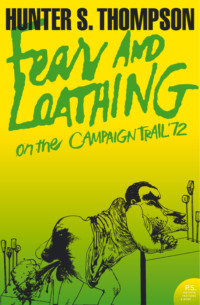
Читать книгу: «Fear and Loathing on the Campaign Trail ’72»
Illustrated by Ralph Steadman


Copyright
William Collins
An imprint of HarperCollinsPublishers Ltd.
1 London Bridge Street
London SE1 9GF
www.harpercollins.co.uk
This Harper Perennial Modern Classics edition published 2005
First published in Great Britain by Flamingo as a Modern Classic in 1994
Copyright © Hunter S. Thompson 1973
PS section copyright © Travis Elborough 2005
PS™ is a trademark of HarperCollinsPublishers Ltd.
Hunter S. Thompson asserts the moral right to be identified as the author of this work
A catalogue record for this book is available from the British Library
All rights reserved under International and Pan-American Copyright Conventions. By payment of the required fees, you have been granted the non-exclusive, non-transferable right to access and read the text of this ebook on-screen. No part of this text may be reproduced, transmitted, down-loaded, decompiled, reverse engineered, or stored in or introduced into any information storage and retrieval system, in any form or by any means, whether electronic or mechanical, now known or hereinafter invented, without the express written permission of HarperCollins ebooks
HarperCollinsPublishers has made every reasonable effort to ensure that any picture content and written content in this ebook has been included or removed in accordance with the contractual and technological constraints in operation at the time of publication
Source ISBN: 9780007204489
Ebook Edition © DECEMBER 2014 ISBN: 9780007440009
Version: 2017-10-17
To Sandy, who endured almost a year of grim exile in Washington, D.C. while this book was being written.
– HST
Between the Idea and the Reality … Falls the Shadow.
T.S. Eliot
December 1971
Is This Trip Necessary? … Strategic Retreat into National Politics … Two Minutes & One Gram Before Midnight on the Pennsylvania Turnpike … Setting Up the National Affairs Desk … Can Georgetown Survive the Black Menace? … Fear and Loathing in Washington …
Outside my new front door the street is full of leaves. My lawn slopes down to the sidewalk; the grass is still green, but the life is going out of it. Red berries wither on the tree beside my white colonial stoop. In the driveway my Volvo with blue leather seats and Colorado plates sits facing the brick garage. And right next to the car is a cord of new firewood: pine, elm, and cherry. I burn a vicious amount of firewood these days … even more than the Alsop brothers.
When a man gives up drugs he wants big fires in his life – all night long, every night, huge flames in the fireplace & the volume turned all the way up. I have ordered more speakers to go with my new McIntosh amp – and also a fifty watt ‘boombox’ for the FM car radio.
You want good strong seatbelts with the boombox, they say, because otherwise the bass riffs will bounce you around inside like a goddamn ping-pong ball … a very bad act in traffic; especially along these elegant boulevards of Our Nation’s Capital.
One of the best and most beneficial things about coming East now and then is that it tends to provoke a powerful understanding of the ‘Westward Movement’ in U.S. history. After a few years on the Coast or even in Colorado you tend to forget just exactly what it was that put you on the road, going west, in the first place. You live in L.A. a while and before long you start cursing traffic jams on the freeways in the warm Pacific dusk … and you tend to forget that in New York City you can’t even park; forget about driving.
Even in Washington, which is still a relatively loose and open city in terms of traffic, it costs me about $1.50 an hour every time I park downtown … which is nasty: but the shock is not so much the money-cost as the rude understanding that it is no longer considered either sane or natural to park on the city streets. If you happen to find a spot beside an open parking meter you don’t dare use it, because the odds are better than even that somebody will come along and either steal your car or reduce it to twisted rubble because you haven’t left the keys in it.
There is nothing unusual, they tell me, about coming back to your car and finding the radio aerial torn off, the windshield wipers bent up in the air like spaghetti and all the windows smashed … for no particular reason except to make sure you know just exactly where it’s at these days.
Where indeed?
At 5:30 in the morning I can walk outside to piss casually off my stoop and watch the lawn dying slowly from a white glaze of frost … Nothing moving out here tonight; not since that evil nigger hurled a three-pound Washington Post through the shattered glass coachlight at the top of my stone front steps. He offered to pay for it, but my Dobermans were already on him.
Life runs fast & mean in this town. It’s like living in an armed camp, a condition of constant fear. Washington is about 72 percent black; the shrinking white population has backed itself into an elegant-looking ghetto in the Northwest quadrant of town – which seems to have made things a lot easier for the black marauders who have turned places like chic Georgetown and once-stylish Capitol Hill into hellishly paranoid Fear Zones.
Washington Post columnist Nicholas Von Hoffman recently pointed out that the Nixon/Mitchell administration – seemingly obsessed with restoring Law and Order in the land, at almost any cost – seems totally unconcerned that Washington, D.C. has become the ‘Rape Capital of the World.’
One of the most dangerous areas in town is the once-fashionable district known as Capitol Hill. This is the section immediately surrounding the Senate/Congress office buildings, a very convenient place to live for the thousands of young clerks, aides and secretaries who work up there at the pinnacle. The peaceful, tree-shaded streets on Capitol Hill look anything but menacing: brick colonial town-houses with cut-glass doors and tall windows looking out on the Library of Congress and the Washington Monument … When I came here to look for a house or apartment, about a month ago, I checked around town and figured Capitol Hill was the logical place to locate.
‘Good God, man!’ said my friend from the liberal New York Post. ‘You can’t live there! It’s a goddamn jungle!’
Crime figures for ‘The District’ are so heinous that they embarrass even J. Edgar Hoover.1 Rape is said to be up 80 percent this year over 1970, and a recent rash of murders (averaging about one every day) has mashed the morale of the local police to a new low. Of the two hundred and fifty murders this year, only thirty-six have been solved … and the Washington Post says the cops are about to give up.
Meanwhile, things like burglaries, street muggings and random assaults are so common that they are no longer considered news. The Washington Evening Star, one of the city’s three dailies, is located in the Southeast District – a few blocks from the Capitol -in a windowless building that looks like the vault at Fort Knox. Getting into the Star to see somebody is almost as difficult as getting into the White House. Visitors are scrutinized by hired cops and ordered to fill out forms that double as ‘hall passes.’ So many Star reporters have been mugged, raped and menaced that they come & go in fast taxis, like people running the gauntlet -fearful, with good reason, of every sudden footfall between the street and the bright-lit safety of the newsroom guard station.
This kind of attitude is hard for a stranger to cope with. For the past few years I have lived in a place where I never even bothered to take the keys out of my car, much less try to lock up the house. Locks were more a symbol than a reality, and if things ever got serious there was always the .44 magnum. But in Washington you get the impression – if you believe what you hear from even the most ‘liberal’ insiders – that just about everybody you see on the street is holding at least a .38 Special, and maybe worse.
Not that it matters a hell of a lot at ten feet … but it makes you a trifle nervous to hear that nobody in his or her right mind would dare to walk alone from the Capitol Building to a car in the parking lot without fear of later on having to crawl, naked and bleeding, to the nearest police station.
All this sounds incredible – and that was my reaction at first: ‘Come on! It can’t be that bad!’
‘You wait and see,’ they said. ‘And meanwhile, keep your doors locked.’ I immediately called Colorado and had another Doberman shipped in. If this is what’s happening in this town, I felt, the thing to do was get right on top of it … but paranoia gets very heavy when there’s no more humor in it; and it occurs to me now that maybe this is what has happened to whatever remains of the ‘liberal power structure’ in Washington. Getting beaten in Congress is one thing – even if you get beaten a lot - but when you slink out of the Senate chamber with your tail between your legs and then have to worry about getting mugged, stomped, or raped in the Capitol parking lot by a trio of renegade Black Panthers … well, it tends to bring you down a bit, and warp your Liberal Instincts.
There is no way to avoid ‘racist undertones’ here. The simple heavy truth is that Washington is mainly a Black City, and that most of the violent crime is therefore committed by blacks – not always against whites, but often enough to make the relatively wealthy white population very nervous about random social contacts with their black fellow citizens. After only ten days in this town I have noticed the Fear Syndrome clouding even my own mind: I find myself ignoring black hitchhikers, and every time I do it I wonder, ‘Why the fuck did you do that?’ And I tell myself, ‘Well, I’ll pick up the next one I see.’ And sometimes I do, but not always …
My arrival in town was not mentioned by any of the society columnists. It was shortly after dawn, as I recall, when I straggled into Washington just ahead of the rush-hour, government-worker car-pool traffic boiling up from the Maryland suburbs … humping along in the slow lane on U.S. Interstate 70S like a crippled steel piss-ant; dragging a massive orange U-haul trailer full of books and ‘important papers’ … feeling painfully slow & helpless because the Volvo was never made for this kind of work.
It’s a quick little beast and one of the best ever built for rough-road, mud & snow driving … but not even this new, six-cylinder super-Volvo is up to hauling 2000 pounds of heavy swill across the country from Woody Creek, Colorado to Washington, D.C. The odometer read 2155 when I crossed the Maryland line as the sun came up over Hagerstown … still confused after getting lost in a hamlet called Breezewood in Pennsylvania; I’d stopped there to ponder the drug question with two freaks I met on the Turnpike.
They had blown a tire east of Everett, but nobody would stop to lend them a jack. They had a spare tire – and a jack, too, for that matter – but no jack-handle; no way to crank the car up and put the spare on. They had gone out to Cleveland, from Baltimore to take advantage of the brutally depressed used-car market in the vast urban web around Detroit … and they’d picked up this ’66 Ford Fairlane for $150.
I was impressed.
‘Shit,’ they said. ‘You can pick up a goddamn new Thunderbird out there for seven-fifty. All you need is cash, man; people are desperate! There’s no work out there, man; they’re selling everything! It’s down to a dime on the dollar. Shit, I can sell any car I can get my hands on around Detroit for twice the money in Baltimore.’
I said I would talk to some people with capital and maybe get into that business, if things were as good as they said. They assured me that I could make a natural fortune if I could drum up enough cash to set up a steady shuttle between the Detroit-Toledo-Cleveland area and places like Baltimore, Philly and Washington. ‘All you need,’ they said, ‘is some dollars in front and some guys to drive the cars.’
‘Right,’ I said. ‘And some jack-handles.’
‘What?’
‘Jack-handles – for scenes like these.’
They laughed. Yeah, a jack-handle or so might save a lot of trouble. They’d been waving frantically at traffic for about three hours before I came by … and in truth I only stopped because I couldn’t quite believe what I thought I’d just seen. Here I was all alone on the Pennsylvania Turnpike on a fast downhill grade -running easily, for a change – when suddenly out of the darkness in a corner of my right eye I glimpsed what appeared to be a white gorilla running towards the road.
I hit the brakes and pulled over. What the fuck was that? I had noticed a disabled car as I crested the hill, but the turnpikes & freeways are full of abandoned junkers these days … and you don’t really notice them, in your brain, until you start to zoom past one and suddenly have to swerve left to avoid killing a big furry white animal, lunging into the road on its hind legs.
A white bear? Agnew’s other son?
At this time of the morning I was bored from bad noise on the radio and half-drunk from doing off a quart of Wild Turkey between Chicago and the Altoona exit so I figured, Why Not? Check it out.
But I was moving along about seventy at the time and I forgot about the trailer … so by the time I got my whole act stopped I was five hundred yards down the Turnpike and I couldn’t back up.
But I was still curious. So I set the blinker lights flashing on the Volvo and started walking back up the road, in pitch darkness, with a big flashlight in one hand and a .357 magnum in the other. No point getting stomped & fucked over, I thought – by wild beasts or anything else. My instincts were purely humanitarian – but what about that Thing I was going back to look for? You read about these people in the Reader’s Digest: blood-crazy dope fiends who crouch beside the highway and prey on innocent travelers.
Maybe Manson, or the ghost of Charley Starkweather. You never know … and that warning works both ways. Here were these two poor freaks, broke & hopelessly stoned, shot down beside the highway for lack of nothing more than a ninety-cent jack-handle … and now, after three hours of trying to flag down a helping hand, they finally catch the attention of a drunken lunatic who rolls a good quarter-mile or so before stopping and then creeps back toward them in the darkness with a .357 magnum in his hand.
A vision like this is enough to make a man wonder about the wisdom of calling for help. For all they knew I was half-mad on PCP and eager to fill my empty Wild Turkey jug with enough fresh blood to make the last leg of the trip into Washington and apply for White House press credentials … nothing like a big hit of red corpuscles to give a man the right lift for a rush into politics.
But this time things worked out – as they usually do when you go with your instincts – and when I finally got back to the derailed junker I found these two half-frozen heads with a blowout … and the ‘white bear’ rushing into the road had been nothing more than Jerry, wrapped up in a furry white blanket from a Goodwill Store in Baltimore, finally getting so desperate that he decided to do anything necessary to make somebody stop. At least a hundred cars & trucks had zipped past, he said: ‘I know they could see me, because most of them swerved out into the passing lane – even a Cop Car; this is the first time in my goddamn life that I really wanted a cop to stop for me … shit, they’re supposed to help people, right …?’
Lester, his friend, was too twisted to even get out of the car until we started cranking it up. The Volvo jack wouldn’t work, but I had a huge screwdriver that we managed to use as a jack-handle.
When Lester finally got out he didn’t say much; but finally his head seemed to clear and he helped put the tire on. Then he looked up at me while Jerry tightened the bolts and said: ‘Say, man, you have anything to smoke?’
‘Smoke?’ I said. ‘Do I look like the kind of person who’d be carrying marrywanna?’
Lester eyed me for a moment, then shook his head. ‘Well, shit,’ he said. ‘Let’s smoke some of ours.’
‘Not here,’ I said. ‘Those blue lights about a hundred yards from where my car’s parked is a State Police barracks. Let’s get some coffee down in Breezewood; there’s bound to be a truckstop.’
Jerry nodded. ‘It’s cold as a bastard out here. If we want to get loaded, let’s go someplace where it’s warm.’
They gave me a ride down to the Volvo, then followed me into Breezewood to a giant truckstop.
‘This is terrible shit,’ Lester muttered, handing the joint to Jerry. ‘There’s nothin‘ worth a damn for sale these days. It’s got so the only thing you can get off on is smack.’
Jerry nodded. The waitress appeared with more coffee. ‘You boys are sure laughin’ a lot,’ she said. ‘What’s so funny at this hour of the morning?’
Lester fixed her with a front-toothless smile and two glittering eyes that might have seemed dangerous if he hadn’t been in such a mellow mood. ‘You know,’ he said, ‘I used to be a male whore, and I’m laughin’ because I’m so happy that I finally found Jesus.’
The waitress smiled nervously as she filled our cups and then hurried back to her perch behind the counter. We drank off the coffee and traded a few more stories about the horrors of the latterday drug market. Then Jerry said they would have to get moving. ‘We’re heading for Baltimore,’ he said. ‘What about you?’
‘Washington,’ I said.
‘What for?’ Lester asked. ‘Why the fuck would anybody want to go there?’
I shrugged. We were standing in the parking lot while my Doberman pissed on the wheel of a big Hard Brothers poultry truck. ‘Well … it’s a weird sort of trip,’ I said finally. ‘What happened is that I finally got a job, after twelve years.’
‘Jesus!’ said Lester. ‘That’s heavy. Twelve years on the dole! Man, you must of been really strung out!’
I smiled. ‘Yeah … yeah, I guess you could say that.’
‘What kind of a job?’ Jerry asked.
Now the Doberman had the driver of the Hard Brothers truck backed up against his cab, screeching hysterically at the dog and kicking out with his metal-toed Army boots. We watched with vague amusement as the Doberman – puzzled by this crazy outburst – backed off and growled a warning.
‘O God Jesus,’ screamed the trucker. ‘Somebody help me!’ It was clear that he felt he was about to be chewed up and killed, for no reason at all, by some vicious animal that had come out of the darkness to pin him against his own truck.
‘OK, Benjy!’ I shouted. ‘Don’t fool with that man – he’s nervous.’ The trucker shook his fist at me and yelled something about getting my license number.
‘Get out of here, you asshole!’ Lester screamed. ‘It’s pigs like you that give Dobermans a bad name.’
Jerry laughed as the trucker drove off. ‘You won’t last long on the job with a dog like that,’ he said. ‘Seriously – what kind of work do you do?’
‘It’s a political gig,’ I said. ‘I’m going to Washington to cover the ’72 presidential campaign for Rolling Stone.’
‘Jesus Christ!’ Jerry muttered. ‘That’s weird! The Stone is into politics?’
I stared down at the asphalt, not sure of what to say. Was ‘The Stone’ into politics? Or was it just me? I had never really wondered about it … but suddenly on the outskirts of Washington, in the cold grey dawn of this truckstop near Breezewood just north of the Maryland line, it suddenly occurred to me that I couldn’t really say what I was doing there – except heading for D.C. with an orange pig-shaped trailer and a Doberman Pinscher with bad bowels after too many days on the road.
‘It sounds like a stinking goddamn way to get back into work,’ said Lester. ‘Why don’t you hang up that bullshit and we’ll put something together with that car shuttle Jerry told you about?’
I shook my head. ‘No, I want to at least try this trip,’ I said.
Lester stared at me for a moment, then shrugged. ‘God damn!’ he said. ‘What a bummer. Why would anybody want to get hung up in a pile of shit like Politics?’
‘Well …’ I said, wondering if there was any sane answer to a question like that: ‘It’s mainly a personal trip, a very hard thing to explain.’
Jerry smiled. ‘You talk like you’ve tried it,’ he said. ‘Like maybe you got off on it.’
‘Not as far as I meant to,’ I said, ‘but definitely high.’
Lester was watching me now with new interest. ‘I always thought that about politicians,’ he said. ‘Just a gang of goddamn power junkies, gone off on their own strange trips.’
‘Come on now,’ said Jerry. ‘Some of those guys are OK.’
‘Who?’ Lester asked.
‘That’s why I’m going to Washington,’ I said. ‘To check out the people and find out if they’re all swine.’
‘Don’t worry,’ said Lester. ‘They are. You might as well go looking for cherries in a Baltimore whorehouse.’
‘OK,’ I said. ‘I’ll see you when I make it over to Baltimore.’ I stuck out my hand and Jerry took it in a quick conventional handshake – but Lester had his thumb up, so I had to adjust for the Revolutionary Drug Brothers grip, or whatever that goddamn thing is supposed to mean. When you move across the country these days you have to learn about nineteen different handshakes between Berkeley and Boston.
‘He’s right,’ said Jerry. ‘Those bastards wouldn’t even be there if they weren’t rotten.’ He shook his head without looking at us, staring balefully across the parking lot. The grey light of dawn was getting brighter now; Thursday night was dying and the highway at the other end of the parking lot was humming with cars full of people going to work on Friday morning.
Welcome to Washington, D.C. That’s what the sign says. It’s about twenty feet wide & ten feet tall – a huge stone plaque lit up by spotlights at the head of Sixteenth Street, just in from the Maryland line. The street is five lanes wide, with fat green trees on both sides and about 1,300 out-of-phase stoplights between here and the White House.
It is not considered fashionable to live in ‘The District’ itself unless you can find a place in Georgetown, an aged brick town-house with barred windows, for $700 or so a month. Georgetown is Washington’s lame answer to Greenwich Village. But not really. It’s more like the Old Town section of Chicago, where the leading citizens are half-bright Playboy editors, smoking tailor-made joints. The same people, in Georgetown, are trendy young lawyers, journalists and bureaucrats who frequent a handful of pine-paneled bars and ‘singles only’ discotheques where drinks cost $1.75 and there’s No Cover Charge for girls wearing hotpants.
I live on the ‘black side’ of Rock Creek park, in what my journalistic friends call ‘a marginal neighborhood.’ Almost everybody else I know or have any professional contact with lives either in the green Virginia suburbs or over on the ‘white side’ of the park, towards Chevy Chase and Bethesda, in Maryland.
The Underculture is scattered into various far-flung bastions, and the only thing even approximating a crossroads is the area around Dupont Circle, downtown. The only people I know who live down there are Nicholas Von Hoffman and Jim Flug, Teddy Kennedy’s hyper-active Legislative Assistant. But Von Hoffman seems to have had a belly-full of Washington and now talks about moving out to the Coast, to San Francisco … and Flug, like everybody else even vaguely connected with Kennedy, is gearing down for a very heavy year: like maybe twenty hours a day on the telephone, and the other four on planes.
With December winding down, there is a fast-swelling undercurrent of political angst in the air around Washington, a sense of almost boiling desperation about getting Nixon and his cronies out of power before they can finish the seizure that began three years ago.
Jim Flug says he’d rather not talk about Kennedy running for President – at least not until he has to, and that time seems to be coming up fast. Teddy is apparently sincere about not planning to run, but it is hard for him or anyone else not to notice that almost everybody who ‘matters’ in Washington is fascinated by the recent series of Gallup Polls showing Kennedy creeping ever closer to Nixon – almost even with him now, and this rising tide has cast a very long shadow on the other Democratic candidates.
There is a sense of muted desperation in Democratic ranks at the prospect of getting stuck – and beaten once again – with some tried and half-true hack like Humphrey, Jackson, or Muskie … and George McGovern, the only candidate in either party worth voting for, is hung in a frustrated limbo created mainly by the gross cynicism of the Washington Press Corps. ‘He’d be a fine President,’ they say, ‘but of course he can’t possibly win.’
Why not?
Well … the wizards haven’t bothered to explain that, but their reasoning appears to be rooted in the hazy idea that the people who could make McGovern President – that huge & confused coalition of students, freaks, blacks, anti-war activists & dazed dropouts -won’t even bother to register, much less drag themselves to the polls on election day.
Maybe so … but it is hard to recall many candidates, in recent history, who failed to move what is now called ‘The McGovern Vote’ to the polls if they actually represented it.
It sure as hell wasn’t the AFL/CIO that ran LBJ out of the White House in 1968; and it wasn’t Gene McCarthy either. It was the people who voted for McCarthy in New Hampshire that beat Johnson … and it wasn’t George Meany who got shot with Bobby Kennedy in Los Angeles; it was a renegade ‘radical’ organizer from the UAW.
It wasn’t the big-time ‘Democratic bosses’ who won the California primary for Bobby – but thousands of Niggers and Spics and white Peace Freaks who were tired of being gassed for not agreeing with The Man in the White House. Nobody had to drag them to the polls in November to beat Nixon.
But there was, of course, The Murder – and then the Convention in Chicago, and finally a turnip called Humphrey. He appealed to ‘respectable’ Democrats, then and now – and if Humphrey or any of his greasy ilk runs in ’72, it will be another debacle like the Eisenhower/Stevenson wipeout in 1956.
The people who turned out for Bobby are still around – along with several million others who’ll be voting for the first time – but they won’t turn out for Humphrey, or Jackson, or Muskie, or any other neo-Nixon hack. They will not even come out for McGovern if the national press wizards keep calling him a Noble Loser …
According to the Gallup Polls, however, the Underculture vote is building up a fearful head of steam behind Ted Kennedy; and this drift has begun to cause genuine alarm among Bigwigs and ‘pros’ in both parties. The mere mention of Kennedy’s name is said to give Nixon bad cramps all over his body, such as it is. His thugs are already starting to lash Kennedy with vicious denunciations – calling him a ‘liar’ and a ‘coward’ and a ‘cheater.’
And this is only December of 1971; the election is still ten months away.
The only person more nervous than Nixon about Kennedy’s recent surge in the polls seems to be Kennedy himself. He won’t even admit that it’s happening – at least not for the record – and his top-level staffers, like Jim Flug, find themselves walking a public tightrope. They can see the thing coming – too soon, perhaps, but there’s nothing they can do about that either. With the boss hunkered down, insisting he’s not a candidate, his lieutenants try to keep their minds off the storm by working feverishly on Projects.
When I called Flug the other night at the office he was working late on a doomed effort to prevent Earl Butz from being confirmed by the Senate as Nixon’s new Secretary of Agriculture.
‘To hell with Butz,’ I said, ‘what about Rehnquist? Are they actually going to put a swine like that on the Supreme Court?’
‘They have the votes,’ he replied.
‘Jesus,’ I muttered, ‘is he as bad as all the rotten stuff I’ve read about him?’
‘Worse,’ Flug said. ‘But I think he’s in. We tried, but we can’t get the votes.’
Jim Flug and I are not close friends in any long-standing personal sense. I met him a few years ago when I went to Washington to do a lot of complicated research for an article about Gun Control Laws for Esquire – an article that finally died in a blaze of niggling between me and the editors about how to cut my ‘final version’ down from 30,000 words to a size that would fit in the magazine.
Flug had gone far out of his way to help me with that research. We talked in the dreary cafeteria in the Old Senate Office Building where we sat down elbow to elbow with Senator Roman Hruska, the statesman from Nebraska, and various other heavies whose names I forget now.
We idled through the line with our trays and then took our plastic-wrapped tunafish sandwiches and coffee in styrofoam cups over to a small formica table. Flug talked about the problems he was having with the Gun Control Bill – trying to put it into some form that might possibly pass the Senate. I listened, glancing up now and then toward the food-bar, half-expecting to see somebody like Robert Kennedy pushing his tray through the line … until I suddenly remembered that Robert Kennedy was dead.
Meanwhile, Flug was outlining every angle and aspect of the Gun Control argument with the buzz-saw precision of a trial lawyer. He was totally into it: crouched there in his seat, wearing a blue pin-striped suit with a vest and oxblood cordovans – a swarthy, bright-eyed little man about thirty years old, mercilessly shredding every argument the National Rifle Association had ever mounted against federal gun laws. Later, when I learned he really was a lawyer, it occurred to me that I would never under any circumstances want to tangle with a person like Flug in a courtroom … and I was careful not to tell him, even in jest, about my .44 magnum fetish.
After lunch that day we went back to his office and he gave me an armload of fact sheets and statistics to back up his arguments. Then I left, feeling very much impressed with Flug’s trip – and I was not surprised, a year later, when I heard he had been the prime mover behind the seemingly impossible challenge to the Carswell Supreme Court nomination, one of the most impressive long-shot political victories since McCarthy sent Lyndon back to the ranch.
Coming on the heels of Judge Haynesworth’s rejection by the Senate, Carswell had seemed like a shoo-in … but a hard-core group of Senate staffers, led by Flug and Birch Bayh’s assistants, had managed to dump Carswell, too.
Now, with Nixon trying to fill two more Court vacancies, Flug said there was not a chance in hell of beating either one of them.
‘Not even Rehnquist?’ I asked. ‘Christ, that’s like Lyndon Johnson trying to put Bobby Baker on the Court.’
‘I know,’ said Flug. ‘Next time you want to think about appealing a case to the U.S. Supreme Court, just remember who’ll be up there.’
‘You mean down there,’ I said. ‘Along with all the rest of us,’ I laughed. ‘Well, there’s always smack …’
Flug didn’t laugh. He and a lot of others have worked too hard for the past three years to derail the kind of nightmare that the Nixon/Mitchell team is ready to ram down our throats. There is not much satisfaction in beating Haynesworth & Carswell, then having to swallow a third-rate yoyo like Powell and a vengeful geek like Rehnquist. What Nixon and Mitchell have done in three years – despite the best efforts of the sharpest and meanest young turks the Democratic opposition can call on – is reduce the U.S. Supreme Court to the level of a piss-poor bowling team in Memphis – and this disastrous, nazi-bent shift of the federal government’s Final Decision-making powers won’t even begin to take effect until the spring of ’72.
The effects of this takeover are potentially so disastrous – in terms of personal freedom and police power – that there is no point even speculating on the fate of some poor, misguided geek who might want to take his ‘Illegal Search & Seizure’ case all the way up to the top.
A helpful hint, however, might be found in the case of the Tallahassee newspaper reporter who went to Canada in 1967 to avoid the draft – and returned to find that he was no longer a citizen of the United States, and now he has ninety days to leave the country. He appealed his case to the Supreme Court, but they refused to even hear it.
So now he has to go, but of course he has no passport – and international travel is not real easy without a passport. The federal immigration officials understand this, but – backed up by the Supreme Court – they have given him an ultimatum to vacate, anyway. They don’t care where he goes; just get out – and meanwhile Chief Justice Burger has taken to answering his doorbell at night with a big six-shooter in his hand. You never know, he says, who might come crashing in.
Indeed. Maybe Rehnquist – far gone with an overdose of raw sowbelly and crazy for terminal vengeance on the first house he comes to.
This world is full of dangerous beasts – but none quite as ugly and uncontrollable as a lawyer who has finally flipped off the tracks of Reason. He will run completely amok – like a Priest into sex, or a narc-squad cop who suddenly decides to start sampling his contraband.
Yes … and … uh, where were we? I have a bad tendency to rush off on mad tangents and pursue them for fifty or sixty pages that get so out of control that I end up burning them, for my own good. One of the few exceptions to this rule occurred very recently, when I slipped up and let about two hundred pages go into print … which caused me a lot of trouble with the tax man, among others, and it taught me a lesson I hope I’ll never forget.
Live steady. Don’t fuck around. Give anything weird a wide berth – including people. It’s not worth it. I learned this the hard way, through brutal overindulgence.
And it’s also a nasty fact that I have to catch a plane for Chicago in three hours – to attend some kind of national Emergency Conference for New Voters, which looks like the opening shot in this year’s version of the McCarthy/Kennedy uprising in ‘68 –and since the conference starts at six o’clock tonight, I must make that plane …
… Back to Chicago; it’s never dull out there. You never know exactly what kind of terrible shit is going to come down on you in that town, but you can always count on something. Every time I go to Chicago I come away with scars.
January
The Million Pound Shithammer … Pros Scorn the Youth Vote … Fresh Meat for the Boys in the Back Room … ‘The Death of Hope’ & A Withering of Expectation … Another McCarthy Crusade? … John Lindsay? … The Rancid Resurrection of Hubert Humphrey … Violence in the Press Box & Mano a Mano on TWA … Who Is Big Ed & Why Is Everybody Sucking Up to Him? …
‘There are issues enough. What is gone is the popular passion for them. Possibly, hope is gone. The failure of hope would be a terrible event; the blacks have never been cynical about America. But conversation you hear among the young now, on the South Side of Chicago, up in Harlem or in Bedford-Stuyvesant, certainly suggests the birth of a new cynicism. In the light of what government is doing, you might well expect young blacks to lose hope in the power elites, but this is something different – a cold personal indifference, a separation of man from man. What you hear and see is not rage, but injury, a withering of expectations.’
– D.J.R. Bruckner, 1/6/72 in the L.A. Times
Bruckner’s article was focused on the mood of Young Blacks, but unless you were reading very closely, the distinction was easy to miss. Because the mood among Young Whites is not much different – despite a lot of well-financed publicity about the potentially massive ‘youth vote.’
These are the 25 million or so new voters between 18 and 25 – going, maybe, to the polls for the first time – who supposedly hold the fate of the nation in the palms of their eager young hands. According to the people who claim to speak for it, this ‘youth vote’ has the power to zap Nixon out of office with a flick of its wrist. Hubert Humphrey lost in ‘68 by 499,704 votes – a minuscule percentage of what the so-called ‘youth vote’ could turn out in 1972.
But there are not many people in Washington who take this notion of the ‘youth vote’ very seriously. Not even the candidates. The thinking here is that the young people who vote for the first time in ’72 will split more or less along the same old lines as their parents, and that the addition of 25 million new (potential) voters means just another sudden mass that will have to be absorbed into the same old patterns … just another big wave of new immigrants who don’t know the score yet, but who will learn it soon enough, so why worry?
Why indeed? The scumbags behind this thinking are probably right, once again – but it might be worth pondering, this time, if perhaps they might be right for the wrong reasons. Almost all the politicians and press wizards who denigrate the ‘so-called youth vote’ as a factor in the ’72 elections have justified their thinking with a sort of melancholy judgment on ‘the kids’ themselves.
‘How many will even register?’ they ask. ‘And even then – even assuming a third of the possibles might register, how many of those will actually get out and vote?’
The implication, every time, is that the ‘youth vote’ menace is just a noisy paper tiger. Sure, some of these kids will vote, they say, but the way things look now, it won’t be more than ten percent. That’s the colleges; the other ninety percent are either military types, on the dole, or working people – on salary, just married, hired into their first jobs. Man, these people are already locked down, the same as their parents.
That’s the argument … and it’s probably safe to say, right now, that there is not a single presidential candidate, media guru, or backstairs politics wizard in Washington who honestly believes the ‘youth vote’ will have more than a marginal, splinter-vote effect on the final outcome of the 1972 presidential campaign.
These kids are turned off from politics, they say. Most of ‘em don’t even want to hear about it. All they want to do these days is lie around on waterbeds and smoke that goddamn marrywanna … yeah, and just between you and me, Fred, I think it’s probably all for the best.
Among the half-dozen high-powered organizations in Washington who claim to speak for the ‘youth vote,’ the only one with any real muscle at this point is the National Association of Student Governments, which recently – after putting together an ‘Emergency Conference for New Voters’ in Chicago last month -brought its leadership back to D.C. and called a press conference in the Old Senate office building to announce the formation of a ‘National Youth Caucus.’
The idea, said 26-year-old Duane Draper – the main organizer -was to get student-type activists into power on the local level in every state where they might be able to influence the drift of the ’72 election. The press conference was well attended. Edward P. Morgan of PBS was there, dressed in a snappy London Fog raincoat and twirling a black umbrella; the New York Times sent a woman, the Washington Post was represented by a human pencil, and the rest of the national press sent the same people they send to everything else that happens, officially, in this doomed sinkhole of a city.
As always, the ‘print people’ stood or sat in a timid half circle behind the network TV cameras – while Draper and his mentor, Senator Fred Harris of Oklahoma, sat together at the front table and explained that the success of the Chicago rally had gotten the ‘youth vote’ off to a running start. Harris didn’t say much; he just sat there looking like Johnny Cash while Draper, a former student body president at the University of Oklahoma, explained to the jaded press that the ‘youth vote’ would be an important and perhaps decisive factor in this year’s election.
I came in about ten minutes late, and when question time came around I asked the same one I’d asked Allard Lowenstein at a similar press conference in Chicago: Would the Youth Caucus support Hubert Humphrey if he won the Democratic nomination?
Lowenstein had refused to answer that question in Chicago, saying, ‘We’ll cross that bridge if we come to it.’ But in Washington Draper said ‘Yes,’ the Youth Vote could get behind Hubert if he said the right things – ‘if he takes the right positions.’
‘How about Jackson?’ I asked.
This made for a pause … but finally Draper said the National Youth Caucus might support Jackson, too, ‘if he comes around.’
‘Around to what?’ I asked. And by this time I was feeling very naked and conspicuous. My garb and general demeanor is not considered normal by Washington standards. Levis don’t make it in this town; if you show up wearing Levis they figure you’re either a servant or a messenger. This is particularly true at high-level press conferences, where any deviation from standard journalistic dress is considered rude and perhaps even dangerous.
In Washington all journalists dress like bank tellers – and those who don’t have problems. Mister Nixon’s press handlers, for instance, have made it ominously clear that I shall not be given White House press credentials. The first time I called, they said they’d never heard of Rolling Stone. ‘Rolling what?’ said the woman.
‘You’d better ask somebody a little younger,’ I said.
‘Thank you,’ she hissed. ‘I’ll do that.’ But the next obstacle up the line was the deputy White House press secretary, a faceless voice called Gerald Warren, who said Rolling Whatever didn’t need White House press credentials – despite the fact they had been issued in the past, without any hassle, to all manner of strange and obscure publications, including student papers like the George Washington University Hatchet.
The only people who seem genuinely interested in the ’72 elections are the actual participants – the various candidates, their paid staff people, the thousands of journalists, cameramen & other media-connected hustlers who will spend most of this year humping the campaign along … and of course all the sponsors, called ‘fat cats’ in the language of Now-Politics, who stand to gain hugely for at least the next four years if they can muscle their man down the homestretch just a hair ahead of the others.
The fat-cat action is still one of the most dramatic aspects of a presidential campaign, but even in this colorful area the tension is leaking away – primarily because most of the really serious fat cats figured out, a few years back, that they could beat the whole rap -along with the onus of going down the tube with some desperate loser – by ‘helping’ two candidates, instead of just one.
A good example of this, in 1972, will probably be Mrs. Rella Factor – ex-wife of ‘Jake the Barber’ and the largest single contributor to Hubert Humphrey’s campaign in ‘68. She didn’t get a hell of a lot of return for her investment last time around. But this year, using the new method, she can buy the total friendship of two, three, or perhaps even four presidential candidates, for the same price … by splitting up the nut, as discreetly as possible, between Hubert, Nixon, and maybe – just for the natural randy hell of it – a chunk to Gene McCarthy, who appears to be cranking up a genuinely weird campaign this time.
I have a peculiar affection for McCarthy; nothing serious or personal, but I recall standing next to him in the snow outside the ‘exit’ door of a shoe factory in Manchester, New Hampshire, in February of 1968 when the five o’clock whistle blew and he had to stand there in the midst of those workers rushing out to the parking lot. I will never forget the pain in McCarthy’s face as he stood there with his hand out, saying over and over again: ‘Shake hands with Senator McCarthy … shake hands with Senator McCarthy … shake hands with Senator McCarthy …’ a tense plastic smile on his face, stepping nervously toward anything friendly, ‘Shake hands with Senator McCarthy’ … but most of the crowd ignored him, refusing to even acknowledge his outstretched hand, staring straight ahead as they hurried out to their cars.
There was at least one network TV camera on hand that afternoon, but the scene was never aired. It was painful enough, just being there, but to have put that scene on national TV would have been an act of genuine cruelty. McCarthy was obviously suffering; not so much because nine out of ten people refused to shake his hand, but because he really hated being there in the first place. But his managers had told him it was necessary, and maybe it was …
Later, when his outlandish success in New Hampshire shocked Johnson into retirement, I half-expected McCarthy to quit the race himself, rather than suffer all the way to Chicago (like Castro in Cuba – after Batista fled) … and God only knows what kind of vengeful energy is driving him this time, but a lot of people who said he was suffering from brain bubbles when he first mentioned that he might run again in ’72 are beginning to take him seriously: not as a Democratic contender, but as an increasingly possible Fourth Party candidate with the power to put a candidate like Muskie through terrible changes between August and November.
To Democratic chairman Larry o’Brien, the specter of a McCarthy candidacy in ’72 must be something like hearing the Hound of the Baskervilles sniffing and pissing around on your porch every night. A left-bent Fourth Party candidate with a few serious grudges on his mind could easily take enough left/radical votes away from either Muskie or Humphrey to make the Democratic nomination all but worthless to either one of them.
Nobody seems to know what McCarthy has in mind this year, but the possibilities are ominous, and anybody who thought he was kidding got snapped around fast last week when McCarthy launched a brutish attack on Muskie within hours after the Maine Senator made his candidacy official.
The front page of the Washington Post carried photos of both men, along with a prominent headline and McCarthy’s harsh warning that he was going to hold Muskie ‘accountable’ for his hawkish stance on the war in Vietnam prior to 1968. McCarthy also accused Muskie of being ‘the most active representative of Johnson administration policy at the 1968 Convention.’
Muskie seemed genuinely shaken by this attack. He immediately called a press conference to admit that he’d been wrong about Vietnam in the past, but now ‘I’ve had reason to change my mind.’ His new position was an awkward thing to explain, but after admitting his ‘past mistakes’ he said that he now favored ‘as close to an immediate withdrawal from Vietnam as possible.’
McCarthy merely shrugged. He had done his gig for the day and Muskie was jolted. The Senator focused all his efforts on the question of his altered Vietnam stance, but he was probably far more disturbed by McCarthy’s ugly revenge-tainted reference to Muskie’s role in the ’68 Democratic Convention. This was obviously the main bone in McCarthy’s throat, but Muskie ignored it and nobody asked Gene what he really meant by the charge … probably because there is no way to understand what happened to McCarthy in Chicago unless you were there and saw it yourself.
I have never read anything that comes anywhere close to explaining the shock and intensity I felt at that convention … and although I was right in the middle of it the whole time, I have never been able to write about it myself. For two weeks afterwards, back in Colorado, I couldn’t even talk about it without starting to cry – for reasons I think I finally understand now, but I still can’t explain.
Because of this: because I went there as a journalist, with no real emotional attachment to any of the candidates and only the barest of illusions about the outcome … I was not personally involved in the thing, so there is no point in presuming to understand what kind of hellish effect Chicago must have had on Gene McCarthy.
I remember seeing him cross Michigan Avenue on Thursday night – several hours after Humphrey had made his acceptance speech out at the Stockyards – and then wandering into the crowd in Grant Park like a defeated general trying to mingle with his troops just after the Surrender. But McCarthy couldn’t mingle. He could barely talk. He acted like a man in deep shock. There was not much to say. The campaign was over.
McCarthy’s gig was finished. He had knocked off the President and then strung himself out on a fantastic six-month campaign that had seen the murder of Martin Luther King, the murder of Bobby Kennedy, and finally a bloody assault on his own campaign workers by Mayor Daley’s police, who burst into McCarthy’s private convention headquarters at the Chicago Hilton and began breaking heads. At dawn on Friday morning, his campaign manager, a seasoned old pro named Blair Clark, was still pacing up and down Michigan Avenue in front of the Hilton in a state so close to hysteria that his friends were afraid to talk to him because every time he tried to say something his eyes would fill with tears and he would have to start pacing again.
Perhaps McCarthy has placed that whole scene in its proper historical and poetic perspective, but if he has I didn’t read it … or maybe he’s been hanging onto the manuscript until he can find a right ending. McCarthy has a sharp sense of drama, along with his kinky instinct for timing … but nobody appears to have noticed, until now, that he might also have a bull-sized taste for revenge.
Maybe not. In terms of classic journalism, this kind of wandering, unfounded speculation will have a nasty effect on that asshole from Ireland who sent word across The Waters to nail me for bad language and lack of objectivity. There have been numerous complaints, in fact, about the publisher allowing me to get away with calling our new Supreme Court Justice William Rehnquist a ‘swine.’
Well … shit, what can I say? Objective Journalism is a hard thing to come by these days. We all yearn for it, but who can point the way? The only man who comes to mind, right offhand, is my good friend and colleague on the Sports Desk, Raoul Duke. Most journalists only talk about objectivity, but Dr. Duke grabs it straight by the fucking throat. You will be hard pressed to find any argument, among professionals, on the question of Dr. Duke’s Objectivity.
As for mine … well, my doctor says it swole up and busted about ten years ago. The only thing I ever saw that came close to Objective Journalism was a closed-circuit TV setup that watched shoplifters in the General Store at Woody Creek, Colorado. I always admired that machine, but I noticed that nobody paid much attention to it until one of those known, heavy, out-front shoplifters came into the place … but when that happened, everybody got so excited that the thief had to do something quick, like buy a green popsicle or a can of Coors and get out of the place immediately.
So much for Objective Journalism. Don’t bother to look for it here – not under any byline of mine; or anyone else I can think of. With the possible exception of things like box scores, race results, and stock market tabulations, there is no such thing as Objective Journalism. The phrase itself is a pompous contradiction in terms.
And so much for all that, too. There was at least one more thing I wanted to get into here, before trying to wind this down and get into something human. Like sleep, or that 550 watt Humm Box they have up there in the Ree-Lax Parlor at Silver Spring. Some people say they should outlaw the Humm Box, but I disagree.
Meanwhile, all that venomous speculation about what McCarthy is up to these days leaves a crucial question hanging: The odd truth that almost everybody in Washington who is paid to analyze & predict the behavior of Vote Blocs seems to feel that the much-publicized ‘youth vote’ will not be a Major Factor in the ’72 presidential campaign would be a hell of a lot easier to accept if it weren’t for the actual figures …
What the experts appear to be saying is that the sudden addition of 25 million new voters between the ages of 18 and 25 will not make much difference in the power-structure of American politics. No candidate will say this, of course. For the record, they are all very solicitous of the ‘youth vote.’ In a close election even ten percent of that bloc would mean 2.5 million votes – a very serious figure when you stack it up against Nixon’s thin margin over Humphrey in 1968.
Think of it: Only ten percent! Two and a half million. Enough -even according to Nixon’s own wizards – to swing almost any election. There is a general assumption, based on the outcome of recent presidential elections, that it takes something genuinely vile and terrifying to cause either one of the major party candidates to come away with less than 40 percent of the vote. Goldwater managed to do this in ’64, but not by much. Even after allowing Johnson’s TV sappers to cast him as a stupid, bloodthirsty ghoul who had every intention of blowing the whole world off its axis the moment he got his hands on ‘the button,’ Goldwater still got 27,176,799 votes, or 38 percent.
The prevailing wisdom today is that any candidate in a standard-brand, two-party election will get about 40 percent of the vote. The root assumption here is that neither party would nominate a man more than 20 percent different from the type of person most Americans consider basically right and acceptable. Which almost always happens. There is no potentially serious candidate in either major party this year who couldn’t pass for the executive vice-president for mortgage loans in any hometown bank from Bangor to San Diego.
We are talking about a purely physical-image gig here, but even if you let the candidates jabber like magpies about anything that comes to their minds, not even a dangerous dingbat like Sam Yorty would be likely to alienate more than 45 percent or 50 percent of the electorate.
And even that far-left radical bastard, George McGovern – babbling a maddening litany of his most Far Out ideas – would be hard pressed to crank up any more than a 30 percent animosity quotient.
On balance, they are a pretty bland lot. Even Spiro Agnew – if you catch him between screeds – is not more than 20 percent different from Humphrey or Lindsay or Scoop Jackson. Four years ago, in fact, John Lindsay dug Agnew so much that he seconded his nomination for the vice-presidency. There are a lot of people who say we should forget about that this year ‘because John has already said he made a mistake about Agnew,’ but there are a lot of others who take Lindsay’s ‘Agnew Mistake’ seriously – because they assume he would do the same thing again next week or next month, if he thought it would do him any good.
Nobody seems very worried about Lindsay right now; they are waiting to see what kind of action he can generate in Florida, a state full of transient and old transplanted New Yorkers. If he can’t make it there, he’s done for. Which is just as well. But if he scores big in Florida, we will probably have to start taking him seriously -particularly if Muskie looks convincing in New Hampshire.
A Muskie-Lindsay ticket could be one of those ‘naturals,’ a marriage made in heaven and consummated by Larry o’Brien … Which gets us back to one of the main reasons why the political wizards aren’t counting on much of a ‘youth vote’ this year. It is hard to imagine even a zealot like Allard Lowenstein going out on the trail, once again, to whip up a campus-based firestorm for Muskie and Lindsay … particularly with Gene McCarthy lurking around, with that ugly mouth of his, and all those deep-bleeding grudges.
Another nightmare we might as well start coming to grips with is the probability that Hubert Humphrey will be a candidate for the Democratic nomination this year … And … there is probably some interesting talk going down around Humphrey headquarters these days:
‘Say … ah, Hube, baby. I guess you heard what your old buddy Gene did to Muskie the other day, right? Yeah, and we always thought they were friends, didn’t we? (Long pause, no reply from the candidate …)
‘So … ah … Hube? You still with me? Jesus Christ! Where’s that sunlamp? We gotta get more of a tan on you, baby. You look grey. (Long pause, no reply from the candidate …) Well, Hube, we might just as well face this thing. We’re comin’ up fast on what just might be a real nasty little problem for you … let’s not try to kid ourselves, Hube, he’s a really mean sonofabitch. (Long pause, etc …) You’re gonna have to be ready, Hube. You announce next Thursday at noon, right? So we might as well figure that crazy fucker is gonna come down on you like a million pound shithammer that same afternoon. He’ll probably stage a big scene at the Press Club – and we know who’s gonna be there, don’t we Hube? Yeah, every bastard in the business. Are you ready for that, Hube Baby? Can you handle it? (Long pause, no reply, etc. – heavy breathing.) OK, Hube, tell me this: What does the bastard know? What’s the worst he can spring on you?’
What indeed? Was McCarthy just honing up his act on Ed Muskie? Or does he really believe that Muskie – rather than Humphrey -was the main agent of Johnsonian policy at the ’68 Convention?
Is that possible? Was Muskie the man behind all that treachery and bloodletting? Is McCarthy prepared to blow the whole lid off? Whose head does he really want? And how far will he go to get it? Does the man have a price?
This may be the only interesting question of the campaign until the big whistle blows in New Hampshire on March 7th. With McCarthy skulking around, Muskie can’t afford anything but a thumping win over McGovern in that primary. But Mad Sam is up there too, and even Muskie’s local handlers concede Yorty at least 15 percent of the Democratic vote, due to his freakish alliance with the neo-Nazi publisher of New Hampshire’s only big newspaper, the Manchester Union-Leader.
The Mayor of Los Angeles has never bothered to explain the twisted reasoning behind his candidacy in New Hampshire, but every vote he gets there will come off Muskie’s pile, not McGovern’s. Which means that McGovern, already sitting on 20 to 25 percent of the vote, could zap Muskie’s whole trip by picking up another 10 to 15 percent in a last-minute rush.
Muskie took a headcount in September and found himself leading with about 40 percent – but he will need at least 50 percent to look good for the fence-sitters in Florida, who will go to the polls a week later … and in Florida, Muskie will have to beat back the show-biz charisma of John Lindsay on the Left, more or less, and also deal with Scoop Jackson, Hubert Humphrey, and George Wallace on the Right.
Jesus! This gibberish could run on forever and even now I can see myself falling into the old trap that plagues every writer who gets sucked into this rotten business. You find yourself getting fascinated by the drifts and strange quirks of the game. Even now, before I’ve even finished this article, I can already feel the compulsion to start handicapping politics and primaries like it was all just another fat Sunday of pro football: Pick Pittsburgh by six points in the early game, get Dallas even with San Francisco later on … win one, lose one … then flip the dial and try to get ahead by conning somebody into taking Green Bay even against the Redskins.
After several weeks of this you no longer give a flying fuck who actually wins; the only thing that matters is the point-spread. You find yourself scratching crazily at the screen, pleading for somebody to rip the lungs out of that junkie bastard who just threw an interception and then didn’t even pretend to tackle the pig who ran it back for six points to beat the spread.
There is something perverse and perverted about dealing with life on this level. But on the other hand, it gets harder to convince yourself, once you start thinking about it, that it could possibly make any real difference to you if the 49ers win or lose … although every once in a while you stumble into a situation where you find yourself really wanting some team to get stomped all over the field, severely beaten and humiliated …
This happened to me on the last Sunday of the regular NFL season when two slobbering drunk sportswriters from the Alexandria Gazette got me thrown out of the press box at the Robert F. Kennedy stadium in Washington. I was there as a special guest of Dave Burgin, sports editor of the Washington Star … but when Burgin tried to force a bit of dignity on the scene, they ejected him too.
We were halfway down the ramp to the parking lot before I understood what had happened. ‘That gin-soaked little Nazi from the Gazette got pissed off when you didn’t doff your hat for the national anthem,’ Burgin explained. ‘He kept bitching about you to the guy in charge of the press box, then he got that asshole who works for him all cranked up and they started talking about having you arrested.’
‘Jesus creeping shit,’ I muttered. ‘Now I know why I got out of sportswriting. Christ, I had no idea what was happening. You should have warned me.’
‘I was afraid you’d run amok,’ he said. ‘We’d have been in bad trouble. All those guys from things like the Norfolk Ledger and the Army-Navy Times. They would have stomped us like rats in a closet.’
I couldn’t understand it. ‘Hell, I’d have taken the goddamn hat off, if I thought it was causing trouble. I barely even remember the national anthem. Usually, I don’t even stand up.’
‘I didn’t think you were going to,’ he said. ‘I didn’t want to say anything, but I knew we were doomed.’
‘But I did stand,’ I said. ‘I figured, hell, I’m Dave’s guest – why not stand and make it easy for him? But I never even thought about my goddamn hat.’
Actually, I was happy to get out of that place. The Redskins were losing, which pleased me, and we were thrown out just in time to get back to Burgin’s house for the 49er game on TV. If they won this one, they would go against the Redskins next Sunday in the playoffs and by the end of the third quarter I had worked myself into a genuine hate frenzy; I was howling like a butcher when the 49ers pulled it out in the final moments with a series of desperate maneuvres, and the moment the gun sounded I was on the phone to TWA, securing a seat on the Christmas Nite Special to San Francisco. It was extremely important, I felt, to go out there and do everything possible to make sure the Redskins got the mortal piss beaten out of them.
Which worked out. Not only did the 49ers stomp the jingo bastards and knock them out of the playoffs, but my seat companion for the flight from Washington to San Francisco was Edward Bennett Williams, the legendary trial lawyer, who is also president of the Washington Redskins.
‘Heavy duty for you people tomorrow,’ I warned him. ‘Get braced for a serious beating. Nothing personal, you understand. Those poor bastards couldn’t have known what they were doing when they croaked a Doctor of Journalism out of the press box.’
He nodded heavily and called for another scotch & soda. ‘It’s a goddamn shame,’ he muttered. ‘But what can you really expect? You lie down with pigs and they’ll call you a swine every time.’
‘What? Did you call me a swine?’
‘Not me,’ he said. ‘But this world is full of slander.’
We spent the rest of the flight arguing politics. He is backing Muskie, and as he talked I got the feeling that he thought he was already at a point where, sooner or later, we would all be. ‘Ed’s a good man,’ he said. ‘He’s honest. I respect the guy.’ Then he stabbed the padded seat arm between us two or three times with his forefinger. ‘But the main reason I’m working for him,’ he said, ‘is that he’s the only guy we have who can beat Nixon.’ He stabbed the arm again. ‘If Nixon wins again, we’re in real trouble.’ He picked up his drink, then saw it was empty and put it down again. ‘That’s the real issue this time,’ he said. ‘Beating Nixon. It’s hard to even guess how much damage those bastards will do if they get in for another four years.2
I nodded. The argument was familiar. I had even made it myself, here and there, but I was beginning to sense something very depressing about it. How many more of these goddamn elections are we going to have to write off as lame but ‘regrettably necessary’ holding actions? And how many more of these stinking, double-downer sideshows will we have to go through before we can get ourselves straight enough to put together some kind of national election that will give me and the at least 20 million people I tend to agree with a chance to vote for something, instead of always being faced with that old familiar choice between the lesser of two evils?
I have been through three presidential elections, now, but it has been twelve years since I could look at a ballot and see a name I wanted to vote for. In 1964, I refused to vote at all, and in ’68 I spent half a morning in the county courthouse getting an absentee ballot so I could vote, out of spite, for Dick Gregory.
Now, with another one of these big bogus showdowns looming down on us, I can already pick up the stench of another bummer. I understand, along with a lot of other people, that the big thing, this year, is Beating Nixon. But that was also the big thing, as I recall, twelve years ago in 1960 – and as far as I can tell, we’ve gone from bad to worse to rotten since then, and the outlook is for more of the same.
Not even James Reston, the swinging Calvinist, claims to see any light at the end of the tunnel in ’72. Reston’s first big shot of the year dealt mainly with a grim ‘memo’ by former JFK strategist, Fred Dutton, who is now a Washington lawyer.
There are hints of hope in the Reston/Dutton prognosis, but not for the next four years. Here is the rancid nut of it: ‘The 1972 election probably is fated to be a dated, weakening election, an historical curio, belonging more to the past than to the new national three or four-party trend of the future.’
Reston either ignored or overlooked, for some reason, the probability that Gene McCarthy appears to be gearing up almost exactly the kind of ‘independent third force in American politics’ that both Reston and Dutton see as a wave of the future.
An even grimmer note comes with Reston’s offhand dismissal of Ed Muskie, the only man – according to E. B. Williams – who can possibly save us from more years of Nixon. And as if poor Muskie didn’t already have enough evil shit on his neck, the eminently reasonable, fine old liberal journal, the Washington Post, called Muskie’s official ‘new beginning/I am now a candidate’ speech on national TV a meaningless rehash of old bullshit and stale cliches raked up from old speeches by … yes … Himself, Richard Milhous Nixon.
In other words, the weight of the evidence filtering down from the high brain-rooms of both the New York Times and the Washington Post seems to say we’re all fucked. Muskie is a bonehead who steals his best lines from old Nixon speeches. McGovern is doomed because everybody who knows him has so much respect for the man that they can’t bring themselves to degrade the poor bastard by making him run for President … John Lindsay is a dunce, Gene McCarthy is crazy, Humphrey is doomed and useless, Jackson should have stayed in bed … and, well, that just about wraps up the trip, right?
Not entirely, but I feel The Fear coming on, and the only cure for that is to chew up a fat black wad of blood-opium about the size of a young meatball and then call a cab for a fast run down to that strip of X-film houses on 14th Street … peel back the the brain, let the opium take hold, and get locked into serious pornography.
As for politics, I think Art Buchwald said it all last month in his Tan letter to Nixon.’
‘I always wanted to get into politics, but I was never light enough to make the team.’
February
Fear & Loathing in New Hampshire … Back on the Campaign Trail in Manchester, Keene & The Booth Fish Hatcheries … Harold Hughes Is Your Friend … Weird Memories of ’68: A Private Conversation with Richard Nixon … Will Dope Doom the Cowboys? … A First, Massive & Reluctantly Final Judgment on the Reality of George McGovern … Small Hope for the Hammer & No Hope At All for the Press Wizards …
It was just before midnight when I left Cambridge and headed north on U.S. 93 toward Manchester – driving one of those big green rented Auto/Stick Cougars that gets rubber for about twenty-nine seconds in Drive, and spits hot black divots all over the road in First or Second … a terrible screeching and fishtailing through the outskirts of Boston heading north to New Hampshire, back on the Campaign Trail … running late, as usual: left hand on the wheel and the other on the radio dial, seeking music, and a glass of iced Wild Turkey spilling into my crotch on every turn.
Not much of a moon tonight, but a sky full of very bright stars. Freezing cold outside; patches of ice on the road and snow on the sidehills … running about seventy-five or eighty through a landscape of stark naked trees and stone fences; the highway is empty and no lights in the roadside farmhouses. People go to bed early in New England.
Four years ago I ran this road in a different Mercury, but I wasn’t driving then. It was a big yellow sedan with a civvy-clothes cop at the wheel. Sitting next to the cop, up front, were two of Nixon’s top speechwriters: Ray Price and Pat Buchannan.
There were only two of us in back: just me and Richard Nixon, and we were talking football in a very serious way. It was late -almost midnight then, too – and the cop was holding the big Merc at exactly sixty-five as we hissed along the highway for more than an hour between some American Legion hall in a small town somewhere near Nashua where Nixon had just made a speech, to the airport up in Manchester where a Lear Jet was waiting to whisk the candidate and his brain-trust off to Key Biscayne for a Think Session.
It was a very weird trip; probably one of the weirdest things I’ve ever done, and especially weird because both Nixon and I enjoyed it. We had a good talk, and when we got to the airport, I stood around the Lear Jet with Dick and the others, chatting in a very-relaxed way about how successful his swing through New Hampshire had been … and as he climbed into the plane it seemed only natural to thank him for the ride and shake hands …
But suddenly I was seized from behind and jerked away from the plane. Good God, I thought as I reeled backwards, Here We Go … ‘Watch Out!’ somebody was shouting. ‘Get the cigarette!’ A hand lashed out of the darkness to snatch the cigarette out of my mouth, then other hands kept me from falling and I recognized the voice of Nick Ruwe, Nixon’s chief advance man for New Hampshire, saying, ‘God damnit, Hunter, you almost blew up the plane!’
I shrugged. He was right. I’d been leaning over the fuel tank with a burning butt in my mouth. Nixon smiled and reached out to shake hands again, while Ruwe muttered darkly and the others stared down at the asphalt.
The plane took off and I rode back to the Holiday Inn with Nick Ruwe. We laughed about the cigarette scare, but he was still brooding. ‘What worries me,’ he said, ‘is that nobody else noticed it. Christ, those guys get paid to protect the Boss …’
‘Very bad show,’ I said, ‘especially when you remember that I did about three king-size Marlboros while we were standing there. Hell, I was flicking the butts away, lighting new ones … you people are lucky I’m a sane, responsible journalist; otherwise I might have hurled my flaming Zippo into the fuel tank.’
‘Not you,’ he said. ‘Egomaniacs don’t do that kind of thing.’ He smiled. ‘You wouldn’t do anything you couldn’t live to write about, would you?’
‘You’re probably right,’ I said. ‘Kamikaze is not my style. I much prefer subtleties, the low-key approach – because I am, after all, a professional.’
‘We know. That’s why you’re along.’
Actually, the reason was very different: I was the only one in the press corps that evening who claimed to be as seriously addicted to pro football as Nixon himself. I was also the only out-front, openly hostile Peace Freak; the only one wearing old Levis and a ski jacket, the only one (no, there was one other) who’d smoked grass on Nixon’s big Greyhound press bus, and certainly the only one who habitually referred to the candidate as ‘the Dingbat.’
So I still had to credit the bastard for having the balls to choose me - out of the fifteen or twenty straight/heavy press types who’d been pleading for two or three weeks for even a five-minute interview – as the one who should share the back seat with him on this Final Ride through New Hampshire.
But there was, of course, a catch. I had to agree to talk about nothing except football. ‘We want the Boss to relax,’ Ray Price told me, ‘but he can’t relax if you start yelling about Vietnam, race riots or drugs. He wants to ride with somebody who can talk football.’ He cast a baleful eye at the dozen or so reporters waiting to board the press bus, then shook his head sadly. ‘I checked around,’ he said. ‘But the others are hopeless – so I guess you’re it.’
‘Wonderful,’ I said. ‘Let’s do it.’
We had a fine time. I enjoyed it – which put me a bit off balance, because I’d figured Nixon didn’t know any more about football than he did about ending the war in Vietnam. He had made a lot of allusions to things like ‘end runs’ and ‘power sweeps’ on the stump but it never occurred to me that he actually knew anything more about football than he knew about the Grateful Dead.
But I was wrong. Whatever else might be said about Nixon -and there is still serious doubt in my mind that he could pass for Human – he is a goddamn stone fanatic on every facet of pro football. At one point in our conversation, when I was feeling a bit pressed for leverage, I mentioned a down & out pass – in the waning moments of the 1967 Super Bowl mismatch between Green Bay and Oakland – to an obscure, second-string Oakland receiver named Bill Miller that had stuck in my mind because of its pinpoint style & precision.
He hesitated for a moment, lost in thought, then he whacked me on the thigh & laughed: ‘That’s right, by God! The Miami boy!’
I was stunned. He not only remembered the play, but he knew where Miller had played in college.
That was four years ago. LBJ was Our President and there was no real hint, in the winter of ’68, that he was about to cash his check. Johnson seemed every bit as tough and invulnerable then as Nixon seems today … and it is slightly unnerving to recall that Richard Nixon, at that point in his campaign, appeared to have about as much chance of getting himself elected to the White House as Hubert Humphrey appears to have now, in February of ’72.
When Nixon went into New Hampshire, he was viewed by the pros as just another of these stubborn, right-wing waterheads with nothing better to do. The polls showed him comfortably ahead of George Romney, but according to most of the big-time press wizards who were hanging around Manchester at the time, the Nixon-Romney race was only a drill that would end just as soon as Nelson Rockefeller came in to mop up both of them. The bar at the Wayfarer Motor Inn was a sort of unofficial press headquarters, where the press people hovered in nervous anticipation of the Rockefeller announcement that was said to be coming ‘at any moment.’
So I was not entirely overcome at the invitation to spend an hour alone with Richard Nixon. He was, after all, a Born Loser – even if he somehow managed to get the Republican nomination I figured he didn’t have a sick goat’s chance of beating Lyndon Johnson.
I was as guilty as all the others, that year, of treating the McCarthy campaign as a foredoomed exercise in noble futility. We had talked about it a lot – not only in the Wayfarer bar, but also in the bar of the Holiday Inn where Nixon was staying – and the press consensus was that the only Republican with a chance to beat Johnson was Nelson Rockefeller … and the only other possible winner was Bobby Kennedy, who had already made it clear – both publicly and privately – that he would definitely not run for President in 1968.
I was remembering all this as I cranked the big green Cougar along U.S. 93 once again, four years later, to cover another one of these flakey New Hampshire primaries. The electorate in this state is notoriously perverse and unpredictable. In 1964, for instance, it was a thumping victory in the New Hampshire primary that got the Henry Cabot Lodge steamroller off to a roaring start … and in ’68, Gene McCarthy woke up on the morning of election day to read in the newspapers that the last minute polls were nearly unanimous in giving him between six and eight percent of the vote … and even McCarthy was stunned, I think, to wake up twenty-four hours later and find himself with 42 percent.
Strange country up here; New Hampshire and Vermont appear to be the East’s psychic answer to Colorado and New Mexico – big lonely hills laced with back roads and old houses where people live almost aggressively by themselves. The insularity of the old-timers, nursing their privacy along with their harsh right-wing politics, is oddly similar and even receptive to the insularity of the newcomers, the young dropouts and former left-wing activists – people like Andy Kopkind and Ray Mungo, co-founder of the Liberation News Service – who’ve been moving into these hills in ever increasing numbers since the end of the Sixties. The hitchhikers you find along these narrow twisting highways look like the people you see on the roads around Boulder and Aspen or Taos.
The girl riding with me tonight is looking for an old boyfriend who moved out of Boston and is now living, she says, in a chicken coop in a sort of informal commune near Greenville, N.H. It is five or six degrees above zero outside and she doesn’t even have a blanket, much less a sleeping bag, but this doesn’t worry her. ‘I guess it sounds crazy,’ she explains. ‘We don’t even sleep together. He’s just a friend. But I’m happy when I’m with him because he makes me like myself.’
Jesus, I thought. We’ve raised a generation of stone desperate cripples. She is twenty-two, a journalism grad from Boston University, and now – six months out of college – she talks so lonely and confused that she is eagerly looking forward to spending a few nights in a frozen chicken coop with some poor bastard who doesn’t even know she’s coming.
The importance of Liking Yourself is a notion that fell heavily out of favor during the coptic, anti-ego frenzy of the Acid Era – but nobody guessed, back then, that the experiment might churn up this kind of hangover: a whole subculture of frightened illiterates with no faith in anything.
The girl was not interested in whatever reasons I might have for going up to Manchester to spend a few days with the McGovern campaign. She had no plans to vote in any election, for President or anything else.
She tried to be polite but it was obvious after two or three minutes of noise that she didn’t know what the fuck I was talking about, and cared less. It was boring; just another queer hustle in a world full of bummers that will swarm you every time if you don’t keep moving.
Like her ex-boyfriend. At first he was only stoned all the time, but now he was shooting smack and acting very crazy. He would call and say he was on his way over, then not show up for three days – and then he’d be out of his head, screaming at her, not making any sense.
It was too much, she said. She loved him, but he seemed to be drifting away. We stopped at a donut shop in Marlboro and I saw she was crying which made me feel like a monster because I’d been saying some fairly hard things about ‘junkies’ and ‘loonies’ and ‘doomfreaks.’
Once they let you get away with running around for ten years like a king hoodlum, you tend to forget now and then that about half the people you meet live from one day to the next in a state of such fear and uncertainty that about half the time they honestly doubt their own sanity.
These are not the kind of people who really need to get hung up in depressing political trips. They are not ready for it. Their boats are rocking so badly that all they want to do is get level long enough to think straight and avoid the next nightmare.
This girl I was delivering up to the chicken coop was one of those people. She was terrified of almost everything, including me, and this made me very uncomfortable.
We couldn’t find the commune. The directions were too vague: ‘Go far to the dim yellow light, then right at the big tree … proceed to the fork and then slow to the place where the road shines …’
After two hours of this I was half crazy. We had been back and forth across the same grid of backroads two or three times, with no luck … but finally we found it, a very peaceful-looking place on a cold hill in the woods. She went inside the main building for a while, then came back out to tell me everything was OK.
I shrugged, feeling a little sad because I could tell by the general vibrations that things were not really ‘OK.’ I was tempted to take her into Manchester with me, but I knew that would only compound the problem for both of us … checking into the Wayfarer at 3:30, then up again at seven for a quick breakfast, and then into the press bus for a long day of watching McGovern shake hands with people at factory gates.
Could she handle that madness? Probably not. And even if she could, why do it? A political campaign is a very narrow ritual, where anything weird is unwelcome. I am trouble enough by myself; they would never tolerate me if I showed up with a nervous blonde nymphet who thought politics was some kind of game played by old people, like bridge.
No, it would never do. But on my way into Manchester, driving like a werewolf, it never occurred to me that maybe I was not quite as sane as I’d always thought 1 was. There is something seriously bent, when you think on it, in the notion that a man with good sense would race out of his peaceful mountain home in Colorado and fly off in a frenzy like some kind of electrified turkey buzzard to spend three or four days being carried around the foulest sections of New England like a piece of meat, to watch another man, who says he wants to be President, embarrassing a lot of people by making them shake his hand outside factory gates at sunrise.
Earlier that night, in Cambridge – over dinner at a bogus Mexican restaurant run by Italian junkies – several people had asked me why I was wasting my time on ‘this kind of bullshit.’ McGovern, Muskie, Lindsay, or even Gene McCarthy. I had just come back from a long day at the Massachusetts ‘Rad/Lib Caucus’ in Worcester, billed as a statewide rally to decide which Democratic candidate to support in the Massachusetts primary on April 25th.
The idea, said the organizers, was to unify and avoid a disastrous vote-splitting orgy that would splinter the Left between McGovern, Lindsay & McCarthy – thus guaranteeing an easy Muskie win. The Caucus organizers were said to be well-known McCarthy supporters, who’d conceived the gathering as a sort of launching pad for Gene in ’72 … and McCarthy seemed to agree; he was the only candidate to attend the Caucus in person, and his appearance drew a booming ovation that gave every indication of a pending victory.
The night before, at a crowded student rally in Hogan Student Center at Holy Cross, McCarthy had responded to a questioner who asked if he was ‘really a serious candidate’ by saying: ‘You’ll see how serious I am after tomorrow’s Caucus.’
The crowd at Holy Cross responded with a rolling cheer. The median age, that night, was somewhere around nineteen and McCarthy was impressively sharp and confident as he drew roar after roar of applause with his quietly vicious attack on Nixon, Humphrey, and Muskie. As I stood there in the doorway of the auditorium, looking across the shoulders of the overflow crowd, it looked like 1968 all over again. There was a definite sense of drama in seeing McCarthy back on the stump, cranking up another crusade.
But that high didn’t last long. The site of Saturday’s Caucus was the gym at Assumption College, across town, and the crowd over there was very different. The median age at the Caucus was more like thirty-three and the results of the first ballot were a staggering blow to McCarthy’s newborn crusade.
McGovern cleaned up, beating McCarthy almost three to one. When the final tally came in, after more than eight hours of infighting, McGovern’s quietly efficient grass-roots organizers had locked up 62 percent of the vote – leaving McCarthy to split the rest, more or less equally, with Shirley Chisholm. Both Muskie and Lindsay had tried to ignore the Caucus, claiming it was ‘stacked’ against them, and as a result neither one got enough votes to even mention.
The outcome of the Massachusetts Rad/Lib Caucus was a shock to almost everybody except the busloads of McGovern supporters who had come there to flex their muscle in public for the first time. McCarthy – who had left early to fly back to Washington for an appearance the next day on Meet the Press – was seriously jolted by the loss. He showed it the next morning on TV when he looked like a ball of bad nerves caught in a crossfire of hostile questions from Roger Mudd and George Herman. He was clearly off-balance; a nervous shadow of the rising-tide, hammerhead spoiler he had been on Friday night for the rally at Holy Cross.
To make things worse, one of the main organizers of the Rad/ Lib Caucus was Jerry Grossman, a wealthy envelope manufacturer from Newton, in the Boston suburbs, and a key McCarthy fundraiser in the ’68 campaign … but after the Rad/Lib Caucus, Grossman went far out of his way, along with Mudd & Herman, to make sure McCarthy was done for.
He immediately endorsed McGovern, saying it was clear that ‘Massachusetts liberals no longer believe in McCarthy’s leadership quotient.’ What this meant, according to the unanimous translation by political pros and press wizards, was, ‘McCarthy won’t get any more of Grossman’s money.’
Grossman ignored the obvious fact that he and other pro-McCarthy heavies had been beaten stupid, on the grass-roots organizing level, by an unheralded ‘McGovern machine’ put together in Massachusetts by John Reuther – a nephew of Walter, late president of the UAW. I spent most of that afternoon wandering around the gym, listening to people talk and watching the action, and it was absolutely clear – once the voting started -that Reuther had everything wired.
Everywhere I went there was a local McGovern floor manager keeping people in line, telling them exactly what was happening and what would probably happen next … while the McCarthy forces – led by veteran Kennedy/Camelot field marshal Richard Goodwin – became more and more demoralized, caught in a fast–rising pincers movement between a surprisingly organized McGovern block on their Right, and a wild-eyed Chisholm uprising on the Left.
The Chisholm strength shocked everybody. She was one of twelve names on the ballot – which included almost every conceivable Democratic candidate from Hubert Humphrey to Patsy Mink, Wilbur Mills, and Sam Yorty – but after Muskie and Lindsay dropped out, the Caucus was billed far and wide as a test between McGovern and McCarthy. There was no mention in the press or anywhere else that some unknown black woman from Brooklyn might seriously challenge these famous liberal heavies on their own turf … but when the final vote came in, Shirley Chisholm had actually beaten Gene McCarthy, who finished a close third.
The Chisholm challenge was a last-minute idea and only half-organized, on the morning of the Caucus, by a handful of speedy young black politicos and Women’s Lib types – but by 6:00 that evening it had developed from a noisy idea into a solid power bloc. What began as a symbolic kind of challenge became a serious position after the first ballot – among this overwhelmingly white, liberal, affluent, well-educated, and over-thirty audience – when almost half of them refused to vote for George McGovern because he seemed ‘too conventional,’ as one long-haired kid in a ski parka told me.
They had nothing against McGovern; they agreed with almost everything he said – but they wanted more; and it is interesting to speculate about what might have happened if the same people who showed up at McCarthy’s Holy Cross rally on Friday night had come out to Assumption on Sunday.
There were not many Youth/Freak vote types at the Rad/Lib Caucus; perhaps one out of five, and probably not even that. The bulk of the crowd looked like professors and their wives from Amherst. One of the problems, according to a bushy young radical-talking non-student from Boston, was that you had to pay a ‘registration fee’ of two dollars before you got a vote.
‘Shit,’ he said. ‘I wouldn’t pay it myself, so I can’t vote.’ He shrugged. ‘But this Caucus doesn’t mean anything, anyway. This is just a bunch of old liberals getting their rocks off Manchester, New Hampshire, is a broken down mill town on the Merrimack River with an aggressive Chamber of Commerce and America’s worst newspaper. There is not much else to say for it, except that Manchester is a welcome change from Washington, D.C.
I checked into the Wayfarer just before dawn and tried to get some music on my high-powered waterproof Sony, but there was nothing worth listening to. Not even out of Boston or Cambridge. So I slept a few hours and then joined the McGovern caravan for a tour of the Booth Fisheries, in Portsmouth.
It was a wonderful experience. We stood near the time clock as the shifts changed & McGovern did his hand-grabbing thing. There was no way to avoid him, so the workers shuffled by and tried to be polite. McGovern was blocking the approach to the drinking fountain, above which hung a sign saying ‘Dip Hands in Hand Solution Before Returning to Work.’
The place was like a big aircraft hangar full of fish, with a strange cold gaseous haze hanging over everything – and a lot of hissing & humming from the fish-packing machines on the assembly line. I have always liked seafood, but after thirty minutes in that place I lost my appetite for it.
The next drill was the official opening of the new McGovern headquarters in Dover, where a large crowd of teenagers and middle-class liberals were gathered to meet the candidate. This age pattern seemed to prevail at every one of McGovern’s public appearances: The crowds were always a mix of people either under twenty or over forty. The meaning of this age gap didn’t hit me until I looked back on my notes and saw how consistent it was … even at the Massachusetts Rad/Lib Caucus, where I guessed the median age to be thirty-three, that figure was a rough mathematical compromise, rather than a physical description. In both Massachusetts and New Hampshire, the McGovern/McCarthy crowds were noticeably barren of people between twenty-five & thirty-five.
Бесплатный фрагмент закончился.