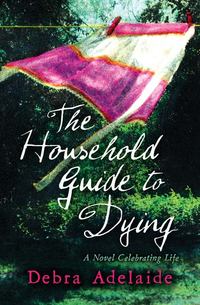
Читать книгу: «The Household Guide to Dying»
The Household Guide to Dying
Debra Adelaide

Dedicated with love to the memory of Adam Wilton and Alison McCallum
Epigraph
Death, you’re more successful than America, even if we don’t choose to join you, we do
John Forbes ‘Death, an Ode’
Table of Contents
Cover Page
Title Page
Dedication
Epigraph
One
Two
Three
Four
Five
Six
Seven
Eight
Nine
Ten
Eleven
Twelve
Thirteen
Fourteen
Fifteen
Sixteen
Seventeen
Eighteen
Nineteen
Twenty
Twenty-One
Twenty-Two
Twenty-Three
Twenty-Four
Twenty-Five
Twenty-Six
Twenty-Seven
Twenty-Eight
Twenty-Nine
Thirty
Thirty-One
Thirty-Two
Thirty-Three
Thirty-Four
Thirty-Five
Thirty-Six
Thirty-Seven
Thirty-Eight
Thirty-Nine
Forty
Forty-One
Forty-Two
Forty-Three
Forty-Four
Forty-Five
Forty-Six
Forty-Seven
Forty-Eight
Forty-Nine
Fifty
Fifty-One
Fifty-Two
Fifty-Three
Fifty-Four
Fifty-Five
Fifty-Six
Fifty-Seven
Fifty-Eight
Fifty-Nine
Sixty
Sixty-One
Acknowledgements
Copyright
About the Publisher
One
The first thing I did this morning was visit the chickens. Archie had already given them the kitchen scraps, so I leaned over the fence and scattered handfuls of layer pellets. As always, they fussed and squabbled as if they’d never been fed before and never would be again. Then I opened the gate and went to the laying boxes, where they still crowded into one corner, even though there was plenty of room. There were three clean eggs: two brown, one white. Not so long ago I could tell which chicken had laid which egg. Now sometimes I couldn’t remember their names. I picked the eggs up carefully. One was still warm. But touch is extraordinary, how it triggers memory, and so then I did remember that the tea-coloured ones were from the brown chickens, and the smaller white one was Jane’s. I held it to my cheek for a moment, savouring its warmth, its wholesomeness. I wondered if this was something that poets would ever write about, because it was an experience I treasured. The comforting shape, the startling freshness. The idea that this egg, white and perfect in the palm of my hand, was a potential new life, requiring of the world nothing but warmth.
Ripeness is all. That was something a poet once said. Eliot, I think. Or Shakespeare. Perhaps both – it’s hard to remember now.
With the eggs in my pocket I made my way back up the garden. Inside the house, the phone was ringing again, but I didn’t bother rushing to answer it. It stopped after five rings. It had been doing that a bit lately. The air was rinsed clean from the rain earlier. I could hear the clipping of hand shears. That would be Mr Lambert next door at work maintaining his lawn, Mr Lambert for whom a heavy dew, rain, or even a snowfall – if such a thing were possible here in the temperate suburbs – never inhibited his devotion to the task. As if in his latter years, all his focus could only be directed down. I realised Mr Lambert had avoided my eye for years. I wondered if he thought about returning to the earth, now that retirement had gripped him and even his grandchildren no longer visited. Or was that just me, thinking about my own future?
Did I say future? I really wish there was the right word for all this, because irony doesn’t come close, is completely inadequate. For a start, I discovered that Eliot was right about the cruellest month – except for me it wasn’t April, but October. Spring was mocking me with its glorious signals that summer was on the way. The wisteria outside my window making the most splendid mess of the verandah. The driveway littered with papery blossoms. My car confettied with them. If I’d been driving this morning it would have been annoying, but instead I was free to admire the way the flowers had been tossed across the windscreen. The shabby old car was as radiant as a bride. And now the sun was out and the wind was warm, I could smell the wisteria. Or perhaps it was the jasmine, which was along the front fence, just out of sight. My sense of smell was becoming muffled.
What is it about mauve and purple flowers? I remembered now that Mr Eliot (my high school English teacher always referred to him with respect) also had a thing about them – lilacs and hyacinths – but for me it was wisteria, and now irises. Archie planted irises in an old concrete laundry tub he’d turned into a pond, and each year they were more crowded and abundant. I’d been watching them over the past week or two. Their great long spears. The subtle swell of the buds on the stems. On the way back from the chicken shed, I noticed that the first one was out. It was bent over – perhaps the rain earlier was stronger than I thought – but the bloom was unharmed. I cut it and placed it in a vase on the kitchen bench. It was beautiful in a frankly genital way. Dark purple with a lick of yellow up each petal. And no scent at all. I think the scent of lilacs would make me retch now.
I’d always thought that this soft margin between winter and summer could never be cruel. But here, although the hemisphere is inverted, I was as bitten by cruelty as the poet was. Spring is the time of hope. Of inspiring songs and rousing actions. Of possibility, of anticipation, of plans. People emerge from winter, after tolerating autumn’s capricious start to the season, and know that if spring has arrived then summer isn’t far away. Every spring our local community has a picnic in the park nearby. Children have outdoor birthday parties. Spring is the time of action, of cleaning, of revolution.
Revolution. I thought a lot about the precise meaning of words now. And their sounds. Revolution is like the word revulsion. Disgust. Rejection. This morning I hadn’t yet faced breakfast, which would only be half a slice of toast, no butter, (there was no question of eating one of those eggs in my pocket). The poets were right about one thing, ripeness is all, but I’d like to tell Mr T.S. Eliot at least that his spring represented an insipid kind of cruelty, compared to mine. A laughable cruelty. It didn’t get more cruel than this: the season of expectation, of hope, of growth; the season of the future, when there was none at all.
It was spring when I’d had the first operation, giving me just long enough to recover by the end of the year and face my Christmas responsibilities, instead of languishing in bed as I’d have liked. Spring again when I discovered the operation hadn’t arrested the cancer. Further removal of body parts and intensive chemical treatment represented a Scylla and Charybdis between which I was pounded for another six months or so. Really, I would have preferred to row backwards, but Archie begged me to keep trying, my mother persuaded me, the fact of my two young daughters reproached me, and so I pushed on. And up until the last operation, when my body was sliced, sawn and prised open (the head this time), I still retained a scrap of hope.
But now the cruellest season had arrived again with an unmistakable finality. At least Mr Eliot had his dry stones and handful of dust to look forward to.
Two
Dear Delia
Can you settle an argument I am having with my friend (we play golf together)? She says you should only do your grocery shopping with a list. That I waste time and spend more money without one. I always take my time and think about it, and it’s true I sometimes come home and forget that I needed light bulbs or rice flour. But then so does she.
Unsure.
PS We are both sixty-five years old.
Dear Unsure
I’m sure that the incomparable Mrs Isabella Beeton would have maintained that the efficient housewife should never undertake her grocery shopping without a list. It is said that impulse buying is curbed by taking a list. That a list prevents the unscrupulous vendor forcing unwanted goods on the customer. However life is short. There’s a lot to be said for spontaneity. You might occasionally forget the light bulbs but I bet you buy those dark chocolate cream biscuits when they’re on special, or extra tins of salmon when you already have stacks in the pantry. I bet your list-carrying friend does too. PS Mrs Beeton was only twenty-eight when she died. Your friend might want to think about that next time she’s writing her list.
Home Economics was promoted to a science some time in the 1970s. I never took the subject myself, already being domestically taught by my mother and grandmother. Both believed in the Deep-End School of home training. And so my grandmother, who cared for me when I was a preschooler, simply pointed me in the right direction and I started to scrub, soak, mop and sweep along with her. When I was a bit older, my mother, Jean, whose speciality was the kitchen, took over. I had to whip, fold and poach (later stir-fry) with barely a lesson. Their theory was that I’d simply pick it all up, that as a female I would learn all this by osmosis. A ludicrous idea, one might think, but there must have been something in the osmosis theory, for I learned without blinking. I understood sewing, cooking, cleaning and knitting. By the time I reached high school and was forced to take a term of cookery, I realised there was nothing more to discover. Learning a subject like domestic science seemed as elementary as learning how to catch a bus or post a letter. Didn’t everyone just do these things? And by then I liked movies, books and music and couldn’t see much scope for that down in Mrs Lord’s austere kitchens or Miss Grover’s sewing class.
Thirty years later, it was different. We women of the early twenty-first century knew we were poised somewhere between domestic freedom or servitude. The home was ripe for reinvention. Even the theorists were claiming it. Angels were out, they’d been expelled years back. Now you could be a goddess, a beautiful producer of lavish meals in magnificent kitchen temples. Or a domestic whore, audaciously serving store-bought risottos and oversized oysters and leaving the cleaning to others. Goddess or whore, both were acceptable.
For Isabella Beeton, on the other hand, home management was a matter of martial discipline and political strategy, with the mistress of the house both the commander of an army and leader of an enterprise. By the early twentieth century housework was a matter of economics. The housewife was the linchpin of an autonomous economic unit. Then it became a science, and all that occurred within the home was accountable to clear logic and linear process. Making a batch of cupcakes was the same as distilling a chemical formula. Children given the right quantities of affection and punishment could be raised as successfully as a batch of scones at exactly 170 degrees centigrade for fifteen minutes. Not that domestic science meant a woman was a domestic scientist. That could never be entered on forms under Occupation.
Finally the home became a site. Housework, like everything else from surfing to jelly wrestling, has now been hijacked by theory. Whatever the present name for the subject is in the secondary school system, I bet it doesn’t include the word home. No doubt there are numerous research projects and dissertations underway right now on the house as locus, the discourses of vacuuming and the multimodality of the food processor.
Though perhaps not. It is women’s work, after all.
One morning, I was contemplating a list which I’d retrieved from the kitchen bench. I was still in bed, the same bed in which I had cavorted with my husband for the last dozen or so years and had the most tender and exciting sex of my life though, I now realised, not nearly enough of it; conceived two children and borne one of them (the other came close, but stubbornly exerted her right to enter the world via hospital intervention); read innumerable books, many of them excellent, a lot of them trashy but wonderfully so; drunk countless cups of tea every Sunday morning while skimming the tabloid papers with an equal mix of cynicism and delight; and made notes on all sorts of things, including writing lists.
Lists were not essential to my life. Nothing would change now if I never wrote another and I suspected that without them I might still have got things done. But this particular morning’s list was not for me, and I’d written it late the night before.
Put on washing
Feed scraps to chickens
Feed fish/mice (pond & tank)
Get girls up
Make lunches (not peanut butter for E)
Feed girls (don’t let D have chocolate milk on cereal again)
Remind E re homework sheet
Check D has reader, library bag
Hang out washing
Empty/fill dishwasher
Girls to school half hr early (choir practice)
And also:
Have shower (if poss!)
Make coffee, drink while hot (ha!)
I had only been writing this sort of list for the last year or so, since it became clear that certain tasks would need to be delegated. Until things were sorted out. That was the term we adopted to describe the future that yawned like crocodile jaws, deep and daunting. Compiling it was hard because it represented things I had been doing intuitively for years. What to put in and leave out? I’d placed it strategically under the pepper grinder late in the night. When the girls came in to kiss me goodbye the next morning, I was too groggy to tell if their hair was properly tied up, teeth cleaned. I murmured goodbye and raised my head to brush their cheeks with my lips. When I woke later there was a feather on the sheet, a dark brown one. I presumed they didn’t take their chickens to school.
As I reread the list I considered how Archie must have felt earlier that morning: was he insulted or bemused, offended or grateful? I wondered if I should have stipulated the girls be dressed in their school uniforms, or reminded him about their hats. Then I wondered why I felt all that was so important. I got out of bed and threw it into the wastepaper bin. Archie probably hadn’t even noticed it.
I generally wake early, before the light has fully hatched. Just the day before, I had made a small pot of tea and taken a cup out into the garden. Some of the chickens were already quietly burbling to themselves. I went and sat in the cane chair under the umbrella tree nursing my tea and listening. I’d always found the sounds of chickens to be immensely pleasurable. The five of them fussed and bickered on their way out of the shed as the light grew. Lizzie – Elizabeth – the smallest and most beautiful, was the first out, leading the foray into the sun. She was a Light Sussex, wearing black feathers over her white plumage like a lacy shawl, and she was bossy, instructing the others on the order they should leave the shed. The last to emerge was Kitty, dark brown to almost black on the tips of her wings. As far as I knew, every morning Kitty greeted the day the same way: a pause at the shed door, scratching the earth, a quick dart out a foot or two, a retreat to the door, another few feet, another retreat, before finally making a line for the feed tray on the other side of the run. Halfway there, Lizzie would always turn and peck her back, whereupon the ritual began again until something distracted either of them. Kitty was the last I acquired, though not the youngest, and poultry protocol insisted that, no matter what, this chain of authority remained.
I decided that if I had another life I could just study chickens. Only that morning sitting there, and throwing the dregs of my tea over the fence (they all rushed to investigate: they were incorrigibly curious) I realised despite having chickens for several years, I knew very little about them. The problem was that they were so easy, so compliant, required minimal care. I had, I saw, taken them completely for granted. There were aspects of them I would never understand. Why, for instance, did Jane, an Australorp with magnificent black plumage, glossy and iridescent green in the sunlight, lay white eggs? Why, when I had reared most of them from chicks, did they still hesitate or even protest at being caught? Kitty would once cuddle contentedly in bed with Daisy, but then after five minutes struggle to be free. Realising that the hen preferred to roost at night, I finally had to coax Daisy into returning her to the rest of the flock, after which Kitty became pathologically timid. (And, as was the way with children, Daisy’s fierce desire to sleep with the hen every night evaporated. Some other animal obsession materialised. First the goldfish, and then, when she finally accepted that they weren’t amenable to cuddling, the mice: India, Africa and China. A few months back, Daisy was insisting that if she didn’t take China, her favourite, to school in her pocket every day, she or it would die.)
I tasted the smallest atoms of life in those few quiet minutes. Drinking tea and waiting by chickens before the rest of the world raised its head. I tossed them a handful of layer pellets. Kitty approached the fence and ate from my hand. The gentle prod of her beak in my palm. The contented cackling. Lizzie darted across and shoved her aside. I was gripped by a sudden urge to protect the smallest of my flock. I entered the shed. Despite the dust, the earthy pungency of the chicken manure, the remains of bones and shells and everything else they unearthed in their endless, restless scratching for vermicular treats, the shed and the run was a pleasant place. It offered tender moments that couldn’t be found anywhere else. The angled poles of light capturing swirls of golden dust. The feathers rising and settling on the ground. The clucking that sounded equally contented and distressed. Above all, the air of expectancy that emanated from every hen, no matter how silly. The pure optimism that kept her laying an egg day after day, when day after day that egg was taken away. Some might regard that as stupid, but I thought it almost unbearably generous. A laying hen was so full of integrity, with all that devotion and focus in her life. And then, the egg itself, sitting sometimes in dirt, sometimes crusted with chicken shit, sometimes as clean and unblemished as a new cake of soap. But inside, more than complete; stuffed, entirely, with possibilities.
It struck me that morning how I should have taken the opportunity more often to regard and wonder fully at this corner of the garden, this ordinary aspect of backyard life. Too late now.
In fact, it was too early, but I went in to Estelle and Daisy anyway. In sleep their forms assumed a softness and delicacy that would dissipate once they woke. For a minute or two I drank in their innocence and purity. Then I placed the chickens carefully beside each of them. Estelle’s hands curled automatically around Lizzie, Daisy sat up with a start when she felt the tickling warmth of Kitty on her cheek.
What’s up? she said.
It wasn’t much past six o’clock, but I figured my daughters would have to cope with a lot worse than being dragged early from their beds.
I need to show you something very important, I said.
Cuddling their chickens, they followed me into the kitchen where I made them a chocolate milk each and sat them on their stools at the opposite side of the bench. The chickens settled into each lap with a few muted chirps. Switching the kettle on again and taking down the tea canister, I began.
Making the perfect cup of tea is not something you’re necessarily going to learn by accident, I said. Although, as Mrs Beeton says, there is very little art in making good tea. If the water is boiling and there is no sparing of the fragrant leaf, the beverage will almost invariably be good.
Who’s Mrs Beeton? Daisy said.
Never mind, said Estelle, sensing the importance of the occasion.
I made the tea while talking them through the entire process, streamlined for the twenty-first century, and taking into account local conditions. I used the small brown pot which was perfect for two cups, Irish Breakfast tea, and one of the white cups. I explained they would hear of things like warming the pot and the milk-first-versus-milk-later debate, and the metal-versus-ceramic-pot argument, which divided purists into polarised camps of Swiftian proportions.
Swiftian? What’s that mean? Estelle asked.
Jonathan Swift. Wrote Gulliver’s Travels, remember?
She nodded. We’d read a children’s version of it together a couple of years back, when she was nine.
He wrote about people called Big-Endians and Little-Endians, I said. All about which end you sliced your boiled egg open. Or something like that. Don’t worry about that now. We’ll do eggs later.
They would only need to heat the pot on the coldest of days, I went on. Not much of a problem here, especially with global warming. Nor, I explained, did they need to worry about the one-for-each-person-and-one-for-the pot rule. It would all depend on how strong you liked your tea, and, as they knew, I happened to like mine quite weak (they nodded, yes, they knew this), whereas others, especially those who took their tea with milk (Jean, their grandmother) might like it strong.
When the tea was made and poured, I placed it under their noses and told them to inhale deeply. I knew they wouldn’t want to take a sip. They sniffed and nodded when I asked them if they could detect the malty aroma.
In my opinion, I added, Irish Breakfast is still the best tea to start the day. Failing that, a brand containing an Assam leaf. And you can forget about Billy Tea, these days it’s nothing like it used to be.
Then I poured it all away and started again, to be sure they’d got it. They drank the last of their chocolate milks and watched until their attention span expired and they wandered back to bed still holding their chickens.
Nowadays, I focused on small but significant things. These days, my daughters indulged me quite a lot. A year ago they would have resisted, whingeing. Refused to see the point of cups of tea, which only ancient people drank. Now they were more tolerant of my eccentric demands. Sometimes they looked at me quizzically, assessing if it was really me. I have, I thought, at least taught my daughters to make a perfect cup of tea. They might otherwise go through life thinking it was always done with teabags. Though I couldn’t explain to myself, really, why I felt this would be a bad thing.
Alone in the kitchen, I raised the cup to my mouth but the perfect cup of tea now tasted bitter and my throat tightened in resistance. I went back to bed, where Archie was just stirring awake.
Three
Dear Delia
My kids won’t eat vegetables apart from potato chips. And my husband hates salad. Do you have any hints to get them eating greens and other vegetables? I get sick of cooking meals they hardly eat.
Fed Up.
Dear Fed Up
Mrs Beeton declared, ‘As with the COMMANDER OF AN ARMY, or the leader of any enterprise, so it is with the mistress of a house. Her spirit will be seen through the whole establishment.’ Assert yourself, Fed Up. You’re the cook, so take command and cook what you think they should eat. In fact, you should cook what you want to eat, even if your favourite dish is sardines on toast or tripe curry. Take your meals alone if you have to. Let them sort it out. Remember, you’re the boss.
What are the cockles of the heart anyway?
The oddest thoughts come to you when you’re standing at a graveside. And at a graveside a dictionary is probably the last thing you have to hand. I knew all about the heart, but when I got home I would have to look up the cockles.
Meanwhile, it was a chilly but clear late winter day, and I was roaming through Rookwood cemetery searching for a grave. The one I was standing before, in that silent city, had a leaning tombstone that said:
Arthur Edward Proudfoot
Late of the Parish
Underneath which had been added:
Also Alice Elizabeth
Wife of the Above
And in smaller lettering the saddest inscription of them all:
Henry James Proudfoot
Stillborn.
And then, under all that:
Died 1875
Gone but Never Forgotten
Always in the Cockles of Our Heart
An entire family history, in one brief and savage year, captured on one tombstone, erected by a family member now probably themselves unknown. There was something inescapably Dickensian about it. Especially when the largest and blackest crow I had ever seen alighted on the headstone two rows down and fixed me with a challenging look.
Let’s check the map, I said to the girls, still thinking about the cockles of the heart.
Archie had walked way ahead, taking photos of the enormous monuments to the dead built by the Italians. There were vaults out here larger than inner-city flats, and probably more expensive. Entire streets devoted to housing the dead. It wouldn’t have surprised me to see some black-scarfed woman emerge from a vault doorway and start sweeping down the pathway in front, or a few old men sitting at a corner smoking and playing cards.
There was nothing extraordinary about the dead, I had already accepted that. But it was extraordinary that I had lived most of my life without visiting them. Now I was doing research for my book. And I was also looking for my father, Frank, who died after a sudden heart attack some thirty-five years ago. His grave was a place I’d never visited. Now that I knew I was dying I needed to come.
I’m bored. This is so boring. When are we leaving?
I told you to bring a book or something.
But Daisy’s complaint was fair. It was tedious for a child of eight to be trailing behind an adult around a cemetery. I knew that Estelle was bored too but she understood why it was important for us to come to Rookwood, and anyway she’d brought her Nintendo DS.
I, on the other hand, was delighted. I hadn’t found my father yet, despite the maps posted all around as well as my mother’s directions, but was happy to wander past the rows and rows of family vaults. We had seen vaults perched like caravans on temporary-looking bases. Maybe they were temporary, maybe some families planned to take their dead relatives with them if they ever moved interstate or overseas. I’d gazed at the Lithuanian monument and peered closely at the sample of Lithuanian soil preserved behind a panel of glass. It looked more like something from a biology experiment than a handful of dirt.
Over here, called Archie, and so I followed and finally came to the place where my father was buried. The headstone was plain, as I knew it would be, Jean being the practical person that she was. It was grey granite, low and modest, with a brass plate inscribed with his name. It said:
Frank (Francis) Bennet
(not even In Loving Memory Of: that wasn’t Jean’s style)
Husband of Jean
Father of Delia
Sadly Missed
And that was it. No other details. No date. At the foot of the grave, Jean had planted some sort of groundcover which required maintenance once every five years, which was about all she visited now.
Hibbertia, said Archie. It’ll outlast a nuclear war.
I leaned over and examined it more closely. This end of winter, the weather was mild and buds were just forming. Soon it would be covered in flat yellow flowers.
I was five when my father died and I wasn’t taken to the funeral. Those were the days when everything to do with death was silenced, hidden and guarded, like a rabid beast that a family was still obliged to keep. Children especially were kept well away, even from their dead parents, as if the bite of that beast would infect them forever. In the first few years after my father died, Jean would visit occasionally with a tin of Brasso and a fresh bunch of fake flowers, but she would never take me, and I don’t remember wanting to go. Now it was so different, it seemed normal that I was bringing my daughters here – complaining though they were – just as it was normal to be discussing with them aspects of the dying process, which, after all, they were watching month by month, week by week.
Had enough? Archie said after I’d stood for a bit longer at the grave of Frank Bennet. I barely remembered him. He was not much more than a tall shape from the past. I remembered him mainly in the study in the house where I grew up, which contained books that he would take from the shelves with such reverence they seemed to be fragile things. I was rarely allowed to touch them. He had a garden shed full of tools also forbidden to me. He would make me watch from a safe distance as he planed a piece of timber or sharpened the lawnmower blades. The strongest memories of my father involved images of me running to his study or shed with messages from my mother about phone calls or dinners, and the powerful sense of importance that gave me.
I had thought the moment might have been more emotionally charged, but it was not like that. I felt nothing much at all, standing there. But I was glad I came, to see him, and to say goodbye in a way. My father’s only heart attack had been sudden and final. He was in his study at his desk one minute, on the floor the next. I wondered what had happened to the cockles of his heart, if they’d just shattered or closed off, or if they’d been faulty all along.
As we drove out of Rookwood cemetery I noticed a huge warehouse on the left, with loading docks down one side. Surely there wasn’t that volume of the dead to be stored or processed like airline cargo. At the end of the building was a red and white sign. Australia Post.
It must be the mail processing centre, I said. Strange place to have it.
Maybe it’s the dead letter office, said Estelle after a second. Then we both screeched with laughter.
I don’t get it, said Daisy, looking aggrieved.
Never mind, sweetie, Archie said as he turned back onto the highway. Do you still want to go to Waverley?
I looked at my watch. It was just after midday.
Yeah, why not? Maybe we can get some lunch around there too.
It’ll still be boring, Daisy said. Why can’t we go on a different excursion, why can’t we go to the beach?
It is near the beach. We could go to Bondi afterwards and get an ice cream.
But I want to go swimming! I want to go to Manly beach.
No, I said, slipping a CD into the player, it’s not nearly warm enough to go swimming at the beach, or anywhere. Besides, I get to choose the excursions from now on.
The opening notes of ‘Heartbreak Hotel’ filled the car.
Eww, not him again, Estelle said. Can’t we listen to something else?
No, I said. I get to choose the music from now on too.
Four
A few months before our visit to the cemetery, I had left on another excursion on my own, and I’d found it was also a matter of the right music.
There was a place I had to revisit before it was too late. Way up north, a place where I once lived. Where we’d both lived. But I knew if I told Archie, he would stop me. I knew if I tried to say goodbye to my daughters, I wouldn’t be able to leave. I had to choose the day carefully, a school day, a work day, a quiet suburban sort of day, when a drive to the local shops could casually extend into a long trip. I just had to get in the car and go. And of all the things I should have been attending to, the only thing I cared for was the accompaniment to my long drive north. Get the background music right, and everything else would slip into place. It was a soundtrack, this road movie of my life, this one-shot-at-it adventure to end all adventures, where my ears would become the organs I’d rely on more than any other, more than, at times, it seemed, my very heart.
So, I forgot checking under the bonnet for oil and water levels, forgot the spare tyre. Forgot phoning ahead to see which places had motels and which didn’t, which places were indeed places, not just dots on the map, specks with only a petrol station, cafe and general store all in one, a pit stop for the loneliest drivers, the emptiest of tanks, a tenminute stop surrounded by bitumen and disappointment, and on a Sunday afternoon always shut.
I didn’t fill a Thermos, or even check I had sunglasses, packets of nuts and dried fruit, two bottles of water, one for me, one for the radiator. Just walked out that door with the barest of essentials in a small bag, a couple of books, and drove off leaving the house to its own rhythms and noises. The beds were roughly made, the dishes rinsed and left in the sink, the note was on the bench.
The screen door was still swinging as I departed. Around me the birds were chirruping in their trees as if it was just another morning in May with the post delivery revving its way from up the road, with the honeysuckle still in need of trimming down by the letterbox and the white dog shit there on the nature strip along with the flattened drink can and the sodden pulp of the week before’s local paper which I’d clean away. One day.
Just not that day. Because that particular day I needed to leave while there was no one around to hold me back or ask why or talk sensibly or remind me of all that needed to be done in the next few weeks or months. Or tell me the most logical thing of all: that what I was rushing towards couldn’t be found. It was a journey I’d been putting off for years, yet now I was racing off as if it were an emergency.
As I swung out of the driveway in reverse, smooth and swift as a handshake, I waved to my neighbour over the road sweeping her front path, nodded to the postie as she puttered past, then accelerated up the street, which turned into the main street, and then into the highway, the one that would take me all the way north.
Music would be my companion. It would be so vital a presence it would almost drive the car itself. But mostly it would wash through my head, drowning the sound of my own thoughts and the details, the remorse, the despair, the pain that would persist in accompanying me on this escape. The soundtrack would charm the memories up, the ones I didn’t want but could no longer ignore. The ones that I had to take with me as I travelled back, and north. The memories, which were a soundtrack of their own.
I chose carefully. Nothing too gloomy. No Tom Waits, or I’d be driving off the road straight into the nearest tree that offered certain and complete annihilation. Bach was good but only for long unbroken stretches: the complex fugal pieces were incompatible with negotiating tricky routes or traffic in unfamiliar towns. I sorted through my box of music, most of them cassettes in cracked covers collected for car trips over the last fifteen years, most of them telling some sort of story, though none with any logic. The Willie Nelson tape with his version of ‘Graceland’ that I currently favoured (there was definitely a whole story in that). Tapes of assorted unrelated artists: Dusty Springfield, Georgie Fame, the Andrews Sisters, the Glenn Miller Band. The mindlessly cheeky George Formby, now so obscure a performer, I wondered how he ever made the transition from record to tape. Mahalia Jackson, if I was in the mood for august serenity. Country, all types. Hank Williams. Yodelling songs. Gillian Welch. Lyle Lovett. (Asleep at the Wheel I’d avoid, for obvious reasons.) It was a big collection, enough for my needs.
And there was always Elvis. I’d not played his albums for nearly fifteen years, never listened to a single song, if I could help it. But now I’d included the old cassettes in the box I was taking with me. It was time to start listening to Elvis again. But I’d wait a little longer before putting him into the player. It was going to be a long journey, and there was plenty of time for that.
So I drove north with songs like ‘Graceland’ urging me on, into the lush steamy warmth, to a place remote yet accessible, elusive yet as solid and immovable as a pyramid. There was chance here, a chance that had to be taken or it would slip away faster than a southern sunset. What was it exactly that I was taking a chance on?
I really didn’t know, even though I was bursting to get there, my heart accelerating ahead of my thoughts, and, while empty of understanding at that stage, I was still ripe with anticipation. The same feelings that had struck me when first I arrived, all those years back.
The town of Amethyst was off the map, but it was there all right, bordered by thick margins of rainforest and mountains that slowly narrowed out, stretching northward until they began to merge into the long triangle that eventually led to Cape York. The town was situated in the middle of the middle, about halfway north of the New South Wales border, and halfway west of the coast. I could get away from the south and head north without a map – anyone could, there were plenty of signs. But at a certain point, to get near the right place, I needed the map, though the name wasn’t marked. I read other names signposting the direction, and they were names that beckoned: Emerald, Sapphire, Ruby. Legendary riches.
Somewhere before the surfing nirvanas and the other lures of the coast I turned west. At some stage I turned off the soundtrack, let Hank and Frank and Mahalia and all the rest lie in their box on the floor of the car along with the tissues and takeaway wrappers and the mobile phone that I’d turn back on again when I could bear to. The cloud that had collected and settled like smog on my memories began to thin out, then lift altogether. And then I didn’t need the map. I knew without looking that a place in the middle of places with names like jewels was near where I needed to be. It wasn’t that far from Emerald, and not so far from the highway either.
Late in the afternoon on the fourth day of the journey, I glanced to my left and saw the signs and the three roadside businesses: a service station, a timber yard and, most oddly of all, a garden art place with gnomes in rows along the front fence, that indicated the turnoff to the last town on the route, Garnet, the last place before my destination. I was travelling on a rise when I saw jutting out of the trees beside the road the sign advertising Lazarus’s trailer and campervan business, three kilometres ahead. A sign about fifty years old, flaked and faded, and pitted with the usual rifle shots. After two kilometres I slowed down, keeping my eye out. There wasn’t another vehicle in sight, and I couldn’t remember passing one since the last town.
I knew I was in the right place, or near enough. The sign had said nothing about where, exactly, but I drove slowly forward again until I spotted a break in the trees to my left, and I took the turnoff past Lazarus’s collection of elderly vehicles, knowing it was the right place to go. The road wound down for a bit then started to rise. Somewhere on the very outer reaches of the range I knew I’d entered that large section of valleys and hills and sluggish little creeks posing as rivers situated between Clermont, not far ahead of me, Emerald to the south, where I’d been, and Alpha to the west, where I didn’t intend to go. The road twisted pleasantly. The sun, low and intense, pokered my eyes. I had already dropped the map on the floor of the car.
When I’d first come here over twenty years ago, a bus had dropped me at the side of the road by Lazarus’s sign. I’d walked along the road towards Amethyst, not caring how long it would take. And there was barely another car, none that I recalled. It was like entering another time frame. Maybe it was the impression of the gums shooting so high they seemed like anchors for the sky. Maybe it was the cooler air, or the spotty variable light, light that also appeared partly dark. Maybe it was the leaves that drifted down from that dense canopy, slower and more dreamily than leaves normally drop. Or maybe the bird calls far above, musical and hidden. It was timeless, other worldly. It was uncharted, and so it seemed to be invested with a corresponding fairytale quality.
Of course, I was young then, I would think that. I was a walking cliché. Seventeen, pregnant, alone. I had fought with my mother yet again. I had not fought with my boyfriend, Van, since I’d been denied the opportunity when he simply disappeared, justifying all the doubts about him my mother had had ever since she first met him. The more she had tried to talk me into an abortion the more I resisted. She was motivated, I understood eventually, only by concern, and distress that I was throwing away my educational opportunities to strap down my life with a baby before I was barely grown myself. I was motivated instead by my ideals, my dreams, adoring Van and falling easily into his older, larger world of music and poetry and inner-city sophistication.
The morning I had woken in Van’s room in Newtown and noticed his romantically meagre belongings were gone, I had felt a sick stab of suspicion, soon confirmed when after days I heard and found out nothing. By then it was too late for an abortion, and definitely too late to admit my mother was right about him.
I couldn’t say at what point I became convinced that Van had returned north to the town where he grew up and where his talented performing family still lived. All I remembered was the aching conviction that north in Amethyst was where I would find him. Or he would find me, and our baby.
Five
Dear Delia
I’ve been reading your column for some years now and I reckon I could do just as well. Who needs to be qualified to write about dirty shirt collars and poultry stuffing anyway?
Yours
Cynical.
Dear Cynical
Perhaps you are unaware that books of household advice form an integral part of our literary heritage. They are cherished by readers the world over and have been particularly sought in times of distress and hardship. Mrs Beeton’s Book of Household Management was beloved by the most unlikely of readers: the conquerors of Mount Everest, the trench soldiers on the battlefields of France. Members of many journeys and expeditions have all drawn comfort from its practical advice and general historical knowledge infused with moral ardour and homely goodness. The members of Scott’s Antarctic expedition might have perished, but they did so with copies of Mrs Beeton in their hands.
The fact that generations of women managed without a single self-help guide is admirable and humbling. Now the number of books available on domestic advice, from specialist titles devoted entirely to stain removal to baby care books and handy manuals taking a novice through simple family meals step by step, is enormous. More than enough to stock several shelves in the average bookstore. A hundred and fifty years back there were approximately none. Mrs Beeton’s Book of Household Management was the first, and that did not appear until 1861. How ever did women manage before the likes of Mrs Beeton?
Unlike Isabella Beeton’s, my career as a household expert was accidental. The series of Household Guides had become mine and made my reputation, but the original idea belonged to Nancy Costello, a commercial publisher and my employer – if freelancers had employers – and also a friend, though in a limited sense. Nancy and I enjoyed a warily pleasant relationship, one in which neither of us was committed to remembering the other’s birthday or socialising regularly, but in which we could ring each other up any time about almost anything. There was no sense of obligation, and no occasion for confusion, resentment or hurt. I doubted I’d ever tell Nancy my best secrets or discuss with her my worst fears, but on the other hand I was always able to count on things like frank gossip, her best recipes (she was a great cook), or the loan of her car should I ever need it.
Nancy was pragmatic, efficient, opportunistic, ahead of her time. She understood, then knew how to address, the crises of confidence that saw intelligent people confounded by the prospect of hanging a painting, replacing a boot heel, or boiling a perfect soft egg. Her first great success was getting a free household magazine into millions of households. Her second was to develop a series of specialist self-help titles that even the vast self-help title industry had not yet thought of.
Nancy decided that the home was diminishing as the site of traditional folklore and knowledge, of mainly female authority. Whereas women had once known almost instinctively how to polish furniture or remove wine stains, now they were more likely to understand how to program a digital set top box, or complete their quarterly tax statement. While it was true that fewer men could now trim hedges or degrease driveways, the deficiency was more obvious in women, who were so traditionally bound to the home. Too many homes were now empty places, physically, psychically but also culturally, lacking the memories, knowledge and wisdom formerly accumulated like cherished crockery and handed down from generation to generation. Like an indigenous language that was no longer spoken, the lore of household life was rapidly becoming extinct, from descaling kettles to preserving peaches, from the uses for naphthalene to the best method for beer-battering fish.
At least, that was Nancy’s view and in some ways she was right. Although my own home, and the home that Jean maintained when I was growing up, was filled with the making of food, of clothes, of messes then of cleanliness, over and over, so regularly you almost never noticed it was there, Nancy represented another type of contemporary woman altogether: a woman who was prepared to acknowledge the importance of the household, but wasn’t personally interested in it. Nancy’s home was a lean and austere place, so tidy that it barely needed cleaning. I knew, without ever having opened any of her cupboards, that she didn’t possess a single bag of fabric scraps and wool oddments, nor a collection of reused Christmas wrapping paper, nor a drawer filled with old corks, bent skewers, rubber bands, chopsticks, stained tea strainers, undisposed disposable plastic spoons and an incomplete set of tin cookie cutters like other households, including mine, did.
Archie and I were starting out when I first met Nancy. Or here, in the city, we were starting out again. He was slowly lawnmowing his way into something we had begun to call a business, and I was working as an editorial assistant. Archie had supported my desire to take up the university place I’d rejected years before thanks to my unplanned pregnancy and naïve ideals. Always a devoted reader, I found myself surprisingly ahead when I commenced the arts degree. I finished under time to discover I was brilliantly unqualified for anything. I understood later the degree was more void-filling than vocationally satisfying. It was the wrapping, layers of it, around my grief. But I was happy enough to take on the only job I was qualified for – if being a good reader qualified you for anything – copyediting and proofreading for Academic Press. We published books by obscure academics, books as faded and dull as the authors themselves. They may as well have been bound in brown corduroy. Soon after I met Nancy, in her capacity as book marketing consultant, Academic Press closed its squeaking doors for good. By then I had Estelle, who was followed three years later by Daisy. After that I only freelanced, an arrangement that suited me with two small children.
When Nancy began the household guides I wasn’t her first choice of author. That was a man by the name of Wesley Andrews, an enterprising person who was known as a bright spark, someone who had great contacts, who got things done. Who seemed to have a hand in all sorts of books and literary ventures. Who’d written perfectly competent novels as well as ghostwritten mediocre but bestselling memoirs of sporting personalities. He had seemed in every way the right person to put his name and imprimatur on the inaugural guide: The Household Guide to Home Maintenance. Correctly understanding that the first book in the series should capture both male and female readers, Nancy felt a male author was necessary. But until the writing ground to a halt somewhere between chapter eight (Roofing and Guttering) and chapter nine (Windows and Flyscreens), no one had any idea that Wesley’s chief literary driving force, if not navigator and mechanic, had been his wife – who, by chapter seven (Patching and Painting) had left him for good. Which perhaps explained why the opinions and recommendations on Simple Plumbing Repairs and Basic Electrics in chapters five and six were so very simple and basic. That is where I came in.
I had already been working for Nancy, first as a casual proofreader, then writing the advice column that appeared in her free publication – advertisements and advertorials disguised as a magazine – which she called Household Words, a joke that I suspected only she and I shared. Her idea for the column had arrived one afternoon when she was looking at a blank space on page five of Household Words and facing a deadline the next day. She phoned me, interrupting a dull editing job, or whatever it was I did then as a freelancer fitting in work between supermarket visits and nappy changes.
I need a dummy column for this issue, then we’ll get real letters. Can you knock something up quickly, on polishing silver, or whatever?
Nancy, no one polishes silver these days. They don’t even use it.
What about stains, then? You’ve got two kids, you’d know a lot about stains.
I guess I do.
I’ll set up the layout now, she said, and you can email me the copy later. I’ll call it Dear Delia. Lucky you’ve got the right name for it.
Nancy paid promptly and generously for a few hundred words of tame advice which I extracted from my non-creative side between the hours of nine and eleven on a Sunday evening while Archie was watching the Channel Ten movie and the girls were in bed. For months I doubted anyone read it, as Household Words was pushed into letter-boxes all over the suburbs along with advertising brochures for Coles Liquor, Woolworths supermarket specials and the Good Guys Electrics catalogue and was hardly distinguishable in content from them anyway. But evidence of its readership emerged when my advice column started to receive more and more emails.
They came regularly, forwarded to me by Nancy’s assistant, and for a while I responded easily enough. Nancy seemed happy, and the extra income helped with the mortgage. But then one day, bored for some reason, I amused myself by winding up the reader. It was such fun, I did it again, then again, never intending to send the replies off, until accidentally and in haste (a dish overcooking? a child left too long in the bath?) I attached the wrong file, hit the send key. If I’d assumed my copy was checked, I was proven wrong a week or two later when my mother rang to say she’d been amused by my unusual responses in that week’s issue. I sat around waiting for Nancy to phone and complain. Instead I was flooded with letters, and more requests than I could deal with. Nancy congratulated me on the initiative, and insisted I go in a bit harder. As a result the advice column developed a cult following.
Dear Delia was only a version of me, a slightly feral one. A more fearless one. But readers seemed to like being insulted, treated with disdain or having their requests dismissed, and so the column continued.
Dear Delia
Last night I had several people over to dinner, including my old friend who is still single despite her divorce coming through a good year ago, and my husband’s new assistant. During the dinner my husband managed to fling his arm across the table and knock over a carafe of red wine onto my best cotton lace tablecloth. He was arguing with Don, our neighbour, and they both got a bit carried away. If I bleach it, it might fall apart, or go white or patchy. What should I do?
Uncertain.
Dear Uncertain
What I will advise you, Uncertain, is to examine your guilt about your relationship with Don. Are you sure your feelings for him are as hidden as you believe? For you can be sure if I worked it out from just one letter, your unnamed husband will have worked it out by now too. Don’t fool yourself for a minute that your attempt to introduce Don to your divorced and still-single friend will work as a cover for your real feelings about him and the relationship you two are conducting on the sly. In fact this will almost certainly backfire: your friend and Don will end up hitting it off in all sorts of ways. They might even be out at a matinee screening of the latest Hugh Grant movie right now. I’d suggest that next time you want to have dinners where arguments occur you use a more appropriate tablecloth. Perhaps seersucker. Or one of those wipe-down vinyl ones.
Бесплатный фрагмент закончился.