Читать книгу: «Taming The Wolf»
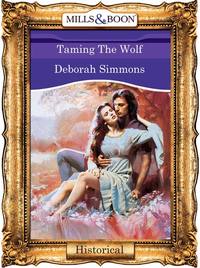
Taming The Wolf
Deborah Simmons

www.millsandboon.co.uk
For my own brother, Robert W. Smith
Contents
Prologue
Chapter One
Chapter Two
Chapter Three
Chapter Four
Chapter Five
Chapter Six
Chapter Seven
Chapter Eight
Chapter Nine
Chapter Ten
Chapter Eleven
Chapter Twelve
Chapter Thirteen
Chapter Fourteen
Chapter Fifteen
Chapter Sixteen
Chapter Seventeen
Chapter Eighteen
Chapter Nineteen
Chapter Twenty
Prologue
England 1270
The sound of approaching riders made Marion freeze, her hands still upon the reins and colder than the autumn winds that whipped against her cloak. Although they were nearly two days gone from Baddersly Castle, she still feared pursuit from her uncle and his soldiers. When both he and his steward were away, she had made her escape, ostensibly to go on a pilgrimage, but even a journey taken in the Lord’s name would ill please Harold Peasely. He would track her down, and when he found her...Marion shuddered at the thought.
If only she could reach the convent, she would have sanctuary, for even her uncle could not touch her there. She could live a selfless, holy existence, locked inside the walls safe from harm, with a group of women who would be a family to her—because she would never have one of her own.
Marion swallowed thickly at the cost of her asylum. Once she had entertained dreams of a husband and children, but her uncle had no intention of giving over his wardship of her lands and wealth to another man. He had kept her hidden away, subject to his wild tempers and so often alone....
With a piercing glance, Marion focused her attention on the oncoming travelers, relaxing slightly when she saw that they did not wear her uncle’s colors. Closer inspection revealed that they were a dangerous-looking, ill-kept group, however, and Marion worried anew.
Although the Church proclaimed that pilgrims were not to be harmed, assassins and outlaws roamed the roads, and the group of young serfs and freedmen Marion had hired to accompany her were poor protection. Little more than boys, the Miller brothers might wield clubs, but they would be no match for armed brigands.
As if to confirm her worst fears, the men ahead suddenly spurred toward them, thundering forward on great horses and raising cruel weapons. Marion gasped as they smote the leader of her train, John Miller, with one mighty blow. Her palfrey balked, and beside her, her servant, Enid, screamed wildly, drawing the attention of one of the attackers, a bearded giant who was soon looming over them. Before Marion could draw a breath, the fellow dragged the shrieking Enid from her seat.
Marion’s heart contracted in horror, and for a moment she simply stared, immobile, as the man pawed at her servant. Then, forcing her limbs to action, she drew her small dagger with calm deliberation. She moved as if in a dream, the world about her seemingly slowed, the clank of weapons and the screams of her companions fading to a low buzz, while she urged her mount toward the fiend who held Enid.
Marion knew she must aim her blade at his heart, and she poised to strike, but years of submission to those bigger and stronger stilled her hand and she remained motionless as the nightmare unfolded around her.
Finally, it was too late. The brute saw her. Laughing at the sight of her puny knife, he lifted an arm to knock her aside like a pesky fly. Marion fell to the ground below, landing hard on her back, the wind knocked from her and her head spinning and spinning....
Chapter One
Campion. Marion drew in a breath at the sight of the massive stone walls, rising high in the air and marching majestically into the distance. Its myriad towers looked so fine, so great and strong, that a tingle of apprehension ran along her spine. What awaited her here?
Anxiously, Marion glanced toward the dark-haired knights who led the train, and she felt her tension ease. Over the past weeks of travel, she had grown to trust the men who had found her in the roadway. But then, she had little choice in the matter, for they were all she knew.
She remembered nothing else.
It was because of her head injury. Geoffrey, the learned one, said that sometimes a blow to the brain could steal one’s memory, and she had to believe him, for she knew naught of herself or her past. All that had happened before the de Burgh brothers appeared in her life was a vast, empty—and rather chilling—void.
Although she lived and breathed and walked and talked, it was eerie, this lack of history. Hearing the song of a bird, she could easily identify it as a sparrow. She could even recall a recipe for roasting the creatures, but how and when she had learned the ingredients escaped her. Her past was a blank.
They called her Marion. It meant naught to her, but they had found the name inscribed in what they thought was her psalter. They said that she was a lady, and only a lady would have such possessions as they discovered—fine clothes, a mirror, books, coins and jewelry. Then they took her with them, for they did not know who she was, and were in a hurry to return home.
“Come, lady!” Geoffrey called. Obviously happy to have finally reached his destination, he urged her on, through the outer bailey and inner bailey toward massive doors, flung open in welcome. He helped her dismount quickly, and Marion smiled at his eagerness as he led her inside. Although a knight, Geoffrey was a gentle, scholarly man, and she liked him readily.
Then Marion looked around, and her eyes widened in wonder at the enormous hall, the like of which she could swear she had never seen before. Light poured in through the tall, arched windows set high in the walls, and chairs and settles were scattered among the benches as evidence of the de Burgh fortune.
It was very impressive—and very dirty. Marion tried not to wrinkle her nose at the smell of overripe food, stale rushes and dogs, which the chill air could not dispel. Even with her faulty wit, she could tell that Campion was in need of a chatelaine.
The thought made Marion pause, while tiny prickles trickled up the back of her neck, along with a sense of discovery. She could do it. She knew it with utter certainty, and with that certainty came a swell of longing and excitement. Not only could she do it, but she would do it well and find happiness in the task.
“Ho! Simon! Geoffrey!” Suddenly, there was such a din that Marion nearly covered her ears. The party was set upon by various large dogs, barking their heads off, followed closely by several large, dark-haired men, shouting even louder. She stepped back as the giants joined the equally big Geoffrey and Simon and jostled and hugged and swung at them in what she hoped was a friendly fashion.
They all seemed to talk at once in shouts and grunts while she watched, amazed by the affection apparent beneath all the gruff bellowing. And then, as if by some unspoken agreement, the noise ceased and all turned to face an approaching figure.
He was not as tall, or nearly as broad as his sons, but Marion immediately guessed that the man who drew near was their father, the earl of Campion. His hair was still as dark as theirs except where it was streaked with silver. His face was more gaunt, his mouth less generous, but the resemblance was there, marking him as an attractive man, despite his years.
Marion watched him closely, her eyes flicking away only to gauge the reaction of others to his presence. Though a patriarch and a nobleman, he did not appear to be a cruel lord and master, nor did he seem full of his own importance. He moved very gracefully, with a dignity that commanded respect, not through brute force but through wisdom, and Marion felt the tightness that had settled in her chest ease at the sight of him.
Although Campion was obviously above the kind of boisterous behavior of the others, he was nonetheless pleased to see his sons. It was evident in his smile and in his voice when he spoke their names. “Simon, Geoffrey,” he said, his tone low and rough with the measure of his affection. And then, while Marion looked on in astonishment, the elegant earl opened his arms and loosely clasped the towering body of the mail-clad Simon.
Marion’s longing returned in a rush, more piercing this time. Had she ever been part of such a family? She watched, fascinated, as the earl did the same with Geoffrey. Then, suddenly, Campion’s attention was upon her. His brows lifted a fraction in polite curiosity, and she nodded her greeting before bending her head, anxiety curling in her breast.
“Sir, we came upon a pack of thieves attacking the Lady Marion’s train,” Geoffrey explained. “Although we dispatched them, we were not in time to save her injury. She was thrown into the roadway and now knows not her own name. All of her people were either slain or fled in fright, so we have offered her our protection until she might regain her...health.”
“My lady,” Campion said, bowing slightly in a formal salute. “We shall be pleased to have you with us. It has been too long since a damsel has graced our hall. I am Campion, and these are my sons,” he said, lifting a hand to take in the group.
“You have met Simon and Geoffrey. May I introduce Stephen,” he said, and another de Burgh stepped forward, this one with a lock of the familiar dark hair hanging loosely over his forehead. He had a different air about him than Simon or Geoffrey, a careless attitude that did not seem to fit Campion’s line.
“My lady,” Stephen said. He flashed white teeth in a mocking grin, and she decided he was too handsome for his own good.
“Robin, my lady.” A man of about twenty years spoke this time. His hair was a shade lighter than the rest, and his friendliness was genuine, as if he were paying court to her. Marion nodded her greeting with pleasure.
“Reynold.” More gaunt than the others and walking with a stiff gait, as though one leg pained him, came Reynold. Although he appeared to be younger than Robin, he seemed angry and bitter beyond his years. He did not return her smile.
“And, finally, Nicholas.” At the earl’s words, no one stepped forward, and Campion repeated the name with just a hint of exasperation. Marion almost laughed aloud then as the youngest de Burgh bounded toward her. He was probably no more than fourteen, a softer, smaller version of his brothers.
“Yes, sir?”
“Please meet our guest,” Campion directed with a nod toward Marion.
“Greetings!” Nicholas said, eyeing her up and down with the eager curiosity of the young. She could see that he was bubbling over with questions for her, but apparently his father also recognized the signs, for he quickly forestalled the interrogation with a reproving look.
Campion then glanced around the hall. “Wilda,” he called. Although he did not raise his voice, a young servant girl was soon at his elbow.
“Yes, my lord?” She spoke respectfully, yet with a sincerity that caught Marion’s attention. She realized that even the servants went about their work with pride here at Campion. It was a situation that struck Marion as oddly unusual, but she could not say why.
“This lady will be staying with us,” Campion said. “Please show her to a room with a hearth, and send something up from the kitchens for her. ‘Tis late, and she will wish to seek her rest after the long journey.”
“Yes, my lord.” Wilda nodded warmly, the casually given welcome touching Marion to the bone. Although she realized that she had been graciously dismissed, Marion could not leave yet. Ignoring the urge to scurry away, she turned to face the earl.
“My lord, I cannot thank you enough for your hospitality. I promise you that you shall not regret it,” Marion said. Then she did hurry after Wilda, before he could change his mind about letting her stay.
She had seen little enough of the castle and its inhabitants, but Marion liked what she saw. Although big and gruff, the de Burgh brothers were handsome and appealing, their father was gentle and kind, and his people were happy. It seemed to Marion’s dazed senses that the very walls reached out to her in welcome.
Already, Campion seemed like home.
* * *
“Come, I have ordered some food and drink for you two,” the earl said to his returning sons.
“And me, too, sir!” Nicholas said.
Campion smiled at his youngest. “For all of us, then.”
Although supper had been cleared away, he sent a servant for bread, cheese, apples and ale. Once these were brought and they were all seated at the high table, Campion nodded toward Simon to speak. He listened intently as his warrior son reported on his trip south to collect monies from a recalcitrant tenant.
“Then, on the way home, when we were hurrying against winter’s winds, we came across a small band being attacked by murderous thieves. We killed the devils, but some of our men were injured in the skirmish,” Simon said.
“The odd thing is, the ruffians were not your usual bandits. They fought very well, like trained soldiers,” Geoffrey put in, “and on fine horseflesh, far better than you would expect such men to own.”
Simon snorted his dispute. “They fought to the death, as the bastards will when cornered, ‘tis all.”
The earl glanced back at Geoffrey, but the boy said nothing further, deferring instead to his brother, as usual. It was not Geoffrey’s way to argue, and yet Campion knew that his scholarly son was probably speaking the truth. Geoffrey might not be as bold as Simon, but he noticed things. He sat back, watched, assessed and made his plans accordingly. That was his strength, and that was why Campion often sent him to accompany his more single-minded brother.
“Some members of the attacked train fled into the woods,” Simon said with a scowl of contempt. “They appeared to be youths hardly fit for working in the fields, let alone escorting a female of any consequence. The only remaining survivor was the woman. When we revived her, she could not tell us who she was, nor did she or the caravan have any colors or clues to identify them.”
Geoffrey spoke up again. “‘Tis plain she is a lady, sir, by the quality of her clothes and by her bearing and speech. I talked with her at length on the road, and she is well educated. She can read and write and has some knowledge of accounts, too.”
“And yet she does not remember her own name?” Campion asked.
“No, sir,” Geoffrey said. Campion held his gaze for a moment, a silent question passing between them, but Geoffrey did not flinch. Without putting the query into words, Campion knew his son believed the woman spoke the truth. Campion then glanced at Simon, to get his opinion, but the older brother obviously did not think the lady worthy of further conversation. He was already fiddling with his scabbard, impatient to be off.
“And who christened her? You?” Stephen asked, laughing at his own jest. Campion shot him a look and did not miss the replenished wine cup in his hands. Stephen was becoming difficult.
“We have called her Marion,” Geoffrey said, ignoring Stephen’s contemptuous chuckling, “for we found the name in one of her books.”
“Oh! And are you smitten with her, brother?” Stephen taunted.
“Geoffrey’s in love!” Nicholas shouted. A round of jeering followed that announcement, and Campion let it play itself out. He could tell with one glance at Geoffrey’s disgusted expression that his son had no interest in the girl other than compassion.
“No?” Stephen said. “Then perhaps ‘tis our Simon who has felt Cupid’s prick?” There was some laughter at Stephen’s play on words. Lord, he was a clever boy. If only he would use it to advantage, instead of wasting it. “Our good brother likes his women short and well rounded, I see!”
Suddenly, the room quieted as Simon shot to his feet. “Wish you a fight?” he growled, looming over Stephen, who leaned back against the wall in a casual pose.
“Lord, no,” Stephen replied. He affected a yawn. “It has been positively peaceful without you about—crowing like a cock at the veriest whim.”
“That is enough,” Campion said. “Simon, sit down. And Stephen, you will be kind enough to keep a civil tongue in your head concerning our guest.” Stephen’s penchant for finding fault with anything and everything was beginning to annoy his father. The girl might not be breathtaking, but she was pretty in an arresting way.
If Stephen could have seen past the current fashion for boyish figures and golden ladies, he might have noticed that the unruly brown curls framing her heart-shaped face would be a riot of thick locks when freed. He might have noted that her skin, although not as ghostly white as some, was pale and pure, and that those great dark eyes could hold their own against another’s of brighter hue.
Campion kept his thoughts to himself, however, having no wish to watch his sons battling one another for the favor of their visitor. Let them ignore her comeliness, but he would not have them treat her rudely, and the look he gave them made that clear.
After a long, threatening moment, Simon sat down, sending a scowl at his black-sheep brother, who grinned shamelessly. One day, Stephen would get his deserts, Campion thought to himself with a flash of premonition, then he focused his attention on the matter at hand. “We shall continue to call her Marion,” he said. “Now, tell me where you found her. Perhaps she was only going to a village or visiting amongst her neighbors.”
“Nay, sir,” Geoffrey said. “A cart held supplies for a long journey, perhaps a pilgrimage.” He paused, as if uncertain how much to say, and then continued on determinedly. “I wanted to go back along the road and ask about her, but Simon...did not feel the issue warranted a delay.”
Campion nodded, but said nothing. Geoffrey’s words held no censure, but Campion knew that the two must have been at odds over the fate of the lady. Simon had no use for women and would have put the return of his company before the mystery of a lone female. And who was to say he was wrong? Perhaps, if they had probed the area, they could have returned her safely to her home. Perhaps not. And with the unpredictable weather and poor state of the roads to contend with, Campion hesitated to second-guess Simon.
He rubbed his chin thoughtfully. “It could not hurt to discover who lives in the area and to send out inquiries, but with winter nigh, I am not certain how much success we shall have. Ask the lady for something of her own, something identifiable—a piece of her jewelry, perhaps—and we shall send it along with a messenger to court.”
Campion sighed softly, his decision made, and put his palms on the table. “Until we discover her identity, however, the lady shall stay with us and shall be treated as such,” he ordered, his gaze sweeping the circle of his sons.
He noted, with chagrin, that the members of this womanless household did not look very well pleased by his verdict. Only Nicholas seemed intrigued by the idea of a visiting female, and Campion could see a wealth of problems in the youth’s healthy curiosity. Simon and Reynold looked positively dour, Robin and Stephen rather amused, and Geoffrey somewhat pained. He obviously was feeling sorry for the poor girl.
Campion, on the other hand, had no fears for the lady. Though small, she looked strong enough to withstand much—even the fierce pack of de Burghs—without flinching. There was more to the mysterious Marion than met the eye, he would swear to it. He remembered her huge eyes, soft as a doe’s, and he sat back, rubbing his chin thoughtfully.
Perhaps, he wondered, smiling himself...perhaps she might even tame the wolves to her hand.
* * *
What beautiful beasts, Marion thought, admiring her own handiwork. It had taken her all winter, but she had finally finished the tapestry last week, and now it brightened the great hall with its bold colors.
It was her own design, a rendering of eight wolves—the de Burgh device—rampant across a field of green, with Campion Castle rising behind them. Of course, the work had been greeted with much humor by the brothers, who taunted Nicholas for being depicted as the runt of the litter and complained loudly about being turned into creatures of various hues. The only de Burghs who did not voice their disapproval were the earl, who was as polite as always, and his eldest son, Dunstan, who did not live at Campion.
For the past week, the hall had been filled with mock howling that would have deafened another woman, but Marion was undisturbed. She took in stride Simon’s grunts, Stephen’s baiting, Robin’s tricks, Reynold’s sharp words, and Nicholas’s curiosity, for they were like brothers to her now.
Seated by the fire with some sewing, Marion mused on her good fortune. A total stranger, without name or fortune or family, she had been taken in by the de Burghs and accepted. She now served as chatelaine in almost every capacity, and the joy of purpose in her life was heady. But Campion and his handsome, dark-haired sons had given her more than a home and a position—they had given her their grudging affection. That was what made her smile and kept the smile upon her face so much that they teased her unmercifully about it.
Startled from her pleasant thoughts by the sound of the great doors banging open, Marion looked up, the needle still in her hand, to see a giant of a man stride into the hall. He was dressed as a knight and accompanied by others similarly garbed, though none was quite as imposing as the man who led them.
Mercy, but the fellow was huge, Marion thought. He looked to be even bigger than the de Burghs, who towered over everyone at Campion. Who was he? He walked into the hall as if he owned it, arrogance apparent in every step.
Suddenly, Marion felt an odd sensation of recognition. There was something familiar about that gait, strong but graceful, and yet it was like none she had ever seen before. While she watched, trying to place the massive warrior, he lifted his helm to shake out a head of dark hair that gave away his identity in an instant.
Dunstan.
For a moment, Marion remained in her seat, studying him with blatant interest. Although the family often spoke of Campion’s firstborn, he lived at his own holding and Marion had never seen him before. She began to stare openly as her curiosity gave way to admiration. Although a good distance from him, she could see his features plainly enough. But no one, no one could ever use the word plain in association with Dunstan.
The eldest de Burgh was the handsomest man Marion had ever seen. He was huge, taller and broader even than Simon, and wore his heavy mail with ease. He looked like a predator, dark menace emanating from his formidable form, but Marion did not shy from the sight. In fact, she was surprised to find her heart increasing its pace, for the first time in her short memory, at a pair of wide male shoulders and muscular legs.
But that was not all that stirred her. The hair that fell to his shoulders was nearly the color of a raven’s wing; his face was broad, his cheekbones high, his jaw firm, and his lips...they were neither too full nor too thin, but just right. She gaped.
Oh, Marion knew the de Burghs were a glorious group of specimens, with their thick hair and striking features, but the others had never affected her in this way. They were men, and they were dear to her, but Dunstan rose above his brothers like cream to the top of the crock.
Although he looked to be hard, even more of a soldier than Simon, his face held none of his younger brother’s tautness, and his mouth, even pulled tight, looked warm and beckoning.... Mercy! Marion lifted a hand to her throat, for she had never before looked at a man and felt the ground give way beneath her feet.
As if drawn by her perusal, he suddenly looked toward her, and Marion realized just how much she had been neglecting her duties. She shot to her feet, forgetting the handwork in her lap, which promptly fell to the floor. “Arthur!” she called to a passing servant in a shaken voice. “Some wine and food for my lord Dunstan.” Then she stooped to retrieve her materials, flustered as she had never been before and all too conscious of her own clumsiness.
She was even more dismayed when a mail-clad knee appeared in front of her. With something akin to amazement, she raised her head to find the object of her admiration before her, holding out the fallen thread. Silently, breathlessly, Marion looked at his hand for a long moment. He had removed his gauntlet, and she gawked at his flesh as if she had never seen such before. And, truly, she had never noticed how appealing such a simple appendage could be.
For one so big, his fingers were neither stubby nor meaty, but long and relatively slender. They were callused and rough, as befitted a warrior, but they held the object gracefully in a light grasp. Marion’s attention shifted to the dark hairs sprinkled on the back of the hand, and she felt herself blushing, as if she were glimpsing some intimate part of his great body, and her heart thudded wildly. Her gaze fled to his face.
He was not really smiling because the corners of his lovely mouth were not curved upward, but it was not a frown, either. It seemed to tease her, that mouth of his, and the sight of his lips this near to her made Marion tingle all over, as if she had just been dropped, shivering, into a hot bath. She lifted her eyes to his.
“They are green!” she murmured, with pleased surprise.
“What?” His voice was a deep one, befitting his size, and had a husky sound to it that made Marion tingle all the more.
“Your eyes. They are different from your brothers’. I always wished for green eyes, instead of plain brown,” she explained. And no ordinary green were Dunstan’s, but the color of the deepest, darkest forest, shrouded in mystery...and promise.
He looked confused. Thrusting the thread at her, he straightened and gave her a peremptory look. “Who are you?”
“Marion,” she answered simply, rising to her feet. When they both stood at full height, she had to lean back her head to look at him.
“Marion, who?” he asked a trifle churlishly.
“I have no other name,” she answered softly. And then she smiled at him. It was easy to do, for he was a beautiful man—even when he was studying her suspiciously, as he was now.
“And you are a visitor to Campion?”
“A guest,” Marion corrected, for a visit implied eventual departure, and she had no intention of leaving.
She watched him slant a glance at the servant, who returned to set out ale and food upon the high table for Dunstan’s men. She nodded her thanks to Arthur, who then withdrew, and turned to find Dunstan’s curious gaze upon her again. “When did you come to Campion?” he asked.
Marion smiled even wider. Did he think she had done away with his father and six brothers? Usurped someone’s position here? Exceeded some unwritten authority on guest behavior? “Nigh on six months ago, my lord. ‘Tis hard for me to believe that I have seen you not. Can it be you did not attend to your lord father for such a time?”
Marion saw a spark of annoyance in his eyes and noted that he was not a one to be teased. “My own lands keep me busy, lady,” he said brusquely. “If you will excuse me.” With a dismissive nod, he turned to join his men, and Marion stifled an urge to reach out and tug on his sleeve. She wanted to call him back, to hold him to her side, but she realized, unfortunately, that whatever earth-shaking thing was between them, it was obviously one-sided. Dunstan did not seem the slightest bit interested in her, beyond normal inquisitiveness.
And why should he? Marion asked herself. She was no court beauty, no sophisticated lady, or even a fresh, young thing in her first flowering. She was short, unremarkable and past marriageable age. For the first time since her arrival at Campion, Marion did not feel at home.
She went back to her sewing and tried to concentrate upon its intricate design rather than the exact hue of Dunstan de Burgh’s eyes, but she kept sneaking surreptitious glances at him. Since he was seated far away at the high table and surrounded by his men, all she could see was a pair of broad shoulders and a mane of dark hair, but it was enough...or too much, depending upon one’s outlook, Marion thought gloomily.
She had often longed to meet Campion’s heir, but now that he was here, she found herself wishing for his speedy departure. She was too old to begin harboring the girlish fancies that his appearance seemed to inspire. Sometimes she wondered if there had ever been a man in her life, but afraid to truly look into her past, she could only rely on her senses. And they told her that there had never been anyone like Dunstan de Burgh.
A sudden burst of noise heralded the entrance of Dunstan’s younger brothers, and Marion felt her errant smile return. They rushed to greet their sibling with a loud volley of rather dubious exchanges: grunts from Simon, insults from Stephen, compliments from Geoffrey, and jests from Robin. Campion followed his sons in at a more stately pace, but he had no reservations about pulling his towering heir into a rough embrace. “‘Tis good to see you,” Marion heard him say, and then they all talked at once.
Listening absently, Marion waited for a formal introduction, but it did not come. The men held a low conversation and then filed up the stairs, presumably to the solar, for a private conference.
What was it about? Marion did not like the urgency of their meeting, nor could she imagine the reason for such grim manners. Was there a threat to Campion? Although the castle seemed impregnable, war was always a possibility, and she did not want to imagine the de Burghs going off to battle.
Moving closer to the fire to ward off a chill, Marion realized that for the first time since entering the safety of Campion’s walls, she felt uneasy, a prickly sense of dread disturbing the hairs upon her neck. Whether it denoted danger to herself or to her newfound family, Marion did not know, but she had to fight an urge to rush to the solar and throw herself into someone’s arms...preferably Dunstan’s.
Chapter Two
Looking up from the papers that had been delivered to him, Campion leaned back and sighed, his heart heavy with their contents. It had been a long and bitter winter with little activity, but the queries he had sent out months ago had borne fruit, and now... Now he wished they had not.
The earl regretted those simple actions, taken before the snows, but it was too late to call them back now. He was well aware that a man often set in motion events that traveled beyond his control, and such had been the case in the autumn when he had asked after a lost lady with no memory.
Reaching a decision, Campion laid his hands upon his knees and surveyed his sons. He felt pride at the sight of them gathered around him in the solar. It had been some time since they had met together. Was it last summer, or had it been spring the last time he had had the pleasure of seeing them all before him?
Campion was glad that the court courier had traveled first to Wessex, with messages for Dunstan. Otherwise, his firstborn might never have come. He felt a small measure of doubt as he wondered if there might be another reason for Dunstan’s visit. Campion was unsure, for his eldest son had become distant and close-mouthed ever since taking over his own holdings.
He is a grown man, keeping his own counsel, Campion noted with a mixture of respect and loss. Although his sons had their faults, they were good men, decent, well educated and capable. The matter at hand returned swiftly to mind, and he hoped that he could depend upon one of them to do what was right.
“It seems we have a problem,” he said without preamble. “You may remember that after Lady Marion arrived, I sent a ring belonging to her to court with the hope that someone there might identify it.” Campion paused, noting, with approval, that he had their undivided attention.
“It was recognized by one Harold Peasely, who claims the ring belongs to his niece, Marion Warenne. The lady, who owns quite a bit of land to the south, has been missing since she undertook a pilgrimage in the fall. Peasely is her guardian, and he wants her back—immediately.”
Campion looked about, assessing the reaction of his audience. Some faces, such as Reynold’s, were taut and grim, while others showed anger and dismay. Good. Obviously, none of his sons wanted the girl to leave. Now, if only he could convince them to keep her here....
“But why does Marion not remember this?” Simon asked sharply. “When we found her in the roadway she knew nothing, and she still claims not to know her own name.”
Campion rubbed his chin thoughtfully. “I do not think the lady wants to be restored to her former life,” he answered slowly. “She has always seemed distressed by efforts to help her remember. I would speculate that she is happier here.” Campion saw Robin nod in agreement, while the others released sighs, grunts and mutters as they mulled over that pronouncement.
“If she does not wish to return, do not send her back,” Stephen said with a casual gesture that belied his concern.
“Unfortunately, we are in a rather awkward position,” Campion said. “This Peasely has threatened to bring a force of arms against us if we do not return Marion to her home at once.”
Robin whistled and shook his head.
“I would like to see him try to take Campion,” Simon snarled.
“Who the devil is he?” Reynold asked.
“He is a minor landholder, brother to Marion’s mother, but he holds sway over her extensive properties, her large fortune and her future, according to the messenger.”
“I say let the bastard come and be damned. He shall know whom he threatens!” shouted Simon, slamming his fist against his palm for emphasis.
“‘Tis not as simple as that, boys,” Campion said, holding up a hand to stem the tide of angry voices. He glanced toward Dunstan, thinking that his eldest might contribute to the discussion, but Dunstan only lounged against the wall with a detached air and an expression of disgust on his face. Obviously, he had no interest in the lady’s disposition and viewed his brothers’ concern as a waste of energy. Campion sighed, for he would have no help from that quarter.
“We have no legal right to the girl,” Campion explained. “Even if she wants to stay with us, we cannot keep her.” Outraged mutters met his words, and he lifted his hand again for attention. “Peasely is Marion’s guardian. There is naught we can do to change that, unless, of course, we were to gain the right to her in a perfectly lawful manner.”
Campion paused to assess each man in the room, hoping that one of them would come to Marion’s aid. They all looked at him expectantly, with the exception of Dunstan, who uttered a low snort and pushed off the wall with a grimace. Campion paid him no mind, for Dunstan did not even know the girl. One of his brothers would have to make the decision that Dunstan so rudely disdained.
“How?” piped up Nicholas.
“By marriage,” Campion said simply. He studied them seriously. “Which one of you shall take her to wife?”
Dead silence met his question.
Campion’s gaze swept the assembly, taking in each son, in turn, though none would meet his probing eyes now. Simon, the born warrior, scowled his denial, while Reynold grunted his dismay. Stephen, as was his way of late, immediately poured himself another cup of wine, Campion noted with a frown.
Robin was studying the tips of his boots with extreme concentration, while Nicholas fiddled with the knife in his belt, and Geoffrey looked torn, as always, between compassion and common sense.
“Will none of you have her?” Campion asked. He could not keep the disappointment from his voice, for he had come to care for the girl. He had hoped that this hastily formed plan would keep her with them, but no one said a word. “Are all my sons unnatural that they will not marry and give Campion heirs?”
Eyes downcast, they all refused to answer, except Simon, who flashed his silver-gray ones like steel. “Why is it that she is not already wed? She looks of an age.”
“‘Tis not difficult to imagine that her uncle covets her lands for himself. If so, he will never willingly let her marry. The messenger hinted as much. ‘Tis more than likely that our Marion was little more than a prisoner in her own castle,” Campion said, hoping that guilt might move his sons when duty and affection had failed to do so.
“He treated her badly,” Nicholas said, his head hanging, his misery impossible to disguise.
“Why do you say that?” Simon asked sharply.
Nicholas shrugged. “Just things that she has said about how wonderful it is here and how she always feels safe and part of a family. She gives me that great smile of hers and says how lucky she is that we took her in.”
Ashamed, furtive glances were exchanged, but still no one volunteered to wed Marion. It was his own fault, Campion decided. He should have remarried long ago, so that the boys would know the company of women. But after his second wife had died birthing Nicholas, a grief-stricken Campion had been loath to give his heart again.
Unfortunately, the result was that his sons had grown to manhood without the tender touch of female hands. Now he was cursed with a grown group of bachelors who thought nothing of easing themselves on a bit of bought flesh, but who would never give him grandchildren.
Could they not see the change in Campion and in themselves, wrought by Marion’s presence? In a few short months, she had made herself indispensable to the household, improving the hall and the rooms and the meals. Campion thought of the girl’s smile, so rich and full of warmth, and he felt a pang of loss.
He ought to marry her himself, Campion thought suddenly, and then sighed at his own foolishness. Although past the age when most girls were wed, Marion was far too young for him, and he was too old to begin a new family. The winter had not been kind to him, and his joints were bothersome. He did not let on to his sons, of course, but he was finding it harder to wield a sword with his previous skill. Fond as he was of Marion, that fondness made him want her to have a robust husband to give her many sons.
And he was looking at seven healthy candidates who refused to take her. Campion let them see his displeasure. “Very well, then. If none of you will have her to wife, she must go home. Who will take her back to Baddersly?”
Again, dead silence met his words. The toes of his boots still interested Robin, Nicholas still fiddled with his knife, and Stephen concentrated on the bottom of his cup. Reynold rubbed his bad leg, as he often did when he was disturbed, and Simon scowled out the window, as if an answer would strike him from the heavens.
“Well?” This time, Campion’s tone left no doubt that he was angry.
Reynold glanced up. “Geoffrey is her favorite,” he pointed out.
Geoffrey looked startled—and appalled. “Nay! I cannot. Make Simon go.”
“Aye. He is best equipped to guard her,” Stephen said, his lips curling into a smirk.
“Enough,” Campion said, calling a halt to the bickering. Yet they muttered on, sending black looks at one another, none of them willing to do the deed. Campion felt his pride in them melt away. By the rood, he faced a room full of cowards! He was about to chastise them as such, when suddenly the voices trailed off. They all looked at one another, brows lifted in surprise. Then, six heads swiveled toward the wall behind him, as they spoke as one.
“Send Dunstan!” all of them cried at the same time.
“Aye! Dunstan is better equipped than I!” Simon said. His words made Campion pause, for normally Simon would rather have died than admit such a thing.
“Aye. He knows her not and would as likely feel nothing even if he did,” Stephen added with a contemptuous sneer.
Campion glanced at Dunstan, who was watching the furor with a detached frown, and he wondered what the boy was thinking. When had his eldest son grown so distant? With a sigh, he turned his attention back to the matter at hand. “Dunstan is a good man on a journey,” he noted.
“Aye! He knows his way throughout the whole country!” Nicholas said.
Campion ignored the youngest de Burgh’s enthusiasm for his eldest brother and considered the idea further. Perhaps Dunstan would be the best man for the job. He was a fine knight and could easily handle any trouble that Peasely might serve him. He was also a baron in his own right, possessing some of the diplomacy that Simon so sorely lacked. And he was not involved with the girl’s affections; it would cause him no suffering to give Marion over to her uncle.
Laying his palms upon the table, Campion made his decision. “If Dunstan is willing, then so be it.”
“Aye, father.” They answered as one, and Campion realized that for once his sons were in agreement, all relieved to escape the task that they had dreaded. Campion sighed, his disappointment heavy as they rose to their feet, eager to be gone, only to halt at the sound of Dunstan’s low voice.
“Stay,” he said, in a tone that brooked no argument. Although the boys rarely listened to one another, they were indebted to their sibling this day, so they deferred to him and remained where they were.
“Fetch the girl, and say your farewells, for we leave within the hour,” Dunstan said.
Campion glanced at him in surprise. “But you just arrived. Surely, you will want to rest before beginning another journey.” Campion felt a sting in his chest at the thought of Dunstan’s swift departure. It had been a year since his firstborn had been home. Why would he go so quickly?
“If you wish me to take on this errand, I would hurry, for I am needed back in Wessex,” Dunstan said tersely. He appeared none too happy to be saddled with the task, and yet he had accepted it readily enough. Campion eyed him closely, trying to see inside the man his boy had become, but Dunstan’s dark eyes glinted dispassionately, revealing nothing. Campion felt another prick of sadness at the knowledge that Dunstan preferred his own castle, his own home now....
Campion turned back to his younger sons. “Have Wilda bring Marion to us,” he said. Then he looked around the room. If the de Burghs had appeared uncomfortable before, they were practically squirming now. Not one of them wanted to face Marion—the cowards. Campion’s shame for them was tempered with a bit of sympathy, for even he knew some trepidation at the coming confrontation. After all, he, too, had come to care for the lady he had taken in.
Now how, by the rood, was he going to tell her she had to leave?
* * *
Campion’s summons stunned Marion. Panic such as she had not known since waking up bewildered in the roadway seized her, and for a long moment she could not even move. Slowly, firmly, she told herself that the earl only wanted to order a special feast in honor of Dunstan’s visit or to introduce his eldest son to her, but her memory loss had forced Marion to rely on her senses. And they told her that something was amiss.
Marion tried to compose herself as she followed Wilda to the solar, but the sight that met her brought on a new rush of dread. Although all the de Burghs were there, the room was silent as a tomb, Campion’s seven sons engaging in none of their usual boisterous banter. The six whom she had grown to love as brothers were arranged around their father, yet not one of them would meet her eyes. Only Dunstan, who was lounging against a wall like a dark, brooding presence, appeared to be watching her, his handsome face in shadow.
“Lady Marion. Please sit down,” the earl said. Campion met her gaze openly, but something in it—a hint of sadness or regret—made her heart contract. She sat down on the edge of a settle, nodding calmly while her mind rushed ahead, pondering what harrowing news might be forthcoming.
“Marion,” Campion began. “You know that we have been happy to have you with us. You have filled a need here, not only by acting as chatelaine, but by cheering us with your smiles. If we could, we would have you stay with us always.”
Marion froze, her body immobile while the outcome that she feared most became a reality. He was sending her away! Where would she go? What would she do, a lone woman without friend or family to take her in, without even a memory of her own past?
“However, it appears that we are not the only people who care about you. Although you may not remember, you have at least one relative who has not forgotten you—your uncle.”
Campion waited, as if expecting her to respond in some way, but how could she? Uncle? What uncle? “I know no uncle,” Marion said finally, her words hardly audible above the pounding of her heart. Forcing her limbs to move, she folded her hands neatly in her lap, affecting an outward appearance of serenity.
“I know this all seems strange to you, my dear,” Campion said. “But I am sure that your memory will return in time, perhaps more quickly when you are home.”
Panic, renewed and ferocious, rushed through her, and Marion gripped her fingers together. It was one thing to be cast out, alone. It was quite another to be thrust into the custody of a stranger from a past that filled her only with dread.... Marion struggled for air while she sought to follow Campion’s words.
“You are Marion Warenne, and you are quite an heiress,” he was saying. He smiled slightly, as though he expected her to be cheered by the news, but she was not. The name meant nothing to her, the wealth even less.
“But, my lord, you told me that I might stay as long as I wish,” she protested, trying to keep her voice steady.
Sympathy washed gently over the earl’s face, frightening her far more than indifference. “I know that, my dear, and I am truly sorry. If you were still alone and unknown, I would most certainly extend my hospitality to you indefinitely. But you have a home of your own, and your uncle is most anxious for your return.”
Through the blind haze of horror that had descended upon her, Marion tried to find words to deny the earl, but she could not. She could only stare at him wide-eyed, while she fought to keep her agitation in check. It came to her from nowhere, this knowledge that she must hide her fear, mask her emotions and keep her soul to herself. She had obviously learned it well, sometime back in the murky past that escaped her.
As if sensing her despair, Campion leaned forward. “Do not worry, Marion. We shall not let any harm come to you.” Fixing his gaze steadily upon her, he spoke over his shoulder to where Dunstan leaned against the wall. “My eldest son, Dunstan, baron of Wessex, will escort you home, and he will make sure all is well.”
Marion suspected that Campion was directing an order at his son, while trying to reassure her, but it mattered little. She knew that once she left the safety of these walls, the de Burghs, from the earl down to young Nicholas, would hold no sway in her life, and it would be foolish to pretend otherwise.
Her champions had deserted her.
Marion marshaled all her resources for one last effort. “You have me at a disadvantage, my lord, for I cannot plead my case very coherently. ‘Tis true that my past is a mystery to me, but I know this much—something there was very wrong. I cannot even try to remember but that I am filled with dread. I beg you, my lord, do not send me back.”
She let the plea hang in the air while Campion rubbed his chin and studied her thoughtfully. Although panic threatened to consume her, Marion betrayed nothing and made no movement. Her back remained straight as a rod while she perched on the edge of the settle, her hands in her lap.
Finally, the earl sighed regretfully. “I am sorry, Marion, but news of your stay here has reached your uncle, and he has threatened war if we do not return you to Baddersly at once.”
War! Marion’s heart sank, along with the very last of her hopes, for she could not blame Campion for his decision. Despite her distress, she had no wish to endanger the men who had taken her in and treated her so kindly. She could not see their blood spilled simply because she felt more at home here than at a castle she no longer recalled.
“Although I am not moved by his intimidation, I fear, my dear, that we have no legal right to you,” Campion explained.
Marion listened, still and quiet, as she felt blackness descend, taking her to a place where she had not been for many months. When she spoke, it was from a distance, detached from them all. “I see,” she said softly. She did not nod or smile, but only eyed the earl gravely. “When do we leave?”
For the first time since Marion had known him, the dignified Campion looked uncomfortable. “As soon as your things are packed,” he answered. “Dunstan is eager to be off. He is well versed with the roadways, having served Edward for many years before receiving his own barony. He will see that you come to no harm.”
As if in answer, Dunstan stepped out of the shadows, a huge, intimidating presence. He was as big as the bole of an oak tree, and right now he looked to be just about as feeling. He moved in front of the window, so that Marion blinked, unable to see him well. And in that instant, she hated him.
“Come, Lady Warenne,” he said, eyeing her disdainfully. “We had best be on our way.”
Marion rose to find the other de Burghs crowding around her. Robin and Geoffrey exchanged glances, both of them looking guilty and ill at ease.
“Dunstan will take good care of you,” Geoffrey offered.
“Yes. He is the very best,” Robin said. He held out his hands to take hers. “Godspeed.”
“Keep well,” Geoffrey added.
Marion nodded, then turned to Stephen, who raised his cup in salute. “Goodbye, Stephen,” she said, surprised at the lump in her throat. She sought again the numbness that would shield her, reaching into the blackness for a place she had been to before coming to Campion.
“Marion.” Simon’s face was taut, his farewell terse.
Reynold did not even speak, but jerked his head and rubbed his bad leg. “Reynold,” she said.
Nicholas stepped toward her then, hanging his head and looking miserable. “I am sorry, Marion,” he muttered. “Dunstan will take care of you, though. He will not let any harm come to you!”
“Thank you for your kindness, all of you,” she said evenly.
Campion took her hands. “Farewell for now, Lady Marion. I hope that we shall meet again soon.”
Despite her best efforts, Marion felt a pressure behind her eyes as she pulled away. Then Dunstan moved forward to escort her out of the room, and she was spared the ignominy of losing her control. A swift glance at his hard features set her own, so that she left the others behind without a glance.
* * *
Since Marion did not turn back, she did not see the de Burghs fling themselves down in disgust. For long moments, silence reigned in the solar. Then Stephen finally spoke. “I would have preferred ranting and raving to that noble acceptance,” he noted before taking a long drink from his replenished cup.
“Aye,” said Campion, frowning thoughtfully. “‘Twould have been easier if she had cursed you all for the cowards that you are.”
“Aye,” Geoffrey whispered softly. And for once, no argument ensued. The de Burghs were all in agreement again.
Бесплатный фрагмент закончился.