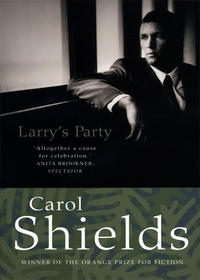
Читать книгу: «Larry’s Party»
Larry’s Party
Carol Shields

Contents
Cover
Dedication
CHAPTER ONE: Fifteen Minutes in the Life of Larry Weller 1977
CHAPTER TWO: Larry’s Love 1978
CHAPTER THREE: Larry’s Folks 1980
CHAPTER FOUR: Larry’s Work 1981
CHAPTER FIVE: Larry’s Words 1983
CHAPTER SIX: Larry’s Friends 1984
CHAPTER SEVEN: Larry’s Penis 1986
CHAPTER EIGHT: Larry Inc. 1988
CHAPTER NINE: Larry So Far 1990
CHAPTER TEN: Larry’s Kid 1991
CHAPTER ELEVEN: Larry’s Search for the Wonderful and the Good 1992
CHAPTER TWELVE: Larry’s Threads 1993–4
CHAPTER THIRTEEN: Men Called Larry 1995
CHAPTER FOURTEEN: Larry’s Living Tissues 1996
CHAPTER FIFTEEN: Larry’s Party 1997
Larry’s Party
THE WORK OF CAROL SHIELDS
Carol Shields: The Stone Diaries
Carol Shields: Unless
About the Author
Copyright
About the Publisher
For Joseph, Nicholas, and Sofia
With thanks to a few men who have offered suggestions in the writing of this book: David Arnason, Tommy Banks, Tony Giardini, Jack Hodgins, Robin Hoople, Don Huband, Steve Hunt, Dayv James-French, the late Jim Keller, Joseph Krotz, Jake MacDonald, Brian MacKinnon, Don McCarthy, Bill Neville, Mark Morton, Doug Pepper, Gord Peters, John Ralston Saul, Donald Shields, John Shields, Ray Singer, Harry Strub and Max Wyman.
Thanks, too, to Maggie Dwyer and Jane Gralen and to the staff at the Winnipeg Public Library.
What is this mighty labyrinth – the earth, But a wild maze the moment of our birth?
(“Reflections on Walking in the Maze at Hampton Court” British Magazine, 1747)
CHAPTER ONE Fifteen Minutes in the Life of Larry Weller 1977

By mistake Larry Weller took someone else’s Harris tweed jacket instead of his own, and it wasn’t till he jammed his hand in the pocket that he knew something was wrong.
His hand was traveling straight into a silky void. His five fingers pushed down, looking for the balled-up Kleenex from his own familiar worn-out pocket, the nickels and dimes, the ticket receipts from all the movies he and Dorrie had been seeing lately. Also those hard little bits of lint, like meteor grit, that never seem to lose themselves once they’ve worked into the seams.
This pocket – today’s pocket – was different. Clean, a slippery valley. The stitches he touched at the bottom weren’t his stitches. His fingertips glided now on a sweet little sea of lining. He grabbed for the buttons. Leather, the real thing. And something else – the sleeves were a good half inch longer than they should have been.
This jacket was twice the value of his own. The texture, the seams. You could see it got sent all the time to the cleaners. Another thing, you could tell by the way the shoulders sprang out that this jacket got parked on a thick wooden hanger at night. Above a row of polished shoes. Refilling its tweedy warp and woof with oxygenated air.
He should have run back to the coffee shop to see if his own jacket was still scrunched there on the back of his chair, but it was already quarter to six, and Dorrie was expecting him at six sharp, and it was rush hour and he wasn’t anywhere near the bus stop.
And – the thought came to him – what’s the point? A jacket’s a jacket. A person who patronizes a place like Cafe Capri is almost asking to get his jacket copped. This way all that’s happened is a kind of exchange.
Forget the bus, he decided. He’d walk. He’d stroll. In his hot new Harris tweed apparel. He’d push his shoulders along, letting them roll loose in their sockets. Forward with the right shoulder, bam, then the left shoulder coming up from behind. He’d let his arms swing wide. Fan his fingers out. Here comes the Big Guy, watch out for the Big Guy.
The sleeves rubbed light across the back of his hands, scratchy but not too scratchy.
And then he saw that the cuff buttons were leather too, a smaller-size version of the main buttons, but the same design, a sort of cross-pattern like a pecan pie cut in quarters, only the slices overlapped this little bit. You could feel the raised design with your finger, the way the four quadrants of leather crossed over and over each other, their edges cut wavy on the inside margin. These waves intersected in the middle, dived down there in a dark center and disappeared. A black hole in the button universe. Zero.
Quadrant was a word Larry hadn’t even thought of for about ten years, not since geometry class, grade eleven.
The color of the jacket was mixed shades of brown, a strong background of freckled tobacco tones with subtle orange flecks. Very subtle. No one would say: hey, here comes this person with orange flecks distributed across his jacket. You’d have to be one inch away before you took in those flecks.
Orange wasn’t Larry’s favorite color, at least not in the clothing line. He remembered he’d had orange swim trunks back in high school, MacDonald Secondary, probably about two sizes too big, since he was always worrying at that time in his life about his bulge showing, which was exactly the opposite of most guys, who made a big point of showing what they had. Modesty ran in his family, his mum, his dad, his sister, Midge, and once modesty gets into your veins you’re stuck with it. Dorrie, on the other hand, doesn’t even shut the bathroom door when she’s in there, going. A different kind of family altogether.
He’d had orange socks once too, neon orange. That didn’t last too long. Pretty soon he was back to white socks. Sports socks. You got a choice between a red stripe around the top, a blue stripe, or no stripe at all. Even geeks like Larry and his friend Bill Herschel, who didn’t go in for sports, they still wore those thick cotton sports socks every single day. You bought them three in a pack and they lasted about a week before they fell into holes. You always thought, hey, what a bargain, three pairs of socks at this fantastic price!
White socks went on for a long time in Larry’s life. A whole era.
Usually he didn’t button a jacket, but it just came to him as he was walking along that he wanted to do up one of those leather buttons, the middle one. It felt good, not too tight over the gut. The guy must be about his own size, 40 medium, which is lucky for him. If, for example, he’d picked up Larry’s old jacket, he could throw it in the garbage tomorrow, but at least he wasn’t walking around Winnipeg with just his shirt on his back. The nights got cool this time of year. Rain was forecast too.
A lot of people don’t know that Harris tweed is virtually waterproof. You’d think cloth this thick and woolly would soak up water like a sponge, but, in actual fact, rain slides right off the surface. This was explained to Larry by a knowledgeable old guy who worked in menswear at Hector’s. That would be, what, nine, ten years ago, before Hector’s went out of business. Larry could tell that this wasn’t just a sales pitch. The guy – he wore a lapel button that said “Salesman of the Year” – talked about how the sheep they’ve got over there are covered with special long oily hair that repels water. This made sense to Larry, a sheep standing out in the rain day and night. That was his protection.
Dorrie kept wanting him to buy a khaki trenchcoat, but he doesn’t need one, not with his Harris tweed. You don’t want bulk when you’re walking along. He walks a lot. It’s when he does his thinking. He hums his thoughts out on the air like music; they’ve got a disco beat: My name is Larry Weller. I’m a floral designer, twenty-six years old, and I’m walking down Notre Dame Avenue, in the city of Winnipeg, in the country of Canada, in the month of April, in the year 1977, and I’m thinking hard. About being hungry, about being late, about having sex later on tonight. About how great I feel in this other guy’s Harris tweed jacket.
Cars were zipping along, horns honking, trucks going by every couple of seconds, people yelling at each other. Not a quiet neighborhood. But even with all the noise blaring out, Larry kept hearing this tiny slidey little underneath noise. He’d been hearing it for the last couple of minutes. Whoosh, wash, whoosh, wash. It was coming out of the body of Larry J. Weller. It wasn’t that he found it objectionable. He liked it, as a matter of fact, but he just wanted to know what it was.
He whooshed past the Triple Value Store, past the Portuguese Funeral Home, past Big Mike’s where they had their windows full of ski equipment on sale. The store was packed with people wearing spring clothes, denim jackets, super-flare pants, and so on, but they were already thinking ahead to next winter. They had snow in their heads instead of a nice hot beach. That’s one thing Larry appreciates about Dorrie. She lives in the moment. When it’s snowing she thinks about snow. When it’s spring, like right now, she’s thinking about getting some new sandals. That’s what she’s doing this very minute: buying sandals at Shoes Express, their two-for-one sale. Larry knows she’s probably made up her mind already, but she told him she’d wait till he got to the store before buying. She wants to make sure Larry likes what she decides on, even though sandals are just sandals to him. Just a bunch of straps.
Dorrie knows how to stretch money. She saves the fifty-cents-off coupons from Ponderosa – which’ll give you a rib eye steak, baked potato and salad, all for $1.69. Or she’ll hear a rumor that next week shoe prices are going to get slashed double. So she’ll say to the guy at Shoes Express, “Look, can you hold these for me till next Wednesday or Thursday or whatever, so I can get in on the sale price?”
It comes to Larry, what the noise is. It’s the lining of his jacket moving back and forth across his shoulders as he strolls along, also the lining material sliding up and down against his shirt-sleeves. He can make it softer if he slows down. Or louder if he lifts his arm and waves at that guy across the street that he doesn’t even know. The guy’s waving back, he’s trying to figure out who Larry is – hey, who’s that man striding along over there, that man in the very top-line Harris tweed jacket?
Actually no one wears Harris tweed much anymore. In fact, they never did, no one Larry ever knew. It’s vintage almost, like a costume. What happened was, Larry was about to graduate from Red River College (Floral Arts Diploma), just two guys and twenty-four girls. The ceremony was in the cafeteria instead of the general-purpose room, and dress was supposed to be informal. So what’s informal? Suits or what? The girls ended up wearing just regular dresses, and the two guys opted for jackets and dress pants.
Larry and his mother went to Hector’s, which she swears by, and that’s where they found the Harris tweed, this nubby-dubby wool cloth, smooth and rough at the same time, heavy but also light, with the look of money and the feel of a grain sack, and everywhere these soft little hairs riding on top of the weave. The salesman said: “Hey, you could wear that jacket to a do at the Prime Minister’s.” Larry had never heard of Harris tweed, but the salesman said it was a classic. That it would never go out of style. That it would wear like iron. Then his mother chimed in about how it wouldn’t show the dirt, and the salesman said he’d try real hard to get them twenty percent off, and that clinched it.
Larry wears the Harris tweed to Flowerfolks almost every day over a pair of jeans, and it’s hardly worn out at all. It never looks wrinkled or dirty. Or at least it didn’t until today when Larry put on this other jacket by mistake. So! There’s Harris tweed and Harris tweed, uh-huh.
It was an accident how Larry got into floral design. A fluke. He’d been out of school for a few weeks, just goofing off, and finally his mother phoned Red River College one day and asked them to mail out their brochure on the Furnace Repair course. She figured everyone’s got a furnace, so even with the economy up and down, furnaces were a good thing to get into. Well, someone must have been sleeping at the switch, because along came a pamphlet from Floral Arts, flowers instead of furnaces. Larry’s mother, Dot, sat right down in the breakfast nook and read it straight through, tapping her foot as she turned the pages, and nodding her head at the ivy wallpaper as if she was saying, yes, yes, floral design really is the future.
Larry’s father, though, wasn’t too overwhelmed. Larry could tell he was thinking that flowers were for girls, not boys. Like maybe his only son was a homo and it was just starting to show. In the end, he did come to Larry’s graduation in the cafeteria but he didn’t know where to look. Even when Mrs. Starr presented Larry with the Rose Wreath for having the top point average, Larry’s father just sat there with his chin scraping the floor.
Larry was offered a job right off at Flowerfolks, and he’s been there ever since. Last October he got to do the centerpieces for the mayor’s banquet. It was even on television, Channel 13. You saw the mayor standing up to give his speech and there were these sprays of wheat, eucalyptus branches, and baby orchids right there on the table. Orchids! So much for your average taxpayer. But Flowerfolks has a policy of delivering their flowers to hospital wards if their clients don’t want them afterwards, so it’s really not a waste. They’re a chain with a social conscience, and also an emphasis on professionalism. They like the employees to look good. Shoulder-length hair’s okay for male staff, but not a quarter inch longer. A tie’s optional, but jackets are required. That’s where the Harris tweed comes in.
Larry can’t help thinking how this new, new jacket will knock their eyebrows off down at work.
Or maybe not, maybe they won’t even notice. He hadn’t noticed himself when he picked it up, so why should they? What happened was he went up to the counter to order his cappuccino. Not that he had to order it. He takes the same thing every day, a double cappuccino. He used to go to a bar for a few beers after work, but Dorrie got worried about all the booze he was soaking up. She was convinced his brain cells were getting killed off. One by one they were going out, like Christmas lights on a string, only there weren’t any replacements available.
“Why don’t you switch to coffee?” she said, and that’s when Larry started dropping into Cafe Capri, which is just around the corner from Flowerfolks. A nothing place, but they’ve brought cappuccino to this town. Nobody knew what it was at first, and some people, like Larry’s folks, still don’t. Larry’s tried it, and now he’s on a streak with double cappuccinos. They start making it when they see him come through the door at five-thirty.
He likes to put on his own cinnamon. He likes it spread out thin across the entire foam area, not just sitting in a wet clump in the middle. You take the shaker, hold it sideways about two inches to the right of the cup and tap it twice, lightly. A soft little cinnamon cloud forms in the air – you can almost see it hanging there – and then the little grains drift down evenly into the cup. Total coverage. Like the dust storm in Winnipeg last summer, how it coated every ledge and leaf and petunia petal with this beautiful, evenly distributed layer of powdery dust.
Lots of coffee places have switched over to disposable plastic, but Cafe Capri still uses those old white cups and saucers with the green rims. You put one of those cups up to your mouth and the thickness feels exactly right, the same dimensions as your own tongue and lips. You and your cup melt together, it’s like a kiss. Customers appreciate that. They’re so grateful for regular cups and saucers that they carry their own empties up to the counter on their way out. That’s what Larry must have done. Taken his cup back up, put his fifty-five cents by the cash, and picked up a jacket from the chair. Only it was someone else’s chair. Or maybe the other guy had already made off with Larry’s jacket at that point. A mistake can work both ways. Larry was probably busy thinking about meeting Dorrie, about the movie they were going to see that night, Marathon Man, their third time, and then coming back to her place after, his prick stirring at the thought.
When they first started going together they’d be lying there on top of her bed and she’d say, “Let’s fuck and fuck and fuck forever.”
“Do you have to say that?” Larry said to her after he’d known her a couple of months. “Can’t you just say ‘making love'?”
She got her hurt look. Parts of her face tended to lose their shape, especially around her mouth. “You say ‘fuck,'” she said to Larry. “You say it all the time.”
“No, I don’t.”
“Come off it. You’re always saying ‘fuck this’ and ‘fuck that.'”
“Maybe. Maybe I do. But I don’t say it literally.”
“What?” She looked baffled.
“Not literally.”
“There you go again,” she said, “with those college words.”
Larry stared at her. She actually thinks flower college is college.
It was sort of a mistake the way they got together. Larry had taken another girl to a Halloween party at St. Anthony’s Hall. She, the other girl, had a pirate suit on, with a patch over the eye, a sword, the whole thing. And she’d made herself a moustache with an eyebrow pencil or something. That bothered Larry, turning his head around quick, and looking into the face of a girl wearing a moustache. A costume is supposed to change you, but you can go too far. Larry was a clown that night. He had the floppy shoes and the hat and the white paint on his face, but he’d skipped the red nose. Who’s going to score points with a red nose? There was another girl, Dorrie, at the table who’d come with her girlfriends. She was dressed like a Martian, but only a little bit like a Martian. You got the general idea, but you didn’t think when you were dancing with her that she was some weird extraterrestrial. She was just this skinny, swervy, good-looking girl who happened to be wearing a rented Martian suit.
“You in love with this Dorrie?” That’s what Larry’s father asked him a couple of months ago. They were sitting there in the stands. As usual the Jets were winning. Everyone around them was cheering like crazy, and Larry’s father said to Larry, not quite turning his face: “So, you in love with this girl? This Dorrie person?”
“What?” Larry said. He had his eyes on the goalie all alone out there on the ice, big as a Japanese wrestler in his mask and shin pads, putting on a tap-dance show while the puck was coming down the ice.
“Love,” Larry’s father said. “You heard me.”
“I like her,” Larry said after a few seconds. He didn’t know what else to say. The question set a flange around his thoughts, holding back his recent worrying days and nights, keeping them separate from right-now time.
“But you’re not in love?”
“I guess not.”
“You just like her?”
“Yes. But a lot.”
“You’re twenty-six years old,” Larry’s father said. “I married Mum when I was twenty-five.”
Like a deadline’s been missed, that was his tone of voice.
“Yeah,” Larry said. “Twenty-six years old, and the kid’s still living at home!”
He felt his bony face fall into confusion. And yet he loved this confusion, it was so unexpected, so full of thrill and danger. Love, love.
“Nothing wrong with living at home,” Larry’s father said, huffing a little, looking off sideways. “Did I say there was anything wrong with that?”
Larry was running this conversation through his head while he walked along Notre Dame Avenue in his stolen Harris tweed jacket, seeing himself in his self’s silver mirror. The fabric swayed around him, shifting and reshifting on his shoulders with every step he took. It seemed like something alive. Inside him, and outside him too. It was like an apartment. He could move into this jacket and live there. Take up residence, get himself a new phone number and a set of cereal bowls.
That’s when he realized he was in love with dopey smart Dorrie. In love. He was. He really was. Knowing it was like running into a wall of heat, his head and hands pushing right through it. This surprised him, but not completely. You can fall in love all by yourself. You don’t have to be standing next to the person; you can do it alone, walking down a street with the wind blowing in your face, a whole lot of people you don’t even know going by and they’re kind of half bumping into you but you don’t notice because you’re in a trancelike state. He forgot, suddenly, how Dorrie had this too-little face with too much hair around it and how he always used to get turned on by girls with bigger faces and just average hair size.
He looked at his watch, worried. He knew she’d still be standing there, though, next to the cash with her arms full of shoes and she’d be pissed off for about two seconds and then she’d get an eyeful of Larry’s jacket and before you knew it she’d be rubbing her hands up and down the cloth and fingering the buttons.
The problem, though, was tomorrow. Larry and his new jacket weren’t going to make it tomorrow. He could go to work in this jacket, but no way could he go back to the Capri at five o’clock. They’d grab him the minute he walked in. Hey, buddy, there’s a call out for that jacket. That jacket’s been reported.
Wait a minute, it’s all a mistake.
A mistake that led to another mistake that led to another. People make mistakes all the time, so many mistakes that they aren’t mistakes anymore, they’re just positive and negative charges shooting back and forth and moving you along. Like good luck and bad luck. Like a tunnel you’re walking through, with all your pores wide open. When it turns, you turn too.
Larry remembers seeing a patient in the Winnipeg Chronic Care Unit when he delivered the flowers after the mayor’s banquet. This guy didn’t have any arms or legs, just little buds growing out of his body. He was one bad mistake, like a human salt shaker perched there on the edge of a bed. Larry, set the flowers down on the table next to him, and the guy leaned over a couple of inches and brushed them with his forehead, then he smelled them, then he stuck his tongue out and licked the leaves and petals, all the while giving Larry a look, almost a wink but not quite. Larry took a lick too, lightly. What he found was, eucalyptus tastes like horse medicine. And orchids don’t taste at all.
The sun was dipping low, and Larry was at the corner now, only half a block from Shoes Express. There was a great big rubbish receptacle standing there with a sign on it: Help Keep Our City Clean.
Larry unbuttoned the Harris tweed jacket, slipped it off fast and rolled it up in a sweet little ball. He stuffed it into the rubbish bin. He had to cram it in. He didn’t know if he was making a mistake or not, getting rid of that jacket, and he didn’t care. The jacket had to go.
And that’s when he really knew how cold the wind had got. It puffed his shirt-sleeves up like a couple of balloons, so that all of a sudden he had these huge brand-new muscles. Superman. Then it shifted around quick, and there he was with his shirt pressed flat against his arms and chest, puny and shrunk-up. The next minute he was inflated again. Then it all got sucked out. In and out, in and out. The windiest city in the country, in North America. It really was.
There were plenty of eyes on him, he could feel them boring through to his skin. In about two minutes some guy was going to pull that Harris tweed jacket out of the garbage and put it on. But by that time Larry would be around the corner, walking straight toward the next thing that was going to happen to him.
CHAPTER TWO Larry’s Love 1978

On a Wednesday in winter Larry walked over to a barber shop on Sargent Avenue and asked for a cut. “Just a regular cut,” he told the barber in an unsmiling, muttering tone of voice that was altogether unlike his usual manner. This was after a decade of having shoulder-length hair. He came out of the barber shop half an hour later with hair that was short around the ears and cropped close at the neck. Even the color seemed different – darker, denser, and without shadows, a color hard to put a name to.
He was shivery with cold for hours after his haircut, lonely for his hair, shrunken in his upper body, but he also felt stronger, braver. The new look made him want to bunch his fists like a prizefighter or cross his arms over his chest. He stood in front of the bathroom mirror working on new expressions, moving his mouth and eyebrows around, and trying to settle on something friendly.
Vivian and Marcie who work with Larry at Flowerfolks were both bursting with compliments. Vivian, the store manager, said the new cut made him look “younger and healthier,” and that started Larry wondering about how he’d been looking lately. He was only twenty-seven, which was not really old enough to show up on his face and body – or was it? His own opinion was that he was in pretty fair shape what with all the walking he did to and from work, plus the weekend hikes out at Birds Hill with his friend Bill Herschel. Marcie chimed in then about how the new hairstyle made him look more “with-it” “It’s 1978,” she said. “The sixties are over.”
What would she know, Larry thought – she was only a kid, seventeen, eighteen.
Larry, at twenty-seven, still lived with his parents, Dot and Stu, in their bungalow on Ella Street, but this was his last week; he was set to move out on Friday, at long last. Both Dot and Stu approved of their son’s haircut. Not that they jumped up and down and waved their arms. It was more a case of pretend nonchalance. “About bloody time,” Larry’s father said, and started in about the number of times he’d had to open the bathtub drain and clean out all the hair and muck. “Why, you’re handsome as can be,” Dot said, reaching out and testing the flat of her hand against the new springiness of Larry’s hair. It had been some time since she’d touched the top of her son’s head, years in fact, and now it was like she couldn’t stop herself. “If this is Dorrie’s influence,” she said, “then I say more power to her.”
On Friday afternoon – blizzards, high winds – Larry and his folks, and his girlfriend, Dorrie, and her family, went downtown to the Law Courts and got married. Dorrie (Dora) Marie Shaw and Laurence John Weller became the Wellers, husband and wife. And on Saturday morning the bridal couple boarded an Air Canada jet for London, England.
Most of the passengers on the plane were wearing jeans and sweaters, but Dorrie had chosen for her travel outfit a new rose-colored polyester blend suit. Now she regretted it, she told Larry. The suit’s straight skirt was restrictive so that she couldn’t relax and enjoy the trip, and she worried about the hard wrinkles that had formed across her lap. She should have invested in one of those folding travel irons she’d seen on sale. And she’d been a dope not to bring along some spot-lifter for the stain on her jacket lapel. By the time they got to England it would be permanently set. They put dye in airplane food, coloring the gravy dark brown so it looked richer and more appetizing. One of the salesmen at Manitoba Motors, where she works, told her about it. He also told her not to drink carbonated drinks on the flight because of gas. People pass a lot of gas on planes, he’d informed her. It had to do with air pressure. Also, one alcoholic drink on land equals three in the air. This is important information.
If only someone had filled her in about what to wear for a trip like this. She’d never been on a plane before – neither had Larry for that matter – but somehow she’d got the idea that air travel was dressy, especially if you were headed for an international destination, such as London, England. She was all for being casual, as she told Larry, she loved comfortable clothes, he knew that, but wouldn’t you think people would make an effort to look nice when they went somewhere important?
“Not everyone’s on their honeymoon,” he reminded her.
And that was the moment they heard a special announcement over the P.A. system, the pilot’s chuckly, good-sport voice coming at them from the cockpit. “Ladies and gents, we thought you’d like to know we’ve got a brand-new married couple aboard our flight today. How about a round of applause, everyone, for Mr. and Mrs. Larry Weller of Winnipeg, Manitoba.”
A stewardess was suddenly standing next to the bride and groom with a bottle of champagne and two glasses and also a corsage to pin on Dorrie’s shoulder, compliments of Air Canada.
“Ohh!’ Dorrie gave a little shriek. She glowed bright pink. She squirmed in her seat with pleasure. “This is fabulous. How did you know? Baby roses, I love baby roses, and, look, they match my outfit. It’s perfect.”
“I almost died of embarrassment,” Dorrie would tell Larry’s mother two weeks later, back home in Winnipeg. “I bet you anything I was blushing from head to foot. Everyone was just staring at the two of us, and then they started cheering and clapping and peering around their seats at us or standing up so they could see who we were and what we looked like. Was I ever glad I had my new pink outfit on. And Larry with his hair restyled. The newly-weds!”
The champagne sent Dorrie straight to sleep, her feet tucked up under her on the seat, and her head flopped over on Larry’s shoulder. The sweet perfume of the roses, which were already darkening, got stirred in with the drone of voices and the dimmed cabin lights and the steady, sleepy vibrations of the plane as it nosed through the night sky.
A little drunk, stranded between the old day and the new, between one continent and another, Larry felt the proprietorial pleasure of having a hushed and satisfied companion by his side. He and Dorrie had boarded the plane under a weight of anticlimax, worn out after the wedding and the wedding lunch at the Delta and from moving his things over to Dorrie’s apartment. And they were hollowed out too – that’s how it felt – after a long, ecstatic night of sex, then the alarm clock going off at five-thirty, the last-minute packing to do, and Larry’s folks arriving, too early, to drive them out to the airport. It was a lot to absorb. But now this unexpected tribute had come to them, to himself and to his wife, Dorrie. A wife, a wife. He breathed the word into the rubbery patterned upholstery of the seat ahead of him – wife.
A daze of contentment fell over him, numbing and fateful, and he shook his head violently to clear his senses – but in the excitement of the last few hours he had forgotten about his recent haircut. Instead of the movement of soft hair flying outward and then landing with a bounce on his neck, that comforting silky familiar flick against his cheek, he sensed only the abruptness of his cold, clean face, how exposed it was beneath the tiny cabin light and how stupidly rigid.
An hour ago he had felt the tug of drowsiness, but now he pledged himself to stay awake. Grief was involved in this decision, and possibly a crude form of gallantry. Staying awake seemed a portion of what was expected of him, part of the new role he had undertaken a mere thirty-six hours earlier, standing in front of a marriage commissioner at the Law Courts with his family and Dorrie’s family looking on. “Marriage is not to be entered into lightly, but with certainty, mutual respect, and a sense of reverence.” These words had been part of the civil ceremony, printed on a little souvenir card he and Dorrie had been given.
He was a husband now, and his chattering, fretful Dorrie, no longer a girlfriend but a wife, was slipping down sideways against his arm, her face damp, pared-down, and sealed shut with sleep. He felt her shoulder lift on every third or fourth breath, lift and then fall in a catching, irregular way, as though her dreams had brought her up against a new, puzzling form of exhaustion, something she would soon be getting used to.
For her sake he would stay alert. He would keep guard over her, drawing himself as straight as possible in his seat without disturbing her sleeping body. He’d clamp his jaw firmly shut in a husbandlike way, patient, forbearing, and keep his eyes steady in the dark. He would do this in order to keep panic at a distance. All that was required of him was to outstare the image in the floating black glass of the window, that shorn, bewildered, fresh-faced stranger whose profile, for all its raw boyishness, reminded him, alarmingly, of – of who?
His father, that’s who.
“The very image of his mother,” people used to say about Larry Weller. Same blue eyes. The freckled skin. Dot’s gestures. That mouth.
Larry could not recall any mention of a resemblance to his father. He was his mother’s boy. Heir to her body, her intensity, and to her frantic private pleasures and glooms.
But now, twenty-seven and a half years into his life, he found that his father had moved in beneath his bones. That nameless part of his face, the hinged area where the jaw approaches the lower ear – he could see now what his flowing hair had hidden: that his father’s genes were alive in his body. Even his earlobes, their fleshiness and color. What was that color? A hint of strawberry that spread from the ears up the veins to the cheeks, his father’s cheeks, curving and surprisingly soft in a man’s hard face.
His father’s solid, ruddy presence. It arrived, sudden and shocking, and stayed with him throughout the two weeks of his and
Dorrie’s honeymoon. He met it each morning in the shaving mirror of the various modest hotels where they stayed. What kind of trick was this? He’d turn his eyes slowly toward the mirror, creeping up on his face, and there the old guy would be, larger and more substantial than a simple genetic flicker. His father’s flexible loose skin pressed up against the glass, a fully formed image, yawning, hoisting up his sleepy lids, dressed in his work clothes with the bus factory’s insignia on the pocket, Air-Rider, his broad shoulders and back bunching forward under Larry’s pajamas, and his large red hands reaching out, every finger scarred in one way or another from the upholstery work he did at the plant. And Larry could hear the voice too, his father’s high, querulous voice, with the Lancashire notes still in place after twenty-seven years in Canada.
Stu Weller. Master upholsterer. Husband of Dot, father of Midge and Larry.
It was Stu, with Dot’s blessing, who had the idea of giving the young couple a package tour of England. A wedding present, gruffly, unceremoniously offered. “We did the same for your sister when she got herself married.”
Never mind that Midge and her husband got divorced after two years. That Paul turned out to like men more than women.
Dorrie would have preferred a honeymoon in Los Angeles or maybe Mexico, somewhere hot, a nice hotel on the beach, but how can a person say no to free tickets, everything paid for, the plane fare, plus a twelve-day bus trip, Sunbrite Tours, breakfast and dinner, all the way up to the Pennines, then down to Land’s End, the very south-west tip of England, then back to London for the final three days. Stu and Dot had taken a similar package tour a few years back, a twenty-fifth anniversary present to themselves, a “journey back to our roots,” as Dot put it, though the real roots for both of them were in the industrial northern town of Bolton, not the green sprawling English countryside.
And when Larry and Dorrie got there it was green, unimaginably green – a bright variegated green that made Larry think of Brussels sprouts. Everyone back home had said: What? – you’re going to England in March? Are you crazy?
But here they were, carried over England’s green hills, ferried down into narrow green valleys, pulling up in the parking lots of green medieval villages where thick-towered castles threw greenish shadows across their squat Sunbrite coach (they had got over their terror of riding along on the left side of the highway with the traffic thundering straight at them).
The tour began in London and headed north-east. Rain, and then episodes of brilliant slanting sunshine accompanied them as they set off, then rain again, pelting the bare trees and hedges, bringing violent, pressing changes of light, as though the day itself was about to offer up an immense idea. They stopped at the picture-postcard town of Saffron Walden, where they were led on a quick march through the old twisted streets and served lunch in a tearoom called the Silken Cat. Dorrie was staunchly brave about the steak and kidney pie, leaving only a few polite scraps on her plate.
“Take notice of these ceiling beams,” their guide instructed. His name was Arthur, a stout, broad-faced man, a Londoner with a beer-roughened voice and a school teacher’s patient explaining manner. “Late fifteenth century. Possibly earlier.”
Dorrie copied this information into a little travel diary she pulled from her purse – “Late 15th century.”
Larry found his wife’s note-taking touching and also surprising. Where had that diary come from? Its cover was red leather. The narrow ruled pages were edged in gold. One of her girlfriends at Manitoba Motors must have given it to her, a going-away present, something she wouldn’t have thought of herself, not in a million years. It moved him to see his Dorrie in a pose of studentlike concentration, pausing over her choice of words, and keeping her writing neat and small. That she would busy herself recording this chip of historical information – late fifteenth century – record it for him, for their life together, stirred a lever of love in his heart.
But he remembered from school that fifteenth century really meant the fourteen-hundreds, how confusing that could be, and he wondered if Dorrie knew the difference and whether he should clarify the point for her. But no. She had already closed the diary and recapped her pen. Looking up at him, catching his eyes on her, she sent a kiss through the air, her small coral lips pushing out.
The first night the tour group was installed in a hotel in Norwich (sixteenth century, more beams) which was said to have been visited on at least one occasion by Edward VII and a “lady friend.” There were snowdrops blooming in the hotel’s front garden. Flowers in March. This took Larry a moment to register, the impossibility of flowers – but here they were. Back home in Canada it was twenty below zero. “Snowdrops,” Dorrie wrote in her diary when she was told what the flowers were called.
“Snowdrops are only the beginning,” Arthur told Larry and Dorrie. “You’ll be seeing daffodils before we’re done.”
The tour, it turned out, was only half booked. The other travelers were mostly retired New Zealanders and Australians, and an ancient deaf Romanian couple who never let go of each other’s hands. “Everyone’s so old,” Dorrie whispered to Larry. She had a gift for disappointment, and now she was wrinkling up her face. “Everyone’s old and fat except for us.”
It was true. Or close to being true. The eighteen passengers, men as well as women, shared the spongy carelessness of flesh that accompanies late middle age. The white permed heads of the wives, their husbands’ rosy baldness, framed faces that were, to Larry’s eyes at least, remarkably similar, softened, and blurred in outline, with their features melted to a kind of putty.
“I’ll bet we’re the only ones who screw all night,” Dorrie said, looking around. “Or screw at all.”
“Probably.” He smiled down at her.
“Notice I said screw and not fuck.”
“Congratulations.”
“I’m a married woman now. Respectable.”
“Ha.” Still smiling.
“Ha yourself.”
A white-haired husband and wife from Arizona had signed on to the tour. They were in England on their sabbatical leave. She, the wife, pronounced the word “sabbatical” as though the syllables were beads on a string. She explained to Dorrie, who had never heard of a sabbatical, that she and Dr. Edwards, her husband, had been to Thailand “last time” and before that to Berkeley in California. “We see these occasions as opportunities to replenish ourselves every seven years,” she said, “and take stock.”
The members of the tour group were wakened early each morning in their various freezing hotel rooms by a knock on the door, then Arthur calling out an upbeat “Morning!”
“Oh, God!” Dorrie came up from under the blankets.
Larry, shaving, washing, attempted to avoid his father’s eyes in the mirror, that ghostly presence floating beneath the steamed-over surface. He tried, through the lather, to blink the face away, and by the time he was fully dressed, two sweaters plus a jacket, he had mostly succeeded.
Invariably he and Dorrie were the last ones down to the hotel dining room, and every morning they were greeted by the same teasing cries of welcome. “Here come the honeymooners.” “Late again.” “Hail to the bride and groom!” Dorrie, ducking her head, her mouth puckering up with happiness and embarrassment, slid into a chair, while Larry accepted pats on the back or thumbs-up signs from the men.
There were hot plates of bacon and sausages and egg – although Dorrie, who was feeling “off,” made do with tea and toast. After that the tour members took their places on the coach and set off for the day’s destination. The New Zealanders and Australians – Heather and Gregory, Joan and Douglas, Marjorie and Brian, Larry never did get all their names straight – preferred to sit near the front of the bus where they bantered genially back and forth, observing silence only when Arthur drew their attention to points of interest. The Romanians sat at the back, the same seat every day. Larry and Dorrie found themselves in the middle of the coach – Dorrie next to the window, taking it as her rightful place since she was shorter than Larry, and because the window seat made her feel less queasy.
Dr. and Mrs. Edwards sat across the aisle from them, their maps and guidebooks spread out on their laps. “We don’t want to miss a thing,” Mrs. Edwards told them. She had her suspicions about Arthur. He was lazy, she said. He “recited” instead of “interpreting.” And he left items off the itinerary, a certain twelfth-century abbey that was definitely starred in their guidebook. She planned to write to Sunbrite’s head office about it when she got home.
“Now, now, Sweetheart,” Dr. Edwards said, patting her hand.
Dr. Edwards told Larry to call him Robin. He asked Larry what he did professionally, what his “field of endeavor” was. Larry told him about the Flowerfolks chain of florists back in Winnipeg, about how he’d got started in the business by taking a floral arts course at a local college. “Ah, botany!” Dr. Edwards said. “Or would that be horticulture?” He turned his body stiffly toward Larry, awaiting his reply. “A little of each,” Larry said, thinking. “But not quite.”
Dr. Edwards was a sociologist; population, urban patterns. A perfect dunce in the garden, he told Larry. Didn’t know a primrose from a lily. He’d never developed an interest. He hadn’t had the leisure. He and Mrs. Edwards lived in an apartment in Tucson, always had, so there wasn’t the need. But someday, when he retired, he might look into it. A hobby kind of thing. A person had to keep learning.
“Maybe I should take up sociology as a hobby,” Larry said. He meant it as a joke, but Dr. Edwards drew back, startled.
One afternoon the coach came to a halt beside a rutted field, the site of an old Roman town, its houses and temples and public spaces outlined on the grass with flat red bricks. Dorrie sat down on a corner of a house foundation and wrote in her diary: “Second Century.” She underlined the entry twice, and looked up at Larry, blankly. He could see it was hard for her to believe that this ruined site had once been a real town bursting with men and women.
She was cold, she told Larry. She’d had enough for one day. More than enough. Later Larry thought of that moment of exhaustion, Dorrie huddled on the foundations of an ancient Roman dwelling, how it seemed to split their honeymoon in two.
They were ushered as the days went by through castles, churches, through stately homes and crumbling tithe barns, and they tramped one morning, in a soft gray rain, along the top of the medieval walls of the city of York. That day, in a vast museum, they looked at coins and furniture and agricultural implements and, spread out in an immense glass case, more than fifty different kinds of scissors for trimming the wicks of lamps. History, it seemed to Larry, left strange details behind, mostly meaningless: odd and foolish gadgets, tools that had become separated from their purpose, whimsical notions, curious turnings, a surprising number of dead ends.
But it was outdoor England that took Larry by surprise and filled him with a kind of anxiety as the coach traveled further and further north. This anxiety he identified, finally, as a welling up of happiness. The greenness of England. It seemed there was not one part of this island that was not under cultivation, not one piece of land so exposed or unfavorable that something could not be made to take root and grow. Their guide, Arthur, joked that in the city of Leeds the birds wake up coughing, but even there, between the factories and dark smudged houses, Larry glimpsed the winter trunks of oaks and chestnuts. Leafless now, thrust up against smoking chimneys and blackened air, these trees seemed to Larry magisterial presences, rich in dignity and entitlement. He thought, mournfully, of the spindly, skinny poplars back home, the impoverished jack pines and stunted spruce, their slow annual growth in a difficult climate and their lopsided, unlovely shapes.
But it was the hedges of England, even more than the trees, that brought him a sense of wonderment. Such shady density, like an artist’s soft pencil, working its way across the English terrain. Why hadn’t his parents told him about this astonishing thing they’d grown up with? The hedges were everywhere. Out in the countryside they separated fields from pasture land, snaking up and down the tilted landscape, criss-crossing each other or angling wildly out of sight, dividing one patch of green from another, providing a barrier between cattle and sheep and flocks of geese. These hedges were stock-proof, Arthur explained, meaning sheep couldn’t slip through – they were every bit as effective as stone walls or barbed wire, and some of them had roots that were hundreds of years old.
In the towns the clipped hedges served as fences between houses, a stitching of fine green seams, and gave protection and privacy to tiny garden plots. Luxurious and shapely, they seemed pieces of tended sculpture, and now, late in a mild winter, their woody fullness was enveloped by a pale furred cloud of green. Buds in March. It seemed impossible. Young leaves unfolding.
Back home you hardly ever saw a hedge, or if you did it was only common spirea or the weedy, fernlike caragana, which was almost impossible to keep in trim. Larry’s father had surrounded the Ella Street house with a chainlink fence, top quality – that was years ago. Like the aluminum siding he’d put on top of the house’s old clapboard, it did the job and there was zero upkeep.
“What are all these hedges made of?” Larry asked Arthur, tossing back the hair he didn’t have anymore. “I mean, what kind of plants do they use?”
Arthur didn’t know. He knew history stuff, he knew his kings and queens, but he was a Londoner. He didn’t know green stuff.
In a brilliantly lit bookstore in Manchester Larry found a book about hedges. It was in a bargain bin. Over a hundred colored, badly bound illustrations instructed the reader on the varieties and uses of hornbeam, butcher’s broom, laurel, cypress, juniper, lime, whitethorn, privet, holly, hawthorn, yew, dwarf box, and sycamore. How to plant them, how to nourish them, and tricks to keep them trim and tidy. How certain plants can be intertwined with others to make a sturdier or more beautiful hedge; plashing, this artful mixing of varieties was called. Larry studied the pages of Hedges of England and Scotland while the coach made its way south, heading toward Devon and Cornwall. In a mere day or two he was able to distinguish from the bus window the various species. This easy mastery surprised him, but then he remembered how he had won the class prize back in his floral arts course, that one of his teachers had commented on his excellent memory and another on his observation skills.
The clues to identifying hedges lay in the density and distribution of thicket, the hue of the green foliage, and the form of the developing leaves. He pronounced the names out loud as he spotted them, and then he wrote them on the inside of the book’s cover. He’d forgotten in the last two or three years that he was like this, always wanting to know things he didn’t need to know.
Dorrie, seated next to him on the coach, had fallen into the doldrums. She was homesick, she said. And tired of being stuck with all these old biddies. Their teasing at breakfast, always the same old thing, it was getting on her nerves, it was driving her bananas.
Each day was greener than the one before. One morning, halfway through the two-week tour, Arthur leapt from his seat at the front of the coach and excitedly pointed out a long sloping field of daffodils. “Didn’t I promise you, ladies and gents, that we’d be seeing daffodils on this holiday!” Everyone crowded to the windows for a look, everyone except for Mrs. Edwards, who was sleeping soundly with her head thrown straight back and her mouth open.
Dorrie pulled her diary out of her purse and wrote a single word on the page: “Daffodils.” (Years later when Larry came across the little book, he found three-quarters of the pages empty. “Daffodils” was the final entry.)
On the same day that they saw the daffodils Dr. Edwards bought Larry a pint of beer – this was in a pub early in the evening, a ten minutes’ rest stop – and said, out of the blue, “Our sabbatical leave doesn’t actually come up for another two years, but Mrs. Edwards has a problem with prescription drugs, also over-the-counter drugs. It’s a terrible business and getting worse, and so it seemed a good idea for us to get away.”
Larry peered into the remains of his dark foamless beer. He wished he were standing at the other end of the polished bar where the New Zealand and Australian couples were laughing loudly and arguing about how many miles it was to the hotel in Bath. Full of rivalrous good feeling, they liked to joke back and forth, shouting out about the relative merits of kiwis and kangaroos, soccer teams and politics. Larry was drawn to their good spirits, but felt shy in their presence, especially the men with their bluff, hearty conviviality, so different from Dr. Edwards’ sly, stiff questioning.
And yet Dr. Edwards, Robin, had seen fit to divulge his unhappy situation to Larry, to a stranger young enough to be his son.
“She hides them. They’re so small, you see. The pills. So easy to conceal.”
“Is she addicted to them?” This seemed to Larry a foolish, obvious question, but he felt a response of some kind was required.
“Yes, addicted, of course. She can’t help herself.”
“That’s terrible. It must be awfully difficult –”
“It’s heartening to see a couple like yourself,” Dr. Edwards said, steering the conversation in a more positive direction. “Just starting off in your life, free as a pair of birds.”
Larry swallowed down the rest of his beer. “We’re going to have a baby,” he said. “My wife, I mean.”
Dr. Edwards received the news politely: “I see,” he said. His fingers twirled a button on his raincoat.
“Maybe you’ve noticed that she’s not feeling all that great,” Larry said. “In the mornings especially.”
“I hadn’t actually noticed.”
“Morning sickness.”
He and Dorrie had agreed that the baby was going to be a secret, at least until they got back home and told their families. It startled him now to hear the words running so loosely out of his mouth: the baby. He’d scarcely thought of “the baby” since leaving home. It was hard enough to remember he was a husband, much less a father. He had to remind himself, announcing the fact to the mirror every morning as he blinked away the ghost of his father’s face. Husband, husband – one husband face pushing its way through another, blunt, self-satisfied, but never quite losing its look of surprise.
Lately he’d found he could dispel the face by filling up his head with the greenness of hedgerows. It was like switching channels. Holly, lime, whitethorn, box, a string of names like the chorus of a popular song. He let their shrubby patterns press down on his brain, their smooth stiff dignified shapes and rounded perfection.
“We were going to wait and get married in June. But then – this happened – so here we are. March.”
He could see he had lost Dr. Edwards’ interest, and certainly the opportunity to offer comforting remarks about Mrs. Edwards’ problems.
“Well,” Dr. Edwards said. He spoke briskly now, more like a sportscaster than a sociology teacher. “Time we got back on the coach or we’ll be left behind.”
“We’ve been going together for over a year,” Larry explained. He hung on to his beer glass. “We’d already talked about marriage. We’d already made up our minds, so this didn’t make any real difference.”
Бесплатный фрагмент закончился.