Читать книгу: «Gallows Thief»


Copyright
Published by HarperCollinsPublishers Ltd
1 London Bridge Street
London SE1 9GF
www.harpercollins.co.uk
First published in Great Britain by HarperCollinsPublishers 2001
Copyright © Bernard Cornwell 2001
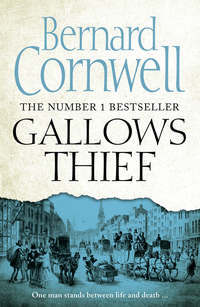
Cover design by Holly Macdonald © HarperCollinsPublishers Ltd 2018
Cover images © ClassicStock/Alamy Stock Photo (street scene); Shutterstock.com (texture)
Bernard Cornwell asserts the moral right to be identified as the author of this work.
A catalogue copy of this book is available from the British Library.
This novel is entirely a work of fiction. The names, characters and incidents portrayed in it, while at times based on historical events and figures, are the work of the author’s imagination.
All rights reserved under International and Pan-American Copyright Conventions. By payment of the required fees, you have been granted the non-exclusive, non-transferable right to access and read the text of this e-book on screen. No part of this text may be reproduced, transmitted, down-loaded, decompiled, reverse engineered, or stored in or introduced into any information storage and retrieval system, in any form or by any means, whether electronic or mechanical, now known or hereinafter invented, without the express written permission of HarperCollins.
Source ISBN: 9780007437559
Ebook Edition © June 2010 ISBN: 9780007339518
Version: 2018-10-01
Dedication
For Antonia and Jef
Contents
Cover
Title Page
Copyright
Dedication
Prologue
Chapter 1
Chapter 2
Chapter 3
Chapter 4
Chapter 5
Chapter 6
Chapter 7
Chapter 8
Chapter 9
Chapter 10
Historical Note
Read on for an excerpt from Fools and Mortals
About the Author
Also by Bernard Cornwell
The SHARPE Series (in chronological order)
The SHARPE Series (in order of publication)
About the Publisher
Prologue
Sir Henry Forrest, banker and alderman of the City of London, almost gagged when he entered the Press Yard for the smell was terrible, worse than the reek of the sewer outflows where the Fleet Ditch oozed into the Thames. It was a stink from the cesspits of hell, an eye-watering stench that took a man’s breath away and made Sir Henry take an involuntary step backwards, clap a handkerchief to his nose and hold his breath for fear that he was about to vomit.
Sir Henry’s guide chuckled. ‘I don’t notice the smell no more, sir,’ he said, ‘but I suppose it’s mortal bad in its way, mortal bad. Mind the steps here, sir, do mind ’em.’
Sir Henry gingerly took the handkerchief away and forced himself to speak. ‘Why is it called the Press Yard?’
‘In days gone by, sir, this is where the prisoners was pressed. They was squashed, sir. Weighed down by stones, sir, to persuade them to tell the truth. We don’t do it any longer, sir, more’s the pity, and as a consequence they lies like India rugs, sir, like India rugs.’ The guide, one of the prison’s turnkeys, was a fat man with leather breeches, a stained coat, and a stout billy club. He laughed. ‘There ain’t a guilty man or woman in here, sir, not if you asks them!’
Sir Henry tried to keep his breathing shallow so he would not have to inhale the noxious miasma of ordure, sweat and rot. ‘There is sanitation here?’ he asked.
‘Very up to date, Sir Henry, very up to date. Proper drains in Newgate, sir. We spoils them, we do, but they’re filthy animals, sir, filthy. They fouls their own nest, sir, that’s what they do, they fouls their own nest.’ The turnkey closed and bolted the barred gate by which they had entered the yard. ‘The condemned have the freedom of the Press Yard, sir, during daylight,’ he said, ‘except on high days and holidays like today.’ He grinned, letting Sir Henry know that this was a jest. ‘They has to wait till we’re done, sir, and if you turn to your left you can join Mister Brown and the other gentlemen in the Association Room.’
‘The Association Room?’ Sir Henry enquired.
‘Where the condemned associate, sir, during the daylight hours, sir,’ the turnkey explained, ‘except on high days and holidays like this one is today, sir, and those windows to your left, sir, those are the salt boxes.’
Sir Henry saw at the end of the yard, which was very narrow and long, fifteen barred windows. The windows were small, dark-shadowed and on three floors, and the cells behind those windows were called the salt boxes. He had no idea why they were called that and he did not like to ask in case he encouraged more of the turnkey’s coarse humour, but Sir Henry knew that the fifteen salt boxes were also known as the devil’s waiting rooms and the antechambers of hell. They were Newgate’s condemned cells. A doomed man, his eyes a mere glitter behind the thick bars, stared back at Sir Henry who turned away as the turnkey hauled open the heavy door of the Association Room. ‘Obliged to you, Sir Henry, obliged, I’m sure,’ the turnkey knuckled his forehead as Sir Henry offered him a shilling in thanks for his guidance through the prison’s labyrinthine passages.
Sir Henry stepped into the Association Room where he was greeted by the Keeper, William Brown, a lugubrious man with a bald head and heavy jowls. A stout priest wearing an old-fashioned wig, a cassock, stained surplice and Geneva bands stood smiling unctuously beside the Keeper. ‘Pray allow me to name the Ordinary,’ the Keeper said, ‘the Reverend Doctor Horace Cotton. Sir Henry Forrest.’
Sir Henry took off his hat. ‘Your servant, Doctor Cotton.’
‘At your service, Sir Henry,’ Doctor Cotton responded fulsomely, after offering Sir Henry a deep bow. The Ordinary’s old-fashioned wig was three plump billows of white fleece that framed his whey-coloured face. There was a weeping boil on his left cheek while, as a specific against the prison’s smell, a nosegay was tied around his neck, just above the Geneva bands.
‘Sir Henry,’ the Keeper confided to the prison chaplain, ‘is here on official duty.’
‘Ah!’ Doctor Cotton’s eyes opened wide, suggesting Sir Henry was in for a rare treat. ‘And is this your first such visit?’
‘My first,’ Sir Henry admitted.
‘I am persuaded you will find it edifying, Sir Henry,’ the priest said.
‘Edifying!’ The choice of word struck Sir Henry as inappropriate.
‘Souls have been won for Christ by this experience,’ Doctor Cotton said sternly, ‘won for Christ, indeed!’ He smiled, then bowed obsequiously as the Keeper ushered Sir Henry away to meet the other six guests who had come for the traditional Newgate breakfast. The last of the guests was called Matthew Logan and he needed no introduction, for he and Sir Henry were old friends and, because both were city aldermen, they were considered very distinguished visitors this morning for the Court of Aldermen were the official governors of Newgate Prison. The Keeper and the Ordinary, whose salaries were fixed by the aldermen, pressed coffee on the two men, but both declined and Logan took Sir Henry’s arm and led him to the hearth where they could talk privately beside the smouldering embers and smoking ashes.
‘You’re sure you want to see this through?’ Logan asked his friend solicitously. ‘You look damned pale.’
Sir Henry was a good-looking man, lean, tall and straight-backed with a clever and fastidious face. He was a banker, rich and successful. His hair, prematurely silver for he was only a few days past his fiftieth birthday, gave him a distinguished appearance, yet at that moment, standing in front of the prisoners’ fireplace in the Association Room, he looked old, frail, emaciated and sickly. ‘It’s the early morning, Logan,’ he explained, ‘and I’m never at my shining best this close to dawn.’
‘Quite,’ Logan said, pretending to believe his friend’s explanation, ‘but this ain’t an experience for everyone, though I must say the breakfast afterwards is very good. Devilled kidneys. This is probably my tenth or eleventh visit, and the breakfast has yet to disappoint me. How is Lady Forrest?’
‘Florence keeps well, thank you for asking.’
‘And your daughter?’
‘Eleanor will doubtless survive her troubles,’ Sir Henry said drily. ‘A broken heart has yet to prove fatal.’
‘Except in poets?’
‘Damn poets, Logan,’ Sir Henry said with a smile. He held his hands towards the remnants of the fire that was waiting to be blown back into life. The prisoners had left their cooking pots and cauldrons stacked about its edges and a pile of blackened potato peelings was curled in the ashes. ‘Poor Eleanor,’ Sir Henry said, ‘if it was up to me, Logan, I’d let her marry, but Florence won’t hear of it and I suppose she’s right.’
‘Mothers usually know best about such things,’ Logan said airily, and then the room’s low murmur of conversation died as the guests turned towards a barred door that had opened with a sudden and harsh squeal. For a heartbeat no one appeared in the doorway and it seemed all the guests held their breath, but then, to an audible gasp, a man carrying a stout leather bag stumped into sight. There was nothing about his appearance to explain the gasp. He was burly, red-faced and dressed in brown gaiters, black breeches and a black coat that was buttoned too tightly over his protuberant belly. He respectfully pulled off a shabby brown hat when he saw the waiting gentry, but he offered no greeting and no one in the Association Room acknowledged his arrival.
‘That,’ Logan told Sir Henry under his breath, ‘is Mister James Botting, more familiarly known as Jemmy.’
‘The petitioner?’ Sir Henry asked softly.
‘The very same.’
Sir Henry suppressed a shudder and reminded himself that men should not be judged by their outward appearance, though it was hard not to disapprove of a being as ugly as James Botting, whose raw-beef slab of a face was disfigured by warts, wens and scars. His bald pate was surrounded by a fringe of lank brown hair that fell over his frayed collar and, when he grimaced, which he did every few seconds in a nervous habit, he displayed yellow teeth and shrunken gums. He had big hands which heaved a bench away from a table onto which he slung his leather bag. He unbuckled the bag and, conscious of being watched by the silent visitors, brought out eight coils of thin white cord. He placed the coils on the table where he fussily arranged them so that they were in a neat row and equidistant from each other. Next, and with the air of a conjuror, he took out four white cotton sacks, each about a foot square, that he placed by the coiled lines and last of all, after glancing up to make sure he was still being observed, he produced four heavy ropes made of three-stranded hemp. Each rope looked to be about ten or twelve feet long and each had a noose tied into one end and an eye spliced in the other. James Botting laid the ropes on the table and then stepped back. ‘Good morning, gentlemen,’ he said smartly.
‘Oh, Botting!’ William Brown, the Keeper, spoke in a tone which suggested he had only just noticed Botting’s presence. ‘A very good morning to you.’
‘And a nice one it is too, sir,’ Botting said. ‘I feared it might rain, there was such a pain in my elbow joints, but there ain’t a cloud in sight, sir. Still just the four customers today, sir?’
‘Just the four, Botting.’
‘They’ve drawn a good crowd, sir, they have, a very good crowd.’
‘Good, very good,’ the Keeper said vaguely, then returned to his conversation with one of the breakfast guests. Sir Henry looked back to his friend Logan. ‘Does Botting know why we’re here?’
‘I do hope not.’ Logan, a banker like Sir Henry, grimaced. ‘He might botch things if he did.’
‘Botch things?’
‘How better to prove he needs an assistant?’ Logan suggested with a smile.
‘Remind me what we pay him.’
‘Ten shillings and sixpence a week, but there are emoluments. The hand of glory for one, and also the clothes and the ropes.’
‘Emoluments?’ Sir Henry was puzzled.
Logan smiled. ‘We watch the proceedings up to a point, Sir Henry, but then we retire for devilled kidneys and as soon as we’re gone Mister Botting will invite folk onto the scaffold for a touch of the dead man’s hand. It’s supposed to cure warts and I believe he charges one shilling and sixpence for each treatment. And as for the prisoners’ clothes and the killing ropes? He sells the clothes to Madame Tussaud if she wants them, and if not then the clothes are sold as keepsakes and the rope is cut into fragments that are usually hawked about the streets. Believe me, Mister Botting does not suffer from penury. I’ve often thought we ought to offer the job of hangman to the highest bidder instead of paying the wretch a salary.’
Sir Henry turned to look at Botting’s ravaged face. ‘The hand of glory doesn’t seem to work on the hangman though, does it?’
‘Not a pretty sight, is he?’ Logan agreed with a smile, then he held up his hand. ‘Hear it?’
Sir Henry could hear a clanking sound. The room had fallen silent again and he felt a kind of chill dread. He also despised himself for the prurience that had persuaded him to come to this breakfast, then he shuddered as the door from the Press Yard opened.
Another turnkey came into the room. He knuckled his forehead to the Keeper, then stood beside a low slab of timber that squatted on the floor. The turnkey held a stout hammer and Sir Henry wondered what its purpose was, but he did not like to ask, and then the guests closest to the door hauled off their hats because the Sheriff and Under-Sheriff had appeared in the doorway and were ushering the prisoners into the Association Room. There were four of them, three men and a young woman. The latter was scarce more than a girl and had a pinched, pale and frightened face.
‘Brandy, sir?’ One of the Keeper’s servants appeared beside Matthew Logan and Sir Henry.
‘Thank you,’ Logan said, and took two of the beakers. He handed one to Sir Henry. ‘It’s bad brandy,’ he said under his breath, ‘but a good precaution. Settles the stomach, eh?’
The prison bell suddenly began to toll. The girl twitched at the sound, then the turnkey with the hammer ordered her to put a foot onto the wooden anvil so her leg irons could be struck off. Sir Henry, who had long ceased to notice the prison’s stench, sipped the brandy and feared it would not stay down. His head felt light, unreal. The turnkey hammered the rivets from the first manacle and Sir Henry saw that the girl’s ankle was a welt of sores.
‘Other foot, girl,’ the turnkey said.
The bell tolled on and it would not stop now until all four bodies were cut down. Sir Henry was aware that his hand was shaking. ‘I hear corn was fetching sixty-three shillings a quarter in Norwich last week,’ he said, his voice too loud.
Logan was gazing at the quivering girl. ‘She stole her mistress’s necklace.’
‘She did?’
‘Pearls. She must have sold it, for the necklace was never found. Then the tall fellow next in line is a highwayman. Pity he isn’t Hood, eh? Still, we’ll see Hood swing one day. The other two murdered a grocer in Southwark. Sixty-three a quarter, eh? It’s a wonder anyone can eat.’
The girl, moving awkwardly because she was unaccustomed to walking without leg irons, shuffled away from the makeshift anvil. She began crying and Sir Henry turned his back on her. ‘Devilled kidneys, you say?’
‘The Keeper always serves devilled kidneys on hanging days,’ Logan said, ‘it’s a tradition.’
The hammer struck at the highwayman’s leg irons, the bell tolled and James Botting snapped at the girl to come to him. ‘Stand still, girl,’ he said, ‘drink that if you want it. Drink it all.’ He pointed to a beaker of brandy that had been placed on the table next to the neatly coiled ropes. The girl spilt some because her hands were shaking, but she gulped the rest down and then dropped the tin mug, which clattered on the flagstones. She began to apologise for her clumsiness, but Botting interrupted her. ‘Arms by your side, girl,’ he ordered her, ‘arms by your side.’
‘I didn’t steal anything!’ she wailed.
‘Quiet, my child, quiet.’ The Reverend Cotton had moved to her side and put a hand on her shoulder. ‘God is our refuge and strength, child, and you must put your faith in him.’ He kneaded her shoulder. She was wearing a pale-blue cotton dress with a drooping neckline and the priest’s fingers pressed and caressed her exposed white flesh. ‘The Lord is a very present help in times of trouble,’ the Ordinary said, his fingers leaving pinkish marks on her white skin, ‘and he will be thy comfort and guide. Do you repent your foul sins, child?’
‘I stole nothing!’
Sir Henry forced himself to draw long breaths. ‘Did you escape those Brazilian loans?’ he asked Logan.
‘Sold them on to Drummonds,’ Logan said, ‘so I’m damned grateful to you, Henry, damned grateful.’
‘It’s Eleanor you must thank,’ Sir Henry said. ‘She saw a report in a Paris newspaper and drew the right conclusions. Clever girl, my daughter.’
‘Such a pity about the engagement,’ Logan said. He was watching the doomed girl who cried aloud as Botting pinioned her elbows with a length of cord. He fastened them behind her back, drawing the line so tight that she gasped with pain. Botting grinned at her cry, then yanked the cord even tighter, forcing the girl to throw her breasts forward so that they strained against the thin material of her cheap dress. The Reverend Cotton leant close so that his breath was warm on her face. ‘You must repent, child, you must repent.’
‘I didn’t do it!’ Her breath was coming in gasps and tears were streaming down her distorted face.
‘Hands in front, girl!’ Botting snapped and, when she awkwardly lifted her hands, he seized one wrist, encircling it with a second length of cord which he then looped about her other wrist. Her elbows were secured behind her body, her wrists in front, and because Botting had pulled her elbows so tightly together he could not join her wrists with the cord, but had to be content with linking them.
‘You’re hurting me,’ she wailed.
‘Botting?’ the Keeper intervened.
‘Shouldn’t be my job to do the pinioning,’ Botting snarled, but he loosened some of the tension from the cord holding her elbows and the girl nodded in pathetic thanks.
‘She’d be a pretty thing,’ Logan said, ‘if she was cleaned up.’
Sir Henry was counting the pots in the hearth. Everything seemed unreal. God help me, he thought, God help me.
‘Jemmy!’ The highwayman, his leg irons struck off, greeted the hangman with a sneer.
‘Come here, lad,’ Botting ignored the familiarity. ‘Drink that. Then put your arms by your side.’
The highwayman put a coin on the table beside the brandy beaker. ‘For you, Jemmy.’
‘Good lad,’ the hangman said quietly. The coin would ensure that the highwayman’s arms would not be pinioned too tightly, and that his death would be as swift as Botting could make it.
‘Eleanor tells me she’s recovered from the engagement,’ Sir Henry said, his back still to the prisoners, ‘but I don’t believe her. She’s very unhappy. I can tell. Mind you, I sometimes wonder if she’s being perverse.’
‘Perverse?’
‘It occurs to me, Logan, that her attraction to Sandman has only increased since the engagement was broken.’
‘He was a very decent young man,’ Logan said.
‘He is a very decent young man,’ Sir Henry agreed.
‘But scrupulous,’ Logan said, ‘to a fault.’
‘To a fault indeed,’ Sir Henry said. He was staring down at the floor now, trying to ignore the girl’s soft sobbing. ‘Young Sandman is a good man, a very good man, but quite without prospects now. Utterly without prospects! And Eleanor cannot marry into a disgraced family.’
‘Indeed she cannot,’ Logan agreed.
‘She says she can, but then, Eleanor would,’ Sir Henry said, then shook his head. ‘And none of it is Rider Sandman’s fault, but he’s penniless now. Quite penniless.’
Logan frowned. ‘He’s on half-pay, surely?’
Sir Henry shook his head. ‘He sold his commission, gave the money towards the keep of his mother and sister.’
‘He keeps his mother? That dreadful woman? Poor Sandman.’ Logan laughed softly. ‘But Eleanor, surely, is not without suitors?’
‘Far from it,’ Sir Henry sounded gloomy. ‘They queue up in the street, Logan, but Eleanor finds fault.’
‘She’s good at that,’ Logan said softly, though without malice for he was fond of his friend’s daughter, though he thought her over-indulged. It was true that Eleanor was clever and too well read, but that was no reason to spare her the bridle, whip and spur. ‘Still,’ he said, ‘doubtless she’ll marry soon?’
‘Doubtless she will,’ Sir Henry said drily, for his daughter was not only attractive but it was also well known that Sir Henry would settle a generous income on her future husband. Which was why Sir Henry was sometimes tempted to let her marry Rider Sandman, but her mother would not hear of it. Florence wanted Eleanor to have a title, and Rider Sandman had none and now he had no fortune either, and so the marriage between Captain Sandman and Miss Forrest would not now take place – Sir Henry’s thoughts about his daughter’s prospects were driven away by a shriek from the doomed girl, a wailing shriek so pitiful that Sir Henry turned in shocked enquiry to see that James Botting had hung one of the heavy noosed ropes about her shoulders and the girl was shrinking from its touch as though the Bridport hemp was soaked in acid.
‘Quiet, my dear,’ the Reverend Cotton said, then he opened his prayer book and took a step back from the four prisoners who were all now pinioned.
‘This was never the hangman’s job,’ James Botting complained before the Ordinary could begin reading the service for the burial of the dead. ‘The irons was struck and the pinioning was done in the yard – in the yard – by the Yeoman of the Halter! By the Yeoman of the Halter. It was never the hangman’s job to do the pinioning!’
‘He means it was done by his assistant,’ Logan muttered.
‘So he does know why we’re here?’ Sir Henry commented as the Sheriff and Under-Sheriff, both in floor-length robes and wearing chains of office and both carrying silver-tipped staves, and both evidently satisfied that the prisoners were properly prepared, went to the Keeper who formally bowed to them before presenting the Sheriff with a sheet of paper.
‘“I am the resurrection and the life,”’ the Reverend Cotton intoned in a loud voice, ‘“he that believeth in me, though he were dead, yet shall he live.”’
The Sheriff glanced at the paper, nodded in satisfaction and thrust it into a pocket of his fur-trimmed robe. Until now the four prisoners had been in the care of the Keeper of Newgate, but now they belonged to the Sheriff of the City of London who, formalities over, crossed to Sir Henry with an outstretched hand and a welcoming smile. ‘You’ve come for the breakfast, Sir Henry?’
‘I’ve come as a matter of duty,’ Sir Henry said sternly, ‘but it’s very good to see you, Rothwell.’
‘You must certainly stay for the breakfast,’ the Sheriff said, as the Ordinary recited the prayers for the burial of the dead. ‘They’re very good devilled kidneys.’
‘I could get a good breakfast at home,’ Sir Henry said. ‘No, I came because Botting has petitioned for an assistant and we thought, before justifying the expenditure, that we should judge for ourselves whether or not one was needed. You know Mister Logan?’
‘The alderman and I are old acquaintances,’ the Sheriff said, shaking Logan’s hand. ‘The advantage of giving the man an assistant,’ he added to Sir Henry in a low voice, ‘is that his replacement is already trained. And if there is trouble on the scaffold, well, two men are better than one. It’s good to see you, Sir Henry, and you, Mister Logan.’ He composed his face and turned to Botting. ‘Are you ready, Botting?’
‘Quite ready, sir, quite ready,’ Botting said, scooping up the four white bags and thrusting them into a pocket.
‘We can talk at breakfast,’ the Sheriff said to Sir Henry. ‘Devilled kidneys! I smelt them cooking as I came through.’ He hauled a turnip watch from a fob pocket and clicked open its lid. ‘Time to go, I think, time to go.’
The Sheriff led the procession out of the Association Room and across the narrow Press Yard. The Reverend Cotton had a hand on the girl’s neck, guiding her as he read the burial service aloud, the same service that he had intoned to the condemned prisoners in the chapel the day before. The four prisoners had been in the famous Black Pew, grouped about the coffin on the table, and the Ordinary had read them their burial service and then preached that they were being punished for their sin as God had decreed men and women should be punished. He had described the waiting flames of hell, told them of the devilish torments that were even then being prepared for them, and he had reduced the girl and one of the two murderers to tears. The chapel’s gallery had been filled with folk who had paid one shilling and sixpence apiece to witness the four doomed souls at their last church service.
The prisoners in the cells overlooking the Press Yard shouted protests and farewells as the procession passed. Sir Henry was alarmed by the noise and surprised to hear a woman’s voice calling insults. ‘Surely men and women don’t share the cells?’ he asked.
‘Not any longer,’ Logan said, then saw where his friend was looking, ‘and I assume she’s no prisoner, but a lady of the night, Sir Henry. They pay what’s called “bad money” to the turnkeys so they can come and earn their living here.’
‘Bad money? Good Lord!’ Sir Henry looked pained. ‘And we allow that?’
‘We ignore it,’ Logan said quietly, ‘on the understanding that it’s better to have whores in the prison than prisoners rioting.’ The Sheriff had led the procession down a flight of stone stairs into a tunnel that ran beneath the main prison to emerge at the Lodge, and the gloomy passage passed an empty cell with an open door. ‘That’s where they spent their last night,’ Logan pointed into the cell. The doomed girl was swaying and a turnkey took her elbow and hurried her along.
‘“We brought nothing into this world,”’ the Reverend Cotton’s voice echoed from the tunnel’s damp granite walls, ‘“and it is certain we can carry nothing out. The Lord gave, and the Lord hath taken away, blessed be the Name of the Lord.”’
‘I didn’t steal anything!’ the girl suddenly screamed.
‘Quiet, lass, quiet,’ the Keeper growled. All the men were nervous. They wanted the prisoners to cooperate and the girl was very close to hysteria.
‘“Lord, let me know mine end,”’ the Ordinary prayed, ‘“and the number of my days.”’
‘Please!’ the girl wailed. ‘No, no! Please.’ A second turnkey closed on her in case she collapsed and had to be carried the rest of the way, but she stumbled on.
‘If they struggle too much,’ Logan told Sir Henry, ‘then they’re tied to a chair and hung that way, but I confess I haven’t seen that happen in many many years, though I do remember that Langley had to do it once.’
‘Langley?’
‘Botting’s predecessor.’
‘You’ve seen a number of these things?’ Sir Henry asked.
‘A good few,’ Logan admitted. ‘And you?’
‘Never. I just conceived today as a duty.’ Sir Henry watched the prisoners climb the steps at the end of the tunnel and wished he had not come. He had never seen a violent death. Rider Sandman, who was to have been his son-in-law, had seen much violent death because he had been a soldier and Sir Henry rather wished the younger man was here. He had always liked Sandman. Such a shame about his family.
At the top of the stairs was the Lodge, a cavernous entrance chamber that gave access to the street called the Old Bailey. The door that led to the street was the Debtor’s Door and it stood open, but no daylight showed for the scaffold had been built directly outside. The noise of the crowd was loud now and the prison bell was muffled, but the bell of Saint Sepulchre’s on the far side of Newgate Street was also tolling for the imminent deaths.
‘Gentlemen?’ The Sheriff, who was now in charge of the morning’s proceedings, turned to the breakfast guests. ‘If you’ll climb the steps to the scaffold, gentlemen, you’ll find chairs to right and left. Just leave two at the front for us, if you’d be so kind?’
Sir Henry, as he passed through the towering arch of the high Debtor’s Door, saw in front of him the dark hollow underside of the scaffold and he thought how it was like being behind and underneath a stage supported by raw wooden beams. Black baize shrouded the planks at the front and side of the stage which meant that the only light came from the chinks between the timbers that formed the scaffold’s elevated platform. Wooden stairs climbed to Sir Henry’s right, going up into the shadows before turning sharply left to emerge in a roofed pavilion that stood at the scaffold’s rear. The stairs and the platform all looked very substantial and it was hard to remember that the scaffold was only erected the day before an execution and dismantled immediately after. The roofed pavilion was there to keep the honoured guests dry in inclement weather, but today the morning sun shone on Old Bailey and was bright enough to make Sir Henry blink as he turned the corner of the stairs and emerged into the pavilion.
A huge cheer greeted the guests’ arrival. No one cared who they were, but their appearance presaged the coming of the prisoners. Old Bailey was crowded. Every window that overlooked the street was crammed and there were even folk on the rooftops.
‘Ten shillings,’ Logan said.
‘Ten shillings?’ Sir Henry was bemused again.
‘To rent a window,’ Logan explained, ‘unless it’s a celebrated crime being punished in which case the price goes up to two or even three guineas.’ He pointed at a tavern that stood directly opposite the scaffold. ‘The Magpie and Stump has the most expensive windows because you can see right down into the pit where they drop.’ He chuckled. ‘You can rent a telescope from the landlord and watch ’em die. But we, of course, get the best view.’
Sir Henry wanted to sit in the shadows at the back of the pavilion, but Logan had already taken one of the front chairs and Sir Henry just sat. His head was ringing with the terrible noise that came from the street. It was, he decided, just like being on a theatre’s stage. He was overwhelmed and dazzled. So many people! Everywhere faces looking up at the black-draped platform. The scaffold proper, in front of the roofed pavilion, was thirty feet long and fifteen feet wide and topped by a great beam that ran from the pavilion’s roof to the platform’s end. Black iron butcher’s hooks were screwed into the beam’s underside and a ladder was propped against it.
A second ironic cheer greeted the sheriffs in their fur-trimmed robes. Sir Henry was sitting on a hard wooden chair that was slightly too small and desperately uncomfortable. ‘It’ll be the girl first,’ Logan said.
‘Why?’
‘She’s the one they’ve come to see,’ Logan said. He was evidently enjoying himself and Sir Henry was surprised by that. How little we know our friends, he thought, then he again wished that Rider Sandman was here because he suspected that the soldier would not approve of death made this easy. Or had Sandman been hardened to violence?
‘I should let him marry her,’ he said.
‘What?’ Logan had to raise his voice because the crowd was shouting for the prisoners to be brought on.
‘Nothing,’ Sir Henry said.
‘“I will keep my mouth as it were with a bridle,”’ the Reverend Cotton’s voice grew louder as he climbed the stairs behind the girl, ‘“while the ungodly is in my sight.”’
A turnkey came first, then the girl, and she was awkward on the steps because her legs were still not used to being without irons and the turnkey had to steady her when she half tripped on the top step.
Then the crowd saw her. ‘Hats off! Hats off!’ The shout began at the front and echoed back. It was not respect that caused the cry, but rather because the taller hats of the folk in front obscured the view for those behind. The roar of the crowd was massive, crushing, and then the people surged forward so that the City Marshal and his men who protected the scaffold raised their staves and spears. Sir Henry felt besieged by noise and by the thousands of people with open mouths, shouting. There were as many women as men in the crowd. Sir Henry saw a respectable-looking matron stooping to a telescope in one of the windows of the Magpie and Stump. Beside her a man was eating bread and fried egg. Another woman had opera glasses. A pie-seller had set up his wares in a doorway. Pigeons, red kites and sparrows circled the sky in panic because of the noise. Sir Henry, his mind swimming, suddenly noticed the four open coffins that lay on the scaffold’s edge. They were made of rough pine and were unplaned and resinous. The girl’s mouth was open and her face, which had been pale, was now red and distorted. Tears ran down her cheeks as Botting took her by a pinioned elbow and led her onto the planks at the platform’s centre. That centre was a trapdoor and it creaked under their weight. The girl was shaking and gasping as Botting positioned her under the beam at the platform’s far end. Once she was in place Botting took a cotton bag from his pocket and pulled it over her hair so that it looked like a hat. She screamed at his touch and tried to twist away from him, but the Reverend Cotton put a hand on her arm as the hangman took the rope from her shoulders and clambered up the ladder. He was heavy and the rungs creaked alarmingly. He slotted the small spliced eye over one of the big black butcher’s hooks, then climbed awkwardly back down, red-faced and breathing hard. ‘I need an assistant, don’t I?’ he grumbled. ‘Ain’t fair. Man always has an assistant. Don’t fidget, missy! Go like a Christian!’ He looked the girl in the eyes as he pulled the noose down around her head. He tightened the slip knot under her left ear, then gave the rope a small jerk as if to satisfy himself that it would take her weight. She gasped at the jerk, then screamed because Botting had his hands on her hair. ‘Keep still, girl!’ he snarled, then pulled down the white cotton bag so that it covered her face.
She screamed. ‘I want to see!’
Sir Henry closed his eyes.
‘“For a thousand years in thy sight are but as yesterday.”’ The Ordinary had raised his voice so he could be heard above the crowd’s seething din. The second prisoner, the highwayman, was on the scaffold now and Botting stood him beside the girl, crammed the bag on his head and climbed the ladder to fix the rope. ‘“O teach us to number our days,”’ the Reverend Cotton read in a singsong voice, ‘“that we may apply our hearts unto wisdom.”’
‘Amen,’ Sir Henry said fervently, too fervently.
‘Here,’ Logan nudged Sir Henry, whose eyes were still closed, and held out a flask. ‘Good brandy. Smuggled.’
The highwayman had flowers in his buttonhole. He bowed to the crowd that cheered him, but his bravado was forced for Sir Henry could see the man’s leg trembling and his bound hands twitching. ‘Head up, darling,’ he told the girl beside him.
Children were in the crowd. One girl, she could not have been a day over six years of age, sat on her father’s shoulders and sucked her thumb. The crowd cheered each arriving prisoner. A group of sailors with long tarred pigtails shouted at Botting to pull down the girl’s dress. ‘Show us her bubbies, Jemmy! Go on, flop ’em out!’
‘Be over soon,’ the highwayman told the girl, ‘you and I’ll be with the angels, girl.’
‘I didn’t steal anything!’ the girl wailed.
‘Admit your guilt! Confess your sins!’ the Reverend Cotton urged the four prisoners, who were all now lined up on the trapdoor. The girl was furthest from Sir Henry and she was shaking. All four had cotton bags over their faces and all had nooses about their necks. ‘Go to God with a clean breast!’ the Ordinary urged them. ‘Cleanse your conscience, abase yourselves before God!’
‘Go on, Jemmy!’ a sailor called. ‘Strip the frow’s frock off!’
The crowd shouted for silence, hoping there would be some final words.
‘I did nothing!’ the girl screamed.
‘Go to hell, you fat bastard,’ one of the murderers snarled at the Ordinary.
‘See you in hell, Cotton!’ the highwayman called to the priest.
‘Now, Botting!’ The Sheriff wanted it done quickly and Botting scuttled to the back of the scaffold where he stooped and hauled a wooden bolt the size of a rolling pin from a plank. Sir Henry tensed himself, but nothing happened.
‘The bolt,’ Logan explained softly, ‘is merely a locking device. He has to go below to release the trap.’
Sir Henry said nothing. He shrank aside as Botting brushed past him to go down the stairs at the back of the pavilion. Only the four condemned and the Ordinary were now out in the sunlight. The Reverend Cotton stood between the coffins, well clear of the trapdoor. ‘“For when thou art angry all our days are gone,”’ he chanted, ‘“we bring our years to an end, as it were a tale that is told.”’
‘Fat bastard, Cotton!’ the highwayman shouted. The girl was swaying and under the thin cotton that hid her face Sir Henry could see her mouth was opening and closing. The hangman had vanished under the platform and was clambering through the beams that supported the scaffold to reach a rope that pulled out the baulk of timber that supported the trapdoor.
‘“Turn thee again, O Lord!”’ The Reverend Cotton had raised one hand to the heavens and his voice to the skies. ‘“At the last and be gracious unto thy servants.”’
Botting jerked the rope and the timber shifted, but did not slide all the way. Sir Henry, unaware that he was holding his breath, saw the trapdoor twitch. The girl sobbed and her legs gave way so that she collapsed on the still-closed trapdoor. The crowd uttered a collective yelp that died away when they realised the bodies had not dropped, then Botting gave the rope an almighty heave and the timber shifted and the trapdoor swung down to let the four bodies fall. It was a short drop, only five or six feet, and it killed none of them. ‘It was quicker when they used the cart at Tyburn,’ Logan said, leaning forward, ‘but we get more Morris this way.’
Sir Henry did not need to ask what Logan meant. The four were twitching, jerking and twisting. They were doing the Morris dance of the scaffold, the hempen measure, the dying capers that came from the stifling, killing, throttling struggles of the doomed. Botting, hidden down in the scaffold’s well, leapt aside as the girl’s bowels released themselves. Sir Henry saw none of it for his eyes were closed, and he did not even open them when the crowd cheered itself hoarse because Botting, using the highwayman’s pinioned elbows as a stirrup, climbed up to squat like a black toad on the man’s shoulders to hasten his dying. The highwayman had paid Botting so he would die more quickly and Botting was keeping faith with the bribe.
‘“Behold, I show you a mystery.’” The Ordinary ignored the grinning Botting, who clung like a monstrous hump on the dying man’s back. ‘“We shall not all sleep,”’ Cotton intoned, ‘“but we shall all be changed in a moment, in the twinkling of an eye.”’
‘There’s the first one gone,’ Logan said, as Botting clambered down from the corpse’s back, ‘and I’ve got a mortal appetite now, by God, I have an appetite!’
Three of the four still danced, but ever more feebly. The dead highwayman swung with canted head as Botting hauled on the girl’s ankles. Sir Henry smelt dung, human dung, and he could suddenly take no more of the spectacle and so he stumbled down the scaffold steps into the cool, dark stone shelter of the Lodge. He vomited there, then gasped for breath and waited, listening to the crowd and to the creak of the scaffold’s timbers, until it was time to go for breakfast.
For devilled kidneys. It was a tradition.
1
Rider Sandman was up late that Monday morning because he had been paid seven guineas to play for Sir John Hart’s eleven against a Sussex team, the winners to share a bonus of a hundred guineas, and Sandman had scored sixty-three runs in the first innings and thirty-two in the second, and those were respectable scores by any standards, but Sir John’s eleven had still lost. That had been on the Saturday and Sandman, watching the other batsmen swing wildly at ill-bowled balls, had realised that the game was being thrown. The bookmakers were being fleeced because Sir John’s team had been expected to win handily, not least because the famed Rider Sandman was playing for it, but someone must have bet heavily on the Sussex eleven which, in the event, won the game by an innings and forty-eight runs. Rumour said that Sir John himself had bet against his own side and Sir John would not meet Sandman’s eyes, which made the rumour believable.
So Captain Rider Sandman walked back to London.
He walked because he refused to share a carriage with men who had accepted bribes to lose a match. He loved cricket, he was good at it, he had once, famously, scored a hundred and fourteen runs for an England eleven playing against the Marquess of Canfield’s picked men and lovers of the game would travel many miles to see Captain Rider Sandman, late of His Majesty’s 52nd Regiment of Foot, perform at the batting crease. But he hated bribery and he detested corruption and he possessed a temper, and that was why he fell into a furious argument with his treacherous team-mates and, when they slept that night in Sir John’s comfortable house and rode back to London in comfort next morning, Sandman did neither. He was too proud.
Proud and poor. He could not afford the stagecoach fare, nor even a common carrier’s fare, because in his anger he had thrown his match fee back into Sir John Hart’s face and that, Sandman conceded, had been a stupid thing to do for he had earnt that money honestly, yet even so it had felt dirty. So he walked home, spending the Saturday night in a hayrick somewhere near Hickstead and trudging all that Sunday until the right sole was almost clean off his boot. He reached Drury Lane very late that night and he dropped his cricket gear on the floor of his rented attic room and stripped himself naked and fell into the narrow bed and slept. Just slept. And was still sleeping when the trapdoor dropped in Old Bailey and the crowd’s cheer sent a thousand wings startling up into the smoky London sky. Sandman was still dreaming at half past eight. He was dreaming, twitching and sweating. He called out in incoherent alarm, his ears filled with the thump of hooves and the crash of muskets and cannon, his eyes astonished by the hook of sabres and slashes of straight-bladed swords, and this time the dream was going to end with the cavalry smashing through the thin red-coated ranks, but then the rattle of hooves melded into a rush of feet on the stairs and a sketchy knock on his flimsy attic door. He opened his eyes, realised he was no longer a soldier, and then, before he could call out any response, Sally Hood was in the room. For a second Sandman thought the flurry of bright eyes, calico dress and golden hair was a dream, then Sally laughed. ‘I bleeding woke you. Gawd, I’m sorry!’ She turned to go.
‘It’s all right, Miss Hood.’ Sandman fumbled for his watch. He was sweating. ‘What’s the time?’
‘Saint Giles just struck half after eight,’ she told him.
‘Oh, my Lord!’ Sandman could not believe he had slept so late. He had nothing to get up for, but the habit of waking early had long taken hold. He sat up in bed, remembered he was naked and snatched the thin blanket up to his chest. ‘There’s a gown hanging on the door, Miss Hood, would you be so kind?’
Sally found the dressing gown. ‘It’s just that I’m late,’ she explained her sudden appearance in his room, ‘and my brother’s brushed off and I’ve got work, and the dress has to be hooked up, see?’ She turned her back, showing a length of bare spine. ‘I’d have asked Mrs Gunn to do it,’ Sally went on, ‘only there’s a hanging today so she’s off watching. Gawd knows what she can see considering she’s half blind and all drunk, but she does like a good hanging and she ain’t got many pleasures left at her age. It’s all right, you can get up now, I’ve got me peepers shut.’
Sandman climbed out of bed warily for there was only a limited area in his tiny attic room where he could stand without banging his head on the beams. He was a tall man, an inch over six foot, with pale-gold hair, blue eyes and a long, raw-boned face. He was not conventionally handsome, his face was too rugged for that, but there was a capability and a kindness in his expression that made him memorable. He pulled on the dressing gown and tied its belt. ‘You say you’ve got work?’ he asked Sally. ‘A good job, I hope?’
‘Ain’t what I wanted,’ Sally said, ‘because it ain’t on deck.’
‘Deck?’
‘Stage, Captain,’ she said. She called herself an actress and perhaps she was, though Sandman had seen little evidence that the stage had much use for Sally who, like Sandman, clung to the very edge of respectability and was held there, it seemed, by her brother, a very mysterious young man who worked strange hours. ‘But it ain’t bad work,’ she went on, ‘and it is respectable.’
‘I’m sure it is,’ Sandman said, sensing that Sally did not really want to talk about it, and he wondered why she sounded so defensive about a respectable job and Sally wondered why Sandman, who was palpably a gentleman, was renting an attic room in the Wheatsheaf Tavern in London’s Drury Lane. Down on his luck, that was for sure, but even so, the Wheatsheaf? Perhaps he knew no better. The Wheatsheaf was famously a flash tavern, a home for every kind of thief from pickpockets to petermen, from burglars to shop-breakers, and it seemed to Sally that Captain Rider Sandman was as straight as a ramrod. But he was a nice man, Sally thought. He treated her like a lady, and though she had only spoken to him a couple of times as they edged past each other in the inn’s corridors, she had detected a kindness in him. Enough kindness to let her presume on his privacy this Monday morning. ‘And what about you, Captain?’ she asked. ‘You working?’
‘I’m looking for employment, Miss Hood,’ Sandman said, and that was true, but he was not finding any. He was too old to be an apprentice clerk, not qualified to work in the law or with money, and too squeamish to accept a job driving slaves in the sugar islands.
‘I heard you was a cricketer,’ Sally said.
‘I am, yes.’
‘A famous one, my brother says.’
‘I’m not sure about that,’ Sandman said modestly.
‘But you can earn money at that, can’t you?’
‘Not as much as I need,’ Sandman said, and then only in summer and if he was willing to endure the bribes and corruption of the game, ‘and I have a small problem here. Some of the hooks are missing.’
‘That’s ’cos I never get round to mending them,’ Sally said, ‘so just do what you can.’ She was staring at his mantel on which was a pile of letters, their edges frayed suggesting they had all been sent a long time in the past. She swayed forward slightly and managed to see that the topmost envelope was addressed to a Miss someone or other, she could not make out the name, but the one word revealed that Captain Sandman had been jilted and had his letters returned. Poor Captain Sandman, Sally thought.
‘And sometimes,’ Sandman went on, ‘where there are hooks there are no eyes.’
‘Which is why I brought this,’ Sally said, dangling a frayed silk handkerchief over her shoulder. ‘Thread it through the gaps, Captain. Make me decent.’
‘So today I shall call on some acquaintances,’ Sandman reverted to her earlier question, ‘and see if they can offer me employment and then, this afternoon, I shall yield to temptation.’
‘Ooh!’ Sally smiled over her shoulder, all blue eyes and sparkle. ‘Temptation?’
‘I shall watch some cricket at the Artillery Ground.’
‘Wouldn’t tempt me,’ Sally said, ‘and by the by, Captain, if you’re going down to breakfast then do it quick ’cos you won’t get a bite after nine o’clock.’
‘I won’t?’ Sandman asked, though in truth he had no intention of paying the tavern for a breakfast he could not afford.
‘The ‘sheaf’s always crowded when there’s a hanging at Newgate,’ Sally explained, ‘’cos the folk want their breakfasts on their way back, see? Makes ’em hungry. That’s where my brother went. He always goes down Old Bailey when there’s a scragging. They like him to be there.’
‘Who does?’
‘His friends. He usually knows one of the poor bastards being twisted, see?’
‘Twisted?’
‘Hanged, Captain. Hanged, twisted, crapped, nubbed, scragged or Jack Ketched. Doing the Newgate Morris, dancing on Jemmy Botting’s stage, rope gargling. You’ll have to learn the flash language if you live here, Captain.’
‘I can see I will,’ Sandman said, and had just begun to thread the handkerchief through the dress’s gaping back when Dodds, the inn’s errand boy, pushed through the half-open door and grinned to discover Sally Hood in Captain Sandman’s room and Captain Sandman doing up her frock and him with tousled hair and dressed in nothing but a frayed old dressing gown.
‘You’ll catch flies if you don’t close your bloody gob,’ Sally told Dodds, ‘and he ain’t my boman, you spoony little bastard. He’s just hooking me up ’cos my brother and Mother Gunn have gone to the crap. Which is where you’ll end up if there’s any bleeding justice.’
Dodds ignored this tirade and held a sealed paper towards Sandman. ‘Letter for you, Captain.’
‘You’re very kind,’ Sandman said, and stooped to his folded clothes to find a penny. ‘Wait a moment,’ he told the boy who, in truth, had shown no inclination to leave until he was tipped.
‘Don’t you bug him nothing!’ Sally protested. She pushed Sandman’s hand away and snatched the letter from Dodds. ‘The little toe-rag forgot it, didn’t he? No bleeding letter arrived this morning! How long’s it been?’
Dodds looked at her sullenly. ‘Came on Friday,’ he finally admitted.
‘If a bleeding letter comes on Friday then you bleeding deliver it on Friday! Now, on your trotters and fake away off!’ She slammed the door on the boy. ‘Lazy little bleeder. They should take him down bleeding Newgate and make him do the scaffold hornpipe. That would stretch his lazy bloody neck.’
Sandman finished threading the silk handkerchief through the gaps in the dress’s fastenings, then stepped back and nodded. ‘You look very fetching, Miss Hood.’
‘You think so?’
‘I do indeed,’ Sandman said. The dress was pale green, printed with cornflowers, and the colours suited Sally’s honey-coloured skin and curly hair that was as gold as Sandman’s own. She was a pretty girl with clear blue eyes, a skin unscarred by pox and a contagious smile. ‘The dress really does become you,’ he said.
‘It’s the only half good one I’ve got,’ she said, ‘so it had better suit. Thank you.’ She held out his letter. ‘Close your eyes, turn round three times, then say your loved one’s name aloud before you open it.’
Sandman smiled. ‘And what will that achieve?’
‘It will mean good news, Captain,’ she said earnestly, ‘good news.’ She smiled and was gone.
Sandman listened to her footsteps on the stairs, then looked at the letter. Perhaps it was an answer to one of his enquiries about a job? It was certainly a very high class of paper and the handwriting was educated and stylish. He put a finger under the flap, ready to break the seal, then paused. He felt like a fool, but he closed his eyes, turned three times then spoke his loved one’s name aloud: ‘Eleanor Forrest,’ he said, then opened his eyes, tore off the letter’s red wax seal and unfolded the paper. He read the letter, read it again and tried to work out whether or not it really was good news.
The Right Honourable the Viscount Sidmouth presented his compliments to Captain Rider Sandman and requested the honour of a call at Captain Sandman’s earliest convenience, preferably in the forenoon at Lord Sidmouth’s office. A prompt reply to Lord Sidmouth’s private secretary, Mister Sebastian Witherspoon, would be appreciated.
Sandman’s first instinct was that the letter must be bad news, that his father had dunned the Viscount Sidmouth as he had dunned so many others and that his lordship was writing to make a claim on the pathetic shreds of the Sandman estate. Yet that was nonsense. His father, so far as Rider Sandman knew, had never encountered Lord Sidmouth and he would surely have boasted if he had for Sandman’s father had liked the company of important men. And there were few men more important than the Right Honourable Henry Addington, first Viscount Sidmouth, erstwhile Prime Minister of Great Britain and now His Majesty’s Principal Secretary of State in the Home Department.
So why did the Home Secretary want to see Rider Sandman?
There was only one way to find out.
So Sandman put on his cleanest shirt, buffed his fraying boots with his dirtiest shirt, brushed his coat and, thus belying his poverty by dressing as the gentleman he was, went to see Lord Sidmouth.
The Viscount Sidmouth was a thin man. He was thin-lipped and thin-haired, had a thin nose and a thin jaw that narrowed to a weasel-thin chin and his eyes had all the warmth of thinly knapped flint and his thin voice was precise, dry and unfriendly. His nickname was ‘the Doctor’, a nickname without warmth or affection, but apt, for he was clinical, disapproving and cold. He had made Sandman wait for two and a quarter hours, though as Sandman had come to the office without an appointment he could scarce blame the Home Secretary for that. Now, as a bluebottle buzzed against one of the high windows, Lord Sidmouth frowned across the desk at his visitor. ‘You were recommended by Sir John Colborne.’
Sandman bowed his head in acknowledgement, but said nothing. There was nothing to say. A grandfather clock ticked loud in a corner of the office.
‘You were in Sir John’s battalion at Waterloo,’ Sidmouth said, ‘is that not so?’
‘I was, my lord, yes.’
Sidmouth grunted as though he did not entirely approve of men who had been at Waterloo and that, Sandman reflected, might well have been the case for Britain now seemed divided between those who had fought against the French and those who had stayed at home. The latter, Sandman suspected, were jealous and liked to suggest, oh so delicately, that they had sacrificed an opportunity to gallivant abroad because of the need to keep Britain prosperous. The wars against Napoleon were two years in the past now, yet still the divide remained, though Sir John Colborne must possess some influence with the government if his recommendation had brought Sandman to this office. ‘Sir John tells me you seek employment?’ the Home Secretary asked.
‘I must, my lord.’
‘Must?’ Sidmouth pounced on the word. ‘Must? But you are on half pay, surely? And half pay is not an ungenerous emolument, I would have thought?’ The question was asked very sourly, as though his lordship utterly disapproved of paying pensions to men who were capable of earning their own livings.
‘I’m not eligible for half pay, my lord,’ Sandman said. He had sold his commission and, because it was peacetime, he had received less than he had hoped, though it had been enough to secure a lease on a house for his mother.
‘You have no income?’ Sebastian Witherspoon, the Home Secretary’s private secretary, asked from his chair beside his master’s desk.
‘Some,’ Sandman said, and decided it was probably best not to say that the small income came from playing cricket. The Viscount Sidmouth did not look like a man who would approve of such a thing. ‘Not enough,’ Sandman amended his answer, ‘and much of what I do earn goes towards settling my father’s smaller debts. The tradesmen’s debts,’ he added, in case the Home Secretary thought he was trying to pay off the massive sums owing to the wealthy investors.
Witherspoon frowned. ‘In law, Sandman,’ he said, ‘you are not responsible for any of your father’s debts.’
‘I am responsible for my family’s good name,’ Sandman responded.
Lord Sidmouth gave a snort of derision that could have been in mockery of Sandman’s good name or an ironic response to his evident scruples or, more likely, was a comment on Sandman’s father who, faced with the threat of imprisonment or exile because of his massive debts, had taken his own life and thus left his name disgraced and his wife and family ruined. The Home Secretary gave Sandman a long, sour inspection, then turned to look at the bluebottle thumping against the window. The grandfather clock ticked hollow. The room was hot and Sandman was uncomfortably aware of the sweat soaking his shirt. The silence stretched and Sandman suspected the Home Secretary was weighing the wisdom of offering employment to Ludovic Sandman’s son. Wagons rumbled in the street beneath the windows. Hooves sounded sharp, and then, at last, Lord Sidmouth made up his mind. ‘I need a man to undertake a job,’ he said, still gazing at the window, ‘though I should warn you that it is not a permanent position. In no way is it permanent.’
‘It is anything but permanent,’ Witherspoon put in.
Sidmouth scowled at his secretary’s contribution. ‘The position is entirely temporary,’ he said, then gestured towards a great basket that stood waist high on the carpeted floor and was crammed with papers. Some were scrolls, some were folded and sealed with wax while a few showed legal pretensions by being wrapped in scraps of red ribbon. ‘Those, Captain,’ he said, ‘are petitions.’ Lord Sidmouth’s tone made it plain that he loathed petitions. ‘A condemned felon may petition the King in Council for clemency or, indeed, for a full pardon. That is their prerogative, Captain, and all such petitions from England and Wales come to this office. We receive close to two thousand a year! It seems that every person condemned to death manages to have a petition sent on their behalf, and they must all be read. Are they not all read, Witherspoon?’
Sidmouth’s secretary, a young man with plump cheeks, sharp eyes and elegant manners, nodded. ‘They are certainly examined, my lord. It would be remiss of us to ignore such pleas.’
‘Remiss indeed,’ Sidmouth said piously, ‘and if the crime is not too heinous, Captain, and if persons of quality are willing to speak for the condemned, then we might show clemency. We might commute a sentence of death to, say, one of transportation?’
‘You, my lord?’ Sandman asked, struck by Sidmouth’s use of the word ‘we’.
‘The petitions are addressed to the King,’ the Home Secretary explained, ‘but the responsibility for deciding on the response is properly left to this office and my decisions are then ratified by the Privy Council and I can assure you, Captain, that I mean ratified. They are not questioned.’
‘Indeed not!’ Witherspoon sounded amused.
‘I decide,’ Sidmouth declared truculently. ‘It is one of the responsibilities of this high office, Captain, to decide which felons will hang and which will be spared. There are hundreds of souls in Australia, Captain, who owe their lives to this office.’
Бесплатный фрагмент закончился.