Читать книгу: «House of War»
HOUSE OF WAR
Scott Mariani

Copyright
Published by AVON
A division of HarperCollinsPublishers Ltd
1 London Bridge Street
London SE1 9GF
www.harpercollins.co.uk
First published in Great Britain by HarperCollins Publishers 2019
Copyright © Scott Mariani 2019
Cover design by Henry Steadman © HarperCollinsPublishers Ltd 2019
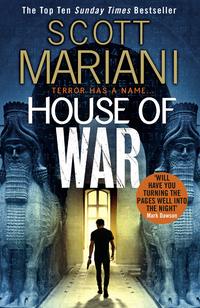
Cover photographs: Human-headed winged bulls guarding a door in Dur-Sharrukin © Poulpy; Figure © Henry Steadman
Scott Mariani asserts the moral right to be identified as the author of this work.
A catalogue copy of this book is available from the British Library.
This novel is entirely a work of fiction. The names, characters and incidents portrayed in it are the work of the author’s imagination. Any resemblance to actual persons, living or dead, events or localities is entirely coincidental.
All rights reserved under International and Pan-American Copyright Conventions. By payment of the required fees, you have been granted the non-exclusive, non-transferable right to access and read the text of this e-book on screen. No part of this text may be reproduced, transmitted, down-loaded, decompiled, reverse engineered, or stored in or introduced into any information storage and retrieval system, in any form or by any means, whether electronic or mechanical, now known or hereinafter invented, without the express written permission of HarperCollins.
Source ISBN: 9780008235987
Ebook Edition © October 2019 ISBN: 9780008235994
Version: 2019-09-17
Discover the series you can’t put down …
‘If you like your conspiracies twisty, your action bone-jarring, and your heroes impossibly dashing, then look no farther – the Ben Hope series is exactly what you need’
Mark Dawson
‘Deadly conspiracies, bone-crunching action and a tormented hero with a heart … Scott Mariani packs a real punch’
Andy McDermott
‘James Bond meets Jason Bourne meets The Da Vinci Code’
J. L. Carrell
‘Non-stop action – this book delivers’
Steve Berry
‘Full of authentic detail and heart-stopping action – a real thrill ride’
Ed Macy
‘Scott Mariani is an awesome writer’
Chris Kuzneski
‘Packed with dark intrigue, danger around every corner, bullets flying, sexual tension, and an endless assault of nasty villains … everything a thriller should be and more’
Joe Moore
‘If you’ve got a pulse, you’ll love Scott Mariani; if you haven’t, then maybe you crossed Ben Hope’
Simon Toyne
‘The action comes thick and fast and is choreographed with Mariani’s trademark skill and authenticity. The modern master of mayhem’
Shots Magazine
‘Fans of Dan Brown will love this’
Closer
‘Edge-of-the-seat excitement … I am hooked on this series’
5* Reader Review
‘Gripping adventure, superbly written’
5* Reader Review
‘Cinematic style, fast pace and, above all, fabulous characters’
5* Reader Review
Contents
Cover
Title Page
Copyright
Discover the series you can’t put down …
Prologue
Chapter 1
Chapter 2
Chapter 3
Chapter 4
Chapter 5
Chapter 6
Chapter 7
Chapter 8
Chapter 9
Chapter 10
Chapter 11
Chapter 12
Chapter 13
Chapter 14
Chapter 15
Chapter 16
Chapter 17
Chapter 18
Chapter 19
Chapter 20
Chapter 21
Chapter 22
Chapter 23
Chapter 24
Chapter 25
Chapter 26
Chapter 27
Chapter 28
Chapter 29
Chapter 30
Chapter 31
Chapter 32
Chapter 33
Chapter 34
Chapter 35
Chapter 36
Chapter 37
Chapter 38
Chapter 39
Chapter 40
Chapter 41
Chapter 42
Chapter 43
Chapter 44
Chapter 45
Chapter 46
Chapter 47
Chapter 48
Chapter 49
Chapter 50
Chapter 51
Chapter 52
Chapter 53
Chapter 54
Chapter 55
Chapter 56
Chapter 57
Chapter 58
Chapter 59
Chapter 60
Chapter 61
Chapter 62
Chapter 63
Chapter 64
Chapter 65
Chapter 66
Keep Reading …
About the Author
By the Same Author
About the Publisher
PROLOGUE
Syria, 2015
The two men were the last ones still inside the ancient temple as the invasion force closed in. They had been racing against time in their desperate last-minute bid to rescue as many of the treasures as they could, but they’d been too slow, too late, and their efforts were futile. Nobody was there to help them. Everyone else had fled hours earlier, when the first death knell of artillery fire sounded in the distance and the terrifying rumours became reality. Now the battle was lost and the government forces trying to hold onto the ancient city in the face of withering attack had fallen into full retreat.
These preserved architectural splendours had graced the desert oasis for two thousand years, dating back to when the thriving city had been one of the major centres on the trade route linking the Roman Empire with Persia, India and China. Here the worlds of classical and Eastern culture had melded and blossomed for centuries. Right up until the present day, their noble heritage had remained as a source of beauty and wonder for the thousands of travellers who flocked there each year to marvel.
And now, on this terrible day that would be remembered for a long time, the ancient city was about to fall into the hands of the destroyers.
The two men knew the end was near. Even though their hours of labour had succeeded in moving the majority of the priceless artifacts to a nearby hiding place where they hoped they could survive, there was still so much to do, so many treasures to try to save. It seemed a hopeless task.
‘We must hurry, Julien,’ said Salim Youssef to his younger associate. ‘They’ll be here any minute.’ He was trying to lift a magnificent Greco-Roman bust from its plinth to place it on a trolley and wheel it outside to the already overloaded truck. But the artifact was far too heavy for his seventy-four-year-old arms to handle. He gasped and wheezed, but he wouldn’t give up. For the last forty years the Syrian had been devotedly in charge of the preservation and cataloguing of the priceless antiquities in this place, which for him was as sacred and holy as a site of religious worship.
His companion was a Frenchman named Julien Segal, twenty-five years his junior, who had been closely involved in Salim’s work for over a decade. He was based equally in Paris and the Middle East, and spoke Arabic fluently. A man known for his elegant dress style and cosmopolitan chic, he wasn’t looking his stylish best at this moment, as he struggled and sweated to drag a six-foot Akkadian alabaster statue across the flagstone floor towards the archway near to which the truck was parked. Even inside the relative coolness of the temple, the August desert heat felt as though it could bake a man inside his skin.
‘It’s no use, Salim. We’ll never make it. Everyone else has run for it, and we should do the same while we still can.’
‘You go, Julien,’ Salim wheezed, clutching his chest. ‘I’m staying. I won’t abandon these treasures, no matter what. This place is all I know and care about.’
‘But they’ll kill you, Salim.’
‘Let those lunatic butchers do their worst,’ the old man said. ‘I’m not afraid of them. I have lived my life and don’t have many years left. But yours is still ahead of you. Go! Save yourself!’ He pulled the truck keys from his pocket and tossed them to Julien Segal.
The Frenchman was about to reply, ‘I won’t leave without you.’ But the words died in his mouth as he turned to see the sight that froze his blood.
They were here.
Nine men had come into the temple’s main entrance and now stood in a semicircle, watching them with detached curiosity. All were bearded and clad in dusty battledress, armed with automatic weapons. Their leader stood in the middle, with four of his soldiers each side of him. He wore black, in accordance with his rank as an ISIL commander. A holstered pistol and a long, sheathed knife hung from his belt.
That was when Julien Segal saw that three of the men were also clutching heavy iron sledgehammers in addition to their weaponry. He opened his mouth to speak, but his throat had gone dry.
Salim spoke for him. The old man stepped away from the bust he’d been trying to manhandle, and advanced towards the invaders, fists clenched in anger. ‘You are not welcome here! Leave now!’
The commander in black stepped forward to meet him. He gazed around the temple’s interior, looking at the statues and other artifacts that Salim and his colleague hadn’t yet been able to remove to safety, and the vacant plinths of those that they had. His voice echoed in the stone chamber as he spoke:
‘I am Nazim al-Kassar. You must be Salim Youssef, the curator. Tell me, old man. This place is looking quite empty. Where have you hidden the rest of these idolatrous pieces of trash you call art?’
‘So you have come here to destroy them,’ Salim said defiantly.
‘This house of blasphemy, along with everything inside it and all that you have vainly tried to rescue,’ said Nazim al-Kassar. ‘It shall be razed to the ground, inshallah.’
‘You will not! You must not!’
The commander smiled. ‘These are the idols of previous centuries, which were worshipped instead of Allah. They have no place in the new Caliphate that will now rule this country for the rest of time. Allah commands that they be shattered and broken into dust.’
‘Savages! Vandals! What gives you the right to erase history? You think you’re doing Allah’s bidding? Where does the Qur’an make such a command? Nowhere! I am also a Muslim, and I say that you bring shame and disgrace upon our religion!’ The old man was seething with fury. Cringing behind him, Julien Segal was too terrified to utter a word.
The commander’s voice remained calm as he pointed a black-gloved finger at Salim and replied, ‘Old man, I will ask only once. You will lead me to where you have hidden the idols of this false divinity, so that the soldiers of the Caliphate may consign them to the past, where they belong.’
‘Then I belong there with them,’ Salim said. ‘I will die before I allow you to wreak your unholy destruction in this place.’
‘So be it,’ the commander said. ‘What you ask for, you will receive.’ He nodded to his men. Four of them stepped forwards, seized Salim and Julien Segal each by the arms, and forced them down to their knees on the flagstone floor. The Frenchman knelt with his head bowed and shoulders sagging. Next to him, the older man refused to break eye contact with his tormentors and remained straight-backed, chin high.
The commander reached down to the hilt of the long, curved knife that hung from his belt, and drew out the blade with a sigh of steel against leather. Salim wouldn’t take his eyes off him for an instant, even though he knew what was coming.
Julien Segal let out a whimper. ‘For God’s sake, Salim. We have to tell them. Please.’
‘I’m sorry, Julien. I will not go to my grave knowing that I betrayed my life’s work to these maniacs.’
The commander stepped around behind Salim.
Salim closed his eyes.
What happened next had Julien Segal burying his face in the dirt and crying in unbearable anguish. But the old man never made a sound. He faced his death with the same steely resolve that he’d shown throughout his life.
Moments later, Julien Segal felt the thump of something hitting the floor beside him. Followed by a second, heavier thud as Salim’s decapitated body slumped forward to fall on the floor next to where the commander had tossed his severed head. Segal couldn’t bring himself to look directly at it, and instead watched in horror as the blood pool spread over the floor, trickling into the cracks between the flagstones and reflecting the light from the arched window.
‘Now it’s your turn,’ said the man called Nazim al-Kassar.
Chapter 1
The present day
It was a cold, bright and sunny October morning in Paris, and Ben Hope was making a brief stop-off in the city on his return from a long journey. The trip to India hadn’t been a scheduled event, but then few things in his life were, or ever had been, despite his best efforts to lead the kind of peaceful and stable existence he might have wished for. It seemed that fate always had other plans for him.
All he really wanted to do now was put the experience behind him, move on from it and get home. Home being a sleepy corner of rural Normandy some three hundred kilometres west of Paris, a place called Le Val, and he couldn’t wait to get there. First he had some business to attend to in the city, which he intended to get sorted as quickly as possible, partly since it was a rather dull chore that he’d put off for too long.
The first thing he’d done when his plane had landed at Orly Airport the previous evening was to call Jeff Dekker, his business partner at Le Val, to say he was back in the country and would be home by early next afternoon. Jeff was pretty well used to Ben’s frequent impromptu disappearances; all he said was ‘See you later.’
Ben’s second action was to call a Parisian estate agent he knew to talk about finally selling the backstreet apartment he’d owned for years and never used any more. Back when he’d worked freelance and lived a nomadic existence, the place had come in handy as an occasional base camp in the city. It had never been more than a bolthole for him, and he’d made little effort to furnish or decorate it beyond the absolute basics of necessity. The pragmatic nature of military life was an ingrained habit that refused to die in him, though he’d been out of that world for quite some years.
Whatever the case, the apartment had long since become surplus to his requirements. Though every time he’d been on the verge of putting the place up for sale, as had happened on several occasions, another of those bolts from the blue would arrive to yank him off on some new crazy mission or other. Which, as he was all too aware, was just a reflection of the broader reality that whatever kinds of plans he had in mind, some new crisis would invariably loom up to divert him right off track.
Such was life. Maybe, after another forty years, he’d get used to it.
But that wasn’t going to happen this time, he told himself. This time he was going to bite the bullet, put the place on the market, go home to Le Val and get back down to running his business. The eternally patient Jeff, his longtime friend and co-director of the tactical training centre they’d founded and built together, might appreciate Ben’s actually being around sometimes. Instructing the world’s top law enforcement, security and close protection services in the finer points of their craft was a dirty job, but someone had to do it.
It was just after eight a.m. At ten-thirty he was due to meet with the property agent, a nervous-mannered chap called Gerbier who, Ben already knew, would spend an hour hemming and hawing about the difficulties of selling the place. First, because despite its theoretically desirable central location it was all but totally secreted away among a cluster of crumbly old buildings and its only access was via an underground car park. Second, because even at its best it had never looked like much on the inside, either, and needed decoration work to appeal to any but the most Spartan of buyers. And third, because right now wasn’t a good time for the Parisian property market in general.
Ben had to admit the guy might have a point about that. For months the city had been locked in increasingly turbulent civil unrest, boiling with constant anti-government protests that had sparked off over a long list of political and social grievances and seemed to grow more serious and violent each passing day. There had been mass arrests, the cops had started deploying armoured personnel carriers and water cannon in the streets, and there were no signs of things cooling down any time soon. Now the troubles had spread across the city into Ben’s normally quiet neighbourhood. He had lain awake for some time last night, listening to the screeching sirens and loud explosions of the latest pitched battle between rioters and the police. It had sounded like both sides meant business.
‘Who can tell where this will end?’ Gerbier had fretted over the phone. ‘The city’s falling into anarchy. Nobody’s buying any more.’
How justified was Gerbier’s pessimism, only time would tell. Ben had been up with the dawn that morning, as always. He’d laboured through his usual gruelling pre-breakfast workout of press-ups, sit-ups and pull-ups, taken a one-minute tepid shower, pulled on fresh black jeans and a denim shirt, scanned a few latest news headlines online, meditatively smoked a couple of Gauloise cigarettes while gazing out at the non-existent view for what might be one of the last times if he got lucky finding a buyer soon, then turned his thoughts to eating breakfast. Dinner last night had been a sandwich wolfed down on the hoof at the airport, and he was starving.
That was when Ben had realised that there wasn’t a scrap of food in the apartment. Worse, much worse, the bare kitchenette cupboards contained not a single coffee bean.
And so here he was, heading briskly along the street, his scuffed brown leather jacket zipped against the chill and the third Gauloise of the day dangling from his lip, in the direction of a local coffee bar where he could get some breakfast and a much-needed fix of the black stuff. It was a five-minute stroll, but when he got there he discovered to his chagrin that the coffee bar had had its windows smashed in last night’s disturbances and was shut.
The owners weren’t the only local traders to have suffered damage from the latest round of protests. All up and down the street, storekeepers were resignedly sweeping up broken glass, nailing plywood sheets over their shattered windows, hauling out buckets of hot soapy water to try and scrub away graffiti that had appeared overnight. Ben stopped for a brief conversation with Habib, who ran the little Moroccan grocery store and tobacconist’s where he’d often bought his cigarettes. Habib expressed sympathy with the protesters but worried that his insurance premiums would sky-rocket if these riots kept up. Ben offered his commiserations, wished Habib good luck and walked on in search of breakfast. He still had plenty of time to kill before meeting Gerbier.
The signs of last night’s troubles were all around. Though it hadn’t rained overnight the roads and pavements were slicked wet, small rivers created by police water cannon trickling in the gutters and pooling around washed-up garbage that choked the drain grids. A recovery crew with a flatbed lorry were removing the burnt-out shells of three cars that had been torched by the protesters. Barriers and cones had reduced the traffic to a crawl as cars and vans and motorcycles threaded their way along streets still littered with riot debris and spent tear gas canisters.
As Ben walked along, he spied one rolling in the gutter and picked it up to examine it, just out of curiosity. It was the strong stuff, the real McCoy. Then again, France’s riot police never had mucked about when it came to dispersing violent demonstrations. The warning on the empty canister said, in French: DANGER – DO NOT FIRE DIRECTLY AT PERSON(S) AS SEVERE INJURY OR DEATH MAY RESULT. Ben had seen from the online news headlines that a couple of civilians had already been accidentally killed that way as the protests mounted. There was a good chance of more fatalities to come. One serious casualty among the police, and the government would probably send in the army.
Ben continued on his way, thinking about Gerbier’s words and wondering where, indeed, it was all going to end. As he’d grown older and wiser he had come to understand that history was the key to predicting what lay in the future. As the saying went, those who failed to learn from the hard lessons of the past were doomed to repeat them. Paris had seen more than its fair share of revolutionary unrest in its time, and none of it seemed to have done much good. The big one of 1789 had kicked off much the same way as was happening now – and look how that ended, eating itself in an orgy of blood and severed heads and giving rise to the Napoleonic empire and rather a lot of even bloodier wars, followed eventually by a new monarchy to take the place of the old. Then had come the July Revolution of 1830, the one portrayed in the famous Delacroix painting that used to be on the old 100-franc banknote, depicting the topless Liberty wielding tricolour flag and musket as she led the people to victory, this time against the royal regime of Charles X. Same dubious result. Then just eighteen years later they’d been at it again, with the populist uprising of 1848 that had spilled enough blood in the streets of Paris to tear down the establishment once more and trigger the foundation of the Second Republic, which lasted exactly three years before the Second Empire turned the country back into a de facto monarchy.
And on, and on, through the ages and right up to the present. Round and round we go, Ben thought. An endless cycle of inflamed passion leading to disappointment, and resentment, and blame, simmering away and slowly building up to the next outburst. And for what? So much suffering and destruction could only deepen the rift between nation and state, while calls for reform would largely go unheeded and life would ultimately carry on just like before. Sure, go ahead and protest about overinflated taxes and rising costs of living and the insidious encroachment of the European superstate and police brutality and human rights infringements and loss of personal freedoms and privacy and anything else you feel strongly about. All fine. Angry mobs ripping their own beautiful city apart, looting and pillaging, harming small businesses, traumatising innocent citizens, not so fine. Unless you really believed that a violent street revolution was the only possible way to change things for the better.
Well, good luck with that.
Those were all the things on Ben’s mind as he walked quickly around the corner of Rue Georges Brassens and collided with a young woman who, quite literally, ran into him without looking where she was going.
He didn’t know it yet, but fate had just launched another of those bolts from the blue at him.
Chapter 2
The woman crashed straight into Ben with enough force to knock the wind out of herself and send her tumbling to the pavement. It took Ben a moment to recover from his own surprise.
Though it hadn’t been his fault, he said in French, ‘Oh, I’m so sorry,’ and went to help her to her feet. He’d become skilled at languages back during his time with Special Forces, learning Arabic, Dari, Farsi and some African dialects, along with various European languages. He had now been living in France long enough to virtually pass for a native speaker.
As she picked herself off the pavement he saw she was more stunned than hurt. She was maybe twenty-five years old and slender, wearing a long camel coat over a white cashmere roll-neck top and navy trousers. Her hair was sandy-blond and her face, if it hadn’t been flushed with shock, was attractively heart-shaped with vivid eyes the same blue as Ben’s own. She didn’t look as though she weighed very much, but it had been quite a collision. The little leather satchel she’d been carrying on a shoulder strap had fallen to the pavement and burst open, scattering its contents.
‘Are you okay?’ Ben asked her. She seemed too flustered to reply, and kept looking anxiously behind her as though she expected to see someone there. A couple of passersby had paused to gawk, but quickly lost interest and walked on. Ben said, ‘Miss? Are you all right?’
The woman looked at him as though noticing him for the first time. Her blue eyes widened with alarm. She backed away a couple of steps, plainly frightened of him. He held his arms to the sides and showed her his open palms. ‘I mean no harm,’ he said jokingly. ‘You’re the one who ran into me. Maybe you should look where you’re going. Here, let me help you with your things.’
He crouched down to pick up her fallen satchel. Her purse had fallen out, along with a hairbrush, some hair ties, a book of Métro tickets and a little black plastic case that said GIVENCHY in gold lettering. The contents of women’s handbags had always been a bit of a mystery to Ben. He was also aware of the delicacy of the situation as he quickly scooped up her personal items from the pavement. She paid no attention while he retrieved her things, apparently too distracted by whatever, or whoever, she seemed to think was lurking in the background. When Ben stood up and offered the satchel back to her, she reached out tentatively and snatched it from his hands like a nervous animal accepting a titbit from a strange and untrusted human.
So much for being a knight in shining armour.
‘You’re bleeding,’ he said, noticing that she’d scuffed the side of her left hand in the fall. ‘Doesn’t look too bad, but you should put some antiseptic on it.’
Still the same terse silence. She turned her anxious gaze behind her again, scanning the street as though she thought she was being followed. Pedestrians walked by, paying no attention. The traffic stream kept rumbling past in the background. A municipal cleaning crew was slowly working its way along the street towards them, gathering up last night’s wreckage. A couple of pigeons strutted and pecked about among the debris in the gutter, seemingly unbothered by whatever was frightening the woman. Then she quickly looped the strap of her satchel over her shoulder and hurried on without a word or another glance at him.
Ben watched her disappear off down Rue Georges Brassens, walking so fast she was almost running, still glancing behind her every few steps as if someone was chasing her.
He shook his head. Some people. What the hell was up with her? The way she’d acted with him, anyone would think he’d been about to attack her. And who did she think was coming after her?
Maybe she was an escaped lunatic. Or a bank robber fleeing from the scene of the crime. Perhaps some kind of political activist or protest organiser the cops were trying to round up and throw in jail along with the other thousand-odd they’d already locked up.
Ben looked around him and saw no squads of gendarmes or psychiatric ward nurses tearing down the street in pursuit. Nor anyone else of interest, apart from the usual passersby who were all just going about their business, the majority of them deeply absorbed in their phones as most people seemed to be nowadays, doing the thumb-twiddling texting thing as they ambled along and somehow managed to avoid stumbling into trees and signposts. It seemed to him that those without digital devices to distract them from their present reality were walking somewhat more briskly than normal, a little stiff in their body language as if trying hard not to take in too much of their surroundings and dwell at any length on the signs of the battlefield that their city environment had become.
One way or another, though, the Parisians had far too much on their minds to be worrying about some panic-stricken woman running down the street blindly crashing into people.
Ben shrugged his shoulders and was about to move on when he saw that the young woman had dropped something else on the ground. She’d been so distracted that she had failed to notice that her phone had bounced off the kerbside and into the gutter, where it was lying among the washed-up debris and broken bottles the cleaning crew hadn’t yet reached.
He picked it up. A slim, new-model smartphone in a smart black leather wallet case. The leather was wet, but the phone inside was dry. There was no question that it hadn’t been lying in the gutter for long, and that it belonged to the woman. He could feel the residual trace of warmth from where it had been nestling in her bag close to her body. In an age when people’s phones seemed to have become the hub of their entire lives, she must have been in a hell of a preoccupied state of mind not to have noticed its absence.
Ben stood there for a moment, thinking what he should do. Further along the street he could see the striped red and white awning of a café-bistro that had obviously escaped damage and was open for business. His mouth watered at the thought of coffee and croissants and he was torn between the temptation of breakfast and the notion of going after the woman to return her phone. She was well out of sight by now, and could have turned off onto any number of side streets. He decided on breakfast and slipped the phone into his pocket.
The place was bustling and noisy, but there was a table free in a corner. Out of habit, Ben sat with his back to the wall so he could observe the entrance. A hurried waiter took his order for a large café noir and the compulsory fresh-baked croissant.
While he waited for his order to arrive, Ben sat quietly and absorbed the chatter from other customers. Predictably the subject of the day, here as everywhere in the city, was the riots. A pair of middle-aged men at the next table were getting quite animated over whether or not the president should declare martial law, order the rebuilding of the Bastille prison, stuff the whole lot of troublemakers behind bars and throw away the key.
When his breakfast arrived Ben gave up eavesdropping on their conversation, took a sip or two of the delicious coffee and tore off a corner of croissant to dunk into his cup. A Gauloise would have rounded things out nicely, but such pleasures as smoking inside a café were no longer to be had in the modern civilised world. He went back to thinking about the strange woman who had bumped into him. What was she so frightened of? Where had she been running from, or to? He had to admit it, he was intrigued. And sooner or later, he was going to have to do something about the phone in his pocket.
Curiosity getting the better of him, he took it out to examine more closely. If the screen happened to be locked, there might not be much he could do except just hand it in to the nearest gendarmerie as lost property. But when he flipped open the leather wallet he soon discovered that the phone wasn’t locked.
Which left him a number of potential ways to find out who the woman was and where she lived, allowing him to return the item to her personally. Ben was good at finding people. It was something he used to do for a living, after he’d quit the SAS to go his own way as what he’d euphemistically termed a ‘crisis response consultant’. A career that involved tracking down people who didn’t always want to be found, especially when they were holding innocent child hostages captive for ransom. Kidnappers didn’t make themselves easy to locate, as a rule. But Ben had located them anyway, and the consequences hadn’t been very pleasant for them.
By contrast, thanks to today’s technology, ordinary unsuspecting citizens were easy to track down. Too easy, in his opinion.
Feeling just a little self-conscious about intruding on her privacy, he scrolled around the phone’s menus. There were a few emails and assorted files, but his first port of call was the woman’s address book. She was conservative about what information she stored in her contacts list. There was someone called Michel, no surname, and another contact called ‘Maman/Papa’, obviously her parents, but no addresses for either, and no home address or home landline number for herself. But the mobile’s own number was there.
Ben took out his own phone to check it with. Damn these bloody things, but he was just as bound to them as the next guy. He’d got into the habit of carrying two of them: one a fancy smartphone registered to his business, the other a cheap, anonymous burner bought for cash, no names, no questions. Its anonymity pleased him and it came in handy in certain circumstances. But for this call he used his smartphone. He punched in the woman’s mobile number. Her phone rang in his other hand. You could tell a lot about a person from their choice of ringtone. Hers was a retro-style dring-dring, like the old dial phone that stood in the hallway of the farmhouse at Le Val. Ben liked that about her. He ended the call and the ringing stopped. So far, so good.
Next he used his smartphone to access the whitepages.fr people finder website, which scanned millions of data files to give a reverse lookup. When a prompt appeared he entered the woman’s mobile number and activated the search. Not all phone users were trackable this way, only a few hundred million worldwide. Which was a pretty large net, but still something of a gamble. If it didn’t pay off, he still had other options to try.
But that wouldn’t be necessary, because he scored a hit first time. In a few seconds he’d gained access to a whole range of information about the mystery woman: name, address, landline number, employer, and the contact details of two extant relatives in the Parisian suburb of Fontenay-sous-Bois a few kilometres to the east. If he’d been interested in offering her a job, he could run a background check to verify her credentials and see if she had any criminal record. If he was thinking of lending her money, he could view her credit rating. As things stood, he only needed the basics, which he now had.
Piece of cake.
Her name was Mme Romy Juneau. All adult women in France were now officially titled Madame regardless of marital status, since the traditional Mademoiselle had been banned for its alleged sexist overtones. But her parents’ shared surname matched hers, suggesting she was unmarried. Some traditions still prevailed. Ben guessed that the phone contact called Michel was probably a boyfriend. She worked at a place called Institut Culturel Segal, ICS for short. The Segal Cultural Institute, whatever that was, in an upmarket part of town on Avenue des Champs-Élysées.
More important to Ben at this moment was her home address, which was an apartment number in a street just a few minutes’ walk from where he was sitting right now, and in the direction she’d been heading when they’d bumped into one another.
It seemed safe to assume that she hadn’t been going to work that morning. Maybe she had the day off. Whatever the case, it was a reasonable assumption that she’d been making her way home. From where, he couldn’t say, and it didn’t really matter. If she was heading for her apartment, there was a strong likelihood that she’d have got there by now, considering the hurry she’d been in.
Ben scribbled her details in the little notebook he carried, then exited the whitepages website and punched in Romy Juneau’s landline number. As he listened to the dialling tone, he thought about what he’d say to her.
No reply. Perhaps she hadn’t got home yet, or was in the bathroom, or any number of possibilities. Ben aborted the call and looked at his watch. The morning was wearing on. He needed to be thinking about finishing breakfast and heading over to see Gerbier at his offices across town. Romy Juneau would have to wait until afterwards.
He was slurping down the last of the delicious coffee when his phone buzzed. He answered quickly, thinking that Romy must have just missed his call and was calling him back. His anticipation soon fell flat when he heard the unpleasantly raspy, reedy voice of Gaston Gerbier in his ear.
The estate agent was calling, very apologetically, to cancel their morning appointment because his hundred-year-old mother had started complaining of chest pains and been rushed off to hospital. It was probably nothing serious, Gerbier explained. The vicious old moo had been dying of the same heart attack for the last thirty-odd years and false alarms were a routine thing. Still, he felt obliged to be there, as the dutiful son, etc., etc. Ben said it was no problem; they could reschedule the appointment for next time he was in town. He wished the old moo a speedy recovery and hung up.
There went his morning’s duties. Ben couldn’t actually say he was sorry to be missing out on the joys of Gerbier’s company. And never mind about the apartment. It wasn’t going anywhere. With a suddenly empty slate and nothing better to do, he decided now was as good a time as any to play the Good Samaritan and deliver the lost phone back to its owner in person. Given the nervous way she’d acted around him before, so as not to freak her out still further by showing up at her door he’d just post it through her letterbox with a note explaining how he’d found it. And that would be that. His good deed done, he could wend his way back to his apartment, jump in the car and be home at Le Val sometime in the afternoon.
Ben munched the last of his croissant, paid his bill and then left the café and set off on foot in the direction of her address. The sky was blue, the sun was shining, the day was his to do with as he pleased, and he felt carefree and untroubled.
He had no idea what he was walking into. But he soon would. He was, in fact, about to meet Mademoiselle Romy Juneau for the second time. And from that moment, a whole new world of trouble would be getting ready to open up.
Chapter 3
Romy Juneau lived in a handsome 1920s period apartment building near the end of a busy little street called Rue Joséphine Beaugiron, fifteen minutes’ walk away, flanked by a travel agency and a corner bar-restaurant called Chez Bogart.
Like Ben’s own neighbourhood, the street hadn’t survived last night’s riot completely unscathed. The quaint old antiquarian bookshop opposite Romy’s building had taken a hit, and like Habib the grocer its owner was surveying the damage with a sour look of disgruntlement as two carpenters fitted a sheet of plywood over the broken window. Why anyone would attack a specialist book store filled with nothing but a bunch of dusty old tomes by dead writers, Ben couldn’t say. Maybe the rioters were intent on procuring some edifying literature to alleviate the boredom of throwing firebombs at the police.
Romy’s building had an art deco archway, once grand, now slightly grungy, on which someone had recently sprayed an obscene slogan about the president. It had tall carved double doors, firmly locked, with a smaller inset door, also firmly locked. On the wall by the door was a buzzer panel with twelve buttons, one for each apartment, each with a corresponding name plate with the initial and surname of the resident. R. Juneau was in apartment 11.
He pressed the button for apartment 6, labelled J. Vanel, waited for some guy’s voice to crackle ‘Qui est-ce?’ out of the speaker grille, and said he had a delivery for Vanel that needed signing for. A moment later the buzzer buzzed and the inset door clicked open, and Ben pushed through into a brick foyer that led to a small interior courtyard. A short, stumpy concierge lady with curlers in her hair was sweeping the floor and barely glanced at Ben as he walked in. The hallway walls were streaked with dirt and a row of wheelie bins smelled of mouldy garbage. Not the best-kept apartment building in Paris, but not the worst either, not these days.
To his left was the door to the concierge’s ground-floor apartment, to his right a spiral stairway with a worn antique banister rail. Set into the centre of the stairway was an original period cage lift apparently still in service, all ornate black wrought iron. A Gothic death trap, to Ben’s eye. On the opposite wall were fixed twelve separate grey steel mailboxes, one for each resident, marked with their names. He took Romy’s phone from his pocket, along with his notebook and pen. He wrote a brief note to the effect that he was returning her property, signed it, folded it inside the phone’s leather wallet and was about to pop it into her mailbox when he noticed that two of the other boxes had had their locks forced open with something like a screwdriver, the grey paint scratched through to the bare metal.
Hardly the most confidence-inspiring level of security. The building was obviously a little too soft a target for thieves, unlike Ben’s place which had a hardened steel security door you’d need a cutting torch to break through. He didn’t want to have gone to the trouble of returning Romy’s phone to her, only for it to be nicked by some light-fingered opportunist punk before she could get to it. He decided to hand it to her in person, face to face. She’d surely realise she had nothing to be frightened of, if he smiled a lot and acted his usual charming self. If she asked how he’d found her address, he’d admit the truth and advise her to erase her own number from her contacts list because it made her far too easy to track online. There were too many suspicious characters around these days to be taking risks.
Choosing the stairs over the Gothic death trap, he started to climb. The stairs were worn and creaky with age, spiralling up around the central lift shaft. The first-floor landing had apartments numbers 1 to 3, the second floor numbers 4 to 6. By his reckoning that made number 11 the middle door on the fourth floor, right at the top of the building.
As he headed towards the third floor, Ben heard the rattle and judder of the lift descending, sounding like it was going to shake itself apart and bring the whole building down, and he was glad he’d taken the stairs. Through the wrought-iron bars he saw the lift’s passenger, a lone man making his way down from an upper floor. Ben gave him only the briefest of glances, but his eye was trained to notice details. The guy was standing with his back to Ben and his face turned away. He was broad-shouldered and well built, about Ben’s height at a shade under six feet. He wore black leather gloves and a long dark coat, quality wool, expensive, with the collar turned up. His hair was short and black, silvering in streaks. Ben caught a whiff of aftershave. The man didn’t turn around as the death trap rattled on its way downwards.
Ben watched the lift disappear below him between floors, then kept on climbing the stairs. A strange, vague feeling had suddenly come over him, as though something at the back of his mind was needling him. He had no idea what it was, and quickly forgot about it.
Moments later he reached the top floor. As he’d guessed, apartment 11 was the middle door of the uppermost three apartments. He paused on the landing for a moment, thinking of the most innocuous way to introduce himself. Honesty and openness were the best policy. She would soon realise he was the friendliest and least menacing guy on the planet. At any rate, he could be that guy when he wanted.
He removed the handwritten note from her phone case, since he’d no longer need it. Then raised his hand to ring the doorbell with a knuckle. Force of habit. In his past line of work, leaving fingerprints often wasn’t a good idea.
Then he stopped. Because he’d suddenly noticed that her door wasn’t locked. Not just unlocked, but hanging open an inch. He used his fist to nudge it gently open a few inches more, and peeked through the gap. The apartment had a narrow entrance passage papered in tasteful pastel blue, with glossily varnished floorboards. There were four interior doors leading off the hallway, one at the far end and one to the left, both closed, and two more to the right, both of which were open though Ben couldn’t see into the rooms from where he stood.
He called out in French, ‘Hello? Anybody there? Mademoiselle Juneau?’ He hoped it wasn’t being too sexist to assume her marital status.
There was no reply. Ben tentatively stepped inside the hall passage. He felt uneasy about doing it, since a lone male stranger didn’t ideally want to be seen to be lurking in the apartment of a young single woman.
The first odd thing he noticed was the smell of something burning, which seemed to be coming from the nearer open door on the right. The second was the little stand in the passage that had been knocked over on its side across the middle of the hallway floor. A pretty ceramic dish lay smashed on the floorboards, various keys scattered nearby. The camel coat Romy Juneau had been wearing earlier looked like it had been yanked down from a hook by the entrance and was lying rumpled on the floor.
Ben moved a little further up the passage, stepped past the coat and the fallen stand, and peered around the edge of the first open door on the right. The door led to a small kitchen, clean and neat, with worktops and cupboards the same pastel blue as the hallway and a table for one next to a window overlooking the street side of the building. The burning smell was coming from a coffee percolator that had been left on the gas stove. It had bubbled itself dry and was giving off smoke. Ben went in and took the coffee off the heat, using a kitchen cloth because it was hot. Then he quickly flipped off the gas burner with a knuckle. Force of habit, again.
Whoever had been in the middle of making coffee had taken a carton of non-fat milk from the fridge and a delicate china cup and saucer from the cupboard and laid them out ready on the worktop next to a little pot of Demerara sugar and a tiny silver spoon. All very dainty and feminine. Ben presumed that someone was the apartment’s occupant. So where was she, and what was all the mess in the hallway?
By now the alarm bell was jangling in the back of his mind. Something wasn’t quite right. He stepped back out into the hallway and called again, a little more loudly, ‘Hello? Mademoiselle Juneau?’
Still no reply. He nudged open the closed door to the left, which was a bedroom. Romy Juneau evidently had a thing for that shade of blue. It was everywhere, the bed covers, the curtains, the walls. But she wasn’t in the room. He stepped up to the further open door on the right, which he now saw led to a salon.
It was inside the salon that Ben now saw Mademoiselle Romy Juneau for the second time.
It would be the last time.
Бесплатный фрагмент закончился.