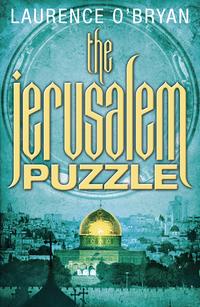
Читать книгу: «The Jerusalem Puzzle»
LAURENCE O’BRYAN
The Jerusalem Puzzle


Copyright
This novel is entirely a work of fiction. The names, characters and incidents portrayed in it are the work of the author’s imagination. Any resemblance to actual persons, living or dead, events or localities is entirely coincidental.
Avon
An imprint of HarperCollinsPublishers Ltd.
1 London Bridge Street
London SE1 9GF
www.harpercollins.co.uk
First published in Great Britain by HarperCollinsPublishers 2013
Copyright © Laurence O’Bryan 2012
Laurence O’Bryan asserts the moral right to be identified as the author of this work
Elaine AM Smith, HA Corby and Michael Robertson to be identified as the authors of their stories
A catalogue record for this book is available from the British Library
All rights reserved under International and Pan-American Copyright Conventions. By payment of the required fees, you have been granted the non-exclusive, non-transferable right to access and read the text of this e-book on-screen. No part of this text may be reproduced, transmitted, downloaded, decompiled, reverse engineered, or stored in or introduced into any information storage and retrieval system, in any form or by any means, whether electronic or mechanical, now known or hereinafter invented, without the express written permission of HarperCollins e-books.
Source ISBN: 9781847562890
Ebook Edition July 2013 ISBN: 9780007453313
Version: 2017-09-05
‘When the blast of war blows in our ears, then imitate the action of the tiger.’
Henry V Act 3, Sc. 1, Wm Shakespeare.
The best part of this story is true.
Table of Contents
Title Page
Copyright
Epigraph
Chapter 1
Chapter 2
Chapter 3
Chapter 4
Chapter 5
Chapter 6
Chapter 7
Chapter 8
Chapter 9
Chapter 10
Chapter 11
Chapter 12
Chapter 13
Chapter 14
Chapter 15
Chapter 16
Chapter 17
Chapter 18
Chapter 19
Chapter 20
Chapter 21
Chapter 22
Chapter 23
Chapter 24
Chapter 25
Chapter 26
Chapter 27
Chapter 28
Chapter 29
Chapter 30
Chapter 31
Chapter 32
Chapter 33
Chapter 34
Chapter 35
Chapter 36
Chapter 37
Chapter 38
Chapter 39
Chapter 40
Chapter 41
Chapter 42
Chapter 43
Chapter 44
Chapter 45
Chapter 46
Chapter 47
Chapter 48
Chapter 49
Chapter 50
Chapter 51
Chapter 52
Chapter 53
Chapter 54
Chapter 55
Chapter 56
Chapter 57
Chapter 58
Chapter 59
Chapter 60
Chapter 61
Chapter 62
Chapter 63
Chapter 64
Epilogue
Keep Reading
The Istanbul Puzzle - an extract
An Interview with Laurence O’Bryan
Visiting Jerusalem
Authonomy short story winners’ stories
In the Name of Science
Murder in the Morning
Sticks and Stones
About the Author
By the Same Author
About the Publisher
1
Flames burst into life with a whoosh. It was an unusually cold night for late February in Jerusalem. Lead-coloured clouds had been rolling in from the Dead Sea, east of the city, since midday. By ten o’clock that night the streets of the Old City’s Muslim quarter were deserted. Smells of cardamom coffee and kofta drifted from shuttered windows.
At one minute past ten, the stepped passage of Aqabat at-Takiya echoed loudly with the sound of footsteps. Two men dressed in dusty suits and chequered keffiyehs were hurrying down the wide steps.
The high masonry walls on each side gave the alley the appearance of a gap between prisons. As the men approached the arched entrance to Lady Tunshuq’s Palace they saw orange flames coming from the recessed doorway.
They stopped, waited a few seconds pressed against the wall, then moved slowly forward, craning their necks until they could see what was burning. Whoever had set the fire was long gone into the warren of narrow alleys all around.
As a gust of wind blew the flames up, they saw the body burning fiercely in front of the double-height, green steel doors. Then a throat-clogging smell of burning flesh hit them. The man who’d seen the flames first was already talking on his phone. He could feel the heat from the fire on his face, though they were fifteen feet away. He coughed, backed away. The acrid smell was getting stronger.
They watched as the flames rose. The wail of an ambulance seemed far away as blackened skin slipped from the man’s face. Tendons and muscle glistened in the flames. A white cheekbone poked out.
Above the head, paler smoke was drifting where hair should have been. The sickly smell was all around now. A man shouted from a half-shuttered window high up. A woman wailed to God.
A spurt of hissing flames reflected on the alternating light and dark bands of Mamluk masonry and the stone stalactites hanging above the doorway. The sound echoed down the long passage.
2
I turned the radio down. Verdi’s ‘Chorus of the Hebrew Slaves’ had passed its climax.
‘This website says Abingdon is the oldest continuously occupied town in Britain.’ I looked up. A squall of rain hit the side of the car.
‘It says people have lived there for 6,000 years. That’s got to make for one hell of a long list of mayors at the town council.’ It was hard reading while Isabel was driving, not just because it was a rainy morning in February, but also because the road we were on, the A415 from Dorchester, twisted and turned at that point under a high canopy of trees.
‘In 1084 William the Conqueror celebrated Easter here.’ I looked at Isabel.
She kept her attention on the road ahead. ‘It is St Helen’s Church we’re looking for, isn’t it?’
‘Yes,’ I said.
‘It was the first monastery to be established in England,’ she said. ‘It’s even older than Glastonbury. You could get four years out of purgatory for visiting it. Sounds like a good deal, doesn’t it?’
She was smiling. Her long black hair was tied up at the back. She looked good.
‘The church is still looking at all sorts of schemes to get people in the door. Did Lizzie tell you they had to go on a marriage preparation course before they used the church for their wedding?’ I said.
‘She doesn’t tell me things like that.’ She sniffed. It was barely audible, but its meaning was clear.
I didn’t reply. I wasn’t going to go there. Lizzie worked at the Institute of Applied Research in Oxford in the office next to mine. We’d always been friendly, though it had never led to anything. Her husband-to-be, Alex Wincly, had followed her around like a day-old puppy for years.
‘They spent three Wednesday evenings talking about their relationship,’ I said. ‘What a nightmare. How did they find enough to talk about?’
‘It sounds like a good idea to me.’ Isabel kept her attention on the traffic, but her eyebrow on my side was up half an inch, at least.
‘I reckon she’s pregnant,’ I said. ‘Why else would they get married in February?’
‘There’s a lot of reasons people get married in winter, aside from being pregnant.’
The car radio buzzed as we swept under electricity cables strung between giant pylons. ‘This is the eleven o’clock news from Radio Three,’ said the announcer.
There was another loud buzz. I missed a few seconds of the next sentence.
‘… the badly burnt body discovered in the Old City of Jerusalem early this morning was that of an American archaeologist named Max Kaiser, according to local sources. His death is being blamed on Islamic extremists. In other news …’
Isabel slowed the car. A car behind, tailgating us, blew its horn.
‘Kaiser’s dead,’ she whispered.
She gripped the wheel. The car sped up again.
I got that out-of-body feeling you get when you discover someone you’ve heard of has died, as if all your senses have become heightened as you realise how fortunate you are to be alive.
We didn’t know Max Kaiser well. We’d only met him once in Istanbul when he’d helped us out of the water in the middle of the night, and allowed us to dry out on his yacht, but we were involved with him. He’d staked a very public claim to a manuscript we’d found in Istanbul so he wasn’t ever going to get my vote for person of the year, but he didn’t deserve to die like that.
‘Poor bastard,’ I said.
‘It’s hard to believe,’ she said.
‘Do you think he told Susan Hunter the truth?’
Isabel shrugged. She looked pale. ‘Susan wouldn’t have fallen for his bullshit,’ she said. She glanced at me. ‘They did say he was burnt to death?’
‘Yeah.’
She went silent.
Dr Susan Hunter was the Cambridge archaeologist who was producing a report for the Turkish government on the ancient manuscript we’d found in an aqueduct tunnel deep under Istanbul. It was the arrangement that had been agreed soon after the manuscript was found.
Dr Hunter was the leading expert on early Byzantine manuscripts in the world. The promise of her personal involvement had probably secured the agreement of the Turkish archaeological authorities for the manuscript to be studied in England.
‘I read that book she wrote on Byzantine superstitions. They believed some totally crazy stuff,’ said Isabel. She shook her head, as if shaking something off.
‘Looks like this storm is getting worse,’ I said, leaning forward to look out the window.
By the time the wedding reception was over we’d experienced the best that Abingdon had to offer. It rained for most of the afternoon, but the bride and groom managed to get wedding pictures by the hotel’s private mooring on the Thames. We enjoyed the reception, especially the all-girl band from Windsor, all mates of Carol’s apparently. We danced non-stop and thanks to Isabel not drinking we were able to drive back to London late that night.
On the journey I checked my email, scoured the online news sites to see if they were saying anything about Max Kaiser’s death. They weren’t. I reread the last email I’d received from Dr Hunter earlier that week. In it she’d said there was no definite delivery date on her final report yet. I’d replied, thanking her for keeping me informed, asking to be put on the circulation list as soon as the report was available. She hadn’t replied.
It was six months since our return from Istanbul. I’d expected Dr Hunter to say her report would be ready in another year or more. At least she hadn’t done that. We all despaired at the institute at some of the reasons academics gave for taking so long to do things. It was a running joke for us.
‘Do you think Kaiser’s death will make any difference to her report, Sean?’
I shrugged. ‘No idea,’ I replied.
After we got home I composed an email to Dr Hunter, asking whether she had heard about Kaiser. I also asked about his level of cooperation. It was probably a bit over the top, poking my nose in, but I couldn’t stop myself.
I needed to know whether she knew how important her report was to us. It had become a talisman. Alek, a colleague and a friend who’d worked with me at the institute and had gone out to Istanbul ahead of me, had been murdered there. The manuscript we’d found was something good that had come out of his death. It felt almost as if he’d given up his life for it. I had to know what was in it, what Dr Hunter’s translation would uncover.
My boss, Dr Beresford-Ellis, had postponed our final project review meeting on what had happened in Istanbul because of the report. My job was now tied up with it all. That was my mistake.
But I knew I was right not to let it go.
We’d stopped a plot to infect thousands with a deadly plague virus at a Muslim demonstration in London after investigating what had happened to Alek. But some of the people who’d been behind that plot had escaped.
That was the unsettling part. My friend Alek had died out there because of these people. Isabel and I had almost died too. And whoever had been digging under Istanbul, looking for that plague virus, were clearly people with substantial resources, whose reasons for going to all that trouble were still unclear.
The best thing that had happened, out of everything that had gone on, was that Isabel and I were getting on so well. She had taken an early retirement package at the Foreign Office. She wanted to leave her old life behind. She didn’t tell me all the details, but she told me enough for me to understand why she wanted out.
The rest of that weekend was uneventful. But on Monday morning I got another shock. I was checking the BBC News website before heading to Oxford for a meeting at the institute, when I spotted an article about a fire in Cambridge in which one person had died. The article didn’t name the person, but the fire had taken place in Elliot Way, a fact that made something twist inside me.
A conversation I’d had with Dr Hunter came back to me, in which she’d mentioned she wanted to move out of her house in Elliot Way, as it was too big for her needs now.
It had to be a coincidence. Was I getting paranoid?
Maybe my GP was right. It was going to take a long time to settle back into a normal life. He was the Zen master of common sense. I’d only gone to him because of Isabel’s pestering. Having your sleep disturbed week after week was the sort of problem I usually tried to solve myself. That’s a male thing, isn’t it? We think we should be able to fix everything, even ourselves.
I checked my email.
My mind was put to rest. There was an email from Dr Hunter. I opened it quickly. ‘Sean, I’m in Jerusalem. I’ll be back in London on Friday. Will call you then. There’s something we need to talk about. SH.’ It had been sent on Sunday afternoon.
I thought about replying, asking her what was so important, but I decided not to. I would find out soon enough. And I had to work on being patient.
I kept my mobile at hand all day on Friday, even though Isabel said I was losing the plot. I even left it on vibrate in a management meeting. Finances have been the main issue in these meetings for the past year, and we’ve all taken a pay cut. Our survival is not in question but what we spend our money on is. That evening I checked my junk mail to see if a new email from Dr Hunter had ended up in the wrong place. It hadn’t. I wasn’t overly concerned, but I looked up Dr Hunter on the internet. What I found out disturbed me.
3
Five minutes’ walk from Amsterdam’s flea market in Waterlooplein there is a side street with a bricked-up end wall. The red brick building at the end of the street had been a squat for a long time. Recently it had been converted into small apartments, rooms really, and let out by the week.
The two young men who had taken the top floor room ten days before had the appearance of derelicts. They were unshaven and dressed in dirty jeans, t-shirts and thin jackets when they arrived, though the sun in February in Amsterdam is a cool affair.
The fact that they didn’t appear out of their room for a week attracted no notice. It was only when the manager of the building, a big mousy-haired woman, knocked on their door that their existence came into question. That was because of the pungent smell that filled the tiny area between the door and the rickety stairs. When she opened the narrow door using her key the sight that greeted her was one she had never seen in all her sixty-six years. And she’d seen a lot, especially in the old days in the red-light district.
Both young men were tied to the bedstead. The mattress had been stripped from it and the iron frame had been upended. Both were naked. That wasn’t what upset her.
Their skin was black and shrivelled to the point where they resembled burnt wooden sculptures rather than humans. The window behind them was open and the room was freezing.
The Amsterdam Medical Office would later determine that local pigeons must have spent many hours feasting on the bodies, particularly the faces, before they were found. The cause of death was obvious. Both of them had suffered one hundred percent burns. But not in one go.
They had been burnt by a blowtorch or some other flammable device on each part of their body, without damaging the room, except for scorch marks on the bedstead. The cloth that had been stuffed into their mouths to keep them quiet must have caught alight, as in each case all that remained of it was a black mulch.
The coroner confirmed that one of the men had died five days before, the other four days before. It was likely that the torture of one of these men was used to encourage the other to talk. Whether he did or not is hard to know. He certainly didn’t benefit.
It would be another twenty-four hours before the National Criminal Database in the United Kingdom would tell the authorities who these men were and what they had been involved in.
4
Dr Hunter’s house had burnt down and her husband had died in the fire.
Even worse, Dr Susan Hunter had gone missing from where she was staying in Jerusalem. It was only a small article, an interview with an Israeli policeman looking
for anyone who might have seen her. But the article said she hadn’t been seen since Sunday night, just about when she’d contacted me. And the police were now looking for her.
I sent an email to Beresford-Ellis. Things had been tricky between us for a while, but I knew what I had to do. I wasn’t going to let the rumours about the collapse of our project in Istanbul impact on what I’d decided, even for a second.
I checked the visa requirements for visiting Israel and booked a flight. I heard Isabel calling me from the kitchen as I was staring at my itinerary. ‘I’m coming,’ I shouted.
Over dinner we discussed what I’d found.
I told her about my flight plans.
‘You really think it’s a good idea to go to Jerusalem?’ she said. Her right eyebrow was raised.
‘Yes.’ I said it softly.
‘You are crazy. You know that, don’t you?’ She leaned towards me. She had her serious expression on.
‘Getting burnt to death is an especially bad way to go,’ she said. ‘Way too many people have died that way.’ Her eyes gave away how worried she was. ‘Bloody hell, even God does it to the Innocents in the Bible.’
I put my knife and fork down. I’d been eating slowly. Rain was lashing at the door out to the balcony. I stared into the darkness, my appetite gone.
‘I feel responsible,’ I said. ‘That manuscript we found in Istanbul, it’s like a bloody curse. Now Kaiser’s dead. And Susan’s missing. I don’t like coincidences.’
She put her knife and fork down too. ‘It’s not your fault Alek died,’ she said. Her powers of perception were one
of the things I liked about her, even when they made me uncomfortable.
‘I could have gone with him.’ I said it forcefully.
‘You told me he insisted on going alone.’
She was right of course, but I could have stayed in contact with him more. He might have told me that he’d found that cavern under Hagia Sophia. I could have gone out there, intervened. He might be alive if I had.
‘You’re not going to wait and see if they find her?’
I shook my head. ‘I can’t.’
‘I have to go out there.’ I spoke fast. ‘Waiting’s not an option. Nobody in Jerusalem will know anything about what Susan might be caught up in, her connection to the book.’
‘Well, I’m coming too,’ said Isabel. ‘It’ll be fun.’
I looked at her. Her loyalty impressed me, and if I was to be honest I was pleased she wanted to come. Her intelligence and wit were an asset – she’d already saved me from being kidnapped in Istanbul. ‘You need me, Sean. Admit it.’ She smiled.
I leaned and reached for her. She pulled away.
‘Have I ever denied it?’ I pushed the plates aside, leaned further and pulled her gently to me.
The following day I called Beresford-Ellis.
‘The authorities can do this a lot better than you, Sean,’ he said.
‘I want to see what’s going on for myself.’
He snorted. ‘This is not your business.’
‘It is my business. She’s been translating the book we found. Now she’s missing and her husband is dead.’
He made a honking noise, like a startled pig. ‘Have you gone stark raving mad, Ryan? You’re a research director, not a private investigator. This sort of stuff is not in your job description. Not in it at all.’ Mr Nice was long gone now. ‘Do you know anything about the situation out there?’ He didn’t wait for me to answer.
‘It’s a bloody powder keg waiting to go off. Think about it, Ryan. This is crazy. You’re crazy even talking about it.’
That made me more determined than ever.
‘Crazy or not, I’m going. And I’m doing it on my own time too, so it doesn’t have to be in my job description.’ I breathed deeply, working on keeping cool.
Now there was a bonus to going. I could enjoy Beresford-Ellis’s discomfort.
‘I’ve quite a lot of holiday time coming up and I can’t think of a better way to spend it. You told me yourself that I hadn’t taken off enough time after Istanbul.’ Check, mate.
‘Your contract is something we need to talk about, actually.’ The frustration in his voice told me everything I needed to know about what he thought of my contract.
‘Sure, when I get back.’
He hummed loudly. ‘Make sure to tell the authorities everything you get up to. I don’t want any policemen ringing me. Every department is having its budget revised this year, Ryan, particularly the wasteful ones. I was planning to tell you in a few days, but I think you should bear it in mind. We may need to make further cuts. That may include staff numbers too.’
It was as veiled a threat as a knife poked in your face. If he could persuade the management committee that I was wasting the institute’s funds, my chances of continuing Alek’s work and of buying new equipment for other projects, would rapidly approach zero. I was angry, but with myself now too. I should have expected this.
‘Keep me informed,’ he said.
I cut the call.
On the way to the airport Isabel showed me an online article about people being burnt to death. It listed the thousands killed by fire and brimstone in Soddom and Gomorrah, the people burnt to death for making the wrong offerings, and lots of other weirdness.
We stuck out among the corporate types on the train. Isabel was in her trademark tight indigo denims. I was in my thin suede jacket and black jeans. We both had black Berghaus backpacks. We might as well have put up a sign saying ON HOLIDAY over our heads.
This was my first time visiting Israel, but not for political reasons. If I was honest, I’d have to say I was glad I had a good reason to go now.
The queue for the flight was moving like a film being downloaded over a slow connection. We went through three separate security checks. Given the daily media reports about Israel, I wasn’t too surprised.
‘Do you think it’s going to kick off out there?’ said Isabel, pointing at a headline in a newspaper about Israel denouncing Iran.
I shrugged. The man ahead of her turned the page.
‘We certainly got our timing right,’ she said. ‘To get there for the start of the third world war.’
5
Henry Mowlam, a senior desk-based Security Services operative, threw the bottle of water towards the blue plastic recycling bin next to the back wall of MI5’s underground control room in Whitehall, central London.
It missed the bin and burst open. A shower of water sprayed over the pale industrial-yellow wall.
‘Bugger,’ said Henry, loudly.
Sergeant Finch was at the end of the row of monitoring desks. She looked up, then walked towards him.
‘You all right today, Henry? Working weekends not suit you?’
Her starched white shirt was the brightest thing in the room.
‘They do, ma’am.’ He saluted her abruptly.
She went over, pushed the plastic bottle towards the bin with her foot. It looked as if she was checking what the bottle was at the same time. Then she came back to him. The simulated outdoor lighting hummed above her head.
‘Are you sure you’re okay?’
‘Yes, ma’am.’ He was staring at his screen.
She walked away.
The report on the screen, which was the latest summary of the electronic monitoring of Lord Bidoner, a former member of the House of Lords only because of a title his father had inherited, had given him nothing new to go on. Lord Bidoner was one of those lords who didn’t apply himself to his responsibilities, and whose shady connections and wheeler-dealing made sure he’d never get an invitation to Buckingham Palace for a garden party.
But they still had nothing definite on Lord Bidoner. Taking a phone call from someone two steps removed from a plot to spread a plague virus in London was enough to put you on a watch list and get you investigated, but it was not enough to get you arrested.
‘We have new threats, Henry. We checked him out. You know there’s been a flood of suspects coming in from Pakistan and Egypt. We have to put Lord Bidoner on the back burner,’ was what Seageant Finch had said to him a week before.
But Henry wasn’t convinced.
He’d mentioned it again at their Monday morning meeting. The head of the unit had brought up Bidoner’s file on the large screen and had reeled off the details of the vetting he’d been subject to over the past six months.
‘He’s passed every check. His father was well respected, a pillar of the house. I know his mother was Austrian, but we don’t hold that against people anymore, Henry.’ There had been titters around the room. Henry hadn’t replied.
It wasn’t having an Austrian mother that made Henry suspicious. It was Bidoner’s use of encrypted telephone and email systems, his endless profits on the stock market from defence industry shares he picked with an uncanny prescience, and his political speeches at fringe meetings about population changes in Europe and the rise of Islam. Taken one by one they were all legitimate, but together they made Henry’s nose twitch.
He stared at his screen. He had other work to do. His hand hovered over the Bidoner report. He should delete it. And he should request that the Electronic Surveillance Unit discontinue the project.
He clicked another part of the screen. He would ask for the surveillance reports to be cancelled later. He had to review an incident in Amsterdam.
The victims of a bizarre double burning had been identified. They were a brother and a cousin of the men who had been arrested in London as part of the virus plot the previous August. The men arrested had known nothing about what they were doing that day. They had been dupes. But they were still in prison on remand.
It looked very much like whoever was behind that plot had just disposed of some people who could betray them.
There was another fact about this incident that concerned Henry. All these dupes were exiled Palestinians, from a village south of Jerusalem. A village where some sickening incidents had taken place.
6
In front of us in the queue there was a bald-headed giant of a man and his stony-faced partner. He must have been six foot eight. I was six one and he towered over me. I overheard a few words in Russian between them.
‘They look like they’re auditioning for the Organizatsiya,’ whispered Isabel.
I shook my head.
‘The Russian Jewish mob,’ she said.
‘That’s a bit harsh,’ I said. ‘What does that make us?’
‘Generation Z dropouts.’
‘Speak for yourself. I haven’t retired at thirty-six like some people I know.’
She gave me one of her smiles, then glanced away, as if she was looking for someone. I turned. There were too many people behind to work out who she’d been staring at.
‘Expecting a friend?’
‘No, it’s not that.’ She leaned toward me. ‘I thought I saw someone I know.’ She shook her head. ‘But it wasn’t him.’
On the plane I spent most of the time reading a guidebook about Israel. About halfway through the flight a small group of skull-capped men went to the front of the cabin and swayed back and forth, their heads down. They were praying.
Later, I looked out of the window when I heard someone say they could see the island of Mykonos. It was barely visible through a blue haze near the horizon. There wouldn’t be many people on the beaches there now.
As we began the descent and the seatbelt sign turned on again, I saw a plume of smoke spreading across the sky.
‘It’s a forest fire on Mount Carmel,’ said Isabel.
‘How the hell do you know that?’
‘There was an article about it on the Jerusalem Post website this morning.’
When we landed at the airport near Tel Aviv I felt the buzz of excitement around me. We reached immigration by passing along a wide elevated sunlit passage. There was a big queue for passport control in the area beyond, but it was moving quickly. Isabel’s ‘Russian mob friends’ allowed us to pass in front of them. I nudged her. There was a rosary in the woman’s hand.
Isabel made a face at me, as if to say, okay you were right.
We passed through immigration quickly. Outside the building there were young soldiers to the left and right in brown, slightly oversized uniforms with machine guns hanging from their shoulders and watchful looks in their eyes.
We took a taxi to Jerusalem, to the Hebron Road not far from the Old City. Coming towards the city on a modern motorway, with large green signs in Hebrew, Arabic and English was a surreal experience. We passed dark green tanks on dark green transporters going the other way. There must have been ten of them. As we neared the city, a glint of gold sparkled near the horizon, set against low hills and a crust of buildings.
‘That must be the Dome of the Rock,’ I said, pointing out the window. ‘Where Solomon built his famous temple.’
Isabel held my hand. ‘I’ve always wanted to come here,’ she said.
The highway turned. The spark of gold was gone. Pale cream, modern two and three-storey apartment buildings filled the low hills around us. As we got close to the city there were older buildings, and long tree-lined boulevards of apartments.
There was a lot of traffic too. Sunday’s the start of the week here, our driver said.
He had given us a running commentary on the latest news from Egypt and on the situation in Israel almost all the way from the airport. Our hotel, the Zion Palace, was a four-star, but it didn’t look it from the outside. The entrance was down a set of wide steps, like descending into a cave, but inside, the lobby was wide and marble-floored. There were brass coffee tables at the back, surrounded by chocolate-brown leather high-backed chairs. Huge blue ceramic pots sat in the corners of the lobby and paintings of Old Jerusalem hung on the walls.
The view from the small balcony in our room made me want to hold my breath. We stared out at the city. To our right were the pale gold sandstone walls of the Old City.
The hill of Mount Zion, crowned by the high upturned-funnel style roof of the Dormiton Abbey with its dome-capped tower was just visible to the far right.
There was an ancient magic to this view. There was history and religion in every glance, and something older overlaying it all. Countless wars had been fought over this patch of land and its fate was still in bitter dispute.
The hum of traffic, honking car horns and occasional shouts came up from the road below. Leaden clouds rolled slowly overhead.
I pointed at the Old City walls.
‘Just a bit further up that way is the Jaffa Gate,’ I said. ‘Do you see the valley to the right of the walls?’ Isabel nodded. ‘That’s where the followers of Ba’al and Moloch sacrificed their children by fire, while priests beat drums to hide the screams.’
‘Yeuch, that’s too sick.’
‘They call that place Gehenna, the valley of hell.’ I went to the edge of the balcony, as if drawn forward. The start of the valley, the part we could see, looked dried out, rocky, its low trees withered and dusty.
‘That’s where the entrance to hell is for a lot of Jews, and for some Christians and followers of Islam too. They think that’s where the wicked will line up to be punished at the end of the world.’
‘And now you can find it on a map,’ said Isabel.
Famished by the time we reached the hotel, we sat down immediately for dinner, eating in near silence, the fatigue of the journey capturing our thoughts. Back at our room I scoured Israeli websites for any news about Dr Hunter. There was nothing about her disappearance mentioned anywhere in the last few days. The only thing I found were the original articles about her going missing.
The main story on the Haaretz website was about a Jewish family that had been burnt to death in an arson attack the night before in a settlement near Hebron. The horror of it leapt off the screen. Pictures of a small blackened house with an ambulance in front of it, surrounded by Israeli soldiers, filled the news page. Isabel looked over my shoulder as I read it.
‘They’re blaming some local Palestinians,’ I said.
‘How many more people are going to get burnt to death?’ said Isabel.
‘You can get shot out here too,’ I said. I pointed at another article. It was about a funeral of a Palestinian youth who’d been shot in the back after being part of a demonstration in a village sandwiched between Jewish settlements. A Jewish settler was being blamed for that death.
‘It’s all sickening,’ said Isabel.
‘There’s a vicious fight going on here, unbending hatred,’ I replied. Opening my email, there was the usual array of special offers from every hotel, airline and social network I’d ever used and some I hadn’t. I spotted an email from Dr Beresford-Ellis. It had an attachment. I clicked on it. The message wouldn’t open. The screen just froze.
Had the internet stopped completely? I went to another tab and tried to download a page. It wouldn’t work either. Nothing would. I waited another minute.
‘I’ll go down and see if they can do anything about the signal; find out if it’s better in the lobby,’ said Isabel.
‘Can you see if you can get some fruit, I’m still hungry?’ I said.
The internet was still off ten minutes later and Isabel hadn’t come back. I let the door bang as I left the room, pushing the old-fashioned key into my pocket as I waited for the lift. I was hoping it would open to Isabel’s smiling face, but it was empty when it arrived.
In the lobby there was no sign of her either. I went to the reception. The dark-haired girl who’d checked us in was gone. In her place was an older guy with a bald spot he was trying to hide by brushing his hair over. He was standing in a corner of the reception area that was walled with blue and white Ottoman-era tiles.
‘No, I haven’t seen a lady in dark blue jeans with straight black hair,’ he said, after I described Isabel. His expression was quizzical, as if he was wondering whether I was asking him to find me a date.
‘Maybe she went to the shop. It’s down the road. Not far.’ He smiled, showed me his yellowing teeth.
‘Is there a problem with the Wi-Fi?’ I asked.
‘No, sir. It’s working perfectly.’
‘Not for me. How far away is this shop?’
‘Not far.’ He pointed towards the front of the hotel, then to the left.
I walked to the glass front door, then up the steps to the road to see if Isabel was coming. I’d never been this protective of Irene, my wife, a doctor who’d volunteered and then been murdered in Afghanistan two years before, but after what had happened to her my urge to look after Isabel couldn’t be ignored. Irene had been robbed of her life. I couldn’t bear for anything like that to happen to anyone else.
It was dark outside.
I had to tell myself to stop being paranoid. I looked back down at the hotel doors.
A man’s face was peering up at me through the glass door.
‘What are you doing out here?’ said a friendly voice behind me. ‘Did you miss me?’
I turned. Isabel was coming towards me from the other direction to the shop. She had a brown paper bag in her arms. ‘I got you your fruit.’
She held the bag forwards, smiled, then touched my arm as she passed. A ridiculous iron weight of fear lifted from my chest. When we got back to the room the Wi-Fi was working perfectly.
‘I got a call from Mark while I was out,’ she remarked. ‘He’s stationed in Cairo these days. Not a million miles from here.’
I spoke slowly. ‘Why does he keep calling you? I thought you two were over.’
She’d dumped him a year ago.
‘You are so jealous!’ she said. There was a sympathetic note to her voice.
I gave her my best see-if-I-care smile.
‘He wants to meet me again.’ She shook her head as if the idea was outrageous.
‘What?’ This was getting annoying.
‘I’m not going to, don’t worry.’
I opened the balcony door and went outside, staring over the lights illuminating the Old City walls. Isabel didn’t just have skeletons in her cupboard, she had live exhibits, waiting to be set free.
I felt a hand on my back and Isabel whispered in my ear. ‘Come to bed, Sean. I want to prove to you that there is no one else.’ Taking my hand she pulled me back inside. It was another hour before I got to sleep.
7
Arap Anach took the thick yellow candle from its holder. It burned with a blue-white flame and gave off a sweet scent; olive oil mixed with myrrh, the ancient incense Queen Esther had bathed in for six months to beautify herself for her Persian King.
Myrrh was used at times of sacrifice. Arap knew its scent from his childhood. One man in particular had smelled of it. A man who’d brought pain.
He closed his eyes, breathing the ancient smell in. Myrrh came from a thorny shrub which wept from the stem after it was cut. Some varieties are worth more than their weight in gold.
He put his left hand out and held it over the flame. The pain was familiar. The walls of the room danced around him as the shadows from the candle played on the walls. He wrenched his thoughts away from the flame, focusing on the wall hangings. The thick red one with the stylised flames embroidered on it was the one he liked most.
He bent his back. The searing pain in his hand grew in steps, as if ascending towards an ultimate crescendo. He threw his head back and opened his eyes. Not much longer. Seconds. One …
The low white roof, its plaster filled with tiny cracks, swam in his vision. The cracks were moving. It always amazed him what pain could do to your consciousness.
His need to take his hand away was making his arm tremble now. It was moving, rocking as muscle spasms from the pain were shooting up his nerves. He kept his hand to the flame.
He had to. It was the only way. He had to know the pain he would inflict on others, the better to enjoy inflicting it when the moment came.
He jerked his hand away, breathing in and out slowly. It was time to make the call.
He turned on the mobile phone, pressed at the numbers quickly, his hand trembling, the pain of the scorched skin pulsing in waves. As he put it to his ear he heard the ring tone at the other end of the line.
‘Rehan,’ said a voice.
‘Father Rehan, I am so glad I found you. I am just checking that everything is in order.’ Arap Anach forced himself to sound friendly. His breathless eagerness he didn’t have to feign.
‘Yes, yes, my son. Your donation has been received. We are all very grateful. Is there anything we can do for you?’
Arap Anach hesitated. ‘No, not really, Father. I’m just happy to be able to help with the restoration of the church.’ He coughed.
‘Please, there must be some small thing we can do for you while you are here.’
Arap coughed again, then spoke. ‘There is a small thing. It would make me so happy. I have prayed for it for a long time.’
8
I woke in the middle of the night. There was fear in my dream. Fear and flames. I wondered for long seconds where I was. My face was hot, sweaty.
The gray shape of the curtains and the yellow glimmer of street lights in the gap between them brought everything back. We had come to look for Dr Hunter, to find out what had happened to Max Kaiser.
For months after we got back from Istanbul I’d wanted to have a long conversation with Kaiser, to give him my honest opinion about him claiming that the book we’d found in Istanbul was his. He needed someone to puncture his ego. It would have ended up in a shouting match or worse, but I didn’t care.
But now he was dead, and in such a horrible manner that my instinct for revenge had turned to pity. He’d reaped what he’d sown. God only knew how many people he’d enraged before me.
I was hoping the dream wouldn’t come back when I fell asleep again, but it did, and the flames were nearer this time and hotter.
But this time I was woken by a voice.
‘Sean, Sean, wake up.’ Isabel’s tone was concerned. I was breathing fast. I sat up.
‘Was it the same as before?’ she asked. She hugged me.
‘Yeah.’ I didn’t have the heart to tell her about the flames. That part was new. The fear wasn’t.
‘Do you want to talk about it?’
‘No, I’ll be ok,’ I said.
I lay down again. Isabel had spent a couple of nights asking me all about what had happened to Irene; how I felt about everything that had happened. It had been good to talk, but this felt different and after her speech about people being burnt to death before we came here, it didn’t seem right to tell her what had got into my dreams.
It was light when I next woke. I’d slept a long time. Isabel was in the shower. The hum of cars, a distant car horn honking and the morning sounds of Jerusalem filled the air when I opened the balcony door. I was glad the night was over.
The traffic was heavy on the road outside. A bell tolled far away. I stared at the old walls of the city. They looked like props from a movie about Crusaders and Saracens. A rolling blanket of clouds filled the sky.
I looked up Max Kaiser on the internet. There were quite a few pieces about his body being found at the back of Lady Tunshuq’s Palace. The police had questioned some local hard-line Islamists. Others were being sought. It was clear who they thought had murdered him.
I found an older article about some work Kaiser had done with a scientist attached to the Hebrew University. His name was Simon Marcus. Had Kaiser met him again while he was out here?
I trawled the Hebrew University website looking for anyone I might know. I needed someone to introduce me to Simon Marcus, someone he would trust.
After almost giving up, I finally found what I was looking for. A Dr Talli Miller in the Laser Research Unit. We had a tenuous connection, but it was better than nothing. She’d presented a paper at a conference I’d spoken at and we’d been at the same table for lunch. It was enough.
I found a contact number and picked up the hotel phone to call her. The number at the university rang and rang. I looked at my watch. It was just past 9.00 a.m. Surely they were open?
Finally a voice answered.
‘University’ was the only word I understood. It was a thin voice. She was speaking in Hebrew, the main language in Israel, the ancient language of Judaism. I knew only a few words of it. Easy words, like shalom: hello.
‘Dr Talli Miller,’ I said.
Normally I’d have spent time learning a language if I was visiting somewhere. My German wasn’t bad following a project we’d worked on in the Black Forest, but a day and a half wasn’t long enough to learn any language, no matter how dedicated you were.
The line sounded dead. Had she hung up?
Then it fizzed.
‘Shalom,’ said a woman’s voice. Talli’s voice.
‘Hi, it’s Sean Ryan. I’m in Jerusalem.’
There was a long silence.
‘Who?’
It was nice to be recognised so quickly. ‘Sean Ryan, I was on the panel when you gave a speech about high temperature lasers at the University of London.’
‘Sean, Sean.’ She repeated my name slowly. ‘How are you?’ Suddenly she was friendly and her voice returned to normal. We reminisced for a few minutes. Then I asked her if she knew Dr Simon Marcus. She did, but not well.
‘That’s a pity,’ I said. ‘I need to speak to him urgently.’
‘I may be able to do something. I’ll call you in a few minutes. What hotel are you in?’
I told her. My spirits lifted. I’d done it. My connections were going to get me to Simon Marcus.
We ate breakfast in a long high-ceilinged dining room. There were groups of people in the room speaking French, Polish and Spanish, all pilgrims visiting their Holy City.
The breakfast, a selection of cheeses, scrambled eggs, olives, jams and soft bread would have satisfied anyone.
One of the waiters, a black-haired, smiling man, came to our table with a wireless telephone handset as we were finishing.
‘Dr Ryan?’ he said.
I nodded. I never used my title in public, but Talli might have used it when she rang the reception. I took the phone.
‘Hello.’
‘I’ll be at your hotel in one hour. Be ready.’ The voice was Talli’s, but the friendliness was gone. In its place was a distinct hardness, the sort of attitude she probably reserved for her most disrespectful students, the ones who insulted her in a lecture.
The line went dead.
‘She’s on her way,’ I said.
An hour later we were in the hotel lobby. I went outside to see if she was coming. It was cool, but my suede jacket was enough to keep me warm. After a while I went back inside.
An hour and a half later we were still waiting.
By then it was nearly eleven. I called the Hebrew University. A receptionist answered. She checked, then came back and told me that Dr Talli Miller was not available.
By 11.30 a.m. I was properly pissed off. We took turns
going back up to the room. God only knew what had happened to Talli. Had I misheard her about the time? No, I couldn’t have. I even tried asking the hotel if they could bring up the number of the person who’d called me. They couldn’t.
For something to do I looked up the main hospitals in Jerusalem and went to their websites on my phone using the hotel lobby Wi-Fi. I was thinking about calling them, asking them if a Dr Susan Hunter had been admitted. We might just get lucky. I took a note of their telephone numbers. I was about to start calling when Talli appeared through the revolving main door of the hotel. Her hair was a mess.
She came towards us, looking solemn. She wasn’t the person I’d remembered from the last time we’d met. That had been someone who’d laughed a lot, poked at you, filled any room she was in with her energy. All that was gone.
After brief hellos, she said, ‘Let’s go.’ She motioned for us to go with her.
‘What happened to being here in an hour?’ I said. I tried not to sound too irritated. I don’t think I succeeded.
‘Do you want my help or not?’ Her cheeks were puffed up and bright pink, as if she’d been running.
‘Where are we going?’ Isabel was playing the part of the unruffled partner. She was smiling sweetly.
‘To the Hebrew University. Simon Marcus is expecting you. He’s waiting.’
‘Let’s go then,’ I said.
It took only twenty minutes to reach the Edmund J. Safra Campus of the Hebrew University of Jerusalem. It was located on the spine of a hill a little to the west of the city centre. The buildings were modern concrete lecture and administration blocks. In between them was dry-looking grass, tall thin cypress trees, short pine trees, and the occasional palm tree.
Talli said Simon Marcus was holding a symposium that lunchtime in one of the teaching labs for his graduate students.
She drove us there in a pale blue beaten-up old Mercedes. She excused its appearance by telling us how badly academics were paid in Israel, and how high their taxes were these days.
We passed a sign for the Manchester teaching lab. Groups of students were hanging around outside the next building. Talli went straight up to the nearest person in one of the little groups and began talking. We waited a few feet away by a concrete bench. She was back with us in a minute.
She threw her hands up in the air. ‘Simon’s not here. It’s not like him, they say. He hasn’t even texted anyone.’ Her eyes rolled.
‘I spoke to him just before I met you. He told me he’d be here.’ She sighed. ‘Something must have happened.’ She looked at me accusingly.
I stared back at her. If something had happened to him she couldn’t blame it on me. On the way here I’d told her about Max Kaiser being burnt to death and about Susan Hunter disappearing. I was starting to regret having said anything.
‘One of the students has gone to look for him. I don’t know what to do after that.’ She waved a hand through the air dismissively, then sat down heavily on the bench.
A few spots of rain fell. Then a downpour started. We all ran.
Talli had parked her car in an underground car park near the sports centre. Once inside the doorway we shook off the rain and walked, squelching, towards the lower floor. As we turned a corner I heard a voice call my name.
I turned.
A young woman with an earnest face and shoulder-length curly black hair, wearing a pink, rain-spotted t-shirt and pale blue jeans was walking fast towards me. She waved, as if she knew me. Isabel was a few paces ahead of me. Talli was even further on. Then she went up to the next floor, the floor the car was on.
‘You’re a long way from home,’ the woman said.
‘I am.’
‘Don’t you remember me?’
‘When did we meet?’ I had a vague memory of her, maybe from the early days in Oxford. We used to get a lot of interns passing through when we first set up the institute.
She bent her head to one side, glancing over my shoulder.
I turned. Isabel was beside me. ‘Hi,’ she said, in a friendly manner. Talli’s car started up with a roar on the floor below. The noise of the engine filled the air.
The girl was backing away. She looked as if she’d expected me to remember something else about her. ‘I have to go,’ she said. She turned and walked away fast.
‘What was that all about?’ said Isabel.
I shrugged. ‘I think I met her in Oxford.’
‘You don’t remember her?’ said Isabel.
‘We get a lot of exchange students who intern at the institute. Some of them send long pleading emails. I stopped reading them. Beresford-Ellis does all that now. Maybe she was hoping for another job.’
Talli’s car was right behind us. She beeped the horn. We got in.
As we drove off the campus I kept an eye out for the girl, but I didn’t see her. Talli’s phone rang. She pulled over to take the call. We were parked in a dangerous place, half blocking a side road leading back into the university.
Within a few seconds I had figured out who she was speaking to. It was Simon Marcus.
Talli spoke in Hebrew, looking at us, gesticulating. Then she went silent. She was listening.
‘You don’t remember that girl?’ whispered Isabel.
‘We used to have a party before the interns left each May. We used to hire a room at the Randolph in Oxford and drink all night. We were asked to leave the last time we did it. Someone let off a fire extinguisher in one of the stairwells. It was a nightmare.’
Isabel shook her head mock-disapprovingly. ‘No wonder you don’t remember people.’
That incident was the real reason we abandoned the intern parties, calming things down after our first years of successes. We’d been lucky no one had sent a picture of the foam on the stairs and people rolling in it to the media. We’d been applying for new research grants that year, and a picture of one of our researchers wielding an extinguisher would not have made good PR.
Talli was talking quickly on the phone. She sounded angry. Then she was listening again.
‘What did Irene think of these parties?’ Isabel asked quizzically.
‘She enjoyed them,’ I said. ‘But that was ten years ago.’
Isabel looked away.
She’d told me early on that an old boyfriend used to drink himself into oblivion. She’d finished with him when he’d refused to give up.
She was very different to Irene. Irene and I had enjoyed occasional benders right up until she died.
After that, grief had taken away any desire to get drunk. Drinking brought back too many memories.
Talli had finished her call. She was putting the car back into gear.
‘What did he say?’ I asked.
‘We’re to meet him in half an hour at a cafe.’
‘What happened to him?’
‘I’ll let him tell you himself.’
Twenty minutes later we were at a small Armenian cafe near the Jaffa Gate. The Jaffa Gate was history come to life. It had originally been built by Herod the Great in the early Roman era. Beside it was a gap in the old city wall, which cars could drive through. The gap had been made in 1898 to allow the German Emperor, Wilhelm II, to drive into the Old City.
On either side of the gate the crenulated city wall ran away left and right.
When General Allenby took Jerusalem in 1917, recovering the city from Islam after seven hundred years under its control, he entered the city on foot, through the original arched Jaffa Gate.
Бесплатный фрагмент закончился.