

Книгу нельзя скачать файлом, но можно читать в нашем приложении или онлайн на сайте.
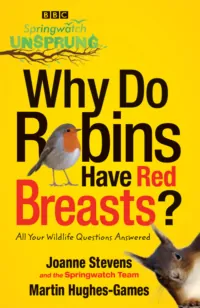
Читать книгу: «Springwatch Unsprung: Why Do Robins Have Red Breasts?»

Dedication
For my parents, who always encouraged me to go outside and have little adventures.
Contents
Cover
Title Page
Dedication
Introduction
Spring
Summer
Autumn
Winter
Sources of Information and Inspiration
Acknowledgements
About the Authors
List of Searchable Terms
Copyright
About the Publisher
Introduction
Since Springwatch first hit our television screens back in 2005, the series has developed an enduring two-way relationship with its audience that is unique in UK broadcasting. Springwatch tapped into the public’s passion for natural history and invited the audience to get involved, ask questions and share their experiences of observing their local wildlife. It started with good old-fashioned letters, videotapes and comments on the programme’s website, but the conversation has today evolved to various social media networks like Facebook, Flickr and Twitter. Whatever the method of communication, one thing remains the same – the audience’s undimmed enthusiasm and endless thirst for knowledge.
By 2009, frankly, the show was inundated; thousands of beautiful photos, hundreds of hours of interesting footage and countless intriguing queries poured in from the audience. To accommodate all of this brilliant content a sister show called Springwatch Unsprung was spawned, with the inimitable Martin Hughes-Games at the helm. Subsequently, Autumnwatch and Winterwatch also gained their own version of Unsprung. Like its host, Unsprung can be anarchic, chaotic and irreverent, but at its heart lies a desire to rekindle a child-like wonder and curiosity about nature. It includes quizzes, live animal guests, artists and other guests who make a living from or have a hobby that involves nature. As a live, unscripted and unrehearsed show anything can happen – and it often does. Ultimately, though, Unsprung is made by the audience; without their input the show simply wouldn’t exist.
Still, even with Unsprung, there just wasn’t enough airtime to answer all the compelling questions that were sent in – proof, if it were needed, that UK wildlife can be just as fascinating as exotic foreign species. Hence this book, as an effort to scratch that metaphorical itch of a nagging wildlife query. You know what it’s like … those niggling but profound questions in life that strike when you’re walking to work, pottering in the garden or beachcombing with the kids (children always seem to ask the simplest but most challenging questions!). Why do ladybirds have spots? Do snails get slower with age? How do moths find their way in the dark? Do oysters dream? And why, oh why, do dogs love rolling in fox poo?!
You’ll find the answers to all these and other equally perplexing questions in this book, arranged by season. Martin Hughes-Games has written an introduction to each section to inspire, inform and boost your natural history knowledge so that you can impress (?!) your friends in the pub. There are some mind-boggling quizzes thrown in for good measure too. And if reading about nature spurs you into action in the real world, there’s a selection of wildlife organisations that would welcome your support and involvement. While Unsprung can’t be re-created exactly on paper, hopefully its spirit shines through in these pages.
Spring

Spring – surely our most uplifting and optimistic season? The thrill of seeing the first flowers, usually the lesser celandine with its gleaming golden petals, the naughty green shoots of Arum (lords and ladies) poking through the brown debris of winter (a plant which probably has more rude colloquial names than any other UK plant, due to the shape of its phallic stamen within the fold of the first leaf), and the shattering sight and smell of a bluebell wood, seemingly hovering an inch or two above reality. How can it be so dazzling? The colours are almost unreal, created from nothing more than air, sunlight and water, with a pinch of minerals from the soil. Magic.
Along with the bluebells there are often great swathes of powerful-smelling ramsons at this time of year. A girlfriend once cooked me a quiche flavoured with ramsons (wild garlic). It was, honesty compelled me to be frank, quite horrid and I foolishly said as much. That was some 30 years ago and she’s still not forgiven me!
Suddenly eggs appear in nest boxes as my chickens start to lay again after a winter of rest. Soon I’m making holes in compost with a pencil to plant tomato seeds. Then there’s the almost forgotten sensation of the Sun’s warmth on bare skin … Yes, spring is one of the glories of living in the UK because, of course, in some countries the different seasons are not so clearly defined – they cannot enjoy this incredible sense of rebirth after a gloomy, desolate winter as new life explodes all across the countryside.
In early April I scan the sky with a mounting sense of expectation. Then, suddenly, there it is – the first swallow of the year, sweeping through the sky, chesting up on the breeze, all the way from Africa, bringing with it the promise of warm days to come.
There are a host of things to see and do in spring. Watch out for migrating toads early in the year; thousands of them wake up from their winter torpor and start to march, en masse, towards their favourite breeding ponds. This can be a seriously impressive spectacle. Writing in 1188, Gerald of Wales slightly misinterpreted the toad migration:
‘In our own days,’ he says, ‘a young man was persecuted by a plague of toads. It seemed as if the entire population of toads had made an agreement to visit him. Toads came flocking from all directions, more and more of them until no one could count them. In the end the young man’s friends who were trying to help were quite worn out.’
So far so good, but then Gerald comes off the rails – as ever, scientific verisimilitude thrown out the window for the sake of a good yarn:
‘The toads killed him and ate him right up leaving nothing but his skeleton!’
Migrating toads often have to cross roads and passing cars can, inadvertently, cause carnage. If you would like to help you can find local toad patrols at www.froglife.org/toadsonroads.
I’m going to feature a special ‘Unsprung’ word for each season, and the one for spring is ‘guffing’. Male newts display to the females underwater and at the end of their display they sometimes come up close and blow a bubble of air at her as if to say, ‘I did all that and still have air to spare!’ This bubble blowing is called ‘guffing’.
Chris Packham and I went badger watching recently and it’s surprisingly exciting – as Chris says, you keep thinking something is going to emerge from the sett entrance in the next 30 seconds. Badger watching is especially rewarding in spring as the youngsters make their first appearance above ground and, having been stuck underground in the sett for many weeks, they tend to be particularly feisty. There are many local badger watching groups to be found at www.badger.org.uk/content/Living.asp.
Of course, spring wouldn’t be spring without mad March hares. I was once filming for Springwatch on Isla with Simon King and he suddenly said ‘quick, quick! Those hares over there – start filming them!’. Frankly I was bemused, it was interesting to see hares, there were six of them all together, but …? Gradually Simon, as only Simon can, revealed the real drama of what was going on. There was one female, just coming into season, and the other five hares were potential suitors. It was fascinating to watch the males chasing the female in turn and seeing her beat them off (and the fur really flies) until, finally, she made her choice. Fighting ‘mad March hares’ are generally females beating off unwelcome suitors, not males fighting each other.
The dawn chorus is one of the greatest wildlife experiences it is possible to have – no, honestly! – and it peaks in spring. Why not get up at first light, make a nourishing cup of tea and step outside into a magical world, a symphony of natural sound. I guarantee you’ll feel uplifted for the rest of the day. If you want to find out who’s making all the music there are organised dawn chorus walks up and down the country, look up your nearest one on: www.countryfile.com/countryside/top-10-dawn-chorus-walks.
The date I hear the drone of my first bumblebee of the year goes straight into the diary. It’s another joyful reminder that summer is on its way. In fact, we have no less than 25 different species of bumblebee. The first ones you see and hear will all be queens who, having hibernated all winter, are now prospecting to find a place in which to nest and start a new colony, often an old mouse hole. If it’s a cold morning and you hear a subdued buzzing sound coming from one place, have a look and you might see something curious. Bees have to ‘warm up’ flight muscles to a critical temperature (30°C) before they can actually take off. To do this they disengage their wings, then activate the muscles which warm up, without the wings moving (rather like pushing down the clutch in the car and revving the engine), then, once the critical temperature is reached, the wings are re-engaged and the bee takes off. Magic! There’s a lovely video of this on the BBC website: www.bbc.co.uk/nature/life/Bumblebee#intro.
Moths and other flying insects do this too.
To help bees, moths and butterflies in your garden why not plant flowers specifically to provide food and shelter for them? Best of all, plant a sequence of plants that will flower all year. There’s some useful advice on the best way to do this at: www.butterfly-conservation.org/93/give-time.html.
Finally, if you are really serious about helping wildlife, get in touch with your local rescue centre. This time of year they are often inundated with injured and abandoned baby animals, fox and badger cubs, deer and a host of birds. They often welcome volunteers and you will find yourself intimately involved in helping to care for wildlife. It’s an emotional roller coaster, though, once you get involved, so be warned!
At a Snail’s Pace 
How long do snails live? Do they get slower with age? Nature Lover
Both the lifespan and speed of a snail vary according to the species. There are thousands of snail species worldwide but of those only about twenty are regularly found in our gardens. Whether or not they live to a ripe old age depends on how well they avoid parasites, disease or predators – and there are plenty of these around; thrushes in particular will readily make a meal of a juicy snail or two. Most snails will survive for only two or three years, but Edible or Roman snails (Helix pomatia) can live for several decades – the oldest known individual reached an impressive 35 years old.
As well as predators and parasites, snails also have to endure extreme weather conditions. They have adapted to survive several months of dry or cold weather by covering their shell opening with an epiphragm – a layer of mucus that dries out to form a barrier which prevents water loss. Some species, such as the Roman snail, can produce a much more substantial and solid epiphragm which is reinforced with calcium carbonate before the mollusc goes into hibernation. Snails can also protect themselves in winter by changing the composition of their blood, or haemolymph, to prevent it freezing. The common garden snail (Helix aspersa) can survive in temperatures down to minus 5 degrees Celsius.
Snails are renowned for their slowness, but they have no need to rush anywhere. The majority of species are herbivores, so they don’t have to chase after prey, and to escape most predators they need only to retreat within their shell. Snails may be slow but they are strong; when tested, one species was able to drag 50 times its own weight horizontally and nine times its weight vertically.
A snail moves by expanding and contracting its muscular foot in waves, and as it does so it secretes a slimy mucus that lubricates its path and reduces any friction on the surface beneath. You can watch how they do this by putting one on a clean drinking glass or windowpane. If you liquidise a little lettuce and smear some on the glass you may be able to see their tongue, or radula, in action too. While you’re there, you could test their speed. Garden snails can crawl up to 1.3 centimetres per second, equivalent to about 0.05 km/h. The fastest known garden snail was called Archie. ‘He’ (snails are hermaphrodites) slithered 33 centimetres in two minutes at the 1995 World Snail Racing Championships held in Norfolk. At the time of writing, Archie’s world record remains unbroken.
Archie’s racing days were numbered, though, because like most of us, he would have got slower with age. Scientists often use the common pond snail, Lymnaea stagnalis, as a model species for studying the central nervous system and investigating how brains change with age. Results so far show that older pond snails are more forgetful than young ones and feed more slowly. It seems that geriatric snails are generally more sluggish …
Flying the Nest 
What happens to fledglings during their first few nights in the big world? Do the parents stay close by or do they call throughout the night as reassurance to the young? Or, apart from feeding, are the young basically alone? Tony from Gloucester
When fledglings leave the nest, am I right in assuming they never return to it? In which case, where do they spend their first night outdoors? I know that the nests get quite dirty and parasite-ridden, but even so it seems awfully harsh that they spend all their young lives in the safety of a warm nest and then – BAM! – just like that they’re out on their own, never to return? Kate
How ‘capable’ should blue tits be when they fledge? I have a blue tit nest in the vent of an extractor fan and the three young left the nest two days ago. They were feathery but barely able to toddle, let alone fly, and showed no inclination at all to seek shelter or move away from a potential predator – me. Five hours later, when almost fully dark, two were still sitting out in the open on my doorstep cheeping loudly. I haven’t seen them since, dead or alive, but they didn’t look like survivors. Did they jump too soon, or are blue tit babies always like this? Stocksfield
Leaving the nest is one of the most dangerous times in a bird’s life. Fledglings need to learn fast; they have to work out how to fly, find their own food and avoid becoming someone else’s dinner. Mortality is high and many blue tit chicks don’t make it – only 38 per cent live for over a year. This is why blue tits lay so many eggs in a clutch (usually 8–10 but up to 16), to increase the chances of at least some of them living to adulthood.
Once chicks of garden birds leave the nest, they rarely return. As Kate points out, the nest is pretty smelly after having a growing family squeezed into it for a while, with droppings and food remains building up. That scent can attract predators. Instead, it is safer for chicks to leave the nest and venture out into the big wide world.
Many garden birds fledge just before they can fly and blackbird chicks leave the nest two or three days before they can take to the air. Fledglings often split up and hide in inconspicuous places, waiting to be fed by their parents. From the parents’ point of view, it’s safer to split up their offspring around a garden than risk keeping them together where, if found, all the chicks may be taken. Blue tit parents encourage their chicks to leave the nest by enticing them with food and calling to them. Those blue tits chirping on the doorstep were certainly in a risky position, as usually parents would guide their youngsters to a safe place.
If you do find an apparently abandoned chick, don’t be tempted to ‘save’ it too hastily. Instead, try leaving it alone and watch from a distance unless it is in immediate danger or very exposed, in which case move it quickly and gently into some cover, like a bush. The parents are probably nearby and will return to look after it when the coast is clear. Fledgling blue tits usually stay with their parents for a couple of weeks, relying on them for food initially while they learn how to be a blue tit and fend for themselves.
Angry Birds 
Why do blue tits fly up to windows and try to ‘attack’ their reflections? Cal
During the breeding season, birds are fired up by hormones and males can become particularly feisty, especially if they are trying to defend a territory. If the resident male catches sight of his reflection in a window, car wing mirror or other shiny surface he will try to see off the apparent ‘intruder’. It is most common to see this behaviour in spring, but birds that hold territories throughout the year, such as robins and grey wagtails, may be up for a fight at almost any time. A robin wouldn’t hang around attacking a mirror for long, though, as it defends its patch by finding a higher perch than its rival and would soon lose its reflection. An angry bird can be very persistent, keeping up the aggression for hours or sometimes days – this intruder just won’t leave! Usually the bird won’t hurt itself but it is a huge waste of their time and energy. If you’re concerned (or irritated!) you can help to remove the reflection by covering the window or mirror with paper or fabric.
You may be wondering why the bird doesn’t recognise its own reflection like we would. Natural reflections are rare and would soon disappear if attacked, for example in a puddle or pond. Very few animal species have been shown to recognise their own reflection, but biologists are very interested in this ability because it can give an insight into how animals’ minds work. To find out if an animal can recognise itself in a mirror, biologists put a coloured mark somewhere on its body while it’s unconscious or asleep in a place that it would only be able to see in a mirror, for example under its chin or on the end of its nose. If the animal pays attention to the mark in its reflection and touches its skin then this suggests that the animal understands that the reflection is itself. The ability to recognise oneself in a mirror suggests some kind of self-awareness.
A human baby doesn’t work out that the infant it can see in the mirror is actually itself until it reaches about 18 months old. This is about the same time that children develop what’s called a ‘theory of mind’; that is, they can infer what other people are thinking or feeling and begin to be able to put themselves in someone else’s shoes. Whether animals can do the same is a matter of huge debate among biologists who study animal behaviour. So far the only other animals shown to recognise their own reflections are similarly large-brained mammals such as chimpanzees, orangutans, elephants and bottlenose dolphins. However, there is one bird that has passed the mirror test: the magpie. Members of the crow family have been shown to be very intelligent, but does this mean that they are self-aware too …? It’s certainly food for thought.
Бесплатный фрагмент закончился.

Начислим +5
Покупайте книги и получайте бонусы в Литрес, Читай-городе и Буквоеде.
Участвовать в бонусной программе