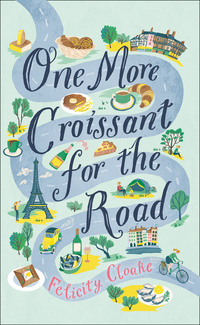
Читать книгу: «One More Croissant for the Road»

Copyright
Mudlark
An imprint of HarperCollinsPublishers
1 London Bridge Street
London SE1 9GF
www.harpercollins.co.uk
First published by Mudlark 2019
FIRST EDITION
Text © Felicity Cloake 2019
Illustrations and cover illustration © Sara Mulvanny/Agency Rush 2019
Cover layout design © HarperCollinsPublishers Ltd 2019
Felicity Cloake asserts the moral right to be identified as the author of this work
A catalogue record of this book is available from the British Library
All rights reserved under International and Pan-American Copyright Conventions. By payment of the required fees, you have been granted the nonexclusive, non-transferable right to access and read the text of this e-book on screen. No part of this text may be reproduced, transmitted, downloaded, decompiled, reverse engineered, or stored in or introduced into any information storage retrieval system, in any form or by any means, whether electronic or mechanical, now known or hereinafter invented, without the express written permission of HarperCollins e-books.
Find out about HarperCollins and the environment at
www.harpercollins.co.uk/green
Source ISBN: 9780008304935
Ebook Edition: June 2019 ISBN: 9780008304942
Version: 2020-03-02
Dedication
For my sausage-scoffing, plonk-sinking peloton – with whom the glass was always half full
Contents
1 Cover
2 Title Page
3 Copyright
4 Dedication
5 Contents
6 Prologue
7 STAGE 1: The Grand Départ, London to Cherbourg
8 STAGE 2: Cherbourg to Avranches
9 STAGE 3: Avranches to Dol-de-Bretagne
10 STAGE 4: Dol-de-Bretagne to Saint-Malo
11 STAGE 5: Saint-Malo to Redon
12 STAGE 6: A Stage in Two Parts: Redon to Tours, Paris to Lamotte-Beuvron
13 STAGE 7: Limoges (Circuit)
14 STAGE 8: Limoges to Bayonne
15 STAGE 9: Bayonne to Pau
16 STAGE 10: Pau to Carcassonne
17 STAGE 11: Marseille
18 STAGE 12: Marseille to Nice
19 STAGE 13: The Col de Joux Plane
20 STAGE 14: Lyon
21 STAGE 15: Chalon-sur-Saône to Dijon
22 STAGE 16: Strasbourg to Meistratzheim
23 STAGE 17: Meistratzheim to Nancy
24 STAGE 18: Toul to Bar-le-Duc
25 STAGE 19: Bar-le-Duc to Reims
26 STAGE 20: Reims to Bondy
27 STAGE 21: Bondy to Paris
28 Vital Statistics
29 Acknowledgements
30 Praise for One More Croissant for the Road
31 About the Publisher
LandmarksCoverFrontmatterStart of ContentBackmatter
List of Pagesiiiivv1234567891011121314151617182122232425262728293031323334353637383940414243444546474849505152535455565758596061626364656667697071727374757677787980818283848587888990919293949596979899100101102103104105106107108109110111112113114115116117119120121122123124125126127128129130131132133135136137138139140141142143144145146147148149150151152153154155156157159160161162163164165166167168169170171172173174175176177178179180181182183184185186187188189190191192193194195196197198199200201202203204205206207208209210211212213214215216217218219220221222223224225226227228229230231232233234235236237238239240241242243244245246247248249250251252253254255256257258259260261262263264265267268269270271272273274275276277278279280281282283284285286287289290291292293294295296297298299300301302303304305307308309310311312313314315316317318319320321322323324325326327328329330331332333334335336337338339340342343344ii
Prologue
A green bike drunkenly weaves its way up a cratered hill in the late-morning sun, the gears grinding painfully, like a pepper mill running on empty. The rider crouched on top in a rictus of pain has slowed to a gravity-defying crawl when, from somewhere nearby, the whine of a nasal engine breaks through her ragged breathing.
A battered van appears behind her, the customary cigarette dangling from its driver’s-side window, and shakily she rears out of the saddle, grubby legs pumping in a surprising turn of speed. As he passes, she casually reaches down for some water, smiling broadly in the manner of someone having almost too much fun. ‘No sweat,’ she says jauntily to his retreating exhaust pipe. ‘Pas de problème, monsieur.’
The van disappears round the next hairpin. Abruptly our heroine dismounts, allowing the heavily laden bike to crash into a pile of brambles, describing an arc of chain grease across her bruised shins en route. Grumpily slapping away a thirsty horsefly, she reaches into the handlebar bag and pulls out a half-eaten croissant.
After peeling off a baby slug and flicking it expertly onto her own shoes, she sinks her teeth into the desiccated pastry, and squints at the map on her phone. Only another 40km to go before lunch.
In the distance, there’s a rumble of thunder.

It’s not like I wasn’t warned. I’d witnessed the danger of turning a hobby into a job first-hand at a magazine publisher I’d once worked for, who regularly offered a bonus for anyone willing to give up their weekend to help with photoshoots for some of their more niche titles. No one ever did it twice.
As the new IT manager wearily switched my computer off and then on again one Monday morning, I asked him how his first gig for Mega Boobs had gone – he’d been so excited about it on Friday. He shook his head: ‘Believe me, Felicity,’ he said in a small, sad voice, ‘you really can have too much of a good thing.’
Poor Hamid. Almost a decade later, I can still see the betrayal in his eyes – but those who don’t learn from history are doomed to repeat it, and, hard as I tried, I just couldn’t shake the urge to eat my way around France. (I’ll be honest, I didn’t try that hard.)
The absurd notion of doing it on two wheels came later, in the summer of 2017, when I rode from the Channel coast to the Mediterranean with a friend who’d recently quit her job in London to move to Provence. In the interests of wringing maximum drama from her departure, Caroline decided to make the journey by bike. I went along on a whim and realised, somewhere around La Rochelle, that I’d never had so much fun in my life.
France, I found, is a place built for cycling and, happily, for eating, too – a country large enough to give any journey an epic quality, but with a bakery on every corner. Here, it seemed to me as I rode through shady forests and sun-baked vineyards, you could go from beach to mountain, Atlantic to Mediterranean, polder to Pyrenees, and taste the difference every time you stopped for lunch.
Three weeks away from a computer gives you a lot of time to think, and as our little peloton pedalled south, a book began to take shape, a Grand Tour of French gastronomy, visiting dishes in their terroir, picking up tips, putting on wisdom as well as weight. The idea marinated for the next 697km, becoming increasingly less ludicrous with every pichet of local wine we swallowed.
When I got home, I told everyone I was going to do a Tour de France.
The indefinite article is important. I’m no Geraint Thomas, but I’ve always ridden a bike, pootling round town on a beautiful but big-boned Pashley, often with a similarly built dog ensconced in its capacious wicker basket. To my own surprise, in recent years I’ve fallen in love with cycling for its own sake too, mostly, but certainly not only, because of the amount you can get away with eating under the flimsy pretext of refuelling.
It all started when I joined a group of friends on a trip from Calais to Brussels in 2014, simply because I’d just been dumped, and it seemed like a good time to do stupid things. Until then, with the exception of the odd flash of elation while careering down Highgate Hill after a glass of wine, I had never really realised that cycling could be fun. Efficient, yes; cheap, certainly! – but enjoyable? In London, a city of mad bus drivers and careless cabbies, where every second pedestrian is FaceTiming their mum in Melbourne rather than looking at the road, and the Boris Bikers are the worst of the lot? No.
That trip, however, was quite different. No one had told me of the quiet satisfaction of pumping your way up a hill, weaving over the saddle like Lance Armstrong on a blood bender, knowing you have just enough left in the tank to make it over the brow, or the eye-watering thrill of the open road on a fast bike with the wind behind you. No one mentioned how sometimes it feels like the bike is part of you, an extension of your limbs, and sometimes, when the sodding chain pops off for the fourth time it feels like you’re locked in noble mortal combat. And most of all, no one told me about the giddy camaraderie of the peloton … even when your only goal is getting somewhere in time for lunch.
From the frankly dreadful fry-up on the ferry, feeling like bold adventurers among the dull hordes of motorists, to the commemorative cream cakes we ate on the steps of a bakery after our first, modest ascent (who knew they had hills in Flanders?), it was a joy from start to greedy finish, and not just because of the ready supply of hot crispy frites.
Two-wheeled travel offered other pleasures, too. Coming up close and personal with big-eyed cows, and stopping to gaze at hot-air balloons as they drifted across the vast Belgian skies. Rounding a corner to find an immaculately tended Great War graveyard, the endless rows of neat white gravestones causing us to fall silent for the next few kilometres and feel glad to discover, mooching around a market the next morning, that life in Ypres hadn’t stopped in 1918. Scoffing cider and cake in an orchard outside Bruges, and making friends with an enormous slavering Bernese mountain dog as the owner lectured us on the folly of the British attitude to Europe (yes, even in 2014, that pot was already coming to the boil). Racing each other through the flat, gravelled trails of the Ardennes forest, and wandering, slightly bow-legged, through a misty Ghent at dusk, high on life after getting my tyres trapped in some tram tracks. Posing for photos by the sign to Asse, pointing saucily at our padded bottoms like Benny Hill’s backing band, as a couple of bemused locals clicked the shutter. And falling asleep in full gear on the Eurostar home with a tiny bottle of wine and a lingering sadness that it was over – and suddenly, I was a Cyclist.
Like all new cyclists, I celebrated by buying loads of kit – stupid clicky shoes that made me walk like a duck, and technical fleece-lined leggings entirely de trop for expeditions around Home Counties pubs, or the trip to Brighton where I made the mistake of eating fish and chips just before tackling Ditchling Beacon. I did a couple of 100-mile sportives, fuelled almost entirely by malt loaf, a glorious four days eating crêpes and drinking cider from teapots in Brittany – and then, summer 2017, came that ride down to the Mediterranean, the biggest and greediest yet, when I finally realised my destiny lay in pedalling round France, eating stuff.
Of course, cycling is a pleasure in itself – as an adult, there’s little as thrilling as freewheeling downhill, wind deafening in your ears, eyes streaming, mouth open in a silent scream of pure joy – but for me at least, there’s as much pleasure in a pint and a pie afterwards, to say nothing of the snacks en route. I firmly maintain that any ride over an hour and a half requires emergency rations; what are you supposed to put in all those pockets if not chocolate and a hip flask? Someone else will always have tyre levers, but not everyone, sad to say, knows the restorative powers of Cadbury’s Wholenut.
Yet, spindly though the pros may be, cycling has always been a peculiarly epicurean pursuit. In the early days of the Tour de France, one wealthy competitor had his butler lay out lavish picnics by the side of the road, while Henri Cornet, winner of the second race in 1904, apparently achieved victory on daily rations that included a staggering 11 litres of hot chocolate, 4 litres of tea and 1.5 kilos of rice pudding. Bernard Hinault, who triumphed five times in the late Seventies and Eighties, glugged champagne on the last climb of the day, while the equally great Eddy Merckx refuelled with patisserie, on the basis that ‘It’s not the pastries that hurt, it’s the climbs’ (it is this quote that later moves me to name my beloved new bike after the great man).
Even in the 1990s, Dutch pro Tristan Hoffman recalls a fellow rider starting the day with that breakfast of champions, two Mars Bars and a litre of Coke. Now, of course, nutrition is taken much more seriously, which is why you no longer get brilliant stories like that of Abdel-Kader Zaaf, who is claimed (slightly dubiously) to have got so inadvertently drunk on wine offered by generous spectators on the blisteringly hot 1951 Tour that he passed out underneath a tree.
Modern pro teams travel with their own chef, whose job it is to keep the supply of low-salt, high-protein, easily digestible food and drink coming: as Sean Fowler of Cannondale-Drapac delicately put it in a 2017 interview, ‘intestinal stress’ is less than ideal in a tour situation. That means rice rather than glutinous pasta, lots of fish and white meat, and definitely no salty ingredients that might lead to water retention. Understandably, no one wants to carry a single extra ounce up an Alp.
Sickly energy gels and bars are handed out to riders en route, along with rice cakes, fizzy drinks (‘for a bit of pleasure’) and the odd ham sandwich, if they’re lucky. On particularly tough stages, however, competitors struggle to find the time to swallow all the calories they need and still keep up with the race – ‘You kind of have to force it down,’ according to current pro Joe Dombrowski. I literally cannot imagine burning 7,000kcal in a day, and not stopping for a bar of Milka. In fact, so much wasted opportunity for sugar makes me feel a little bit weepy.
As a result, I never watch the Tour on TV without a large box of chocolates; though I’m no sports fan, it has a nostalgic pull for me. The occasionally excitable, generally soporific commentary was the soundtrack to the summer holidays of my childhood, turned up loud in the campsite bar to compete with the thwack of plastic on rubber and the squealing ruckus around the babyfoot table. Those endless afternoons eating Mr Freeze lollies and waiting for a turn at ping-pong have left me with a lifelong weakness for men in Lycra and cycling’s most famous race.
The glorious backdrops are a part of it, of course: no one who spent every childhood summer somewhere in l’hexagone can be entirely immune to the attractions of a neat Norman village flashing by at speed, or indeed one of those endless straight routes départementales flanked with poplars and enormous billboards for thrillingly large hypermarchés ‘à gauche au feu’. I see France zip past behind the riders, and my heart aches for it – for the landscapes and people, the Orangina and bad pop music, and most of all, for its glorious, glorious food.
My tour will be in less of a hurry than the actual race – bad for the digestion, and if I’m going to do this properly, there will be a lot of digesting on the menu. When I sit down and try to make a list of my 21 favourite French foods (to match the number of stages in the real Tour), not only is it hard to whittle them down, but those that make the cut come from almost every corner of the country, with the exception of the far Nord, which, despite an admirable facility with the deep-fat fryer, did not particularly wow me with its cuisine on my previous visit.
And whereas a list of my most treasured British dishes would skew heavily towards stodge, this lot, though a little low on salad, is pleasingly varied: (almost*) anything we can do, France does better. They’ve even beaten us on our specialist subject, the spud – I like a baked potato as much as the next noted gourmand, but I think we can all agree that Alpine tartiflette takes it to the next level. (Mostly by adding more cheese.)
The dog and I make a trip to Stanfords in Covent Garden, home of every map under the sun, and pick up a massive road atlas that seems to list every hamlet and track I might possibly wish to traverse, as well as a map of national bike routes, which, it quickly becomes clear, will be of almost no use to me whatsoever. These purchases give me the pleasing sense, as I spread the map out on the floor at home and try to stop Wilf trampling muddy paws across the Bay of Biscay, of embarking on an expedition. They also make terrifyingly clear how large France is.
Taking a deep breath, I open the atlas. Dodging Calais and its horse-fat frites, it makes sense to start off with moules in Normandy, then curve round the coast to Brittany, which does such good crêpes and butter and, even better, crêpes with butter. From the wind-swept Atlantic coast I’ll start to head south, first to the Loire Valley, home of the tarte Tatin, as well as all those famous chateaux everyone goes on about, then down to Limousin to coo over some of its famous cattle, before zipping through Bordeaux towards the Spanish border and Bayonne, the French capital of chocolate.
Having run out of France to the south, and skirting a furry tail currently draped over the Pyrenees, my route turns east for poule au pot, and the cassoulet country of the Languedoc, before hitting the Côte d’Azur, with its rust-red fish soups and deliciously oily ratatouille. Tempting as it is to head for Provence proper at this point, that herb-scented heaven-on-earth where I spent every rosé-soaked summer of my twenties, I fear I’d never tear myself away in mid-June and I cannot ignore the siren call of tartiflette from my second-favourite place in France, the Haute Savoie. I wish I could say that it’s the thrill of the physical challenge that attracts me to the mountains, but it isn’t, it’s the cheese.
From there, the map suggests I’m quite close (i.e. a-whole-day-on-a-train close, due to aforementioned size of country) to Lyon, often touted as the culinary capital of France. Though I’ve only driven past it, my reading suggests it specialises in an extraordinary array of animal parts, and oddly, one of France’s best salads, the lyonnaise, with its bitter leaves dressed with salty bacon fat and rich, runny egg yolk.
The logical next stop on my way north is Burgundy, for all sorts of things cooked in its perfect wine, but particularly beef, sticky, soft and intensely savoury, and then, looking at the route I’ve traced thus far, which flirts with the Spanish, Italian and Swiss borders, it feels like a dereliction of duty not to go and make eyes at the Germans in Strasbourg, too.
It’s a long way to go for some fermented cabbage and faggots, and yet I have a lot of time for fermented things and sausages, especially washed down with cold beer. Also, I note with satisfaction that this puts me in the ideal place to knock off a wobbly quiche Lorraine in Lorraine, and the fluffy little madeleines that occupy such a central place in the national psyche, before making a triumphant entry into Paris via Champagne, which may or may not have invented French onion soup (and God, who doesn’t love French onion soup, all cheesy and oozy and glorious?), but which does, happily, have an awful lot of fizzy wine going for it.
Paris, of course, like any cosmopolitan capital city, is a place where you can eat yourself around the globe, but my ambitions are more modest. I’m hoping, as a crescendo of my trip, to achieve croissant nirvana in the city of light. Certainly, I’ll have eaten enough of the things by then to judge what’s good and what’s not – I’m intending to put away at least one a day, barring any more interesting offers.
PAUSE-CAFÉ – The Croissant Rating System

Pay attention, because you’re going to be seeing a lot more of this. I started rating croissants on the coast-to-coast trip of 2017, for no better reason than they’re reliably found throughout France, I enjoy over-thinking food and most importantly I like them. The perfect croissant is, of course, entirely a matter of taste – professional pâtissières put a lot of store by the lamination of the dough, or how skilfully the pastry and butter have been folded together to create hundreds of distinct layers: according to one equation I find online, the average croissant has 649. Me, I’m less concerned with looks; some of the most disappointing pastries I’ve eaten in London are the ones flaunting their perfect strata of dough all over social media, but which turn out to have very little in the way of flavour. What I look for in a good croissant is:
1 butteriness (no margarine-based croissants for me)
2 a good balance of caramelised sweetness and bready savoury notes
3 a crisp base
4 a slightly damp middle – squidgy but not doughy
In the text that follows, all scores are out of 10: 1–4 denotes a poor croissant not even worth finishing (a croissant contains about 260kcal); 5–7 as a mediocre-to-decent example not worth complaining about and 8+ as a good croissant worth repeating immediately if time permits.
It’s a satisfyingly neat loop around the country, but one, I note, that covers an awful lot of ground. A cursory google turns up the terrifying fact that France is the largest country in Western Europe, a whopping 27 times the size of Wales. Distances are vast – it looks like it might take me at least three days to cycle across Brittany alone.
Unfortunately, I have a day job as a weekly columnist, and a mortgage to pay, to say nothing of a terrier with a truly prodigious appetite; I can’t afford to dawdle around this place like a tourist – I need to be a Tourist. So like the boys in Lycra,† I’ll need the odd lift. Until quite recently I’d assumed the Tour de France actually rode around France, but they don’t; they get on team coaches and doze their way to the next starting line. Me, I’m going to let the train take the strain.
To add to the fun, I’ve hit a summer of rail strikes: two days out of every seven are to be given over to industrial action in a dispute over President Macron’s attempts to open the passenger network up to competition. On the plus side, the dates have been announced in advance. On the minus side, the actual services affected won’t be decided until the night before, which makes the whole thing a bit of a Russian roulette.
PAUSE-CAFÉ – Cycle Touring: A Bluffer’s Guide
If the reactions of my friends and family are anything to go by, anyone who hasn’t ridden a bike since childhood finds the idea of weeks doing nothing but this a bit daunting. In fact, as I always breezily explain, cycling is much easier than running, especially when your feet are actually stuck to the bike. Once you’ve got going, momentum will keep your legs spinning round with surprisingly little effort on your part, and on good roads with a forgiving gradient, you can cover a decent distance without much expertise: it’s not for nothing that 100 miles is said to be the cycling equivalent of running a marathon, though having done both (preens), I can confirm a marathon is a lot more unpleasant.
Cyclists tend to measure distances in kilometres rather than miles, just like they tend to drink espressos rather than tea, and call their silly hats casquettes rather than caps. It’s Rule 24 in the Velominati handbook (the Velominati being a half-jokey online cult to the two-wheeled god) and one of the few that I obey, mostly because 50km sounds a lot more impressive than 31 miles (though they’re also right that all shorts should be black – ‘wet, dirty white Lycra is basically transparent; enough said on that matter’).
I’ve found that, when riding all day, it’s reasonable to cover between 70 and 150km depending on the terrain, weather and how much of interest is along the way, with an average speed of about 15km/h. That said, not everyone falls easily into sitting in the saddle for six hours on the trot, so 50–70km feels like a more manageable distance with company desirous of a nice holiday rather than a wholesale reconfiguration of their nether regions.
My recommendation for anyone thinking of embarking on anything similar for the first time is to make sure you have a bike that’s both light and sturdy: dedicated touring bikes will never be as featherlight as racers, but you can stick a rack on most things, and if you’re staying on tarmac, a robust road bike has always been my choice.
Other things you’ll need, apart from all the obvious stuff you’d take on holiday if you had to carry it round with you:
Panniers and rack. A bar or frame bag is also useful for your wallet, etc., though I like to keep my phone attached to my handlebars to help with navigation/show those all-important Instagram alerts on the go.
Basic toolkit: inner tube, patches, pump, multitool, tyre levers, chain lube. France in particular is well supplied with bike shops; if you’re going somewhere that isn’t, you might want to consider spare brake pads, etc.
Padded shorts and gloves: trust me, you won’t regret these if you’re doing more than a day in the saddle.
Decent lights – naive urban cyclists (me) may be startled at how dark it is on country roads.
Water bottles – I took two and ran out several times. Get big ones.
Chunky but not too heavy bike lock.
Portable phone charger – or actual maps, given that’s mostly what you’ll be using it for.
Tent, sleeping bag, rollmat (only if planning to camp, obviously).
Wet wipes. They hide a multitude of bike-oil-based sins.
Trains or not, it’s still a daunting prospect as I gaze at the little map, stuck with flags like a ham studded with cloves. Yet just the names involved make my heart leap, bringing back happy memories of summers past and journeys taken, squashed sandwiches scoffed on ski lifts and arguments in the hot, sticky back seat of a Vauxhall Cavalier.
These places might sound familiar, but I know they’ll look different from a bike. A cyclist’s pace is swift enough to make satisfying progress, yet slow enough to enjoy it, to notice the landscape changing before and, of course, under the tyres – it’s hard to get a sense of the terrain when it’s flashing past you in the car, or on the train, but when you’re forced to really feel it in your legs, it’s hard to ignore. Places seem to stamp themselves on your consciousness with startling firmness, as Graham Robb writes in his book The Discovery of France, which is to be my only constant companion, despite his admission that it’s ‘too large to justify its inclusion in the panniers’ (yep, thanks, Graham, I noticed): ‘A bicycle unrolls a 360-degree panorama of the land, allows the rider to register its gradual changes in gear ratios and muscle tension, and makes it hard to miss a single inch of it, from the tyre-lacerating suburbs of Paris to the Mistral-blasted plains of Provence.’
A cyclist can embrace the leisurely passage of time on the smaller roads, weaving as they do through hamlets on the way to nowhere, past tumbledown chateaux and fields of somnambulant cattle, and then stop for refreshments in a prosperous little town, watching the world go by at some bustling café in the soothing company of small dogs.
A bike also, of course, offers a unique opportunity to plod miserably through Zones Industrielles in the rain, and dodge lorries on a road that turns out to be bigger and scarier than Google Maps is prepared to admit, to say nothing of the ever-present and exciting possibility of eating lunch outside a Total garage because nowhere else will let you in dressed like that. They’re pretty good at both highs and lows, bikes, and that’s what makes them fun. I can’t wait.
Robb describes the actual Tour de France as ‘a joyful beating of the bounds that millions of people with no interest in sport still enjoy every summer’. Mine feels rather like that, too: a way to see how the country fits together, how the Wild West of craggy Atlantic granite and wide ocean beaches becomes the south-west of duck fat and complicated Basque consonants, to get a feeling for the state of regional French cooking, so long lauded around the world, yet as vulnerable to the very 21st-century pressures of time and convenience as anywhere else.
Is it still possible, I wonder, to find roadside places full of what the redoubtable Fanny Cradock described as ‘heavily tattooed, burly camion drivers … where the soap is attached to a string in the communal loo and the tablecloths may be of paper, but where an excellent five-course meal can be found for well under a pound’? Will I eat better in France than I would at home, and come back two stone heavier, with incipient scurvy?
My tour will have several, not insignificant diversions from its more famous namesake. For a start, as described above in luxuriant detail, my route is going to be based solely around the greatest hits of French cuisine, rather than its landscapes and local politics. Secondly, though there will be a rag-tag peloton for the most scenic bits, I’ll be mostly on my own, as it seems most of my friends, very inconsiderately, have proper jobs that preclude going away for five weeks. Thirdly, I’m going to have to lug everything with me, including a tent and sleeping bag, to leave me more to spend on food (pro teams sleep in hotels where they don’t even carry their bags upstairs themselves). And lastly … I’m a 35-year-old food writer who spends most of her working week testing recipes – and when I say testing, I mean eating them all up and licking the plate while the dog looks on with jealous eyes. Tour riders start off with about 4–5 per cent body fat. I suspect mine, though mercifully unmeasured, is more akin to a pot of clotted cream.
The problem with this last point, of course, is that it means my power-to-weight ratio – that most vital of statistics in modern sport – is sub-optimal. I’m going to be hauling a lot of unnecessary baggage round France, which is unfortunate when, according to British Cycling, ‘one of the best ways to get quicker on the bike, especially on hills, is to drop a few pounds’. I have a go, I really do, but there’s the small matter of six weeks’ worth of recipes to write and perfect before I go, and eventually I concede defeat, which is unfortunate, because the rather chi-chi cycling outfitters Café du Cycliste, based in Nice but with a smart little shop in East London, are kind enough to step in at the last minute with the offer of some gear. I’m not quite sure that I’m exactly the clothes horse they had in mind to sport the two elegant outfits they’ve picked out. ‘Does … does this come in large?’ I ask tentatively, stepping from the changing room in something so skintight you’d be able to count my ribs if they hadn’t disappeared some time in the late 1980s.
More pressingly, I don’t have a proper bike. My last true love was trashed by couriers on the way back from Marseille last summer and my first reserve, the Pashley, which weighs over 20kg even without a dog on board, is clearly not up to the task. I seek expert advice from friends like Rich, who’s into long, long rides and recommends various bikes that are eminently practical and reasonably priced, Jon, who’s into spending money on really sexy-looking bikes, and Max, who’s into cycling up mountains with the minimum of kit, and then I ignore it all in favour of one that makes my heart flutter when I look at it, and my accountant weep, despite my parents’ generous contribution in lieu of all future Christmas and birthday gifts.
Eddy (named for the pastry-loving Merckx) is a steel-framed (more flexible than aluminium on bumpy terrain, less risky than the pricy but delicate carbon frames used by the pros) Condor touring bike in Paris Green, a colour which feels auspicious. I spend an expensive afternoon in a basement on the Grays Inn Road being measured up (‘your arms are … really long’) and then a nervous month praying he will be ready in time for the off after discovering belatedly that delivery is scheduled for around the time I should be in the Loire Valley.
Fortunately, after I look ready to burst into tears in front of other customers, they manage to hurry things along and he arrives a week before the off, a thing of rare and lustrous beauty, though unfortunately I’m so hungover after a work party the night before that I fail to listen when they explain technical points about how to trim the chain, on the basis I have no idea what this means and am in no state to learn. Instead, I have a vivid flashback to telling a completely sober Nigel Slater that I loved him, over and over, and clench my fists around the handlebars in hot shame.
So I’ve got the bike and the kit and the rudimentary vocab, having enrolled in a panic cramming course at the French Institute in South Kensington and ploughed my way through various Inspector Maigret mysteries instead of packing. This at least means I’ll be able to discuss murder weapons with confidence on my journey, if required.
Yet such is the rush before I go that I don’t quite make time to check if all my gear will fit in my new bright yellow panniers. Sitting in the corner of the bedroom gathering dust, they look vast in comparison with the one I’ve used previously, yet I have a sneaking suspicion that once I’ve included important morale-boosting items like Marmite and sloe gin, there might not be an awful lot of room for luxuries like spare inner tubes and plasters.
Naturally, instead of dealing with the problem, I insist on throwing a Royal Wedding Party for the nuptials of Harry and Meghan, to the evident dismay of my friends, who nevertheless come and support me, because that’s what friends do. Gemma even brings me a tiny bottle of Echo Falls rosé to stick in my panniers.
‘I’m really looking forward to it,’ says Matt, who is accompanying me for the first few days and claims he’s ‘all sorted’, as the three of us – the last survivors of the Happy Event – sit outside the pub at dusk, drinking snakebite and black (it seemed funny when I ordered them).
I giddily watch the dog begging for crisps on the other side of the bar, and vaguely wonder who he belongs to. ‘Yeah, me too,’ I say. ‘Do you think I should go home and pack?’
* With the exception of breakfast, picnic food and cakes, all of which I reckon the UK has the edge on.
† Don’t get me started on the iniquities of the Women’s Tour.

STAGE 1
The Grand Départ, London to Cherbourg

Douillons aux Poires – or Pears in Pyjamas
The Norman equivalent of an apple turnover but with a much cooler name. Considered rather homely fare, you won’t see them on many restaurant menus, but you may well find them in boulangeries. They’re best eaten warm from the oven, with a big dollop of crème fraîche.
It’s 3 a.m., and things are not going according to plan. Instead of the sound night’s sleep I’d been planning, perhaps after a couple (definitely just a couple) of farewell drinks with friends, I’m sitting glumly on a pile of new Lycra, chilled fizz unopened in the fridge, the bin overflowing with packaging, struggling to keep my eyes open and wondering if I should just open the Echo Falls and be done with it. An old friend who offers to pop in on her way home from a night out to say goodbye ‘if you’re still awake!’ gets a couple of paces through the door, regards the chaos before her with visible alarm and declines my kind offer to stay and chat – ‘you look like you’re a bit busy’.
Frankly, I don’t know how I do it, let alone find the time to post a jaunty photo of my almost-empty fridge on Instagram (‘I hope those ferments don’t explode,’ someone comments, once it’s far too late to be helpful) and send friends a mad-eyed selfie wearing my ridiculous new sardine-patterned cap … but somehow I get a couple of hours’ kip before getting up to check yet again that I have the essentials, like a salami knife and a pot of pink nail varnish, and enjoy a final, vast cup of tea.
It’s a solemn moment. I start every day with a mug of English Breakfast, the colour of damp – but not wet, not even soggy – sand, made with boiling water and fresh milk, which definitely rules out anything from the train catering trolley, let alone any prettily tinted tisanes the French might serve under the name of thé. This will be my last cuppa until July, and let me tell you, it’s emotional. Though to be honest, that could also be the exhaustion setting in.
Pushing past Eddy waiting patiently in the hall, I go to meet a friend and her baby who’ve come to wave me off – and, listening to the gory details of the birth, feel relieved to be able to spend a few minutes revelling in someone else’s suffering instead of my own. I’d planned to have a symbolic full English, but in the end, thinking of what’s to come, I wimp out and go for avocado on toast with a feral-tasting kombucha on the side as a final taste of Islington.
Back home, while Hen changes Gabriel on the sitting-room floor (there’s about as much dignity in being a baby as a long-distance cyclist, it seems), I change my own clothes from those appropriate for breakfast with a friend to those needed to ride a Grand Tour – or at least the 4.73km I’ll be covering on the way to Waterloo. To their credit, neither of them laugh when I emerge.
Sweetly, Hen obligingly takes several photos of me standing proudly with my unwieldy steed outside the house as passers-by gawp, trying her hardest to find a good angle for a food writer clad entirely in Lycra, and then I can delay no longer – it’s time to leave. Eddy and I wobble unsteadily out of the gate and down the kerb, I manage a half-wave and smile for the camera, and ride straight into the back of a stationary double-decker bus – thankfully at very low speed, denting nothing but what little is left of my pride.
After peeling myself off an advert for an evangelical concert in Leytonstone, I discover, within two turns of the pedals, that my shiny new yellow panniers are on wrong. As I said, I didn’t have much time to prepare, what with asking the dog if he was going to miss me 63 times and spending 13 minutes staring vacantly at socks in the wee small hours. Luggage situation sorted and finally over-taking Hen and the pram, I race across town – a familiar journey fraught with new significance. I become obsessed by the idea that I’m going to have an accident of some sort before I even leave London (it’s not beyond the realms of possibility dressed like this; at least two vans make an attempt on my life on the Farringdon Road), so it’s with some relief that I finally unclip my feet in SE1 and click-click my way into the scrum within to pick up the train tickets.
Here I encounter a new problem. I haven’t had the chance or indeed inclination to ride Eddy fully laden before, and the vastly uneven distribution of weight means I’m destined to spend the next five weeks battling his desperate desire to plunge to the floor at every given opportunity. Waterloo station on a Friday afternoon is not, I discover, the ideal location to kick off this particular fight.
Tickets safely stuck in my back pouch, I locate Matt, a university friend and a veteran of that fateful first Brussels trip. He’s recently been working so hard doing something mysterious for the Civil Service that he hasn’t had much of a chance to get on a bike full stop, though I have in my possession a text claiming he’s been to a spinning class that ‘nearly killed me’. In the circumstances, it’s kind of him to offer to accompany me on the Grand Départ, and cheering to find someone who looks more nervous than me. I perk up immediately.
We’d both talked the talk about bringing a proper British picnic for the train, but clearly this hasn’t happened thanks to a mutual lack of organisation, so, once the bikes are installed by the inevitable foul-smelling lavatory, and we’ve found seats a safe distance away, we make do with wistful chat about Fortnum’s Scotch eggs and how to make a perfect cheese and pickle sandwich instead (mature Cheddar, sliced rather than grated, Branston, no salad). Once I’ve exhausted him on chutneys, Matt is keen to know my plans and I’m equally keen to divert attention away from the glaring lack of them, so the journey proves a polite clash of wills, broken only by the first sight of the sea.
Pushing through the Bank Holiday crowds at Portsmouth Harbour, we climb gingerly onto our bikes for the last leg on home soil, pedalling past the defeated-looking Victory Shopping Centre on a classic British cycle lane that terminates abruptly in the middle of a junction. How I’ll miss these soon, I think nostalgically as an ancient Toyota Yaris lurches across my path without indicating.
I soon get my revenge as we sail past it at the ferry terminal, and straight into the usual lines of idling cars, the occupants sitting on the tarmac in their folding chairs, gawping at each new arrival like paparazzi at the world’s worst film premiere. We attract particular attention; I’d like to think it’s because we look so dashing, but they might well just be rubbernecking at my Lycra (Matt, meanwhile, is dressed like a normal person).
Having breezed through the ticket gates with the kind of cheer that a pair of rogue cyclists in a queue of cars often seem to be met with, my heart sinks as we approach the customs post. I have never managed to make it past one of these on two wheels without being pulled in for checking, less (I think) because of my shifty demeanour and more because it’s considerably quicker and easier to search a pushbike than a four-by-four with an Alsatian in the back. As the finger of suspicion inevitably beckons us over, I remember the trusty salami slicer stashed somewhere behind me – though it’s a modest blade of the sort you’ll find in the window of newsagents all over France, often along with child-sized versions labelled ‘my first knife’, I have a nasty feeling these chaps won’t appreciate how essential it is to a decent picnic.
‘I’ll take the gentleman’s right pannier, and your left one,’ the officer says, once we’ve finally managed to prop the ungainly bikes upright against their corrugated lair. I frantically try to remember which pannier contains the offending item, but they both look identical until I hoist the left one onto the conveyor belt for scanning and hear the clink of tent poles within. Of course it’s in this one – I try to look nonchalant, but it’s with a sinking sense of inevitability that I obediently pull out the catering bag containing Marmite, Tabasco and my lovely Opinel for inspection.
The man in charge goes from bored to outraged in under 10 seconds, even as I point out – quite calmly, I think – that it’s a steak knife. ‘There’s no way that’s for cutting meat,’ he counters, staring at the tiny blade as if examining it for incriminating marks. Before I can testily reply that in that case it’s probably quite safe, I’m saved from myself by Matt, a man never known to lose his temper, who gently points out the name of an Alpine restaurant carved onto the wooden handle. The guard, perhaps a vegetarian, is unimpressed (though, as I decide not to point out, it’s in the Michelin Guide and everything). Just as my bottom lip begins to tremble embarrassingly, he calls his supervisor. ‘Oi, mate, over here a second.’
The boss appraises the situation with a cursory glance.
‘Look behind you,’ he tells me. ‘What’s in there?’
I turn to see a Perspex box a little over half full of vicious-looking flick knives and something that appears to be a large cutlass.
‘Offensive weapons?’ I suggest tentatively.
‘THEY’RE THE SAME,’ he says firmly. (They’re totally not.)
It seems because my little knife has a locking function (useful with a crag of Alpine cheese, or a well-matured saucisson), it’s illegal under UK law – but possibly because I’m at serious risk of Making a Scene, and seem unlikely to stab anyone but customs officials, I’m eventually allowed to keep it on the strict basis that I never attempt to travel with it again. As the homeward leg seems laughably far off, I make the promise in good faith and we’re allowed to pedal off with picnic kit intact. Matt swears blind he hears one of them mutter that it was more trouble than it was worth to fill in the confiscation paperwork, but I prefer to believe that I just don’t look like the kind of girl to go on the rampage with a steak knife. (In Paris, five weeks later, this same knife is waved through by security guards at the Musée d’Orsay, who presumably realise any civilised person likes picnics too much to want to slash Manet’s Le Déjeuner sur l’herbe.)
After this drama, I accept the official prohibition on cycling onto the ferry itself without a murmur, so my final, anticlimactic contact with British soil comes while battling to keep Eddy upright as I wheel him onto the ramp, his generous rear end trying desperately to remain in Hampshire as I steer him onwards to adventure. Lashed to a large pipe on the back of the ship, perfectly positioned to catch the salty swell over the stern, I quietly forget Condor’s advice about never letting him get wet in favour of skipping up the stairs to find the restaurant.
In the absence of any pork pies, I’ve been distracting Matt with titbits about Brittany Ferries catering, lovingly detailing the glorious buffet of hors d’oeuvres awaiting us on board, plates groaning with prawns and smoked trout, Russian salad and devilled eggs, and as much baguette and Breton butter as you can fill your boots with. After ranging the length of the Normandie Express, dodging excited children and clicking up and down stairs in shoes already beginning to annoy me, I’m forced to concede that this particular vessel boasts little more than a bar – so as the engine finally grinds to life, and Portsmouth’s Spinnaker Tower recedes into the distance, we head out on deck to raise a bottle of ‘Gourmandie’ cider (see what they did there? I didn’t, until Matt pointed out) to the success of the expedition instead.
Once on the open sea, having realised Matt knows an awful lot about the Royal Navy and its various aircraft carriers for a man who allegedly works in another department entirely (definite spy), the cider and the excitement soon catch up with me, and I spend much of the rest of the voyage passed out in a reclining chair, waking up only once when my companion brings a microwaved boeuf bourguignon back from the café, and then, apparently only seconds later, finding myself staring at the foggy harbour walls of Cherbourg in puzzled stupefaction.
‘Why does it say port militaire in English?’ I ask Matt, discreetly wiping the dribble from my cheek.
‘I think you may need a coffee,’ comes the polite reply.
If cycling onto a ferry is a joy, disembarking is the reverse: there’s nothing like a boatful of Brits eager to get to their chateaux in the Dordogne to put the wind up you when you’re not quite sure which side of the road to choose. Special as we may have felt among the cars in Portsmouth, turns out we aren’t the only cyclists to have made the crossing, just the tardiest, and as we wait in line for passport control we discreetly size each other up. Only one woman has more luggage than me, and, sensing the chance for some friendly one-upmanship, I try to get close enough to ask her what she’s up to, but on seeing her American papers, the gendarme whisks her to one side to fill in various forms and we stream past, casually flapping our maroon passports. ‘Wonder what it’ll be like next summer,’ I hear a man behind me say.
The rumbles of continental geopolitics come a distant second to those of our stomachs, however; having not eaten more than a few peanuts since that avo toast back in King’s Cross, I’m ravenously hungry – which is, of course, the very best way to arrive in France. After only a few angry honks, we lose the stream of ferry traffic to the autoroute and find ourselves in a prosperous-looking little port, the quayside thronged with people strolling in the evening sunshine, boats bobbing in the breeze. I check Eddy into the luxury of the hotel’s laundry room, where I suspect he’s gearing up to leak chain grease onto the stacks of clean sheets, hang up my Lycra ready for tomorrow (spoiler: this is the last time it will be thus honoured until my mum gets hold of it in the Alps), and go downstairs to find Matt already halfway through a bottle of La Cotentine Blanche, named after the Norman peninsula we’ll be tackling over the next few days.
First beer polished off at appropriately British speed, we repair next door to the Café de Paris, recommended as ‘a true seafood brasserie – invigorating!’ by the Michelin Guide. The dining room is full to bursting with tables of merry French eating seafood.
‘Well, this looks good!’ said Matt cheerfully as we’re led to the back of the dining room … and then up some curved stairs to an empty room decorated in the height of 1980s ferry chic, all pale pine and frosted lights and napkin fans on the tables.
‘Do you think this is where they put the British people?’ he whispers, his voice echoing around the space.
We laugh and order kirs (because one celebratory drink is never enough), and are halfway down them when another party is ushered in, men and women alike clad in faded chino shorts, pressed polo shirts and expensive waterproof sailing jackets. Before they even begin to speak, Matt winks. We are indeed in the Anglo-Saxon ghetto.
Бесплатный фрагмент закончился.