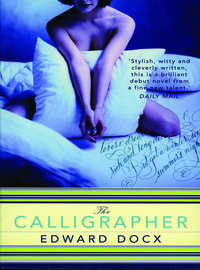
Читать книгу: «The Calligrapher»

THE
CALLIGRAPHER
EDWARD DOCX

Dedication
To Emma
Epigraph
‘Oh, to vex me, contraries meet in one:
Inconstancy unnaturally hath begot
A constant habit;’
John Donne
‘I am thinking of aurochs and angels, the secret of
durable pigments, prophetic sonnets, the refuge of art.’
Vladimir Nabokov
‘He stretched out his arms to the crystalline, radiant sky.
“I know myself,” he cried, “but that is all –” ’
F. Scott Fitzgerald
Contents
Cover
Title Page
Dedication
Epigraph
Titivillus the Devil
PART ONE
1 Confined Love
2 The Prohibition
3 The Sun Rising
4 Love’s Exchange
PART TWO
5 The Indifferent
6 The Bait
7 The Triple Fool
8 Love’s Diet
PART THREE
9 The Damp
10 Negative Love
11 Air and Angels
12 The Dream (‘Image of her …’)
13 Song
14 Love’s Alchemy
15 The Message
16 The Apparition
17 The Good Morrow
PART FOUR
18 The Dream
19 Love’s Growth
20 The Legacy
21 Song
22 The Ecstasy
23 The Canonization
PART FIVE
24 Farewell to Love
25 The Curse
26 Twickenham Garden
27 The Broken Heart
28 A Nocturnal upon St Lucy’s Day
29 A Valediction, Forbidding Mourning
30 Woman’s Constancy
Acknowledgements
Copyright
About the Publisher
Titivillus the Devil
I might as well confess up front that I am in league with the Devil. It’s not a big deal – a stint of social nihilism here, a stretch of marital sabotage there – and I’m afraid it goes with the job. Seek for long enough and you will find that most human pursuits have a patron saint; but, of all the arts in the world, only calligraphy has a patron demon. His name is Titivillus. And he is a malicious little bastard.
Imagine a medieval monastery – somewhere in the high Pyrenees, say, with a great arched gate and tall white stone walls. In one corner of the cloistered courtyard there is a tower. Up the spiral staircase, nearer to the light and away from the damp, is usually to be found a large, round room. This is the scriptorium. And here, seated on stools, bent over their desks, arranged in a horseshoe around the senior supervisor, the armarius, are the monks.
In their right hands they have quills, and in their left they hold their knives. They work in silence and the only sound is their breathing and the continual rasp of their nibs across vellum. Despite their elevation, the light is dim and the older brothers are squinting. But there is no question of burning a fire or even a candle because the safety of the rare and sacred manuscripts is far more important than the monks’ mere earthly comfort.
Every so often, one of the brothers will raise his hand to signal the armarius to bring him additional quills, another pot of ink or some more skins. The knife, a treasured possession, will be used to pin down the undulating page at the point of writing as well as to sharpen the pen (hence pen-knife); but now and then, and with a bite of his lip, a monk will also have to use it to scratch out a mistake.
These mistakes are what Titivillus lives for.
He is a short, low-ranking demon, with a pot belly and a puckered, petulant face. Most of the day, he skulks about the corners of the scriptorium, sometimes sitting on his swag bag, other times scratching at his pointed ears or picking his nose with his stubby fingers, but he is always watching, always alert. Best of all he likes those errata that neither monks nor proof-readers notice and that survive in the new manuscript unchecked, to be reproduced by the next generation of scribes; but slips of the pen so big that the calligrapher must start the entire page again are also welcome – because these set back the Work of God.
Every night, after it has become too dark for the monks to continue and they have left the scriptorium for vespers, Titivillus carefully collects all the mistakes into his sack and drags them down to Hell, there to present them to the Devil so that each sin can be registered in a book – against the name of the monk responsible – to be read out on Judgement Day.
These unsatisfactory (some would say unfair) arrangements continued for more or less a thousand years – until the Renaissance flared across Europe and the calligrapher’s lot began to turn from bad to worse. By the beginning of the fourteenth century, the monks found themselves being forced to work at a furious pace, on and on into the darkness in order to meet the ferocious demand for manuscript copies from the newly founded universities. Before long, sick of the blind rush, the brothers were desperately looking for ways to evade responsibility for the burgeoning number of flaws in their work and so save their ever-more imperilled souls.
Now Titivillus saw his chance.
He offered the holy scribes an eternal bargain: personal absolution from their sins in return for a secret guarantee that the number of mistakes would continue to increase dramatically. As the errors were already out of control, the monks gladly agreed.
Thus Titivillus became the patron demon of calligraphers: he kept their sins hidden and he rescued them from Hell.
Human endeavour, however, was having one of its periodic sprints, and by 1476 William Caxton (who learnt his filthy disgusting ways in Cologne) had set up his printing press in Westminster. All too soon, it looked as though Titivillus’s deal was worthless.
You might have thought that such a development was pretty much the end for the ugly little runt. You might have thought that one of Lucifer’s slicker lieutenants would have called Titivillus in for a personal assessment meeting and explained how, regrettably, some personnel were no longer required. But the Devil never fires his staff; he simply demotes them, drops their wages and forces them to carry on in ever-worsening conditions.
And so believe me, the pot-bellied little son of a bitch is still alive and well in twenty-first-century London, a maestro of distraction, kicking around my attic flat, sulkily intent on fucking things up just for the hell of it, whenever opportunity presents. Unfortunately for him, I don’t take on much biblical work. But what can he do? There aren’t that many calligraphers around these days and he has to take whatever he can get. Nevertheless, an eternal pact cannot be undone: he remains the Devil’s envoy and I remain confederate. Which suits me well. For should I make the occasional mistake, should I slip a little here and there, then absolution is surely only a formality.
Surely.
PART ONE
1. Confined Love
Some man unworthy to be possessor
Of old or new love, himself being false or weak,
Thought his pain and shame would be lesser,
If on womankind he might his anger wreak,
And thence a law did grow,
One should but one man know;
But are other creatures so?
Are sun, moon, or stars by law forbidden,
To smile where they list, or lend away their light?
Are birds divorced, or are they chidden
If they leave their mate, or lie abroad a-night?
Beasts do no jointures lose
Though they new lovers choose,
But we are made worse than those.
Who e’er rigged fair ship to lie in harbours,
And not to seek new lands, or not to deal withal?
Or built fair houses, set trees, and arbours,
Only to lock up, or else let them fall?
Good is not good, unless
A thousand it possess,
But doth waste with greediness.
Like so many people living through this great time in human history, I am not at all sure what is right and what is wrong. So if I appear a little slow to grasp the moral dimensions of what follows, I’m afraid I will have to ask you to bear with me. Apologies. It’s a difficult age.
Actually, I do not believe I was behaving all that badly when these withering atrocities first began. (And if it would now be helpful for me to admit that mine was a crime of sorts, then I feel I must also be allowed to maintain that I did not deserve the punishment.) Rather, I seem to recall that I was trying to be as careful and as sensitive and as discreet as possible; it was William who was acting like a fool.
We had finally come to a halt in the middle of ‘The Desire for Order’. Lucy and Nathalie were somewhere up ahead – progressing unabashed through the room designated ‘Modern Life’. I had been hoping to slip away without detection. But matters were not proceeding to plan. For the last two minutes, William had been following me through the gallery with the air of a pantomime detective: two steps behind, stopping only a slapstick fraction after me, and then raking his eyes accusingly up and down my person as if I were responsible for the summary immolation of an entire pension of pensioners or some such outrage.
He spoke in a vociferous whisper: ‘Jasper, what – in the name of arse – are you doing?’
‘Ssshh.’ The artificial lights hummed. ‘I am attempting to enjoy my birthday.’
‘Well, why do you keep running away from us?’
‘I’m not.’
‘Of course you are.’ His voice was becoming progressively louder. ‘You are deliberately refusing to enter “Modern Life” – over there.’ He pointed. ‘And you keep drifting back into “the Desire for Order” – in here.’ He pointed again, but this time at his feet and with a flourish. ‘Don’t think I haven’t been watching you.’
‘For Christ’s sake William, if you must know –’
‘I must.’
‘I am trying to get off this floor altogether and back upstairs into “Nude Action Body” without anybody noticing. So it would be very helpful if you would stop drawing attention to us and go and catch up with the girls. Why, exactly, are you following me?’
‘Because you’ve got the booze and I think you should open it. Immediately.’ He paused to draw a stiffening breath. ‘And because you always look oddly attractive when you are up to something.’
‘I’m not up to anything and I haven’t got the wine: I stowed it inside Lucy’s bag, which is now safely inside a cloakroom locker.’ I feigned interest in the mangled wire that we were facing.
‘You didn’t. My God. Well, we must mount a rescue. We must spring the noble prisoner from its vile cell straightaway! The Americans put their cream sodas in those lockers – I’ve seen them do it – and their … their bum bags. And God only knows what’s in Lucy’s bag: women’s products probably. And cheap Hungarian biros. You realize –’
‘Will you please keep your voice down?’ I frowned. An elderly couple wearing ‘I love Houston’ T-shirts seemed to be choking to death on the far side of the installation. ‘Anyway, Lucy uses an ink pen.’
But William was undeterred. ‘You realize that you may have ruined that great Burgundy’s life. One of the most elegant vintages of the last millennium traumatized beyond recovery within minutes of your having taken possession. It’s barbarous. I am holding you personally resp—’
‘William, for fuck’s sake. If you must talk so bloody loudly, then can you at least try to sound more like a human being from the present century? And less like a fucking ponce.’ I cleared my throat. ‘Besides, you’re not allowed to wander around Tate Modern swigging booze. It’s against the rules.’
‘Balls. What rules? That’s a 1990 Chambertin Clos de Bèze you’ve got locked up in there like a … like a common Chianti. Bought by me – especially for you, my dear Jasper, on this, the occasion of your twenty-ninth birthday. How could they stop us drinking it? They wouldn’t dare.’
I mimicked his ridiculous manner: ‘As well you know, my dear William, that bottle needs opening for at least two hours before we could even go near it. It’s my wine now and I forbid you to molest it before it’s had a chance to develop. Look at you, you’re slathering like a paedophile.’
‘Well, I think you’re being very unfair. You drag your friends out to look at all this – all this bric-à-brac and mutilated genitalia and then you deny us essential refreshment. Of course I am desperate. Of course I need a drink. This isn’t art, this is wreckage.’
I took a few steps away from him and turned to face a large canvas covered in heavy ridges of dun brown paint. William followed and did the same, tilting his head to one side in a parody of viewers of modern art the world over.
‘Actually,’ he said, a little less audibly, ‘I was meaning the small bottle of speciality vodka that Nathalie bought you. I thought you might have stashed it in your coat or something. I only need a painkiller to get me through the next room.’ Mock grievance now yielded to genuine curiosity: ‘Anyway, you haven’t answered my question.’
‘That’s because you are a complete penis, William.’
‘Why are you in such a hurry to leave us? What’s so special about “Nude Action Body”?’ He looked sideways at me but I kept my attention on the painting. ‘Is it that girl you were staring at?’
‘No.’
‘Yes, it is. It’s that girl from upstairs.’
‘No, it isn’t.’
‘The one you were pretending not to follow before we came down here.’ He paused. ‘I knew it. I knew it.’
‘OK. Yes. It is.’
He gave a theatrical sigh. ‘I thought you were supposed to be stopping all that. What was it you said?’ He composed his face as if to deliver Hamlet’s saddest soliloquy. ‘ “I can’t go on like this, Will, I am going mad. Oh Will, save me from the quagmire of womankind. No more of this relentless sex. Oh handsome Will, I have to stop. I must stop. I will be true.”’
I ignored him. ‘William, I need you to buy me some time and stop fucking around. Lucy and Nathalie will be back in here looking for us any second. Go and distract them. Be nice. Be selfless. Help me.’
He ignored me. ‘OK, maybe not the “handsome Will” bit – but those were more or less your words. And now look at you: you’re right back to where you were a year ago. You can’t leave your flat without trying to sleep with half of London. And never a moment’s cease to consider what the fuck you are doing or – heaven forbid – why.’
I walked towards the exit on the far side of the room and considered a collection of icons made to evoke the Russian Orthodox style. The figures were blurred and distorted and appeared to recede into their frames, so that it was impossible to tell whether they were indeed hallowed saints or grotesque contorted animals or merely half-smudged lines signifying nothing.
‘Look, Will, I need fifteen minutes. Will you keep an eye on the others for me – please? Don’t let them leave this floor. If they look like they’re moving, set off the fire alarm or something. I don’t want to fuck up and have to concoct some stupid bullshit. Not tonight. It would be awful. Lucy gets so uptight. I just want everyone to have as relaxed and pleasant a dinner as possible this evening.’
‘The fire alarm?’
‘Yes, it stops the escalators working.’
He shook his head, but there was amusement in his eyes.
‘I’m sorry. Will. But I swear to you: that girl winked at me and she is far too pretty for me to ignore. Admit it, she is. What am I supposed to do? I can’t just let it go. Come on. Millions of men would pay to be winked at by girls like her. I have a responsibility to act. Fifteen minutes max.’
He smiled. ‘Well, go on then: get on with it. But if the authorities arrest me for false alarms I shall instantly confess that you made me do it. I shall explain that you are dangerously persuasive and the worst sort of unscrupulous libertine –’
‘I’m exceptionally scrupulous.’
‘And I shall tell them that you are incapable of behaving in a decent manner towards friends – or even your own girlfriend – and that you deserve to be taught a serious lesson. See you in fifteen.’
‘Thank you, William.’
‘And don’t forget to check for sisters.’
Now, I don’t want to start blaming Cécile for the first wave of demoralizing set-backs that followed hard on the heels of this, the otherwise inauspicious evening of my twenty-ninth birthday, but as far as immediate causes of disaster go, then she has to shoulder full responsibility: J’accuse Cécile, la fille française. Had she not winked at me, I probably wouldn’t have risked it. But what could be the purpose of such fetching Mediterranean looks as hers, if not to fetch?
All the same, the fire alarm surprised everybody.
Chaos followed fast, rushing through ‘Nude Action Body’ like a messenger from the Front with news of approaching armies. From hidden antechambers and doors marked ‘private’ dozens of orange-clad ushers emerged and began urgently to usher; the lifts stopped; small blue lights flashed from odd places high on the walls; and (as if all this were not encouragement enough) an unnervingly measured female voice interrupted the revels every thirty seconds to spell the situation out in an exciting variety of languages. ‘This is a routine emergency. Please leave the building by the nearest fire exit and follow the advice of the officials. Thank you.’
I had only just returned to the fifth floor and had taken no more than three steps into the gallery proper. But now I doubled back and stood to one side by the wide emergency exit doors at the top of the escalators, waiting for Cécile. Along with everyone else, she was sure to leave this way. There was no longer any need to seek her. And I was rather enjoying all the panic.
Parents issued taut-voiced instructions to their charges. Scandinavians strode calmly towards the emergency stairs. Italian men put their arms around Italian women. A litter of art-college day-outers roused themselves reluctantly from their beanbags. Two children came careering out of ‘Staging Discord’ opposite. And an American woman began to scream ‘oh my God, oh my God’.
Given that Irony and Futility still seemed to be filling in for God and Beauty on the art circuit – the thought occurred to me that had I been filming the whole thing, I could perhaps have submitted the results for exhibition myself; perhaps a showing in ‘History Memory Society’: ‘People from All Over the World Leaving in Uncertainty’ (Jasper Jackson, calligrapher and video artist).
Of course I didn’t actually know that Cécile’s name was Cécile as I fell into place three or four people behind her. (Jostle, jockey, joke and jostle all the way down six flights of unapologetically functional fire stairs.) I didn’t know anything about her at all, except that she had short, choppy, boyish, black hair, a cute denim skirt cut above the knee, thin brown bare legs and unseasonable flip-flops, which flapped on every step as she went. And that she had (quite definitely) winked at me as we circled Rodin’s Kiss.
Outside, safely asquare the paving slabs of the South Bank, I looked hastily around. The light was thickening. St Paul’s across the Thames – a fat bishop boxed in and stranded flat on his back – and two bloated seagulls, making heavy weather of the homeward journey upstream. Crowds continued to eddy from the building but there was as yet no sign of William or Nathalie or Lucy’s adorable light-brown bob. Still, I had to act quickly.
Cécile was standing with her back to me, looking across the river.
‘Hi.’ I said.
She turned and then smiled, an elbow jutting out over the railings. ‘Oh, hello.’
‘That was quite exciting.’ I returned her smile.
‘You think there is a fire?’
I looked doubtful. ‘Probably terrorists or art protestors or rogue vegetarians.’
‘I wonder what they save from the flames?’ She bent an idle knee in my direction and swivelled her toe on the sole of her flip-flops. ‘The paintings or the objets?’
‘Good question.’
‘Maybe in an emergency they have an order for what to keep – and they begin at the top and then descend until everything is burning too much.’
‘Or maybe,’ I said, ‘they just let the bastard go until it’s finished so that they can open up afterwards as a new sort of gallery: Burnt Modern. A new kind of art.’
‘Perhaps that’s what the protesters want – a new kind of art.’ She was a born flirt.
I met her eye and moved us on. ‘They evacuated the building very quickly.’
‘Yes. But there are some people still coming out, I think.’ She gestured. ‘I like how in an emergency everybody starts to talk. As if because there is a disaster, now we can all be friends happy together.’ She looked past me for a second. ‘Will they let us back in, do you think?’
‘I’m not sure. But I am supposed to be going to a restaurant at eight so I don’t think I will be able to wait. This might take a couple of hours.’ I paused. ‘I should find my friends and see if they are OK.’
‘Me too. I have already lost them once today – when we were on the London Eye.’
‘How long are you in London for?’
‘I live here.’ She frowned slightly – amused disparagement.
I pretended to be embarrassed.
She relented. ‘I am teaching here.’
‘French?’
‘Yes.’ A pout masquerading as a smile.
‘You have an e-mail address?’
‘Yes.’
‘If I write to you, do you think that you’ll reply?’
‘Maybe. It depends what you say.’
I found William sitting on a bench with a diesel-coated pigeon and the man who had earlier been selling the Big Issue outside the main entrance.
‘Jasper – Ryan. Ryan – Jasper. We haven’t thought of a name for this little chap yet.’ He indicated the creature now pecking at a chocolate wrapper.
‘Where’s Lucy?’ I asked, acknowledging Ryan.
‘She’s fetching her bag with Nat. Did you meet anyone nice’ William winked exaggeratedly ‘– in the toilets?’
‘Yes, thanks.’
William did an American accent: ‘I hope you were real gentle with him.’
Ryan snorted and got up. ‘See you Thursday, Will mate,’ he said, ‘and let’s hope this new bloke knows how to deal with those fucking tambourine bastards.’
‘See you later.’ William raised an arm as Ryan left.
I sat down and was about to speak but William motioned me to be quiet.
‘Here they come,’ he said, ‘they’ve seen us.’
Lucy and Nathalie were making their way towards the bench. William addressed the pigeon: ‘You’ll have to piss off now, old chap, but we’ll catch up again soon, I hope. Let me know how the diet works out.’
Before we go much further, I should explain that William is one of my firmest friends from the freezing Fenland days of my tertiary education. (Philosophy, I’m afraid, man’s most defiant folly.) I can still remember the pale afternoon, a week or so after we had all arrived for our first year, when we were walking back from a betting shop together and he came out to me. It was going to be very awkward, he confided, and he was at a bit of a dead end with the whole idea because – apart from his sister, who didn’t count – he hadn’t really met any women before now, but – how could he put this?– he was rather worried that he might not be homosexual and – as I seemed to be rather, well, in the know on the subject, as it were – had I any suggestions as to next steps vis-à-vis the ladies?
Unfortunately, several centuries in the highest ranks of government, church and army had left the men in his family quite unable to imagine women, let alone talk to them. Indeed, William suspected that he was the first male child in sixteen generations not to turn out gay. As I could imagine, this was a severe blow both to him and his lineage but he had tried it with other boys at school on several occasions and there was absolutely nothing doing. The truth of the matter was that he liked girls; and that was that. And as he was now nearing twenty, he rather felt that he should be getting on with it. Could I offer any pointers?
Naturally, things have moved on a good deal since then and these days Will is regularly trumpeted by various tedious publications as one of the most eligible men in London. He is an invaluable ally and well known on the doors of all good venues – early evening, private and exclusive as well as late night, public and squalid. I regret to say, however, that his approach remains erratic and hopelessly undisciplined. Though many women find him attractive, the execution of his actual seductions is not always the most appropriate. It is as if a strain of latent homosexuality bedevils his genes – like an over-attentive waiter at a business lunch.
All else aside, William is the most effortlessly charming man that anybody who meets him has ever met. He is also genuinely kind. And though he claims to feel terribly let down by the astonishing triviality of modern life, this is merely an intellectual arras behind which he chooses to conceal a rare species of idealism. He does not believe in God or mankind but he visits churches whenever he is abroad and runs a music charity for tramps.
On the subject of William’s relationship with Nathalie … Back in March, he claimed that it was purely platonic and I have to say that I think he was telling the truth. Under light questioning, he explained that it was only in this way that he could maintain the exclusivity of their intimacy since – of the few women who shared his bed from time to time – Nathalie was the only one with whom he was not having sex. They were therefore bound together by uncompromised affection and happily unable to cheat on one another. (She, too, I understood, was at complete liberty.) This approach, he confided, was an ingenious variation on the arrangement his forefathers had shared with their various wives since they had first come to prominence (under Edward II); dynastic obligations aside, they had kept sex resolutely outside of marriage, thereby removing all serious woes, threats and resentment from their lives.
A little before midnight, the birthday evening’s rightful enchaînement having been long re-established, Lucy and I were alone at last, intimately ensconced at the corner of the largest table in La Belle Epoque, my favourite French restaurant. We were considering the last of our dessert with a certain languid desire, and feeling about as happy as two young lovers can reasonably expect to feel in a London so beleaguered by medieval licensing laws. A little drunk perhaps, a little reckless with the cross-table kissing, a little laissez-faire with the last of the Latour; but undeniably at ease with one another and, well, having a good time. The bill was paid and my friends had all left – William and Nathalie among the last to go, along with Don, another university friend, over from New York, with his wife, Cal, and Pete, Don’s fashion-photographer brother, who had arrived with a beautiful Senegalese woman called Angel.
If pressed, the casual observer would probably have informed you that he was watching a boyfriend and girlfriend quietly canoodling while they awaited a final pair of espressos. If he was any good at description, this observer might have gone on to say that the woman was around twenty-eight, five-foot six or seven, slim, with dead straight, bobbed, light-brown hair, which – he might have further noticed – she had a habit of hooking behind her ears. Had he dashed over and stolen my chair while I visited the gents’, he would also have been able to tell you that her face was very slightly freckled, principally across the bridge of her nose, that she had thin lips (but a nice smile), that her eyes were a beseeching shade of green and that she liked to sit straight in her chair, cross her legs and loosen her right shoe so she could balance it, swinging a little, on her extended big toe. He might have rounded the whole thing off with some remarks about how – even now – England can still turn out these roses every once in a while. But at this stage we would surely have to dispute his claims to being casual and tell him to fuck off.
It is more or less true to say that back then, Lucy and I were more or less a year into it – our relationship, that is. I’m not sure why – these things happen …
Actually, I am sure why: because I liked Lucy very much. That is to say, I still like Lucy very much. Which is to say I have always liked Lucy very much. Lucy is the sort of woman who makes the human race worth the running. She’s not stupid or simpering, and she only laughs when something is funny. She’s intelligent and she knows her history. Yes, she can be cautious, but she’s quick-witted (a lawyer by profession) and she will smile when she sees she has won a point. Then she’ll pass on because she’s as sensitive to other people’s embarrassment as quicksilver to the temperature of a room. She keeps lists of things to do. She remembers what people have said, but doesn’t hold it against them. She seldom talks about her family. And she has no time for magazines or horoscopes. If you were sitting with us in some newly opened London eatery, privately wishing you had an ashtray for your cigarette, you might well find that she had discreetly nudged one to a place just by your elbow. Which is how we met.
Even so, it is with regret that I must add that Lucy is a nutcase. But I didn’t know that then. That all came later.
‘Close your eyes,’ she said, putting her finger to my lips for good measure.
I did as I was told and lowered my voice. ‘You haven’t organized a –’
‘Too late. It’s tough. I’ve got you a big cake with candles and all the waiters are going to join in with “Happy Birthday to You”, so you’ll just have to sit still and act appreciative.’
I heard the rustle of a bag and the stocky chink of espresso cups.
‘OK, open your eyes.’
A young waiter with a napkin over his shoulder hovered nearby – curious. A neatly wrapped present lay on the table.
Lucy smiled, infectiously. ‘Go ahead: guess.’
I leant across and kissed her.
‘Guess.’
‘Earrings?’
‘You wish.’
‘A gold locket with a picture of Princess Diana?’
‘Oh, go on, for God’s sake … open it.’
I undid her neat wrapping and unclasped the dark velvet case: a gentleman’s watch with a leather strap, three hands and Roman numerals. I held it carefully in my palm.
‘So now you have no excuses.’ Her eyes were full of delight. ‘You can never be late again.’
I felt that tug of gladness that you get when someone you care about is happy. ‘I won’t be late again, I promise,’ I said.
‘Not ever?’
‘Not for as long as the watch keeps time.’
‘It has a twenty-five-year guarantee.’
‘Well, that’s at least twenty-five years of me being on time then.’
On the face of it ‘Confined Love’ is one of John Donne’s more transparent poems: a man railing against the confinement of fidelity. Neither birds nor beasts are faithful, says his narrator, nor do they risk reprimand or sanctions when they lie abroad. Sun, moon and stars cast their light where they like, ships are not rigged to lie in harbours, nor houses built to be locked up … The metaphors are soon backed up nose to tail, honking their horns, like off-road vehicles in a downtown jam.
On the face of it, Donne, the young man about town, Master of the Revels at Lincoln’s Inn, seems to be striding robustly through his lines, booting the sanctimonious aside with a ribald rhythm and easy rhyme, on his way to wherever the next assignation happens to be. But actually, that’s not the point of the poem. That’s not what ‘Confined Love’ is about at all.
2. The Prohibition
Take heed of loving me,
At least remember, I forbade it thee;
Some introductions. My name, as you may have gathered, is Jasper Jackson. I am twenty-nine years old. And I am a calligrapher.
My birthday, 9th March, falls exactly midway between Valentine’s Day and April Fool’s – except when there’s a leap year, when it comes closer to the latter.
What else? I am an orphan. I have no recollection of the day itself but it would appear that my father, the young and dashing George Jackson, wrapped both himself and my mother, Elizabeth, around a Devon tree while trying to defeat his friends in their start-of-the-holiday motor race from Paddington to Penzance. My mother did not die straightaway but I was never taken to visit her in hospital.
From the age of four onwards (and very luckily for me), my upbringing and education was placed in the hands of Grace Jackson, my father’s mother, at whose Oxford home I was staying when news of the accident arrived. In a way, therefore, my entire life can be viewed as one long, extended holiday at my grandmother’s. And I am pleased to report that I can recall nothing but happiness from my early years. Even the reprimands I remember only with affection.
It is a hot summer afternoon. The whole town is wearing shorts or less. My grandmother and I stand contentedly in the grocer’s queue. We are buying black cherries – a special treat – as a prelude to our usual Saturday afternoon tea. (Grandmother has a fondness for scones on Saturdays.) I am holding the fruit in a brown paper bag, waiting to hand them up to be weighed. My movements go unnoticed because I am living at waist height (oh, happy days). I glance around. I see a red-haired girl about my age passing by the vegetable stands outside. One hand is holding her mother’s and the other is clutching the sticky stick of an orange iced-lollipop, which is cocked at a dangerous angle and visibly melting as she half-skips along.
I move without thinking. Still carrying the cherries, in a second I am out of the shop and on to the street. I turn one corner, then another. For the first time in my life – with exaggerated care – I cross a main road alone. There is a cry behind me – my grandmother. Then comes a shout – a man from the shop running along the pavement after me. The girl turns, wrist pivoting on her mother’s arm; the ice slides clean off and drops to the pavement. My sweetheart registers the disaster for a long moment, then her grey eyes come slowly up and look directly into mine. I too am visibly melting. I am five or maybe six.
But scolding was never my grandmother’s strong suit. Rather, she believed in punishment by improvement. (Perhaps this was because we had, between us, lost too many relatives to waste time being cross with each other: my grandfather had died suddenly, while in Cairo on business just after the Suez crisis.) So once we had returned the cherries, there were a few serious words – ‘Jasper, you cannot go anywhere by yourself until you are twelve, do you understand?’ – and then it was off to the library with me for a miserable afternoon indoors. Which was a blow because I had been planning to play on, my bike with Douglas Wilson from down the road.
I say miserable, but actually the library in question was beautiful, the most beautiful in Britain. Although, due to the war. Grandmother never finished her post-graduate work (something to do with medieval French), Somerville College felt that she was far too clever a scholar to lose. And when she returned from Egypt with my father still a boy and a pitiful widow’s pension, they quickly made her deputy librarian. By the time I arrived on the scene, two decades later, she had become an authority on late medieval manuscripts at the glorious Bodleian, a building in which, I maintain, it is impossible to be anything but enthralled – even when, ostensibly, one is being punished.
Between the ages of four and twelve years, I must have spent more time in the Bodleian than most academics manage in their entire lives. Often during the school holidays (although rarely on Saturdays) my grandmother would sit me down at the table near the reference section that was reserved for members of staff, and bring me a book to read. ‘It didn’t seem to do your father any good in the long run, Jasper,’ she once said, ‘but at least he knew a few things before he died, which is all we can any of us really hope for.’
Evidently, my grandmother was following exactly the same method of combining childcare with a career that she had when bringing up my father; and, like him, I think I became something of a mascot among the librarians, many of whom used to mind me on odd days when Grandmother had to go and give a lecture somewhere or there was a serious section count going on. Indeed, over the years, just about anybody who was anyone at the university came to know me. People would stop by to say hello on their way in or out, and ask me what I was reading, and sometimes (as in the case of Professor Williams, Grandmother’s friend) take me down to the canteen for lunch, and even bring me presents (which, at Christmas, I used to have to hide to avoid giving the impression that I was getting too many).
If, however, I was in need of ‘improving’, as was the case on the afternoon of the cherries, my grandmother would sit me down and, instead of giving me a book, place a large illuminated manuscript before me. She would then provide me with a range of sharpened pencils and some stiff paper and instruct me to copy out an entire page – ‘as exactly as you can, please, Jasper, I want your letters to look just like those. No noise. No trouble. Come and find me when you have finished.’
Secretly, I loved the task, but I had to pretend otherwise in case Grandmother realized and changed my punishment to something awful like washing cars, which is what Douglas had to do when he was in trouble.
The fateful cherry-day page was in Latin of course, but I remember asking one of the Saturday assistants what it was about and he told me it was a prayer written in 1206 by a monk, who was hiding in the Sierra Norte above old Seville, asking God to deliver him from the women in his dreams.
My grandmother and I decided we should stay in Oxford until I was twelve. Then we moved to Avignon, where she had been offered a job cataloguing some of the exquisite work left behind by the scribes who lived there during the hundred years of papal occupation until 1409. I attended a lycée while she worked in the Livree Ceccano, the municipal library, which was housed in what had originally been one of the many sumptuous palaces built by the cardinals who came to take up expedient residence near their pontiff.
In two years her task was complete and our next destination was the German university town of Heidelberg, where she led a restoration programme, which brought some of the earliest Reformation documents back to light.
‘Finally the boss, eh, Jasper – at sixty-three,’ she said. ‘Who says that women are held back in this clever old world of ours? And all because I bothered to learn German in the war.’
I never noticed how much money my grandmother had, which suggests she had enough, but we were by no means well off – a librarian’s salary is thin, even at the best of times. Nor is restoration exactly lucrative. I seem to remember that we spent a lot of time waiting for buses and persuading one another that second-hand clothes lent a person an air of bohemian charm unavailable to those lesser folk whose imaginations could not travel beyond the high street.
In Heidelberg, as in Avignon, our flat was small, designed for one not two. However, because the old universities always own the best property, the building we shared was both characterful and well situated. We lived at the top of an old house on Plock, an oddly named medieval street, that ran parallel to the Hauptstrasse and was overlooked by the castle. I should also mention that on the ground floor was the finest delicatessen in Germany – run by my two friends, Hans and Elke. They are still there now although Hans has grown a moustache to celebrate his fiftieth birthday and Elke is refusing to allow him into the shop until he relents. My first real job – Saturdays and late-night Wednesday – was behind their counter.
As a hollow-cheeked, fourteen-year-old English boy, now with a French accent and ever darker hair, I devoted the next four years, with increasing success, to the twin joys of reading and the pursuit of my pretty Rhineland classmates.
At school, I was never popular with the other boys in the usual kinds of ways: I was not a natural team captain, I did not draw an appreciative gang around me at the back of the class, and I never got around to beating the shit out of anyone. In fact, from about thirteen onwards, as far as I was concerned, male company was a complete waste of time. What can one boy teach another? Very little. Conkers perhaps.
No. The only thing that ever got me thinking, got me wondering, got my heart kicking with the sheer excitement of life, was the girls.
The girls were everything – their opinion, their glances, their moods; the way they walked or changed their hair; what they said, did, wanted to become; where they lived, how they had their bedrooms; which film stars they liked and why; who they read, who they imagined themselves with at night, which clothes they preferred at weekends; what they liked boys to say, why, and how often; what they wanted to buy; what they disliked about their brothers, fathers, uncles, each other; what amused them, what sickened them; how they put their socks on, how they took them off; when and how often they shaved their legs; what they thought about school, tangerines, Goethe, their mothers, holding hands, history, rivers, Portugal, and kissing strangers – all of it mattered. I had to know. To my mind, the girls were the point of being alive.
Two days after we arrived in Germany, I discovered that it was possible to walk along the narrow wooden balcony outside my bedroom window, climb over the end and swing across without too much peril on to the fire escape. Persuading my female classmates to accompany me up those skeletal steps at night was, I think, the first serious labour set for me by that merciless taskmaster whom Donne refers to as the ‘devil Love’. But I was always a good student and I studied hard.
I learned, for example, that a young lady who has just emerged, blinking, back into the forbidding glare of the real world from, say, a cinema would adamantly refuse to scale a precipitous iron stairway merely to clamber into the bedroom of an over-eager adolescent male.
‘Why not?’ I asked.
‘Too dangerous,’ claimed Agnes, an even-tempered girl with dark corkscrew hair, who sat as close to me as possible in chemistry lessons.
‘No, it isn’t.’
‘Yes, it is.’
‘I do it all the time.’
‘Really?’
‘No. I mean I climb up there by myself all the time.’
‘I was joking. I know what you meant.’ She smiled.
‘Oh.’ I clicked my tongue. ‘Anyway, why not, Agnes?’
‘My clothes would get covered in rust.’ She ran her finger along the handrail as if to prove her point.
‘Not if you took them off.’
‘Jasper!’
I grinned. ‘Why not then?’
‘We might get found out. What if I got stuck?’
‘You won’t. It’s dead easy – I’ll help.’ I made as if to start up the first step. ‘Who’s going to find out?’
‘Your grandmother for one –’
‘She’s gone to bed early. Professor Williams is coming tomorrow. And her room is on the other side. Anyway she doesn’t mind.’
I stood, stalled on the lowest rung. Agnes looked suspicious again: ‘How do you know she doesn’t mind?’
‘She told me.’
Frank disbelief. ‘She told you?’
‘Yes.’
‘When?’
‘Once. Anyway, Agnes, why not – just for a bit?’
She said nothing for a moment – vacillating perhaps – then she shook her head. ‘Because I have to be home by midnight or Dad comes out looking for me.’ She made a pretend-serious face: ‘We’re Catholics.’
‘What has that got to do with anything?’
‘Plus he knows I am with you so he’ll probably set off at quarter to.’
‘And what’s that supposed to mean?’
‘He thinks that girls are in danger the minute it turns midnight.’ She widened her eyes histrionically.
I took the step back down. ‘OK then – it’s only eleven-thirty, so I could rush you home now, get myself in his good books and bank an extra half an hour so that we can stay out until twelve-thirty next time. That way if you do suddenly turn sex-mad next Friday, you’ll have someone to talk to about it.’
‘Who says I am free next Friday?’
Sure enough, the next Friday but one I learnt another lesson: that the most efficient way from the cinema to my bedroom was not necessarily the most direct. Take lovely Agnes first on a walk up the crooked steps to the old Schloss, and wander there among the battlements; look down upon the river, see how the moonlight casts the water in silver as if it were a necklace running through the town (I was only fourteen); imagine how the sons of the city merchants would leave their beds and scale the ramparts to meet secretly with the daughters of the court – and then bring her back into town, and presto, what was previously a grotty and precarious fire escape has miraculously become un escalier d’amour. Seduction, I realized, was all about setting an appropriate scene – a scene into which the subject can willingly walk and there abandon her former censorious sense of self to take on a new and flattering identity. As we all know, it becomes more complicated when everyone grows up but even the most recalcitrant old hag once dreamed herself a Juliet.
Nowadays Agnes teaches chemistry in Baden Baden and has two children. She writes me the occasional letter – and I write back; but we dare not meet up in case something happens. Catholics.
After Heidelberg, it was back home to England – to the icy Fens, there to wow all comers with my deft grasp of the German philosophers. This was not, in any sense, fun, but if I thought my chosen subject unyielding, it was as nothing compared to the arduousness of attempting to sleep with the women. Try as I may, I can scarcely exaggerate the skill and endurance that a young man is required to develop if he wishes to navigate the freezing sea of female sexuality that surrounds a Cambridge education.
Imagine the most socially awkward, sexually confused and neurotic people in the whole world and put them all in the same place for three uneasy years: that’s Cambridge University. And don’t let anyone tell you different. Talk about sex by all means – talk about it till you’re blue in the balls – but you’re sick if you even think about doing it. Worse than sick: you’re dangerous.
Nonetheless, I had my successes amid the crunching icebergs and the raging Arctic winds and fared better than most of my fellows, many of whom were lost for ever – buried like Captain Scott beneath the tundra or fallen, snow-blind and lust-numbed, into the ice-tombs of the Nuptial Crevasse. Having overcome such hazardous and bitter conditions, I arrived in London full of triumph and resource.
Then I really started work.
In fact, during the next seven years, I think I must have had some sort of a physical relationship with pretty much all the women in the city: young, old, dark, fair, married or lesbian; Asian, African, American, European, even Belgian; tall, short, thin or hefty; women so clever that they couldn’t stand the claustrophobia of their own consciousness; women so thick that each new sentence was a triumph of heartbreaking effort; fast and loose, slow and tight; sexual athletes, potato sacks; witches, angels, succubae and nymphs; women who could bore you to sleep even as you entered the bedroom; women who could keep you up all night disturbing the deepest pools of your psyche; aunts, daughters, mothers and nieces; crumpets, strumpets, chicks and tarts; damsels, dames, babes and dolls; all that I desired and quite a few I didn’t. And then, when I was well and truly satisfied that there was nothing more to want, I did it all again.
It was a difficult time for everyone.
There were nights I could not go out for fear of fury or beatings, or grim-faced boyfriends bent on brutal reprisals; and yet neither could I stay in for fear of a deranged and raging flatmate. (I know, I know, but it was his girlfriend who started it). Once, things got so bad that I had to spend a couple of nights at one of William’s tramp hostels. But then I fucked the cook. (Largely because I caught sight of her using fresh coriander in the soup. It was pure lust, but sixteen stone, for Christ’s sake, and forty fucking three.)
When I met Lucy, she was my way out. My best hope.
But I am getting distracted. I should explain how I became a professional calligrapher.
After I arrived in London, I did quite a few jobs, all of them monumentally senseless and too depressing to go into here. From what I could discover, the corporate arena of employment is best compared to a stinking circus, full of grovelling clowns, fawning jugglers and boot-licking buskers, all running around in circles as they frantically try to outdo one another in feats of sycophancy and obsequiousness and irrelevance. There is no ring-master and not a single thing is ever accomplished to the wider benefit of mankind.
No wonder then, that on my twenty-sixth birthday, worn out and wretched, having resigned from yet another job, I journeyed to Rome to visit my grandmother, who had finally ‘retired’, taking a surprisingly lucrative consultancy role at the Vatican.
Professional calligraphy was her idea.
‘The truth of the matter, Jasper, is that all calligraphers are to some extent in league with the Devil,’ Grandmother explained, carefully slicing through a truly delicious vitello tonnato at II Vicolo, our favourite trattoria, on the Via del Moro, in the heart of beautiful Trastevere. ‘You might want to bear that in mind before you decide to pursue it. All other arts in the world have their patron saint, only calligraphy has a patron demon.’
‘Serious?’
‘Yes. Look it up: St Dunstan for musicians, St Luke for artists, St Boniface for tailors – I even found a patron saint for arms dealers once – St Adrian of Nicomedia. Don’t underestimate the capacity of the Roman Church for intervention. But you’ll never come across the patron saint of calligraphers: they have thrown their lot in with the opposition. It’s well known.’
‘Not that well known.’
‘Among people who read, it is well known.’
‘Who read Latin manuscripts from the Middle Ages.’
‘Among people who read.’ She looked at me directly for a moment – her eyes blue and always watery; then her face cracked into the familiar lines of her smile. ‘The patron devil’s name is Titivillus. He crops up all over from about 1285 onwards, especially in the margin doodles. I’ve mentioned him to you before, I’m sure I have.’
A typical grandmother trap. If I agreed that she had indeed mentioned him, then why had I forgotten? If I shook my head and claimed that she had not, then she would probably be able to cite time and place.
‘Yes, actually, now you bring it up, I do remember something you told me about the little calligraphy devil – or was it Professor Williams who explained him to me? How is Professor Williams, by the way?’
‘He’s very well, thank you.’ She took a sip of her Dolcetto and tried to frown, ‘Anyway, if you are going to make a living out of calligraphy, then you’ll have to make a deal with the Devil.’
I shrugged. A motorino buzzed by – the girl on the back still fiddling with her helmet strap as her tanned knees joggled slightly with the cobbles.
Grandmother finished what was left on her plate and arranged her cutlery neatly before carefully brushing some breadcrumbs into her palm. ‘Don’t worry, there are lots of advantages. Guaranteed absolution from sin for one. I imagine that could come in quite handy.’
I returned to the last of my rigatoni.
She picked up her glass and settled in her chair. ‘Seriously, Jasper, the main problem is that although you are very good, you have no experience of commercial art – of the art of art-for-money business. And you don’t know anything about the more technical side of things, like how to prepare vellum or which pigments to use for which col—’
‘How much do you get for a commission?’
‘Hang on a second. Slow down.’ Grandmother scowled. ‘Commissions do not just fall out of the bloody sky.’
‘Of course not, I mean –’
‘First, I think, you’ll have to go on the course at Roehampton.’ She raised her finger again to stop me interrupting. ‘I know you think you don’t need to but there’s a whole world of craft skills behind the art – which flight feathers are the best and why, how to cure the quills with hot sand, layout grids, organic pigments, not to mention gilding or mixing gesso …’ She shook her head. ‘You don’t know any of that. And then there’s the history too, and the theory behind the scripts. Also, I imagine the teachers will help you understand what’s going on right now – on the commercial side of things. You might make some good gallery contacts there. And, apart from anything else, there’s no harm in having a qualification that everybody can recognize.’
I nodded. ‘Right. I accept I will probably have to go on the course.’
‘Not probably. Definitely.’
‘But surely it can’t be all hand-to-mouth nightmares – trying to sell stuff at exhibitions? I thought your friends all worked on commissions. What about Susan or that man who’s doing the Bible thing? Surely there must be some way of getting a salary.’
‘I’m not saying that it is all hand to mouth. There are commissions to be had, and good ones. Of course there are. But you should look at the facts.’ She took another sip of wine, pausing to taste it. ‘There are two hundred or so professionals already working in England – all ahead of you in the queue. Not to mention all the locally celebrated amateurs.’
‘Mmm.’
‘Of that two hundred probably fewer than fifty actually earn a living with quill and ink. Most of them are doing wedding invitations or the menus of pseudo-Bavarian restaurant chains.’ She pursed her lips. ‘Of that fifty I would say fewer than twenty are regularly commissioned to produce formal manuscripts and even then, most do a bit of parliamentary or legal work whenever they have to. And of that last twenty, there are fewer than half a dozen artists who can afford to keep themselves in mozzarella di bufala.’
I broke some bread and dipped it in the olive oil. ‘OK. So how much do they get for a commission?’
‘That depends.’
‘On what?’
‘Lots of things: on talent, of course, but also on reputation, contacts and – most of all – who their clients are.’ Grandmother raised her eyebrows. ‘Granted, you are considerably better than any other professional I have seen in the last few years, and certainly there cannot be many people in the world with your repertoire of hands, but that’s not enough on its own. You need to get a few good clients – and for that you need to get a reputation – and for that we need just a little more than me saying “my grandson is a genius with a quill”.’
‘Perhaps I should enter the church.’ I helped myself to more bread.
‘No, you’re too handsome for that. Besides, I didn’t say I couldn’t help you. Calligraphy is about the only thing in the world that I can help you with. You have the talent, Jasper, and I have the contacts. If you promise to go to Roehampton, then I will fix you up a meeting with my friend Saul – he works out of New York. America is –’ Grandmother broke off. A warm breeze, that seemed to come from the Gianicolo hill, had suddenly disturbed her white hair. She adjusted her ancient sunglasses on her head. ‘America is the only place to make any sort of money these days. If we are to get you to the front of that queue, you really need a big New York agent with a serious client list. Saul was a friend of your grandfather’s. In fact he was your father’s godfather. I think you’ve met him once.’
I must have looked blank.
‘He started off in rare books years ago and he has hung on to that side of things, even after he moved into paintings and traditional art. He’s become a bit of a dealer in his old age but he is respected and there is nothing that he cannot sell.’ She finished her wine. ‘He is definitely our man. In the meantime, you must begin by doing some speculative pieces – let’s say three or four of the famous Shakespeare sonnets in a few different hands – so that we have something to send him when the time comes.’
I pretended injury. ‘Why didn’t you suggest this when I was twenty-one? I’ve wasted five years labotomizing myself in offices.’
‘Because you wouldn’t have listened to me when you were twenty-one.’
‘Yes, I would.’
‘No, you wouldn’t. You only listen to me when you have already decided something for yourself.’ She picked up her battered clutch bag. ‘Shall we go to Babington’s for afternoon tea?’
‘I thought you had to go back to work.’
‘Oh bugger that. I am seventy-five – I can do what I like. And anyway this is work. I am a consultant. You are consulting me.’
I stayed in Rome all that summer courtesy of the Vatican and the remains of the money left to me by my mother. I practised and I learnt, studying more intently than ever before and seeking constant advice and criticism from Grandmother. I returned to London in September, rented a threadbare room and enrolled on the course. By December, she finally gave the all-clear (never was quality control so merciless) and we sent six Shakespeares to Saul, each done in a different hand.
Two weeks later I received notice that one of them had already been sold as a Christmas gift – for $200. While this was by no means a great deal of money, I felt that at least I was on my way.
My first real commission came the following spring (just as I was preparing for my exams): twelve ‘Let me not to the marriage of true minds’ at $750 a shot. That was more like it. In all they took four months to complete. But I was reasonably certain that they were well done. And Saul – to whom I spoke more and more on the telephone – was confident that if I could stand doing ‘True Minds’ for the rest of my life, then I would be able to survive.
I walked the exams and was one of only three to sell my work at the end-of-term exhibition. I received a second commission on the back of the first, and then a third. I became a little faster and the money got better every time. Then, in the autumn of that year, I flew to New York and met up with Saul himself – a man of such significant girth that you might journey for several seasons to encircle his waist once.
And it is Saul who saves me still. Since then, my commissions have come from the heart of art-loving America, where he is thick as thieves with that little band of insightful millionaires, who consider that the best gift they can give their satiated friends is an original manuscript copy of something beautiful. For these people, I am truly grateful. But I owe Saul the most. He was responsible for securing me my current work – the most interesting and extended job to date: thirty poems taken from the Songs and Sonnets of John Donne.
Бесплатный фрагмент закончился.