Читать книгу: «The Pagan Lord»
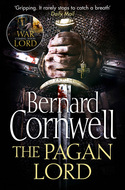
THE PAGAN LORD

BERNARD CORNWELL

Copyright
HarperCollinsPublishers
1 London Bridge Street
London SE1 9GF
www.harpercollins.co.uk
First published in Great Britain by HarperCollinsPublishers 2013
Copyright © Bernard Cornwell 2013
Maps © John Gilkes 2013
Family tree © Colin Hall 2009
Cover layout design © HarperCollinsPublishers Ltd 2016
Cover illustration © Lee Gibbons/Tin Moon www.leegibbons.co.uk.
Bernard Cornwell asserts the moral right to be identified as the author of this work.
A catalogue record for this book is available from the British Library.
This novel is entirely a work of fiction. The names, characters and incidents portrayed in it, while at times based on historical figures, are the work of the author’s imagination.
All rights reserved under International and Pan-American Copyright Conventions. By payment of the required fees, you have been granted the non-exclusive, non-transferable right to access and read the text of this e-book on-screen. No part of this text may be reproduced, transmitted, down-loaded, decompiled, reverse engineered, or stored in or introduced into any information storage and retrieval system, in any form or by any means, whether electronic or mechanical, now known or hereinafter invented, without the express written permission of HarperCollins.
Source ISBN: 9780007331925
Ebook Edition © 2014 ISBN: 9780007331949
Version: 2019-09-27
Dedication
THE PAGAN LORD
is for Tom and Dana
Go raibh mile maith agat
CONTENTS
Cover
Title Page
Copyright
Dedication
Place Names
Map
The Royal Family of Wessex
Part One: THE ABBOT
Chapter One
Chapter Two
Part Two: MIDDELNIHT
Chapter Three
Chapter Four
Chapter Five
Part Three: RUMOURS OF WAR
Chapter Six
Chapter Seven
Chapter Eight
Chapter Nine
Chapter Ten
Part Four: ICE-SPITE
Chapter Eleven
Chapter Twelve
Chapter Thirteen
Historical Note
Keep Reading …
About the Author
Also by Bernard Cornwell
About the Publisher
PLACE NAMES
The spelling of place names in Anglo-Saxon England was an uncertain business, with no consistency and no agreement even about the name itself. Thus London was variously rendered as Lundonia, Lundenberg, Lundenne, Lundene, Lundenwic, Lundenceaster and Lundres. Doubtless some readers will prefer other versions of the names listed below, but I have usually employed whichever spelling is cited in either the Oxford or the Cambridge Dictionary of English Place-Names for the years nearest to AD 900, but even that solution is not foolproof. Hayling Island, in 956, was written as both Heilincigae and Hæglingaiggæ. Nor have I been consistent myself; I should spell England as Englaland, and have preferred the modern form Northumbria to Norðhymbralond to avoid the suggestion that the boundaries of the ancient kingdom coincide with those of the modern county. So this list, like the spellings themselves, is capricious.
| Æsc’s Hill | Ashdown, Berkshire |
| Afen | River Avon, Wiltshire |
| Beamfleot | Benfleet, Essex |
| Bearddan Igge | Bardney, Lincolnshire |
| Bebbanburg | Bamburgh Castle, Northumberland |
| Bedehal | Beadnell, Northumberland |
| Beorgford | Burford, Oxfordshire |
| Botulfstan | Boston, Lincolnshire |
| Buchestanes | Buxton, Derbyshire |
| Ceaster | Chester, Cheshire |
| Ceodre | Cheddar, Somerset |
| Cesterfelda | Chesterfield, Derbyshire |
| Cirrenceastre | Cirencester, Gloucestershire |
| Coddeswold Hills | The Cotswolds, Gloucestershire |
| Cornwalum | Cornwall |
| Cumbraland | Cumbria |
| Dunholm | Durham, County Durham |
| Dyflin | Dublin, Eire |
| Eoferwic | York, Yorkshire |
| Ethandun | Edington, Wiltshire |
| Exanceaster | Exeter, Devon |
| Fagranforda | Fairford, Gloucestershire |
| Farnea Islands | Farne Islands, Northumberland |
| Flaneburg | Flamborough, Yorkshire |
| Foirthe | River Forth, Scotland |
| The Gewæsc | The Wash |
| Gleawecestre | Gloucester, Gloucestershire |
| Grimesbi | Grimsby, Lincolnshire |
| Haithabu | Hedeby, Denmark |
| Humbre | River Humber |
| Liccelfeld | Lichfield, Staffordshire |
| Lindcolne | Lincoln, Lincolnshire |
| Lindisfarena | Lindisfarne (Holy Island), Northumberland |
| Lundene | London |
| Mærse | River Mersey |
| Pencric | Penkridge, Staffordshire |
| Sæfern | River Severn |
| Sceapig | Isle of Sheppey, Kent |
| Snotengaham | Nottingham, Nottinghamshire |
| Tameworþig | Tamworth, Staffordshire |
| Temes | River Thames |
| Teotanheale | Tettenhall, West Midlands |
| Tofeceaster | Towcester, Northamptonshire |
| Uisc | River Exe |
| Wiltunscir | Wiltshire |
| Wintanceaster | Winchester, Hampshire |
| Wodnesfeld | Wednesbury, West Midlands |

The Royal Family of Wessex

PART ONE
The Abbot
One
A dark sky.
The gods make the sky; it reflects their moods and they were dark that day. It was high summer and a bitter rain was spitting from the east. It felt like winter.
I was mounted on Lightning, my best horse. He was a stallion, black as night, but with a slash of grey pelt running down his hindquarters. He was named for a great hound I had once sacrificed to Thor. I hated killing that dog, but the gods are hard on us; they demand sacrifice and then ignore us. This Lightning was a huge beast, powerful and sullen, a warhorse, and I was in my war-glory on that dark day. I was dressed in mail and clad in steel and leather. Serpent-Breath, best of swords, hung at my left side, though for the enemy I faced that day I needed no sword, no shield, no axe. But I wore her anyway because Serpent-Breath was my companion. I still own her. When I die, and that must be soon, someone will close my fingers around the leather-bindings of her worn hilt and she will carry me to Valhalla, to the corpse-hall of the high gods, and we shall feast there.
But not that day.
That dark summer day I sat in the saddle in the middle of a muddy street, facing the enemy. I could hear them, but could not see them. They knew I was there.
The street was just wide enough for two wagons to pass each other. The houses either side were mud and wattle, thatched with reeds that had blackened with rain and grown thick with lichen. The mud in the street was fetlock deep, rutted by carts and fouled by dogs and by the swine that roamed free. The spiteful wind rippled the puddles in the ruts and whipped smoke from a roof-hole, bringing the scent of burning wood.
I had two companions. I had ridden from Lundene with twenty-two men, but my mission in this shit-smelling, rain-spitted village was private and so I had left most of my men a mile away. Yet Osbert, my youngest son, was behind me, mounted on a grey stallion. He was nineteen years old, he wore a suit of mail and had a sword at his side. He was a man now, though I thought of him as a boy. I frightened him, just as my father had frightened me. Some mothers soften their sons, but Osbert was motherless and I had raised him hard because a man must be hard. The world is filled with enemies. The Christians tell us to love our enemies and to turn the other cheek. The Christians are fools.
Next to Osbert was Æthelstan, bastard eldest son of King Edward of Wessex. He was just eight years old, yet like Osbert he wore mail. Æthelstan was not frightened of me. I tried to frighten him, but he just looked at me with his cold blue eyes, then grinned. I loved that boy, just as I loved Osbert.
Both were Christians. I fight a losing battle. In a world of death, betrayal and misery, the Christians win. The old gods are still worshipped, of course, but they’re being driven back into the high valleys, into the lost places, to the cold northern edges of the world, and the Christians spread like a plague. Their nailed god is powerful. I accept that. I have always known their god has great power and I don’t understand why my gods let the bastard win, but they do. He cheats. That’s the only explanation I can find. The nailed god lies and cheats, and liars and cheaters always win.
So I waited in the wet street, and Lightning scraped a heavy hoof in a puddle. Above my leather and mail I wore a cloak of dark blue wool, edged with stoat fur. The hammer of Thor hung at my throat, while on my head was my wolf-crested helmet. The cheek-pieces were open. Rain dripped from the helmet rim. I wore long leather boots, their tops stuffed with rags to keep the rain from trickling down inside. I wore gauntlets, and on my arms were the rings of gold and rings of silver, the rings a warlord earns by killing his enemies. I was in my glory, though the enemy I faced did not deserve that respect.
‘Father,’ Osbert began, ‘what if …’
‘Did I speak to you?’
‘No.’
‘Then be quiet,’ I snarled.
I had not meant to sound so angry, but I was angry. It was an anger that had no place to go, just anger at the world, at the miserable dull grey world, an impotent anger. The enemy was behind closed doors and they were singing. I could hear their voices, though I could not distinguish their words. They had seen me, I was certain, and they had seen that the street was otherwise empty. The folk who lived in this town wanted no part of what was about to happen.
Though what was about to happen I did not know myself, even though I would cause it. Or perhaps the doors would stay shut and the enemy would cower inside their stout timber building? Doubtless that was the question Osbert had wanted to ask. What if the enemy stayed indoors? He probably would not have called them the enemy. He would have asked what if ‘they’ stay indoors.
‘If they stay indoors,’ I said, ‘I’ll beat their damned door down, go in and pull the bastard out. And if I do that then the two of you will stay here to hold Lightning.’
‘Yes, Father.’
‘I’ll come with you,’ Æthelstan said.
‘You’ll do as you’re damned well told.’
‘Yes, Lord Uhtred,’ he said respectfully, but I knew he was grinning. I did not need to turn around to see that insolent grin, but I would not have turned because at that moment the singing stopped. I waited. A moment passed and then the doors opened.
And out they came. Half a dozen older men first, then the young ones, and I saw those younger ones look at me, but even the sight of Uhtred, warlord draped in anger and glory, could not stifle their joy. They looked so happy. They were smiling, slapping each other’s backs, embracing and laughing.
The six older men were not laughing. They walked towards me and I did not move. ‘I am told you are Lord Uhtred,’ one of them said. He wore a grubby white robe belted with rope, was white-haired and grey-bearded and had a narrow, sun-darkened face with deep lines carved round his mouth and eyes. His hair fell past his shoulders, while his beard reached to his waist. He had a sly face, I thought, but not without authority, and he had to be a churchman of some importance because he carried a heavy staff topped with an ornate silver cross.
I said nothing to him. I was watching the younger men. They were boys mostly, or boys just turned to men. Their scalps, where their hair had been shaved back from their foreheads, gleamed pale in the grey daylight. Some older folk were coming from the doors now. I assumed they were the parents of these boy-men.
‘Lord Uhtred.’ The man spoke again.
‘I’ll speak to you when I’m ready to speak,’ I growled.
‘This is not seemly,’ he said, holding the cross towards me as if it might frighten me.
‘Clean your rancid mouth out with goat piss,’ I said. I had seen the young man I had come to find and I kicked Lightning forward. Two of the older men tried to stop me, but Lightning snapped with his big teeth and they staggered back, desperate to escape. Spear-Danes had fled from Lightning, and the six older men scattered like chaff.
I drove the stallion into the press of younger men, leaned down from the saddle and grasped the man-child’s black gown. I hauled him upwards, thrust him belly-down over the pommel and turned Lightning with my knees.
And that was when the trouble started.
Two or three of the younger men tried to stop me. One reached for Lightning’s bridle and that was a mistake, a bad mistake. The teeth snapped, the boy-man screamed, and I let Lightning rear up and flail with his front hooves. I heard the crash of one heavy hoof into bone, saw blood bright and sudden. Lightning, trained to keep moving lest an enemy try to hamstring a back leg, lurched forward. I spurred him, glimpsing a fallen man with a bloody skull. Another fool grasped my right boot, trying to haul me from the saddle, and I slammed my hand down and felt the grip vanish. Then the man with long white hair challenged me. He had followed me into the crowd and he shouted that I was to let my captive go, and then, like a fool, he swung the heavy silver cross on its long shaft at Lightning’s head. But Lightning had been trained to battle and he twisted lithely, and I leaned down and seized the staff and ripped it from the man’s grasp. Still he did not give up. He was spitting curses at me as he seized Lightning’s bridle and tried to drag the horse back into the crowd of youths, presumably so I would be overwhelmed by numbers.
I raised the staff and slammed it down hard. I used the butt end of the staff as if it were a spear, and did not see it was tipped with a metal spike, presumably so the cross could be rammed into the earth. I had just meant to stun the ranting fool, but instead the staff buried itself in his head. It pierced his skull. It brightened that dull gloomy day with blood. It caused screams to sound to the Christian heaven, and I let the staff go and the white-robed man, now dressed in a robe dappled with red, stood swaying, mouth opening and closing, eyes glazing, with a Christian cross jutting skywards from his head. His long white hair turned red, and then he fell. He just fell, dead as a bone. ‘The abbot!’ someone shouted, and I spurred Lightning and he leaped forward, scattering the last of the boy-men and leaving their mothers screaming. The man draped over my saddle struggled and I hit him hard on the back of his skull as we burst from the press of people back into the open street.
The man on my saddle was my son. My eldest son. He was Uhtred, son of Uhtred, and I had ridden from Lundene too late to stop him becoming a priest. A wandering preacher, one of those long-haired, wild-bearded, mad-eyed priests who gull the stupid into giving them silver in return for a blessing, had told me of my son’s decision. ‘All Christendom rejoices,’ he had said, watching me slyly.
‘Rejoices in what?’ I had asked.
‘That your son is to be a priest! Two days from now, I hear, in Tofeceaster.’
And that was what the Christians had been doing in their church, consecrating their wizards by making boys into black-clothed priests who would spread their filth further, and my son, my eldest son, was now a damned Christian priest and I hit him again. ‘You bastard,’ I growled, ‘you lily-livered bastard. You traitorous little cretin.’
‘Father …’ he began.
‘I’m not your father,’ I snarled. I had taken Uhtred down the street to where a particularly malodorous dung-heap lay wetly against a hovel wall. I tossed him into it. ‘You are not my son, I said, ‘and your name is not Uhtred.’
‘Father …’
‘You want Serpent-Breath down your throat?’ I shouted. ‘If you want to be my son you take off that damned black frock, put on mail and do what I tell you.’
‘I serve God.’
‘Then choose your own damned name. You are not Uhtred Uhtredson.’ I twisted in the saddle. ‘Osbert!’
My younger son kicked his stallion towards me. He looked nervous. ‘Father?’
‘From this day on your name is Uhtred.’
He glanced at his brother, then back to me. He nodded reluctantly.
‘What is your name?’ I demanded.
He still hesitated, but saw my anger and nodded again. ‘My name is Uhtred, Father.’
‘You are Uhtred Uhtredson,’ I said, ‘my only son.’
It had happened to me once, long ago. I had been named Osbert by my father, who was called Uhtred, but when my elder brother, also Uhtred, was slaughtered by the Danes my father had renamed me. It is always thus in our family. The eldest son carries on the name. My stepmother, a foolish woman, even had me baptised a second time because, she said, the angels who guard the gates of heaven would not know me by my new name, and so I was dipped in the water barrel, but Christianity washed off me, thank Christ, and I discovered the old gods and have worshipped them ever since.
The five older priests caught up with me. I knew two of them, the twins Ceolnoth and Ceolberht who, some thirty years before, had been hostages with me in Mercia. We had been boys captured by the Danes, a fate I had welcomed and the twins had hated. They were old now, two identical priests with stocky builds, greying beards and anger livid on their round faces. ‘You’ve killed the Abbot Wihtred!’ one of the twins challenged me. He was furious, shocked, almost incoherent with rage. I had no idea which twin he was because I could never tell them apart.
‘And Father Burgred’s face is ruined!’ the other twin said. He moved as if to take Lightning’s bridle and I turned the horse fast, letting him threaten the twins with the big yellow teeth that had bitten off the newly ordained priest’s face. The twins stepped back.
‘The Abbot Wihtred!’ the first twin repeated the name. ‘A saintlier man never lived!’
‘He attacked me,’ I said. In truth I had not meant to kill the old man, but there was small point in telling that to the twins.
‘You’ll suffer!’ one of the twins yelped. ‘You will be cursed for all time!’
The other held a hand towards the wretched boy in the dung-heap. ‘Father Uhtred,’ he said.
‘His name is not Uhtred,’ I snarled, ‘and if he dares call himself Uhtred,’ I looked at him as I spoke, ‘then I will find him and I will cut his belly to the bone and I will feed his lily-livered guts to my swine. He is not my son. He’s not worthy to be my son.’
The man who was not worthy to be my son clambered wetly from the dung-heap, dripping filth. He looked up at me. ‘Then what am I called?’ he asked.
‘Judas,’ I said mockingly. I was raised as a Christian and had been forced to hear all their stories, and I recalled that a man named Judas had betrayed the nailed god. That never made any sense to me. The god had to be nailed to a cross if he was to become their saviour, and then the Christians blame the man who made that death possible. I thought they should worship him as a saint, but instead they revile him as a betrayer. ‘Judas,’ I said again, pleased I had remembered the name.
The boy who had been my son hesitated, then nodded. ‘From now on,’ he said to the twins, ‘I am to be called Father Judas.’
‘You cannot call yourself …’ either Ceolnoth or Ceolberht began.
‘I am Father Judas,’ he said harshly.
‘You will be Father Uhtred!’ one of the twins shouted at him, then pointed at me. ‘He has no authority here! He is a pagan, an outcast, loathed of God!’ He was shaking with anger, hardly able to speak, but he took a deep breath, closed his eyes and raised both hands towards that dark sky. ‘O God,’ he shouted, ‘bring down your wrath on this sinner! Punish him! Blight his crops and strike him with sickness! Show your power, O Lord!’ His voice rose to a shriek. ‘In the name of the Father, and of the Son and of the Holy Spirit, I curse this man and all his kin.’
He took a breath and I pressed my knee on Lightning’s flank and the great horse moved a pace closer to the ranting fool. I was as angry as the twins.
‘Curse him, O Lord,’ he shouted, ‘and in thy great mercy bring him low! Curse him and his kin, may they never know grace! Smite him, O Lord, with filth and pain and misery!’
‘Father!’ the man who had been my son shouted.
Æthelstan chuckled. Uhtred, my only son, gasped.
Because I had kicked the ranting fool. I had pulled my right foot from the stirrup and lashed out with the heavy boot and his words stopped abruptly, replaced by blood on his lips. He staggered backwards, his right hand pawing at his shattered mouth. ‘Spit out your teeth,’ I ordered him, and when he disobeyed I half drew Serpent-Breath.
He spat out a mix of blood, spittle and broken teeth. ‘Which one are you?’ I asked the other twin.
He gaped at me, then recovered his wits. ‘Ceolnoth,’ he said.
‘At least I can tell the two of you apart now,’ I said.
I did not look at Father Judas. I just rode away.
I rode home.
Perhaps Ceolberht’s curse had worked, because I came home to death, smoke and ruin.
Cnut Ranulfson had raided my hall. He had burned it. He had killed. He had taken Sigunn captive.
None of it made sense, not then. My estate was close to Cirrenceastre, which was deep inside Mercia. A band of horse-Danes had ridden far, risking battle and capture, to attack my hall. I could understand that. A victory over Uhtred would give a man reputation, it would spur the poets to taunting songs of victory, but they had attacked while the hall was almost empty. They would surely have sent scouts? They would have suborned folk to be spies for them, to discover when I was there and when I was likely to be absent, and such spies would surely have told them that I had been summoned to Lundene to advise King Edward’s men on that city’s defences. Yet they had risked disaster to attack an almost empty hall? It made no sense.
And they had taken Sigunn.
She was my woman. Not my wife. Since Gisela died I had not taken another wife, though I had lovers in those days. Æthelflaed was my lover, but Æthelflaed was another man’s wife and the daughter of the dead King Alfred, and we could not live together as man and wife. Sigunn lived with me instead, and Æthelflaed knew it. ‘If it wasn’t Sigunn,’ she had told me one day, ‘it would be another.’
‘Maybe a dozen others.’
‘Maybe.’
I had captured Sigunn at Beamfleot. She was a Dane, a slender, pale, pretty Dane who had been weeping for her slaughtered husband when she was dragged out of a sea-ditch running with blood. We had lived together almost ten years now and she was treated with honour and hung with gold. She was the lady of my hall and now she was gone. She had been taken by Cnut Ranulfson, Cnut Longsword.
‘It was three mornings ago,’ Osferth told me. He was the bastard son of King Alfred, who had tried to turn him into a priest, but Osferth, even though he had the face and mind of a cleric, preferred to be a warrior. He was careful, precise, intelligent, reliable and rarely impassioned. He resembled his father, and the older he got the more like his father he looked.
‘So it was Sunday morning,’ I said bleakly.
‘Everyone was in the church, lord,’ Osferth explained.
‘Except Sigunn.’
‘Who is no Christian, lord,’ he said, sounding disapproving.
Finan, who was my companion and the man who commanded my troops if I was absent, had taken twenty men to reinforce Æthelflaed’s bodyguard as she toured Mercia. She had been inspecting the burhs that guarded Mercia from the Danes, and doubtless worshipping in churches across the land. Her husband, Æthelred, was reluctant to leave the sanctuary of Gleawecestre and so Æthelflaed did his duty. She had her own warriors who guarded her, but I still feared for her safety, not from the Mercians, who loved her, but from her husband’s followers, and so I had insisted she take Finan and twenty men and, in the Irishman’s absence, Osferth had been in charge of the men guarding Fagranforda. He had left six men to watch over the hall, barns, stables and mill, and six men should have been more than enough because my estate lay a long way from the northern lands where the Danes ruled. ‘I blame myself, lord,’ Osferth said.
‘Six was enough,’ I said. And the six were all dead, as was Herric, my crippled steward, and three other servants. Some forty or fifty horses were gone, while the hall was burned. Some of the walls still stood, gaunt scorched trunks, but the hall’s centre was just a heap of smoking ash. The Danes had arrived fast, broken down the hall door, slaughtered Herric and anyone else who tried to oppose them, then had taken Sigunn and left. ‘They knew you’d all be in the church,’ I said.
‘Which is why they came on Sunday,’ Sihtric, another of my men, finished the thought.
‘And they would have known you wouldn’t be worshipping,’ Osferth said.
‘How many were there?’ I asked Osferth.
‘Forty or fifty,’ he replied patiently. I had asked him the question a dozen times already.
Danes do not make a raid like this for pleasure. There were plenty of Saxon halls and steadings within easy reach of their lands, but these men had risked riding deep into Mercia. For Sigunn? She was nothing to them.
‘They came to kill you, lord,’ Osferth suggested.
Yet the Danes would have scouted the land first, they would have talked to travellers, they would know that I always had at least twenty men with me. I had chosen not to take those twenty into Tofeceaster to punish the man who had been my son because a warrior does not need twenty men to deal with a pack of priests. My son and a boy had been company enough. But the Danes could not have known I was at Tofeceaster, even I had not known I was going there till I heard the news that my damned son was becoming a Christian wizard. Yet Cnut Ranulfson had risked his men in a long, pointless raid, despite the danger of meeting my men. He would have outnumbered me, but he would have taken casualties that he could ill afford, and Cnut Longsword was a calculating man, not given to idiotic risks. None of it made sense. ‘You’re sure it was Cnut Ranulfson?’ I asked Osferth.
‘They carried his banner, lord.’
‘The axe and broken cross?’
Two
My son, Uhtred. It seemed strange calling him that, at least at first. He had been called Osbert for almost twenty years and I had to make an effort to use his new name. Perhaps my father had felt the same when he renamed me. Now, as we rode back from Tameworþig, I called Uhtred to my side. ‘You haven’t fought in a shield wall yet,’ I told him.
‘No, Father.’
‘You’re not a man till you do,’ I said.
‘I want to.’
‘And I want to protect you,’ I said. ‘I’ve lost one son, I don’t want to lose another.’
We rode in silence through a damp, grey land. There was little wind and the trees hung heavy with wet leaves. The crops were poor. It was dusk and the west was suffused with a grey light that glinted off the puddled fields. Two crows flew slowly towards the clouds that shrouded the dying sun. ‘I can’t protect you for ever,’ I said. ‘Sooner or later you’ll have to fight in a shield wall. You have to prove yourself.’
‘I know that, Father.’
Yet it was not my son’s fault that he had never proved himself. The uneasy peace that had settled on Britain like a damp fog had meant that warriors stayed in their halls. There had been many skirmishes, but no battle since we had cut down the spear-Danes in East Anglia. The Christian priests liked to say that their god had granted the peace because that was his will, but it was the will of men that was lacking. King Edward of Wessex was content to defend what he had inherited from his father and showed little ambition to increase those lands, Æthelred of Mercia sulked in Gleawecestre, and Cnut? He was a great warrior, but also a cautious one, and perhaps the new pretty wife had been entertainment enough for him, except now someone had taken that wife and his twin children. ‘I like Cnut,’ I said.
‘He was generous,’ my son said.
I ignored that. Cnut had indeed been a generous host, but that was the duty of a lord, though once again I should have thought more carefully. The feast at Tameworþig had been lavish, and it had been prepared, which meant Cnut knew he would entertain me rather than kill me. ‘One day we’ll have to kill him,’ I said, ‘and his son, if he ever finds his son. They stand in our way. But for the moment we’ll do what he asked. We’ll find out who captured his wife and children.’
‘Why?’ he asked.
‘Why what?’
‘Why help him? He’s a Dane. He’s our enemy.’
‘I didn’t say we’re helping him,’ I growled. ‘But whoever took Cnut’s wife is planning something. I want to know what.’
‘What is Cnut’s wife called?’ he asked.
‘I didn’t ask him,’ I said, ‘but I hear she’s beautiful. Not like that plump little seamstress you plough every night. She’s got a face like the backside of a piglet.’
‘I don’t look at her face,’ he said, then frowned. ‘Did Cnut say his wife was captured at Buchestanes?’ he asked.
‘That’s what he said.’
‘Isn’t that a long way north?’
‘Far enough.’
‘So a Saxon band rides that deep into Cnut’s land without being seen or challenged?’
‘I did it once.’
‘You’re Lord Uhtred, miracle-worker,’ he said, grinning.
‘I went to see the sorceress there,’ I told him, and remembered that strange night and the beautiful creature who had come to me in my vision. Erce, she had been called, yet in the morning there had only been the old hag, Ælfadell. ‘She sees the future,’ I said, but Ælfadell had said nothing to me of Bebbanburg, and that was what I had wanted to hear. I wanted to hear that I would retake that fortress, that I would become its rightful lord, and I thought of my uncle, old and sick, and that made me angry. I did not want him to die until I had hurt him. Bebbanburg. It haunted me. I had spent the last years trying to amass the gold needed to go north and assault those great ramparts, but bad harvests had bitten into my hoard. ‘I’m getting old,’ I said.
‘Father?’ Uhtred asked, surprised.
‘If I don’t capture Bebbanburg,’ I told him, ‘then you will. Take my body there, bury it there. Put Serpent-Breath in my grave.’
‘You’ll do it,’ he said.
‘I’m getting old,’ I said again, and that was true. I had lived more than fifty years and most men were lucky to see forty. Yet all old age was bringing was the death of dreams. There had been a time when all we wanted was one country, free of Danes, a land of the English kin, but still the Northmen ruled in the north and the Saxon south was riddled with priests who preached turning the cheek. I wondered what would happen after my death, whether Cnut’s son would lead the last great invasion, and the halls would burn and the churches would fall and the land Alfred had wanted to call England would be named Daneland.
Osferth, Alfred’s bastard son, spurred to catch us up. ‘That’s odd,’ he said.
‘Odd?’ I asked. I had been daydreaming, noticing nothing, but now, looking ahead, I saw that the southern sky was glowing red, a lurid red, the red of fire.
‘The hall must still be smouldering,’ Osferth said. It was dusk and the sky was dark except in the far west and above the fire to our south. The flames reflected from the clouds and a smear of smoke drifted eastwards. We were close to home and the smoke had to be coming from Fagranforda. ‘But it can’t have burned that long,’ Osferth went on, puzzled. ‘The fire was out when we left.’
‘And it’s rained ever since,’ my son added.
For a moment I thought of stubble burning, but that was a nonsense. We were nowhere near harvest time and so I kicked my heels to hurry Lightning. The big hooves splashed in puddled ruts and I kicked him again to make him gallop. Æthelstan, on his lighter and smaller horse, raced past me. I called to the boy to come back, but he kept riding, pretending not to have heard me. ‘He’s headstrong,’ Osferth said disapprovingly.
‘He needs to be,’ I said. A bastard son must fight his own way in the world. Osferth knew that. Æthelstan, like Osferth, might be the son of a king, but he was not the son of Edward’s wife, and that made him dangerous to her family. He would need to be headstrong.
We were on my land now and I cut across a waterlogged pasture to the stream that watered my fields. ‘No,’ I said in disbelief because the mill was burning. It was a watermill I had built and now it was spewing flames, while close to it, dancing like demons, were men in dark robes. Æthelstan, far ahead of us, had curbed his horse to stare beyond the mill to where the rest of the buildings were aflame. Everything that Cnut Ranulfson’s men had left unburned was now blazing: the barn, the stables, the cow shelters, everything; and all about them, capering black in the flamelight, were men.
There were men and some women. Scores of them. And children too, running excitedly around the roaring flames. A cheer went up as the ridge of the barn collapsed to spew sparks high into the darkening sky, and in the burst of flames I saw bright banners held by dark-robed men. ‘Priests,’ my son said. I could hear singing now and I kicked Lightning and beckoned my men so that we galloped across the waterlogged meadow towards the place that had been my home. And as we approached I saw the dark robes gather together and saw the glint of weapons. There were hundreds of folk there. They were jeering, shouting, and above their heads were spears and hoes, axes and scythes. I saw no shields. This was the fyrd, the gathering of ordinary men to defend their land, the men who would garrison the burhs if the Danes came, but now they had occupied my estate and they had seen me and were screaming insults.
A man in a white cloak and mounted on a white horse pushed through the rabble. He held up his hand for silence and when it did not come he turned his horse and shouted at the angry crowd. I heard his voice, but not his words. He calmed them, stared at them for a few heartbeats, and then wrenched his horse around and spurred towards me. I had stopped. My men made a line on either side of me. I was watching the crowd, looking for faces I knew and saw none. My neighbours, it seemed, had no stomach for this burning.
The horseman stopped a few paces from me. He was a priest. He wore a black robe beneath the white cloak and a silver crucifix was bright against the black weave. He had a long face carved with shadowed lines, a wide mouth, a hook of a nose, and deep-set dark eyes beneath thick black brows. ‘I am Bishop Wulfheard,’ he announced. He met my eyes and I could see nervousness beneath the defiance. ‘Wulfheard of Hereford,’ he added as if the name of his bishopric would give him added dignity.
‘I’ve heard of Hereford,’ I said. It was a town on the border between Mercia and Wales, a smaller town than Gleawecestre yet, for some reason that only the Christians could explain, the small town had a bishop and the larger did not. I had heard of Wulfheard too. He was one of those ambitious priests who whisper into kings’ ears. He might be Bishop of Hereford, but he spent his time in Gleawecestre where he was Æthelred’s puppy.
I looked away from him, staring instead at the line of men who barred my path. Perhaps three hundred? I could see a handful of swords now, but most of the weapons had come from farm steadings. Yet three hundred men armed with timber axes, with hoes and with sickles could do lethal damage to my sixty-eight men.
‘Look at me!’ Wulfheard demanded.
I kept my eyes on the crowd and touched my right hand to Serpent-Breath’s hilt. ‘You do not give me orders, Wulfheard,’ I said, not looking at him.
‘I bring you orders,’ he said grandly, ‘from Almighty God and from the Lord Æthelred.’
‘I’m sworn to neither,’ I said, ‘so their orders mean nothing.’
‘You mock God!’ the bishop shouted loud enough for the crowd to hear.
That crowd murmured and a few even edged forward as if to attack my men.
Bishop Wulfheard also edged forward. He ignored me now and called to my men instead. ‘The Lord Uhtred,’ he shouted, ‘has been declared outcast of God’s church! He has killed a saintly abbot and wounded other men of God! It has been decreed that he is banished from this land, and further decreed that any man who follows him, who swears loyalty to him, is also outcast from God and from man!’
I sat still. Lightning thumped a heavy hoof on the soft turf and the bishop’s horse shifted warily away. There was silence from my men. Some of their wives and children had seen us and they were streaming across the meadow, seeking the protection of our weapons. Their homes had been burned. I could see the smoke sifting up from the street on the small western hill.
‘If you wish to see heaven,’ the bishop called to my men, ‘if you wish your wives and children to enjoy the saving grace of our Lord Jesus, then you must leave this evil man!’ He pointed at me. ‘He is cursed of God, he is cast into an outer darkness! He is condemned! He is reprobate! He is damned! He is an abomination before the Lord! An abomination!’ He evidently liked that word, because he repeated it. ‘An abomination! And if you remain with him, if you fight for him, then you too shall be cursed, both you and your wives and your children also! You and they will be condemned to the everlasting tortures of hell! You are therefore absolved of your loyalty to him! And know that to kill him is no sin! To kill this abomination is to earn the grace of God!’
He was inciting them to my death, but not one of my men moved to attack me, though the rabble found new courage and shuffled forward, growling. They were nerving themselves to swarm at me. I glanced back at my men and saw they were in no mood to fight this crowd of enraged Christians because my men’s wives were not seeking protection, as I had thought, but trying to pull them away from me, and I remembered something Father Pyrlig had once said to me, that women were ever the most avid worshippers, and I saw that these women, all Christians, were undermining my men’s loyalties.
What is an oath? A promise to serve a lord, but to Christians there is always a higher allegiance. My gods demand no oaths, but the nailed god is more jealous than any lover. He tells his followers that they can have no other gods beside himself, and how ridiculous is that? Yet the Christians grovel to him and abandon the older gods. I saw my men waver. They glanced at me, then some spurred away, not towards the ranting mob, but westwards away from the crowd and away from me. ‘It’s your fault.’ Bishop Wulfheard had forced his horse back towards me. ‘You killed Abbot Wihtred, a holy man, and God’s people have had enough of you.’
Not all my men wavered. Some, mostly Danes, spurred towards me, as did Osferth. ‘You’re a Christian,’ I said to him, ‘why don’t you abandon me?’
‘You forget,’ he said, ‘that I was abandoned by God. I’m a bastard, already cursed.’
My son and Æthelstan had also stayed, but I feared for the younger boy. Most of my men were Christians and they had ridden away from me, while the threatening crowd was numbered in the hundreds and they were being encouraged by priests and monks. ‘The pagans must be destroyed!’ I heard a black-bearded priest shout. ‘He and his woman! They defile our land! We are cursed so long as they live!’
‘Your priests threaten a woman?’ I asked Wulfheard. Sigunn was by my side, mounted on a small grey mare. I kicked Lightning towards the bishop, who wrenched his horse away. ‘I’ll give her a sword,’ I told him, ‘and let her gut your gutless guts, you mouse-prick.’
Osferth caught up with me and took hold of Lightning’s bridle. ‘A retreat might be prudent, lord,’ he said.
I drew Serpent-Breath. It was deep dusk now, the western sky was a glowing purple shading to grey and then to a wide blackness in which the first stars glittered through tiny rents in the clouds. The light of the fires reflected from Serpent-Breath’s wide blade. ‘Maybe I’ll kill myself a bishop first,’ I snarled, and turned Lightning back towards Wulfheard, who rammed his heels so that his horse leaped away, almost unsaddling his rider.
‘Lord!’ Osferth shouted in protest and kicked his own horse forward to intercept me. The crowd thought the two of us were pursuing the bishop and they surged forward. They were screaming and shouting, brandishing their crude weapons and lost in the fervour of their God-given duty, and I knew we would be overwhelmed, but I was angry too and I thought I would rather carve a path through that rabble than be seen to run away.
And so I forgot the fleeing bishop, but instead just turned my horse towards the crowd. And that was when the horn sounded.
It blared, and from my right, from where the sun glowed beneath the western horizon, a stream of horsemen galloped to place themselves between me and the crowd. They were in mail, they carried swords or spears, and their faces were hidden by the cheek-pieces of their helmets. The flamelight glinted from those helmets, turning them into blood-touched spear-warriors whose stallions threw up gouts of damp earth as the horses slewed around so that the newcomers faced the crowd.
One man faced me. His sword was lowered as he trotted his stallion towards Lightning, then the blade flicked up in a salute. I could see he was grinning. ‘What have you done, lord?’ he asked.
‘I killed an abbot.’
‘You made a martyr and a saint then,’ he said lightly, then twisted in the saddle to look past the horsemen at the crowd, which had checked its advance but still looked threatening. ‘You’d think they’d be grateful for another saint, wouldn’t you?’ he said. ‘But they’re not happy at all.’
‘It was an accident,’ I said.
‘Accidents have a way of finding you, lord,’ he said, grinning at me. It was Finan, my friend, the Irishman who commanded my men if I was absent, and the man who had been protecting Æthelflaed.
And there she was, Æthelflaed herself, and the angry murmur of the rabble died away as she rode slowly to face them. She was mounted on a white mare, wore a white cloak, and had a circlet of silver about her pale hair. She looked like a queen, and she was the daughter of a king, and she was loved in Mercia. Bishop Wulfheard, recognising her, spurred to her side where he spoke low and urgently, but she ignored him. She ignored me too, facing the crowd and straightening in her saddle. For a while she said nothing. The flames of the burning buildings flickered reflections from the silver she wore in her hair and about her neck and on her slim wrists. I could not see her face, but I knew that face so well, and knew it would be icy stern. ‘You will leave,’ she said almost casually. A growl sounded and she repeated the command in a louder voice. ‘You will leave!’ She waited until there was silence. ‘The priests here, the monks here, will lead you away. Those of you who have come far will need shelter and food, and you will find both in Cirrenceastre. Now go!’ She turned her horse and Bishop Wulfheard turned after her. I saw him plead with her, and then she raised a hand. ‘Who commands here, bishop,’ she demanded, ‘you or I?’ There was such a challenge in those words.
Æthelflaed did not rule in Mercia. Her husband was the Lord of Mercia and, if he had possessed a pair of balls, might have called himself king of this land, but he had become the thrall of Wessex. His survival depended on the help of West Saxon warriors, and those only helped him because he had taken Æthelflaed as his wife and she was the daughter of Alfred, who had been the greatest of the West Saxon kings, and she was also the sister of Edward, who now ruled in Wessex. Æthelred hated his wife, yet needed her, and he hated me because he knew I was her lover, and Bishop Wulfheard knew it too. He had stiffened at her challenge, then glanced towards me, and I knew he was half tempted to meet her challenge and try to reimpose his mastery over the vengeful crowd, but Æthelflaed had calmed them. She did rule here. She ruled because she was loved in Mercia, and the folk who had burned my steading did not want to offend her. The bishop did not care. ‘The Lord Uhtred,’ he began and was summarily interrupted.
‘The Lord Uhtred,’ Æthelflaed spoke loudly so that as many folk as possible could hear her, ‘is a fool. He has offended God and man. He is declared outcast! But there will be no bloodshed here! Enough blood has been spilled and there will be no more. Now go!’ Those last two words were addressed to the bishop, but she glanced at the crowd and gestured that they should leave too.
And they went. The presence of Æthelflaed’s warriors was persuasive, of course, but it had been her confidence and authority that overrode the rabid priests and monks who had encouraged the crowd to destroy my estate. They drifted away, leaving the flames to light the night. Only my men remained, and those men who were sworn to Æthelflaed, and she turned towards me at last and stared at me with anger. ‘You fool,’ she said.
I said nothing. I was sitting in the saddle, gazing at the fires, my mind as bleak as the northern moors. I suddenly thought of Bebbanburg, caught between the wild northern sea and the high bare hills.
‘Abbot Wihtred was a good man,’ Æthelflaed said, ‘a man who looked after the poor, who fed the hungry and clothed the naked.’
‘He attacked me,’ I said.
‘And you are a warrior! The great Uhtred! And he was a monk!’ She made the sign of the cross. ‘He came from Northumbria, from your country, where the Danes persecuted him, but he kept the faith! He stayed true despite all the scorn and hatred of the pagans, only to die at your hands!’
‘I didn’t mean to kill him,’ I said.
‘But you did! And why? Because your son becomes a priest?’
‘He is not my son.’
‘You big fool! He is your son and you should be proud of him.’
‘He is not my son,’ I said stubbornly.
‘And now he’s the son of nothing,’ she spat. ‘You’ve always had enemies in Mercia, and now they’ve won. Look at it!’ She gestured angrily at the burning buildings. ‘Æthelred will send men to capture you, and the Christians want you dead.’
‘Your husband won’t dare attack me,’ I said.
‘Oh he’ll dare! He has a new woman. She wants me dead, and you dead too. She wants to be Queen of Mercia.’
I grunted, but stayed silent. Æthelflaed spoke the truth, of course. Her husband, who hated her and hated me, had found a lover called Eadith, a thegn’s daughter from southern Mercia, and rumour said she was as ambitious as she was beautiful. She had a brother named Eardwulf who had become the commander of Æthelred’s household warriors, and Eardwulf was as capable as his sister was ambitious. A band of hungry Welshmen had ravaged the western frontier and Eardwulf had hunted them, trapped them, and destroyed them. A clever man, I had heard, thirty years younger than me, and brother to an ambitious woman who wanted to be a queen.
‘The Christians have won,’ Æthelflaed told me.
‘You’re a Christian.’
She ignored that. Instead she just gazed blankly at the fires, then shook her head wearily. ‘We’ve had peace these last years.’
‘That’s not my fault,’ I said angrily. ‘I asked for men again and again. We should have captured Ceaster and killed Haesten and driven Cnut out of northern Mercia. It isn’t peace! There won’t be peace till the Danes are gone.’
‘But we do have peace,’ she insisted, ‘and the Christians don’t need you when there’s peace. If there’s war then all they want is Uhtred of Bebbanburg fighting for them, but now? Now we’re at peace? They don’t need you now, and they’ve always wanted to be rid of you. So what do you do? You slaughter one of the holiest men in Mercia!’
‘Holy?’ I sneered. ‘He was a stupid man who picked a fight.’
‘And the fight he picked was your fight!’ she said forcibly. ‘Abbot Wihtred was the man preaching about Saint Oswald! Wihtred had the vision! And you killed him!’
I said nothing to that. There was a holy madness adrift in Saxon Britain, a belief that if Saint Oswald’s body could be discovered then the Saxons would be reunited, meaning that those Saxons under Danish rule would suddenly become free. Northumbria, East Anglia and northern Mercia would be purged of Danish pagans, and all because a dismembered saint who had died almost three hundred years in the past would have his various body parts stitched together. I knew all about Saint Oswald: he had once ruled in Bebbanburg, and my uncle, the treacherous Ælfric, possessed one of the dead man’s arms. I had escorted the saint’s head to safety years before, and the rest of him was supposed to be buried at a monastery somewhere in southern Northumbria.
‘Wihtred wanted what you want,’ Æthelflaed said angrily, ‘he wanted a Saxon ruler in Northumbria!’
‘I didn’t mean to kill him,’ I said, ‘and I’m sorry.’
‘You should be sorry! If you stay here there’ll be two hundred spearmen coming to take you to judgement.’
‘I’ll fight them.’
She scorned that with a laugh. ‘With what?’
‘You and I have more than two hundred men,’ I said.
‘You’re more than a fool if you think I’ll tell my men to fight other Mercians.’
Of course she would not fight Mercians. She was loved by the Mercians, but that love would not raise an army sufficient to defeat her husband because he was the gold-giver, the hlaford, and he could raise a thousand men. He was forced to pretend that he and Æthelflaed were on cordial terms because he feared what would happen if he attacked her openly. Her brother, King of Wessex, would want revenge. He feared me too, but the church had just stripped me of much of my power. ‘What will you do?’ I asked her.
‘Pray,’ she said, ‘and I’ll take your men into service.’ She nodded towards those of my men whose religion had taken away their loyalty. ‘And I shall stay quiet,’ she said, ‘and give my husband no cause to destroy me.’
‘Come with me,’ I said.
‘And tie myself to an outcast fool?’ she asked bitterly.
I looked up to where smoke smeared the sky. ‘Did your husband send men to capture Cnut Ranulfson’s family?’ I asked.
‘Did he do what?’ she sounded shocked.
‘Someone pretending to be me captured his wife and children.’
She frowned. ‘How do you know?’
‘I just came from his hall,’ I said.
‘I would have heard if Æthelred had done that,’ she said. She had her spies in his household, just as he had them in hers.
‘Someone did it,’ I said, ‘and it wasn’t me.’
‘Other Danes,’ she suggested.
I slid Serpent-Breath back into her scabbard. ‘You think because Mercia has been peaceful these last years,’ I said, ‘that the wars are over. They’re not. Cnut Ranulfson has a dream; he wants it to come true before he’s too old. So keep a good watch on the frontier lands.’
‘I already do,’ she said, sounding much less certain now.
‘Someone is stirring the pot,’ I said. ‘Are you sure it’s not Æthelred?’
‘He wants to attack East Anglia,’ she said.
It was my turn to be surprised. ‘He wants to do what?’
‘Attack East Anglia. His new woman must like marshland.’ She sounded bitter.
Yet attacking East Anglia made some sense. It was one of the lost kingdoms, lost to the Danes, and it lay next to Mercia. If Æthelred could capture that land then he could take its throne and its crown. He would be King Æthelred, and he would have the fyrd of East Anglia and the thegns of East Anglia and he would be as powerful as his brother-in-law, King Edward.
But there was one problem about attacking East Anglia. The Danes to the north of Mercia would come to its rescue. It would not be a war between Mercia and East Anglia, but between Mercia and every Dane in Britain, a war that would drag Wessex into the fight, a war that would ravage the whole island.
Unless the Danes to the north could be kept quiet, and how better than to hold hostage a wife and children whom Cnut held dear? ‘It has to be Æthelred,’ I said.
Æthelflaed shook her head. ‘I’d know if it was. Besides, he’s scared of Cnut. We’re all scared of Cnut.’ She gazed sadly at the burning buildings. ‘Where will you go?’
‘Away,’ I said.
She reached out a pale hand and touched my arm. ‘You are a fool, Uhtred.’
‘I know.’
‘If there is war …’ she said uncertainly.
‘I’ll come back,’ I said.
‘You promise?’
I nodded curtly. ‘If there’s war,’ I said, ‘I will protect you. I swore that to you years ago and a dead abbot doesn’t change that oath.’
She turned to look again at the burning buildings and the light of the fires made her eyes appear wet. ‘I’ll take care of Stiorra,’ she said.
‘Don’t let her marry.’
‘She’s ready,’ she said, then turned back to me. ‘So how will I find you?’ she asked.
‘You won’t,’ I answered, ‘I’ll find you.’
She sighed, then turned in the saddle and beckoned to Æthelstan. ‘You’re coming with me,’ she ordered. The boy looked at me and I nodded.
‘And where will you go?’ she asked me again.
‘Away,’ I said again.
But I already knew. I was going to Bebbanburg.
The assault of the Christians left me with thirty-three men. A handful, like Osferth, Finan and my son, were also Christians, but most were Danes or Frisians and followers of Odin, of Thor, and of the other gods of Asgard.
We dug out the hoard that I had buried beneath the hall, and afterwards, accompanied by the women and children of the men who had stayed loyal to me, we went eastwards. We slept in a copse not far from Fagranforda. Sigunn was with me, but she was nervous and said little. They were all nervous of my bleak, angry mood, and only Finan dared talk with me. ‘So what happened?’ he asked me in the grey dawn.
‘I told you. I killed some damned abbot.’
‘Wihtred. The fellow who’s preaching Saint Oswald.’
‘Madness,’ I said angrily.
‘It probably is,’ Finan said.
‘Of course it’s madness! What’s left of Oswald is buried in Danish territory and they’ll have pounded his bones to dust long ago. They’re not idiots.’
‘Maybe they dug the man up,’ Finan said, ‘and maybe they didn’t. But sometimes madness works.’
‘What does that mean?’
He shrugged. ‘I remember in Ireland there was a holy fellow preaching that if we could only play a drum with the thigh bone of Saint Athracht, poor woman, then the rain would stop. There were floods then, you see. Never seen rain like it. Even the ducks were tired of it.’
‘What happened?’
‘They dug the creature up, hammered a drum with her long bone, and the rain stopped.’
‘It would have stopped anyway,’ I snarled.
‘Aye, probably, but it was either that or build an ark.’
‘Well, I killed the bastard by mistake,’ I said, ‘and now the Christians want my skull as a drinking bowl.’
It was morning, a grey morning. The clouds had thinned during the night, but now they closed down again and spat showers. We rode on tracks that led through damp fields where the rye, barley and wheat had been beaten down by rain. We rode towards Lundene, and off to my right I caught glimpses of the Temes flowing slow and sullen towards the far-off sea. ‘The Christians have been looking for a reason to be rid of you,’ Finan said.
‘You’re a Christian,’ I said, ‘so why did you stay with me?’
He gave a lazy grin. ‘What one priest decrees another priest denies. So if I stay with you I go to hell? I’m probably going anyway, but I’ll easily find a priest who’ll tell me different.’
‘Why didn’t Sihtric think that?’
‘It’s the womenfolk. They’re more scared of the priests.’
‘And your woman isn’t?’
‘I love the creature, but she doesn’t rule me. Mind you, she’ll wear her knees out with praying, though,’ he said, grinning again. ‘And Father Cuthbert wanted to come with us, poor man.’
‘A blind priest?’ I asked. ‘What use is a blind priest? He’s better off with Æthelflaed.’
‘But he wanted to stay with you,’ Finan said, ‘so if a priest wanted that then how sinful is it for me to want the same thing?’ He hesitated. ‘So what are we doing?’
I did not want to tell Finan the truth, that I was going to Bebbanburg. Did I even believe that myself? To take Bebbanburg I needed gold and hundreds of men, and I was leading thirty-three. ‘We’re going viking,’ I said instead.
‘I thought as much. And we’ll be back.’
‘We will?’
‘It’s fate, isn’t it? One moment we’re in the sunlight, and the next every dark cloud in Christendom is pissing all over us. So Lord Æthelred wants to go to war?’
‘So I hear.’
‘His woman and her brother want it. And when he’s driven Mercia into chaos they’ll be screaming for us to come back and save their miserable lives.’ Finan sounded so confident. ‘And when we do come back they’ll forgive us. The priests will be putting wet kisses all over our arses, so they will.’
I smiled at that. Finan and I had been friends for so many years. We had shared slavery together, and then stood shoulder to shoulder in the shield wall, and I glanced at him and saw the grey hair showing beneath his woollen cap. His grizzled beard was grey too. I supposed I was the same. ‘We get old,’ I said.
‘We do, but no wiser, eh?’ he laughed.
We rode through villages and two small towns and I was wary, wondering if the priests had sent word that we were to be attacked, but instead we were ignored. The wind turned east and cold, bringing more rain. I glanced behind often, wondering if Lord Æthelred had sent men in pursuit, but none appeared and I assumed he was content to have driven me from Mercia. He was my cousin, my lover’s husband, and my enemy, and in that dank summer he had finally won the victory over me that he had sought so long.
It took us five days to reach Lundene. Our journey had been slow, not just because the roads were waterlogged, but because we did not have enough horses to carry wives, children, armour, shields and weapons.
I have always liked Lundene. It is a vile, smoky, stinking place, the streets thick with sewage. Even the river smells, yet the river is why Lundene exists. Go west and a man can row deep into Mercia and Wessex, go east and the rest of the world lies before his prow. Traders come to Lundene with shiploads of oil or pelts, wheat or hay, slaves or luxuries. It is supposed to be a Mercian city, but Alfred had made sure it was garrisoned by West Saxon troops, and Æthelred had never dared challenge that occupation. It was really two towns. We came to the new town first, built by the Saxons and spreading along the northern bank of the wide, sluggish Temes, and we threaded the long street, finding our way past carts and herds, through the slaughter district where the alleys were puddled in blood. The tanners’ pools lay just to the north and gave off their stench of urine and shit, and then we dropped down to the river that lay between the new and old towns, and I was assailed by memories. I had fought here. In front of us was the Roman wall and the Roman gate where I had repelled a Danish attack. Then up the hill and the guards on the gate stood aside, recognising me. I had half expected to be challenged, but instead they bowed their heads and welcomed me back, and I ducked under the Roman arch and rode into the old city, the city on its hill, a city made by the Romans in stone and brick and tile.
We Saxons never liked living in the old city. It made us nervous. There were ghosts there, strange ghosts we did not understand because they had come from Rome. Not the Rome of the Christians; that was no mystery. I knew a dozen men who had made that pilgrimage and they had all come back to talk of a marvellous place of columns and domes and arches, all in ruins, and of wolves among the broken stones and of the Christian pope who spread his poison from some decayed palace beside a rancid river, and that was all understandable. Rome was just another Lundene, only bigger, but the ghosts of Lundene’s old town had come from a different Rome, a city of enormous power, a city that had ruled all the world. Its warriors had marched from the deserts to the snow and they had crushed tribes and countries, and then, for no reason that I knew, their power had fled. The great legions had become weak, the beaten tribes revived, and the glory of that great city had become ruin. That was true in Lundene too. You could see it! There were magnificent buildings falling into decay, and I was assailed, as I always was, by the sense of waste. We Saxons built in wood and thatch, our houses rotted in the rain and were torn by the wind, and there was no man alive who could remake the Roman glory. We descend towards chaos. The world will end in chaos when the gods fight each other, and I was convinced, I still am, that the inexplicable rise of Christianity is the first sign of that encroaching ruin. We are children’s toys swept along a river towards a killing pool.
I went to a tavern beside the river. It was properly named Wulfred’s Tavern, though everyone called it the Dead Dane because the tide had dropped one day to reveal a Danish warrior impaled on one of the many rotting stakes that stab the mud where once there were wharves. Wulfred knew me, and if he was surprised that I wanted space in his cavernous buildings, he had the grace to hide it. I was usually a guest in the royal palace that was built on the hill’s top, but here I was, offering him coins. ‘I’m here to buy a ship,’ I told him.
‘Plenty of those.’
‘And find men,’ I said.
‘No end of men will want to follow the great Lord Uhtred,’ he said.
I doubted that. There had been a time when men begged to give me their oath, knowing that I was a generous lord, but the church would have spread the message that I was cursed now, and the fear of hell would keep men away.
‘But that’s good,’ Finan said that night.
‘Why?’
‘Because the bastards who want to join us won’t be frightened of hell.’ He grinned, showing three yellow teeth in his empty gums. ‘We need bastards who’ll fight through hell.’
‘We do too,’ I said.
‘Because I know what’s in your mind,’ he said.
‘You do?’
He stretched on the bench, casting an eye across the great room where men drank. ‘How many years have we been together?’ he asked, but did not wait for an answer. ‘And what have you dreamed of all those years? And what better time than now?’
‘Why now?’
‘Because it’ll be the last thing the bastards expect, of course.’
‘I’ll have fifty men, if I’m lucky,’ I said.
‘And how many does your uncle have?’
‘Three hundred? Maybe more?’
He looked at me, smiling. ‘But you’ve thought of a way in, haven’t you?’
I touched the hammer hanging about my neck and hoped that the old gods still had power in this mad, declining world. ‘I have.’
‘Then Christ help the three hundred,’ he said, ‘because they’re doomed.’
It was madness.
And, as Finan had said, sometimes madness works.
She was called Middelniht, a strange name for a war boat, but Kenric, the man selling her, said she had been built from trees cut down at midnight. ‘It gives a boat good luck,’ he explained.
Middelniht had benches for forty-four oarsmen, an unstepped mast made of spruce, a mud-coloured sail reinforced by hemp ropes, and a high prow with a dragon’s head. A previous owner had painted the head red and black, but the paint had faded and peeled so the dragon looked as if it suffered from scurvy.
‘She’s a lucky boat,’ Kenric told me. He was a short wide man, bearded and bald, who built ships in a yard just to the east of the Roman city’s walls. He had forty or fifty workers, some of them slaves, who used adzes and saws to make merchant ships that were fat, heavy and slow, but Middelniht was of a different breed. She was long, and her midships were wide, flat and lay low in the water. She was a sleek beast.
‘You built her?’ I asked.
‘She was wrecked,’ Kenric said.
‘When?’
‘A year ago on Saint Marcon’s day. Wind blew up from the north, drove her onto Sceapig Sands.’
I walked along the wharf, looking down into Middelniht. Her timbers had darkened, but that was likely to have been the recent rain. ‘She doesn’t look damaged,’ I said.
‘Couple of bow strakes were stove in,’ Kenric said. ‘Nothing that a man couldn’t make good in a day or two.’
‘Danish?’
‘Frisian built,’ Kenric said. ‘Good tight oak, better than the Danish crap.’
‘So why didn’t the crew salvage her?’
‘Silly bastards went ashore, made a camp and got caught by Centish men.’
‘Then why didn’t the Centish men keep her?’
‘Because the silly bastards fought each other to a standstill. I went down and found six Frisians still alive, but two of them died, poor bastards.’ He made the sign of the cross.
‘And the other four?’
He jerked a thumb towards his slaves working on a new boat. ‘They told me her name. If you don’t like it you can always change it.’
‘It’s bad luck to change a boat’s name,’ I said.
‘Not if you get a virgin to piss in the bilge,’ Kenric said, then paused. ‘Well, that might be difficult.’
‘I’ll keep her name,’ I said, ‘if I buy her.’
‘She’s well made,’ Kenric said grudgingly, as if he doubted that any Frisian could build ships as well as he did.
But the Frisians were renowned shipbuilders. Saxon boats tended to be heavy, almost as if we were frightened of the sea, but the Frisians and the Northmen built lighter ships that did not plough through the waves, but seemed to skim across them. That was a nonsense, of course; even a sleek ship like Middelniht was laden with stone ballast and could no more skim than I could fly, but there was some magic in her construction that made her appear light. ‘I planned to sell her to King Edward,’ Kenric said.
‘He didn’t want her?’
‘Not big enough.’ Kenric spat in disgust. ‘West Saxons have always been the same. They want big boats, then they wonder why they can’t catch the Danes. So where are you going?’
‘Frisia,’ I said, ‘maybe. Or south.’
‘Go north,’ Kenric said.
‘Why?’
‘Not so many Christians up north, lord,’ he said slyly.
So he knew. He might call me ‘lord’ and be respectful, but he knew my fortunes were at a low ebb. That would affect the price. ‘I’m getting too old for sleet, snow and ice,’ I said, then jumped down onto Middelniht’s foredeck. She shivered beneath my feet. She was a war boat, a predator, built of fine-grained Frisian oak. ‘When was she last caulked?’ I asked Kenric.
‘When I repaired her strakes.’
I pulled out two of the deck boards and peered down at the ballast stones. There was water there, but that was hardly surprising in a boat that had been left unused. What mattered was whether it was rainwater or the saltwater brought upriver on the tide. The water lay too low to be reached and so I spat and watched as the blob of spittle floated on the dark water, suggesting it was fresh. Spittle spreads and vanishes in saltwater. So she was a tight boat. If the water in her bilge was fresh then it had come from the clouds above, not from the sea below.
‘She’s staunch,’ Kenric said.
‘Her hull needs cleaning.’
He shrugged. ‘I can do it, but the yard’s busy. I’ll charge.’
I could find a beach and do the job myself between the tides. I looked across Kenric’s slipways to where a small, dark merchant ship was moored. She was half the size of Middelniht, but every bit as wide. She was a tub, made for carrying heavy cargo up and down the coast. ‘You want that instead?’ Kenric asked, amused.
‘One of yours?’
‘I don’t build shit like that. No, she belonged to an East Saxon. Bastard owed me money. I’ll break it up and use the timber.’
‘So how much for Middelniht?’
We haggled, but Kenric knew he had the whip and I paid too much. I needed oars and lines too, but we agreed a price and Kenric spat on his hand and held it out to me. I hesitated, then took his hand. ‘She’s yours,’ he said, ‘and may she bring you fortune, lord.’
I owned Middelniht, a ship built from timbers cut in darkness.
I was a shipmaster again. And I was going north.
PART TWO
Middelniht
Three
I love the whale’s path, the long waves, the wind flecking the world with blown spray, the dip of a ship’s prow into a swelling sea and the explosion of white and the spatter of saltwater on sail and timbers, and the green heart of a great sea rolling behind the ship, rearing up, threatening, the broken crest curling, and then the stern lifts to the surge and the hull lunges forward and the sea seethes along the strakes as the wave roars past. I love the birds skimming the grey water, the wind as friend and as enemy, the oars lifting and falling. I love the sea. I have lived long and I know the turbulence of life, the cares that weigh a man’s soul and the sorrows that turn the hair white and the heart heavy, but all those are lifted along the whale’s path. Only at sea is a man truly free.
It had taken six days to settle matters in Lundene, the chief of which was to find a place where my men’s families could live in safety. I had friends in Lundene and, though the Christians had sworn to break and kill me, Lundene is a forgiving city. Its alleys are places where foreigners can find refuge, and though there are riots and though the priests condemn other gods, most of the time the folk know to leave each other alone. I had spent many years in the city, I had commanded its garrison and rebuilt the Roman walls of the old town, and I had friends there who promised to look after our families. Sigunn wanted to come with me, but we were going to where the blades would draw blood and that was no place for a woman. Besides, I could not let her come if I forbade my men to bring their women, and so she stayed with a purse of my gold and a promise that we would return. We bought salt fish and salt meat, we filled the casks with ale and stowed them aboard Middelniht, and only then could we row downriver. I had left two of the older men to guard our families, but the four enslaved Frisians who had been part of Middelniht’s wrecked crew all joined me, and so I led thirty-five men downriver. We used the tide to carry us round the wide bends I knew so well, past the mudbanks where the reeds stirred and the birds cried, past Beamfleot where I had won a great victory that had inspired the poets and left the ditches red with blood, and then out to the wild wind and the endless sea.
We stranded Middelniht in a creek somewhere on the East Anglian coast and spent three days scraping her hull clean of weeds and scum. We did the work during the low tides, first scraping one side and recaulking the seams, then using a high tide to float her, spill her over and so expose her other flank. Then it was back to sea, rowing out of the creek to raise the sail and head her dragon prow northwards. We shipped the oars, letting an east wind drive us, and I felt the happiness I always felt when I had a good ship and a fast wind.
I made my son take the steering oar, letting him get used to the feel of a ship. At first, of course, he pushed or pulled the oar too far, or else he corrected too late and Middelniht lurched or yawed, losing speed, but by the second day I saw Uhtred smiling to himself and I knew that he could feel that long hull trembling through the oar’s loom. He had learned and knew the joy of it.
We spent the nights on land, nosing into a creek on some empty shore and pulling back to sea in the first light. We saw few ships other than fishing craft who, seeing our high prow, hauled their nets and rowed frantically towards the land. We slid past, ignoring them. On the third day I glimpsed a mast far to the east, and Finan, whose eyes were like a hawk’s, saw it at the same time and he opened his mouth to tell me, but I cautioned him to silence, jerking my head towards Uhtred in explanation. Finan grinned. Most of my men had also seen the distant ship, but they saw what I intended and kept quiet. Middelniht forged on and my son, the wind blowing his long hair about his face, gazed enraptured at the oncoming waves.
The distant ship drew nearer. She had a sail grey as the low clouds. It was a big sail, wide and deep, crossed with hemp lines to reinforce the weave. No trader, probably, but almost certainly another lean, fast ship made for fighting. My crew was now watching the ship, waiting for the first glimpse of her hull above the ragged horizon, but Uhtred was frowning at our sail’s trailing edge, which was fluttering. ‘Should we tighten it?’ he asked.
‘Good idea,’ I said. He half smiled, pleased at my approval, but then did nothing. ‘Give the order, you damned fool,’ I said in a tone that took the smile straight off his face. ‘You’re the steersman.’
He gave the order and two men tightened the sheet till the flutter vanished. Middelniht dipped into a trough, then reared her prow up a green wave and as we reached the top I looked eastwards and saw the prow of the approaching ship. It showed a beast’s head, high and savage. Then the ship vanished behind a screen of wind-blown spray. ‘What’s the first duty of a steersman?’ I asked my son.
‘To keep the ship safe,’ he answered promptly.
‘And how does he do that?’
Uhtred frowned. He knew he had done something wrong, but did not know what, and then, at last, he saw the crew staring fixedly towards the east and turned that way. ‘Oh God,’ he said.
‘You’re a careless fool,’ I snarled at him. ‘Your job is to keep a lookout.’ I could see he was angry at my public reproof, but he said nothing. ‘She’s a warship,’ I went on, ‘and she saw us a long time ago. She’s curious and she’s coming to smell us. So what do we do?’
He looked again at the ship. Her prow was constantly visible now, and it would not be long before we saw her hull. ‘She’s bigger than us,’ Uhtred said.
‘Probably, yes.’
‘So we do nothing,’ he said.
It was the right decision, one I had made just moments after seeing the far ship. She was curious about us and her course was converging on ours, but once she was close she would see we were dangerous. We were not a merchant ship loaded with pelts, pottery or anything else that could be stolen and sold, we were warriors, and even if her crew outnumbered us by two to one she would take casualties that no ship could afford. ‘We hold our course,’ I said.
Northwards. North to where the old gods still had power, north to where the world shaded into ice, north towards Bebbanburg. That fortress brooded over the wild sea like the home of a god. The Danes had taken all of Northumbria, their kings ruled in Eoferwic, yet they had never succeeded in capturing Bebbanburg. They wanted it. They lusted after it like a dog smelling a bitch in heat, but the bitch had teeth and claws. And I had one small ship, and dreamed of capturing what even whole armies of Danes could not conquer.
‘She’s East Anglian.’ Finan had come to stand beside me. The stranger was closing on us now, aiming her prow well ahead of ours, but angling towards us, and because she was the larger ship she was faster than Middelniht.
‘East Anglian?’
‘That’s not a dragon,’ Finan jerked his chin towards the ship, ‘it’s that weird thing King Eohric put on all his ships. A lion.’ Eohric was dead and a new king ruled in East Anglia, but perhaps he had kept the old symbol. ‘She’s got a full crew too,’ Finan went on.
‘Seventy men?’ I guessed.
‘Near enough.’
The other crew was dressed for battle in mail and helmets, but I shook my head when Finan asked if we should make similar preparations. They could see we were no merchantman. They might be trying to overawe us, but I still doubted they would try to trouble us, and there was small point in dressing for war unless we wanted battle.
The East Anglian ship was well sailed. She curved in close to us and then shook out her sail to slow the hull so that she kept pace with Middelniht. ‘Who are you?’ a tall man called across in Danish.
‘Wulf Ranulfson!’ I called back, inventing a name.
‘From where?’
‘Haithabu!’ I shouted. Haithabu was a town in southern Daneland, a long way from East Anglia.
‘What’s your business here?’
‘We escorted a pair of merchantmen to Lundene,’ I called, ‘and we’re going home. Who are you?’
He seemed surprised I had asked. He hesitated. ‘Aldger!’ he finally called. ‘We serve King Rædwald!’
‘May the gods grant him long life!’ I shouted dutifully.
‘You’re well to the west if you’re going to Haithabu!’ Aldger bellowed. He was right, of course. Had we been bound for southern Daneland we would have crossed the sea much further south and be feeling our way up the Frisian coast.
‘Blame this wind!’
He was silent. He watched us for a time, then gave the order for his sail to be sheeted home, and the larger ship drew ahead of us. ‘Who is Rædwald?’ Finan asked.
‘He rules in East Anglia,’ I said, ‘and from what I hear he’s old, sick and about as much use as a gelding in a whorehouse.’
‘And a weak king invites war,’ Finan said. ‘No wonder Æthelred is tempted.’
‘King Æthelred of East Anglia,’ I said scornfully, but doubtless my cousin wanted that title, though whether East Anglia would want him was another matter. It was a strange kingdom, both Danish and Christian, which was confusing, because most of the Danes worship my gods and the Saxons worship the nailed one, but the East Anglian Danes had adopted Christianity, which made them neither one thing nor the other. They were allies to both Wessex and to Northumbria, and Wessex and Northumbria were natural enemies, which meant that the East Anglians were trying to lick one arse while they kissed the other. And they were weak. The old King Eohric had tried to please the northern Danes by attacking Wessex, and he and many of his great thegns had died in a slaughter. That had been my slaughter. My battle, and the memory filled me with the rage of the betrayed. I had fought so often for the Christians, I had killed their enemies and defended their lands, and now they had spat me out like a scrap of rancid gristle.
Aldger crossed our bow. He deliberately swung his bigger ship close to us, perhaps wanting us to baulk at the last moment, but I growled at Uhtred to hold his course, and our bow sliced within a sword’s length of Aldger’s steering oar. We were close enough to smell his boat, even though he was upwind. I waved to him, then watched as he swung his bows northwards again. He kept pace with us, but I reckoned he was merely bored. He stayed with us for an hour or more, then the long ship turned away, the sail filled full from aft, and she sped off towards the distant land.
We stayed at sea that night. We were out of sight of land, though I knew it lay not far to our west. We shortened the great sail and let Middelniht plunge northwards through short, steep waves that spattered the deck with cold spray. I had the oar for most of the night and Uhtred crouched beside me as I told him tales of Grimnir, the ‘masked one’. ‘He was really Odin,’ I told him, ‘but whenever the god wanted to walk among humans he would wear his mask and take a new name.’
‘Jesus did that,’ he said.
‘He wore a mask?’
‘He walked amongst men.’
‘Gods can do whatever they want,’ I said, ‘but from here on we wear a mask too. You don’t mention my name or your name. I’m Wulf Ranulfson and you’re Ranulf Wulfson.’
‘Where are we going?’ he asked.
‘You know where we’re going,’ I said.
‘Bebbanburg.’ He said the name flatly.
‘Which belongs to us,’ I said. ‘You remember Beocca?’
‘Of course.’
‘He gave me the charters,’ I said. Dear Father Beocca, so ugly, so crippled, and so earnest. He had been my childhood tutor, a friend to King Alfred, and a good man. He had died not long before and his twisted bones were buried in Wintanceaster’s church, close to the tomb of his beloved Alfred, but before he died he had sent me the charters that proved my ownership of Bebbanburg, though no man living needed to see a charter to know that I was the rightful lord of the fortress. My father had died while I was a child, and my uncle had taken Bebbanburg, and no amount of ink on parchment would drive him out. He had the swords and the spears, and I had Middelniht and a handful of men.
‘We’re descended from Odin,’ I told Uhtred.
‘I know, Father,’ he said patiently. I had told him of our ancestry so many times, but the Christian priests had made him suspicious of my claims.
‘We have the blood of gods,’ I said. ‘When Odin was Grimnir he lay with a woman, and we came from her. And when we reach Bebbanburg we shall fight like gods.’
It was Grimesbi that had made me think of Grimnir. Grimesbi was a village that lay not far from the open sea on the southern bank of the Humbre. Legend said that Odin had built a hall there, though why any god would choose to make a hall on that windswept stretch of marsh was beyond my imagining, but the settlement provided a fine anchorage when storms ravaged the sea beyond the river’s wide mouth.
Grimesbi was a Northumbrian town. There had been a time when the kings of Mercia ruled all the way to the Humbre, and Grimesbi would have been one of their most northerly possessions, but those days were long past. Now Grimesbi was under Danish rule, though like all sea ports it would welcome any traveller, whether he was Danish, Saxon, Frisian, or even Scottish. There was a risk putting into the small port because I did not doubt that my uncle would listen for any news of my coming northwards, and he would surely have men in Grimesbi who were paid to pass on news to Bebbanburg. Yet I also needed news, and that meant risking a landing in Grimesbi because the harbour was frequented by seamen, and some of them would surely know what happened behind Bebbanburg’s great walls. I would try to lessen the risk by emulating Grimnir. I would wear a mask. I would be Wulf Ranulfson out of Haithabu.
I gave my son the steering oar. ‘Should we go west?’ he asked.
‘Why?’
He shrugged. ‘We can’t see the land. How do we find Grimesbi?’
‘It’s easy,’ I said.
‘How?’
‘When you see two or three ships, you’ll know.’
Grimesbi was on the Humbre, and that river had been a path into central Britain for thousands of Danes. I was sure we would see ships, and so we did. Within an hour of Uhtred’s question we found six sailing westwards and two rowing eastwards, and their presence told me I had come to the place I wanted to be, to the sea-road that led from Frisia and Daneland to the Humbre. ‘Six!’ Finan exclaimed.
His surprise was somehow no surprise. All six ships travelling towards Britain were war boats, and I suspected all six were well crewed. Men were coming from across the sea because rumour said there were spoils to be won, or because Cnut had summoned them. ‘The peace is ending,’ I said.
‘They’ll be crying for you to return,’ Finan said.
‘They can kiss my pagan arse first.’
Finan chuckled, then gave me a quizzical glance. ‘Wulf Ranulfson,’ he said. ‘Why that name?’
‘Why not?’ I shrugged. ‘I had to invent a name, why not that one?’
‘Cnut Ranulfson?’ he suggested. ‘And Wulf? I just find it strange that you chose his name.’
‘I wasn’t thinking,’ I said dismissively.
‘Or you were thinking of him,’ Finan said, ‘and you think he’s marching south?’
‘He will be soon,’ I said grimly.
‘And they can kiss your pagan arse,’ he said. ‘What if the Lady Æthelflaed calls?’
I smiled, but said nothing. There was land in sight now, a grey line on a grey sea, and I took the steering oar from Uhtred. I had travelled the Humbre so often, yet I had never been into Grimesbi. We were still under sail, and Middelniht curved into the river mouth from the east, passing the long spit of sand that was called the Raven’s Beak. The seas broke white on that sand where the bones of ships were black and stark, but as we passed the tip of the beak the water settled and the waves were tamed and we were in the river. It was wide here, a vast expanse of grey water beneath a grey wind-scoured sky. Grimesbi lay on the southern shore. We took down the sail and my men grumbled as they pushed the oars into their tholes. They always grumbled. I have never known a crew not to grumble when asked to row, but they still pulled on the looms willingly, and Middelniht slid between the bare withies thrust as markers into the hidden mudbanks where fish traps were staked in long tangles of black nets, and then we were inside Grimesbi’s anchorage where there was a score of small fishing boats and a half-dozen larger ships. Two of the larger craft were like Middelniht, ships made for fighting, while the others were trading boats, all of them tied against a long wharf made of dark timbers. ‘The pier looks rotten,’ Finan observed.
‘It probably is,’ I said.
Beyond the pier was a small village, the wooden houses as dark as the wharf. Smoke rose along the muddy shore where fish were being smoked or salt was being boiled. There was a gap between two of the larger ships, a gap just wide enough to let Middelniht tie up to the wharf at the pier’s end. ‘You’ll never slide her into that hole,’ Finan said.
‘I won’t?’
‘Not without hitting one of the ships.’
‘It’ll be easy,’ I said. Finan laughed, and I slowed the oar-beat so that Middelniht crept through the water.
‘Two West Saxon shillings says you can’t do it without hitting one of those boats,’ Finan said.
‘Done,’ I held out a hand. He slapped it, and I ordered the oars shipped to let Middelniht’s small speed carry her into the gap. I could see no one ashore other than the small boys employed in scaring gulls away from the fish-drying racks, yet I knew we were being watched. It’s strange how much we care that we show seamanship. Men were judging us, even though we could not see them. Middelniht glided closer, her oars held aloft so their blades swayed against the grey sky, her prow heading for the stern of a long warship. ‘You’re going to hit her,’ Finan said happily.
Бесплатный фрагмент закончился.