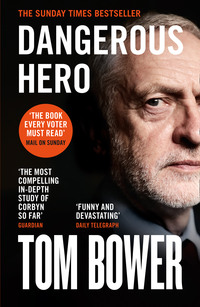
Читать книгу: «Dangerous Hero»

Copyright
William Collins
An imprint of HarperCollinsPublishers
1 London Bridge Street
London SE1 9GF
www.WilliamCollinsBooks.com
This eBook first published in Great Britain by William Collins in 2019
Copyright © Tom Bower 2019
Cover image © Getty Images
Tom Bower asserts the moral right to be identified as the author of this work
A catalogue record for this book is available from the British Library
The publishers have made every effort to credit the copyright holders of the material used in this book. If we have incorrectly credited your copyright material please contact us for correction in future editions.
All rights reserved under International and Pan-American Copyright Conventions. By payment of the required fees, you have been granted the non-exclusive, non-transferable right to access and read the text of this e-book on screen. No part of this text may be reproduced, transmitted, down-loaded, decompiled, reverse engineered, or stored in or introduced into any information storage and retrieval system, in any form or by any means, whether electronic or mechanical, now known or hereinafter invented, without the express written permission of HarperCollins.
Source ISBN: 9780008299613
Ebook Edition © February 2019 ISBN: 9780008299590
Version: 2019-11-11
Dedication
To Veronica
Contents
Cover
Title Page
Copyright
Dedication
Preface to the Paperback
Preface
Islington, Late 1996
1 Rebel With a Cause
2 The First Rung
3 The Deadly Duo
4 The Other Comrade
5 Four Legs Good, Two Legs Bad
6 The Harmless Extremist
7 Circle of Fear
8 Lame Ducks
9 Party Games
10 The Takeover
11 The Purge
12 The Jew-Haters
13 Stuck in the Bunker
14 Squashing the Opposition
15 The Coming of St Jeremy
16 Game-Changer
17 Resurrection
Picture Section
Acknowledgements
Index
About the Author
About the Publisher
Preface to the Paperback
Sceptics scoffed at the title of this book, but the turbulence in the Labour Party since its publication in February 2019 has justified the sobriquet attached to Jeremy Corbyn. Contrary to the vote-winning image of an honourable campaigner for a gloriously benevolent society, Corbyn’s life, as revealed here, is a catalogue of duplicity and dogma. Similarly, John McDonnell’s career as a virulent Trotskyist poses a warning to Britain’s honest electors. Over the past months, both men have sought to airbrush their lifelong alliance with tyranny from the public record. This book tears away the disguises they have adopted. Electors should judge them on their footprint. Thirty years after Eastern Europe was liberated from oppression, Britain now stands on the edge of succumbing to a group of Stalinist sympathisers.
Ostensibly, the 2019 election is about Brexit. But in reality, it is a contest between capitalism and communism. A careless vote risks allowing a government led by Marxists to take control of the country by default. And once Corbyn and his trusted associates are in Downing Street there will be little reprieve. The locks will be turned. No Marxist government in history has ever relinquished power democratically.
As students of Lenin, Corbyn and McDonnell entered the general election determined to ignore the fundamental disagreements with many party supporters to promote their lifelong passion to transform Britain into a Marxist state. Echoing Hugo Chávez, their Venezuelan hero, Corbyn and McDonnell offer the most deprived of Britain’s electorate a bonanza of riches, confiscated from the middle classes. (Britain’s seriously rich long ago relocated their wealth abroad, far from Corbyn’s grasp.) Corbyn’s political manifesto promises that equality of opportunity will be replaced by equality of poverty. His election will hasten the exodus of the country’s wealth creators to more welcoming nations. The aftermath of destroying capitalism is visible in Venezuela – hyperinflation and crippling shortages.
Even worse, contrary to Corbyn’s promises Britain will no longer be a fundamentally decent and tolerant society. Ever since the original publication of this book, the evidence that Labour under Corbyn’s leadership is anti-Semitic has been irrefutable. As successive Labour MPs resigned in disgust over Corbyn’s tolerance of their persecutors in their constituencies and in Westminster, Corbyn has shown no shame. With horror, mournful MPs have witnessed the triumph of their persecutors. Chris Williamson, suspended from the party as a suspected anti-Semite, was never expelled. To his victims’ distress, many traditional Labour MPs meekly collaborated with Corbyn rather than revolt against his racism. Self-interest suffocated the principles so loudly proclaimed by those social democrats – formerly the bedrock of the Labour Party. Lenin called them his ‘useful idiots’.
Rarely has every individual’s vote been more important than in the 2019 general election. The reason is described in this biography of a man who, despite his veneer of virtuousness, is, I believe, a dangerous hero.
Preface
The genesis of this book started exactly fifty years ago.
At the end of January 1969, a group of Marxist and Trotskyist students at the London School of Economics led a stormy protest against the school’s director, an authoritarian from Southern Rhodesia. He had ordered the staff to close a series of gates inside the building in Aldwych to prevent a students’ meeting in the school’s Old Theatre. In the mêlée, at about 5 p.m., a caretaker guarding the gates died from a heart attack and the students instantly started a month-long occupation, igniting similar sit-ins across Britain’s universities.
Throughout that first night of occupation, hundreds of LSE students crowded into the Old Theatre to debate the prospects of a Marxist revolution in Britain. Led by American graduates from Berkeley, California, where the student revolt against the Vietnam War had started five years before, and with speeches from French and German students, battle-scarred from 1968 street fights in Paris and Berlin, LSE’s Marxists and Trotskyists (there were many) told us we were the vanguard of a worldwide revolution – which would begin with the students, and the workers would follow. We believed it.
Aged twenty-three and from a conservative background, I had completed my law degree at the LSE (the country’s best law faculty at the time), and while studying for the Bar exams was employed on legal research projects at the college. Long before that dramatic night I had concluded that English law protected property rights at the expense of the rights of individuals and real democracy. Surrounded by articulate Marxists studying sociology and government, and going to lectures by Ralph Miliband and other Marxist teachers, I became attracted to their analysis of society. In that era, for anyone interested in politics that was not surprising.
In the wake of the Sharpeville massacre in South Africa in 1960 (I had marched in protest through London with my school friends against apartheid during the early years of that decade) and the anti-Vietnam protests outside the American embassy in Grosvenor Square in 1968 (along with others, I escaped with just some nasty blows from the police), I shared the horror at the dishonesty and disarray of Harold Wilson’s Labour government. Added to that, for family reasons I was influenced by events in Germany. In particular I became fascinated by Rudi Dutschke, an erudite Marxist who spoke in graphic terms in Berlin about ‘the long march through the institutions of power’ to remove the Nazis and their capitalist supporters from ruling post-war Germany. In April 1968 an attempted assassination of Dutschke illustrated the raw battle for power between good and evil raging across Europe and America. (I would meet Dutschke later in Oxford.)
Those days and nights of long debates about politics, the economy and society were decisive for many of us involved in the LSE occupation. After a month it all petered out, but that 1968 generation was marked for life. None of us attained high office in politics, industry or education. Instead, that seminal moment in Britain’s social history created cynics: men and women who were dissatisfied, curious, nonconformist and determined to expose evil in the world, of whatever type and wherever it might be found.
As ‘Tommy the Red’ (I became a students’ spokesman), that month I learned many vital lessons for the journalistic career I embarked on soon after, travelling for a week on a special train with Willy Brandt during his successful election campaign to become Germany’s chancellor. I emerged from that train with a unique insight about politicians and statecraft. Not least, that every politician is best judged by his or her closest advisers. Thereafter I spent many years producing BBC TV documentaries in Germany (about the Allied failure to prosecute Nazi war criminals and to de-Nazify post-war Germany) and across the world. Witnessing a myriad of wars, elections, corrupt politicians and shady businessmen cured me of Marxism, but not of my curiosity and innate scepticism.
LSE’s Marxist student leaders did not join the conventional world. Some died tragically young, often from suicide, while others committed their whole lives to the struggle for revolution. In researching this book I was reunited with several of them. After fifty years they had changed a good deal physically, but not in their core beliefs. Pertinently, they all genuinely sensed that their Marxist dream would finally come true, delivered by Jeremy Corbyn.
Despite being excited by that prospect, they have no illusions about Corbyn himself. None of those illustrious Marxists who have survived since the 1960s – all intelligent, well-educated, engaged and engaging – recall Corbyn as a major player over any of the four decades before his ascension as leader of the Labour Party in September 2015. On the contrary, although they did not doubt his sincerity, they were underwhelmed by his intellect. In any event, for them, winning power was all that mattered, and like many across Britain’s political spectrum, they were certain that Corbyn would be Britain’s next prime minister.
That possible outcome was the reason I wrote this book. With Corbyn having a good chance of victory, the public deserves to know more about him. Surprisingly for a politician, but not for a hard-left conspirator, he has done his best to conceal his personal life from the media – which he loathes.
My main criterion for writing previous biographies has been to identify those at the top of the greasy pole, ambitious to influence our lives but unwilling to reveal their pasts with a reasonable measure of truth. Often they have falsified their biographies to protect themselves from public criticism. Corbyn is no different. Despite his repeatedly stated commitment to improve the lives of the impoverished, fight injustice, champion equality and destroy greed, he has hidden away much about himself that is relevant to judge his character and Britain’s likely fate under the Marxist-Trotskyist government he has always promoted.
There can be no doubt about his passion to improve conditions for his constituents and the less advantaged in Britain and across the world. Frugal in his clothes and his food, he poses as the ‘good idealist’ engaged in a lifelong fight for justice and equality. In varying degrees, that aspiration is common to every politician: even tyrants don’t openly promise injustice and inequality. The difference between politicians is in their methods. Corbyn’s credo reflects his abstemious lifestyle. He disapproves of ambition and success. Equating both with greed, he strives not for equality of opportunity, but equality of poverty. In his ideal world, recognising the guilt of its shameful empire, Britain would abolish immigration controls and allow the needy to enter the country to share its wealth. For the rest, by taxation and confiscation of property, Corbyn would irreversibly transform Britain. Inevitably, there would be winners and losers; and until recently he did not conceal his contempt for his quarry. However, in his efforts to win the next general election he has starkly modified his language, and his senior colleagues have followed his lead.
Just how Corbyn became a communist has never been revealed. Before he was elected Labour’s leader he was not seen as a figure of consequence, and thereafter he did all he could to protect the mystery. Since he now offers himself as Britain’s next leader, his background story has become relevant. Is he a danger to the country? How genuine are his beliefs or his public character? Is he as benign as Labour’s spin doctors now insist?
Ever since the collapse of the Soviet empire in 1989, the number of those who advocate Marxism as a system of government has rapidly diminished. No one much under the age of forty-five is a credible witness of the oppressive dictatorships imposed by Russia on Eastern Europe. No one much under sixty can recall the industrial anarchy orchestrated by communist conspirators in Britain during the 1960s and 1970s. Only the far left looks back on that era with any nostalgia. The rest blame the widespread strikes of those years, often orchestrated by Marxists or Trotskyists, for permanent damage to Britain’s economy.
Corbyn disagrees with that assessment. For him, his election as prime minister would be the curtain-raiser to completing the unfinished business halted by Labour’s election defeat in 1979. His admirers, for whom he is a hero, agree. The older ones are resolute socialists; his younger supporters are idealists, ignorant of history. Across that spectrum, few understand the society that Corbyn and his fellow Trotskyists, including John McDonnell, Len McCluskey, Diane Abbott and Seumas Milne, intend to build.
I understand the Corbyn Utopia better than most, because I have spent my life and career among the hard left. At school and in my block of flats in north-west London, I grew up surrounded by the children of communists, and often visited their homes. In the late 1950s I began travelling to communist Czechoslovakia, and as a journalist, between 1969 and the fall of the Berlin Wall in 1990 I frequently travelled across communist East Germany to interview senior officials and study the government archives about the Nazi era. As a BBC TV reporter I spent a lot of time during the 1970s with British strikers, especially the miners led by Arthur Scargill and his fellow Marxist trade union leaders. In 1989 I began three years of work in Russia, interviewing high-ranking Soviet intelligence officers who played the spy game against the West. While filming wars in Vietnam, the Middle East and South America, I constantly encountered hard-left idealists and latterday commissars. As a result I am no stranger to the manoeuvres of Corbyn and his group to seize power, nor to their ambitions once in Downing Street.
This book, told with the help of eyewitness accounts by people who have known Corbyn throughout his life, reveals the nature of the man who, if the Conservatives successfully rip themselves apart over Europe, is set to become prime minister.
The question is whether a Labour government led by Corbyn would transform the country for the better. Has capitalism, as he argues, run its course, and would our lives be improved by socialism? If so, is Corbyn’s socialism the same brand that we have experienced under successive Labour governments since 1945, or something more radical, like a Marxist miracle? Is he a reformer or a revolutionary? And what sort of socialist is Corbyn? His supporters damn every opponent, especially Blairites, castigating each critic, even sympathetic ones, as ‘traitors’ or worse. Does that aggression, and the accusations that paint Corbyn as an entrenched anti-Semite, override his image as an authentic ‘good bloke’ blessed with everlasting politeness. As described in this book, I have found another side of the man. Would his election have a happy ending for Britain? For some, he would be a dangerous hero.
Islington, Late 1996
‘I’ve got all these debts,’ Jeremy Corbyn told his long-time friend Reg Race. ‘Can you work out why?’
‘I don’t need to be a genius to tell him what’s wrong,’ Race thought. ‘He’s in danger of bankruptcy.’ But at first he said nothing. Sitting in the Spartan living room of Corbyn’s semi-detached house in north London, Race picked up a single sheet of paper and read out the politician’s financial death warrant. Across from him sat his host and Claudia Bracchitta, Corbyn’s formidable Chilean wife. They had positioned themselves unnaturally far apart from each other.
Claudia had summoned Race as a mutual friend to solve their differences. Blending his expertise in both Marx and Mammon had won him the trust of the Corbyns. As Corbyn’s close political ally on the far left for many years, Race, a former MP, had transformed himself in recent times from a political agitator into a successful financial consultant in Britain’s health business.
The papers in front of him showed that the Corbyns owed their bank £30,000, the equivalent today of twice that figure. Several personal loans had been guaranteed by Corbyn’s income as an MP. He was also burdened by high mortgage repayments. As a last resort, the bank could threaten to recover its money by seizing his home. ‘You’ve run out of loans,’ said Race. Unchecked, within five years the debts would amount to £100,000. Corbyn’s annual salary was £43,000.
Claudia interrupted. This was entirely the result of her husband’s folly, she said. She and their three sons had little money even to buy food and clothes. ‘We can’t afford a decent life.’
The principal cause of the debts was the Red Rose Community Centre on the Seven Sisters Road in Holloway, north London. Situated in the heart of Corbyn’s constituency, the Red Rose was a bar and dance area on the ground floor of the building that fulfilled his commitment to open his party office in the constituency. Corbyn was paying its rent and some of its staff’s salaries out of his own pocket. Simultaneously, he owed a large sum to the Inland Revenue for his employees’ unpaid National Insurance and pension contributions. The financial chaos was matched by his style of management. His employees complained about being both undervalued and underpaid. Among the casualties was Liz Phillipson, his battle-scarred assistant, who had resigned rather than continue to tolerate Corbyn’s fecklessness.
‘You haven’t got enough money for what you’re doing,’ Race said bluntly. ‘You should close your office in Holloway and move to the Commons. That would cut your costs by 80 per cent.’
‘I won’t,’ replied Corbyn.
‘Oh, come on, Jeremy, you know he’s right,’ Claudia said, her voice rising. ‘Why don’t you believe him?’
Corbyn mumbled, then fell silent. His body language showed that he felt no inclination to follow Race’s recommendations. Claudia was becoming noticeably agitated. ‘It was clear a breakdown was coming,’ thought Race.
He was not surprised by the tension. Corbyn had first met his ‘utterly lovely’ wife (she had an athletic figure and a characterful face) in 1987, and soon after they decided to marry. An intellectual with a deep understanding of South America, Claudia had bonded with him at a protest meeting against Chile’s military dictatorship, addressed by Ken Livingstone. ‘She wanted to get off with me,’ Livingstone would recall, ‘but I had to go off to meet Kate, my partner, so she went for Jeremy.’ In the flush of romance and clearly infatuated, Claudia had not grasped that while her future husband’s enthusiasm for making jam or turning wood on a lathe was appealing, his lack of interest in material things meant that he ignored her need for comfort. At one stage she had planned for them and their young sons to move from Islington to leafy Kingston-upon-Thames, but was quickly disabused of the idea. ‘He has to live in his constituency,’ Keith Veness, another close political friend, informed her. ‘No one told me,’ she sighed.
Long before the onset of their financial problems, life with Corbyn had proved difficult. Tony Banks, the Labour MP for Newham North-West, witnessed just how difficult as one day he walked into Westminster’s central lobby and spotted Claudia standing by the wall, tearfully holding her children. Jeremy, she explained, had promised to meet her two hours earlier. He had not turned up. Banks took the four Corbyns to the Commons family room and went off in search. Eventually he found Corbyn in a committee room. ‘You’d better come out and look after your children,’ he suggested. Corbyn did not seem fazed for a moment. Banks was not surprised. ‘When pushed to have a day off,’ he recalled, ‘Jeremy’s idea was to take his partner to Highgate Cemetery and study the grave of Karl Marx.’
Reg Race had experienced something similar when he had invited the Corbyn family for a week’s holiday at his country home in Derbyshire. On the day, Claudia arrived with the children.
‘Where’s Jeremy?’ asked Mandy, Reg’s wife.
‘I don’t know,’ replied Claudia with sadness. ‘He just told me “I’ve got to go to a meeting,” and I haven’t seen him since.’
Over the following thirty-six hours, Claudia called several numbers searching for her husband. Two days later he turned up, explaining his absence as a necessary sacrifice for ‘the movement’. At the time, Race decided that Corbyn was absent-minded rather than neglectful. But a huge question about his attitude towards his responsibilities remained unanswered.
Shortly after, Keith Veness and his wife Val confronted the same thoughtlessness. Claudia, who had come from a middle-class family used to a certain degree of comfort, was always complaining about the shortage of money.
‘I’ve told Jeremy that he should stop being an MP and get a well-paid job,’ she confided.
‘What can Jeremy do to earn more money?’ Veness asked.
Val added, ‘The miners get much less than Jeremy.’ But Claudia, she realised, did not appreciate her husband’s hair-shirt lifestyle. She had even wanted a cleaner, but Corbyn had vetoed that. Did Claudia have bourgeois tendencies, Val wondered.
None of Corbyn’s constituents could have imagined the tension when he arrived at meetings with his family to speak about Ireland, a subject of no interest to Claudia. By contrast, he had a self-proclaimed (if questionable) passion for Arsenal Football Club. Claudia was worried about hooliganism at the team’s home matches at Highbury, while Corbyn, according to Keith Veness, regarded the game as ‘crude and awful’, and much preferred not to go. So Veness took Corbyn’s sons to matches, while their father went to political meetings.
‘Jeremy wasn’t interested in football,’ recalled Veness, contradicting Corbyn’s boast of passionate support for Arsenal. ‘Except, that was, on Cup final day.’
By late 1996 the marriage was all but over, and with nothing left in common, the two had drifted apart. To Corbyn, Claudia’s list of complaints was familiar. Ever since 1967, when he had met Andrea Davies, his first girlfriend, at the Telford Young Socialists, a succession of women had made the same observations: he never changed his ways, and he rarely thought about them. Throughout the years he wore the same shabby clothes, ate the same bland food and stuck to the same political convictions he had begun to absorb in Jamaica, where he had spent fifteen months as a teenager in the 1960s. Admirers hailed his inflexibility as proof of his uncompromising principles, and to some the purity of his other-worldliness was endearing. Detractors blamed his limited intelligence and lack of education for his failure to appreciate others. On his own account, amid a constant round of demonstrations, speeches and political manoeuvres, he claimed to avoid causing any personal insult. Further, to avoid criticising any of his partners, he would insist that politics was about ideas, not personalities.
Reg Race had helped him realise his first political dreams in the early 1970s. Ever since, Corbyn had trusted his advice, especially once his friend became the financial supremo at the Greater London Council (GLC) during Ken Livingstone’s turbulent reign in the 1980s. But as they forged a bond on the left of the Labour Party, Race had discovered Corbyn’s ignorance about the bureaucratic requirements of government, and his simple-mindedness about finances. While the committed revolutionary strove to challenge powerbrokers across the world on behalf of the oppressed, he seethed about any personal criticism in his own home. With so much to hide, he condemned any revelations about himself as abhorrent.
However, on the day in 1996 on which Race described Corbyn’s financial crisis, the focus was entirely on him. Even if a rich benefactor had volunteered to pay off all the debts (and that was improbable), he would soon have fallen behind again. He had little choice, Race told him, but to sell the family home. Claudia agreed. Reluctantly, so did Corbyn – and thereafter broke off his relations with Race. The messenger was to blame. After this experience, Race questioned Corbyn’s character and his propriety to influence the direction of the Labour movement.
In early 1999 the Corbyns’ home was sold for £365,000 (£730,000 today), and they downsized to a house in Mercers Road, a shabby street in Tufnell Park, off the Holloway Road. On the day of the move, Corbyn was told by Claudia to empty the fridge. He forgot. He also forgot to clear the garage. Late in the afternoon, while their former home’s new owner, dressed in a camelhair coat, fumed on the pavement, the garage door was opened to reveal rubbish crammed to the ceiling. Corbyn had regularly picked wood from neighbourhood skips, and also collected railway junk as he criss-crossed the country on trains. Boxes of safety lamps, metal signs, track signals and other paraphernalia had been stuffed in any old how. Late in the day, everything was finally shuttled across to the basement of Mercers Road, creating a new world of clutter.
The move brought one advantage. The building had been converted into bedsits, making the estrangement between Claudia and Corbyn easier. She and their three sons took the top floors, where she lived with a young South American dubbed ‘the toy boy’, while Corbyn, in the basement, had relationships with a series of younger women.
The couple’s estrangement was kept secret for almost two years. Late in 1999, while Corbyn was at a peace conference in The Hague, a journalist contacted Claudia and asked whether the two had separated. Instead of telling the complete truth, she explained that their twelve-year marriage had ended in 1997. She said that she had wanted their eleven-year-old son Ben to go to Queen Elizabeth’s grammar school in Barnet, but that Corbyn had stipulated that he should go instead to Holloway School, a local comprehensive notorious for achieving, for three successive years, the worst GCSE results in the country, and listed as ‘failing’ by Ofsted, the office for standards in education.
From The Hague, Corbyn confirmed Claudia’s account. Defending his ideological purity against selective schools, he implied, was more important than his son’s education – or his marriage. To avoid being branded a hypocrite, he said he preferred his son to be badly educated than to be given an unfair advantage. Labour’s Islington council, he knew, despite receiving additional government funds, had failed to improve Holloway. The school was plagued with discipline problems and classes in which up to twenty languages were spoken, the white pupils being especially disadvantaged.
In a series of interviews, Claudia reinforced the same message. ‘My children’s education is my absolute priority, and this situation left me with no alternative but to accept a place at Queen Elizabeth Boys’ School. I had to make the decision as a mother and a parent … It isn’t a story about making a choice, but about having no choice. I couldn’t send Ben to a school where I knew he wouldn’t be happy.’ To the public Corbyn appeared to have acquiesced in his wife’s wishes, but, like so many communists, he had put his political principles first, and ended the marriage: he could not live with a woman who did not accept his beliefs. The only dent to that image of ideological purity was Claudia’s revelation that Corbyn had agreed for another of their sons to spend two years at the local Montessori nursery, at £600 per term.
If that had been the last word on the subject, the notion that the marriage had broken up over Corbyn’s principles might have been plausible. He favoured, he said, France’s strict laws on the privacy of public figures’ family lives – laws which have been exploited to conceal rampant corruption among French politicians, including former presidents. But Claudia, possibly with Corbyn’s encouragement, went further. ‘He is first the politician and second the parent,’ she said. ‘He definitely felt it would have compromised his career if he had made the same choice that I did. It’s very difficult when your ideals get in the way of family life … It has been a horrendous decision.’
Sixteen years later, the whole tale was expanded. Rosa Prince, Corbyn’s semi-authorised biographer, described, with Bracchitta’s help, a tormented family: ‘Corbyn and Bracchitta went round and round in circles for months. She would not send Ben to Holloway School and Corbyn could not bear for him to go to Queen Elizabeth’s … In choosing Queen Elizabeth’s, Bracchitta was aware that she was ending her marriage … Once again, Corbyn had put politics above his relationship.’ That version is clearly incorrect. The marriage ended because of Corbyn’s behaviour – his financial incompetence, his thoughtless absences, his neglect of his family and his apparent misogyny. ‘He told me that the marriage had ended long before the school bit,’ Ken Livingstone recalled. ‘We had a chat at the time and he said his marriage had fallen apart over other things, not the school.’ Like Reg Race, Livingstone had discovered that Corbyn’s ‘authenticity’ was fictitious – a confection for political appearances. He had posed as a man who refused to sell out, albeit he was never heard to advocate higher standards of teaching.
The posturing became even more apparent in July 2016, one year after Corbyn became Labour’s leader. He appeared in a televised interview with the novelist and poet Ben Okri. The premise was Corbyn’s love of literature, but this was totally fabricated. He had only ever read very little. Equally misleading was his declaration: ‘You have to be honest with people. You have to say what you believe to be the truth. If you hide the truth you are very dishonest.’
Up to the present day, Corbyn has concealed or distorted the nature of his close relationships, his personal life and his prejudices. The communists understood the value of those Lenin called ‘useful idiots’ – the well-intentioned idealists in the West who blindly supported the Soviet agenda. Lenin also mastered one critical ruse to grab public support. ‘A lie told often enough,’ he said, ‘becomes the truth.’ He had gone on to adopt Dostoyevsky’s wise observation in Crime and Punishment: ‘They lie and then worship their own lies.’ Considering his long involvement with Corbyn before his ambition to lead Britain materialised, in 2018 Reg Race made a measured judgement about his former friend. Realising that Corbyn was guilty of that same deception, he concluded, ‘He’s not fit to be leader of the Labour Party, and not fit to be Britain’s prime minister.’
1
Rebel With a Cause
The Corbyns could trace their roots in England back to the eighteenth century and beyond. Farmers, priests, a tailor, a chemist and a solicitor conformed to a traditional middle-class background which in 1915 produced David Corbyn. David met his future wife Naomi Josling in 1936, at a meeting about the Spanish Civil War, when both were twenty-one-year-old students at London University. Naomi was studying science.
On 4 October that year Oswald Mosley, the leader of the British Union of Fascists, organised a march through London’s East End to assert his power. Met with fierce opposition by socialists and local inhabitants, the ensuing ‘Battle of Cable Street’ entered folklore, especially among British Jews, as an example of their resilience. According to Jeremy Corbyn, David and Naomi’s fourth son, both his parents were present at the famous confrontation, in which 175 people were injured. Those who later met his parents have cast considerable doubt on this claim. Similarly, Corbyn would boast that his father considered volunteering to fight in Spain, but that is also unlikely. Neither parent was an adventurer: rather they were hard-working, intelligent professionals. Their son, it appears, added Cable Street and the Spanish Civil War to their life stories to camouflage his comfortable middle-class roots.
David Corbyn, a skilled engineer, was employed by Westinghouse Brake & Signal Co., a British manufacturer of electrical devices used by the railways. Following the outbreak of the Second World War, his then employers, English Electric, moved their factory to the West Country, to avoid German bombs. The family settled in Chippenham, a historic market town between Bristol and Swindon. David’s income increased, and he was able to buy a large stone house surrounded by a garden, fields and woods in Kington St Michael, a village three miles north of the town. In that pleasant environment, Corbyn’s three older brothers were born – David, Andrew and Piers. All of them were clearly intelligent: David would become an electrical engineer and Andrew a mining engineer, while Piers pursued his childhood hobby to become an acknowledged weather expert.
By the time Jeremy was born, on 26 May 1949, the Corbyns owned a car, an unusual luxury in the immediate post-war years, but the whole family dressed scruffily, and were renowned for their unconventional lifestyle, not least because in a Tory area both parents were members of the local Labour Party. In that era there was nothing unusual in socialists sending their children to private primary schools to guarantee a good education and success at the 11-Plus exam. Indeed, most of the ministers in Clement Attlee’s Labour government had been either privately educated or sent to grammar schools. Nor was it unusual that the Corbyns moved to another area after their second son, Andrew, failed his 11-Plus. He successfully re-sat the exam and entered Haberdashers’ Adams grammar school in Newport, Shropshire. Jeremy would follow him there four years later. The family’s new home, Yew Tree Manor, a five-bedroom seventeenth-century farmhouse, was exceptionally luxurious compared to that of most families, who struggled through post-war austerity with shortages of food and fuel and urban winter smog. Living an unconventional, slightly chaotic lifestyle, Naomi Corbyn, a grammar-school maths teacher, maintained a vegetable garden, while her husband converted their garage into a workshop where he would turn wood and build toys and carts.
The four sons were not detached from political or literary life. Naomi read modern fiction and contemporary history, and gave her youngest son a collection of George Orwell’s essays for his sixteenth birthday. Jeremy never claimed to have read them, although in 2016, he said he had been influenced by The Ragged-Trousered Philanthropists, a novel written in 1910 by Robert Tressell, the pseudonym of Robert Noonan, a house painter. The book describes the politically powerless underclass in Edwardian England, and its ruthless exploitation by employers and by the civic and religious authorities. Corbyn’s reference to the novel fitted his narrative after he became Labour’s leader, but in truth, as a teenager he did not read any literature. Rather, he sat in his bedroom poring over Ordnance Survey maps of the surrounding countryside and gazing at a world atlas, dreaming of future journeys. In the corner was a hand-operated Gestetner duplicator, used to produce leaflets for the local Labour Party. By that time he was already a political animal.
At school, he was regarded as an outsider. Unlike his three elder brothers, he was a poor student, uninterested in sport, insouciant and gauche. ‘He was not noticeably clever,’ recalled Lynton Seymour-Whiteley, his finely-named Latin teacher. Striking out against the school’s mainstream, Corbyn joined the Campaign for Nuclear Disarmament, the Young Socialists at Wrekin’s Labour Party, and the League Against Cruel Sports, the last an unusual show of contrariness in a Tory shire famous for hunting and shooting. Considering that the school motto was ‘Serve and Obey’, his refusal to join the Combined Cadet Force, and instead to hoe a vegetable plot, was principled defiance, and a singular reason for being remembered. In 1967 he sat his A-Levels, passing two exams with a grade E, and failing the third. With no chance of following his three brothers to university, he risked being marooned in Shropshire. On his last day at school, John Roberts, the headmaster, harshly predicted that fate: ‘You’ll never make anything of your life.’ In embarrassment, his mother would later tell people that it was her youngest son’s poor handwriting that had prevented his getting to university. Without any status, he was a downstart. He came to loathe achievers, especially undergraduates with ambitions to get to the top, disdained those who enjoyed material wealth, and showed little respect for religion. Most of all he hated the rich and successful, and identified with losers. In his self-protection he became conspicuously stubborn.
He drifted into odd jobs for nearby farmers and a local newspaper, but his main focus was to organise the Wrekin Young Socialists. May Day in 1967 was marked by taking a home-made red banner to the top of the nearby Wrekin hill, tying it to the trig point and singing ‘The Red Flag’. Soon after, the Young Socialists held their annual dinner at the Charlton Hotel in Wellington. Clean-shaven, Corbyn arrived in a dark suit, white shirt and tie, looking like a typical middle-class teenager. Except that he faced an uncertain future.
His salvation was his parents’ suggestion that he apply to join Voluntary Service Overseas (VSO), a Foreign Office initiative funded since 1958 to send young male volunteers to work in Britain’s former colonies for £12 pocket money per month and free board and lodging. Most recruits were graduates, not eighteen-year-olds with poor A-Levels. Corbyn’s luck was to be sent as a ‘cadet teacher’ to Kingston, Jamaica. He was contracted by VSO to stay on the island for two years. On 28 August 1967 he boarded a BOAC Boeing 707 with about thirty other volunteers for the twelve-hour flight.
The contrast between Shropshire and Kingston was dramatic. Jamaica had become independent in 1962, but that had done little to change the extreme divisions between rich and poor. ‘It was impossible not to be influenced by the gulf between the iconic haves and the have-nots,’ recalled Michael Humfrey, the head of the island’s Special Branch. ‘That would certainly have affected Corbyn deeply.’ The ‘haves’, especially the twenty-one families who dominated the island, lived in luxury, while the ‘have-nots’, who inhabited three areas about a mile from Corbyn’s school – known as Dunkirk, Tel Aviv and McGregor Gully – survived on a subsistence diet, without mains water or electricity, under zinc roofs resting on cardboard walls. The gap was aggravated by racism – whites at the top, followed by the Lebanese and those with light-brown skin, known as the ‘high browns’, then the Chinese, with blacks at the bottom. Jamaicans, quipped the locals, had ‘an eye for shade’.
Corbyn was based at Kingston College, an elite grammar school for 1,600 fee-paying and scholarship pupils. Contrary to his version, the college was not in a ‘deprived’ area, nor in this period did he, despite his assertion that he was known throughout the school as ‘Mr Beardman’, grow a beard. Contemporary photographs show him mop-haired and clean-shaven, and none of his pupils or fellow teachers recalls him with a beard.
His one task was to teach Caribbean geography four times a week to third-form boys, all of whom had passed the 11-Plus, in classes of about thirty-five. Later, he would exaggerate that there were seventy pupils in his class. ‘It was a really defining moment of my life,’ he would say, ‘because I was thrown in at the deep end as an eighteen-year-old.’ He kept ahead by the time-honoured ruse for beginner teachers of reading the textbook in advance of the lesson, then reciting it. In years to come, he would not admit to the school’s elite status. Dissembling further, in January 2018 he told GQ magazine that he had been ‘working at schools and theatres and taught polio-stricken children in camps for the victims’. In truth, he worked at just the one school, helped with a single production in one theatre, and only briefly appeared at one camp for polio victims. There was a charity for such children attached to the town’s university, and a local organiser recalls ‘one white man helping’, but did not identify him as Corbyn. His only job was to teach. Years on, he would boast that his experiences taught him to control a crowd and to deal with a crisis. His students recall the opposite.
Standing out with his pale skin, strange ‘bouncy walk’ and unusually long hair, and always wearing the same clothes – later dubbed ‘Oxfam-reject style’ – he faced a class which, Robert Buddan, one of his pupils, recalls, ‘teased him. We were a bit troublesome and didn’t make things easy for him. He was a good target.’ Asking his charges to explain Jamaican swearwords did not improve Corbyn’s standing. Faced with boys who spoke out in class and directly challenged any poor mark, he regularly exploded in anger. ‘He would shout at us and turn red,’ says Buddan. The apprentice teacher was also unable to add up the marks he awarded for classwork accurately, and the boys frequently complained that his final totals were wrong. He was soon mocked across the school as ‘Fire Red’, especially after one particularly humiliating incident. While Corbyn’s attention was distracted, a boy called Michael (‘Mad’) Reid crept up behind the seated teacher and clipped a lock of his long hair. Corbyn leapt to his feet, lunged at the laughing boy and chased him through the school, at one point squeezing through a window on the first floor, keeping up the chase until he lost the trail. Sheepish and red-faced, he returned to the classroom. No one was punished by a detention or a caning.
At weekends the VSO volunteers would join up with Peace Corps aid workers from Canada and the USA, and meet local girls to drink Old Charlie’s rum and dance to rock music. Corbyn never took part. ‘He didn’t mix with us,’ recalled Dennis Dawes, another VSO cadet and later a Hampshire police officer. ‘He was serious-looking.’ Corbyn even avoided the Christmas Day party at the British High Commission. The unsociable teenager came to notice just once, in November 1967, when he was working as a lighting technician at The Barn, the island’s first professional theatre, which was staging a production called It’s Not My Fault, Baby. Otherwise, he spent weekends with groups of ten Kingston College pupils hiking across the hills above the town and towards the 7,402-foot peak of the Blue Mountain. On one trip to the north coast they watched refugees from nearby Cuba landing on the beach. One hundred miles to the north, a heroic figure dressed in military fatigues was fighting American imperialists.
During Corbyn’s first year in Jamaica, the island was on the edge of turmoil. Fascination with Fidel Castro’s Cuban republic, and the recent death of Che Guevara in Bolivia, had spread unrest across the region – although, unlike those in South America, Fidel’s few disciples in Jamaica were cautioned against violence. Castro had judged Jamaica to be unsuitable for guerrilla warfare, and his intelligence service made only limited contact with the island’s young Marxists. These were led by Hugh Small, Trevor Munroe and D.K. Duncan, each inspired to overthrow the white colonial legacy by America’s Black Power movement, especially Martin Luther King, Stokely Carmichael and, most importantly, Malcolm X’s anti-Semitic Nation of Islam, which condemned ‘Zionist dollars’ bankrolling colonial oppression. ‘We were young, black agitators looking for answers,’ recalled Small. Ever since two British soldiers had been killed by black nationalists inspired by an American Trotskyist in 1965, Small had led the fight against Washington’s influence, but his group, dispirited and fragmented, was failing to throw off the shackles of British rule.
Towards the end of 1967, the socialist People’s National Party (PNP) unexpectedly lost a second successive general election to the centrist Labour Party. Many suspected electoral fraud. Following that defeat, Leroy Cooke, a Marxist, was appointed as the PNP’s youth organiser to agitate in schools. Peter Croft, a VSO cadet teacher who arrived at the same time as Corbyn, recalls their ‘endless discussions about Jamaican politics and the personalities involved’. Both young men read reports of the local socialists’ tirades against colonialism, imperialism, racism and the capitalists’ exploitation of Third World countries, and witnessed from the periphery the raw struggle between Jamaica’s rich whites and impoverished blacks. In conversations over a beer in a bar on Friday after school with four other teachers, Corbyn would discuss the unrest. ‘He asked about the difference between Labour and the PNP,’ recalled Victor Chang, one of his drinking companions, ‘and was interested in socialism. He was curious about Jamaican Marxism.’
Unknown to Chang, Corbyn was unsettled by Kingston College. His classroom overlooked the school’s large chapel, where once a week Bishop Gibson, the Anglican cleric who had founded the school back in 1925, still preached. The pupils were focused on academic excellence, and were proud of the school’s reputation as a powerhouse of sport. The grounds were located close to the island’s famous Sabina Park cricket ground, and England played the West Indies there in February 1968, but Corbyn was uninterested in that intense contest, or in the endless track competitions outside his classroom. The school’s motto – Fortis Cadere Cedere Non Potest (The Brave May Fall But Never Yield) – was painted in large letters on a wall overlooking the sports field. Equally irritating to him were the boys’ well-pressed khaki uniforms and ties, the compulsory combined cadet force, and the choir. Lest he forget religion’s importance, he could see Holy Trinity Catholic Cathedral across the road and, a little further down, St George’s school, a rival private college rigorously overseen by Jesuit priests. Taken together – education, sport, tradition, the army, organised religion and the quest for achievement – Kingston College epitomised nearly everything Corbyn loathed.
As 1968 began, the mood in Kingston became tense. Walter Rodney, a twenty-six-year-old Guyanese, arrived from Havana to forge an anti-capitalist alliance between radicals, Black Power supporters and what were called ‘the discontented’. Rodney was already well known to the island’s Special Branch. In 1962, while studying at University College of the West Indies in Kingston, he had travelled to Havana, where he met Fidel Castro, and returned to Jamaica with a plan to spread Marxism across the West Indies. Later that year he flew to a so-called peace congress in Leningrad, earning the CIA classification of ‘convinced Communist with pro-Castro ideals and an interest in Black Power’. Back in Jamaica, he took a small group of young Marxist graduates to ‘Reasonings’ – meetings across the island with the dispossessed and Rastafarians. Encouraged by Armando Velazquez, the Cuban consul on the island, he spoke about revolution at secondary schools, churches and youth centres. Although Rodney was banned by the school’s administrators from speaking at Kingston College, Corbyn heard about his lectures, and about CIA plots to overthrow governments in Cuba and across Latin America. He learned about the importance of the Soviet Union’s contribution to Castro’s revolution. Without Moscow’s assistance, the left’s ambitions across South America would have been snuffed out by America. And ever since the failed CIA-inspired invasion of Cuba at the Bay of Pigs in 1961, Jamaica had been treated as Washington’s appendage, and hated for that.
In the summer of 1968 Corbyn was joined at Kingston College by Paul Wimpory, a physics graduate from Birmingham, also on a VSO contract, and the two became friends. By that time Corbyn had moved into a rented room in a house on Easton Avenue, a residential area in New Kingston, owned by the aunt of Dawn Tapper, one of the school’s English teachers. On the eve of her marriage, Tapper asked Corbyn to be the chief usher in the church. He agreed, only to forget his principal chore – he left all the wedding programmes in the house, and there was no time to return to collect them. As a result, the ceremony was confused, the minister omitted parts of the service, and the congregation did not say the responses. ‘He felt very bad about it,’ Tapper recalled.
Walter Rodney lived in an adjoining road to Corbyn. Wimpory believed that Corbyn, no longer under the direct supervision of the High Commission, was ‘rebelling against his affluent background’ and his links with traditional Britain. None of the VSO students who attended a drinks reception at the High Commission in early September recall seeing Corbyn. By then, about to start his second year of teaching, Corbyn frequently expressed to Wimpory his dismay about the ‘vast inequalities’ on the island, 137 years after slavery in Jamaica was abolished. He became convinced that the British Empire had not benefited Jamaicans, and that it had left behind a legacy of guilt for the gross exploitation of innocent, impoverished people.
On 15 October, Walter Rodney attempted to return to Jamaica via Canada. By then his trips to Cuba and Moscow, combined with reports of student revolts in Europe and guerrilla warfare financed by Moscow in Asia, Africa and Latin America, had aroused fear among pro-Western Jamaicans. In that mood, the government banned his entry. Three days later, the university campus in Kingston erupted. For two days, left-wing students rioted, burning buildings and cars in what became known as the Rodney Riots. The unrest was put down, but the government failed to recover its authority. Remarkably, none of the young Marxists recalls seeing Corbyn during the rioting, and neither Wimpory nor Chang ever discussed those tumultuous events with him. He has never mentioned witnessing the uprising, and has never since met the Marxist students who subsequently became prominent Jamaicans. Yet their influence on him would seem to have been profound. Within eight weeks of the riots, Corbyn decided he could no longer tolerate Kingston College. To his good fortune, the school had been underpaying him by £1 per week, so he received a lump sum of £52 (about £900 today), and planned in secret how to escape.
The first casualty of his leaving was one of the college’s pupils, Derrick Aarons, a fourteen-year-old weekend hiker and a participant in the Duke of Edinburgh Award. Aarons had completed all the requirements for the award’s Bronze Medal, and had been assured by Corbyn that the necessary forms had been sent to London, and that in January 1969 he would receive his medal from Jamaica’s governor general. The excited boy frequently asked Corbyn if he had received a reply yet from London. The answer was always no. In January Aarons returned from his holidays, and was told that Corbyn had decamped back to Britain. The medal never materialised. ‘I was,’ recalled Aarons, ‘a very disappointed teenager.’ Had Corbyn even submitted the forms? During a recent trip to London, Aarons, today a prominent Caribbean doctor, contacted Corbyn’s office to arrange a reunion. ‘I was convinced,’ he said, ‘that he would remember me as the keenest of his hikers, but I never received any acknowledgement.’
The more important casualties of Corbyn’s decision to quit early were the pupils in his four geography classes. No replacement could be found. ‘I always thought how curious to leave part of the way through the school year,’ observed Paul Wimpory. ‘It was not very professional.’ Corbyn left Jamaica, Dawn Tapper recalled, just days after her wedding on 14 December. ‘Jeremy told us that he was returning to Britain,’ she said. ‘I gave him a piece of my wedding cake to eat on his journey.’
Corbyn has always concealed what he did after leaving Kingston. ‘I spent my youth in Jamaica,’ he told Channel 4 News in 2015, but did not elaborate. According to his account, he left Jamaica in July 1969, having fulfilled his two-year contract. Not only is that untrue, but he has never honestly revealed what happened during the missing seven months. His description of the journey from Jamaica is vague: ‘I took a sailing boat around the Caribbean, and then a fishing boat to Guyana.’ The only local passenger ship leaving Kingston and going as far as Trinidad was a small island-hopping freighter. That left 430 miles along the coast to Georgetown, Guyana’s capital – hardly the route for a ‘fishing boat’.
Corbyn says that he ‘spent some time in Guyana’, a pertinent revelation. The former British colony was then Walter Rodney’s home. Until 1964, Cheddi Jagan, a Marxist, had been the country’s leader, but with the connivance of the British and the CIA he had been replaced by a pro-Western prime minister. Nevertheless, in 1968 the strong Cuban presence in Guyana, Castro’s base for guerrilla warfare in South America, remained undiminished, and with Rodney’s help Corbyn could have flown to Cuba via Mexico. He has never said when he first visited Cuba, and the extent of his Marxist education in Guyana remains unknown. Like so much of his account of his life until he left Guyana, it is partly romanticised, and possibly an invention.
According to Corbyn’s version, he travelled from Guyana to Brazil, and on to Uruguay, Argentina, Chile, Bolivia, Paraguay, Peru, back to Buenos Aires, and then sailed to France in 1970. He has said that during the year he spent travelling he had been impressed by the culture of South America’s indigenous tribes, the history of the European settlers’ revolts against the colonial powers, and the countries’ battles during the 1950s against rapacious American corporations and CIA subversion. The journey confirmed his socialist ideals. Here was a cause that suited his ‘loser’ personality – he would fight for the downtrodden against their oppressors.
More recently, Corbyn has claimed that he was influenced by Open Veins of Latin America, by the Uruguayan journalist, writer and poet Eduardo Galeano, a critique of the exploitation of the continent’s Indians by monarchs, the Catholic Church and multinational American corporations. That is doubtful. The book was first published in 1971, a year after Corbyn returned to Britain, and he could not read Spanish. Pertinently, shortly before his death in 2015 Galeano repudiated the book as a distortion of the continent’s economic history, and confessed that he was embarrassed by his youthful prejudice in favour of South America’s left-wing dictators. In his enthusiasm for the book, Corbyn ignored Galeano’s disclaimer. He was enchanted, he said, by the indigenous customs and languages of South American civilisations – Incas, Quechua and Aymara – all smothered by Spanish colonialism.
He would also claim to have been influenced by Walter Rodney’s How Europe Underdeveloped Africa, published in 1972, which described the Caribbean search for identity after the end of colonialism. Rodney’s and Galeano’s ideas, picked up after his year in Jamaica, thereafter became the foundation of Corbyn’s principles and way of looking at the world. He loathed imperialism – Spanish, American or British. He never sought to understand how Greek, Roman and successive European empires were the foundation of Western civilisation, but stuck resolutely to his belief in the unalleviated evil of white colonial oppression. In 2015 he demanded that the then prime minister David Cameron apologise to Jamaica for Britain’s ‘brutal’ involvement in the slave trade. ‘It’s a history of the most gross exploitation of people,’ he said. He would never condemn Russian, Chinese or Arab oppression in similar terms. Nor, as a self-proclaimed pacifist, could he explain how the victims of imperialism – either the local Indians in Latin America or Europeans as the prey of the French, Soviet and German empires – could have regained their liberty without fighting.
In 1970, three years after leaving Britain, Corbyn returned to his family’s Shropshire home. He had not once spoken with his parents during his time away. On the single occasion he telephoned his home, there was no reply.
He returned to a seemingly empty future. Not only did he have no prospects, but he had missed the best of the swinging sixties. Although he would later claim to have joined his brother Piers on an anti-Vietnam war demonstration in London, that famous clash between the children of the counter-culture and the police had erupted during his absence, back in 1968. He also missed the big anti-apartheid marches of the 1960s, only joining their mini-successors two decades later, such as the Trotskyist ‘Non-Stop Picket’ breakaway group championing illegal protests in London, during which he was arrested. In speeches or interviews he never mentioned the outbreak of urban terrorism – Baader Meinhof in Germany, the Red Brigade in Italy, the Red Army in Japan, the Weathermen in America, the Quebec separatists in Canada, the Angry Brigade in Britain. Unlike every other leftist, he did not march with CND from Aldermaston to London every Easter. The politics of the sixties philosophers who had so influenced young undergraduates had no relevance to someone filled with Walter Rodney’s protests against colonial oppression. Perhaps a particular loss, he had missed the election in November 1970 of Salvador Allende, Chile’s Marxist president. His only contemporaneous eyewitness experience was the resurgence of the IRA’s war against colonialism.
On his return to Britain, now twenty years old, he had good reason to be apprehensive. Minimally educated, unqualified and unable to engage in hard work, he was isolated in Shropshire, forced to take a series of local jobs. In May 1972, after rejoining the Wrekin Labour Party, he arrived at the Young Socialists’ annual congress in Skegness with Andrea Davies, a nurse from Telford, his first British girlfriend. Although ostensibly a Labour Party function, the camp for five hundred members was run by Liverpool’s Militant Tendency, a group of revolutionary socialists formed in Liverpool in 1955 with the express purpose after the mid-1960s of infiltrating Labour to make the theories of Trotsky, Marx, Lenin and Engels official party policy.
Бесплатный фрагмент закончился.