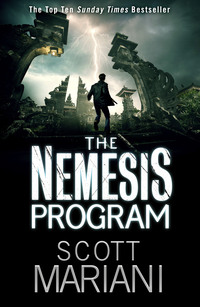
Читать книгу: «The Nemesis Program»


Copyright
Published by Avon an imprint of
HarperCollinsPublishers Ltd
1 London Bridge Street
London SE1 9GF
www.harpercollins.co.uk
First published in Great Britain by HarperCollins Publishers 2014
This ebook edition published by HarperCollins Publishers 2016
Copyright © Scott Mariani 2014
Cover photographs © Shutterstock.com Images
Cover design © Henry Steadman 2016
Scott Mariani asserts the moral right to be identified as the author of this work.
A catalogue copy of this book is available from the British Library.
This novel is entirely a work of fiction. The names, characters and incidents portrayed in it are the work of the author’s imagination. Any resemblance to actual persons, living or dead, events or localities is entirely coincidental.
All rights reserved under International and Pan-American Copyright Conventions. By payment of the required fees, you have been granted the non-exclusive, non-transferable right to access and read the text of this e-book on screen. No part of this text may be reproduced, transmitted, down-loaded, decompiled, reverse engineered, or stored in or introduced into any information storage and retrieval system, in any form or by any means, whether electronic or mechanical, now known or hereinafter invented, without the express written permission of HarperCollins.
Source ISBN: 9780007398461
Ebook Edition © September 2016 ISBN: 9780007398478
Version: 2019-12-06
‘We’ve arranged a global civilisation in which most crucial elements profoundly depend on science and technology. We’ve also arranged things so that no one understands science or technology. This is a prescription for disaster. We might get away with it for a while, but sooner or later, this combustible mixture of ignorance and power is going to blow up in our faces.’
Carl Sagan, 1995
‘I could set the earth’s crust into such a state of vibration that it would rise and fall hundreds of feet, throwing rivers out of their beds, wrecking buildings, and practically destroying civilisation. The principle cannot fail.’
Nikola Tesla, 1898
Contents
Cover
Title Page
Copyright
Epigraph
Prologue
Chapter One
Chapter Two
Chapter Three
Chapter Four
Chapter Five
Chapter Six
Chapter Seven
Chapter Eight
Chapter Nine
Chapter Ten
Chapter Eleven
Chapter Twelve
Chapter Thirteen
Chapter Fourteen
Chapter Fifteen
Chapter Sixteen
Chapter Seventeen
Chapter Eighteen
Chapter Nineteen
Chapter Twenty
Chapter Twenty-One
Chapter Twenty-Two
Chapter Twenty-Three
Chapter Twenty-Four
Chapter Twenty-Five
Chapter Twenty-Six
Chapter Twenty-Seven
Chapter Twenty-Eight
Chapter Twenty-Nine
Chapter Thirty
Chapter Thirty-One
Chapter Thirty-Two
Chapter Thirty-Three
Chapter Thirty-Four
Chapter Thirty-Five
Chapter Thirty-Six
Chapter Thirty-Seven
Chapter Thirty-Eight
Chapter Thirty-Nine
Chapter Forty
Chapter Forty-One
Chapter Forty-Two
Chapter Forty-Three
Chapter Forty-Four
Chapter Forty-Five
Chapter Forty-Six
Chapter Forty-Seven
Chapter Forty-Eight
Chapter Forty-Nine
Chapter Fifty
Chapter Fifty-One
Chapter Fifty-Two
Chapter Fifty-Three
Chapter Fifty-Four
Chapter Fifty-Five
Chapter Fifty-Six
Chapter Fifty-Seven
Chapter Fifty-Eight
Chapter Fifty-Nine
Chapter Sixty
Chapter Sixty-One
Chapter Sixty-Two
Chapter Sixty-Three
Chapter Sixty-Four
Chapter Sixty-Five
Chapter Sixty-Six
Chapter Sixty-Seven
The Ben Hope series
Keep Reading …
About the Author
Also by Scott Mariani
About the Publisher
Prologue
The Altai Mountains Bayan-Ölgii Province Western Mongolia
The biting wind was starting to whip flurries of snow across the barren mountainside, high up in the wilderness where not even the most rugged four-wheel-drive vehicle could reach. Soon, Chuluun knew, the winter snowfalls would be here in earnest and it might be a long time before he could venture out this far again in search of food.
The argali herd that the teenager was tracking had led him almost half a mile across bare rock from where he’d tethered his pony further down the mountain. Wolves were an ever-present concern, but the curly-horned wild sheep could sense the roving packs from a great way off, and having paused on their trek to munch contentedly on a scrubby patch of heather, they seemed calm enough to reassure Chuluun that his pony was safe.
There was one predator too smart to let himself be noticed by the argali. Chuluun had been hunting over these mountains for six years, since the age of eleven, when his father had become too infirm to ride long distances any more, and he prided himself on his ability to sneak up on anything that walked or flew. His parents and seven younger brothers and sisters depended almost entirely on him for meat, and in the harsh environment of Mongolia, meat meant survival.
Staying carefully downwind of the grazing sheep and moving with stealthy ease over the rocks, Chuluun stalked up to within a hundred metres of his quarry. He settled himself down at the top of a rise in a vantage point from which his pick of the herd, a large male he estimated stood a good four feet at the shoulder, was nicely presented side-on.
Very slowly, Chuluun slid the ancient Martini-Henry into aiming position and hunkered down behind it. He opened the rifle’s breech, drew one of the big, long cartridges from his bandolier and slipped it silently inside. Closing the breech, he flipped up the tangent rearsight. At this range he knew exactly how much elevation he needed to compensate for gravity’s pull on the trajectory of the heavy bullet.
The argali remained still, munching away, oblivious. Chuluun honoured his prey, as he honoured the spirit of the mountains. He blinked a snowflake from his eyelashes. Gently, purposefully, he curled his finger around the trigger, controlled his breathing and felt his heart slow as his concentration focused on the all-important shot. If he missed, the herd would be off and he couldn’t hope to catch up with them again today, nor this week. But Chuluun wasn’t going to miss. Tonight, his family were going to eat as they hadn’t eaten in a long while.
At the perfect moment, Chuluun squeezed the trigger.
And in that same moment, everything went insane.
The view through the rifle’s sights disappeared in a massive blurred explosion. His first confused thought was that his gun had burst on firing. But it wasn’t the gun.
Chuluun barely had time to cry out as the ground seemed to lurch away from under him and then heave him with terrifying violence into the air. He was spinning, tumbling, sliding down the mountain. His head was filled with a deafening roar. Something hit him a hard blow and he blacked out.
When Chuluun awoke, the sky seemed to have darkened. He blinked and sat up, shivering with cold and beating the snow and dirt from his clothes, then staggered to his feet. His precious rifle lay half-buried in the landslide that had carried him down from the top of the rise. Still half-stunned, he clambered back up the rocky slope and peered, afraid to look, over the edge.
He gasped at the incredible sight below.
Chuluun was standing on the edge of a vast near-perfect circle of utter devastation that stretched as far as his keen young hunter’s eyes could see. Nothing remained of the patch of ground where the argali herd had been quietly grazing. The mountainside was levelled. Gigantic rocks pulverised. The pine forests completely obliterated. All gone, swept away by some unimaginable force.
His face streaked with dirt and tears and contorted into an expression of disbelief, Chuluun gazed up at the strange glow that permeated the sky, like nothing he’d ever seen before. Blades of lightning knifed through the rolling clouds. There was no thunder. Just a heavy, eerie pall of silence.
Suddenly filled with conviction that something unspeakably evil had just happened here, he scrambled away with a terrified moan and started fleeing down the slope towards where he’d left his pony.
Chapter One
Paris Seven months later
The apartment was all in shadow. It wasn’t normal for Claudine Pommier to keep her curtains tightly drawn even on a bright and sunny June afternoon.
But then, it wasn’t normal for someone to be stalking her and trying to kill her, either.
Claudine was tense as she padded barefoot down the gloomy, narrow hallway. She prayed the boards wouldn’t creak and give her away. A moment ago she’d been certain she could hear footsteps outside the triple-locked door. Now she heard them again. Holding her breath, she reached the door and peered through the dirty glass peephole. The aged plasterwork and wrought-iron railing of the old apartment building’s upper landing looked distorted through the fish-eye lens.
Claudine felt a flood of relief as she recognised the tiny figure of her neighbour, Madame Lefort, with whom she shared the top floor. The octogenarian widow locked up her apartment and started heading for the stairs. She was carrying a shopping basket.
Claudine unlatched the security chain, slid back both bolts and the deadlock and rushed out of the door to catch her.
‘Madame Lefort? Hang on – wait!’
The old woman was fit and sprightly from decades of negotiating the five flights of winding stairs each day. She was also as deaf as a tree, and Claudine had to repeat her name three more times before she caught her attention.
‘Bonjour, Mademoiselle Pommier,’ the old woman said with a yellowed smile.
‘Madame Lefort, are you going out?’ Claudine said loudly.
‘To do my shopping. Is something wrong, dear? You don’t look well.’
Claudine hadn’t slept for two nights. ‘Migraine,’ she lied. ‘Bad one. Would you post a couple of letters for me?’
Madame Lefort looked at her tenderly. ‘Of course. You poor dear. Shall I get you some aspirin too?’
‘It’s okay, thanks. Hold on a moment.’ Claudine rushed back into the apartment. The two letters were lying on the table in the salon, sealed and ready but for the stamps. Their contents were identical; their addressees half a world apart. She snatched them up and rushed back to the door to give them to Madame Lefort. ‘This one’s for Canada,’ she explained. ‘This one for Sweden.’
‘Where?’ the old woman asked, screwing up her face.
‘Just show the person at the counter,’ Claudine said as patiently as she could. ‘They’ll know. Tell them the letters have to go registered international mail, express delivery. Have you got that?’
‘Say again?’
‘Registered international mail,’ Claudine repeated more firmly. ‘It’s terribly, terribly important.’
The old woman inspected each letter in turn an inch from her nose. ‘Canada? Sweden?’ she repeated, as though they were addressed to Jupiter and Saturn.
‘That’s right.’ Claudine held out a handful of euros. ‘This should cover the postage. Keep the change. You won’t forget, will you?’
As the old woman headed off down the stairs, Claudine hurried back to her apartment and locked herself in. All she could do now was pray that Madame Lefort wouldn’t forget, or manage to lose the letters halfway to the post office. There was no other way to get word out to the only people she could trust. Two allies she knew would come to her aid.
If it wasn’t too late already.
Claudine ventured to the window. She reached out nervously and pulled the edge of the curtain back a crack. The afternoon sunlight streamed in, making her blink. Five floors below, the traffic was filtering along the narrow street. But that wasn’t what Claudine was watching.
She swallowed. The car was still there, in the same parking space at the kerbside right beneath her windows where it had been sitting since yesterday. She was completely certain it was the same black Audi with dark-tinted glass that had followed her from Fabien’s family country home two days ago.
And, before that, the same car that had tried to run her down in the street and only narrowly missed her. It still made her tremble to think of it.
She quickly drew the curtain shut again, hoping that the men inside the car hadn’t spotted her at the window. She was pretty sure there were three of them. Her instinct told her they were sitting inside it, just waiting.
On her return from Fabien’s place, after the scare and the realisation she was being followed, she hadn’t intended to remain here in the apartment any longer than it took to pack a few things into a bag and get the hell out. But the car had appeared before she’d been able to escape – and now she was trapped.
Were these the men that Daniel had warned her about? If that was the case, they knew everything. Every detail of her research. And if so, they must know what she’d learned about their terrible plans. If they caught her, they wouldn’t let her live. Couldn’t let her live. Not after what she’d uncovered.
Under siege in her own apartment. How long could she hold out? She had enough tinned provisions to last about a week if she rationed her meals. And enough brandy left to stop her terror from driving her crazy.
Claudine spent the next half hour pacing anxiously up and down the darkened room, fretting over whether the old lady had sent her letters. ‘I can’t stand this,’ she said out loud. ‘I need a drink.’
Walking into the tiny kitchen, she grabbed a tumbler and the brandy bottle and sloshed out a stiff measure. She downed it in a couple of gulps and poured another. It wasn’t long before the alcohol had combined with her fatigue to make her head swirl. She wandered back through into the salon, lay on the couch and closed her eyes. Almost instantly, she began to drift.
When Claudine awoke with a start and opened her eyes, the room was completely dark. She must have slept for hours. Something had woken her. A sound. Her heart began to race.
That was when the bright flash from outside lit up the narrow gap between the curtains, followed a moment later by another rumble of thunder. She relaxed. It was just a storm. The howling wind was lashing the rain against the windows.
She got up from the couch and groped for the switch of the table lamp nearby. The light came on with a flicker. The ancient wiring of the apartment building threatened to black the place out every time there was a storm. The clock on the mantelpiece read 10.25. Too late to go and ask Madame Lefort if she’d posted the letters, as the old woman was always in bed by half past nine. It would have to wait until morning.
Claudine stepped back over to the window and peered out of the crack in the curtains. With a gasp she saw that the car was gone.
Gone! Just an empty pool of light, glistening with rainwater, under the streetlamp where it had been parked.
She blinked. Had she just imagined the whole thing? Was nobody following her after all? Had the near-miss in the street two days ago just been a coincidence, some careless asshole not looking where he was going?
The rush of relief she felt was soon overtaken by a feeling of self-blame. If this whole thing had been just her paranoia getting the better of her, then she should never have sent those letters. She’d made a fool of herself.
Suddenly she was hoping that the old woman hadn’t posted them after all.
The storm continued outside. Claudine knew she wouldn’t get any more sleep that night. She wandered into her little bedroom, flipped on the side light and picked up her violin. One of the upsides to sharing the top floor with a deaf old woman was that she could play whenever she liked. Madame Lefort wouldn’t even have heard the thunder.
Thankful that she had something to occupy her mind, Claudine cradled the instrument under her chin, touched the bow to the strings and went into the opening bar of the Bach sonata she’d been trying to master for the last couple of months.
Another bright flash outside and at that moment the lights went out. She cursed and went on playing by the red glow from the neon sign of the hotel across the street.
Then she paused, frowning. There’d been a noise. Before the roll of thunder. Like a thump. It seemed to have come from above. There was nothing above her apartment but the roof. Maybe the wind had knocked something down, she thought, or sent a piece of debris bouncing over the tiles. She went on playing.
But she hadn’t produced more than a few notes before her bow groaned to a dissonant halt on the strings. She’d heard the noise again.
There was someone inside the apartment.
A cold sweat broke out over her brow. Her knees began to shake. She needed to arm herself with something. Thinking of the knife block on the kitchen worktop, she tossed her violin and bow down on the bed and hurried towards the doorway – then skidded to a halt on the bare boards as another violent lightning flash lit up the room and she saw the figure standing in the doorway, blocking her exit.
Too terrified to speak, Claudine retreated into the bedroom.
The intruder stepped into the room after her. She could see him outlined in the red glow from the hotel sign. He was tall, very tall. Shoulders like an ox. Black boots, black trousers, black jacket and gloves. His hair was silver, cropped to a stubble. He had a hard, angular face. Pale eyes narrowed to slits. Around his waist was some kind of utility belt, like builders and carpenters wore.
For one crazy, irrational moment, Claudine thought he was a workman come to carry out the much-needed repairs to the bathroom. But that idea vanished as he drew the claw hammer from his utility belt and came towards her.
She snatched the violin from the bed. Lashing wildly out with it, she caught him across the brow with such force that the instrument broke apart. The splintering wood raked his flesh, drawing blood that looked as dark as treacle in the red light. He barely seemed to have felt the blow. He swung the hammer and knocked the shattered violin from her hand. She cowered away from him. ‘Please—’
He struck out again with the hammer. Claudine’s vision exploded, white and blinding pain flashing through her head. She fell onto the bed, dazed.
The big man stood over her, clutching the hammer in his muscular fist. Strands of bloody hair dangled from the steel claw. Unhurriedly, calmly, he wiped the tool clean on the bedcover and then slipped it back into his utility belt. From another long pouch he drew out a cylindrical tube with some kind of plunger and transparent plastic nozzle attached.
He bent over her. Through the fog of pain, she saw him smile. His eyes and teeth were red in the hotel neon.
The man spoke in English. ‘Now it’s time for that pretty mouth of yours to be plugged up.’
A hoarse cry of terror burst from Claudine’s lips as she realised what he was holding. She tried desperately to wriggle away from him but he reached out with a quick and powerful hand, grabbed her hair and pinned her thrashing head to the bed, ignoring the wild blows she flailed out at his face and arms.
With his other hand he jammed the nozzle of the tube into her screaming mouth. She cried out and bit down on the hard plastic and tried to spit it out, gagging as it was forced deep inside.
The man pressed the plunger. Instantly, something foul-tasting, warm and soft filled her mouth. It was coming out under pressure and there was nothing Claudine could do to stop it flowing down her throat. She tried to cough it out, but all of a sudden no air would come. There was an awful sensation of pressure building up inside her as the substance swelled and expanded, filling every cavity of her throat and nasal passages.
She couldn’t breathe, couldn’t scream, couldn’t open or shut her jaws a millimetre. She stopped trying to lash out at him, and in a crazed, agonised panic she clamped her hands to her mouth and felt the hardening foam bulging out from between her lips like some grotesque tongue.
The man dropped the empty canister on the bed and used both hands to hold her bucking, convulsing body down. After a minute or so, as her brain was becoming starved of oxygen, her movements began to slacken. The man let her go and stood up.
The darkness was rising fast as Claudine’s vision faded. For a few seconds longer she could still dimly register the man’s shape standing over her in the red-lit room, watching her impassively with his head slightly cocked to one side.
Soon she could see nothing at all.
The man waited a few more moments before he checked her pulse. Once he was satisfied that she was dead, he left the bedroom. He unlocked the apartment door and left it ajar as he made his silent way towards the stairs.
Chapter Two
‘I wish we didn’t have to do this,’ Jude said.
It was a hazy, warm late Saturday morning in the peaceful village of Little Denton in rural Oxfordshire. Fat bumblebees were humming around the flowerbeds, birds were chirruping happily overhead. Once in a while, a car hissed by the gates of the former vicarage.
A sharp-eyed observer might have spotted the signs that the old house nestling among the trees behind the high stone wall was no longer lived in: the unclipped ivy spreading over the windowpanes; the rather unkempt state of the lawn that stretched far down towards the river; the remnants of last winter’s fallen leaves still lying about the grounds; and it wouldn’t have taken much asking around to discover that the local community was still recovering from the shocking deaths, just six months earlier, of the vicar and his wife in a car crash. Simeon and Michaela Arundel had been much loved and were sadly missed by everyone who’d known them.
The vicarage had been in the Arundel family for generations and now it had passed to twenty-year-old Jude. From time to time the young man drove up from Portsmouth, where he was still half-heartedly studying Marine Biology while considering his future options now that his life had changed so dramatically, to get on with the painful, drawn-out task of sorting out Simeon and Michaela’s possessions and take care of the place as best he could.
Today the task at hand had taken Jude right down to the bottom of the long garden, where he was gazing sadly up at an ancient beech tree. He wasn’t alone. The same astute observer might also have noticed the physical similarity between him and the older blond-haired man, about twice Jude’s age, who was standing next to him: a little taller at just under six feet, a little more muscular though still lithe and athletic-looking, and a good deal more battle-scarred.
That man was called Ben Hope. He’d been and done many things in his time, most of them involving danger and secrecy. Danger he could handle – God knew he’d handled enough of it both during his time with the SAS and since – but one secret even he hadn’t known about for many years, and which had hit him like a high-velocity rifle round, was the stunning revelation that Jude was his own son. He was the product of a short-lived romance back in the distant days when Ben, Michaela and Simeon had all been students together in nearby Oxford and Ben had been set on a career in the Church.
The discovery of who his real father was had come as just as big a shock to Jude. It had taken them both months to even begin to get used to the idea.
‘I seriously wish we didn’t have to do this,’ Jude said again, looking up at the old beech tree. ‘Is it such a problem? Couldn’t we just leave it?’
Ben pointed up at the thick, leafless dead branch that overhung the glass roof of the nearby summer house. ‘We could just leave it,’ he said. ‘But come the next high wind, that branch is going to break off and crash straight through that roof. You don’t want anyone to be underneath it when it happens. Or to have to fork out for the glazier’s bill even if no one is.’
At that moment Scruffy, a wiry-haired terrier of uncertain breed who’d once belonged to the Arundels and now had been more or less adopted by Ben and his fiancée Brooke, burst out of the bushes in pursuit of a darting squirrel. The dog raced across the unmown lawn, ploughed destructively through some roses and disappeared at full pelt into the shrubs on the far side.
Jude rolled his eyes in exasperation at the dog’s antics, then turned back to the tree and shrugged. ‘Then it looks like we don’t have much choice.’
Ben had found all he needed for the job in Simeon’s woodshed behind the house. He grabbed the coil of rope, propped the ladder against the tree and shinnied up twenty feet to the level of the branch. Hanging precariously off the side of the ladder as Jude stabilised the bottom, he looped the rope around the branch’s gnarly tip. Once he was confident that it was securely attached to the sound limb above it, he climbed back down and picked up the chainsaw. ‘Now for the fun part,’ he muttered.
‘Aren’t you supposed to wear protective clothing to handle one of those things?’ Jude asked, frowning.
‘Yup,’ Ben said. He primed the carb, applied just enough choke.
‘So aren’t you going to wear any?’
‘Nope.’
‘You’re a mad bastard, you know that?’
‘So people keep telling me.’ Ben yanked the start cord. The noisy snorting buzz of the two-stroke engine shattered the serenity of the morning.
It took some time to remove the large branch in sections, each one carefully secured by the rope so that it didn’t plunge through the glass roof and defeat the purpose of the whole delicate operation. Eventually, all that remained of the offending branch was a pile of pieces on the ground and a big raw circle on the side of the tree.
‘I hate to see it mutilated like that,’ Jude said when Ben had come down and killed the chainsaw engine. ‘This was Dad’s favourite tree. Told me about how he used to climb right up it when he was a kid …’ Jude suddenly went quiet.
Ben could see the discomfort in his expression, more than just sadness. He laid a hand on Jude’s shoulder. ‘It’s okay, you can call him Dad. We’ve talked about this. That’s how you knew him, all your life.’
‘Except that he wasn’t,’ Jude said glumly.
‘Maybe, but he was still a better father to you than I would’ve been,’ Ben replied. Even though he was being completely sincere, his words seemed surreal to him. The truth was still hard to accept after six months. It weighed heavily on his mind that he hadn’t yet drummed up the courage to reveal to Brooke the real identity of the young man she thought was just the son of a close friend. He wanted to tell her, but the ‘right time’ he kept waiting for just never seemed to materialise.
‘Anyway, it’s a shame,’ Jude said, changing the subject and gazing wistfully up at the tree, shielding his eyes from the bright sun.
‘If it’s any consolation to your green sensibilities, once it’s seasoned that’ll make for pretty good firewood,’ Ben said with a smile. ‘Carbon neutral fuel, negligible environmental impact. Let’s gather it up and stick it in the woodshed.’
Once that warm work was taken care of, it was midday and they were both ready for one of the beers that Jude had chilling to wash down a ham sandwich or two. In the airy cool of the kitchen they slouched on chairs at the long pine table, munched and sipped from their bottles. Ben was quiet, as he often was these days, deep in thought. Jude wasn’t the only one whose situation had changed in a big way over the last few months. Sometimes, when Ben thought about the radical steps he’d taken towards a completely new direction in life, it made his heart thump.
‘Are you nervous about it?’ Jude asked suddenly, as if he’d been able to read Ben’s thoughts.
Ben took out his pack of Gauloises cigarettes and Zippo lighter, and lit up as he considered the question. ‘Nervous about which bit? Getting married in three days’ time? Or giving up my whole career and business and going back to college yet again, to study along with a bunch of kids half my age?’
‘Hey, I’m half your age, and we get on okay,’ Jude laughed. ‘Anyway, I wasn’t talking about you taking up your Theology course again after all this time, wanting to become a vicar and all that. No problems there. You’d be great in the Church.’
‘Your mother once told me the same thing,’ Ben said, with a trace of doubt showing in his voice.
‘I meant the wedding,’ Jude said. ‘That’s the part that’d scare the shit out of me.’
Ben had to admit he felt pretty much the same way. Marrying his beautiful soulmate Brooke Marcel was the most exciting and wonderful thing that had happened to him in a very long time – and there’d been a time, not so long ago, when he hadn’t been sure whether she’d ever speak to him again, or whether he’d even see her again. But the wedding plans weren’t exactly what he’d had in mind when he’d proposed to her in a remote Peruvian rainforest village back in February.
‘If it was up to me and Brooke,’ he sighed, watching a curl of blue Gauloise smoke curl and drift in the sunlight from the window, ‘we’d have the quietest wedding ever. No messing around, no fuss: get in there, sign the papers, and get out again.’
Jude chuckled. ‘And then Phoebe came along.’
‘Yeah, and then Phoebe came along,’ Ben said. Brooke’s elder sister was married to a blustering overpaid idiot of a City banker called Marshall Kite, whom she’d persuaded in her interfering way to foot the bill for turning what should have been a small, private ceremony into an overblown great extravaganza. Christ Church Cathedral in Oxford was booked for the lavish wedding itself, the reception was due to take place in the county’s most flamboyantly expensive country hotel, and the last time Ben had dared to check the swelling list of guests and assorted bridesmaids and other apparently indispensible personnel, it had seemed to him that half the world’s population would be in attendance. Jeff Dekker, who’d been second-in-command at the Le Val Tactical Training Centre in Normandy before Ben had passed the business over to him, was going to be best man. Ben fully expected the ex-SBS commando to laugh his pants off when he saw the ludicrous scale of the affair.
In fact, the only part of the whole silly circus Ben was looking forward to with any pleasure was that he’d have a rare chance to see his sister Ruth, who was flying in later today from Switzerland in plenty of time for the full-dress wedding rehearsal that Phoebe had arranged ‘just to make sure’. The rehearsal was scheduled for 2 p.m. tomorrow, exactly forty-eight hours before the big show. Ben was as steeled for it as he could be.
‘Ben?’ Jude said.
‘What?’ Ben smiled absently.
‘I appreciate your coming over to help me out.’
‘Least I can do. I know the last few months have been tough.’ Ben looked at his watch. ‘Brooke said she might be coming over sometime after lunch,’ he said. She’d rushed off to London first thing that morning to hand over the keys of her old Richmond flat to her landlord and arrange for the last of her things to be delivered to the rented house in Oxford’s Jericho district where she and Ben would be living while he finished his studies.
Right now, the house was in complete disorder. Ben had never realised that Brooke had so much stuff. On top of that were all the wedding gifts that had already started arriving: such as the one from Winnie. She’d been a faithful housekeeper to the Hope family for many years. After Ben’s parents had died, she’d moved with him to the remote coastal house in Ireland and tried to mother him as best she could, usually to little avail. When Ben had started up the Le Val Tactical Training Centre in Normandy, rather than move with him to France Winnie had chosen to return to her home county of Lancashire and live with her elder cousin Elspeth. Winnie obviously believed that Ben had reached the age of forty without a knife, fork or plate to his name: the kitchen in Jericho was now filled with a sprawling great dinner service that could cover a banquet table.
Then there were the piled-up cases of wine and whisky from Ben’s old SAS comrade, Boonzie McCulloch, who now lived in Italy with his fiery Neapolitan wife, Mirella. The gift from Commander Darcey Kane of the National Crime Agency had come with a card bearing the message ‘Bastard! Love, D’. When Ben had opened the oblong box he’d found a deluxe .308 rifle cleaning kit inside. Darcey was thoughtful like that. Except that Ben didn’t happen to possess a rifle. Not any more. At this juncture in his life he didn’t expect to have to see one, most of all hear one, ever again.
‘It’ll be good to catch up with Brooke,’ Jude said. ‘I like her a lot.’
‘I’m glad the two of you get on so well.’
‘Oh – I just remembered. I’ve got something for you.’
‘There was no need for you to get us a present,’ Ben protested, hoping it would be nothing too large, and that Jude hadn’t spent too much of his limited funds on it.
‘I didn’t. It’s not, I mean, it’s … what the hell.’ Jude drained his beer and got up. ‘Come and I’ll show you.’
Ben stubbed out his cigarette and followed Jude upstairs to the large, airy bedroom that had once belonged to Simeon and Michaela. He felt a chill as he walked in. He still remembered the awful night they’d died, in that accident which had been anything but.
‘There,’ Jude said, pointing at a row of clothing neatly laid out on the bed.
Ben looked. ‘These were Simeon’s.’
Jude nodded. ‘His vicar uniform. Or whatever you’re meant to call it.’
Ben sadly ran his fingers over the clothes. The black clerical shirt, fitted with its Roman collar, lay folded on top of a pair of sharply-creased matching trousers. Next to it was the long black cassock, then the white linen surplice that Simeon would have put on to conduct morning and evening services.
‘He was about your size,’ Jude said. ‘I reckon they’d fit you. When you get ordained one day, I’d like you to wear them. He’d have wanted it too.’
Ben wasn’t comfortable with the idea. But as he was on the verge of saying no, he saw the look on Jude’s face and bit his tongue. ‘Thank you, Jude. It’s a very kind thought.’
‘Then you’ll wear them?’
‘I’ll wear them. I promise.’
There was a silence. Then Jude said, ‘So are you going to try them on, or what?’
‘Now?’
Jude grinned. ‘While you’re doing that, I’m going to go put the chainsaw and stuff away.’
Left alone in his old friends’ bedroom, Ben spent a few moments gazing sadly at the clothes. He thought about the man Simeon Arundel had been. Thought about himself, and how much he had to live up to. Through the open window he could hear Jude knocking about in the woodshed and the dog barking excitedly at something.
‘Fuck it,’ Ben murmured to himself. Reluctantly, hesitantly, he pulled off his jeans and put on the black trousers, then stripped off his T-shirt and buttoned up the black clerical one. Jude had been right about the fit. Even the shiny patent leather shoes could have been made for him.
Ben stared at his reflection in the full-length mirror by the wardrobe. An Anglican vicar’s garb was one uniform he’d never seen himself wearing before, and to his self-conscious eye he cut an unlikely figure in it.
Reverend Benedict Hope. Could it ever really happen? He’d never turned away from a challenge in his life, but this might just be one of the hardest he’d ever faced. Maybe even harder than the hellish endurance test of qualifying for entry into 22 SAS.
Feeling self-conscious, he was about to start changing back into his own clothes when he heard the front doorbell chime in the hallway downstairs, then again, and again. Who could that be? Brooke, so soon? She wouldn’t ring the bell over and over like that, so insistently.
Ben swore under his breath. He put his head out of the window and called, ‘Jude! Are you going to get that?’ But Jude was now too busy throwing sticks in the garden for Scruffy to take any notice.
Ben was about to snap, ‘For fuck’s sake,’ then caught a glimpse of the swearing vicar in the mirror and shut his mouth. He strode out of the bedroom, thundered down the stairs and across the entrance hall. The doorbell was still ringing relentlessly. ‘All right, I’m coming – I’m coming!’ he yelled.
Ben wrenched open the door.
There was a woman standing on the doorstep. She was slender, about the same age as Brooke. Her hair was longer than it had been when Ben had last seen her, and it had gone back to its natural dark red. She was wearing it loose, ringlets tumbling down over her shoulders.
She looked at Ben in amazement. ‘Holy crap,’ she said. ‘Ben?’
Ben blinked in disbelief. It was her.
It was Roberta Ryder.
Chapter Three
The stunned silence seemed to go on forever as they both stood there staring at one another. He was gaping at her; she was gaping at what he was wearing.
‘Are you—?’ she said at last. ‘You haven’t become a—?’
‘Eh? No, I was just trying them on,’ he muttered, glancing down at himself.
‘Oh, right. That explains it.’
Another few seconds passed, neither of them knowing what to say. ‘Well, aren’t you going to invite me in?’ she asked.
Ben led her through into the living-room, stunned and lost for words. Roberta Ryder, PhD, effortlessly attractive and beguiling, brilliantly intelligent, frequently cantankerous, the most opinionated and headstrong woman he’d ever known: the American scientist had once meant a great deal to him and she was someone he’d always known he would never forget.
The last time they’d been together had been on a bittersweet snowy day in Canada, a long time ago. He’d never expected to see her again. And certainly not like this.
‘What are you … doing here?’ was all he could say.
‘Looking for you,’ she replied. ‘What else would I be doing here?’
Ben noticed how agitated she seemed. Her face was pale and tight. She kept peering nervously through the window at the gravelled driveway and the road beyond. Ben followed her eye and saw the empty blue Vauxhall parked outside the gates.
‘I called your old place in France,’ she said. ‘Someone called Jeff told me where I could find you. Said if you weren’t at the address in Oxford you might be at the vicarage in Little Denton.’
‘You found me,’ he said. ‘But why?’
Roberta turned away from the window to face him. ‘I wouldn’t have come here, Ben. But I didn’t know what else to do. Who else to turn to. Something’s going on. I think I’m in danger. Hell, I know I am. It’s serious.’
She tensed as the living room door suddenly swung open. Jude walked in, took one look at her, stopped in his tracks and broke into a beaming smile. ‘Oh. Hi.’
‘This is Jude,’ Ben told her. ‘He’s my … never mind.’ Turning to Jude, he said, ‘How about making a cup of coffee, Jude?’
Roberta shook her head. ‘I don’t want any coffee.’
‘Then go make one for yourself,’ Ben said, giving Jude a stern look.
‘I don’t really w—’ Jude began, then got the point and turned to leave the room. ‘Nice to meet you, whoever you are,’ he called back over his shoulder.
‘What do you mean, danger?’ Ben asked her when they were closed in the room alone. ‘What kind of danger?’
‘The kind where I’m being followed,’ she said seriously.
He blinked. ‘Followed by who?’
‘All I know is that these people are after me, Ben. That’s why I’m here. I’m scared.’
Ben let out a long sigh. This wouldn’t be the first time Roberta, an incurable maverick with an apparently irresistible penchant for researching into areas of science that were liable to draw all kinds of the wrong attention, had got herself into trouble. And it had been big trouble that had brought her and Ben together in Paris that memorable autumn – a scrape that both of them had been lucky to escape from with their lives.
‘Please don’t tell me it’s alchemy again,’ he said.
‘It’s not alchemy.’
‘Or some other hocus-pocus. Go on, then. What’s it this time?’
Her eyes flashed defensively. ‘Hocus-pocus?’
‘Whatever. It got you into a bit of a mess, if you care to remember.’
‘Yeah, well, this time it’s different. This isn’t even about me.’
‘Then what the bloody hell is it about?’ he demanded.
Her defensive look was undiminished. ‘Wouldn’t folks of your, uh, persuasion consider it blasphemous to say that word when you’re togged up in that outfit?’ she fired at him.
‘Never mind the outfit,’ he said irritably. ‘It’s just …’
‘Fancy dress?’
‘A long story, Roberta. I don’t think you’ve come all this way to hear it.’
Somewhere in the house, the landline phone was ringing. Ben faintly heard Jude pick up and talk to someone.
Roberta nodded, swallowed and then began to talk all in a rush. ‘All right. Listen. It’s about my friend. Her name’s … her name was Claudine, Claudine Pommier. In Paris. She was killed. Murdered. The cops say it was the maniac they’re calling le bricoleur.’
‘The “handyman”?’ Ben said, trying to make sense of her flurry of words.
‘A serial killer,’ Roberta explained agitatedly. ‘He’s claimed four victims in different parts of Paris. The cops say Claudine was his fifth. He’s a sick piece of shit who creeps into women’s homes and murders them.’
‘Slow down. Why do they call him the “handyman”?’ Ben asked.
‘Because of the way he kills them,’ she replied with a grimace. ‘You want me to draw you a picture? Power tools. Nail guns. Hammers and chisels.’
‘I get the idea,’ Ben said, repelled. ‘Go on.’
‘Claudine was found with … Jesus, it’s too awful. With her lungs full of expanding foam, the kind builders use to fill wall cavities and things. She suffocated.’
Ben had seen a good number of people die in a good many unpleasant ways, but this was almost too gruesome to imagine, even for him. He felt disgusted.
‘It happened three days ago,’ Roberta said. ‘I only found out this morning. I’d just flown in from Ottawa to see her.’ She paused to wipe away the tears of grief and rage that had clouded her eyes.
‘I’m very sorry. All I can say is that they’re sure to catch this guy. If there was anything I could do …’
Roberta shook her head vehemently. ‘You’re not understanding me. Let me finish. There’s more to it, a lot more. I—’
At that moment the living room door swung open again and Jude stepped in, interrupting Roberta’s flow. ‘Ben?’ he said. ‘Brooke just called. Says a lorry shed its load on the motorway. Be here as soon as she can.’
‘Fine,’ Ben said, not taking his eyes off Roberta.
‘So, you here for the wedding?’ Jude asked her cheerily, appearing not to have noticed the tense mood in the room.
‘Wedding?’ she said, arching an eyebrow.
‘Listen,’ Ben said quickly. ‘Why don’t we go for a drive? There’s a quiet park on the other side of the village. We can talk in peace there,’ he added, throwing an icy look at Jude, whose face dropped.
Outside, Roberta looked around her. ‘Can we go in your car? My ass aches from driving.’
‘I don’t have one,’ Ben said. ‘I came on the bus.’
‘What about that there?’ she said, pointing at the rusted heap that Jude somehow managed to get about in.
‘We’ll be lucky if we get it out of the gate,’ he said.
‘So you dress like a priest and you travel around by bus,’ she snorted. ‘That doesn’t sound like the Ben Hope I used to know.’
‘Vicar,’ he corrected her. ‘And you’re right. I’m not the same man you used to know.’
Бесплатный фрагмент закончился.