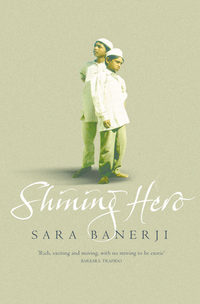
Читать книгу: «Shining Hero»

SARA BANERJI
Shining Hero

Dedication
Dedicated to Matthew Kneale, mentor and friend
Epigraph
THE MAHABHARATA IS AN EPIC POEM eight times longer than the Iliad, written in the third or fourth century B.C. It tells the story of a great war between two sets of cousins, the five Pandavas, the third of whom was Arjuna, and the hundred Kauravas, the eldest of whom was Dhuriodhana.
They fought for the kingdom whose capital city was Hastina-pura, which means city of the elephant, and to which the brave, heroic Pandavas were entitled. They had however been tricked out of their inheritance by the treacherous and devious Kauravas.
This poem is more than a story or a history. It describes the moral and ethical standards of the day and makes value judgements which are valid even in modern times. Anger, fear, hatred, jealousy, greed, lust, envy, pride and arrogance are all experienced by the protagonists of the Mahabharata. Heroes are capable of acting badly. One of Arjuna’s brothers, the heroic Yudhistra, loses everything he owns including his wife and children as well as his kingdom, in a game of dice. Arjuna himself suffers weakness at the start of the battle. His chariot is driven by the god Krishna who instructs and advises him when Arjuna becomes filled with doubt because he realises he will have to kill uncles, cousins and even his old teacher.
In the Bhagavad Gita, meaning ‘The Song Of God’, Krishna, during the battle, reminds Arjuna that because he is a kshatriya, or of the warrior caste, he has a greater duty to fight than he has towards his relatives.
In the course of the song Krishna gives Arjuna precise instructions on how to silence his mind and reach the Absolute so that to this day those learning to meditate can find the instructions for transcending thought in the Bhagavad Gita.
Contents
Cover
Title Page
Dedication
Epigraph
1 Seduction by Suriya
2 A Little Suit of Shining Armour
3 Warlike Gestures
4 The Curse of a Yogi
5 The Dharma of the Kshatriya
6 Gold and Silver
7 Sati
8 The Song of the Gandharvas
9 Vana-Parva
10 Bad Omens
11 Udyoga
12 The Divine Cuirass
13 The Sun and the Moon
14 Apsaras
15 Draupadi’s Sari
16 A Moon-Shaped Arrow
17 Unity
18 Cosmic Consciousness
Acknowledgement
About the Author
Praise
Copyright
About the Publisher
1 SEDUCTION BY SURIYA
Pritha, yet unwedded, bore him, peerless archer on the earth, Portion of the solar radiance for the sun inspired his birth.
The river, Koonty thought, was like Soma, the liquid god. A limpid animal to whom she came for comfort and to be freed of pain, though now, as she let the sacred water tickle against her ankles she wondered if she had imagined the interior gnawing. Or perhaps this holy river, annually stocked with melting goddesses, had cured her. Half an hour ago she had been certain she was dying but now she was well again. She stirred the water with her toes, started to feel happy. When she was little she would never have touched the water in this way. Then she had been afraid, for she had been told the story of the elephant who was snared by water serpents. As it was dragged, drowning, to the bottom of the river, the elephant implored the high gods for help. Vishnu had heard its prayer and, riding on his vehicle, the angel bird Garuda, appeared at the waterside. The great god, four-armed, crowned with a diadem, did not need to act. His mere presence had been enough. The serpent king and queen rose to the surface of the river and balanced in the water, their great and weighty victim struggled out of their tendrils and the Nagas folded their hands and bowed to the Lord Ruler of the Universe. But Koonty had feared that, in her case Vishnu might not think her sufficiently important to be saved and it was several years before she would believe that this tale was only a myth.
The stones of the riverbank had been smoothed by the slaps and caresses of ancient currents until they had become like dull jewels studding a water bangle. Even when the river lost control and drowned its own banks as though it no longer loved them, its stones stayed warm. But the river was not only a magic water woman bestowing wet kisses that grew rice. It killed as well.
Every year since Koonty was born she had seen it spread its transparent and reflective body over the land till houses were flattened, fields vanished and cuddled banks were lost utterly.
That was when Koonty and the zamindar’s children got a new playground. Sitting astride floating banana logs they bounced over the lost fields shouting, leaping and splashing on their banana ponies and trying to shove each other off into the drowning rice crop, while the peasant farmers mourned the loss of their livelihood. Paddling with their hands or punting with passing bamboo poles, pretending to be walking on water like yogis or crossing the ocean like foreigners, the children explored a new, wet world that, yesterday, had been paddy fields, cabbage crops, the road to Calcutta. A mirror world where an enormous yellow sky shone on the ground and only the tips of plants were visible. Sometimes their rubber chappals got sucked off and were bobbed away like rubber boats to be captured in the spring, while Boodi Ayah, wheedling, threatening, urging, would try to wade through the slush to get at them. But the watery ayah had closed her extended world to adults.
Koonty’s mother would rush out shouting, ‘What is this crazy behaviour? Who will marry a girl who is seen acting like a peasant child? You will end up like your sister if you go on like this.’ Shivarani, Koonty’s older sister, would never get married because she was too tall and was a Communist.
‘Me. I will marry Koonty,’ whispered Pandu, the zamindar’s oldest son, while Koonty’s dry mother, the lady of the land, the un-magical woman, was telling her husband, ‘You must do something about that wild girl before it is too late.’
‘What harm can come?’ murmured Koonty’s father. He did not look up from his book.
‘She might lose her virginity, sitting astride like that. Raped by a banana tree. What a waste,’ wailed Meena, Koonty’s mother.
But this river, thought Koonty, is not only a woman. It is a man as well. A husband. Every year his wife, Durga, is thrown into his body, to mingle with his substance in a million muddy forms, re-emerging later in little bits, a manicured finger here, a nose ring there.
Koonty and Pandu dived for her earrings and came up with the goddess’ arm.
‘I bet you don’t dare keep that,’ said Pandu. ‘I bet you are afraid she’ll put a curse on you.’ He was always testing Koonty, trying to find out how far she would go. Her daringness excited him. Rolling the arm inside the hem of her blouse, she carried it to the rose garden and hid it there.
Several days later her mother saw the curling fingers beckoning from behind a Queen Elizabeth.
‘This will bring trouble upon you,’ she raged and beat Koonty about the ears with her supari cutters. Koonty leapt around the veranda to avoid the whacking scissors, while her mother shouted, ‘Now for certain the goddess will put a curse upon you.’ Now the fear came to Koonty. Was that what the pains had been? Durga’s late curse? Her mother had gone down to the river bank, and, ululating, had thrown the sacred arm back into the water then waited for long minutes in case celestial retribution was to follow.
Koonty could hear the sound of hymns coming from the village over the loudspeaker. They were worshipping the Durga there and this time tomorrow would be immersing the goddesses here. This time tomorrow the river will be filled with new goddesses, she was thinking, when the pain gripped Koonty again so that instantly she could not think of anything else but it. IT. Big IT pain hurling through her stomach as though she, like the deep parts of the river, had inside her body sharp stones and a tumbling current.
Her bare feet curled, her hands clenched. ‘Ouch, ouch,’ wailed Koonty and she tried to get away from the pain by squatting down into the water. She arched her back against it. Tried to duck out from under the burden of agony. But the pain was inside her, she could not escape it.
She had started feeling ill during the monsoon. She had been very sick and her mother had taken her to the doctor. But though he examined her all over he had found nothing wrong and said it must have been something she had eaten.
‘Keep her on rice and dahi for a day or two and she’ll be all right.’
But the sickness had continued.
‘Perhaps she is allergic to fish,’ the doctor said.
Koonty’s mother agreed. ‘I have noticed that it is after taking maacher jhal that she gets the worst nausea. But it is a very great pity because here in Hatipur village we get the best fish of all India. There is nothing to surpass the hilsa taken out of our own Jummuna river.’
Koonty gave up fish and sure enough after a month and a half of abstinence she suddenly became perfectly well again.
But now she was feeling worse than sick and the pain was so intense that she could not walk, but had to crouch, waiting for it to recede. She was desperate to get home but each time she tried to start on the half mile back, the pain grabbed again. She wished she had listened to her mother who was always warning her of the wrongness of wandering so far away from home.
‘What of it that the Hatibari estate is well guarded,’ her mother told her. ‘Even though there are tall brick walls all round and a stockade in the water, even though the people from the village are forbidden to come inside, yet still there are cobras in the jungly bits. And who knows, when the watchman is sleeping, dacoits might slip in from the river. You are to be married soon and a certain behaviour is expected of you. What a mess you are. It was bad enough when you were a little girl and went round with tattered clothes and untidy hair, but at the age of fifteen one expects something neater and more modest. You are a woman, Koonty, soon to be married, and it is time you began to behave like one.’
Koonty was betrothed to Pandu, the zamindar’s son. Pandu had given her a gold chain with a medal on it for her last birthday. ‘Don’t tell my father,’ he had laughed. ‘I should not even be talking to you now that we are betrothed, let alone giving you presents. But look.’
On the golden disc he had had inscribed, ‘Koonty Pandava of the Hatibari of Hatipur.’ She had giggled and felt thrilled at the words, for this was the first time she had fully taken in the full fact of what it would mean to be the lady of Hatibari.
‘To be married to the eldest son of the zamindar of Hatipur village is a tremendous honour and triumph,’ her mother would tell her at frequent intervals. ‘You must not let any breath of scandal taint your reputation or the Pandava family will call the marriage off.’ The zamindar had been very reluctant at first to allow his eldest son to marry the daughter of his estate manager.
The river flowed through land belonging to the zamindar, whose estate covered several miles in all directions and Koonty’s father lived in one of the estate houses.
That river. It ruled all their lives and even the zamindar was sometimes conquered by it. Koonty remembered the last monsoon when the golden, killing waters had lapped right up to the steps of her parents’ house and had even reached the Hatibari mansion. River had seeped into the beds of canna lilies and gaudy zinnias, softening their grip upon the soil till their roots broke free and floated away to join the garlands of the pauper dead. Koonty’s father had had to call the Hatibari servants out at midnight and get them to construct a mini dam of straw and clay to prevent the water entering the house. But in spite of all his precautions the water managed to mount the Hatibari steps and the wife of the zamindar, coming down to view the disaster, had to raise her sari above her ankles.
‘How stupid of the grandfather to have built this grand house so near the river,’ she told Koonty’s father, as he summoned yet more servants with mops and pails.
After the flood receded, the Hatibari garden was covered with river mementos; lotus leaves, boat bits, stranded fish, while the river bobbed with the memory of its recent association with land – parts of houses, drowned goats, ripped-out bits of trees. The liquid god left brown stains upon the purity of the Hatibari marble that took the servants, under Koonty’s father’s supervision, weeks of scouring, rubbing ferociously with twists of coconut rope and handfuls of sand, to eradicate.
Koonty tried to remember what she had eaten for the midday meal. Perhaps a chingdi maach had fallen into her dhall by mistake. Perhaps the cook had used fish stock when he made the mutton with kumro. It must be the fish allergy, for Durga was a mother goddess and no mother would punish so severely for the small offence of carrying away a single arm.
‘Oh, Ma, Oh, Ma,’ Koonty wailed. But the house was too far away. Her mother could not hear her though her cries were so loud that buffaloes lounging lazily, up to their shoulders in water across the river, stirred and opened their eyes and some of the mynahs, tick-picking on the buffalo backs, winged off.
She was only fifteen, she was engaged to be married and she was going to die at any moment.
Round the bend of the river and out of sight, she could hear village boys playing. From the sudden splash and laughing shriek she thought they must be hanging from the branch of an overhanging tree and dropping feet first, head first, bottom first, into the water as she and Pandu had done as recently as two years ago. The water buffaloes did not mind the boys’ shouts. They only flinched from Koonty’s screams.
Squatting low in the water, because this position seemed the least agonising, she gripped her arms around her knees and braced her body. Tilting her head back she could just see through the mango orchards and beyond the lake the great house that would have been hers if she had lived to be married. The Hatibari. Fifty windows reflecting the river. Stone lions larger than life-size on each corner of the roof. Her father was inside at this moment, preparing lists of wedding guests with the zamindar. He would never hear Koonty. The boys round the corner heard her. Laughed and shouted back. They thought she was laughing too, joining with them in their fun.
Ever since she was little she had kept coming here, though since she was soon to marry him and become a respectable wife, she no longer played on the water with Pandu. Koonty had been sitting here earlier in the year when she had first seen Suriya, the Sun God.
‘Keep away from the waterside,’ her mother kept warning. ‘That is the place from which trouble can come.’ For who can control water, who can put an impenetrable fence through a sacred river? The rest of the property was almost unassailable. The river was its only weakness in spite of the watchman who patrolled its banks. In the old days they had put up a brick wall seven feet high all along the bank but the first monsoon had washed it away so that not a brick was left standing and the bamboo water fence had to be replaced several times a year.
Koonty always sent the watchman away when she wanted to sit here. ‘If I see someone coming I will shout for you.’ She was going to be the new young mistress of the Hatibari. He did as she told him. But when she had seen a man come swimming into the Hatibari water she had not shouted for the watchman. She had kept perfectly silent the evening the Sun God came.
Koonty had first heard he was visiting their village from Boodi Ayah. Boodi had returned with the day’s food shopping, gasping and babbling with the excitement.
‘Dilip Baswani has come to the village.’
When the family looked blank she said, ‘The actor who plays the part of the Sun God in the film of the Mahabharata.’
Koonty had stared at the young woman in disbelief. ‘Dilip the glorious? There in our village? I must go and see him.’ With her parents she had seen the film five times in Calcutta.
‘He is making speeches in the tea shop. He is standing for the election,’ said Boodi Ayah. ‘I saw him with my own eyes.’
Dilip Baswani, dressed entirely in gold, had ridden into the village on a golden motorbike. His goggles were golden, he shone with gold leather and wore a plastic golden helmet.
‘He is even more beautiful than in the film, Koonty Missie. His skin looks soft as silk and his eyes are the colour of honey.’ The ayah’s excitement became so great that a cone of fresh ladies’ fingers fell from her arms and she nearly dropped the eggs.
‘Take that stuff on to the big house where they are waiting for it and stop filling my daughter’s mind with ideas,’ said Koonty’s mother sternly.
‘When can I go to hear him?’ cried Koonty. ‘I think we should go this very minute in case it is too late and he is gone.’
Koonty’s mother became stern. ‘You are only fifteen years old and about to become the wife of the young zamindar. How can you be seen among the ordinary people? A girl in your situation must stay modestly at home.’
‘What harm can it do for me only to go there and listen?’ Koonty had begged. ‘Boodi Ayah could come with me.’
‘That silly woman will be useless in such a mob,’ snapped the mother. ‘It is all her fault, with her foolish chatter, that you are so eager to see this man who is nothing but a C-grade film actor. Also a thousand people from fifty villages will be there to hear him. What will your husband-to-be’s family think if they hear you have been mingling amongst all kinds of untouchable people and gawping at a trashy film star?’
So Koonty had sat by the river instead, felt sad, cross, wished she was there among the village crowd which she could hear faintly from down the water. She imagined how impressed the girls at school would have been if she had told them she had actually seen Dilip Baswani with her own eyes like Boodi Ayah. His voice, drifting over the water, did not even sound the same as it did at the cinema.
All the girls at her school were deeply in love with one Mahabharata character or another. Koonty’s passion was Arjuna and she had a lurid poster of the actor in her bedroom.
‘Is this all you modern girls have to talk about? Cheap films and their cheaper stars. If you want to know these stories you should read the original texts,’ Koonty’s mother would reprimand.
‘Oh, Ma, what an old fuddy-duddy you are.’
In the evening she had gone back to the river just in case the Sun God started talking to the villagers again. As she sat there she had heard a commotion on the water, excited shouts, cries of awe, as though a thousand people were gathered there watching something wonderful.
‘Come and look, brother,’ she could hear one person cry to another. ‘It is the Sun God himself, here in our river.’
She heard later how the shout had spread over the countryside. People had leapt from bullock carts and run to see. Buses stopped and disgorged their passengers. The village streets emptied, shopkeepers hastily boarded up and ran to the waterside, labourers dropped their spades and rushed. Children flooded out of the school and raced their excited teacher to the river.
As the Sun God swam, he became surrounded by a hundred boys, dog-paddling alongside, and the crowds that gathered on the banks became ten deep. Trees on the waterside began cracking under the weight of people who had climbed them to catch a sight of the swimming film star and every house and hut that overlooked the water had people scrambling to the rooftops, trying to see him. Only the people of the Hatibari had remained inside, though from its upper windows could be seen the faces of the zamindar’s servants craning there, trying to get a peep but not wanting to risk the wrath of their employers by gawping openly.
Dilip Baswani swam as fast as he could, trying, hopelessly, to shake off the mob of village boys, till ahead of him he saw the bamboo barricade cutting into the water like a fence, beyond which were trees and a domed roof. This must be the border of the Hatibari estate, he thought, the great house the villagers had told him about. Private property onto which they would not dare follow him, but onto which he, the zamindar’s future MLA, would surely be welcome. He entered the stockade and felt gratified to see the mob of boys fall back. Inside he found himself gratefully alone.
He turned a bend and looked with pleasure onto groomed grassy banks planted with flowering shrubs and free of crowds. Then he saw one lone figure sitting, feet in the water, watching him, a young girl with untidy hair and a muddy sari.
She stared with sparkling eyes, her mouth rounded in an O of amazement.
‘Hello,’ he said, but the girl just stared at him in silence.
A servant girl from the Hatibari, but pretty enough, he thought. And the age he liked.
‘What’s your name, dear?’ he asked as he scrambled out of the water. But Koonty’s lips seemed to have got stuck in their gasp of surprise.
‘I need a little rest,’ he said. ‘There are such crowds everywhere else. I don’t expect the zamindar will mind if I get my breath back here.’ He stood looking down at her, smiling. Charming, he thought.
He was not wearing a golden helmet, a gold leather jacket, gleaming goggles. He wore nothing but golden swimming shorts slung just below his small corpulence. But all the same Koonty knew exactly who he was for she had seen his face at the cinema five times.
‘I always like to take a swim in the evening,’ he said, as he sat down at Koonty’s side. ‘It is good for my digestion.’
Koonty tried to say something, opened her mouth, moved her lips, but only a sort of croaking squeak came out.
River water dripped from the Sun God’s arms and ran down his chest in rivulets.
‘Well, my dear, haven’t you got a tongue?’ He touched her arm. Gently. A shiver ran through her as though a stream of gold swished down her veins.
The crowds that were packed so thickly round the bend peered and craned, but the film star had become lost to sight. They waited for a long long time, but he did not come back. After an hour and a half they began to move away.
Now the pains were following each other so fast Koonty scarcely had time to breathe between them. She squatted lower into the water, braced herself tighter as a great racking spasm seized her. A sudden warmth gushed out of her and the water round her ankles turned red. A second spasm, huger than the first, overtook her and she could feel something heavy thrusting between her thighs as though she was being torn apart. Spreading her knees she saw, emerging into the water, something round and hazed with dark wet fur. Then another surge and the rest was there. Arms, legs, a stomach to which was attached a long twisted cord.
It lay under the water for a moment then floated up, eyes closed, lips moving.
Koonty let out a little scream of shock and darkness came over her eyes as though she was about to faint. Through the daze she reached out a hand and touched the little creature that lay half submerged in water. Its limbs began to move, tiny desperate thrashings. Its mouth began twisting, pouting. Koonty ran her hand over the child’s face and felt the movement of its lips against her fingers. As she passed her hand along its arm, a minute and wrinkled finger clutched around hers.
She was not having some terrible dream. This was true. She had had a baby. She had given birth to the Sun God’s child. She was finished now. Truly finished.
She had been worried at first. The things he asked her to do, the things he was doing to her did not seem modest. But he had reassured her. ‘You trust me, don’t you, my dear? You need not be afraid of me.’ He had spoken in his deep and husky voice and it had not come into her mind for a single moment not to trust him, any more than she would have mistrusted her father.
‘Lie like that, there, let me pull up your sari. Now open your legs a little. Good, good, that’s right.’ The doctor had talked to her like that when she had jumped out of the banyan tree, missed the river and sprained her ankle.
‘Are you sure?’ she had whispered and felt dazed with the deliciousness of his nearness, the feel of his skin, the smell of his foreign toilet water.
‘Yes, yes, my sweet. Quite sure. Now close your eyes.’ He had told her, ‘You needn’t worry about anything I do, for after all I am a god, aren’t I?’ Then he had laughed as though he had made a joke. His voice had been very rich and loving.
That evening she had taken down the poster of Arjuna and put up one of the Sun God instead.
He had told her not to worry, to trust him, but all the same she had given birth to his baby and now the young zamindar would not marry her. No one would. She would live lonely and ashamed for the rest of her life. Her parents would feel such shame that they would forbid her to go on living with them. She would not be able to live in the village either, for everyone would know. Koonty had earlier feared that she was dying. Now she was even more afraid of living.
As the water surged round her clothes and legs, carrying the blood away, she crouched numbly, gazed at the baby and felt chills of terror running through her. Her mother might have heard her earlier cries and at any moment come here to find her. She listened, her heart cracking against her ribs, for the sound of Boodi Ayah’s bare feet, Boodi sent to look for her.
‘The queen so pleased a rishi that he gave her a mantra which would evoke any god she wanted who would then, by his grace, produce in her a child.’ Koonty remembered that verse from the Mahabharata. She understood. She had pleased some rishi and her life was now destroyed because of it.
The baby began to let out little mewing cries and she hastily picked it up, the umbilical cord trailing, and tried to silence it. Its skin felt soft as silk. Softer than the Sun God’s skin. She pressed her knuckle against its mouth and at once, like the grip of a leech, its lips began sucking.
But after a moment it let go of the knuckle and began mewling again. She held it closer to her body and the baby started writhing. Her breasts had become tight and were spilling milk. She could feel it running warm down her ribs, over the place where her heart kept so loudly pounding.
To silence the baby, to stop the sound that would at any moment betray her, she pulled back her choli and held the child close. In a moment the baby had clamped upon the nipple and the only sound was a high-pitched grunt at every suck.
‘Hello, Baby God,’ she whispered, then pressing her face against the top of the head felt the soft fluff of newborn hair against her lips.
After a while the baby fell asleep. Koonty could not move. Her body was raw. Her legs felt weak. She sat there, the baby in her arms, and did not know what to do next, while the rose-ringed parakeets swooped among the trees, screaming. One extra loud bird cry startled the baby. It opened its eyes and Koonty saw that they were the colour of honey.
After that, sometimes the baby slept and sometimes fed but Koonty did not know what to do.
Night fell suddenly, the sun extinguished in a few fiery minutes. The bats came out. Fireflies began to dance among the silhouettes of trees. Behind her the lights came on in the Hatibari. She began to hear people calling her from the house. Never before had she stayed here after dark. Footsteps running over the paths. People calling, calling.
She held the baby tightly to her body, kept quite still and waited. She did not know what to do.
Her mother and Boodi Ayah were coming closer, shouting, ‘Koonty, Koonty, Koonty.’ Her mother was saying, ‘Sometimes she goes down there by the river, but she surely wouldn’t be there now, in the dark, when you have no idea who might be on the water.’
The household had been so absorbed in the news they had heard on the radio that they had not realised that Koonty was still outside. There was a fear of all-out war with Pakistan who had, that day, made an illegal military attempt to grab the Indian state of Kashmir. But now the worry about Koonty had made them forget about war and rush panicking around the estate, searching for the missing daughter.
Their voices came closer and Koonty gripped the child and felt dazed with fear. Then they began to move off again, their voices growing distant. ‘Perhaps she’s in the rose garden. Go and look there, Boodi.’
A little later, hurricane lamps and men’s voices. Her mother talking too loudly because she was afraid. ‘The only place left is the river. I am terrified that she has fallen in. Even though she can swim, this river is deceptive. The current can be very strong even for a healthy girl.’
The voice of the young zamindar. ‘Give me the lamp. I will go and look there.’ Her husband-to-be coming to where she sat with the Sun God’s baby in her lap. She could see, reflected in the river water, the swinging light approaching.
‘Koonty, Koonty,’ called the young man who was to marry her. He was getting very close. She could tell them that she had found the baby at the river’s edge. She could tell them it was a villager’s baby and she was only holding it for a moment. He was quite near now. At any moment he would see her sitting here. She could hear his panting breath. She could see his face gleaming in the lamplight. The young zamindar found her there, standing knee-deep in the river.
‘Why are you crying, Koonty? What’s the matter?’ Pandu kept asking her as he helped her back to the house. ‘You are shivering all over and wet from head to toe. Whatever have you been doing all this time? We have all been worried sick about you.’ He tried to hug her but she shook his arms off. ‘Come on, Miss Koonty,’ he whispered. ‘Tell your Pandu what’s the matter.’
After a while, when she only wept and would not speak he became angry. ‘You are hiding something. It’s those village boys, isn’t it? I heard them shouting. Have you been talking to them? I should have listened to your mother. She always said it was not proper for you to be roaming round the estate without a chaperone. She always said you’d turn out like your sister.’ All the way back to the Hatibari and even after they got inside, he kept on, sometimes trying to console her incomprehensible grief, sometimes raging against the suspected deception or infidelity. ‘You are going to be my wife. You should have some consideration. Don’t cry, my sweet. Here, wipe your face on the corner of my shawl.’
Later he told her mother, ‘She was trying to rescue a kitten, I think, though I can’t get her to talk about it.’ He felt he was doing well, impressing the mother with what an understanding husband he was going to be. ‘I heard something. A sound of mewing in the water.’
‘She was always very kind to animals,’ said Koonty’s mother and secretly thought that perhaps the zamindar’s family would be satisfied with a smaller dowry, now that they had discovered what a compassionate bride they were getting. ‘She would sacrifice herself for some small creature.’
Later the young zamindar presented Koonty with a kitten, but at the sight of the furry mewling thing she began to cry and thrust it from her. ‘Take it away. I don’t even want to look at it.’
2 A LITTLE SUIT OF SHINING ARMOUR
Bowed with drops of toil and languor, low, a chariot driver came, Loosely held his scanty garment and a staff upheld his frame. Karna now a crowned monarch to the humble Suta fled, As a son unto a father reverentially bowed his head.
The Emperor Aurangzeb suffered from a carbuncle until an East India Company official called Job Charnock found a physician who managed to cure it. As a reward, Job was granted a tract of land eighty miles up the Hoogly river by the Nawab of Bengal and there he founded the city of Calcutta.
By the end of the eighteenth century Calcutta was the capital of the East India Company’s government, with an opulent and lively social life and opportunities for making a quick fortune for a lucky few. To this day, throughout the town, grand Western-style buildings, now crumbling, point back to its imperial past.
Dolly, her impoverished parents’ eleventh child, was born in the house where once William Hickey had dined with his face covered with blood, because he had become ‘sadly intoxicated’ at a previous get-together and had fallen while dismounting from his phaeton.
At the time of Dolly’s birth, more than a hundred families were living in considerable squalor and poverty in Hickey’s one-time grand residence. But because the new baby was born in the year of India’s independence her parents said, ‘Perhaps the goddess is going to bless us at last even though this is only a female child.’ For this reason, when she was old enough, they sent Dolly to the local school although their other daughters had never been give such an opportunity.
Each evening Dolly would come home and as she helped her mother pick through the rice for stones or roll the chupatties she would chatter joyfully about the things she had learnt that day. ‘We did fractions,’ she would announce, as she crushed the spices on the great thick slab of stone. Splashing water from the brass jar onto the seeds and pods and barks, she would heave the heavy stone roller over the top. Rolling, splashing, crushing she would tell her mother, ‘Did you know that the Moguls ruled India before the British and that this is the first time for ages that we Indians have been free?’ Or, as she stirred the great pan of simmering milk, keeping the iron spoon going to stop the milk boiling over or burning at the bottom, she would tell her mother about trade winds, or magnetism.
Sometimes the father would say worriedly, ‘Do you think all this education is spoiling her? Perhaps she is getting too much of it and won’t be able to find a husband.’
‘She is not neglecting her domestic duties,’ said the mother.
Later, after her parents and her ten siblings slept, Dolly sat by the light of a kerosene lamp and did her homework. She was determined to do well. She planned one day to live in a proper house, not a room in the bustee. If she passed her exams and got a good job, when she was grown up her children would have a bed each and they would eat mutton curry every day. Sometimes one of the babies would wake and cry, disturbing her. Then she would take it on her knee and joggle it on one arm while going on with her writing.
‘My teacher says I will certainly get into university. He is sure I will get a scholarship,’ she told her parents.
Her father’s face was stern, her mother’s anxious. ‘What? What?’ cried Dolly, suddenly afraid.
‘All this education is not needed for a woman,’ said her father.
‘There are better things for a woman to do with her life than to study,’ said her mother.
They had found Dolly a husband.
‘But I don’t want a husband,’ wailed the girl. ‘I am only thirteen. I’m too young to get married.’
‘I was married at ten,’ said her mother.
Dolly pinched lips and refrained from saying, ‘I don’t want my life to be like yours.’ Instead she said, ‘Baba, Ma, please. I am doing so well at school and if I get into university I will get a good job. I will become a teacher, maybe.’
‘How long will this take?’ asked her father.
‘Four years. Five years.’ Dolly was shivering.
‘We cannot go on feeding so many,’ said Dolly’s father. ‘We cannot spend all this on one when there are so many others who have a need. Anyway you are only a girl and the money must be spent on the boys.’
‘I could earn some money from teaching now, maybe,’ pleaded Dolly.
‘Teach who? In this village?’ Her father was scornful. ‘Who can afford to pay a young ignorant girl to teach them? Anyway there is a school that costs nothing already. And after you have finished university you will be too old for marriage.’
‘You can go on studying after you are married. There will be nothing to stop you then. You will be living in a company compound with all kinds of facilities. There will be many opportunities open to you there,’ her mother consoled her. ‘As it is we have to make a great sacrifice for your marriage. There is the big expense of the wedding feast and also the dowry. A large amount of our savings will have to be spent.’
Cheered by the thought of going on with her schooling after marriage, and eventually going to university after all, Dolly agreed.
The young bridegroom, Adhiratha, was twenty-seven years old and a company car driver. ‘He even has a pension,’ her father told Dolly. ‘You are very lucky for you will be provided for all your life. Even after he retires. You will not be poor when you are old like your mother and me.’
‘In fact we need a daughter with such a husband or how will we survive in our old age?’ said Dolly’s mother.
Dolly laughed at the thought of caring for her parents, not being able to imagine such a role reversal.
‘He is everything nice,’ said Dolly’s mother, showing her daughter a photo of Adhiratha. She was happy to see the girl smiling again.
The picture showed a pleasant-looking young man with a thin face, a large moustache and glasses.
‘He looks clever,’ said Dolly. She was quite excited now, longing to meet the man, with whom she thought she had fallen in love already. As a Hindu wife-to-be, and therefore required to respect the husband, as was the tradition she did not use his name even in her mind.
‘He has a sensitive face,’ she thought and the ‘He’ to which she referred was now the central person of her life. All other ‘he’s’ she thought, must go by some other name from this day on.
Adhiratha looked like the kind of person who would appreciate education and Dolly visualised the two of them discussing books together, or even both attending night school. After all he would not be wearing glasses if he was not an intellectual.
If Dolly had known then the real reason for the glasses, would her parents have continued to insist on the marriage? Would Dolly have felt afraid?
Dolly fell wildly in love with Adhiratha the moment she set eyes on him.
‘How glad I am,’ she thought after their wedding, as they sat together in a proper electric-lit room to eat their meal. The company bungalow was a pukka stone and mortar affair with running water and glass in the windows.
They could not stop smiling at each other across the table. Sometimes before the meal was eaten, with only a smile for a signal, the two of them would leap up, overturning chairs, spilling misti and rush for their bed with its new sheet and dunlopillo mattress that had been kept wrapped in its cellophane for protection.
In bed they would lie naked, sweating under the slow turning fan, and explore each other’s beautiful bodies all over again. Adhiratha would bury his face in Dolly’s thick black hair that smelled of the spices she had been cooking. He would kiss the softness of her neck and whisper, ‘I love you, Dolly, I love you Dolly, I love you Dolly.’
He went to work each day wearing his smart chauffeur cap and a pristine white uniform with the company logo embroidered on the pocket that had been lovingly starched and pressed by his little new wife.
After he had gone Dolly would sing as she dusted her house, washed up the dishes, and swept her yard. She remembered how she had quarrelled with her parents when they had tried to arrange her marriage but now she was so happy. Her heart sang with joy because she loved Adhiratha so much and because everything she wanted in the world had been given to her. A hundred times a day, as she swept and polished their bungalow and made special delicious things for her husband’s evening meal, Dolly would say to herself, ‘How lucky my parents insisted I got married to Adhiratha.’ They even had a little garden and Dolly would pick hibiscus, zinnias and canna lilies and arrange them in a jug, then blush with delight when Adhiratha came home and praised her artistry.
Dolly was invited to continue her education at the company school and when term began, each day she would walk across the compound to her class, crossing shady yards, under trees planted by the company, past beds of flowers. There she revelled in the company of girls of her own age and she and her friends would sometimes get a chance to go to the bioscope, then later imitate the accents and behaviour of Ashok Kumar, or swank around pretending to be Meena Kumari.
But no matter how much studying she did, nor how much fun she had with her friends in the day, when Adhiratha got home in the evening she was always there, ready with his evening meal. Her mother had taught her to cook. Her chupatties puffed out like footballs, her parathas were as thin and fine as silk, her kheers and paish the best on the company compound. When Adhiratha invited fellow workers to a meal they would marvel that so young a wife should turn out to be such a marvellous cook. Pulling her sari over her head in deference, she would serve out the food for them, while the young men teased her until she blushed. ‘Hey, Dolly, those chupatties will float up like balloons if you make them any lighter.’ ‘Hey, Dolly. I think I will throw away my own wife and take you home with me instead so that I can eat sag like you make every day.’
‘No you won’t, you swine,’ Adhiratha would josh back. ‘She’s mine. She’s the best thing in my life and I’m not giving her up for anyone.’
‘But when are you starting the baby?’ Dolly’s mother kept asking and patted Dolly’s stomach, which sounded hollowly empty.
‘We are waiting for a year. Till I take my exams,’ Dolly told her parents.
‘How modern,’ said the father. ‘Let us hope that the gods will not take offence.’
‘What do you mean?’ Dolly was startled.
‘They give us children when they decide. It is not up to you to make such decisions.’ He spoke fiercely. ‘Exams are not an excuse for delaying children.’
‘Oh, Baba, you don’t know anything,’ laughed the modern Dolly, amused by her parents’ silly superstitious and old-fashioned attitudes. ‘These days women don’t just have to fill the house with babies like they did when you and Ma were young.’
‘But why take such risks?’ said the mother, trying to soothe the situation. ‘What difference will it make? Have the baby and when it comes, God will look after you. And look after the baby.’
‘I plan to look after my baby, myself,’ said the blasphemous, proud Dolly.
Soon after their marriage it was the time of the Durga Puja.
Goddess Durga is the giver of rice. She is the mother. But she is also yellow and terrible. She is Devi, one of the female aspects of the Absolute, that infinite, inert and creative Silence. Her serene and aloof expression does not change as she slays the demon who is trying to destroy the world. She shows no trace of rage or emotion because, for her, the deed, the Cosmos and her self are only illusions, only parts of the Cosmic dream. She rides a lion, holds weapons in her many arms, is cool as a dream and calm as an untroubled river. She is the inaccessible, the inevitable, for she knows that all this is an illusion. All this is Maya. And Durga is responsible for the illusion, she is the illusion and she is only playing at creation. Creation is the play of the gods, nothing to be really taken seriously. That is what her calm face says.
Each year great images are made of her all over Bengal. Wood armatures fifteen feet high are wrapped with straw, then covered with clay, which is modelled into the smallest detail. Lips rich with scarlet gloss, eyelids dark with lamp khol, fingernails manicured with crimson lacquer, her tiny waist belted in gold, her human hair glossed with resin. Her tinsel-trimmed sari glitters and her cut-glass jewels sparkle.
The puja lasts for four days, during which the images, which have taken so many months to sculpt, are worshipped by the rich and the poor, the educated and the illiterate, who present the goddesses with flowers, fruit, garlands and sweets. For Durga is very powerful and has it in her power to grant life to the dying, health to the sick, children to the infertile and husbands to the hideous. There is no one so rich and privileged that they never need her help.
There was much competition, at Durga Puja, among neighbourhoods and companies, but year after year Adhiratha’s employers always came out with the most beautiful image of the goddess and the most impressive shrine. The company shrine was an exact replica of a Hindu temple and as large. It was made of cotton material stretched over a bamboo frame which in the dark glowed with the light of a thousand multi-coloured electric bulbs. It was painted so realistically that people who saw it from a distance thought a new temple of brick and stone had sprung up overnight.
On the first Durga Puja after her marriage, Dolly made a dish of the milky sweets called shandesh. They were the shape of little fishes and she decorated them with foil of purest gold. When they were ready she put on her best sari and decorated her forehead with scarlet kumkum, then she walked across the compound to the shrine. There, many other people were making offerings to Durga. Some were prostrate on the ground before the goddess. Even the directors of this company had come with gifts for their goddess, for the company was thriving.
Dolly put the plate at the feet of the austere towering image, then, placing her palms together, knelt and bowed till her head touched the ground and said, ‘Thank you, thank you, thank you.’
After the period of worship was over, Adhiratha was one of those given the honour of carrying the goddess to the holy river, where she would be ritually immersed. People cried out Durga’s praises as the gigantic figure, with her calm face and ornate attire, was jogged along the roads. Some people ran ahead of the procession and threw themselves in the goddess’s path as though she was the Juggernaut and they wished to be crushed to death by her.
At the river other Durgas were arriving, though none as large and lovely as that which Dolly’s new young husband and the other men were carrying.
The company had two long boats waiting, boards lashed between them to form a platform for the statue. It was hauled onto this, then held in place and steadied with poles and ropes.
Dolly and Adhiratha stood on the bank watching while the boat was punted to the centre of the river which was already bobbing with a hundred little boats and rafts carrying Durgas of every size.
There, with the lookers-on ululating and shouting holy praises, the goddess was tipped into the river. As she sank, people scooped up handfuls of water, that had become further blessed by contact with the deity, and threw it over their heads. And as the goddess disappeared from sight, men filled their mouths with petrol and, setting fire to it with cigarette lighters, blew great arcs of flame over the water.
Firecrackers were hurled from the banks and bridges. Little clay lamps burning oil were set bobbing away on the water like luminous ducklings. For a while the whole bubbling river was spattered with bursts and crackles of fire and the wild cries of the people calling out to the vanishing goddess.
Dolly took her exams and did well. She had been married for a year. In the evening when Adhiratha got home he told her, ‘They have promoted me. I am to become head driver and will get a raise of a hundred and fifty rupees a month.’
Dolly put her arms round him and hugged. She felt so happy she could not speak. Then she whispered something.
‘What? I couldn’t hear.’ Adhiratha was teasing her. Although he had not heard, he knew quite well what she had said.
Her eyes down and whispering a little louder, she said, ‘We can start our family this year.’
‘Did you ask for Durga’s blessing?’ he asked, laughing, as he hung his chauffeur’s hat on the rack. His wife’s devotion to Durga always amused him. ‘It’s only a statue,’ he would say. ‘I’m the one who does all the hard work, while she just stands there. It’s me you should be thanking.’
‘Oh, you,’ Dolly chided. ‘You must not talk like that about the goddess. She might put a curse on us.’
That night Adhiratha made love to her without using a condom and afterwards they laughed and embraced each other, certain that the baby was already made.
After three months when Dolly had still not become pregnant, the first little flicker of worry began to set in. Dolly, only half joking, told Adhiratha, ‘I said you should not have spoken disrespectfully about the goddess.’
‘Silly girl,’ said Adhiratha. ‘It is early days. Look how well everything is turning out for us.’ His new job had earned them a bigger bungalow and the allowance for a couple of servants. There was only one little trouble to shade their lives – Adhiratha’s eyes often ached.
He had always had trouble with his eyes and his glasses were not a sign that he was educated or particularly literate as Dolly had presumed from looking at his photo. He had worn them since childhood.
‘Don’t keep rubbing them,’ Dolly urged and made eye-washes for him out of herbs and spices, remedies that the people in the village used when they could not afford a doctor.
Dolly woke in the night sometimes, to hear him moaning softly. She would gently massage his forehead with her thumbs till the pain ebbed away.
‘You have to see the doctor,’ she demanded and went on insisting in spite of his protests.
‘I am a driver. If this company finds out that I have problems with my sight they may sack me.’ He tried to soothe her, ‘My eyes have given trouble all my life. I know how to cope with it,’ but she would not be calmed. She felt sure his eyes were getting worse.
In the end, at her insistence, and with many misgivings, he agreed.
The company doctor gave Adhiratha painkillers and made an appointment for him to see a specialist.
Dolly had still not conceived a child by the third Durga Puja after their marriage. She was getting worried, no longer soothed by Adhiratha’s assurance that ‘it’s early days’. Her mother had been pregnant with her third child at this stage. Dolly felt ashamed to go and visit her parents these days.
‘What is the matter with you? Are you infertile or something?’ Dolly’s usually gentle mother became quite angry at the idea. And worried. Would Adhiratha’s family take revenge on her daughter, if they began to think she was infertile? There were stories of such failed brides having kerosene thrown over them then being set alight by the parents-in-law.
At this year’s Durga Puja, Dolly prostrated herself before the haughty goddess and instead of saying, ‘thank you’ said, ‘please, please, please’. She rose at last, speckled with grit from the ground, having only implored, ‘Make me a baby, make my husband’s eyes better.’
The specialist diagnosed Adhiratha’s problem as glaucoma, a build-up of fluid within the eyeball. He gave the young chauffeur drops to put in his eyes that might, over time, reduce the pressure.
‘How much time?’ asked Adhiratha.
‘One or two years. This medicine retracts the pupils, affecting your sight, so you must not drive a car for a couple of hours after application.’ Adhiratha had to get up two hours earlier each morning to get rid of the effects of the medicine in time for his day’s work and he lived in a constant state of anxiety in case he was called upon for emergency jobs, when his vision was still blurred.
‘It is preying on your mind, my husband,’ Dolly said. ‘Isn’t there another job the company can give you that does not need good sight?’ Secretly she began to think that part of the reason for her failing to conceive was because her husband was so worried and tired.
Six months later Adhiratha crashed a company car.
‘We are sorry to see you go,’ said the manager. ‘You have been an excellent driver.’
‘Is there no other job you can give me?’ pleaded Adhiratha.
The man bowed his head and looked sad. ‘If this had happened a year ago, yes, we might have found some place for you in the packing department. But last year we made a loss. We are getting rid of staff. I am so sorry, Adhiratha, but there is nothing I can offer you.’
Adhiratha was given a farewell party and a lump sum.
Dolly cried the day she and Adhiratha had to leave their bungalow in the company compound. She moved in with her parents while Adhiratha dossed down with friends and hunted for a place to live that they could afford. Because he had only been working for the company for five years, although they had been as generous as they could, the severance payment was not enough for him to rent anything better than a short-term lease of a room in the bustee.
‘It’s home, though,’ he told Dolly when she arrived to join him. ‘And knowing you, you’ll make it nice.’
Dolly cried again when she saw the sordid room.
‘I’ll get a job, don’t worry, don’t be afraid,’ Adhiratha tried to reassure her, but she could hear the fear in his voice too.
Adhiratha had no skills apart from driving and for a while worked as a taxi driver. But a smashed taxi put a stop to that.
‘Don’t worry, my darling,’ soothed Dolly. ‘We still have a little money left, and something is sure to turn up.’ By now he had to accept that his driving days were over. No longer treated by the free medical service of the company and without enough money to pay for the expensive drugs, his eyes rapidly deteriorated. He could hardly see six feet ahead of him. And what work can an almost blind man find in a city with so much unemployment?
‘Don’t be sad, darling husband,’ sobbed Dolly. ‘I have got my school cert so I should be able to get a job while you are looking for something. I might become a hotel receptionist.’ She felt quite excited at the idea and visualised herself seated behind a smart desk, wearing a uniform, and meeting all kinds of interesting people.
But when she went out in response to adverts in the Statesman she found that she was competing for humble jobs with people much more qualified than she was. Men and women who had left university with first-class degrees were clamouring to become shop assistants, bus conductors, railway clerks and company secretaries. Dolly didn’t stand a chance.
After six months the severance payment was nearly finished. Soon, not only would they have nowhere to live, they would have nothing to eat either.
‘We will have to go to the village and live with your parents,’ wept Dolly.
Adhiratha shivered at the idea. ‘They have ten other children and are trying so desperately to raise enough money for the dowries so that my two sisters can marry. If there is no work in the city there is certainly none in the village. How can we possibly inflict ourselves upon them?’ He felt sick with shame.
Next day Dolly went back to the company where she and Adhiratha had once been so happy. She went from bungalow to bungalow offering to do the washing for the families there. At the end of the day she had the promise of five households of washing.
She came home and told him, saying, ‘We will have to buy a charcoal steam iron.’
Adhiratha was aghast.
‘Suggest something else then,’ said Dolly. ‘At least I will be able to make just enough so that we have shelter and do not starve.’ She added with deepening bitterness, ‘Now I understand why Ma Durga never gave us a child. Because she knew we would not be able to afford to give it a decent life.’
Adhiratha held her tight against him, hugged and hugged her till her miserable shivering stopped.
Later he said, ‘We haven’t even got running water. How are you going to wash all these clothes?’
‘In the river. Like the other dhobis,’ said Dolly firmly.
‘Oh God.’ Adhiratha groaned and put his hands over his eyes. ‘But you don’t know anything about being a dhobi.’
‘Don’t know anything?’ she mocked. ‘Darling husband, who has been washing your clothes these last three years, since your mother stopped doing them? Have you ever complained? Weren’t your collars and cuffs always crisp with starch? Didn’t I always get the last grimy traces off them? Didn’t I starch your uniforms and dhotis with boiled rice water till they were so stiff they could have stood up on their own? How can you say I don’t know how to be a dhobi?’
‘But that was different,’ said Adhiratha. ‘In the bungalow we had hot running water from the tap. A clothesline in the garden. Electricity for the iron. Here you have none of those things.’ In the bustee room the only light was from oil lamps and lanterns. Water came from a ruptured pipe along the road.
But Dolly was undaunted. ‘There is no other way. I will manage.’
She washed endless piles of clothes, all day long, standing ankle-deep in the shallow part of the river, among a line of other dhobis. Daily at dawn she would be at the riverside wetting the garments, rubbing them with strong yellow soap, then beating them against a stone already rubbed smooth and shiny by hundreds, perhaps thousands of years of dhobi wear. From the time the sun rose until it sunk again Dolly beat the washing then laid it to dry on the riverbank. At night, carrying the vast heap of dry, clean washing on her head, she would return home. There she would prepare the evening meal for her husband and herself on a chula, a stove made in a pierced bucket that had been lined with mud and which burned the cow-dung fuel that Adhiratha collected and dried each day. Their morning meal was only rice water from the previous night’s cooking.
During the weeks that followed Adhiratha tried to help Dolly in every way he could. He struggled behind her carrying the heaps of dirty clothes. Went round the bungalows collecting the washing in a basket. Even tried to assist his wife in beating the clothes against the stones. In the end she told him, ‘It is not your dharma to be a dhobi. Try to find some work that is more suited to you.’
‘I am no good at it, you mean,’ he said humbly.
‘That is what I mean,’ she laughed.
Adhiratha found a job at last. Pulling a rickshaw.
It was Dolly’s turn to be aghast. ‘You are to become a rickshaw wallah? I am to be the wife of a rickshaw wallah?’
‘Well, I am the husband of a dhobi woman,’ he laughed. ‘We are coming down in the world. That is all.’ Then he gave her a hug and said, ‘We have still got each other. We are still young. Who knows what will turn up.’ He picked up her hand, and caressed it. It was wrinkled like the hand of a dead person from so much immersion in water.
‘We would be better off if we had never had the good period in the company compound,’ she thought. Their present situation, a home surrounded by stinking drains and a single daily meal of rice and dhall, would have been easier to bear, she thought, if she had not experienced those happy days in the leafy compound, where they ate chingri and hilsa and bathed their rice in ghee.
That year, on the first day of the Durga Puja, as Dolly passed the company shrine on her way to collect the dirty washing, she turned her head the other way. And hoped the goddess noticed and felt ashamed, for by this time Dolly and Adhiratha had been married for five years and, in spite of all her prayers, there was still no child. In fact Adhiratha had begun to say that it would be a disaster if Dolly became pregnant now.
Бесплатный фрагмент закончился.