Читать книгу: «Ten Thousand a-Year. Volume 2»
CHAPTER I
"The Attorney-General did his work very fairly, I thought—eh, Lynx?" said Mr. Subtle, as arm-in-arm with Mr. Lynx, he quitted the Castle-gates, each of them on his way to their respective lodgings, to prepare for the next day's work.
"Yes—he's a keen hand, to be sure: he's given us all work enough; and I must say, it's been a capital set-to between you! I'm very glad you got the verdict!"
"It wouldn't have done to be beaten on one's own dung-hill, as it were—eh? By the way, Lynx, that was a good hit of yours about the erasure—I ought, really, if it had occurred to me at the time, to have given you the credit of it—'twas entirely yours, Lynx, I must say."
"Oh, no!"—replied Lynx, modestly. "It was a mere accident my lighting on it; the merit was, the use you made of it!"
"To think of ten thousand a-year turning on that same trumpery erasure!"–
"But are you sure of our verdict on that ground, Mr. Subtle? Do you think Lord Widdrington was right in rejecting that deed?"1
"Right? to be sure he was! But I own I got rather uneasy at the way the Attorney-General put it—that the estate had once been vested, and could not be subsequently de-vested by an alteration or blemish in the instrument evidencing the passing of the estate—eh? that was a good point, Lynx."
"Ay, but as Lord Widdrington put it—that could be only where the defect was proved to exist after a complete and valid deed had been once established."
"True—true; that's the answer, Lynx; here, you see, the deed is disgraced in the first instance; no proof, in fact, that it ever was a deed—therefore, mere waste paper."
"To be sure, possession has gone along with the deed"–
"Possession gone along with it!—What then?—That is to say, the man who has altered it, to benefit himself and his heirs, keeps it snugly in his own chest—and then that is of itself to be sufficient to"–
"Ay—but what I'm afraid of, is this: that the presumption of forgery arising from the alteration, is overcome by the presumption to the contrary, arising from long-continued and consistent possession!—On the other hand, however, it is certainly a general rule that the party producing an instrument must account for the appearance of erasure or alteration, to encounter the presumption of fraud!—I must say that seems good sense enough!"…
"It's really been a very interesting cause," said Mr. Subtle.
"Very. Some capital points—that of Mortmain's on the stamp act"–
"Pish, Lynx! there's nothing in it! I meant the cause itself has been an interesting one—uncommonly."
Mr. Subtle suddenly paused and stood still. "God bless my soul, Lynx—I've made a blunder!"
"Eh!"
"Yes—by Jove, a blunder! Never did such a thing since I've led a cause before!"
"A blunder? Impossible!—What is it?" inquired Lynx, briskly, pricking up his ears.
"It will be at least thirty or forty pounds out of our client's pocket. I forgot to ask Widdrington for the certificate for the costs of the special jury. I protest I never did such a thing before—I'm quite annoyed—I hate to overlook anything."
"Oh! is that all?" inquired Lynx, much relieved—"then it's all right! While you were speaking to Mr. Gammon, immediately after the verdict had been given, I turned towards Quicksilver to get him to ask for the certificate—but he had seen a man with the new 'Times' containing the Division on the Catholic claims, and had set off after him—so I took the liberty, as you seemed very earnestly talking to Mr. Gammon, to name it to the judge—and it's all right."
"Capital!—Then there isn't a single point missed!—And in a good two days' fight that's something."
"D'ye think we shall keep the verdict, and get its fruits?"
"We shall keep the verdict, I've no doubt; there's nothing in Widdrington's notes that we need be afraid of—but of course the Aubreys will put us to bring another ejectment, perhaps several."
"Yes—certainly—there must be a good deal of fighting before such a property as Yatton changes hands," replied Lynx, with a complacent air; for he saw a few pleasant pickings in store for him. "By the way," he continued, "our client's a sweet specimen of humanity, isn't he?"
"Faugh! odious little reptile! And did you ever in all your life witness such a scene as when he interrupted me in the way he did?"
"Ha, ha! Never! But, upon my honor, what an exquisite turn you gave the thing—it was worth more than called it forth—it was admirable."
"Pooh—Lynx!" said Mr. Subtle, with a gratified air; "knack—mere knack—nothing more. My voice trembled—eh?—at least so I intended."
"Upon my soul, I almost believed you were for the moment overcome, and going to shed tears."
"Ah, ha, ha!—Delightful! I was convulsed with inward laughter! Shed tears!! Did the bar take it, Lynx?" inquired Mr. Subtle; for though he hated display, he loved appreciation, and by competent persons. "By the way, Lynx, the way in which you've got up the whole case does you vast credit—that opinion of yours on the evidence was—upon my word—the most masterly"—here he suddenly ceased and squeezed his companion's arm, motioning him thereby to silence. They had come up with two gentlemen, walking slowly, and conversing in a low tone, but with much earnestness of manner. They were, in fact, Mr. Aubrey and Lord De la Zouch. Mr. Subtle and Mr. Lynx crossed over to the other side of the narrow street, and quickened their pace, so as soon to be out of sight and hearing of the persons they seemed desirous of avoiding. Mr. Subtle was, indeed, unable to bear the sight of the man whom his strenuous and splendid exertions during the last two days had tended to strip of his all—to thrust from the bright domain of wealth, prosperity, distinction, into—as it were—outer darkness—the outer darkness of poverty—of destitution.
"It's rather a nuisance for the Aubreys—isn't it?" quoth the matter-of-fact Lynx.
"It's quite frightful!"—replied Mr. Subtle, in a tone of voice and with a manner which showed how deeply he felt what he uttered. "And it's not only what Mr. Aubrey will lose, but what he will be liable to—the mesne profits—sixty thousand pounds."
"Oh!—you think, then, that we can't go beyond the statute of limitations?—Eh?—is that so clear?" Mr. Subtle looked sharply at Lynx, with an expression it would be difficult to describe. "Well"—continued the impenetrable Lynx—"at all events, I'll look into it." He felt about as much sentiment in the matter as a hog eating acorns would feel interest in the antiquity of the oak from which they fell, and under whose venerable shade he was munching and stuffing himself.
"By the way, Lynx—aren't you with me in Higson and Mellington?"
"Yes—and it stands first for to-morrow morning!"
"I've not opened my papers, and—why, we've a consultation fixed for ten o'clock to-night! What's it all about?"
"It's libel against a newspaper editor—the Pomfret Cockatrice; and our client's a clergyman. They've slandered him most abominably: they say he entered the church as a wholesale dealer in tithes—and as to religion—is an unbeliever and hypocrite!"
"Ay, ay?—that sounds a little like substantial damages!—Do they justify?"2
"No—they've pleaded not guilty only."
"Who leads for the defender?"
"Mr. Quicksilver."
"Oh!—very well. We must have the consultation to-morrow morning, at the Robing-room—ten minutes before the sitting of the court. I'm rather tired to-night." With this the great leader shook hands with his modest, learned, laborious junior—and entered his lodgings.
As soon as Titmouse had been ejected from the court, in the summary way which the reader will recollect, merely on account of his having, with some slight indecorum, yielded to the mighty impulse of his agitated feelings, he began to cry bitterly, wringing his hands, and asking every one about him if they thought he could get in again, because it was "his case" that was going on. His eyes were red and swollen with weeping; and his little breast throbbed violently as he walked to and fro from one door of the court to the other. "Oh, gents, will you get me in again?" said he, in passionate tones, approaching two gentlemen, who, with a very anxious and oppressed air, were standing together at the outside of one of the doors—in fact, Lord De la Zouch and Mr. Aubrey; and they quickly recognized in Titmouse the gentleman whose claims were being at that instant mooted within the court. "Will you get me in? You seem such respectable gents—'Pon my soul I'm going mad! It's my case that's going on! I'm Mr. Titmouse"–
"We have no power, sir, to get you in," replied Lord De la Zouch, haughtily: so coldly and sternly as to cause Titmouse involuntarily to shrink from him.
"The court is crowded to the very door, sir—and we really have no more right to be present in court, or get others into court, than you have," said Mr. Aubrey, with mildness and dignity.
"Thank you, sir! Thank you!" quoth Titmouse, moving with an apprehensive air away from Lord De la Zouch, towards Mr. Aubrey, "Know quite well who you are, sir! 'Pon my solemn soul, sir, sorry to do all this; but law's law, and right's right, all the world over!"
"I desire you to leave us, sir," said Lord De la Zouch, with irrepressible sternness; "you are very intrusive. How can we catch a syllable of what is going on while you are chattering in this way?" Titmouse saw that Mr. Aubrey looked towards him with a very different expression from that exhibited by his forbidding companion, and would perhaps have stood his ground, but for a glimpse he caught of a huge, powdered, broad-shouldered footman, in a splendid livery, one of Lord De la Zouch's servants, who, with a great thick silver-headed cane in his hand, was standing at a little distance behind, in attendance on the carriage, which was in the Castle-yard. This man's face looked so ready for mischief, that Titmouse slowly walked off. There were a good many standers-by, who seemed all to look with dislike and distrust at Titmouse. He made many ineffectual attempts to persuade the doorkeeper, who had assisted in his extrusion, to readmit him; but the incorruptible janitor was proof against a sixpence—even against a shilling; and at length Titmouse gave himself up to despair, and thought himself the most miserable man in the whole world—as very probably, indeed, he was: for consider what a horrid interval of suspense he had to endure, from the closing of Mr. Subtle's speech, till the delivery of the verdict. But at length, through this portentous and apparently impenetrable cloud burst the rich sunlight of success.
"Mr. Titmouse!—Mr. Titmouse!—Mr. Tit"–
"Here! Here I am! Here!"—exclaimed the little wretch, jumping off the window-seat on which he had been sitting for the last hour in the dark, half-stupefied with grief and exhaustion. The voice which called him was a blessed voice—a familiar voice—the voice of Mr. Gammon; who, as soon as the jury had begun to come back, on some pretence or other had quitted his seat between Quirk and Snap, in order, if the verdict should be for the plaintiff, to be the very first to communicate it to him. In a moment or two Mr. Gammon had grasped both Mr. Titmouse's hands. "My dear, dear Mr. Titmouse, I congratulate you! You are victorious! God grant you long life to enjoy your good fortune! God bless you, Titmouse!" He wrung Titmouse's hands—and his voice trembled with the intensity of his emotions! Mr. Titmouse had grown very white, and for a while spoke not, but stood staring at Mr. Gammon, as if hardly aware of the import of his communication.
"No—but—is it so? Honor bright?" at length he stammered.
"It is indeed! My long labors are at length crowned with success!—Hurrah, hurrah, Mr. Titmouse!"
"I've really won? It a'n't a joke or a dream?" inquired Titmouse, with quickly increasing excitement, and a joyous expression bursting over his features, which became suddenly flushed.
"A joke?—the best you'll ever have. A dream?—that will last your life. Thank God, Mr. Titmouse, the battle's ours; we've defeated all their villany!"
"Tol de rol! Tol de rol! Tol de lol, lol, lol, rido!—Ah," he added in a loud truculent tone, as Lord De la Zouch and Mr. Aubrey slowly passed him—"done for you now—'pon my life!—turned the tables!—that for you!" said he, snapping his fingers; but I need hardly say that he did so with perfect impunity, as far as those two gentlemen were concerned, who were so absorbed with the grievous event which had just happened, as scarcely to be aware of their being addressed at all.
"Aubrey, it's against you—all is lost; the verdict is for the plaintiff!" said Lord De la Zouch, in a hurried agitated whisper, as he grasped the hand of Mr. Aubrey, whom he had quitted for an instant to hear the verdict pronounced. Mr. Aubrey for some moments spoke not.
"God's will be done!" at length said he, in a low tone, or rather in a faint murmur. More than a dozen gentlemen, who came crowding out, grasped his hand with fervent energy.
"God bless you, Aubrey! God bless you!" said several voices, their speakers wringing his hands with great vehemence as they spoke.
"Let us go"—said Lord De la Zouch, putting Mr. Aubrey's arm in his own, and leading him away from a scene of distressing excitement, too powerful for his exhausted feelings.
"I am nothing of a fatalist," said Mr. Aubrey, after a considerable pause, during which they had quitted the Castle-gates, and his feelings had recovered from the shock which they had just before suffered;—"I am nothing of a fatalist, but I ought not to feel the least surprise at this issue, for I have long had a settled conviction that such would be the issue. For some time before I had the least intimation of the commencement of these proceedings, I was oppressed by a sense of impending calamity"–
"Well, that may be so; but it does not follow that the mischief is finally done."
"I am certain of it!—But, dear Lord De la Zouch, how much I owe to your kindness and sympathy!" said Mr. Aubrey, with a slight tremor in his voice.
"We are at this moment, Aubrey, firmer friends than we ever were before. So help me Heaven! I would not lose your friendship for the world; I feel it a greater honor than I am worthy of—I do, indeed," said Lord De la Zouch, with great emotion.
"There's a great gulf between us, though, Lord De la Zouch, as far as worldly circumstances are concerned—you a peer of the realm, I a beggar!"
"Forgive me, Aubrey, but it is idle to talk in that way; I am hurt beyond measure at your supposing it possible that under any circumstances"–
"Believe me, I feel the full value of your friendship—more valuable at this moment than ever!"
"That a serious calamity has fallen upon you is certain;—which of us, indeed, is safe from such a calamity? But who would bear it with the calm fortitude which you have already evinced, my dear Aubrey?"
"You speak very kindly, Lord De la Zouch; I trust I shall play the man, now that the time for playing a man's part has come," said Mr. Aubrey, with an air of mingled melancholy and resolution. "I feel an inexpressible consolation in the reflection, that I cannot charge myself with anything unconscientious; and, as for the future, I put my trust in God. I feel as if I could submit to the will of Heaven with cheerfulness"–
"Don't speak so despondingly, Aubrey"–
"Despondingly?" echoed Mr. Aubrey, with momentary animation—"Despondingly? My dear friend, I feel as if I were indeed entering a scene black as midnight—but what is it to the valley of the shadow of death, dear Lord De la Zouch, which is before all of us, and at but a little distance! I assure you I feel no vain-glorious confidence; yet I seem to be leaning on the arm of an unseen but all-powerful supporter!"
"You are a hero, my dear Aubrey!" exclaimed Lord De la Zouch, with sudden fervor.
"And that support will embrace those dearer to me than life—dearer—far—far"–He ceased; his feelings quite overcame him, and they walked on for some time in silence. Soon afterwards they parted—for Lord De la Zouch perceived that his unfortunate companion wished to be alone. He wrung Mr. Aubrey's hands in silence; and having turned in the direction of his hotel, Mr. Aubrey made for his lodgings. The streets were occupied by passengers, some returning from the Castle after the great trial of the day; others standing here and there, in little knots, conversing as he passed them; and he felt conscious that the subject of their thoughts and conversation was himself and his fallen fortunes. Several deep-drawn sighs escaped him, as he walked on, the herald of such dismal tidings, to those whom he loved; and he felt but for that which supported him from within, as it were, a fallen angel, so far as concerned this world's honors and greatness. The splendors of human pomp and prosperity seemed rapidly vanishing in the distance. In the temporary depression of his spirits, he experienced feelings somewhat akin to those of the heart-sickened exile, whose fond eyes are riveted upon the mosques and minarets of his native city, glittering in the soft sunlight of evening, where are the cherished objects of all his tenderest thoughts and feelings; while his vessel is rapidly bearing him from it, amid the rising wind, the increasing and ominous swell of the waters, the thickening gloom of night—whither? The Minster clock struck ten as he passed one of the corners of the vast majestic structure, gray-glistening in the faint moonlight. The melodious chimes echoed in his ear, and smote his subdued soul with a sense of peculiar solemnity and awe; they forced upon him a reflection upon the transient littleness of earthly things. Then he thought of those dear beings who were awaiting his return, and a gush of grief and tenderness overflowed his heart, as he quickened his steps, with an inward and fervent prayer that Heaven would support them under the misfortune which had befallen them. As he neared the retired row of houses where his lodgings were situated, he imagined that he saw some one near the door, as if on the look-out for his approach; and who, as he drew nearer, suddenly entered them, and closed the door. This was a person whom Mr. Aubrey did not at all suspect—it was his worthy friend Dr. Tatham; who, unable to quit Yatton in time to hear the trial, had early that morning mounted his horse, and after a long and hard ride, reached York soon after Mr. Aubrey had set off for the Castle. Though many of the county people then in York were aware that Mrs. and Miss Aubrey were also there, a delicate consideration for their exquisitely distressing situation restrained them from intruding upon their privacy, which had been evidently sought for by the species of lodgings which Mr. Aubrey had engaged. On the second day, the excellent Dr. Tatham had been their welcome and instructive guest, scarce ever leaving them; Mr. Aubrey's groom bringing word, from time to time, from his master, how the trial went on. Late in the evening, urged by Kate, the doctor had gone off to the Castle, to wait till he could bring intelligence of the final result of the trial. He had not been observed by Mr. Aubrey amid the number of people who were about; and had at length fulfilled his mission, and been beforehand with Mr. Aubrey in communicating the unfortunate issue of the struggle. The instant that Mr. Aubrey had set his foot within the door, he was locked in the impassioned embrace of his wife and sister. None of them spoke for some moments.
"Dearest Charles!—we've heard it all—we know it all!" at length they exclaimed in a breath. "Thank God, it is over at last—and we know the worst!—Are you well, dearest Charles?" inquired Mrs. Aubrey, with fond anxiety.
"Thank God, my Agnes, I am well!" said Mr. Aubrey, much excited—"and thank God that the dreadful suspense is at an end; and also for the fortitude, my sweet loves, with which you bear the result. And how are you, my excellent friend?" continued he, addressing Dr. Tatham, and grasping his hands; "my venerable and pious friend—how it refreshes my heart to see you! as one of the chosen ministers of that God whose creatures we are, and whose dispensations we receive with reverent submission!"
"God Almighty bless you all, my dear friends!" replied Dr. Tatham, powerfully affected. "Believe that all this is from Him! He has wise ends in view, though we see not nor comprehend them! Faint not when you are rebuked of Him! If ye faint in the day of adversity, your strength is small! But I rejoice to see your resignation!"—Aubrey, his wife, and sister, were for a while overcome with their emotions.
"I assure you all," said Aubrey, "I feel as if a very mountain had been lifted off my heart! How blessed am I in such a wife and sister!" A heavenly smile irradiated his pale features—and he clasped his wife, and then his sister, in his arms. They wept as they tenderly returned his embrace.
"God," said he, "that gave us all, has taken all: why should we murmur? He will enable us, if we pray for His assistance, to bear with equanimity our present adversity, as well as our past prosperity! Come, Agnes! Kate! play the woman!"
Dr. Tatham sat silent by; but the tears ran down his cheeks. At length Mr. Aubrey gave them a general account of what had occurred at the trial—and which, I need hardly say, was listened to in breathless silence.
"Who is that letter from, love, lying on the table?" inquired Mr. Aubrey, during a pause in the conversation.
"It's only from Johnson—dearest!—to say the children are quite well," replied Mrs. Aubrey. The ruined parents, as if by a common impulse, looked unutterable things at each other. Then the mother turned deadly pale; and her husband tenderly kissed her cold cheek; while Kate could scarcely restrain her feelings. The excitement of each was beginning to give way before sheer bodily and mental exhaustion; and Dr. Tatham, observing it, rose to take his departure. It was arranged that the carriage should be at the door by eight o'clock in the morning, to convey them back to Yatton—and that Dr. Tatham should breakfast with them, and afterwards accompany them on horseback. He then took his departure for the night, with a very full heart; and those whom he had left, soon afterwards retired for the night; and having first invoked the mercy and pity of Heaven, sank into slumber and brief forgetfulness of the perilous position in which they had been placed by the event of the day.
Somewhat different was the mode in which the night was spent by the victorious party. Gammon, as has been seen, was the first to congratulate Titmouse on his splendid success. The next was old Quirk—who, with a sort of conviction that he should find Gammon beforehand with him—bustled out of court, leaving Snap to pay the jury, settle the court-fees, collect the papers, and so forth. Both Quirk and Snap (as soon as the latter was at liberty) exhibited a courtesy towards Titmouse which had a strong dash of reverence in it, such as was due to the possessor of ten thousand a-year; but Gammon exhibited the tranquil matter-of-fact confidence of a man who had determined to be, and indeed knew that he was, the entire master of Titmouse.
"I—wish you'd call a coach, or something of that sort, gents.—I'm devilish tired—I am, 'pon my soul!" said Mr. Titmouse, yawning, as he stood on the steps between Quirk and Gammon, waiting for Snap's arrival. He was, in fact, almost beside himself—bursting with excitement; and could not stand still for a moment. Now he whistled loudly, and boldly; then he hummed a bar or two of some low comic song; and repeatedly drew on and off his damp gloves, with an air of petulant impetuosity. Now he ran his hand through his hair with careless grace; and then, with arms folded on his breast for a moment, looked eagerly, but with a would-be languid air, at two or three elegant equipages, which, one by one, with their depressed and disappointed occupants, rolled off. At length, Lord Widdrington, amid a sharp impetuous cry of "Make way for the judge there—make way for my Lord!" appeared in his robes, (holding his three-cornered hat in his hand,) with a wearied air; and passing close by Titmouse, was honored by him with a very fine bow indeed—his Lordship not being, however, in the least aware of the fact—as he passed on to his carriage. The steps were drawn up; the door was closed; and amid a sharp blast of trumpets, the carriage drove slowly off, preceded and followed by the usual attendants. All this pomp and ceremony made a very deep impression upon the mind of Titmouse. "Ah," thought he, with a sudden sigh of mingled excitement and exhaustion—"who knows but I may be a judge some day? It's a devilish pleasant thing, I'm sure! What a fuss he must make wherever he goes! 'Pon my life, quite delightful!" As there was no coach to be had, Mr. Titmouse was forced to walk home, arm-in-arm with Mr. Quirk and Mr. Gammon, and followed, at a little distance, by a knot of persons, acquainted with his name and person, and feeling towards him a strange mixture of emotions—dislike, wonder, contempt, admiration. Goodness gracious! that strange little gentleman was now worth, it was said, ten thousand a-year; and was squire of Yatton!! Old Quirk shook Titmouse's hand with irrepressible enthusiasm, at least a dozen times on their way to the inn; while Gammon now and then squeezed his arm, and spoke, in an earnest tone, of the difficulties yet to be overcome. On reaching the inn, the landlady, who was standing at the door, and had evidently been on the look-out for her suddenly distinguished guest, received him with several profound courtesies, and eager and respectful inquiries about his health, as he had had no luncheon—and asking what he would be pleased to have for his supper. She added, moreover, that fearing his former bedroom might not have been to his mind, she had changed it, and he would that night sleep in the very best she had.
"We must make a night on 't, eh?" quoth Mr. Quirk, with an excited air. His partners assented to it, as did Mr. Titmouse; and cold beef, sausages, fowl, ham, beefsteaks, and mutton-chops, were ordered to be in readiness in half an hour's time. Soon afterwards Mr. Titmouse followed the chambermaid to his new bedroom.
"This is the room we always give to quality folk—when we get them," said she, as she set his candle on the drawers, and looked round the apartment with a little triumph.
"Ah—yes!—'pon my soul—quite right—always do your best for quality!—Lovely gal—eh?" Here he chucked her under the chin, and seemed disposed to imprint a kiss upon her cheek; but, with a "Lord sir—that's not the way quality folks behave!" she modestly withdrew. Titmouse, left alone, first threw himself on the bed; then started off, and walked about; then sat down; then danced about; then took off his coat; then threw himself on the bed again; hummed, whistled, and jumped up again—in a sort of wild ecstasy, or delirium. In short, it was plain that he was not master of himself. In fact, his little mind was agitated by the day's event, like as would be a small green puddle by the road-side, for a while, on a stone being suddenly flung into it by a child. While Messrs. Quirk and Snap were, after their sort, as excited as was even Mr. Titmouse himself, Gammon, retiring to his bedroom, and ordering thither pens, ink, and paper, sat down and wrote the following letter:—
"York, 5th April, 18—.
"My Dear Sir,—The very first leisure moment I have, I devote to informing you, as one of the most intimate friends of our highly respected client, Mr. Titmouse, of the brilliant event which has just occurred. After a most severe and protracted struggle of two days, (the Attorney-General having come down special on the other side,) the jury, many of them the chief gentlemen of the county, have within this last hour returned a verdict in favor of our friend, Mr. Titmouse—thereby declaring him entitled to the whole of the estates at Yatton, (ten thousand a-year rent-roll, at least,) and, by consequence, to an immense accumulation of bygone rents, which must be made up to him by his predecessor, who, with all his powerful party, and in spite of the unscrupulous means resorted to to defeat the ends of justice, is dismayed beyond expression at the result of this grand struggle—unprecedented in the annals of modern litigation. The result has given lively satisfaction in these parts—it is plain that our friend Mr. Titmouse will very soon become a great lion in society.
"To you, my dear sir, as an early and valued friend of our interesting client, I sit down to communicate the earliest intelligence of this most important event; and I trust that you will, with our respectful compliments, communicate the happy news to your amiable family—who, I am persuaded, must ever feel a warm interest in our client's welfare. He is now, naturally enough, much excited with his extraordinary good fortune, to which we are only too proud and happy to have contributed by our humble, but strenuous and long-continued exertions. He begs me to express his cordial feelings towards you, and to say that, on his return to town, Satin Lodge will be one of the very first places at which he will call. In the mean time, I beg you will believe me, my dear sir, with the best compliments of myself and partners, yours most sincerely,
"Oily Gammon.
"Thomas Tag-Rag, Esq.
&c. &c. &c."
"That, I think, will about do"—quoth Gammon to himself, with a thoughtful air, as, having made an exact copy of the above letter, he sealed it up and directed it. He then came down-stairs to supper, having first sent the letter off to the post-office. What a merry meal was that same supper! Mr. Titmouse, Mr. Quirk, and Mr. Snap, ate almost to bursting; Gammon was more abstinent—but, overpowered by the importunities of his companions, he took a far greater quantity than usual of the bouncing bottled porter, the hard port, and fiery sherry, which his companions drank as if they had been but water. Then came in the spirits—with hot water and cold; and to these all present did ample justice; in fact, it was very hard for any one to resist the other's entreaties. Mr. Gammon in due time felt himself going—but seemed as if, on such an occasion, he had no help for it. Every one of the partners, at different stages of the evening, made—more suo—a speech to Titmouse, and proposed his health; who, of course, replied to each, and drank the health of each. Presently old Quirk sang a comic song, in a very dismal key; and then he and Snap joined in a duet called, "Handcuff v. Halter;" at which Gammon laughed heartily, and listened with that degree of pleased attention, which showed that he had resolved, for once at least, to abandon himself to the low enjoyment of the passing hour. Then Titmouse began to speak of what he should do, as soon as he had "touched the shiners"—his companions entering into all his little schemes with a sort of affectionate enthusiasm. At length old Mr. Quirk, after by turns laughing, crying, singing, and talking, leaned back in his chair, with his half-emptied tumbler of brandy and water in his hand, and fell fast asleep. Gammon also, in spite of all he could do, began—the deuce take it!—to feel and exhibit the effects of a hasty and hearty meal, and his very unusual potations, especially after such long abstinence and intense anxiety as he had experienced during the previous two days. He had intended to have seen all his companions under the table; but he began gradually to feel a want of control over himself, his thoughts, and feelings, which a little disquieted him, as he now and then caught glimpses of the extent to which it was proceeding. "In vino veritas," properly translated, means—that when a man is fairly under the influence of liquor, you see a strong manifestation of his real character. The vain man is vainer; the voluble, more voluble; the morose, more morose; the passionate, more passionate; the detractor, more detracting; the sycophant, more sycophantic, and so forth. Now Mr. Gammon was a cold, cautious, long-headed schemer, and as the fumes of liquor mounted up into his head, they did but increase the action and intensity of those qualities for which, when sober, he was so pre-eminently distinguished; only that there was a half-conscious want of coherency and subordination. The impulse and the habit were present; but there seemed also a strange disturbing force: in short—what is the use of disguising matters?—Mr. Gammon was getting very drunk; and he felt very sorry for it—but it was too late. In due time the dismal effort not to appear drunk, ceased—a vast relief! Silent and more silent he became; more and more observant of the motions of Snap and Titmouse; more and more complicated and profound in his schemes and purposes; and at length he felt as if, by some incomprehensible means, he were attempting to take himself in—inveigling himself: at which point, after a vain attempt to understand his exact position, with reference to himself, he slowly, but rather unsteadily, rose from his chair; looked with an unsettled eye at Titmouse for nearly a minute; a queer smile now and then flitted across his features; and he presently rang the bell. Boots having obeyed the summons, Gammon with a turbid brain and cloudy eye followed him to the door, with a most desperate but unavailing effort to walk thither steadily. Having reached his room, he sat down with a sort of suspicion that he had said or done something to commit himself. Vain was the attempt to wind up his watch; and at length he gave it up, with a faint curse. With only one stocking off, conceiving himself to be undressed, after trying four or five times ineffectually to blow out his candle, he succeeded, and got into bed; his head, however, occupying the place assigned to his feet. He lay asleep for about half an hour—and then experienced certain insupportable sensations. He was indeed miserable beyond description; and lost all thoughts of what would become of Titmouse—of Quirk and Snap—in his own most desperate indisposition.
CHAPTER II
When, about seven o'clock on the morning after the delivery of the verdict, which, if sustained, consigned the Aubreys to beggary, they met to partake of a slight and hasty breakfast before setting off for Yatton, the countenances of each bore the traces of great suffering, and also of the efforts made to conceal it. They saluted each other with fervent affection, each attempting a smile—but a smile, how wan and forced! "The moment has arrived, dear Agnes and Kate," said Mr. Aubrey, with a fond air but a firm voice, as his sister was preparing tea, in silence, fearful of looking at either her brother or sister-in-law; "the moment has arrived that is to try what stuff we are made of. If we have any strength, this is the time to show it!"
"I'm sure I thought of you both almost all night long!" replied Miss Aubrey, tremulously. "You have a lion's heart, dear Charles; and yet you are so gentle with us"–
"I should be a poor creature indeed, Kate, to give way just when I ought to play the man. Come, dear Kate, I will remind you of a noble passage from our glorious Shakespeare. It braces one's nerves to hear it!" Then, with a fine impressive delivery, and kindling with excitement as he went on, Aubrey began—
"In the reproof of chance
Lies the true proof of men. The sea being smooth
How many shallow bauble boats dare sail
Upon her patient breast, making their way
With those of nobler bulk?
But let the ruffian Boreas once enrage
The gentle Thetis, and, anon, behold
The strong-ribb'd bark through liquid mountains cut,
Bounding between the two moist elements
Like Perseus' horse; where's then the saucy boat,
Whose weak untimber'd sides but even now
Co-rivall'd greatness? Either to harbor fled,
Or made a toast for Neptune!—Even so,
Doth valor's show, and valor's worth divide,
In storms of fortune."3
'Twas kindly meant of Aubrey; he thought to divert the excited feelings of his wife and sister, and occupy their imagination with the vivid imagery and noble sentiment of the poet. While he repeated the above lines, his sister's eye had been fixed upon him with a radiant expression of resolution, her heart responding to what she heard. She could not, however, speak when he had ceased. For herself she cared not; but when she looked at her brother, and thought of him, his wife, his children, her fortitude yielded before the moving array, and she burst into tears.
"Come, Kate—my own sweet, good Kate!" said he, cheerfully, laying his hand upon hers, "we must keep constant guard against our feelings. They will be ever arraying before our eyes the past—the dear, delightful past—happy and beautiful, in mournful contrast with the present, and stirring up, every moment, a thousand secret and tender associations, calculated to shake our constancy. Whenever our eyes do turn to the past, let it be with humble gratitude to God for having allowed us all, in this changing world, so long an interval of happiness; such, indeed, as falls to the lot of few. What! shall we receive good at the hand of God, and shall we not receive evil?"
"My own Charles!" exclaimed Mrs. Aubrey, rising and throwing her arms round her husband, whose countenance was calm and serene, as was the tone of the sentiments he expressed solemn and elevated. Miss Aubrey was overcome with her stronger feelings, and buried her face in her handkerchief. Shortly afterwards the carriage drew up, and Dr. Tatham also made his appearance on horseback.
"Good-morning! good-morning, my friends," cried he, cheerfully, as he entered, holding forth both his hands; "you can't think how fresh and pleasant the air is! The country for me, at all times of the year! I hate towns! Did you sleep well? I slept like a top all night long;—no, I didn't either, by the way. Come, come, ladies! On with your bonnets and shawls!" Thus rattled on worthy little Dr. Tatham, in order to prevent anything being said which might disturb those whom he came to see, or cause his own highly-charged feelings to give way. The sight of Mrs. and Miss Aubrey, however, who greeted him in silence as they hastily drew on their bonnets and shawls, overcame his ill-sustained gayety; and before he could bustle back, as he presently did, to the street door, his eyes were obstructed with tears, and he wrung the hand of Mr. Aubrey, who stood beside him, with convulsive energy. They soon set off, and at a rapid pace, Dr. Tatham riding along beside the carriage. Yatton was about twelve miles off. For the first few miles they preserved a tolerable show of cheerfulness; but as they perceived themselves nearing Yatton, it became plainly more and more of an effort for any of them to speak. Dr. Tatham, also, talked to them seldomer through the windows. At one time he dropped considerably behind; at another, he rode as much ahead.
"Oh, Charles, don't you dread to see Yatton?" said Miss Aubrey, suddenly, as they turned a familiar corner of the road. Neither Mr. nor Mrs. Aubrey answered her.
"When you come to the village," said Mr. Aubrey presently, to the postilion, "drive through it, right up to the Hall, as quickly as you can." He was obeyed. As they passed rapidly along with their windows up, none of the wretched party seemed disposed to look through, but leaned back, in silence, in their seats.
"God bless you! God bless you! I shall call in the evening," exclaimed Dr. Tatham; as, having reached the vicarage, he hastily waved his hand, and turned off. Soon they had passed the park gates; when had they entered it before with such heavy hearts—with eyes so dreading to encounter every familiar object that met them? Alas! the spacious park was no longer theirs; not a tree, not a shrub, not a flower, not an inch of ground; the trees all putting forth their fresh green leaves—nothing was theirs; the fine old turreted gateway, too—an object always, hitherto, of peculiar pride and attachment, their hearts seemed to tremble as they rattled under it!
"Courage, my sweet loves! Courage! courage!" exclaimed Mr. Aubrey, grasping each of their hands, and then they burst into tears. Mr. Aubrey felt his own fortitude grievously shaken as he entered the old Hall, no longer his home, and reflected, moreover—bitterest thought of all—that he had been declared by the law to have been hitherto the wrongful occupant of it; that he must forthwith proceed to "set his house in order," and prepare for a dreadful reckoning with him whom the law had declared to be the true owner of Yatton.
The formal result of the trial at York, was, as has been already intimated, to declare Mr. Titmouse entitled to recover possession of only that insignificant portion of the estates which were occupied by Jacob Jolter; and that, too, only in the event of the first four days of the ensuing term elapsing, without any successful attempt being made to impeach, before the court, the propriety of the verdict of the jury. It is a principle of our English law, that the verdict of a jury is, in general, irreversible and conclusive; but, inasmuch as that verdict may have been improperly obtained—as, for instance, either through the misdirection of the judge, or his erroneous admission or rejection of evidence; or may have no force in point of law by reason of the pleadings of the party for whom it has been given, being insufficient to warrant the court to award its final judgment upon, and in conformity with, such verdict, or by reason of the discovery of fresh evidence subsequently to the trial: therefore the law hath given the party who failed at the trial, till the end of the first four days of the term next ensuing, to show the court why the verdict obtained by his opponent ought to go for nothing, and matters remain as they were before the trial, or a new trial be had. So anxious is our law to afford the utmost scope and opportunity for ascertaining what ought to be its decision, which, when obtained, is, as hath been said, solemnly and permanently conclusive upon the subject; such the effectual and practical corrective of any error or miscarriage in the working of that noble engine—trial by jury. Thus, then, it appears, that the hands of Mr. Titmouse and his advisers were at all events stayed till the first four days of Easter term should have elapsed. During the interval thus afforded to the advisers of Mr. Aubrey, his case, as it appeared upon the notes of his counsel on their briefs, with the indirect assistance and corroboration derived from the short-hand writers' notes, underwent repeated and most anxious examination in all its parts and bearings, by all his legal advisers. It need hardly be said, that every point in the case favorable to their client had been distinctly and fully raised by the Attorney-General, assisted by his very able juniors, Mr. Sterling and Mr. Crystal; and so was it with the counsel of Mr. Titmouse, as, indeed, the result showed. On subsequent examination, none of them could discover any false step, or any advantage which had been overlooked, or taken inefficiently. Independently of various astute objections taken by the Attorney-General to the reception of several important portions of the plaintiff's evidence, the leading points relied on in favor of Mr. Aubrey were—the impropriety of Lord Widdrington's rejection of the deed of confirmation on account of the erasure in it; the effect of that deed, assuming the erasure not to have warranted its rejection; and several questions arising out of the doctrine of adverse possession, by which alone, it had been contended at the trial, that the claim of the descendants of Stephen Dreddlington had been peremptorily and finally barred. Two very long consultations had been held at the Attorney-General's chambers, attended by Mr. Sterling, Mr. Crystal, Mr. Mansfield, the three partners in the firm of Runnington and Company, Mr. Parkinson, and Mr. Aubrey—who had come up to town specially for the purpose. Greatly to the surprise of all of them, he stated most distinctly and emphatically, that he insisted on no ground of objection being taken against his opponent, except such as was strictly just, equitable, honorable, and conscientious. Rather than defeat him on mere technicalities—rather than avail himself of mere positive rules of law, while the RIGHT, as between the consciences of man and man, was substantially in favor of his opponent—Mr. Aubrey declared, however absurd or Quixotic he might be thought, that he would—if he had them—lose fifty Yattons. Fiat justitia, ruat cœlum. "You mean to say, Aubrey," interrupted the Attorney-General, mildly, after listening for some time to his friend and client with evident interest, and admiration of his pure and high-minded character—"that it would be unconscientious of you to avail yourself of a fixed and beneficial rule of law, established upon considerations of general equity and utility—such, for instance, as that of adverse possession in order to retain possession, while"–
"Pray, Mr. Attorney-General, if I had lent you five hundred pounds seven or eight years ago, would you set up the statute of limitations against me when I asked for re-payment?"
"Excuse me, Aubrey," replied the Attorney-General, with a faint flush upon his handsome and dignified features; "but how idle all this is! One would imagine that we were sitting in a school of casuistry! What are we met for, in the name of common sense? For what, but to prevent the rightful owner of property from being deprived of it by a trumpery accidental erasure in one of his title-deeds, which time has deprived him of the means of accounting for?" He then, in a very kind way, but with a dash of peremptoriness, requested that the case might be left in their hands, and that they might be given credit for resorting to nothing that was inconsistent with the nicest and most fastidious sense of honor. This observation put an end to so unprecedented an interference; but if Mr. Aubrey supposed that it had had any effect upon the Attorney-General, he was mistaken; for of course that learned and eminent person secretly resolved to avail himself of every means that he could think of, for overturning the verdict, and securing the Aubreys in the possession of Yatton. He at the same time earnestly endeavored to moderate the expectations of his client, declaring that he was by no means sanguine as to the issue; that Lord Widdrington's rulings at Nisi Prius were very formidable things—in fact, rarely assailable; and then, again, the senior puisne judge of the court—Mr. Justice Grayley—had been consulted by Lord Widdrington at the trial, and concurred with him in his principal ruling, now sought to be moved against. At the close of the second consultation, on the night of the first day in Easter term, (the Attorney-General intending to move on the ensuing morning,) after having finally gone over the case in all its bearings, and agreed upon the exact grounds of moving—the Attorney-General called back Mr. Runnington for a moment, as he was walking away with Mr. Aubrey, and whispered to him, that it would be very proper to assume at once that the motion failed; and consider the best mode of negotiating concerning the surrender of the bulk of the property, and the payment of the mesne profits.
"Oh! Mr. Aubrey has quite made up his mind to the worst, Mr. Attorney-General."
"Ah, well!" replied the Attorney-General, with a sigh; and about five minutes after Mr. Runnington's departure, the Attorney-General stepped into his carriage, which had been standing for the last hour opposite his chambers. He drove down to the House of Commons, where he almost immediately after delivered a long and luminous speech on one of the most important and intricate questions that had been discussed during the session!
At length arrived the morning of the second day in term. Lord Widdrington was occupied for about a couple of hours in "going through the bar"—i. e. calling on counsel to "move" in their order matters of general business, before taking motions for new trials. About a quarter of an hour before his Lordship had completed the round of the bar, the Attorney-General came into court, and arranged all his books and papers before him; Mr. Subtle sitting next to him, intending to take a note of the grounds on which he moved.
"Does any other gentleman move?" inquired Lord Widdrington, looking over the court. He received no answer.
"Mr. Attorney-General," said he; and the Attorney-General rose–
"If your Lordship pleases," he commenced, slowly rising and bowing—"in a case of Doe on the Demise of Titmouse against Jolter, tried before your Lordship at the last assizes for the county of York, I have humbly to move your Lordship for a rule to show cause why a nonsuit should not be entered, or why the verdict entered for the plaintiff should not be set aside, and a New Trial had." He proceeded to state the facts of the case with great clearness and brevity. In like manner—with perfect simplicity and precision—he stated the various points arising upon the evidence, and the general grounds of law which have been already specified; but I am so grateful to the reader for his patience under the infliction of so much legal detail as was contained in the last chapter of this history, that I shall now content myself with the above general statement of what took place before the court. As soon as he had sat down, the judges consulted together for a minute or two; and then—
"You may take a rule to show cause, Mr. Attorney-General," said Lord Widdrington.
"On all the grounds I have mentioned, my Lord?"
"Yes—on all of them. They are very well worth considering—Mr. Solicitor-General, do you move?"
Up rose, thereupon, the Solicitor-General.
"I shall discharge your rule," whispered Mr. Subtle to the Attorney-General.
"I'm not excessively sanguine,"—whispered the Attorney-General, leaning his head close to Mr. Subtle, and with his hand before his mouth. Then his clerk removed the battery of books which stood before him, together with his brief; and taking another out of his turgid red bag, the Attorney-General was soon deep in the details of an important shipping case, in which he was going to move when next it came to his turn.
Thus the court had granted a "RULE NISI," as it is called, (i. e. it commanded a particular thing to be done—"unless" sufficient "cause" could be thereafter shown to the court why it should not be done,) for either entering a nonsuit, or having a new trial. Now, had this rule been obtained in the present day, nearly two years must have elapsed, owing to the immense and perhaps unavoidable arrear of business, before the other side could have been heard in answer to it. Now, had such been the state of business at the time when the Rule in Doe d. Titmouse v. Jolter was moved for, see the practical effect of it: had Mr. Aubrey, instead of the high-minded and conscientious man he undoubtedly was, been a rogue, he might have had the opportunity of getting in nearly twenty thousand pounds, and setting off with it to spend upon the Continent, as soon as he found that the court had decided against him: or, if the tenants should have been served with notice not to pay their rents to any one but Mr. Titmouse—at all events not to Mr. Aubrey—how were Mr. Aubrey and his family to have subsisted during this interval?—and with the possibility that, at the end of some two years, he might be declared to be the true owner of Yatton, and consequently all the while entitled to those rents, &c., the non-payment of which might have entailed upon him the most serious embarrassments! During the same interval, poor Mr. Titmouse, heart-sick with hope deferred, might have taken to liquor, as a solace under his misery, and drunk himself to death before the rule was discharged—or brought his valuable life to a more sudden and abrupt conclusion: which affecting event would have relieved the court from deciding several troublesome points of law, and kept the Aubreys in possession of the Yatton estates. Thus much for some of the incidental effects of the law's delay! At the time, however, concerning which I am writing, it was otherwise.4 Shall I be believed when I inform the reader that within ten or twelve days after the rule nisi, in the present case, had been moved, "cause was shown" against it, by Mr. Subtle and Mr. Lynx, and very admirably shown against it too. (Mr. Quicksilver, fortunately for the interests of Mr. Titmouse, was absent, attending a great meeting in the City, called by himself to establish a society for the Moral and Intellectual Regeneration of Mankind on the basis of Pure Reason.) The Attorney-General exerted himself to the utmost in support of his rule. He felt that the court—though scarcely at all interfering during his address—was against him; yet he delivered, perhaps, one of the most masterly arguments that had ever been heard in the place where he was speaking. Mr. Sterling and Mr. Crystal, wisely avoiding the ground so admirably occupied by the Attorney-General, contented themselves with strengthening those positions which appeared to them less fortified by authorities than the others; and then the court said they would take a day or two's time to consider; "less on account," said Lord Widdrington, "of the difficulty of the case, than the magnitude of the interests which would probably be affected by their decision."
"You have them dead with you, Subtle," whispered the Attorney-General, a slight expression of chagrin stealing over his features, as he heard the observation of Lord Widdrington.
"I never doubted it," replied Mr. Subtle, with a confident air. Every day afterwards, from the sitting to the rising of the court, did the anxious Aubrey attend in the King's Bench, to hear the judgment of the court delivered. At length arrived the last day of the term. Soon after the sitting of the court, Lord Widdrington pronounced judgment in two or three cases; but not seeing the Attorney-General (who was engaged before the House of Lords) in his place, delayed giving judgment in the case of "Doe v. Jolter." About two o'clock he made his appearance; and shortly afterwards, Lord Widdrington, after disposing of the matter then before the court, said—"There was a case of Doe on the demise of Titmouse against Jolter, in which, early in the term, a rule was obtained by the Attorney-General, calling upon the lessor of the plaintiff to show cause why"—and he proceeded to state the rule, and then to deliver the written unanimous judgment of the court. A clear statement of the facts out of which the questions submitted to the court had arisen, and of those questions themselves, was listened to by Mr. Aubrey in breathless suspense, before he could obtain the faintest intimation of the judgment which the court was about to pronounce. Lord Widdrington went on to dispose, one by one, with painful deliberation and precision, of the several points presented for the decision of the court. One or two were decided in favor of the defendant; but his Lordship added, that it had become unnecessary to do so, in consequence of the answers given by the witnesses to subsequent questions at the trial, and which disposed of the doubts arising on the former ones. The documentary evidence, subsequently put in, got rid of another difficulty in the early part of the plaintiff's case, and rendered immaterial a question put by the plaintiff's counsel, and strenuously objected to on the part of the defendant, and which the court was of opinion, as had been Lord Widdrington at the trial, ought not to have been allowed. Then, as to the Adverse Possession, on which very great stress had been laid by the defendant's counsel, the court was of opinion that none existed; since there had been a disability—indeed, a series of disabilities,5—through infancy, coverture, and absence beyond seas, of the various parties through whom the lessor of the plaintiff claimed. Finally, as to the question concerning the ERASURE, the court was of opinion, that the deed in which it occurred had been properly rejected; inasmuch as the erasure was in a clearly material part of the deed, and there were no recitals in the deed by which it could be helped. That it was incumbent upon those proffering the deed in evidence, to account for its altered appearance, although the deed was more than thirty years old, and rebut the presumption of fraud arising therefrom. That the erasure was a clear badge of fraud; and to hold otherwise, would be to open a wide door to frauds of the most extensive and serious description. That there had been no evidence offered to show that the deed had ever been a valid deed; the very first step failed; and, in short, in its then state, it was in contemplation of law no deed at all; and, consequently, had been properly rejected. "For all these reasons, therefore," concluded Lord Widdrington, "we are clearly of opinion, that the verdict ought not to be disturbed, and the rule will consequently be DISCHARGED."6 As these last words were pronounced, a mist seemed for a moment to intervene between Mr. Aubrey and everything around him; for his thoughts had reverted to Yatton, and the precious objects of his affection who were there, in sickening suspense, awaiting the event which had that moment taken place. The words yet sounding in his excited ears, seemed like the sentence of expulsion from Paradise passed upon our dismayed and heart-broken first parents. Yes, in that solemn region of matter-of-fact and common-place—that dead sea—generally speaking—as far as feeling, sentiment, incident, or excitement is concerned, the Court of King's Bench—there sat a man of exquisite sensibility—pure and high-minded—whose feelings were for a while paralyzed by the words which had fallen from the judgment-seat, uttered with a cold, business-like, indifferent air—oh! how horridly out of concert with the anxious and excited tone of him whom, with his lovely family, they consigned, in fact, to destitution! After remaining for about a quarter of an hour, during which brief interval he resumed the control over his feelings which he had so long and successfully struggled to maintain, he rose, and quitted the court. It was a heavy lowering afternoon—one which seemed to harmonize with the gloomy and desolate mood in which he slowly walked homeward. He encountered many of his friends, on foot, on horseback, and in carriages, on their way down to the Houses of Parliament; the very sight of them, in the morbid state of his feelings, gave him a pang that was indescribable. With them matters were the same as they had ever been—as they had till then been with him—and as probably they would be with them to the end of their career; but he had been forced, suddenly and forever, to quit the scene of high excitement and proud aspirations!—He heaved many deep sighs, as he exchanged nod after nod with those he met, as he approached Charing Cross. There he encountered Lord C–, the brilliant Foreign Secretary, arm-in-arm with two eloquent and leading members of the Government—all of them evidently in high spirits, on their way down to the House.
"Ah!—Aubrey!—In town?—An age since we met!"—exclaimed they, in a breath, shaking him cordially by the hand.—"You know, of course, that the budget comes on to-night—eh?"–
"I was not aware of it,"—said Mr. Aubrey.
"I assure you," interrupted Lord C–, "our friends will do us great service—very essential service, by being early in their attendance!—You know that Mr. Quicksilver intends to come out against us to-night in great force?—My dear Aubrey, you are going the wrong way!"
"I am not going down to the House to-night!"
"Not going down?—Eh?—My dear Aubrey, you astonish me!—Have you paired off? You can't think how I lament your absence!"
"I am returning to Yorkshire almost immediately."
"But surely you can come for an hour, or so, to-night—eh? Come! The division won't come on till late. Don't let a trifle stand in the way!"
"I would not let a trifle stand in the way," replied Mr. Aubrey, in a tone and manner which at once arrested the attention of those whom he was addressing, and suddenly reminded them of what, in their political eagerness, they had for a moment lost sight of—namely, the perilous position of his private affairs.
"My dear Aubrey, I beg a thousand pardons for intruding such matters upon you," said Lord C–, with sudden earnestness; "but shall we have an opportunity of meeting before you leave town?"
"I fear—not;—I set off by the mail to-morrow evening—and have in the mean time much to attend to," said Mr. Aubrey, unable to repress a sigh—and they parted. But for a determination not to yield to a morbid sensibility, he would have got into a hackney-coach, and so have avoided the "troops of friends," the hosts of "old familiar faces," all wending down to the scene in which he had begun so eminently to distinguish himself—but from which he seemed now to be forever excluded. He, therefore, pursued his way on foot. One of those on whom his troubled eye lit, was a well-known figure on horseback—the great Duke of –, on his way down to the House of Lords, going very slowly, his head inclined on one side, his iron-cast features overspread with an expression of stern thoughtfulness. He did not observe Mr. Aubrey—in fact, he seemed too much absorbed with his own thoughts to observe or recognize anybody; yet he now and then mechanically raised his finger to his hat, in acknowledgment of the obeisances of those who saluted him as he passed. Poor Aubrey sighed; and felt as if circumstances had placed him at an immeasurable distance from the man whom, so lately, he had entertained familiarly at dinner; that there seemed suddenly to exist, as it were, a great and impassable gulf between them.
On reaching his house in Grosvenor Street, his heart fluttered while he knocked and rang; and he seemed to himself to shrink from the accustomed obsequious voice and manner of the powdered menial who admitted him. Having ordered a slight dinner, he repaired to his library. The only letter which had arrived since he had left in the morning, bore the Grilston postmark, and was in the handwriting of Mrs. Aubrey. He opened it with trembling eagerness. It was crossed—the dear familiar handwriting!—from beginning to end, and full of heart-subduing tenderness. Then it had a little enclosure, with a strange, straggling superscription, "To my Papa;" and, on opening it, he read, in similar characters—
"My dear Papa, I love you very very much. Do come home. Mamma sends her love. Your dutiful son,
"Charles Aubrey.
"P. S.—Agnes sends her love; she cannot write because she is so little. Please to come home directly.
"Charles A., Yatton."
Aubrey saw how it was—that Mrs. Aubrey had either affected to write in her little son's name, or had actually guided his pen. On the outside she had written in pencil—
"Charles says, he hopes that you will answer his letter directly."
Aubrey's lip quivered, and his eyes filled with tears. Putting the letters into his bosom, he rose and walked to and fro, with feelings which cannot be described. The evening was very gloomy. Rain poured down incessantly. He was the only person in that spacious and elegant house, except the servants left in charge of it; and dreary and desolate enough it appeared. He was but its nominal owner—their nominal master! In order to save the post, he sat down to write home—(home! his heart sank within him at the thought)—and informed Mrs. Aubrey and his sister of the event for which his previous letters had prepared them; adding that he should set off for Yatton by the mail of the ensuing night, and that he was perfectly well. He also wrote a line or two, in large printed characters, by way of answer to his little correspondent, his son, towards whom—ah!—how his heart yearned! and having despatched his packet, probably the last he should ever frank, he partook of a hasty and slight dinner, and then resigned himself to deep meditation upon his critical circumstances. He was perfectly aware of his precise position, in point of law, namely, that he was safe in the possession of the Yatton property, (with the exception of the trifle which was occupied by Jolter, and had been the object of the action just determined,) till another action should have been brought, directly seeking its recovery; and that by forcing his opponent to bring such action, he might put him to considerable risk of retaining his verdict, and thereby greatly harass him, and ward off, indefinitely, the evil day from himself. By these means he might secure time, possibly also, favorable terms for the payment of the dreadful arrear of mesne profits, in which he stood indebted to his successor. To this effect he had received several intimations from Mr. Runnington, as upright and conscientious an adviser as was to be found in the profession. But Mr. Aubrey had decided upon his course; he had taken his ground, and intended to maintain it. However sudden and unlooked-for had been the claim set up against him, it had been deliberately and solemnly confirmed by the law of the land; and he had no idea but of yielding to it a prompt and hearty obedience. He resolved, therefore, to waste no time—to fritter away no energy in feeble dalliance with trouble; but to face her boldly. He determined to instruct Mr. Runnington, on the morrow, to write to his opponent's solicitors, informing them that within three weeks' time, the estates at Yatton would be delivered up to their client, Mr. Titmouse, and also to arrange for the quickest possible disposal of his house in Grosvenor Street, and his wines and his furniture, both there and at Yatton. He resolved, moreover, to take forthwith the necessary steps for vacating his seat in Parliament, by applying for the Stewardship of the Chiltern Hundreds; and having determined on these arrangements, consequent upon the adverse decision of the Court of King's Bench of that day, he experienced the momentary relief and satisfaction of the seaman who has completely prepared his vessel for the approaching storm. He felt, indeed, relieved, for a while, from a dreadful pressure.
"And what, now, have I really to complain of?" said he to himself; "why murmur presumptuously and vainly against the dispensations of Providence? I thank God that I am still able to recognize His hand in what has befallen me, and to believe that He hath done all things well; that prosperity and adversity are equally, from Him, means of accomplishing His all-wise purposes! Is it for me, poor insect! to question the goodness, the wisdom, or the justice of my Maker? I thank God for the firm belief I have, that He governs the world in righteousness, and that He has declared that He will protect and bless those who sincerely endeavor to discover, and conform to His will concerning them. He it was who placed me in my late condition of prosperity and eminence; why should I fret, when He sees fit gently to remove me from it, and place me in a different sphere of exertion and suffering? If the dark heathen could spend a life in endeavoring to steel his heart against the sense of suffering, and to look with cheerless indifference upon the vicissitudes of life, shall I, a Christian, shrink with impatience and terror from the first glimpse of adversity? Even at the worst, how favored is my situation in comparison of that of millions of my fellow-creatures? Shall I—may I not—lessen my own sufferings, by the contemplation of those which the Almighty has thought fit to inflict upon my brethren? What if I, and those whom I love, were the subjects of direful disease—of vice—of dishonor? What if I were the object of the just and universal contempt of mankind; given up to a reprobate mind; miserable here, and without hope hereafter? Here have I health, a loving family—have had the inestimable advantages of education, and even now, in the imminent approach of danger, am enabled to preserve, in some measure, a composure of feeling, a resolution—which will support me, and those who are dearer to me than life." Here his heart beat quickly, and he walked rapidly to and fro. "I am confident that Providence will care for them! As for me, even in sight of the more serious and startling peril which menaces me—what is it to a Christian but a trial of his constancy? There hath no temptation taken you, say the Scriptures written for our instruction, but such as is common to man;7 but God is faithful, who will not suffer you to be tempted above what ye are able, but will with the temptation, also make a way to escape, that ye may be able to bear it." This consolatory passage led Aubrey, in a calm and exalted mood of mind, to meditate upon that picture of submission to manifold misfortune, simple and sublime beyond all comparison or approach, drawn by the pencil of one inspired with wisdom from on high—calculated at once to solemnize, to strengthen, and elevate the heart and character of man; and which is to be found in the first and second chapters of the Book of Job. Oh reader! who, brilliant as may be at this moment your position in life, may have been heretofore, or may be hereafter, placed in circumstances of dreadful suffering and peril, suffer him whose humble labors now for a moment occupy your attention, reverently to refer you again and yet again, to that memorable passage of holy writ! With danger surrounding him, with utter ruin staring him in the face, Mr. Aubrey read this passage of Scripture; his shaken spirit gathered from it calmness and consolation; and after a while, retiring early to bed, he enjoyed a night of tranquil repose.
"These wretches are determined not to let the grass grow underneath their feet, Mr. Aubrey," said Mr. Runnington, who, the next morning, made his appearance at breakfast, pursuant to appointment; "within two hours' time of the court's delivering judgment, yesterday afternoon, I received the following communication." He handed to Mr. Aubrey this letter:—
"Saffron Hill, 25th April 18—.
"Gentlemen:
"Doe d. Titmouse v. Jolter.
"The rule for a new trial herein having been this day discharged, and the unanimous judgment of the court delivered in favor of the claims to the Yatton estate, of the lessor of the plaintiff, in the present action, we shall feel obliged by an intimation from you, at your earliest possible convenience, of the course which your client may think fit to adopt. You are, of course, aware that we are now in a situation to attack, successfully, the entire property at Yatton, at present in the possession of Mr. Aubrey; and that, had we thought fit, we might have sought and recovered it all in the action which has just been decided in favor of our client. It is now in our power greatly to strengthen the evidence adduced at the late trial: and we beg to be informed whether it is your client's intention to put Mr. Titmouse to the enormous expense, and delay, of a second trial, the issue of which cannot be doubtful; or, with the promptitude and candor which are to be expected from a gentleman of the station and character of your client, at once to yield to our client the substantial fruits of his verdict.
"If his reasonable wishes and expectations in this matter should be disregarded and frustrated, we would merely intimate that it will be for your client most seriously to weigh the consequences; to see whether such a line of conduct may not greatly prejudice his interests, and place him in a far worse position than, perhaps, he would otherwise have occupied. As we understand your client to be in town, we trust you will forgive us for requesting you immediately to communicate with him; and that at your earliest convenience you will enable us to announce the result to our client.—We are, gentlemen, your obedient servants,
"Quirk, Gammon, & Snap."Messrs. Runnington & Co."
"Well—I own I see nothing to find fault with," said Mr. Aubrey, calmly, but with a suppressed sigh, as soon as he had read the letter.
"Rather quick work, too—is it not, Mr. Aubrey?—within an hour or two after judgment pronounced in their favor:—but, to be sure, it's very excusable, when you consider the line of business and the sort of clients that Messrs. Quirk, Gammon, and Snap are accustomed to."
"I have made up my mind as to the course I shall adopt," said Mr. Aubrey.
"Oh, of course, that is quite clear!" said Mr. Runnington, pouring out his coffee—"we shall stand another shot, and see if they've ammunition enough left for the purpose: and we'll tender a bill of exceptions, and carry the case into the Exchequer Chamber, and thence into the House of Lords—ah! we'll work them, I warrant them!"—and he rubbed his hands, with a little excitement in his manner.
"Why, Mr. Runnington," answered Mr. Aubrey, gravely, "would it not be wanton—most unconscientious—in me to put them to the expense and anxiety of a second trial, when the whole case, on both sides, has been fairly brought before both the court and the jury?"
"Good heavens, Mr. Aubrey!" exclaimed Mr. Runnington, with visible amazement—"who ever heard of an estate of even one or two hundred a-year being surrendered after one assault?"
"If it were ten thousand times ten thousand a-year, I would submit—after such a trial as ours!" said Mr. Aubrey, calmly.
"How do we know what fraud and perjury may have been resorted to in order to secure the late verdict, and which we may have the means of exploding against the next trial? Ah, Mr. Aubrey, you don't know the character of Messrs. Quirk, Gammon, and Snap in the profession; they learn a fresh trick from every scoundrel, swindler, and thief, whose case they undertake."
"I thought that fraud and perjury were never to be presumed, Mr. Runnington! Besides, had we not the advantage of most eminent, acute, and experienced counsel? How could it escape them?"
"I would only venture to remind you," said Mr. Runnington, firmly but respectfully, "of the observations of the Attorney-General, at our last consultation."
"I thought I was unanswered, Mr. Runnington, though I did not feel at liberty to press the matter," replied Mr. Aubrey, with a melancholy smile.
"Excuse me, but we must take the chance of a second trial," said Mr. Runnington.
"I have decided upon the course I shall adopt," replied Mr. Aubrey, calmly and determinedly—"I beg you, Mr. Runnington, to write this day to the gentlemen upon the other side, and inform them that within three weeks I shall be prepared to deliver up possession of Yatton."
"My dear sir!—Do I hear aright?" exclaimed Mr. Runnington, with some agitation. "Deliver up possession of the estates? and within three weeks? My ears are deceiving me!"
"That was what I said—or meant to say—Mr. Runnington," replied Mr. Aubrey, rather peremptorily.
"I give you my honor, Mr. Aubrey, that in the whole course of my practice I never heard of such a procedure!" said Mr. Runnington, with a half-desperate air.
"And I shall further request you to state that the last quarter's rents are in my banker's hands, and will be paid over to the order of Mr. Titmouse"–
"Good gracious, Mr. Aubrey!" interrupted Mr. Runnington, with an air of deep concern.
"I have well considered the position in which I am placed," said Mr. Aubrey, with a serious air.
"It is very painful for me to mention the subject, Mr. Aubrey; but have you adverted to the mesne profits?"
"I have. It is, indeed, a very fearful matter: and I frankly own that I see no way open before me, but to trust to the forbearance of"–
"Forbearance!—The forbearance of Messrs. Quirk, Gammon, and Snap!! or of any one counselled by them!"
"Why, what can I do? I might as well undertake to pay off the national debt as the sum of sixty thousand pounds!"
"That's just the very thing," replied Mr. Runnington, with a dismayed air.
"Whatever honorable negotiation can effect, I leave it in your hands to do. With reference to the time which may be allowed for liquidating this frightful demand"—Mr. Aubrey changed color, but spoke with firmness—"I must own this to be a matter which has occasioned me inexpressible anxiety, Mr. Runnington. I really do not see what length of time will enable me to discharge so vast a sum of money, or even to make any sensible impression upon it. I am quite at the mercy of my enemies!" Here both were silent for some time.
"At one time, I fancied that in a case so grievously hard as yours," said Mr. Runnington, with a sigh—"you might obtain relief from a Court of Equity from the payment of the mesne profits, on the ground of your total ignorance of the title of Titmouse; and I laid a case before the most skilful lawyer in the Court of Chancery—but alas! the answer was in the negative—that the court had no power whatever to deprive a man of what he had proved to be his strict legal rights"–
"Nor can I, Mr. Runnington, see on what principle such an interference could be supported!8 Besides—can I entirely acquit myself of negligence? Have I not been culpably forgetful of the suggestions which you made to me at the time of my marriage settlement? No, no! I feel myself bound hand and foot"–
At this moment a thundering appeal to the knocker of the door announced an arrival; and presently the servant entered and stated that Lord C– had called, and was waiting in the library. After repeating two or three directions to Mr. Runnington, Mr. Aubrey left him; and presently entered the library, where Lord C– was waiting to receive him. Lord C– was a middle-aged man, tall, of elegant person, with a very handsome and intellectual countenance, and most winning address; he was a thorough politician, and possessed of eloquence, immense practical knowledge, and a commanding intellect. He was made for eminent office; and got through the most complicated and harassing business with ease and celerity. He had for several years entertained a sincere regard for Mr. Aubrey, whom he considered to be a very rising man in the House of Commons, and to have rendered him, on several occasions, special service in debate. He had been much shocked to hear of the sudden misfortune which had befallen Mr. Aubrey; and had now come to him with a sincere desire to be of service; and also, not without a faint hope of prevailing upon him to come down that evening, and support them in a very close division. He was as kind-hearted a man as—a keen politician could be.
"I am really shocked beyond expression to hear all this," said he, after Aubrey had, at his earnest request, explained the position in which he was placed; the dreadful loss he had sustained, the still more dreadful liabilities to which he was subject. "Really," exclaimed his Lordship, "who can be safe? It might have happened to me—to any of us! Forgive me, my dear Aubrey," he continued earnestly, "if I venture to express a hope that at all events Mrs. Aubrey and your family are provided for, and your very lovely sister; they, I trust, are out of the reach of inconvenience?" Mr. Aubrey's lips quivered, and he remained silent.
"Allow me a friend's freedom, Aubrey, and let me repeat my question; are your family provided for?"
"I will be frank, Lord C–," replied Mr. Aubrey, with a strong effort to preserve his composure. "The little provision which had been made for them, is lost, with Yatton; but for them—my wife, my children, my sister—I could have submitted to this misfortune with unshrinking fortitude; but they are, alas, involved in my ruin! My wife had nothing when I married her; and of course the settlements I made on her were out of the Yatton property; as also was the little income left my sister by my father. With Yatton all is gone—that is the plain fact; and there is no disguising it."
Lord C– seemed much moved.
"The Duke of –, I, and two or three other of your friends, were talking about these matters last night; we wish we could serve you. What is the sort of foreign service you would prefer, Aubrey?"
"Foreign service?" echoed Mr. Aubrey, significantly.
"Yes; an entire change of scene would be highly serviceable in diverting your thoughts from the distressing subjects which here occupy them, and must continue to occupy them for some time to come. Can there be a doubt of it?"
"It is very kindly meant, Lord C–; but do you really think I can for a single moment entertain the idea of quitting the country to escape from pecuniary liability?"
"That's the point, exactly; I decidedly think you ought to do so; that you must," replied Lord C–, in a matter-of-fact manner.
"Nothing upon earth shall induce me to do so," replied Mr. Aubrey, firmly. "The bare idea shocks me. It would be the meanest, most unprincipled conduct—it would reflect disgrace on the king's service."
"Poh—this is mere eccentricity—knight-errantry; I'm sure that when you are in a calmer mood you will think differently. Upon my honor, I never heard of such absurdity as yours, in my life. Are you to stay at home, to have your hands tied behind your back, and be thrust into prison—to court destruction for yourself and your family?" Mr. Aubrey turned aside his head, and remained silent.
"I must plead in favor of Mrs. Aubrey—your children—your sweet lovely sister;—good God! it's quite shocking to think of what you are bringing them to."
"You torture my feelings, Lord C–," said Mr. Aubrey, tremulously and very pale; "but you do not convince my judgment. Every dictate of conscience and honor combines to assure me that I should not listen to your proposal."
"Good God! what an outrage on common sense!—But has anything been yet said on the subject of these liabilities—these mesne profits, as I think you said they are called?"
"Nothing; but they follow as a matter of course."
"How is it that you owe only sixty thousand pounds, Aubrey?"
"Only sixty thousand!" echoed Mr. Aubrey, amazedly.
"At the rate of ten thousand a-year, you must have had at least a hundred thousand pounds of the money belonging to your successor"–
"The statute of limitations prevents more than six years' arrears being recoverable."
"But do you intend, Aubrey, to avail yourself of such a protection against the just claims of this poor, unfortunate, ill-used gentleman? Are not the remaining forty thousand pounds justly due—money of his which you have been making away with? Will you let a mere technical rule of law outweigh the dictates of honor and conscience?"
"I really don't exactly understand your drift, Lord C–," said Mr. Aubrey, coloring visibly.
"Well—I will explain. Your sovereign has a right to command your services; and, by obeying him and serving your country, you are enabled to prevent a malignant opponent from ruining you and your family, by extorting a vast sum of money not equitably due: I protest I see no difference in principle, Aubrey, between availing yourself of the statute of limitations, and of the call of the king to foreign service;—but we must talk of this again. By the way, what is the name of your worthy opponent? Tittlemouse, or some such strange name?"
"Titmouse!—By the way, you lose a seat for Yatton," said Aubrey, with a faint smile.
Lord C– pricked up his ears. "Ay, ay! how's that?"
"The gentleman whom you have named professes, I understand, Liberal principles; probably he will sit for the borough himself; at all events, he will return the member."
"He's a poor ignorant creature, isn't he? What has made him take up with Liberal principles? By taking a little notice of him early, one might—eh?—influence him;—but—of course you don't intend to vacate this session?"
"I intend this day to apply for the Chiltern Hundreds; and this evening, if you like, a new writ may be moved for the borough of Yatton."
"You must come down to-night, my dear Aubrey, you really must," said Lord C–, with undisguised anxiety—with more than he had shown during the interview. "The numbers will run very close; they are stirring heaven and earth!—Good heavens! my dear Aubrey, a vote's invaluable to-night;—gad, you sha'n't have the Chiltern Hundreds;9 you mustn't really apply for it—at all events, not till to-morrow."
"I shall sit no more in the House of Commons," said Mr. Aubrey, with a sad determined air; "besides, I leave for Yatton by to-night's mail. There are those waiting for me whom you would not have me disappoint, Lord C–!"
"Not for worlds, my dear Aubrey," replied Lord C–, half absently. He was intensely disappointed at not obtaining Mr. Aubrey's vote that evening; and rose to go.
"Then I am to direct to Yatton, when I may have occasion to write to you?" said he.
"For the next three weeks only—my movements after that period are not yet fixed."
"Adieu, Aubrey; and I entreat of you to remember me most sincerely to Mrs. Aubrey and your sister; and when you look at them,—recollect—pray, recollect our conversation of to-day."
With this Lord C– took his departure, and left poor Aubrey much depressed. He quickly, however, roused himself, and occupied the principal part of the day in making the necessary and melancholy arrangements for breaking up his establishment in Grosvenor Street, and disposing of his wines, books, and furniture at Yatton. He also instructed a house-agent to look out for two or three respectable but small houses in the outskirts of town, out of which might be chosen the one appearing most suitable to himself and Mrs. Aubrey, on their arrival in London. About eight o'clock he got into the York mail, and his heart was heavy within him.
CHAPTER III
The result of a very long consultation between Mr. Runnington and his partners, held on the day after his last interview with Mr. Aubrey, was, that he drew up the following draft of a letter, addressed to Messrs. Quirk, Gammon, and Snap:—
"Lincoln's Inn, 26th April 18—.
"Gentlemen:
"Doe d. Titmouse v. Jolter.
"In answer to your letter of yesterday, (the 25th inst.,) we beg to inform you, that after the judgment in this cause pronounced yesterday in the Court of King's Bench, our client, Mr. Aubrey, does not intend to resist the claim of Mr. Titmouse to the residue of the Yatton property. We now, therefore, beg to give you notice, that on the 17th of next month you will be at liberty, on behalf of your client, Mr. Titmouse, to take possession of all the property at Yatton, at present in the possession of Mr. Aubrey. The whole of the last quarter's rents, due at Ladyday, have been paid into the bank of Messrs. Harley at Grilston, and will, on the day above mentioned, be placed at the disposal of your client.
"We are also instructed to request the delivery of your bill at as early a period as may suit your convenience, with a view to its immediate examination and settlement.
"We cannot forbear adding, while thus implicitly following the instructions of our client, our very great surprise and regret at the course which he has thought fit to adopt; since we have the strongest reasons for believing, that had he been disposed to contest your client's claim farther, in accordance with advice received from a high quarter, his case would have been materially strengthened, and your difficulties greatly increased, and rendered, in fact, absolutely insuperable. We feel confident that the magnanimity displayed by our client, will be duly appreciated by yours.
"We are, Gentlemen, your obedient servants,
"Runnington & Co.
"Messrs. Quirk, Gammon, & Snap."
"Really," said Mr. Runnington, when he had read over the above to his partners, "I must throw in a word or two about those accursed mesne profits—yet it's a very ticklish subject, especially with such people as these—eh?"
One partner shook his head, and the other looked very thoughtful.
"We must not compromise Mr. Aubrey," said the former of the two.
"We have had no instructions on that point," said the latter,—"on the contrary, you told us yourself that your instructions were to announce an unconditional surrender."
"That may be; but in so desperate a business as this, I do think we have a discretion to exercise on behalf of himself and family, which I must say, he seems quite incapable of exercising himself. Nay, upon my honor, I think we are bound not to forego the slightest opportunity of securing an advantage for our client in this unrighteous claim!"
His partners seemed struck with his observation; and Mr. Runnington, after a few moments' consideration, added the following postscript:—
"P. S.—As to the mesne profits, by the way, of course we anticipate no difficulty in effecting an amicable arrangement satisfactory to both parties, due consideration being had for the critical position in which our client finds himself placed so suddenly and unexpectedly. Indeed, it is not difficult to conceive that Mr. Aubrey, in taking the step of which we have above advised you, must have contemplated"–(here Mr. Runnington paused for a considerable time,) "being met in a similar frank, liberal, and equitable spirit."
It was agreed, at length, that the whole amount and effect of the above postscript ought to be regarded as a spontaneous suggestion of Messrs. Runnington, not in any way implicating, or calculated in any event to annoy, Mr. Aubrey; and a fair copy of the letter and postscript having been made, it was signed by the head of the firm, and forthwith despatched to Saffron Hill.
"Struck, by Jove, Gammon!" exclaimed Mr. Quirk, as, with the above letter open in his hands, he hurried, the instant after he had read it, into the room of his wily partner, and threw it down exultingly before him. Gammon read it with apparent calmness, but a slight flush overspread his cheek; and, as he finished the perusal, a subdued smile of excitement and triumph stole over his acute and placid countenance.
"Lord, Gammon! isn't it glorious?" quoth Mr. Quirk, heatedly, rubbing his hands together; "give us your hand, friend Gammon! We've fought a precious hard battle together"—and he shook his partner's hand with vehement cordiality. "This fellow Aubrey is a trump—isn't he?—Egad, if I'd been in his shoes—one way or another, I'd have stuck at Yatton for a dozen years to come—ah, ha!"
"Yes, I am sure you would—if you had been able," replied Gammon, dryly, and with a smile—the real character of which was not perceived by Mr. Quirk.
"Ay, that I would," replied he, with a triumphant chuckle—"but now to come to business. By next quarter-day Titmouse will have £5,000 in hard cash—half of it on the 17th of next month.—Lord! what have we done for him!" he added with a sort of sigh.
"We've put an ape into possession of Paradise—that's all"—said Gammon, absently and half aloud, and bitterly and contemptuously.
"Humph!—what of that?" said Mr. Quirk—"It answers our purposes, at any rate! By the way, Gammon, you see what's said about our bill—eh? The sooner it's made out the better, I should say—and—ahem! hem!—while Mr. Aubrey's on the tight rope he won't think of looking down at the particular items, will he? I should say, now's our time; and we should strike while the iron's hot! I've got rather a stiff entry, I can assure you. I must say Snap's done his duty; and I've not had my eyes shut—or my pen idle! You know one must live in these hard times—eh?" Here Mr. Quirk winked very knowingly.
"You must not overdo it, Mr. Quirk—but all that I leave, as usual, to your admirable management, as to that of a first-rate man of business. You know I'm a sad hand at accounts; but you and Snap are perfect adepts—in short, I'm satisfied you'll do all that should be done."
"Ay, ay, trust us!" interrupted Quirk, quickly, with a significant nod, and fancying himself and Snap already at work, plundering the poor Aubreys. "And, by the way, Gammon, there are the mesne profits—that's a mighty fine postscript of theirs, isn't it?" and replacing his spectacles, he read it over aloud. "All my eye, of course!" he added, as he laid down the letter—"but I suppose one must give 'em a little time; it is a little hard on him just at present; but then, to be sure, that's his look-out—not ours, or Titmouse's!—Off-hand, I should say we ought to be content with—say—twenty thousand down, and the rest within two years, so as to give him time to look about him a little"–
"That will be quite an after consideration," said Mr. Gammon, who, for the last few minutes, had appeared lost in thought.
"Egad—an after consideration? Hang me if I think so, Gammon! There's a certain bond—eh? don't you recollect"–
"I assure you, Mr. Quirk, that my eye is fixed quite as steadily and anxiously on that point as yours," said Gammon, gravely.
"Thank you—thank you, Gammon!" replied Quirk, with the air of a man suddenly relieved from apprehension—"it couldn't possibly be in better hands. Lud—to go wrong there! It would send me to my grave at a hand gallop—it would, so help me Heaven, Gammon!—Titmouse—by the way—is a queer hand to deal with—isn't he? Wasn't he strange and bumptious the other day? Egad, it made me quake! Need we tell him, just yet," he dropped his voice, "of the letter we've got? Couldn't we safely say only that they have sent us word that we shall have Yatton by the 17th of next month?"
"Very great caution is necessary, Mr. Quirk, just now"–
"You don't think the young scamp's going to turn round on us, and snap his fingers in our face, eh?" inquired Mr. Quirk, apprehensively, violently twirling about his watch-key.
"If you leave him implicitly to me, you shall get all you want," replied Gammon, very gravely, and very pointedly. Quirk's color changed a little, as he felt the keen gray eye of Gammon fixed upon him, and he involuntarily shrank under it.
"You'll excuse me, Gammon," at length said he, with rather a disturbed air; "but there's no fathoming you, when you get into one of your mysterious humors; and you always look so particularly strange whenever we get on this subject! What can you know that I don't—or ought not to know?"
"Nothing—nothing, I assure you," replied Gammon, with a gay smile.
"Well, I should have thought not. But, coming back to the main point, if one could but touch some part of that same ten thousand pounds, I should be a happy man!—Consider Gammon, what a draught there has been on my purse for this last sixteen months! Ecod!—the sleepless nights it has cost me!"
"Well, can you doubt being soon richly repaid, my dear sir? Only don't be too hasty."
"I take it, Gammon, we've a lien on the rents now in the banker's hands, and to become due next quarter-day, and on the first instalment of the mesne profits, both for our bill of costs, and in respect of that same bond?"
"Mesne profits, Mr. Quirk?" echoed Gammon, rather quickly; "you seem to take it for granted that they are all ready to be paid over! Even supposing Titmouse not to grow restive, do you suppose it probable that Mr. Aubrey, after so vast and sudden a sacrifice, can have more than a very few thousands—probably hundreds—to keep him and his family from immediate want, since we have reason to believe he has got no other resources than Yatton?"
"Not got 'em—not got 'em? D—n him! then he must look sharp and get 'em, that's all! You know we can't be trifled with; we must look after the interests of—Titmouse. And what's he to start with, if there's no mesne profits forthcoming? But, hang it! they must; I should say a gentle pressure, by-and-by, as soon as Aubrey's fairly got out of Yatton, must produce money, or security—he must know quantities of people of rank and substance that would rush forward, if they once heard him squeal"–
"Ah, you're for putting the thumbscrews on at once—eh?" inquired Gammon, with subdued energy, and a very strange sort of smile.
"Ay—capital—that's just what I meant!"—quoth Quirk.
"Eugh! you heartless old reprobate!" thought Gammon, nearly on the point of expressing as much; but his momentary excitement passed off unobserved by Mr. Quirk. "And, I must say, I agree with you," added Gammon, calmly, "we ought in justice to see you first reimbursed your very heavy outlays, Mr. Quirk."
"Well, that's honorable, Gammon.—Oh, Gammon, how I wish you would let me make a friend of you!" suddenly added Mr. Quirk, eying wistfully his surprised companion.
"If you have one sincere, disinterested friend in the world, Mr. Quirk, I am he," said Mr. Gammon, throwing great warmth into his manner, perceiving that Mr. Quirk was laboring with some communication of which he wished to deliver himself.
"Tut—hold your tongue! Let's have no nonsense," sternly whispered Mr. Tag-rag to his submissive wife.
"Your name, sir?" quoth the footman, in a sort of gentlemanly way.
"Mr., Mrs., and Miss Tag-rag," replied Mr. Tag-rag, after clearing his throat; and so they were announced, Miss Quirk coming forward to receive the ladies with the most charming affability. There stood Titmouse, in an easy attitude, with his hands stuck into his coat-pockets, and resting on his hips, in a very delicate and elegant fashion. How completely he seemed at his ease!
"Oh Lord!" thought the almost trembling Tag-rag, "that's the young fellow I used to go on so to!"
In due time dinner was announced; and who can describe the rapture that thrilled through the bosoms of the three Tag-rags, when Mr. Quirk requested Mr. Titmouse to take down—Miss Tag-rag!! Her father took down Mrs. Alias; Mr. Quirk, Mrs. Tag-rag; and Gammon, Miss Quirk. She really might have been proud of her partner. Gammon was about thirty-six years old; above the average height; with a very easy, calm, gentlemanly appearance and address, and an intellectual and even handsome countenance; though it occasionally exhibited, to a keen observer, a sinister expression. He wore a blue coat, a plain white waistcoat, (not disfigured by any glistening fiddle-faddle of pins, chains, or quizzing-glasses,) black trousers, and plain black silk stockings. There was at once an appearance of neatness and carelessness; and there was such a ready smile—such a bland ease and self-possession about him—as communicated itself to those whom he addressed. I hardly know, Mr. Gammon, why I have thus noticed so particularly your outward appearance. It certainly, on the occasion I am describing, struck me much; but there are such things as whited walls and painted sepulchres!
Dinner went off very pleasantly, the wines soon communicating a little confidence to the flustered guests. Mrs. Tag-rag had drunk so much champagne—an unusual beverage for her—that almost as soon as she had returned to the drawing-room, she sat down on the sofa and fell asleep, leaving the two young ladies to amuse each other as best they might; for Mrs. Alias was very deaf, and moreover very stiff and distant, and sat looking at them in silence. To return to the dining-room for a moment. 'T was quite delightful to see the sort of friendship that seemed to grow up between Quirk and Tag-rag, as their heads got filled with wine; at the same time each of them half unconsciously drawing closer and closer to Titmouse, who sat between them—volubility itself. They soon dropped all disguise—each plainly under the impression that the other could not, or did not, observe him; and at length, impelled by their overmastering motives, they became so barefaced in their sycophancy—evidently forgetting that Gammon was present—that he could several times, with only the utmost difficulty, refrain from bursting into laughter at the earnest devotion with which these two worshippers of the little golden calf strove to attract the attention of their divinity, and recommend themselves to its favor.
At length the four gentlemen repaired to the drawing-room, whence issued the sounds of music; and on entering, they beheld the two lovely performers seated at the piano, engaged upon a duet. The plump flaxen-haired Miss Quirk, in her flowing white muslin dress, her thick gold chain and massive bracelets, formed rather a strong contrast to her sallow skinny little companion, in a span-new slate-colored silk dress, with staring scarlet sash; her long corkscrew ringlets glistening in bear's grease; and as for their performance, Miss Quirk played boldly and well through her part, a smile of contempt now and then beaming over her countenance at the ridiculous incapacity of her companion. As soon as the gentlemen made their appearance the ladies ceased, and withdrew from the piano, Miss Tag-rag, with a sweet air of simplicity and conscious embarrassment, gliding towards the sofa, where sat her mamma asleep, but whom she at once awoke. Mr. Quirk exclaimed, as evidently elevated with wine, he slapped his daughter on her fat back, "Ah, Dora, my dove!" while Tag-rag kissed his daughter's cheek, and squeezed her hand, and then glanced with a proud and delighted air at Titmouse, who was lolling at full length upon the other sofa, picking his teeth. While Miss Quirk was making tea, Gammon gayly conversing with her, and in an undertone satirizing Miss Tag-rag, the latter young lady was gazing, with a timid air, at the various elegant nick-nacks scattered upon the tables and slabs. One of these consisted of a pretty little box, about a foot square, with a glass lid, through which she saw the contents; and they not a little surprised her. They were pieces of cord; and on looking at one of the sides of the box, she read with a sudden shudder,—"With these cords were tied the hands of Arthur Grizzlegut, executed for high treason, 1st May 18—. Presented, as a mark of respect, to Caleb Quirk, Esq., by J– K–." Poor Miss Tag-rag recoiled from the box as if she had seen it filled with writhing adders. She took an early opportunity, however, of calling her father's attention to it; and he pronounced it a "most interesting object," and fetched Mrs. Tag-rag to see it. She agreed, first, with her daughter; and then with her husband. Quietly pushing her investigations, Miss Tag-rag by-and-by beheld a large and splendidly bound volume—in fact, Miss Quirk's album; and, after turning over most of the leaves, and glancing over the "poetical effusions" and "prose sentiments" which few fools can abstain from depositing upon the embossed pages, when solicited by the lovely proprietresses of such works, behold—her heart fluttered—poor Miss Tag-rag almost dropped the magnificent volume; for there was the idolized name of Mr. Titmouse appended to some beautiful poetry—no doubt his own handwriting and composition. She read it over eagerly again and again:—
"Tittlebat Titmouse Is My name,
England Is My Nation,
London Is My Dwelling-Place,
And Christ Is My Salvation."
How exquisite—how touching its simplicity! She looked anxiously about for writing implements! but not seeing any, was at length obliged to trust to her memory; on which, indeed, the remarkable composition was already inscribed in indelible characters. Miss Quirk, who was watching her movements, guessed the true cause of her excitement; and a smile of mingled scorn and pity for her infatuated delusion shone upon her face; in which, however, there appeared a little anxiety when she beheld Titmouse—(she did not perceive that he did so in consequence of a motion from Gammon, whose eye governed his movements as a man's those of his spaniel)—walk up to her, and converse with a great appearance of interest. At length Mr. Tag-rag's "carriage" was announced. Mr. Quirk gave his arm to Mrs. Tag-rag, and Mr. Titmouse to the daughter; who endeavored, as she went down the stairs, to direct melting glances at her handsome and distinguished companion. They evidently told, for she could not be mistaken; he certainly once or twice squeezed her arm—and the last fond words he uttered to her were, "'Pon my soul—it's early; devilish sorry your going—hope you've enjoyed yourself!" As the Tag-rags drove home, they were all loud in the praises of those whose splendid hospitality they had been enjoying. Possessing a daughter, for whom Quirk must naturally have wished to make so splendid a match as that with Titmouse—but who was plainly engaged to Mr. Gammon—how kind and disinterested was Mr. Quirk, in affording every encouragement in his power to the passion which Titmouse had so manifestly conceived for Miss Tag-rag! And was there ever so delightful a person as Gammon? How cordially he had shaken the hands of each of them at parting! As for Miss Tag-rag, she felt that if her heart had not been so deeply engaged to Titmouse, she could have loved Mr. Gammon!
"I hope, Tabby," said Mrs. Tag-rag, with subdued excitement, as they rattled homeward, "that when you're Mrs. Titmouse, you'll bring your dear husband to hear Mr. Horror? You know, we ought to be grateful to the Lord—for He has done it!"
"La, ma, how can I tell?" quoth Miss Tag-rag, petulantly. "I must go where Mr. Titmouse chooses, of course; and no doubt he'll take sittings in one of the West End churches; you know, you go where pa goes—I go where Titmouse goes! But I will come sometimes, too—if it's only to show that I'm not above it, you know. La, what a stir there will be! The three Miss Knipps—I do so hope they'll be there! I'll have your pew, ma, lined with red velvet; it will look so genteel."
"I'm not quite so sure, Tabby, though," interrupted her father, with a certain swell of manner, "that we shall, after a certain event, continue to live in these parts. There's such a thing as retiring from business, Tabby; besides, we shall nat'rally wish to be near you!"
"He's a love of a man, pa, isn't he?" interrupted Miss Tag-rag, with irrepressible excitement. Her father folded her in his arms. They could hardly believe that they had reached Satin Lodge. That respectable structure, somehow or other, now looked to the eyes of all of them shrunk into most contemptible dimensions; and they quite turned up their noses, involuntarily, on entering the little passage. What was it to the spacious and splendid residence which they had quitted? And what, in all probability, could that be to the mansion—or any one, perhaps, of the several mansions—to which Mr. Titmouse would be presently entitled, and—in his right—some one else?
Miss Tag-rag said her prayers that evening very briefly—pausing for an instant to consider, whether she might in plain terms pray that she might soon become Mrs. Titmouse; but the bare thought of such an event so excited her, that in a sort of confused whirl of delightful feeling, she suddenly jumped into bed, and slept scarce a wink all night long. Mr. and Mrs. Tag-rag talked together very fast for nearly a couple of hours, sleep long fleeing from the eyes dazzled with so splendid a vision as that which had floated before them all day. At length Mr. Tag-rag, getting tired sooner than his wife, became very sullen, and silent; and on her venturing—after a few minutes' pause—to mention some new idea which had occurred to her, he told her furiously to "hold her tongue, and let him go to sleep!" She obeyed him, and lay awake till it was broad daylight. About eight o'clock, Tag-rag, who had overslept himself, rudely roused her—imperiously telling her to "go down immediately and see about breakfast;" then he knocked gently at his daughter's door; and on her asking who it was, said in a fond way—"How are you, Mrs. T.?"
CHAPTER IV
While the brilliant success of Tittlebat Titmouse was exciting so great a sensation among the inmates of Satin Lodge and Alibi House, there were also certain quarters in the upper regions of society, in which it produced a considerable commotion, and where it was contemplated with feelings of intense interest; nor without reason. For indeed to you, reflecting reader, much pondering men and manners, and observing the influence of great wealth, especially when suddenly and unexpectedly acquired, upon all classes of mankind—it would appear passing strange that so prodigious an event as that of an accession to a fortune of ten thousand a-year, and a large accumulation of money besides, could be looked on with indifference in those regions where MONEY
"Is like the air they breathe—if they have it not they die;"
in whose absence, all their "honor, love, obedience, troops of friends," disappear like snow under sunshine; the edifice of pomp, luxury, and magnificence that "rose like an exhalation," so disappears—
"And, like an insubstantial pageant faded,
Leaves not a rack behind."
Take away money, and that which raised its delicate and pampered possessors above the common condition of mankind—that of privation and incessant labor and anxiety—into one entirely artificial, engendering totally new wants and desires, is gone, all gone; and its occupants suddenly fall, as it were, through a highly rarefied atmosphere, breathless and dismayed, into contact with the chilling exigencies of life, of which till then they had only heard and read, sometimes with a kind of morbid sympathy; as we hear and read of a foreign country, not stirring the while from our snug homes, by whose comfortable and luxurious firesides we read of the frightful palsying cold of the polar regions, and for a moment sigh over and shudder at the condition of their miserable inhabitants, as vividly pictured to us by adventurous travellers.
If the reader had reverently cast his eye over the pages of that glittering centre of aristocratic literature, and inexhaustible solace against the ennui of a wet day—I mean Debrett's Peerage, his attention could not have failed to be riveted, among a galaxy of brilliant but minor stars, by the radiance of one transcendent constellation.
Behold; hush; tremble!
"Augustus Mortimer Plantagenet Fitz-Urse, Earl of Dreddlington, Viscount Fitz-Urse, and Baron Drelincourt; Knight of the Golden Fleece; G. C. B., D. C. L., F. C. S., F. P. S., &c., &c., &c.; Lieutenant-General in the army, Colonel of the 37th regiment of light dragoons; Lord Lieutenant of –shire; elder brother of the Trinity House; formerly Lord Steward of the Household; born the 31st of March, 17—; succeeded his father, Percy Constantine Fitz-Urse, as fifth Earl, and twentieth in the Barony, January 10th, 17—; married, April 1, 17—, the Right Hon. Lady Philippa Emmeline Blanche Macspleuchan, daughter of Archibald, ninth Duke of Tantallan, K. T., and has issue an only child,
"Cecilia Philippa Leopoldina Plantagenet, born June 10, 17—.
"Town residence, Grosvenor Square.
"Seats, Gruneaghoolaghan Castle, Galway; Tre-ardevoraveor Manor, Cornwall; Llmryllwcrwpllglly Abbey, N. Wales; Tully-clachanach Palace, N. Britain; Poppleton Hall, Hertfordshire.
"Earldom, by patent, 1667; – Barony, by writ of summons, 12th Hen. II."
Now, as to the above tremendous list of seats and residences, be it observed that the existence of two of them, viz. Grosvenor Square and Poppleton Hall, was tolerably well ascertained by the residence of the august proprietor of them, and the expenditure therein of his princely revenue of £5,000 a-year. The existence of the remaining ones, however, the names of which the diligent chronicler has preserved with such scrupulous accuracy, had become somewhat problematical since the era of the civil wars, and the physical derangement of the surface of the earth in those parts, which one may conceive to have taken place11 consequent upon those events; those imposing feudal residences having been originally erected in positions so carefully selected with a view to their security against aggression, as to have become totally inaccessible—and indeed unknown, to the present inglorious and degenerate race, no longer animated by the spirit of chivalry and adventure.
[I have now recovered my breath, after my bold flight into the resplendent regions of aristocracy; but my eyes are still dazzled.]
The reader may by this time have got an intimation that Tittlebat Titmouse, in a madder freak of Fortune than any which her incomprehensible Ladyship hath hitherto exhibited in the pages of this history, is far on his way towards a dizzy pitch of elevation,—viz. that he has now, owing to the verdict of the Yorkshire jury, taken the place of Mr. Aubrey, and become heir-expectant to the oldest barony in the kingdom—between it and him only one old peer, and his sole child, an unmarried daughter, intervening. Behold the thing demonstrated to your very eye, in the Pedigree on the next page, which is only our former one12 a little extended.
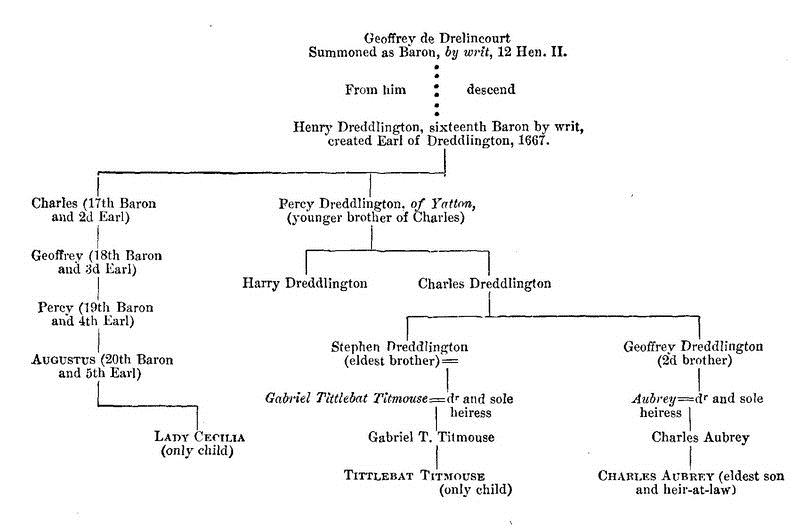
From this I think it will appear, that on the death of Augustus, fifth earl and twentieth baron, with no other issue than Lady Cecilia, the earldom being then extinct, the barony would descend upon the Lady Cecilia; and that, in the event of her dying without issue in the lifetime of her father, Tittlebat Titmouse would, on the earl's death without other lawful issue, become Lord Drelincourt, twenty-first in the barony! and in the event of her dying without issue, after her father's death, Tittlebat Titmouse would become the twenty-second Lord Drelincourt; one or other of which two splendid positions, but for the enterprising agency of Messrs. Quirk, Gammon, and Snap, would have been occupied by Charles Aubrey, Esq.;—on considering all which, one cannot but remember a saying of an ancient poet, who seems to have kept as keen an eye upon the unaccountable frolics of the goddess Fortune, as this history shows that I have. 'Tis a passage which any little schoolboy will translate to his mother or his sisters—
At the time of which I am writing, the Earl of Dreddlington was about sixty-seven years old; and he would have realized the idea of an incarnation of the sublimest PRIDE. He was of rather a slight make, and, though of a tolerably advanced age, stood as straight as an arrow. His hair was glossy, and white as snow: his features were of an aristocratic cast; their expression was severe and haughty; and I am compelled to say that there was scarce a trace of intellect perceptible in them. His manner and demeanor were cold, imperturbable, inaccessible; wherever he went—so to speak—he radiated cold. Comparative poverty had embittered his spirit, as his lofty birth and ancient descent had generated the pride I have spoken of. With what calm and supreme self-satisfaction did he look down upon all lower in the peerage than himself! And as for a newly-created peer, he looked at such a being with ineffable disdain. Among his few equals he was affable enough; and among his inferiors he exhibited an insupportable appearance of condescension—one which excited a wise man's smile of pity and contempt, and a fool's anger—both, however, equally nought to the Earl of Dreddlington!—If any one could have ventured upon a post mortem examination of so august a structure as the earl's carcass, his heart would probably have been found to be of the size of a pea, and his brain very soft and flabby; both, however, equal to the small occasions which, from time to time, called for the exercise of their functions. The former was occupied almost exclusively by two feelings—love of himself and of his daughter, (because upon her would descend his barony;) the latter exhibited its powers (supposing the brain to be the seat of the mind) in mastering the military details requisite for nominal soldiership; the game of whist; the routine of petty business in the House of Lords; and the etiquette of the court. One branch of useful knowledge by the way he had, however, completely mastered—that which is so ably condensed in Debrett; and he became a sort of oracle in such matters. As for his politics, he professed Whig principles—and was, indeed, a bitter though quiet partisan. In attendance to his senatorial duties, he practised an exemplary punctuality; was always to be found in the House at its sitting and rising; and never once, on any occasion, great or small, voted against his party. He had never been heard to speak in a full House; first, because he never could summon nerve enough for the purpose; secondly, because he never had anything to say; and lastly, lest he should compromise his dignity, and destroy the prestige of his position, by not speaking better than any one present. His services were not, however, entirely overlooked; for, on his party coming into office for a few weeks, (they knew it could be for no longer a time,) they made him Lord Steward of the Household; which was thenceforward an epoch to which he referred every event of his life, great and small. The great object of his ambition, ever since he had been of an age to form large and comprehensive views of action and conduct, to conceive superior designs, and to achieve distinction among mankind—was, to obtain a step in the peerage; for considering the antiquity of his family, and his ample, nay, superfluous pecuniary means—so much more than adequate to support his present double dignity of earl and baron—he thought it but a reasonable return for his eminent political services, to confer upon him the honor which he coveted. But his anxiety on this point had been recently increased a thousand-fold by one circumstance. A gentleman who held an honorable and lucrative official situation in the House of Lords, and who never had treated the Earl of Dreddlington with that profound obsequiousness which the earl conceived to be his due—but, on the contrary, had presumed to consider himself a man, and an Englishman, equally with the earl—had, a short time before, succeeded in establishing his title to an earldom which had long been dormant, and was, alas, of creation earlier than that of Dreddlington. The Earl of Dreddlington took this untoward circumstance so much to heart, that for some months afterwards he appeared to be in a decline; always experiencing a dreadful inward spasm whenever the Earl of Fitzwalter made his appearance in the House. For this sad state of things there was plainly but one remedy—a Marquisate—at which the earl gazed with the wistful eye of an old and feeble ape at a cocoa-nut, just above his reach, and which he beholds at length grasped and carried off by some nimbler and younger rival.
Among all the weighty cares and anxieties of this life, however, I must do the earl the justice to say, that he did not neglect the concerns of hereafter—the solemn realities of that Future revealed to us in the Scriptures. To his enlightened and comprehensive view of the state of things around him, it was evident that the Author of the world had decreed the existence of regular gradations of society. The following lines, quoted one night in the House by the leader of his party, had infinitely delighted the earl—
"Oh, where DEGREE is shaken,
Which is the ladder to all high designs,
The enterprise is sick!
Take but DEGREE away—untune that string,
And, hark! what discord follows! each thing meets,
In mere oppugnancy!"14
When the earl discovered that this was the production of Shakespeare he conceived a great respect for that writer, and purchased a copy of his works, and had them splendidly bound. They were fated never to be opened, however, except at that one place where the famous passage in question was to be found. How great was the honor thus conferred upon the plebeian poet, to stand amid a collection of royal and noble authors, to whose productions, and those in elucidation and praise of them, the earl's splendid-looking library had till then been confined!—Since, thought the earl, such is clearly the order of Providence in this world, why should it not be so in the next? He felt certain that then there would be found corresponding differences and degrees, in analogy to the differences and degrees existing upon earth; and with this view had read and endeavored to comprehend the first page or two of a very dry but learned book—Butler's Analogy—lent him by a deceased kinsman—a bishop. This consolatory conclusion of the earl's was greatly strengthened by a passage of Scripture, from which he had once heard the aforesaid bishop preach—"In my Father's house are MANY MANSIONS; if it had not been so, I would have told you." On grounds such as these, after much conversation with several old brother peers of his own rank, he and they—those wise and good men—came to the conclusion that there was no real ground for apprehending so grievous a misfortune as the huddling together hereafter of the great and small into one miscellaneous and ill-assorted assemblage; but that the rules of precedence, in all their strictness, as being founded in the nature of things, would meet with an exact observance, so that every one should be ultimately and eternally happy—in the company of his equals. The Earl of Dreddlington would have, in fact, as soon supposed, with the deluded Indian, that in his voyage to the next world—
"His faithful dog should bear him company;"
as that his Lordship should be doomed to participate the same regions of heaven with any of his domestics; unless, indeed, by some, in his view, not improbable dispensation, it should form an ingredient in their cup of happiness in the next world, there to perform those offices—or analogous ones—for their old masters, which they had performed upon earth. As the earl grew older, these just, and rational, and Scriptural views, became clearer, and his faith firmer. Indeed, it might be said that he was in a manner ripening for immortality—for which his noble and lofty nature, he secretly felt, was fitter, and more likely to be in its element, than it could possibly be in this dull, degraded, and confused world. He knew that there his sufferings in this inferior stage of existence would be richly recompensed,—for sufferings indeed he had, though secret, arising from the scanty means which had been allotted to him for the purpose of maintaining the exalted rank to which it had pleased God to call him. The long series of exquisite mortifications and pinching privations arising from this inadequacy of means, had, however, the earl doubted not, been designed by Providence as a trial of his constancy, and from which he would, in due time, issue like thrice-refined gold. Then also would doubtless be remembered in his favor the innumerable instances of his condescension in mingling, in the most open and courteous manner, with those who were unquestionably his inferiors, sacrificing his own feelings of lofty and fastidious exclusiveness, and endeavoring to advance the interests, and as far as influence and example went, polish and refine the manners of the lower orders of society. Such is an outline—alas, how faint and imperfect!—of the character of this great and good man, the Earl of Dreddlington. As for his domestic and family circumstances, he had been a widower for some fifteen years, his countess having brought him but one child, Lady Cecilia Philippa Leopoldina Plantagenet, who was, in almost all respects, the counterpart of her illustrious father. She resembled him not a little in feature, only that she partook of the plainness of her mother. Her complexion was delicately fair; but her features had no other expression than that of a languid hauteur. Her upper eyelids drooped as if she could hardly keep them open; the upper jaw projected considerably over the under one; and her front teeth were prominent and exposed. Frigid and inanimate, she seemed to take but little interest in anything on earth. In person, she was of average height, of slender and well-proportioned figure, and an erect and graceful carriage, only that she had a habit of throwing her head a little backward, which gave her a singularly disdainful appearance. She had reached her twenty-seventh year without having had an eligible offer of marriage, though she would be the possessor of a barony in her own right, and £5,000 a-year; a circumstance which, it may be believed, not a little embittered her. She inherited her father's pride in all its plenitude. You should have seen the haughty couple sitting silently side by side in the old-fashioned yellow family chariot, as they drove round the crowded park, returning the salutations of those they met in the slightest manner possible! A glimpse of them at such a moment would have given you a far more just and lively notion of their real character, than the most anxious and labored description of mine.
Ever since the first Earl of Dreddlington had, through a bitter pique conceived against his eldest son, the second earl, diverted the principal family revenues to the younger branch, leaving the title to be supported by only £5,000 a-year, there had been a complete estrangement between the elder and the younger—the titled and the moneyed—branches of the family. On Mr. Aubrey's attaining his majority, however, the present earl sanctioned overtures being made towards a reconciliation, being of opinion that Mr. Aubrey and Lady Cecilia might, by intermarriage, effect a happy reunion of family interests; an object, this, which had long lain nearer his heart than any other upon earth, till, in fact, it became a kind of passion. Actuated by such considerations, he had done more to conciliate Mr. Aubrey than he had ever done towards any one on earth. It was, however, in vain. Mr. Aubrey's first delinquency was an unqualified adoption of Tory principles. Now all the Dreddlingtons, from time whereof the memory of man runneth not to the contrary, had been firm unflinching Tories, till the distinguished father of the present earl quietly walked over, one day, to the other side of the House of Lords, completely fascinated by a bit of ribbon which the minister held up before him; and ere he had sat in that wonder-working region, the ministerial side of the House, twenty-four hours, he discovered that the true signification of Tory, was bigot—and of Whig, patriot; and he stuck to that version till it transformed him into a GOLD STICK, in which capacity he died; having repeatedly and solemnly impressed upon his son, the necessity and advantage of taking the same view of public affairs, that so he might arrive at similar results. And in the way in which he had been trained up, most religiously had gone the earl; and see the result: he, also, had attained to eminent and responsible office—to wit, that of Lord Steward of the Household. Now, things standing thus—how could the earl so compromise his principles, and indirectly injure his party, as by suffering his daughter to marry a Tory? Great grief and vexation of spirit did this matter, therefore, occasion to that excellent nobleman. But, secondly, Aubrey not only declined to marry his cousin, but clinched his refusal, and sealed his final exclusion from the dawning good opinion and affections of the earl, by marrying, as hath been seen, some one else—Miss St. Clair. Thenceforth there was a great gulf between the Earl of Dreddlington and the Aubreys. Whenever they happened to meet, the earl greeted him with an elaborate bow, and a petrifying smile; but for the last seven years not one syllable had passed between them. As for Mr. Aubrey, he had never been otherwise than amused at the eccentric airs of his magnificent kinsman.—Now, was it not a hard thing for the earl to bear—namely, the prospect there was that his barony and estates might devolve upon this same Aubrey, or his issue? for Lady Cecilia, alas! enjoyed but precarious health, and her chances of marrying seemed daily diminishing. This was a thorn in the poor earl's flesh; a source of constant worry to him, sleeping and waking; and proud as he was, and with such good reason, he would have gone down on his knees and prayed to Heaven to avert so direful a calamity—to see his daughter married—and with a prospect of perpetuating upon the earth the sublime race of the Dreddlingtons.
CHAPTER V
Rank is very apt to attract and dazzle vulgar and feeble optics; and the belief that such is its effect upon mankind generally, is unspeakably gratifying to a vain and ignorant possessor of that rank. Of the truth of one part of this observation, take as an illustration the case of Tittlebat Titmouse; of the other, that of the Earl of Dreddlington. The former's dinner engagement with the latter, his august and awful kinsman, was an event of such magnitude as to absorb almost all his faculties in the contemplation of it, and also occasion him great anxiety in preparing for an effective appearance upon so signal an occasion. Mr. Gammon had repeatedly, during the interval, instructed his anxious pupil, if so he might be called, as to the manner in which he ought to behave. He was—Heaven save the mark, poor Titmouse!—to assume an air of mingled deference, self-possession, and firmness; not, on the one hand, to be overawed by the greatness with which he would be brought into contact, nor, on the other, unduly elated by a sense of his own suddenly acquired importance. He was, on the contrary, to steer evenly between the extremes of timorousness and temerity—to aim, at least, at that happy mean, so grateful to those able to appreciate the effort, and object, of those who had attained to it. Titmouse was to remember that, great as was the Earl of Dreddlington, he was yet but a man—related, too, by consanguinity, to him, the aforesaid Titmouse; who might, moreover, before many years should have elapsed, become himself Lord Drelincourt, and by consequence equally entitled, with the present possessor of that resplendent rank, to the homage of mankind. At the same time that the earl's advanced years gave him a natural claim to the reverence of his young kinsman—(whom his Lordship was about to introduce into the sublime regions of aristocracy, and also of political society)—Titmouse might extract a few ingredients of consolation from the reflection, that his income probably exceeded, by a third, that of the Earl of Dreddlington. This is the sum of Mr. Gammon's general instructions to his eager and excited pupil; but he also gave Titmouse many minor hints and suggestions. He was to drink very little wine—(whereat Titmouse demurred somewhat vehemently, and asked "How the d—l he was to get his steam up without it?")—and on no account to call for beer or porter, to which plebeian beverages, indeed, he might consider himself as having bid a long and last adieu;—to say occasionally, only, "my Lord" and "your Lordship," in addressing the earl—and "your Ladyship," in addressing Lady Cecilia;—and, above all, never to appear in a hurry, but to do and say whatever he had to do and say calmly; for that the nerves of aristocracy were very delicate, and could not bear a bustle, or the slightest display of energy or feeling. Then, as to his dress—Gammon, feeling himself treading on very doubtful ground, intimated merely that the essence of true fashion was simplicity—but here Titmouse grew fidgety, and his Mentor ceased.
During the night which ushered in the eventful day on which Titmouse dined with the Earl of Dreddlington, our friend got but very little sleep. Early in the morning he engaged a most respectable glass-coach to convey him westward in the evening, in something like style; and before noon, his anxieties were set at rest by the punctual arrival of various articles of dress, decoration, and scent—for Titmouse had a great idea of scents. As for his new watch and its brilliant gold guard-chain—ambitious reader! you should have seen them! About half-past four o'clock Titmouse retired to his bedroom, and resigned himself into the hands of Mr. Twirl, the tip-top hairdresser from the Strand, whose agreeable manipulations, and still more agreeable small-talk, occupied upwards of an hour; Titmouse, from time to time, giving the anxious operator abundant notice of the high quarter in which his handiwork was likely soon to be scrutinized.
"Pray-a, can you tell me," quoth Titmouse, drawlingly, shortly after Twirl had commenced his operations, "how long it will take me to get from this infernal part of the town to Grosvenor Square? Dem long way, isn't it, Mr. What's-your-name?"
"Grosvenor Square, sir?" said Twirl, glibly, but with a perceptible dash of deference in his tone; "why it is as one might say a tolerable way off, certainly; but you can't well miss your way there, sir, of all places in town"–
"My coachman," interrupted Titmouse, with a fine air, "of course, had I thought of it, he must know, dem him, of course!"
"Oh! to be sure, sir. There's none but people of the most highest rank lives in that quarter, sir. Excuse me, sir, but I've a brother-in-law that's valet to the Duke of Dunderwhistle there"–
"Indeed! How far off is that from Lord Dreddlington's?" inquired Titmouse, carelessly.
"Lord Dreddlington's, sir?—Well, I never! Isn't it particular strange, if that's where you're going, sir—it's next door to the Duke's—the very next door, sir!"
"'Pon my life, is it indeed? How devilish odd!"
"Know the Earl of Dreddlington then, I presume, sir?"
"Ya-as, I should think so; he's my—my—relation, that's all; and devilish near too!"
Mr. Twirl instantly conceived a kind of reverence for the gentleman upon whom he was operating.
"Well, sir," he presently added in a still more respectful tone than before, "p'r'aps you'll think it a liberty, sir; but, do you know, I've several times had the honor of seeing his Lordship in the street at a little distance—and there's a—a family likeness between you, sir—'pon my word, sir. It struck me, directly I saw you, that you was like some nob I'd seen at the other end of the town." [Here Titmouse experienced pleasurable sensations, similar to those said to be enjoyed by a cat when you pass your hand down its glossy coat in the right direction.] "Will you allow me, sir, to give your hair a good brushing, sir, before I dress it? I always like to take the greatest pains with the hair of my quality customers!—Do you know, sir, that I had the honor of dressing his Grace's hair for a whole fortnight together, once when my brother-in-law was ill; and though p'r'aps I oughtn't to say it, his Grace expressed the highest satisfaction at my exertions, sir."
"'Pon my life, and I should say you were an uncommon good hand—I've known lots worse, I assure you; men that would have spoiled the best head of hair going, by Jove!"
"Sir, you're very kind. I assure you, sir, that to do justice to a gent's hair requires an uncommon deal of practice, and a sort of nat'ral talent for it besides. Lord, sir! how much depends on a gent's hair, don't it? Of two coming into a room, it makes all the difference, sir! Believe me, sir, it's no use being well-dressed, nay, nor good-looking, if as how the hair a'n't done—what I call—correct!"
"By Jove, I really think you're nigh about the mark," said Titmouse; and after a pause, during which Mr. Twirl had been brushing away at one particular part of the head with some vehemence, "Well," he exclaimed with a sigh, ceasing for a moment his vigorous exertions—"I'm blest if I can manage it, do what I will!"
"Eh? What's that? What is it?" inquired Titmouse, a little alarmedly.
"Why, sir, it's what we gents, in our profession, calls a feather, which is the most hobstinatest thing in nature."
"What's a feather?" quoth Titmouse, rather faintly.
"You see, sir, 'tis when a small lot of hair on a gent's head will stick up, do all we can to try and get it down; and (excuse me, sir,) you've got a regular rattler!" Titmouse put up his hand to feel, Twirl guiding it to the fatal spot; there it was, just as Twirl had described it.
"What's to be done?" murmured Titmouse.
"I'm afraid, sir, you don't use our OSTRICH GREASE and RHINOCEROS MARROW, sir."
"Your what?" cried Titmouse, apprehensively, with a dismally distinct recollection of the tragedy of the Cyanochaitanthropopoion, and the Damascus Cream, and the Tetaragmenon Abracadabra; matters which he at once mentioned to Mr. Twirl.
"Ah, it's not my custom, sir," quoth Twirl, "to run down other gents' inventions; but my real opinion is, that they're all an imposition—a rank imposition, sir. I didn't like to say it, sir; but I soon saw there had been somebody a-practising on your hair."
"What, is it very plain?" cried Titmouse, with a kind of horror, starting up and stepping to the glass.
"No, sir—not so very plain; only you've got, as I might say, accustomed to the sight of it; but when it's properly curled, and puckered up, and frizzed about, it won't show—nor the feather neither, sir; so, by your leave, here goes, sir;" and, after about a quarter of an hour's more labor, he succeeded in parting it right down the middle of the head, bringing it out into a bold curl towards each eyebrow, and giving our friend quite a new and very fascinating appearance, even in his own eyes. And as for the color—it really was not so very marked, after all; a little purple-hued and mottled, to be sure, in parts, but not to a degree to attract the eye of a casual observer. Twirl having declared, at length, his labors completed—regarding Titmouse's head with a look of proud satisfaction—Titmouse paid him half a crown, and also ordered a pot of ostrich grease and of rhinoceros marrow, (the one being suet, the other lard, differently scented and colored,) and was soon left at liberty to proceed with the important duties of the toilet. It took him a good while; but in the end he was supremely successful. He wore black tights, (i. e. pantaloons fitting closely to his legs, and tied round his ankles with black ribbons,) silk stockings, and shoes with glittering silver buckles. His white neckerchief was tied with great elegance, not a superfluous wrinkle being visible in it. His shirt-front of lace, had two handsome diamond pins, connected together by a little delicate gold chain, glistening in the midst of it. Then he had a white waistcoat edge, next a crimson one, and lastly a glorious sky-blue satin waistcoat, spangled all over with gold flowers inwrought—and across it hung his new gold watch-guard, and his silver guard for his eyeglass, producing an inconceivably fine effect. His coat was of a light brown, of exquisite cut, fitting him as closely as if he had been born in it, and with burnished brass buttons, of sugar-loaf shape. 'Twas padded also with great judgment, and really took off more of his round-shouldered awkwardness of figure than any coat he had ever worn before. Then he had a fine white pocket-handkerchief, soaked in lavender water; and immaculate white kid gloves. Thus habited, he stood before his glass, bowing fifty different times, and adjusting his expression to various elegant forms of address. He was particularly struck with the combined effect of the two curls of his hair towards each eye, and the hair underneath his chin curved upwards on each side of his mouth in complete symmetry. I have ascertained from Mr. Titmouse himself, that on this memorable occasion of his first introduction to NOBILITY, every item of dress and decoration was entirely new; and when at length his labors had been completed, he felt great composure of mind, and a consciousness of the decisive effect which he must needs produce upon those into whose presence he was so soon to be ushered. His "carriage" was presently announced; and after keeping it standing for a few minutes, (which he conceived to be usual with fine people,) he gently placed his hat upon his head; drew on one glove, took his little ebony cane in his hand; and, with a hurried inward prayer that he might be equal to the occasion, stepped forth from his apartment and passed on to the glass-coach. Such a brilliant little figure, I will take upon myself to say, had never before issued, nor will perhaps ever again issue, from the Cabbage-Stalk Hotel. The waiters whom he passed, inclined towards him with instinctive reverence. He was very fine, to be sure; but who could, they justly thought, be dressed too finely that had ten thousand a-year, and was gone to dine with a lord in Grosvenor Square?
Titmouse was soon on his way towards that at once desired and dreaded region. He gazed with a look of occasional pity and contempt, as he passed along, at the plebeian pedestrians, and the lines of shops on each side of the narrow streets, till increasing indications of superior modes of existence presented themselves; and then he began to feel not a little fidgety and nervous. The streets grew wider; the squares greater; hackney-coaches (unsightly objects!) became fewer and fewer, giving place to splendid vehicles—coaches, and chariots—with one, two, and even three footmen, in elegant liveries, clustering behind, with long canes, cockades, and shoulder-knots; crimson, blue, green, bear and tiger skin hammercloths, with burnished coronets and crests upon them; sleek coachmen with wigs and three-cornered hats, and horses that pawed the ground with very pride; ladies within, glistening in satin, lace, and jewels—their lords beside them, leaning back with countenances so stern and haughty; oh, by all that was grand and tremendous! Titmouse felt himself getting now within the very vortex of greatness and fashion, and experienced a frequent fluttering and catching of the breath, and a sense of indefinite distressing apprehension. He was, however, now in for it—and there was no retreat. As he neared Grosvenor Square, he heard, ever and anon, terrific thundering noises at the doors opposite which these splendid vehicles had drawn up—as if the impatient footmen were infuriated because the doors did not fly open of themselves, at the sound of the approaching carriage-wheels. At length he entered Grosvenor Square, that "pure empyrean" of earthly greatness. Carriages rolled calmly and haughtily past him, others dashed desperately in different directions. At each side of Lord Dreddlington's house, were carriages setting down with tremendous uproar. Mr. Titmouse felt his color going, and his heart began to beat much faster than usual. 'Twas quite in vain that he "hemmed" two or three times, by way of trying to reassure himself: he felt that his hour was come; and would have been glad, at the moment, of any decent excuse for driving off home again, and putting off the evil day a little longer. Opposite the dreaded door had now drawn up Mr. Titmouse's glass-coach; and the decent coachman—whose well-worn hat, and long, clean, but threadbare blue coat, and ancient-looking top-boots, bespoke their wearer's thriftiness—slowly alighting, threw the reins on his quiet horses' backs, and gave a modest rat-tat-tat-tat-tat at the door without ringing.
"What name shall I give, sir?" said he, returning to his coach, and letting down the loud clanking steps, with such a noise as seemed to indicate his desire to show the solid metal structure of them!
"Titmouse—Mr. Titmouse;" replied our friend, hurriedly, as the lofty door was thrown open by the corpulent porter; disclosing several footmen in light blue liveries, with silver shoulder-knots, and powdered heads, standing in the hall waiting for him.
"Mr. Titmouse!" exclaimed the coachman to the servants: then, having returned to the coach—"When shall I come back for you, sir?" he inquired of his flustered fare.
"D— me, sir—don't bother me," faltered Titmouse, quitting the vehicle with great trepidation: and the next moment he was in the hands of the Philistines—the hall door was closed upon him. All his presence of mind had evaporated; the excellent lessons given him by Mr. Gammon had disappeared like breath from the surface of a mirror. Though Lord Dreddlington's servants had never before seen in the house so strange an object as poor little Titmouse, they were of far too highly polished manners to appear to notice anything unusual. They silently motioned him up-stairs with a bland courteous air, he carrying his little agate-headed cane in one hand, and his new hat in the other. A gentlemanly person in a full black dress suit, opened the drawing-room door for him, with an elegant inclination, which Titmouse very gracefully returned. A faint mist seemed to be in the drawing-room for a second or two, during which Titmouse heard his name gently whispered by the gentleman who had introduced him; quickly clearing away, however, he beheld, at the upper end, but two figures, that of an old gentleman, and a young lady—they were, in fact, the Earl of Dreddlington and Lady Cecilia. Now—if truth must be told—that great man had not been a whit behindhand, in the matter of dress, with the little creature now trembling before him; being, in truth, full as anxious to make an effective first appearance in the eyes of Mr. Titmouse, as he in those of the Earl of Dreddlington. And each had, in his way, completely succeeded. There was little or no substantial difference between them. The Right Honorable the Earl of Dreddlington was an old experienced fool, and Tittlebat Titmouse a young inexperienced one. They were the same species of plant, but had grown in different soils. The one had had to struggle through a neglected existence by the dusty, hard road-side of life; the other had had all the advantage of hothouse cultivation—its roots striking deep into, and thriving upon, the rich manure of sycophancy and adulation!—We have seen how anxious was our little friend to appear as became the occasion, before his great kinsman; who in his turn had several times during the day exulted secretly in the anticipation of the impression which must be produced upon the mind of Titmouse by the sudden display, in the earl's person, of the sublimest distinctions which society can bestow, short of royalty. It had once or twice occurred to the earl, whether he could find any fair excuse for appearing in his full general's uniform; but on maturer reflection, governed by that simplicity and severity of taste which ever distinguished him, he had abandoned that idea, and appeared in a plain blue coat, white waistcoat, and black knee-breeches. But on his left breast glittered one or two foreign orders, and across his waistcoat was the broad red ribbon of the Bath. His hair was white and fine; his cold blue eye and haughty lip gave him an expression of severe dignity: and he stood erect as an arrow. Lady Cecilia reclined on the sofa, with an air of languor and ennui which had become habitual to her; and was dressed in glistening white satin, with a necklace of large and very beautiful pearls. The earl was standing in an attitude of easy grace to receive his guest, as to whose personal appearance, by the way, he was quite in the dark—Mr. Titmouse might be a great or a little man, and forward or bashful; and require a corresponding demeanor and address on the part of the earl. "Gracious Powers!" he involuntarily exclaimed to himself, the instant his eye caught sight of Titmouse, who approached slowly, making profound and formal obeisances. The earl stood rooted to the spot which he had occupied when Titmouse entered. If his servants had turned an ape into the drawing-room, his Lordship could scarcely have felt or exhibited greater amazement than he now experienced, for a moment. "Ah, Heavens!" thought he, "what a fool have we here? what creature is this?" Then it flashed across his mind;—"May this be the future Lord Drelincourt?" He was on the point of recoiling from his suddenly-discovered kinsman in dismay, (as for Lady Cecilia, she gazed at him, through her glass, in silent horror, after a faint exclamation, on his first becoming visible, of "Gracious! Papa!") when his habitual self-command came to his assistance; and, advancing very slowly a step or two towards Titmouse—who, after a hurried glance around him, saw no place to deposit his hat and cane upon except the floor, on which he accordingly dropped them—the earl extended his hand, slightly compressed the tips of Titmouse's fingers, and bowed courteously, but with infinite concern in his features.
"I am happy, Mr. Titmouse, to make your acquaintance," said the earl, slowly—"Sir, I have the honor to present you to my daughter, the Lady Cecilia." Titmouse, who by this time had got into a sort of cold sweat—a condition from which the earl was really not very far removed—made a very profound and formal bow, (he had been taking lessons from a posture-master to one of the theatres,) first to the earl, and then to Lady Cecilia, who rose about two inches from the sofa, with an almost audible sigh, and then sank again upon it, without removing her eyes from the figure of Titmouse, who went on bowing, first to the one and then to the other, till the earl had engaged him in conversation.
"It gives me pleasure, sir, to see that you are punctual in your engagements. I am so too, sir; and owe to it no small portion of any success which I may have had in life. Punctuality, sir, in small matters, leads to punctuality in great matters." This was said very deliberately, and with a sort of freezing grandeur.
"Oh yes, my Lord! quite so, your Lordship," stammered Titmouse, suddenly recollecting a part of Gammon's instructions; "to be sure—wouldn't have been behind time, your Lordship, for a minute, my Lord; uncommon bad manners, if it please your Lordship"–
"Will you be seated, sir?" interrupted the earl, dignifiedly motioning him to a chair, and then sitting down beside him; after which his Lordship seemed, for a second or two, to forget himself; staring in silence at Titmouse, and then in consternation at Lady Cecilia. "I—I—" said he, suddenly recollecting himself, "beg your par—sir, I mean—I congratulate you upon—your recent success. Sir, it must have been rather a surprise to you?"
"Oh yes, sir—my Lord, most uncommon, may it please your Lordship—particular—but right is right—please your Lordship"–
["Oh Heavens! merciful Heavens! How horrid is all this! Am I awake or only dreaming? 'Tis an idiot—and what's worse, a vulgar idiot! And this thing may become Lord Drelincourt!" This was what was passing through Lord Dreddlington's mind, while his troubled eye was fixed upon Titmouse.]
"It is, indeed, Mr. Titmouse," replied his Lordship, "very true, sir; what you say is correct. Quite so; exactly." His eye was fixed on Titmouse, but his words were uttered, as it were, mechanically, and in a musing manner. It flitted for a moment across his mind, whether he should ring the bell, and order the servant to show out of the house the fearful imp which had just been shown into it; but at that critical moment he detected poor Titmouse's eye fixed with a kind of reverent intensity upon his Lordship's glittering orders. 'Twas a lucky look, that, for Titmouse, since it began to melt away the ice which was beginning to incrust the little heart of his august relative. 'Twas evident that the poor young man had not been accustomed to society, thought the earl, with an approach towards the compassionate mood. He was frightfully dressed, to be sure; and as for his speech, he was manifestly overawed by the Presence in which he found himself; [that thought melted a little more of the ice.] Yet, was it not evident that he had some latent power of appreciating real distinction, when he beheld it? [his Lordship's little heart here lost all the ice which had begun so suddenly to collect round it.] And again;—he has actually thrust out the intolerable Aubrey, and is now lawful owner of Yatton—of TEN THOUSAND A-YEAR–
"Did you see the review, to-day, sir?" inquired the earl, rather blandly—"His Majesty was there, sir, and seemed to enjoy the scene." Titmouse, with a timid air, said that he had not seen it, as he had been at a boatrace upon the river; and after a few more general observations—"Will you permit me, sir? It is from A QUARTER requiring the highest—a-hem!" said the earl, as a note was brought him, which he immediately opened and read. Lady Cecilia, also, appearing to be reading, Titmouse had a moment's breathing time and interval of relief. What would he have given, he thought, for some other person, or several persons, to come in and divide the attention—the intolerably oppressive attention of the two august individuals then before him! He seized the opportunity to cast a furtive glance around the room. It opened into a second, which opened into a third: how spacious, each, and lofty! And glittering glass chandeliers in each! What chimney and pier glasses! What rich flowered satin curtains—they must have cost twelve or fourteen shillings a-yard at least!—The carpets, of the finest Brussels—and they felt like velvet to the feet;—then the brackets, of marble and gold, with snowy statues and vases glistening upon each; chairs so delicate, and gilded all over—he almost feared to sit down on them. What would the Quirks and Tag-rags think of this! Faugh—only to think for a moment of Alibi House and Satin Lodge!—Then there was the Lady Cecilia—a lady of high rank! How rich her dress—and how haughtily beautiful she looked as she reclined upon the sofa! [she was in fact busy conning over the new opera, which was to come out the next evening.] And the Earl of Dreddlington—there he was, reading, doubtless, some letter from the king or one of the royal family—a man of great rank—resplendent in his decorations—all just according to what he had seen in pictures, and heard and read of—what must that red ribbon have cost? Ay, indeed, poor Lord Dreddlington, it had cost you the labor of half a life of steadfast sycophancy, of watchful manœuvring, and desperate exertion! And at last, the minister tossed it to you in a moment of disgust and despair—mortally perplexed by the conflicting claims of two sulky dukes and a querulous old marquis, each of whom threatened to withdraw his "influence and support," if his rival's claims were preferred! He had never seen any of such a breadth.—It must have been manufactured on purpose for the earl! How white were his hands! And he had an antique massive signet-ring on his forefinger, and two glittering rings at least on each of his little fingers—positively Titmouse at length began to regard him almost as a god:—and yet the amazing thought occurred that this august being was allied to him by the ties of relationship! Such were the thoughts and reflections passing through the mind of Titmouse, during the time that Lord Dreddlington was engaged in reading his letter—and afterwards during the brief intervals which elapsed between the various observations addressed to him by his Lordship.
The gentleman in black at length entered the room, and advancing slowly and noiselessly towards the earl, said in a gentlemanlike manner, "Dinner, my Lord;" and retired. Into what new scenes of splendid embarrassment was this the signal for Mr. Titmouse's introduction? thought our friend, and trembled.
"Mr. Titmouse, will you give your arm to the Lady Cecilia?" said the earl, motioning him to the sofa. Up jumped Titmouse, and approached hastily the recumbent beauty; who languidly arose, arranged her train with one hand, and with the other, having drawn on her glove, just barely touched the proffered arm of Titmouse, extended towards her at a very acute angle, and at right angles with his own body—stammering, "Honor to take your Ladyship—uncommon proud—this way, my Lady." Lady Cecilia took no more notice of him than if he had been a dumb waiter; walking beside him in silence—the earl following. To think that a nobleman of high rank was walking behind him!
Would to heaven, thought the embarrassed Titmouse, that he had two fronts, one for the earl behind, and the other to be turned full towards Lady Cecilia! The tall servants, powdered and in light blue liveries, stood like a guard of honor around the dining-room door. That room was extensive and lofty: what a solitary sort of state were they about to dine in! Titmouse felt cold, though it was summer; and trembled as he followed, rather than led, his haughty partner to her seat; and then was motioned into his own by the earl, himself sitting down opposite an antique silver soup tureen! A servant stood behind Lady Cecilia; another behind Titmouse; and a third on the left of the earl; while on his right, between his Lordship and the glistening sideboard, stood a portly gentleman in black, with a bald head and—Titmouse thought—a somewhat haughty countenance. Though Titmouse had touched nothing since breakfast, he felt not the slightest inclination to eat, and would have given the world to have dared to say as much, and be at once relieved from a vast deal of anxiety. Is it indeed easy to conceive of a fellow-creature in a state of more complete thraldom, at that moment, than poor little Titmouse? A little animal under the suddenly exhausted receiver of an air-pump, or a fish just plucked out of its own element, and flung gasping and struggling upon the grass, may serve to assist your conceptions of the position and sufferings of Mr. Titmouse. The earl, who was on the look-out for it, observed his condition with secret but complete satisfaction; here he beheld the legitimate effect of rank and state upon the human mind. Titmouse got through the soup—of which about half a dozen spoonfuls only were put into his plate—pretty fairly. Anywhere else than at Lord Dreddlington's, Titmouse would have thought it poor, thin, watery stuff, with a few green things chopped up and swimming in it; but now he perceived that it had a sort of superior flavor. How some red mullet, enclosed in paper, puzzled poor Titmouse, is best known to himself.
"The Lady Cecilia will take wine with you, Mr. Titmouse, I dare say, by-and-by," observed the earl, blandly; and in a moment's time, but with perfect deliberation, the servants poured wine into the two glasses. "Your Ladyship's health, my Lady"—faltered Titmouse. She slightly bowed, and a faint smile glimmered at the corners of her mouth—but unobserved by Titmouse.
"I think you said, Mr. Titmouse," quoth the earl, some time afterwards, "that you had not yet taken possession of Yatton?"
Titmouse soon got pretty communicative with Miss Macspleuchan, and told her about the Tag-rags, Miss Tag-rag, and Miss Quirk, both of whom were absolutely dying of love for him, and thought he was in love with them, which was not the case—far from it. Then he hinted something about a most particular uncommon lovely gal that had his heart, and he hoped to have hers, as soon as he had got all to rights at Yatton. Then he described the splendid style in which he was going down to take possession of his estates. Having finished this, he told her that he had been the morning before to see a man hanged for murdering his wife; that he had been into the condemned cell, and then into the press-room, and had seen his hands and arms tied, and shaken hands with him; and he was going into such a sickening minuteness of detail, that to avoid it Miss Macspleuchan, who felt both shocked and disgusted, suddenly asked him if he was fond of heraldry; and rising from the sofa, she went into the second room, where, on an elegant and antique stand, lay a huge roll of parchment, on a gilded stick, splendidly mounted and most superbly illuminated,—it was about three-quarters of a yard in breadth, and some ten or twenty feet in length. This was the Pedigree of the Dreddlingtons. She was giving him an account of Simon de Drelincourt, an early ancestor of the earl's, who had come over with William the Conqueror, and performed stupendous feats of valor at the battle of Hastings, Titmouse listening in open-mouthed awe, and almost trembling to think that he had broken a valuable dish belonging to a nobleman who had such wonderful ancestors; not, at the moment, adverting to the circumstance that he was himself descended from the very same ancestors, and had as rich blood in him as the earl and Lady Cecilia—when a servant entered and informed him in a whisper that "his carriage had arrived." He considered that etiquette required him to depart immediately.
"Beg your pardon; but if ever you should come down to my estate in the country, shall be most uncommon proud to see your Ladyship."
"I beg your pardon; you are mistaken, sir," interrupted Miss Macspleuchan, hastily, and blushing scarlet; the fact being that Titmouse had not caught her name on its having been once or twice pronounced by Lady Cecilia; and very naturally concluded that she also must be a lady of rank. Titmouse was, however, so occupied with his efforts to make a graceful exit, that he did not catch the explanation of his mistake; and, bowing almost down to the ground, reached the landing, where the tall servant, with a very easy grace, gave him his hat and cane, and preceded him down-stairs. As he descended, he felt in his pockets for some loose silver, and gave several shillings between the servants who stood in the hall to witness his departure; after which, one of them having opened the door and gently let down the steps of the glass-coach, Titmouse popped into it.
"Home, sir?" inquired the servant, as he closed the door.
"The Cabbage-Stalk Hotel, Covent Garden," replied Titmouse, with an affected drawl.
His answer was communicated to the coachman, who thereupon addressed a sharp argument to the brace of meek and skinny horses, standing with downcast heads before him—which they lifted up—then they got into motion—and away rumbled the glass-coach. As soon as its distinguished inmate had become calm enough to reflect upon the events of the evening, he came to the conclusion that the Earl of Dreddlington was a very great man indeed; the Lady Cecilia very beautiful, but rather proud; and Miss Macspleuchan (Lady Somebody, as he supposed) one of the most interesting ladies whom he had ever met with; that there was something uncommon pleasing about her: in short, he felt a sort of grateful attachment towards her; but how long it would have lasted after his hearing that she was only a plain miss, and a poor relation, I leave the acute reader to conjecture.
CHAPTER VI
Mr. Gammon was with Titmouse about half-past nine o'clock the next morning, not a little anxious to hear how that young gentleman had got on over-night; but met with a totally different reception from any that he had before experienced.
He imagined for a few minutes that Lord Dreddlington had been pumping Titmouse; had learned from him his position with respect to Gammon, in particular; and had injected distrust and suspicion into the mind of Titmouse, concerning him. But Gammon, with all his acuteness, was quite mistaken. The truth was, 'twas only an attempt on the part of poor Titmouse to assume the composed demeanor, the languid elegance, which he had observed in the distinguished personages with whom he had spent the preceding evening, and which had made a very deep impression on his little mind. He drawled out his words, looked as if he were half asleep, and continually addressed Gammon as "Sir," and "Mr. Gammon," just as the Earl of Dreddlington had constantly addressed him—Titmouse. Our friend was sitting at breakfast, on the present occasion, in a most gaudy dressing-gown, and with the newspaper before him; in short, his personal appearance and manner were totally different from what Gammon had ever previously witnessed; and he looked now and then at Titmouse, as if for a moment doubting his identity. Whether or not he was now on the point of throwing overboard those who had piloted him from amid the shoals of poverty into the open sea of affluence, shone upon by the vivid sunlight of rank and distinction, Gammon did not know; but he contracted his brow, and assumed a certain sternness and peremptoriness of tone and bearing, which were not long in reducing Titmouse to his proper dimensions; and when at length Mr. Gammon entered upon the delightful subject of the morrow's expedition, telling him that he, Gammon, had now nearly completed all the preparations for going down to, and taking possession of Yatton in a style of suitable splendor, according to the wish of Titmouse—this quickly melted away the thin coating of mannerism, and Titmouse was "himself again." He immediately gave Mr. Gammon a full account of what had happened at Lord Dreddlington's, and, I fear, of a great deal more, which might, possibly, have happened, but certainly had not, e. g. his Lordship's special laudation of Mr. Gammon as a "monstrous fine lawyer," which Titmouse swore were the very exact words of his Lordship, who "would have been most happy to see Mr. Gammon," and a good deal to the like effect. Also that he—Titmouse—had been "most uncommon thick" with "Lady Cicely," (so he pronounced her name;) and that both she and Lord Dreddlington had "pressed him very hard to go with them to a ball at a duke's!" He made no mention of the broken trifle-dish; said they had nearly a dozen servants to wait on them, and that there were twenty different sorts of wine, and no end of courses, at dinner. That the earl wore a star, and garter, and ribbons—which Gammon erroneously thought as apocryphal as the rest; and had told him that he—Titmouse—might one day wear them, and sit in the House of Lords; and had, moreover, advised him most strenuously to get into Parliament as soon as possible, as the "cause of the people wanted strengthening." [As Lord Coke, somewhere says, in speaking of a spurious portion of the text of Lyttleton, "that arrow came never out of Lyttleton's quiver"—so Gammon instantly perceived that the last sentence came never out of Titmouse's own head, but came plainly marked as that of a wise and able man and statesman.]
As soon as Titmouse had finished his little romance, Gammon proceeded to the chief object of his visit—their next day's journey. He said that he much regretted to inform Titmouse that Mr. Snap had expressed a very anxious wish to witness the triumph of Mr. Titmouse; and that unless he had some particular objection—"Oh none, 'pon honor!—poor Snap!—devilish good chap in a small way!" said Titmouse, in a most condescending manner, and at once gave his consent—Gammon informing him that Mr. Snap would be obliged to return to town by the next day's coach. The reader will smile when I tell him, and if a lady, will frown when she hears, that Miss Quirk was to be of the party—a point which her anxious father had secured some time before. Mrs. Alias had declared that she saw no objection, as Mr. Quirk would be constantly with his daughter, and Gammon had appeared most ready to bring about so desirable a result. He had also striven hard, unknown to his partners, to increase their numbers, by the Tag-rags, who might have gone down, all three of them, if they had chosen, by coach, and so have returned. Gammon conceived that this step might not have been unattended with advantage in several ways; and would, moreover, have secured him a considerable source of amusement. Titmouse, however, would not listen to the thing for one moment, and Gammon was forced to give up his little scheme. Two dashing young fellows, fashionable friends of Titmouse, (who had picked them up, Heaven only knows where, but they never deserted him,) infinitely to Gammon's annoyance, were to be of the party. He had seen them but once, when he had accompanied Titmouse to the play, where they soon joined him. One was a truly disgusting-looking fellow—a Mr. Pimp Yahoo—a man about five-and-thirty years old, tall, with a profusion of black hair parted down the middle of his head, and falling down in long clustering curls from each temple upon his coat-collar. His whiskers also were ample, and covered two-thirds of his face, and spread in disgusting amplitude round his throat. He had also a jet-black tuft—an imperial—depending from his underlip. He had an execrable eye—full of insolence and sensuality; in short, his whole countenance bespoke the thorough debauchee and ruffian. He had been, he said, in the army; and was nearly connected, according to his own account—as with fellows of this description is generally the case—with "some of the first families in the North!" He was now a man of pleasure about town—which contained not a better billiard-player, as the admiring Titmouse had had several painful opportunities of judging. He was a great patron of the ring—knowing all their secrets—all their haunts. He always had plenty of the money of other people, and drove about in a most elegant cab, in which Titmouse had often had a seat; and as soon as Mr. Yahoo had extracted from his communicative little companion all about himself, that astute gentleman made it his business to conciliate Titmouse's good graces by all the arts of which he was master—and he succeeded. The other chosen companion of our friend was Mr. Algernon Fitz-Snooks; a complete fool. He was the sole child of a rich tradesman—who had christened him by the sounding name given above; and afterwards added the patrician prefix to the surname, which also you see above, in order to gratify his wife and son. The youth had never "taken to business"—but was allowed to saunter about, doing, and knowing, nothing, till about his twenty-second year, when his mother died, as also a year afterwards did his father, bequeathing to his hopeful son some fifty thousand pounds—absolutely and uncontrolledly. Mr. Algernon Fitz-Snooks very judiciously thought that youth was the time to enjoy life; and before he had reached his thirtieth year, he had got through all his fortune except about five or six thousand pounds—in return for which, he had certainly got something; viz. an impaired constitution and a little experience, which might, possibly, at some future time, be useful. He had a pleasing face, regular features, and interesting eyes; his light hair curled "deliciously;" and he spoke in a sort of lisp and in a low tone—and, in point of dress, always "turned out" beautifully. He, also, had a cab, and was a great friend of Mr. Yahoo, who had introduced him into a great deal of high society, principally in St. James's Street; where both he and Mr. Yahoo had passed a great deal of their time, especially during the night! There was no intentional mischief in poor Fitz-Snooks: nature had made him only a fool—his prudent parents had done the rest; and if he fell into vice, it was only because—as people say—"he couldn't help it." Such were the chosen companions of Titmouse; the one a fool, the other a rogue—and "he must," he said, "have them down to the jollifying at Yatton." A groom and a valet—both impudent knaves, and both newly hired the day before—would complete the party of the morrow. Gammon assured Titmouse that he had taken all the pains in the world to get up a triumphant entry into Yatton; his agents at Grilston, Messrs. Bloodsuck and Son—the Radical electioneering attorneys of the county—who were well versed in the matter of processions, bands, flags, &c. &c. &c., had by that time arranged everything, and they were to be met, when within a mile of Yatton, by a grand procession. The people at the Hall, also, were under orders from Mr. Gammon, through Messrs. Bloodsuck and Son, to have all in readiness—and a banquet prepared for nearly a hundred persons—in fact, all comers were to be welcome. To all this Titmouse listened with eyes glistening, and ears tingling with rapture; but can any tongue describe his emotion, on being apprised that the sum of £2,500, in the banker's hands, was now at his disposal—that it would be doubled in a few weeks—and that a check for £500, drawn by Mr. Titmouse on the London agents of the Grilston bankers, had been honored on the preceding afternoon? Titmouse's heart beat fast, and he felt as if he could have worshipped Gammon. As for the matter of carriages, Mr. Gammon said, that probably Mr. Titmouse would call that morning on Mr. Axle, in Long Acre, and select one to his mind—it must of course be one with two seats—and Mr. Gammon had pointed out several which were, he thought, eligible, and would be shown to Mr. Titmouse. That would be the carriage in which—he presumed—Mr. Titmouse himself would travel; the second, Mr. Gammon had taken the liberty of already selecting. With this, Mr. Gammon (just as the new valet brought in no fewer than a dozen boxes of cigars ordered over-night by Titmouse) shook his hand and departed, saying that he should make his appearance at the Cabbage-Stalk the next morning, precisely at eleven o'clock—about which time it was arranged they were all to start. Titmouse hardly knew how to contain himself, on being left alone. About an hour afterwards, he made his appearance at Mr. Axle's: who, worthy and indefatigable man, carried on two businesses, one public, i. e. that of a coach-builder—one private, i. e. that of a money-lender. He was a rich man—a very obliging and "accommodating" person, by means of which latter quality he had amassed a fortune of, it was believed, a hundred thousand pounds. He never made a fuss about selling on credit—or lending, taking back, or exchanging, carriages of all descriptions; nor in discounting the bills of his customers, to any amount. He proved generally right, in each case, in the long rim. He would supply his fashionable victim with as splendid a chariot, and funds to keep it some time going, as he or she could desire; well knowing that in due time, after they should have taken a few turns in it about the parks, and a few streets and squares in the neighborhood, it would quietly drive up to one or two huge dingy fabrics in a different part of the town, where it would deposit its burden, and then return to its maker very little the worse for wear; who took it back at about a twentieth part of its cost, and soon again disposed of it in a way equally advantageous to himself. Mr. Axle showed Mr. Titmouse very obsequiously over his premises, pointing out (as soon as he knew who his visitor was,) the carriages which Mr. Gammon had the day before desired should be shown to him; and which Mr. Titmouse, with his glass stuck in his eye—where it was kept by the pure force of muscular contraction—examined with something like the air of a connoisseur—occasionally rapping with his agate-headed cane—now against his teeth, then against his legs. He did not seem perfectly satisfied with any of them; they looked—he said—"devilish plain and dull."
"Hollo—Mr. Axletree, or whatever your name is—what have we here? 'Pon my soul, the very thing!"—he exclaimed, as his eye caught a splendid object—the state-carriage of the ex-sheriff, with its gorgeously decorated panels: which, having been vamped up for some six or seven successive shrievalties—(being on each occasion heralded to the public by laudatory paragraphs in the newspapers, as entirely new and signal instances of the taste and magnificence of the sheriff-elect)—seemed now perfunctus officio. Mr. Axle was staggered for a moment, and scarce supposed Mr. Titmouse to be in earnest—Gammon having given him no inkling of the real character of Titmouse; but observing the earnest steadfast gaze with which he regarded the glittering object, having succeeded in choking down a sudden fit of laughter, Mr. Axle commenced a most seductive eulogium upon the splendid structure—remarking on the singularity of the circumstance of its happening just at that exact moment to be placed at his disposal by its former owner—a gentleman of great distinction, who had no longer any occasion for it. Mr. Axle declared that he had had numerous applications for it already; on hearing which, Titmouse got excited. The door was opened—he got in; sat on each seat—"Don't it hang beautifully?" inquired the confident proprietor, testing, by pressure, the elasticity of the springs, as he spoke.
"Let me see, who was it that was after it yesterday? Oh—I think it was Sir Fitzbiscuit Gander; but I've not closed with him yet!"
"What's your price, Mr. Axletree?" inquired Titmouse, rather heatedly, as he got out of the carriage.
After some little higgle-haggling he bought it!!!—for there was nothing like closing at once, where there was keen competition! Mr. Gammon—thought Titmouse—could not have seen this beautiful vehicle when making his choice on the preceding morning! For the rest of the day he felt infinitely elated at his fortunate purchase; and excited his imagination by pictures of the astonishment and admiration which his equipage must call forth on the morrow. Punctual to his appointment, Mr. Gammon, a few moments before the clock had struck eleven on the ensuing morning, drew up to the Cabbage-Stalk, as near at least as he could get to it, in a hackney-coach, with his portmanteau and carpet-bag. I say as near as he could; for round about the door stood a little crowd, gazing with a sort of awe on a magnificent vehicle standing there, with four horses harnessed to it. Gammon looked at his watch, as he entered the hotel, and asked why the sheriff's carriage was standing at the door. The waiter to whom he spoke, seemed nearly splitting with laughter, which almost disabled him from answering that the carriage in question was that of Mr. Titmouse, ready for setting off for Yorkshire. Mr. Gammon started back—turned pale, and seemed nearly dropping an umbrella which was in his hand.
"Mr. Titmouse's!" he echoed incredulously.
"Yes, sir—been here for this hour, at least, packing, such a crowd all the while; everybody thinks it's the sheriff, sir," replied the waiter, scarce able to keep his countenance. Mr. Gammon rushed up-stairs with greater impetuosity than he had perhaps ever been known to exhibit before, and burst into Mr. Titmouse's room. There was that gentleman, with his hat on, his hands stuck into his coat-pockets, a cigar in his mouth, and a tumbler of brandy and water before him. Mr. Yahoo, Mr. Fitz-Snooks, and Mr. Snap were similarly occupied; and Mr. Quirk was sitting down with his hands in his pockets, and a glass of negus before him, with anything but a joyful expression of countenance.
"Is it possible, Mr. Titmouse"–commenced Gammon, almost breathlessly.
"Ah, how d'ye do, Gammon?—punctual!" interrupted Titmouse, extending his hand.
"Forgive me—but can it be, that the monstrous thing now before the door, with a crowd grinning around it, is your carriage?" inquired Gammon, with dismay in his face.
"I—rather—think—it is," replied Titmouse, slightly disconcerted, but striving to look self-possessed.
"My dear sir," replied Gammon, in a kind of agony, "it is impossible! It never can be! Do you mean to say that you bought it at Mr. Axle's?"
"I should rather think so," replied Titmouse, with a piqued air.
"He's been grossly imposing on you, sir!—Permit me to go at once and get you a proper vehicle."
"'Pon my life, Mr. Gammon, I think that it's a monstrous nice thing—a great bargain—and I've bought it and paid for it, that's more."
"Gentlemen, I appeal to you," confidently said Gammon, turning in an agony to Mr. Yahoo and Mr. Fitz-Snooks.
"As for me, sir," replied the former, coolly, at the same time knocking off the ashes from his cigar;—"since you ask my opinion, I confess I rather like the idea—ha! ha! 'Twill produce a sensation; that's something in this dull life!—Eh, Snooks?"
"Ay—a—I confess I was a little shocked at first, but I think I'm getting over it now," lisped Mr. Fitz-Snooks, adjusting his shirt-collar, and then sipping a little of his brandy and water. "I look upon it, now, as an excellent joke; egad, it beats Chitterfield hollow, though he, too, has done a trick or two lately."
"Did you purchase it as a joke, Mr. Titmouse?" inquired Gammon, with forced calmness, nearly choked with suppressed fury.
"Why—a—'pon my life"—said Titmouse, with a desperate effort to appear at his ease—"if you ask me—wonder you don't see it! Of course I did!—Those that don't like it may ride, you know, in the other—can't they? Eh?"
"We shall be hooted at, laughed at, wherever we go," said Mr. Gammon, vehemently.
"Exactly—that's the novelty I like," said Mr. Yahoo, looking, as he spoke, at Mr. Gammon with a smile of ineffable insolence.
Mr. Gammon made him no reply, but fixed an eye upon him, under which he became plainly rather uneasy. He felt outdone. Talk of SCORN!—the eye of Gammon, settled at that instant upon Mr. Yahoo, was its complete and perfect representative; and from that moment the wretch Yahoo felt something like fear of the eye of man, or of submission to it. When, moreover, he beheld the manner in which Titmouse obeyed Gammon's somewhat peremptory request to accompany him out of the room for a moment, he resolved, if possible, to make a friend of Gammon. That gentleman failed, on being alone with Titmouse, in shaking his resolution to travel in the splendid vehicle standing at the door. Titmouse said that he had bought and paid for the carriage; it suited his taste—and where was the harm of gratifying it? Besides, it was already packed—all was prepared for starting. Gammon thereupon gave it up; and, swallowing down his rage as well, and as quickly as he could, endeavored to reconcile himself to this galling and most unexpected predicament.
It seemed that Miss Quirk, however really anxious to go down to Yatton—to do anything, in short, calculated to commit Mr. Titmouse to her—was quite staggered on discovering, and shocked at seeing, the kind of persons who were to be their travelling companions. As for Mr. Yahoo, she recoiled from him with horror at the very first glance. What decent female, indeed, would not have done so? She had retired to a bedchamber, soon after entering the Cabbage-Stalk; and, seeing her two unexpected fellow-travellers, presently sent a chambermaid to request her papa to come to her.
He found her considerably agitated. She wished earnestly to return to Alibi House; and consented to proceed on her journey only on the express promise of Mr. Titmouse and her papa, that no one should be in the carriage in which she went except her papa and Mr. Gammon—unless, indeed, Mr. Titmouse should think proper to make himself the fourth.
Mr. Quirk, on this, sent for Mr. Gammon, who, with a somewhat bad grace, ("Confound it!" thought he, "everything seems going wrong,") undertook to secure Mr. Titmouse's consent to that arrangement.
While Messrs. Quirk and Gammon were closeted together, one of the waiters entered the room occupied by Mr. Titmouse and his friends, and informed him that a lad had brought a parcel for him, which he, the aforesaid lad, had received special orders to deliver into the hands of Mr. Titmouse. Accordingly there was presently shown into the room a little knock-kneed lad, in tarnished livery, in whom Titmouse recollected the boy belonging to Mr. Tag-rag's one-horse chaise; and who gave a small parcel into Mr. Titmouse's hands, "with Mrs. and Miss Tag-rag's respectful respects."
As soon as he had quitted the room, "By Jove! What have we here?" exclaimed Titmouse, just a little flustered as he cut open the string of the parcel. Inside was a packet wrapped up in white paper, and tied in a pretty bow, with narrow white satin ribbons. This again, and another still, within it, having been opened—behold, there stood exposed to view, three fine cambric pocket-handkerchiefs, each of which, on being examined, proved to be marked with the initials "T. T." in hair; and Mr. Yahoo happening to unfold one of them, (in so doing, dropped upon it some of the ashes of his cigar,) lo! in the centre was—also done in hair—the figure of a heart transfixed with an arrow!!! Mr. Yahoo roared; and Mr. Fitz-Snooks lisped, "Is she pretty, Tit? Where's her nest? Any old birds?—eh?"
Titmouse colored a little; then grinned, and put his finger to the side of his nose, and winked his eye, as if favoring the bright idea of Mr. Fitz-Snooks. On a sheet of gilt-edged paper, and sealed with a seal bearing the tender words, "Forget me not," was written the following:
"Sir—Trusting you will excuse the liberty, I send you three best cambric pocket-handkerchiefs, which my daughter have marked with her own hair, and beg your acceptance of, hoping you may be resigned to all the good fortune that may befall you, which is the prayer of, dear sir, yours respectfully,
"Martha Tag-rag.
"P. S.—My daughter sends what you may please to wish and accept: and hope we have the great happiness to see you here again, when you return to town from your noble mansion in the country.
"Satin Lodge, 18th May 18—."
"Oh! the naughty old woman! Fie! Fie!" exclaimed Mr. Yahoo, with his intolerable smile.
"'Pon my soul, there's nothing in it," said Titmouse, reddening.
"Where's Satin Lodge?" lisped Mr. Fitz-Snooks.
"It is a country-house on the—the Richmond road," said Titmouse, with a little hesitation; and just then the return of Gammon, who had resumed his usual calmness of manner, relieved him from his embarrassment. Mr. Gammon had succeeded in effecting the arrangement suggested by Mr. Quirk and his daughter; and within about a quarter of an hour afterwards, behold the ex-sheriff's resplendent but cast-off carriage filled by Miss Quirk and Titmouse, and Mr. Quirk and Gammon—the groom and valet sitting on the coach-box; while in the other, a plain yellow carriage, covered with luggage, sat Mr. Yahoo, Mr. Fitz-Snooks, and Mr. Snap, all of them with lighted cigars—Snap never having been so happy in all his life as at that moment.
Mr. Titmouse had laid aside his cigar in compliment to Miss Quirk; who wore a long black veil, and an elegant light shawl, and looked uncommonly like a young bride setting off—oh, heavens!—thought she—that it had been so!—on her wedding excursion. Mr. Gammon slouched his hat over his eyes, and inclined his head downwards, almost collapsed with vexation and disgust, as he observed the grins and tittering of the group of spectators gathered round the carriage and doorway; but Titmouse, who was most splendidly dressed, took off his hat on sitting down, and bowed several times to—as he supposed—the admiring crowd.
"Get on, boys!" growled Mr. Gammon; and away they rattled, exciting equal surprise and applause whereever they went. Whoever had met them, must have taken Titmouse and Miss Quirk for a newly-married couple—probably the son or daughter of one of the sheriffs who had lent the state carriage to add éclat to the interesting occasion!
With the exception of the sensation produced at every place where they changed horses, the only incident during their journey worth noticing, occurred at the third stage from London. As they came dashing up to the door of the inn, their advent setting all the bells of the establishment ringing, and waiters and hostlers scampering up to them like mad, they beheld a plain and laden dusty travelling-carriage, waiting for horses—and Gammon quickly perceived it to be the carriage of the unfortunate Aubreys! The travellers had alighted. The graceful figure of Miss Aubrey, her face pale, and wearing an expression of manifest anxiety and fatigue, was standing near the door, talking kindly to a beggar-woman, with a cluster of half-naked children around her; while little Aubrey was romping about with Miss Aubrey's beautiful little spaniel Cato; Agnes looking on and laughing merrily, and trying to escape from the hand of her attendant. Mr. and Mrs. Aubrey were talking together, close beside the carriage-door. Gammon observed all this, and particularly that Mr. Aubrey was scrutinizing their appearance, with a sort of half-smile on his countenance, melancholy as it was.
"Horses on!" said Gammon, leaning back in the carriage.
"That's a monstrous fine woman standing at the inn door, Titmouse—eh?" exclaimed Mr. Yahoo, who had alighted for a moment, and stood beside the door of Titmouse's carriage, his execrable eye settled upon Miss Aubrey. "I wonder who and what she is? By Jove, 'tis the face—the figure of an angel! egad, they're somebody; I'll look at their panels!"
"I know who it is," said Titmouse, rather faintly; "I'll tell you by-and-by."
"Now, now! my dear fellow. Our divinity is vanishing," whispered Mr. Yahoo, eagerly, as Miss Aubrey, having slipped something into the beggar's hand, stepped into the carriage. As soon as her brother had entered, the door was closed, and they drove off.
A somewhat different account of the affair appeared in the "York True Blue" of the same day.
"Yatton Hall.—We have received one or two accounts of the orgies of which this venerable mansion was yesterday the scene, on occasion of Mr. Titmouse taking possession. We shall not give publicity to the details which have been furnished us—hoping that the youth and inexperience of the new owner of Yatton (all allowance, also, being made for the very natural excitement of such an occasion) will be deemed a palliative in some measure of the conduct then exhibited.
One fact, however, we may mention, that a very serious fracas arose between Mr. Titmouse and a certain well-known sporting baronet, which is expected to give employment to the gentlemen of the long robe at the ensuing assizes. Nor can we resist adverting to a circumstance, which our readers will, we trust, credit, on being assured that we witnessed it with our own eyes—that Mr. Titmouse positively travelled in the cast-off state carriage of the Lord Mayor of London!!!! Nothing, by the way, could be more absurd and contemptible than the attempt at a 'Procession' which was got up—of which our accounts are ludicrous in the extreme. Will our readers believe it, that the chief personages figuring on the occasion, were the editor and publisher of a certain low Radical print—which will no doubt, this day, favor its readers with a flaming description of this 'memorable affair!'"
Titmouse, assisted by his attentive valet, made a desperate attempt to get up, and present himself the next day at dinner. Aided by a glass of pretty strong brandy and water, he at length got through the fatiguing duties of the toilet, and entered the drawing-room, where his travelling companions were awaiting his arrival—dinner being momentarily expected to be announced. He was deadly pale; his knees trembled; his temples throbbed; his eyes could not bear the light; and everything seemed in undulating motion around him, as he sank in silent exhaustion on the sofa. After a few minutes' continuance, he was compelled to leave the room, leaning on Gammon's arm, who conducted him to his chamber, and left him in charge of his valet, who got him again into bed, and there he lay, enduring much agony, (Dr. Goddart being sent for,) while his friends were enjoying themselves at dinner.
Snap had set off the ensuing day for town, by the first coach, pursuant to the arrangements already spoken of; but I think that old Mr. Quirk would have made up his mind to continue at Yatton until something definite had been done by Titmouse, in two matters which absorbed all the thoughts of the old gentleman—his daughter and the Ten Thousand Pounds bond. Miss Quirk, however, intense as was her anxiety to become the affianced bride of Titmouse, and as such the mistress of the delightful domain where at present she dwelt only as a guest, and in a very embarrassing position—was not so blind to all perception of womanly delicacy as to prolong her stay; and at length prevailed upon her father to take their departure on the day but one after that on which they had arrived. Mr. Quirk was perfectly miserable. He vehemently distrusted Titmouse—and feared and detested Gammon. As for the former gentleman, he had not made any definite advances whatever towards Miss Quirk, nor afforded to any one the slightest evidence of a promise of marriage, either express or implied. He chattered to Miss Quirk an infinite deal of vulgar absurdity—but that was all, in spite of the innumerable opportunities afforded him by the lady and her anxious parent. Was Titmouse acting under the secret advice of that deceitful devil Gammon?—thought Mr. Quirk, in an ecstasy of perplexity and apprehension. Then as to the other matter—but there Gammon had almost as deep a stake, in proportion, as Quirk himself. On the morning of his departure, he and Gammon had a very long interview, in which they several times came to high words; but in the end Gammon vanquished his opponent as usual; allayed all his apprehensions; and accounted for all Titmouse's conduct in the most natural way in the world. "Look at his position just now," quoth Gammon—"the excitement, the novelty, the bewilderment, the indisposition he is experiencing: surely, surely this is not a moment to bring him to book!" In short, Gammon at length brought Quirk, who had received the first intimation of the matter with a sudden grunt of surprise and anger, to acknowledge the propriety of Gammon's remaining behind, to protect Titmouse from the designing Yahoo that had got hold of him; and solemnly pledged himself, as in the sight of Heaven, to use his utmost efforts to bring about, as speedily as possible, the two grand objects of Mr. Quirk's wishes. With this the old gentleman was fain to be satisfied; but entered the chaise which was to convey Miss Quirk and himself to Grilston, with as rueful a countenance as he had ever exhibited in his life. Mr. Titmouse was sufficiently recovered to be present at the departure of Miss Quirk, who regarded his interesting and languid looks with an eye of melting sympathy and affection. With half a smile and half a tear, she slipped into his hand, as he led her to the chaise, a little sprig of heart's ease, which he at once stuck into the button-hole of his coat.
"'Pon my soul—must you go? Devilish sorry you can't stay to have seen some fun!—The old gent" (meaning her father) "don't quite seem to like it—he, he!" said he, in a low tone; then he handed her into the chaise, she dropping her veil to conceal the starting tear of mingled disappointment, and desire, and disgust, and they drove off, Titmouse kissing his hand to her as he stood upon the steps; and, as soon as they were out of sight, he exchanged a very significant smile with Mr. Gammon.
The next day, Titmouse rose about ten o'clock, almost entirely recovered from his indisposition. Accompanied by Mr. Yahoo and Mr. Fitz-Snooks, with whom he was conversing as to the course he should take with reference to Sir Harkaway—whom, however, they advised him to treat with silent contempt, as he, Titmouse, was clearly in the wrong—he took a stroll about noon, down the path leading to the park gates. They all three had cigars in their mouths, Titmouse walking between them, as odious-looking a little puppy, sure, as man ever saw—puffing out his smoke slowly, and with half-closed eye, his right hand stuck into his coat-pocket, and resting on his hip. These three figures—Heaven save the mark!—were the new lord of Yatton and his select friends!
"By jingo, surely here comes a parson," quoth Titmouse; "what the devil can he want here?"—'Twas Dr. Tatham, who slowly approached them, dressed in his Sunday suit, and leaning on his old-fashioned walking-stick, given him many, many years ago by the deceased Mrs. Aubrey.
"Let's have some sport," said Fitz-Snooks.
"We must look devilish serious—no grinning till the proper time," said Yahoo.
"Hallo—you sir!" commenced Titmouse, "who are you?" Dr. Tatham took off his hat, bowed, and was passing on.
"Devilish cool, upon—my—soul—sir?" said Titmouse, stopping, and staring impudently at the worthy little doctor, who seemed taken quite by surprise.
"My worthy old gentleman," said Yahoo, with mock respect, "are you aware who it was that asked you a question?"
"I am not, sir," replied Dr. Tatham, quietly but resolutely.
"My name is Tittlebat Titmouse, at your service—and you are now in my grounds," said Titmouse, approaching him with an impudent air.
"Am I really addressed by Mr. Titmouse?" inquired Dr. Tatham, somewhat incredulously.
"Why, 'pon my life, I think so, unless I'm changed lately; and by Jove, sir—now, who are you?"
"I am Dr. Tatham, sir, the vicar of Yatton: I had intended calling at the Hall, as a matter of courtesy; but I fear I am intruding"–
"Devil a bit—no, 'pon honor, no! you're a very good old fellow, I don't doubt!—Pray—a—is that little church outside, yours?"
"It is, sir," replied Dr. Tatham, seriously and sternly; his manner completely abashing the presumptuous little coxcomb who addressed him.
"Oh—well—I—I—'pon my soul, happy to see you, sir—you'll find something to eat in the Hall, I dare say"–
"Do you preach in that same little church of yours next Sunday?" inquired Mr. Yahoo, whose gross countenance had filled Dr. Tatham with unspeakable aversion.
"I preach there every Sunday, sir, twice," he replied gravely and distantly.
"You see, sir," lisped Fitz-Snooks, "the prayers are so—so—devilish long and tiresome—if you could—eh?—shorten 'em a little?"—
Dr. Tatham slowly turned away from them, and, disregarding their calls to him, though their tone of voice was greatly altered, walked back again towards the gate, and quitted the park for the first time in his life, with feelings of mortal repugnance. On reaching his little study, he sat down in his old armchair, and fell into a sad revery, which lasted more than an hour; and then he rose, and went to see the old blind stag-hound fed—and looked at it, licking his hands, with feelings of unusual tenderness; and the doctor shed a tear or two as he patted its smooth gray old head.
On Saturday morning, Mr. Titmouse, at Mr. Gammon's instance, had fixed to go over the estate, accompanied by that gentleman, and by Mr. Waters and Dickons, to give all the information required of them, and point out the position and extent of the property. To an eye capable of appreciating it, in what admirable order was everything! but Titmouse quickly tired of it, and when about a mile from the Hall, discovered that he had left his cigar-box behind him; at which he expressed infinite concern, and, greatly to the annoyance of Gammon, and the contempt of his two bailiffs, insisted on returning home; so they re-entered the park. How beautiful it was! Its gently undulating surface, smooth as if overspread with green velvet; trees great and small, single and in clumps, standing in positions so picturesque and commanding; the broad, babbling, clear trout-stream winding through every part of the park, with here and there a mimic fall, seen faintly flashing and glistening in the distance; herds of deer suddenly startled amid their green pastures and silent shades, and moving off with graceful ease and rapidity; here and there a rustic bridge over the stream; here an old stone bench placed on an elevation commanding an extensive prospect; there a kind of grotto, or an ivy-covered summer-house; then the dense, extensive, and gloomy woods, forming a semicircular sweep round the back of the Hall; all around, nearly as far as the eye could reach, land of every kind in the highest state of cultivation, plentifully stocked with fine cattle, and interspersed with snug and substantial farms.
All this, thought Titmouse, might do very well for those who fancied that sort of thing; but as for him, how the devil could he have thought of leaving his cigars behind him? Where, he wondered, were Yahoo and Fitz-Snooks? and quickened his pace homeward.
On Gammon the scene which they had been witnessing had made a profound impression; and as his attention was now and then called off from contemplating it, by some ignorant and puerile remark of the proprietor of the fine domain, he felt a momentary exasperation at himself for the part he had taken in the expulsion of the Aubreys, and the introduction of such a creature as Titmouse. That revived certain other thoughts, which led him into speculations of a description which would have afforded uneasiness even to the little idiot beside him, could he have been made aware of them. But the cloud that had darkened his brow was dispelled by a word or two of Titmouse. "Mr. Gammon, 'pon my soul you're devilish dull to-day," said he. Gammon started; and with his winning smile and cheerful voice, instantly replied, "Oh, Mr. Titmouse, I was only thinking how happy you are; and that you deserve it!"
"Yes; 'pon my soul it ought all to have been mine at my birth!—Don't it tire you, Mr. Gammon, to walk in this up-and-down, zig-zag, here-and-there sort of way? It does me, 'pon my life! What would I give for a cigar at this moment!"
The next day was the Sabbath, tranquil and beautiful; and just as the little tinkling bell of Yatton church had ceased, at half-past ten o'clock, Dr. Tatham rose, in his reading-desk, and commenced the service. The church was quite full, for every one was naturally anxious to catch a glimpse of the new tenants of the squire's pew. It was empty, however, till about five minutes after the service had commenced, when a gentleman walked slowly up to the church door; and having whispered an inquiry of the old pew-opener which was the squire's pew, she led him into it—all eyes settled upon him; and all were struck with his appearance, his calm keen features, and gentlemanly figure. 'Twas, of course, Gammon; who, with the utmost decorum and solemnity, having stood for half a minute with his hat covering his face, during which time he reflected that Miss Aubrey had sat in that pew on the last occasion of his attendance at the church, turned round, and behaved with the greatest seriousness and reverence throughout the service, paying marked attention to the sermon. Gammon was an unbeliever, but he thought Dr. Tatham an amiable and learned enthusiast, but who was most probably in earnest; and he felt disposed to admit, as his eye glanced round the attentive and decent congregation, that the sort of thing was not without its advantages. Almost all present took him for Titmouse, and watched every turn of his countenance with intense interest; and, in their simplicity, they rejoiced that Mr. Aubrey's successor was, at all events, so grave and respectable-looking a man; and they fancied that he frequently thought, with kindness and regret, of those whose seat he was occupying. About the middle of the service, the main-door of the church standing wide open, the congregation beheld three gentlemen, smoking cigars, and laughing and talking together, approaching the porch. They were dressed very finely indeed; and were supposed to be some of the great friends of the new squire. They stopped when within a few yards of the church; and after whispering together for a moment, one of them, having expelled a mouthful of smoke, stepped forward to the door, holding his cigar in one hand, and with the other taking off his hat. There was a faint smirk on his face, (for he did not catch the stern countenance of Gammon anxiously directed towards him,) till he beheld Dr. Tatham's solemn eye fixed upon him, while he made a momentary pause. Titmouse blushed scarlet; made a hesitating but most respectful bow; and, stepping back a few paces, replaced his hat on his head, and lit his cigar from that of Mr. Fitz-Snooks, within view, perhaps unconsciously, of more than half the congregation. Then the three gentlemen, after Mr. Titmouse had spoken a word or two to them, burst out into a laugh, and quitted the churchyard.
CHAPTER VII
Aubrey's sudden plunge into the cold and deep stream of trouble, had—the first shock over—served, as it were, to brace his nerves. 'Tis at such a time, and on such an occasion, that the temper and quality of the soul are tried; whether it be weak in seeming strength, or strong in seeming weakness. How many are there, walking with smiling complacent confidence along the flowery bank, who, if suddenly bidden to strip and enter, would turn pale and tremble as they reluctantly prepared to obey the stern mandate; and, after a convulsive shudder, a faint shriek, a brief struggle, disappear from the surface, paralyzed, never to be seen again! In such a point of view, let me hope that the situation of Aubrey, one of deepening difficulty and danger—the issue of which, hid in the darkness of the future, no earthly intelligence could predict—will excite in the thoughtful reader an anxiety not unmingled with confidence.
The enervating effects of inactivity upon the physical structure and energies of mankind, few can have failed to observe. Rust is more fatal to metal than wear. A thorough-bred racer, if confined in stable or paddock, or a boxer, born of the finest muscular make, if prematurely incarcerated in jail, will, after a few years, become quite unable to compete with those vastly their inferiors in natural endowments and capabilities; however they may, with careful training, be restored to the full enjoyment and exercise of their powers. Thus is it with the temper and intellect of man, which, secluded from the scenes of appropriate stimulus and exercise, become relaxed and weakened. What would have become of the glorious spirit and powers of Achilles, if his days had all melted away in the tender, delicate, emasculating inactivity and indulgence of the court of Lycomedes? The language of the ancient orator concerning his art may be applied to life, that not only its greatness, but its enjoyment, consists in action—action—ACTION. The feelings, for instance, may become so morbidly sensitive, as to give an appearance of weakness to the whole character; and this is likely to be specially the case of one born with those of superior liveliness and delicacy, if he be destined to move only in the realms of silent and profound abstraction and contemplation—in those refined regions which may be termed a sort of paradise; where every conceivable source of enjoyment is cultivated for the fortunate and fastidious occupants, to the very uttermost, and all those innumerable things which fret, worry, and harass the temper, the head, and the heart of the dwellers in the rude regions of ordinary life—most anxiously weeded out; instead of entering into the throng of life, and taking part in its constant cares and conflicts—scenes which require all his energies always in exercise, to keep his place, and escape being trodden under foot. Rely upon it, that the man who feels a tendency to shrink from collision with his fellows, to run away with distaste or apprehension from the great practical business of life, does not enjoy moral or intellectual health; will quickly contract a silly conceit and fastidiousness, or sink into imbecility and misanthropy; and should devoutly thank Providence for the occasion, however momentarily startling and irritating, which stirs him out of his lethargy, his cowardly lethargy, and sends him among his fellows—puts him, in a manner, upon a course of training; upon an experience of comparative suffering, it may be of sorrow, requiring the exercise of powers of which he had before scarcely been conscious, and giving him presently the exhilarating consciousness that he is exhibiting himself—a MAN.
"It is probable," says the late Mr. Foster, in his Essay on "Decision of Character"—"that the men most distinguished for decision, have not, in general, possessed a large share of tenderness: and it is easy to imagine that the laws according to which our nature is formed, will with great difficulty allow the combination of the refined sensibilities, with a hardy, never shrinking, never yielding constancy. Is it not almost of the essence of this constancy, to be free from even the perception of such impressions as cause a mind, weak through susceptibility, to relax, or to waver?—No doubt, this firmness consists partly in overcoming feelings—but it may consist partly, too, in not having them." The case I am contemplating is perhaps the difficult, though by no means, I am persuaded, uncommon one—of a person possessing these delicate sensibilities, these lively feelings; yet with a native strength of character beneath, which, when the occasion for its display has arisen—when it is placed in a scene of constant and compulsory action, will fully evince and vindicate itself. It is then "that another essential principle of decision of character," to quote from another part of the same essay, "will be displayed; namely, a total incapability of surrendering to indifference or delay the serious determinations of the mind. A strenuous will accompanies the conclusions of thought, and constantly urges the utmost efforts for their practical accomplishment. The intellect is invested, as it were, with a glowing atmosphere of passion, under the influence of which the cold dictates of reason take fire, and spring into active powers."
There is, indeed, nothing like throwing a man of the description we are considering, upon his own resources, and compelling him to exertion. Listen, ye languid and often gifted victims of indolence and ennui, to the noble language of one blessed with as great powers as perhaps were ever vouchsafed to man—Edmund Barke!
"Difficulty is a severe instructor, set over us by the Supreme ordinance of a parental guardian and legislator, who knows us better than we know ourselves, as He loves us better, too. Pater ipse colendi, haud facilem esse viam voluit. He that wrestles with us, strengthens our nerves and sharpens our skill; our antagonist is our helper. This amicable contest with difficulty, obliges us to an intimate acquaintance with our object, and compels us to consider it in all its relations; it will not suffer us to be superficial."
The man, moreover, whose disposition is one of sterling excellence, despite the few foibles which it may have contracted in comparative solitude and inactivity, when he is compelled to mix indiscriminately with the great family of man, oh, how patient and tolerant becomes he of the weakness and errors of others, when thus constantly reminded of, and made to feel his own! Oh, how pitiful! how very pitiful is he!—How his heart yearns and overflows with love, and mercy, and charity towards his species, individually—whose eye looks oft on their grievous privations, their often incurable distress and misery!—and who in the spirit of a heavenly philanthropy penetrates even to those deserted quarters—
"Where hopeless anguish pours her moan,
And lonely want retires to die!"
It may be that some of the preceding observations are applicable to many individuals of the purest and most amiable characters, and powerful and cultivated intellects, in the higher classes of society, whose affluence exempts them from the necessity of actively intermingling with the concerns of life, and feeling the consciousness of individual responsibility,—of having a personal necessity for anxious care and exertion. They are assured that a position of real precariousness and danger, is that which is requisite for developing the energies of a man of high moral and intellectual character; as it will expose to destruction one of a contrary description.
I have endeavored, in previous portions of this history, to delineate faithfully the character of Mr. Aubrey—one (how idle and childish would have been the attempt!) by no means perfect, yet with very high qualities. He was a man of noble simplicity of character, generous, confiding, sincere, affectionate: possessing a profound sense of religion, really influencing his conduct in life; an intellect of a superior order, of a practical turn, of a masculine strength—as had been evidenced by his successful academical career, his thorough mastery of some of the most important and difficult branches of human knowledge, and by his aptitude for public business. He was at the same time possessed of a sensibility that was certainly excessive. He had a morbid tendency to pensiveness, if not melancholy, which, with a feeble physical constitution, was partly derived from his mother, and partly accounted for by the species of life which he had led. From his early youth he had been addicted to close and severe study, which had given permanence and strength to his naturally contemplative turn. He had not, moreover, with too many possessed of his means and station, entered, just at the dawn and bloom of manhood, upon that course of dissipation which is a sure and speedy means of destroying "the freshness of thought and of feeling," which "never again can be theirs," and inducing a lowered tone of feeling, and a callousness which some seem to consider necessary to enable them to pass through life easily and agreeably. He, on the contrary, had stepped out of the gloom and solitude of the cloister into the pure and peaceful region of domestic life, with all its hallowed and unutterable tendernesses, where the affections grew luxuriantly; in the constant society of such women as his mother, his sister, his wife, and latterly his lovely children. Then he was possessed, all this while, of a fine fortune—one which placed him far beyond the necessity for anxiety or exertion. With such tastes as these, such a temperament as his, and leading such a life as his, is it surprising that the tone of his feelings should have become somewhat relaxed? The three or four years which he had spent in Parliament, when he plunged into its fierce and absorbing excitement with characteristic ardor and determination, though calculated to sharpen the faculties, and draw forth the resources of his intellect, subjected him to those alternations of elevation and depression, those extremes of action and reaction, which were not calculated to correct his morbid tendencies.
Therefore came there up to him a messenger from Heaven, with trouble and affliction in his countenance, telling him to descend from the happy solitude of his high mountain, into the dismal hubbub and conflict in the plain beneath. He came down with humility and awe, and with reverent resignation; and was—instantly surrounded!—
A weak man would have been confused and stunned, and so sunk helpless into the leaden arms of despair. But it was not so with Aubrey. There was that dormant energy within, which, when appealed to, quickly shook off the weakness contracted by inaction, and told him to be up and doing; and that, not with the fitfulness of mere impulse, but the constant strength of a well regulated mind, conscious of its critical position; and also of a calm inflexible determination to vanquish difficulty, and if possible escape the imminent danger, however long and doubtful might prove the conflict. Above all, he was consoled and blessed by the conviction, that nothing could befall him that was not the ordination of Providence,
——"supremely wise,
Alike in what it gives and what denies;"
that His was the ordering of the sunshine and the gloom, the tempest and the calm of life. This was to Aubrey—this is—as the humble writer of these pages (who has had in his time his measure of anxiety and affliction) has in his soul a profound and intimate persuasion and conviction of—the only source of real fortitude and resignation, amid the perplexities, and afflictions, and dangers of life. Depend upon it, that a secret and scarce acknowledged disbelief, or at least doubt and distrust of the very existence of God, and of His government of the world—HIS REAL PRESENCE AND INTERFERENCE with the men and the things of the world—lies at the bottom of almost all impatience and despair under adverse circumstances. How can he be impatient, or despairing, who believes not only the existence of God, and His moral government of the world, but that He has mercifully vouchsafed to reveal and declare expressly that the infliction of suffering and sorrow is directly from Himself, and designed solely for the advantage of His creatures? If ye endure chastening, God dealeth with you as with sons; for what son is he whom the father chasteneth not? We have had fathers of our flesh which corrected us, and we gave them reverence: shall we not much rather be in subjection unto the Father of spirits, and live? For they verily for a few days chastened us after their own pleasure; but he for our profit, that we might be partakers of his holiness. Now, no chastening for the present seemeth to be joyous, but grievous: nevertheless afterward it yieldeth the peaceable fruit of righteousness unto them which are exercised thereby. Wherefore lift up the hands which hang down, and the feeble knees. While thus benignantly teacheth the voice of God, thought Aubrey, shall I rather incline mine ear to the blighting whisper of the Evil One—a liar, and the father of a lie, who would fain that I should become a fool, saying within my heart there is no God—or, if I cannot but believe that there is one, provoking me to charge Him foolishly, to curse Him and die? Not so, however, had Aubrey read the Scriptures—not so had he learned the Christian religion.
The last time that we caught a glimpse of the ruined family, they had arrived nearly at the end of their long and melancholy journey from Yatton to the metropolis. When before had such been the character of their journey to town? Had they not ever looked forward with pleasure towards the brilliant gayeties of the season; their re-entrance into an extensive and splendid circle of friends—and he into the delightful excitement of political life—the opening of the parliamentary campaign? Alas, how changed now all this! how gloomy and threatening the aspect of the metropolis, whose dusky outskirts they were entering! With what feelings of oppression—of vague indefinite apprehension—did they now approach it: their spirits heavy, their hearts bleeding with their recent severance from Yatton! Now, distress, desertion, dismay, seemed associated with the formidable name of "London." They had now no place of their own awaiting, thoroughly prepared for them, their welcome arrival—but must drive to some quiet and inexpensive family hotel for temporary shelter. As their eyes caught familiar point after point in their route through the suburbs—now passed at a moderate pace, with a modest pair of horses; formerly dashed past by them in their carriage and four—there were very few words spoken by those within the carriage. Both the children were fast asleep. Poor Kate, as they entered Piccadilly, burst into tears: her pent-up feelings, suddenly gave way, and she cried heartily; Mrs. Aubrey also weeping. Mr. Aubrey was calm, but evidently oppressed with profound anxiety. Still he affectionately grasped their hands, and, in something which was designed for a cheerful tone and manner, besought them to restrain their feelings, and thank Heaven that so far they had got on safely.
CHAPTER VIII
When Mr. Aubrey arrived at Mr. Weasel's chambers, he looked dejected and harassed; yet, exerting his powers of self-command, he at once addressed himself, calmly and vigorously, to the business of the day. From time to time he peremptorily excluded the distressing thoughts and recollections arising out of his morning's interview with Mr. Runnington; and succeeded in concentrating his attention upon a case of more than usual intricacy and multifariousness of details, which Mr. Weasel, having glanced over, had laid aside for a more leisurely perusal. He handed it, however, to Mr. Aubrey soon after his arrival, with something approaching to a secret satisfaction, in the expectation of its "proving too much for him;" but he was mistaken. Mr. Aubrey left a little earlier than usual; but not before he had sent in the voluminous "case" to Mr. Weasel's room by the clerk, together with a half-sheet of draft paper, containing a brief summary of the results at which he had arrived; and which not a little surprised Mr. Weasel. The case did not happen to involve much technical knowledge; but, as well in respect of the imperfect manner in which it was drawn up, as of the confusion worse confounded of the transactions themselves, out of which the questions arose, there were required persevering attention, strength of memory, and great clear-headedness. In short, Weasel owned to himself that Mr. Aubrey had taken a very masterly view of the case; and how would his estimate of his pupil's ability have been enhanced, by a knowledge of the situation in which he was placed—one so calculated to distract his attention, and prevent that hearty and complete devotion to legal studies, without which Mr. Weasel well knew how vain was the attempt to master them?
"Have you read Aubrey's opinion on that troublesome case—I mean the Cornish Bank?" inquired Weasel, taking a pinch of snuff, of Mr. Thoroughpace, another pupil who had just sat down beside Mr. Weasel, to see him "settle" [i. e. score out, interline, and alter] a pleading drawn by the aforesaid Thoroughpace. That gentleman replied in the negative. "He's got a headpiece of his own, I can tell you!–Egad, somehow or another, he always contrives to hit the nail on the head!"
"I'd a sort of notion, the very first day he came, that he was a superior man," replied Thoroughpace. "He makes very few notes—seems to trust entirely to his head"–
"Ah! a man may carry that too far," interrupted Mr. Weasel, thrusting a pinch of snuff up his nose.
"Then I wish I could," replied Thoroughpace. "Isn't there such a thing as making the hand engross the business of the head?" Mr. Weasel—recollecting that in his library stood twelve thick folio volumes of manuscript "precedents," which he had been fool enough to copy out with his own hand during his pupilage, and the first year or two of his setting up in business—hemmed, and again applied to his snuff-box. "How do you get on with Aubrey in the pupils' room?" he inquired.
"Why, I didn't like him at first. Very reserved, and is not without hauteur. Even now, though very courteous, he says little, appears entirely absorbed by his studies; and yet he seems to have something or other pressing on his mind."
"Ah! I dare say! Law's no trifle, I warrant him! No doubt it's teasing him!" replied Weasel, rather complacently.
"Do you know I should doubt it! I never saw a man to whom it seemed to yield so easily.—He's a particularly gentlemanlike person, by the way; and there's something very attractive in his countenance. He seems highly connected."
"Oh—why, you've heard of the great cause of Doe d. Titmouse v. Jolter, a Yorkshire ejectment case, tried only last spring assizes?—That case, you know, about the effect of an erasure.—Well, he's the defendant, and has, I hear, lost everything."
"You astonish me! By Jove, then, he had need work!"
"Shall we set to work, Mr. Thoroughpace?" said Weasel, suddenly, looking at his watch lying on his desk. "I've promised to let them have these pleas by six o'clock—or the other side will be signing judgment;" and plunging his pen into the inkstand, to work he went, more suo, as if such a man as his pupil, Mr. Aubrey, had never existed. Weasel was not at all a hard-hearted man; but I verily believe that if a capias ad satisfaciendum (i. e. final process to take the body into custody to satisfy debt and costs) against Charles Aubrey, Esquire, had come into Mr. Weasel's chambers to be "settled" as requiring special accuracy—after humming and hawing a bit—and taking an extra pinch of snuff, he would have done his duty by the document faithfully, marked his seven-and-sixpence in the corner, and sent it out indifferently with other papers; consoling himself with this just reflection, that the thing must be done by somebody! and he might as well have the fee as any one else!
On Mr. Aubrey's return home to dinner, he found that his sister had received another long letter from Dr. Tatham, to which was appended a postscript mentioning Mr. Gammon in such terms as suggested to Mr. Aubrey a little scheme which he resolved to carry into effect on the morrow—namely, to call himself at the office of Messrs. Quirk, Gammon, and Snap, and seek an interview with Mr. Gammon, who, Dr. Tatham stated, had quitted Yatton for town only the day before the doctor had written to Miss Aubrey. After a very restless and unhappy night, during which he was tormented by all kinds of dismal dreams, Messrs. Quirk, Gammon, and Snap figuring in each as the stern and mysterious arbiters of his earthly destiny, he resolved to put an end to his present insupportable suspense—to learn at once the extent of what he had either to hope or to fear—by calling that very afternoon at Saffron Hill. For that purpose, he quitted Mr. Weasel's at the early hour of three o'clock; and straightway bent his steps towards those delectable localities—through Fetter Lane to Hatton Garden, thence inquiring his way to Saffron Hill. He was not long in finding the house of which he was in quest, his eye being soon attracted by the great, gleaming brass-plate with the words "Quirk, Gammon, and Snap," as prominent and threatening as ever those names had appeared to Titmouse in the day of his agony and suspense. He had stood gazing at them with idiot longing and vulgar apprehension, as the reader has seen. How very different a person now looked at them with feelings of intense interest and overmastering anxiety, as at the names of those who had him completely in their power—his fortunes, his liberty, his livelihood, and that of the dear beings whose interests, whose all on earth, whose personal safety—were bound up in his! Mr. Aubrey, with a jaded air, dressed in a buttoned black surtout, and with an umbrella under his arm, entered the hall, where were sitting and standing several strange-looking people—one or two suffering evidently great agitation; in fact, relatives of prisoners whose trials for capital offences were coming on the next day at Newgate—and made his way into a room, on the door of which he read "Clerks' Room."
"Now, sir, your name and business?" said a showily dressed Jewish-looking youth, with copious curls, lolling at a desk from which he did not move, and speaking in a tone of very disagreeable assurance.
"Is Mr. Gammon within? my name is Aubrey," he added, taking off his hat; and there was a certain something in his voice, countenance, and bearing—a certain courtly superiority—which induced the personage whom he had addressed to slip off his stool, and exhibit as polite an air as he could possibly assume.
"Mr. Gammon is in his room, sir, and alone. I believe he is rather busy," said the youth, going towards Mr. Gammon's room—"but I've no doubt you can see him."
The fact was, that at that very moment Mr. Gammon was engaged drawing up "Instructions to prepare Declaration" in an action for mesne profits against Mr. Aubrey! He had only the day before returned from Yatton, where circumstances had occurred which had quickened their intended proceeding against that unfortunate gentleman—that being the first quarter to which, at Mr. Titmouse's suggestion, they were to look for a considerable supply of ready money. That morning, in the very room into which Mr. Aubrey was to be presently shown, had taken place a long discussion between Mr. Quirk and Mr. Gammon, on the very subject which had now brought to their office Mr. Aubrey. Mr. Quirk was for making short work of it—for "going straight a-head"—and getting the whole £60,000 or security for the greater portion, and £20,000 down! Gammon, however, was of opinion that that was mere madness; that by attempting to proceed to extremities against so unfortunate a sufferer as Mr. Aubrey, they could not fail of drawing down on themselves and their client universal execration—(at that, Quirk only grunted and grinned;) and, moreover, of driving Mr. Aubrey desperate, and forcing him either to quit the country, or accept the protection of the insolvent laws—at this Mr. Quirk looked serious enough. Gammon had, in the end, satisfied his senior partner that their only chance was in gentleness and moderation; and the old gentleman had, as usual, agreed to adopt the plan of operations suggested by Gammon. The latter personage had quite as keen a desire and firm determination as the former, to wring out of their wretched victim the very last farthing which there was the slightest probability of obtaining; for Titmouse had pointed to that quarter for the discharge of his ten thousand pound bond, and bill of costs (which—by the way—contained some three hundred items, slightly varied in language, which stood also charged in their bill to Mr. Aubrey!) then twenty—or at least fifteen thousand pounds, were to be handed over to himself, Titmouse; and all the rest that could be got, Mr. Gammon might appropriate to his own use. Such was the prospective partition of the spoil!—Mr. Gammon's inquiries into Mr. Aubrey's circumstances, had completely convinced him, however, that it would be impossible to extract any considerable sum from that unfortunate gentleman; and that if they could contrive to get payment of their bill against him—perhaps substantial security for a portion—say four or five thousand pounds—of the mesne profits; and his own personal responsibility for the payment of any portion of the remainder, hereafter—they had better rest satisfied—and look for liquidation of their own heavy claim, to a mortgage upon the Yatton estates. Mr. Gammon had also proposed to himself certain other objects, in dealing with Mr. Aubrey, than the mere extraction of money from him; and, in short, prompted by considerations such as those above intimated, he had come to the determination, an hour or so before Mr. Aubrey's most unexpected visit, to be at once prepared with the necessary means for setting in motion legal proceedings for the recovery of the arrear of mesne profits. But we are keeping Mr. Aubrey waiting, all this while, in the outer office.
"Have I the honor to address Mr. Gammon?" commenced Mr. Aubrey, courteously, on being shown into the room—not announced by name, but only as "a gentleman"—where Gammon sat busily engaged writing out the "Instructions" for framing the rack on which it was designed to extend his unconscious visitor!
"Sir, my name is Gammon," he replied, coloring a little—and rising, with an expression of very great surprise—"I believe I have the honor of seeing Mr. Aubrey?—I beg you will allow me to offer you a chair"—he continued with forced calmness of manner, placing one as far distant as was possible from the table, and, to make assurance doubly sure, seating himself between Mr. Aubrey and the table; expecting to hear his visitor at once open the subject of their bill, which they had so recently sent in.
"Will you suffer me, Mr. Aubrey," commenced Gammon, with a bland and subdued air, not fulsome, but extremely deferential, "before entering on any business which may have brought you here, to express deep and sincere sympathy with your sufferings, and my personal regret at the share we have had in the proceedings which have ended so adversely for your interests? But our duty as professional men, Mr. Aubrey, is often as plain as painful!"
"I feel obliged, sir," said Mr. Aubrey, with a sigh, "for your kind expressions of sympathy—but I cannot for a moment conceive any apology necessary. Neither I, nor my advisers, that I am aware of, have ever had cause to complain of harsh or unprofessional treatment on your part. Your proceedings certainly came upon me—upon all of us—like a thunder-stroke," said Mr. Aubrey, with a little emotion. "I trust that you have given me credit, Mr. Gammon, for offering no vexatious or unconscientious obstacles."
"Oh, Mr. Aubrey! on the contrary, I am at a loss for words to express my sense of your straightforward and high-minded conduct; and have several times intimated my sentiments on that subject to Messrs. Runnington"—Mr. Aubrey bowed—"and again I anxiously beg that you will give me credit for feeling the profoundest sympathy"—he paused, as if from emotion; and such might well have been excited, in any person of ordinary feeling, by the appearance of Mr. Aubrey—calm and melancholy—his features full of anxiety and exhaustion, and his figure, naturally slender, evidently somewhat emaciated.
["I wonder," thought Gammon, "whether he has any insurances on his life!—He certainly has rather a consumptive look—I should like to ascertain the fact—and in what office—and to what extent."]
"I trust, most sincerely, Mr. Aubrey, that the mental sufferings which you must have undergone, have not affected your health?" inquired Gammon, with an air of infinite concern.
"A little, certainly, sir, but, thank God, I believe not materially; I never was very robust," he replied with a faint sad smile.
["How like his sister!"—thought Gammon, watching his companion's countenance with real interest.]
"I am not quite sure, Mr. Gammon," continued Aubrey, "that I am observing etiquette in thus coming to you, on a matter which you may consider ought to have been left to my solicitors, and who know nothing of my present visit—but"–
"An honorable mind like yours, Mr. Aubrey, may surely act according to its own impulses with safety! As for etiquette, I know of no professional rule which I break, in entering into a discussion with you of any topic connected with the action which has recently been determined," said Gammon, cautiously, and particularly on his guard, as soon as his penetrating eye had detected the acuteness which was mingled with the sincerity and simplicity of character visible in the oppressed countenance of Mr. Aubrey.
"I dare say you can guess the occasion of my visit, Mr. Gammon?"
["There goes our bill!—Whew!—What now?" thought Gammon.]
Mr. Gammon bowed, with an anxious, expectant air.
"I allude to the question yet remaining between your client, Mr. Titmouse, and me—the mesne profits"–
"I feared—I expected as much! It gave me infinite anxiety, as soon as I found you were approaching the subject!"
"To me it is really a matter of life and death, Mr. Gammon. It is one pressing me on, almost to the very verge of despair!"
"Do not, Mr. Aubrey," said Gammon, in a tone and with a look which touched the heart of his agitated companion, "magnify the mischief. Don't—I beg—imagine your position to be one so hopeless! What is there to stand in the way of an amicable adjustment of these claims? If I had my way, Mr. Aubrey—and if I thought I should not be acting the part of the unjust steward in Scripture—I would write sixty thousand farthings for sixty thousand pounds!"
"You have named the sum for which I believe I am legally liable to Mr. Titmouse," said Mr. Aubrey, with forced composure; "it is, however, a sum as completely out of my power to pay or secure—or even a quarter of it—as to give him one of the stars."
"I am aware, Mr. Aubrey, that you must have had many calls upon you, which must have temporarily crippled your resources"–
"Temporarily!" echoed Mr. Aubrey, with a sickening smile.
"I devoutly trust that it is only temporary! For your own and family's sake," he added quickly, observing the watchfulness with which his every look and word was regarded by his companion. "Any proposal, Mr. Aubrey," he continued with the same apparent kindness of manner, but with serious deliberation, "which you may think proper to make, I am ready—eager—to receive and consider in a liberal spirit. I repeat—If I, only, had to be consulted—you would leave this room with a lightened heart; but to be plain and candid, our client, Mr. Titmouse, is a very difficult person to deal with! I pledge my word of honor to you—[Oh Gammon! Gammon! Gammon!]—that I have repeatedly urged upon Mr. Titmouse to release you from all the rents which had been received by you previously to your having legal notice of the late proceedings." I suppose Gammon felt that this declaration was not received as implicitly as he desired, and had expected; for with a slight stiffness, he added, "I assure you, sir, that it is a fact. I have always been of opinion that the law is harsh, and even faulty in principle, which, in such a case as yours—where the possessor of an estate, to which he believed himself born, is ousted by a title of which he had no previous knowledge, nor MEANS of knowledge"—Gammon uttered this very pointedly, and with his eye fixed searchingly upon that of Mr. Aubrey—"requires him to make good the rents which he had so innocently appropriated to his own use. That is my opinion, though it may be wrong. I am bound to say, however, that as the law now stands—if Mr. Titmouse should, contrary to my advice, determine to stand upon his strict rights"–Gammon paused, shook his head, shrugged his shoulders, and looked with melancholy significance at Mr. Aubrey.
"I am entirely at his mercy! that I perfectly understand. I do trust, however, that in the name of our common humanity he will have some consideration for the helpless—the miserable situation in which I am so unexpectedly placed," said Aubrey, with mournful energy. "Never having imagined it necessary to save money"–
"Oh no—nor, with such an income as yours was, to resort, I fear, to any of the ordinary modes of providing against emergencies—by insurance of your life, for instance"—interposed Gammon, sighing.
"No—sir! nothing of the sort"—["Ah!—the deuce you have not!" thought Gammon]—"and I confess—I now bitterly feel—how improvident I have been! My situation is so deplorable and desperate, that disguise would be absurd, even could I stoop to it; and I declare, in the presence of Heaven, Mr. Gammon, that without giving up the little remnant of plate I have preserved, and my books, I am unable to liquidate even the amount of your bill sent in the day before yesterday"—Gammon gazed at Aubrey mournfully, but in silence—"and if my miserable remnant of means be so appropriated, we are literally beggars"—he paused, and his voice faltered.
"Indeed—indeed, you distress me beyond measure, Mr. Aubrey," said Gammon, in a low tone.
"If you can but secure me, sir—and that is the object of this intrusion upon you—a merciful interval, to prepare myself for the profession which I have entered—the bar—whatever earnings I might obtain, after leaving a bare maintenance for myself and family, shall be devoted faithfully to liquidate the heavy claims upon me! For myself, Mr. Gammon, I do not care about living upon bread and water for the next ten years; but there are others"—his voice trembled. "Sir," he suddenly added with almost passionate energy, "by every consideration which can influence a gentleman, I conjure you to interfere between me and utter immediate ruin!"
This was the real thrilling language of the heart; but it failed to produce the least impression upon Gammon, in whom it excited only intense chagrin and disappointment. "Oh, that it were but in my power," said he, however, with great energy, "to send you out of this room a free man! If I alone were to be consulted," he continued with vivacity, "I would instantly absolve you from all demands—or at least give you your own time, and take no other security than your word and honor!"
"Oh! what a happy—happy man! what a happy family should we be if only"–he could not finish the sentence, for he was greatly moved.
["Here's an infernal business!" thought Gammon to himself, and, bending down his head, he covered his eyes with his hands;—"worse, far worse than I had suspected. I would take five pounds for all my residuary interest in the sixty thousand pounds!! I've not the least doubt that he's speaking the truth. But the bill part of the business is highly unsatisfactory! I should like my friend Quirk to be here just now! Surely, however, Mr. Aubrey must be able to get security? With such friends and connections as his!—If one could only get one or two of them to join him in a bond for ten thousand pounds—stay—that won't exactly do either—by the way—I must have my thumb upon him!"]
"I am so profoundly affected by the situation in which you are placed, Mr. Aubrey," said Gammon, at length appearing to have subdued his emotion, and feeling it necessary to say something, "that I think I may take upon myself to say the instructions which we have received shall not be acted upon, come what may. Those must be really monsters, not men, Mr. Aubrey, who could press upon one in your position; and that such should be attempted by one who has succeeded to your former splendid advantages, is inconceivably shocking. Mr. Aubrey, you shall not be crushed—indeed you shall not, so long as I am a member—possibly not the least influential one—of this firm, and have any weight with your formidable creditor, Mr. Titmouse. I cannot do justice to my desire to shelter you and yours, Mr. Aubrey, from the storm you dread so justly!" There was a warmth, an energy in Gammon's manner, while saying all this, which cheered the drooping heart of his wretched visitor. "What I am about to say, Mr. Aubrey, is in complete confidence," continued Gammon, in a low tone. Mr. Aubrey bowed, with a little anxious excitement in his manner. "May I rely implicitly upon your honor and secrecy?"
"Most implicitly, sir. What you desire me to keep within my own breast, no one upon earth shall know from me."
"There are serious difficulties in the way of serving you. Mr. Titmouse is a weak and inexperienced young man, naturally excited to a great pitch by his present elevation, and already embarrassed for want of ready money. You may imagine, sir, that his liabilities to us are of considerable magnitude. You would hardly credit, Mr. Aubrey, the amount of mere money out of pocket for which he stands indebted to us; our outlay during the last two years having considerably crippled our own pecuniary resources in an extensive practice like ours, and driven us to incur responsibilities which are beginning to occasion us personally considerable anxiety. Of course, Mr. Aubrey, we must look to Mr. Titmouse to be speedily reimbursed: he insists upon our immediately calling upon you; and I have reason to suspect that he has at his elbow one or two very heartless advisers, who have suggested this to him; for he follows it most pertinaciously. That he cannot meet the liabilities I have alluded to out of his annual income, without swallowing it up entirely for eighteen months or two years, is certain. I regret to say that Mr. Quirk and Mr. Snap encourage his disposition to press you;—do not be alarmed, my dear sir!" he continued, observing the deadly paleness of Mr. Aubrey, whose eye was riveted upon that of Gammon; "for I declare that I will stand between you and them; and it is enough for me to say, moreover, that I have the power of doing so. I am—but this is committed specially and sacredly to your confidence—the only person living who happens to possess the means of controlling Mr. Titmouse; and since you have entered this room, I have resolved to exercise my powers. Now, bearing in mind that I have no legal authority from him, and am, at the same time, only one of a firm, and assuring you that I am entailing a serious personal responsibility upon myself in what I am doing, let me throw out for your consideration my general notion of what I think ought to be done—merely my off-hand notion."
"I perfectly understand you, sir—and am penetrated by a sense of gratitude! I listen to you with inexpressible anxiety," said Mr. Aubrey.
"Had I been consulted," continued Mr. Gammon, "we should have proposed to you, with reference to our bill, (which I frankly acknowledge contains a much more liberal entry than would probably be allowed on taxation, but with equal truth I declare that it is none of my doing,")—Gammon knew the credit for candor which this acknowledgment of a fact, of which Messrs. Runnington would quickly apprise Mr. Aubrey after examining the bill, was likely to obtain for him with Mr. Aubrey—"I say, I should have proposed to you, in the first instance, the payment of our bill by easy instalments, during the next three or four years, provided you could have obtained partial security. But I am only one of three, and I know the determination of Mr. Quirk and Mr. Snap, not to listen to any proposal with reference to the mesne profits which is not based upon—in short, they say, the bill must be paid at once without being looked into—I mean," he added quickly, "without its being subjected to the harassing and protracted scrutiny which a distrustful, an ungrateful client, or unreasonable opponent, has it too frequently in his power to inflict. Oh, let me disguise nothing from you, my dear sir, in a conversation of this kind between two gentlemen!" continued Gammon, with an admirable air of frankness, for he perceived that Mr. Aubrey looked slightly staggered. "I am ashamed to acknowledge that our bill does contain exorbitant entries—entries which have led to very frequent and fierce disputes between me and my partners. But what is to be done? Mr. Quirk is—to be completely candid with you—the moneyed man of the firm; and if you were but to glance at the articles of our partnership"—Gammon shrugged his shoulders and sighed—"you would see the tyrannical extent of power over us which he has thereby secured! You observe how candid I am—perhaps foolishly so."
["I've not quite mastered him—I can tell it by his eye"—thought Gammon—"is this a game of chess between us? I wonder whether, after all, Messrs. Runnington are aware of his being here—knowing and trusting to his ability—and have put him thoroughly on his guard? He is checking strong feelings incessantly, and evidently weighing every word I utter. Misery has sharpened faculties naturally acute."]
"Pray do not say so, Mr. Gammon, I fully appreciate your motives. I am devoured with anxiety for an intimation of the nature of the terms which you were about, so kindly, to specify."
"Specify, Mr. Aubrey, is perhaps rather too strong a term—but to proceed. Supposing the preliminary matter which I have alluded to satisfactorily arranged, I am disposed to say, that if you could find security for the payment of the sum of ten thousand pounds within a year, or a year and a half"—[Mr. Aubrey's teeth almost chattered at the mention of it]—"I—I—that is, my impression is—but—I repeat—it is only mine"—added Gammon, earnestly—"that the rest should be left to your own honor, giving at the same time a personal undertaking to pay at a future—a very distant day—in the manner most convenient to yourself—the sum of ten thousand pounds more—making in all only one-third of the sum due from you; and receiving an absolute release from Mr. Titmouse in respect of the remaining two-thirds, namely, forty thousand pounds."
Mr. Aubrey listened to all this with his feelings and faculties strung to the utmost pitch of intensity; and when Gammon had ceased, experienced a transient sense, as if the fearful mountain which had pressed so long on his heart were moving.
"Have I made myself intelligible, Mr. Aubrey?" inquired Gammon, kindly, but very gravely.
"Perfectly—but I feel so oppressed and overwhelmed with the magnitude of the topics we are discussing, that I scarcely at present appreciate the position in which you would place me. I must throw myself, Mr. Gammon, entirely upon your indulgence!"
Gammon looked a little disappointed.
"I can imagine your feelings, sir," said he, as, thrusting into a heap the papers lying on the table, he threw them into a drawer, and then took a sheet of paper and a pencil; and while he made a few memoranda of the arrangement which he had been mentioning, he continued—"You see—the grand result of what I have been hastily sketching off is—to give you ample time to pay the amount which I have named, and to relieve you, at once, absolutely from no less a sum than Forty Thousand Pounds," said he, with emphasis and deliberation, "for which—and with interest—you will otherwise remain liable to the day of your death;—there can be no escape," he continued with pointed significance of manner—"except, perhaps, into banishment, which, with your feelings, would be worse than death—for it would—of course—be a dishonorable exile—to avoid just liabilities;—and those who bear your name would, in such an"–
"Pray, sir, be silent!" exclaimed Mr. Aubrey, in a tone and manner which electrified Gammon, who started in his chair. Mr. Aubrey's face was whitened; his eye glanced lightning at his companion. Dagon-like, Gammon had put forth his hand and touched the ark of Aubrey's honor. Gammon lost his color, and for, perhaps, the first time in his life, quailed before the majesty of man; 'twas also the majesty of suffering; for he had been torturing a noble nature. Neither of them spoke for some time—Mr. Aubrey continuing highly excited—Gammon gazing at him with unfeigned amazement. The paper which he held in his hand rustled, and he was obliged to lay it down on his lap, lest Mr. Aubrey should notice this evidence of his agitation.
When a thing of this sort is once fairly set going, where is it to end? When fashion does go mad, her madness is wonderful; and she very soon turns the world mad. Presently the young men appeared everywhere in black satin stocks, embroidered, some with flowers, and others with gold, and which went by the name of "Titmouse-Ties;" and in hats, with high crowns and rims a quarter of an inch in depth, called "Tittlebats." All the young blades about town, especially the clerks and shopmen in the city, dressed themselves in the most extravagant style; an amazing impetus was given to the cigar trade—whose shops were crowded, especially at nights; and every puppy that walked the streets puffed cigar-smoke in your eyes. In short, pert and lively Titmice might be seen hopping about the streets in all directions. As for Tag-rag, wonders befell him. A paragraph in a paper pointed him out as the original of Black-bag, and his shop in Oxford Street as the scene of Titmouse's service. Thither quickly poured the tide of fashionable curiosity, and custom. His business was soon trebled. He wore his best clothes every day, and smirked and smiled, and bustled about amid the crowd in his shop, in a perfect fever of excitement. He began to think of buying the adjoining premises, and adding them to his own; and set his name down as a subscriber of a guinea a-year to the "Decayed Drapers' Association." Those were glorious times for Mr. Tag-rag. He was forced to engage a dozen extra hands; there were seldom less than fifty or a hundred persons in his shop at once; strings of carriages stood before his door, sometimes two deep, and continual strugglings occurred between the coachmen for precedence. In fact, Mr. Tag-rag believed that the Millennium (about which he had often heard wonders from Mr. Dismal Horror, who, it seemed, knew all about it—a fact of which he had first persuaded his congregation, and then himself) was coming in earnest.
CHAPTER IX
The undulations of the popular excitement in town, were not long in reaching the calm retreat of Mr. Titmouse in Yorkshire. To say nothing of his having on several occasions observed artists busily engaged in sketching different views of the Hall and its surrounding scenery, and, on inquiry, discovered that they had been sent from London for the express purpose of presenting to the excited public sketches of the "residence of Mr. Titmouse," a copy of the inimitable performance of Mr. Bladdery Pip—viz. "Tippetiwink," (tenth edition) was sent down to Mr. Titmouse by Gammon; who also forwarded to him, from time to time, newspapers containing those paragraphs which identified Titmouse with the hero of the novel, and also testified the profound impression which it was making upon the thinking classes of the community. Was Titmouse's wish to witness the ferment he had so unconsciously produced in the metropolis, unreasonable? Yatton was beginning to look duller daily, even before the arrival of this stimulating intelligence from town; Titmouse feeling quite out of his element. So—Gammon non contradicente—up came Titmouse to town. If he had not been naturally a fool, the notice he attracted in London must soon have made him one. He had been for coming up in a post-chaise and four; but Gammon, in a letter, succeeded in dissuading him from incurring so useless an expense, assuring him that men of even as high consideration as himself, constantly availed themselves of the safe and rapid transit afforded by the royal mail. His valet, on being appealed to, corroborated Mr. Gammon's representations; adding, that the late hour in the evening at which that respectable vehicle arrived in town would effectually shroud him from public observation. Giving strict and repeated orders to his valet to deposit him at once "in a first-rate West-End hotel," the haughty lord of Yatton, plentifully provided with cigars, stepped into the mail, his valet perching himself upon the box-seat. That gifted functionary was well acquainted with town, and resolved on his master's taking up his quarters at the Harcourt Hotel, in the immediate vicinity of Bond Street.
The mail passed the Peacock, at Islington, about half-past eight o'clock; and long before they had reached even that point, the eager and anxious eye of Titmouse had been on the look-out for indications of his celebrity. He was, however, compelled to own that both people and places seemed much as usual—wearing no particular air of excitement. At this he was a little chagrined, till he reflected on the vulgar ignorance of the movements of the great, for which the eastern regions of the metropolis were proverbial, and also on the increasing duskiness of the evening, the rapid pace at which the mail rattled along, and the circumstance of his being concealed inside. When his humble hackney-coach (its driver a feeble old man, with a wisp of straw for a hat-band, and sitting on the rickety box like a heap of dirty old clothes, and the flagging and limping horses looking truly miserable objects) had rumbled slowly up to the lofty and gloomy door of the Harcourt Hotel, it seemed to excite no notice whatever. A tall waiter, in a plain suit of black evening dress, with his hands stuck behind his coat-tails, continued standing in the ample doorway, eying the plebeian vehicle which had drawn up, with utter indifference—conjecturing, probably, that it had come to the wrong door. With the same air of provoking superciliousness he stood till the valet, having jumped down from his seat beside the driver, ran up, and in a peremptory sort of way exclaimed, "Mr. Titmouse of Yatton!" This stirred the waiter into something like energy.
"Here, sir!" called out Mr. Titmouse from within the coach; and on the waiter's slowly approaching, the former inquired of him in a sufficiently swaggering manner—"Pray, has the Earl of Dreddlington been inquiring for me here to-day?" The words seemed to operate like magic; converting the person addressed, in a moment, into a slave—supple and obsequious.
"His Lordship has not been here to-day, sir," he replied in a low tone, with a most courteous inclination, gently opening the door, and noiselessly letting down the steps. "Do you alight, sir?"
"Why—a—have you room for me, and my fellow there?"
"Oh yes, sir! certainly.—Shall I show you into the coffee-room, sir?"
"The coffee-room? Curse the coffee-room, sir! Demme, sir, do you suppose I'm a commercial traveller? Show me into a private room, sir!" The waiter bowed low; and in silent surprise led Mr. Titmouse to a very spacious and elegantly-furnished apartment—where, amid the blaze of six wax candles, and attended by three waiters, he supped, an hour or two afterwards, in great state—retiring about eleven o'clock to his apartment, overcome with fatigue—and brandy and water: having fortunately escaped the indignity of being forced to sit in the room where an English nobleman, two or three county members, and a couple of foreign princes, were sitting sipping their claret, some writing letters, and others conning over the evening papers. About noon, the next day, he called upon the Earl of Dreddlington; and though, under ordinary circumstances, his Lordship would have considered the visit rather unseasonable, he nevertheless received his fortunate and now truly distinguished kinsman with the most urbane cordiality. At the earl's suggestion, and with Mr. Gammon's concurrence, Titmouse, within about a week after his arrival in town, took a set of chambers in the Albany, together with the elegant furniture which had belonged to their late tenant, a distinguished fashionable, who had shortly before suddenly gone abroad upon a mission of great importance—to himself: viz. to avoid his creditors. Mr. Titmouse soon began to feel, in various ways, the distinction which was attached to his name—commencing, as he did at once, the gay and brilliant life of a man of high fashion, and under the august auspices of the Earl of Dreddlington. Like as a cat, shod with walnut-shells by some merry young scapegrace, doubtless feels more and more astounded at the clatter it makes in scampering up and down the bare echoing floors and staircases; so, in some sort, was it with Titmouse, in respect of the sudden and amazing éclat with which all his appearances and movements were attended in the regions of fashion. 'Tis a matter of indifference to a fool, whether you laugh with him or at him; so as that you do but laugh—an observation which will account for much of the conduct both of Lord Dreddlington and Titmouse. In this short life, and dull world, the thing is—to create a sensation, never mind how; and every opportunity of doing so should be gratefully seized hold of, and improved to the uttermost, by those who have nothing else to do, and have an inclination to distinguish themselves from the common herd of mankind, and show that they have not lived in vain. Lord Dreddlington had got so inflated by the attention he excited, that he set down everything he witnessed to the score of deference and admiration. His self-conceit was so intense, that it consumed every vestige of sense he had about him. He stood in solitary grandeur upon the lofty pillar of his pride, inaccessible to ridicule, and insensible indeed of its approach, like vanity "on a monument smiling at" scorn. Indeed,
"His soul was like a star, and dwelt apart."
He did not conceive it possible for any one to laugh at him, or anything he might choose to do, or any one he might think fit to associate with and introduce to the notice of society—which kind office he forthwith performed for Titmouse, to whose odd person, and somewhat eccentric dress and demeanor, his Lordship (who imagined that the same operation was going on in the minds of other people) was growing daily more reconciled. Thus, that which had at first so shocked his Lordship, he got at length perfectly familiar and satisfied with, and began to suspect whether it had not been assumed by Titmouse, out of a daring scorn for the intrusive opinions of the world, which showed a loftiness of spirit akin to his Lordship's own. Besides, in another point of view—suppose the manner and appearance of Titmouse were ever so absurd, so long as his Lordship chose to tolerate them, who should venture to gainsay them? So the earl asked him frequently to dinner; took him with them when his Lordship and Lady Cecilia went out in the evenings; gave him a seat in his carriage in going down to the House; and invited him to accompany him and Lady Cecilia when they either drove or rode round the Park. As for the matter of riding, Titmouse's assiduous attention at the riding-school, enabled him to appear on horseback without being glaringly unequal to the management of his horse, which, however, he more than once induced to back somewhat threateningly upon those of Lady Cecilia and the earl. Titmouse happening to let fall, at the earl's table, that he had that day ordered an elegant chariot to be built for him, his Lordship intimated that a cab was the usual turn-out of a bachelor man of fashion; whereupon Titmouse the next day countermanded his order, and was fortunate enough to secure a cab which had just been completed for a young nobleman who was unable to pay for it, and whom, consequently, the builder did not care about disappointing. He soon provided himself with a great horse and a little tiger. What pen can do justice to the feelings with which he first sat down in that cab, yielding upon its thoroughly well-balanced springs, took the reins from his little tiger, and then heard him jump up behind! As it was a trifle too early for the Park, he suddenly bethought himself of exhibiting his splendors before the establishment of Mr. Tag-rag; so he desired his little imp behind to run and summon his valet, who in a trice came down; and in answer to a question, "whether there wasn't something wanting from a draper or hosier," was informed glibly, that six dozen of best cambric pocket handkerchiefs, a dozen or two pair of white kid gloves, half-a-dozen stocks, and various other items were "wanting"—(i. e. by the valet himself, for Titmouse was already profusely provided with these articles.) Off, however, he drove—occupied with but one idea—and succeeded, at length, in reaching the Oxford Street establishment, before the door of which five or six carriages were standing. I should say that, at the moment of Mr. Titmouse's strutting into that scene of his former miserable servitude, he experienced a gush of delight sufficient to have effaced all recollection of the wretchedness, privation, and oppression, endured in his early days. There was presently an evident flutter among the gentlemen engaged behind the counter—for, thought they—it must be "the great Mr. Titmouse!" Mr. Tag-rag, catching sight of him, bounced out of his little room, and bustled up to him through the crowd of customers, bowing, scraping, blushing, and rubbing his hands, full of pleasurable excitement, and exhibiting the most profound obsequiousness. "Hope you're well, sir," he commenced in a low tone, but instantly added, in a louder voice, observing that Mr. Titmouse chose to appear to have come merely upon business, "what can I have the honor to do for you, sir, this morning?" And handing him a stool, Tag-rag, with a respectful air, received a very liberal order from Mr. Titmouse, and called for a shopman to make a minute of the precious words which fell from the lips of Mr. Titmouse.
"Dear me, sir, is that your cab?" said Tag-rag, as, having accompanied Titmouse, bowing at every step, to the door, they both stood there for a moment, "I never saw such a beautiful turn-out in my life, sir"–
"Ya—a—s. Pretty well—pretty well; but that young rascal of mine's dirtied one of his boots a little—dem him!" and he looked terrors at the tiger.
"Oh dear!—so he has; shall I wipe it off, sir? Do let one of my young men"–
"No, it don't signify much. By the way, Mr. Tag-rag," added Mr. Titmouse, in a drawling way, "all well at—at—demme if I've not, at this moment, forgot the name of your place in the country"–
"Satin Lodge, sir," said Tag-rag, meekly, but with infinite inward uneasiness.
"Oh—ay, to be sure. One sees, 'pon my soul, such a lot of places—but—eh?—all well?"
"All very well, indeed, sir; and constantly talking of you, sir," replied Tag-rag, with an earnestness amounting to intensity.
"Ah—well! My compliments—" here he drew on his second glove, and moved towards his cab, Tag-rag accompanying him—"glad they're well. If ever I'm driving that way—good-day!" In popped Titmouse—up jumped his tiger behind—crack went his whip—and away darted the horse and splendid vehicle—Tag-rag following it with an admiring and anxious eye.
As Mr. Titmouse sat in his cab, on his way to the Park, dressed in the extreme of the mode; his glossy hat perched sideways on his bushy, well-oiled, but somewhat mottled hair; his surtout lined with velvet; his full satin stock, spangled with inwrought gold flowers, and ornamented with two splendid pins, connected together with delicate double gold chains; his shirt-collar turned down over his stock; his chased gold eyeglass stuck in his right eye; the stiff wristbands of his shirt turned back over his coat-cuffs; and his red hands concealed in snowy kid gloves, holding his whip and reins with graceful ease: when he considered the exquisite figure he must thus present to the eye of all beholders, and gave them credit for gazing at him with the same sort of feelings which similar sights had, but a few months before, excited in his despairing breast, his little cup of happiness was full, and even brimming over. This, though I doubt whether it was a just reflection, was still a very natural one; for he knew what his own feelings were, though not how weak and absurd they were; and of course judged of others by himself. If the Marquis of Whigborough, with his £200,000 a-year, and 5,000 independent voters at his command, had been on his way down to the House, absorbed with anxiety as to the effect of the final threat he was going to make to the Minister, that, unless he had a few strawberry leaves promised him, he should feel it his duty to record his vote against the great Bill for "Giving Everybody Everything," which stood for a third reading that evening; or the great Duke of –, a glance of whose eye, or a wave of whose hand, was sufficient to have lit up an European war, and who might at that moment have been balancing in his mind the fate of millions of mankind, as depending upon his fiat for peace or war:—I say, that if both, or either of these personages, had passed or met Mr. Titmouse, in their cabs, (which they were mechanically urging onward, so absorbed the while with their own thoughts, that they scarce knew whether they were in a cab or a handbarrow, in which latter, had it been before their gates, either of them might, in his abstraction, have seated himself;) Titmouse's superior acquaintance with human nature assured him, that the sight of his tip-top turn-out, could not fail of attracting their attention, and nettling their pride. Whether Milton, if cast on a desolate island, but with the means of writing Paradise Lost, would have done so, had he been certain that no human eye would ever peruse a line of it; or whether Mr. Titmouse, had he been suddenly deposited in his splendid cab, in the midst of the desert of Sahara, with not one of his species to fix an envying eye upon him, would nevertheless have experienced a great measure of satisfaction, I am not prepared to say. As, however, every condition of life has its mixture of good and evil, so, if Titmouse had been placed in the midst of the aforesaid desert at the time when he was last before the reader, instead of dashing along Oxford Street, he would have escaped certain difficulties and dangers which he presently encountered. Had an ape, not acquainted with the science of driving, been put into Titmouse's place, he would probably have driven much in the same style, though he would have had greatly the advantage over his rival in respect of his simple and natural appearance; being, to the eye of correct taste, "when unadorned, adorned the most." Mr. Titmouse, in spite of the assistance to his sight which he derived from his neutral22 glass, was continually coming into collision with the vehicles which met and passed him, on his way to Cumberland Gate. He got into no fewer than four distinct rows (to say nothing of the flying curses which he received in passing) between the point which I have named, and Mr. Tag-rag's premises. But as he was by no means destitute of spirit, he sat in his cab, on these four occasions, cursing and blaspheming like a little fiend; till he almost brought tears of vexation into the eyes of one or two of his opponents, (cads, cab-drivers, watermen, hackney-coachmen, carters, stage-coachmen, market-gardeners, and draymen,) who unexpectedly found their own weapon—i. e. slang—wielded with such superior power and effect, for once in a way, by a swell—an aristocrat. The more manly of his opponents were filled with secret respect for the possessor of such unsuspected powers. Still it was unpleasant for a person of Mr. Titmouse's distinction to be engaged in these conflicts; and he would have given the world to have conquered his conceit so far as to summon his little tiger within, and surrender to him the reins. Such a ridiculous confession of his own incapacity, however, he could not think of, and he got into several little disturbances in the Park; after which he drove home: the battered cab had to be taken to the maker's, where the injuries it had sustained were repaired, however, for the trifling sum of forty pounds.
The position obtained for Titmouse by the masterly genius of Mr. Bladdery Pip, was secured and strengthened by much more substantial claims upon the respect of society than those derived from literary genius. Rumor is a dame always looking at objects through very strong magnifying-glasses; and who, guided by what she saw, soon gave out that Titmouse was patron of three boroughs; had a clear rent-roll of thirty thousand a-year; and had already received nearly a hundred thousand pounds in hard cash from the previous proprietor of his estates, as a compensation for the back rents, which that usurper had been for so many years in the receipt of. Then he was—in truth and fact—very near in succession to the ancient and distinguished Barony of Drelincourt, and the extensive estates thereto annexed. He was young; by no means ill-looking; and was—unmarried. Under the mask of naïveté and eccentricity, it was believed that he concealed great natural acuteness, for the purpose of ascertaining who were his real and who only his pretended friends and well-wishers, and that his noble relatives had given in to his little scheme, for the purpose of aiding him in the important discovery upon which he was bent. Infinite effect was thus given to the earl's introductions. Wherever Titmouse went, he found new and delightful acquaintances; and invitations to dinners, balls, routs, soirées, came showering daily into his rooms at the Albany, where also were left innumerable cards, bearing names of very high fashion. All who had daughters or sisters in the market, paid eager and persevering court to Mr. Titmouse, and still more so to the Earl of Dreddlington and Lady Cecilia, his august sponsors; so that—such being the will of that merry jade Fortune—they who had once regarded him as an object only of shuddering disgust and ineffable contempt, and had been disposed to order their servants to show him out again into the streets, were now, in a manner, magnified and made honorable by means of their connection with him; or rather, society, through his means, had become suddenly sensible of the commanding qualities and pretensions of the Earl of Dreddlington and the Lady Cecilia. In the ball-room—at Almack's even—how many young men, handsome, accomplished, and of the highest personal consequence and rank, applied in vain for the hand of haughty beauty, which Mr. Titmouse had only to ask for, and obtain! Whose was the opera-box into which he might not drop as a welcome visitor, and be seen lounging in envied familiarity with its fair and brilliant inmates? Were there not mothers of high fashion, of stately pride, of sounding rank, who would have humbled themselves before Titmouse, if thereby he could have been brought a suitor to the feet of one of their delicate and beautiful daughters? But it was not over the fair sex alone that the magic of Mr. Titmouse's name and pretensions had obtained this great and sudden ascendency; he excited no small attention among men of fashion—great numbers of whom quickly recognized in him one very fit to become their butt and their dupe. What signified it to men secure of their own position in society, that they were seen openly associating with one so outrageously absurd in his dress—and vulgar and ignorant beyond all example? So long as he bled freely, and "trotted out," briskly and willingly, his eccentricities could be not merely tolerated, but humored. Take, for instance, the gay and popular Marquis Gants-Jaunes de Millefleurs; but he is worth a word or two of description, because of the position he had contrived to acquire and retain, and the influence which he managed to exercise over a considerable portion of London society. The post he was anxious to secure was that of the leader of ton; and he wished it to appear that that was the sole object of his ambition. While, however, he affected to be entirely engrossed by such matters as devising new and exquisite variations of dress, equipage, and cookery, he was, in reality, bent upon graver pursuits—upon gratifying his own licentious tastes and inclinations, with secrecy and impunity. He really despised folly, cultivating and practising only vice; in which he was, in a manner, an epicure. He was now about his forty-second year; had been handsome; was of bland and fascinating address; variously accomplished; of exquisite tact; of most refined taste. There was, however, a slight fulness and puffiness about his features—an expression in his eye which spoke of satiety—and spoke truly. He was a very proud, selfish, heartless person; but these qualities he contrived to disguise from many of even his most intimate associates. An object of constant anxiety to him, was to ingratiate himself with the younger and weaker branches of the aristocracy, in order to secure a distinguished status in society, and he succeeded. To gain this point, he taxed all his resources; never were so exquisitely blended, as in his instance, with a view to securing his influence, the qualities of dictator and parasite: he always appeared the agreeable equal of those whom, for his life, he dared not seriously have offended. He had no fortune; no visible means of making money—did not sensibly sponge upon his friends, nor fall into conspicuous embarrassments; yet he always lived in luxury.—Without money, he in some inconceivable manner always contrived to be in the possession of money's worth. He had a magical power of soothing querulous tradesmen. He had a knack of always keeping himself, his clique, his sayings and doings, before the eye of the public, in such a manner as to satisfy it that he was the acknowledged leader of fashion. Yet was it in truth no such thing—but only a false fashion; there being all the difference between him, and a man of real consequence, in society, that there is between mock and real pearl—between paste and diamond. It was true that young men of sounding name and title were ever to be found in his train, thereby giving real countenance to one from whom they fancied (till they found out their mistake) that they themselves derived celebrity; thus enabling him to effect a lodgement in the outskirts of aristocracy; but he could not penetrate inland, so to speak, any more than foreign merchants can advance farther than to Canton, in the dominions of the Emperor of China.23 He was only tolerated in the regions of real rank and fashion—a fact of which he had a very galling consciousness; though it did not, apparently, disturb his equanimity, or interrupt the systematic and refined sycophancy by which alone he could secure his precarious position.
With some sad exceptions, I think that Great Britain has reason to be proud of her aristocracy. I do not speak now of those gaudy flaunting personages, of either sex, who, by their excesses or eccentricities, are eternally obtruding themselves, their manners, dress, and equipage, upon the offended ear and eye of the public; but of those who occupy their exalted sphere in simplicity, in calmness, and in unobtrusive dignity and virtue. I am no flatterer or idolater of the nobility. I have a profound sense of the necessity and advantage of the institution: but I shall ever pay its members, personally, an honest homage only, after a stern and keen scrutiny into their personal pretensions; thinking of them ever in the spirit of those memorable words of Scripture—"Unto whomsoever much is given, of him shall be much required," and that not hereafter only, but HERE also. No one would visit their faults and follies with a more unsparing severity than I; yet making all just allowances for their peculiar perils and temptations, exposed, as they are, especially at the period of their entrance upon life, to sedulous and systematic sycophancy, too often also to artful and designing profligacy. Can, however, anything excite greater indignation and disgust in the mind of a thoughtful and independent observer than the instances occasionally exhibited of persons of rank presumptuously imagining that they enjoy a sort of prescriptive immunity from the consequences of misconduct? An insolent or profligate nobleman is a spectacle becoming every day more dangerous to exhibit in this country; of that he may be assured.
Such are my sentiments—those of a contented member of the middle classes, with whom are all his best and dearest sympathies, and who feels as stern a pride in his "Order," and determination to "stand by it" too, as ever was felt or avowed by the haughtiest aristocrat for his; of one who, with very little personal acquaintance with the aristocracy, has yet had opportunities of observing their conduct; and sincerely and cheerfully expresses his belief, that very, very many of them are worthy of all that they enjoy—are bright patterns of honor, generosity, loyalty, and virtue; that, indeed, of by far the greater proportion of them it may be said that they
"Have borne their faculties so meek—have been
So clear in their great office, that their virtues
Will plead like angels."
And finally, I say these are the sentiments of one who, if that Order were in jeopardy, would, with the immense majority of his brethren of the middle classes, freely shed his blood in defence of it: for its preservation is essential to the well-being of society, and its privileges are really ours.
To return, however, to the marquis. The means to which, as I have above explained, he resorted for the purpose, secured him a certain species of permanent popularity. In matters of dress and equipage, he could really set the fashion; and being something of a practical humorist, and desirous of frequent exhibitions of his influence in order to enhance his pretensions with his patrons—and being also greatly applauded and indulged by the tradespeople profiting by the vagaries of fashion, he was very capricious in the exercise of his influence. He seized the opportunity of the advent of my little hero, to display his powers very advantageously. He waved his wand over Titmouse, and instantly transformed a little ass into a great lion. 'Twas the marquis, who with his own hand had sketched off, from fancy, the portrait of Titmouse, causing it to be exhibited in almost every bookseller's shop-window. Well knew the marquis, that had he chosen to make his appearance once or twice in the parks, and leading streets and squares, in—for instance—the full and imposing evening costume of the clown at the theatre, with cunningly colored countenance, capacious white inexpressibles, and tasteful cap and jacket—within a few days' time several thousands of clowns would make their appearance about town, turning it into a vast pantomime. Could a more striking instance of the marquis's power in such matters have been exhibited, than that which had actually occurred in the case of Titmouse? Soon after the novel of Tippetiwink had rendered our friend an object of public interest, the marquis happened, somewhere or other, to catch a glimpse of the preposterous little ape. His keen eye caught all Titmouse's personal peculiarities at a glance; and a day or two afterwards he appeared in public, a sort of splendid edition of Titmouse—with quizzing-glass stuck in his eye and cigar in his mouth; taper ebony cane; tight surtout, with the snowy corner of a white handkerchief peeping out of the outside breast-pocket; hat with scarce any rim perched slantingly on his head; satin stock bespangled with inwrought gold flowers; shirt-collar turned down; and that inimitable strut of his!—'Twas enough; the thoughtful young men about town were staggered for a moment; but their senses soon returned. The marquis had stamped the thing with his fiat; and within three days' time, that bitter wag had called forth a flight of Titmice which would have reminded you, for a moment, of the visitation of locusts brought upon Egypt by Moses. Thus had been effected the state of things, recorded towards the close of the preceding chapter of this history. As soon as the marquis had seen a few of the leading fools about town fairly in the fashion, he resumed his former rigid simplicity of attire; and, accompanied by a friend or two in his confidence, walked about the town enjoying his triumph; witnessing his trophies—"Tittlebats" and "Titmouseties" filling the shop-windows on the week-days, and peopling the streets on Sundays. The marquis was not long in obtaining an introduction to the quaint little millionaire, whose reputation he had, conjointly with his distinguished friend Mr. Bladdery Pip, contributed so greatly to extend. Titmouse, who had often heard of him, looked upon him with inconceivable reverence, and accepted an invitation to one of the marquis's recherché Sunday dinners, with a sort of tremulous ecstasy. Thither on the appointed day he went accordingly, and, by his original humor, afforded infinite amusement to the marquis's other guests. 'Twas lucky for Titmouse that, getting dreadfully drunk very early in the evening, he was utterly incapacitated from accompanying his brilliant and good-natured host to one or two scenes of fashionable entertainment, in St. James's Street, as had been arranged between the marquis and a few of his friends!
See post, Chapter V., Preliminary Note.
An important and salutary improvement in the law of libel, especially in the case of newspapers, was effected in 1843, by statute 6 and 7 Vict. c. 96. Till then the TRUTH was inadmissible as a justification on a criminal prosecution for libel—the rule being that the greater the truth the greater was the libel—by which was meant its greater tendency to a breach of the peace. Now, however, the defendant may defend himself against an indictment or information, by pleading that the charge was true, and that it was for the public benefit that it should have been published; but he must specially state in his plea the particular facts by reason of which it was for the public benefit. If such plea, or evidence in support of it, should be false or malicious, the act allows that circumstance to be taken into consideration in awarding punishment. A serious amount of fine, imprisonment, and hard labor, may be inflicted for publishing, or threatening (with intent to extort money) to publish, a false and malicious libel. In civil proceedings a defendant may plead that he was not guilty of actual malice or gross negligence; and offered to publish, or published, a full apology, in which case he may pay money into court by way of amends; and in all actions of defamation he may show an apology, or offer of one, in mitigation of damages. This statute does not extend to Scotland.
Troilus and Cressida, i. 3.
The great increase of business alone, is the cause of the accumulation of arrears—especially in the Queen's Bench, which is almost overpowered by the enormous pressure of its criminal business. All the three superior courts have recently adopted post-terminal fittings, to enable them to despatch their arrears; an act of Parliament having been passed (stat. 1 and 2 Vict. c. 32) for that purpose.
If the reader will refer to vol. i. p. 490, he may see how the disabilities here alluded to arose, and affected the case. The doctrine of "adverse possession" is founded on the anxiety of our law to secure quietude of title. It gives every reasonable facility for the assertion of just rights against wrongful possessors of property; but with equal reasonableness fixes a limit to immunity from the consequences of negligent acquiescence under usurpation, considering it, in a word, better policy to protect a person in possession, than to encourage a struggle for it among strangers. Vigilantibus non dormientibus jura subveniunt, is the maxim of the common law, on which also the statute law has often acted, and recently with great effect, by stat. 3 and 4 Will. 4, c. 27, (passed on the 24th July 1833.) By its provisions, many of the most subtle and difficult questions concerning the nature of "possession" are got rid of; and the period of twenty years from the commencement of the rights of possession, fixed as that within which alone an action or suit in equity for the recovery of lands must be brought—unless a party was, when his right accrued, laboring under the disability of infancy, coverture, insanity, or absence beyond seas: in any of which cases an extension of ten years is allowed: but it is expressly provided, that however numerous such disabilities may have been—however long and uninterruptedly they may have lasted—forty years shall be absolutely the limit within which the action or suit must be brought from the time of the right first accruing. If the statute "once begin to run," as the lawyers say, "nothing can stop it." The above constitute some of the boldest and best of the great alterations recently effected in our English system of real property law. A far longer period than the present one was requisite to constitute "adverse possession" at the time mentioned in the text.
See post, Chapter V., Preliminary Note.
"[Greek: 'Anthropinos]," signifies in this place, (1 Corinth. x. 13,) says a commentator on this memorable passage of Scripture, "such as is suited to the nature and circumstances of man; such as every man may reasonably expect, if he consider the nature of his body and soul, and his situation in the present world."
It might be inferred, from a somewhat loose statement in an English law treatise, that in a case like that of Mr. Aubrey—viz. of possession of property in entire ignorance that it belonged to another—a Court of Equity would protect against the rightful owner's claim for the mesne profits. Such, however, is by no means the case. Mr. Titmouse had recovered at law—by the superior strength of his title, and without requiring any assistance whatever from a Court of Equity; the mesne profits, therefore, were absolutely his—and any interference, by a Court of Equity, to deprive him of them, would have been an act of direct spoliation. Such a notion, therefore, is utterly destitute of foundation. If Mr. Titmouse had been compelled to seek the assistance of a Court of Equity in order to prosecute his claim, and had clearly been guilty of negligence or fraud; it is possible that some terms might have been imposed upon him, with reference to the mesne profits to be wrung from his comparatively-speaking innocent opponent—but even then, it is conceived that Equity would be very slow and jealous in exercising such a stretch of power. The Roman law took a different view of the subject, regarding him—qui justas causas habuisset quare bona ad se pertinere existimasset, (Dig. Lib. v. Tit. iii. 1, 20, &c.)—with great leniency, and exempting him from payment of mesne profits accrued previous to the action. According to the law of Scotland, a bonâ fide possessor evicted (i. e. turned out) by a person having a better right, is entitled to retain the fruits or profits (called "violent profits") which he may have reaped or received during his bonâ fide possession. It would seem, however, that this doctrine is based not solely upon the bonâ fide ignorance of the ousted party, but upon the concurring negligence and delay of his victorious opponent.
It is by no means a matter of course, to apply for and obtain this nominal appointment, which occasions ipso facto the vacating a seat in Parliament. It is a matter of discretion with the Chancellor of the Exchequer; and he has refused it during the present session [1844] to several applicants.
See Dr. Bubble's "Account of the late Landslips, and of the Remains of Subterranean Castles."—Quarto Edition, Vol. III. pp. 2000-2008.
Ante, Vol. 1., p. 441.
Horace, Carm. 1. 34, ad finem.
Troilus and Cressida, i. 3.
For a really short-sighted person a concave glass, and for a too long-sighted man a convex glass, is requisite: but simpletons who wear a glass for mere appearance' sake, have one through which they can really see—i. e. a piece of common window-glass. Three-fourths of the young men about town wear the last kind of glass.
Since this was written, Great Britain has, by the demonstration of her irresistible naval and military power, and by the wisdom of her diplomacy, totally changed our relations with China—which has opened to us five of her ports, ceded to us a great island, and entered into a commercial treaty with us!