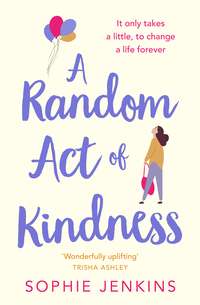
Читать книгу: «A Random Act of Kindness»
A RANDOM ACT OF KINDNESS
Sophie Jenkins

Copyright
Published by AVON
A Division of HarperCollinsPublishers Ltd
1 London Bridge Street
London SE1 9GF
www.harpercollins.co.uk
First published in Great Britain by HarperCollins 2019
Copyright © Sophie Jenkins 2019
Cover design by Holly Macdonald © HarperCollinsPublishers Ltd 2019
Cover illustrations © Shutterstock.com
Sophie Jenkins asserts the moral right to be identified as the author of this work.
A catalogue copy of this book is available from the British Library.
This novel is entirely a work of fiction. The names, characters and incidents portrayed in it are the work of the author’s imagination. Any resemblance to actual persons, living or dead, events or localities is entirely coincidental.
All rights reserved under International and Pan-American Copyright Conventions. By payment of the required fees, you have been granted the non-exclusive, non-transferable right to access and read the text of this ebook on screen. No part of this text may be reproduced, transmitted, downloaded, decompiled, reverse engineered, or stored in or introduced into any information storage and retrieval system, in any form or by any means, whether electronic or mechanical, now known or hereinafter invented, without the express written permission of HarperCollins.
Source ISBN: 9780008281830
Ebook Edition © 2019 ISBN: 9780008281854
Version: 2019-05-20
Dedication
Dedicated to Rowena Jenkins
19.10.1931–3.12.2018
Contents
Cover
Title Page
Copyright
Dedication
Lot 1
Lot 2
Lot 3
Lot 4
Kim
Lot 5
Lot 6
Kim
Lot 7
Kim
Lot 8
Lot 9
Kim
Lot 10
Lot 11
Lot 12
Lot 13
Lot 14
Kim
Lot 15
Lot 16
Kim
Lot 17
Lot 18
Kim
Lot 19
Lot 20
Lot 21
Lot 22
Lot 23
Kim
Lot 24
Lot 25
Kim
Lot 26
Lot 27
Lot 28
Lot 29
Kim
Cato Hamilton Auctioneers & Fern Banks Vintage Auction Catalogue
Acknowledgements
Keep Reading …
Also by Sophie Jenkins
About the Publisher
LOT 1
A Chanel-style black-and-white cotton tweed suit with bracelet-length sleeves, double ‘C’ gilt buttons, chain-weighted hem and matching skirt.
Most stories start with action. This isn’t one of them. Mine starts with indecision. It’s a warm Sunday evening and I’m dragging my wheelie case over the cobbled stones of Camden Market, pondering the big issues of my life. Can I really make a living selling vintage dresses from one small stand? Should I call in at Cotton’s Rhum Shack to cheer myself up before going home?
The din of the case rattling on the cobbles is attracting some negative attention from passers-by in an annoyed ‘What the hell is that noise?’ kind of way. It’s a cheap black suitcase, with nothing going for it except that it’s big enough to carry my stock of frocks.
I come out through the imposing arch of Stables Market onto the busy Chalk Farm Road and I stand on the kerb, still undecided. Quick drink? Across the way, the lights in Cotton’s Rhum Shack are gleaming. It’s snug and inviting, located between a music shop and one selling white crockery. Right now, there’s a gap in the traffic and I’ve got the chance to dash across. Still, something makes me hesitate. It’s been a long day and I haven’t sold much so the case is heavy. If I turn right past the Lock and trundle my case along the towpath, I’ll be home. I can hang up the dresses, kick off my shoes, undo my fitted jacket and relax. Simple choice. Drink, or home?
Before I reach a decision, a woman coming along the pavement catches my eye. I see her now exactly as I did the first time we met, in a series of close-ups – the scarlet lips, the little Chanel suit, the black silk turban covering her dark hair, her sharp little face, faux pearls, a black patent handbag with intertwined Cs hanging from the crook of her elbow. She wears the outfit as naturally as if it’s her skin. It is the perfect fit. With the tick-tick-tick of her heels, she’s a combination of sound and vision – that confident, moneyed walk; chin tilted upwards, completely self-contained except for the way her eyes flick slyly towards me to gauge the effect she’s having.
I’ve imagined this moment for a long time.
I feel a surge of happiness and forget about the Rhum Shack. This is my chance to thank her, I decide, for the way she changed my life one day a few years ago.
I was very down at the time; stuck in a dark place. What turned me around was that she noticed me, a total stranger, when I thought I was invisible; she saw through my misery to the person I wanted to be; she told me in a few kind, well-chosen words how to be the person I could be.
I want her to see my transformation.
Transformation!
What a word.
It’s the best word in the English language.
She made me realise that we’re not fixed, rooted firmly in our inadequacies, but that we can change who we are whenever we choose; we can pick up the kaleidoscope, shake it and transform ourselves again and again. We can choose the way we face the world. We can choose the way the world sees us.
I’m smiling; I can’t help it. I wish I’d been the one who’d dressed her all up in black and white with those bright red lips.
As she gets closer she, in turn, is studying my outfit with equally blatant curiosity, from my shoes to my confidence-boosting slightly masculine Prince of Wales check jacket with shoulder pads and the nipped-in waist.
I lower my white sunglasses and my eyes meet hers.
She briefly raises one fine eyebrow and smiles at me approvingly.
I love that smile. It makes my day.
‘Darling, you startled me, you know!’ she says warmly. Dahlink, you stertled me! … Her accent is German or Austrian, strong and precise. ‘That suit! So chic! Suddenly, it’s 1949 again – I thought I was dead all of a sudden, bof! God knows, I’ve practised, but here?’ A train thunders over the bridge and she looks around, then winces and covers her ears at the trailing noise until it fades.
She folds her arms and looks at me again intently from head to foot, then works her way up once more – shoes, knees, skirt, jacket – and she nods her approval. ‘Perfect.’ She adds in a whisper from behind her slender hand, ‘Except for that suitcase, of course.’
This time around, she’s not looking at me with gentle compassion but with humour.
I look at my scruffy case and laugh. ‘Grim, isn’t it? But it’s practical.’
‘Oh, prektikel! Well then!’
Does she remember me? If she doesn’t, I’ll take that as a compliment because it’s a sign of how much I’ve changed.
Suddenly, her expression changes to one of alarm.
‘Oh! My bus is coming!’ she says. ‘Excuse me! Goodbye!’
The number twenty-four is coming up under the bridge and she spins around and hurries in her heels towards the bus stop, pearls jingling, her handbag swinging from the crook of her elbow. Waving at the driver, she reaches in her bag for her travel card. In her rush, she’s dropping her money. Coins are rolling over the pavement, spinning in all directions.
I crouch to gather them up for her. The number twenty-four bus comes alongside us, gusting warm fumes, and she hurries onto it.
‘Wait!’ I call, picking up as much of her cash as I can, but she doesn’t hear me, so I grab my case and step onto the bus just as the doors are closing. I’ve forgotten just how heavy my wheelie bag is. Before I can hoist it on board, the doors momentarily close on my arm.
As I yelp and let go, the driver opens the door again and a dark-haired, broad-shouldered guy in a pink floral shirt and jeans grabs the case by the handle before it falls to the ground. ‘It’s okay! I’ve got it!’ he says.
I sum him up at a glance. Not the fact that he’s good-looking and his eyes are deep blue; that’s just a quirk of nature and not a good indicator of character. What I notice is that his pink shirt is crisply ironed and he’s wearing tan leather shoes polished to a shine. For that reason, I immediately trust him.
‘Thank you!’ I say gratefully, then I hurry up the aisle to the woman in the Chanel suit and hand back her money.
She looks from me to her empty bag with great astonishment – what? Her cash has been trickling out of it? And I’ve been picking it up as it rolled away? ‘Ach, you are kindness itself!’ she says, kissing her fingers and scattering goodwill my way.
Good deed done, I go to get off the bus, when I suddenly realise that the man in the pink shirt hasn’t got on behind me. I wonder where he is and what he’s done with my suitcase.
And then I realise he’s taken it.
Not straight away – I’m a trusting sort of person and I have to double-check before it sinks in. First of all, I think wryly, ha ha, wouldn’t it be ironic if he’s run off with it when I’m here doing a good turn? And then I turn to the driver: ‘That man who had my bag, what did he do with it?’
The driver shrugs and puffs out his cheeks sympathetically then closes the doors.
‘Stop, I’m getting off,’ I say in a panic.
He opens the doors again, so I jump off the bus and look up and down the road with insane optimism as the bus pulls away.
The opportunistic thief has gone and stolen my case.
I lean against the high stone wall of Stables Market, taking deep breaths and pressing my heart back under my ribs.
This great, indescribable sense of loss comes over me, closing my throat with grief.
Gone. Stolen – my beautiful clothes; the clothes that are my livelihood and my dreams.
LOT 2
A Paul Smith gentleman’s pink slim-fit floral shirt, size medium.
Once the initial wave of shock passes, I straighten up and force myself to think about things rationally. I mean, that suitcase is so hideously noisy that no thief in his right mind would want to drag it for any distance. And who wants a load of old clothes, anyway? (Apart from me, obviously.)
First, because of the noise of my rickety case, I’m guessing the man wouldn’t have gone far. He’d probably nip down one of the residential side streets, out of sight, and find a quiet place to rummage through the contents of the bag, to see if there was anything in there worth keeping. And when he found that there wasn’t, I reassure myself, he’d dump it and walk away.
Guided by instinct and a bit of local knowledge, I head to Castlehaven Road, where there’s a large triangle of overgrown grass surrounded by wooden benches, known optimistically as The Gardens, which is usually deserted.
Today it’s busy. Circling each other on skateboards are three boys – for a hopeful but disappointing moment it sounds just like the wheels on my case. On one of the benches, two tanned and amiable drunks are making philosophical conversation through the medium of Carlsberg Special Brew lager.
The kids watch me suspiciously as I walk around the perimeter of the garden, eyes alert, holding firmly on to my handbag and visualising my scattered clothing fluttering in the long grass like injured birds (this is how sure I am I’ll find them).
But I don’t find them. On the path, the boys circle like sharks. I leave the gardens and walk slowly back to Chalk Farm Road, knowing I should keep on looking but also knowing in my heart how pointless it could be. The guy with my case could have headed straight for the towpath, or for the car park in the superstore, or down any of the other side streets, or he could have gone straight home. I think about my pathetic gratitude as he’d held my case for me while I triumphantly dashed onto the bus to hand the old lady her money back. That’s what you get for helping someone out, I reflect bitterly.
Back on Chalk Farm Road I look across towards the market. Miraculously, I suddenly see that pink shirt as he reappears right at the entrance to the Stables with my suitcase. ‘Hey!’ I yell. ‘Excuse me!’
‘Hey!’
We’re shouting across the traffic and waving our arms at each other.
‘Wait there!’ I’m dashing across in my pencil skirt, dodging cars – this is the way to cross a road in London: assertively. ‘My bag!’ I say warmly and with happy relief until I see he’s holding a small shaggy brown dog on a lead. I feel a familiar rush of fear and I keep a distance between us. I’ve got a thing about dogs.
‘Sorry,’ he explains. ‘I let go of the lead when I saw you struggling and my dog went back into the Stables to investigate the remains of someone’s burger. When I came back and I couldn’t see you, I kind of thought I’d better wait here, you know, as it was the last place we saw each other.’
I don’t know what it is about that sentence that melts my heart. It’s as if we’re old friends and that’s what we do, we come back to the last place we saw each other.
‘Thanks. Really. You don’t know what it means, to get my case back. It contains all of my best stock.’ My voice is wobbling with relief. He’s got a beautiful face. His nose is big and noble. He looks trustworthy and somehow sensitive, and his deep blue eyes never leave mine. The pink shirt sets off his tan. And he’s clearly kind. I grab the case, using it as a shield between the dog and me. ‘Thank you,’ I say to him again, because I’m still so relieved at getting it back.
‘My pleasure.’ He holds out his hand. ‘David Westwood.’
‘Really? Any relation to Vivienne?’ I ask, studying him with interest.
His blue eyes narrow as if he’s shortsighted and trying to focus. ‘Vivienne?’
‘She’s a fashion designer. Same surname.’
He laughs and shakes his head. ‘No, sorry. No relation.’
‘I’m Fern Banks.’ I jerk my head towards the entrance. ‘I work here.’
‘I guessed that when you talked about your stock.’ He looks interested. ‘So, how’s it working out for you?’
‘It’s early days,’ I reply; this is the reassuring fact that I hold on to in the quiet times.
‘I’ve got my name down for a stall.’
I give a shiver of serendipity. ‘Really? What are you selling?’
‘Light boxes.’ His gaze leaves mine for a moment. ‘I’m having a career change,’ he adds.
There’s something defensive about the way he says it that makes me glance up at him curiously, but I’m just happy that he’s not selling clothes; I’ve got enough competition as it is. And I’m still buzzing from getting my case back, so I say, ‘There’s a stall going next to mine. It’s small, though.’
‘Where exactly is it?’
‘It’s right next to the entrance to the covered market.’
He looks down at my case thoughtfully. ‘But there’s no storage, right?’
I shrug. ‘True.’ I feel a bit disappointed, even though it makes no difference to me whether he’s interested in the stall or not; I don’t know the guy and I’m just trying to be helpful. All the same, I really want him to take it. Nothing to do with his looks; anyway, I’m in a relationship. ‘My boyfriend thinks it’s a good spot because there’s plenty of through traffic,’ I hear myself say, just so we’re clear that my motives are entirely innocent. Then I inwardly cringe – first, because I sound like the kind of woman who needs reassurance from a man about her decisions and secondly, calling him ‘my boyfriend’ makes me sound adolescent.
Ideally, David Westwood would look devastated at the news I’m not single, but instead he nods and says seriously, ‘Through traffic is very important. Actually, I’m trying to get a place indoors, in the Market Hall.’
‘Oh, lovely!’ I say with deep insincerity.
‘My girlfriend, Gigi, says the atmosphere is really friendly in there. And of course it’s under cover.’
My girlfriend, Gigi. So here we are, two strangers making it absolutely clear that we’re all coupled up so that there can never be any misunderstanding about our motives.
I knew a Gigi at school and I’m just about to mention it, when I notice that the shaggy brown dog is getting restless. It gets to its feet and stretches before sniffing with great deliberation around his owner’s shoes. As if he can sense my gaze on him, he suddenly lifts his head and looks directly at me, his eyes alert under two blond eyebrows.
I look away quickly, feeling my heart rate rise. I try never to make eye contact with a dog, in case it sees it as a challenge and goes for me, so I wrap things up quickly, while I’ve still got the chance. ‘Well, David, thanks again for your good deed, minding my case,’ I say briskly. ‘I appreciate it.’
He looks bemused. ‘You’re welcome.’
The dog is tugging him towards Chalk Farm Tube, in the general direction of Cotton’s Rhum Shack. So that settles it. I’ll go the other way: straight home.
David Westwood raises his hand to wave goodbye; he walks away with his pink shirt flapping in the breeze.
I’m still looking at him, when he unexpectedly turns around.
‘Hey, Fern?’
‘What?’
‘I’d better watch myself, hadn’t I?’ he says, laughing. ‘You know what they say, right? No good deed ever goes unpunished.’
LOT 3
Black one-sleeved asymmetrical dress, rough stitching feature, labelled Comme des Garçons, Post Nuclear collection, 1980.
Home is along the Regent’s Canal towpath; a one-bedroom basement flat in Primrose Hill. The flat isn’t actually mine – my parents own it. It’s easy to get to, situated between the two Northern line stations of Camden Town and Chalk Farm. It’s a ten-minute walk along the canal from Camden Lock. It used to be my father’s pied-à-terre during the week and when he retired I moved in as a sort of tenant, to ‘look after the property’, as they put it, on a temporary basis until I save enough for a deposit for my own place. The emphasis is on the word temporary. However, I haven’t yet told them I’ve been fired from my dream job as personal stylist in a large department store, and that getting my own place has become an ever more distant and unlikely prospect.
In the meantime, I’m very grateful to live here.
The walk is beautiful in the early mornings; cyclists say hello, walkers smile, the air is fresh and the shadows of the bridges cast cool stripes across the towpath. The sky is filled with gulls shrieking like the sound of the harbour when the fishing boats come in. At night, though, it’s a different place – the smell of dope hangs in the air, empty lager tins bob on the glossy canal and the bridges are lit up with violet lights.
The decor in the flat is early 21st-century modern; this is my father’s taste: Barcelona chairs, glass console tables, a built-in glass wine rack and a flatscreen TV. The flat isn’t very big, but it has a brick-lined utility room that stretches under the pavement on the street, which I use as my walk-in wardrobe. The living area is divided between the kitchen at one end and the lounge at the other, with a hallway leading to the bathroom and bedroom. The bedroom is in an extension and looks out on a small L-shaped garden with raised decking and palm trees, which my father created in the new millennium when he heard on Gardeners’ Question Time that summer droughts would turn all gardens into deserts.
Since then it seems to have created its own microclimate. The hardy banana plants bear fruit, stubby little bananas that I’ve never been tempted to eat, then having thrown their energy into fruiting and fulfilling their mission, they give up and die and a new plant grows. All this happens without any help from me apart from a quick swaddle in the winter with gardening fleece.
The foliage is pretty to look out on and it’s fairly low maintenance. My father rings me up now and then to remind me to do the ‘brown-bitting’, as he calls it, which means cutting off the dead bits so that the palms look respectably green – it’s something I generally put off until just before my parents visit.
What else? I’ve got good neighbours. Above me lives Lucy Mills, an actor. The top floor is occasionally inhabited by a retired Welsh couple who travel a lot.
As well as my pitch in Camden Market, I sell clothes online. As a hobby it was fun, but as an actual source of income it’s not going that well, to be honest. The main problem is, I don’t like sending dresses out into a void. I like to know the person they’re going to; their shape, their colouring, their temperament.
The returns are a problem. Basically, women are now a different shape from what they used to be. And even though I write down the measurements of each garment along with a ‘will this fit you’ exact measurement guide, people really can’t be bothered to use a tape measure – does anyone even have a tape measure these days? I give the approximate equivalent dress size (this will roughly fit a size 10 or 12), but even if it does fit, that doesn’t mean it’ll necessarily suit a person. If shoppers like the look of something onscreen, they’ll give it a try and then send it back if it’s not suitable. This means that my income is worryingly unstable from day to day. It’s not a good feeling to be solvent at the beginning of the week and then over the next few days have to return the money and go back to square one.
And people aren’t always honest. Sometimes the clothes come back worn, or splashed with red wine, or smelling of cigarette smoke. And if I point this out in a phone call they’ll argue that I’ve ‘sold them as preowned so obviously … blah blah blah’. And that’s the reason for the one-star stroppy reviews that say if it had been possible to give less than one star they would have, because I was rude or reluctant to refund the money.
One of the main selling points of wearing vintage is that the piece is a one-off. It’s also one of the main drawbacks; the popular dresses are snapped up quickly and that’s another reason my ratings are low – it’s often down to disgruntled shoppers.
It’s hard work being self-employed, but since I lost my dream job as a personal stylist, this is my plan B. And that’s where I’m at now; trying to make it work. My long-term aim is to have a solid customer base of people to shop for. I love that feeling you get when you see a garment that brings to mind a person, when you find a dress that’s totally them, and all you want to do is reunite them.
In Camden Market at the weekends, it’s crazy. One month into my new venture, I’ve had a couple of really good days, which keep me going. A lot of gorgeous girls come through looking for something original to wear – model agency scouts find a lot of new faces in Camden – but the customers I like best are the ones who are shy and uncertain and who dress for comfort in safe colours: grey, beige, brown. They look warily at my stall as they hurry past, and then come back and try not to catch my eye. What keeps me going is when they find something and suddenly see themselves through new eyes. They are my dream customers.
Unfortunately, I don’t come across them very often.
I trundle the case up the horse ramp from the towpath and halfway along my street, I bump it down the steps to the basement.
The first thing I do is hang the dresses up in the utility room under the pavement. There’s no storage at my stall, which means I have to pack and unpack my stock every day.
While I’m getting on with this, vaguely thinking of my encounter with David Westwood, I hear myself saying ‘Any relation to Vivienne?’ in that cringy way and David Westwood laughing, ‘No. Sorry.’
And then my thoughts switch to the old woman wearing Chanel and red lipstick, model slim in her black-and-white Chanel suit, perfect in it, and that approving expression in her eyes when she saw me.
Unpacking a Comme des Garçons dress that still hasn’t sold on the stall after a month, I shake the creases out and put it on my mannequin, Dolly. With her moulded black hair and rosebud lips, Dolly seems particularly supercilious and unhelpful today. I bought her from Blustons in Kentish Town when it closed down. Blustons was famous for the Fifties-style showstopping red-and-white polka-dot halterneck dress in the window that Dolly modelled wonderfully for many years.
I move Dolly into the light and photograph her for the website. My phone rings and I pick up to my father, who tells me they are having dinner with the Bennetts and that they’ll be staying at the flat overnight. Oh joy!
First, this means I’ll be sleeping on the sofa. Secondly, I’ll have to tell them that I’ve lost my job – I’ve so far managed to put this off for a month by keeping our phone calls short.
There’s nothing wrong with my father; he’s a decent enough guy and he’d probably understand if I told him the whole story. But my mother’s a different matter. I’m always uncomfortable with her, never able to relax. She modelled in the Seventies, at the time when models dictated the popularity of women’s fashion, and my love of clothes has totally come from her. She never reached the worldwide popularity of models Jerry Hall and Christie Brinkley, but for a while she moved in the right circles, and the glitter and glamour of those times has never faded for her – she still has every copy of Elle, Cosmopolitan and Vogue magazines in which she featured.
When it became obvious in my teens that I was too short to be a fashion model – I overheard her tell a friend, regretfully, that I’d inherited my father’s looks and her brains – I thought it would please her if I studied fashion design. But at St Martin’s, the more I found out about the great designers, the more certain I was that I could never equal them. As a daughter, I’m an all-round disappointment and losing my job doesn’t help.
To take my mind off my worries, I call my boyfriend, Mick, who’s in Amsterdam with his band, just to say hello. It goes to voicemail, so I leave him a message to say hi.
Mick and I have been dating for nine months in a friends-with-benefits kind of way. We met at Bestival on the Isle of Wight. He’s got red hair and a beard that covers most of his very beautiful face. He’s a sound engineer and spends a lot of time travelling. Sometimes I meet up with him somewhere like Hamburg or Paris, and when he’s in London he stays over and we have fun together, but other than that, I don’t know where the relationship is heading, if anywhere. We both like it the way it is. He’s keen on the idea of free spirits; figuratively and literally – no commitment and drinks on the house. His job means that he’s not home a lot, but I don’t mind. Honestly, it suits me, too.
In a flurry of activity, I make up my bed for my parents with fresh linen, do a bit of desultory tidying, spray the place with Febreze, and then I go shopping for vodka, Worcestershire sauce, tomato juice and celery so I can make some Bloody Marys to welcome my parents with. It’s ‘their tipple’, as they put it, and because of the tomato juice element they knock it back as if it’s a health food, which is fine with me.
As a family we like each other a lot better after a drink.
I start watching television and around ten thirty, I give up on my welcoming committee duties and fall asleep.
I wake up as I hear them coming down the steps sometime later and listen to the key rattling in the lock. In my lowest moods I decide I’ll ask for that key back, ‘for a friend’, an excuse I’ve used before, but they seem to have a little stash of them in reserve in case I absentmindedly forget who owns the place.
With a wide smile of welcome, I jump to my feet and there’s my father in a Burberry trench coat, carrying an overnight bag and holding the door for my mother, who comes in with her cream hair blending with her fur-trimmed cream cape, fluttering, elegant and distant.
‘Hi! Hi! Come in!’ I say, even though they’re already very much inside.
I don’t recognise my mother at first. Without a shadow of a doubt, even despite my habit of scrutinising everyone, I would have passed her in the street.
My father has mentioned my mother’s ‘tweaks’, as he calls them, and I realise that one of them has involved filling the dimple in her chin. I have the very same dimple and now she’s got rid of hers … What does that mean? We both have the same wide mouth too, only hers is now poutier, even though she’d pouted perfectly adequately with the old one. And her eyes, which had been large and round, are smaller, as if her real face is sitting some distance behind the one she’s currently wearing. She has the eyeholes of Melania Trump.
She looks me up and down without a word, taking in my pencil skirt and white silk blouse. If she could have frowned, she would have. She recoils with a gasp when she sees Dolly. Overreacting is an affectation she’s developed.
‘You’ve still got that ugly old thing,’ she says.
I cover up Dolly’s ears. ‘Don’t offend her, she’ll come and get you in the night.’
My mother pretends not to hear.
‘Bloody Marys,’ I say cheerfully, sweeping my hand in the direction of the kitchen island as if I’m introducing them to each other.
‘Thank you, darling,’ my father says, putting his hands on my shoulders briefly in what passes as a hug.
‘It’s warm in here,’ my mother remarks in a troubled way. She looks around with the restlessness of discontent, fanning her strange and unfamiliar face. ‘Isn’t it warm?’
It isn’t, actually, because the heating went off at ten, but my mother’s menopausal, so I agree with her. ‘It’s been very sunny today and hot air sinks, doesn’t it?’
‘It rises,’ my father says.
‘It must be affecting us on its way up again,’ I say brightly. Honestly, I’ve no idea who I am when I’m with my parents. They seem to bring out my inner inanity. When I’m with them, they’re the grown-ups and I regress to some attitude of despicable girlishness that isn’t really me at all.
I stir my drink with my celery stick, mixing in the spices and turning it dark brown. Wow, it’s strong.
They sit on the sofa with a sigh and I perch on the footstool opposite them with an eagerness I don’t feel. ‘How are the Bennetts?’ These are the old friends they’ve had dinner with.
‘Oh, you know,’ my mother says dismissively. ‘Ruth drinks too much.’ She pulls her cape around her and gulps hers down. ‘How’s work?’ she asks with an emphasis on work. Her voice is hoarse and it catches in her throat. ‘Still dressing people? However would they manage to go out in public without you?’
That’s sarcasm, that is, but it gives me the chance to look at her properly without appearing to stare. ‘How would they go out in public without me? Naked, I suppose,’ I reply, also with sarcasm.
‘Have people got no taste of their own?’ my mother asks.
I take a large gulp of my drink and wipe my mouth with the back of my hand in a show of reckless bravado. ‘Well, you don’t have to worry about people’s taste anymore, because I’ve been fired.’ I’d been dreading breaking this bit of news to them but now, ta-da! It’s done!
I brace myself for some yelling, because being with them is as nerve-racking as living on the edge of a volcano, but unusually for my parents they seem at a loss for words.
‘Fern, Fern.’ My father closes his eyes and shakes his head in despair. He looks more resigned than surprised. ‘You were fired? Why?’
I give them the short version of the story.
‘When did this happen?’
‘A month ago.’
‘And you’re only telling us now?’
They glance at each other over their drinks. I’ve confirmed their deepest fears about me.
‘What are you going to do?’ my father asks. ‘Are you getting Jobseeker’s Allowance?’
‘No.’ I wipe the condensation off my glass with my thumb. ‘I’m concentrating on my vintage clothing company. I’m a fashion curator.’
‘Really?’ My mother looks at me with a flicker of animation and for a moment we connect briefly with a small spark of mutual passion that makes my spirits lift.
My father, too, looks hopeful. ‘You’ve got business premises?’
‘I’ve got a stall in Camden Market,’ I tell them.
They freeze. It’s as if we’ve got some kind of satellite time-lapse going on; it takes them a few seconds for the horrible implications to sink in.
All empathy wiped clean once more, my mother says suspiciously, ‘You’re telling us you’re a market trader?’ as if it’s some elaborate story I’ve made up to make a fool of her.
I take a business card out of my wallet, which depicts me standing against a wall of flowers in a Sixties minidress. ‘Look!’ I say. ‘That dress is Pucci. You had one like that, didn’t you?’
She knows I’m trying to get around her and she doesn’t reply.
Some vague desperation for that old connection makes me persevere. ‘Gorgeous, isn’t it? Marilyn Munro was buried in Pucci, you know.’
‘I’m assuming not in this specific dress.’
Ha ha, she’s hilarious, my mother.
She reads the business card slowly, at arm’s-length, too proud for reading glasses. ‘Fern Banks Vintage.’ She hands it back to me and sighs, summing up my enterprise with her own brand of snobbery. ‘In other words, you’re selling people’s cast-offs.’
That hurts.
I reply lightly, forcing a smile. ‘That’s one way of putting it.’
‘And you hope to make a living this way?’ my father asks.
‘Yes, I do. I never pay over the odds. I look for styles and buy diffusion lines, nothing too out there, just clothes for women to look good in.’
‘As opposed to?’
‘Look …’ I’m talking too fast and too defensively, I know, but I want them to understand that this is something I can make a go of. ‘This is something I’m actually good at. And I’m building a decent client list.’ I’m stretching the truth a bit here, obviously. But it’s early days.
A deep weariness has come over them.
See? I think bitterly. Dressing people up in a department store doesn’t seem such a bad job now, does it?
My mother expresses her disapproval by emanating a dense and disappointed silence.
I play with a button on the Barcelona footstool. The silence is just starting to get uncomfortable, when: ‘How’s Mick?’ my father asks casually, breaking it.
That didn’t take long, did it? ‘He’s fine! He sends his love.’ I say that to annoy them. It’s not the kind of thing that Mick would do, send his love to my parents. They’ve only met once, briefly, on my birthday, and he wasn’t what they wanted for me. What he thought of them, he didn’t say. He never gives them a second thought.
They digest my comment for a moment.
‘Your mother and I have been talking about the flat,’ my father says, crossing one leg over the other.
‘Oh, really?’ I feel nervous, as if I’m no longer on solid ground, and I stare at his feet. For a moment I think that what I’m seeing is his pale bare ankle, but no, he’s wearing beige socks.
‘The reason we’re keeping it in our name, apart from the issue of capital gains tax, is because we feel it’s financially safer. For you, you understand,’ he adds.
‘How so?’
He and my mother exchange a look.
‘Have you thought,’ my mother says, ‘that Mick might simply be out for what he can get?’
This is a brand-new put-down out of a whole array of criticisms. I mean, Mick couldn’t possibly like me for my company, my looks and the fact the sex is good, could he? No. He’s after my flat. Correction: their flat. I take another mouthful of my drink. My eyes water. It hits the back of my nose like mustard powder. It’s more like a punishment than a cocktail.
‘He’s got his own house,’ I point out. ‘In Harpenden.’
That shakes them.
‘Actually his own?’ my father asks dubiously.
‘Yes. Actually his own.’ I’ve got a decent imagination, but even I couldn’t invent a house in Harpenden.
My mother gives me the look she uses when she suspects me of lying. I think of getting up to show her photographs of it on my phone, but I change my mind and sink back down again because honestly, it’s not worth the effort.
I crunch on my celery stick and look at her face with those new, strange eyes and wonder what my father thinks about it. The work she’s had done ages her. Only people afraid of losing their looks have that kind of extreme appearance, the kind that makes them look stretched and plumped and filled and tightened. When you see a face like that you immediately put them in the category of the middle-aged. When I was a personal stylist I saw the same shiny foreheads and immobile mouths on a daily basis. It rarely made women look young. It made them look as if the humanity had been taken out of them.
My parents are leaning towards each other on the red sofa, still recovering from the Harpenden house revelation, forcing them to come up with some new reason for protecting me from Mick or protecting the flat from me. Time to change the subject.
‘I saw an interesting woman today. You’d have liked her,’ I say to my mother. ‘She was wearing Chanel.’
‘You sold her Chanel?’ My mother brightens, visibly impressed. ‘Is she anyone we’d know?’
She’s got the wrong end of the stick, but I don’t want to ruin it, so I smile brightly. ‘I’m afraid I can’t say. Client confidentiality. Can I refresh your glass?’
Vodka, tomato juice, Worcestershire sauce, Tabasco sauce, celery salt, fresh celery. Glasses refreshed, I sit down again on the red footstool and the hit of my drink is so strong that for a moment I have the horrible feeling I’m going to topple off it.
‘Is she a television personality?’ my mother persists eagerly, hankering after the days when she, too, was a name and hung out with the stars.
I smile enigmatically, not wanting to ruin it for her.
‘I can guess who it is,’ she says smugly, mollified by her own imagination.
The doorbell rings. In my semi-drunk state it doesn’t sound like the doorbell. It sounds like an alarm, harsh and urgent and motivating, and the three of us are galvanised out of our alcohol-numbed torpor into action, struggling to our feet in uncomprehending panic.
‘Who is it?’ my mother asks, keeping her voice low as if we’re in hiding.
I open the door and it’s my upstairs neighbour, Lucy. She comes in full of drunken merriment. ‘Hey! I saw your light on and I—’ She suddenly notices my parents. ‘Oh, hello!’
I can guess what my mother is thinking behind her frozen face. She hates people who drop in unexpectedly. She thinks it’s the height of rudeness.
‘Bloody Mary?’ I ask Lucy.
‘Ooh, yes. Is this a party?’
Lucy’s got curly blonde hair and the kind of cheerful superficiality that actors are good at during those times when they’re not talking about a new role. They take acting seriously, but they treat life with a very light touch, which is a welcome relief if you belong to my family. Lucy’s wearing a black unstructured asymmetric dress with a lot of zips. Comme des Garçons. I know because I sold it to her. She’s playing Lady Macbeth at The Gatehouse and she still has her stage make-up on. She’s electrified with post-performance adrenaline.
Lucy’s ambition is to direct. She’s been in all the best crime dramas: Scott & Bailey, Silent Witness, Endeavour, Shetland. Whenever she’s in something, she invites me upstairs so we can watch it together on her flatscreen TV and she points out the flaws in the acting, things that I’d never have noticed – like when someone fluffs a line, or winces before the knife’s been raised, or fails to respond to the scene.
And that’s the way she’s looking at me now, slightly critically, as if I’m not playing the part of host very well, so I introduce her to my parents and while I mix another jug of Bloody Marys she fills us in on how the night has gone. The theatre was packed. There had been a heckler. The audience was so caught up that at the end there was a long, thick silence after Malcolm’s closing lines.
‘Malcolm McDowell?’ my mother asks hopefully, ready to claim acquaintance because he bought her a drink once.
‘Malcolm. Duncan’s son,’ Lucy says. ‘“This dead butcher and his fiend-like queen”.’
My mother’s disappointed. ‘A dead butcher?’ she echoes, confused.
‘He’s talking about Macbeth! The fiend-like queen – that’s me. And they’re holding up Macbeth’s head and this orange light comes over them – it’s like an Isis video. Cheers!’
Lucy brings a whole new element to the night. There are some things that my parents will only say to me, which shows some kind of loyalty, I suppose, so the conversation stops being personal. Lucy sits on the footstool and I sit on the Barcelona chair while my parents loll on the sofa. We’ve reached the hazy stage of drunkenness where words become particularly meaningful.
Lucy’s still talking about the play and her excitement about the concept of the ‘Pahr off sgestion’.
We’re momentarily perplexed but rooting for the concept anyway. ‘Par? Path?’ I prompt helpfully.
She takes a couple of shots at it.
‘Parf – parf –.’ She takes another sip of the drink to clear her head and leans forward. ‘Power of suggestion,’ she says, exaggerating the words at us as if we’re deaf. ‘The three Weird Sisters, psychics as we call them, I play second psychic as well … anyway, the thing is, they put the idea into Macbeth’s head. They plant it there. Hadn’t occurred to him to become the Thane of Cawdor before then but he thought, you know what? I can do that. See what I mean? It’s dark, right?’
‘Aha! Brainwashing,’ my father says.
‘Not brainwashing.’
‘Visualisation,’ I say.
‘You see?’ Lucy asks happily.
‘They didn’t read the future, they just gave him a goal to aim for,’ my father says.
‘Yes!’
My mother’s face turns my way. ‘What are your goals, Fern?’
‘To make a success of my business.’
She remains unimpressed. ‘That’s it?’
‘Well,’ I shrug, ‘the Thane of Cawdor thing’s already gone.’
My mother hates flippancy. ‘She had so much promise,’ she says, turning to Lucy for support. ‘She’s thrown it all away. She needs to do more with her life.’
‘Why does she?’ Lucy asks. ‘She’s got a nice life. You’ve got a nice life, Fern, haven’t you?’
‘Yes.’ I want to hug her.
My mother says icily, ‘She’s got a market stall.’
Cheerfully unaware, Lucy replies, ‘I know. Great, isn’t it? There was a waiting list and everything! She was really lucky to get it, weren’t you, Fern?’
My mother’s not used to people disagreeing with her. She glares at Lucy from the depths of her narrow eye sockets. When Lucy remains oblivious to the silent death stare, my mother stands up and announces coldly, ‘I’m going to bed.’
Retires: hurt.
‘Goodnight,’ we say in unison.
As she stands, the fur on her cape quivers as if it’s alive – and about to throttle her.
The thought comes into my head with no particular emotion or malice.
My mother goes through the door that leads to the bathroom and bedroom and closes it quite firmly.
‘Was it something I said?’ Lucy asks, surprised.
My father looks at his watch. ‘My word! It is getting awfully late. It’s almost midnight.’ He puts his glass down and stands up.
I stand up, too, and he gives me a hug, a proper hug, and for a moment I feel his soft, shaved cheek against mine.
He says goodnight to Lucy and follows my mother to bed.
‘Insane!’ Lucy whispers thrillingly, widening her eyes at me after he’s gone. ‘Are they always like this?’
I think about it. ‘Actually, yeah.’
‘What has she got against market stalls?’
I shrug and try to laugh it off. ‘She was hoping I’d be a model, like her. And then, as I’m only five foot five, she was happy to settle for me being a fashion designer.’
‘Oh, I get it. You’re not living up to her motherly expectations. “What are your goals, Fern?”’ Lucy says, in an accurate imitation, and adds in her ordinary voice, ‘And that whole Malcolm McDowell thing – what was that all about?’
‘She met him when he was in Caligula,’ I say gloomily. ‘But nothing came of it. That’s my mother. Always hoping for the best and always disappointed.’
We stare at each other for a moment and then for no reason at all, we suddenly start to laugh, muffling it with our fists on our mouths.
‘And the dead butcher bit. Did she think Macbeth actually was a butcher?’
The tears are rolling down my face. ‘Don’t!’
‘“She had so much promise and she’s thrown it all away …”’
‘Stop it!’
‘You know what?’ Lucy says, giggling weakly. ‘You should do stand-up. You’ve got enough material.’
‘I could do stand-up.’
‘That’ll teach her. This could be your Thane of Cawdor moment.’ She wipes her eyes and raises her glass. ‘Happy to help.’ She looks at the time and finishes her drink. ‘I’d better go too, I suppose. Time to take my Night Nurse medicine. I’m incubating a cold.’ To prove it, she sneezes into the elbow of her black dress. Her zips jingle.
‘Bless you,’ I say, dodging out of the way as she checks for damage – I don’t move far enough to be rude but I do try to get far enough away to avoid the germs that might have escaped around her slim arm, because what could be worse than catching a cold at this crucial time in my business career?
(Plenty, as it turns out.)
I see Lucy out into the cool night and she totters up the wooden steps, waving all the way, then curses softly for a few moments outside her front door while she finds her keys.
I lock the door and stand in the now spinning centre of the flat that I live in, with my parents tucked up in the bedroom, my friend safely upstairs.
I wonder if the night will have repercussions. My mother’s very good at keeping a grudge going, but she can only keep it going as long as we’re together and they’re going back in the morning.
I brush my teeth in the kitchen sink then make up the sofa, switch the lights off and wrap myself up in my duvet.
Surprisingly, I sleep well.
LOT 4
A sky-blue silk satin Sixties-style A-line dress with bracelet-length sleeves and feather trim to neckline and cuffs, scalloped knee-length hem, unlabelled.
I wake up next morning wound up tightly in my duvet and all the events of the previous night come tumbling back into my head, starting with the alarming fact that my parents are asleep in my bedroom.
The sun is flickering in my eyes, the light filtered by the lacy green leaves of the tree fern in the garden. The sky is a clear blue and it was a frock of that same pure, uplifting colour that lost me my dream job.
At least I’ve told my parents now, so that’s one problem out of the way.
I’d been dreading telling them – it’s true, my mother’s had many disappointments in her life, not just the fact she ended up marrying my father instead of Malcolm McDowell because she failed to become as famous as Jerry Hall. I’ve disappointed her too, and I’m not sure it’s anything I can put right.
I studied fashion at St Martin’s, but not just to please my mother – I genuinely had ambitions of becoming a fashion designer. Like her, because of her, I’ve always loved clothes. I’ve been buying vintage clothing since my early teens. I enjoyed studying the construction of the pieces as much as wearing them.
But in my final year, compared with my fellow students, I knew that I didn’t have the imagination or the vision to design clothes that were often avant-garde and unwearable for the average person. I lacked the sheer sense of performance that it takes to bring a collection to the catwalk. To be honest, I’d been winging it anyway, because my passion is for clothes that make a person look good. Otherwise, what’s the point? Me, I always choose style over innovation.
After graduating, I spent a few years in fashion sales and I was thrilled when I landed the job as personal stylist in a large department store in Oxford Street.
One of the first things we needed to know about a client was their budget and then we were encouraged to stretch it – although, not all our clients were rich.
There are many reasons why people need help shopping for clothes. These days, people are less confident about their appearance than ever. Sometimes they don’t have the confidence to try something new. Sure, they can choose the labels that also have a line of accessories like beaded bags and matching hats, but although it makes shopping easier, it’s self-defeating in a way. There’s always the risk that someone else is going to show up wearing exactly the same thing and that they’ll both have to spend the whole occasion keeping as far away from each other as possible to avoid looking like middle-aged twins.
Fashions change. Partners aren’t always helpful enough – or patient enough – to give an honest second opinion. After two outfits, a man will say that anything looks great, just so that he can be done with the whole boring business and go home. Friends aren’t always tactful and those who follow trends are the worst. There’s nothing more demoralising than shopping with a fashionista who pushes into the dressing room, tries on the stuff that her friend has just turned down and looks fabulous in everything.
As a personal stylist, my job was to make my clients look in the mirror and see themselves differently. I was supportive, admiring and knowledgeable. For a period of two hours, I was the perfect friend; bringing coffee or prosecco, zipping and unzipping, encouraging them to own the clothes – can you sit in it? Eat in it? Dance in it? And then I’d get them thinking about accessories: bags, shoes, scarves, pendants, fur cuffs, sunglasses – the beautiful final touches that make a look. It was a brilliant feeling to see a woman admiring herself in the mirror with happy disbelief – and keep on looking. For me, that was the ultimate job satisfaction. I discovered I, too, had the ability to see women through their own eyes and boost their confidence by transforming them into someone new.
The client who got me fired was an elderly man shopping for his wife. His name was Kim Aston. He arrived for the two-hour appointment, a neat, slightly built man about my own height, wearing a suit and a bright, multicoloured silk tie. His greying hair was short and swept back from his forehead.
He looked nervously at the glittering chandeliers and the ornate chairs and faced me with a frown. ‘I was just about to leave,’ he said as soon as I introduced myself.
‘Are you in a hurry?’ I asked.
‘No. It’s just that—’ He looked up at the enormous chandelier again as if its blatant, lavish extravagance was putting him off. ‘I didn’t think it was going to be so—’ He shrugged and tailed off.
I smiled understandingly, because I knew what he meant. Our department was ostentatiously luxurious. Cream carpets, mirrors, drapes. We were selling the experience: this is what it’s like to be rich and have a personal shopper, a valet, an attendant, someone to admire you and to make you look the best you can be while you sit back and enjoy it then hand over a credit card at the end. We were selling the promise that all this could be theirs. And for two hours it was theirs to enjoy. But Kim Aston found it intimidating and I could understand that, too.
I said, ‘Would you prefer coffee or tea with your glass of champagne?’
That’s how we did it. We took it for granted that the client would have coffee or tea and a glass of champagne, to relax.
‘Tea, please.’
I tapped in the order on my iPad and led him through to the dressing room where the clothes I’d chosen for his sick wife were hanging.
On the telephone he’d been quite sure of what he wanted. Loose-fitting dresses, elasticated waists, silky fabrics and bright colours – size 14, he thought, or maybe a little bigger. I’d chosen six for his wife that I thought she might like, based on the image I’d built of her, but in the dressing room I realised I’d got it wrong because he looked at my selection anxiously, as if he’d already bought them all on impulse and realised he’d made a terrible mistake.
My colleague Mario carried the tray of drinks in and put it on a gilt, glass-topped table next to the cream velvet and gilt chair.
I handed Mr Aston his glass. There was nothing like a glass of fizz to boost the confidence of a wary shopper.
He held it at eye level and stared through the bubbles as if he were in a dream.
‘You said your wife likes bright colours,’ I said, ‘but if you’d prefer a more muted palette, I do have some things in mind that fulfil your criteria. What do you think of this? It’s silk jersey, very comfortable to wear and not restrictive,’ I said, showing him a red-and-blue Diane von Furstenberg wrap-around dress.
He smiled faintly as if amused. ‘We’ve been married forty-five years,’ he said. ‘It goes by very quickly.’ He looked at me closely. ‘You’re too young to know that yet. It’s all ahead of you, all that potential. For my wife, she’s reached the finish line and she’s having her bottle of water and her banana.’
I laughed, because it was a nice way of putting it.
‘She’s still interested in fashion,’ I said, ‘which is lovely.’
He sighed. ‘I’m not sure that she is interested in fashion. She’s not fashionable,’ he said thoughtfully, sipping his champagne, ‘she wouldn’t enjoy being called that at all. She’s a very practical woman. She’s always had short hair.’ He looked at me as if expecting me to comment favourably on this example of her practicality.
‘It’s often best to stick with a hairstyle that you know suits you,’ I pointed out. ‘Some women have the face for it.’
‘And it dries quickly,’ he said. ‘She has it trimmed every six weeks.’
‘Good! So it keeps its shape.’
He put his drink down and took the dress from me. His face softened. ‘Don’t get me wrong, I like this one,’ he said, worried he’d offended me, holding it up high as if his wife were a tall woman, a woman he was used to looking up to. ‘But no. This isn’t it. It’s rather plain, you see.’
I smiled. I wasn’t done yet. ‘I’ll put it over here,’ I said and then I showed him a shocking-pink shift dress with fluted sleeves that was very pretty.
He studied it for a long time, his face expressionless, and finally he gazed at me doubtfully. ‘Do you try these on yourself?’
‘No. I mean, not unless I’m looking for something personally.’ I let the dress hang. ‘This fabric is very flattering.’
‘You have to wear black, I suppose. All the staff seem to be wearing black. That’s the uniform, is it? Black?’
‘It is, yes.’
He nodded. ‘I’ve noticed that. The trouble with this is the sleeves. See? These sleeves, they don’t seem very practical. They dangle.’ Again, he looked at me quickly. ‘I was thinking in terms of housework, loading the dishwasher, cooking.’
Once again, I adjusted my image of his wife. She obviously wasn’t too ill to do housework. ‘This is more of a going-out dress,’ I said. ‘Does she get to go out much, your wife?’
‘She does when she can. She’s got two friends about the same age as herself, Mercia and Betty, and they like their classes. University of the Third Age, have you heard of that? No? A lifetime of knowledge and a wealth of experience. Tai chi, watercolours. They had an exhibition in the library.’
‘This floral dress is by Chloé. It’s a bit looser in style; it’s a relaxed fit. It’s great that she gets out. Do you paint, too?’
Mr Aston laughed appreciatively. ‘No, I don’t. I haven’t got an artist’s eye. The women don’t want us hanging around with them; although Betty plays golf sometimes when the weather’s fine. Golf is my hobby; although I haven’t much of a golfer’s eye, either. They’ve been good friends to Enid. What other frocks have you got there?’
‘This is a beautiful silk jersey by DKNY.’
‘Animal print,’ he said doubtfully. ‘I don’t know how Enid would feel about animal print. She might find it a little common.’ He sat on the cream velvet chair, looked at the dresses and took a deep breath. ‘Have you got something a bit more special, with some kind of embellishment? Feathers, ostrich feathers?’ he asked hopefully.
He’d taken me by surprise. ‘You mean a cocktail dress?’ He hadn’t mentioned it in his brief, but this is how it was sometimes, clients had to find out first of all what they didn’t want before they decided what they did want. ‘You don’t think that any of these are suitable for your wife?’
He shook his head. ‘I keep thinking of a frock that feels special,’ he said, his face creased with the difficulty of trying to explain. ‘The kind of frock that’ll give a person a lift. A dress to make the eyes sparkle.’
I liked him. ‘I know exactly what you mean. I’ll put these away for now and bring something more suitable for evening. More champagne?’
Mr Aston held up his glass. He was beginning to relax at last, but I couldn’t help but wonder whether the practical, short-haired Mrs Aston would appreciate a feathery cocktail dress as much as he seemed to think. It was difficult to judge without meeting her personally. I’d never had anyone shop by proxy before.
I carried the dresses out and asked Mario to refresh Mr Aston’s drink while I searched our stock for cocktail dresses and feathers. We had a black feather cape and an ivory ostrich feather bolero and I chose a couple of little chiffon dresses to go with them then headed back to the dressing room.
Mr Aston looked up hopefully, but his face immediately fell.
‘They’re not quite what I had in mind,’ he said, stroking the ostrich feathers wistfully. ‘But they are beautiful, there’s no denying it.’ He sighed deeply.
I felt I’d let him down. ‘From all the things you’ve seen, Mr Aston, is there anything you’d like to look at again?’
‘No … I don’t think so,’ he said wistfully, ‘but I’m very pleased that I came.’
‘Your wife will be disappointed,’ I said. She wasn’t the only one. I was disappointed myself.
‘I’ll relate the experience to her in detail,’ he said, finishing his wine and cold tea and looking around him as though he was memorising it for her.
I didn’t want him to leave yet. I wasn’t used to failing with a client. I always had a sense of what they wanted but, more importantly, under normal circumstances I usually knew fairly quickly what would suit them. And, suddenly, it came to me. And after one hundred minutes together, I suddenly felt in tune with Mr Aston’s wife’s taste.
Don’t get me wrong; I was scrupulously fair about it. It was only when I’d absolutely exhausted all other in-store possibilities that I’d suggested the under-the-counter deal.
I’d recently bought a satin sky-blue dress with a feather trim and a scalloped hem from a charity shop and it was his wife’s size, a 14. It was a playful dress and as I’d passed the window, the beautiful blue had made me smile. I guessed it was from the Sixties and I wondered if Mr Aston was nostalgic for the days of his youth, and whether the dress was a message, a compliment to his wife, Enid. The dress was to say to her: this is how I see you.
I showed him a photograph of it on my phone.
‘Oh, that’s more like it.’ He brightened immediately. ‘I’d like to see that,’ he said.
‘The thing is, it’s from my personal collection,’ I explained, ‘but we could meet up somewhere for you to have a look at it if you’re interested.’
‘When?’
‘This evening, if you’re free?’
‘Here?’
‘Not here but – where would suit you?’
‘St John’s Wood.’
‘Carluccio’s, then?’
And that’s what we did. We met in Carluccio’s.
He did love the dress, as I knew he would. He loved the frothy abundance of delicate feathers, the innocent blue, the rich gleam of the satin. He thought it was perfect. We did an under-the-counter deal.
Бесплатный фрагмент закончился.