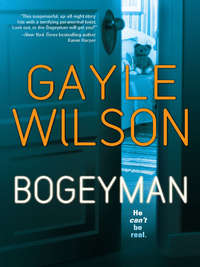
Читать книгу: «Bogeyman»
Gayle Wilson
Bogeyman

This book is dedicated to the strongest, most wonderful group of women I know, with my love, my gratitude and my deepest admiration…
Jill, Kelley, Connie, Lisa, Michelle, Dorien, Peg, Linda, LJ, Karen, Sherry, Geralyn, Stef, Teresa, Diane, Nic, Donna, Julie and Allison.
Thank you for everything!
And a very special dedication to Angelon.
She knows all the reasons why.
Contents
Prologue
Chapter 1
Chapter 2
Chapter 3
Chapter 4
Chapter 5
Chapter 6
Chapter 7
Chapter 8
Chapter 9
Chapter 10
Chapter 11
Chapter 12
Chapter 13
Chapter 14
Chapter 15
Chapter 16
Chapter 17
Chapter 18
Chapter 19
Chapter 20
Chapter 21
Chapter 22
Chapter 23
Chapter 24
Chapter 25
Chapter 26
Chapter 27
Chapter 28
Chapter 29
Chapter 30
Coming Next Month
Prologue
Twenty-five Years Earlier…
She had known he would come tonight. In spite of the rain and the cold. In spite of her praying “Please, Jesus” over and over again since Rachel had turned out the light.
She listened, but there was no sound now except her sister’s breathing, slightly whistling on each slow intake of air. And the rain, of course, pelting down on the tin roof overhead.
It made enough noise to drown out anything else, she reassured herself. Whatever she thought she’d heard—
The sound came again, and this time there was no doubt what it was. She had anticipated this, dreaded it too many nights not to recognize that soft tapping on the glass.
She opened her eyes to the darkness, staring up at the ceiling as if she could see through it to the storm above. Maybe if she waited—if she pretended to be asleep—maybe this time Rachel would hear him and wake up. Or maybe Mama would get up to check and see if they were warm enough.
The tapping came again. Louder. Demanding.
Her sister’s breathing hesitated, a long pause during which she repeated her talisman phrase again. Then the sounds Rachel made settled back into that same pattern of wheezing inhalation followed by sibilant release.
Mama always said Rachel slept like the dead.
Mama…
If she got out of bed and tiptoed across the floor to the door, surely with the noise of the rain, she could open it without him hearing. And if he didn’t hear, then he would never know that she’d told.
If you ever tell anyone…
She quickly destroyed the image his words created. Denied them because she couldn’t bear to think about what would happen if she didn’t go to the window….
She took a breath, squeezing her eyes shut to stop the burn of tears. Please, dear Jesus.
Except Jesus hadn’t answered her prayers any of the other times. Somewhere inside her heart she knew he wasn’t going to answer tonight.
Which meant that nobody would. There was nobody she could turn to. Nobody who could do anything about what he’d told her he would do if she didn’t mind him. Nobody but her.
She opened her eyes, raising her arm to scrub at them with the sleeve of her nightgown. He didn’t like it when she cried. He said it spoiled everything. And that if she wasn’t real careful—
She drew another breath, fighting to keep it from turning into a sob. Then, moving as carefully as she could, she pushed back the sheet and the piled quilts and sat up, putting her bare feet on the stone-cold floor.
By the time he tapped again, she was at the window. As she put her fingers around the metal handles of the sash to lift it, she couldn’t find even enough hope left inside her heart to repeat the words she’d prayed all night. The ones they had told her at Sunday school would protect her from evil.
Now she knew that they, too, had lied.
1
Present Day…
The storm had increased in intensity, rain pounding against the windows as if demanding admittance. Not for the first time Blythe Wyndham regretted the isolation of the small rental house she and her daughter had moved into two months ago.
She’d never been easily spooked—not by thunderstorms or by being alone—but right now she was wondering why she hadn’t taken her grandmother up on her offer to move back into the family home. The hundred-year-old farmhouse, which the Mitchells had occupied since its construction, was almost as isolated as the one in which she and Maddie were currently living. Still, it had been home for most of Blythe’s childhood, and she had always felt completely safe there.
Safe?
Blythe shook her head, wondering at her use of the word. There was no reason to think the house they were in wasn’t safe. She couldn’t ever remember consciously worrying about that before. Why the thought would cross her mind tonight—
“We haven’t said my prayers.”
Her daughter’s reminder destroyed Blythe’s momentary uneasiness. Smiling, she brushed strands of pale blond hair away from the forehead of the little girl she’d just tucked into bed.
No matter what else might have gone wrong in her life, Maddie was the one thing that had always been right. And the reason Blythe had chosen to return to the small Alabama community where she’d been raised.
“Then say them now,” she prompted.
Maddie closed her eyes, putting her joined hands in front of her face, small thumbs touching her lips. “Now I lay me down to sleep. I pray the Lord my soul to keep. If I should die before I wake, I pray the Lord my soul to take.”
Blythe wondered who had decided that was an appropriate prayer for a child. Of course Maddie, who said the words by rote, was probably not even cognizant of their meaning.
Thank God.
“God bless Mommy and Miz Ruth and Delores.” Maddie’s listing of personal blessings that had grown by two since their move to Crenshaw. “And God keep Daddy safe in heaven. Amen.”
“Amen,” Blythe repeated softly.
Her daughter’s blue eyes flew open to catch her mother studying her face. “You didn’t close your eyes.”
“If I did, I couldn’t look at you.”
“But you aren’t supposed to look at me. You’re supposed to bow your head and close your eyes. Everybody knows that.”
As Blythe herself had always been, Maddie was an obeyer of rules. The trait made her an easy child to handle, but Blythe often wondered if it shouldn’t be her role to introduce the occasional urge to rebel into her daughter’s well-ordered existence.
“Sorry. I guess I forgot,” Blythe said, her smile widening at the note of concern in Maddie’s voice.
“You better ask forgiveness. Before you go to sleep. You hear me?”
The culture of the area was obviously making inroads, not only on the little girl’s speech, but on her thinking as well. Blythe could hardly complain, since that was one of the reasons she’d brought Maddie back. That and the fact that the only family she had left in the world was here.
“I will, I promise. And you promise to sleep tight, okay?”
“Okay.” Maddie turned slightly to one side, one hand sliding under the feather pillow, another item on loan from her great-grandmother’s house.
The necessity of that kind of borrowing had also, like it or not, played a part in their homecoming. The little insurance money that had been left after the bills had all been paid, including those incurred by the move, wouldn’t have extended to luxuries like feather pillows. With her grandmother’s generosity, it would go a little further and hopefully keep them solvent until Blythe could find some kind of permanent employment.
“Just don’t say that thing Miz Ruth always says,” Maddie ordered without opening her eyes.
“What thing?”
“About the bugs biting me.”
Blythe could almost hear her grandmother’s voice, its distinctive Southern accent repeating the same good-night wish she’d whispered to Blythe when she was a child. Sleep tight. Don’t let the bedbugs bite.
“That’s just a silly old saying.” She bent over to press a kiss on the little girl’s temple. “There are no bedbugs here or at Miz Ruth’s.”
Maddie had quickly picked up on the name by which most of the inhabitants of Crenshaw referred to Ruth Mitchell. Or maybe because that was how her grandmother’s housekeeper always addressed her, and the little girl spent her mornings with the two old women.
In any case, given the growing closeness between them, Blythe had decided that it didn’t matter what Maddie called her great-grandmother. Ruth Mitchell would be for Maddie exactly what she had been for Blythe—friend, confidante and role model. The child couldn’t have a better one.
Blythe pushed up from her perch on the edge of the bed, reaching over to turn off the bedside lamp as she did. The flash of lightning that illuminated the darkened room was followed closely by a clap of thunder.
Blythe glanced down at the little girl in the bed, but her eyes were still closed. Apparently the storm didn’t bother her.
Normally, they didn’t bother Blythe either. There was something about this one, however, that had kept her slightly on edge since the rain had started. If the power went out—
That’s what she had intended to do, she remembered. Locate the flashlight and gather up any candles she could find. Despite having been here for a couple of months, she hadn’t managed to get everything unpacked.
Of course, working at Raymond Lucky’s law office half a day made it hard to get much done at the house. And she couldn’t have managed either the job or the unpacking had her grandmother and Delores not been so eager to look after Maddie for her.
When she’d started with Ray, Blythe had intended to prove herself so invaluable that he’d be forced to hire her full-time. Now she knew he didn’t have enough clients to warrant that expenditure. Although her greatest fear was that Ray would decide he couldn’t afford her any longer, she had already started putting out feelers for more permanent—and more lucrative—positions.
Despite the obvious advantages of her move back home, that was the major drawback to living in this small, rural community. A lack of jobs that related to any of her skills.
Without the required education courses that would allow her to teach, her English degree seemed worthless in this setting. As did the five years before Maddie’s birth that she’d spent as editor of one of Boston’s small entertainment magazines.
Such as they are, she acknowledged.
Denying the rush of bitterness over the turn her life had taken, Blythe flipped the switch for the overhead light as she entered the kitchen, welcoming its glow. Despite her earlier uneasiness, the room seemed warm and familiar.
Safe.
She rummaged through the drawers, searching for the utility candles she knew she’d brought with her. This was where she’d always kept them in the old house. She couldn’t imagine where else she might have put them when she’d unpacked the container they’d been in.
Which probably indicated she hadn’t. And that meant they were in one of the boxes lined up along the wall in what had been the house’s front parlor.
She debated letting the candles go and simply going back upstairs to bed. That way if the power did go out, she’d never know.
Not unless Maddie has another nightmare.
The thought was enough to send her out of the kitchen and into the hall. She stopped a moment at the foot of the stairs, listening for any sounds coming from the little girl’s bedroom. She could hear nothing but the steady beat of the rain against the roof.
She crossed the hall to open the door of the parlor. She kept this room shut off in an attempt to keep the utility bill down. Besides, other than using it as storage, she couldn’t imagine that she would ever need the space.
By force of habit she flipped the switch, remembering only when nothing happened that she’d not yet replaced the bulbs in the overhead fixture. So far, she had only worked in here in the daytime, so that until tonight, there had been no need. And too many other things that demanded her time.
Blowing out an exasperated breath, she walked over to the boxes. She squatted before the first, trying to read the words she’d carefully printed in indelible marker as she’d packed them. Despite the occasional flare of lightning, that proved impossible. Why the hell hadn’t she brought the flashlight?
Because you’re operating on too little sleep and too much stress.
Putting her hand on the top of the box, she pushed herself up. Screw the candles. The flashlight would be enough.
As long as it had working batteries. Given the way the night was going…
She started across the parlor, heading back to the hall. With the lack of furniture in the room, her footsteps seemed unnaturally loud as she crossed the wooden floor. Halfway to the door she realized that wasn’t all she was hearing.
She stopped, tilting her head toward the hallway. For a few seconds there was nothing, and then the noise came again.
Even over the omnipresent rain she could hear it. A low, muffled tapping.
She had heard the same sound a couple of times before, always at night, and always as she lay in that state between waking and sleeping. It had seemed too much trouble to get up and locate the source then, but she’d better figure it out tonight or, combined with her feeling of anxiety about the storm, the noise would keep her awake. If there was anything she didn’t need, it was another night of interrupted sleep.
A shutter? she wondered. Or a branch brushing against the house? Except there didn’t seem to be enough wind to cause either.
She hurried into the front hall, once more stopping at the foot of the staircase. Again she cocked her head to listen.
Other than the rain, the house was now silent. She took a breath of relief. In the middle of it, the tapping came again. Whatever its cause, it was definitely coming from upstairs.
The faint light spilling out into the hall to the den reminded her that she had been headed to the kitchen to retrieve the flashlight. Once she had it, she’d go upstairs and locate whatever was making the racket. When that had been taken care of, she’d check on Maddie and then get into her own bed. Maybe they could manage to make it through one night without any further disturbances.
The flashlight was lying on the counter where she’d put it when she’d started rummaging through the drawers. She picked it up and then walked over to check the dead bolt and chain lock on the back door. Both were secure.
She pushed aside the sheer curtain that covered the glass top half of the door, intending to peer out into the darkness. For an instant her reflection made it seem as if someone was out there looking in at her. Although her realization of what she was really seeing was almost instantaneous, the jolt of adrenaline that initial sensation created caused her to jerk the fabric back over the pane.
Still fighting that ridiculous surge of panic, she turned, taking a last look around the kitchen before she retraced her steps. She hesitated in the doorway, her fingers finding the switch several seconds before they pulled it down. She waited, giving her eyes a chance to adjust to the sudden lack of light.
This was her normal routine. Cutting off the lights down here and making her way up the stairs in the dark. Since she no longer closed Maddie’s door at night, she didn’t want to turn on the light at the top of the stairs and chance waking her.
She hadn’t taken two steps into the hall before the tapping sounded again, seeming louder than before. Maybe the rain had slackened, allowing her to hear whatever was brushing against the house more clearly.
As she started toward the stairs, she pushed the button on the flashlight forward with her thumb. A narrow cone of light appeared before her, but before she could focus it on the bottom step, it blinked out.
“Damn it.” Angry at herself for not making better preparations in case of an emergency, she shook the flashlight. The batteries rattled inside their metal case, and almost miraculously, the light reappeared, this time without wavering.
At least she knew what to do if she really needed the thing. Which she didn’t right now.
She slid the button back into the off position, conserving what life was left in the batteries. Putting her left hand on the banister, she began to climb the narrow stairs. Halfway up, the tapping began again.
This time she didn’t stop to listen. She took the last few risers in a rush, trying to get to the top of the staircase so that she could determine the direction from which the sound was coming. By the time she’d reached the upstairs hall, however, there was only the noise of the rain.
Check on Maddie. Maybe by the time she’d done that, whatever she was hearing would sound again.
She walked down the hall, guided by the nightlight she’d put in Maddie’s room after the first of the terrors. A flare of lightning, turning the night sky as bright as day, illuminated the window at the end of the hallway. It was immediately followed by a boom of thunder that literally shook the house.
Certain that some object nearby had been struck, Blythe waited, her heart in her throat, for the sound of a falling tree or for Maddie’s screams. When neither occurred, she continued down the hall, her eyes fastened on the dark panes of the window at its end.
In the faint light provided by the night-light, she could see her reflection again, distorted by the mullions and the waviness of the old glass. Given the multiple images portrayed in the window, she had to fight the urge to look over her shoulder to make sure she was alone.
She turned into Maddie’s room, expecting the little girl to be as distraught by the storm as she was. Instead, Maddie was lying on her side, just as she had been when Blythe had gone downstairs. Her eyes were closed.
Instead of the relief she should have felt, Blythe’s first reaction was a renewed sense of uneasiness. How could the child sleep through the noise of the storm?
She tiptoed closer to the bed, spending a few seconds watching the regular rise and fall of Maddie’s breathing. The little girl’s lashes rested unmoving against her cheek.
Although her inclination was to pull the piled quilts over her daughter’s small, exposed shoulder, Blythe stepped back from the bed. It would be stupid to take a chance on waking Maddie, who was obviously fine.
And obviously dealing with the storm much better than you are.
Blythe turned, intending to make her way to her own bedroom. If she couldn’t sleep, there was a sack of paperbacks that her grandmother had pressed on her when she’d picked Maddie up after work yesterday. Most of them would be romances, but maybe that was exactly what she needed. Something positive. Life affirming. With a happily-ever-after guarantee.
She had already reached the doorway to Maddie’s room when the tapping came from behind her. She whirled, looking immediately toward the window to her right.
There was no doubt in her mind that something had struck its glass. She walked across the room, leaning over the small secretary she’d placed in front of the window.
Below was the roof of a narrow screened porch that had been added to the original structure. There were no trees. No branches to brush against the house, even if there had been enough wind to move them. And, she remembered, there were no shutters on the windows at the back.
Realizing that she still held the flashlight in her hand, she pushed the switch forward, pointing the beam outside the window. Rain streaked the glass, but there was nothing out there. She leaned forward as much as she could, directing the flashlight in a circle—above, to the right, below the window and then to the left. Nothing.
She straightened, trying to understand how she could have been wrong about the direction of the sound. It had come from here.
Obviously, it didn’t. You were wrong. So what else is new?
Her thumb had already begun to apply pressure to the off switch when the tapping came again. This time there was no mistake. The sound was right in front of her. She could even see the glass tremble slightly in its frame.
The cone of light from the flashlight was focused directly on the window. With a growing sense of horror she realized that there was nothing out there. Nothing touching the window. Nothing moving against it. Nothing that could move against it. Nothing.
Even as she came to that realization, the beam blinked out, leaving her looking at an empty blackness beyond the glass. Despite her success downstairs, she didn’t even try to shake the thing back on.
She backed away from the window instead. Then, without being conscious of having made a decision, she ran across to the bed and pulled back the covers. She scooped Maddie up and had already started to carry her across the room when the little girl’s eyes opened.
“What’s wrong?”
“Nothing,” she lied. “I thought you might like to sleep in my bed. Because of the storm.”
Her voice trembled, but she prayed that, roused from a deep sleep, her daughter wouldn’t notice. The wide blue eyes looked over her shoulder, seeming to fasten for a moment on the window above the secretary.
Then Maddie turned her head, looking up at her. “Don’t be frightened, Mama. There’s nothing to be afraid of. It’s only the rain.”
Unable to speak, Blythe nodded.
No doubt there was a perfectly logical explanation for what had just happened. Whatever that might be, right now she wasn’t interested.
All she was interested in at this moment was getting Maddie out of this room. And maybe even out of this house.
2
As he entered his utility room, Cade Jackson struck his rain-soaked uniform hat against his leg before he hung it on one of the row of hooks by the back door. Then, sitting down on the bench, he removed his lowtopped boots and socks, both of which were even wetter than the rest of his attire.
The Sheriff’s Department had been asked to help the state troopers work a tanker-trailer wreck out on the interstate. Cade and his deputies had done little more than direct traffic around the area of the possibly toxic spill. The thunderstorm, which had grown in intensity while the highway crews had worked to clean up the mess, had complicated things, dragging out the final all-clear for several hours.
As a result, Cade was cold and tired and hungry. And right now he wasn’t sure which of those pressing needs should take precedence.
Shower first, he decided, standing again to slip out of his yellow slicker. The hotter the better. To be followed by a couple of packets of aspirin powder to put a dent in the headache that had developed as he’d squinted through the driving rain at the oncoming headlights. Once those two things were accomplished, then he could think about taking something from freezer to microwave and out again in a matter of minutes.
He walked into the kitchen, fingers working over the buttons on his shirt. The light on the answering machine that sat on the counter was blinking.
Whatever this was, given the night he’d had, it couldn’t be good. Still, delaying wouldn’t make the news any better. Blowing out a breath, he stabbed Play.
While he waited for the message to begin, he pulled his shirt out of his pants to undo the last of its buttons. He was in the act of shrugging out of the damp garment when Teresa Payne’s voice, with its distinctive nasal drawl, came through the speaker.
“Hey, Cade. Just touching base. When you get in, give me a call about tomorrow night.”
Returning this particular call was way down on his list of priorities. He had run out of excuses to avoid Teresa’s invitations. And he wasn’t up to coming up with anything creative tonight.
So tell her the truth. Tell her you aren’t interested. And that you aren’t ever going to be.
There was enough of his good-ol’-boy upbringing left that he knew he was incapable of being that blunt. At least at this point. If Teresa didn’t figure it out pretty soon, he wouldn’t have much choice. As for tonight…
Carrying the balled-up shirt in his hand, he walked down the hall, not bothering to turn on a light. He’d grown up in this house. He knew every crack and crevice of it. Every squeak of the cross-sawn oak floorboards.
He flipped on the overhead in the bathroom. Dropping the shirt onto the floor, he unbuckled his belt and unzipped his uniform pants. He stepped out of those, leaving them on the tile beside the discarded shirt.
With one hand, he reached back and gripped the fabric between his shoulders to pull his T-shirt over his head. He pitched it to lie on top of the pants and shirt. Seconds later, his boxers had joined the growing pile.
He shivered a little in the cold. He should have turned up the thermostat, he realized. If he had, by the time he’d finished his shower, the house would be habitable.
Nude, he stepped out into the hall and pushed the lever up with his thumb. The furnace in the basement came to life with a whoosh, sending heated air through the vents.
He went back into the bathroom, reaching into the shower to turn on the hot water. Given the location of the heater, it would take longer for that to get warm.
Since Maria had come today, the racks had all been stripped bare for the washing machine. As he reached for a clean towel from the stack above the john, he caught a glimpse of himself in the mirror.
Dampness from the rain had spiked his hair. It glistened like jet in the light of the fluorescent. Even the twin swatches of gray at his temples were darkened by the moisture.
He had shaved around five this morning, but the ever-present afternoon stubble now made him look slightly sinister. And the shadows under his eyes made him look old.
Hell, you are old. Thirty-seven going on a hundred. Especially on nights like this.
As he turned away from the image in the mirror, exhaustion in every aching muscle, he wondered if he could be coming down with something. Probably not that lucky, he decided. The luxury of a couple of days off, spent inside a warm house, would work wonders. Both the cold and the rain were supposed to continue well into next week, and he would have no choice but to be out in them.
He slid back the glass door and stepped in, turning his back to the water. For several seconds he didn’t move, letting the force of the spray pound the bunched muscles between his shoulders. After a couple of minutes, he leaned his head back, eyes closed, to let the shower slough the cold moisture of the rain from his hair.
As his body began to lose the bone-deep chill, his tiredness, too, seemed to ease. He scrubbed every inch of his skin, literally trying to wash a way the day’s tensions.
It seemed to work. When he stepped out of the shower, the bathroom was at least ten degrees warmer than it had been when he’d entered. He grabbed the towel he’d taken from the shelf, using it first to dry his hair and then his body.
When he was finished, he wrapped the towel around his waist and opened the bathroom door. Steam wafted out into the cooler hall as he headed toward his bedroom.
Left hand on the top of the chest, he fished a pair of clean pajama bottoms out of the second drawer. He sat down on the end of the bed, which was made—the last time it would be until Maria showed up again next week—and put them on.
He stood, pulling the pajamas up to his waist. He went back to the chest of drawers for a clean T-shirt. Now all he needed were the aspirin and something to eat.
Two packets of powdered aspirin, a product everyone in the department swore by, had begun to make inroads on his headache by the time the microwave sounded. Ignoring the baleful light of the answering machine, he carried his dinner, still in its black plastic tray, along with a fork into the den.
He sat down on the couch, putting his food on the coffee table in front of him. Despite the tempting aromas of meat loaf, potatoes and gravy, he used the remote to turn on the TV.
He wolfed down the contents of the plastic tray, almost without looking at them, while he watched a rain-fogged video of the wreck his men had worked. When the local news cut to commercials, he glanced back into the kitchen.
The unanswered phone call would nag at him until he’d returned it. When he had, and had made a final check-in with the department’s dispatcher, he could crawl into bed and forget about the needs of the citizens of Davis County until the phone—or better yet, the alarm—woke him.
He pushed up from the deep cushions of the couch and made his way back to the kitchen counter. He listened to the message again, before he glanced down at his watch.
Decision made, he called up the number on caller ID and then pushed Talk. He listened to the electronic beeps, trying to decide what he was going to say this time.
“Hey, Cade,” Teresa said. “I was afraid you were still out working that mess on 65.”
“Got in about half an hour ago. The state finally decided that whatever the guy was hauling, it wasn’t a public threat.”
“That’s good to know. Hope you all don’t catch pneumonia from standing out in this rain.”
“Yeah, me, too.” He leaned against the cabinet, allowing the silence to lengthen.
Nothing was going to change. He was only delaying the inevitable. He might as well get this over with so he could go to bed.
“About tomorrow night…” he began and then hesitated.
This whole thing was his fault, and he knew it. He should never have opened the door even the crack he’d allowed. When it had started, he hadn’t seen the harm in their friendship. By the time he did, it was too late.
Teresa laughed. The sound was soft, but its bitterness apparent. “I can hear it coming.”
“Hear what coming?”
“Whatever you’ve got on. You’re either working. Or you’ve promised somebody you’ll do something for them. Or help them do something.”
“Teresa—”
“And that isn’t ever going to change, is it? Why don’t you just tell me to quit bothering you?”
“You aren’t bothering me.”
“Oh, hell, Cade. Don’t lie. That just makes it worse.”
“Look, why don’t we—”
“No. No pity arrangements. You and I are a little old for those kinds of games.”
There was nothing he could say to that. She was right. They were both too old for games. He had been for five years. Ever since Jean had walked out on him.
“I don’t blame you,” she said, speaking quickly now. “I just thought that maybe…I don’t know. There aren’t that many singles our age in Crenshaw. I just thought we had a lot in common. At least I hoped we did.”
They did. More than Cade and his ex-wife had ever had.
And look how well that worked out.
At least he and Teresa had had the same upbringing, right here in Davis County. And like him, she wasn’t interested in living anywhere else.
Despite knowing that, there was nothing there. No spark of interest. Not on his part. Knowing himself as he did, he knew there would never be.
He resisted the urge to offer more platitudes. The quicker they got through this, the less painful it would be. For both of them.
“I guess I was wrong,” she added.
“I’m sorry.” Despite his intentions, the apology slipped had out.
He hadn’t meant to hurt her. The fact that he wasn’t interested in a relationship didn’t have anything to do with Teresa. Maybe if he told her that…
“It isn’t you.”
“Oh, Lord, Cade. At least spare me the crap.”
“I’m sorry.”
“And for God’s sake, stop saying that.”
He obeyed, willing himself not to prolong this. Again the silence grew.
“You’re a good man, Cade Jackson,” Teresa said finally. “Even if you aren’t, and won’t ever be, my man. You don’t owe me any explanations, so don’t bother trying to think them up. Just…If you ever change your mind…”
He waited, lips pressed together. She never finished the sentence. Instead, there was a low click and then the dial tone in his ear.
After a moment he put the receiver back on the stand, stopping the sound. Despite his exhaustion, despite the promise he’d made to himself, he didn’t move. Not to cut off the light or to head to bed.
You and I are a little old for those kinds of games. That went along with what he’d been thinking when he’d looked into the mirror tonight. Thirty-seven going on a hundred.
In every way that mattered, Teresa Payne was far too young for him. And he no longer believed he was ever going to find someone who wasn’t.
She had been right last night, Blythe realized. There was no overhanging branch up there. No shutter. And absolutely nothing to bang against that window.
“What are you looking at?”
Blythe turned to find Maddie standing at her elbow, blue eyes shifting from her face up to the bedroom window. The little girl was wearing only her nightgown. Although it was made of thick flannel, with long sleeves and a deep flounce, long enough to brush the winter-browned grass, it offered too little protection against the early morning cold.
“There was something bumping against your window last night. I could hear it. I thought maybe I could see whatever it was from down here.”
She had come downstairs and out through the screened porch as soon as she’d woken up, leaving Maddie asleep in her bed. Or so she had thought.
“I didn’t hear anything.”
“You don’t remember?”
“I didn’t hear it.”
This was the same kind of stonewalling with which Maddie replied to questions about her nightmares.
Stonewalling? She’s four. If she says she doesn’t remember, then she doesn’t. She isn’t capable of that kind of deception.
And how does a little girl not remember something tapping against her window? Or dreams that make her scream hysterically?
“Well, whatever it was, it doesn’t seem to be there now,” Blythe said, turning to look down at her daughter with a smile. “How about some breakfast?”
“Egg McMuffin?”
“Not exactly what I had in mind. How about bacon and eggs and toast?” That was the kind of food she never had time to prepare in the mornings as she was rushing to get Maddie ready for Ruth’s and herself ready for work.
“That’s what Delores always fixes.”
Of course. Delores and Miz Ruth couldn’t imagine starting the day without a cooked breakfast.
“So what would you like? Other than McDonald’s.”
“Cereal. Coco Charlies.”
The Egg McMuffin would probably have been a more nutritious choice, Blythe thought. Death by sugar.
Despite the unfortunate choice of words, Blythe managed to hold on to her smile as, hand between the small shoulders, she turned the little girl back toward the house. “Coco Charlies it is.”
“It makes its own chocolate milk,” Maddie said cheerfully, skipping along in front of her.
With its concrete floor and open walls, the screened porch was almost as cold as the outside. The small kitchen, however, had already warmed in the few minutes since Blythe had turned up the heat. This house might have its problems, but at least the plumbing and the furnace were reliable.
Fingers crossed.
While Maddie took her place at the table, Blythe retrieved the box of cereal from the old-fashioned pantry. On her way across the room, she opened the fridge and took out a quart of milk. She set both on the table and reached into the cabinet above the sink for a bowl.
Easier than eggs and bacon. And if the sugar made Maddie hyper, then there was no one to be bothered by it but her.
If Ruth and Delores at their age could put up with her daughter’s energy day after day, then she certainly had nothing to complain about.
Except maybe too many nights of lost sleep.
“So you really didn’t hear anything last night?” She dumped a cup or so of the brown pebbles into the bowl and covered them with milk.
“Rain. And the thunder.”
“You didn’t mind that?”
Maddie shook her head, digging her spoon into the mess in the bowl. She was right, Blythe realized. The milk had already taken on a decidedly brown tinge.
“Do you?” Maddie asked, looking up from under her bangs.
“Do I what?”
“Mind the rain?”
“Not most of the time.”
“Maybe that’s what you heard.”
“I don’t think so.” She didn’t want to make Maddie fearful. “Maybe it was a bird,” she suggested, sticking the milk back in the refrigerator. “Or a squirrel.” She turned back to see Maddie’s eyes come up again, widened with interest.
“Trying to get out of the rain?”
“Maybe. Maybe they were just cold,” she added with a smile.
“Then…would it be all right to open it for them the next time?”
“Open the window?” For some reason, despite the winter sunlight flooding the kitchen, last night’s chill was back.
“So that whatever is knocking can come in.”
In Maddie’s world, the one Blythe herself had created, you took care of those who couldn’t take care of themselves. You fed strays and rescued chipmunks from the neighbor’s cat. And if something was cold and hungry, you let it in.
Except not this time. Even though Blythe couldn’t explain the certainty she felt about that, she knew that whatever had caused the tapping she’d heard last night wasn’t something she wanted to let into her home.
And especially not into Maddie’s bedroom.
3
“Mama! Help me! Somebody help me!”
The screams pulled Blythe out of a sleep so deep that, despite her exhaustion, she couldn’t believe she’d achieved it. After all, she had tossed and turned in Maddie’s narrow bed for what seemed like hours. Listening for the tapping. Straining to identify every creak of the old house. She had finally drifted off, only to be awakened as suddenly as if someone had poured ice water over her.
She scrambled from under the covers, not stopping to pull on the woolen robe that lay across the foot of the bed. She ran across the heart-pine floors, bare feet skidding across their smooth surfaces as she made the turn through the doorway of Maddie’s bedroom and headed down the hall toward her own.
In the cold light of day—when her heart wasn’t frozen with fear or her mind imagining ridiculous scenarios—she hadn’t been able to justify letting the child sleep with her again. But she also couldn’t bring herself to put her back in that bedroom.
She had wondered if whatever she’d heard tapping at the window last night in Maddie’s room could precipitate the night terrors. Obviously, she’d been wrong.
“Mama, wake up. Please, Jesus. Please, somebody help me. Daddy. No. Daddy.”
By the time Blythe reached the doorway of her bedroom, the panicked screams had increased in volume. Following the now-familiar pattern, the little girl’s shrieks were growing so frenzied, words were no longer distinguishable. Piercing and hysterical, the screams echoed and reechoed through the room, even when Blythe turned on the bedside lamp.
As always when the child was in the grip of a terror, Maddie’s eyes were open, their dilated pupils eating up the blue iris. Blythe knew from experience that the little girl was totally unaware of her surroundings, still trapped in the horror of whatever she was dreaming about.
Blythe threw back the covers and then lifted her daughter to hold her against her heart. She rocked her back and forth in a rhythm familiar to them both since Maddie had been a baby.
“Shh. I’m here. I’ve got you. Everything’s all right.”
After what seemed an eternity, the little girl responded, turning her head to bury her face between her mother’s breasts. Through the thickness of her flannel gown, Blythe could feel the sweat-soaked hair. At least the shrieks had faded to whimpers.
Over the top of Maddie’s head, Blythe released a sigh of relief. Her own nightmare was that one night her daughter wouldn’t return from whatever terrifying place the dream took her. Tonight she had, and Blythe sent a silent prayer of thanks heavenward.
She had done that far more often since she’d come back to Crenshaw. Prayed. It was something she couldn’t remember doing much of during the last few years. Not even during those terrible months of John’s illness.
Maybe she’d sought divine intervention more often because she had returned to her roots, the town where she’d spent her childhood, which had certainly not lacked for religious instruction. Or maybe, she admitted, it was that she was at the end of her own very human resources in knowing how to deal with what was going on.
Why wouldn’t she be? How could she be expected to know what to do with night terrors so severe she literally feared for her daughter’s life—or her sanity. Or with inexplicable noises that chilled her to the bone.
She leaned back, attempting to put some space between them so that she could look down into those normally lucent and guileless eyes. Maddie refused to look up, clutching her more tightly instead, small fingers locked into the fabric of Blythe’s gown.
“It’s all right,” she whispered again. “It was just a dream. I’m right here, and I have you.”
There was no response. At least Maddie was no longer trembling.
Gradually Blythe’s own panic began to ease. With the light of day, she might again be able to convince herself that this scene, which had been repeated no less than a dozen times in the last few weeks, had not been nearly as frightening as she remembered.
With one hand, she brushed damp tendrils of fine blond hair away from her daughter’s face. In response to the gesture, Maddie finally leaned back, looking up at her.
In the glow from the lamp, the little girl’s features seemed illuminated, as if lit from within. The blue eyes had now lost the look of horror they’d held only moments before.
“What’s wrong?” Maddie’s pale brows were drawn together in puzzlement.
Unsure how to answer the question, Blythe forced a smile. “You had a bad dream. Don’t you remember?”
The child shook her head. She raised a fist, rubbing her eyes in that timeless gesture of sleepiness.
“Don’t you remember anything, Maddie? Not even what made you call me?”
Another negative motion of the sweat-drenched head, and then her daughter leaned tiredly against her chest again. As she did, she put the thumb of the hand she’d used to rub her eyes into her mouth. In the stillness, Blythe listened to the sound of her sucking it.
The psychologist she’d taken Maddie to had advised she not make an issue of this, although the habit was something the little girl had outgrown years ago. Ignore it and everything else, the woman had said.
She had reassured Blythe that night terrors weren’t uncommon in children Maddie’s age. Although there was definitely a genetic component to them, they were usually triggered by stress.
Probably the result of her father’s death, combined with the move, the psychologist had suggested. She just needed lots of love and reassurance that she was safe and that you’ll always be there for her. Other than that, it was better to completely ignore the nightmares.
Blythe had had to fight against her instinct, which was to ignore the advice rather than the nightmares. She wanted to question Maddie about her dreams. To talk to her about them. To find out if there really were, as it seemed, no lingering traces of whatever horror paralyzed her in the darkness.
Instead, she had listened to the expert. About that, as well as about not sleeping with her daughter, which was one bit of advice she no longer intended to follow. At least not right now.
“I think I’ll sleep in here with you the rest of the night,” she said, pulling the covers back.
Obediently the little girl scooted over in the bed, making room. Blythe slipped between the warm sheets, settling the quilts around them again.
Before she reached over to turn off the lamp, she took one last look at her daughter. The little girl had already cuddled down on her side, her thumb back in her mouth. Her lashes lay motionless against the apple of her cheek, her breathing again relaxed and even.
Asleep? Was it possible that she’d already dropped off, despite the state in which Blythe had found her only minutes before? Something she obviously had no memory of.
Thank God, Blythe thought, completing the motion she’d begun. And while you’re at it, dear Heavenly Father, would you please give me that same blessed forgetfulness?
There was no answer to her prayer. At least not an affirmative one. Just as there had been no answer to any of the others she had prayed since she’d returned.
“Land sakes, child. You look like death warmed over. You sickening for something?”
“Too little sleep,” Blythe said, taking the cup of coffee her grandmother held out to her.
As soon as she had it in her hands, she turned her gaze back to the scene revealed through the kitchen window. Maddie was playing in her great grandmother’s sunlit back garden, the one where Blythe had spent so many happy hours during her own childhood.
The tire swing she’d played on still hung from the lowest branch of a massive oak. Maddie’s body was draped through it now, her jean-clad bottom and legs and the soles of her scuffed sneakers all that were visible from this angle.
“She having more of those nightmares?”
Blythe turned to find her grandmother still standing at her elbow, her gaze also fastened on the little girl. In an attempt to hide the sudden thickness in her throat at the genuine concern in the old woman’s voice, Blythe lifted the steaming cup and took a sip. Despite the strong flavor of chicory, a remnant of her grandmother’s childhood in St. Francisville, the coffee warmed her almost as much as entering this house always did.
“Night terrors,” she corrected softly, finding it difficult to believe that the child they were watching was the same one who had trembled in her arms only hours before. “An appropriate name. She’s certainly terrified by whatever she sees.”
“But if she doesn’t remember—”
“I remember. I thought last night—” Blythe stopped, hesitant to put her fear into words, lest doing so should give it some actual power.
“You thought what?” her grandmother asked when the silence stretched between them.
“I’m afraid she won’t come back from wherever she is.”
“Oh, child. You don’t believe that. You can’t.” With one weathered hand, its fingers knotted with arthritis and the blue veins across the back distended beneath the thin skin, her grandmother touched her fingers as they gripped the cup, seeking warmth for the coldness that seemed to have settled permanently in her chest.
“You haven’t seen her. And anyone seeing her now…” Blythe didn’t finish the thought, knowing that she could never explain the gap between the picture below and the events of last night.
“Why don’t you tell me exactly what happens?” her grandmother suggested. “Sit down at the table, and we’ll drink our coffee while you tell me all about it.”
“I should watch her—”
“In Crenshaw? Who you gonna watch her from here?”
The old woman was right. The backyard was as safe as church, to use one of her grandfather’s favorite expressions. There was no reason to fear for Maddie’s safety. That was one of the reasons Blythe had decided to come home.
She’d been reluctant to talk to anyone about the terrors. More reluctant to mention the tapping. The kindness in her grandmother’s voice encouraged her to share her fears, however, just as it always had. Here in this kitchen, she had revealed a hundred secrets during her adolescence.
And this—whatever was going on—wasn’t even a secret. If she could share the particulars of her daughter’s nightmares with some dismissive stranger in Montgomery, surely she could confide in her family. Almost the only family she had left.
“Delores, would you get us some of that pound cake you made yesterday?” Her grandmother took Blythe’s arm to guide her away from the window, apparently taking her silence for consent.
“Yes’m. You all want some preserves to go with that?”
Delores Simmons, the ancient black woman who had looked after the household since Blythe could remember, was almost as old as her mistress. Although the two elderly women were closer than sisters, the traditional formalities that had existed between them for more than half a century were still maintained, even in private.
“Preserves?” Blythe’s grandmother asked, pulling out a chair at one side of the kitchen table and gesturing toward the opposite one. “Or apple butter, maybe. I made both, so I guarantee they’re good.”
Blythe slipped into the place, shaking her head in response to the question. “Not for me.”
“Just the cake, Delores. And make sure you don’t cut none of that sad streak either.”
“Now you know Miz Blythe always likes a bit of sadness with her sweet.”
Despite the fact that the women were talking about a common flaw that left a swath of butter-rich denseness through center of the cake, the words seemed symbolic. A little too apt.
“You said she calls you. That that’s how it starts.”
Surprised by the change in subject, Blythe looked up from her coffee. Her grandmother’s faded blue eyes were focused patiently on her face. “She calls Mama.”
Blythe wasn’t sure when the thought had crept into her head, but since it had, she couldn’t dislodge it. Because she was no longer sure Maddie was calling her. Just as she was no longer sure—
She shook her head, refusing to take the next step. If she did, it might take her down a road she didn’t want to consider.
“And you go to her, of course,” her grandmother prodded, “and then what?”
“That isn’t all she says.”
“Something besides Mama?”
“I don’t know whether or not she says more the longer the dreams go on or whether I understand more each time. Most of it is just…sounds. Screams. No words. But at the very beginning…Before she gets so hysterical…There are words.”
“What does she say?”
“Help me. Mama, help me. Daddy. No. Daddy.”
“If she’s calling for her daddy, then maybe—I mean didn’t that psychologist tell you this was connected to John’s death?”
“Not exactly. She said the stress of his death combined with the stress of the move. But…a four-year-old? How she can be stressed?” Blythe asked. “Does she seem stressed to you?”
“She’s just having a nightmare, baby. Everybody has them.”
“But what does she see that terrifies her so much she can’t get her breath?”
“And she’s crying when she says all that?”
As she asked the question, Delores set a glass dessert plate down in front of Blythe. A thick slice of pound cake, the promised sad streak bisecting its perfection, rested in the center on a paper doily. Despite the presentation, Blythe felt a wave of nausea at the thought of trying to eat it.
“Is she crying? A little. At first. Then she starts begging for somebody to help her. Then…‘Please, Jesus, help me,’” Blythe whispered, her eyes holding on the black ones of her grandmother’s housekeeper.
“That pure don’t sound like it’s got nothing to do with Mr. John, whatever that doctor told you. That baby’s afraid of something.”
Blythe nodded, relieved to have her own conclusion put into words. To find someone who understood the fear she felt as the episodes escalated. “She’s terrified. After a while the words become screams. Shrieks. As if someone is—”
“Hurting her,” Delores finished softly when she couldn’t go on.
“Nobody’s ever hurt that child in her life,” her grandmother said dismissively. “Why in the world would she have a dream about somebody doing it?”
Бесплатный фрагмент закончился.