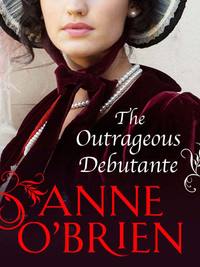
Читать книгу: «The Outrageous Debutante»

‘We think it would be best if you kept your distance from Lord Nicholas.’
‘And if I don’t?’ But in Thea’s heart she already knew the answer.
‘Maybe nothing. Perhaps you would fall in love and marry. But if he discovered the truth, would Lord Nicholas continue to look on you with love—or would he turn his back with condemnation and contempt?’
‘I could not bear that.’ A tear stole unnoticed down Thea’s cheek. She knew what she had to do. She must set herself to destroy any vestige of the relationship which might have begun to blossom between herself and Lord Nicholas. It should not be too difficult, should it, to give him a disgust of her if she really tried? To make him wonder what he had ever seen in her?
No one must guess. Not Lord Nicholas. Not ever Nicholas.
And, whilst Thea found herself reduced to the blackness of utter misery, Lord Nicholas Faringdon was equally prey to extreme emotions. Against all the odds he had fallen in love. He wanted nothing more than to ask for the lady’s hand in marriage. She fired his blood. She intrigued him. She entranced him. If he had his way, Miss Theodora Wooton-Devereux would become Lady Nicholas Faringdon in the shortest possible time.
A smile of satisfaction touched his mouth. There was nothing in the manner of that lady towards him that might indicate that she would not welcome his addresses.
Dear Reader
In The Disgraced Marchioness, the first volume in The Faringdon Scandals trilogy, Lord Henry Faringdon succeeded in finding happiness with beautiful Eleanor in New York. This left Henry’s handsome younger brother, Nicholas, to administer the Burford estates in Herefordshire in the name of his infant nephew. I wondered what Nicholas’s future would be, bound as he would be by a sense of duty—and so was born The Outrageous Débutante.
Nicholas is a typical Faringdon, with dark good looks, unused to having his will thwarted, and driven by ambitions. What will happen when his path is crossed by Theodora, a delicious débutante who is just as strong-willed as he, and certainly given to outrageous behaviour? Will it be possible for Nicholas and Theodora to find any future together after so stormy a first encounter? And when scandal strikes again, far too close to home, can their love even be declared, much less survive? Nicholas has to face the grave demons of his past, Theodora the truths of hers, both of which have the power to wreck any love affair between them. It could all so easily end in heartbreak …
Still the Faringdon history is not complete. Sarah Russell has yet to find her destiny. Although not a Faringdon by birth, her fate will become involved with that of the notorious Lord Joshua Faringdon, the Black Sheep of the family, cousin to Henry and Nicholas. Look out for their turbulent love affair, in The Enigmatic Rake, coming soon!
I hope that you enjoy this passionate encounter between Theodora and Nicholas, as much as I did in bringing them together.

About the Author
ANNE O’BRIEN was born and lived for most of her life in Yorkshire. Here she taught history, before deciding to fulfil a lifetime ambition to write romantic historical fiction. She won a number of short story competitions until published for the first time by Harlequin Mills & Boon®. As well as writing, she finds time to enjoy gardening, cooking and watercolour painting. She now lives with her husband in an eighteenth-century cottage in the depths of the Welsh Marches.
Recent titles by the same author:
RUNAWAY HEIRESS
PURITAN BRIDE
MARRIAGE UNDER SIEGE
and in The Faringdon Scandals: THE DISGRACED MARCHIONESS
Don’t miss the third instalment of THE FARINGDON SCANDALS THE ENIGMATIC RAKE Coming, March 2006
The Outrageous
Debutante
Anne O’Brien
 www.millsandboon.co.uk
Prologue
The sun beat down from a sky so pale with heat as to be almost colourless. From the deep ochre sand and rock of the Syrian desert, ruins of a Roman town stood proud, as if grown from the earth. Arches lifted their broken heads to the heavens, columns rose with splintered capitals and walls crumbled into dust. They might have stood there since the beginning of time, and would continue to stand until the hot winds and cold nights reduced them once more to nothing but grains of sand. Nothing moved in the landscape except for a pair of lazily circling eagles and the lizards that basked on the hot stones. Nothing moved until two figures emerged from the distant heat haze, to fly across the firm sand towards the ancient town. A pair of fine Arabian horses, their riders crouched low as they encouraged them to pit their strength and speed against each other. Far behind followed a small group of riders, at a more sedate pace, leading well-laden pack horses.
The two riders drew rein before the remains of a magnificent triumphal arch. The animals danced at the curbing of their energies and tossed their heads. They were beautiful, both satin-skinned greys with the short curved necks and small heads of true Arab breeding. The riders controlled them with ease as the horses resisted the firm hands on the reins and fought to run.
As they finally settled and consented to stand, sides heaving, the riders dismounted. They walked towards the crumbling stonework and, securing the reins to fallen masonry, sank down in the shade. Then they proceeded to unwind the scarves that had been draped around head and face against the sun and sand and to loosen the all-encompassing robes that protected their clothes—to reveal that the riders were female.
‘That was wonderful! So much light and space. I love the elemental heat of it—even when my nose is pink and I have sand in my mouth!’ The younger woman wiped the back of her hand over her dry lips as she watched the slowly approaching caravan, then turned her brilliant blue eyes on her older companion. ‘You have no idea how much I shall miss this place, Mama.’
Lady Drusilla Wooton-Devereux smiled her understanding, in complete accord with her daughter. ‘I, too, regret leaving it, Thea. And Sir Hector would not be averse to remaining at the Court of Constantinople for a few more years. But his position does not allow him free choice in the matter. We must make the most of the remaining days here.’
Theodora Wooton-Devereux pulled the long veil completely from around her head, to reveal the interesting fact that her hair was of a rich gold, a burnished cap in the sunlight and cut as short as any boy’s. She ran her fingers through the short strands where the wisps stuck to her heated forehead and cheeks. Unconventional it might be—shockingly so, some might say—but it drew attention to the face of a Beauty. Glorious deep blue eyes, the dark, elegantly arched brows, the fine cheekbones and straight, almost masterful nose. Miss Wooton-Devereux’s delicious mouth with its full bottom lip curved in unalloyed pleasure. She was without doubt a striking young woman.
‘What will it be like in Russia when Papa is sent to St Petersburg?’ she asked. ‘Cold, I expect.’
‘Not so much now in the summer months. But in winter, yes. A land of ice and snow, temperatures so low you could not believe it. Even the rivers freeze over.’ Lady Drusilla smiled at the memories, surrounded as she was by extreme heat and dust. ‘Your father and I spent a few months there—he was in a lowly position in the diplomatic ranks in those days, of course—before you were born, Thea.’
‘How exciting it must have been—you as a young bride. I shall like to see it. And the court of Tsar Alexander, of course. Do you suppose he is as handsome as they say? We shall need furs and woollen cloth, not these wonderful light garments.’ Thea leapt to her feet, unwilling to sit longer when energy surged through her veins, and strode around so the robes billowed about her, robes such as a Bedouin in the desert would wear, revealing that beneath them she wore wide breeches as the Turks might, tucked into the tops of long leather boots. ‘I think that wherever we go, this will always be my favourite place. Riding for ever with the distance never seeming to come any closer. Sleeping outside under the stars, which shine with such brilliance.’ She spread her arms and danced a few short steps of joy. ‘But I expect Russia will hold as many delights. How long do you suppose before Papa is transferred?’
‘A few months, perhaps as long as six. We should be fixed in London for the time and so will take a house for the Season.’ Lady Drusilla watched her daughter, unwilling to curb Thea’s delights. But she knew she must. It was more than time for her to remember her duties as a mother to this enchanting daughter.
‘Thea—I do not think that you should come with us to Russia.’ The words came out as a bald statement.
The dance across the sand stopped. The dancer turned, her face registering a sharp mixture of shock and surprise. A sudden fear.
‘Not come with you? But why not? I have always travelled with you. Saint Petersburg cannot contain more dangers than Constantinople, surely. And if you are to accompany Papa, there is no reason for me not to do so.’
‘It is not a matter of safety. That has never been an issue, as you are well aware.’ Lady Drusilla turned her eyes away, unwilling to see the hurt that she must surely inflict. She knew her daughter’s temperament too well. Had she not herself fostered the strong streak of independence, the love of travel and adventure? But there were now steps that must be taken. ‘It is time that you married, Thea.’ She kept her voice light and gentle. ‘You are now one and twenty, high time that you were wed. I had been married all of two years when I was your age.’
‘There is plenty of time for that.’ Thea came to sit beside her mother, intent on persuasion. In her short life she had rarely found it difficult to get her own way. But Lady Drusilla, fully aware of her daughter’s tactics, shook her head and resisted the clasp of the urgent hand on her arm.
‘No. We have been too selfish with you, my love. Enjoyed your company far too much. I shall miss you dreadfully.’ She closed her hand over Thea’s, to still the restless fingers. ‘But it is time that you had a husband and your own home. Children, of course. We must not leave it longer. It would be most unwise.’
‘Mama—do I really need a husband? I would far rather come with you to Russia. Perhaps in a few years when—’
‘No! You are older than a traditional débutante for her coming out as it is, Thea, and that is my fault. You should have a Season in London—you deserve one. You are a beautiful young woman and should not be denied a formal introduction to London society. Besides, I want a rich and titled husband for you, so that you might be comfortable.’
‘But I am an heiress. I don’t need more wealth.’
‘Perhaps not. But you certainly need a husband. I do not wish to think of you growing old as an eccentric and lonely spinster, roaming the deserts with no company but your servants, the object of gossip and speculation from everyone you meet. That is not what any mother would want for her daughter.’
‘I would not be lonely. I should take a lover!’ The lady lifted her chin, deliberately intending to shock her mother, horrified at this sudden arrangement of her future life without any consideration for her own wishes.
‘You will do no such thing, Theodora. Your upbringing might have been somewhat out of the way in comparison with that of most young girls, but I will have no truck with the scandalous, the improper!’
‘I see.’ Thea lowered her chin, her mind working rapidly. ‘Does Sir Hector agree with this plan?’
‘Yes. Of course. We have talked of it.’
Of course they would have. And Sir Hector would undoubtedly be swayed by Lady Drusilla’s forceful arguments. All the joy, all the brightness, seemed to have gone out of the day. ‘Very well.’ What other could she say? ‘I suppose I shall have to be more conventional in London.’
‘Assuredly. I think I have allowed you far too much licence in the past.’ Lady Drusilla frowned a little at her daughter as she considered her sudden compliance.
‘No. Never too much. It has been wonderful, Mama. Can I gallop my horse in London?’
‘Certainly not. Nor wear the garments you enjoy at present, as you are very well aware.’
‘Or ride astride?’
‘Theodora! You must behave with decorum and dignity. Your purpose in London will be to attract a husband, not frighten him away with an exhibition of unseemly manners. I would not wish you to become an object of gossip or shunned because the ton considers you ill bred.’
‘Oh, dear! It all seems very dull.’
‘By no means. I wager that you will find it most entertaining.’
‘Well, I shall certainly do my best to make it so, as you know, Mama. I have never yet been bored. I suppose that London can offer as much to attract and occupy me as Constantinople or St Petersburg.’
‘Thea!’ Lady Drusilla warned as she recognised the glint in her daughter’s eye.
‘Don’t fret, Mama. Of course I shall behave.’ After a little thought, Thea’s good humour had quickly reasserted itself and she laughed. ‘Perfectly, in fact. I shall set my cap at a fabulously rich Earl and ensnare him, just to please you.’ Her eyes twinkled at the prospect, but she managed to keep an expression of innocent compliance in place. Perhaps London might not be so dull after all.
Chapter One
In the county of Herefordshire, far removed from the exotic delights and windblown sands of Arabia, Lord Nicholas Faringdon opened a letter with utmost reluctance, a letter that was destined to disrupt the unchanging predictability of his life.
His lordship had spent the morning, unaware of the devious workings of fate, in the company of George Dinmore, agent to the estate of Burford. A fine sense of optimism warmed his blood, as satisfying as the first real heat of early summer that brushed his skin. It was too early to tell if the harvest would be good but the crops were coming on well, the arable fields sheened with bright green. Now it was up to sun and rain and the will of God. There had been too many cold and wet summers of late. But the cattle and sheep were thriving, as were the horses on his own estate at Aymestry Manor. It could not be said that Lord Nicholas neglected his duty to his family in his role as trustee for Tom, his young nephew, who held the title and inheritance as Marquis of Burford.
The little town of Kingshall, its wood-and-plaster dwellings clustered around a central market square, hummed with life. Outside the Red Lion, Lord Nicholas had paused to listen to the landlord, who could be relied upon for knowledge of any local happenings. Nicholas made it his business to enquire and keep abreast of developments or hints of unrest. The local cottage industries were thriving well enough. There was no serious competition here from machines. He knew that if he rode down Back Lane, he would see the women who made the beautifully sewn gloves from the palest, finest of leathers, sitting working on their doorsteps in the sun. But another bad summer, another autumn beset by storms and heavy rain, would push up the price of grain. Lack of food, as Nicholas well knew, led to mutterings in the Red Lion over a draught of ale. The lord would be the easiest target for such discontent when tempers ran high. Lord Nicholas Faringdon had no intention of allowing his nephew’s inheritance to be destroyed or compromised in any way, even if his nephew was living in New York with Nell, his mother, and nearly four years old.
As soon as the pasture had opened up on the edge of the town he had urged the young chestnut mare out of her somnolence into an easy gallop. She had willingly extended her stride until they’d flown across the grassland in perfect unity, disturbing a small flock of Ryeland sheep. He rode well, could never remember not being at home on horseback. The speed, the breeze which had ruffled and tugged at his dark hair, the sun which had glittered on the still waters of the mere, had all served to lift his spirits, banishing the niggling worries that had plagued him of late.
He did not know why he had been so beset. There was no obvious cloud of concern on his horizon, nothing which could not be managed between himself, Dinmore and Hoskins, the family lawyer in London. Nicholas had frowned as he breasted a rise and the lovely, familiar view of Burford Hall had opened up before him, its mellow stone glowing in the sharp midday light. For some reason life was a little flat. Even a little lonely. The house was empty apart from himself and the servants and would be so as far into the future as he could see. His brother Hal and Nell, now his wife, were firmly settled in New York where the firm of Faringdon and Bridges occupied Hal’s business acumen. His eldest brother Thomas had been dead now more than three years. So the Hall was empty. As was his own attractive manor at Aymestry.
Perhaps a visit to town was the remedy for this vague sense of ennui. It was a year or more since he had last taken up residence for any length of time at Faringdon House in Grosvenor Square. The Season would be at its height with all the Polite World in town. It would not do for him to rusticate completely, to become nothing but a county squire, buried in soil and hunting with pretensions to neither fashion nor style. Nicholas smiled at his own harsh judgement. There was little chance of that. He could rise to the occasion as well as any and play the sophisticated man of fashion.
Lord Nicholas’s arrival on the sweep of gravel before the steps of Burford Hall had coincided with that of the post boy from Leominster, so that now he stood in the library, wine glass in hand, having leafed through the letters before casting them on to the desk. But not all. One of them, the fatal one, had caught his attention—he had recognised the handwriting immediately. It caused him to groan quietly. He might have wished for a change of pace and scenery, but that did not include the interference of Aunt Beatrice. He could guess at the content before he even unfolded the thin sheets of paper with Lady Beatrice’s distinctive scrawl. Carrying it to the window seat, he sat and prepared to read.
My dear Nicholas,
Although the Season has been under way for some weeks, it has come to my notice when visiting Judith in Grosvenor Square that Faringdon House has remained closed up with the knocker off the door and we have not had the pleasure of your company. I took the liberty of calling to ask Elton if he had any knowledge of your sudden arrival—which he had not. I am sure that it is not good for you to bury yourself in the country. You need to come to town, my boy.
I know that it will be no surprise to you if I suggest that matrimony should play a significant part in your planning. You are young, well set up with your own income and property, both of which are substantial, and I do not hesitate to say that you are not unattractive to the opposite sex. It is time that you took a wife—indeed, I consider it to be your duty. Now that Henry and Eleanor are settled in New York—although why that should be I cannot imagine—it behoves you to consider setting up your own nursery. I am sure that you take my meaning. I believe that life can be considered cheap Across the Sea.
How can you expect to meet anyone suitable if you are buried at Burford Hall? Not that it is not a delightful place—I remember exceptional house parties there in your dear mother’s day—but not in April when you should be in London for the Season.
I cannot insist that you come to town, of course—
Really! Nicholas’s lips curled in appreciation of his aunt’s forthright style, against which few members of the family were ever prepared to take a stand.
and I am sure that you can find any number of excuses why your time at Burford is invaluable, but it would please me if you would present yourself in Berkeley Square for my own ball in three weeks. I will take the opportunity to introduce you to this year’s crop of débutantes. Some very pretty well-bred girls, who would be valuable additions to the Faringdon family.
There is no need to reply to this letter. Merely arrive!
Your loving aunt
Beatrice
He cast the letter on to the desk to pour a glass of claret from the decanter, which the footman had brought in whilst he read.
Merely arrive!
Well, he had thought of going, had he not? But not if he was to be an object of Beatrice’s interest. Like a rare insect under a magnifying lens.
Marriage. Of course she would interest herself. Her advice in the letter was nothing new. But Beatrice—damn her!—had pricked at his sense of duty and he could not but acknowledge the weight of her argument. Even so, the prospect of dancing attendance on any number of young girls at Almack’s and other fashionable squeezes filled him with something akin to horror. Eyed, assessed, gossiped over by their avaricious mamas, his income, rank and future prospects a matter for public speculation. The daughters hanging on his every word, hoping for a declaration of undying love or at least the invitation to accept his hand in marriage and take up residence at Aymestry Manor. Or, even more enticingly, at Burford Hall in the absence of the Marquis. Thomas, with considerable aplomb and good humour, would have laughed it off and enjoyed the flirtation and the female fluttering for his attention. Hal would have simply made himself scarce. He, Nicholas, in the circumstances, could do neither. The bonds around him, the silken ties of family responsibility and duty, tightened around him even more. Unbreakable, even though constructed from love and care.
Nicholas poured another glass of claret and frowned into it. Hal had the right of it when he took himself off to New York. But, of course, he had Nell with him now, the love of his life.
He supposed he could simply stay buried here, as Aunt Beatrice had so tactfully phrased it. Offer for the hand of Amelia Hawkes, daughter of the hard-riding, hard-drinking baronet whose land marched with the Faringdon estate in the west. She would like nothing better than to be Lady Nicholas Faringdon, and many would see it as a good match. An excellent rider to hounds, well connected locally, Amelia would take over the running of Aymestry Manor with the same style as she had run her father’s establishment since her mother’s death. She had probably been waiting for an offer from him for the past half-dozen years, he decided, with more than a touch of guilt. Not that he had ever encouraged her to believe that marriage was in his mind—but neither had he discouraged her. With some discomfort he saw the situation from Miss Hawkes’s perspective. They met frequently in the hunting season. He stood up with her at local assemblies in Ludlow and at private parties. Her father, Sir William, certainly would have no objection to such a match. Why not offer for the girl and tell Beatrice that she need dabble no longer—it would be comfortable, easy, familiar?
No, he could not do it. He put down the neglected wineglass with a sharp snap. Poor Amelia. He had not been fair with her. The plain truth was that he no longer wanted comfortable, easy and familiar. She was an attractive girl and would no doubt make some man an excellent wife. He liked her well enough. But love? Amelia never caused his blood to run hot or his eyes to spark with the possessive emotion that he had seen in Hal’s when he turned his gaze on Nell. Nor was the lady blessed with a well-informed mind. They could exchange views on horses and hunting, the desirability of pheasant at the end of the season when stringy could be something of a compliment. But if he ever took the conversation into any other channels—the new ideas on farming—or, God preserve him, the political situation—her eyes glazed over and she had no opinion or knowledge to volunteer. And, he realised as the image of Miss Amelia formed in his mind, she had absolutely no interest in clothes and her appearance, spending most of her days in a riding habit. Nicholas, he discovered with some surprise, since it had never crossed his mind before, was sufficiently fastidious that his future wife must look and play her part with style, whether it be in a fashionable drawing room or on the hunting field.
No. Miss Amelia Hawkes would never be mistress of Aymestry Manor. He supposed it would have to be Aunt Beatrice and the débutantes. He hoped to God that since it was undoubtedly his duty to marry and his heart was clearly not engaged elsewhere, he could meet someone suitable, someone intelligent, stylish and conventional, within a few weeks of his arrival and get it over with. As long as he did not repeat the experience he’d had with Georgiana Fitzgerald. He’d thought he had been in love. The lovely Georgiana Fitzgerald had flirted and smiled, had led him to believe that she would look for more than a light friendship—indeed, a deeper, lasting relationship. For his part he had been entranced by a lively and confiding manner and lovely face. And then, when he had been on the point of declaring himself, she had thrown him over to become the object of interest to an extremely wealthy Viscount on the trawl for a wife. She had wanted a title and fortune, not the heart and devotion of a younger son with a mere easy competence. Nicholas, distinctly disillusioned, had been left to consider the folly of allowing his heart to become engaged when considering matrimony. But that did not make Miss Amelia Hawkes any more acceptable!
On which negative note, Lord Nicholas tossed off the remainder of the claret and left the haven of his library to give instructions for his visit to town. With perhaps, in spite of everything, a lightening of his heart.
Chapter Two
Judith, Countess of Painscastle, sat alone in the supremely elegant withdrawing room of the Painscastle town house in Grosvenor Square. Thoroughly bored. she leafed through a recent edition of La Belle Assemblée, but the delicious fashions for once left her unmoved. She closed the pages and frowned down at the fair and innocent beauty who graced the front cover. There was absolutely no reason for her lack of spirits! There were so many possible demands on her time, and all of them designed to please and entertain. A soirée at the home of Lady Beech that very night. Lady Aston’s drum later in the week. A luncheon party. An essential visit to the dressmaker. What more could she require in life? She was truly, deliriously happy. But her husband Simon had found a need to visit Newmarket. He would return before the end of the week. But she missed him more than she would ever admit.
Now a married lady of almost seven years, Judith had changed little from the flighty, gossip-loving débutante who had stolen Painscastle’s heart. Her hair was as wildly red and vibrant as ever, her green eyes as sparkling and full of life. Only the previous year she had fulfilled her duty and presented her lord with a son and heir. She was inordinately proud and loved the boy beyond measure. But she could not devote all day and every day to her child. She needed something, or someone, to entertain her.
She sighed again, flicked through the pages again, tutted over an illustration of an unattractive and certainly unflattering walking dress with heavy embroidered trim around the hem and cuffs when, on a polite knock, the door opened. Matthews, her butler, entered and presented a silver tray with a bow.
‘Forgive me, my lady. A morning visitor.’
She cast aside the magazine at once and sprang to her feet. A diversion!
‘A visitor!’
‘A young lady. She says that she is unknown to you, but was advised to call by Lady Beatrice Faringdon.’
‘Mama told her to come? Did she, now? She did not tell me.’ Judith picked up the visiting card from the tray. ‘I do not recognise this name. But if Mama sent her … Pray show the lady in, Matthews.’
‘Yes, my lady.’ There was a stern expression on his face as he retreated from the room to usher forward the lady in question.
‘Miss Wooton-Devereux, my lady.’
‘Thank you, Matthews. Would you be so kind as to bring ratafia?’
‘Of course, my lady.’ With a distinct frown, the butler retired.
The lady curtsied. Judith did likewise.
‘Forgive me, my lady.’ The lady spoke with confident assurance in a low, rather husky voice. ‘I know that it is not usual to pay a morning call on someone to whom one has not been formally introduced, but my mama and Lady Beatrice have exchanged some correspondence of late. Lady Beatrice suggested that it would be of advantage to me to make your acquaintance as we are to be here in London for a little time. Being of a similar age, you understand.’ She saw the lack of comprehension in Judith’s face. ‘I gather that your mama has not told you of this.’
‘No. Nothing.’
‘Forgive me. Perhaps I should not have presumed.’
‘No, no—I am delighted that you did.’ Judith thought that the lady did not look particularly sorry. ‘Come and sit.’ She waved an expansive hand towards a chair. ‘I was only a moment ago thinking that I was in need of a distraction.’ And this, she thought, after an equally brief moment of being in the lady’s company, might be exactly the diversion she needed.
As the lady settled herself on the cream-and-gold striped chair, shaking out her skirts and removing her gloves, Judith took stock of her visitor.
‘I am Theodora Wooton-Devereux. We—my parents and I—have just arrived in town. My mother is set to launch me into society, you should understand.’ The lady’s opinion of this intent was signalled by the faintest of curls to her beautiful lips.
‘Indeed.’
The lady who sat before Judith in her withdrawing room, and somehow seemed to fill it with her personality was, well, striking, Judith supposed. Perhaps not classically beautiful exactly. Stunning might be a better word. She would certainly draw all eyes when she entered a room. She did not wear a bonnet. Her fair hair shone and—oh, my—it was cut quite short into the neck with curls that lay softly, without artifice, against her cheeks and forehead. When it was all the rage to wear ringlets falling to the shoulder from a high crown, Judith could not but stare. It was quite outrageous. But quite—charming, if one had the courage to wear it so. Judith knew that she would never dare. As Miss Wooton-Devereux turned her head, there was a touch of burnished copper amongst the gold where the sun caressed it. And those dark lashes and brows—an interesting combination with the deep blue of her eyes. Were her lashes actually dyed? And was there just a hint, the faintest brush of cosmetics on that flawless skin? Judith feared so—and was entranced. Her gown was both expensive and tasteful, but definitely not that of a débutante, shimmering as it did in pure silk of deepest amethyst, trimmed with knots of ribbon and a profusion of tiny silk flowers, in the same hue, around the hem and low-cut neckline.
Definitely not a débutante! Judith decided.
Nor did she wear the single strand of pearls so appropriate to a young girl on the brink of her presentation to society. Instead, a golden necklace of tiny entwined flowers and leaves lay against her throat, coloured stones winking in their depths, and matching earrings dripped exotically from her delicate ears. A stole was draped in artistic folds over her arms, of distinctly eastern pattern with just the hint of sparkle in the weave and the long fringes. Her hands, now revealed as she placed her gloves and reticule on the occasional table beside her, were long-fingered, slender, with a number of intricately worked rings that gleamed gold and silver in the sunlight.
The vision immediately stirred Judith’s jaded appetite. It was as if some exotic butterfly had taken it into its head to land in her withdrawing room and bring it to life.
‘You said that your name was Theodora?’ Judith enquired when she had completed her survey as tactfully as she might.
‘Yes. My mama, Lady Drusilla, called me for the Empress of the Roman Empire, the wife of the Emperor Justinian. She admired her, I believe. But do call me Thea.’
‘Thea. Yes, of course. An unusual name.’
‘Unfortunately. We do not choose our own and my mama has eclectic tastes.’ A glinting smile touched Thea’s face. ‘I have to be grateful that she did not name me Cleopatra. Or Dido.’
‘No, indeed! That would be most unfortunate!’ The Countess of Painscastle had no idea who Dido might be but decided that it did not matter. Ah—you must call me Judith. You say that you are to have a London Season?’
‘Yes.’
‘Forgive me, but …’
‘I know what you are thinking.’ Thea smiled with cheerful composure. ‘You think that I am too old to be a débutante. My mama warned me that it must be so.’
‘Well … That is to say … You are very forthright!’
‘I was brought up to be so. And your comment is certainly accurate. It is not my choice to have a Season at all. I wish to go to Russia instead. But my mother insists. She wants an Earl for me, you see.’
‘Really.’ Judith blinked. ‘Well—that is to say … I expect she might …’
‘Yes. So my father has taken a house in Upper Brook Street and we are set to entertain. Your mama is acquainted with mine—and so suggested that you might give me some advice—how to go on here. I know the protocol in Paris and Constantinople. Even Vienna. But I have never lived in London before.’
‘I see.’ Judith didn’t, but she was sure that this fascinating creature would soon explain.
‘And so I thought I should come and see if you are willing—or if you would rather not. I hope that you would tell me what you truly feel. Parents can be so thoughtless and inconsiderate when they compromise their offspring—particularly when that offspring has no inclination for it at all!’
‘Very true.’ Judith found herself returning the smile in astonishment—and total agreement.
‘Perhaps I should have not come here before we were introduced. Perhaps it is not comme il faut?’
Judith found herself sitting on the very edge of her seat. ‘Perhaps not—well, no, it is definitely not the done thing, but I am delighted that you did. I was suffering from such a megrim before you arrived.’
‘I have never suffered from a megrim in my life, but it pleases me that I can restore your spirits.’ Miss Wooton-Devereux laughed gently, showing perfect teeth, her eyes gleaming with amusement. What an odd creature she was, to be sure.
‘Tell me—’ Judith had to satisfy her curiosity and decided that she felt no compunction in asking ‘—why have you not been presented before?’
Thea was perfectly willing to explain. ‘My father, Sir Hector, is in the diplomatic service. He has been Ambassador to the Court of Constantinople of late. And we have travelled extensively so I have never had the opportunity to stay long in London or enjoy a Season. But now he is between posts. He expects to be sent to St Petersburg later in the year, but for the present we are to remain in London.’
The simple explanation was interrupted by Matthews, who brought in a tray bearing a decanter of ratafia, two glasses and a plate of little biscuits. He arranged them on the table beside Judith’s chair and left, but not before directing another disapproving glance in the direction of their guest.
‘I can not think what is wrong with Matthews.’ Judith watched him as he left the room, shoulders rigid.
Thea laughed again, an infectious low chuckle that instantly encouraged Judith to smile in response. ‘I believe that I have the answer. I am the cause of your butler’s disapproval.’
‘Why? What can you have done?’
‘I came unchaperoned. Without my maid. He appears to disapprove.’
‘Yes. I imagine that he would.’
‘But it is only a step,’ Thea explained. ‘Hardly a stroll. Why should I need a maid with me? I am hardly likely to be set on by footpads in Mayfair in broad daylight, I presume.’
‘No. Of course not. But it is most unconventional. It is not considered … seemly for an unmarried lady to venture on the streets unaccompanied.’
‘I do not see—’ She broke off as Judith handed her a glass of ratafia. She sipped it reluctantly, but with a practised pretence at enjoyment.
‘It would not be good for you to be seen as fast,’ Judith explained after taking a sip from her own glass, ‘if you are to be accepted by the haut ton. You are not in Constantinople now—or Vienna.’
‘I suppose not. I think your mama had the right of it. I need advice. Are you indeed willing to give me your support, Judith?’
‘I think it would be the most delightful thing.’ Judith put down her glass and all but clapped her hands with pleasure. ‘It is just that you must be careful not to offend. You will wish to acquire tickets for Almack’s, I suppose. And the patronesses are so strict, unpleasant even. The slightest whiff of scandal and they could refuse—and that would be fatal for anyone wishing to cut a dash in London.’
‘Oh, there is no problem there.’ Thea wafted away the problem with an elegant sweep of her hand. ‘My mother is thick as thieves with Princess Esterhazy. They have known each other for ever—in diplomatic circles, you understand.’
‘Oh dear. I did not mean to imply …’ Instant colour rose in Judith’s cheeks to clash with her hair.
‘No matter. I know that she is not liked. But she can be very informative when she is not lecturing or finding fault. Perhaps you would be so kind as to drive or ride with me in the Park and point out some of the people I should know. And not know, of course, for I have not the least idea. Unless they are very entertaining. Have you noticed that those who are most scandalous and shunned by polite society are the most pleasurable to know?’
‘I suppose so. I had not thought.’ Judith’s eyes grew round with astonishment.
‘One has only to look at Lord Byron. Most unacceptable, but totally fascinating.’
‘Well—yes. I agree. I suppose … Are you acquainted with my Lord Byron?’
‘I know of him—all the scandals and the notoriety that he enjoys. And read his works of course. I thoroughly enjoyed The Corsair, but I think my mother would not welcome his lordship as a visitor to her withdrawing room. However free thinking she might claim to be, she disapproves of unbridled volatility above all things.’
Judith could think of no reply to this revelation.
‘So will you help, Judith?’ Thea returned to her original plea. ‘I think we should deal well together.’
‘I should be delighted.’ Judith found her voice at last. And felt as if she had just been swept along by a positive whirlwind!
‘On first acquaintance, I think that London could offer me a deal of pleasure.’ Thea took another sip of ratafia with remarkably smooth features and looked hopeful.
‘Oh, yes.’ Judith gave a sigh of satisfaction and silently thanked her mama. Theodora Wooton-Devereux could just be a gift from heaven. But what polite society would make of Miss Wooton-Devereux, Judith could not imagine. It would be just too fascinating to discover. She decided to take the matter in hand immediately.
‘If I might say, Thea—that is a very pretty stole. Quite eye-catching.’
‘Yes. I like it.’ Thea rearranged the folds of the scarf. ‘I bought it in Palmyra. It is considered to be very typical of the delicate work produced in that city.’ She caught a look in Judith’s eye. ‘Is there perhaps a problem with it? You must tell me, for I have not the slightest inclination.’
‘Well—yes, it is certainly very attractive—but perhaps not for morning wear, you understand, as it is rather … decorative! For an afternoon visit it would be unexceptional. Or an evening at home. I hope that you do not mind me mentioning it?’
‘Why, no.’ Thea held up the luxurious fringing for inspection. ‘Really? I would not have known. And I would dislike above all things to be considered lacking in taste. There! I said that we might deal well together, dear Judith.’
‘I do hope so.’ The Countess nodded with satisfaction.
‘Now, enough of me. Tell me about yourself and your family.’ Thea folded her hands in her lap and set herself to be sociable. ‘Is your husband at home?’
‘No, he is not. Simon has gone to Newmarket! I am quite vexed about it.’
‘Ah! I understand that you have a young son.’
‘Oh, yes. Giles. Now he is quite adorable. Come and see.’
Thea sighed a little, but was determined to fulfil her social duties. After all, she owed Judith much for her unaffected welcome of an unknown lady to her home, and suspected that she would owe her more before her sojourn in London came to an end. With a not quite enthusiastic smile, but a sharp relief at being able to abandon the much disliked ratafia, she followed Judith up the sweep of the staircase to the nursery to meet the heir to the Painscastle inheritance, prepared to admire and be charmed as was required.
Why her mother thought she needed a husband and children of her own, she could not imagine!
Thea returned to the smart rented property in Upper Brook Street, worthy of one of his Majesty’s Ambassadors, to find a chaotic scene of boxes and packages littering the generous entrance hall. Their luggage, it appeared, had finally caught up with them. Servants, hired with the house, were in evidence and in the centre of it all, directing operations with imperious manner and a list in her hand, was Lady Drusilla. As wife to the Ambassador, she had successfully moved homes—and countries—many times. Sir Hector was, sensibly, nowhere to be seen. There was no hope, Thea realised, of her making an entrance undetected, so she did not try.
‘Theodora! Where have you been? And without your maid—do not even try to deny it! Agnes informed me of your sneaking off within minutes of your leaving the house! As you must know she would!’
Thea bridled at the onslaught, even if it was expected. It was simply one more nail in the coffin of her much-prized freedom. ‘If you had wished me to follow every social convention, you should have brought me up differently, Mama.’ Her eyes snapped with irritation. She would have a few well-chosen words with Agnes Drew, her childhood nurse and now her maid—or perhaps more of a companion and confidante—whose loyalty seemed to be as much to Lady Drusilla as to herself.
‘True. I myself have no time for many of them. That one. And that.’ The lady pointed at two boxes and crossed them off her list as they were carried away. ‘But here in London—it is important to have a care.’
‘I have been out of the house barely two hours—and done nothing to draw attention to myself.’ Thea narrowed her eyes at her mother’s back. ‘How should you think otherwise! Your opinion of me is not flattering, Mama.’
‘Nonsense! My opinion of you is of the highest as you are very well aware. But by the end of the Season I hope to have acquired a rich and titled husband for you.’ She announced her intentions with supreme disregard for the interested audience of maids and footmen around her.
‘I know. An Earl. Any one of them will do, however old and ill favoured. As long as he is titled and rich! And available!’
‘Now, Theodora! I have it on the best authority—from your father, no less—that the Earl of Moreton is in town. He is neither old nor ill favoured and has, I am given to understand, considerable address. Since he also has the advantage of being unmarried, he sounds to be just the thing. I have every hope.’ For the first time, Lady Drusilla gave her daughter her full attention and noted the heightened colour in her cheeks, hardly engendered by a gentle stroll along Upper Brook Street, plus the sparkle in her eyes, which denoted a flash of temper. ‘What have you been doing to put yourself so out of countenance?’
‘Nothing. I am not out of countenance.’ Except that she was after listening for an hour—was it only an hour?—to Judith singing the praises of a husband who seemed pleasant enough, but dull in the extreme. An equally tedious lifestyle of trivial pursuits and pastimes in London, of visits and conversations with the same set of acquaintance day after day, week after week. Winter spent incarcerated in the depths of the country, trapped by bad weather and worse roads. Was that the life for which she was destined? She shuddered at the prospect. There was no point telling her mama, who had quite made up her mind, of her fears, her depressing thoughts. But she did not have to like it. Or the unknown Earl of Moreton!
‘So, where have you been?’
‘To pay a morning call on Lady Painscastle.’
‘I see. I am quite sure that you should not have done that without an invitation, Thea.’ Lady Drusilla frowned her disapproval, but kept her tone light.
‘Oh, she did not mind. I liked her. And she did not turn me from the door—although her butler would have dearly liked to.’ A faint smile illuminated Thea’s face at the memory.
‘It is all your own fault if you allow servants the opportunity to patronise you, my dear.’ Thea had to admire her mother’s worldly wisdom expressed so casually. ‘Take your maid in future! And wear a hat. I expect it is not at all the thing to go about with your head uncovered. At least you had the sense to wear gloves.’
‘Yes, Mama.’
‘So?’ Lady Drusilla raised her brows. ‘What has ruffled your feathers?’
Thea sighed a little. ‘Do I really need a husband?’
‘Yes. We have had this conversation before. You know my reasons—and your father’s, of course.’
‘But I have enjoyed independence for all my twenty-one years. Travel. Culture. Pleasing myself. Why can I not continue to do so?’
‘You cannot travel for the rest of your life, Theodora. It is not suitable.’
‘But you have.’ Thea sat herself down on one of the unopened wooden packing cases, swinging her reticule carelessly by its silken strings.
‘I had the felicity to meet and marry your father. Such opportunities as wife to a royal Ambassador are not given to everyone. You need a husband who will admire you for your qualities and allow you freedom to express yourself. As Sir Hector allowed me. I hope you will not break anything in that case on which you are sitting!’
Thea hid a smile. Secretly she doubted that Sir Hector had had any choice in his wife’s chosen lifestyle. ‘Does such a husband exist for me, do you suppose?’
‘Of course.’
Thea pursed her pretty lips, looking sceptical, but made no reply.
‘It is merely a matter of learning a few rules, knowing how to go on. And if you could pretend to be demure and biddable for a few weeks—’
‘Ha!’
‘And converse in a genteel and respectful manner, without interruption—’
‘About fashion and embroidery, the latest dance and the latest on dit.’
‘Exactly.’
‘Oh, Mama. What have you committed me to!’
‘It is not purgatory, my love.’
‘And growing my hair into curls and ringlets again, if the glances I received today are anything to say to the matter.’
‘I told you that you should not have been so extravagant! But you would do it!’ Lady Drusilla stepped round a pair of leather travelling cases and leaned to kiss her daughter lightly on the cheek. She understood and sympathised with her concerns very well. ‘You are a lovely young woman of whom I am very proud. Whether you grow your hair again, my love, is purely a matter of your own personal choice.’
‘I have no intention of doing so.’ Thea returned the salute and rose to her feet. ‘By the by, I arranged for us to pay an afternoon call on Lady Beatrice Faringdon tomorrow if that suits.’
‘Certainly. An excellent idea. My acquaintance with Lady Beatrice is from the very distant past, when we were still girls, but she is, I think, knowledgeable and accommodating. And, most important, has entrée to the best families in London. So begins our first step in the campaign.’ Lady Drusilla crossed off two more items on her list. ‘Did you learn anything other of import?’
‘No. Except that this stole is pretty enough, but far more suitable for evening wear than for a morning visit.’ The lady raised her brows, her mouth curling into a mischievous smile, as she lifted the delicate scarf from her shoulders.
‘Oh.’ Lady Drusilla inspected the garment with sudden interest. ‘Perhaps we shall need a new wardrobe. It would not do to be regarded as provincial. Or oriental in our case! What is suitable in Constantinople is quite plainly not suitable here.’
The two ladies exchanged smiles, their differences reconciled.
‘Let us go and discuss the matter with your father. Who, you will notice, has absented himself from all this.’ She waved her hand in an expansive gesture at the chaos around her feet, then handed her list with great willingness to one of the footmen. ‘And then, dear Thea, when we have some funds at our disposal, perhaps a stroll down Bond Street would be in order.’
On the following afternoon Lady Drusilla Wooton-Devereux and her daughter, with Agnes Drew discreetly, if a trifle smugly, in attendance, applied the knocker to Lady Beatrice Faringdon’s imposing establishment in Berkeley Square. Expected, they were admitted and ushered into the lady’s withdrawing room.
‘Drusilla. My dear.’ Lady Beatrice surged to her feet with a rustle of the puce damask that shrouded her opulent figure and clashed uncomfortably with her fading red hair. ‘And this must be your daughter. Theodora.’ She held out a hand in greeting, then halted, the hand falling to her side, and raised her lorgnette to deadly effect. She did not need to apply the lens as her eyesight was perfect. But the gesture was guaranteed to make an impression. She levelled the glass at her friend’s daughter, surveyed her with a critical thoroughness from head to foot, and drew in a breath.
‘Well. Caro Lamb, as I live and breathe!’
Which unwise comment was guaranteed to bring about a distinct pause in the proceedings. Lady Caroline Ponsonby, as she was before her marriage to William Lamb, Viscount Melbourne, was a spoiled capricious beauty whose appearance, behaviour and wild, tempestuous affair with Lord Byron some years previously had scandalised a notoriously decadent society.
Theodora took it upon herself to reply, with the politest of smiles, before her mother could intervene. But there was a noticeable edge to her voice and a glint in her eye, which might be interpreted as a challenge to their hostess. ‘I hope that my upbringing has been more respectable than that of Lady Melbourne. It is certainly not my intention to distress my relatives by my outrageous behaviour or to take the town by storm in quite the same manner as that unfortunate lady. I would consider it exceptionally bad ton either to fly into a fit of rage in public, or to attempt to slash my wrists with broken glass.’
Lady Beatrice actually coloured at the implied set-down.
‘Forgive me, my dear girl! Drusilla! It was not my intention to be so ill mannered. It is just … The hair, you understand. So fair … and so short. And so slender a figure. A mere fleeting impression, I do assure you.’ She thought for a moment and raised her glass again. ‘You have not been ill, have you?’
‘Of course she has not.’ Lady Drusilla stepped into the breach with calming words, a gracious smile for Lady Beatrice and a narrowed glance toward her daughter. ‘We have travelled extensively in recent months in Arabia to see some of the archaeological sites. Theodora found it expedient to cut her hair. The sand is a great trial, you understand, and not kind to long hair. Theodora is always excessively healthy!’
‘Of course. Forgive me, dear Drusilla …’ Lady Beatrice almost gushed.
‘And is nothing like poor Caro Lamb.’
‘Indeed no. My wits must have abandoned me.’ Lady Beatrice managed to recover her air of self-assurance and smiled with a trifle more warmth at the young lady who still regarded her with the coolest of expressions. ‘And so charmingly dressed. I remember seeing Lady Melbourne in the most inappropriate gowns—if you could call them that—with not a stitch on beneath them, I warrant. Little wonder that she always looked as if a brisk breeze would demolish her. Some of the young girls today …’ Lady Beatrice shook her head and brought her thoughts in line. ‘But that is of no account. I am so delighted to see you again. Come and sit. And you, Theodora. How long is it since we last met, Drusilla?’
‘Far too long to contemplate!’
The difficulties over, the three ladies sat, the two older ones intent on catching up over a dish of tea. Their paths had not crossed since school girls at Miss Felton’s Academy for Young Ladies in Bath. Drusilla Hatton, as a daughter of wealthy parents, had even then nursed ambitions to travel and experience for herself what life could offer. Beatrice had been destined for a Season in London and as advantageous a marriage as she could achieve. The two girls had parted with many tears and protestations of undying loyalty. They would keep in touch. But they had not. And so of necessity the ladies had grown apart.
As the two ladies set to reminisce, Thea let her thoughts wonder, listening with only half an ear to the less than exciting doings of her parent at the Academy in Bath. What could they find to talk about that was of interest after all these years? It all sounded desperately dull and hedged about with restriction and parental expectations. She hid a yawn with considerable expertise. It reminded her of the worst of formal diplomatic receptions where nothing happened to relieve the tedium and no one had anything of moment to say after the introductions had been made. Thea fervently wished that she had found another occupation for the afternoon—until a stray comment from Lady Beatrice caught her attention.
‘You had a sister, I remember. A year or so older, at school with us. Mary, I think.’
Thea’s eyes snapped to her mother’s face.
‘Yes. You have a good memory.’
I did not know that my mother had a sister! Why did I not know? Lady Drusilla’s reply was smooth enough, and yet Thea sensed the slightest of hesitations, a hint of reserve in her voice. She turned her attention fully.
‘Does she live in London?’ Lady Beatrice went on to enquire.
‘No. Mary lived her whole life in the country. And is now dead. Some years ago.’
‘I am sorry. Did she perhaps have family?’
‘Yes. Two … two children. But we had not kept in touch. There was … an estrangement. Her marriage was not an easy one. I was not made welcome in her house.’
‘You need not tell me about difficult marriages …’
The conversation moved on, leaving Thea to wonder about this branch of the family of which she was completely unaware.
The visit drew to a natural close when the ladies ran out of events and people to recall, criticise and chuckle over.
‘As you know, we do not expect to remain long in London.’ Lady Drusilla drew on her gloves in preparation to making her departure. ‘But it is my wish to see my daughter married. You were kind enough to offer to ease our entrée into London society. I cannot express my gratitude sufficiently, Beatrice.’
‘It will be my pleasure. At the end of the week I have an invitation to Lady Aston’s drum. All the world and his wife will be there, I expect. It has been my intention to get up a small party—just family and close friends, you understand. I am expecting my nephew Nicholas to arrive here from the country any day—that is, if his recent correspondence rings true. But he is a difficult boy to pin down, with a mind of his own, and getting him to put in an appearance in town is more aggravating than you could possibly believe …’ Lady Beatrice shook her head and huffed in indulgent irritation at the vagaries of her wiful relative. ‘But that aside—you, my dear Drusilla, must come as my guest. It will be the perfect opportunity for you. And for Theodora to make some acquaintances.’
Бесплатный фрагмент закончился.