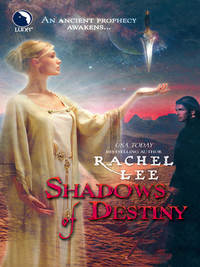
Читать книгу: «Shadows of Destiny»
Shadows of Destiny
Rachel Lee
 www.mirabooks.co.uk
To Holly, for the song of Anahar.
And to Matt, for the courage of the Anari.
Contents
Chapter One
Chapter Two
Chapter Three
Chapter Four
Chapter Five
Chapter Six
Chapter Seven
Chapter Eight
Chapter Nine
Chapter Ten
Chapter Eleven
Chapter Twelve
Chapter Thirteen
Chapter Fourteen
Chapter Fifteen
Chapter Sixteen
Chapter Seventeen
Chapter Eighteen
Chapter Nineteen
Chapter Twenty
Chapter Twenty-One
Chapter Twenty-Two
Chapter Twenty-Three
Chapter Twenty-Four
Chapter Twenty-Five
Chapter Twenty-Six
Chapter Twenty-Seven
Chapter Twenty-Eight
Chapter Twenty-Nine
Chapter Thirty
Chapter Thirty-One
Chapter Thirty-Two
Chapter Thirty-Three
Chapter Thirty-Four
Chapter Thirty-Five
Chapter Thirty-Six
Chapter Thirty-Seven
Chapter Thirty-Eight
Epilogue


Chapter One
“And be ye faithful always, one to the other,” the priestess intoned quietly.
“And be we faithful always, one to the other,” Tom Downey and Sara Deepwell responded.
“The grace of the gods be with you always,” the priestess said. “You are now one before this company, before the gods, in this world, and in every world where you may travel.”
Tom and Sara kissed. Cilla Monabi could feel the radiant glow in her sister Ilduin’s heart, and her own heart shared Sara’s joy. Yet this time of joy would be fleeting. Sara met her eye, just for an instant, and nodded. She, too, knew.
But for tonight, they would celebrate.
The stones of Anahar did not sing in celebration, though Cilla could feel the joy of the gods as she walked through the temple. A precious love was joined, and even in a world fraught with war and the black hatred of Ardred, that precious love was worthy of joy.
The marketplace before the temple was adorned with the trappings of a wedding, for in the wake of the war that had taken so many of their number, the Anari longed for just cause to wear their finest, cook their best, sing and dance beneath the stars. Cilla found Ratha at the edge of the crowd, his iridescent blue-black face impassive, his obsidian eyes unreadable.
“Dance with me, cousin,” she said.
“I cannot,” he replied quietly, almost with shame.
Cilla placed a hand on his strong, muscled, scarred arm. “Look around you, Ratha. The men and women of Monabi Tel are dancing. Giri was their kin, and my own as well.”
“He was my brother,” Ratha said. “We had endured so much together. I am not whole without him.”
They had endured much, Cilla knew. Ratha and Giri Monabi had been betrayed by Cilla’s brother, captured by Bozandari slavers and sold on the block, until Lord Archer Blackcloak had gained their freedom. Their hardships had not ended then, for as they rode with Archer they had found themselves drawn into the lives of warriors. When they had finally returned to Anahar, at the dawn of winter, it had been to kill their betrayer, and then to train and lead the Anari in war.
Ratha had atoned for killing Cilla’s brother, for she had witnessed that act, and her brother’s confession, and pronounced it justice. Such was her right as an Anari priestess and judge. But Ratha had sojourned in the desert to cleanse his soul, and he had returned a different man. Still a warrior, but no longer with a thirst for blood. He had hoped that Giri, too, would find that redemption. Instead, Cilla knew, Ratha had watched as Giri was cut down in the savage battle of the canyon that had destroyed the Bozandari invaders.
And Ratha had not been whole since.
“Dance with me,” she said again, softly, insistently. “Dance with me as Giri would have, with joy in his heart and a jest on his lips. That was your brother’s magic, Ratha. Do not let it die with him.”
He moved as if his limbs were stiff with frost. But he moved. Cilla took his hand and led him to the dance.
Tess Birdsong, too, patiently tried to draw a man to dance. But like Ratha, Archer Blackcloak seemed to find little room for joy in his heart. Guilt weighed upon him like a mantle of lead, and Tess knew it was a guilt neither she nor a wedding could push aside. Yet somehow, she must.
She was no longer the terrified, confused, lost woman who had awakened in a field of blood and death those many months ago. But enlightenment had borne a steep price. Though she had not chosen it, destiny had chosen her, and she was as shackled to its whims as an Anari slave in a Bozandari market.
And still, she did not know who she really was. Amnesia had stolen most of her memory, and while the Temple of Anahar had revealed moments of her past to her, it had failed to fill in all the empty places.
Tonight she had worked to look her finest, her blond hair, longer now than it had been when first she had awakened with a mind as bare as a newborn babe’s, was threaded with blue ribbons and golden trinkets Cilla had loaned her. Her dress, blue rather than the white she usually wore, had been made for her from a fine, glistening fabric found among the spoils of the army they had defeated. Golden ribbon wound it about beneath her breasts, across her middle and around her waist. On her feet she wore fine golden slippers.
Dressed, she thought, like a queen, for a moment of joy that carried the shadow of death.
For death would come. She knew that to the core of her being. Too many had already died and too much evil yet remained.
She avoided touching the walls of the temple. Tonight she needed it to yield no secrets to her, and she feared the stones might do just that.
Outside she sought Archer with her eyes. Something about him remained always apart, even from his closest companions. Hence it was no surprise to find he had stationed himself in shadows at the edge of the square. He leaned against the corner of a rainbow-hued building, one arm folded over a broad chest cased in black fabric. Of all the people present this night, only Archer wore black. He was the quiet mourner at the edge of the celebration, the one who knew better than any of them all that lay ahead.
His gray eyes missed little as he watched the dancers, jugglers and musicians. He even smiled as Tom and Sarah emerged from the temple, wed at last.
But it was a smile that didn’t reach any further than his face.
Feeling a pang for him, Tess made her way through the crowds to his side, and reached for his tanned and battle-scarred hand.
He looked down at her as she gently squeezed his fingers.
“’Tis a fine night for a wedding,” he said.
“Aye, but you look less than joyful. Come, dance with me and allow your heart to lighten for just a brief while.”
“Is yours lightening?”
After a moment, she looked down, away from his perceptive gaze. “We all know what has passed, Archer,” she murmured finally, her words barely audible above the music and laughter. “And we all know what lies ahead.”
“I very much doubt anyone knows what lies ahead. ’Twill be far worse than what we have so far faced.”
“Aye,” Tess nodded. “I have dreams, such dreams….” Her face shadowed, but then she looked at him with a determined smile. “However it may be, and whatever looms ahead, the gods have decreed that we must live. So let us live this night.”
After a moment, he acquiesced and led her into the square to join the other dancers. She had never, to her memory, danced before, but it wasn’t long before Archer had helped her master the simple steps and she was whirling with him in the outer circle of dancers that surrounded an inner circle moving in the opposite direction.
When the feet and body moved to such happy music, it was impossible to remain sad. Before long, Archer smiled and his feet seemed to grow lighter. Tess let go of the pall that always shrouded her heart and let laughter flow freely.
Regardless of what the morrow might bring, life had granted a respite, and she felt it would be wrong, very wrong, not to savor these precious moments of joy.
Topmark Tuzza, the Bozandari commander, could hear the rejoicing in Anahar halfway across the valley where he and his men were imprisoned behind fences, watched by Anari guards. They had been defeated in battle three weeks before by the Anari, and they were still licking their wounds.
The topmark had been invited to the wedding, but had refused the honor. His men were not yet ready for what he was about to ask of them, and he was not about to anger them by attending the wedding as an honored guest. He could not afford to lose his authority over them.
Yet even after all this time, he could still not think of a way to broach the subject. Many of his men, most of his men, thought of the Anari as a slave race. They had set out to conquer a rebellion against the authority of the Bozandar Empire.
How was he to persuade them that there was a greater evil, and a greater cause? That they now must switch allegiance, but yet would not be betraying their own families and people?
Tuzza was no dull man. Sharp wits more than family connections had raised him to the heights. He was related to the emperor, yes. But so were many others. It was only through achievement that Tuzza could stand directly behind his emperor at important events, could offer words of advice directly into his emperor’s ear.
He would be seen as a fool and a traitor when his intent became known. Either one would be enough to make his men turn on him.
Closing his eyes, he listened to the distant sound of reveling, and leaned back in his camp chair, seeking yet again the words that would persuade.
His men, of course, had seen the many healings the Ilduin witches had caused. Many of the more severely wounded had benefited greatly from the Ilduins’ touch…as had he himself. Some had even outright marveled that after a battle so bitterly fought, the Ilduin, who had fought beside the Anari, had been so willing to heal their enemies.
Perhaps that was the place to start. Perhaps he should speak of the Ilduin and the Lord Annuvil, he who was the First Prince of the Firstborn King, long before Bozandari and Anari had ever walked the face of this world. Perhaps he should remind them of the tales of old, and of the nearly forgotten prophecies that foretold such a time as this.
Of course, if he had not himself seen the Ilduin and their powers, had not seen the Lady Tess lead troops into battle, then with one word from her mouth cause the conflict to cease…Tuzza himself might not have believed the dark man who had come to him and said, “I am Annuvil.”
The Firstborn Immortals had vanished so long ago, so many centuries in the past, that it was hard to believe one of them yet survived. Two of them, actually, according to Lord Annuvil.
Yet Tuzza could not deny it. He had seen what he had seen, and he was still alive only because of it.
These times had been foretold. The outcome was unwritten, but the return of the Ilduin and the Firstborn King were writ in more than one prophecy. They were writ on the fabric of every soul, every mountain and stream, every rock and tree, every bird and bear, serpent and snow wolf. They were writ by the gods themselves, and Tuzza knew better than to dispute such a destiny.
His mother had schooled him thus from the time of his birth. His mother and the old Anari woman, each of whom had sat beside his bed and told him stories when he was too ill with fever to rise and run and play. The same two women who had patched his wounds when he fell, ensured that his bedding was clean and that his pillow bore the fresh scent of spring flowers. Looking back, he could hardly remember where his mother left off and the Anari woman had begun, could hardly distinguish which of them had performed which graces in his youth.
They had taught him to respect the old ways, and sometimes—when she was sure no one else could hear—the Anari woman would speak in the Old Tongue. Fragments of words floated into his consciousness, and though he knew not their meaning, he felt once again that sense of wonder, of contact with life, with light, with the gods themselves, which had filled his heart in those bygone days.
But in his childhood that wonder had been bright and beautiful, song and light. It was a dark wonder that now filled him. Fear and grief and a bottomless, aching loss for the men who had died under his command, and the many more who would die in the war to come.
It would be Tuzza who would lead those men—the same men who now sulked sullenly under the eyes of their Anari captors—once again into battle. He would lead them into battle with an Anari host at their sides and a Bozandari host before them.
And more would die at his hand.
Chapter Two
They danced until their bodies were weary, yet their minds did not tire. At last, Archer and Tess slipped away from the revelers and into the quieter night beyond the city of Anahar. Above, the stars looked cold and unforgiving, and beyond the warmth of Anahar’s walls, the wind held a bitter bite.
The unnatural winter, which to the north had left so many to starve and freeze to death, now at long last was reaching the normally warm lands of the Anari. Never had snow been seen in Anahar, but Tess suspected that would soon change.
“His breath still blights the land,” Archer murmured. Lifting his cloak, he drew Tess within its warmth, against his side. “Can you tell yet how many Ilduin he has subverted?”
Tess shook her head, grateful for the warmth Archer shared with her. “Other than the two I have already found, I cannot yet tell for certain.” Her hand lifted to touch the pouch of colored stones that hung around her neck. Each stone belonged to one of the twelve living Ilduin. When she held them in her hands, she could draw on the power of her sisters, or communicate with them. But some yet remained out of reach, beyond her ability to call. Two she was certain belonged to Ilduin who had fallen into Ardred’s clutches. But others remained a mystery to her.
“I am sorry,” she said after a few moments. “If I knew all the other Ilduin, it would be easier. But so far I have met only Cilla and Sara. Some of the others I can reach, while others yet remain untouchable to my mind. It may be that they themselves have not yet discovered their powers.”
“Indeed. Many believe the Ilduin long dead and gone from this world. Why should not some of the Ilduin be among the nonbelievers?”
He sighed. A gust of wind at that moment snatched his cloak and lifted it, blowing its icy breath inside. Tess shivered.
“I fear,” he said presently, “that Ardred must claim more than two of your sisters. This winter he inflicts on us is a sure sign of his growing power.”
“I fear it, too.”
“With the Bozandar Empire lying between us and the lands to the north, it is impossible to learn how many others he and his hive-masters have drawn in. We will need Tuzza’s help to pierce the veil and glean information.”
“I know.”
“A relief army will be leaving Bozandar soon, to come look for Tuzza’s army. There will be a terrible battle. But Tuzza has not yet found a means to convince his men to fight beside the Anari against the greater evil, especially since it may require fighting their brothers-in-arms.”
“It is essential we gain the cooperation of Bozandar.”
“Aye.” He looked down at her, his face unreadable in the starshine. “I would hear any suggestion you might have.”
That was when she realized that he had at last begun to trust her. Always before there had been a sense that he doubted her real purposes. It was a doubt for which she could not blame him. After all, she could remember nothing before the horrific day the past autumn when she had awakened among the slaughtered caravan, knowing not even her own name.
Sometimes she wondered if she should trust herself. At times she had felt the touch of the Enemy, Lord Ardred, like a dark shadow in her mind, seeking, always seeking, something from her. It had been a while, though, since she had felt that chilling, oily touch in her mind, and for that she was grateful.
“I wish I had a suggestion,” she said finally. “I don’t think asking those soldiers to become traitors is going to be easy for anyone, no matter how silver-tongued.”
She felt, rather than saw, his agreeing nod.
“Yet,” he said after a moment, “they will not be traitors, but saviors. Saviors of all men.”
“So go in and tell them who you are. It worked with Tuzza.”
A sigh escaped him, barely heard before it was snatched away by the wind.
“How many will believe that I have lived for so long, hidden among them?”
“I find it hard to believe myself. Has it been as awful as I suspect?”
“It has been a curse. Death would have been welcome countless times. And yet it is a just punishment. My deeds led to the end of the Firstborn. Why should I not wander the world, a stranger among strangers, for the rest of eternity?”
“Not your deeds alone.” She turned to face him, allowing the icy wind to come between them. “Just because you have a conscience does not mean that you alone are responsible. I have looked into the past in my dreams and in the old stories, and what I see is that many were responsible in different ways. Say what you will, Annuvil, the guilt is not yours alone.”
“Mayhap not. What does it matter? I have been preserved for this time, these events. Perhaps if I acquit myself well and do what is expected of me this time, the gods will set me free.”
She tilted her head back to better see him. “You would wish your own end? Are you sure that is a good wish for a man who will lead us in the war against Ardred?”
Surprising her, he chuckled. “There are many ways a man can be set free. Perhaps at last I will be free to be mortal. Perhaps it will be something else. How should I know? The minds of the gods are ever opaque.”
“I am coming to know that well.” She felt a wave of relief at his laughter, though she couldn’t have blamed him for being bitter about his lot. Nor could she imagine how awful these centuries must have been for him.
“It’s a wonder,” she said slowly, “that the years did not drive you mad.”
“Sometimes they did. I am grateful that I have little memory of those times, however. They are blurred in my mind, and all sense of time was lost. I sometimes lived like a beast in the forest, I believe.”
“I’m sorry. Sorry and awed, for I cannot imagine surviving such a thing. How did you make yourself go on?”
“I was promised,” he said slowly. “I was promised that someday my Theriel would be returned to me.”
She stepped back even farther, and ignored the cold wind. For some reason she could not readily name, she felt…hurt. “Who promised you?”
“Elanor. She came to me after…after the destruction. She promised that if I served her well, in the end I would see my wife again. I have clung to that promise.”
“Are you sure you can trust Elanor? Or any of the gods?”
He shook his head. “No. I freely admit I cannot. Their purposes are not ours. But…it is all I have. My heart died with Theriel, and the remaining ember is all that I have left. I must believe.”
“I can see that.” She turned from him, letting his cloak fall away, letting the wind sweep over her and chill her to her very bones. She spread her arms as if to embrace the winter night. A snowflake, such as had never fallen in this valley in the memory of men, drifted down and landed on one of her fingertips.
“I don’t know who I am,” she said slowly, watching the flake melt. “I don’t know where I am from. I have no promises to uphold me. Yet here I am, and I do what I must.”
“Then perhaps your burden is the greater by far.”
She turned suddenly and faced him. “What do they mean when they call me the Weaver?”
“It is said that one day an Ilduin would come who could touch the warp and woof of reality, and bend it to her will.”
“And they think I am that person?”
“You wielded the Weaver’s sword in battle.”
“Anyone could have wielded that sword.”
He shook his head slowly. “Not as you did.”
She closed her eyes, remembering the moment when Tom had placed the sword in her hand and told her what it was. After that, everything had become a great blur. She had little memory of the battle afterward, and knew only what she was told: that she had led a force of men against a flanking attack and had saved the day. That later, with one word, she had caused the battle to instantly still.
A great fear began to tremble in her, colder than the cold that surrounded her. “What does it mean? What is expected of me?”
“I know not.”
“The prophecies. If the Weaver is mentioned in them, there must be some hint, some clue!”
“Have you not realized by now how prophecies are more riddles than foretellings? I cannot tell you what it is you are to do. I cannot tell you how to do it. You must trust, my lady, that when the time comes you will know.”
“There is too much call for trust.”
“I know.” He looked past her down the valley to where the fires burned in the prison compound. “They too must find a way to trust. For trust, I believe, is all that will save us from the wiles of Ardred.”
She turned from him and looked down the valley, too, thinking of the men who must be huddled around those fires, despairing and perhaps even bitter in defeat, a taste that no Bozandari had known before. “Aye,” she said, her heart heavy with dread. “They, too, must trust. And perhaps that will be the most difficult thing of all.”
That night, in her dreams, the white wolf came to her again, as he had twice in reality. He howled, a mournful, spine-tingling sound, then seemed to gesture for her to follow him.
Through the mists of her dream, she slipped after him. As was the way of dreams, she never wondered why she followed, or what the wolf wanted of her. Nor did she feel any fear.
Gradually the mist softened, then faded until she could see the woods through which they traveled. Always the wolf was just ahead of her, pausing in his easy, long-legged lope when necessary to let her catch up.
At last they emerged into a clearing. Above, the sky glistened with a carpet of stars thicker than any she had ever seen. Then, around her, she heard the murmur of voices. She could not make out the words but sensed that she stood in the center of some invisible gathering.
Until now, she had felt nothing, but as she stood there, her discomfort grew, because she felt as if she were being judged by some unseen jury. The wolf remained at her side, but his presence offered scant comfort. She began to think of fleeing from this haunted clearing. At that instant the voices fell silent.
Then a woman stepped out of the shadows, her face concealed by a hood that cast it in darkness.
“Many,” the woman said quietly, “are your sisters who have gone before you. To none of us fell the burden that now befalls you. Yet each of us, in her own way, has prepared your path with promises and prayers. We cannot tell you what is to come, for the gods make a game, and we are bound by their rules. But we will be with you, little sister. If you hear a whisper on the air, listen for our voices. All that lies between is a veil, and that veil can be pierced.”
Before Tess could question her, the woman had vanished back into the shadows. For a second or two, she could hear the quiet murmur of the voice again.
Then she was alone in the clearing with only the white wolf.
He nudged her hand with his cool, damp nose and she blinked.
And gasped. For she no longer stood in the clearing at all, nor was it any longer dark.
Dawn was breaking over the mountains to the east, wreathed in red and pink and orange, the globe of the sun not yet visible.
Nor was she in her bed. She stood halfway between Anahar and the compound housing the Bozandari prisoners of war.
The frigid morning air made her cheeks sting, but she was still surprisingly warm. Looking down at herself, she saw that she had dressed in her fine white woolens and boots, with her cloak about her shoulders. Had she done that in her sleep?
A sound behind her made her swing sharply around, and she gasped as she saw the wolf was still with her.
What was going on? Had she been dreaming? Or had she been awake in some netherworld? Had long-dead Ilduin really spoken to her?
Or was she simply losing her mind?
But then the wolf came toward her and shoved his big, soft head beneath her hand. Instinctively she scratched him behind the ears, and marveled at how silky his coat felt.
She must have been sleepwalking, she thought. Thank goodness she had dressed before setting out from Anahar. Else she would be frozen and dead right now, it was that cold.
She was about to return to the city on the hillside when the wolf tipped back his head and howled. It was a beautiful sound, music unto itself.
And it was answered. Tess felt her scalp prickle as wolves howled back from the awkward, hardy trees that made life for themselves in the green desert that was the Anari lands. The sound was eerie, as eerie as anything she had ever heard. There must have been dozens of them.
But then they emerged from the trees, still howling, a harmony among their voices that reverberated until it sounded as if they numbered in the several dozens. But there were only seven more of them, all as white as the one that stood beneath her hand.
She should have been terrified. She should have fled. She should have tried to call on her powers for protection. Instead she remained rooted to the spot as the wolf pack ran toward her, their yellow eyes bright, mouths relaxed in smiles, as if they were coming home.
When they reached her, their howling stopped and they began to make quiet whimpers and whines as they swirled around her legs, sniffing her as if to learn her. Then, as if by silent order, all seven sat on their haunches and looked up at her.
She spoke, not knowing what else to do. “What do you want?”
The only answer she received was from the pack leader. His head moved from beneath her hand so that he could tug at her robe with his mouth.
He pulled her gently.
Toward the prison compound.
And all the others followed, as if they were tamed beasts at her beck and call. But she knew otherwise, and wondered what it all meant.
Ras Lutte, formerly overmark of the Bozandari army, approached his ruler slowly, as if hoping to avoid notice. He had news to bring, and bring it he must, for such was his duty. But he knew the meaning of the dour visage upon the throne, a face that seemed to bear the weight of the gods themselves upon its features. Lutte was all too familiar with that expression. It had been months, it seemed, since his ruler had borne any other.
Yet the ruler was still an astonishingly beautiful man, fair of complexion, golden of hair, blue of eye. To Lutte and others, it seemed he might even be the spawn of the gods, for never had a man so handsome and charismatic ever been seen before.
Until this brooding had begun.
But at least no one died from these silent broodings.
“My lord,” Lutte finally said, after placing his right fist to his heart and bowing at the waist. “I pray that I disturb thee not, yet the woman has spoken.”
The man on the throne looked up slowly, as if all of his strength were required simply to lift his head. Lutte could not be certain, but he thought he saw tears in his ruler’s eyes. Immediately, Lutte lowered his gaze to the floor. Such things were not to be seen.
“What is it, Overmark?” the ruler asked, each word seeming to wend its way from the bottom of a deep cavern.
“The Weaver summons the wolves, my lord. Soon, the woman says, the Enemy host will march.”
The man’s eyes closed for a moment, then he nodded. “Just as it was foretold.”
Lutte knew little of prophecy and trusted less than he knew. He was loathe even to trust the woman who sat in her room like the shell of a human being, hardly taking even food or drink, her body nearly as desiccated in life as any Lutte had seen in death.
He was a man of science and mathematics, the science and mathematics of war. Born into the Bozandari peerage, trained in the Academy of War, tested in battle, proved in a half-dozen campaigns. His exile after an affair with a topmark’s wife had not changed his nature. It was possible to take the soldier out of the army, but never to take the army out of the soldier. Now he had found another army, and he had taken to the task of training the ragged band of outlaws and exiles into a smoothly functioning fist to be wielded at his will.
But not his will. The will of his ruler. And the will of his ruler was guided by prophecy and the mumblings of the woman. It was, Lutte thought, a shaky foundation upon which to base a campaign. But he had learned loyalty in the academy, and his personal dalliances aside, his professional loyalty was a matter of pride.
He relayed the woman’s words as if they were those of the most accomplished spy, not because he trusted her or her ramblings, but because it was his duty to do so.
“If this is so,” Lutte said, “then our agents in Bozandar must be at their task. Surely Bozandar can crush the slave people and end this rebellion.”
“Bozandar will not be our ally,” the ruler said. “In the end, it will come to us and us alone. It will come to me. For only I can slay my brother.”
Again he is on about his brother, Lutte thought. As if the rest of the world were mere pawns in this sibling rivalry. Lutte had heard the whispers, that his ruler was in fact the second son of the Firstborn King, but he did not believe them. The children of the Firstborn were long dead, if ever they had existed. Lutte needed no ancient good or evil to empower him. The evil of the human heart more than sufficed to afflict the world. And only the good of the human heart could bring it comfort. The rest were tales, legends, myths told to fortify the sheep against the hardness of life, and make the sheep compliant within it.
“Is there anything else?” the ruler asked.
“No, my lord.”
“Then go,” the ruler said. “Tend to your numbers and your geometries. And pray that you never stand on a field where straight lines bend and twice two is not four.”
He did not read my mind, Lutte thought as he bowed and turned to leave. His face had betrayed his skepticism, and his ruler knew of his reputation. It was nothing more.
What a pity, Ardred thought as Lutte left. What a pity that such a talented young mind should lack the most essential of all knowledge: the numbering of the gods, the geometry of the soul.
Lutte was a good soldier, but poor counsel. What he lacked, Ardred most needed. For no man can make war upon his brother with lightness of heart, whatever their past. Once, Ardred had laid siege to Annuvil. Now Annuvil would come to lay siege to Ardred.
Lutte thought he knew what danger lay when two men loved a woman, for such had been his crime. But he knew nothing at all.
Ardred must kill his brother. The world could not be stitched back together until Annuvil was dead. Only then would the glory and true power return.
And all this for the love of a single woman.
Theriel.
Chapter Three
The rustle began at the edges of the Bozandar camp. Muted gasps and movements filtered through the camp as if through the muscles and sinew of a waking giant, slowly willing it into motion. Tuzza put down his pen and emerged from his tent, his senses alert for any hint of danger or malice. He felt none, and slowly made his way through the gathering throng of soldiers at the eastern fence.
“It cannot be!” one man whispered.
“They cannot live so far south!” another added.
“My eyes deceive me, for they bend to her!”
Tuzza shouldered his way through until he could see for himself what had caused such a stir. And his mouth dropped open.
There stood Lady Tess, a semicircle of snow wolves arrayed behind her, silent yet alert, their eyes fixed on her as if she were their pack leader. One of them, however, stood beside her, golden eyes searching among the soldiers until at last they fixed on Tuzza. A shiver ran through him as he made eye contact with the beast, a recognition of something preternatural and unexplainable.
So it was true.
Tuzza instinctively lowered himself to one knee and bowed. He had no need to speak, for his men were still soldiers, whatever their current lot. They knelt with him.
“Rise, Topmark Tuzza,” the woman said, her voice quiet but firm. She spread her hands behind her, indicating the wolves. Then the fingers of one hand returned to rest on the head of the snow-white beast beside her. “Rise and make way for your Lady and her court.”
“Fall in!” Tuzza commanded.
Some, those whom fortune had placed at the rear of the battles and who had not needed her healing touch, grumbled. But they were the fewer, and the looks of their comrades shamed them into obedience.
“Dress ranks!” Tuzza said.
Even in those who grumbled, the first act of obedience had rekindled the training and drill that countless hours had transformed into automatic responses. The men adjusted their spacing, and soon stood in lines so straight that they might have been set down by a surveyor.
Tuzza faced Lady Tess. “My men stand ready, m’lady. We are at your service.”
“Very well,” Tess said, now striding toward them as if she were gliding on air, the wolves in her train.
She marched to the front of the formation, then turned to face them. Once again the wolves took up their places behind and at her side. When she spoke, her voice was clear and strong, a bell ringing in the soul itself.
“I am she who was foretold,” Tess said. While she loathed the words and what they meant, she knew their truth. She could not hide from herself any longer. “Believe, or disbelieve. But disbelief will be your doom, for you will disbelieve that which you now see for yourselves. Topmark Tuzza stands at my service. Where stand you?”
For long moments, the host stood frozen. Tuzza stepped forward and ranged himself beside the lady. Now, perhaps, he could quell the unrest in his ranks and refashion from them an army. He spoke quietly, yet pitching his voice to reach even the most distant of ears among his men. “The days we learned about as children, the days we thought were mere tales fashioned for our amusement, have arrived. While we may have to fight our brethren, our purpose is not to bring about the fall of Bozandar, but her salvation. For the Enemy we fight would bring the death of all.
“Stand with me, my men, for the sake of your families, for the sake of your children yet unborn. For if we do not stand now, we shall face the fate of the Firstborn, and never shall our names be heard again.”
He could see his men wavering, uncertain in their loyalties. Outside the walls of the compound, however, the Anari guards bent their knees and made signs of fealty toward the Lady Tess. Then the wolves began to keen, a sound that made the hair on the back of a man’s neck rise, that sent a tingle running along even the bravest spine.
With a simple movement of her hand, the lady silenced the wolves, a sight so shocking that many doubtful hearts were swayed.
“Brave men of Bozandar,” she said, “declare yourselves now, for your entire future is writ in this moment.”
A ripple of movement ran through the ranks, and when stillness again returned, every soldier had knelt.
The lady opened her arms and turned her face heavenward. To those with eyes to see, she almost seemed to glow a pale blue, an aura that enveloped the wolves at her feet. Then snow began to fall, gently, sparkling in the rising dawn light, looking almost like blood. Above, gray clouds churned, marked red here and there as the sun rose above the mountains.
“He brings the snow,” the lady said. “He seeks to destroy you with cold and hunger. He would murder your brothers and leave barren the wombs of your sisters. He would strike from the fabric of time your very existence. I will not let this be.”
Reaching up with one hand, she appeared to grasp something in the air and twist it. A sudden wind sprang up, strong enough to make men lean. As it blew, it drove the clouds away, clearing the sky until it was the perfect blue of dawn.
The lady lowered her arm and looked at all the men kneeling before her. “Rise,” she said. “You have chosen wisely this day. I will arrange better accommodations for you as swiftly as I can. May Elanor bless you and your families.”
Then she turned and exited the compound, the wolves a protective phalanx around her.
In the Bozandari compound, the murmuring and even arguments continued throughout the day. Some refused to believe what they had seen. The vast majority, however, believed their own senses, and eventually argued the dissenters into silence.
The strongest voices among them were the voices who had seen Tess on the battlefield, those who had seen or experienced her healing and that of her sisters.
Such magicks had long vanished from the world, and had long been thought to be silly tales. Now those who had seen with their own eyes no longer could deny the truth of the stories.
Tuzza chose to remain mostly out of sight this day, while the discussions raged outside his tent. His men had elected to offer fealty to the lady, and he never doubted that they would keep that oath. Honor was held in the highest esteem by the Bozandari army, and these men would not go back on their words. Yet still they might argue about what they had seen and what it meant.
Toward evening, as the sky reddened again to the west and the camp began to settle for another cold night, Archer Blackcloak, he who was Annuvil, came to the prison camp to speak with Tuzza.
The first thing Tuzza noted was that Master Archer, as he preferred to be called, seemed to have grown somehow since last they spoke. It was as if in shouldering the burdens left to him by his heritage, as if in announcing his true identity, Archer had grown physically as well as figuratively. The lines of care and suffering still carved his face deeply, but they only enhanced the sense of power about him.
Tuzza offered him wine, and the two of them sat at the wooden camp table, the map of the Bozandari world between them.
“I heard,” Archer said, “that the lady paid you a visit early this morning.”
“Aye, she did. With eight white wolves.”
Archer’s mouth lifted in a smile. “That must have commanded attention.”
“I am not certain what commanded the most attention—the wolves or when she stopped the snow and drove away the clouds.” Tuzza, who had believed himself to be the most unsurprisable of men, nevertheless sounded awed as he spoke of the lady banishing the storm.
Archer nodded and sipped his wine. “She is full of surprises, that one. Nor does she yet know all she can do.”
“A wild talent?”
“At times. For some reason, the gods deprived her of all memory when they brought her to me and my friends. Whatever she may have known before, all is lost. She knows only what she learns with each passing day.”
“Then she has learned a great deal.”
Archer nodded. “Quite a bit in such a short time.”
“I hear the Anari guards referring to her as the Weaver. Do they mean the one foretold?”
There was a glint in Archer’s eye. “What think you, Tuzza? Did she reach out and cast away a storm?”
“I saw it with my own eyes.” He looked down into his wine and breathed, “The Weaver. I never thought to see such a thing.”
“Few of us did. I do not mind saying that living in the times foretold by prophecy will bring little joy to most of us.”
“No. These will be hard times.”
“The hardest. We will all be sorely tested. Sorely indeed.” He caught Tuzza’s gaze and held it. “All we will have, brother, is trust in one another. I cannot tell you how important that will be.”
“You call me brother?”
“Aye, for you are about to share my burden. And no joyous road it will be.”
“I am honored, my lord.”
“Speak to me of honor when we have passed through this shadow and can clasp hands on the other side.” Archer shook his head. “I have known for centuries that this time approached, yet I am no more ready to face it than I ever was. And it grieves me that others must share my burden, for if I had chosen to act differently long ago, this would never have come about.”
“And I might never have been born and never have seen my children grow to adulthood.”
Archer smiled faintly. “You are very positive.”
“One must be positive to lead an army.”
“Aye, it is so.”
They sat quietly together for a while, sipping their wine, a silent camaraderie growing between them.
The first to break the silence was Archer. “Do you trust your men?”
“Aye. We regard honor very highly.”
Archer nodded, then leaned closer. “Watch them nonetheless, brother. For he has ways of taking over the minds of men. You have heard of the hives?”
“Aye, but I have never met one.”
“You will, before this is done. He draws men into his sway, then bends their will to his. He can even occupy one of them if he wishes. It is as if they have only a single mind, and it is strange to see how they work in concert. That is how he controls his armies.”
Tuzza looked appalled and took a deep draft of his wine. “That will worry me.”
“It should. Once he takes them over, they even lose their fear of mortality. It is unforgivable that he uses them thus, but he does and you must be prepared for it. And you must ever be wary that he might take control of some of your soldiers. For he will certainly try.”
“How can I guard against it?”
“I know of no way to stop it. But when it happens…Ilduin blood judges harshly. Be wary and tell your men to be wary. And know this. While your men may hesitate at the thought of battle with other Bozandari, those whom he holds will not hesitate to cut your men down like chaff.”
After a few moments of clearly pained thought, Tuzza refilled their wine goblets. “Then tonight, my lord brother, we must enjoy the fruits of the earth and the gifts of the gods, for we cannot know when our hour will come.”
Archer raised his goblet in toast and took a deep drink. “We need information about what is happening to the north of Bozandar. Since the rebellion, your armies have made it all but impossible to send scouts in that direction. If there is any way you can get news, I will be grateful. It is never wise to march blind to meet an enemy.”
Tuzza nodded. “I will find a way.”
“I’m sure by now an army marches to your rescue. Ponder on this, Tuzza, for I would not engage them in battle and waste lives needlessly. We must find a way to prevent the fight and convince them to join us.”
“That will be even harder than today was.”
“Aye. I have some notion of the stiff spines of the Bozandar army. And whether you believe it or not, the Anari are every bit as stiff-spined. I would avoid the bloodshed if we can. We are going to need every able man to fight the evil that comes.”
Tuzza’s mouth framed a wry smile. “And apparently we will need some Ilduin as well.”
“Aye, for he has corrupted at least two that we know of, and there may be more.”
“Fire must be fought with fire.”
“Sad to say. I would not corrupt these women in any way, had I the choice.”
Tuzza sighed. “I think they will not be corrupted, my lord. They will see what they should not see, and perhaps do things they will regret, but they will understand why the choices were forced upon them, as any good soldier does.”
“I hope you are right. The three who are with us seem somehow steeped in unassailable purity. I fear it will not last.”
“War carries a heavy toll. But perhaps Lady Tess can travel with me to meet the advancing army. If she could do for them what she did for us today, my job of persuasion would be ever so much easier.”
Archer lifted a brow. “You will not ride alone regardless, Tuzza. For I will not have you called traitor and carried away in shackles. You are no traitor, and we need you.”
“Treason is in the eye of the beholder, Master Archer. My emperor will not see my actions as anything other.”
“Then we need to enlighten him as well.”
Tuzza almost laughed. “He is not an easy man to persuade.”
“Perhaps he has never been swayed before by an Ilduin.”
“Certainly not by the Weaver.”
Archer’s expression grew grave. “She must be guarded at all costs, Tuzza. Ardred will stop at nothing to claim her. The mere fact that prophecy predicted her appearance is no guarantee of safety. The days and weeks to come hold no guarantees. At this point, the future is no longer writ, even for the most gifted of prophets.”
Tuzza’s answering nod was grim. “I understand, my lord.”
“Tomorrow I would take you into Anahar with me to meet my lieutenant Ratha. It is time for us to forge bonds between us, and we must forge them like the finest steel if we are to withstand the onslaught to come.”
“It will be no easy task.”
“No part of this task will be easy. The faint of heart may as well flee right now.”
“There are no faint hearts in this camp, my lord.”
“Nor in mine. But we will come across them, just as we will come across enemies stronger than you now imagine.”
“I have seen what the lady can do, Lord Annuvil. Trust me, I can imagine.”
Chapter Four
We should listen in, Cilla thought, an impish smile on her dark features as she met Tess’s eyes.
Without a doubt, Tess agreed, meeting her gaze. She was still sometimes surprised at the ease with which she and her Ilduin sisters could touch each other’s minds, and remembered the first time she had noticed this ability, as Sara and Tom had demonstrated their love for each other.
Ahem! Cilla and Tess immediately looked to Sara’s window, where Sara was glaring back at them with a mock stern expression. Can a girl have a bit of privacy, please?
Cilla put a hand to her mouth to suppress a laugh, mirth dancing in her eyes. But sister, you are the only hope we have!
Get your own man, Sara thought with a toss of her head, followed by a wink.
I’m trying, Cilla thought. I’m trying.
Tess laughed aloud and drew Cilla aside. “Come, sister. Let us walk together and leave sweet Sara to enjoy her new marriage.”
“Of course,” Cilla said. “’Twas only sport.”
“And pleasant sport at that,” Tess said, her smile fading. “But as our men have gone to discuss things manly, perhaps we should take the opportunity to advance our own knowledge.”
They walked toward the temple slowly, as if reluctant to end the celebratory mood and resume the hard work that lay before them. Even Tess’s visit to the Bozandari camp had seemed almost a royal visit, born of a dream. The snow wolves had slipped away into the hills around Anahar, and now, even with Cilla beside her, she felt very alone as she walked to face the gods.
“Have you any news of Ratha?” Tess asked.
“He has withdrawn within himself,” Cilla said, shaking her head. “I try to tell him it was not his fault that Giri fell, that it is not wise to grieve alone, but he will hear none of it.”
“Do Anari believe in life after death?” Tess asked. For all the time she had spent in the temple at Anahar, she knew little of their religion.
“Yes,” Cilla said. “Of a sort. Giri is beyond the veil now, in the garden of the gods, but his life there—if life it be—is nothing like life here. Those who pass beyond the veil become all and nothing, united yet unique. All of those beyond the veil can feel one another’s thoughts as we Ilduin can, if thoughts they have at all.”
Tess nodded, ghosts of memories flitting through her mind, wispy and unapproachable.
“You do not remember what your people believe,” Cilla said.
“No,” Tess replied. “Although my heart tells me it was not far different from what you have said.”
Cilla smiled. “Why did you ask?”
“We grieve not for those who have passed,” Tess said. “Their pain has ended, their struggles complete. We ought not to be sad on their account, for the life they have now—whatever it may be—is better than any they have known. No, we grieve for ourselves, for the holes that are left in our own lives by the passing of those whom we loved.”
“This we are taught as well,” Cilla said. “It is as if a piece of flesh has been cut from one’s arm. We do not feel the pain of the flesh which is gone. We feel the pain from the flesh that remains, raw and open and torn. Until the body can repair it, the pain remains. But it is never fully repaired, for the scar we build is not the same as the flesh it replaces.”
“Exactly,” Tess said, squeezing her sister’s hand.
“You are saying that Ratha needs time to build a scar over the hole that Giri’s death has left.”
Tess nodded. “And until he can do that, dear sister, he will be too pained to feel your love for him. Or his for you.”
“Give me not false hope,” Cilla said sharply. Then, after a moment. “Forgive me, my lady. I did not mean to scold you.”
“There is nothing to forgive,” Tess said. “And I am not your lady, but your sister. I must have someone in my life who pays me no homage, but simply shares with me this journey of life.”
Cilla nodded. “Yes, sister.”
“And I give you no false hope,” Tess said. “Trust not in what you see on Ratha’s face just now, nor hear in his words. Ratha cannot look upon you, nor hear you, nor speak to you. Only his grief sees you, hears you, and responds. Grief cannot love. But Ratha can.”
Tess sighed and looked down at the colorful, rainbow-hued cobbles beneath their feet, trying desperately to recall the song that the stones of Anahar had sung when they had summoned the Anari. That song had seemed to open doors within her, to fill her with a sense of awe that had been good, unlike much of the awe she had felt since awaking with no memory.
“Grief,” she said, “is not a gentle thing, Cilla. It claws at us like a ravening beast, and is loathe to release us from its grip. Worse, we find it hard to accept that someone we love is lost to us for the rest of our days. ’Twould be easier for Ratha had Giri left on a long journey with no intent to return. For at least then he would have known his brother still existed somewhere within this world, and that eventually he might hear Giri’s voice again in this lifetime. He has no such hope now. But eventually he will find acceptance, and with acceptance he will return to you.”
Cilla squeezed Tess’s hand. “I pray that you are right, sister. For my heart both leaps and aches every time I see him. Long did I gaze upon him in my childhood, when I hid among the rocks and watched him play. Longer, it seems, was he lost to me after he was taken away into slavery. Then he returned, and it felt as if I had found the missing part of my own soul. And now…”
“Now he is gone again,” Tess said. “For a time. But only for a time, sister. You have been patient these many years. Let not patience fail you now.”
“Listen to you two! Gloom and sorrow!”
Tess and Cilla turned to see Sara, running to catch up with them. Her face shone with the glow of a new bride.
“And why aren’t you in your room with your husband?” Tess asked.
Sara giggled. “Men, it seems, lack…stamina.”
Cilla held up a finger. “You asked for privacy, if I recall? Now you will tell us what we could have heard for ourselves?”
Sara shook her head. “No. I have said all that I will. But a woman cannot live only in her husband’s arms. Not this woman, at least. I need time with my sisters as well. So scold me not for my presence, nor if I should leave you. Tom will not sleep all day, and I will be there when he awakens.”
“I’m quite sure you will,” Tess said, laughing. She turned to Cilla. “Come, let us hurry to the temple, while he sleeps, lest Sara’s…needs…call her away before she can learn anything.”
“Somehow,” Cilla said, “I think she is learning quite a lot. Just not of Ilduin lore.”
Sara smiled. “With sisters such as you, a bride needs no groomsmother. Perhaps the gods will be more delicate.”
“That,” Tess said, sighing, “would truly surprise.” And deep within her, she felt the stirring of anger, anger that her sister’s joy must be overshadowed, anger that they all grieved so much, not only for the past, but for the future as well.
No one, she thought as her steps carried her closer to the temple, should have to grieve for that which had not yet passed. But that sorrow, it seemed, was the fate of the Ilduin.
“The young prophet emerges,” Erkiah said with a smile as Tom entered his chamber. “Although now that you are wed, I suppose that ‘young’ no longer applies. Pray, Tom, tell me why you lie not in the arms of your bride?”
Tom blushed behind the leathern mask that covered his eyes, leaving only slits for him to see through. Ever since Tess had healed him from fatal wounds received in a Bozandari ambush along the road to Anahar, his irises had grown so pale that he could no longer bear bright light. The mask Tess had thought to make for him had saved him from being virtually blind. “I pretended to sleep. I love her like a fish loves the river, yet we have been so busy these past days in preparation for the wedding…and I found myself missing my studies.”
Erkiah waved a hand at his young charge. “Apologize not, my friend, neither to me nor to her. Apparently she waited only minutes after your ruse before scurrying off to meet her sisters at the temple and continue her own work. In other times, lovers might pale at such a thought. But you both know there is much to be done and little time in which to do it. The shame is only that you could not speak openly of it, one to the other.”
“I fear I am not yet accustomed to marriage,” Tom said. “Nor is Sara, I suppose.”
“I pray that you will have time to grow into it,” Erkiah said, sadness on his features. “For all that has happened, the greater burden lies before us.”
“And Lord Archer’s strength will fail,” Tom said.
Erkiah nodded. “Sadly, yes. Thus it is foretold. It weighs upon us to ascertain how, and when, and stand ready to fortify him.”
“Show me those prophecies, please,” Tom said, walking to the shelves on which Erkiah’s scrolls lay. “Nothing we have learned together will matter if in this we err.”
“You speak truth,” Erkiah said. “If my memory fails me not, that text is on the second shelf, third scroll from the right.”
“If ever your memory fails you,” Tom said, reaching for the vellum, “the gods themselves will quake with fear.”
“You do me too much credit,” Erkiah said, laughing. “I am but a man, and like any other I am prone to error.”
“But not in matters of consequence.” Tom met his eyes, then unrolled the top of the scroll. “Eshkaron Treysahrans. Your memory does not fail.”
Erkiah nodded and watched as Tom stretched the scroll over the table and weighted the corners with candlesticks.
He shuddered and spoke. “I would that I had forgotten. This is a text I have not read since I was a young man. It frightened me so that never again have I touched it, save to pack it for my journey here, and unpack it upon my arrival.”
Tom studied him gravely. This was not the Erkiah he had come to know, eagerly seeking knowledge as a hungry man at morning. “I would ask why it frightened you, but I know your answer already. You will tell me to read it, for then I will know.”
“That is true,” Erkiah said, “though hardly prophecy.”
“Of course it was not prophecy,” Tom replied, smiling. “It is simply what you always say.”
“Prophecy,” Erkiah said, “would be to tell me why I say those same words each time.”
Tom shook his head. “No, it takes no prophet to see this. If I simply commit to memory all that you say, I can never be more than your pale image in the mirror of time. Your wish is that I will be greater than that, and thus you compel me to read for myself and challenge you.”
Erkiah smiled weakly. “I would that we had met in happier times, my son. Were it such, we might spar thus hour upon hour and take joy in the sparring. Alas, we have no such luxury.”
“We will,” Tom said firmly. “We will.”
The Eshkaron Treysahrans was the most difficult of the prophetic writings, but Tom slogged through it with a determination that Erkiah found both admirable and almost frightening. While the name of its author had been lost in the sands of time, Erkiah considered it to be among the oldest of the prophecies, and the one least changed by the pens of the intervening scribes, in large part because few had chosen to transcribe it. His copy might be the only one still in existence. If not, he doubted there were even a half-dozen others.
The title of the work—The Death of the Gods—gave little clue as to its meaning. Unlike the titles of most prophecies, this seemed to have been chosen by the original author, for reasons that had little to do with illuminating the text itself. In fact, the author had gone to great lengths to avoid precisely that sort of illumination.
The text was divided into three sections. The first was a series of riddles without either answers or, it had seemed to Erkiah, any connecting subject line. The second part was a fragmentary chronology, beginning with “the death of the last of the First” and ending with “the birth of the first of the Last,” without any context to identify what beings, or even what kind of beings, were referenced. The few scholars who had appended notes to this section had served only to muddle the issue, with interpretations ranging from the gods themselves to the Firstborn to the Ilduin and even, among the last scholars to attempt, to the Bozandari nobility.
It was the third section—Aneshtreah, or “Admonitions”—which had struck fear in Erkiah those many years ago. In the style of a stern master writing to a recalcitrant young student, it was a series of warnings, each more dire than the last. Its central message was one about trust, or, more aptly, suspicion. It began:
Trust not your mother.
In pain has she born you, in hardship sustained you,
And great her resentment, though hidden it may be.
Trust not your father,
For first when he spawned you was last as he fed you,
And greater his wrath at the end of the day.
And so it continued, admonishing the reader to trust neither man nor beast, friend nor foe, neither wife nor children, neither master nor servant, neither god nor priest. The cold dissection of each relationship left no room for honor, commitment or even love. The final stanza banished all hope:
Trust not the Shadow,
For shadow must fail in the presence of light,
The Dark One must yield to the Fair in the fight.
Trust not the Light,
A dagger he wields for the heart entombed,
While cruelty unbounded his soul attuned.
“By the gods,” Tom whispered as he sat back from the scroll. His face was ashen. “It cannot be.”
Erkiah nodded. “So I thought as well, my friend. And yet, thus it is written.”
“Do I read this right?” Tom asked. “Lord Archer is the Shadow, and the Enemy the Light?”
“The legends say that Ardred was the fairer of the brothers,” Erkiah said. “And surely it does not surprise you that Archer would be called the shadow. From his hair to his visage to the way he has slipped through this world almost unseen for all of these years.”
Tom shook his head slowly. “But if that is true, then Archer will fail us.”
Erkiah simply nodded.
Tom’s face fell as he completed the thought. “And our future rests in the hands of Ardred.”
Бесплатный фрагмент закончился.