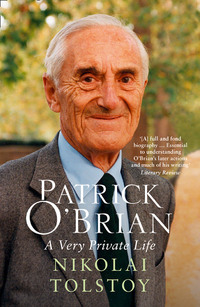
Читать книгу: «Patrick O’Brian»
PATRICK O’BRIAN
A Very Private Life
Nikolai Tolstoy

Copyright
William Collins
An imprint of HarperCollinsPublishers
1 London Bridge Street
London SE1 9GF
www.WilliamCollinsBooks.com
This eBook first published in Great Britain by William Collins in 2019
Copyright © Nikolai Tolstoy 2019
Cover image: Marinepics Ltd/Shutterstock
Nikolai Tolstoy asserts the moral right to be identified as the author of this work
All photographs courtesy of the author
A catalogue record for this book is available from the British Library
All rights reserved under International and Pan-American Copyright Conventions. By payment of the required fees, you have been granted the non-exclusive, non-transferable right to access and read the text of this e-book on-screen. No part of this text may be reproduced, transmitted, down-loaded, decompiled, reverse engineered, or stored in or introduced into any information storage and retrieval system, in any form or by any means, whether electronic or mechanical, now known or hereinafter invented, without the express written permission of HarperCollins
Source ISBN: 9780008350581
Ebook Edition © October 2019 ISBN: 9780008350604
Version: 2020-09-25
Dedication
I dedicate this book to my late cousin Adrian Slack and his sister Julia, the dearest of friends as well as closest of relatives since those distant days of childhood at Appledore beside the Severn Sea.

At home in the cloister of Correch d’en Baus
Epigraph
Indeed I cannot conceive a more perfect mode of writing any man’s life, than not only relating all the most important events of it in their order, but interweaving what he privately wrote, and said, and thought; by which mankind are enabled as it were to see him live, and to ‘live o’er each scene’ with him, as he actually advanced through the several stages of his life.
James Boswell, The Life of Samuel Johnson, LL.D. (London, 1793), i, p. 6
CONTENTS
Cover
Title Page
Copyright
Dedication
Epigraph
Preface
I Collioure and Three Bear Witness
II The Catalans
III New Home and New Family
IV Voyages of Adventure
V In the Doldrums
VI A Family Man
VII Master and Commander
VIII The Green Isle Calls
IX Pablo Ruiz Picasso
X Shifting Currents
XI Muddied Waters
XII Travails of Existence
XIII Family Travails
XIV The Sunlit Uplands
XV Epinician Acclaims
XVI Triumph and Tragedy
XVII Melmoth the Wanderer
Envoi
Appendix A: Collioure: History and Landscape
Appendix B: Patrick and His First Wife Elizabeth
Appendix C: Patrick’s Sailing
Footnotes
Notes
Index
Acknowledgements
About the Author
Also by Nikolai Tolstoy
About the Publisher
Preface
A fortnight after Patrick O’Brian’s death, the playwright David Mamet wrote of his literary achievement:
Recently I put down O’Brian’s sea novel ‘The Ionian Mission’ and said to my wife, ‘This fellow has created characters and stories that are part of my life.’
She said: ‘Write him a letter. He’s in his 80s. Write him and thank him. And when you are in England, look him up, go tell him.
‘How wonderful,’ she said, ‘to be alive, when he is still alive. Imagine living in the 1890s and being able to converse with Conan Doyle.’
Mamet promptly rehearsed the eulogium with which he would address his literary hero, and began preparing a letter of introduction at his breakfast table. Then, glancing at the newspaper beside him, he saw to his dismay an announcement of the melancholy news of Patrick’s death.[1]
I have no doubt that Patrick would have been delighted by such praise from his acclaimed fellow writer, and that had my mother still been alive she would have inserted the letter in her box-file ‘Valuable Fans and very good reviews’. My hope is that, while nothing can quite replace a face-to-face conversation, this book may compensate by enabling Mamet and others of Patrick’s worldwide legion of admirers to learn much more of his life and personality than might have been obtained from any interview with the famously reclusive writer.
This book covers the latter part of Patrick O’Brian’s life, from the moment of his and my mother’s arrival at Collioure in the south of France in the autumn of 1949. It is the period during which he wrote all his major works. Since my mother’s death twenty years ago, I remain the sole intimate observer of Patrick’s astonishing career from impoverished and little-known writer in 1955, when I first met him, until his death at the height of his international fame at the turn of the millennium forty-five years later. Nevertheless, it never occurred to me at any point during his lifetime to compile his biography – not least because I was well aware of his detestation of inquisitive enquiries into his private life.
My unanticipated decision to undertake the task began in the aftermath of Patrick’s death at the beginning of the year 2000. I was witness to the acute distress caused him by the imminent appearance of an unauthorized biography.[fn1] My dismay was briefly allayed by its publication soon afterwards, when I was asked to review it. My initial impression was that the book appeared largely harmless. Knowing little at the time about Patrick’s early life, and his relationship with his first wife Elizabeth and son Richard, I felt I had no reason not to accept the author’s account of Patrick’s life before I knew him as broadly accurate, and besides dismissed it as of little relevance to his reputation as a writer.
What I was not prepared for, however, was the startling extent to which a small but vociferous coterie of journalists and reviewers eagerly swallowed everything related in the book that could be interpreted as detrimental to Patrick’s reputation, regardless of its truth – or in many instances even likelihood.[fn2] Regrettably, it was in some of the more meretricious cases that his detractors arranged for their pieces to be posted on the internet for futurity.
Before long it occurred to me that I was uniquely placed to provide a more balanced and credible picture. Not only had I known Patrick intimately throughout the greater part of his life,[fn3] but in addition I possess almost all his personal papers, extending from his appearance in a pram at the age of one to his final melancholy sojourn in Dublin. This includes such invaluable sources as my mother’s and his own diaries covering every day of the greater part of the period 1945 to 1999, my mother’s financial accounts from 1945 to 1997, Patrick’s correspondence with his literary agents, publishers and admirers, manuscripts of many of his unpublished works, recorded interviews with his friends and family, extensive personal notes, preliminary drafts of his novels, his precious library, and much else. In addition, I knew intimately many of his and my mother’s friends inhabiting Collioure or visiting them there, almost all of whom are now sadly dead. However, I soon realized that, much more significantly than a desire to refute the damaging effect of media vilification, a biography based on authentic evidence would constitute a remarkable chronicle of love, endeavour, and in some ways unique triumph over daunting odds. In addition it would reveal much of the genesis and inspiration of his admired works of fiction and biography, which continue to enthral millions of readers around the world.
For the rest, it is my hope that this biography will enable readers to arrive at judgements based on evidence, rather than efflorescent imagination. In my experience, truth tends to be vastly more interesting than the most lurid of conjectures. I conclude with an assurance that I have suppressed nothing material from memories extending over five decades and the extensive archive in my possession, save one matter of trifling consequence which for the present I feel it proper to withhold.
Nikolai Tolstoy, 2019
I
Collioure and Three Bear Witness
I went in the loft & there found not only old account books so beautifully kept but our old formally-kept diaries of nearly 30 years ago. How vividly alive we were in those days, or seem to be in this reflection, & how v v little we lived & loved on.
Patrick’s diary, 9 December 1981
In the summer of 1945 Patrick and my mother Mary were compelled to leave London, following the abrupt termination of their wartime employment at Political Warfare Executive. Although they had been very happy during the three years’ tenancy of their elegant Queen Anne house in Chelsea, it was with buoyant excitement that they began their new life in a tiny cottage in a remote valley of North Wales. Patrick welcomed the prospect of entering on a romantic wilderness existence with my mother. His deprivation of many of the normal pleasures of childhood, above all the fellowship of contemporaries, made him by nature unusually self-sufficient. Furthermore, he and my mother were still young (Patrick being then thirty, and my mother twenty-nine), adventurous, and very much in love.
His ambitions were clear. Ever averse to dependence on others, he intended to live so far as possible by the work of his hands, while resuming his precocious career as a writer, which five years of war had compelled him to abandon. Prospects appeared as promising as might be. My mother possessed a modest private income on which they were able to scrape by in their two-roomed house at Cwm Croesor in Snowdonia, whose rent amounted to a mere £4 a year. They were fit, resourceful, and unmaterialistic: a perfect team. Neither ever baulked at hard work, and they rarely repined at the constraints of poverty. Over the bitter winter of 1945–46 they laboured undauntedly to make their home habitable, and toiled at their little garden in order to make themselves as self-sufficient as possible in the coming year. Patrick’s shooting and fishing among the mountains and lakes completed their supply of food.
Nevertheless, the spring of 1946 found him increasingly assailed by frustration and pessimism. Try as he would, his pen failed to flow with its former facility. While my mother’s faith in his talent as a writer never wavered, Patrick increasingly experienced prolonged bouts of writer’s block, a condition which by the end of their four years in Wales had all but overwhelmed him. Moving to a larger house nearby in the valley generated only the briefest spasm of revived creativity, and during the winter of 1948 –49 he began to despair of ever fulfilling his consuming ambition. He grew more and more tense, irritable, self-doubting, and agitated by agonizing thoughts of death and dissolution.[1] In addition the long dark wet winters of North Wales imposed debilitating physical gloom over their lives. Eventually he and my mother decided that their only recourse was to effect a total severance with their current unhappy existence.
After living together for six years, in the summer of 1945 Patrick had married my mother, when he further adopted the decisive course of changing his surname from Russ to O’Brian. Contrary to widespread speculation when this was belatedly made public at the end of his life, I have shown elsewhere that he did not select his new name in order to pass himself off as an Irishman. Indeed, the name itself was chosen effectively at random. His overriding motive was to achieve a total break with his past: above all, to banish all association with his selfish and frequently tyrannical father. However, as failure dogged his every effort to extract himself from the grim predicament he found himself facing, he became increasingly troubled by an obsessive fear that his father’s destructive shadow hung over him, frustrating his every effort to break free. Even the rugged recesses of Snowdonia proved too little protection from the hated oppressor, whose presence he sensed looming above him in forbidding screes or tearing down the valley in raging storms, and eventually it seemed that a second flight afforded the only avenue for escape and renewal.
The bleak Welsh winters no longer proffered an invigorating challenge, but exerted a dampening gloom permeating the little household. By the early summer of 1949, the young couple fastened on the south of France, as refuge from the more and more desperate impasse into which Patrick found himself driven. He returned from an exploratory expedition with the exciting news that he had discovered the ideal spot where they could rebuild their lives.
The little town of Collioure lies on the Mediterranean coast, a few miles from the Spanish frontier. Years later, in his broadly autobiographical novel Richard Temple, Patrick provided a vivid sketch of the impression it first made on him:
The village stood on a rocky bay, with a huge castle jutting out into the middle, and a path led round underneath this castle to a farther beach and farther rocks … A jetty ran out at the end of the second beach … and as he walked along the jetty … he took in a host of vivid impressions – the brilliance of the open sea, white horses, the violet shadows of the clouds. From the end of the jetty the whole village could be seen, arranged in two curves; the sun had softened the colour of the tiled roofs to a more or less uniform pale strawberry, but all the flat-fronted houses were washed or painted different colours, and they might all have been chosen by an angel of the Lord … the high-prowed open fishing-boats were also painted with astonishing and successful colours: they lay in two rows that repeated the curves of the bay, and their long, arched, archaic lateen yards crossed their short leaning masts like a complexity of wings.[2]
The couple arrived at the town in the beginning of September, which is generally one of the best months of the year on the Côte Vermeille. Tourists had departed, and the little town reverted to its workaday existence. The brilliant sunshine was tempered by a pleasant freshness in the air, with the Pyrenees looming behind the town standing out sharp and clear against a pure azure sky.
During his prefatory visit Patrick had already made a few friends. Among these was a beautiful Colliourencque[fn1] (as the town’s female inhabitants are termed), Odette Boutet. Odette was married to a sculptor and painter named François Bernardi.[fn2] They met again the day after Patrick’s return with my mother, when the two couples immediately became fast friends. During his initial visit Odette had helped Patrick find a small apartement on the second floor of 39, rue Arago,[fn3] situated opposite a great gateway opening through the town wall onto the seafront. There was a living room, bedroom, a windowless nook known as ‘the black hole’, a bathroom with shower, and a tiny lavatory.
Always hospitable to a fault, when guests came to stay my parents customarily abandoned the bedroom, ensconcing themselves on lilos, inflatable mattresses, in the black hole. Electricity only arrived in the apartement nine months after their arrival. Inadequate heating was initially provided by a small bottled-gas cooker, and it was not until towards the end of 1953 that they managed to afford ‘a beautiful blue enamelled stove, a flexible desk-light for P. & various other things … Very pleased with stove. It was too heavy for P & me but P & Rimbaud managed.’ This was the Mirus, a handsome and extremely effective heater, capable of burning coal or wood. Cooking was conducted on a small ‘Wonder Oven’, operating on bottled gas.
Apart from the inevitable proliferation of tourist shops and restaurants and the regrettable removal of cobblestones from the streets, the appearance of Collioure within its town walls is not greatly changed since my parents first lived there. Most streets are so narrow that the inhabitants might almost touch hands from opposite windows. Behind the rue Arago, clustered houses along winding passages ascend the hillside to the base of Fort Miradou, while a couple of streets away the Place de la Mairie provided a pleasant refuge under the shade of its plane trees, where townspeople strolled and gossiped in the evenings.
In one major respect, however, Collioure has changed beyond recognition. Some time ago, when I was discussing the town with an old family friend, widow of a retired Colliourench fisherman, she described the new Musée de Collioure in the Faubourg. It contains many pleasing relics of former local life: fishing gear, old photographs, household implements, and so forth. ‘But one aspect it can never show,’ Hélène Camps observed emphatically, ‘is the incessant and extraordinary noise we all knew in those days’ – whether inside or outside the town. For many years all coastal road traffic to Spain passed through the heart of Collioure. Eventually this came to be diverted inland through a massive road tunnel constructed beyond the railway line.
In 1954 Patrick wrote this lively description for the American magazine Homes and Gardens:[fn4]
Where the foothills of the Pyrenees plunge directly to the sea, the smooth-rounded Mediterranean sea that has bitten away the land in black cliffs there, the road winds and winds interminably: hair-pin bends writhe down to the gaunt bridges that stand over naked, dried up river-beds, and from each ravine the road twists upwards through cuttings in the red-black rock to the narrow back of the hill – up, and down again. It is a nightmare for a nervous driver in a hurry, for the lorries from Port Vendres, the buses and the cars tear furiously round the corners – blind corners – screaming brutally with their tyres, klaxons, horns. They all disregard the most elementary precautions (no Latin soul should ever drive a car) and a stranger might well demand whoever had established the theory that the French drive on the right side of the road.
But in the autumn, when the tide of summer cars has slackened, and before the schooners from the south have begun to bring up the oranges that load the lorries in the port, then one can walk safely on the road, follow its turning through the hills and look with tranquillity on the sea below or up to the mountains on the right hand.
This is the time of the vendanges. The hills, terraced with inconceivable labour to the height of the fertile land, are covered everywhere with vines, and the vines are ready.
Although families native to Collioure still live in and around the town, many houses and flats now sadly belong to absentee owners, a proportion of whom I understand do not even appear for some eleven months of the year. In contrast, Collioure in the Forties and Fifties was overwhelmingly home to Colliourench fishermen and their families. Most were closely interrelated through marriage, with links in many cases extending back for centuries. An unfortunate consequence of this was a never-ending spate of raucous conversations conducted throughout the day and much of the night, not only within the houses, whose windows for much of the year were opened wide to the mild air, but also between relatives or neighbours living on opposite sides of the narrow streets. My mother, who might have felt herself back in the Devonshire fishing village of her childhood, was able to tolerate this with fair equanimity. For the edgy and introspective Patrick, however, the hurly-burly proved a constant trial of his temper. His ears were jarred by hoarsely jocose cries of fishermen, high-pitched exchanges between wives and daughters, and maddening screams from their children. ‘Everyone evidently assumed everyone else was deaf,’ he once remarked to me.
Rare objections to the cacophony achieved little more than to exacerbate it:
Last night the Puits [the restaurant on the ground floor] made such a din: Mme R[imbaud]. told me Franco it was who threw the bottle last year: Pilar told her today. P[ilar] & F[ranco] keep cailloux [pebbles] on their window-sill.
This entry in my mother’s diary alludes to an outraged assault on late-night revellers in the restaurant on the ground floor. A year later, to her evident satisfaction, there was a repeat attack: ‘Last night someone threw a bottle outside the Puits: it made a fine noise.’ These incidents provoked inconclusive police and private investigations, all conducted at stentorian level on the spot, the fallout from which their friend Odette once told me had not entirely subsided half a century later.
As though this were not trial enough, Patrick understood barely a word of these vociferous exchanges, since almost everyone’s first or even sole language was Catalan. The occasional bilingual exchange was as often as not equally hard to understand. As my mother recorded:
The woman opposite went bankrupt, & left to live at Elne. There she took up with a man & they came back to live at her house here. His wife found out where they were, & on Sunday came & tried to get at them. They barred their door & she sat on a chair in the Street for six hours. A filthy scene (woman screeching French – man Catalan) by the arch 3 days ago must have been them, I think. The woman was dragging a 4–6 year old child with her.[fn5]
If the human cacophony momentarily waned in the early hours, it was only to be replaced by horrid war cries uttered by the martial cats of Collioure, who waged internecine conflict around gutters, doorways, and up and down stairs – there being generally no doors at street level to communal entrances. Even my parents’ tough little Welsh hunt terrier Buddug could barely hold her own against these feline hosts of Midian. She was enabled to sally forth at will through an entrance cut in the door to the flat. One fine spring day my mother reported: ‘Cats (toms) infest stairs, & Budd rages. She came in with v. bloody nose this morning.’ Their morals were as depraved as their conduct was aggressive. On 9 September 1951 my mother adopted a kitten from the rue, whom she named Pussit Tassit, entering her arrival at the appropriate date in her childhood Christopher Robin Birthday Book. The following May, Patrick ‘saw our cat being covered in the street by a large black tom while half a dozen others sat quietly watching’.
My mother’s diary entries regularly attest to the strain imposed by the unrelenting cacophony:
‘Our rue gets more & more noisy’; ‘Oh God I am so sick with hearing vicious slaps & more vicious screaming at Martine. Patrick tried to read a T.S.E[liot]. poem [Burnt Norton] aloud yesterday but was drowned by the noise in the rue. Both boiled this morning as cats howling kept us from sleeping’; ‘V. bad night: noises’; ‘Street noises formidable’; ‘Neither of us can sleep: too much noise.’
When their neighbour Madame Rimbaud fell ill and was visited by the doctor, his ministrations were accompanied by well-intentioned ‘Shoutings of choruses of women down there all day’.
Despite the disadvantages of their cramped quarters and noisy surroundings, my parents remained at first broadly satisfied with their new home, and swiftly became profound lovers of Collioure and its inhabitants. Their isolated and unproductive life in Snowdonia had long strained Patrick’s nerves to desperation, and there could be no doubting the truth of his parting aphorism: ‘it is better to be poor in a warm country.’[fn6]
In fact the weather at Collioure was far from being balmy throughout the entirety of the year. Winters could prove bitterly cold, and one snowstorm was so heavy that roofs collapsed beneath the weight. In January 1954 my mother recorded: ‘Snow thick from Al Ras to Massane; cold & it rained all night’, and shortly afterwards: ‘Rain in the night, & today the Dugommier hillside specked with snow. They say 15° [Fahrenheit] below zero at Font Romeu.’ I remember seeing in the town at that time photographs of what I recall as enormous waves frozen in mid-air as the sea hurled itself against the town walls. Life in the tiny flat above the rue Arago could be harsh indeed: ‘Ice on comportes in the rue; glacial wind. Mirus [stove] full blast hardly keeps us warm’; ‘Still 23° without, washing frozen into boards … Frightful cold: P. works au coin du feu.’
In spring the ‘maddening, howling tramontane’ battered the region for frustrating weeks, while in the autumn ‘Wind (from Spain) & clouds prevented plage. C’est le vent d’Espagne – il fait humide – c’est pas sain.’

Port d’Avall and Château St Elme under snow in 1954[fn7]
Of course much of the year was generally hot, but even then freak weather could strike Collioure’s microclimate, arising from its situation between the mountains and the sea. July 1953 saw a ‘fantastic hail storm … River vast red flow.’ Much of this belongs to the past, owing to climate change, but is important to recall when reliving my parents’ early days in Collioure.
A hostile critic has conjectured that Patrick’s move to Collioure was undertaken ‘perhaps, in order to be a long way from the family he had abandoned’.[3] In reality, seven years had passed since he finally left his first wife Elizabeth for my mother. Moreover, he continued in close touch with his young son Richard, the only other member of his immediate family, whom he had no intention of abandoning, while he maintained intermittent correspondence with his brothers, sisters and stepmother throughout the long years that lay ahead.
It is true that relations with his son had been troubled, although nothing approaching the extent alleged by subsequent critics. Richard O’Brian was, by his own admission, somewhat indolent as a child, and made unsatisfactory progress at the Devonshire preparatory school to which his father and my mother had sent him for two and a half years at great financial sacrifice to themselves. At the end of the summer term of 1947 Patrick was obliged to withdraw him, and set about teaching him at the house where he and my mother were living in North Wales. Although the boy’s education improved considerably in consequence, in some respects the experience was an unhappy one. Patrick’s own wretched childhood had left him constitutionally ill-equipped (for much of his adult life, at any rate) to deal with small children, a failing on occasion so pronounced as to be all but comical. Walking above Collioure in November 1951, he fled down a sidetrack on ‘seeing some beastly little boys’ – one of several similarly alarming encounters. He imposed what might now appear excessively rigorous discipline on his son during lessons. Although Richard regularly stayed with his mother in London during the ‘school holidays’, during his time in Wales he had missed her and his beloved boxer Sian acutely. Patrick and my mother were fond of dogs, but it was impossible to introduce Sian into the sheep-farming community of Cwm Croesor.
This regime continued for two years, during which time excruciating attacks of writer’s block made Patrick more and more testy and uncompromising in his efforts to educate the boy. It is likely that Patrick’s frustration with Richard’s lack of satisfactory progress was exacerbated by his own inability to achieve anything constructive in his writing. On the other hand, outside lessons he became in marked contrast a strikingly adventurous and imaginative parent. My mother’s unwavering affection, too, went far to ameliorate Richard’s life. Eventually, the ill-conceived scheme came to an end, with the departure of Patrick and my mother for Collioure in September 1949. That July Richard’s mother Elizabeth married her longstanding lover John Le Mee-Power, which enabled her to make a successful application to the courts to recover custody of her son.
Patrick was deeply concerned to secure the best education possible for Richard. In 1945 he had registered him for entry to Wellington College, a public school with a strong military tradition, with a view to his eventually obtaining a career in the Army. Unfortunately this was my father’s old school, which I in turn entered in January 1949. When my father was informed by Elizabeth that the O’Brians planned to send Richard there, he managed to persuade the Master of the undesirability of his attending the same school as me. The fact that my mother was at the time denied all contact with me presumably influenced the College’s concurrence with my father’s objection, which would now seem harsh and arbitrary. It is possible that some future unhappiness might have been avoided, had Richard and I been permitted to become friends from an early age.
The sincerity of Patrick’s concern to advance Richard’s education and future career cannot be doubted. The annual fees for Wellington were £160–£175 a year, which together with travel and additional expenses required a total expenditure of about £200 per annum. Yet his and my mother’s combined income for 1950–51 amounted to £341 6s 9d.[fn8] Nor was the proposed sacrifice any fanciful project, since they had earlier paid about £170 a year for Richard’s preparatory school fees and expenses.[4]
Eventually Richard came to believe that his father had contributed nothing material towards his education. In a press interview conducted over half a century later, he declared: ‘My father never offered to help … [I] had been sent to a boarding school in Devon by [my] mother … [My] mother found the fees increasingly difficult to pay.’[5]
II
The Catalans
When a man wakes in the night and finds his head filled with remorse and bitter, old regret, if he chose he could reflect that no other man in the world would be suffering precisely that remorse nor exactly that regret … Of course, he would not choose to do so, for he would be too busy dodging about in his mind, trying to escape – unless, that is, he were occupied with feeling the wound to see how much it still hurt and trying to persuade himself that there was virtue in mere remorse.
Patrick O’Brian, ‘The Voluntary Patient’
With Secker & Warburg’s acceptance of Three Bear Witness in February 1951, Patrick had reason to feel confidence in his regenerated career as a writer. Not only was it his first adult novel, but the first novel he had published since Hussein in 1938. At last he had emerged from the creative chasm inflicted by the War with his accompanying personal crises of divorce and remarriage, followed by the dire impact of his troubled exile in North Wales.
At the same time, he had come to feel he had finally shed the oppressive effect of his father’s dark shadow. In the summer of 1949, shortly before his and my mother’s departure from Cwm Croesor, a solitary walk brought him to a precipitous, sunless valley amidst the mountains. ‘When I was going up to Llyn yr Adar there seemed to be a thing at the top of the high black barren cliff that forms the backside of Cnicht.’ What it was he found hard to identify:
I watched it for some time, but it did not move; and all the way along the valley I kept looking up, but it seemed immobile … When I came back it was still there. Gargoyle-ish, brooding, jutting out, small in the distance, but menacing and in control. The next time I went up to the lake it was not there.
This uncanny experience occurred when Patrick had attained the nadir of his increasingly frustrating Welsh exile, shortly before he made the dramatic decision to escape to sunny France. Returned from his walk, he wrote the powerful story ‘Naming Calls’, which was later published in The Last Pool. It recounts the terrifying experience of a writer who withdraws to a small house set in the sinister valley explored by Patrick. The tale concludes with the destruction of the frantic outcast, when a raging storm drives up the valley and dislodges ‘a vast mass of rock’ from the mountainside above: ‘Abel shrieked high and the door burst open, swinging wide and shuddering on its hinges.’ The elemental force of the tempest is unmistakably intended as an evocation of the man’s father, ‘a formidable, roaring tyrant’, whose spirit he had inadvertently conjured forth.
It is clear that Patrick had come to associate his oppressive malaise with his frequently bullying giant of a parent, who had repeatedly afflicted him with demoralizing terror during his infancy. Now, however, when in Three Bear Witness he adverted to the same uncanny episode, it was to dismiss it comfortingly as an unpleasant memory banished to the past. After a spasm of apprehension, ‘I felt positively merry – a glance upwards showed it there, of course, an insignificant rock, though curious. When I had finished my sandwiches it was gone.’[1]
Unfortunately, the couple’s financial predicament remained as alarming as ever. Secker’s acceptance of Three Bear Witness brought only the briefest respite. An advance of £100 was contracted on 1 February 1951, half on acceptance and half at publication. Sympathetic to his client’s worrying predicament, Spencer Curtis Brown charitably forwarded him the second £50, which was not otherwise due to be paid for at least another year. ‘Even agents can have kind hearts on occasion,’ he wrote to the publisher, who failed however to reimburse Curtis Brown in turn. Sadly, Curtis Brown’s generosity was all but negated by the rapacious grasp of government. As my mother learned: ‘C.B. now has to deduct income tax at 9/- in the £: with that & his 10% Testimonies £100 has shrunk to £49.’
While the prospect of his novel’s publication went far to restore Patrick’s self-esteem, until it was published openings for further literary employment remained constricted.[fn1] Shortly before their move to France, Patrick confessed to Warburg that he had ‘written himself out’, so far as short stories were concerned. Gradually, however, the colourful turbulence of Collioure brought him a fresh harvest of imaginative themes. During the year following November 1950, he composed no less than thirty-three short stories. Many were set in and around Collioure, drawing on his observations of the town, its inhabitants, customs and traditions.
Why then did he not launch at once into the work on Southern France, which he had discussed with Fred Warburg, and for which an option was stipulated in the contract for Three Bear Witness? It looks as though one of his recurrent failures of confidence inhibited his undertaking a full-scale book during the anticlimactic year which stretched between his completion of Three Bear Witness and its publication in the spring of 1952. Ever his own sternest critic, it was about this time that he penned this frank assessment of his approach to writing:
I often, or at least sometimes, like my writing when I am doing it, but so much more often I feel uneasy and ashamed afterwards. All the affectations, poses and ‘special’ attitudes stare out – hideously pimpled youth smirking in the looking-glass yet finds his confidence decay and enters a public room fingering himself – and often the ‘clever pieces’ appear shallow and dull as well as quite unauthoritative, the ‘poetic touches’ arty, long-winded and false, and dreadfully often the whole thing comes to pieces at the end – shuffles off in the lamest manner possible. This is because I think of a good beginning, grow excited and embark upon the story, taking it for granted that it will finish itself.
In November 1951 Patrick sent off his collection, provisionally entitled Samphire and Other Stories:
I have just posted the MS to Curtis Brown: yesterday I sent six stories to the New Yorker and one, with two poems, to Irish Writing.[fn2] That they may prosper. The postage was very expensive: I did not think about Spain [for cheap postage] until this morning. But even so I do not think I would have posted them from there; they are too precious, and I want to hear soon. After re-reading and re-typing both, I am fairly sure that Samphire is much better than The Lemon: not so clever, much more concentrated (the Lemon tries to say too much and grows diffuse) and because of the hatred in it, more lovingly handled. So I have called the book Samphire and put that story first. It was a slimmer parcel than usual, but it is between 60 and 65 thousand … I feel rather low now, with the typewriter folded up and the MS gone: I regret my hurry; I could have polished more.
Sadly, disappointment swiftly followed. A month later Fred Warburg wrote to Curtis Brown:
I have now had a report on the new stories of Patrick O’Brian, SAMPHIRE, and some of them are good, though others seem to us basically to fail. However I think it is absolutely essential that we publish the novel now called THREE BEAR WITNESS instead of TESTIMONIES and see if we can do well with it before committing ourselves to further work from O’Brian particularly in the short story field.
Eventually most of the stories were published in book form, although not for some years. It was an eclectic selection that Patrick had despatched. ‘Samphire’, on which he particularly prided himself, is simply summarized. A young couple is walking beside a seacliff: he complacent, insensitive, and possessed of a tiresomely adolescent sense of humour; she a quiet, nervous, sensitive girl, whose nerves are stretched to breaking point by her husband’s relentlessly patronizing jocularity. When he stretches down to pick a sprig of samphire, she suddenly loses self-control and vainly attempts to push him over the edge. Even the insensitive soul to whom she is married recognizes with shock the impassable gulf suddenly opened between them, and realizes that nothing will ever be the same again.
In 1985, Patrick explained to the publisher Bell and Hyman how he came to write the story:
I was reflecting … as I walked along the cliffs that overhang the sea near our house [at Collioure], and a striking example occurred to me – that of a particularly elegant, intelligent woman who in her extreme and utterly inexperienced youth had married a bore or, at least a man who had developed into a bore, a didactic eternally prating bore. At some point in my walk I noticed some plants growing quite far down on the rock face: the lines about the samphire-gatherer in King Lear drifted into my mind, & as I walked on in a vague, uneasy state of the two notions combined and this took form without any conscious effort on my part.
This account is not entirely candid. The story makes uneasy reading for me, since the husband is unmistakably a recognizable, if uncharitable, portrait of my father, and the delicate young wife my mother, who was eighteen when they married. It was lingering guilt, I suspect, that impelled Patrick to write a story stressing that the marriage was doomed from the outset, regardless of intervention by any third party.
The extent to which Patrick at this experimental stage of his literary career utilized his fiction as an instrument of attack or defence in relation to aspects of his own life is exemplified by two other stories in the collection. In the first, ‘The Flower Pot’, a couple of Germans, living in what is manifestly Collioure, lovingly tend six flower pots on their windowsill. A fierce tramontane blows up, an increasing gale tearing through the streets: one of the pots is dislodged, and kills a fisherman below. The man responsible is filled with horror:
A man struck dead, or maimed for ever: struck down and by his fault. The great wave of hatred rising from the street. The foreigners at René’s have killed père Matthieu. The pointing and the great just wave of hate; and his head only, peering from the window, peering down to meet the hatred and the pointing.
One might imagine this gloomy little tale arose from a flight of fancy, but for this notice in my mother’s diary for St Patrick’s Day 1951:
P. finished the Flower Pot yesterday … after we had been on the jetty. There was a fantastic dry warm wind three days ago which knocked the pinks off bedroom window-sill. It landed just beside M. Ribeille, who only laughed. We felt terribly guilty & P. has fastened all the pots with wire.
Their dismay was understandable, but Patrick’s emphasis on the great wave of collective hatred arising against the hapless outsider plainly reflects his continuing sense of isolated insecurity, originating in the damaging circumstances of his solitary childhood.
Another tale illustrates Patrick’s propensity, at least in the early days of his literary career, to deploy his fiction as a weapon of psychic attack. ‘The Lemon’ concerns a man whose isolated existence has transformed him into a psychopath. The first part of the story comprises an arresting analysis of his bewildering condition, and its symptoms. Despite this, he is on good terms with his neighbours, who are:
working people, kind, sensible, very tolerant. Good people, my neighbours: all except the man and woman who kept the restaurant on the ground floor. They were a bad couple; the man a flashy, smarmy-haired little pompous rat; the woman a short-legged, hard-faced shrew of about forty … They drank heavily, quarrelled and screamed until dawn sometimes. Their place was frequented by their friends and by foreigners on the spree, and they bawled and sang and shrieked above the blaring wireless until four or five in the morning.
A sluttish waitress, ceaselessly singing loudly and tunelessly during the day, by night slept indiscriminately with the clientèle.
The restaurant in question is unmistakably Le Puits, which occupied the ground floor of the house in the rue Arago, two storeys below the flat in which Patrick and my mother lived. On 19 February my mother wearily recorded: ‘The Puits kept it up until 6 a.m.: an infernal racket.’ On 27 May Patrick stayed up most of the night writing ‘The Lemon’. In the story he (for I fear the nameless protagonist is he) creeps downstairs, removes the fuse controlling the lighting for the restaurant, and hurls a hand grenade (‘the lemon’) into the darkness. As he carefully restores the fuse and tiptoes back up to his apartement, a blinding flash and shattering roar proclaim the destruction of the entire crew of revellers in Le Puits. Ah, if only …[fn3]
Of the thirty-three stories Patrick wrote during the year 1950–51, nine were never published. Of these, three (‘Federico’, ‘Moses Henry’ and ‘Fort Carré’) appear to be lost. The manuscripts of the remaining six are in my possession, and make interesting reading. ‘Mrs Disher’ concerns an old man’s confused reflections on his dying housekeeper, while ‘The Clerk’ explores a disturbing memory of medieval antisemitism encountered in a remote English town by a visiting enthusiast for church architecture.
‘George’ (which he retitled ‘The Tubercular Wonder’) is the most revealing of these unpublished tales in respect of Patrick’s own life. In the first volume of this biography, I suggested that it provides an illuminating exposé of his troubled state of mind at the time he began his secret affair with my mother, betraying an overriding sense of guilt in respect of his betrayed wife Elizabeth.[2] The theme of another story, ‘Beef Tea’, recalls that of ‘Samphire’, with its dull and relentlessly facetious husband, who drives his long-suffering wife to insanity. It looks like a further attempt to dismiss the reproachful figure of my father, representing him as utterly impossible to live with.
The personal application of the story ‘A Minor Operation’, which is one of those published in the collection, speaks for itself. A young English couple come to live in an old French town by the sea. We learn that ‘they were virgins; virgins from principle, mystic and practical’. They are very poor, but so well liked by the inhabitants that they are continually sustained by regular gifts of food. Much of this popularity they put down to the ‘affectionate, well-mannered dog they had brought with them’. After a while Laurence is troubled by a severe affliction to his hand. Eventually an operation becomes necessary, which unexpectedly proves so sanguinary that the surgeons depart, leaving their patient for dead. However, he is not. Arising from the operating table, the victim races frantically back to his apartement, brutally kicks their beloved dog downstairs, and apparently (it is not entirely clear) kills his wife.
Patrick wrote the story on 12 and 13 June 1951, originally entitling it ‘A Nice Allegory’, and later ‘Hernia, Stranguary and Cysts’. That the couple is Patrick and my mother, and the dog their Buddug, is evident from the opening description. Three weeks earlier, my mother had written in her diary: ‘P. showed Dr Delcos swelling on his hand. It has to be removed.’ Five days later ‘P. had his hand done, fainted, poor P., is splinted & bound & in a sling.’ For over a fortnight he continued in great pain, suffering continual discharges of pus from the infected wound, and enjoying little sleep.
It looks as though this protracted suffering led Patrick, as in ‘The Lemon’, to reflect on how far an inordinate degree of psychological distress or physical pain might wholly distort a man’s nature, exposing the perilous fragility of the mind’s control over destructive elements of the subconscious. The threat is emphasized by the frenzied patient’s violent assault on the very beings to whom he is closest.
There exists what may be a tentative draft of the tale in one of Patrick’s notebooks. There he contemplates writing the story of ‘A very sensible childless pair [who] decide that the husband had best beget one on a healthy girl’. This he does, with predictably stressful effect on the wife. This perhaps appearing too trite or unrealistic a theme, it seems Patrick converted it into a savage melodrama, whose principal content derived from his own experience.
Another story written at this time is ‘William Temple’, which remains unpublished. Ultimately a precursor to Patrick’s novel Richard Temple (1962), it begins on an unmistakably autobiographical note. Like Patrick during his wartime service with Political Warfare Executive, Temple is employed by a branch of Intelligence whose members do not normally operate in occupied Europe. Again, I suspect like Patrick himself, ‘he had often pictured to himself William Temple as one of that great secret army that was being built up in France’. Unexpectedly, he is selected to be dropped on a special mission to the French Resistance ‘in the mountains between Spain and France’. After a realistic account of his reception by the maquis, he is diverted into a hunt for a magnificent boar, which he finally tracks down and shoots.
The story is very much longer than others written at this time, being reckoned by Patrick at 23,500 words. The indications are that it was at first intended as a novel, which for some reason came to an unanticipated halt. Possibly, with the (symbolic?) death of the boar, he simply found further inspiration lacking. At any rate, he decided to include it among the collection submitted to Fred Warburg. In view of its exceptional length, it was divided into two parts, oddly entitled ‘A Pair I’ and ‘A Pair II’. The adventure is fluently narrated, but from its length ill-suited to a collection of short stories.
Disheartened by Warburg’s rejection, Patrick brought his short-story writing to an abrupt close. Not until well over a year had passed did he attempt another. As his publisher pointed out, the twenty tales are widely varied in quality. Without straying into excessive analysis, it has to be said that in several cases the plots appear somewhat contrived, and I am inclined to suspect the baneful influence of Somerset Maugham in what appears to be Patrick’s apparent need to round off with a quirky or violent conclusion. Again, several stories are driven by a desire to sublimate personal fantasies, wish-fulfilments or resentments which do not always fully accord to dramatic requirement. More, too, might perhaps have been made of those descriptive passages at which Patrick excelled, evoking the Catalan people and their harsh but beguiling landscape.
Another possibility for generating desperately needed additional income occurred to Patrick at this time. In November 1951 Curtis Brown passed an enquiry to Fred Warburg: ‘Patrick asks if I know of any books which a publisher would like him to translate from the French. It occurs to me that he might be a very good translator. Have you by any chance any such book in mind?’
Warburg could offer nothing, and the proposal fell by the wayside. Eventually Curtis Brown was to be proved right, and Patrick became an admired translator of contemporary French writing. But another ten years were to pass before he was afforded opportunity to undertake that lucratively dependable employment.
Over the winter of 1950–51 the couple’s hopes were largely founded on the success of Three Bear Witness, for which Warburg had expressed such high regard. It was a desperately worrying time. In January 1952 my mother lamented that: ‘The year continues to go badly: Seckers don’t want W[illy Mucha]’s maquettes. Very much gloom.’ They were eager to have the dustjacket illustrated by their friend. At the beginning of the next month ‘Secker sent list with T.B.W. in it.’ A month later the strain had become almost unendurable: ‘I could not sleep for thinking of TBW, copies being liable to arrive any time now.’ Eventually, on 22 April, ‘TBW came; parcel on the stairs. P. infinitely kind, sat by me.’
Unhappily, the excitement proved ephemeral. Press reception in Britain was muted, and although one or two reviewers voiced approval of the book’s finer qualities, it slipped rapidly from public consciousness. For all their exceptional resilience and recurrent surges of optimism against hostile odds, for much of the time during the first two and a half years of their life in Collioure, Patrick and my mother found it hard to sustain their spirits. Foremost among concerns impossible to overlook was the grinding poverty of their existence, which continued poised on the brink of disaster.
Looking back, five months after their arrival in Collioure their bank balance stood at 600 francs (about 12 shillings). But for the unstinted generosity of their neighbours, and occasional contributions from my mother’s father, they could not possibly have survived. A year later my mother ruefully noted: ‘On Thursday the money had not arrived at the bank, so I borrowed 1000fr. The electricity came & demanded all we had save 5fr. so I went to Tante Alice for another 1000fr.’ In April 1951: ‘Accounts alarm me much: we spend far too much.’ By the end of that month: ‘Did month’s accounts: 11.000fr odd, much better. Two francs left in the house but will get bread and milk with “j’ai oublié mes sous & money should be at bank tomorrow”.’

Patrick and Willy Mucha
The year 1952 opened with the anguished query: ‘Can we live on 10.500 fr a month until July? We will try.’
For over two years they frequently went hungry. Having cooked a modest feast for St Patrick’s Day in 1951, my mother reflected: ‘We are so used now to very plain living that we cannot eat much at feasts, we have no capacity.’ For everyday diet: ‘We live mainly on new potatoes, fried bread & bread-and-marmalade.’ Much of their modest shopping was conducted across the frontier in Spain, where prices were much lower. This regularly involved my mother’s walking to Port Bou and back: a 34-mile round hike, traversing successive steep rocky ridges.
Patrick’s parting words on leaving Wales were: ‘if you’re going to be poor, it’s better to be poor in a warm country’. This was to prove true in some respects, and the couple grew adept at living off the land. On 3 September 1951 my mother ‘picked 4 lbs. of blackberries in the river bed, & we made about 5 lbs of jelly’. In the same week they went gathering figs in the mountains at Col de Mollo. The task proved hazardous as well as arduous. ‘Got a dozen ripe ones; trees covered in green ones … P. in tree and I underneath when a chasseur shot at us: shots spat all round. Coming home met Marraine who said the chasseurs are “très mal élevés”, & said Come & see her for some anchovies.’
After a time Patrick, who had been a keen fisherman in Cwm Croesor, took his rod to join men angling at night from the jetty, regularly returning with anything up to half-a-dozen tasty daurades (bream).
But this monotonous and erratic diet was largely seasonal, and there were lengthy spans when little or nothing was available to be picked or caught. They might scarcely have survived, had their sustenance not been supplemented by the wonderful generosity of the warm-hearted Colliourenchs. Typical entries in my mother’s diary read: ‘Mlle Margot called me in with great mystery & filled my basket with huge cauli., 4 eggs, a big onion & 6 oranges, all with hideous embarrassment; she could not meet my eye’; ‘Tante gave us viande hâchée & bones & pâté & a pot au feu’; ‘Mlle Margot brought us 13 fresh eggs & a litre of ? Banyuls “pour demain”’ (Easter Day).
My parents never forgot this kindness, and remained lifelong friends with many of their affectionate neighbours, a sadly diminishing handful of whom remain. Within such a tight-knit community, mutual concern and charitable support were taken for granted. Links of family and friendship permeated the town. When the electrician Cadène was electrocuted at work, some 1,500 people attended his funeral. An incomer, having bought a house in the town, sought to eject the tenants on grounds that they had lately failed to pay rent. The husband had in fact always paid, but on falling ill temporarily proved insolvent. The huissier (bailiff) arrived, together with a removal van, to enforce their departure. The town rose in anger, and, despite the appearance of gendarmes from Port-Vendres, refused to permit the ejection. The van driver declared that he would not have accepted the employment, had he known it was not an ordinary removal, while the ringleader of the town’s resistance was discovered to be gentle Dr Delcos.
The Colliourenchs also possessed enchanting natural courtesy. When King George VI died in 1952, ‘Women come up & say how sorry about King, tears running down their faces. Tricolor at half-mast in place & at post office.’ Women in the shops explained to each other, as my mother passed by, ‘c’est son roi à Madame.’
One neighbour remained for some reason dubious about the extent of this Christian spirit, expressing her view with that decisive emphasis that characterizes the true Colliourencque. At the time of Odette Bernardi’s difficult divorce, my mother ‘offered that O. would be happier if F[rançois]. were to remove her from here, Mlle. M[argot]. agreed “parce que c’est un pays de perdition, Collioure”. She repeated this many times, saying that we do not know – the terrible character of Collioure, unlike any other village.’
As my mother commented on encountering such baffling pronouncements: ‘eh?’
In view of their life of constant privation, it is not surprising that she and Patrick were rarely free from one ailment or another. From June 1950 ‘medecine’ and ‘chemist’ feature remorselessly in their monthly household accounts. In February 1951, ‘P. looked & felt terribly poorly on the 17th’. Dr Delcos paid regular visits, presenting no bill until that May, when additional expense arose from treatment of the dangerous cyst in Patrick’s hand. In February 1952 ‘P’s rheumatism very bad’; a few weeks later ‘P. went to dr. & had his left ear completely cleaned but it is stone deaf still. The right one hurt dreadfully. He came out with shirt wet through.’ A persistent requirement was medicine for his ‘nerves’. Similarly, my mother was visited by recurrent afflictions: ‘My tum in bad condition’; ‘I slept all afternoon – had vile headache’; ‘Medecine [M’s liver] 530 [francs]’.
Some of Patrick’s troubles appear to have stemmed from unremitting mental strain. ‘Medicine [P’s nervous turn]’, reads a characteristic entry in their account book. A bad attack, the nature of which is obscure, occurred in May 1952, when my mother was staying with her parents in England. At dinner with their neighbours the Rimbauds:
I smoked. In spite of pills I felt the usual trouble coming on, but escaped in time on pretext of seeking Almanach Catalá – on the stairs wondered very much where I was – at home (still on all fours) recovered with dear Buddug’s aid (she was very kind on finding that it was not all a great game, and stood quite still, just touching my face) washed, returned in reasonably good form, and was able to finish the evening without, I hope and trust, throwing any damp.
About this time Patrick compiled a six-page essay, perhaps with a vague view to publication, entitled ‘How to make the best of poverty’. The advice is pragmatic, being based on daily experience:
If you have to go a month on x p[ennies]. you must make do on  fr. the first day, and on each day after that. Never rely on any bank, friend, publisher or business person to send money on a given day
Do not ever pretend to be rich, with the lower classes. Be as affable as can be with them, but always use a good deal of ceremony – M. and Mme., and formal greetings always.[fn4] If you have to borrow money, do it before you are destitute. Once you have no money at all (literally none) your mind, your values, are terribly distorted.
Careful instructions are given providing advice on giving up smoking: ‘The first few days are hard, but your increasing sense of smugness will carry you through. You end up on a wonderful moral pinnacle, and if you ever start to smoke again they taste exceedingly good.’
When the worst comes to the worst, ‘Exceedingly weak tea without milk is a good drink, if you take it piping hot.’ Even Buddug’s concerns were taken into account: ‘If you have a dog, feed it before your meal begins. You will find it comes too hard at the end.’
With regard to making ends meet:
The food that you can afford when you are very poor needs a great deal of care and preparation to be anything but sickeningly dull. With very great care it can be surprisingly good – garlic, herbs (especially thyme and parsley) flour and a little oil rightly used can give plain potatoes soul and substance.[fn5]
If there are two of you, you would be better advised to leap off a cliff than to allow wrangling to begin. As soon as you are wretched your subconscious, unsavoury mind begins to look about for a scapegoat: you must stop it from picking on the object nearest at hand – the almost invariable object, the loved one.
Furthermore, in a time of poverty you usually have little to do – you do not shop, you do not go out much, paid amusements stop, the sight of your acquaintance is unpleasant – so once quarrelling starts it goes on.
Regular daily routine was essential for preservation of morale:
It is important to maintain the appearance of ordinary life – regular meals (even if they consist of nothing at all but the thinnest tea), an afternoon walk. One has a tendency to stay in bed very late, to stop washing, not to shave … In extreme cases you must give in and go to bed but even then it can be done with a sort of decency. It is platitudinous to point out that you are much richer when you have reduced your needs to a minimum!
Бесплатный фрагмент закончился.