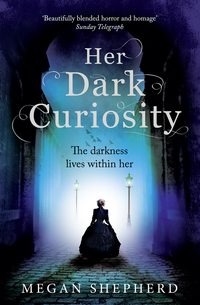
Читать книгу: «Her Dark Curiosity»
MEGAN SHEPHERD
Her Dark Curiosity

To Peggy and Tim,
for a childhood filled with books & love
Table of Contents
Cover
Title Page
Dedication
Chapter 1
Chapter 2
Chapter 3
Chapter 4
Chapter 5
Chapter 6
Chapter 7
Chapter 8
Chapter 9
Chapter 10
Chapter 11
Chapter 12
Chapter 13
Chapter 14
Chapter 15
Chapter 16
Chapter 17
Chapter 18
Chapter 19
Chapter 20
Chapter 21
Chapter 22
Chapter 23
Chapter 24
Chapter 25
Chapter 26
Chapter 27
Chapter 28
Chapter 29
Chapter 30
Chapter 31
Chapter 32
Chapter 33
Chapter 34
Chapter 35
Chapter 36
Chapter 37
Chapter 38
Chapter 39
Chapter 40
Chapter 41
Chapter 42
Chapter 43
Chapter 44
Chapter 45
Acknowledgments
About the Author
Also by Megan Shepherd
Copyright
About the Publisher
1
The air in my crumbling attic chamber smelled of roses and formaldehyde.
Beyond the frosted windowpanes, the rooftops of Shoreditch stretched toward the east in sharp angles still marked with yesterday’s snow, as chimney stacks pumped smoke into an already foggy sky. On nights like these, I never knew what dangers might lurk in the streets. Yesterday morning a flower girl around my age was found frozen on the corner below. I hadn’t known her aside from glimpses in the street, one girl on her own nodding to another, but now her dark, pretty eyes would never again meet mine in the lamplight. The newspapers said nothing of her death – just one of dozens on such a cold night. I’d learned of it in slips and whispers when I made my usual rounds to the flower stalls and butcher stands. They told me she’d tried to stuff flowers between the layers of her meager clothing for warmth. The flowers had frozen too.
I pulled my patchwork quilt tighter around my shoulders, shivering at the thought. After all, a threadbare scrap of fabric wasn’t much more than crumpled flowers.
Winter in London could be a deadly time.
And yet, as I studied the street below where children trailed a chestnut roaster hoping for fallen nuts, I couldn’t help but feel there was something about the narrow streets that whispered of a certain familiarity, a sense of safety despite the rough neighborhood. The tavern owner across the street came out to hang a sparse holly wreath on her paint-flecked door, getting ready for Christmas in a few weeks. My thoughts drifted backward to memories of mincemeat pies and presents under a fir tree, but my smile soon faded, along with the fond remembrances. What good would presents do me now, when death might be just around the corner?
I returned to my worktable. The attic I let was small, a narrow bed and a cabinet missing a drawer arranged around an ancient woodstove that groaned into the night. My shabby worktable was divided in two halves; the right-hand side contained half a dozen twisted rosebushes in various states of being grafted. A flower shop in Covent Garden paid me to alter these bushes so that the same plant would produce both red and white flowers. The meager profit I made helped pay for the rent and the medical supplies on the left side of the table: a syringe from my previous day’s treatment, a package wrapped in butcher paper, and scrawled notes about the healing properties of hibiscus flowers.
I took my seat, letting the patchwork quilt pool onto the floor, and reached for one of the glass vials. Father had developed this serum for me when I’d been a baby, and until recently it had kept the worst of my symptoms at bay. Over the past few months, however, all that had begun to change, and I was growing more ill: muscle spasms, followed by a deep-seated ache in my joints, and a vertigo that left my vision dulled. The instant I touched the vial, my hand clenched with a sharp tremor, and the small container slid from my fingers and shattered on the floor.
‘Blast!’ I said, hugging my quaking hand to my chest. This was how the fits always began.
As flickering shadows from my lamp threw beastlike shapes on the roof, I cleaned the broken glass and then unwrapped the butcher’s package and smoothed down the edges. The smell of meat filled the air, ironlike, only just beginning to rot. My head started to spin from the odor. I lifted one of the pancreases. The organ was the size of my fist, a light fleshy color, shriveled into deep wrinkles. The cow must have been killed yesterday, maybe the day before.
Its death might mean my life. I’d been born with a spinal deformity that would have been fatal, if my father hadn’t been London’s most gifted surgeon. He’d corrected my spine, though the operation resulted in a scar down the length of my back and several missing organs that he’d been able to substitute in his desperation with those of a fawn. My body had never quite accepted the foreign tissue, resulting in the tremors, dizziness, and need for daily injections.
I wasn’t certain why the serum was failing now. Perhaps I was becoming immune, or the raw ingredients had altered, or perhaps now that I was growing from child to woman, my body’s composition was changing, too. I’d outgrown his serum just as I had my childish respect for him. His serum had only ever been temporary anyway, lasting a day or two at most. Now I was determined to create something even better: a permanent cure.
The pancreas’s puckered flesh yielded under my scalpel’s sharpened blade, separating like butter. It required but three simple incisions. One down the length. One to expose the glycogen sac. Another to slice the sac free and extract it.
I slid over the tray clinking with glass vials, along with the crushed herbs I’d already mixed with powders from the chemists’. This work had a way of absorbing me, and I scarcely realized how the afternoon was passing, or how cold the air seeping through the window was growing. At last I finished this latest batch of serum and waited impatiently to see if the various ingredients would hold. In order to be effective, the disparate parts would need to maintain cohesion for at least a full minute. I waited, and yet after only ten seconds the serum split apart like a bloated eel left too long in the sun.
Blast.
It had failed, just like all the times before.
Frustrated, I pushed my chair back and paced in front of the twisted rosebushes. How much longer could I go on like this, getting worse, without a cure? A few more months? Weeks? A log cracked in the woodstove, sending hot light licking at the stove’s iron door. The flames flickered like those of another fire long ago, my last night on the island. I had been desperate then, too.
Montgomery stood on the dock, the laboratory where he’d helped Father with his gruesome work blazing behind him. Waves lapped at the dinghy I crouched in, waiting for him to join me. We’d sail to London, put the island behind us, start a new life together. And yet Montgomery remained on the dock, let go of the rope, and pushed me out to sea.
But we belong together, I had said.
I belong with the island, he’d replied.
A church bell rang outside, six chimes, and a glance at the window told me night had settled quickly. I was late again, reliving memories I’d sooner forget. I grabbed my coat and threw open the door, dashing down four rickety flights of stairs until I was outside with the wind pushing at my face and the cold night open before me.
I stuck to the well-traveled, gaslit thoroughfares. It wasn’t the fastest route to Highbury, but I didn’t dare take the shortcuts through the alleyways. Men lurked there, men so much larger than a slip of a girl.
I turned north on Chancery Lane, which was busy at all hours with people loitering between pubs, and I hugged my coat tighter, keeping my eyes low and my hood pulled high. Even so, I got plenty of stares. Not many young ladies went out alone after dark.
In such chaos, London felt much like Father’s island. The beasts that lurked here just had less fur and walked more upright. The towering buildings seemed taller each day, as though they’d taken root in the oil and muck beneath the street’s surface. The noise and the smoke and the thousand different smells felt suffocating. Too closely packed. Ragged little children reached out like thorny vines. It felt as if eyes were always watching, and they were – from upstairs windows, from dark alleys, from beneath the low brims of wool caps hiding all manner of dark thoughts.
As soon as I could, I escaped the crowd onto a street that took me to the north section of Highbury. From there it wasn’t too far to Dumbarton Street, where the lanes were wide and paved with granite blocks, swept clean of all the refuse found in the lesser neighborhoods. The houses grew from stately to palatial as my boots echoed on the sidewalk. Twelve-foot-high Christmas trees studded with tiny candles shone behind tall windows, and heavy fir garlands framed every doorway.
I paused to lift the latch of the low iron gate surrounding the last house on the corner. The townhouse was three stories of limestone facade with a sloping mansard roof that gave it a stately air, as though it had quietly withstood regime changes and plague outbreaks without blinking an eye. It was on the quiet end of Dumbarton, not the grandest house by far, despite the fact that its owner was one of London’s wealthiest academics. I dusted off my coat and ran my fingers through my hair before ringing the doorbell.
The door was opened by an old man dressed in a three-piece black suit who might look stern if not for the deep wrinkles around the corners of his eyes, which betrayed his inclination to smile in a charmingly crooked way – a habit he gave in to now.
‘Juliet,’ he said, ‘I was starting to worry. How was your visit with Lucy?’
I smiled, the only way I knew to hide my guilt, and pulled off my gloves. ‘You know Lucy, she could chatter away for hours. Sorry I’m a bit late.’ I kissed his cheek as if that would make up for the lie, and he kindly helped me out of my coat.
‘Welcome home, my dear,’ he said.
2
Professor Victor von Stein had been a colleague of my father’s – and the man who turned him in to the police ten years ago for crimes of ethical transgression. The professor’s betrayal of their friendship might have bothered me when I was younger and still had respect for my father, but now I thought he’d done the world – and me – a favor. I owed him even more because, for the last six months, he’d been my legal guardian.
When I’d left Father’s island, I’d followed Montgomery’s instructions to find a Polynesian shipping lane and, after nearly three scorched weeks in the dinghy, was picked up by traders bound for Cape Town. From there, the expensive trinkets Montgomery had packed bought me passage to Dakar, and on to Lisbon. I’d gotten sick on the last leg of the voyage, and by the time I reached London was little more than a skeleton, raving about monsters and madmen. I must have said my friend Lucy’s name, because one of the nurses had summoned her, and she’d taken care of me, but my good fortune ended there. One of the doctors was an old acquaintance from King’s College by the name of Hastings. A year ago he’d tried to have his way with me and I’d slit his wrist. As soon as he learned I’d returned, he’d had me thrown in jail, which was where Professor von Stein had found me.
Lucy Radcliffe told me your circumstances, he had said. Is it true what you did to this doctor?
He needn’t have asked. The scar at the base of Dr Hasting’s wrist matched my old mortar scraper exactly.
It is, I’d said, but I had no choice. I’d do it again.
The professor had studied me closely with the observant eyes of a scientist, and then demanded I be released into his custody and the charges dropped. Hastings didn’t dare argue against someone so highly respected. The next day, I went from a dirty prison cell to a lady’s bedroom with silk sheets and a roaring fire.
Why are you doing this? I had asked him.
Because I failed to stop your father until it was too late, he’d replied. It isn’t too late for you, Miss Moreau, not yet.
Now, sitting at the formal dining table with a forest of polished silver candlesticks between us, I secretly kicked off my slippers and curled my toes in the thick Oriental rug, glad to put that old life behind me.
‘An invitation arrived today,’ the professor said from his place opposite me. The hint of an accent betrayed that he’d grown up in Scotland, though his family’s Germanic ancestry was evident in his fair hair and deep-set eyes. A fire crackled in the hearth behind him, not quite warm enough to chase the cold that snuck through the cracks in the dining room windows.
‘It’s for a holiday masquerade at the Radcliffes’,’ he continued, removing a pair of thin wire-rimmed spectacles from his pocket, along with the invitation. ‘It’s set for two weeks from today. Mr Radcliffe included a personal note saying how much Lucy would like you there.’
‘I find that rather ironic,’ I said, buttering my roll with the hint of a smile, ‘since last year the man would have thrown me into the streets if I’d dared set foot in his house. He’s changed his tune now that I’m under your roof. I think it’s you he’s trying to win over, Professor.’
The professor chuckled. Like me, he was a person of simple tastes. He wanted only a comfortable home with a warm fire on a winter night, a cook who could prepare a decent coq au vin, and a library full of words he could surround himself with in his old age. I was quite certain the last thing he wanted was a seventeen-year-old girl who slunk around and jumped at shadows, but he never once showed me anything but kindness.
‘I fear you’re right,’ he said. ‘Radcliffe has been trying to ingratiate himself with me for months, badgering me to join the King’s Club. He says they’re investing in the horseless carriage now, of all things. He’s a railroad man, you know, probably making a fortune shipping all those automobile parts to the coast and arranging transport from there to the Continent.’ He let out a wheezing snort. ‘Greedy old blowhards, the lot of them.’
The cuckoo clock chimed in the hallway, making me jump. The professor’s house was filled with old heirlooms: china dinner plates, watery portraits of stiff-backed lords and ladies whose nameplates had been lost to time, and that blasted clock that went off at all hours.
‘The King’s Club?’ I asked. ‘I’ve seen their crest in the hallways at King’s College.’
‘Aye,’ he said, buttering his bread with a certain ferocity. ‘An association of university academics and other professionals in London. It’s been around for generations, claiming to contribute to charitable organizations – there’s an orphanage somewhere they fund.’ He finished buttering his roll and took a healthy bite, closing his eyes to savor the taste. He swallowed it down with a sip of sherry.
‘I was a member long ago, when I was young and foolish,’ he continued. ‘That’s where I met your father. We soon found it nothing more than an excuse for aging old men to sit around posturing about politics and getting drunk on gin, and neither of us ever went back. Radcliffe’s a fool if he thinks they can woo me again.’
I smiled quietly. Sometimes, I was surprised the professor and I weren’t related by blood, because we seemed to share what I considered a healthy distrust of other people’s motives.
‘What do you say?’ he asked. ‘Would you like to make an appearance at the masquerade?’ He gave that slightly crooked smile again.
‘If you like.’ I shifted again as the lace lining of my underskirt itched my bare legs like the devil. I’d never understand why the rich insisted on being so damned uncomfortable all the time.
‘Good heavens, no. I haven’t danced in twenty years. But Elizabeth should arrive by then, unless there’s more snow on the road from Inverness, and I’ve no doubt we shall be able to wrangle her into a ball gown. She used to be quite the elegant dancer, as I recall.’
The professor stowed his glasses in his vest pocket. Elizabeth was his niece, an educated woman in her mid-thirties who lived on their family estate in northern Scotland and served the surrounding rural area as a doctor – an occupation a woman would only be permitted to do in such a remote locale. I’d met her as a child, when she was barely older than I was now, and I remember beautiful blond hair that drove men wild, but a shrewdness that left them uneasy.
‘You know how the holidays are,’ he continued, ‘all these invitations to teas and concerts. I’d be a sorry escort for you.’
‘I very much doubt that, Professor.’
While he went on talking about Elizabeth’s Christmas visit, I dug my fork beneath my dress and scratched my skin beneath the itchy fabric. It was a tiny bit of relief, and I tried to work it under my corset, when the professor cocked his head.
‘Is something the matter?’
Guiltily, I slid the fork into my lap and sat straighter. ‘No, sir.’
‘You seem uncomfortable.’
I looked into my lap, ashamed. He’d been so kind to take me in, the least I could do was try to be a proper lady. It surely wasn’t right that I felt more comfortable wrapped in a threadbare quilt in my attic workshop than in his grand townhouse. The professor didn’t know about the attic, and only knew a very limited account of what had happened to me over the past year. I had told him that the previous autumn I’d stumbled upon my family’s former servant, Montgomery, who had told me that my father was alive and living in banishment on an island, to which he took me. I’d lied to the professor and said Father was ill and passed away from tuberculosis. I had claimed that the disease had decimated the island’s native population and I’d fled, eventually making my way back to London.
I had said nothing of Father’s beast-men. Nothing of Father’s continued experimentation. Nothing of how I’d fallen in love with Montgomery and thought my affections returned, until he’d betrayed me. Nothing of Edward Prince, either, the castaway I’d befriended, only to learn he was Father’s most successful experiment, a young man created from a handful of animal parts chemically transmuted using human blood. A boy who had loved me despite the secret he kept carefully hidden, that a darker half – a Beast – lived within his skin and took control of his body at times, murdering the other beast-men who had once been such gentle souls. Edward was dead now, his body consumed in the same fire that had taken my father. That didn’t mean, however, that I’d ever managed to forget him.
By the time I looked up, I found the professor’s attention had strayed to his newspaper. I returned to my baked hen, stabbing it with my fork. Why hadn’t I seen Edward’s secret? Why had I been so naïve? My thoughts drifted to the past until the professor let out a little exclamation of surprise at something he read.
‘Good lord, there’s been a murder.’
My fork hovered over my plate. ‘It must have been someone important if it’s reported on the front page.’
‘Indeed, and unfortunately, I knew the man. A Mr Daniel Penderwick, solicitor for Queensbridge Bank.’
The name sounded vaguely familiar. ‘Not a friend of yours, I hope.’
The professor seemed absorbed by the article. ‘A friend? No, I’d hardly call him a friend. Only an acquaintance, and a black one at that, though I’d never wish anything so terrible upon the man as murder. He was the bank solicitor who took away your family’s fortune all those years ago. Made a career of that dismal work.’
Uneasiness stirred at the mention of those darker times. ‘Have they caught his murderer?’
‘No. It says here they’ve no suspects at all. He was found dead from knife wounds in Whitechapel, and the only clue is a flower left behind.’ He gave me a concerned glance above his spectacles, then folded the paper and tossed it to the side table. ‘Murder is hardly proper dinner conversation. Forgive me for mentioning it.’
I swallowed, still toying with the fork. The professor was always worried that whenever an unpleasant topic of conversation arose, I’d think of my father and be plagued by nightmares. He needn’t have worried. They plagued me regardless.
After all, I had helped kill Father.
When I looked up, the professor was studying me, the laugh lines around his eyes turned down for once. ‘If you ever need to discuss what happened while you were gone …’ He shifted, nearly as uncomfortable with such conversations as I. ‘I knew your father well. If you need to resolve your feelings for him …’ He sighed and rubbed his wrinkles.
I wanted to tell him how much I appreciated his efforts, but that he would never understand what had happened to me. No one would. I remembered it as if it had happened only moments ago. Father’s laboratory burning, him locked inside, the blood-red paint bubbling on the tin door. I feared he would escape the laboratory, leave the island, and continue experimenting somewhere else. I’d had no choice but to open the door. A crack, that was all it had taken, to let Jaguar – one of my father’s creations – slip inside and slice him apart.
I smiled at the professor. ‘I’m fine. Really.’
‘Elizabeth is better with this sort of thing. You’ll feel more comfortable with another woman in the house, someone to speak with freely. What would a wrinkled old man know about a girl’s feelings? You’re probably in love with some boy and wondering what earrings to wear to catch his eye.’
He was only teasing now, and it made me laugh. ‘You know me better than that.’
‘Do I? Yes, I suppose so.’ He gave his off-balance smile.
It wasn’t my way to be tender with people, but the professor was an old curmudgeon with a kind heart, and he’d done so much for me. Kept me from prison. Given me elegant clothes, kept me fed on French cuisine, and done his best to be the father figure I should have had.
On impulse I went to his end of the table, where I wrapped my arms around his shoulders and kissed his balding head. He patted my arm a little awkwardly, not used to me showing such emotion.
‘Thank you,’ I said. ‘For all you’ve done for me.’
He cleared his throat a little awkwardly. ‘It’s been my pleasure, my dear,’ he said.
After dinner I climbed the stairs, jumping as the cuckoo clock sprang to life in the hallway. I considered ripping the loud-mouthed wooden bird out of its machinery, but the professor adored the old thing and patted the bird lovingly each night before bed. It was silly for him to be so sentimental over an old heirloom, but we all have our weaknesses.
I went to my room, where I locked the door and took out the silver fork I’d stolen from the dinner table, pressing my finger against the sharp tines. The professor had set up accounts at the finer stores in town for me, but what I needed was cash – paper money for my secret attic’s rent, for the equipment and ingredients for my serums, and grafting roses only paid so much. I stared at the fork, regretting the need to steal from the man who’d given me a life again. But as I looked out the window at the dark sky and saw the snow falling in gentle flakes, flashing when hit by the lights of a passing carriage, I told myself I was desperate.
And desperation could lead a person to things one might never do otherwise.
3
That night, like most nights, I lay in my sprawling bed, staring at the ceiling, and trying desperately not to think about Montgomery.
It never worked.
When I had moved into the professor’s home, he had wallpapered my bedroom ceiling in a dusky pale rose print. Now, my eyes found hidden shapes among the soft buds, remembering the boy who would never give me flowers again.
‘He loves me,’ I whispered to nothing and to no one, counting the petals. ‘He loves me not.’
When I’d been a girl of seven and he a boy of nine, he’d once accompanied us to our relatives’ country estate. One morning after Mother and Father had gotten in a terrible row, I’d found a small bouquet of Queen Anne’s lace on my dresser. I’d never had the courage to ask Montgomery if he’d left them. When Mother found the flowers, she tossed them out the window.
Weeds, she had said.
Years later, he’d given me flowers on the island, when we were no longer children and he’d outgrown his shyness. He’d won my affection, but his betrayal had left my heart dashed against the rocks, broken and bleeding.
‘He loves me, he loves me not,’ I whispered. ‘He’ll forget me, he’ll forget me not. He’ll find me, he’ll find me not …’
I sighed, letting the sounds of my whispers float up to the rose-colored wallpaper. I rolled over, burying my face in my pillow.
You must stop with such childish games, I told myself, as the place beneath my left rib began to ache.
The next morning the professor took me to the weekly flower show at the Royal Botanical Gardens, held in the palatial glass-and-steel greenhouse known as the Palm House, where I found myself surrounded by ranunculus and orchids and spiderlike lilies, and where the only things more ostentatious than the flowers were the dozens of fine ladies sweating in their winter coats. A year ago I’d never thought I would find myself wearing elegant clothes once more, amid ladies whose perfume rivaled the flowers, who tittered about my past behind my back but wouldn’t dare say anything to my face.
It was shocking how much one’s fate could twist in a single year.
The professor, who I was quite certain wished to be anywhere but in a sweaty greenhouse surrounded by ladies, wandered off to inspect the mechanical system that opened the upper windows, leaving me alone to the sly looks and catty whispers of the other ladies.
… used to work as a maid …
… father dead, you know, mother turned to pleasing men for money …
… pretty enough, but something off about her …
Through a forest of towering lilies, a woman in the next aisle caught my eye. For a moment she looked like my mother, though Mother’s hair had been darker, and she’d been thinner in the face. It was more the way this woman hung on the arm of a much older white-haired man, dressed finely with a silver-handled cane. The woman wore no wedding ring – so the man was her lover, not her husband.
The couple paused, and the woman stopped to admire the lilies. I was about to leave when I overheard her say, ‘Buy me one, won’t you, Sir Danvers?’
Sir Danvers. I gave him another look, discreetly, studying the expensive cane, the bones of his face. Yes, it was he. Sir Danvers Carew, Member of Parliament, a popular lord and landowner – and one of the men who used to keep my mother as his mistress. He’d seemed kind, like his reputation, until he turned to drink. He had once knocked Mother around the living room, then struck my leg with that same cane when I’d tried to stop him. I hadn’t thought of him in years, and yet now my shin ached with phantom pain from that day.
I turned away sharply, though there was no danger of him recognizing me. Back then I’d been the skinny child of a mistress he hadn’t kept but a few weeks, and now I was one of the elegant young ladies come to admire hothouse flowers in winter.
‘May I show you these lilies, miss?’ a vendor across the aisle said. I turned my head, still a bit dazed by the memories. ‘They’re a new hybrid I developed myself,’ she continued. ‘I cross-pollinated them with Bourgogne lilies from France.’
Eager to be away from Sir Danvers, I pretended to admire the flowers. The blooms were beautiful, but the hybridization had made the stems too thick. They would have done better crossed with Camden lilies to keep the stems strong but delicate. I didn’t dare start talking aloud about splicing and hybridization, though – I’d have sounded too much like Father.
I swallowed. ‘They’re beautiful.’
‘There you are!’ called a voice at my side. Lucy came tripping along the steam grates in a tight green velvet suit, fanning her face. ‘I’ve been up and down every hall looking for you. Oh, this blasted heat.’ With her free hand she dabbed a handkerchief at the sweat on her forehead. Beneath our feet, the boilers churned out another blast of steam that rose as in a Turkish bath. I inhaled deeply, letting it seep into my pores. I felt healthier here, in the tropical warmth, where the symptoms of my illness never seemed quite as bad.
Lucy glanced rather disdainfully at a bucket of mangled daisies with broken stems. ‘Good lord. It looks as though someone pruned those flowers with a butter knife.’
‘It isn’t about the sharpness of the blade,’ I said. ‘It’s about the hand that holds it.’
‘Well, if you ask me, that hand isn’t anything special either. Must we come here every week? What do I care for flowers, unless a young man is giving them to me?’
I smiled. ‘Which dashing young man would that be? You seem to have quite a few these days.’
Her powdered cheeks grew pinker as she brushed by a display of orchids, absently knocking their petals to the floor. ‘Papa prefers John Newcastle, of course, and I know he’s handsome and a self-made man and all that, but he’s so boring. And then there’s Henry, and my goodness, I simply can’t abide him. He’s from Finland, you know, which might as well be the end of the earth. He hadn’t even seen an automobile until one practically ran him over in Wickham Park.’
As I watched her carelessly knock over an entire plant, I said, ‘For a boy you keep claiming to dislike, you certainly seem to dwell on him.’
She gasped with indignation and rattled on more about her other suitors, but I only half listened. I’d heard all this before, time and time again, different young men depending on the week. I nodded absently while I stooped to clean up the flowers she’d knocked over.
‘Really, Juliet,’ Lucy said in exasperation. ‘You must remember you’re not a maid anymore.’
I paused. She was right. I lived with a wealthy guardian now and was back in good social standing. Seeing Sir Danvers and remembering my mother’s fall from grace had made me relive my former shame all over again. At the far end of the aisle, Sir Danvers and his mistress admired some orchids. He tapped the cane on the steel grates at his feet, sending vibrations all the way to where we stood. I had the sudden urge to stride over, snatch the cane from his hand, and slam the silver tip into his shin, as he had once done to mine. For a man his age, it wouldn’t take much force to shatter the bone.
My hands itched for that cane. More tittering laughter came from behind me, cruel and high-pitched, and I imagined the flower show ladies whispering among themselves.
… violent tendencies …
… well, with a father like hers …
Itch, itch, itch. But I forced myself to turn away. The professor wanted to prove I could be a respectable young lady despite who my father had been. The only problem was, being respectable wasn’t nearly as second nature as I had thought it would be.
I turned my back on them, facing the frost-covered wall of the greenhouse, beyond which I could make out the shadowy shapes of falling snow. As I watched, a black police carriage pulled up outside. My breath froze. Ever since Scotland Yard officers had arrested me in response to Dr Hastings’s accusations, I’d been jumpy around policemen.
All that is behind you, I reassured myself.
But the carriage stopped, and a handsome officer perhaps ten years my senior climbed out, and through the glass panes dripping with condensation, he looked directly at me.
I turned toward the sprays of ferns, Sir Danvers forgotten, thoughts racing. If this had been Father’s island, I could have disappeared into those vines with silent steps I’d learned from his beast-men. But large as the greenhouse was, the police would find me in minutes.
Lucy gave me a strange look, dabbing at her brow. ‘Whatever’s the matter with you?’
‘The police are here,’ I whispered. I jerked my chin toward the door at the far end of the palm court, where the groan of the heavy iron door sounded. I should get away from Lucy. It would only humiliate her to have her friend arrested so publicly.
I started for the door to intercept him, but Lucy grabbed my arm. ‘The police? Oh, don’t tell me you’re still afraid of the police. That was ages ago, and everything was sorted out. And look at you; you’d look like royalty if you’d just stop slouching so much. Only criminals slouch.’
My heart pounded harder as the officer appeared through the vines that draped from the catwalk above. He was a tall man with a sweep of chestnut hair that matched Lucy’s, and he walked with the confidence of the upper classes. Not a beat patrol officer, then. They’d sent someone important for me – how thoughtful. He was dressed in a fine dark suit with an old-fashioned copper bulletproof breastplate beneath his cravat, and a pistol at his hip.
My muscles twitched, urging me to flee, but Lucy’s arm still held me.
‘Oh, him?’ She sighed. ‘You’ve nothing to worry about. He’s not here for you. Papa must have sent him to collect me.’
I looked between the officer and Lucy, still not understanding. ‘What do you mean?’
‘That’s John Newcastle, the suitor Papa’s so fond of,’ she said. ‘I was just telling you about him. Weren’t you listening? Really, Juliet.’
I stared at her. ‘You didn’t say he was a police officer!’
‘He isn’t a police officer,’ she said, fluffing her hair where the humidity had made it go flat. ‘He’s an inspector. Scotland Yard’s top inspector.’ Her voice dropped to a mutter. ‘He’s rather fond of telling me how important he is, not to mention handsome. He’d marry himself, I do believe, if he could.’
‘Lucy—’ I started, but Inspector Newcastle reached us then and gave us a dashing smile, his eyes only darting to me in a perfunctory manner before settling on Lucy.
‘Lucy, darling.’ He bent forward to kiss her cheek, which left a glistening mark that she dabbed at with the handkerchief.
‘Papa sent you, I presume?’
‘He invited me to supper, and I offered to come collect you.’
She pounced on my arm again. ‘John, this is my friend Juliet Moreau. Oh, Juliet, I’ve a fine idea. Go ask the professor if you can join us for a bite to eat.’ Her insistent wink told me she didn’t want to spend an extra moment alone with her suitor.
‘Yes, you’re welcome to join us, Miss Moreau.’ He extended his hand to take mine, but as soon as my fingers were in his, his hand tightened. ‘Have we met before? Your name sounds somewhat familiar.’
I glanced at Lucy. ‘I don’t believe so, Inspector. I think I would remember.’ I extracted my fingers from his grasp, wishing I could just as easily remove his suspicions about my name from his thoughts. I nodded my chin toward his copper breastplate. ‘What an unusual piece. Is it an antique?’
‘Why, yes,’ he said, clearly pleased. ‘It belonged to my grandfather. A lieutenant in the Crimean War. Kept him alive despite five bullets and a gunpowder explosion. I try to be a modern man, and we have better protective garments these days, but a little sentimental superstition can be healthy, don’t you think?’ He tapped his breastplate good-naturedly.
I smiled, relieved I’d managed to distract him from my name.
Lucy slid her arm into mine and said, ‘Juliet’s quite a tragic case, I’m afraid. Both parents dead, left penniless. She even had to work at one point.’
She started to lead me toward the door, but I pulled away a little too fast. I had errands to run before returning home, errands I had to keep secret.
‘Thank you for the offer, but I’ve plans with the professor. It was a pleasure meeting you, Inspector. I’ll see you soon, Lucy.’
I ducked away from them and found the professor amid the crowd, still engrossed by the rusted mechanics of the greenhouse. He smiled warmly when he saw me.
‘I wondered if you’d mind if I had a bite to eat with Lucy,’ I said.
‘Well, certainly,’ he said, eyes twinkling. Now he could go home to his books and a thick slice of Mary’s gingerbread cake. I kissed him on the cheek and hurried through the tunnel of palms to the doorway, where I could at last be on my own. I took one last breath of the thick, warm air, before pushing the heavy door open and bracing for the cold.
A swirling gust of snow ruffled my velvet skirts. The botanical garden’s ice-covered lake spread in front of me, the water sprite fountain in the center now frozen under a waterfall of ice.
I’d get an earful from Lucy later. She wouldn’t like that I’d left her to fend off John Newcastle’s kisses alone. But just being around the police – even a well-mannered inspector – made me nervous.
And I had my errands to run.
I drew my fur-lined coat around my neck and waited behind the frozen skeleton of an azalea for Inspector Newcastle and Lucy to leave. They climbed into the black carriage amid pleasantries I couldn’t make out, save for a single curse from Lucy when her skirt caught on the curb. I smiled at her impropriety as their carriage rolled away over the cobblestone.
Pulling my coat tighter, I made my way toward Covent Garden. The sun was already heading for the horizon, so I slipped into an alleyway that would cut my walk by half. The alley was quiet, save for a pair of cats chasing each other through abandoned crates.
Ahead of me a short young man approached from the opposite direction, cap pulled low over his brow so his face was hidden in shadows. As our paths grew closer, he took his time looking me up and down, giving me gooseflesh. He wasn’t wearing gloves, and I noticed that he was missing his middle finger – a difficult detail to ignore. I stiffened. The only reason an otherwise warmly dressed man wouldn’t wear gloves on a day this cold was if he planned on needing his dexterity for something.
I stepped into the street to pass him with a wide berth, but he spun around and walked alongside me. The hair on the back of my neck rose. I forced myself to keep walking, hoping he’d just doubled back on some forgotten errand, even though I knew it was too late for wishes. I glanced at my boot, where a knife was hidden – a trick I’d learned from Montgomery.
‘Spare a coin, miss?’ the man asked, suddenly right at my side, in a voice that seemed unnaturally deep. His bare fingers reached out, the missing middle finger leaving an unnatural vacancy.
I jerked away. ‘Sorry, no.’
‘With those fine buttons? Come on, miss. Just a coin. It isn’t safe out here, alone on the streets. Not safe for a girl at all.’
I saw his arm twitch a second before he grabbed my coat. I ducked out of his grasp and pulled the knife from my boot, then shoved him against the curb at the right angle for his ankles to catch. It threw him off-balance and he fell. I collapsed on top of him, knee digging into the soft center of his chest, knife at his throat, as I checked the alley to make certain we were alone.
His cap fell back, and I started as shoulder-length red hair tumbled out around a pretty face. A girl younger than me, disguised as a man, which explained the put-on deep voice. That was good – a girl I could scare off. A man I might have had to inflict some damage upon.
‘I know it isn’t safe,’ I hissed. ‘What do you think knives are for?’
I pressed the knife closer against her neck, watching the flesh wrinkle beneath it. Her eyes went wide.
‘I didn’t mean nothing!’ she said, voice substantially higher now. ‘Please, miss, I swear, I just wanted them buttons!’
I narrowed my eyes at her, digging my knee deeper until I felt a rib, and then gave an extra jab before climbing off her.
I jerked my chin toward the opposite street. ‘Go on,’ I said. ‘And next time put some lampblack on your chin to look like a beard, and for god’s sakes wear gloves; your bare hands gave you away instantly.’
She scrambled to her feet, brushing the muck off her clothes, and stumbled away at a run. I sheathed the knife in the boot holster, then wiped a trembling hand over my face, breathing some life back into my cold hands.
I took off at a brisk walk, still shaken, the afternoon clouds overhead the only witness to the incident I couldn’t forget fast enough, until at last I saw the shining lights of Covent Garden.
4
The market was filled at all hours with a vast range of people, and I gladly plunged into the safety of their midst. Ladies in fine dresses shopped for Christmas presents, scullery maids swarmed past the wrinkle-faced vegetable women, tailors and seamstresses haggled in the textile quarter. My fine coat and boots caused no one to give me a second glance, until I slipped into the meat section of the market. Few fine young ladies could stomach these narrow passageways. Eels as long as my arm twitched on hooks above lambs’ glassy dead eyes, and stray cats licked up the salty blood pooling on the floor. By the time I reached Joyce’s Choice Meats, I was getting nothing but strange looks.
Jack Joyce, however, tipped his hat to me.
Joyce, an Irish ex-boxer who’d turned to the meat trade in his old age, cracked a broken-toothed grin as I approached. His previous profession had left him not only minus a few teeth but with a permanent squint eye that never seemed to be looking in the same direction as the other. A small black dog with a white spot on his chest and notable only in his ugliness, wagged his tail.
‘Hello, Joyce,’ I said, and then knelt to scratch the dog’s bony head. In general, I did my best to stay away from animals. They only reminded me of the dark experimentation Father had done. That was why I limited myself to plants. Roses couldn’t kill, or maim, or betray.
‘And hello to you too, boy.’ I picked up the dog, though he was heavy in my arms. ‘He’s put on a pound or two, I believe.’
‘Aye. Soon enough he’ll be fatter than a queen’s lapdog, if you keep buying him scraps. And just as lazy.’ Joyce took his knobby old hands away from his fire and dug around behind the counter until he came back with some chicken bones that he tossed to the dog.
Technically, the dog was mine. He’d started following me around town ever since I’d first come to Joyce’s Meats six months ago. It was the meat in my pocket he smelled, and the only way I could get him to keep from trailing at my heels was to pay Joyce to keep him well-fed on scraps, a task that despite his grumbling, I suspected, the old boxer rather enjoyed.
‘Let’s see,’ Joyce said, digging around beneath the counter. He came up with a package wrapped in butcher paper and tied with twine. ‘Here’s your order. Two pancreases, one liver. Couldn’t get my hands on the deer heart you wanted. I should have it next week.’
‘That’s fine,’ I said, slipping the package into my pocket. Just being here stirred the bones of my hands from their slumber, made them remember what Father had done to me. I flexed them, hoping to hold off the symptoms of another fit.
The dog finished his chicken bone and barked at Joyce, who stooped down on his bad knee and scratched the dog’s head. ‘When are you going to give this ugly fellow a name already?’ he asked.
I leaned against the counter, watching the dog thumping his tail. ‘He isn’t my dog.’
‘Don’t think he understands that.’
‘My guardian wouldn’t care much for a stray in his house. I fear I’m already uncivilized enough for him.’ I didn’t mention how the last dog I’d named, a puppy called Crusoe, had died under Father’s scalpel. The thought made my stiff hands ache more, and I pushed them into my coat pockets.
Joyce grinned. ‘Aw, you could use a companion. Keep him in a back garden. How about Romeo, eh? Romeo and Juliet, you were made for one another.’
‘I was made for a flea-ridden stray?’ I couldn’t help but laugh. ‘Well, perhaps you’re right. Though in any case, Romeo doesn’t suit him. Who’s that boxer you’re always talking about? The underdog. That mutt’s an underdog, if I’ve ever seen one.’
‘Mike Sharkey,’ Joyce said. ‘Pride of Ireland. He beat that big Turkish bloke four to one. What do you say, fella? Are you a Sharkey?’
I watched Joyce pet him and scratch beneath his chin. Joyce had always been friendly with me, and never once asked what a well-dressed young woman wanted with so many animal organs.
‘Hope you’re taking care out there, miss, walking around town on your own, especially this late in the afternoon. It’ll be dark soon. You’ve heard about the murders, I wager?’
‘Which murders? This is London. There are a dozen murders every day.’
His eyes went serious beneath his brow. ‘Didn’t read the morning paper, did you?’ He rooted around in the stack of old newspapers he used to wrap cuts of meat and slapped one down on the table.
‘A MASS MURDERER IN THE MAKING?’ the headline read.
‘Three murders in the last two days,’ Joyce said. ‘Scotland Yard says they’re connected; the murderer leaves his mark at each crime scene. It’s all anyone’s been talking about. They’re calling him the Wolf of Whitechapel on account of how he claws up the bodies. One of them had a purse on him and a gold watch, but the murderer didn’t touch it. Wasn’t interested in anything but tearing that man apart like an animal.’
Like an animal.
The twist in my gut grew to a desperate squeeze, and I had to lean on the counter to catch my breath. Like an animal, that’s how Edward had killed his victims. Ripped their hearts out with six-inch claws.
My hand slid to my chest, pressing against the hard whalebone corset. On the island, I’d seen a woman with her jaw ripped off. Buzzing flies. A blood-stained tarpaulin. Mauled, like all the others.
To this day, even so long after his death, my heart wrenched to think that Edward had killed so many of the islanders. He had seemed such an innocent young man, and yet beneath his skin lurked a monster.
A monster created by my father.
‘Christ, didn’t mean to frighten you, miss. I forget you’re a proper lady sometimes.’
‘It’s quite all right, Joyce,’ I said with a shaky smile.
I started to pick up the package to go when he said, ‘You just be careful, miss. Flowers dipped in blood, that’s his mark. That’s how they know the bodies are connected.’
I slowly turned back to him. The professor had said that a flower had been found beside the body of that terrible solicitor, Daniel Penderwick, who had taken my family’s fortune on behalf of the bank. Shocked that I had been acquainted with the first victim of what the police thought might be a mass murderer, I pointed toward the paper. ‘On second thought, do you mind if I read that article?’
He passed me the newspaper and I pored over it carefully. There was Penderwick’s name, listed as the Wolf of Whitechapel’s first victim. A second victim had been found last night, torn apart with violent wounds, and a white flower left nearby. The victim’s name made me start.
Annie Benton.
A creeping feeling began in my ankles, making my toes curl. Annie Benton had been my roommate when I worked as a maid at King’s College. She’d had a bad habit of digging through my belongings. A few months ago she’d gotten back in touch with me under the pretense of friendship, but had then stolen my mother’s small diamond ring – the only thing I had left of her.
I leaned against the butcher’s stand to steady myself. If I’d read Annie’s name in any other context, I would have been seething with anger, but the thought of her murdered by such violent means left me feeling strangely hollow and out of place, as though time was moving backward.
Was it coincidence that I’d known two of the victims?
‘These are the only murders? Annie Benton and Penderwick?’
‘Rumors of another one found just an hour ago. Unidentified body – so they claim,’ Joyce said. ‘I’d like to think there won’t be more, but Scotland Yard don’t have much to go on.’
The creeping sensation ran up the backs of my legs. My vision started to go foggy as blood pooled in my extremities. I gripped the butcher’s stand harder and accidentally brushed against one of the glassy-eyed pig’s heads. I jumped and cried out.
‘You feeling all right, lass?’
‘Yes,’ I stuttered. ‘Here – some coins for this package, and to keep the dog fed. I should go.’
‘I’ll see you next week for the usual order?’
I nodded before leaving, still clutching Joyce’s newspaper, along with the meat. It wasn’t until I was halfway to Highbury, and the sun had dipped behind the skyline, that I realized I’d taken the wrong road.
I’d wandered into the seedy end of Whitshire, where rats outnumbered the people ten to one and more gaslights were broken than not. The hair rose on the back of my neck, reminding me of my altercation with the girl thief earlier. I’d been lucky that time to escape unharmed. I might not be lucky again.
I took a deep breath as I mentally worked out a map for the direction I needed to go to get me back to a well-lit street. I hurried past a dress shop full of headless mannequins, taking care to avoid the open street, but a foggy feeling crept upon me.
Stay near the lampposts, I told myself. Stay near the light.
I turned the corner onto a shadowy street with only a single lamp glowing at the far end, and my heartbeat sped. After a few minutes I felt the neck-tingling sensation that I was being followed, and considered reaching for the knife in my boot. But as I strained my ears, I made out only the sound of little footsteps that stopped when I stopped, and when I whirled around to face my pursuer, the little black dog was behind me. He wagged his tail.
‘Oh, Sharkey,’ I gasped. He ran over and I gave him a good scratch. ‘You weren’t supposed to follow me! I haven’t time to take you back to the market now – I’ll be late getting home as is.’ I sighed. ‘Well, come on.’
It was a quiet evening, save for the wind that ruffled the strands of hair that had come loose from my braid. I hurried through the streets with Sharkey at my heels, though I hadn’t a clue how I’d explain him to the professor. Lock him in the garden, perhaps, until morning. It was impossible to think about anything but the murders, until I nearly stepped on a white flower on the ground in front of me.
I stopped.
A flower itself was rare enough in winter. I knew all too well how much care and tending they needed to stay as fresh as this one was. It lay all by itself on a patch of sidewalk wiped of snow as though someone had left it for me, creamy white petals radiating from a gold center, a delicate stem no thicker than a bootlace.
A tropical flower.
There was a rustle in the alleyway to my side – a rat, no doubt – and the dog took off after it. I knelt in front of the flower. Five petals, not unlike the ones that had grown on Father’s island. Montgomery had picked one, once, from the garden wall and tucked it behind my ear. The memory of Montgomery made the place around my rib throb with familiar hurt.
He loves me, he loves me not …
My heart twisted at the memory, and I turned to go. I should get home, before I was late for supper and the professor grew suspicious. But the flower was so beautiful, delicate as a whisper there in the snow, that I couldn’t leave it.
I pulled off a glove and reached down to pick it up.
As soon as I did, I knew something was wrong. My bare fingers touched a wet substance beneath the flower. I held my fingers up to the faint light from the lamppost.
Blood.
Blood spotted the back of the flower, as though it had been pressed into a pool of it. It was still fresh.
Бесплатный фрагмент закончился.