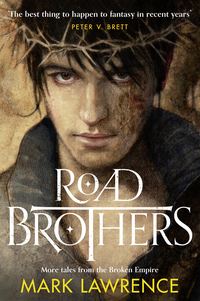
Читать книгу: «Road Brothers»


Copyright
HarperVoyager
an imprint of HarperCollinsPublishers Ltd
1 London Bridge Street
London SE1 9GF
www.harpercollins.co.uk
First published in ebook in Great Britain by HarperVoyager 2017
Copyright © Mark Lawrence 2017
Map © Andrew Ashton
Cover layout design © HarperCollinsPublishers Ltd 2017
Jacket illustration © Kim Kincaid
Mark Lawrence asserts the moral right to be identified as the author of this work.
A catalogue copy of this book is available from the British Library.
These works are entirely works of fiction. The names, characters and incidents portrayed in them are the work of the author’s imagination. Any resemblance to actual persons, living or dead, events or localities is entirely coincidental.
All rights reserved under International and Pan-American Copyright Conventions. By payment of the required fees, you have been granted the non-exclusive, non-transferable right to access and read the text of this e-book on screen. No part of this text may be reproduced, transmitted, down-loaded, decompiled, reverse engineered, or stored in or introduced into any information storage and retrieval system, in any form or by any means, whether electronic or mechanical, now known or hereinafter invented, without the express written permission of HarperCollins.
Source ISBN: 9780008221386
Ebook Edition © September 2017 ISBN: 9780008221393
Version: 2017-10-04
Contents
Cover
Title Page
Copyright
Map
Introduction
A Rescue
Sleeping Beauty
Bad Seed
The Nature of the Beast
The Weight of Command
Select Mode
Mercy
A Good Name
Choices
No other Troy
The Secret
Escape
Know Thyself
Three is the Charm
Acknowledgements
Also by Mark Lawrence
About the Author
About the Publisher
Map

Introduction
I learned most of what I know about writing from writing short stories. They’re a great place to practise the art. They are also a fine means by which to revisit a character or a world, illuminating a corner of the original tale that perhaps deserves more attention. In addition, they can be used to look back over the years, allowing us to see how our heroes and villains … well mainly villains if we’re honest … came to be where we found them and what shaped them along the way.
The stories in this anthology were written over the space of a few years, mostly for other projects. They offer a mix of murder, mayhem, pathos, and philosophy, and stand on their own without the need to have read the books that inspired them. The events occur before or around the edges of those described in the Broken Empire trilogy and will contain a variety of spoilers.
I hope you’ll enjoy dipping into the lives of Jorg and his brothers one more time. It was a grand tale and I was sorry to leave it behind.
Mark Lawrence
Bristol, 2017
Oh, and I’ve added a brief footnote at the end of each story … because I wanted to!
A Rescue
‘I spent a year hunting down the men who burned my home. I followed them across three nations.’
‘I see.’ The old man laid down his quill and looked up across the desk at Makin.
Makin returned the stare. The king’s man had a long white beard, no wider than his narrow chin and reaching down across his chest to coil on the desk before him. He’d asked no question but Makin felt the need to answer.
‘I wanted them to pay for the lives of my wife and my child.’ Even now the anger rose in him, a sharpness twitching his hands towards violence, a yammering in his ears that made him want to shout.
‘And did it help?’ Lundist studied him with dark eyes.
The guards had told Makin the man had journeyed from the Utter East and King Olidan had hired him to tutor his children, but it seemed his duties extended further than that.
‘Did it help?’ Makin tried to keep the snarl from his voice.
‘Yes.’ Lundist set his hands before him, the tips of his long fingers meeting in front of his chest. ‘Did taking your revenge ease your pain?’
‘No.’ When he took to his bed, when he closed his eyes, it was blue sky Makin saw, the blue line of sky he had watched from the ditch he had lain in, run through, bleeding out his lifeblood. A line of china blue fringed with grass and weeds, black against the brightness of the day. The voices would return to him – the harsh cries of the footmen set to chase down his household. The crackle of the flames finding the roof. Cerys hid from the fire as her mother had told her to. A brave girl, three years in the world. She hid well and no one found her, save the smoke, strangling her beneath her bed before the flames began their feast.
‘… your father.’
‘Your pardon?’ Makin became aware that Lundist was speaking again.
‘The captain of the guard accepted you for wall duty because I know your father has ties with the Ancrath family,’ Lundist said.
‘I thought the test …’
‘It was important to know that you can fight – and your sword skills are very impressive – but to serve within the castle there must be trust, and that means family. You are the third son of Arkland Bortha, Lord of Trent, a region that one might cover a fair portion of with the king’s tablecloth. You yourself are landless. A widower at one and twenty.’
‘I see.’ Makin nodded. He had disarmed four of Sir Grehem’s men when they came at him. Several sported large bruises the next day although the swords had been wooden.
‘The men don’t like you, Makin. Did you know that?’ Lundist peered up from the notes before him. ‘It is said that you are not an easy man to get along with.’
Makin forced the scowl from his face. ‘I used to be good at making friends.’
‘You are …’ Lundist traced the passage with his finger, ‘a difficult man, given to black moods, prone to violence.’
Makin shrugged. It wasn’t untrue. He wondered where he would go when Lundist dismissed him from the guard.
‘Fortunately,’ Lundist continued, ‘King Olidan considers such qualities to be a price worth paying to have in his employ men who excel at taking lives when he commands it, or in defence of what he owns. You’re to be put on general castle duty on a permanent basis.’
Makin pursed his lips, unsure of how he felt. Taking service with the king had seemed to be what he needed after his long and bloody year. Setting down roots again. Service, duty, renewed purpose, after his losses had set him adrift for so long. But just now, when he had thought himself cut loose once more, bound for the loneliness of the road, he had, for a moment, welcomed it.
Makin stood, pushing back the chair that Lundist had directed him to. ‘I will attempt to live up to the trust that’s been placed in me.’ He thought of the ditch. Cerys had had faith in him, a child’s blind faith. Nessa had had faith, in him, in his word, in God, in justice … and her trust had seen her pinned to the ground by a spear in the cornfield behind her home. He saw again the blue strip of sky.
Lundist bent to his ledger, quill scratching across parchment.
As Makin turned to go, the tutor spoke again. ‘The need for vengeance feels like a hunger, but there is no sating it. Instead it consumes the man that feeds it. Vengeance is taking from the world. The only cure is to give.’
Makin didn’t trust himself to speak and instead kept his jaw locked tight. What did a dried-up old scribe know of the hurts he’d suffered?
‘There’s a gap between youth and age that words can’t cross,’ Lundist said. He sounded sad. ‘Go in peace, Makin. Serve your king.’
‘The Healing Hall is on fire!’ A guardsman burst through the door into the barracks.
‘What?’ Makin rolled to his feet from the bunk, sword in his hand. He’d heard the man’s words. Saying ‘what’ was just a reflex, buying time to process the information. He glanced at the blade in his grasp. An edge would rarely help in fighting flames. ‘Are we under attack?’ No one would be mad enough to attack the Tall Castle, but on the other hand the queen and her two sons had been ambushed just a day from the capital. Only the older boy had survived, and barely.
‘The Healing Hall is on fire!’ The man repeated, looking around wildly. Makin recognized him as Aubrek, a new recruit: a big lad, second son of a landed knight and more used to village life than castles. ‘Fire!’ All along the barracks room men were tumbling from their beds, reaching for weapons.
Makin pushed past Aubrek and gazed out into the night. An orange glow lit the courtyard and on the far side tongues of flame flickered from the arched windows of the Healing Hall, licking the stonework above.
Castle-dwellers scurried in the shadows, shouts of alarm rang out, but the siege bell held its peace.
‘Fire!’ Makin roared. ‘Get buckets! Get to the East Well!’
Ignoring his own orders, Makin ran straight for the hall. It had once been the House of Or’s family church. When the Ancraths took the Tall Castle a hundred and twenty years previously they had built a second church, bigger and better, leaving the original for the treatment of the sick and injured. Or, more accurately, to repair their soldiers.
The heat brought Makin up short yards from the wall.
‘The Devil’s work!’ Friar Glenn’s voice just behind him.
Makin turned to see the squat friar, halted a few yards shy of his position, the firelight glaring on the baldness of his tonsure. ‘Is the boy in there?’
Friar Glenn stood, mesmerized by the flames. ‘Cleansed by fire …’
Makin grabbed him, taking two handfuls of his brown robe and heaving him to his toes. ‘The boy! Is Prince Jorg still in there?’ Last Makin heard the child had still been recuperating from the attack that had killed his mother and brother.
A wince of annoyance crossed the friar’s beatific expression. ‘He … may be.’
‘We need to get in there!’ The young prince had hidden in a hook-briar when the enemy had come for him a week earlier. He had sustained scores of deep wounds from the thorns and they had soured despite Friar Glenn’s frequent purging in the Healing Hall. He wouldn’t be getting out on his own.
‘The Devil’s in him: my prayers have made no impression on his fevers.’ The friar sank to his knees, hands clasped before him. ‘If God delivers Prince Jorg from the fire then—’
Makin took off, skirting around the building toward the small door at the rear that would once have given access to the choir loft. A nine-year-old boy in the grip of delirium would need more than prayers to escape the conflagration.
Cries rang out behind him but with the roar of the fire at the windows no meaning accompanied the shouts. Makin reached the door and took the iron handle, finding it hot in his grasp. At first it seemed that he was locked out, but with a roar of his own he heaved and found some give. The air sucked in through the gap he’d made, the flames within hungry for it. The door surrendered suddenly and a wind rushed past him into the old church. Smoke swirled in its wake, filling the corridor beyond.
Every animal fears fire. There are no exceptions. It’s death incarnate. Pain and death. And fear held Makin in the doorway, trapped there beneath the weight of it as the wind died around him. He didn’t know the boy. In the years Makin had served in King Olidan’s castle guard he had seen the young princes on maybe three occasions. It wasn’t his part to speak to them – merely to secure the perimeter. Yet here he stood now, at the hot heart of the matter.
Makin drew a breath and choked. No part of him wanted to venture inside. No one would condemn him for stepping back – and even if they did he had no friends within the castle, none whose opinion he cared about. Nothing bound him to his service but an empty promise and a vague sense of duty.
He took a step back. For a moment in place of swirling smoke he saw a line of brittle blue sky. Come morning this place would be blackened spars, fallen walls. Years ago, when they had lifted him from that ditch, more dead than alive, they had carried him past the ruins of his home. He hadn’t known then that Cerys lay within, beneath soot-black stones and stinking char.
Somehow Makin found himself inside the building, the air hot, suffocating, and thick with smoke around him. He couldn’t remember deciding to enter. Bent double he found he could just about breathe beneath the worst of the smoke, and with stinging, streaming eyes he staggered on.
A short corridor brought him to the great hall. Here the belly of the smoke lay higher, a dark and roiling ceiling that he would have to reach up to touch. Flames scaled the walls wherever a tapestry or panelling gave them a path. The crackling roar deafened him, the heat taking the tears from his eyes. A tapestry behind him, that had been smouldering when he passed it, burst into bright flames all along its length.
A number of pallets for the sick lined the room, many askew or overturned. Makin tried to draw breath to call for the prince but the air scorched his lungs and left him gasping. A moment later he was on his knees, though he had no intention to fall. ‘Prince Jorg …’ a whisper.
The heat pressed him to the flagstones like a great hand, sapping the strength from him, leaving each muscle limp. Makin knew that he would die there. ‘Cerys.’ His lips framed her name and he saw her, running through the meadow, blonde, mischievous, beautiful beyond any words at his disposal. For the first time in forever the vision wasn’t razor-edged with sorrow.
With his cheek pressed to the stone floor Makin saw the prince, also on the ground. Over by the great hearth one of the heaps of bedding from the fallen pallets had a face among its folds.
Makin crawled, the hands he put before him blistered and red. One bundle, missed in the smoke, proved to be a man, the friar’s muscular orderly, a fellow named Inch. A burning timber had fallen from above and blazed across his arm. The boy looked no more alive: white-faced, eyes closed, but the fire had no part of him. Makin snagged the boy’s leg and hauled him back across the hall.
Pulling the nine-year-old felt harder than dragging a fallen stallion. Makin gasped and scrabbled for purchase on the stones. The smoke ceiling now held just a few feet above the floor, dark and hot and murderous.
‘I …’ Makin heaved the boy and himself another yard. ‘Can’t …’ He slumped against the floor. Even the roar of the fire seemed distant now. If only the heat would let up he could sleep.
He felt them rather than saw them. Their presence to either side of him, luminous through the smoke. Nessa and Cerys, hands joined above him. He felt them as he had not since the day they died. Both had been absent from the burial. Cerys wasn’t there as her little casket of ash and bone was lowered, lily-covered into the cold ground. Nessa didn’t hear the choir sing for her, though Makin had paid their passage from Everan and selected her favourite hymns. Neither of them had watched when he killed the men who had led the assault. Those killings had left him dirty, further away from the lives he’d sought revenge for. Now though, both Nessa and Cerys stood beside him, silent, but watching, lending him strength.
‘They tell me you were black and smoking when you crawled from the Healing Hall.’ King Olidan watched Makin from his throne, eyes wintry beneath an iron crown.
‘I have no memory of it, highness.’ Makin’s first memory was of coughing his guts up in the barracks, with the burns across his back an agony beyond believing. The prince had been taken into Friar Glen’s care once more, hours earlier.
‘My son has no memory of it either,’ the king said. ‘He escaped the friar’s watch and ran for the woods, still delirious. Father Gomst says the prince’s fever broke some days after his recapture.’
‘I’m glad of it, highness.’ Makin tried not to move his shoulders despite the ache of his scars, only now ceasing to weep after weeks of healing.
‘It is my wish that Prince Jorg remain ignorant of your role, Makin.’
‘Yes, highness.’ Makin nodded.
‘I should say, Sir Makin.’ The king rose from his throne and descended the dais, footsteps echoing beneath the low ceiling of his throne room. ‘You are to be one of my table knights. Recognition of the risks you took in saving my son.’
‘My thanks, highness.’ Makin bowed his head.
‘Sir Grehem tells me you are a changed man, Sir Makin. The castle guard have taken you to their hearts. He says that you have many friends among them …’ King Olidan stood behind him, footsteps silent for a moment. ‘My son does not need friends, Sir Makin. He does not need to think he will be saved should ill befall him. He does not need debts.’ The king walked around Makin, his steps slow and even. They were of a height, both tall, both strong, the king a decade older. ‘Young Jorg burns around the hurt he has taken. He burns for revenge. It’s this singularity of purpose that a king requires, that my house has always nurtured. Thrones are not won by the weak. They are not kept except by men who are hard, cold, focused.’ King Olidan came front and centre once more, holding Makin’s gaze – and in his eyes Makin found more to fear than he had in the jaws of the fire. ‘Do we understand each other, Sir Makin?’
‘Yes, highness.’ Makin looked away.
‘You may go. See Sir Grehem about your new duties.’
‘Yes, highness.’ And Makin turned on his heel, starting the long retreat to the great doors.
He walked the whole way with the weight of King Olidan’s regard upon him. Once the doors were closed behind him, once he had walked to the grand stair, only then did Makin speak the words he couldn’t say to Olidan, words the king would never hear, however loud-spoken. ‘I didn’t save your son. He saved me.’
Returning to his duties, Makin knew that however long the child pursued his vengeance it would never fill him, never heal the wounds he had taken. The prince might grow to be as cold and dangerous as his father, but Makin would guard him, give him the time he needed, because in the end nothing would save the boy except his own moment in the doorway, with his own fire ahead and his own cowardice behind. Makin could tell him that of course – but there are many gaps in this world … and there are some that words can’t cross.
Footnote
Makin has always been an interesting character for me, a failed father-figure if you like. He should be Jorg’s moral touchstone but too often finds himself swept along by the force of Jorg’s personality and by the chaos/cruelty of the life he’s entangled in. We root for him to recover himself.
Sleeping Beauty
A kiss woke me. A cool kiss pulled me from the hot depths of my dreaming. Lips touched mine, and deep as I was, dark as I was, I knew her, and let her lead me.
‘Katherine?’ I spoke her name but made no sound. A whiteness left me blind. I closed my eyes just to see the dark. ‘Katherine?’ A whisper this time. Damn but my throat hurt.
I turned my head, finding it a ponderous thing, as if my muscles strove to turn the world around me whilst I remained without motion. A white ceiling rotated into white walls. A steel surface came into view, gleaming and stainless.
Now I knew something beyond her name. I knew white walls and a steel table. Where I was, who I was, were things yet to be discovered.
Jorg. The name felt right. It fitted my mouth and my person. Hard and direct.
I could see a sprawl of long black hair spread across the shining table, reaching from beneath my cheek, overhanging the edge. Had Katherine climbed it to deliver her kiss? My vision swam, my thoughts with it – was I drunk … or worse? I didn’t feel myself – I might not yet know who I was, but I knew enough to say that.
Images came and went, replacing the room. Names floated up from the back of my mind. Vyene. I had a barber cut my hair almost to the scalp when I left Vyene. I remembered the snip of his shears and the dark heap of my locks, tumbled across his tiled floor. Hakon had mocked me when I emerged cold-headed into the autumn chill.
Hakon? I tried to hang details upon the void beneath his name. Tall, lean … no more than twenty, his beard short and bound tight by an iron ring beneath his chin. ‘Jorg the Bald!’ he’d greeted me and fanned out his own golden mane across his shoulders, bright against wolfskins.
‘Watch your mouth.’ I’d said it without rancour. These Norse have little enough respect for royalty. Mind you neither do I. ‘Has my beauty fled me?’ I mocked sorrow. ‘Sometimes you have to make sacrifices in war, Hakon. I surrendered my lovely locks. Then I watched them burn. In the battle of man against lice I am the victor, whilst you, my friend, still crawl. I sacrificed one beauty for another. My own, in exchange for the cries of my enemies. They died by the thousand, in the fire.’
‘Lice don’t scream. They pop.’
I recalled the bristling of scalp beneath palm as I rubbed my head trying to find an answer to that one. I tried now to touch the hair spread out before me across the steel but found my hands restrained. I made to sit up but a strap across my chest held me down. Straining, I could see five more straps binding me to the table, running across my chest, stomach, hips, legs, and ankles. I wore nothing else. Tubes ran from glass bottles on a stand above me, down into the veins of my left wrist.
This room, this white and windowless chamber, had not been made by any people of the Broken Empire. No smith could have fashioned the table, and the plasteek tubes lay beyond the art of some king’s alchemist. I had woken out of time, led by dreams and a kiss to some den of the Builders.
The kiss! I flung my head to the other side, half-expecting to find Katherine standing there, silent beside the table. But no – only sterile white walls. Her scent lingered though. White musk, fainter than faint, but more real than dream.
Me, a table, a simple room of harsh angles, kept warm and light by some invisible artifice. The warmth enfolded me. My last memories had been of cold. Hakon and me trudging through the snow-bound forests of eastern Slov, a week out from Vyene. We picked our path between the pines where the ground lay clearest, leading our horses. Both of us huddled in our furs, me with only a hood and a quarter inch of hair to keep my head from freezing. Winter had fallen upon us, hard, early, and unannounced.
‘It’s buggery cold,’ I said unnecessarily, letting my breath plume before me.
‘Ha! In the true north we’d call this a valley spring.’ Hakon, frost in his beard, hands buried in leather mittens lined with fur.
‘Yes?’ I pushed through the pine branches, hearing them snap and the frost scatter down. ‘Then how come you look as cold as I feel?’
‘Ah.’ A grin cracked his wind-reddened cheeks. ‘In the north we stay by the hearth until summer.’
‘We should have stayed by that last hearth then.’ I floundered through snow, banked along a break in the trees.
‘I didn’t like the company.’
I had no answer for that. Exhaustion had its teeth in me and my bones lay cold in white flesh.
The house in question had stood implausibly deep in the forest, so isolated that Hakon had been convinced the tales of a witch were true.
‘Don’t be stupid,’ I’d told him. ‘If there’s a witch living in the forest and she eats children then she’s going to want to live on the edge, isn’t she? I mean how often does a little Gerta or Hans come wandering this far in?’
Hakon had caved beneath the undeniable weight of my logic. We’d gone to ask for shelter, and failing it being offered, to take it. The door stood ajar – never a good sign in a winter storm, and the snow in front of the porch lay heavily trodden, covered with a fresh fall that obscured detail.
‘Something’s not right.’ Hakon unslung his axe, a heavy, single-bladed thing with a long cutting edge, curved to bite deeper.
I’d nodded and advanced, silent save for the crump of fresh snow beneath my boots. Reaching out with my sword, I pushed the door wider. My theory about little girls and the middle of forests didn’t survive the hallway. A child lay sprawled there, golden curls splashed with crimson, arms and legs at broken angles. I advanced another step, my nose wrinkled against the stink. Blood, the reek of guts, and something else, something rank and feral.
A hand clamped my shoulder and I nearly spun to hack it off. ‘What?’
‘We should leave … the witch—’
‘There’s no witch living here.’ I pointed at the corpse. ‘Unless she’s got teeth big enough to bite a girl’s face off, a taste for entrails, and a nasty habit of shitting in her own hallway.’ I pointed to the brown mound by the foot of the stairs, which, unlike the girl’s guts, was still steaming ever so slightly.
‘Bear!’ Hakon released my shoulder and started to back away. ‘Let’s run.’
‘Let’s,’ I agreed.
A big black head thrust out from beneath the stairs as we retreated to the horses. I saw another bear, larger still, through the broken shutters to the side of the house, licking out a bowl in the kitchen. And, as we reached our steeds and started to hurry away, a cub watched us from the attic bedroom, its wet muzzle thrust out between the winter boarding, teeth scarlet.
Why did it have to be bears? If it had been a witch I’d have stuck my sword through her neck and moved in. Bears though … Better to run, even if it’s out into the killing cold.
Each step sapped my strength as the heat left me, stolen a scrap at a time, squandered into the night air with every breath.
I plodded on, deep in myself, refusing exhaustion. It had been time to leave Vyene, whether winter was approaching or not. I might regret it now, freezing in the pathless forest, but I’d stayed too long. Sometimes the dream of a place sucks you in and before you know it you’re part of that dream too. In a city as grand and as old as Vyene the dream is one of glory, steeped in history, but like all dreams it’s an illusion that will use you up while grass grows under your feet, while thorns spring up, dense on all sides, and hem you in. A kiss had woken me there too. Elin, leaving with her brother, Sindri, to their halls and duties in the north. Hakon had wanted to stay, but he’d had enough of the ancient capital and wanted to see the provinces, to slum it with the King of Renar. And so we’d left, escaped the trap of intrigue and politicking that was Vyene, shook ourselves free before its soft jaws closed entirely around us, and moved along.
Full night and a bitter moon found us some miles further on, breaking from the treeline and setting out across a snowfield where the land turned stony and started to rise. Snow began to fall once more, large-flaked, ghostly, ponderous at first, then rushing as the wind picked up again.
I lay on the steel table remembering – seeing lost days unfold. The dreams that had wrapped me still clung, leeching away urgency and care. It occurred to me that some drug pulsed in my veins, some sleeping draught to keep me dull. I jerked my body within the bands that kept me on the table. Nothing moved. The thing must be bolted to the floor.
Each strap had a buckle. One free hand and I’d be out of there. So all that truly held me was the binding on my wrists. I strained to break a hand free but the bands weren’t made for breaking.
‘Fuck.’
I stared around the room. In the top corner, opposite me, a glass eye watched, a short black cylinder ending in a dark lens.
The tubes that ran, from bottles on a steel stand to needles in my arm, hung tantalisingly close. Straining until my neck screamed and my vision blurred, I could almost touch the nearest of the trio with the tip of my tongue. Close! But ‘close’ can be the difference between cutting a throat and slicing air.
I stared at the tubes, hating them, trying not to let the drugs drag me down again. I felt myself sinking, the whiteness of the ceiling filling my mind.
Sinking.
I had felt myself sinking into a white embrace when we left the trees behind. The snow crust lay too thin to hold my weight and beneath it, cold soft depths where a man could flounder. In the drifts a man would lose the last of his heat quick enough, and find at the limits of his strength that the snow became almost warm, a cradle into which he might relax, and perhaps sleep, just for a moment, to recover himself.
‘Here!’ Hakon held the haft of his axe for me to grab hold and hauled me onto firmer ground.
‘Why did we leave the woods, again?’ I asked the question with numb lips, the words coming out blunt-edged. At least my teeth had ceased to chatter, which seemed as if it should be a good thing. The wind scoured the hillside. In the forest the trees had muted it.
‘Nothing beats a cave for shelter.’ Hakon pushed me on.
‘Cave? Where?’ I could see little past swirling snow and darkness.
I’d promised Sindri to send his cousin back alive after his trip to Renar. So far it looked as though it was Hakon keeping me alive. ‘And where’s my damn horse?’
‘Back in the trees with mine. I saw a light. We’re checking it out. You’ll remember when you’re warmer. Let’s get to the cave.’ Hakon kept up a steady pace and I stumbled after him.
‘Cave? There’ll be bears!’ I remembered something about a baby bear with a red muzzle, and a girl with golden locks and no face. Swords and axes aren’t a match for a bear’s strength. Put a length of steel through one and the beast will still kill you before it realizes it’s dead.
‘This is a medical facility, Jorg. Look in the skin-flask.’
‘The what?’
‘It’s on your back. Depress the third, seventh, and sixth button.’
I took the cylinder from my shoulder and set it down before me by its strap. I knelt and pressed the numbered bumps as directed, glancing down only briefly, expecting to be rushed. I leapt back as the lid began to unscrew along a previously unseen seam. The top fell away with a hiss and I leaned forward to peer at the contents.
‘Pink slime.’ For some reason my stomach rumbled, reminding me I hadn’t eaten in … well, a very long time. ‘Does it taste as bad as it looks?’
‘Nu-skin. Touch it to your hand.’ Hakon turned his head, the ugly array of rods emerging from his eyes now pointing at my injury.
I didn’t trust Kalla but knowledge can be power and my half-flayed hand hurt badly enough to stop me concentrating. With my good hand I dipped a fingertip into the muck and felt it writhe, the sensation similar to holding a slug. I touched the slightest smear of it to the raw flesh of my other hand, still tight around the plague vial. The effect came within seconds, the livid pinkness of the slime flowing into something more skin-coloured, spreading, thinning, the feeling of insects crawling … and finally, a patch of new skin little wider than a fingerprint.
‘If you help me you can walk away with many such treasures. Wonders of the old world. I could explain them to you. A man with that kind of magic on his side could rule—’
‘I already have a kingdom, ghost.’ I sealed the cylinder and set it over my shoulder again.
‘Is it enough?’ she asked, Hakon immobile, her voice rising from his chest. The sweet smell of rot hung about him. A fly buzzed about his head, settling by the corner of an eye.
‘Nothing is ever enough.’ Habit led my fingers to the old burns across the left side of my face, still rough and puckered. ‘You didn’t want me pretty? Or doesn’t your gloop heal burns?’
‘It was made for burns. Burns are its speciality. But that injury is curiously resistant. There’s an exotic energy signature … If our physics laboratory were operational then …’
I backed toward the mouth of the cave and the green riot of hook-briar. The drone of bees reached me now, the call of birds. High summer outside, the seasons had turned whilst I slept.
‘There’s no escape that way, Jorg.’ Kalla followed. ‘Hook-briar was one of our works.’
‘Yours?’
‘Well, not mine. But from this facility. This was a big place once. Three hundred people worked here. Chamber upon chamber, waiting now for a man with enough vision to excavate them. Hook-briar – a cheaper, self-renewing razor wire. Highly effective engineering. For warmer climes than this of course if you want all-year protection. They never did get a strain that wouldn’t die back in the winter.’
‘And your … “projector” is out there?’ I tilted my head toward the midst of the thorns. ‘You’re not worried I might call on you in person?’ I gave her my dangerous smile. I hadn’t felt like smiling since I woke but now the edge of an idea sliced through the fading fog of Kalla’s drugs.
Hakon nodded. ‘It’s safe enough from you even if you wore armour and carried shears. Naked and without weapons you pose no threat. I tell you this to show you how hopeless your situation is. Work with me and power beyond your dreams could be—’
‘I’ve dreamed enough, ghost,’ I said. ‘Time to die. Goodbye, Brother Hakon.’
His lips twitched, a snarl of effort, and words stuttered out. ‘B-b-beauty. S-s-sacrifice.’ His own voice, free of Kalla’s control. The mutterings of a broken mind. Or perhaps his memory of our joking in Vyene about the price we’d pay to see our enemies burn.
I set my strength to untwisting the top of the vial.
‘No!’ Hakon started forward, Kalla shouting from his chest unit.
The lid came free and I flung the container over his head, back along the corridor. Kalla had said it held death, a plague that might scour mankind from the world. I’d called it Pandora’s Box. I turned and ran, shrugging Hakon’s reaching fingers from my shoulder. I built up speed, barefoot across the stony cavern floor.
I’d released Pandora’s ills and back along the corridor a klaxon sounded, wailing like a thousand banshees. Angling toward the extreme left of the cave mouth, I reached the impenetrable wall of thorns, and leapt, high as I might, diving forward.
‘Purging. Repeat – level 0 viral breach. Repeat. Full Purge!’
Pandora’s Box held all the world’s troubles … but at the bottom of it, last to emerge, trapped among nightmares, lay Hope.
The hook-briar gave before my weight, thorns snagging at my skin, slipping in, tearing, slicing deeper, holding, until at last they arrested my advance and I hung among them. Trapped as I’d been trapped years before, pierced by the same sharp and sudden pain, but this time by my own volition.
I heard rather than saw the hot white tongue of fire that roared from the cave mouth, a spear of incendiary rage surrounded by billowing flame that spilled to either side, spreading, engulfing.
The klaxon felt silent, leaving only the roar of flames, the crackle of burning, and my screaming as the margins of the inferno reached me, naked amongst the thorns.
Unconsciousness is a blessing in such times, but horrifically late in coming. I felt my skin crisp, saw my hair shrivel and burn as the hot breath of the fire blew around me. I saw the skin melting from my hands before the heat took my sight.
Unconsciousness is a blessing, but only a temporary one.
I found myself amid a forest of blackened coils, thorn-toothed, stark against the blueness of the sky.
Rolling my bald and weeping head, I saw with blurred eyes a corridor cut through the midst of the hook-briar where only fine white ash remained. The silver-steel of the cylinder lay beneath me, scorched but unharmed. I jabbed at the buttons with sticky fingers, some welded together with molten skin, clumsy in a pain that admits no description.
Three times I tried the numbers. I would have wept but I’d gone past tears. At last, infinitely slow, the lid rotated off and I dipped my hands into the nu-skin. I daubed the slime across each finger. As the stuff writhed across them I held each digit wide, despite the pain. I smeared slime across my face, into my mouth, into each eye, down across my body as far as the remaining thorns would let me.
Whatever science or enchantment the nu-skin held it proved to be powerful. The unguent worked different wonders depending on where it found itself, repairing my sight, flowing down my windpipe and healing my lungs to the point where I could scream once more, building new skin across my arms while the dead stuff sloughed away.
I tore free of the thorns, only to snare myself on new ones, but allowing the application of my dwindling stock of slime to new areas, groin, legs, back. The skin’s work drew on my own strength, an exhaustion rising through me that dragged me into a torpor despite the crawling agony of it all.
At last a light rain woke me. I stood, caught amid the skeletal remains of the briar, impaled on black thorns, smeared with ash, but unburned, clad in a new hide.
Even burned and brittle the hook-briar took its toll on me as I struggled through. By the time I reached the corridor of ash I ran with blood from a hundred wounds, the last of the nu-skin exhausted early in the escape. The rain came heavy now, but warm, sluicing down across my body in a crimson wash. I stood in the mud and ash and let it clean me.
I returned to the cave, finding it still hot, the stone ticking as it cooled, no trace of Hakon save a stain around the blackened drug stand. Wincing at the heat beneath my bare and bleeding feet I made my way along the dark corridor and found my sword. And thus dressed I left the bunker.
At last, before my strength failed once more, I picked my way around ancient remnants of razor wire and came to where the top of a sunken pillar of Builder-stone emerged from the mud. The stone had been cracked by the fire’s heat and a little less than a foot of it lay exposed. Despite the weathering and corrosion it took more effort than I thought remained in me to slide the top to one side. The hollow interior stretched down beyond sight, the inner surface crowded with myriad crystalline growths, all interconnected with a forest of silver wires, some thick, some finer than spider silk. Many of the crystals lay dark, but here and there one glowed with a faint light, visible only in the shadow.
‘Found you.’
‘Don’t.’ Kalla’s voice, weak and pulsing from the interior.
I pried a rock from the muck about me. A heavy chunk of what might once have been poured stone. Grunting with effort I lifted it to the lip of the column. It would fit down the inside with an inch or two to spare.
‘I can’t end. Not like—’
‘A thousand years is too long to live.’ And I let the rock fall. It dropped with a prolonged and continuous sound of shattering, ricocheting from one wall to the other, tearing away the guts that had let Kalla echo for so long within the last works of the Builders.
I looked at my hands, torn and empty. A great weariness washed through me, a desire to lie myself down in the mud and let sleep claim me. All that stopped me was the memory of a kiss, the hint of her scent.
‘No. I’ve slept long enough.’
A kiss had woken me and I’d found, as we so often do, that the world had moved on without me. And that’s the riddle of existence for you. When to move and when to stay. Dwell too long and we become the prisoner of our dreams, or someone else’s. Move too fast, live without pause, and you’ll miss it all, your whole life a blur of doing. Good lives are built of moments – of times when we step back and truly see. The dream and the dreamer. There’s the rub. Does the dream ever let go? Aren’t we all only sleepwalking into old age, just waiting, waiting, waiting for that kiss?
Bleeding, smeared with muck and ash, I staggered down the hill, all that survived the purge of Bunker 17. I might be counted one more ill to be visited upon the world, for I could hardly be called its hope. But, hope or horror, I had endured. I had been delivered from the thorns in fire and pain and set free.
I ran a hand across the baldness of my scalp and felt my mouth twist in its old smile, a bitter one to be sure – but not only bitter.
‘Sleeping beauty, woken by the princess’s kiss,’ I said.
And so I set off to find her.
Footnote
This was the first Broken Empire short story I wrote, prompted by a reader daring me to do a Jorg/fairy-tale mash-up. It’s framed around Sleeping Beauty but has a nod to Goldilocks and even Rapunzel! Chronologically it takes place between the two threads in Emperor of Thorns, before the Wedding Day thread in King of Thorns, on Jorg’s return to Ancrath from his first visit to Vyene. Hakon is a character seen in The Red Queen’s War trilogy.
Did Katherine wake Jorg using her dream-magic, or was it just a failure of the ageing machinery? That’s for the reader to decide.
Bad Seed
At the age of eight Alann Oak took a rock and smashed it into Darin Reed’s forehead. Two other boys, both around ten years old, had tried to hold him against the fence post while Darin beat him. They got up from the dirt track, first to their hands and knees, one spitting blood, the other dripping crimson from where Alann’s teeth found his ear, then unsteadily to their feet. Darin Reed lay where he had fallen, staring at the blue sky with wide blue eyes.
‘Killer,’ they called the child after that. Some called ‘kennt’ at his back and the word followed him through the years as some words will hunt a man down across the storm of his days. Kennt, the old name for a man who does murder with his hands. An ancient term in the tongue that lingered in the villages west of the Tranweir, spoken only among the greyheads and like to die out with them, leaving only a scatter of words and phrases that fitted too well in the mouth to be abandoned.
‘You forgive me, Darin, don’t you?’ Alann asked it of the older boy a year later. They sat at the ford, watching the water, flowing white around the stepping-stones. Alann threw his pebble, clattering it against the most distant of the nine steps. ‘I told Father Abram I repented the sin of anger. They washed me in the blood of the lamb. Father Abram told me I was part of the flock once more.’ Another stone, another hit. He had repented anger, but there hadn’t been anger, just the thrill of it, the red joy in a challenge answered.
Darin stood, still taller than Alann but not by so much. ‘I don’t forgive you, but I wronged you. I was a bully. Now we’re brothers. Brothers don’t need to forgive, only to accept. If I forgave the blow you might forget me.’
‘Father Abram told me …’ Alann struggled for the words. ‘He said, men don’t stand alone. We’re farmers. We’re of the flock, the herd. God’s own. We follow. To stray is to be cast out. Strays die alone. Unmourned.’ He threw again, hit again. ‘But … I feel … alone here, right among the herd. I don’t fit. People are scared of me.’
Darin shook his head. ‘You’re not alone. You’ve got me. How many brothers do you need?’
Alann fought no more battles, not with his first wreaking such harm. They watched him, the priest and the elders, and hung about by his guilt the boy stepped aside from whatever small troubles life in the village placed in his path. Alann Oak turned the other cheek though it was not in his nature to do so. Something ran through him, something sharp, at the core, not the dull anger or jealous loathing that prompts drunks to raise their fists, rather a reflex, an urge to meet each and any challenge with the violence born into him.
‘I’m different.’ Spoken on his fourteenth name-day, out in the quiet of a winter’s night while others lay abed. Alann hadn’t the words to frame it but he knew it for truth. ‘Different.’
‘A dog among goats?’ Darin Reed at his side, untroubled by the cold. He swept his arm toward the distant homes where warmth and light leaked through shutter cracks. ‘With them but not of them?’
Alann nodded.
‘It will change,’ Darin said. ‘Give it time.’
Years fell by and with the seasons Alann Oak grew, not tall but tall enough, not broad but sturdy, hardened by toil on the land with plough and hoe. He walked away from his past, although he never once strayed further than Kilter’s Market seven miles down the Hay Road. He walked away from the whispers, from the muttered ‘kennt’, and all that came with him from those days was Darin Reed, the larger child but the smaller man, his fast companion, pale, quiet, true.
The smoke of war darkened the horizon some summers, and once in winter, but the fires that sent those black clouds rising passed by the villages of the Marn, peace still lingering in the backwaters of the Broken Empire just as the old tongue still clung there. Perhaps they lacked the language for war.
Sometimes those unseen battles called to Alann. In the stillness of night, wrapped tight by darkness, Alann often wondered what a thing it would be to take up sword and shield and fight, not for any cause, not to place this lord or that lord in a new chair – but just to meet the challenge, to put himself to the test that runs along the sharp edge of life. And maybe once or twice he gathered his belongings in the quiet after midnight and set off from his parents’ cottage – but each time he found Darin, sat upon the horse trough beside the track that joins the road to Melsham. Each time the sight of his blood brother, pale beneath the moon, watching and saying nothing, turned Alann back the way he came.
Alann found himself a woman, Mary Miller from Fairfax, and they married in Father Abram’s church on a chill March morning, God himself watching as they said their vows. God and Darin Reed.
More years, more seasons, more crops leaping from the ground in the green storm of their living, reaped and harvested, sheep with their lambs, Mary with her two sons, delivered bloody into Alann’s rough hands. As red as Darin Reed when he lay there veiled in his own lifeblood. And family changed him. The need to be needed proved stronger than the call of distant wars. Perhaps that was all he had ever looked for, to be valued, to be essential, and who is more vital to a child than its ma and pa?
Time ran its slow course, bearing farm and farmer along with it, and Alann watched it all pass. He held his boys with his calloused hands, nails bitten to the quick, prayed in God’s stone house, knowing every hour of every day that somehow he didn’t fit into his world, that he went through the motions of his life not quite feeling any of it the way it should be felt, an impostor who never knew his true identity, only that this was not it. Even so, it was enough.
‘None of them see me, Darin, not Mary, not my sons, or Father Abram. Only you, and God.’ Alann thrust at the soil before him, driving the hoe through each clod, reducing it to smaller fragments.
‘Maybe you don’t see yourself, Alann. You’re a good man. You just don’t know it.’ Darin stood looking out across the rye in the lower field.
‘I’m a bad seed. You learned that the day you came against me.’ Alann bent and took up a clod of earth, crumbling it in his hand. He pointed across the broken earth to where Darin’s gaze rested. ‘I sowed that field myself, checked the grains, but there’ll be karren grass amongst the rye, green amongst the green. You won’t see it until it’s time to bear grain – even then you have to hunt. But come an early frost, come red-blight, come a swarm of leaf-scuttle, then you’ll see it. When the rye starts dying … that’s when you’ll see the karren grass because it may look the same, but it’s hard at the core, bitter, and it won’t lie down.’ He dug at the ground, then, turned by some instinct, looked east across the wheat field. Two strangers approaching, swords at their hips.
‘It’s a bad day to be a peasant.’ The taller of the two men smiled as he walked across the field, flattening the new wheat beneath his boots.
‘It’s never a good day to be a peasant.’ Alann straightened slowly, rubbing the soil from his hand. The men’s grimy tatters had enough in common to suggest they had once been a uniform. They came smeared with dirt and ash, blades within easy reach, a reckless anticipation in their eyes.
‘Where’s your livestock?’ The shorter man, older, a scar threading his cheekbone leading to a cloudy eye. Close up both men stank of smoke.
‘My sheep?’ Alann knew he should be scared. Perhaps he lacked the wit for it, like goats led gently to their end. Either way a familiar calm enfolded him. He leant against his hoe and kept his gaze on the men. ‘Would you like to buy them?’
‘Surely.’ The tall man grinned, a baring of yellow teeth. Wolf’s fangs. ‘Lead on.’
For a heartbeat Alann’s gaze fell to the soldiers’ boots, remnants of the fresh green wheat still sticking to the leather. ‘I’ve never been a good farmer,’ he said. ‘Some men have the feel for it. It’s in their blood. The land speaks to them. It answers them.’ He watched the strangers. Conversations carry a momentum, there’s a path they are expected to take, a cycle, a season, like the growing of a crop. Take the rhythm of seasons away and farmers grow confused. Turn a conversation at right angles and men lose their surety.
‘What?’ The shorter man frowned, doubt in his blind eye.
The tall man twisted his mouth. ‘I don’t give a—’
Alann flipped up his hoe, a swift turn about the middle, sped up by kicking the head. He lunged forward, jabbing. Instinct told him never to swing with a long weapon. The short metal blade proved too dull to cut flesh but it crushed the man’s throat back against the bones of his neck and his surprise left him in a wordless crimson mist.
Without pause, Alann charged the soldier’s companion, the shaft of his hoe held crosswise before him in two outstretched hands. The man turned his shoulder, reaching for his sword. He would have done better to pull his knife. Alann bore him to the ground, pressing the hoe across his neck, pinning the half-drawn blade with the weight of his body.
Men make ugly sounds as they choke. Both soldiers purpled and thrashed and gargled, the first needing no more help to die, the second fighting all the way. When soldiers poke a hole in a man and move on, leaving him to draw his last breaths alone, there’s a distance. That’s battle. The farmer though, the death he brings is more personal. He gentles his beast, holds it close, makes his cut, not in passion, not with violence, but as a necessary thing. The farmer stays, the death is shared, part of the cycle of seasons and crops, of growing and of reaping. They name it slaughter. Alann felt every moment of the older man’s struggle, body to body, straining to keep him down. He watched the life go out of the soldier’s good eye. And finally, exhausted, revolted, trembling, he rolled clear.
Getting to all fours, Alann vomited, a thin acidic spew across the dry earth. He rose to his knees, facing out across the next field, rye, silent and growing, row on row, rippling in the breeze. It hardly seemed real, a dead man to either side of him.
‘You should get up,’ Darin said. Solemn, pale, watching as he always watched.
‘… they called me kennt.’ Allen’s mind still fuzzy within that strange and enfolding calm. ‘When I was a boy, the others called me kennt. They knew. Children know. It’s grown men who see what they want to see.’
‘You can walk away from it.’ Darin looked down at the dead men. ‘This doesn’t define you.’
‘Forgive me then.’ Alann got to his feet, drawing the sword the soldier had failed to pull and taking the dagger that he should have reached for instead.
‘You need to forgive yourself, brother.’ Darin offered him that smile, the only one he ever had, the almost smile, sadder than moonset. The smile faded. ‘You have to go to the house now.’
‘The house! They came from the house!’ Even as Alann said it he started to run up the slope toward the rise concealing his home. He ran fast but the sorrow caught him just the same, a chokehold, misting his eyes. His life had never fitted, his wife, his children, always seeming as though they should belong to someone else, someone better, but Mary he had grown to love, in his way, and the boys had taken hold of his heart before they ever knew how to reach.
Alann ran, pounding up the slope. The flames had the house in their grip by the time he cleared the ridge. The heat stopped him as effectively as a wall. Some men, better men perhaps, would have run on, impervious to the inferno, impervious to the fact that nothing could live within those walls, too wrapped in grief to do anything but die beside their loved ones. For Alann though, the furnace blast that blistered his cheeks and took the tears from his eyes, burned away the mist of emotion and left him empty. He stepped back from the crackle and the roar, one pace, three paces, five until the heat could be endured. He dropped both weapons and stared into his empty hands as if they might hold his sorrow.
‘I’m sorry.’ Darin, standing at his side, untouched by the heat, untroubled by the run.
‘You!’ Alann turned, hands raised. ‘You did this!’
‘No.’ A plain denial. A slow shake of his head.
‘You brought this curse … you never forgave me!’
‘It didn’t happen for a reason, Alann. These things never do. Hurt spills over into hurt, like water over stones. There’s no foreseeing it, no knowing who it will touch, who will be left standing.’
Alann knelt to take up the sword and the knife.
‘You’ve got to get to the village, warn the elders. There needs to be a defence—’
‘No.’ Alann’s turn to offer flat refusal. He turned and walked toward the shelter where the sheep huddled against winter storms. Kindling lay stacked in the lee of the dry-stone wall, and in a niche set into its thickness, wrapped in oil-cloth, an old hatchet, a whetstone alongside. Alann thrust sword and dagger into his belt and took the hand-axe, and the stone to set an edge on it.
‘There’s another side to this, Alann. It’s a storm like any other, the worst of them, but it will end—’
‘You want me to rebuild? Find a new wife? Make more sons?’ Alann scanned the distant fields as he spoke, his hands already busy with the whetstone on the hatchet blade. He could see the lines where the soldiers had set off through the beet, angling towards Warren Wood. Robert Good’s farm lay beyond, and Ren Hay’s, the village past those. Alann pocketed the stone and set off after his prey at a steady jog.
Darin was waiting for him at the wood’s edge.
‘You’ll die, and for nothing. You won’t save anyone, won’t get revenge. You’ll die as the man you never wanted to be. God will see you—’
‘God sent the soldiers. God made me a killer. Let’s see how that turns out.’
‘No.’ And Darin stepped into his path, careless of the hatchet in his brother’s hand.
‘It’s over.’ Alann didn’t pause. ‘And you’re just a ghost.’ He stepped through Darin and went on into the trees.
Six soldiers rested at the base of one of the old-stones, monoliths scattered through the Warren Wood, huge and solitary reminders of men who lived off these lands before Christ first drew breath. They had insignias beneath the grime of their tunics but Alann wouldn’t have known which lord they took their coin from even if the coat of arms had flown above them on a new-sewn banner. He slipped back through the holly that hid him and in the clearer space behind drew the sword he had taken. It would serve him poorly in the close confines beneath the trees and he had never swung one before. He stepped around the bush, breaking through the reaching branches of a beech, the sword held in two hands over his shoulder.
The soldiers started to rise as he emerged into the clearing around the old-stone. He threw the sword and it made half a turn in the ten yards between them, impaling a bearded man through the groin. Alann pulled the hatchet and knife from his belt and charged, arms crossed before him.
The quickest of the patrol came forward before he covered the ground, one with sword in hand, helm on head, the other bare-headed, his knife in his fist, shield awkward on his arm. At the last moment before they closed Alann threw himself to the ground before the pair, feet first, sliding between them through the dirt and dry leaves. He swung out with both arms, hatchet to the back of one knee, knife to the other. A farmer butchers his own meat, he knows about such things as tendons and the purpose they serve.
Alann’s slide ended at the base of the old-stone, taking the feet from under a third soldier as he stood. He rolled into space and threw himself clear as a sword struck sparks from the monolith just above his head. He ran, sure-footed, a tight circle around the base of the old-stone, thicker than a pair of grandfather oaks. Two soldiers gave pursuit but were yards behind him as he came again upon the three felled men and a fourth seeking to help one of the injured men up. Alann powered through the cluster, a quick hatchet blow to the back of the standing man as he bent over, followed by a knife slash across the neck of the groin-stabbed man as he gained his feet.
A tight turn around the monolith and Alann spun about, crouching low. The two soldiers thundered round the corner, swords before them. Alann launched himself into the foremost, beneath the man’s sword, both legs driving him forward and up, shoulder turned to take the impact against the man’s belly. The two of them crashed back into the third, taking him down. Four quick stabs to the man’s abdomen at the tempo of a fast clap. Alann clambered over him, pinning his sword arm beneath his knee, and lunging, brought his hatchet down into the face of the soldier behind. The man had been scrabbling away on his backside to get clear, but too slow.
Alann drove his dagger through the throat of the gut-stabbed man then wrenched it out. Dripping with blood he stood and jerked the hatchet from the face of the second twitching soldier. It came free with a crack of bone.
A wounded animal is only at its most dangerous because that’s when it’s likely to attack you. A man who was already attacking you is considerably less dangerous when wounded. Alann walked around to finish the two hamstrung men.
He stood from the task, scarlet with other men’s blood. Darin watched from the gloom beneath the trees, silent, ghost-pale, his limbs translucent, little more than suggestions of the light and shade.
‘You’ve killed evil men,’ Darin said.
Alann looked around at the red ruin he’d made. ‘There’s evil in most men – just waiting for its chance.’
‘They were evil. You did God’s work.’
‘God didn’t make me to kill evil men – he made me to kill, like the knife is made to cut.’
Shouts rung out deeper in the woods, more soldiers, from several directions. Alann raised his hatchet.
Darin slid from the shadows, almost invisible when he stood in the sunlight. ‘We’re brothers, Alann, come back with me. There’s still a life for you here.’
‘The choice has been made. By me, or for me. There’s no going back. Not anymore.’
The shouts grew closer.
Alann spoke again. ‘There’s only one thing you can do for me now, Darin.’
A silence hung between them, golden in the light.
‘I forgive you, brother.’
And saying it Darin stepped back into the shadow, indistinct even there now, his features smoothed into some blur that might be any man. Around him others rose, pale ghosts, eight more, crowding close so that Alann could no longer be sure which was Darin. They stood there, nine wraiths, the shadows of his kills. His new crop.
Бесплатный фрагмент закончился.