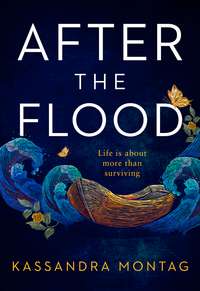
Читать книгу: «After the Flood»


Copyright
The Borough Press
An imprint of HarperCollinsPublishers Ltd
1 London Bridge Street
London SE1 9GF
www.harpercollins.co.uk
First published in Great Britain by HarperCollinsPublishers 2019
Copyright © Kassandra Montag 2019
Cover illustration © Shutterstock.com
Cover design by Ellie Game © HarperCollinsPublishers Ltd 2019
Kassandra Montag asserts the moral right to be identified as the author of this work.
A catalogue copy of this book is available from the British Library.
This novel is entirely a work of fiction. The names, characters and incidents portrayed in it are the work of the author’s imagination. Any resemblance to actual persons, living or dead, events or localities is entirely coincidental.
All rights reserved under International and Pan-American Copyright Conventions. By payment of the required fees, you have been granted the non-exclusive, non-transferable right to access and read the text of this e-book on screen. No part of this text may be reproduced, transmitted, down-loaded, decompiled, reverse engineered, or stored in or introduced into any information storage and retrieval system, in any form or by any means, whether electronic or mechanical, now known or hereinafter invented, without the express written permission of HarperCollins.
Source ISBN: 9780008319557
Ebook Edition © SEPTEMBER 2019 ISBN: 9780008319571
Version: 2019-06-07
Dedication
For Andrew
Epigraph
Only what is entirely lost demands to be endlessly named: there is a mania to call the lost thing until it returns.
—Günter Grass
Contents
Cover
Title Page
Copyright
Dedication
Epigraph
Map
Prologue
Chapter 1
Chapter 2
Chapter 3
Chapter 4
Chapter 5
Chapter 6
Chapter 7
Chapter 8
Chapter 9
Chapter 10
Chapter 11
Chapter 12
Chapter 13
Chapter 14
Chapter 15
Chapter 16
Chapter 17
Chapter 18
Chapter 19
Chapter 20
Chapter 21
Chapter 22
Chapter 23
Chapter 24
Chapter 25
Chapter 26
Chapter 27
Chapter 28
Chapter 29
Chapter 30
Chapter 31
Chapter 32
Chapter 33
Chapter 34
Chapter 35
Chapter 36
Chapter 37
Chapter 38
Chapter 39
Chapter 40
Chapter 41
Chapter 42
Chapter 43
Chapter 44
Chapter 45
Chapter 46
Chapter 47
Chapter 48
Chapter 49
Chapter 50
Chapter 51
Chapter 52
Chapter 53
Chapter 54
Chapter 55
Chapter 56
Chapter 57
Chapter 58
Acknowledgments
About the Author
About the Publisher
Map

PROLOGUE
CHILDREN THINK WE make them, but we don’t. They exist somewhere else, before us, before time. They come into the world and make us. They make us by breaking us first.
This was what I learned the day everything changed. I stood upstairs folding laundry, my back aching from Pearl’s weight. I held Pearl inside my body, the way a great whale swallows a man into the safety of his belly, waiting to spit him out. She rolled over in ways a fish never would; breathed through my blood, burrowed against bone.
The floodwater around our house stood five feet high, covering roads and lawns, fences and mailboxes. Nebraska had flooded only days before, water coming across the prairie in a single wave, returning the state to the inland sea it once was, the world now an archipelago of mountains and an expanse of water. Moments earlier, when I’d leaned out the open window, my reflection in the floodwater had returned dirty and marred, like I’d been stretched and then ripped into indiscriminate shreds.
I folded a shirt and screams startled me wide eyed. The voice was a blade, slipping metal between my joints. Row, my five-year-old daughter, must have known what was going on because she screamed, “No, no, no! Not without Mommy!”
I dropped the laundry and ran to the window. A small motorboat idled in the water outside our house. My husband, Jacob, swam to the boat, one arm paddling, the other clamping Row against his side as she struggled against him. He tried to hoist her onto the boat, but she elbowed him in the face. A man stood in the boat, leaning over the gunwale to pick her up. Row wore a too-small plaid jacket and jeans. Her pendant necklace swung like a pendulum across her chest as she struggled against Jacob. She thrashed and twisted like a caught fish, sending a spray of water into his face.
I opened the window and yelled, “Jacob, what are you doing?!”
He wouldn’t look at me or respond. Row saw me in the window and screamed for me, her feet kicking at the man who held her under the armpits, lifting her over the side of the boat.
I pounded the wall next to the window and yelled out to them again. Jacob pulled himself over the side of the boat as the man held Row. The panic in my fingertips turned to a buzzing fire. My body shook as I folded myself through the window and leapt into the water below.
My feet hit the ground beneath the water and I rolled to the side, trying to lighten my impact. When I surfaced, I saw Jacob had winced; the pained, tightened expression still on his face. He was now holding Row, who kicked and screamed, “Mommy! Mommy!”
I swam toward the boat, pushing aside debris that littered the water’s surface. A tin can, an old newspaper, a dead cat. The engine roared to life and the boat spun around, spraying me in the face with a wave of water. Jacob held Row back as she reached for me, her tiny arm taut, her fingers scratching the air.
I kept paddling as Row receded into the distance. I could hear her screams even after I could no longer see her small face, her mouth a dark circle, her hair standing on end, blowing in the wind that came off the water.
CHAPTER 1
Seven Years Later
SEAGULLS CIRCLED OVER our boat, which made me think of Row. The way she squawked and waved her arms when she was first trying to walk; the way she stood completely still for almost an hour, watching the sandhill cranes, when I took her to the Platte to see their migration. She always seemed birdlike herself, with her thin bones and nervous, observant eyes, always scanning the horizon, ready to burst into flight.
Our boat was anchored off a rocky coast of what used to be British Columbia, just outside a small cove up ahead, where water filled a small basin between two mountaintops. We still called oceans by their former names, but it was really one giant ocean now, littered with pieces of land like crumbs fallen from the sky.
Dawn had just lightened the horizon and Pearl folded the bedding under the deck cover. She had been born there seven years earlier, during a storm with flashes of lightning white as pain.
I dropped bait in the crab pots and Pearl came out from under the deck cover, a headless snake in one hand, her knife in the other. Several snakes were woven around her wrists like bracelets.
“We’ll need to eat that tonight,” I said.
She sent me a sharp glance. Pearl looked nothing like her sister had, not thin boned or dark haired. Row had taken after me with her dark hair and gray eyes, but Pearl resembled her father with her curly auburn hair and the freckles across her nose. Sometimes I thought she even stood the way he did, solidly and sturdily, both feet planted on the ground, chin up slightly, hair always messed, arms a little back, chest up, as though exposing herself to the world with no fear or apprehension.
I had searched for Row and Jacob for six years. After they were gone, Grandfather and I took to the water on Bird, the boat he’d built, and Pearl was born soon after. Without Grandfather with me that first year, Pearl and I never would have made it. He fished while I fed Pearl, gathered information from everyone we passed, and taught me to sail.
His mother had built kayaks like her ancestors, and he remembered watching her shape the wood like a rib cage, holding people the way a mother held a child within her, sheltering them to shore. His father was a fisher, so Grandfather had spent his childhood on the Alaskan coastal seas. During the Hundred Year Flood, Grandfather had migrated inland with thousands of others, finally settling in Nebraska, where he worked as a carpenter for years. But he always missed the sea.
Grandfather searched for Jacob and Row when I didn’t have the heart to. Some days, I followed languidly behind him, tending to Pearl. At each village, he’d check the boats in the harbor for any sign of them. He’d show photographs of them at every saloon and trading post. On the open sea he’d ask every fisher we passed if they’d seen Row and Jacob.
But Grandfather had died when Pearl was still a baby, and suddenly the enormous task swelled up before me. Desperation clung to me like a second skin. In those early days, I would strap Pearl to my chest with an old scarf, wrapping her snugly against me. And I’d follow the same route he had taken: scouting the harbor, asking the locals, showing photographs to people. For a while it gave me vigor; something to do beyond survival, something that meant more to me than reeling in another fish to our small boat. Something that gave me hope and promised wholeness.
A year ago, Pearl and I had landed in a small village tucked in the northern Rockies. The storefronts were broken down, the roads dusty and littered with trash. It was one of the more crowded villages I’d been to. People hurried up and down the main road, which was filled with stalls and merchants. We passed one stall heavy-laden with scavenged goods that had been carried up the mountain before the flood. Milk cartons filled with gasoline and kerosene, jewelry to be melted and made into something else, a wheelbarrow, canned food, fishing poles, and bins of clothing.
The stall next to it sold items that had been made or found after the flood: plants and seeds, clay pots, candles, a wood bucket, bottles of alcohol from the local distillery, knives made by a blacksmith. They also sold packets of herbs with sprawling advertisements: WHITE WILLOW BARK FOR FEVER! ALOE VERA FOR BURNS!
Some goods had the corroded appearance of having been underwater. Merchants paid people to dive into old houses for items that hadn’t yet been scavenged before the floods and hadn’t rotted since. A screwdriver with a glaze of rust, a pillow stained yellow and heavy with mold.
The stall across from these held only small bottles of expired medications and boxes of ammunition. A woman with a machine gun guarded each side of the stall.
I had packed all the fish I’d caught in a satchel slung over my shoulder, and I hung on to the strap as we walked up the main road toward the trading post. I held Pearl’s hand with my other hand. Her red hair was so dry it was beginning to break off at the scalp. And her skin was scaly and light brown, not from sun, but from the early stages of scurvy. I needed to trade for fruit for her and better fishing supplies for me.
At the trading post I emptied my fish on the counter and the shopkeeper and I bartered. The shopkeeper was a stout woman with black hair and no bottom teeth. We went back and forth, settling on my seven fish for an orange, thread, fishing wire, and flatbread. After I packed my goods in my bag I laid out the photos of Row before the shopkeeper, asking if she’d seen her.
The woman paused, staring at the photo. Then she slowly shook her head.
“Are you sure?” I asked, convinced her pause meant she’d seen Row.
“No girl looks like this here,” the woman announced in a thick accent, and turned back to packaging my fish.
Pearl and I made our way down the main road toward the harbor. I’d check the ships, I told myself. This village was so crowded, Row could be here and the shopkeeper could have never seen her. Pearl and I walked hand in hand, pulling away from the merchants as they reached out to us from their stalls, their voices trailing behind us, “Fresh lemons! Chicken eggs! Plywood half off!”
Up ahead of me, I saw a girl with long dark hair, wearing a blue dress.
I stopped in my tracks and stared. The blue dress was Row’s: it had the same paisley pattern, a ruffle at the hem, and bell sleeves. The world flattened, the air gone suddenly thin. A man at my elbow was nagging me to buy his bread, but his voice came as though from a distance. A giddy lightness filled me as I watched the girl.
I rushed toward her, running down the path, knocking over a cart of fruit, pulling Pearl behind me. The ocean at the bottom of the harbor looked crystal blue, suddenly clean-looking and fresh.
I grabbed the girl’s shoulder and spun her around. “Row!” I said, ready to see her face again and pull her into my arms.
A different face glared at me.
“Don’t touch me,” the girl muttered, jerking her shoulder from my grasp.
“I’m so sorry,” I said, stepping back.
The girl scurried away from me, glancing over her shoulder at me anxiously.
I stood in the bustling road, dust swirling around me. Pearl turned her head toward my hip and coughed.
It’s someone else, I told myself, trying to adjust to this new reality. Disappointment crowded me but I pushed it back. You’ll still find her. It’s okay, you’ll find her, I chanted to myself.
Someone shoved me hard, ripping my satchel from my shoulder. Pearl fell to the ground and I stumbled to the side, catching myself against a stall with scavenged tires.
“Hey!” I yelled at the woman, now darting down the main road and behind a booth with bolts of fabric. I ran after her, leaping over a small cart filled with baby chicks, dodging an elderly man with a cane.
I ran and spun in circles, looking for the woman. People moved past me as though nothing had happened, the swirl of bodies and voices making me nauseous. I kept looking for what felt like ages, the sunlight dimming around me, casting long shadows on the ground. I ran and spun until I nearly collapsed, stopping close to where it had happened. I looked up the road at Pearl, who stood where she’d fallen, next to the stall with tires.
She didn’t see me between the people and stalls, and her eyes moved anxiously over the crowd, her chin quivering, holding her arm like it’d been hurt in the fall. This whole time she’d been waiting, looking abandoned, hoping I’d return. The fruit in my satchel that I’d gotten for her had been the one thing I was proud of that day. The one thing I could cling to as evidence that I was doing okay by her.
Watching her, I felt gutted and finished. If I’d been more alert, not so distracted, the thief never would have ripped it from my shoulder so easily. I used to be so guarded and aware. Now I was worn down with grief, my hope for finding Row more madness than optimism.
Slowly it dawned on me: the reason the blue dress was so familiar, the reason it had grabbed my gut like a hook. Yes, Row had that same dress, but it wasn’t one Jacob had packed and taken with them when he took her from me. Because I found that dress in her bedroom dresser after she was gone and I slept with it for days afterward, burying my face in her smell, worrying the fabric between my fingers. It had stayed in my memory because it had been left behind, not because she could be somewhere out there wearing it. Besides, I realized, she would be much older now, too large for that dress. She had grown. I knew this, but she remained frozen in my mind as a five-year-old with large eyes and a high-pitched giggle. Even if I ran across her, would I recognize her immediately as my own?
It was too much, I decided. The constant drain of disappointment every time I reached a trading post and found no answers, no signs of her. If Pearl and I were going to make it in this world, I needed to focus on only us. To shut everything and everyone else out.
So we’d stopped looking for Row and Jacob. Pearl sometimes asked me why we’d stopped and I told her the truth: I couldn’t anymore. I felt they were somehow still alive, yet I couldn’t understand why I hadn’t been able to hear about them in the small communities that were left, tucked high in the mountainsides, surrounded by water.
Now we were drifting, spending our days with no destination. Each day was the same, spooling into the next like a river running into the ocean. Every night I lay awake, listening to Pearl breathe, the steady rhythm of her body. I knew she was my anchor. Every day I feared a raider ship would target us, or fish wouldn’t fill our nets and we’d starve. Nightmares engulfed me and my hand would shoot out for Pearl in the night, rattling both of us awake. All these fears lined up with a little hope wedged in the cracks in between.
I closed the crab pots and dropped them over the side, letting them sink sixty feet. As I surveyed the coast, an odd, fearful feeling, a tiny bubble of alarm, rose in me. The shore was marshland, filled with dark grass and shrubs, and trees grew a little farther back from the shore, crowding up the mountainside. Trees now grew above the old tree line, mostly saplings of poplar, willow, and maple. A small bay lay around the shore’s bend, where traders sometimes anchored or raiders lay in wait. I should have taken the time to scope out the bay and make sure the island was deserted. There was never any quick escape on land the way there was on water. I steeled myself to it; we needed to look for water on land. We wouldn’t last another day otherwise.
Pearl followed my eyes as I gazed at the coast.
“This looks like the same coast with those people,” Pearl said, needling me.
She’d been going on for days about raiders we saw robbing a boat in the distance. We’d sailed away, and I was weary, heart heavy, as the wind pulled us out of sight. Pearl was upset we hadn’t tried to help them, and I tried to remind her it was important we keep to ourselves. But under my rationalizations, I feared that my heart had shrunk as the water rose around me—panic filling me as water covered the earth—panic pushing out anything else, whittling my heart to a hard, small shape I couldn’t recognize.
“How were we going to attack an entire raider ship?” I asked. “No one survives that.”
“You didn’t even try. You don’t even care!”
I shook my head at her. “I care more than you know. There isn’t always room to care more.” I’ve been all used up, I wanted to say. Maybe it was good I hadn’t found Row. Maybe I didn’t want to know what I’d do to be with her again.
Pearl didn’t respond, so I said, “Everyone is on their own now.”
“I don’t like you,” she said, sitting down with her back to me.
“You don’t have to,” I snapped. I squeezed my eyes shut and pinched the bone between my eyebrows.
I sat down next to her, but she kept her face turned from me.
“Did you have your dreams again last night?” I tried to keep my voice kind and soft, but an edge still crept in.
She nodded, squeezing the blood from the snake’s tail down to the hole where its head had been.
“I’m not going to let that happen to us. We’re staying together. Always,” I said. I stroked her hair back from her face and a shadow of a smile crossed her lips.
I stood up and checked the cistern. Almost empty. Water all around but none to drink. My head ached from dehydration and the edges of my vision were beginning to blur. Most days, it was humid; it rained almost every other day, but we were in a dry spell. We’d need to find mountain streams and boil water. I filled Pearl’s water skin with the last of the fresh water and handed it to her.
She stopped playing with her headless snake and weighed the water in her hand. “You gave me all the water,” she said.
“I already drank some,” I lied.
Pearl stared at me, seeing right through me. There was never any hiding from her, not like I could hide from myself.
I fastened my knife in my belt and Pearl and I swam to shore with our buckets for clam digging. I was worried it would be too wet for clams, and we both stumbled along the marsh until we found a drier spot to the south, where the sun fell warm and steady. Little holes peppered the mud plain. We began digging with driftwood, but after a few minutes Pearl tossed her driftwood to the side.
“We won’t find anything,” she complained.
“Fine,” I snapped. My limbs were heavy with fatigue. “Then go up the mountainside and see if you can find a stream. Look for willows.”
“I know what to look for.” She spun on her heel and awkwardly tried to run up the mountainside. The poor thing was still trying to account for the motion of the sea, and she set her feet down too firmly, swaying from side to side.
I kept digging, pulling the mud in piles around me. I hit a shell and tossed the clam in my bucket. Above the wind and waves, I thought I heard voices coming from around the bend in the mountain. I sat back on my heels, alert, listening. A tension settled along my spine and I strained to hear, but there was nothing. I always thought I sensed things on land that weren’t there—hearing a song where there was no music, seeing Grandfather when he was already dead. As though being on land returned me to the past and all the things the past had carried.
I leaned forward and dug my hands into the mud. Tossed another shell into my bucket with a clink. I’d just found another clam when a small, sharp scream pierced the air. I froze, looking up, scanning the landscape for Pearl.
CHAPTER 2
SEVERAL YARDS UP the mountainside, in front of shrubs and a steep rock face, a wiry man held Pearl, her back against his front, a knife at her throat. Pearl was still, her eyes quiet and dark, her arms at her sides, not able to reach the knife at her ankle.
The man had a desperate, off-kilter look on his face. I stood up slowly, my heart pounding in my ears.
“Come with me,” he called out. He had a strange accent I couldn’t place, clipped and heavy on the consonants.
“Okay,” I said, my hands up to show I wasn’t going to try anything, walking toward them.
When I reached them he said, “You move and she goes.”
I nodded.
“I’ve got a ship,” he said. “You’ll work it. Drop your knife on the ground.”
Panic rose up in me as I unfastened my knife and tossed it toward him. He sheathed it at his waist and grinned at me. Holes showed where teeth should be. His skin was tanned to a red brown and his hair grew in sandy patches. A tattoo of a tiger spread across his shoulder. Raiders tattooed their members, often with an animal, though I couldn’t remember which crew used the tiger.
“Don’tcha worry. I’ll care for ya. It’s up thataway.”
I followed the man and Pearl along the side of the mountain, winding our way toward the cove. Rough grass scratched my ankles and I stumbled over a few rocks. The man lowered the knife from Pearl’s neck but kept his hand on her shoulder. I wanted to reach forward and snatch her out of his grasp, but his knife would be at her throat again before I pulled her away. Quick flashes of how things could go ran through my mind—him deciding he only wanted one of us or there being too many people to fight once we reached his ship.
The man started chatting about his people’s colony up north. I wanted him to shut up so I could think straight. A canteen hung from the man’s shoulder and swung back and forth at his hip. I could hear liquid sloshing inside and my thirst rose above even my fear as my parched mouth ached for water, my fingers itching to reach it and unscrew the cap.
“It’s important we have new nations now. Important for …” The man cast his hand out in front of him, as if he could pluck a word from the air. “Organizing.” The man nodded, clearly pleased. “That’s how it was always done, back in the beginning, when we were still in caves. People aren’t organized, we’d all be snuffed out.”
There were other tribes who were trying to make new nations by sailing from land to land, setting up military bases on islands and ports, attacking others and making colonies. Most of them began as a ship that took over other ships, and eventually they began trying to take over communities on land.
The man looked over his shoulder at me and I nodded dumbly, wide eyed, deferential. We were half a mile from our boat. As we approached the bend along the mountainside, the ground dropped away at our side and we walked along a steep rock face. I thought about grabbing Pearl and leaping from the cliff to the water and swimming to our boat, but it was too far in this choppy water. And I couldn’t know if we’d have a clean fall into the water or if there were rocks below.
The man had shifted to talking about his people’s breeding ships. Women were expected to produce a child every year or so, to grow the raider crews. They waited until a girl bled before they moved her to a breeding ship. Until then, she was held captive in a colony.
I’d passed breeding ships when I was fishing, recognized them by their flag of a red circle on white. A flag that warned boats not to approach. Since illness spread so quickly on land, the raiders reasoned the babies would be safer on ships, which they often were. Except when a contagion broke out on a ship and almost everyone died, leaving a ghost ship, unmoored until it crashed against a mountain and drifted to the bottom of the sea.
“I know what you’re thinking,” the man continued. “But the Lost Abbots—we, we do things the right way. Can’t build a nation without people, without taxes, without having people to enforce those taxes. That’s what gives us the chance to organize.
“This yer girl?” the man asked me.
I startled and shook my head. “Found her on a coast a few years back.” He wouldn’t be so keen on separating us if he didn’t think we were family.
The man nodded. “Sure. Sure. They come in handy.”
The wind changed as we began to make our way around the mountain, and voices from the cove now reached us, a clamoring of people working on a ship.
“You look like a girl I know, back at one of our colonies,” the man said to me.
I was barely listening. If I lunged forward, I could reach his right arm, pull it behind his back, and reach for my knife in his sheath.
He reached out and touched Pearl’s hair. My stomach clenched. A gold chain with a pendant hung from his wrist. The pendant was dark snakewood, with the engraving of a crane on it. Row’s necklace. The necklace Grandfather had carved for her the summer we’d gone to see the cranes. It was colorless except the drop of red paint he’d placed between the crane’s eyes and beak.
I stopped walking. “Where’d you get that?” I asked. Blood surged in my ears and my body thrummed like a hummingbird’s wings.
He looked down at his wrist. “That girl. One I was telling you about. Such a sweet girl. I’m surprised she’s made it this long. Doesn’t seem to have it in her …” He gestured with his knife toward the cove. “Don’t have all day.”
I lunged at him and swiped his right leg with my foot. He tripped and I smashed my elbow down on his chest, knocking the air from him. I stomped on the hand holding the knife, grabbed it, and held it to his chest.
“Where is she?” I asked, my voice all breath, barely above a whisper.
“Mom—” Pearl said.
“Turn away,” I said. “Where is she?” I pushed the knife farther between his ribs, the tip digging into skin and membrane. He gritted his teeth, sweat gathering at his temples.
“Valley,” he panted. “The Valley.” His eyes darted toward the cove.
“And her father?”
Confusion furrowed the man’s brow. “She had no father with her. Must be dead.”
“When was this? When did you see her?”
The man squeezed his eyes shut. “I dunno. A month ago? We came here straight after.”
“Is she still there?”
“Still there when I left. Not old enough yet—” He winced and tried to catch his breath.
He almost said not old enough for the breeding ship yet.
“Did you hurt her?”
Even now, a pleased look crossed his face, a sheen over his eyes. “She didn’t complain much,” he said.
I drove the knife straight in, the hilt to his skin, and pulled it up to gut him like a fish.
CHAPTER 3
PEARL AND I stole the man’s canteen and shoved his body over the side of the cliff. As we ran back to the boat I kept thinking of his crew in the cove, wondering how soon they would start searching for him. There was enough wind, I thought, to push us south quickly. Once Bird got behind another mountain it’d be hard to track us.
When we got back to the boat I raised the anchor, Pearl adjusted the sails, and we surged forward, the coast behind us growing smaller, but I still couldn’t breathe steadily. I hid from Pearl under the deck shelter, my whole body shaking, not unlike how the man’s body shook when he died. I’d been in fights before, tense moments with weapons out, but I hadn’t killed. Killing that man was like stepping through a door to another world. It felt like a place I’d already been to but had forgotten, hadn’t wanted to remember. It didn’t make me feel powerful; it made me feel more alone.
We sailed south for three days until we reached Apple Falls, a small trading port nestled on a mountain that had been in British Columbia. The water in the canteen lasted us only a day, but late on the second day it rained a small bit, just enough that we weren’t ill with thirst by the time we reached Apple Falls. I dropped the anchor over the side and glanced at Pearl. She stood at the bow, staring at Apple Falls.
“I didn’t want you to see that,” I said to Pearl, watching her closely. Pearl hadn’t spoken to me much since.
Pearl shrugged.
“He was going to hurt us. You don’t think I should have done it? You think he was a good person?” I asked.
“I just didn’t like it. I didn’t like any of it,” she said, her voice small. She paused, as if thinking, then said, “Desperate people.” She looked at me a little too intently. I always said to her, when she asked me why people were cruel, that desperate people did desperate things.
“Yes,” I said.
“Will we try to find her now?”
“Yes,” I said, the word out of my mouth before I knew I’d already decided it. A response beyond reason. Just the image in my mind of Row in danger and me moving toward her, with no choice, only one direction to move, the way rain falls from the sky and does not return to the heavens.
Though I was surprised to realize this, Pearl showed no shock. She merely looked at me and said, “Will Row like me?”
I walked to her, squatted, and wrapped my arms around her. Her hair smelled like brine and ginger and I buried my face in it, her body as tender and vulnerable as the night I birthed her.
“I’m sure of it,” I said.
“Are we going to be okay?” Pearl asked.
“We’re going to be fine.”
“You said everyone is alone. I don’t want to be alone,” Pearl said.
My chest tightened and I pulled her close to me again. “You won’t ever be alone,” I promised. I kissed the top of her head. “We better count these,” I said, gesturing to the buckets of fish laid out on the deck.
Row is alone out there, I kept thinking, weighing each dead fish in my palm, one part of me asking how much it was worth, the other part imagining her alone on some coast. Did Jacob die? Did he abandon her? My hands shook with cold rage at this thought. He abandons people; that’s what he does.
But he wouldn’t do that to her, I argued with myself, feeling myself being pulled back into the hatred that had kept me awake at night for years after he left. I’d been blinded by love and now, I knew, I was blinded by hate. I had to focus. To remember Row and forget him.
The last three days we’d sailed, a part of me thought of Row incessantly. I had the sense that my entire body was plotting how to reach her, while my consciousness focused on tightening the rope at the block or reeling in fishing line, the small daily tasks that grounded me. There was both a low thrum of panic and shock at discovering she was alive, and a strange animal tranquility as I moved about the boat as if it were simply another day. It was what I’d dreamed of and hoped for and also what I’d feared. Because her being alive meant I had to go after her, had to risk everything. What kind of mother abandons her child in her hour of need? And yet, wouldn’t taking Pearl on this journey be a kind of abandonment of her? An abandonment of the peaceful life we’d fought to build together?
Pearl and I loaded the salmon and halibut into four baskets. We had gutted and smoked the salmon already on our boat, but the halibut was fresh from this morning, which could give us bargaining power.
Apple Falls was aptly named—apple trees had been planted in a clearing between the peaks of two mountains. Thieves were shot by the guards of the orchard, who had watchtowers on each mountain. I was hoping we’d be able to trade for at least half a basket of apples, plus some grain and seed. At our last trading post we had only three baskets of fish and could barely trade for the rope, oil, and flour we needed. We needed to trade for some vegetable seeds so I could grow a few more vegetables on board. Right now we only had a half-dead tomato plant. Beatrice, my old friend at Apple Falls, would give me a better deal for my fish than at any other port.
Water rippled against the mountainside and the bank rose in a steep incline up the mountain, with a small peat ledge for a dock. A wooden boardwalk, half submerged, had been cobbled together over the years.
We docked our boat and paid the harbor fees with a crate of metal scraps I had found while hunting the shallows. Bird was one of the smallest boats in the harbor, but it was sturdily built. Grandfather had designed the boat to be simple and easy to maneuver. One square mast, a rudder, a punting pole, and oars on each side. A deck cover made from old rugs and plastic tarp where we slept at night. He’d made it from the trees in our yard back in Nebraska at the beginning of the Six Year Flood, when we knew that fleeing was our only chance to survive.
Water had already covered the coasts around the world by the time I was born. Many countries had been cut to half their size. Migrants fled inland, and suddenly Nebraska became a bustling, crowded place. But no one knew the worst was yet to come—the great flood that lasted six years, water rising higher than anyone could imagine, whole countries becoming seafloors, each city a new Atlantis.
Before the Six Year Flood, earthquakes erupted and tsunamis struck constantly. The ground itself seemed heavy with energy. I’d hold out my hand and feel the heat in the air like the pulse of an invisible animal. On the radio we heard rumors that the seafloor had split, water from within the earth seeping into the ocean. But we never knew for certain what happened, only that the water rose around us as if to swallow us up in a watery grave.
People called the years the coasts disappeared the Hundred Year Flood. The Hundred Year Flood didn’t last exactly a hundred years, because no one knew for sure exactly when it began. Unlike a war it had no call to arms, no date by which we could remember its beginning. But it lasted close to a hundred years, a little longer than a person’s lifetime, because my grandfather always said that when his mother was born New Orleans existed and when she died it did not.
What followed the Hundred Year Flood was a series of migrations and riots over resources. My mother would tell me stories of how the great cities fell, when electricity and the Internet faltered on and off. People would show up on doorsteps at homes in Indiana, Iowa, Colorado, clinging to their belongings, wide eyed and weary, asking to be let in.
Near the end of the Hundred Year Flood, the government moved inland, but its reach was limited. I was seventeen when I heard over the radio that the president had been assassinated. But then a month later, a migrant passing through said he’d fled to the Rockies. And then later, we heard a military coup had taken over a session of Congress and members of the government had fled after that. Communication was breaking down by that point, the whole world reduced to a rumor, and I stopped listening.
I was nineteen when the Six Year Flood began and had just met Jacob. I remember standing next to him watching footage of the White House flood, only the flag on the roof visible above the water, each wave soaking the flag until it lay sagging against the pole. I imagined the interior of the White House, so many faces staring out of its paintings, water trickling down hallways into all its chambers, sometimes loud and sometimes quiet.
The last time my mother and I watched television together it was the second year of the Six Year Flood and I was pregnant with Row. We saw footage of a man lying on an inflatable raft, balancing a whiskey bottle on his tummy, grinning up at the sky, as he floated past a skyscraper, trash swirling around him. There were as many ways to react as people, she always said.
This included my father, who was the one to teach me what the floods meant. The blinking on and off of communication was familiar to me, the crowds of people at soup kitchens normal. But when I was six I came home early from school with a headache. The garden shed door was open and through the opening I saw only his torso and legs. I stepped closer, looked up, and saw his face. He’d hung himself from a rafter with a rope.
I remember screaming and backing away. Every cell in me was a small shard of glass; even breathing hurt. I ran inside and looked for my mother, but she wasn’t home from work. Cell towers were down that month, so I sat on the front stoop and waited for my mother to come home. I tried to think of how to tell her but words kept wincing away from me, my mind recoiling from reality. Many days, I still feel like that child on the stoop, waiting and waiting, my mind empty as a bowl scooped clean.
After my mother had gotten home, we found a mostly empty bag of groceries on the table with a note from my father: “The shelves were bare. Sorry.”
I thought when I had my own children I’d understand him more, understand the despair he felt. But I didn’t. I hated him even more.
PEARL TUGGED ON my hand, pointing to a cart of apples sitting just past the dock.
I nodded. “We should be able to get a couple,” I said.
The village was a clamoring, crowded throng of people and Pearl stuck close to me. We slung the baskets of fish on two long poles so we could carry them on our shoulders and we started up the long winding path between the two mountains.
I felt relief at being on land again. But as the crowd closed around me, I felt a new kind of panic, different from anything I felt when I was alone on the waves. An out-of-control sensation. Being the foreigner, the one who had to relearn the ever-changing rules of each trading post.
Pearl wasn’t ambivalent like I was, hovering between relief and panic. She hated being on land, the only benefit being that she could hunt snakes. Even as a baby she hated being on land, refusing to fall asleep when we camped on the shores at night. Sometimes she got nauseous on land and went out for a swim to calm her nerves while we were at a port.
The land was filled with stumps of cut trees and a thick ground cover of grasses and shrubs. People seemed to be crawling over one another on the path, an old man bumping into two young men carrying a canoe, a woman pushing her children in front of her. Everyone’s clothes were dirty and torn and the smell of so many people living close together made me dizzy. Most people I saw in ports were older than Pearl, and Apple Falls was no different. Infant mortality was high again. People would talk on the streets about our possible extinction, about the measures needed to rebuild.
Someone knocked one of Pearl’s baskets to the ground and I cursed them and quickly scooped up the fish. We passed the main trading post and saloon and cut across the outdoor market, smells of cabbage and fresh-cut fruit lingering in the air. Shacks littered the outskirts of town as we traveled farther up the path, toward Beatrice’s tent. The shacks were cobbled together with wood planks or metal scraps or stones stacked together like bricks. In the dirt yard of one shack, a small boy sat cleaning fish, a collar around his neck, attached to a leash that was tied around a metal pole.
The boy looked back at me. Small bruises bloomed like dark flowers on his back. A woman came and stood in the doorway of the shack, arms crossed over her chest, staring back at me. I looked away and hurried on.
Beatrice’s tent stood on the southern edge of the mountain, hidden by a few redwoods. Beatrice had told me she guarded her trees against thieves with her shotgun, sometimes awakening at night to the sound of an ax on wood. But she only had four shotgun shells left, she had confided in me.
Pearl and I squatted and slid the poles from our shoulders. “Beatrice?” I called out.
It was silent for a moment and I worried it was no longer her tent, that she was gone.
“Beatrice?”
She poked her head through the tent opening and smiled. She still wore her long gray hair in a braid down her back and her face had deeper creases, a sun-etched rough texture.
She sprang forward and grabbed Pearl in a hug. “I was wondering when I’d see you again,” she said. Her eyes darted between Pearl and me, taking us in. I knew she feared there’d come a day when we didn’t return to trade, just as I feared there’d come a day when I’d come to trade and her tent would be taken over by someone else, her name a mere memory.
She hugged me and then pulled me back by my shoulders and eyed me. “What?” she asked. “Something’s different.”
“I know where she is, Beatrice. And I need your help.”
Бесплатный фрагмент закончился.