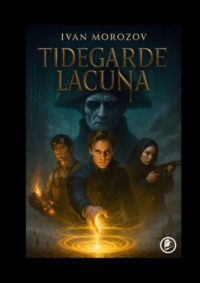
Читать книгу: «Tidegarde: Lacuna»
© Ivan Morozov, 2025
ISBN 978-5-0068-3788-1
Created with Ridero smart publishing system
TIDEGARDE: Lacuna
The Sovereign’s Waltz
The music was a river of strings and horns, flowing through the grand ballroom of the Winter Palace. It carried the scent of beeswax from a thousand candles and the heavy perfume of the court. Gold leaf glittered on the ceiling, catching the light and throwing it back onto a sea of dark green uniforms and silk gowns in shades of sapphire and crimson. Sineus Bielski stood apart from it all, a statue in the tide, his duty a wall between him and the celebration. His work began here, in the noise and the crowd.
He let his gaze drift, but his focus was not on the faces or the jewels. He saw what no one else could: the Memory-Script, the luminous threads of light that wove the world together. Every person, every pillar, every glass of wine was surrounded by a shimmering tapestry of its own history. To him, the ballroom was not a room of people but a forest of glowing, shifting patterns. His purpose was to find the one pattern that was wrong.
He scanned the attendees, more than 300 of them, a task that took ninety seconds of intense, unbroken concentration. He dismissed the bright, steady threads of loyal courtiers and the tangled, anxious knots of those in debt. Then he saw it. Three small, flickering anomalies near the French delegation. They were like smudges on a clean pane of glass, a subtle corruption in the script that spoke of a fabricated identity. His eyes narrowed on a visiting trade attaché, a man whose personal history felt thin, recently written.
A hand touched his elbow, a single, precise tap. Count Valerien Orlov stood beside him, a faint, knowing smile on his lips. Orlov’s eyes flicked toward the attaché, then back to Sineus, a barely perceptible dip of his chin. It was the Sovereign’s Waltz, a silent language of glances and gestures that moved empires. The signal was a confirmation, an order transmitted in less than a second. The target was confirmed. The task was his.
Sineus gave a slight, formal bow, a gesture of acknowledgment that no one else would notice or understand. He was now tasked with neutralization. He turned and moved through the crowd, a ghost slipping between laughing groups and dancing couples. The attaché was heading for a side door, seeking a moment of quiet. Sineus followed, maintaining a distance of ten meters, his steps silent on the polished floor.
The man entered a small antechamber, lined with portraits of long-dead tsars whose own memories had been trimmed and polished by generations of the Lodge of the Double-Headed Eagle. The heavy door swung shut, muffling the sound of the orchestra. The target was isolated from all witnesses. The operation could proceed. Sineus entered the room, closing the door softly behind him. The attaché turned, a flicker of surprise on his face.
– Can I help you? – the man asked, his Russian accented.
Sineus did not answer. He focused his will, the world of color and sound dissolving into the pure language of the script. He reached out with his mind, not his hands, and grasped the man’s memory. He sifted through the threads of childhood, of education, of false loyalties. It took fifteen seconds to find the cold, hard line of the man’s true mission directive, a memory implanted by Napoleon’s own occultists. It pulsed with a faint, ugly light.
He tightened his mental grip on that single, offending thread. For a moment, he felt the man’s conviction, the belief in his cause. Then, with a thought, he performed the Excision. There was a clean, cold snap, a feeling like a string breaking under tension. The price of the act was a familiar wave of detachment, a feeling of being hollowed out. The agent’s mission memory was severed.
The severed thread of memory, a shimmering filament of purpose and intent, wavered in the air for less than a second. It was a thing of pure information, a ghost of a promise. Then it dissolved, its energy reabsorbed into the vast, silent script of the world, leaving no trace. The work was clean.
The foreign agent blinked. A deep line of confusion appeared between his brows. He looked at his hands, then around the room, as if waking from a long dream. His purpose was gone. His operational capacity was now zero. He was no longer a threat.
– I… forgive me, – the man stammered, his eyes unfocused. – I seem to have lost my way.
Sineus watched him, feeling nothing but the cold satisfaction of a completed task. His emotional engagement was zero. The man was a broken tool, and Sineus was the one who had broken him. He observed as the agent, now just a lost man in a fine suit, fumbled with the door handle and wandered back toward the ballroom, his face a mask of bewilderment.
Straightening his uniform, Sineus turned away from the scene. The faint scent of the man’s sweat and fear lingered in the air, a scent he knew well. He returned to the periphery of the ball, his duty done, the wall of his isolation built one stone higher. He was a guardian, but he guarded from the outside, forever separate from the life he protected.
A Lodge courier, a young man with old eyes, approached him through the throng. The courier’s uniform was plain, designed not to be noticed. He stopped before Sineus and spoke in a low voice.
– Your presence is requested.
A new directive. The summons from his mentor meant the night’s work was not yet over. He gave a curt nod and followed the courier from the noise and the light, leaving the Sovereign’s Waltz behind.
The work was never over.
A Choice Forged Under Fire
The journey from the Winter Palace was a descent. From the river of music and light, the Lodge courier led him through the frozen, sleeping streets of Moscow, past the dark shapes of merchant houses and the skeletal branches of ice-coated linden trees. Their destination was a fur trader’s shop, its windows shuttered, the air around it thick with the smell of cured hides and cold stone. The courier knocked once, a precise rhythm against the heavy oak door. It opened into darkness.
They did not enter the shop. Instead, they went down a narrow flight of stairs hidden behind a stack of bundled pelts. The air grew colder, losing the scent of the city and taking on the clean, sterile smell of deep earth and old secrets. The passage was lit by simple, enclosed lanterns, their light too weak to cast real shadows. After thirty seconds of descent, they reached a single iron door. Sineus placed his palm against its surface. A low hum vibrated through the metal, a silent question asked of his very blood and bone. The lock clicked open. He had been granted entry.
He stepped through alone, the door closing behind him. He was in the archive, a circular chamber lined from floor to ceiling with thousands of wooden boards, each one a captured memory. The air was still and dry, smelling of beeswax and ancient vellum. In the center of the room, Pyotr Orlov sat at a heavy wooden workbench, his back to the door. He was a thin, elderly man, his simple brown cassock worn smooth at the elbows. He did not turn.
Sineus approached the bench and placed a small glass phial upon its surface. Inside, a single, shimmering filament of light pulsed with a faint, captured energy. It was the excised memory of the French agent’s mission, a severed thread of purpose now contained and inert. The operation was complete, but the duty was not. Not until the memory was archived.
Pyotr finally looked up, his pale blue eyes magnified by simple spectacles. His fingers, long and delicate, were permanently stained with the black ink of his craft. He picked up the phial, his touch gentle, as if handling a butterfly’s wing.
– Another one for the library, – Pyotr murmured, his voice a dry rustle of paper. He set the phial aside and picked up a silver-rimmed monocle with a lens of polished obsidian, an Oculus Speculum. He fitted it to his eye and peered at the captured memory-thread. The lens allowed him to see the script of the memory itself, to read the quality of the cut.
Sineus stood in silence, a perfect soldier awaiting inspection. He knew what Pyotr would see. The excision had been flawless, a single, clean cut with no fraying, no psychic residue. The memory’s integrity was 100%. It was a testament to his skill, his control. It was the only testament he cared for.
Pyotr removed the Oculus Speculum and set it down carefully. He gave a slow, weary nod. He took a fresh linden wood board, its surface coated in a smooth, white layer of gesso. From a velvet-lined case, he produced a silver stylus.
– A clean cut, as always, – Pyotr said. He uncorked the phial, and the severed thread of memory drifted out, hovering over the board. With the tip of the stylus, he gently touched the filament and began to guide it, transcribing its complex energy into a spiraling pattern on the gesso. The work was slow, requiring absolute concentration. The memory of a man’s entire purpose was being painted into a prison of wood and chalk.
Sineus watched the process, his mind calm. This was order. This was the preservation of the Empire. A flawed piece was removed, the whole made stronger. It was simple. It was necessary.
– But duty without choice is slavery, Sineus, – Pyotr said without looking up, his hand never wavering. The silver stylus continued its slow, circular path, the shimmering line of the memory sinking into the white surface.
The words were an unwelcome noise, a disruption to the clean logic of the work. Sineus felt a flicker of irritation. Duty was not slavery. Duty was a shield against the chaos of choice. It was a perfect, straight line through a tangled world. He had given himself to that line, and in return, he had been given purpose. It was a bargain he had made long ago.
– True honor is a choice forged under fire, – the old man continued, his voice soft but firm. – Not the unthinking swing of a blade, no matter how sharp.
Sineus’s gaze remained fixed on the Memory Icon. He saw Pyotr’s words as the sentimentality of an old man who worked with the ghosts of the past but no longer faced the threats of the present. Honor was mission success. It was a threat neutralized. It was the quiet hum of the lock granting him entry into this room. The rest was philosophy, and philosophy did not stop armies. His adherence to his function was total.
The last of the shimmering thread sank into the board. Pyotr lifted the stylus, the transcription complete. The agent’s memory was now just a complex, silent pattern, indistinguishable from the thousands of others that lined the walls. The archivist blew gently on the surface to set the memory, then placed the finished icon into an empty slot on the rack. The mission was officially closed. The agent was forgotten.
Footsteps echoed from the passage. Both men turned as the iron door opened and another Lodge courier entered. This one was breathing hard, his face flushed from the cold and haste. He carried a leather dispatch case, its seal marked with the insignia of the western front command.
– Urgent, from Smolensk, – the courier said, his voice tight. He handed the case to Pyotr.
Pyotr took the case, his brow furrowed with concern. He broke the wax seal, the snap echoing in the silent chamber. He pulled out a single sheet of vellum and began to read. Sineus watched his mentor’s face. He saw the old man’s eyes widen. He saw the color drain from his cheeks, leaving his skin the color of old parchment. Pyotr’s hand, the one that had been so steady just moments before, began to tremble.
The air in the sanctum grew heavy, thick with a sudden, unspoken dread. The scent of beeswax was sharp and cloying.
A new kind of war had found them in the dark.
The Wrongness on the Map
Pyotr’s hand trembled. The vellum sheet, filled with the tight, urgent script of a field agent, shook as if caught in a winter wind. The old man’s face had gone the color of the gesso-coated boards that lined the walls, a flat and bloodless white. He looked up at Sineus, his eyes wide behind his spectacles, and for the first time, Sineus saw not the calm archivist but a frightened man. The scent of beeswax in the sanctum suddenly felt sharp, suffocating.
– What is it? – Sineus asked, his voice low and steady.
Pyotr folded the dispatch with a sharp crackle of parchment. He did not answer immediately, his gaze distant, lost in the implications of the words he had just read. He looked at the thousands of captured memories lining the circular walls, a library of excised pains and forgotten duties. His expression was that of a librarian who had just heard the sound of a lit torch falling among the stacks.
– This is a matter for the Memory Duma, – Pyotr said finally, his voice thin. – An emergency session. Now.
The Memory Duma convened in a chamber of dark, polished oak that smelled of old wood and sealing wax. There were no windows. The only light came from twelve heavy, enclosed lanterns that cast a dull, yellow glow on the twelve men seated around the long table. These were the masters of the Lodge, the guardians of the Empire’s past. Sineus stood by the wall, a silent observer, his presence required but his participation not invited. He was a tool, and tools did not speak at the council of the hand.
The session began, not with the urgent dispatch from Smolensk, but with procedure. A state envoy, a man with a soft body and a voice like dry leaves, delivered a ten-minute report on conventional military movements. He spoke of troop positions, of supply lines, of the number of cannon in a French division. The words were a meaningless drone, a recitation of facts that felt like a history from a different, simpler war.
When the envoy finished, Grigori Levin spoke. He was a senior mnemonic chirurgeon, a man built like a stone block, his face set in lines of unshakeable certainty. His hands, resting flat on the table, were thick and steady. He was the voice of tradition, of caution.
– The reports from the front are troubling, – Levin said, his tone measured, as if discussing a poor harvest. – I propose we begin the fortification rituals for the border cities. Reinforce their mnemonic wards. It is the prudent course.
The council members nodded. It was a familiar strategy, a slow and careful process of strengthening a city’s memory of its own loyalty, its own walls, its own history. It was a defense built of belief, but it took weeks. Weeks they might not have. Sineus felt a cold knot tighten in his gut. This was ignorance. This was the price of a system that valued protocol over perception.
His gaze drifted to the large campaign map of the western front that dominated the far wall. It was a masterpiece of cartography, the rivers and forests rendered in exquisite detail. But Sineus saw more. He saw the shimmering Istopis, the script of memory, laid over the land like a second, luminous map. He saw the bright, strong threads of Russian towns, the deep-rooted memory of centuries.
Then he saw the wrongness.
It was a space on the map, west of Smolensk. A space that felt cold. It was not a color, but an absence of color in the script. A patch of psychic silence where the luminous threads of the world seemed to fray into nothing. It was a void, a hole in the fabric of what was. A place where a story had been unwritten.
He tried to trace the source of the cold spot with his mind, to follow the severed threads back to the blade that had cut them. But there were no threads. It was not a clean cut. It was an erasure. The anomaly resisted his focus, a sensation like pressing his hand against a block of ice that did not melt, but simply drank the heat from his skin, leaving it numb.
– The memory-tariff on French wine is another point of contention, – a council member with a thin, grey beard was saying. – Their merchants are attempting to bypass the wards by embedding shipping manifests with false memory-stamps.
The man’s words were a distant buzzing. Sineus’s entire being was fixed on the cold spot on the map. The psychic pressure was growing, a silent scream that only he could hear. The wrongness was not static. It was spreading, a slow, cancerous stain on the Istopis. The threat awareness in the room was zero. They were debating tariffs while a piece of the world was being eaten.
He wanted to shout, to stride to the map and point to the void. But what could he say? That he felt a cold spot? That he sensed an absence? They would dismiss it as fatigue, as the strain of his work. His unique perception, his greatest weapon, was a cage. It isolated him, leaving him to watch the coming storm alone.
He clenched his fist at his side, the leather of his glove creaking. The price of his silence was their continued ignorance. The price of speaking was his own credibility. He was trapped.
The session droned on. Levin’s proposal to begin the fortification rituals was approved. Committees were formed. Reports were requested. The great, slow machine of the Lodge turned its gears, oblivious.
Finally, the meeting was adjourned. The twelve masters of the Lodge rose, their chairs scraping against the wood floor. They filed out of the chamber, their conversation returning to court politics and personal rivalries. Sineus did not move. He remained by the wall, his eyes locked on the map, on the silent, growing void in the west.
The low hum of the lanterns filled the empty room. The air smelled of cold dust and extinguished purpose.
He had to go there. He had to see the void for himself.
The Shrieking Void
He left the empty council chamber, the scent of cold dust and extinguished purpose clinging to his uniform. The wrongness on the map was a splinter in his mind, a cold spot that demanded to be seen. He did not wait for an order. He walked through the silent, subterranean corridors of the Lodge, his boots echoing on the stone, each step a decision. The path led him to a deep vault, to a single, lead-lined door that required two men to open.
The observation chamber was a cold, sterile circle of iron and stone. In its center stood the Chronos Telescope, a complex apparatus of brass, silver, and precisely ground lenses that did not magnify objects in space, but focused on the memory-script of a distant location. A young acolyte, a boy named Pavel with nervous hands and the pale skin of one who rarely saw the sun, stood waiting by the control panel.
– The coordinates from the Duma chamber are set, Your Excellency, – Pavel said, his voice tight. He avoided looking at the telescope itself, as if it were a loaded cannon. – The strain… the masters recommend no more than ten minutes of observation.
– I am aware of the recommendations, – Sineus said, his voice flat. He stripped off his gloves and placed them on the console. The metal of the controls was cold beneath his fingertips. He could feel the low hum of the device, a vibration that seemed to travel up his arms and settle in his teeth.
He began the final calibration, aligning the temporal coordinates to the present moment. The machine whirred, its intricate gears clicking into place. The process took a full 120 seconds, a lifetime of mechanical precision while a piece of the world was dying. Pavel shifted his weight from foot to foot, the sound of his leather soles scuffing the stone floor a small, irritating noise in the heavy silence.
– It is not a clean energy source, sir, – the acolyte whispered, unable to stop himself. – The backlash from a direct viewing…
– Your concern is noted, – Sineus cut him off, his eyes fixed on the glowing dials. The calibration was complete. He took a steadying breath and leaned forward, pressing his eye to the main lens.
The world dissolved. The stone walls of the chamber vanished, replaced by the shimmering, luminous tapestry of the Istopis. He saw the memory of the land west of Smolensk, a landscape woven from threads of light. He saw the deep, strong constellations of history that marked ancient forests and the faint, pulsing lines of wagon roads. He saw the clean, ordered work of his own kind, the occasional neat gap where a memory had been excised, a single severed thread removed from the great weave. It was a familiar, manageable kind of damage.
He pushed his perception deeper, toward the cold spot. The mental strain was immense, a physical pressure against his skull. The image swam, then sharpened. He found the source. A French siege unit, their dark blue uniforms stark against the grey snow. And with them, a weapon he had never seen. It was a Lethe Mortar, a heavy siege weapon cast from dull, blackened bronze, its barrel aimed at the sky. It looked crude, brutal.
The mortar fired. A deep, booming report echoed in the psychic silence. A single, hollow iron shell climbed in a high arc, a dark tear against the fabric of the sky. It flew over a small, unnamed Russian village, a place whose memory was a warm, dense knot of light – generations of births, harvests, and simple loyalties.
The shell detonated. It did not explode with fire and shrapnel. It released a shimmering, odorless cloud that expanded in a perfect 500-meter radius, blanketing the village in a silent, iridescent mist.
Sineus watched, his breath held. He expected to see the threads of memory fray, to see them cut and fall away. That was the law of their craft. You could cut, you could damage, you could remove. But you could not unmake.
The threads did not break. They burned to nothing.
Where the cloud touched the Istopis, the light simply went out. Not severed, not damaged. Erased. Annihilated. The warm, dense knot of the village’s history vanished in an instant, leaving behind a patch of perfect, silent, absolute black. A hole in the world.
A shimmering distortion appeared where the village had been, a visible wound in the fabric of reality like heat haze on a winter day. A Lacuna. It was the shape of the erased memory, a three-dimensional photograph of an absence. The sight was a violation, a deep and profound wrongness that made the hair on his arms stand up. The idea of a severed thread was a child’s comfort. This was not a cut. This was a void.
Then he saw it move. The edge of the Lacuna, the shimmering border of the void, began to expand. It crept outward, eating the memory of the surrounding fields, the trees, the very soil. It was consuming reality at a rate of two meters per minute. It was not a scar. It was a cancer.
The psychic shock hit him like a physical blow. The telescope felt like it had become a conduit for the annihilation itself. A wave of absolute cold and nausea washed over him. He stumbled back from the eyepiece, gasping, one hand flying to his head as a spike of pain shot through his temple. The stone floor seemed to sway beneath his feet. The solid world felt thin, a fragile skin stretched over an endless, hungry nothing.
– Your Excellency! – Pavel cried out, rushing to his side. – Sir, are you alright? What did you see?
Sineus fell to one knee, his body trembling. He could not speak. He could only see the spreading black stain in his mind’s eye. The Lodge, the Duma, Grigori Levin with his talk of rituals and tariffs – they were all fools. They were sharpening knives for a swordfight while the enemy was poisoning the ocean.
This was not a war for control of history. It was a war against oblivion itself.
The low hum of the telescope’s cooling system filled the chamber. The air smelled of ozone and hot metal.
He had to go back. He had to make them understand.
The Chains of Protocol
He did not request the emergency session. He forced it. The doors to the Memory Duma’s antechamber slammed open with a crack that made the junior archivist jump, spilling a tray of ink pots and sealing wax. Sineus strode past him without a word, the cold iron certainty of his purpose radiating from him like a winter chill. The wrongness he had seen through the Chronos Telescope was a physical weight in his gut, a shard of ice lodged beneath his ribs.
The twelve masters of the Lodge of the Double-Headed Eagle convened with visible irritation. They filed into the windowless chamber of dark oak, their faces masks of strained patience. The air, thick with the scent of old wood and the faint, cloying sweetness of beeswax, felt heavy, stagnant. They were men who measured time in generations, and his urgency was an insult to their deliberate pace. Sineus stood before them, not as an instrument awaiting orders, but as a herald of a coming storm.
– I have seen it, – he began, his voice cutting through the formal silence. He did not wait to be acknowledged. He described what he had witnessed through the Chronos Telescope, the complex apparatus of brass and lens that allowed the Lodge to see the memory of distant places. He spoke of the French siege weapon, the Lethe Mortar, and the hollow iron shell that released not fire, but a shimmering, silent mist.
He explained what the mist did. He did not use the language of theory, but of a man who had watched a wound open in the world. He told them how the memory-script of an entire village – its people, its history, its very right to exist – had not been cut or damaged, but annihilated. Burned to nothing.
– It leaves behind a void, a Lacuna, – Sineus said, his voice low and hard. – A hole in the fabric of what is. And it spreads. I watched it consume the land around it at a rate of two meters per minute. It is not a scar. It is a cancer.
A wave of shock and disbelief rippled through the council. One of the masters, a thin man with a tremor in his hand, leaned forward.
– A malfunction, perhaps? The telescope is a delicate instrument. The strain of a long-distance viewing…
– The instrument was perfectly calibrated, – Sineus stated, his gaze unwavering. – The energy signature was unlike anything I have ever seen. It was not the clean snap of a severed thread. It was the shriek of erasure.
The room filled with the sound of uneasy murmuring. They were grappling with a concept that their entire craft deemed impossible. You could cut a memory. You could store it, study it, even let it fade. But you could not unmake it. To unmake a memory was to unmake a piece of the world. It was a violation of the fundamental law.
Then Grigori Levin stood. He was a senior mnemonic chirurgeon, a man whose life was dedicated to the slow, painstaking repair of damaged memories. He was built like a stone buttress, his face a mask of unshakeable certainty, and he moved with the deliberate weight of a man who believed tradition was the only true shield. He waited for the murmurs to die down, his pale eyes fixed on Sineus.
– Your findings are disturbing, – Levin began, his voice a calm, deep baritone that absorbed all panic. – But they are unverified. A single observation from a single operative, no matter how gifted.
He let the words hang in the air. He was not just questioning the data; he was questioning Sineus. He was framing urgency as instability.
– We will not risk schism, – Levin continued, his gaze sweeping across the other masters, who nodded in slow, grateful agreement. – We will not throw our centuries of protocol into the fire based on one frantic report. Panic is a worse enemy than any French weapon.
Sineus watched him, his jaw tight. He saw a loose, dark thread on the cuff of Levin’s perfectly tailored coat. It was a small imperfection, a detail that should have been corrected, and the sight of it was an irritation, a tiny point of chaos in the man’s otherwise crushing order.
– I propose a measured and prudent course of action, – Levin announced, his voice resonating with the comforting authority of the familiar. – We will begin the fortification rituals for the border cities. Smolensk first, then Vyazma. We will reinforce their mnemonic wards, strengthen their memory of loyalty, of their own walls.
It was a plan of profound, suicidal ignorance. A process that would take three to four weeks to complete for each city. It was a strategy for fighting a conventional siege, not a spreading plague of nothingness. It was like building a fortress wall, stone by stone, while the ground it was built on dissolved into dust. But it was a known procedure. It was safe. It was slow. The council members visibly relaxed, their fear replaced by the simple comfort of a task they understood.
Pyotr Orlov, his face pale and drawn, rose to his feet.
– Grigori, you are not listening! – the old archivist pleaded, his voice thin. – The threat is not the city walls, it is the land itself! The weapon is mobile. While we are chanting over Smolensk, it will be annihilating a dozen more villages. Sineus has never been wrong.
Levin turned his head slowly to look at Pyotr, his expression one of mild disappointment.
– Your affection for your student is understandable, Pyotr. But it is not a basis for grand strategy. I call for a vote on my proposal. All in favor of beginning the fortification rituals.
Hands went up around the table. Thick, manicured hands. Old, liver-spotted hands. Eleven of them. Sineus watched as his mentor’s hand rose, followed by one other, a younger man at the far end of the table who could not meet Sineus’s gaze. Two votes against eleven. The thread of his argument, of his desperate warning, was cut. He was utterly alone.
Levin’s gaze returned to Sineus. It was cold, final. The master of the Lodge was now addressing the disobedient tool.
– Your unsanctioned observation has caused considerable disruption, Bielski. Your investigation is concluded. You are to stand down.
The words were hammer blows. Each one drove the nail of his failure deeper.
– You will retire to your family estate and await further instructions, – Levin commanded. – You will not speak of this to anyone. You will not act. Is that understood?
Sineus did not answer. He stood in the suffocating silence, his fists clenched at his sides, the leather of his gloves creaking. He was trapped. His oath to the Lodge demanded obedience. But his sight, the very gift that made him their greatest weapon, showed him the cliff edge they were marching towards. To obey was to be complicit in the world’s end. To disobey was to become a traitor. The price of his silence was their continued ignorance. The price of speaking further was his own career, perhaps his life.
The council was adjourned. The masters rose, their chairs scraping on the polished oak floor. They filed out of the chamber, their conversation already turning back to court politics, to rivalries, to the price of French wine. They left him standing alone in the gloom, the weight of their decision pressing down on him.
The low hum of the lanterns filled the empty room. The air smelled of cold dust and the wax of a sealed tomb.
His oath was to the Empire, not to the twelve blind men who had just condemned it.
His honor, or their survival. A choice had to be made.
The Weight of Ancestors
The ride to Bielski Manor was a study in obedience. For three days, Sineus rode east, away from the spreading stain on the world’s memory, his face a mask of cold duty. He followed the order given by Grigori Levin. He retired to his family estate. He did not deviate from the route by a single meter. He was a tool returning to its sheath, and the desolation of the landscape matched the hollow space inside his chest. The villages grew sparser, the fields more fallow, until finally the road became a private track, choked with weeds.
The manor rose from the overgrown grounds like a monument to sorrow. It had been sealed for a generation, its windows dark eyes staring out at a world that had moved on. The air was heavy, still, carrying the damp smell of leaf rot and wet stone. He dismounted, his boots sinking into the soft earth. The great oak door was bound by a heavy iron lock, cold and slick with moisture. He pressed the Bielski Cipher-Key, the small clockwork cylinder of brass and silver from his pocket, against the keyhole. He hummed the lullaby, the one his mother had sung to him, its complex mnemonic vibrations a secret language only the lock understood. There was a deep, grinding click, and the door swung inward on protesting hinges.
He stepped from the grey afternoon into a deeper gloom. The air inside was thick, stale, a mix of dust and the faint, papery scent of decay. He was confined. He was alone. This was his punishment for seeing what the Memory Duma refused to. He walked through the silent halls, his footsteps echoing in the oppressive quiet, past furniture shrouded in white cloths like rows of patient ghosts. He did not stop until he reached the library.
The library was the heart of the house, a two-story octagon of dark wood and leather-bound spines. A thick coat of dust lay over everything, turning the rich mahogany of the shelves to a uniform, lifeless grey. A single spider’s thread, impossibly fine, stretched from a globe to a bookshelf, shimmering in the weak light from the tall, grimy windows. A draft from the open door made it tremble, then snap. The severed thread drifted down into the shadows, gone. Sineus felt a kinship with it.
He lit a single oil lamp, the small flame pushing back the gloom in a weak, flickering circle. He needed guidance, and the living had failed him. So he would turn to the dead. He ran his fingers along the spines of the ancestral records, the leather dry and cracked beneath his touch. These were the memory-annals of the Bielski line, three hundred years of service and sacrifice, bound and chronicled. He pulled down the first heavy volume, the cover embossed with a faded eagle. He laid it on the great central table, the sound a dull thud in the silence. He opened it. The pages smelled of time itself.
For hours, he searched. He moved from one volume to the next, a silent, methodical progression through the centuries. He was not looking for tales of loyalty. The Lodge had taught him enough of that. He was looking for the opposite. He was looking for precedent. For a justification for the treason that was taking root in his soul. He found it, not once, but four times. Four moments when a Bielski had stood against the established order, had broken their oath for the sake of a higher truth.
There was Kaelan Bielski, who in 1648 refused a direct order to burn a series of Cossack villages, choosing instead to forge a secret truce that saved hundreds of lives at the cost of his military career. He was declared a coward and stripped of his rank, but the records showed the border remained peaceful for fifty years. There was another, Anya Bielski, a woman who in 1721 used the family’s wealth to buy and free a shipment of serfs bound for a Siberian mine, an act that saw her exiled from court.
He found another, a captain of the guard who leaked a conspiracy to the foreign court it targeted, preventing a war but dying in a duel he was meant to lose. Each story was a variation on the same theme: a choice made under pressure, a price paid in status or life, and a result that proved the rebellion right. They were footnotes in the grand history of the Empire, but here in this library, they were pillars.
He felt as if the portraits on the walls were watching him, their painted eyes following his every move. He could almost hear their voices, a chorus of silent judgment and encouragement.
– Did you feel this? – he whispered to the empty room, his voice rough from disuse. He looked up at the portrait of the man who had defied the Tsar. – This cold certainty that you are right, and the entire world is wrong?
The fourth record held him the longest. It was the story of his great-grandfather, Dmitri Bielski, from the year 1775. A series of early thaws threatened to burst the banks of the Volga and drown a dozen villages downstream. The local governor, fearing the cost of evacuation and the disruption to tax collection, forbade any action. He declared the threat exaggerated. Dmitri, a military engineer, saw the truth in the rising water levels. He saw the inevitable.
He did not argue. He did not petition. He gathered his men, seized the governor’s supply barges, and in defiance of a direct command from the Tsar’s own representative, evacuated all twelve villages. He used his family fortune to pay for the relocation. The flood came three days later, a devastating wave that wiped the empty villages from the map. Dmitri was arrested, charged with treason. He was saved from execution only by the personal testimony of a thousand peasants. He lost his commission, his standing at court, his wealth. He saved three thousand lives. The conflict was so clear, the price so high. His conscience demanded a cost, and Dmitri had paid it without hesitation.
Sineus closed the book, the leather sighing as it shut. He stood and walked to one of the tall, arched windows, wiping a clean patch through the grime with the sleeve of his coat. He looked out at the forest that bordered the estate. It was supposed to be a vibrant green, even in the fading light. Instead, the trees on the farthest ridge, some 20 kilometers away, were a sickly, washed-out grey. The edge of the Ashen Tract. The physical proof of the threat he had seen, the cancer that was eating the world, was visible from his own home. It was not a report. It was not an anomaly on a map. It was a stain on his land.
He pressed his forehead against the cool glass. The oath he had sworn to the Lodge felt like a chain, each link forged from tradition and protocol. Grigori Levin’s calm, reasonable voice echoed in his mind. *We will not risk schism. We will begin the fortification rituals.* It was the voice of the governor from 1775, the voice of prudence in the face of catastrophe. To obey was to be a good soldier and watch the world burn. To disobey was to become a traitor and try to save it. The price of his silence was oblivion for thousands. The price of action was his own honor, his safety, his entire life.
He thought of the severed thread of the agent’s memory, dissolving into nothing in the antechamber of the Winter Palace. It had been so clean, so sterile. His career, his place in the Lodge, was a thread just like it. By acting, he would be the one to sever it. But the alternative was to watch the entire tapestry of the world be unmade, not by clean cuts, but by a shrieking, hungry void.
He looked back at the books on the table, at the silent testimony of his ancestors. They had not chosen the easy path. They had not chosen obedience when it meant disaster. They had chosen fire. They had chosen honor, the kind Pyotr had spoken of. The kind forged in defiance.
His decision settled into place, not with a crash, but with a quiet, cold finality. The knot of conflict in his gut dissolved, replaced by a solid core of purpose. His shoulders, which had been hunched with the weight of his indecision, straightened. He was no longer a man trapped by orders, but a man guided by sight. His duty was not to the blind council, but to the people who would be consumed by their blindness.
The last light of day faded from the sky. The library was steeped in shadow, the single lamp a small island of gold in a sea of darkness.
The choice was no longer if he should act. It was how he would begin.
I Choose Fire
The choice was made. It had settled in the library of his ancestors, a cold, hard stone in his gut. Now, in the dead of a Moscow night, Sineus moved through the streets not as a nobleman, but as a ghost. The air was sharp with frost and the distant smell of coal smoke. Each step on the slick cobblestones was a final, irrevocable act. His destination was a place he was sworn to protect, a place he was now about to violate. The Lodge armory.
He reached the unassuming iron door set into the stone foundation of a forgotten trade house. There was no keyhole, no handle. Its only lock was a memory, a ward of shimmering, invisible script that hummed with the question of belonging. To any other, it was an impassable wall. To Sineus, it was a thread to be manipulated. He placed his palm flat against the cold iron, closed his eyes, and reached out with his mind. He did not break the ward. He lied to it. He wove a temporary fiction, a memory of his own authorization, and pushed it into the lock’s simple consciousness. For a fraction of a second, the ward believed him. A low click echoed in the alley. The door swung open into darkness.
He bypassed three such layers of security, each more complex than the last. The final gate was a lattice of shimmering, silver threads that would have shredded the mind of any unauthorized person who touched it. Sineus saw it not as a barrier, but as a loom. He found the master thread, the one that held the pattern together, and with a focused thought, he gently unwove it. The lattice dissolved into a harmless shower of light, reforming behind him as he passed. The price of this entry was a small, sharp pain behind his eyes, a warning of the strain. He had spent ninety seconds turning his own house’s defenses against it.
The air inside was cold and sterile, smelling of gun oil, beeswax, and the faint, electric tang of contained mnemonic energy. Racks of rifles stood in perfect, silent rows. Shelves of sealed canisters held neutralized memories, categorized and labeled. This was the Lodge’s mundane power, the tools for a war he now knew they were not fighting. He ignored it all, his boots echoing on the stone floor as he moved toward the back of the chamber, toward a second, heavier vault door. This was where the forbidden things were kept.
He located the vault he sought. This lock was different, purely mechanical and ancient, but he had studied the schematics. He worked the combination, the tumblers falling into place with heavy, final clicks. The door swung open, revealing a small chamber, its walls lined with lead. In the center, suspended in a shimmering stasis field, was a flawless sphere of solid black material. The Orphic Compass. It was a forbidden artifact, a tool that did not point north, but toward the absence of memory. It pointed toward the Lacuna.
He reached in and broke the stasis field. The sphere, some twenty centimeters in diameter, dropped into his waiting hands with an unnatural weight, a solid twenty-five kilograms of cold, polished night. It was heavier than stone, heavier than lead. It was heavy with purpose. As his fingers closed around it, he felt the final thread of his old life snap. He traded his honor, his safety, and his name for this cold, black sphere. He had committed treason. The air in the armory suddenly felt thin, the silence absolute. He was no longer a tool of the Lodge. He was a thief.
He did not linger. He made his way to the surface, to the small, spartan office Pyotr Orlov kept near the sanctum. The room was empty, smelling of old paper and his mentor’s pipe tobacco. It was a smell of comfort, of guidance. Now it was the smell of betrayal. He found a clean sheet of paper and a pen. His hand did not tremble as he wrote. The ink flowed, a black, stark line against the white.
Three words.
He left the note on the center of the desk, a small white flag of rebellion. “I choose fire.” It was a declaration, a promise, and a farewell. He owed his mentor that much. He owed him the truth of his choice.
The stables were his final stop. He moved with the quiet efficiency of a man who knew his time was short. He did not take the finest horse, but the sturdiest, a dark gelding with a calm eye. He packed saddlebags with seven days of supplies: hard bread, dried meat, a whetstone, and two full canteens of water. He was no longer a nobleman with an estate to supply him. He was a soldier on a solo mission, a rogue agent with nothing but what he could carry. The reins felt coarse in his hands, a rough leather thread connecting him to a future he would have to forge himself.
He led the horse into the pre-dawn gloom of the street and mounted. He did not look back at the sanctum. He did not look back at the glittering spires of the city. He turned the horse west, toward the front, toward the spreading stain of the Ashen Tract. He was a traitor. He was a fugitive. He had no allies, no support, no one in the entire world who would call him friend.
The cold air was sharp and clean in his lungs. The silence of the empty streets was a vast, open space.
He was utterly and completely alone, and for the first time in his life, he felt free.
He rode west to hunt the void alone
The Alchemist’s Bargain
For eight days, the Orphic Compass had been his only guide. It was not a needle swinging north, but a cold, dense weight in his saddlebag, a twenty-five-kilogram sphere of solid night that hummed a low, discordant note against his hip. The hum grew stronger as he rode deeper into the Ashen Tract, the vast wound in the world’s memory. The vibration was a physical thing, a promise of proximity to the void he hunted. He followed it through a landscape bled of all color, under a sky the color of dishwater.
The town appeared as a smudge on the horizon, then resolved into a collection of broken teeth. It was not a ruin of war, not the honest destruction of cannon and fire he had seen on campaign maps. This was a place of deeper wrongness. Buildings sagged as if their very memory of structural integrity had been cut. A church steeple listed at an angle that defied gravity, its bell silent. The ground, a fine grey dust that looked like ash but felt cold as grave dirt, crunched under his horse’s hooves with a sound like breaking bone. He dismounted, the silence of the place pressing in on him, a tangible weight on his eardrums.
He pulled the Orphic Compass from its bag. In the open air, its low hum was a palpable thrum against his palms. The vibration was stronger here, insistent. He was close. He moved down what might have been a main street, past the hollow shells of homes. A frayed rope, once part of a shop sign, dangled from a rusted bracket, its end a tangle of severed threads that danced in a wind he could not feel. He was a ghost in a city of ghosts, his purpose a cold, hard stone in his gut.
A flicker of movement in a second-story window. He froze.
Too late.
A thin, dark wire stretched taut across his path, nearly invisible against the grey dust. His boot caught it. The wire snapped with a sharp *twang*, a single, plucked note in the oppressive quiet. It was a sound of purpose. A sound of ambush.
*Click.*
The noise was sharp, metallic, unmistakable. The sound of a rifle bolt being driven home. It came from the window where he’d seen the movement, to his left. Another *click* echoed it from a pile of collapsed masonry to his right. A third sounded from the doorway of a ruined bakery directly behind him. He was in a kill box. Perfectly triangulated. These were not bandits.
He slowly raised his hands, his gaze sweeping over the three positions. They emerged from the ruins not with a rush, but with a slow, deliberate confidence. They wore no uniform, only a mismatched collection of patched leather, heavy wool, and hardened expressions. The first was a woman, emerging from the rubble to his right. Her face was smudged with soot, her dark hair tied back severely. She held her rifle with an unnerving stillness, its stock pressed tight to her shoulder. She was not a soldier, but she knew her weapon.
The leader stepped out of the bakery behind him, moving to block his only path of retreat. He was tall and lean, with dark, curly hair wild with grease and neglect. His sharp brown eyes burned with a fierce, angry intelligence. He wore a heavy leather apron over a simple linen shirt, and in one hand he held a pistol, its muzzle a dark, unblinking eye. In his other, he carried a strange device of brass and copper, fitted with what looked like a series of tuning forks. Sineus could smell the faint, sharp scent of ozone and strange chemicals clinging to him.
– Another of the Tsar’s butchers, come to admire the rot, – the man said. His voice was rough, laced with an Italian accent.
Sineus kept his hands where the man could see them. His heart was a steady, cold drum in his chest. This was the price of his choice. No allies, no authority, only his own skill to keep him alive.
– I am not your enemy, – Sineus said, his voice even.
The man laughed, a short, harsh bark devoid of humor. – Your coat says otherwise. Your boots say otherwise. The way you stand, straight as a parade pike, says otherwise. – He gestured with the pistol. – On your knees.
Sineus did not move. The woman to his right adjusted her aim, the rifle’s sights centering on his chest. The third figure, a burly man in the window, remained a silent, menacing silhouette. This was a test. To kneel was to accept the role of a captive nobleman, to confirm their prejudice. To stand was to risk a bullet. He held the man’s gaze.
– I am hunting the thing that did this, – Sineus said, his voice low and clear. – The weapon that un-makes the world.
That gave the leader a moment’s pause. The angry fire in his eyes was banked by a flicker of surprise, then suspicion. The woman, Elina, tilted her head, her expression less hostile than analytical. She was judging him, weighing his words against the evidence of her own eyes.
– Big words for a man in a fine coat, – the leader sneered, recovering his balance. But the absolute certainty was gone from his voice. He took a step closer, the pistol never wavering. The smell of ozone was stronger now. – What would an aristocrat know of un-making? You only know how to take. Your kind, the Lodge, the French dogs – you are all the same. You cut and carve history to suit your appetites, and you leave this poison behind for the rest of us to choke on.
He knew of the Lodge. This was no simple revolutionary. This was a man who understood the secret war. This was an Alchemical Carbonari. This was Alessandro Volpe.
– I have left the Lodge, – Sineus stated. It was a simple fact, but saying it aloud felt like another betrayal, another thread cut loose. – I act alone.
– A rogue butcher is still a butcher, – Alessandro shot back. He gestured with his chin toward the Orphic Compass, still clutched in Sineus’s hand. – What is that? Another one of your tools for trimming the past?
– It is a guide, – Sineus said. – It points to the voids. To the Lacunae.
Alessandro’s eyes narrowed. He knew the term. He took another step, his gaze fixed on the perfect, black sphere. He was close enough now that Sineus could see the fine lines of exhaustion around his eyes, the permanent black stains under his fingernails. This was a man who worked with his hands, a man who built things. And a man who had seen too much.
– You hunt them? – Alessandro asked, his voice a low growl of disbelief. – Why? A sudden fit of conscience? Did you finally see the bill for all your clean, quiet work in the palaces?
Every word was an accusation, and every accusation was true. Sineus felt the weight of the agent in the Winter Palace, the clean excision, the duty he had performed without question. It felt a lifetime ago. He thought of Pyotr, of his mentor’s shattered mind. The price of this war was no longer an abstract concept.
– I saw what the Lethe Mortar does, – Sineus said, his voice dropping. – I saw it doesn’t just cut. It annihilates. I saw the hole it leaves in the world.
The woman, Elina, took a half-step forward, her rifle lowering a few centimeters. The name of the weapon had struck a nerve.
– You saw it? – she asked, her voice quiet but intense. It was the first time she had spoken.
Sineus met her gaze. Her eyes were a deep, steady brown, filled not with Alessandro’s fiery anger, but with a profound, settled grief. – I saw it unmake a village west of Smolensk. I saw the Lacuna spread.
A heavy silence fell over the ruined square. The wind picked up, sending a swirl of grey dust across the cobblestones. Alessandro looked from Sineus to Elina, a silent conversation passing between them. The third man in the window had not moved, had not made a sound. He was pure discipline.
– My town was west of Smolensk, – Elina said, her voice barely a whisper. The statement hung in the air, heavy and cold as lead.
Alessandro’s expression hardened again, but the focus of his anger had shifted. He looked at Sineus, truly looked at him, and for the first time, he seemed to see past the fine wool of his coat.
– Even if you speak the truth, – Alessandro said, his voice tight, – why should we trust you? You are one of them. You were born to a world of lies written on the backs of my people. Your word is worthless here.
He was right. Sineus understood it with a clarity that was as sharp and painful as a shard of glass. His title, his name, his education – everything that gave him authority in his old life was a liability here. These people had been fighting a war against his world long before the French had crossed the border. To them, he was not a rogue agent seeking to save the Empire. He was just a different flavor of tyrant. Words were not enough. His honor was not a currency they accepted.
He had to give them something else. A different kind of proof.
The dust of forgotten lives settled on his shoulders. The grey, empty sky offered no judgment.
He had to give them something they could not deny.
A Fragile Truce
His word was worthless. Alessandro Volpe was right. In this grey, broken town, his name was a liability and his honor was a foreign currency. He was a ghost with nothing to offer but the truth, and the truth was not enough. The Italian’s pistol remained steady, a dark punctuation mark at the end of a death sentence. Elina Petrova’s rifle was a rigid line of judgment. The third man, silent in the window, was an unmoving shadow. They were a closed circuit of grief and anger, and he was the intruder.
– On your knees, – Alessandro repeated, his voice flat.
Sineus did not move. He had knelt to his Tsar. He had bowed to the Patriarch. He would not kneel here. Not to this. He had made a choice in the dust of his ancestors’ library, and that choice had a price. This was part of it. The cost was everything he had been.
– Escort me to your hideout, – Sineus said. It was not a request. It was a statement of the next logical action. – My proof is not for the open street.
Alessandro’s eyes narrowed. The sheer audacity of the command, spoken by a man with three guns trained on him, seemed to momentarily short-circuit his rage. A flicker of something – amusement, or perhaps a grudging respect for nerve – crossed his face before the mask of the hardened revolutionary fell back into place. He gave a sharp, almost imperceptible nod.
The man in the window vanished. Elina lowered her rifle but kept it ready, its muzzle pointed at the ground a meter in front of Sineus’s feet. Alessandro gestured with his pistol. – Walk.
They moved through the dead town, a small, tense procession. Sineus led, his back a perfect target. Alessandro followed five paces behind, his steps silent on the cold ash. Elina walked to his left, her gaze sweeping the ruined rooftops, a soldier on watch. They were a unit, their movements economical and practiced. He was the foreign object in their machine. A frayed thread on his own coat cuff, torn during his flight from Moscow, caught his eye. It was a small, stupid detail, a reminder of all the other, greater threads he had severed.
The hideout was not a building, but a hole. A collapsed cellar beneath what had once been a tannery, the entrance hidden by a sheet of rusted iron. Alessandro slid the metal aside, revealing a dark maw that smelled of damp earth, ozone, and hot metal. He gestured again with the pistol. Sineus descended a set of steep stone steps into the earth.
The space was cramped and alive. It was the absolute opposite of a Lodge sanctum. There were no sterile vaults or silent archives. This was a workshop, a laboratory, a den. A small, roaring forge cast a pulsing orange glow over everything, its low hum a constant vibration in the floor. Workbenches were buried under brass gears, spools of copper wire, and strange, half-finished clockwork devices. Blueprints showing complex schematics for artillery shells and handheld tools were tacked to the soot-stained brick walls. The air was thick with the sharp, chemical tang of strange reagents. This was a place where things were made, not preserved.
Alessandro shoved him toward a sturdy wooden crate. – Sit.
Sineus remained standing. He had been escorted, not captured. It was a fine distinction, but it was the only ground he had to stand on. He unslung the heavy saddlebag from his shoulder and set it carefully on a workbench cluttered with tools and metal shavings. The Carbonari watched his every move, their suspicion a palpable force in the cramped space.
– You wanted proof, – Sineus said, his voice quiet in the humming workshop. – Words are not proof. I understand.
He reached into the bag. The tension in the room snapped taut. Elina’s rifle came up. Alessandro’s pistol was instantly level with Sineus’s chest. Sineus moved with deliberate slowness, his hands in plain sight. He wrapped his fingers around the cold, dense sphere within the bag. He drew it out.
He placed the Orphic Compass on the workbench.
It sat there in the flickering forge-light, a perfect sphere of solid, polished night. It absorbed the light, reflecting almost nothing. It was a hole in the visual world, twenty-five kilograms of impossible density. Its presence seemed to drink the sound from the room, the hum of the forge suddenly muted.
Alessandro stared at it. He did not move for a full ten seconds. He was no longer a revolutionary holding a gun. He was an inventor, an artisan, looking at a masterpiece of forbidden craft. He knew what it was. He knew what it meant. He slowly lowered his pistol, placing it on the bench beside a set of calipers.
– Where, – Alessandro breathed, his voice a hoarse whisper. – Where did you get this?
The question was not an accusation. It was awe. It was the professional jealousy of a master craftsman.
– I took it, – Sineus said. He had to give them the whole truth. This was the price of an alliance. He was trading his last secrets for a chance. – From a lead-lined vault in the Lodge armory in Moscow. It was the price of my exit.
Alessandro circled the workbench, his eyes never leaving the Compass. He reached out a hand, then hesitated, his fingers hovering just above the sphere’s flawless surface. He could feel its low, resonant hum without touching it. He looked at Sineus, and the raw anger in his eyes had been replaced by a complex, warring expression of disbelief and calculation. The distrust was still there, a hard kernel of hate for Sineus’s class, his accent, his entire world. But it was now overlaid with the undeniable fact of the object on the table. No loyalist of the Lodge would ever be allowed to touch this, let alone steal it. The act was so profound, so absolute in its treason, that it was its own kind of truth.
– This is not a tool for butchers, – Alessandro said softly, more to himself than to Sineus. – This is a cartographer’s instrument. It reads the wounds.
– It does more than that, – Sineus said, seizing the opening. He did not wait for permission. He began to speak, his voice low and precise, the words stripped of all emotion. He laid out the intelligence as he would for a general staff meeting. He described the Chronos Telescope, the Lodge’s device for seeing into the memory of the past. He described his observation of the French unit west of Smolensk.
He gave them the numbers. The hard, undeniable metrics of the new war.
– The weapon is a Lethe Mortar. Its shell detonates mid-air, releasing an alchemical agent. The area of effect is approximately a 500-meter radius. It does not cut memory. It does not sever a single thread. It annihilates the script itself.
He saw Elina flinch at the word. Her knuckles were white where she gripped her rifle.
– The result is a Lacuna, – Sineus continued, his gaze fixed on Alessandro. – A void. But it is not a static scar. It is cancerous. It actively consumes the adjacent reality. I measured the spread rate. It is approximately two meters per minute.
Alessandro stopped circling. He stood perfectly still, his face a mask of intense concentration. He was processing the data, running the calculations in his head. The revolutionary was gone, replaced by the scientist.
– Two meters a minute, – Alessandro repeated, his voice a low murmur. He looked at the blueprints on the wall, then back at Sineus. – It doesn’t just erase. It eats. It’s a self-fueling reaction. The energy released from the annihilated memory powers the expansion.
– Yes, – Sineus confirmed. – The French have not created a weapon. They have created a plague. They are not conquering territory. They are unmaking it.
A heavy silence descended on the workshop, broken only by the soft hiss of the forge. Elina slowly lowered her rifle, leaning it against the wall. The fight had gone out of her, replaced by a vast, hollow emptiness. She now had the physics to explain her grief. Her town had not been captured or burned. It had been eaten.
Alessandro walked back to the workbench. He looked from the impossible black sphere of the Compass to Sineus’s face. The last of his fiery anger had burned away, leaving only the cold ash of strategic reality. This threat was bigger than empires, bigger than revolutions. An expanding void that consumed memory would consume everything, indiscriminately. It would consume his workshops, his people, his cause. It would unwrite the future he was fighting to build.
He picked up his pistol from the bench, but he did not point it. He checked the mechanism with a practiced motion and tucked it into his belt. It was a gesture of finality. A decision made.
– We have a common enemy, – Alessandro said, his voice flat and devoid of any warmth. He looked at Elina, who gave a single, slow nod. Her eyes were fixed on Sineus, her expression unreadable. – For now.
The truce was offered. Not with a handshake, but with a shared, grim understanding. It was a partnership born of necessity, a fragile bridge across a chasm of blood and belief.
– The terms are simple, – Alessandro continued, his voice all business now. – You have knowledge the Lodge protects and a way of seeing the world that my instruments cannot replicate. We have a network, workshops, and weapons they do not understand. You give us your intelligence. All of it. In return, we give you shelter, resources, and the muscle to act on it. This is not a friendship. It is a transaction. Your life, for your knowledge. Is that clear?
– It is clear, – Sineus said.
He felt the shift in the room. The weight of their hostility had not vanished, but it had been redirected. He was no longer the target. He was now a component in Alessandro’s machine. A tool. He had traded one form of servitude for another, but this time, it was a choice he had made. He had given up his most valuable asset – his secret knowledge – for a chance to fight. The price was leverage. He had none left.
He was no longer isolated. He was interdependent. The feeling was not one of comfort, but of a new and profound vulnerability. He was tied to these people now, his survival linked to their own. A new thread, coarse and uncertain, was being woven.
The low hum of the forge filled the silence. The sharp smell of ozone was now the smell of a shared, desperate purpose.
Alessandro picked up a strange, half-finished rifle from the bench, its stock a skeleton of brass and wood. He slid the bolt home with a sharp, definitive snap.
– Good, – he said, his eyes glinting in the firelight.
They were prey. And everyone was a hunter.
Caught Between Hammers
The journey through the blighted forest was a journey through a dead lung. For two days, they had moved through a world bled of all color, guided by the low, discordant hum of the Orphic Compass in Sineus’s saddlebag. The trees were grey and brittle, their branches like the bones of starved animals. They snapped with no wind. The ground was a fine, pale dust that looked like ash but felt cold as grave dirt, muffling their footsteps in an unnatural quiet. No birds sang. No insects droned. There was only the crunch of their boots and the thrum of the black sphere, a vibration that promised they were getting closer to the void.
Alessandro moved with a hunter’s economy, his eyes constantly scanning the skeletal woods. The sharp, chemical smell of ozone clung to his leather apron, a strange and alien scent in this dead place. He paused, holding up a hand. Sineus stopped beside him, his own hand resting on the hilt of his sword. The silence pressed in, a tangible weight. It was not an absence of sound, but the presence of a profound and hungry quiet.
– We’re being watched, – Alessandro whispered, his Italian accent turning the words to sharp-edged stones.
Sineus did not need his companion’s warning. He could feel it. A shift in the script of the world. A new set of threads, pulled taut. He scanned the ridge to their left. Nothing but grey trunks and pale dust. But the feeling was undeniable. A predator’s focus. He had felt it a hundred times in the ballrooms of the Winter Palace, the silent regard of a rival or a spy. This was different. This was not the gaze of an intriguer. It was the gaze of a wolf.
Then he saw them. Five shapes, detaching themselves from the grey landscape. They wore the dark green greatcoats of the Lodge’s enforcers, their movements a fluid, disciplined dance of encirclement. They were not rushing. They were simply closing a net. At their head was a tall man with a jagged scar that ran from his left temple to his jaw. Even at a hundred meters, Sineus recognized the cold, relentless purpose in his posture.
– Kurov, – Sineus said, the name a block of ice in his throat.
– A friend of yours? – Alessandro asked, his hand moving to the strange, brass-fitted pistol at his belt.
– The Lodge’s hound, – Sineus answered. – Their best hunter. He was sent to bring me back. Or to put me down.
Janusz Kurov raised a hand, and his men froze, rifles held at a low ready. He was giving them a chance to surrender. It was the only courtesy he would offer. The air grew thick with unspoken threat. A single, severed thread of a spider’s web, torn from its anchor, drifted between two dead branches, a fragile, useless thing.
– I don’t like our chances, – Alessandro muttered, his eyes darting from Kurov’s men to the dense woods behind them. – Five of them. Two of us.
– The odds are not in our favor, – Sineus agreed, his mind racing. Kurov would not be reasoned with. He was an instrument of the Duma’s will, as single-minded as a headsman’s axe. To fight was suicide. To surrender was to end his mission. That left only one option.
– Run, – Sineus said.
They broke from the path, plunging into the thickest part of the skeletal forest. A sharp crack echoed behind them. Not a rifle shot. A signal. The hunt had begun. They ran, the cold dust kicking up around their boots. Branches, brittle as old bone, clawed at their coats. Alessandro cursed in a low, steady stream, his breath pluming in the cold air. They vaulted a petrified log, its bark peeling away in grey sheets. The sounds of pursuit were faint but steady. Kurov’s men were not sprinters; they were trackers, relentless and patient. They would wear them down.
They ran for what felt like an hour, their lungs burning with the cold, dead air. The forest thinned, opening onto a narrow track that cut through the blighted landscape. A road. A chance for speed. They stumbled onto it, gasping for breath.
And froze.
Ahead of them, not two hundred meters down the track, was another patrol. Ten men. Their uniforms were the dull, familiar blue of the French army. They marched in a tight formation, bayonets fixed, their faces grim and hard. They had not seen them yet.
Sineus felt a cold knot tighten in his stomach. Kurov was behind them. The French were in front of them. They were caught between the two closing jaws of a vise. The grey, overcast sky seemed to press down, the lid on a box with no escape.
– Out of the fire, – Alessandro breathed, his voice tight with disbelief. He drew his pistol, the metallic click loud in the silence. – And into the forge. Which one, aristocrat?
It was not a choice. It was a triage. They could not fight both. They could not outrun both. Sineus looked at the French patrol, then back in the direction of Kurov’s unseen hunters. The Lodge would not be fooled. Kurov would not be stopped by a trick. But the French… they were soldiers, operating on orders and training. Their reality was simpler. More fragile.
– The French, – Sineus said, his voice low and urgent. The price of his choice was a terrible risk: he had to trust this cynical Italian to protect him while he was defenseless. – I can stop them. Buy me a moment. Cover our retreat.
Alessandro stared at him, his dark eyes wide with a mix of alarm and morbid curiosity. – Stop them? How?
– Just be ready to run, – Sineus said. He did not wait for an answer. He closed his eyes.
The world of grey dust and blue uniforms vanished. The sound of Alessandro’s ragged breathing faded. Sineus let it all go, sinking into the current of the world’s true script. He reached out with his mind, his senses expanding beyond his body. He saw the luminous threads of memory that made up the forest, the road, the men. He ignored the dark green threads of Kurov’s approaching squad. He focused on the knot of blue up ahead.
He found the patrol leader, a sergeant with a thick mustache and a memory-script bright with the simple duties of his day. Sineus ignored the man’s history, his name, his family. He searched for the most recent, most fragile thread: the memory of the path they were walking. It was a thin, shimmering line of light, barely five minutes old, detailing the turns and contours of the track they had just followed.
It was a simple, functional memory. Easy to isolate. Easy to cut.
Sineus focused his will into a single point of cold, sharp intent. He grasped the shimmering thread. For a fraction of a second, he felt the sergeant’s simple confidence, the certainty of his direction. Then, with a thought, he severed it.
The thread snapped.
It was an invisible act, silent and clean. But to Sineus, it felt like a physical blow. A wave of dizziness washed over him, and a sharp pain lanced behind his eyes. He stumbled, his eyes flying open. The grey world rushed back in, stark and cold.
Alessandro grabbed his arm, steadying him. – What did you do?
Sineus looked down the track. The French sergeant had stopped dead. He was looking around, his face a mask of sudden, profound confusion. He looked at the road behind him, then at the road ahead, as if he had just been dropped there from the sky. He turned to his men, his mouth opening and closing. The patrol faltered, their disciplined line breaking as they looked to their leader for an order that would not come. Their command integrity had shattered.
– Now, – Sineus gasped, the world still swimming at the edges of his vision.
They didn’t need another word. They plunged back into the forest, leaving the confused French patrol behind them on the road. From the woods behind them, a sharp whistle cut through the air – Kurov, realizing his prey had changed direction. But it was too late. The moment of confusion Sineus had bought was all they needed. They ran, their feet finding purchase on the dead earth, the shouts of two different languages fading behind them.
They ran until the shouts were gone, until the only sound was the rasp of their own breathing and the pounding of their own hearts. They finally collapsed in a deep thicket of grey, thorned bushes, hidden from view. Sineus leaned against the trunk of a dead tree, his head spinning. The pain behind his eyes was a dull, steady throb.
He had done it. He had used his ability not as a tool of sterile excision in a quiet palace, but as a weapon in a desperate scramble for survival. He had severed a man’s memory of his own path, turning his mind into a cage. The act felt dirtier. More real.
Alessandro slumped down beside him, his pistol still in his hand. He looked at Sineus, his chest heaving. The anger was gone from his eyes. The suspicion was gone. In its place was a look of profound, unnerving awe.
– You cut him, – Alessandro said, his voice a hoarse whisper. – From two hundred meters away. You just… reached into his head and cut him.
Sineus said nothing. He closed his eyes, the image of the snapping memory-thread burning in his mind. He was a rogue agent. A traitor. Hunted by his own kind and by the enemies of his empire. He had no allies, no resources, no sanctuary. There was only this man beside him, a man who hated everything he had once stood for. There was only the cold, heavy weight of the Orphic Compass and the knowledge that he was fighting a war against the unmaking of the world.
This was his new life. There was no Lodge to report to. There was no mentor to guide him. There was no honor, only survival. The sense of security he had lived with his entire life was gone, another severed thread cast into the void.
The grey light filtered down through the dead branches. A single drop of cold rain traced a path down a pale, smooth stone.
Their path led to the camps of the forgotten.