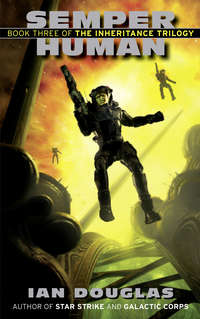
Читать книгу: «Semper Human»


For Brea, as always, my patient and loving muse
Table of Contents
Title Page
Dedication
Timeline of the Inheritance Universe
Stranded …
Prologue
Chapter 1
Chapter 2
Chapter 3
Chapter 4
Chapter 5
Chapter 6
Chapter 7
Chapter 8
Chapter 9
Chapter 10
Chapter 11
Chapter 12
Chapter 13
Chapter 14
Chapter 15
Chapter 16
Chapter 17
Chapter 18
Chapter 19
Chapter 20
Chapter 21
Chapter 22
Chapter 23
Chapter 24
Epilogue
By Ian Douglas
Copyright
About the Publisher
Timeline of the Inheritance Universe
Years before present
50,000,000–30,000,000: Galaxy dominated by the One Mind, sentient organic superconductors with hive mentality. They create the network of stargates across the Galaxy, and build the Encyclopedia Galactica Node at the Galactic Core.
30,000,000–10,000,000: Dominance of Children of the Night, nocturnal psychovores. They replace the One Mind, which may have transcended material instrumentality.
10,000,000 TO PRESENT: Dominance of the Xul, also known as the Hunters of the Dawn. Originally polyspecific pantovores, they eventually exist solely as downloaded mentalities within artificial cybernetic complexes.
Circa 500,000 B.C.E.: Advanced polyspecific machine intelligence later called variously the Ancients or the Builders extends a high-technology empire across a volume of space several thousand light years in extent. Extensive planoforming of Chiron, at Alpha Centauri A, of Mars in the nearby Sol System, and of numerous other worlds. QCC networks provide instantaneous communications across the entire empire. Ultimately, the Builder civilization is destroyed by the Xul. Asteroid impacts strip away the newly generated Martian atmosphere and seas, but Earth, with no technological presence, is ignored. A Xul huntership is badly damaged in the battle over Mars; it later crashes into the Europan world-sea and is frozen beneath the ice. Survivors of the Martian holocaust migrate to Earth and upload themselves into gene-tailored primates that later will be known as Homo sapiens.
10,000 B.C.E.–7500 B.C.E.: Earth and Earth’s Moon colonized by the Ahannu, or An, who are later remembered as the gods of ancient Sumeria. Around 7500 B.C.E., asteroid strikes by the Xul destroy An colonies across their empire. Earth is devastated by asteroid strikes. One colony, at Lalande 21185, survives.
Circa 6000 B.C.E.: Amphibious N’mah visit Earth and help human survivors of Xul attack develop civilization. They are later remembered as the Nommo of the Dogon tribe of Africa, and as civilizing/agricultural gods by other cultures in the Mideast and the Americas.
Circa 6000–5000 B.C.E.: N’mah starfaring culture destroyed by the Xul. Survivors exist in low-technology communities within the Sirius Stargate and, possibly, elsewhere.
1200 B.C.E. [SPECULATIVE]: The Xul revisit Earth and discover an advanced Bronze Age culture. Asteroid impacts cause devastating floods worldwide, and may be the root of the Atlantis myth.
700 C.E.: The deep abyssal intelligence later named the Eulers fight the Xul to a standstill by detonating their own stars. This astronomical conflagration of artificial novae is seen in the skies of Earth, in the constellation Aquila, some one thousand two hundred years later.
The Heritage Trilogy
2039–2042: Semper Mars
2040: 1st UN War. March by “Sands of Mars Garroway.” Battle of Cydonia. Discovery of the Cydonian Cave of Wonders.
2040–2042: Luna Marine
2042: Battle of Tsiolkovsky. Discovery of An base on the Moon.
2067: Europa Strike
2067: Sino-American War. Discovery of the Singer under the Europan ice.
The Legacy Trilogy
2138–2148: Star Corps
2148: Battle of Ishtar. Treaty with An of Lalande 21185. Earth survey vessel Wings of Isis destroyed while approaching the Sirius Stargate.
2148–2170: Battlespace
2170: Battle of Sirius Gate. Contact with the N’mah, an amphibious species living inside the gate structure. Data collected electronically fills in some information about the Xul, and leads to a Xul node in Cluster Space, thirty thousand light years from Sol. A Marine assault force uses the gate to enter Cluster Space and destroy this gate.
2314–2333: Star Marines
2314: Armageddonfall
2323: Battle of Night’s Edge. Destruction of Xul Fleet and world in Night’s Edge Space.
The Inheritance Trilogy
2877: Star Strike
2877 [1102 M.E..]: 1MIEF departs for Puller 695. Battle of Puller 695 against Pan-Europeans. Contact with Eulers in Cygni Space. Battle of Cygni Space. Destruction of star in Starwall Space, eliminating local Xul node.
2886: Galactic Corps
2886 [1111 M.E.]: Raid on Cluster Space by 1MIEF. Discovery of stargate path to major Xul node at Galactic Core.
2887 [1112 M.E.]: Operation Heartfire. Assault on the Galactic Core.
4004: Semper Human
3152: Volunteer elements of the Marine third Division enter extended cybernetic hibernation.
3214: Formation of the Galactic Associative.
4004 [2229 A.M.]: Dahl Incursion. Contact with the Tarantulae. Attack on Xul presence within the Quantum Sea. Xenophobe Collapse.
4005 [2230 A.M.] Re-establishment of the United States Marine Corps.
Stranded …
Behind him, the Samuel Nicholas was fast dwindling to a lopsided disk as Garwe and fifteen other War Dogs hurtled toward Objective Reality. Fusion bursts and antimatter warheads, positron beams, gravitics disruptors, and lasers at x-ray and gamma frequencies crisscrossed the gulf of space between worldlet and asteroid-sized starship, eliciting dazzling flashes and twinkles of light, expanding clouds of dust and white-hot plasma on the surfaces of both. Chunks of molten rock and hull metal boiled off into hard vacuum. The Nicholas wouldn’t be able to take that kind of point-blank bombardment for long.
Which was why, several long seconds later, the Samuel Nicholas vanished, rotating back up into normal four-D space.
And the cloud of Marine fighters, strikepods, and twelve heavy naval vessels were left alone to confront the Xul world.
“Bastards!” Dravis Mortin said over the squadron channel.
“Belay that,” Captain Xander’s voice snapped. “Pay attention to your approach!”
Garroway knew, with the Samuel Nicholas gone, none of the Marines of 1MarDiv would be going home.
We are now on our own …
Prologue
Some three hundred fifty light years from the exact center of the Milky Way Galaxy, the Marine OM-27 Eavesdropper Major Dion Williams forced its way through the howling storm.
The howl, in this case, was purely electronic in the vacuum of space, a shrill screech caused by the flux of dust particles interacting with the Williams’ magnetic shields. But since the tiny vessel’s crew consisted of uploaded t-Human minds and a powerful Artificial Intelligence named Luther, all of them resident within the Williams’ electronic circuitry, they “heard” the interference as a shrieking roar. The tiny vessel shuddered as it plowed through the deadly wavefront of charged particles.
“Sir! There it is again!” Lieutenant (u/l) Miek Vrellit indicated a pulse of coherent energy coming through the primary scanner. “Do you see it?”
“Yeah,” Captain (u/l) Foress Talendiaminh replied. “Looks like a gravitational lensing effect.”
“Yeah, but it’s not noise! There’s real data in there!”
“What do you make of it, Luther?”
“Lieutenant Vrellit is correct,” the AI replied, as the data sang across the ship’s circuitry. “There is data content. I cannot, however, read it. This appears to be a new type of encryption.”
“But the signal’s coming from inside the event horizon!” Talendiaminh said. “That’s impossible!”
“I suggest, sir,” the AI said, “that we record what we can and transmit it to HQ. Let them determine what is or is not possible.”
“Agreed.”
But then, as seconds passed, Vrellit sensed something else. “Wait a second! Anyone feel that?”
“What?”
“Something like …”
And then circuitry flared into a white-hot mist, followed half a second later by a fast-expanding cloud of gas as the Williams began to dissolve.
The monitor’s faster-than-light QCC signals were already being received some twenty-six thousand light years away, on the remote outskirts of Earth’s solar system. The last transmission received was Lieutenant Vrellit’s electronic voice, a shriek louder than the storm of radiation.
“Get! Them! Out! Of! My! Mind! …”
“Star Lord, you are needed.”
Star Lord Ared Goradon felt the odd, inner twist of shifting realities, and groaned. Not now! Whoever was dragging him out of the VirSim, he decided, had better have a damned good reason.
“Lord Goradon,” the voice of his AI assistant whispered again in his mind, “there is an emergency.” When he didn’t immediately respond, the AI said, more urgently, “Star Lord, wake up! We need you fully conscious!”
Reluctantly, he swam up out of the warmth of the artificially induced lucid dream, the last of the sim’s erotic caresses tattering and fading away. He sat up on his dream couch, blinking against the light. His heart was pounding, though whether from his physical exertions in the VirSim or from the shock of being so abruptly yanked back to the rWorld, he couldn’t tell.
The wall opposite the couch glared and flickered in orange and black. “What is it?”
“A xeno riot, Lord,” the voice told him. “It appears to be out of control. You may need to evacuate.”
“What, here?” It wasn’t possible. The psych index for Kaleed’s general population had been perfectly stable for months, even with the news of difficulties elsewhere.
But on his wall, the world was burning.
It was a small world, to be sure—an artificial ring three thousand kilometers around and five hundred wide, rotating to provide simulated gravity and with matrix fields across each end of the narrow tube to hold in the air. Around the perimeter, where patchwork patterns of sea and land provided the foundation for Kaleed’s scattered cities and agro centers, eight centuries of peace had come to an end in a single, shattering night.
The wall revealed a succession of scenes, each, it seemed, worse than the last. Orange fires glared and throbbed in ragged patches, visible against the darkness of the broad, flat hoop rising from the spinward horizon up and over to the zenith, and down again to antispin. Massed, black sheets of smoke drifted slowly to antispin, above the steady turning of the Wheel, sullenly red-lit from beneath. That he could see the flames against the darkness was itself alarming. What had happened to the usual comfortable glare of the cities’ lights, to their power?
“Show me the Hub,” he ordered the room.
Cameras directed at Kaleed’s hub fifteen hundred kilometers overhead showed the wheelworld’s central illuminator was dead. The quantum taps within providing heat and warmth had failed, and the three extruded Pylons holding the Hub in place were dark. There appeared to be a battle being fought at the base of Number Two Pylon, two clouds of anonymous fliers, their hulls difficult to see as their nanoflage surfaces shifted and blended to match their surroundings, were swarming about the base and the column, laser and plasma fire flashing and strobing with each hit.
Damn it … who was fighting who out there?
“Administrator Corcoram wishes to see you, Lord,” his assistant told him as he stared at the world’s ruin. “Actually, several hundred people and aigencies have requested direct links. Administrator Corcoram is the most senior.”
“Put him through.”
The System Administrator appeared in Goradon’s sleep chamber, looking as though he, too, had just been roused from sleep. His personal aigent had dressed his image in formal presentation robes, but not edited the terror from the man’s face. “Star Lord!”
“What the hell is going on, Mish? There was nothing in the last admin reports I saw. …”
“It just came out of nowhere, sir,” Mishel Corcoram replied. “Nowhere!”
“There had to be something.”
The lifelike image of Kaleed’s senior administrator shrugged. “There was a … a minor protest scheduled for nineteen at the public center in Lavina.” That was Kaleed’s local admin complex.
Eight standard hours ago. “Go on.”
“Our factors were there, of course, monitoring the situation. But the next thing socon knew, people were screaming ‘natural liberty,’ and then the Administrative Center was under attack by mobs wielding torches, battering rams, and weaponry seized from Administratia guards dispatched to quiet things down.” The image looked away, as though studying the scenes of fire and night flickering in the nano e-paint coating Goradon’s wall. “Star Lord … it’s the end of Civilization!”
“Get a hold of yourself, Mish. Who are the combatants? What are they fighting about?”
“The stargods only know,” Corcoram replied. He sounded bitter. “Reports have been coming in for a couple of hours, now, but they’re … not making much sense. It sounds like r-Humans are fighting s-Humans … and both of them are fighting both Dalateavs and Gromanaedierc. And everyone is attacking socon personnel and machines on sight.”
“A free-for-all, it sounds like.”
“Pretty much, yeah.”
Goradon shook his head. “But why?”
“Like I said, Lord. It’s the collapse of Civilization!”
Which Goradon didn’t believe for a moment. Mish Corcoram could be hyper-dramatic when the mood took him, and could pack volumes of emotion into the utterly commonplace. He was a good hab administrator—the effective ruler of the wheelworld known as Kaleed—but Ared Goradon was the administrator for the entire Rosvenier system … not just Kaleed, but some two thousand other wheelworlds, cylworlds, rings, troider habs, toroids, and orbital cols, plus three rocky planets, two gas giants, and the outposts and colonies on perhaps three hundred moons, planetoids, cometary bodies, and Kuiper ice dwarfs. His jurisdiction extended over a total population of perhaps three billion humans of several subspecies, and perhaps one billion Dalateavs, Gromanaedierc, Eulers, N’mah, Veldiks, and other nonhuman sapients or parasapients.
He could not afford to become flustered at the apparent social collapse of a single orbital habitat.
“Star Lord,” his AI assistant whispered in his ear. “Other reports are beginning to come through. There was some transmission delay caused by the damage to the Hub. It appears that similar scenes are playing out on a number of other system habs.”
“How many?”
“Four hundred seventeen colonies and major bases so far. But that number is expected to rise. This … event appears to be systemwide in scope.”
On the wall, a remote camera drone captured a single, intensly brilliant pinpoint of light against the far side of the Wheel, nearly three thousand kilometers distant … perhaps in Usila, or one of the other antipodal cities. Gods of Chaos … he could see the shockwave expanding as the pinpoint swelled, growing brighter. Had some idiot just touched off a nuke? …
“Star Lord,” his assistant continued. “I strongly recommend evacuation. You can continue your duties from the control center of an Associative capital ship.”
“What’s close by?”
“The fleet carrier Drommond, sir. And the heavy pulse cruiser Enthereal.”
Seconds ago, the very idea of abandoning Kaleed, of abandoning his home, had been unthinkable. But a second nuclear detonation was burning a hole through the wheeldeck foundation as he watched.
The fools, the bloody damned fools were intent on pulling down their house upon their own heads.
“Mish, on the advice of my AI, I’m transferring command to a warship. I recommend that you do the same.”
“I … but … do you think that’s wise?”
“I don’t know about wise. But the situation here is clearly out of control, yours and mine.”
“But what are we going to—”
The electronic image of the Kaleed senior administrator flicked out. On the wall, a third city had just been annihilated in a burst of atomic fury—Bethelen, which was, Goradon knew, where Mish lived.
Where he had lived, past tense.
Goradon was already jogging for the personal travel pod behind a nearby wall that would take him spinward to the nearest port. He might make it.
“What I’m going to do,” he called to the empty air, as if Mish could still hear him, “is call for help.”
“What help?” his AI asked as he palmed open the hatch and squeezed into the pod.
“I’m going to have them send in the Marines,” he said.
It was something Goradon had never expected to say.
1
2101.2229
Associative Marine Holding Facility 4
Eris Orbital, Outer Sol System
1542 hours, GMT
Marine General Trevor Garroway felt the familiar jolt and retch as he came out of cybe-hibe sleep, the vivid pain, the burning, the hot strangling sensation in throat and lungs as the hypox-perfluorate nanogel blasted from his lungs.
The dreams of what was supposed to be a dreamless artificial coma shredded as he focused on his first coherent thought. Whoever is bringing me out had better have a damned good reason. …
Blind, coughing raggedly, he tried to sit up. He felt as though he were drowning, and kept trying to cough up the liquid filling his lungs. “Gently, sir,” a female voice said. “Don’t try to do it all at once. Let the nano clear itself.”
Blinking through the sticky mess covering his eyes, Garroway tried to see who was speaking. He could see patterns of glaring light and fuzzy darkness, now, including one nearby shadowy mass that might have been a person. “Who’s … that?”
“Captain Schilling, sir. Ana Schilling.” Her voice carried a trace of an accent, but he couldn’t place it. “I’m your Temporal Liaison Officer.”
“Temporal … what?”
“You’ve been under a long time, General. I’m here to help you click in.”
A hundred questions battled one another for first rights of expression, but he clamped down on all of them and managed a shaky nod as reply. With the captain’s help, he sat up in his opened hibernation pod as the gel—a near-frictionless parafluid consisting of nanoparticles—dried instantly to a gray powder streaming from his naked body. He’d trained for this, of course, and gone through the process several times, so at least he knew what to expect. Focusing his mind, bringing to bear the control and focus of Corps weiji-do training, he concentrated on deep, rhythmic breathing for a moment. His first attempts were shallow and painful, but as he pulled in oxygen, each breath inactivated more and more of the nanogel in his lungs. Within another few seconds, the last of the gel in his lungs had either been expelled or absorbed by his body.
And his vision was clearing as well. The person-sized mass resolved itself into an attractive young woman wearing what he assumed was a uniform—form-fitting gray with blue and red trim. The only immediately recognizable element, however, was the ancient Marine emblem on her collar—a tiny globe and anchor.
Gods … how long had it been? He reached into his mind to pull up the date, and received a shock as profound as the awakening itself.
“Where’s my implant?” he demanded.
“Ancient tech, General,” Schilling told him. “You’re way overdue for an upgrade.”
For just a moment, panic clawed at the back of his mind. He had no implant! …
Sanity reasserted itself. Like all Marines, Garroway had gone without an implant during his training. All Marines did, during recruit training or, in the case of officers, during their physical indoctrination in the first year of OCS or the Commonwealth Naval Academy. The theory was that there would be times when Marines were operating outside of established e-networks—during the invasion of a hostile planet, for instance.
He knew he could manage without it. That was why all recruits were temporarily deprived of any electronic network connection or personal computer, to prove that they could survive as well as any pretechnic savage.
But that didn’t make it pleasant, or easy. He felt … empty. Empty, and impossibly alone. He couldn’t mind-connect with anyone else, couldn’t rely on local node data bases for information, news, or situation alerts, couldn’t monitor his own health or interact with local computers such as the ones that controlled furniture or environmental controls, couldn’t even do math or check the time or learn the freaking date without going through …
He started laughing.
Schilling looked at him with concern. “Sir? What’s funny?”
“I’m a fucking Marine major general,” he said, tears streaming down his face, “and I’m feeling as lost as any raw recruit in boot camp who finds he can’t ’path his girlfriend.”
“It can be … disorienting, sir. I know.”
“I’m okay.” He said it again, more firmly. “I’m okay. Uh … how long has it been?” He looked around the room. A number of other gray-clad personnel worked over cybe-hibe pods set in a circle about the chamber. Odd. This was not the storage facility he remembered … it seemed like just moments ago. His eyes widened. “What’s the date?”
Schilling leaned forward slightly, staring into his eyes. Her eyes, he noted, were a lustrous gold-green, and could not be natural. Genetically enhanced, he wondered? Surgical replacements? Or natural genetic drift? She seemed to be looking inside him, as though gauging his emotional stability.
“The year,” she said after a moment, “is 2229 Annum Manus, the Year of the Corps. Or 4004 of the Current Era, if you prefer, or Year 790 of the Galactic Associative. Take your pick. Does that help?”
He wasn’t sure. His brow furrowed as he tried to work through some calculations without the aid of his cerebral implant. The numbers were slippery, and kept wiggling out of his mental grasp. “I went under in … wait? I’ve been under for something over eight hundred years?”
“Very good, sir. According to our records, your last period on active duty was from 1352 through 1377 A.M.” Her head cocked to one side. “I believe you called it ‘M.E.’ in your day. The ‘Marine Era?’?”
“?‘A.M.’ means … meant something quite different. Antimatter. Or morning, if you were a civilian.”
She looked puzzled. “Morning? I don’t think I know that one.”
“From ‘antimeridian.’ Before the sun is overhead.”
“Ah. A planet-based reference, then.” She dismissed the idea with a casual shrug. “In any case, you were promoted to brigadier general in 1374, and were instrumental in the victory at Cassandra in 1376. The following year—that would be 3152 by the old-style calendar—you elected to accept a promotion to major general and long-term cybe-hibe internment in lieu of mandatory retirement.”
“Of course I did. I wasn’t even two centuries old.” His eyes narrowed. “How old are you, anyway, Captain?”
She grinned. “Old enough. Older than I look, anyway.”
“Genetic antiagathic prostheses?”
“Some,” she admitted. “There are a fair number of people alive in the Associative now who are pushing a thousand, and that’s not counting uploaders. Partly genetic prosthesis, partly nanogenetic enhancement. And I’ve spent two tours so far inside one of those pods.”
“Really?” He was impressed. “In the names of all the gods and goddesses, why?”
She shrugged again. “Cultural disjunct, I suppose.”
“Copy that.” The gulf between civilian life and life in the Marine Corps had been enormous even back in his day. It might be considerably worse now.
“The Corps is my home,” she added. “Most of my family was on Actinia.”
He heard the pain in her voice, and decided not to question her further on that. Evidently, he’d missed a lot of history. Eight centuries’ worth.
The numbers finally came together for him. “Okay. I’ve been out of it for 852 years. I take it there’s a crisis?”
Again, that perplexed look. “What makes you think that, sir?”
“An old expression, ancient even in my day,” he replied. “?‘In case of war, break glass.’?”
“I … don’t understand, sir.”
“Never mind.” He looked around the chamber that had changed so much in eight centuries. Eleven other pods rested quietly in alcoves around the oval space. His command constellation. The other waking personnel appeared to be working at reviving them. “What’d they do, rebuild the place around us?”
“Moved you to a larger facility, about three hundred years ago. You’re in Eris Ring, now.”
“Huh. We got hibed in Noctis Lab. On Mars.”
“That facility was closed, sir, not long after they brought you up here. The whole of Mars is military-free, now. The Associative’s been downscaling all of the military services for a long time, now.”
“I see.” He was looking forward to catching up on history. It promised to be very interesting indeed. “Eris? A planetoid?”
“Dwarf planet, Sir. Sol system … one of the scatter-disk objects.”
“TNO,” Garroway said, nodding. “I know.” Trans-Neptunian Objects was a catch-phrase for some thousands of worlds and worldlets circling Sol beyond the orbit of Neptune, most beyond even the Kuiper Belt. Eris, in fact, according to history downloads he’d scanned, had been responsible for downgrading another dwarf planet—Pluto—from its former status as a full-fledged planet. That had been over a thousand years ago—no. He stopped himself. Two thousand years ago.
He nodded toward the other personnel working on the silent cybe-hibe pods. “They’re recalling my people?”
“Yes, sir. But the orders were to wake you first. Then your command staff. Protocol. Your brigade will not be revived until you’ve received a full briefing, and give the appropriate orders.”
“Okay. You know, you didn’t answer my question, Captain.”
“Which one, sir?”
“Is there a crisis?”
“So I gather. I don’t have any details, though. You’ll get that in your briefing download.”
“I expect I will.” Carefully, he swung his legs out of the pod recess, his bare feet reaching for the deck. Most of the nanogel was gone, now. He glanced down at himself, then at Captain Schilling. “Hm. I trust there are no nudity taboos in this century.”
She smiled. “No, sir. Nothing like that. But I have a uniform for you, if you want to be presentable for your constellation when they come around.”
“Good idea. But food first, I think. Uh, no … maybe a shower …”
“Both are waiting for you, General. Do you feel like you can stand, yet?”
“Not sure. But I sure as hell intend to try.” His feet found the deck. He swayed alarmingly, but with Schilling’s help, he managed to stay on his feet. She had a floater chair waiting for him in case he needed it, but full muscular control reasserted itself swiftly and he waved it away, preferring to do this on his own if he could. The cybe-hibe procedure permeated the body with molecule-sized machines that did everything from arresting cell metabolism to keeping muscle groups healthy, if inactive. There was some stiffness, and a few unsteady moments as he relearned how to keep his balance, but surprisingly few aftereffects of an eight-century sleep.
Eight centuries? How much had the world, the Galaxy, changed? How much had Humankind changed? When he’d entered cybe-hibe—it seemed literally like just last night—there’d been the bright promise of a new, golden age. The dread, ancient enemy, the xenophobic Xul, had been defeated at last. Across a Galaxy that had seemed a desert in terms of sentient life—where only a handful of reclusive or unusually sequestered intelligent species had survived the Xul predations—more and more nonhuman cultures were being discovered, contacted, and invited to join the loose and somewhat freewheeling association that was then being called the Galactic Commonwealth.
Now it was being called the Associative? There would be other changes, of course, besides the name. He found himself anxious to learn them … as well as a bit afraid.
The shower proved to be a transparent cylinder giving him a choice of traditional water at any temperature, high-frequency sound waves, or total immersion in a thin, hazy nano-parafluid programmed to cleanse his skin while permitting him to continue breathing normally. He chose water, more for the stimulation of the pounding on his skin than anything else. Garroway found he needed the liaison officer’s help, though. Without his implant, he couldn’t interact with the damned shower controls.
When he was clean and dry, Schilling gave him a button-sized pellet that, when pressed against his chest and activated by her thought, swiftly grew into a skin-tight set of dark gray neck-to-soles utilities. It was, he thought grimly, downright embarrassing. Here he was a Marine major general, and he couldn’t even bathe or dress himself without the captain’s help.
Then she led him into the mess hall, and he realized just how much things had really changed as he’d slept down through the centuries. …
The compartment was large and spherical, with much of one entire half either transparent, or, more likely, a deck-to-overhead viewall with exceptional clarity. The view was … stunning, a blue and white swatch of dazzling light, a sharp-edged crescent, arcing away beneath a brilliant, pinpoint sun.
But for a moment, Garroway was utterly lost. It looked like Earth, with those piercing, sapphire blues and swirls of cloud-whites. But the sun was all wrong, far too tiny, far too brilliant, a spark, not a disk.
For just a moment, he wondered if something had happened to the sun during his long sleep. Then he wondered if he’d misunderstood the captain, that this Eris was not the frigid dwarf planet in Sol’s outer system, but an Earthlike world of some other, utterly alien star.
“That can’t be Earth’s sun,” he said, squinting at the pinpoint. “It’s way too bright.” He could see a distinct bluish tinge to the intense white of its glare.
“No, sir,” Schilling told him. She smiled.
“And since when do tiny little icebox planetoids have their own atmosphere and water?”
“Terraforming has come a long way, General,” Schilling told him. “That’s not Sol. It’s Dysnomia.”
“Dysnomia.” He blinked. In his day, Eris had been an ice, rock, and frozen methane worldlet 2500 kilometers in diameter, about eight percent larger than, and 27 percent more massive than, Pluto. Discovered in the early twenty-first century, it had a highly inclined, highly eccentric orbit, but he couldn’t remember the exact numbers without his implant. He knew the place was cold, though, down around twenty-five Kelvins or so, a scant twenty-five degrees above zero absolute. Dysnomia had been a tiny satellite of Eris, like Pluto’s Charon, but smaller, a rock only 150 kilometers across.
“The Eridian satellite,” Schilling told him. “About five hundred years ago, they planted a quantum converter on it and turned it into a microstar. It’s tiny, but it’s only about thirty-seven thousand kilometers from the planet. Orbits once in fifteen standard days. The converter provides enough heat to warm Eris, and the nanoforming matrix is doing the rest.”
“You’re losing me, Captain. They turned a 150-kilometer asteroid into a star, and then … what? Nanoforming?”
“Terraforming, using nanoreplicators and assemblers. Breaking methane, ammonia, and water ice into water, oxygen, nitrogen, and carbon.”
“And the star goes around the planet, instead of the other way around?”
“Exactly. Eris still rotates beneath it, though, and has a day …” She paused, closing her eyes as she checked a data base through her implant, “of twenty-eight hours and some.”
He looked into the achingly beautiful blue of the planet’s crescent. “Terraforming a planet doesn’t happen overnight. How long before people are living there?”
“Oh, they’re living there now. Not many … a few hundred thousand. Mostly military at this point. Most of them are Eulers, actually, in the Deeps. The atmosphere won’t be breathable for another few centuries, and the storms are still pretty bad, but they started colonizing it as soon as stable continents emerged from the world ocean.”
“Continents.”
A globe appeared in the air as Schilling sent a request through her implant, blue and brown, without cloud cover.
“Three main continents,” she said, and each highlighted itself on the projection in turn as she named it. “Brown, Trujillo, and Rabinowitz. Those were the discoverers of Eris, way back when. Two minor continents over here … Xena and Gabrielle.” She paused, then frowned. “Strange. No data on where those names came from.”
Garroway thought about this as Schilling led him to a table and two chairs that seemed to grow out of the deck as they approached. The technology had changed, and changed tremendously if Humankind was able now to create stars, even small ones. That was only to be expected, of course. Human technology had been in a rapidly upward-lunging, almost logarithmic curve since the eighteenth or nineteenth century.
He took one of the chairs, as Schilling sat in the other. She placed one hand, palm down, on a colored patch on the table. “What would you like to eat?”
“Captain, I have no idea. Choose something for me.”
A white, plastic hemisphere materialized in front of each of them; seconds later, the hemispheres evaporated, revealing their meals. Garroway wasn’t sure what it was—there was something that might be meat, something else that might be starchy, a third thing that was brilliant green—but he decided not to ask questions. The stuff was edible—in fact, delicious—whatever it was, and that was all he needed to know for the moment.
Other Marine personnel were in the mess hall as well, though the cavernous room was not close to being filled. The others kept their distance, however, though he saw numerous glances and curious stares. He found himself trying to listen in on conversations at the nearest tables. He was curious. How much had Anglic changed in eight centuries? Did they even speak an Anglic-derived tongue, now, or had the vagaries of history brought some other language to the fore?
Again, he decided to wait rather than bombard Schilling with questions. While he could hear voices, the nearby conversations seemed muffled, somehow, and he suspected that some sort of privacy field was blanketing the compartment.
Thirty minutes or so later, he leaned back, watching his empty plate dissolve back into the table surface. “Well, if that was a sample of the food in the forty-first century, I could get to like this time.”
“You’ll like it more with your implant.”
“Eh?”
“You’ll find nanotech is a part of just about everything now, including what you eat. And your implant has programs that let you respond in subtle ways to nano-treated food. Speaking of which … here.” She handed him a small inhaler. He hadn’t seen where she’d been carrying it on that painted-on uniform, and wondered if she’d materialized it out of the table the same way as she’d summoned their meals.
“What’s this?”
“Your new implant. We needed you to get a meal into your stomach first, so the implant nano has some raw material to work with. Just press that tip into a nostril and touch the release.”
He followed her directions. A warm, moist puff of air invaded his sinuses, and he tasted metal.
“The nano is programmed to follow the olfactory nerve into the brain,” she told him. “It knows where to go, and will begin chelating into imbedded circuits almost immediately. You’ll find yourself coming back on-line within an hour or two. Full growth will be completed within twenty hours or so.”
“That’s good.” He was still feeling shaken at the emptiness he felt without an e-connect. Damn, what had people done before cerebral implants? “And this’ll be better than my old one, huh?”
“Oh, yeah. A lot. You’ll be amazed.”
“I don’t know. Takes a lot to amaze me. What about Lofty?”
She cocked her head again. “?‘Lofty?’ Who—”
“My essistant. Personal secretary and Divisional AI. Named for Major Lofton Henderson.”
“Oh, I see. Your personal software has all been backed up in the facility network. You’ll get it all back with the download. Who is Major Henderson?”
“Check your Corps history download, Captain,” he said with stern disapproval. “He was a Marine aviator in the pre-spaceflight era. He commanded VMSB-241 at the Battle of Midway in the year 167 of the Marine Era. Killed in action leading a glide-bomb attack against the aircraft carrier Hiryu. Won a posthumous Navy Cross.”
“Yes, sir.”
“Son of a bitch.”
“Pardon, sir?”
“Nothing. I just realized that I rattled that off without consulting my implant data base. Maybe there’s hope for me yet.”
“I’m very sure there is, General.”
“So what does a … what did you call yourself? A temporal liaison do?”
“Lots of people are disoriented when they come out of cybe-hibe, sir. And even with the download, they can feel … isolated. Cut off. I’m here as a kind of a guide. I can answer questions. And, well, I know what you’re going through. What you’re feeling. I can reassure you that you’re not as alone as you might feel.”
“If there’s still a Corps, I won’t be alone,” he said. “I confess, though, that I’m a little surprised there still is a Marine Corps. There was talk back in the early thirtieth about disbanding us. The Corpsman who put me under down in Noctis Lab offered to bet me that he’d be waking me up again within the year … that I’d end up being retired, anyway. I take it that didn’t happen?”
“If you’ll check your Corps history, General, you’ll recall that the Marine Corps has always been threatened with disbanding. Why maintain a separate military organization when there’s the regular army?”
That, Garroway thought, was the absolute truth. Since the creation of the Continental Marines in 1775, the Corps had been a kind of bastard unwanted child—except when there was a war on. During peacetime, it was budget battles and second-line equipment, “Truman’s police force” and “in case of war, break glass.” Once the shooting started, though, it was send in the Marines.
In fact, the whole Marine cybe-hibe holding facility was an outgrowth of that millennia-old problem. Even well before the thirtieth century, what Schilling had casually referred to as “cultural disjunct” had been a serious issue within the Corps. Marines tended to stick together, to evolve their own unique culture with their own language and their own ways of looking at the world, and that culture was generally at sharp odds with the local civilian background. The problem had become even worse in the early days of interstellar military operations, when Marine units were packed away in cybe-hibe and deployed to star systems light years away; those units might return to Earth two decades or more after they’d left, aged—thanks to the combined effects of hibernation and relativistic time dilation—only a couple of years. Men and women already isolated from the civilian population by the Marine microculture found themselves even more isolated by twenty years of social change—and the aging or death of any friends or relatives left behind.
Small wonder that Marines tended to form bonded relationships with Marines, that there were traditional Marine family lines going back, in some cases, two thousand years. Garroway’s great-grandfather had been Gunnery Sergeant Aiden Garroway, who’d taken part in the op that had broken the back of the ancient Xul menace at the Galactic Core in the twenty-ninth century. And there were records of Garroways going much, much further back. There’d been a remote ancestor—immortalized in Corps legend as “Sands of Mars Garroway”—back in the mid-twenty-first, even before the first voyages to other stars.
He started to make a mental note to check and see if there were any Garroways around now. He’d had two kids, Ami and Jerret, before his first stint in cybe-hibe. Their mother had discouraged contact with him, damn her, and they’d been distant after the break-up. But maybe enough time had passed for their descendents. …
He shook off the thickening mood, electing instead to stare up at the impossibly blue and white curve of Eris and the tiny glare of Dysnomia, hanging in the sky above the mess deck.
A new century. A new millennium.
He was looking forward to that download.
Upper Stratosphere, Dac IV
Star System 1727459
1820 hours, GMT
The RS/A-91 strikepod plunged out of the upper haze deck into a calm and empty gulf, and Marine Lieutenant Marek Garwe shifted from tactical to optical. Salmon-pink cloud walls towered in all directions, like vast and fuzzy-looking cliffs with gently curved and wind-sculpted faces. The haze layer above was composed mostly of crystals of water ice, scattering the local star’s light, turning the sky a deep, royal blue, with a ghostly halo about the sun.
Below, the cloud canyon yawned into darkness. The next cloud deck was over forty kilometers below, deeply shadowed in the depths beyond the slanting reach of the rays of a distant sun. Intermediate cloud layers indicated updrafts, including a vast spiral in the distance of a storm. Most astonishing was the sheer scale of the vista ahead and below; the opening in the cloud layer appeared to be dozens of kilometers wide and deep, but Garwe’s instrument feeds showed the empty gulf to be nearly four hundred kilometers across.
Dac IV was a gas giant, a little smaller than Jupiter in the distant Sol system, but with the same wind-whipped cloud bands and rotating storm cells in an atmosphere that was 99 percent hydrogen and helium. The 1 percent or so left over was mostly methane and ammonia, plus the poisonous soup of chemical compounds constantly upwelling from the world’s interior that gave the planet’s clouds their spectacular range of color.
Characteristic of most gas giants, Dac IV had no solid surface, which meant that Garwe’s confused and constantly shifting altitude readings were irrelevant; below his hurtling RS/A-91 Starwraith’s hull, the atmosphere grew steadily denser and hotter until it was compressed into metallic hydrogen.
“Tighten up your formation, people,” a voice whispered in his mind. “Objective now reads as 150 kilometers ahead.” Captain Corolin Xander was the CO of Anchor Marine Strike Squadron 340, “The War Dogs,” currently operating as Blue Flight. Her Starwraith was somewhere ahead and off Garwe’s starboard sponson, invisible even to his amplified senses as the squadron plunged toward Hassetas floatreef.
“I’m being painted,” Lieutenant Amendes, in Blue Two, reported. “Intense EM scans, all bands.”
“They can’t be sure of what they’re seeing,” Xander replied. “They may not even be getting anything back.”
“Oh, they see us, all right,” Lieutenant Bakewin said. “They see something. Scans are increasing in power.”
Starwraiths were encased in the latest wrinkle in nanoflage, a layer of active nano designed to render the two-meter craft effectively invisible by bending all incoming electromagnetic radiation around the smoothly curved surfaces. Pod-to-pod communication was strictly quantum nonlocal, meaning there were no transmissions to give the sender away.
But Dac technology was still a major unknown. How the Dacs had even developed technology in the first place—with no mines, no metallurgy, no heavy industry, no fire—was the subject of ongoing xenosociotechnic debate, and the principal reason for the Associative Compound on Hassetas.
The twelve tiny pods comprising Blue Flight leveled off when they reached the expected Hassetasan depth. In popular human thought, gas giants like Dac IV, those located in their star’s outer system rather than in close to their star, were cold … and so they were at the thin, upper layers of their outer cloud decks. The deeper into the atmosphere a flier plunged, however, the thicker and hotter the gas mix became. At this depth, the atmospheric pressure was about eight times human standard, and the temperature outside the Starwraith’s hull hovered at around the freezing point of water. The day, by most human standards, was positively balmy … at least when compared to temperatures higher or lower in the intensely stratified volume of Dac’s turbulent atmosphere.
Ahead, a cloud wall rose like an impenetrable cliff, a vast pink-brown cliff with a looming, mushroom-shaped top, with wind-carved striations running along its face.
“Reduce velocity, Blues,” Xander ordered. “We’re going subsonic.”
The flight plunged into the face of the cloud-cliff, as the individual pods were buffeted somewhat by windstreams whipping around the cloud at 300 kilometers per hour. At eight atmospheres, with an H/He gas mix, the speed of sound was nearly 2400 kph, so the local winds were little more than zephyrs.
The clouds thickened until optical feeds were useless; Garwe shifted again to tactical, though there was little useful information the system could give him now—radiation flux, gas mix and pressure, temperature and windspeed, projected position of the other eleven pods of Blue Flight.
And, ahead, the beacon marking Hassetas.
Moments later, the flight emerged into another crystalline gulf, the interior of a vast spiral of clouds marking a hot updraft from below.
And ahead, an immense, gossamer bubble almost transparent in the sunlight, was the Dac living city called Hassetas.
“Hassetas airspace control,” Xander’s voice snapped out, crisp and concise, “this is Associative Marine Flight Blue on docking approach. Acknowledge.”
There was no immediate reply, and the silence was a palpable, imminent threat. Had the Hassetas crisis worsened during Blue Flight’s descent from Tromendet, Dac IV’s largest moon? There could be no doubt that weapons—highly advanced and lethal weapons—were trained on the tiny Marine pods now approaching the living floatreef.
The Marines had just called the Dacs’ bluff and sent their squadron into the heart of this latest crisis, and now it was up to the Krysni jellyfish—and the sapient floatreef they served—to decide how to respond.
Would it be peace, and an invitation to land?
Or the triggering of a savage curtain of high-energy weaponry?
Garwe found he was holding his breath, waiting for the reply. …
2
2101.2229
Associative Marine Holding Facility 4
Eris Orbital, Outer Sol System
1845 hours, GMT
Trevor Garroway leaned back in a reclining seat grown by Captain Schilling from the deck of the large compartment she called the Memory Room. “You sure we can start this so soon?” he asked her. “You said it would take twenty hours to grow a new implant.”
The easy stuff is already in place, she told him. It took Garroway a moment to realize that she hadn’t spoken aloud, that her mouth hadn’t moved as she’d said the words. His implant was already picking up the transmitted thoughts of others with his implant encoding.
So … can you hear this? he thought, forcing the words out one by one in his mind.
Ouch, yes, she replied. You don’t need to shout. We’re connected over your basic personal link-channel. Others will be added later. You can also use that channel to begin downloading library data. You don’t have much in the way of artificial storage, yet—only about a pic of memory so far—but the link will let you download the gist to your native memory. You’ll just need to review it to see what’s there.
So what memories are you giving me now? he asked.
A general history of the past two thousand years, she told him, with emphasis on the Xul wars and subsequent social and technological development within the sphere of Humankind … what you knew as the Commonwealth. The rise of the Associative. A little bit of Galactic history, as we now understand it. Not much detail, here, not yet … just what you’ll need to put things into context later.
When you finally tell me what the goddamn crisis is that warrants pulling a Marine Star Battalion out of cold storage, he said, nodding. Gotcha.
Exactly. Are you comfortable? Ready to begin?
He took a deep breath as he settled back into the too-comfortable chair. Ready as I can be, Captain. Shoot. …
And the images began coming down, a trickle at first, and then a flood.
It would, he realized, take him a long time to go through these new memories. Each distinct memory, each fact or date or historical event, did not, could not exist in isolation, but was a part of a much larger matrix. Until he had access to a lot more information, these bits and pieces would tend to remain discreet, unconnected, and essentially meaningless within the far vaster and more complex whole.
One thing, though, was clear immediately. The aliens were coming out of hiding.
He already remembered, of course, the history of the Xenophobe Wars. The Xul—electronically uploaded nonhuman sentients who’d apparently been around for at least the past ten million years—had been the dominant Galactic species, taking control of much of the Galaxy from a predecessor species known as the Children of the Night. The Xul had brought some evolutionary baggage forward in their advance to sapience—notably a hard-wired survival trait that led them, in rather overenthusiastically Darwinian fashion, to utterly obliterate any other species that might constitute a threat. The Xul, it turned out, had been the answer to the age-old question known as the Fermi Paradox. In a Galaxy ten to twelve billion years old, which, given the number of planets and the sheer tenacity and inventiveness of life, should be teeming with intelligent species, the sky was curiously empty. When Humankind had first ventured into its own Solar backyard, then on to the worlds of other nearby suns, it had encountered numerous relics indicating that various species had passed that way before—the Cydonian Face on Mars, the Tsiolkovsky Complex on Luna, the planetwide ruins of Chiron. …
Eventually, other species had been encountered, and communications begun: the An of Llalande 21185, low-tech remnants of an earlier, vanished stellar empire; the amphibious N’mah, living a precarious rats-in-the-walls existence inside the Sirius Stargate, again the survivors of a once far-flung network of interstellar traders; the Eulers, benthic life forms from the ocean deeps of a world twelve hundred light years from Sol, with a curiously mathematical outlook on Reality and the technology to detonate stars.
All three species had encountered the Xul scourge, and all three had survived, albeit barely. The Eulers had fought the Xul more or less to a standstill by exploding many of their own stars—creating funereal pyres visible as anomalous novae in Earth’s night skies in the constellation of Aquila, back in the early years of the twentieth century. The N’mah had gone into hiding, deliberately abandoning interstellar travel in favor of survival. The An colony on a gas giant moon had simply been overlooked, and without radio or other attention-getting technologies, had managed to stay overlooked for the next ten to twelve thousand years.
The Xul, it turned out, had possessed a singular blind spot. Though no longer corporeal, existing as arguably self-aware software within huge and complex computer networks, they’d obviously begun as biological life forms—quite possibly as a number of them—arising on worlds that must have been similar in most respects to Earth in terms of temperature range, gravity, and atmospheric composition. Their blind spot was an inability to see outside of the ecological box; they tended to overlook other possible environments that might harbor life. The current An homeworld, for instance, was an Earth-sized moon of a gas giant, heated from within by tidal flexing, but far outside the so-called habitable zone of the system’s cool, red-dwarf star. The N’mah lived inside entirely artificial but necessary structures, the ten- or twenty-kilometer-wide stargates constructed by a far older, long-vanished congeries of star-faring species. And the Eulers, six-eyed tentacled chemovores evolving near deep-ocean volcanic vents, lived under such crushing pressures that they might have remained forever unnoticed by the Xul hunterships if they hadn’t possessed minds brilliant enough, and curious enough, to develop—through artificially crafted intelligent life forms and a patience spanning perhaps millions of years—the technology to venture into interstellar space.
All of that had been well known and understood by the time Garroway had joined the Marine Corps, in the twenty-eighth century. During the next few hundred years of his Marine career, perhaps half a dozen other intelligent species had been discovered—the Vorat, the widely scattered Nathga, the Chthuli. Again, nonterrestrial habitats had kept them hidden from the Xul. The Vorat were thermic chemovores, dwelling on high-temperature, high-pressure worlds similar to Venus in Earth’s solar system. The Nathga were jelly-bag floaters that had evolved in the upper cloud levels of a world like Jupiter, eventually developing the technology that had allowed them to slowly migrate to some thousands of similar gas giants across a good third of the Galaxy. And the Chthuli, like the Eulers, were a benthic species that had colonized the ocean basins of several oceanic worlds.
But across the Galaxy, world after world showed the silent ruins marking the passing of sentient species akin to Humans, in terms of environmental preference and carbon chemistry if not outward form, all blasted into premature extinction by the xenophobic Xul.
Now, however, some twelve hundred years after the final defeat of the Xul at the Galactic Core, hundreds of nonhuman species had been discovered and contacted to one degree or another. Many had joined the original Terran Commonwealth in a kind of Galactic United Nations—the Associative.
Many of the more recently discovered species, however, were so alien that they shared little common ground with humans. Communications were difficult, even impossible, with species that communicated by smell or by changing patterns on their integuments or through subtle modulations of their bodies’ electrical fields, with beings that didn’t understand the concept of union, or with entities that thought so slowly they didn’t even appear to be aware of more ephemeral species flitting in and out about them.
Garroway’s curiosity was piqued as new memories surfaced of strange cultures and alien biologies. He tried querying the data base, hoping to get imagery of some of these beings … then realized his curiosity would have to wait until his implant had grown in fully. He didn’t have that capability yet.
His military training noticed one important difference between the Associative and the old Commonwealth. There no longer was such a thing as “human space” … or borders between stellar nations. While there were interstellar empires out there, few individual species competed for the same type of real estate, and the “territories” of dozens of different species overlapped. It had been centuries before the Nathga were discovered adrift within the atmospheres of gas giants inside star systems already colonized by humans. The concept of distinct borders had been lost over half a millennium ago.
How, Garroway wondered, did governments control their own volumes of space? Did they even try … and what changes did that mean for military strategy? For that matter, if there was little or no competition between governments, why was there a need for the military at all?
And why was there still such a thing as the Marine Corps?
Surprisingly, he found himself little impressed with the purely technological advances of the past eight hundred years. Most of what he was seeing as new memories continued to surface were further developments of old themes. Interstellar travel still required a mix of the Alcubierre Drive and the huge stargates left behind by a vanished, Galaxy-spanning culture. Quantum power taps, much smaller than the ones Garroway had known, still provided the vast quantities of energy necessary for FTL travel. Nanotechnology had continued its inexorable advance toward the ever-smaller, ever-smarter. Perhaps the most notable technological advances had come in the fields of health and medicine. Some of what he was seeing now he didn’t begin to understand. What the hell was mindkeeping, anyway? Or upload therapy? …
The Xul threat, he noted, had not entirely vanished after the climactic battle at the Galaxy’s core two decades before he’d been born. Xul nodes—local networks and fleet centers where they’d kept watch over the Galaxy for developing technic cultures—continued to be discovered from time to time, and had to be eliminated one by one. However, thanks to data retrieved from the Galactic center, Xul codes, software, and upload technology all were now well-enough understood that the ongoing mop-up had been turned over to AI assault units. Unmanned probes mimicking Xul hunterships would approach a target system and infect the local node with nanotech devices allowing the assault unit to literally reprogram the local Xul reality. When incoming data suggested that there was a threat that needed to be eliminated, the Xul virtual reality was simply rewritten on the fly to prove that the threat had already been eliminated.
And so far, the technique appeared to be working. There’d been no new Xul incursions in eight hundred years, and hundreds of Xul bases had subsequently been infiltrated and shut down from within. No new Xul nodes had been discovered in over two centuries, and most people thought that the last of the monsters had been found and destroyed.
Garroway knew better than to get too excited about that. The Galaxy was an extraordinarily huge place, and more Xul nodes could be—almost certainly were—still out there, lost somewhere within that vastness of four hundred billion suns.
How’s it going, General? Schillng’s voice said, overriding the torrent of memories.
Okay, I guess, he replied. Damn, there’s a hell of a lot. …
He felt her mental smile. A lot can happen in eight hundred fifty years, in a collective culture that numbers in the hundreds of trillions of entities. Do you have any questions?
Not yet. I don’t know enough to know what to ask.
Okay. I’ve got a new download here. This one is mission specific. See what you think.
A moment later, Garroway came up for air. “Oh, gods,” was all he could say.
The Xul he’d known had possessed one striking weakness. Different nodes were slow to share data, and individual nodes could be slow—centuries, sometimes—in responding to a perceived threat. They also didn’t change. Tactics that had worked for millennia were not discarded, not changed, when opponents learned how they worked. It was one of the very few advantages Humankind had enjoyed in the long conflict, and the Marines had used it to their tactical advantage time after time.
Бесплатный фрагмент закончился.