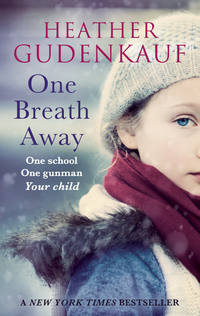
Читать книгу: «One Breath Away»

Praise for Heather Gudenkauf
‘Brilliantly constructed, this will have you gripped until the last page …’
Closer
‘Deeply moving and lyrical … it will haunt you all summer.’
Company
5 stars ‘Gripping and moving’
Heat
‘Her technique is faultless, sparse and simple and is a master-class in how to construct a thriller … A memorable read … A technical triumph.’
Sunday Express
‘It’s totally gripping …’
Marie Claire
‘Tension builds as family secrets tumble from the closet.’
Woman & Home
‘This has all the ingredients of a Jodi Picoult novel.’
Waterstones Books Quarterly
‘Set to become a book group staple’
The Guardian
‘A skilfully woven thriller that will keep you hooked to the end’
Choice magazine
‘Jodi Picoult has some serious competition in Heather Gudenkauf.’
Bookreporter
‘Deeply moving and exquisitely lyrical, this is a powerhouse of a debut novel.’
Tess Gerritsen, No. 1 Sunday Times bestselling author
‘Fans of Jodi Picoult will devour this great thriller.’
Red
‘The author slowly and expertly reveals the truth in a tale so chillingly real, it could have come from the latest headlines.’
Publisher’s Weekly
‘Heart-pounding suspense and a compelling family drama come together to create a story you won’t be able to put down.’
Diane Chamberlain, bestselling author of
The Midwife’s Confession
‘This haunting psychological thriller lives up to expectation. Jodi Picoult or perhaps Joanne Harris are the nearest comparisons.’
Peterborough Evening Telegraph
‘A great thriller, probably the kind of book a lot of people would choose to read on their sun loungers. It will appeal to fans of Jodi Picoult.’
Radio Times
‘An enchantingly lyrical novel mixed with shockingly menacing overtones’
Newbooks
‘Gripping and powerful, right to the end’
Northern Echo
‘Secrets are slowly revealed by Gudenkauf’s skilled writing.’
NY Metro
‘A real page-turner’
Woman’s Own
About the Author
HEATHER GUDENKAUF is the critically acclaimed author of the New York Times bestselling novels The Weight of Silence and These Things Hidden. Her debut novel, The Weight of Silence , was picked for The TV Bookclub. She lives in Iowa with her family.
Read more about Heather and her novels at www.HeatherGudenkauf.com
Also available from Heather Gudenkauf
THE WEIGHT OF SILENCE
THESE THINGS HIDDEN
One Breath Away
Heather
Gudenkauf

For Alex, Anna and Grace
~My three wishes
ACKNOWLEDGEMENTS
As always, enormous gratitude goes to my agent, Marianne Merola, for her wisdom, guidance, attention to detail and her friendship. Thanks also to Henry Thayer for his behind-the-scenes support.
A thousand thanks to my editor, Miranda Indrigo, whose insights and suggestions are always spot on. Thanks also to all the folks at HQ—especially Margaret O’Neil Marbury and Valerie Gray. I’m so proud to call HQ my home.
Thank you to John and Kathy Conway and Howard and Shirley Bohr for opening up their homes and farms to me as I researched the novel. I always enjoy our time together.
Much appreciation goes to Mark Dalsing, whose advice in regard to police procedure and his early readings of the manuscript were invaluable.
A heartfelt thank-you goes out to my parents, Milton and Patricia Schmida, my brothers and sisters and their families, for their generous support and enthusiasm.
Much love and thanks to Scott, Alex, Anna and Grace—I couldn’t do it without you.
Holly
I’m in that lovely space between consciousness and sleep. I feel no pain thanks to the morphine pump and I can almost believe that the muscles, tendons and skin of my left arm have knitted themselves back together, leaving my skin smooth and pale. My curly brown hair once again falls softly down my back, my favorite earrings dangle from my ears and I can lift both sides of my mouth in a wide smile without much pain at the thought of my children. Yes, drugs are a wonderful thing. But the problem is that while the carefully prescribed and doled-out narcotics by the nurses wonderfully dull the edges of this nightmare, I know that soon enough this woozy, pleasant feeling will fall away and all that I will be left with is pain and the knowledge that Augie and P.J. are thousands of miles away from me. Sent away to the place where I grew up, the town I swore I would never return to, the house I swore I would never again step into, to the man I never wanted them to meet.
The tinny melody of the ringtone that Augie, my thirteen-year-old daughter, programmed into my cell phone is pulling me from my sleep. I open one eye, the one that isn’t covered with a thick ointment and crusted shut, and call out for my mother, who must have stepped out of the room. I reach for the phone that is sitting on the tray table at the side of my bed and the nerve endings in my bandaged left arm scream in protest at the movement. I carefully shift my body to pick up the phone with my good hand and press the phone to my remaining ear.
“Hello.” The word comes out half-formed, breathless and scratchy, as if my lungs were still filled with smoke.
“Mom?” Augie’s voice is quavery, unsure. Not sounding like my daughter at all. Augie is confident, smart, a take-charge, no one is ever going to walk all over me kind of girl.
“Augie? What’s the matter?” I try to blink the fuzziness of the morphine away; my tongue is dry and sticks to the roof of my mouth. I want to take a sip of water from the glass sitting on my tray, but my one working hand holds the phone. The other lies useless at my side. “Are you okay? Where are you?”
There are a few seconds of quiet and then Augie continues. “I love you, Mom,” she says in a whisper that ends in quiet sobs.
I sit up straight in my bed, wide awake now. Pain shoots through my bandaged arm and up the side of my neck and face. “Augie, what’s the matter?”
“I’m at school.” She is crying in that way she has when she is doing her damnedest not to. I can picture her, head down, her long brown hair falling around her face, her eyes squeezed shut in determination to keep the tears from falling, her breath filling my ear with short, shallow puffs. “He has a gun. He has P.J. and he has a gun.”
“Who has P.J.?” Terror clutches at my chest. “Tell me, Augie, where are you? Who has a gun?”
“I’m in a closet. He put me in a closet.”
My mind is spinning. Who could be doing this? Who would do this to my children? “Hang up,” I tell her. “Hang up and call 9-1-1 right now, Augie. Then call me back. Can you do that?” I hear her sniffles. “Augie,” I say again, more sharply. “Can you do that?”
“Yeah,” she finally says. “I love you, Mom,” she says softly.
“I love you, too.” My eyes fill with tears and I can feel the moisture pool beneath the bandages that cover my injured eye.
I wait for Augie to disconnect when I hear three quick shots, followed by two more and Augie’s piercing screams.
I feel the bandages that cover the left side of my face peel away, my own screams loosening the adhesive holding them in place; I feel the fragile, newly grafted skin begin to unravel. I am scarcely aware of the nurses and my mother rushing to my side, tearing the phone from my grasp.
Augie
My pants are still damp from when Noah Plum pushed me off the shoveled sidewalk into a snowbank after we got off the bus and were on our way into school this morning. Noah Plum is the biggest asshole in eighth grade but for some reason I’m the only one who has figured this out and I’ve only lived here for eight weeks and everyone else has lived here for their entire lives. Except for maybe Milana Nevara, whose dad is from Mexico and is the town veterinarian. But she moved here when she was two so she may as well have been born here, anyway.
The classroom is freezing and my fingers are numb with the cold. Mr. Ellery says it’s because it is not supposed to be below zero at the end of March and the boiler has been put out to pasture. Mr. Ellery, my teacher and one of the only good things about this school, is sitting at his desk grading papers. Everyone, except Noah, of course, is writing in their notebooks. Each day after lunch we start class with journal time and we can write about anything we want to during the first ten minutes of class. Mr. Ellery said we could even write the same word over and over for the entire time and Noah asked, “What if it’s a bad word?”
“Knock yourself out,” Mr. Ellery said, and everyone laughed. Mr. Ellery always gives time for people to read what they’ve written out loud if they’d like to. I’ve never shared. No way I’m going to let these morons know what I’m thinking. I’ve read Harriet the Spy and I keep my notebook with me all the time. Never let it out of my sight.
In my old school in Arizona, there were over two hundred eighth graders in my grade and we had different teachers for each subject. In Broken Branch there are only twenty-two of us so we have Mr. Ellery for just about every subject. Mr. Ellery, besides being really cute, is the absolutely best teacher I’ve ever had. He’s funny, but never makes fun of anyone and isn’t sarcastic like some teachers think is so hilarious. He also doesn’t let people get away with making crap out of anyone. All he has to do is stare at the person and they shut up. Even Noah Plum.
Mr. Ellery always writes a journal prompt on the dry erase board in case we can’t think of what to write about. Today he has written “During spring break I am going to …”
Even Mr. Ellery’s stare doesn’t work today; everyone is whispering and smiling because they are excited about vacation. “All right, folks,” Mr. Ellery says. “Get down to work and if we have some time left over we’ll play Pictionary.”
“Yesss!” the kids around me hiss. Great. I open my notebook to the next clean page and begin writing.
“During spring break we’re going to fly back to Arizona to see our mother.” The only sounds in the classroom are the scratch of pencils on paper and Erika’s annoying sniffles; she always has a runny nose and gets up twenty times a day to get a tissue. “I don’t care if I ever see snow or cows ever again. I don’t care if I ever see my grandfather again.” I am hoping with all my might that instead of coming back to Broken Branch after spring break, my mother will be well enough for us to come home. My grandfather tells us this isn’t going to happen. My mother is far from being able to come home from the hospital. My mom will be in Arizona until she is out of the hospital and well enough to get on a plane and come here so Grandma and Grandpa, who I met for the first time ever a couple months ago, can take care of all of us. But it doesn’t matter what my grandpa says—after spring break, I am not coming back to Broken Branch.
A sharp crack, like a branch snapped in half during an ice storm, makes me look up from my notebook. Mr. Ellery hears it, too, and stands up from behind his desk and walks to the classroom door, steps into the hallway and comes back in shrugging his shoulders. “Looks like someone broke a window at the end of the hallway. I’m going to go check. You guys stay in your seats. I’ll be right back.”
Before he can even leave the classroom the shaky voice of Mrs. Lowell, the school secretary, comes on the intercom. “Teachers, this is a Code Red Lockdown. Go to your safe place.”
A snort comes from Noah. “Go to your safe place,” he says, mimicking Mrs. Lowell. No one else says a thing and we all stare at Mr. Ellery, waiting for him to tell us what to do next. I haven’t been here long enough to know what a Code Red Lockdown is. But it can’t be good.
Mrs. Oliver
The morning the man with the gun walked into Evelyn Oliver’s classroom, she was wearing two items she had vowed during her forty-three-year career as a teacher never to wear. Denim and rhinestones. Mrs. Oliver was a firm believer that a teacher should look like a teacher. Well-groomed, blouses with collars, skirts and pantsuits crisply ironed, dress shoes polished. None of that nonsense younger teachers wore these days. Miniskirts, tennis shoes, plunging necklines. Tattoos, for goodness’ sake. For instance, Mr. Ellery, the young eighth-grade teacher, had a tattoo on his right arm. A series of bold black slashes and swoops that Mrs. Oliver recognized as Asian in origin. “It means teacher in Chinese,” Mr. Ellery, wearing a sleeveless T-shirt, told her after, embarrassingly, he caught her staring at his deltoid muscle one stifling-hot August afternoon during in-service week when all the teachers were preparing their classrooms for the school year. Mrs. Oliver sniffed in disapproval, but really she couldn’t help but wonder how painful it must be to have someone precisely and methodically inject ink into one’s skin.
Casual Fridays were the worst, with teachers, even the older ones, wearing denim and sweatshirts emblazoned with the school name and logo—the Broken Branch Consolidated School Hornets.
But on this unusually bitter March day, the last day school was in session before spring break, Mrs. Oliver had on the denim jumper she now knew she was going to die while wearing. Shameful, she thought, after all these years of razor-sharp pleats and itchy support hose.
Last week, after all the other third graders had left for the day, Mrs. Oliver had tentatively opened the crumpled striped pink-and-yellow gift bag handed to her by Charlotte, a skinny, disheveled eight-year-old with shoulder-length, burnished-black hair that chronically housed a persistent family of lice.
“What’s this, Charlotte?” Mrs. Oliver asked in surprise. “My birthday isn’t until this summer.”
“I know,” Charlotte answered with a gap-toothed grin. “But my mom and me thought you’d get more use out of it if I gave it to you now.”
Mrs. Oliver expected to find an apple-scented candle or homemade cookies or a hand-painted birdhouse inside, but instead pulled out a denim stone-washed jumper with rhinestones painstakingly arranged in the shape of a rainbow twinkling up at her. Charlotte looked expectantly up at Mrs. Oliver through the veil of bangs that covered her normally mischievous gray eyes.
“I Bedazzled it myself. Mostly,” Charlotte explained. “My mom helped with the rainbow.” She placed a grubby finger on the colorful arch. “Roy V. Big. Red, orange, yellow, violet, blue, indigo, green. Just like you said.” Charlotte smiled brightly, showing her small, even baby teeth, still all intact.
Mrs. Oliver didn’t have the heart to tell Charlotte that the correct mnemonic for remembering the colors in the rainbow was Roy G. Biv, but took comfort in that fact that she at least knew all the colors of the rainbow if not the proper order. “It’s lovely, Charlotte,” Mrs. Oliver said, holding the dress in front of her. “I can tell you worked hard on it.”
“I did,” Charlotte said solemnly. “For two weeks. I was going to Bedazzle a birthday cake on the front but then my mom said you might wear it more if it wasn’t so holiday-ish. I almost ran out of beads. My little brother thought they were Skittles.”
“I will certainly get a lot of wear out of it. Thank you, Charlotte.” Mrs. Oliver reached over to pat Charlotte on the shoulder and Charlotte immediately leaned in and wrapped her arms around Mrs. Oliver’s thick middle, pressing her face into the buttons of her starched white blouse. Mrs. Oliver felt a tickle beneath her iron-gray hair and resisted the urge to scratch.
It was Mrs. Oliver’s husband, Cal, who had convinced her to wear the dress. “What can it hurt?” he asked just this morning when he caught her standing in front of her open closet, looking at the jumper garishly glaring right back at her.
“I don’t wear denim to school, and I’m certainly not going to start wearing it just before I retire,” she said, not looking him in the eye, remembering how Charlotte had rushed eagerly into the classroom at the beginning of the week to see if she was wearing the dress.
“She worked on it for two weeks,” Cal reminded her at the breakfast table.
“It’s not professional,” she snapped, thinking of how on each passing day this week, Charlotte’s shoulders wilted more and more as she entered the room to find her teacher wearing her typical wool-blend slacks, blouse and cardigan.
“Her fingers bled,” Cal said through a mouthful of oatmeal.
“It’s supposed to be ten below outside today. It’s too cold to wear a dress,” Mrs. Oliver told her husband, miserably picturing how Charlotte wouldn’t even look her way yesterday, defiantly pursing her lips and refusing to answer any questions directed at her.
“Wear long johns and a turtleneck underneath,” her husband said mildly, coming up behind her and kissing her on the neck in the way that even after forty-five years of marriage caused her to shiver deliciously.
Because he was right—Cal was always right—she had brushed him away in irritation and told him she was going to be late for school if she didn’t get dressed right then. Wearing the jumper, she left him sitting at the kitchen table finishing his oatmeal, drinking coffee and reading the newspaper. She hadn’t told him she loved him, she hadn’t kissed his wrinkled cheek in goodbye. “Don’t forget to plug in the Crock-Pot,” she called as she stepped outside into the soft gray morning. The sun hadn’t emerged yet, but it was the warmest it would be that day, the temperature tumbling with each passing hour. As she climbed into her car to make the twenty-five-minute drive from her home in Dalsing to the school in Broken Branch, she didn’t realize it could be the last time she made that journey.
It was worth it, she supposed, after seeing Charlotte’s face transform from jaded disappointment to pure joy when she saw that Mrs. Oliver was actually wearing the dress. Of course Cal was right. Wearing the impractical, gaudy thing wouldn’t hurt anything; she’d had to suffer the raised eyebrows in the teacher’s lounge, but that was nothing new. And it obviously had meant a lot to Charlotte, who was now cowering in her desk along with fifteen other third graders, gaping up at the man with the gun. At least, Mrs. Oliver thought, shocking herself with the inappropriateness of the idea, if he shot her in the chest, she couldn’t be buried in the damn thing.
Meg
I’m trying to figure out what I’m going to do with all my free time for the next four days as I drive idly around Broken Branch in my squad car. This will be the first year that I won’t have Maria with me for spring break. By the looks of things, spring doesn’t seem like it will be appearing any time soon, even though it officially arrived two days earlier.
By rights, Tim should be able to have Maria this vacation; she’s spent the past two with me. But I had it all planned out for tomorrow, my day off. We were going to bake Dutch letters, flaky almond-flavored cookies, the one family tradition I’ve kept from when I was young. Afterward we were going to pitch a tent and have an old-fashioned campout in the living room. Then we were going to take advantage of the freak snowstorm to go snowshoeing at the bottom of Ox-eye Bluff with hot chocolate and marshmallows and oyster chowder when we got home. I even persuaded Kevin Jarrow, the part-timer on our police force, to pick up my Saturday shift so I could spend it with Maria. But this time Tim insisted. He finally scored a full five days off from his job as an EMT in Waterloo, where we both grew up.
“Listen, Meg,” he said when he called me the day before yesterday. “I don’t ask for much, but I really want Maria this school break….”
“She’s not an item on your grocery list,” I said hotly. “I thought we had this all figured out.”
“You had it all figured out,” he said. Which was true. “I want to spend a few days with her and I don’t think there’s anything unreasonable about that.”
“Where did this suddenly come from?” I asked.
“Hey, I’ll take any minute I can get with Maria and you know it. Besides, you’ve had her the past two holidays.” He was getting angry now. I imagined him sitting in the duplex we once shared, rubbing his forehead the way he did when he was frustrated.
“I know,” I said softly. “I just had it all planned out.”
“You could always come spend some of the time with us,” he said cautiously. I sighed. I was too tired to have this conversation. “Meg, you know I never did the things you thought I did.” Here we go, I thought. Every few months Tim insists that he didn’t have the affair with his coworker, that she was an unstable liar who had wanted something more, but whom he had rebuffed. Some days I half believe him. This isn’t one of those days.
“You can pick her up on Wednesday after school,” I told him.
“I was hoping tomorrow, after I get done with work. Around noon.”
“She’ll miss her last day of school before vacation. That’s when they do all the fun things.” It sounded lame, I know, but it was all I had.
“Meg,” he said in that way he has. “Meg, please …”
“Fine,” I snapped.
So yesterday I said goodbye to my beautiful, funny, sweet, perfect seven-year-old daughter. “I’ll call you every day,” I promised her, feeling like I was saying goodbye forever. “Twice.”
“Bye, Mom,” she said, swiping a quick kiss across my cheek before climbing into Tim’s car.
“If it hasn’t all melted, we’ll go snowshoeing when you get back,” I called after her.
“So, we’ll be at my folks tomorrow night for dinner and at my sister’s on Sunday.” His face turned serious. “I ran into your mom last week.”
“Oh,” I said as if I didn’t care.
“Yeah, they’d really like to see Maria.”
“I bet they would,” I grumbled.
“Is it okay if I take her over to see them?”
I shrugged. “I guess.” My parents weren’t bad people, just not particularly good people. “Promise me you won’t leave her at the trailer, it’s a death trap. And make sure Travis isn’t hanging around when you visit.” My brother, Travis, is one of the main reasons I became a police officer. Growing up he made my parents’ lives miserable and mine pure hell. It seemed like every week a police officer was at the door of our trailer, Travis in tow. They gave him more than enough chances to get his shit together and he blew it time and time again. It wasn’t until the summer I was thirteen and Travis was sixteen, when he threatened my father with a kitchen knife, smacked my mother across the face and ripped out a chunk of my hair as I tried to pull him away from them, that the police finally got serious.
“What do you want to do?” Officer Stepanich, a frequent visitor to our home, asked wearily. His young female partner, Officer Demelo, stood by silently, taking in the broken glass, the knocked-over chairs, the bald spot on the top of my head. Welcome to our lovely home, I wanted to say, but instead my face burned with shame.
Fully expecting my parents to finally say enough is enough and have Travis’s ass arrested for assault, they once again refused to press charges.
“What do you want to do?” Officer Demelo asked, and I looked up in surprise when I realized she was talking to me and only me.
“Now, now,” Officer Stepanich said, “this is really a parent decision.”
“I don’t think that wad of hair on the floor got there by itself and I can’t imagine that Meg here pulled it out of her own head,” Officer Demelo said, her eyes never leaving mine. I was surprised she remembered my name and even more impressed that she ignored the obviously senior officer’s lead. “Let’s see what she wants to do,” Officer Demelo insisted.
Travis smirked. He was six inches taller and about eighty pounds heavier than I was, but in that moment, knowing that only an ignorant coward would beat on his family the way he did, I felt stronger, more powerful. He thought he was invincible. But in that sliver of a moment, I knew that there was a way out for our family.
“I want to press charges,” I said, speaking only to Officer Demelo, who didn’t look much older than I was, but carried herself with a confidence I wanted for myself.
“You sure that’s what you want to do?” Officer Stepanich asked.
“Yes,” I said firmly. “I do.” Officer Stepanich turned to my parents, who looked bewildered but nodded their agreement. They took Travis away in handcuffs. He came back home a few days later. I expected him to exact some kind of revenge upon me, but he kept his distance, didn’t lay a hand on me. It didn’t keep him out of trouble, though. Over the years he’s been in and out of jail, most recently for drug possession. That arrest twenty years ago didn’t change Travis, but in my mind it saved my life.
“Travis will get nowhere near Maria,” Tim promised. He looked as if he’d like to say more, then settled on, “Talk to you later, Meg.” He drove away with Maria waving happily goodbye.
My windshield wipers can barely keep up with the thick snow that is falling. Great, I think. I’ll be shoveling for hours after I end my ten-hour shift at three o’clock. I debate whether to still make the Dutch letters tomorrow and decide to ditch that idea; instead, I’ll sleep in, watch TV, pick up a pizza from Casey’s and feel sorry for myself.
I feel my phone vibrate in my coat pocket. I peek at the display thinking it might be Maria. Stuart. Shit. I stuff my phone back into my coat. Stuart, a newspaper reporter who wrote for the Des Moines Observer and lived about an hour and a half from Broken Branch, and I called it quits about a month ago when I found out he wasn’t actually separated from his wife like he told me. Nope, they were still living under the same roof and, at least from her perspective, happily married. Yeah, the irony isn’t lost on me. I divorced my ex for screwing around and I end up being the other woman in some poor lady’s nightmare. Stuart said all the usual crap: I love you, it’s a loveless marriage, I’m leaving her, blah, blah, blah. Then there was the little issue where Stuart used me to get the biggest story of his career. I told him if he didn’t shut up I was going to shoot him with my Glock. I was only half joking.
I flip open the phone. “I’m working, Stuart,” I snap.
“Wait, wait,” he says. “This is a business call.”
“All the better reason for me to hang up,” I say shortly.
“I hear you’ve got an intruder at the school,” Stuart says in his breezy, confident way. Asshole.
“Where’d you hear that?” I ask cautiously, trying not to give away the fact that this is news to me.
“It’s all over, Meg. Our phone at the paper has been ringing off the hook. Kids are posting it on their walls and tweeting all about it. What’s going on?”
“I can’t comment on any ongoing investigation,” I say firmly, my mind spinning. An intruder at the school? No. If there was something going on I would know about it.
“Maria. Is she okay?”
“That’s none of your business,” I say softly. I wasn’t the only one Stuart hurt.
“Wait,” he says before I can hang up. “Maybe I can help you.”
“How’s that?” I say suspiciously.
“I can track the media end of things, keep you informed of what we hear, give you a heads-up on anything that sounds important.”
“Stuart,” I say, shaking my head. “Honestly, nothing you have to say to me is important anymore.”
Will
That morning, as Will Thwaite watched his grandchildren climb onto the school bus, the horizon not yet shaded with the petal-pink edging that comes before the sunrise, he realized, as he often did in the dark-cornered mornings, that he missed his wife terribly. He was so used to having Marlys there right by his side working the farm. She was the one who shook him awake at five each morning, the one who pushed a thermos of hot coffee into his hands and sent him out the door with the promise of a hot breakfast upon his return from feeding the cattle. He felt her absence the way one might miss a limb. Fifty years they would be married, this coming fall. He tried to remember the last time she had been away from the farm overnight and settled upon eleven years ago when she went to visit their fourth son, Jeffery, his wife and their newborn daughter in Omaha. She had packed a bag for four days, climbed into the Cadillac, hollered out the window that there were meals in the freezer for him to put in the microwave and drove away in a cloud of deep brown Iowa dust.
He sipped at his coffee, wincing at its bitter taste, not at all like Marlys’s, understanding why Marlys had to stay away for so much longer this time. It had been two months already and still she couldn’t give him a date when she would be returning home. Their youngest child and only daughter needed so much care and was having so many setbacks from the accident that it could be well into April before he would next see his wife. For many years Will thought that he might never see Holly again, she was set so hard against him. He suspected that if he tried to pin Holly down to exactly why she hated him, she wouldn’t quite be able to say, though she managed to poison his grandchildren against him. At least the boy, P.J., a quiet child with brown eyes, thick round glasses and the soul of an old man, had warmed to him rather quickly. The girl, Augustine—Augie—was a different matter altogether. When Will walked into the hospital, the cool institutional air a welcome reprieve from the dry, incessant Arizona heat, he felt a quickening of his pulse as he turned the corner and entered the burn unit. Slouching in an uncomfortable-looking chair was his daughter. But of course it wasn’t Holly, it couldn’t be. Holly was in a hospital bed recovering from third-degree burns. Besides, the forlorn creature before him was much too young to be Holly. But she had Holly’s pale skin, brown hair and plump roundness. Not fat by any means, but solid, in a healthy farm girl way, and he smiled inwardly at the thought. This was his granddaughter, and for a brief moment Will thought that this was his chance, his opportunity, to reclaim his wayward daughter, who for the past fifteen-odd years had dismissed him for reasons he couldn’t quite determine.
His hopes were quickly squelched when Marlys, always emotive and loud in the most inappropriate places, squealed in delight at seeing her grandchildren for the first time.
“Augustine? P.J.?” she asked loudly, causing the other visitors’ heads to snap up. She held her arms out to the children, expecting, Will supposed, for Augie and P.J. to leap from their seats and bound into them. Instead, the two gaped up at their grandmother, who Will had to admit was quite the sight. The worry over Holly, the frantic packing, the scrambling to make sure the farm duties were covered, had exhausted Marlys even before they left Broken Branch. Then there was their flight, the first ever for Marlys, and not knowing the ins and outs left her feeling small and inept. After finally arriving in Revelation and seeing her grandchildren, Marlys could no longer hold back the emotion. She gathered the stunned children into her arms, pushed them back from her at arm’s length after a moment to get a good look, then pulled them back to her.
“We’re your grandparents,” she cried through her tears. “Oh, aren’t you beautiful?” she said to Augie, whose mouth lifted into a wisp of a smile. “You look just like your mother did at your age. And you.” Marlys turned to P.J., lifting his chin with one work-worn finger. “Aren’t you a handsome young thing?” Her tears dripped down her wrinkled cheeks and plopped onto P.J.’s upturned face. The boy didn’t squirm away or wipe the moisture away from his forehead, but looked in awe up at his grandmother and then cast an unsure glance at his grandfather, who shrugged as if to say, I don’t know what she’s doing, either. When Will turned his gaze to Augie, hoping to share in the levity of moment, he was met with an accusing, suspicious glare. Holly had already filled his granddaughter with the tales of her childhood. The backbreaking work, the isolation of the farm, the battles over curfew, the unfairness of it all. While Marlys preened over the children, who basked in the attention, Will stepped back and busied himself with finding a nurse who could give him some information about the condition of his daughter.
Now, two months later, he was no closer to breaking down the wall that separated him from his granddaughter. God knows he had tried. He understood how hard being away from her mother must be for Augie and he tried to give her space. He waited one full week before telling her that chores were an essential part of living on the farm, that she needed to contribute. It had been easy with P.J., who followed his grandfather with rapt attention. Augie, on the other hand, would retreat to her room, Holly’s old bedroom, each day after school and wouldn’t emerge until the next morning. She answered any questions in monosyllabic grunts and refused to eat with them. Claimed to be a vegetarian, scowled and scoffed at the fact that he was a cattleman, that he raised animals for food. He knew better than to argue with Augie, tried to be patient. Though at times he thought he would explode with frustration, he vowed to try and educate her gradually, if not a bit gruffly. But she certainly didn’t make it easy for him. She still glared at him with disdain and took every opportunity she could to argue and disagree with what he said. It was like raising Holly all over again. But the thing was, over the years, after his relationship with his daughter had disintegrated into far-flung memories of when she was little and thought he hung the moon, he swore if he had the chance to do it over again, he would do things differently. Now the opportunity had presented itself in Augie, a clone of his daughter, and damned if he still couldn’t get it right.
Holly
Once again I woke up to another morning in the hospital. I’m beginning to think that I’ll never be able to leave this place. I want to rip the IV from my arm and run away screaming. My entire life I’ve been trying to get free, first from my folks and from Broken Branch and all its small-town hokeyness. Then it was from my marriage to David and the way being tied to one person, or maybe it was just him, suffocated me. So first I severed ties with my Iowa family, leaving them behind without a hug or a kiss, just an I’ve gotta get out of here or I’m going to die, and not once did I ever look back. Ran away to Colorado with a boy who I grew up with. We got sick of each other after only a year, so off I went to Arizona where I ended up going to cosmetology school. There I met David; we got married and had Augie. That fiasco lasted an entire seven years. He tried to get me to stay, said he wanted another baby, wanted to grow old together. I told him I couldn’t live this way anymore, that I would die if I had to wake up one more morning looking at the same god-awful flocked wallpaper or listen to our next-door neighbor go on and on about how the neighborhood was going to hell.
“We’ll take off the wallpaper,” David had said. “We can move,” he promised. So we took down the wallpaper and I got pregnant. But he knew. He understood that it wasn’t the wallpaper or the neighbors. It was us. Really me, who couldn’t stand being there, being married, being trapped in the suburbs, which isn’t all that different from small-town Iowa. David looked so hurt, so wounded, when he watched P.J. People tended to regard me that way after they’ve been around me for any length of time. First my mother and father. Especially my father. How I took private glee in the look on his face when I told him that living on a farm was like hell on earth, that spending one more minute in Broken Branch was a minute wasted, thrown away, never to be retrieved. My older brothers called me selfish and ungrateful. My mother cried. I felt bad about that. But it didn’t make me want to stay. My father actually helped carry my suitcase out to the old Plymouth Arrow I had saved up for by detasseling corn every summer since I was thirteen.
“You are seventeen years old, Holly,” my father said. “And I know you think you’ve got all the answers, but what you are doing to your mother is inexcusable.”
“I can’t spend another day here,” I told him, not able to look him in the eyes, instead staring over his shoulder out at the acres and acres of ankle-high seed corn. “I can’t explain it.”
My father was quiet for a minute. His green John Deere hat perched on his head, pulled low so that his eyes were shaded. But I already knew they were looking at me with disapproval. He leaned against the back hatch of the Plymouth, his tan arms folded across his chest. “You’re ashamed of being the daughter of a farmer? You think you’re too good enough for this life? Is that it?”
I shook my head, mortified. “No! That’s not it.”
“Well, from where I’m standing, it sure appears that way. I understand you wanting to travel, see the world, but there’s no need to leave this way, like you’ve waited your whole life to get away from your mother and me.”
But I have, I wanted to say to him, but didn’t. “I just can’t seem to stand myself in my own skin while I’m here,” I tried to explain, knowing that I was failing miserably.
“You think that’s going to change when you drive away from here? You think your skin is going to fit you any better?”
“Yes, in fact, I do,” I said, shaken that he had pegged it exactly. I was terrified that wherever it was I ended up I would feel the exact same way. That I needed to leave.
“You’ll be back,” my father said with a sureness that made my chest hum with anger. “You’ll come back, and when you do, you owe your mother an apology.”
“I won’t be back,” I spat back. “I’m never coming back here, ever.”
My father shook his head and laughed a little. A light chuckle. “Oh, you’ll be back.” He reached out to give me a hug but I stepped past him. “Well, I guess you’ve been through about every boy and man in the county, not much left to stay for.” I just climbed into my car without even saying goodbye. As I pulled away from the farm, I looked in my rearview mirror and there was my father, already turned away from me, surrounded by the dust and gravel kicked up into the air from my tires, heading toward his cattle that never seemed to disappoint and certainly never talked back to him.
I was true to my word. I had never returned, not once, to Broken Branch in the eighteen years since I left. But I wonder if I did the next worse thing by sending my children there.
Mrs. Oliver
Mrs. Oliver hardly dared to look away from the stranger standing in front of her, but the cries of her students pulled her gaze away from the man who looked vaguely familiar.
Sixteen of the seventeen children were helplessly staring up at Mrs. Oliver, some with tears in their eyes, waiting for direction as to what to do. The monthly tornado and fire drills had done nothing to prepare them for this. Not even the Code Red Lockdown drills could have readied them for the surprisingly calm, albeit slightly manic-looking man dangling a gun from his fingers. Only one child, P. J. Thwaite, the son of one of her former students, Holly Thwaite, was peering raptly at the man, scanning his face, not as if he knew him, but as if maybe, at one time, he had seen him somewhere before. The man stared back at P.J., his expression flat and unemotional, which unnerved Mrs. Oliver even more.
As a classroom teacher Mrs. Oliver couldn’t begin to count the number of times she had needed to appear unruffled and completely in control. There was the time, her first year teaching no less, when seven-year-old Bert Gorse, on a dare, decided to climb to the top of the tall steel slide and try to jump and grab onto the branch of a nearby maple tree. Mrs. Oliver remembered watching in horror from her position across the playground as Bert leaped into the air, his eyes screwed shut, his hands reaching for the branch, fingers clawing at the rough bark. “For God’s sake!” she yelled before she could stop herself. “Open your eyes!” Unable to grab the limb, Bert fell twelve feet to the hardscrabble earth below. Calmly, she told the little girl standing next to her to run as fast as she could to get help.
“You swore,” the girl breathed in disbelief.
Mrs. Oliver bent down and put her face so close to the little girl’s she could smell the peanut butter sandwich the child had eaten for lunch and said in the low, even tone that children for the next forty years would know to take seriously, “Run.” Trying not to wobble in her new high heels, Mrs. Oliver made her way as quickly as possible over to Bert, who was sprawled out on his belly, unmoving. The knot of terrified boys who surrounded Bert began unraveling at her approach. “Go stand next to the building,” she ordered, and the boys obeyed at once. Mrs. Oliver knelt down, the knees of her brand-new polyester pantsuit grinding into the dirt. Bert’s eyes were open but glazed over with pain or shock. “Not dead!” Mrs. Oliver said joyfully, and behind her the children erupted with a soft whoosh of relief. “Are you okay, Bert?” she questioned, but Bert’s mouth could only open and close soundlessly like a fish on dry land. “Got the wind knocked out of you?” she said in her smooth, low manner that the children found reassuring. Mrs. Oliver maneuvered herself onto her stomach and lay next to Bert so she could better see his pale, pinched face and where he could see her round, placid one. “It’s going to be just fine, Bert. Just lie still now until help comes,” she said soothingly.
Bert was okay, although he ended up with two broken arms and a collapsed lung. Once Bert regained the use of his hands, he wrote his teacher a lovely letter in his messy cursive, thanking her for waiting with him until the ambulance arrived. Mrs. Oliver still had that letter, now framed and hanging in the room that her grown daughter, Georgiana, called the Shrine to Mrs. Oliver. Bert Gorse was now a fifty-year-old banker who lived in Des Moines with his wife and three children. Through the years, Mrs. Oliver remained steadfast in her belief that a teacher needed to be calm and in control under any circumstance. Certainly unlike Gretchen Small, the young fifth-grade teacher, who began to hyperventilate when the fire alarm accidentally went off.
Mrs. Oliver straightened her spine, cleared her throat and willed her voice to emerge strong and clear. “What do you want?” she demanded, stepping between P.J. and the man with the gun.
Meg
I’m debating whether to give Stuart’s claim that there is a gunman in the school any credence and call dispatch when the squawk of my radio stops me short.
It’s Randall Diehl, our dispatcher. “You need to go over to the school right now. We’ve got a lockdown.”
Maria’s school. Damn. Stuart was right.
“What’s up?” I ask. Since I’ve lived here there have only been two lockdowns at the school, a kindergarten through twelfth-grade building. One of the last of its kind. At the end of this school year Broken Branch’s only school would be closed down; too expensive and outdated to maintain, the superintendent and school board voted to consolidate with three other nearby towns. In the future, Maria’s school district would be known as Dalsing-Conway-Bohr-Broken Branch Consolidated Schools.
The first lockdown I was involved with was two years ago when two inmates from the Anamosa State Penitentiary escaped and were thought to be in our area. They weren’t. The second time was when two misguided high schoolers called in a fake bomb threat. They hadn’t studied for their finals and thought this would cleverly get them out of the tests. It most certainly did that. And got them kicked out of school.
“We got a possible intruder in the school. Just head on over there,” Randall says impatiently, which was not like him at all. “The chief will meet you and he’ll fill you in. Communication is a mess. The 9-1-1 lines are jammed with calls from students, teachers, frantic parents.”
“Will do,” I tell him, and flip on my windshield wipers to clear away the snow. Interesting, Chief McKinney already at the scene. I check the clock. Just after noon. Probably just a misunderstanding, a prank by some kids to kick off spring vacation. Maria will be sad she missed all the excitement.
I turn the squad car around and head up Hickory Street toward the school and am grateful to have something to occupy my time besides the thought of spending four whole days without Maria, which makes me feel empty, as if my insides have been hollowed out. Tim always said he couldn’t ever imagine me as a kid. The few pictures that I had of myself as a child showed me as a serious, unsmiling creature with unkempt hair, wearing a pair of my brother Travis’s old jeans.
“Did you ever have any fun?” Tim teased when he first saw the photos.
“I had fun,” I protested, though that was pretty much a lie. My childhood consisted of taking care of my parents, who, for reasons still unknown, were completely defeated by life, and trying to stay out of the way of my volatile brother. When Tim and I had Maria I was determined to make her childhood as carefree and joy-filled as mine wasn’t. I think we did a pretty good job of this, at least until the divorce, and even then Tim and I did our best to protect Maria. We didn’t argue in front of her, we didn’t bad-mouth each other, but she knew. How could she not? Even if we didn’t make a big spectacle out of the end of our marriage, she had to have seen my red, swollen eyes, Tim’s tight, forced laughter.
In minutes I pull up to the school and find Chief McKinney already there along with Aaron Gritz—curious, because he isn’t on duty today—trying to keep a small, angry-looking group away from the school’s entrance. Chief McKinney’s deep baritone fills the air. “Go on back to your cars or you are all going to freeze standing out here. We need to find out exactly what’s going on and we can’t do that if we have to concern ourselves with—”
A woman steps forward, waving her cell phone, and in a trembling voice interrupts the chief. “My son just called me from inside and he said there was a man with a gun. Can’t you get them out of there?”
“Based on the information we have,” Chief McKinney says patiently, “we’ve determined that the best response is to contain the area and not send officers into the school at this time.”
“But my seventh grader called and said there were two men,” another woman speaks up.
A man in a dress shirt and tie, no coat, rushes forward. “I heard there’s a bomb threat. Are you evacuating?”
“This is exactly what the problem is,” Chief McKinney says to me in a low voice, pointing first at the school and then the crowd, snowflakes collecting on his bristly gray mustache. “We can’t begin to know what’s going on in there if we’re chasing rumors out here.” He turns his back to the crowd and drops his voice to a whisper. “Meg, dispatch got a call from a man who says he’s inside the building with a gun. Said for everyone to stay out or he’ll start shooting. I want tape and barriers set up around the entire perimeter of the school.” He turns to Gritz. “Aaron, escort everyone about three hundred feet back.
“Okay, folks,” the chief says in a firm but nonconfrontational voice. “Please follow Officer Gritz’s directions now. We need to get to work here. I promise if we have any news to share, we will let you know immediately.”
I know what each of these parents is thinking of. The mass shooting at Columbine. It crossed my mind, too. Columbine changed everything in the way law enforcement responds to these situations. If we had evidence that the perpetrator in the school had started shooting, the chief would have immediately sent in a rapid deployment team to the source of the threat. Thankfully that hasn’t happened in this case. Yet. Because the suspect called dispatch and threatened the students and anyone who entered the building, we were approaching this as a hostage situation, meaning we were going to try to contact the intruder, find out what he wants and attempt to calmly talk our way out of this. The second there is evidence that shooting has started, we’d be in there. But for now, we needed more information.
“Won’t forcing the parents away from here cause a panic?” I ask Aaron in a quiet voice so the crowd won’t hear.
“I think they are already in a panic,” Aaron responds. He is wearing his rabbit-trimmed aviator hat with earflaps and his nose is red from the cold.
Just after my divorce was finalized, I got the police officer position with the Broken Branch Police Department. Aaron was on the interview team. Aaron is fortyish, divorced with two children and very handsome. At the interview Aaron asked me why I wanted to move to such a small community as Broken Branch when I was used to the larger, more urban city of Waterloo. “The fact that Broken Branch is a small, rural community is exactly why I want to settle down here. It’s a perfect place to raise a daughter.” What I refrained from telling the interview team was that I needed distance from Tim and our divorce. Waterloo wasn’t such a big city. Every time I turned a corner I ran into someone who knew my ex-husband, my parents, had been scammed by my brother. Besides, the hours that I worked for the Waterloo Police Force were terrible for a single mother. Broken Branch was only about an hour from Waterloo, close enough for Tim to easily see Maria.
I fell in love with Broken Branch years earlier when Tim and I drove through on our way to Des Moines. We stopped to buy honey from an old man selling jars of the amber liquid out of the back of his pickup truck.
“How did Broken Branch get its name? It’s so unusual?” I asked.
“Now, that is a great story,” the man said as he placed a large glass jar of clover honey, slim honey sticks and homemade beeswax candles carefully into a plastic bag and handed it to Tim. “Most people say it’s because the poor people who first settled here discovered a huge fallen tree over fifty feet long filled with an enormous beehive in it. Thousands and thousands of bees were buzzing inside and around the tree. Wanting the honey inside, they called on the help of an old woman who was known to have a way with bees. The story goes that she walked down to that hollowed-out tree and began singing a strange foreign song and all the bees became silent and followed her as she walked and sang. There were bees in her hair and on her arms, but still she walked and sang. Not one bee stung her. She led the bees to another felled tree down by the creek and the bees created a new home there. The settlers, who were poor and starving, gathered all that honey out of the broken branch and lived off of it for the winter. They were so thankful to the old woman that they offered to name the town after her, but she said that the thanks should lie with the bees and the tree that housed them. So they respected her wishes and named the town Broken Branch.”
I was completely enchanted by the story, and as Tim and I explored the peaceful streets lined with modest homes and towering trees, I knew I would return to Broken Branch. Little did I know that it would be to stay.
Fortunately, I impressed Chief McKinney, Aaron and the rest of the interview team enough for them to offer me the job.
A few months later, I found myself sitting alone with Aaron at a local bar after Broken Branch’s citywide softball tournament where I played first base. I had too much sun, not enough food and two lousy beers, and in the singular most embarrassing moment of my life, I made a halfhearted pass at Aaron. He gently pulled me off of him and told me that he wasn’t interested.
“I’m boring, too serious, aren’t I?” I asked. He looked at me for a very long time.
“No, Meg, you’re not boring, you’re great. It just wouldn’t be a good idea,” he said, and left me standing there. Though a few years have passed since that mortifying encounter, and Aaron has not brought it up once, I still blush bright red whenever I think of that night.
As I return to my car to retrieve a roll of crime tape, once again I feel my phone vibrate. Stuart. He just doesn’t give up. A text this time. I decide to ignore it and begin unraveling the police tape.
I met Stuart last January when Maria and I were cross-country skiing in Ox-eye Bluff. Maria, a novice at skiing, fell down one too many times. The final straw was that after the umpteenth tumble Maria’s skis became tangled in a thorny bramble of twigs at the side of the trail. By the time I freed her, Maria had worked herself into such a snit she refused to put her skis back on or to even walk out of the valley. We sat there for twenty minutes, Maria’s tears freezing against her cheeks, until a skier came gliding down the trail. He swooshed to a stop in front of us “Everything okay?” he asked.
“We’re fine,” I answered. “Just an equipment malfunction. We’re resting up for a few minutes.”
“Your mom can’t keep up with you, can she?” the man said to Maria, eliciting her first smile of the afternoon. “That’s what happens when you get old.” He smiled conspiratorially at her. “People can’t maintain the vigorous pace of us youngsters.”
“Exactly how old do you think I am?” I asked him through narrowed eyes.
“It’s rude to comment on a lady’s age.” He sniffed and then gave me a mischievous smile. “Why don’t you help me get her up,” he said to Maria. “If we leave her here much longer the wolves will start circling.”
I was about to tell him I was obviously fifteen years his junior and could drop a wild animal at two hundred yards with my eyes closed, but to my surprise Maria quickly scrambled to her feet and held out a hand to help me up. “Let’s go, Mom,” she said. “I think I hear howling.”
“There are no wolves in Ox-eye Bluff,” I said, reaching out my hands for the man and Maria to pull me to my feet. “I don’t think there are any wolves in Iowa for that matter. Coyotes, yes. Wolves, no.” The man was tall, at least six foot, fit with a lean face and closely cut brown hair flecked with gray.
He caught me looking and had the decency to blush. “It’s premature.”
“Yeah, right,” I said, raising my eyebrows. Together, the three of us skied to the end of the trail and then hiked our way out of the valley to where my car was parked. We didn’t talk much but I did learn that the man’s name was Stuart Moore and that he was a writer for the Des Moines Observer, the largest newspaper in the state. He also worked into the conversation how he had three grown children and was separated, the divorce held up by his wife.
“You don’t look old enough to have three adult children,” I said in mock disbelief.
“Well, child marriage, you know,” he answered as he clipped my skis onto the top of my car.
“You must have been what? Like twelve?” I played along.
“Something like that.” He laughed.
“What brings you here?” I asked. “Des Moines is an hour and a half from here.”
“I actually live just north of Des Moines, so it’s not quite that far. I’ve skied all over Iowa, Minnesota and Wisconsin. Ox-eye has some of the best trails and no one else seems to know about it. I almost always have the trails to myself,” he explained.
“Until now,” Maria piped up.
“Until now,” Stuart agreed.
Stuart and I took it slow. At first, anyway. I was still bruised from my divorce and Aaron’s mortifying rebuff and I had Maria to think about. That winter we would run into each other at Ox-eye and end up cross-country skiing, or snowshoeing. In the spring and summer we would, by some unspoken agreement, meet up at Ox-eye to hike the trails. Sometimes with Maria, sometimes not.
The first time Stuart and I slept together was only about two months ago. Maria was spending the weekend at Tim’s house. There wasn’t enough snow for skiing anymore so I invited him back to my house for the first time. Being with Stuart, the way he touched me, the way he tucked a strand of my hair behind my ear, made me feel safe and needed. He confided to me how his soon-to-be ex-wife had an affair with one of his colleagues, how it tore him apart, tore his family apart. How the divorce was finally going through. I told him about my work as a police officer in a small town, about Tim and the slow burn of my marriage. We drank too much wine and for three hours I didn’t think of DUIs or meth labs or disputes over fence lines. I didn’t think of Tim or even of Maria. I led Stuart into my bedroom and shut out the rest of the world. For a while I thought that maybe, just possibly, Stuart and I would end up together. How wrong I was. Within a matter of days I learned two crucial things about Stuart: he was married and would do anything to get a story. I don’t think Stuart had this grand plan of using me to get his big scoop. But the opportunity presented itself and Stuart took it.
I finish unwinding the yellow tape, bright and almost cheerful against the whiteness of the snow, if not for the bold black words declaring Police Line Do Not Cross.
Бесплатный фрагмент закончился.