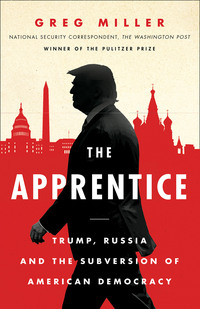
Читать книгу: «The Apprentice»
THE
APPRENTICE

TRUMP, RUSSIA AND THE SUBVERSION OF AMERICAN DEMOCRACY
Greg Miller

Copyright
William Collins
An imprint of HarperCollinsPublishers
1 London Bridge Street
London SE1 9GF
WilliamCollinsBooks.com
First published in Great Britain in 2018 by William Collins
This William Collins eBook edition published in 2020
First published in the United States by Custom House, an imprint of HarperCollinsPublishers, in 2018
Copyright © 2018 by W P Company LLC
Cover design by Ploy Siirpant
Cover photographs © AFP/Getty Images (Trump); © Phoelixde/Shutterstock (Russian skyline); © Samiran Sarkar/Shutterstock (D.C. skyline); © Maxy M/Shutterstock (texture); © Anadolu Agency/Getty Images (back cover)
Greg Miller asserts the moral right to be identified as the author of this work in accordance with the Copyright, Designs and Patents Act 1988
A catalogue record for this book is available from the British Library.
All rights reserved under International and Pan-American Copyright Conventions. By payment of the required fees, you have been granted the non-exclusive, non-transferable right to access and read the text of this e-book on-screen. No part of this text may be reproduced, transmitted, down-loaded, decompiled, reverse engineered, or stored in or introduced into any information storage and retrieval system, in any form or by any means, whether electronic or mechanical, now known or hereinafter invented, without the express written permission of HarperCollins.
Source ISBN: 9780008325787
eBook Edition © 2020 ISBN: 9780008325763
Version: 2020-01-20
Praise for the Apprentice
‘The most comprehensive account of the Trump-Russia story to date … Miller trots expertly through this troubling tale’
Sunday Times
‘[A] lucid and startling account … the clearest account yet of what Russia actually did’
The Times
‘How Clinton became Putin’s enemy after she attacked the legitimacy of Russian elections has been well told … But no one has done a better job than Miller of describing the vastness of Russian efforts to destroy her’
Guardian
‘Damn good … Miller’s book paints on a broad canvas, showing readers the full arc of an incredibly complicated political tale … Miller’s account of the Russian hacking of the Democrats is highly persuasive’
Washington Post
‘May read like a greatest hits of America’s horror show at the hands of a leader unfit to confront the threat of Russian interference’
Kirkus
‘Penetrating … Well-paced but rich in detail, Miller’s narrative is one of the best of the many new books on this evolving saga. His treatment of Trump’s possible obstruction of justice in trying to influence investigations by former FBI director James Comey and other intelligence officials is especially good’
Publishers Weekly, Starred Review
‘An integrated synthesis – a solid account that goes back many years to get elements of a full picture’
New York Journal of Books
‘We cannot understand what happened in the 2016 election, Russia-gate or the imploding Trump presidency by reading the 24-hour digital news on our phones … Fortunately, we still have a simple technology invented nearly six centuries ago: books. Greg Miller has written a damn good one’
KAI BIRD, winner of the Pulitzer Prize
Dedication
To Rebecca, Katie, Peter, and Cole
For Mom and Dad
Contents
Cover
Title Page
Copyright
Praise for the Apprentice
Dedication
Prologue
Part One
1. The Hack
2. Putin’s Trolls
3. Moths to the Flame
Part Two
4. “I Believe You Have Some Information for Us”
5. The Missing Emails
6. Crossfire Hurricane
7. Deep Inside the Kremlin
Part Three
8. Dezinformatsiya
9. The Russian Ambassador
10. Briefing the President
Part Four
11. You’re Fired
12. The Special Counsel Strikes
Part Five
13. “I Can’t Put on the Charm”
14. Helsinki
Epilogue
Picture Section
Notes
Index
Acknowledgments
About the Author
Also by Greg Miller
About the Publisher
PROLOGUE
THE WARREN OF CUBICLES WAS SECURED BEHIND A METAL door. The name on the hallway placard had changed often over the years, most recently designating the space as part of the Mission Center for Europe and Eurasia. But internally, the office was known by its unofficial title: “Russia House.”
The unit had for decades been the center of gravity at the CIA, an agency within the agency, locked in battle with the KGB for the duration of the Cold War. The department’s prestige had waned after the September 11 attacks, and it was forced at one point to surrender space to counterterrorism operatives. But Russia House later reclaimed that real estate and began rebuilding, vaulting back to relevance as Moscow reasserted itself. Here, among a maze of desks, dozens of reports officers fielded encrypted cables from abroad, and “targeters” meticulously scoured data on Russian officials, agencies, businesses, and communications networks the CIA might exploit for intelligence.
Deeper inside was a conference room adorned with Stalin-era posters of heroically depicted Soviets, muscled soldiers and workers striding across fields or factories under the hammer and sickle. The room, swept routinely for listening devices, was the scene of increasingly tense meetings in the months leading up to the 2016 presidential election, as senior agency officials sought to make sense of a series of disconcerting reports. In late July, the agency had gained access to an extraordinary stream of information showing that Russian president Vladimir Putin was himself directing the “active measures” operation aimed at disrupting the U.S. presidential race. U.S. intelligence partners were also warning Russia House about worrisome contacts between Russian figures and campaign associates of the Republican nominee.
Donald Trump’s vigorous displays of admiration for the Russian leader only made things more bewildering. He routinely praised Putin and even seemed to enlist Moscow in an effort to hack his opponent’s email account. The question was, why? Taking a hard line against Russia was the politically winning move, and yet Trump seemed subservient.
Unlike any presidential candidate in memory, Trump had shielded his finances from public scrutiny. He refused to release his personal tax returns. His business empire was a labyrinth of separate companies registered under different names. Many of those he had done business with hid their identities behind corporate shells. Some of his most prominent developments were deep in debt, though how deep and to whom was nearly impossible to discern.
During the campaign, there was consolation in the idea that Trump’s unsettling behavior toward Moscow was a product of inexperience—a problem that would be contained when he was surrounded by smarter advisers or wouldn’t matter anymore once he lost. But those inside U.S. spy agencies were privy to alarming secrets that were not so easily shrugged off. Among them was that the Kremlin was actively seeking to help elect Trump.
Russia House was the point of origin for that assessment, which would later be embraced by the U.S. intelligence community and infuriate the 45th president. The Kremlin’s objectives began with sowing discord in American democracy, but broadened in mid-2016 to backing a specific candidate—who at this moment, his second day as leader of the free world, was making his way toward CIA headquarters.
President Trump had barely been in office twenty-four hours when his motorcade departed the White House grounds for the nine-mile trip to the CIA’s Northern Virginia campus. The clouds and cold that had dampened Inauguration Day lingered over a city littered with the debris of America’s post-election divide—pro-Trump memorabilia, inauguration programs and celebratory banners along the parade route; broken windows and burned vehicles on blocks where protesters had clashed with police in riot gear. Trump’s arrival in the White House had been followed by a women’s march that drew a crowd three times larger than the inaugural audience,[1] and now throngs of pink-clad activists watched the caravan accelerate through the D.C. streets. Their gestures toward the motorcade, countered by some salutes from Trump supporters wandering Washington, reflected in the thick tinted glass of the president’s passing car.
The street-side crowds dissipated as the line of vehicles left downtown, crossed into Virginia, and followed the Potomac River north, turning onto the main route through the suburb of McLean and then past the zigzagging barricades that guard the entrance to the CIA. The agency occupies a sprawling, leafy campus in Northern Virginia enclosed by miles of electrified fence. At the center of the property is a seven-story building with a row of glass doors opening onto an iconic marble lobby—with the CIA seal inlaid in the terrazzo floor—frequently depicted in movies.
The CIA welcome for Trump would be cordial, even warm, but it was by now well known that the agency was responsible for a series of highly classified reports that had helped trigger an FBI investigation of Russia’s interference and ties to associates of the president. And Trump had made no secret of his growing belief that the CIA and FBI were engaged in a coordinated effort to damage his presidency before it had even begun. His blistering attacks on intelligence agencies had only intensified as he prepared to take office. He disparaged their conclusions about Russia’s involvement in the election and accused them of deliberately sabotaging him by leaking a document that had come to be known as the “dossier.” That collection of memos, compiled by a former British intelligence officer, contained dozens of unproven but explosive allegations about then-candidate Trump’s ties with Russia. Among the most salacious was that he had consorted with prostitutes during a 2013 trip to Moscow for the Miss Universe pageant, paying women to defile a hotel room where President Barack Obama had once stayed.
The dossier’s contents had been in circulation in Washington newsrooms for months, disseminated not by spy agencies but the private opposition research firm that had commissioned the reports. Their unsubstantiated assertions had gone mostly unreported in the press until U.S. intelligence officials told Trump about the dossier two weeks before he was sworn in. When its contents were published on BuzzFeed, Trump lashed out on Twitter. “Intelligence agencies should never have allowed this fake news to ‘leak’ into the public,” he said. “One last shot at me. Are we living in Nazi Germany?”
The sting of that slur was acute. The CIA’s lineage traced to World War II and the creation of a spy service whose mission was to help Allied forces defeat the same Nazis that Trump now invoked. The agency’s precursor, the Office of Strategic Services, was disbanded after the war, but a statue of its founding director, General William “Wild Bill” Donovan, still stands in the agency lobby. Trump likely knew little of that history—or for that matter of the record of CIA abuses and corresponding reforms that had transpired during the intervening decades—and would never retract the insult. Many presidents had clashed with the CIA, but the relationship had never taken such an ugly turn before a commander in chief had even taken office.
No one knew what Trump would say when he addressed the crowd that awaited him, but one thing was certain: he would not be brought into Russia House.
THE TRIP TO LANGLEY HAD BEEN PLACED ON THE PRESIDENT’S CALENDAR weeks earlier by Reince Priebus, the White House chief of staff. Priebus, a political operative grounded in the Republican Party establishment, had mapped out the new president’s first days down to the hour, a detailed schedule that was to set a breathtaking pace and serve as an example of the urgency and ambition of the new administration. The CIA was the first government agency on Trump’s itinerary, a decision designed in part to assure the GOP establishment that Trump would settle into office and be “presidential,” which for Republicans entailed being a staunch defender of the country’s national security institutions. More important, the Trump team hoped that the visit could avert an unnecessary rift with an agency whose unique aura and authority had proven seductive to previous presidents but was also capable of fierce bureaucratic combat—even against occupants of the Oval Office.
Trump stepped out of his armored car at 2:06 P.M. in an underground parking garage and was greeted by a CIA leadership team in flux. Now-former director John Brennan and his deputy had resigned once Trump took office, so Meroe Park, who had served for more than three years in the number three role, was officially in charge of the agency and its 20,000 employees. Park (the first woman to hold the reins as director, albeit in an acting capacity) held the job for just three days—long enough for Trump’s pick as CIA chief, Republican congressman Mike Pompeo, to be confirmed.
Park escorted the president into the Original Headquarters building, an H-shaped structure that opened when John F. Kennedy was president. Trump was then taken by golf cart—an accommodation he required even for short distances—to a futuristic command post that operatives of Kennedy’s era could hardly have imagined.
The CIA’s Predator operations floor is a dazzling theater of high-tech warfare. Concentric rows of computer terminals face a wall of high-definition video screens. The ambient lighting is darkened to allow analysts to focus on footage transmitted halfway around the world from aircraft (the early Predators now largely replaced with larger, more powerful Reapers) equipped with cameras and missiles but no cockpits. The number of CIA drone strikes had plunged since the early years of the Obama administration, the peak of the covert war against Al-Qaeda, but the use of unmanned aircraft was still significant. The viewing can be monotonous—countless hours of surveillance over dusty patches of remote terrain in places including Pakistan, Yemen, and Syria. But moments of engagement are dramatic.
The sight of missiles streaming toward a target is particularly adrenaline-inducing to the newly initiated, and the agency often brings those it most wants to impress to the Predator display, with highlights of successful strikes cued up. Trump appeared suitably enthused, though puzzled by what he regarded as undue restraint. When told that the CIA flew surveillance flights over Syria, but that only the military conducted strikes—an Obama policy meant to return the agency’s focus to its core espionage mission—Trump made clear he disagreed. When the agency’s head of drone operations explained how the CIA had developed special munitions to limit civilian casualties, the president seemed nonplussed. Shown a strike on a Taliban compound, Trump noticed that the militants had scattered seconds before the explosion. “Can they hear the bombs coming?” Trump said. “We should make the bombs silent so they can’t get away.”
Agency officials had been given just three days’ notice that Trump had planned to visit CIA and would deliver remarks; they had scrambled to make preparations that typically take weeks. An email to the workforce had offered tickets to the first four hundred employees to respond, a move that helped to ensure the new president would encounter a friendly crowd since the event was being held on a weekend. The agency readied a teleprompter, hoping the president would work from a prepared text. But the White House sent word at the last minute to scrap the screens—Trump would speak off the cuff.
THERE ARE NUMEROUS LOCATIONS AT CIA HEADQUARTERS SUITABLE for a speech, among them a cavernous hallway lined with past directors’ portraits and a semi-spherical auditorium known as the Bubble. But the risers for Trump’s visit were placed before the agency’s most hallowed backdrop: a marble wall on the north side of the main lobby marked by six rows of hand-carved stars, 117 in total at that time, each representing an agency officer killed in the line of duty. The number had grown by at least forty since the September 11 attacks, reflecting the toll of the wars in Iraq and Afghanistan. The constellation had gained three new hand-chiseled stars just months before Trump’s visit, commemorating a trio of paramilitary officers killed in eastern Afghanistan in 2016. The names of many of the dead are entered in a grim ledger that rests beneath the field of stars, protected by an inch-thick plate of glass; the goatskin-bound volume also contains blank spaces for those whose identities and CIA missions remain classified.
The wall is, to the CIA, Arlington National Cemetery in miniature, a sacred space. In addition to somber memorial services when new stars are unveiled, the setting has been used for ceremonies marking momentous agency events, including the culmination of the hunt for Osama bin Laden. It has also been a backdrop for presidents. In 2009, Obama stood before the stars for a first visit that was also uncomfortable. As a presidential candidate, he had called the CIA’s post-9/11 interrogation methods torture. Once in office, he ordered the agency’s secret prisons dismantled, and directed that the legal memos used to justify their operation be made public. Obama defended those decisions to a wary audience that he acknowledged viewed him with “understandable anxiety and concern.” But he also spoke of employees’ sacrifice and courage, describing the stars behind him—eighty-nine at the time—as “a testament to both the men and women of the CIA who gave their lives in service to their country.” Even those who considered Obama hostile to the agency (and there were many) respected his recognition of so many lives lost.
As the ceremony for Trump got under way, Park was first to the podium, telling the new president that “hundreds more” agency employees wished to attend but were turned away for lack of space. “It means a great deal that you chose to come to CIA on your first full day as president,” she said.
Vice President Mike Pence was next to speak, and hit all the politically expedient notes. It was “deeply humbling,” he said, to appear before “men and women of character who have sacrificed greatly and to stand before this hallowed wall, this memorial wall, where we remember 117 who paid the ultimate sacrifice for our freedom.” He then set the table for Trump, saying he knew the new president was “going to make America safe again,” and that he had “never met anyone with a greater heart for those who every day, in diverse ways, protect the people of this nation through their character and their service and their sacrifice.”
Trump took the stage in a striped blue tie and, though indoors, a topcoat that fell below his knees. “There is nobody that feels stronger about the intelligence community and the CIA than Donald Trump,” he said as he stood facing the bronze gaze of Donovan’s statue. The agency would get so much support under his administration, he said, that “maybe you’re going to say, ‘Please don’t give us so much backing.’” He vowed to rid the world of terrorist groups and assured employees that their new director, Pompeo, was a “total star.”
The speech to that point seemed on track. Park and other agency officials appeared to exhale, gaining confidence that their fears—a confrontation, an attack on the Russia analysts, another Nazi slur—would not materialize. Then midway through his fifteen-minute appearance, without any pause or outward sign, Trump changed course. Abandoning discussion of anything relevant to the agency, he set off on a riff about how youthful he felt—“thirty, thirty-five, thirty-nine”—and described the size of his crowds during the final days of the campaign—“twenty-five thousand, thirty thousand people, fifteen thousand, nineteen thousand.” He falsely claimed to hold the record for Time magazine covers, and teased that he would help build a new room at CIA so that “your thousands of other people that have been trying to come in” would have the privilege of seeing him next time. Drifting into solipsism, Trump called members of the media “the most dishonest human beings on earth” for refusing to acknowledge the “million, million and a half people” he said had attended his inauguration the previous day—an erroneous claim off by a factor of four.
Hard-core Trump loyalists in the crowd stayed with him, standing throughout, cheering the taunts and boasts. But others began to shift uncomfortably, and CIA veterans who read his remarks or watched them online recoiled. There is no shortage of braggadocio at the CIA, an agency regarded by other U.S. intelligence services as permanently afflicted with a superiority complex. But in that setting, between the flags that frame the memorial wall, the display of rampant egotism felt offensive. A CIA veteran called Trump’s address “one of the more disconcerting speeches I’ve seen.” Another called it a “freewheeling narcissistic diatribe.” Brennan, whose career at the agency spanned twenty-five years, issued a statement later that day describing Trump’s appearance as a “despicable display of self-aggrandizement.” The president, Brennan said, “should be ashamed of himself.”
Members of Trump’s entourage had a different reaction: the applause and ovations persuaded his handlers, including Priebus, that the president had made headway in mending his rift with the CIA, and possibly had begun to win over the agency workforce. Pompeo, according to aides, saw the dynamic in reverse: that through ovation and flattery the workforce had begun to win over a president who craved adoration. Either way, Trump’s team considered his appearance at CIA a success.
During his speech, Trump directed applause to two of his closest aides, both sitting in the front row. “General Flynn is right over here. Put up your hand. What a good guy,” Trump said of his national security adviser, Michael Flynn. A retired Army general who had been one of Trump’s most vocal campaign supporters, Flynn was by then already under FBI investigation for omitting large foreign payments from his financial disclosure forms. Within days, he would also be questioned by FBI agents over his troubling post-election contacts with the Russian ambassador to the United States. Next to get presidential praise was Priebus: “Reince. He’s like this political guy that turned out to be a superstar, right?” Trump said of his chief of staff, who was already struggling to tame the chaos of the Trump White House and was soon, like Flynn, banished.
Absorbed in self-adulation and grievances, Trump was blind to a stunning array of problems, some in plain view from the CIA stage: the failings of a national security adviser he’d insisted on hiring despite warnings; the existence of a larger agency workforce beyond this clapping, self-selected crowd that would be profoundly disturbed by his vainglorious performance; the fragments of intelligence being assembled in that very building that would help expose a web of connections between his campaign and Russia, and feed into investigations that would threaten his presidency.
Trump’s ability to see these perils was impaired by his own unfamiliarity with the norms of governance, his insecurity and narcissism. Other presidents had varying levels of these traits, but none had ever possessed such a concentrated combination. These qualities had been on display from the start of his campaign. But now, against a backdrop that symbolized the profound burden of presidential responsibility, his shortcomings seemed suddenly and gravely consequential.
In the reality show that had propelled him to great fame, Trump was depicted as a business titan with peerless instincts—a consummate negotiator, a fearless dealmaker, and an unflinching evaluator of talent who forgot nothing. Week after week, contestants competed for the chance to learn from a boardroom master—to be, as the show’s title put it, his apprentice.
In the reality that commenced with his inauguration, Trump seemed incapable of basic executive aspects of the job. His White House was consumed by dysfunction, with warring factions waiting for direction—or at least a coherent decision-making process—from the president. His outbursts sent waves of panic through the West Wing, with aides scrambling to contain the president’s anger or divine some broader mandate from the latest 140-character blast. He made rash hiring decisions, installing cabinet officials who seemed unfamiliar with the functions of their agencies, let alone their ethical and administrative requirements. Decorated public servants were subjected to tirades in the Oval Office and humiliating dress-downs in public. White House documents were littered with typos and obvious mistakes. Senior aides showed up at meetings without the requisite security clearances—and sometimes stayed anyway. Trump refused to read intelligence reports, and he grew so visibly bored during briefings that analysts took to reducing the world’s complexities to a collection of bullet points.
The supposedly accomplished mogul was the opposite of how he’d been presented on prime-time television. Now he was the one who was inexperienced, utterly unprepared, in dire need of a steadying hand. Now he was the apprentice.
The word, of course, has another connotation, one acutely relevant when it came to Donald Trump: an aspect of servility. Trump’s admiration for the leader of Russia was inexplicable and unwavering. He praised Putin, congratulated him, defended him, pursued meetings with him, and even when talking tough, fought virtually any policy or punitive measure that might displease him.
Like any trained intelligence operative, Putin understood the manipulative power of playing to someone’s insecurities and ego. On cue, he reciprocated with frequent praise for the president he had sought to install in the White House. The CIA experts in Russia House saw through these ploys, but they now worked for a president who couldn’t be persuaded of anything by an agency he believed was engaged in a plot to discredit him.
It’s hard to imagine that even a master manipulator like Putin would have anticipated the full success of his operation. Not only had he sabotaged Hillary Clinton, but he had also helped install in the Oval Office someone who—by virtue of his fragile ego, disdain for democratic norms, and volatile leadership—compounded the impact of the Russian campaign. In the months that followed Trump’s visit to CIA headquarters, his administration would be tarred by scandals political and personal, a rate of White House dismissals unparalleled in history, and investigations into possibly illegal actions by the president, his family, and his team. Trump’s decisions sometimes seemed as if they were designed to erode American effectiveness or standing, be it in government or on the world stage. Again and again he would belittle America’s closest allies—Britain, Canada, France, Germany, and Australia—all the while praising Russia’s strongman.
In so doing, Trump was extolling an authoritarian with an abysmal record on human rights. A significant number of Putin’s critics have ended up dead, most prominently Boris Nemtsov, an opposition politician who was shot multiple times as he walked near the Kremlin in 2015. Others included Natalya Estemirova, the human rights activist who was kidnapped in Chechnya and found shot in the head; Anna Politkovskaya, the crusading journalist who was shot in her apartment building as she returned home; Sergei Yushenkov, the politician who was shot while investigating a possible government role in the bombing of an apartment building; and Alexander Litvinenko, the former security services officer who died an excruciating death in Britain when his tea was laced with polonium-210, a radioactive substance. Particularly among those who had spent decades in the shadows at secret war with the USSR and then Putin’s regime, Trump’s obsequious manner was horrifying—and mystifying.
After concluding his speech, Trump was whisked out of the building and back to his car for the return trip to Washington. The CIA crowd thinned as crews began stacking chairs and breaking down risers. That week, something occurred that officials had seen only in the aftermath of a CIA tragedy. Flowers began to accumulate at the foot of the Memorial Wall on Monday, as the agency returned to work. By week’s end there was a small mound of bouquets placed by employees who passed by the stars in silence.
THIS IS THE STORY OF ONE OF THE MOST STUNNING AND ALARMING instances of political malfeasance in American history: the successful efforts of a foreign government to influence the results of a presidential election, and the president’s potential obstruction of justice after his tainted victory. What was indisputable was that a foreign government had successfully infiltrated our democracy, pushing the election toward the candidate it favored. What now also seems indisputable is that, almost immediately after the Mueller Report was submitted to Congress, Trump directly attempted to do exactly what his critics claimed he had done with Russia: cut a criminal quid pro quo deal with a foreign government to benefit his own political standing. As this book reveals, Trump campaign goings-on in the Ukraine were always key to the collusion investigation. Evidence is also mounting that just as Trump has blocked government officials from cooperating with Congress, the Mueller investigation was badly hampered by a similar White House strategy. Trump and his allies seem increasingly desperate to hide the truth about his relations with Ukraine and Russia. He would not want you to read the pages that follow.
PART
ONE
CHAPTER 1
THE HACK
THE GEOGRAPHY AND HISTORY OF THE NETHERLANDS—ALWAYS in the shadow of great powers—forced it to become quietly effective at espionage. And while the Dutch intelligence service, known as AIVD (which translates to General Intelligence and Security Service), cannot match the global reach of the CIA or MI6 (Britain’s Secret Intelligence Service), and its officers may never compete for screen time with Jason Bourne or James Bond, it kept its focus on Russia even as the United States was diverting intelligence resources to terrorism after the September 11 attacks.
With one of the largest and fastest internet hubs in the world, the Netherlands had become a pass-through point for cyber criminals, particularly from Eastern Europe. Dutch spies, as a result, became particularly adept at operating in cyberspace, relying on that capability to monitor online crime as well as the resurgent threat posed by Moscow. In 2014, AIVD accomplished a digital feat of David-and-Goliath proportions, the agency’s cyber unit penetrating a hacking syndicate linked to Russia’s foreign intelligence service, the SVR. The Dutch gained access not only to the group’s computer systems but to the surveillance cameras mounted above the entrance to its lair, capturing clear images of the Russian hackers as they filed into what they’d always thought was a secure space in the heart of Moscow. Analysts used the images in some cases to identify individual hackers, gradually compiling a roster with their names, the handles they used online, and grainy photos.
The AIVD had achieved what cyber spies call “exquisite access.” It was in the process of carefully exploiting this penetration a year later that the Dutch began to see a suspicious new stream of data flowing into the SVR system. AIVD spies traced its origin to a Democratic National Committee server in Northern Virginia.
The DNC functions as the war chest and back office of the Democratic Party, raising money and helping to field and fund candidates across the country. In presidential races, it oversees the party’s primaries, its debates, its convention, and the process of selecting its nominee for president. The breach of its systems was at that stage almost imperceptible, intermittent signals between a pair of computers on opposite sides of the Atlantic. In reality each ping was a silent betrayal, an expression of obedience by a DNC server to a distant machine secretly working for the Kremlin.
The Russian hackers’ forays into the DNC network had easily eluded the organization’s security, but U.S. intelligence agencies also failed to see the breach, even though the hackers behind it were already well known, having pulled off a spree of attacks in previous months on high-profile targets including the Pentagon, the State Department, and the White House—operations the Dutch had also detected and warned the Americans about. Certainly the DNC wasn’t as alarming a target as those repositories of U.S. government secrets, but the failure to detect the intrusion would mean that by the time it was first noticed by the DNC, Moscow was already tunneling toward troves of material, including internal DNC emails and research files, that it would use to sow chaos in the U.S. election.
The Dutch relayed what they had learned to the National Security Agency, the massive U.S. spy organization responsible for all forms of electronic espionage. The AIVD turned over images of the hackers, IP addresses (numeric codes that correspond to specific computers on the network), and other information that the NSA was able to corroborate.
From that moment in 2015, the scale of the Russian operation and its consequences for the United States would only expand. But at the time, U.S. officials saw the alert about the penetration of the DNC as falling into the category of conventional espionage, the sort of data gathering that Russia, China, and every other country with enough hacking capability—including the United States—pursues. Such probing of government, institutional, and corporate networks was so persistent and aggressive by state-level hacking enterprises that the adversaries involved acquired distinct reputations. The Russians were seen as the most sophisticated and—ironically, given how the year would play out—adept at hiding their tracks. China was “noisier,” less concerned with getting caught. While improving, Iran and North Korea were second-tier players. Attacks on think tanks and political organizations like the DNC were a problem, but defending against them was not necessarily the job of the U.S. government, which had enough on its hands fending off the equally frequent assaults on higher-stakes targets: classified networks, black budget programs, weapons designs.
Protecting those assets required constant vigilance. In November 2014, less than a year before the DNC attack, the White House experienced a Russian offensive so brazen that American officials saw it as a turning point in Kremlin tactics. The hackers gained entry with a common “spearphishing” ruse—sending bogus emails with disguised links or attachments that, once clicked, led to a malware-infested site set up to gather passwords and other sensitive information. The most striking aspect of the intrusion wasn’t that Russian hackers got into a White House network—in this case an unclassified email system that allowed White House staff to correspond when the issue at hand wasn’t sensitive, such as writing your husband that you’d be home late, or a congressional staffer that you’d received her letter. What was exceptional was how they reacted when confronted in that digital space by American cyber defenders. Rather than retreat and move on as the Americans patched holes, the Russian operatives stayed and fought. Every time the Americans severed the Russians’ connection to the malware they had installed—key to their survival inside the White House network—the intruders managed to repair the link or create a new one.
The NSA team had a remarkable penetration of its own: through secret “implants”—the software equivalent of a Trojan horse, bits of pre-positioned code—the Americans were able to monitor the Russians’ computers and see their adversaries’ every move in advance, as if watching them wheel new weapons into position before firing. The advantage proved decisive, but only after a protracted fight. At a 2017 security conference, Richard Ledgett, who was deputy director of the NSA at the time, described the battle as the online equivalent of “hand-to-hand” combat and a game changer unlike any the agency had ever waged.
The DNC penetration detected by the Dutch did not prompt such a daring showdown. The information was noted on internal NSA report logs and shared with other agencies, including the FBI. On August 6, 2015, an agent from the FBI’s Washington, D.C., field office called the DNC’s front desk and asked to speak with the “person in charge of technology.” Inevitably, he was transferred to the computer help desk and put in touch with an IT contractor, Yared Tamene.
FBI special agent Adrian Hawkins told Tamene that there were signs of compromise in the DNC system and provided some computer IP addresses that he said would help to locate the intrusion. But the address was the one the DNC used for its entire network—tied to more than a thousand laptops, servers, and phone lines. Tamene was a former college math instructor who had been an IT consultant at the DNC for four years but was no cybersecurity expert. He had heard plenty about how individuals were conned out of their passwords by hackers pretending to be from the government, a bank, or a credit card company, and was wary. He pressed Hawkins to provide proof of his position, but remained unswayed by the agent’s attempts to convince him.
The call lasted several minutes, as Hawkins outlined in somewhat cryptic terms the bureau’s concerns about the breach. He wanted to know whether the committee had detected the intrusion on its own and done anything about it. Tamene hesitantly acknowledged that the committee had endured some phishing attacks, but dodged detailed questions about the organization’s staff and systems. Hawkins then offered the first hint—although an indirect one—that the bureau suspected Russia. Check for malware associated with “the Dukes,” he said, an industry nickname for the hacking group with ties to Moscow. Tamene seemed unfamiliar with the moniker but agreed to have a look. After hanging up, he and a colleague did a quick internet search, read up on the group’s methods, and performed a cursory search of DNC log files. They found nothing and Tamene couldn’t help wondering whether he had fallen for a prank. Tamene informed his supervisor, Andrew Brown, the DNC’s chief technology officer, of the incident.
The disconnect persisted through subsequent interactions—that is, when both sides managed to connect at all. In October, two months after he first called the DNC, Hawkins left a series of voice mails for Tamene, who ignored them, later explaining he had nothing new to report. Behind the scenes, he appealed to Brown for help, telling him, “We need better tools or better people.” A month later, in November, the FBI agent finally got through, only to be told by Tamene that the DNC network appeared clean. Hawkins countered by again providing the DNC address, saying it was “calling home” to Russia. Tamene took this warning more seriously. He and his team began exploring whether there were gaps in the DNC’s defenses—bad search parameters, problems with the firewall—that were preventing the IT department from detecting the intrusion. But again, his follow-up checks yielded no evidence of compromise. It would later turn out that the FBI’s internal deliberations were so slow that by the time Hawkins had permission to pass along one IP address, the Russians had switched to another.
All of this back-and-forth had given Russia’s hackers another three months inside the DNC servers. In all that time, the FBI’s Hawkins had not seen fit to raise the matter with top officials at the DNC. Nor did they learn at this stage from their own staff: because of the tech team’s failure to find evidence of the hack, Brown evidently felt no need to sound internal alarms.
The bureau’s failure to contact a single official above Tamene would later be deemed by the DNC to be an unfathomable lapse. The FBI, for its part, felt it had tried repeatedly to warn the committee—in fact, Hawkins was so frustrated by the difficulty in getting through that in December 2015, he went to the low-slung DNC building on a quiet street two and a half blocks south of the Capitol. He asked the security guard in the lobby to be on the lookout for Tamene, and to stop him and have him call the bureau.
After months of frustration, the FBI pushed for a face-to-face meeting. In February 2016, Hawkins, Tamene, and two of his IT colleagues arrived at Joe’s Cafe, in Sterling, Virginia, thirty miles west of the DNC’s Washington office, but a ten-minute drive from the DNC’s data center in Loudoun County.
There in Joe’s Cafe, Tamene’s lingering uncertainty about Hawkins’s FBI credentials finally subsided when the agent produced his badge. More important, Hawkins also produced a set of computer logs from a day in December showing precise time stamps that enabled the DNC to narrow its search for suspicious activity. He listed penetrations of other targets by the Dukes and recommended a tool that could help detect intruders on DNC systems. In a February 18 email, Hawkins even provided IP addresses associated with the DNC intrusions—data that traced the attack back to its origin in Russia.
AFTER FINALLY CONVINCING THE DNC TECH TEAM THAT THE breach was real, Hawkins urged them not to block those Russian incursions. Take modest steps to protect sensitive data, he said, but don’t disrupt the correspondence between the two systems or make any moves that would let Russia know its operation had been discovered. Though counterintuitive, this would allow further monitoring and avoid sending the hackers into hiding or, in a worst-case scenario, wiping the system of data to cover their tracks—leaving a barren, broken network. But it also left more time for Russia to make off with more data.
Tamene and his team went back to search their firewall logs. Again, nothing. They continued to wonder whether it was all a hoax, mischievous hackers merely “spoofing” DNC addresses online and making the FBI think the committee’s defenses had been pierced. Nevertheless, for the next couple of months, the FBI continued to alert the DNC about possible intrusions. In March, one of Hawkins’s colleagues, FBI special agent Lafayette Garrett, emailed the DNC tech team twice, alerting them to phishing attempts aimed at committee staffers; thus prompted, the committee’s tech team was able to repel the forays. A month later, Hawkins asked Tamene for copies of computer logs that might help the FBI see which IP addresses were connecting to the DNC network. Tamene said he needed to ask the DNC’s lawyers.
On April 26, Hawkins was put in touch with Michael Sussmann, a former prosecutor who handles cyber cases at the DNC’s law firm in Washington, Perkins Coie. Sussmann urged DNC executives to approve the FBI’s request, saying that the logs would be part of a classified investigation and kept from the public. “They really are helping you,” he explained in an internal email. But by then it was already too late. Critical opportunities to contain the damage had been squandered—by FBI agents who took too long to get past the DNC help desk and by committee staff who failed to grasp the growing danger or get the attention of committee executives.
AS ALL OF THIS WAS GOING ON, HILLARY CLINTON WAS BEING PUMMELED by additional digital trauma.
Clinton’s use of a private email account while serving as the nation’s top diplomat between 2009 and 2013 had been a self-inflicted political wound that hobbled her candidacy from the outset. The practice had been unearthed by Republicans as part of an intensely partisan congressional inquiry into one of the most tragic events of Clinton’s State Department tenure—a 2012 attack on two American compounds in Benghazi, Libya, in which the U.S. ambassador, J. Christopher Stevens, and three other Americans were killed.
Congress is equipped with an array of oversight committees to investigate such events, and a whopping seven of them did. They found security breakdowns and unheeded warnings but no evidence to substantiate incendiary claims that the Obama administration had blocked a viable rescue mission or engaged in a cover-up. The Republican leadership, however, created an additional panel—the House Select Committee on Benghazi—with a deep budget, broad authority, and cynical mission that was inadvertently revealed long afterward by one of its architects.
“Everybody thought Hillary Clinton was unbeatable, right?” House majority leader Kevin McCarthy, a California Republican, said in a Fox News interview in September 2015 as the presidential campaign was heating up.[1] “But we put together a Benghazi special committee, a select committee. What are her numbers today? Her numbers are dropping. Why? Because she’s untrustable. But no one would have known any of that had happened, had we not fought.”
The Benghazi committee was by no means the first to politicize a catastrophic event overseas, but the effectiveness with which it did so altered the dynamic in Washington. The name of the coastal Libyan city became a political shorthand—like Watergate or Whitewater—for a scandal that Clinton couldn’t shake. But it wasn’t any particular decision she had made about State Department personnel or facilities in Benghazi that proved most politically damaging. Instead it was the committee’s discovery as it assembled documents that Clinton had used a private email server while serving as secretary, and that the department had only a portion of her official correspondence.
Russia undoubtedly took note of this dynamic as it mounted its election interference campaign. And many of the partisan impulses that were sharpened by the Benghazi experience would resurface in 2016, impeding the United States’ ability to deliver a united response.
Clinton’s use of a nongovernment email server—@clintonemail.com—had first been revealed in 2013 by a Romanian hacker who went by the name Guccifer. But the committee zealously dug further into the matter. Led by South Carolina Republican and former federal prosecutor Trey Gowdy, the panel noticed that messages to and from the secretary were being routed not through classified State Department systems but rather a server in the basement of the Clintons’ home in Chappaqua, New York.
Under congressional pressure, the State Department sent letters to Clinton and her predecessors asking them to produce any work emails still in their possession. (Former secretary of state Colin Powell had also used a private email account.) In December 2014, Clinton’s lawyers arrived at the department with twelve boxes filled with hard copies of more than thirty thousand messages. But she withheld another thirty-one thousand, insisting that while they were stored on her system they pertained to personal matters, including her daughter’s upcoming wedding and mother’s funeral, and were “not related in any way to my job as Secretary of State.” Having concluded this, she had then erased the emails she deemed personal.[2]
It was a decision that played straight into decades-long depictions of Clinton as secretive and duplicitous when it came to concealing the family’s alleged misdeeds. The committee was, reasonably, outraged that she had deleted a massive stockpile of messages without allowing any outsider to review what was being destroyed.
The controversy remained under wraps until The New York Times broke the story several months later, on March 2, saying Clinton’s use of private email “may have violated federal requirements that officials’ correspondence be retained,” and reignited lingering concerns about the Clintons’ “lack of transparency and inclination toward secrecy.” Immediately, the Clinton campaign was on its heels.
A week later, in a tense press conference, Clinton said that in using her private email address she had “opted for convenience,” and acknowledged that “it would have been better if I’d simply used a second email account.” Republicans rushed forward with sinister interpretations, implying that she was hiding incriminating messages about Benghazi or other scandals. The panel issued a subpoena for all of her communications, hoping to stave off any further email destruction. At the same time, the State Department came under court order to start publicly releasing batches of Clinton emails after they had been internally reviewed. The result was a disaster for Clinton—monthly dumps for the media to sift through, generating a seemingly endless stream of stories on the very issue that Trump and Putin would come to see as one of her most acute vulnerabilities.
State Department investigators subsequently determined that “classified information may exist on at least one private server and thumb drive that are not in the government’s possession.” Because some of the sensitive information in the emails belonged not to State but to spy agencies, the inspector general for the entire intelligence community examined a sample of forty Clinton emails and found that at least four contained classified material. He then relayed that finding to the Justice Department. The fallout from that referral would be devastating to her chances of becoming president.
IN THE SPRING OF 2016, NEARLY A YEAR AFTER THE DUTCH HAD ALERTED Washington to the penetration of the DNC, a second wave of Russian hackers converged on Clinton-related targets. These new intruders were working not for Russia’s foreign intelligence service, but its military spy agency: the Main Intelligence Directorate of the General Staff, otherwise known as the “GRU.” Long seen as inferior to other Russian services, the GRU had invested heavily in cyber capabilities and had raised its standing in the Kremlin through one successful hacking operation in particular.
The head of the Russian military, General Valery Gerasimov, had delivered an address in 2013 that American spies studied closely.[3] Reprinted in a Russian publication called the Military-Industrial Courier, the speech spoke of a new era of hybrid warfare, one in which “the role of nonmilitary means of achieving political and strategic goals has grown, and, in many cases, they have exceeded the power of force of weapons.” The GRU had tested this theory in Ukraine in 2014, where it used a series of cyberattacks to shut down telecommunications systems, disable websites, and jam the cell phones of Ukrainian officials before Russian forces entered the Crimean peninsula.
After the Russian military had seized control of key Crimean facilities, GRU turned its information warfare troops loose to rally public support among Crimea’s largely ethnic Russian population to break with Ukraine and support annexation by Moscow. To do so, GRU psyops teams blitzed social media platforms, including Facebook and the Russian-language social network VKontakte, with fake personas and pro-Russian propaganda. In one week alone GRU cyber teams targeted dozens of Ukrainian activist groups, hubs of protesters on social media, and English-language publications, sowing confusion and creating the impression of a groundswell of support for Russian intervention.
Three years later, the GRU joined the Putin-ordered operation to damage or defeat Clinton. Working out of a building on Komsomolsky Prospekt in Moscow, a GRU cyber-operative named Aleksey Lukashev sent a spearphishing email to Clinton campaign chairman John Podesta on March 19, 2016. Lukashev had used a popular online service for shortening website addresses to help mask his baited missive and make it look like a legitimate security notification from Google. The breach was enabled when one of Podesta’s aides saw a supposed security warning from Google and had asked a computer technician to evaluate it. “This is a legitimate email,” the technician wrote. “John needs to change his password immediately.” With the ensuing mouse click, Russia gained access to a trove of messages stored on Podesta’s account. Within two days, Lukashev and his GRU unit had made off with more than 50,000 emails.
Lukashev was part of a GRU hacking group designated by its unit number, 26165. That same month, the hackers began probing the DNC network for gaps in defenses, seemingly oblivious to the fact that another Russian intelligence service was already rummaging through the files. U.S. spies said it was not uncommon for Putin to unleash separate agencies on the same target. In April, the Russian unit found an indirect route into the DNC system, stealing the computer credentials of an employee at a sister organization, the Democratic Congressional Campaign Committee, which occupied the same office and worked to help elect congressional candidates. Another spearphishing operation did the trick, luring the DCCC employee into clicking a link that effectively gave the GRU the keys into the network.
Once inside, Lukashev’s group installed a program known as X-Agent malware on at least ten DCCC machines, enabling them to steal passwords and data from other employees, and even monitor their keystrokes and take photos of their computer screens as they typed away unsuspectingly. The hackers tried to hide their tracks by transmitting the pilfered information to a server the GRU had leased in Arizona (paid for not with rubles or dollars but with bitcoin cryptocurrency). By April 18, the GRU used its access to the passwords and files of the DCCC—some of whom also had access to the DNC network—to sneak across a digital bridge into the main party organization’s network.
In April, GRU operatives registered a new internet domain—dcleaks.com—after discovering that the first address they wanted, “electionleaks.com” was already taken.
For all its advances, the GRU made a number of costly blunders that would help U.S. investigators reconstruct the incursion. The Russian hackers often used the same computers, email addresses, and phony online accounts for multiple transactions related to the operation—registering the dcleaks.com domain, accessing URL-shortening services, and facilitating bitcoin payments.
Those clues would be collected and revealed nearly two years later. But even at the time, the GRU arrived inside the DNC system with all the stealth of a cymbal crash. At long last, the committee’s overmatched security team finally encountered an intruder that its systems could detect.
The GRU’s hackers were “like a thunderstorm moving through the network,” recalled one investigator involved in the case. “They were actively compromising systems. They were remote accessing into systems in the middle of the night. They were deleting logs. They were opening up files on administrators’ desktops. They were archiving massive amounts of files.” At one point, the GRU crew began stashing pilfered material in a massive single file, presumably to make it easier to drag out when the raid was done. But they stuffed so much into the single container that it crashed the system they had set up to export their stolen data in the first place. Left behind, the copy of the busted file provided investigators a comprehensive inventory of the loot—but no firm sense of how much other material the GRU might have captured in other smash-and-grabs.
On April 29, little more than two months after the February Joe’s Cafe meeting between special agent Hawkins and three members of the DNC’s IT group, Tamene’s team of contractors saw strange activity on the network. He promptly notified his supervisors at the DNC and—after so many months deflecting calls from the FBI—dialed Hawkins to inform him of what he had found.
It had now been eight months since the FBI had first reached out to the DNC.
CHAPTER 2
PUTIN’S TROLLS
VLADIMIR PUTIN, A NATIVE OF LENINGRAD, NOW ST. PETERSBURG, was born in 1952 in the lingering shadow of World War II. His father had been badly wounded in combat and his mother barely survived the 900-day siege of Leningrad when the Nazis tried to starve the city into surrender. The death toll in Leningrad was 640,000, including one of Putin’s brothers. Both parents got factory jobs after the war and Putin grew up in a walk-up communal apartment building where he recalled chasing rats in the stairwells. “There was no hot water, no bathtub,” Putin said many years later. “The toilet was horrendous. It ran smack up against a stair landing. And it was so cold—just awful—and the stairway had a freezing metal handrail.” A bright boy, Putin attended a school for the city’s best students. He also studied judo, earning a black belt, a skill that invested the diminutive young man with a quiet confidence.
After earning a law degree at Leningrad State University, Putin joined the KGB in 1975. “I was driven by high motives,” he said of his choice of profession. “I thought I would be able to use my skills to the best of society.” He had an undistinguished career, however, making it only to the rank of lieutenant colonel. He served in counterintelligence, monitoring foreigners in Leningrad, and then as an officer in Dresden, a backwater assignment, where he almost certainly attempted to recruit Westerners who came to East Germany. With the fall of the Berlin Wall, Putin returned to his native city and attached himself to the administration of the reformist mayor, Anatoly Sobchak, one of his old law professors. A fluent German speaker, Putin established a reputation as a competent but colorless bureaucrat who worked well with foreigners. His real skill was his ability to vault upward, almost unnoticed, on the coattails of powerful patrons.
In 1996, after Sobchak lost his reelection bid, Putin moved to Moscow, holding a series of positions in the administration of President Boris Yeltsin, until he was appointed director of the FSB, the intelligence and security agency that was rebuilding its power following the dismantling of the KGB. In August 1999, Putin was appointed prime minister in the chaotic Yeltsin administration, marked by the increasing decrepitude and alcoholism of the president. When Yeltsin resigned on December 31, 1999, Putin—looking very much like a nervous, pale junior staffer—became acting president. He won election to the post three months later with 53 percent of the vote.
The rich and powerful around Yeltsin had backed Putin’s rise because they believed he was malleable, but Putin, as ruthless as he was cunning, viewed them as a threat to his rule. He gradually used the powers of the state and the court system to bring the oligarchs under control, imprisoning those who crossed him and seizing their property. The man who’d once seemed destined for the background became the new tsar, and the country’s media, also brought to heel, portrayed the vigorous Putin as the embodiment of Russia’s revival, a state that he had returned to its proper place as a global power able to rival the United States—“the main enemy,” in the parlance of the KGB.
Seen from Moscow, the operation to sway the U.S. election had a long prologue. It was carried out by a regime that has fine-tuned the politics of grievance into a sophisticated propaganda weapon. Putin believes the United States engineered the breakup of the Soviet Union, eagerly plundered the fallen empire’s spoils, and has been using its influence ever since to keep Russia weak. His innovation has been to sharpen and magnify those charges into his raison d’état—and to point to them to show why responding to U.S. aggression was not only justified but a necessity.
His resentments, nurtured over many years of perceived slights and betrayals, had found a particular focus in his animus for Hillary Clinton. As Russians voted in the parliamentary election on December 4, 2011, videos documenting widespread fraud at the ballot box rocketed around the internet. The next day, Clinton offered her view on the sidelines of a conference in Bonn, Germany. “Russian voters deserve a full investigation of all credible reports of electoral fraud and manipulation,” she told reporters. “The Russian people, like people everywhere, deserve the right to have their voices heard and votes counted.”
As she spoke, activists in Moscow were readying a protest of the election results in the city center. They had registered an expected five hundred attendees with the police; five thousand showed up, the biggest anti-government demonstration of the Putin era. The frustrations of an urban middle class that increasingly yearned for not just material well-being but also for political freedom burst into the open. It would take months for the protests, which soon drew some hundred thousand participants, to subside.
Putin was furious. To him, the fact that the first protests erupted just hours after Clinton’s remarks was far from a coincidence. His German biographer Hubert Seipel described Putin’s anger that day as a seminal moment in shaping his disdain for Clinton and his conviction that the United States sought regime change in Russia.
“I saw the first reaction of our American partners,” Putin told supporters a few days later. “The first thing the secretary of state did was to characterize and evaluate the elections and say that they were dishonest and unfair, even though she had not yet received the materials from the [election] observers. She set the tone for certain actors [in] this country—she gave them a signal. They heard that signal and, with the support of the U.S. State Department, began their active work.”
Putin would survive the challenge and eagerly start pushing back—with the same tools he accused the West of using against him.
FEBRUARY 2016 BROUGHT ST. PETERSBURG SNOW FLURRIES AND ICE fog, a curtain of crystals in the frigid air. The districts that hug the northern bank of the Neva River had for decades been dotted with factories that rose during the nineteenth century. The area had seen its fortunes fade with the Soviet Union’s collapse. But its tree-lined streets, historic apartment buildings, and green spaces had maintained their charm, and the closed factories gradually gave way to office buildings beckoning a digital-friendly generation of Russians and internet start-ups.
The shuttered factories had been well situated alongside the ancient waterways that braided Russia’s intersection with Europe. But now, with steamships replaced by fiber optics, those with enough know-how, funding, and cleverness could access different sorts of currents. The firm that leased the four-story building at 55 Savushkina Street seemed to be among this new breed of Russians who in their own modern ways were following in St. Petersburg’s mercantile tradition.
The name of the company, the Internet Research Agency, sounded vaguely impressive if uninspired. A street sign in front of the building warned cars to slow down for children crossing on the next block. A short stroll away, on a verdant island in the Neva, were tennis courts, a museum, and a palace overlooking the water that served as a summer retreat for Tsar Alexander I. Not that the tech-savvy employees of the Internet Research Agency had time for such diversions. Each morning they filed in for cubicle-bound jobs that combined two of their generation’s consuming pastimes: crafting posts for social media and clicking refresh to see whether their creations had gone viral.
On February 10, 2016, as the fog outside thickened, employees received new instructions for an important project. An internal memo directed the company’s “specialists” to devote their social media skills to a single target—the U.S. presidential election. The aims were explicit: “use any opportunity to criticize Hillary and the rest (except Sanders and Trump—we support them).”
The Internet Research Agency memo represented a distillation of a remarkable effort only alluded to in the company’s name. Since its founding, the agency had devoted inordinate attention to studying the political climate in the United States, with special focus on issues that seemed to strike deep emotional chords with Americans—guns, Islamist terrorism, and race. By April 2014, the firm had set up a special department for what was referred to internally as the “Translator Project,” an effort to infiltrate America’s dominant social media platforms—YouTube, Facebook, Instagram, and Twitter. And unlike the costly stratagems of the Cold War—planting sleeper agents, recruiting and running Western turncoats, launching satellites and spy planes, underwriting proxy wars—the disruptive potential of the internet was vast and unbelievably cheap.
The project required an immersive understanding not only of the way Americans interacted online but also the fault lines of the country’s political landscape. In June 2014, two of the company’s employees boarded flights for the United States. Aleksandra Krylova and Anna Bogacheva spent the next three weeks crisscrossing America, making stops in at least nine states, including California, Texas, Michigan, Louisiana, and New York. Posing as tourists, the travelers studied the contours of the country’s charged political atmosphere. The report they compiled upon their return was valuable enough that the agency sent another employee on a subsequent excursion, in November, to Atlanta, for a more focused, four-day mission whose purpose remains murky.
Even by tech start-up standards, the Internet Research Agency had an unusual business model. There were normal-seeming departments—graphics, data analysis, search-engine optimization—but no evident source of revenue. Nor were there any meetings with clients; the agency’s “research” was all consumed in-house. And yet it had kept adding employees, hundreds of them, with an annual budget in the millions of dollars.
The firm’s founder had no apparent background or expertise in online ventures. The incomplete accounts of his life indicate that Yevgeny Prigozhin was born in St. Petersburg in 1961 and appeared headed for athletic glory as a cross-country skier before being imprisoned in 1981 for crimes including robbery. After his release amid the Soviet Union’s 1991 collapse, Prigozhin opened a hot dog stand, but the move that truly altered his fortunes in Russia came seven years later, with his purchase of a rickety vessel that he turned into a floating food establishment. New Island Restaurant, as it was called, attracted a different category of clientele—most notably another St. Petersburg native, Vladimir Putin. Prigozhin endeared himself to the future Russian president with an attention to detail and a willingness even as proprietor to engage in the more quotidian aspects of running a restaurant. Putin “saw how I built my business starting from a kiosk,” Prigozhin said in an interview with a St. Petersburg magazine. “He saw how I was not above serving a plate.”
The connection ultimately helped position Prigozhin for a series of lucrative catering contracts, supplying food to schools in St. Petersburg and the Russian military. (His bond with the increasingly powerful politician paid off in other ways, too: in 2002, Putin brought world leaders, including President George W. Bush, aboard the New Island for meals taken while drifting along the city’s waterways.) Those deals led to even greater riches as Prigozhin branched out, earning billions from contracts that came to include providing soldiers for hire to guard oil wells in Syria. Prigozhin family social media accounts offered glimpses of sprawling estates, private airplanes, and Yevgeny’s adult children cavorting on a luxury yacht. As he ascended into the ranks of the Russian oligarchs, the entrepreneur who so impressed Putin by personally busing dishes acquired the nickname “Putin’s cook” and was soon handling other kinds of dirty work.
According to a top-secret NSA report issued more than a year after the U.S. election, the Internet Research Agency conducted information warfare along several fronts. One was referred to internally as “govnostrana”—which the NSA translated as “crap country”—and referred to attacks meant to damage a nation’s reputation and sap its citizens’ confidence. This effort involved the creation of two types of trolls (the term for online provocateurs), one focused on influencing public opinion by amassing loyal followings, and another that used teams of four or five people to churn out a mass volume of posts to overwhelm any competition from those posting contrary opinions.
In a February 2018, interview with The Washington Post, Marat Mindiyarov, a teacher by training, explained that he began working at the agency in late 2014 because it was close to home and he needed to make money during a stretch of unemployment. “I immediately felt like a character in the book 1984,” he recalled. The agency, he said, was “a place where you have to write that white is black and black is white. Your first feeling, when you ended up there, was that you were in some kind of factory that turned lying, telling untruths, into an industrial assembly line.” Others hired at the Internet Research Agency described their assignments and the atmosphere there as similarly Orwellian. Lyudmila Savchuk, an activist and journalist who infiltrated the Internet Research Agency in 2015 as part of an investigation of the outfit, said, “Their top specialty was to slip political ideas inside a wrapping that was as human as possible.”
Like many employees at the agency, Mindiyarov’s main tasks involved producing pro-Putin propaganda for Russian-speaking audiences, particularly to drum up support for Russia actions in Ukraine. A former Soviet republic, Ukraine had since the fall of communism struggled to balance its close cultural and economic ties to Moscow against a desire to build a more independent and Western identity, developing democratic institutions and pursuing closer ties to Europe. That struggle had first taken on a frightening new dimension in 2004. During that year’s presidential campaign, reform candidate Viktor Yushchenko had become badly disfigured after ingesting what authorities later determined was a near-lethal dose of the same dioxin used in Agent Orange, a poisoning that few seemed to doubt had been carried out by the Kremlin. Yushchenko survived only to lose the race to a rival politician, Viktor Yanukovych, who was seen as a puppet of Moscow.
Amid evidence of widespread electoral fraud, Ukraine had been convulsed by prodemocratic protests that came to be known as the Orange Revolution. It was one in a series of popular uprisings inside and outside Russia that unnerved Putin, who came to suspect clandestine interference by the United States. A revote ordered by the country’s supreme court reversed the disputed outcome, handing the election to Yushchenko. Putin looked to the Russian military and intelligence services to undermine the democratically elected leader, and some of the strategies that did just that would be models for his later intervention in the American presidential contest.
Yushchenko was unable to fully stabilize the country, and after five years the pro-Moscow Yanukovych regained power. Drawing upon (and paying heavily for) the advice of an American consultant, Yanukovych lasted four years before an uprising removed him from office. Moscow responded to the disintegration of the government it backed by sending in Russian forces—the insignias stripped from their green uniforms—to begin dismembering the country. Russia annexed the Black Sea peninsula of Crimea and sent arms and “volunteers” from the ranks of its own military to bolster pro-Russia separatists in eastern Ukraine. Putin claimed that Russian speakers in Ukraine needed to be protected in the wake of a nationalist revolution, but much of the world saw the Russian invasion as a violation of international law and Ukraine’s sovereignty.
When Russia’s currency began tumbling under crippling sanctions imposed by the United States and the European Union, Mindiyarov was enlisted in a campaign to post glowing comments on Russian news sites and online magazines. “I was writing that everything was the opposite: how wonderful our life was, how wonderful it is that the ruble was strengthening … that sanctions were going to make us stronger and so on and so forth,” he recalled.
Days at the agency were divided into two twelve-hour shifts, Mindiyarov said, with quotas requiring employees to deliver 135 website comments per shift, 200 characters apiece. “You come in and spend all day in a room with the blinds closed and twenty computers,” he said, adding that he was paid 40,000 rubles, or about $800, a month after Russia’s currency crashed in late 2014. It was decent money at a time when Russia’s economy had been crumpled by Western sanctions.
Mindiyarov said he wasn’t involved in the “Translator Project,” but knew there were other sections of the company aimed at an audience in the United States. An unnamed troll told an independent television station in Russia that Internet Research Agency employees were told to engage with Americans online and “get into an argument in order to inflame it, and rock the boat.” The troll said their orders by 2016 were to specifically attack Clinton. “The main message is: aren’t you tired, brother Americans, of the Clintons, how long have they been around?” the station quoted the troll as saying. To ensure that their use of English was seamless enough for online political debate, employees in St. Petersburg watched the Netflix drama House of Cards, a show about a corrupt American pol who rises to become president.[1]
As an English speaker, Mindiyarov had been approached to apply for the “Facebook department,” where pay was twice as high. (The employees who emerged from that section for smoke breaks were younger, hipper, with newer phones and better haircuts.) But Mindiyarov was tripped up by the entrance test: his English wasn’t strong enough to pass as native in the rapid-fire encounters of social media, where you had to be fluent even in American idioms. In response to the essay question “What do you think of Hillary Clinton?” he wrote that she seemed to have a strong chance to be the next U.S. president. It was unclear, he reflected later, whether the answer itself was disqualifying or merely the caliber of the English he used to articulate it.
THE WEEKEND OF THE WHITE HOUSE CORRESPONDENTS’ ASSOCIATION Dinner at the start of May was supposed to bring a momentary respite from the pressure of the presidential campaign. Many Washington insiders, including senior officials at the DNC, would be donning gowns or tuxedoes for the annual bash near Dupont Circle. The so-called nerd prom always attracts an influential if eclectic crowd—cabinet secretaries, cable news anchors, and a smattering of Hollywood stars. Five years earlier, with Trump in attendance, Obama had mercilessly taken full advantage of the chance to return fire on the reality TV star who had used his fame to fan a baseless conspiracy about the president’s place of birth. The jokes mocked Trump’s ego and boorishness, and as the audience roared, Obama’s target was visibly annoyed, so much so that some would later wonder whether that moment of humiliation had motivated him to mount his own serious run for the White House.
Saturday night’s event, Obama’s last as president, was expected to have a more valedictory tone for the Democrats, but the prospect of another Democrat in the Oval Office come 2016 also provided reason to celebrate. Preparation for the pre-event parties was already under way on Friday when DNC executive director Amy Dacey learned for the first time around four P.M that the committee’s network had been penetrated. Immediately she picked up the phone and dialed Michael Sussmann at Perkins Coie.
“We’ve had an intrusion,” she told him. The contract IT team first thought they could contain the damage and keep the committee’s systems up and running, she explained, but it seemed obvious they were overmatched, especially if the bureau’s suspicions proved correct and the hackers were Russian. Finally Tamene and his team were getting it: the DNC was in big trouble. “They were mature enough to know that they couldn’t fight the Red Army,” Dacey said.
While still on the phone with Dacey, Sussmann fired off a text to Shawn Henry, a former top cyber official at the FBI who had left the bureau to take a top job with a Silicon Valley cybersecurity firm, CrowdStrike. With his shaved head and dark suits, Henry would never be mistaken for a member of the hacker crowd, but he had been on the front lines of previous election-cycle cyberattacks. In 2008, he was in charge of the FBI cyber division when Chinese officials hacked the computers of the presidential campaigns of John McCain and Barack Obama, looking to steal intelligence that would give them insight into how each man would steer U.S. foreign policy regarding China.
As the White House Correspondents’ Dinner and a weekend of follow-up events got under way in Washington, Sussmann formally moved to enlist CrowdStrike to protect the DNC. The intrusion and the plan to counter it were to be kept secret from most DNC staff. “You can’t let the attackers know you know they’re there,” Sussmann instructed Dacey. “You only have one chance to raise the drawbridge.” If the hackers were tipped off, they could destroy logs and wipe their tracks or worse—steal piles of data while making a scorched-earth retreat. Most Democrats would party in blissful ignorance of the potential nightmare going on back at their national committee headquarters.
For the DNC, the timing was terrible. Half a dozen primaries had just ended, with Clinton taking a commanding lead, but the coming weeks formed a brutal final sprint, with potentially decisive contests in ten states, including Oregon, Indiana, and California. The Democratic National Convention, the committee’s showcase event, was twelve weeks away. The party had picked Philadelphia for the 2016 event, and 50,000 people were expected to attend, including about 5,000 delegates, with millions more watching on television.[2] The DNC’s staff was working around the clock planning for the general election. It was also an intense period of political maneuvering. Supporters of Bernie Sanders, the senator from Vermont, were already suspicious that a party apparatus held tightly in the Clinton family grip had sought to deny them the nomination, and the internal debates about candidates, strategies, fundraising, and campaigning were detailed in thousands of internal DNC emails, spreadsheets, and other files—all residing on a computer system that might have been thoroughly compromised by Russia.
“You had staff running full tilt, gathering research on the Republican front-runner, Donald Trump,” Dacey recalled. “You had an intruder inside the system who was interested in that opposition research, and a convention to plan for. It was the perfect storm.”
By Friday, May 6, CrowdStrike had worked with Tamene’s team to install stronger threat detection system software. Immediately it turned up troubling evidence of two Russian hacking teams—the newly discovered, “noisier” intruder as well as the quieter one that the FBI had long warned the DNC was already inside.
U.S. intelligence agencies had for years been reluctant to publicly identify hacking groups by country out of concern that doing so would jeopardize sources as well as run the risk of complicating diplomatic relations. When they wanted to signal publicly that a nation-state was behind a cyber campaign, they adopted the euphemism “advanced persistent threat,” or APT. The term had been coined in 2006 by an Air Force intelligence officer looking for a way to pass information to defense contractors getting hammered by a specific set of foreign hackers, without revealing the classified detail that the country behind the assault was China. It had then spread to cyber firms in the private sector and now was used throughout the industry. A Chinese cell known as People’s Liberation Army Unit 61398 had carried off a string of thefts of intellectual property and commercial secrets from American and European defense contractors, and engaged in espionage against countries including the United States, Canada, India, and Israel as well as against the United Nations. They were so prolific and brazen that like graffiti artists, they sometimes left telltale signs of who they were, lines of computer code that sometimes included nicknames such as “Ugly Gorilla.” Unit 61398 became known as APT1.
The teams rummaging through the DNC machines were known from previous intrusions on other targets and already had their designated monikers: APT 28 and APT 29. CrowdStrike had its own branding conventions using animals to represent various countries. Chinese groups were pandas, while the label for the Russian teams was based on a symbol associated with that country for centuries: the DNC hackers were dubbed Fancy Bear and Cozy Bear.
CrowdStrike was confident that Fancy Bear—the later arrival at the DNC—was an extension of the GRU. Cozy Bear’s affiliation was less clear. CrowdStrike suspected that it was tied to Russia’s domestic intelligence service, the FSB. But U.S. intelligence agencies had for years been certain that whatever the name—Cozy Bear, APT 29, or the Dukes—the team was an extension of Russia’s foreign intelligence service, the SVR.
The original Cozy Bear DNC hack had taken place so long ago that log files were difficult to come by, but with what they could find, CrowdStrike investigators began to reconstruct the intruders’ actions. The Cozy Bear crew had been disciplined and patient. They had compromised the DNC’s email, chat, and internet phone systems. They had set up an automated mechanism so that every time a DNC employee got an email, a copy was forwarded to Cozy Bear. The unit stole passwords and log-ins for system administrators, but behaved cautiously with these keys, never gorging themselves on data they could access, always minimizing the chances of getting caught. The April newcomer, however, had no such manners—it foraged without restraint.
Investigators saw no indication the two teams were working together or were even aware of one another’s presence, though they did seem to target separate areas of the network: Fancy Bear went after research files, at one point making off with a trove of opposition material on Trump, while Cozy Bear focused on emails and chats. The bottom line was clear: the committee and many of its internal secrets had been utterly exposed. Yet in calculating the damage, DNC leaders and investigators relied on an assumption that seemed reasonable: that while whatever information the Russians had taken might be mined by Kremlin analysts, it wouldn’t be exposed publicly. Cozy Bear, after all, had attacked other nongovernmental organizations and defense contractors as well as foreign governments and political organizations. “This is a sophisticated foreign intelligence service with a lot of time, a lot of resources,” Henry concluded. “There’s no doubt this is a nation-state targeting a United States political system. What are candidates thinking about? What are they developing? What are their strategies? It’s classic espionage.” And classic espionage meant not revealing to the world what had been stolen, if for no other reason than it would jeopardize subsequent efforts.
Having taken measure of the breach, the experts began drafting a plan to kick the hackers out. Doing so would require rebuilding entire systems, resetting passwords, and picking a time to shut the network down. On an aggressive timeline, the operation could be carried out starting around May 20. But DNC leaders were reluctant to disrupt the network at a time when the party’s nomination had not yet been secured, so a date was set for the three-day Memorial Day weekend, when it would be easier to take the system offline without cutting into work time or raising suspicions. Yet while Clinton’s lead was commanding, Bernie Sanders was still in the race and drawing energetic crowds. The DNC leadership decided it was better to wait even longer and ensure that the contest was clinched. CrowdStrike held off, scheduling the work for mid-June.
During that stretch, the Russians amassed more emails that appeared to show DNC bias in favor of Clinton—not only old correspondence, but new messages written during the stretch when the DNC could have been in cleanup mode. And because the hacking was still being kept secret, nobody outside the inner circle had any sense that they should be more cautious than usual when sending emails and documents. On May 21, Mark Paustenbach, a committee communications official, wrote to a colleague, “Wondering if there’s a good Bernie narrative for a story, which is that Bernie never ever had his act together, that his campaign was a mess.” Other damaging emails had been written before CrowdStrike had even had enough time to conclude the attack was being carried out by Russians. For example, on May 5, a committee staffer emailed Paustenbach and Dacey suggesting a way to call voters’ attention to Sanders’s faith. “It might make no difference, but for KY and WVA can we get someone to ask his belief. Does he believe in a God,” wrote Brad Marshall, the DNC’s chief financial officer, who had lived and worked for years in Kentucky. “He had skated on saying he has a Jewish heritage. I think I read he is an atheist … My Southern Baptist peeps would draw a big difference between a Jew and an atheist.” This was way beyond the official DNC position, which was that the organization was there to help all Democratic candidates without favor toward any in particular. Marshall added in a second email that it came down to the “Jesus thing.” Dacey replied: “AMEN.” Dacey later insisted that she had meant her remark not as affirmation of the plan but to express understanding of the venting by her staff. Regardless of intention, it was a comment that would later add fuel to a fire.
Бесплатный фрагмент закончился.