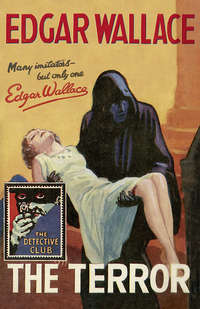
Читать книгу: «The Terror»

Published by COLLINS CRIME CLUB
An imprint of HarperCollinsPublishers Ltd
1 London Bridge Street
London SE1 9GF
www.harpercollins.co.uk
The Terror first published in Great Britain by The Detective Story Club Ltd for Wm Collins Sons & Co. Ltd 1929
White Face first published in Great Britain by Hodder & Stoughton 1930
Introduction © Martin Edwards 2016
Cover design © HarperCollinsPublishers Ltd 1929, 2016
A catalogue copy of this book is available from the British Library.
This novel is entirely a work of fiction. The names, characters and incidents portrayed in it are the work of the author’s imagination. Any resemblance to actual persons, living or dead, events or localities is entirely coincidental.
All rights reserved under International and Pan-American Copyright Conventions. By payment of the required fees, you have been granted the non-exclusive, non-transferable right to access and read the text of this e-book on screen. No part of this text may be reproduced, transmitted, down-loaded, decompiled, reverse engineered, or stored in or introduced into any information storage and retrieval system, in any form or by any means, whether electronic or mechanical, now known or hereinafter invented, without the express written permission of HarperCollins.
Source ISBN: 9780008137571
Ebook Edition © February 2016 ISBN: 9780008137588
Version: 2015-11-24
Contents
Cover
Title Page
Copyright
Introduction
The Terror
Editor’s Preface
Chapter I
Chapter II
Chapter III
Chapter IV
Chapter V
Chapter VI
Chapter VII
Chapter VIII
Chapter IX
Chapter X
Chapter XI
Chapter XII
Chapter XIII
Chapter XIV
Chapter XV
White Face
Dedication
Chapter I
Chapter II
Chapter III
Chapter IV
Chapter V
Chapter VI
Chapter VII
Chapter VIII
Chapter IX
Chapter X
Chapter XI
Chapter XII
Chapter XIII
Chapter XIV
Chapter XV
Chapter XVI
Chapter XVII
Chapter XVIII
Chapter XIX
Chapter XX
The Detective Story Club
About the Publisher
INTRODUCTION
IN July 1929, Edgar Wallace’s The Terror headed the list of the first half dozen titles published by Collins in their Detective Story Club, the only one which was not a reissue. This lively, melodramatic thriller does not outstay its welcome—its brevity is such that some bibliographies describe it as a short story, although in fact it is a novella with an unusual history. On its first appearance, The Terror was published on its own, its modest length bulked out to 192 pages thanks to the cunning use of a conspicuously large type-face. Rather than resort to the same tactic to achieve its page count, this reissued edition includes the bonus of a second Wallace book published in the following year, and White Face is rather more than twice as long as The Terror.
An enthusiastic preface to the Detective Story Club edition hailed The Terror as ‘a masterpiece of its kind’, and, nearly ninety years later, there is no denying that it displays the characteristics that made Edgar Wallace a literary phenomenon. Margaret Lane, his first major biographer, summarised the lurid plot ingredients: ‘an old mysterious house built over hidden dungeons…hidden treasure…the hooded figure appearing on moonlit nights and leaving a trail of murder in its wake, the shrieking heroine trapped in the dungeon with a sinister madman’. Add to that both a master criminal and ace detective masquerading as someone else, and you have a classic slice of Twenties popular culture.
Just like the early whodunits of Agatha Christie and Dorothy L. Sayers, The Terror belongs to an age when people craved escapism at least as much as they had ever done. Memories of the First World War, which in one way or another touched almost every family in the land, were still raw. Edgar Wallace’s thrillers met a particular need, and met it better than any of his peers. He was, G. K. Chesterton said, ‘a huge furnace and factory of fiction’, and the popularity of his books made him a fortune, which he spent as quickly as he earned it.
An intriguing facet of The Terror is the story’s genesis in the theatre. The idea for the story came during the course of an extravagant holiday in Caux in late 1926. Wallace met Bertie Meyer, a theatrical manager, who suggested that Wallace write a play for two prominent actors, Mary Glynne and Dennis Nielsen-Terry. It took Wallace a mere ‘five nervous and preoccupied days’, as Margaret Lane perhaps euphemistically described them, to rise to the challenge. Even more impressive was the result of his frantic labours: the play ran for almost seven months at the Lyceum, and having cost just £1,000 to stage, made £35,000 in profits.
Success in the theatre led to The Terror being filmed; it became Warner Brothers’ second ‘all-talking picture’ before Wallace produced this book version. A more notable screen adaptation came in 1938; the cast included such luminaries as Alastair Sim, in characteristic scene-stealing form as Soapy Marks, and Bernard Lee, best remembered today as ‘M’ in Dr No and ten subsequent James Bond films, as Freddy Fane.
White Face appears to be the only other example of an original book that Wallace based on an earlier stage play, Persons Unknown, although his productivity was so astonishing that his bibiliography is as convoluted as a thriller plot, and it is hard to be sure about such things: The British Bibliography of Edgar Wallace by W. O. G. Lofts and Derek Adley is a full-length work, yet even its industrious authors admitted that, after four years’ research, they were far from confident they had traced all his stories published in Britain, let alone anywhere else. In 1932, White Face was turned into a film, but like the original film version of The Terror, it is now considered officially to be lost, unless any prints turn up in archives or the hands of private collectors.
This tale of a white-masked villain who terrorises London boasts a neat ‘least likely person’ twist, and also some snappy snatches of dialogue, as when a detective opines: ‘Policemen and reporters get their living out of other people’s misfortunes.’ Another police officer expresses the view: ‘The jury is a body or institution which gives everybody the benefit of the doubt except the police.’ A later passage, which has something of a timeless quality, notes: ‘Parliament had been playing too interfering a part in the police force lately…The Home Office had issued new instructions which, if they were faithfully carried out, would prevent the police from asking vital questions. Every step that the crank and the busybody could devise to interfere with the administration of justice had assumed official shape.’
Wallace never pretended to be a literary stylist, but the energy of his writing and the slickness of his plot twists earned him countless readers. At one time, his publishers claimed that he was responsible for one in every four British novels read. If this was an exaggeration, it did at least have the merit of seeming plausible. A Detective Story Club advertisement for The Terror said the tale proved once again ‘that there are many imitators, but only one Edgar Wallace’. This was perfectly true. Richard Horatio Edgar Wallace (1875–1932) was extraordinary among authors in that his life was as extraordinary as his books. He was one of a kind, and the latest biography, written by Neil Clark and published in 2014, is called fittingly Stranger than Fiction.
Wallace’s work had a universal appeal. As Clark says, ‘Among his millions of fans were King George V…Stanley Baldwin, a president of the United States, and a certain Adolf Hitler.’ Writing in 1969, Penelope Wallace, his daughter, suggested that an underlying reason for his popularity was ‘his lack of bitterness’:
‘There are occasions when he is angry, particularly on such subjects as “baby farming” but none where hatred…obscures the text. His villains are usually English and on the rare occasions when they are not home-grown they are imported impartially…There is no trace of racial or religious prejudice and it is rare for the villain to be completely bad. Those who say that his characters are either black or white can never have read his books. Few of his bad men are disallowed a redeeming feature or two.’
Reading tastes fluctuate as time passes, and the world has changed a great deal since Wallace adapted The Terror and White Face from his plays. Fortunately, good story-telling never goes completely out of fashion. Edgar Wallace was a gifted story-teller, and it is a pleasure to introduce these two lively tales to a new generation of readers.
MARTIN EDWARDS
May 2015
www.martinedwardsbooks.com
THE TERROR
EDITOR’S PREFACE
POST-WAR fiction has produced hundreds of clever detective novels and not a few really first-class writers, but there is only one Edgar Wallace. His supremacy we feel sure cannot be challenged. His name has become a household word throughout the English-speaking world, and many of his ‘thrillers’ have already found their way in translations into the libraries of every country in Europe.
While we make a superlative statement about the man without any fear of criticism, we hesitate to say which of the novels of his very prolific pen is the best! Perhaps, taking popularity as a guide, we may put The Terror in the place of honour. This wonderful story has thrilled the London theatre world in its dramatised form; it has been made into a super film, which was one of the first ‘talkies’ shown to the public, and which will long be pronounced one of the best, and now in book form the Detective Story Club presents it to the world.
The Terror is a masterpiece of its kind, and the Edgar Wallace enthusiast will delight in tracing a hundred and one clever devices from subtleties in plot to fine consistency in the characters. The plot speaks for itself, but as an example of a cleverly drawn character take Soapy Marks, a man of secondary importance in the story. In the opening scene we see him chided by his confederate, Connor: (‘Don’t try swank on me, Soapy—use words I can understand’) but this characteristic does not obtrude—in fact, it is only well on in the book that we see Soapy in his true light, spoken of by Scotland Yard as ‘so clever that one of these days we’ll find him in Oxford or Cambridge’. And so with each and every one of the characters.
The atmosphere of terror suggested by the very title of the book is handled with that care which makes real melodrama—a word, by the way, which should not have become degraded in meaning, had all the novels and plays so called been of the Edgar Wallace standard! He never overdoes it. His thrills are relieved by flashes of real humour and the love element introduced with Mary Redmayne and the drunken Ferdie Fane is so slightly suggested that when she admits in the closing chapter, ‘Yes—I—I’m awfully fond of—of Mr Fane,’ we only then realise that the unknown something which gave the story its charm was indeed love!
CHAPTER I
O’SHEA was in his maddest mood, had been like it all night. Stalking up and down the grassy slope, muttering to himself, waving his hands at some invisible audience, cackling with laughter at his own mysterious jokes; and at dawn he had fallen upon little Lipski, who had dared light a cigarette in defiance of instructions, and had beaten him with savage brutality, and the other two men had not dared interfere.
Joe Connor sprawled on the ground, chewing a blade of grass, and watching with sombre eyes the restless figure. Marks, who sat cross-legged by his side, watched too, but there was a twisted and sneering smile on his thin lips.
‘Mad as a coot,’ said Joe Connor in a low voice. ‘If he pulls this job off without getting us in gaol for the rest of our lives we’ll be lucky.’
Soapy Marks licked his dry lips.
‘He’s cleverest when he’s mad.’ He spoke like a man of culture. Some said that Soapy was intended for the church before a desire for an easier and more illicit method of living made him one of the most skilful, and nearly the most dangerous, gangster in England.
‘Lunacy, my dear fellow, does not mean stupidity. Can’t you stop that fellow blubbering?’
Joe Connor did not rise; he turned his eyes in the direction of the prostrate figure of Lipski, who was groaning and swearing sobbingly.
‘He’ll get over it,’ he said indifferently. ‘The bigger beating he gets the more he respects O’Shea.’
He wriggled a little closer to his confederate.
‘Have you ever seen O’Shea—his face, I mean?’ he asked, dropping his voice a note lower. ‘I never have, and I’ve done two—’ he thought ‘—three,’ he corrected, ‘jobs with him. He’s always had that coat on he’s got now, with the collar right up to his nose, the same old hat over his eyes. I never used to believe there was that kind of crook—thought they were only seen on the stage. First time I ever heard of him was when he sent for me—met him on the St Albans Road about twelve o’clock, but never saw his face. He knew all about me; told me how many convictions I’d had, and the kind of work he wanted me for—’
‘And paid you well,’ said Marks lazily, when the other paused. ‘He always pays well; he always picks up his ‘staff’ in the same way.’
He pursed his lips as though he were going to whistle, examined the restless figure of the master thoughtfully.
‘He’s mad—and he pays well. He will pay better this time.’
Connor looked up sharply.
‘Two hundred and fifty quid and fifty getaway money—that’s fair, ain’t it?’
‘He will pay better,’ said Marks suavely. ‘This little job deserves it. Am I to drive a motor-lorry containing three tons of Australian sovereigns through the streets of London, possibly risk hanging, for two hundred and fifty pounds—and getaway money? I think not.’
He rose to his feet and dusted his knees daintily. O’Shea had disappeared over the crest of the hill, was possibly behind the hedge line which swept round in a semi-circle till it came within half a dozen feet of where the men were talking of him.
‘Three tons of gold; nearly half a million pounds. At least I think we’re entitled to ten per cent.’
Connor grinned, jerked his head towards the whimpering Lipski.
‘And him?’
Marks bit his lip.
‘I don’t think we could include him.’
He glanced round again for some sign of O’Shea, and dropped down beside his companion.
‘We’ve got the whole thing in our hands,’ he said in a voice that was little more than a whisper. ‘He’ll be sane tomorrow. These fits only come on him at rare intervals; and a sane man will listen to reason. We’re holding up this gold convoy—that’s one of O’Shea’s oldest tricks, to fill a deep cutting full of gas. I wonder he dare repeat it. I am driving the lorry to town and hiding it. Would O’Shea give us our share if he had to decide between an unpleasant interview with us and a more unpleasant interview with Inspector Bradley?’
Connor plucked another blade of grass and chewed on it gloomily.
‘He’s clever,’ he began, and again Marks’ lips curled.
‘Aren’t they all?’ he demanded. ‘Isn’t Dartmoor full of clever people? That’s old Hallick’s great joke—he calls all the prisoners collegers. No, my dear Connor, believe me, cleverness is a relative term—’
‘What does that mean?’ growled Connor with a frown. ‘Don’t try swank on me, Soapy—use words I can understand.’
He looked around again a little anxiously for the vanished O’Shea. Behind the hill crest, in a narrow lane, O’Shea’s big car was parked that would carry him to safety after the job. His confederates would be left to take all the risks, face the real dangers which would follow, however cleverly the coup was organised.
A little distance away to the left, on the edge of the deep cutting, four big steel gas cylinders lay in line. Even from where he sprawled he could see the long white road leading into the cutting, on which presently would appear the flickering lights of the gold convoy. His gas mask lay under his hand; Marks had his sticking out of his coat pocket.
‘He must have a lot of stuff,’ he said.
‘Who—O’Shea?’ Marks shrugged his shoulders. ‘I don’t know. He spends money like a lunatic. I should think he was broke. It’s nearly twelve months since he had a big haul.’
‘What does he do with the money?’ asked Connor curiously.
‘Spends it, as we all do,’ was the laconic answer. ‘He talked about buying a big country house last time I saw him; he was going to settle down and live the life of a gentleman. Last night, when I had a chat with him, he said it would take half this loot to pay his debts.’
Marks examined his well-manicured nails.
‘Amongst other things he’s a liar,’ he said lightly. ‘What’s that?’
He looked towards the line of bushes a few yards distant. He had heard a rustle, the snap of a twig, and was on his feet instantly. Crossing the short intervening space, he peered over the bushes. There was nobody in sight. He came back thoughtfully to Connor.
‘I wonder if the devil was listening,’ he said, ‘and how long he’s been listening!’
‘Who—O’Shea?’ asked the startled Connor.
Marks did not reply, but drew a deep breath. Obviously he was uncomfortable.
‘If he’d heard anything he would have come for me. He’s moody—he’s been moody all night.’
At this point Connor got up and stretched himself.
‘I’d like to know how he lives. I’ll bet he’s got a wife and family tucked away somewhere—that kind of bird always has. There he is!’
The figure of O’Shea had appeared across the rise; he was coming towards them.
‘Get your masks ready. You don’t want any further instructions, Soapy?’ The voice, muffled by the high collar which reached to the tip of his nose, was rational, almost amiable.
‘Pick that fellow up.’ He pointed to Lipski, and, when the order had been obeyed, he called the cringing man before him. ‘You’ll go to the end of the road, put your red lantern on and stop them. By stop them I mean slow them down. Don’t let yourself be seen; there are ten armed men on the lorry.’
He examined the cylinders; from the nozzle of each a thick rubber pipe trailed down into the cutting. With a spanner he opened the valve of each, and the silence was broken by the deep hissing of the gas as it escaped.
‘It’ll lie in the bottom, so you needn’t put on your masks till we’re ready,’ he said.
He followed Lipski to the end of the cutting, watched the red lamp lit, and pointed out the place where the man was to hide. Then he came back to Marks. Not by word or sign did he betray the fact that he had overheard the two men talking. If there was to be a quarrel this was not the moment for it. O’Shea was intensely sane at that moment.
They heard the sound of the incoming trolley before they saw the flicker of its lights emerge from the cover of Felsted Wood.
‘Now,’ said O’Shea sharply.
He made no attempt to draw on a mask, as did his two assistants.
‘You won’t have to use your guns, but keep them handy in case anything goes wrong—don’t forget that if the guard isn’t knocked out immediately it will shoot at sight. You know where to meet me tomorrow?’
The shrouded head of Soapy nodded.
Nearer and nearer came the gold convoy. Evidently the driver had seen the red light at the end of the cutting, for his siren sounded. From where O’Shea crouched he commanded a complete view of the road.
The trolley was within fifty yards of the cutting and had slowed perceptibly when he saw a man leap up, not from the place where he had posted him, but a dozen yards farther up the road. It was Lipski, and as he ran towards the moving trolley his hand went up, there was a flash and a report. He was firing to attract attention. O’Shea’s eyes glowed like coals. Lipski had betrayed him.
‘Stand by to run!’ His voice was like a rasp.
And then the miracle happened. From the trolley leapt two pencils of flame, and Lipski crumpled up and fell by the side of the road as the lorry rumbled past. The guard had misunderstood his action; thought he was attempting to hold them up.
‘Glorious,’ whispered O’Shea huskily, and at that instant the lorry went down into the gas-filled cutting.
It was all over in a second. The driver fell forward in his seat, and, released of his guidance, the front wheels of the lorry jammed into a bank.
O’Shea thought of everything. But for that warning red light the trolley would have been wrecked and his plans brought to naught. As it was, Marks had only to climb into the driver’s seat, and reverse the engine, to extricate it from the temporary block.
A minute later the gold convoy had climbed up to the other side of the depression. The unconscious guard and driver had been bundled out and laid on the side of the road. The final preparations took no more than five minutes. Marks stripped his mask, pulled on a uniform cap, and Connor took his place in the trolley where the gold was stored in small white boxes.
‘Go on,’ said O’Shea, and the trolley moved forward and four minutes later was out of sight.
O’Shea went back to his big, high-powered car and drove off in the opposite direction, leaving only the unconscious figures of the guard to testify to his ruthlessness.
CHAPTER II
IT was a rainy night in London. Connor, who had preferred it so, turned into the side door of a little restaurant in Soho, mounted the narrow stairs and knocked on a door. He heard a chair move and the snap of the lock as the door was opened.
Soapy Marks was there alone.
‘Did you see him?’ asked Connor eagerly.
‘O’Shea? Yes, I met him on the Embankment. Have you seen the newspapers?’
Connor grinned.
‘I’m glad those birds didn’t die,’ he said.
Mr Marks sneered.
‘Your humanity is very creditable, my dear friend,’ he said.
On the table was a newspaper, and the big headlines stared out, almost shouted their excitement.
GREATEST GOLD ROBBERY OF OUR TIME.
THREE TONS OF GOLD DISAPPEAR BETWEEN SOUTHAMPTON AND LONDON.
DEAD ROBBER FOUND BY THE ROADSIDE.
THE VANISHED LORRY.
In the early hours of yesterday morning a daring outrage was committed which might have led to the death of six members of the C.I.D., and resulted in the loss to the Bank of England of gold valued at half a million pounds.
The Aritania, which arrived in Southampton last night, brought a heavy consignment of gold from Australia, and in order that this should be removed to London with the least possible ostentation, it was arranged that a lorry carrying the treasure should leave Southampton at three o’clock in the morning, arriving in London before the normal flow of traffic started. At a spot near Felsted Wood the road runs down into a depression and through a deep cutting. Evidently this had been laid with gas, and the car dashed into what was practically a lethal chamber without warning.
That an attack was projected, however, was revealed to the guard before they reached the fatal spot. A man sprang out from a hedge and shot at the trolley. The detectives in charge of the convoy immediately replied, and the man was later found in a dying condition. He made no statement except to mention a name which is believed to be that of the leader of the gang.
Sub-Inspectors Bradley and Hallick of Scotland Yard are in charge of the case…
There followed a more detailed account, together with an official statement issued by the police, containing a brief narrative by one of the guards.
‘It seems to have created something of a sensation,’ smiled Marks, as he folded up the paper.
‘What about O’Shea?’ asked the other impatiently. ‘Did he agree to split?’ Marks nodded.
‘He was a little annoyed—naturally. But in his sane moments our friend, O’Shea, is a very intelligent man. What really annoyed him was the fact that we had parked the lorry in another place than where he ordered it to be taken. He was most anxious to discover our little secret, and I think his ignorance of the whereabouts of the gold was our biggest pull with him.’
‘What’s going to happen?’ asked Connor in a troubled tone.
‘We’re taking the lorry tonight to Barnes Common. He doesn’t realise, though he will, that we’ve transferred the gold to a small three-ton van. He ought to be very grateful to me for my foresight, for the real van was discovered this evening by Hallick in the place where O’Shea told me to park it. And of course it was empty.’
Connor rubbed his hand across his unshaven chin.
‘O’Shea won’t let us get away with it,’ he said, with a worried frown. ‘You know him, Soapy.’
‘We shall see,’ said Mr Marks, with a confident smile.
He poured out a whisky and soda.
‘Drink up and we’ll go.’ He glanced at his watch. ‘We’ve got plenty of time—thank God there’s a war on, and the active and intelligent constabulary are looking for spies, the streets are nicely darkened, and all is favourable to our little arrangement. By the way, I’ve had a red cross painted on the tilt of our van—it looks almost official!’
That there was a war on, they discovered soon after they turned into the Embankment. Warning maroons were banging from a dozen stations; the darkened tram which carried them to the south had hardly reached Kennington Oval before the anti-aircraft guns were blazing at the unseen marauders of the skies. A bomb dropped all too close for the comfort of the nervous Connor. The car had stopped.
‘We had better get out here,’ whispered Marks. ‘They won’t move till the raid is over.’
The two men descended to the deserted street and walked southward. The beams of giant searchlights swept the skies; from somewhere up above came the rattle of a machine-gun.
‘This should keep the police thoroughly occupied,’ said Marks, as they turned into a narrow street in a poor neighbourhood. ‘I don’t think we need miss our date, and our little ambulance should pass unchallenged.’
‘I wish to God you’d speak English!’ growled Connor irritably.
Marks had stopped before the gates of a stable yard, pushing them. One yielded to his touch and they walked down the uneven drive to the small building where the car was housed. Soapy put his key into the gate of the lock-up and turned it.
‘Here we are,’ he said, as he stepped inside.
And then a hand gripped him, and he reached for his gun.
‘Don’t make any fuss,’ said the hated voice of Inspector Hallick. ‘I want you, Soapy. Perhaps you’ll tell me what’s happened to this ambulance of yours?’
Soapy Marks stared towards the man he could not see, and for a moment was thrown off his guard.
‘The lorry?’ he gasped. ‘Isn’t it here?’
‘Been gone an hour,’ said a second voice. ‘Come across, Soapy; what have you done with it?’
Soapy said nothing; he heard the steel handcuffs click on the wrist of Joe Connor, heard that man’s babble of incoherent rage and blasphemy as he was hustled towards the car which had drawn up silently at the gate, and knew that Mr O’Shea was indeed very sane on that particular day.
CHAPTER III
TO Mary Redmayne life had been a series of inequalities. She could remember the alternate prosperity and depression of her father; had lived in beautiful hotel suites and cheap lodgings, one following the other with extraordinary rapidity; and had grown so accustomed to the violent changes of his fortune that she would never have been surprised to have been taken from the pretentious school where she was educated, and planted amongst county school scholars at any moment.
People who knew him called him Colonel, but he himself preferred his civilian title, and volunteered no information to her as to his military career. It was after he had taken Monkshall that he permitted ‘Colonel’ to appear on his cards. It was a grand-sounding name, but even as a child Mary Redmayne had accepted such appellations with the greatest caution. She had once been brought back from her preparatory school to a ‘Mortimer Lodge’, to discover it was a tiny semi-detached villa in a Wimbledon by-street.
But Monkshall had fulfilled all her dreams of magnificence; a veritable relic of Tudor times, and possibly of an earlier period, it stood in forty acres of timbered ground, a dignified and venerable pile, which had such association with antiquity that, until Colonel Redmayne forbade the practice, charabancs full of American visitors used to come up the broad drive and gaze upon the ruins of what had been a veritable abbey.
Fortune had come to Colonel Redmayne when she was about eleven. It came unexpectedly, almost violently. Whence it came, she could not even guess; she only knew that one week he was poor, harassed by debt-collectors, moving through side streets in order to avoid his creditors; the next week—or was it month?—he was master of Monkshall, ordering furniture worth thousands of pounds.
When she went to live at Monkshall she had reached that gracious period of interregnum between child and woman. A slim girl above middle height, straight of back, free of limb, she held the eye of men to whom more mature charms would have had no appeal.
Ferdie Fane, the young man who came to the Red Lion so often, summer and winter, and who drank so much more than was good for him, watched her passing along the road with her father. She was hatless; the golden-brown hair had a glory of its own; the faultless face, the proud little lift of her chin.
‘Spring is here, Adolphus,’ he addressed the landlord gravely. ‘I have seen it pass.’
He was a man of thirty-five, long-faced, rather good-looking in spite of his huge horn-rimmed spectacles. He had a large tankard of beer in his hand now, which was unusual, for he did most of his drinking secretly in his room. He used to come down to the Red Lion at all sorts of odd and sometimes inconvenient moments. He was, in a way, rather a bore, and the apparition of Mary Redmayne and her grim-looking father offered the landlord an opportunity for which he had been seeking.
‘I wonder you don’t go and stay at Monkshall, Mr Fane,’ he suggested.
Mr Fane stared at him reproachfully.
‘Are you tired of me, mine host?’ he asked gently. ‘That you should shuffle me into other hands?’ He shook his head. ‘I am no paying guest—besides which, I am not respectable. Why does Redmayne take paying guests at all?’
The landlord could offer no satisfactory solution to this mystery.
‘I’m blessed if I know. The colonel’s got plenty of money. I think it is because he’s lonely, but he’s had paying guests at Monkshall this past ten years. Of course, it’s very select.’
‘Exactly,’ said Ferdie Fane with great gravity. ‘And that is why I should not be selected! No, I fear you will have to endure my erratic visits.’
‘I don’t mind your being here, sir,’ said the landlord, anxious to assure him. ‘You never give me any trouble, only—’
‘Only you’d like somebody more regular in his habits—good luck!’
He lifted the foaming pewter to his lips, took a long drink, and then he began to laugh softly, as though at some joke. In another minute he was serious again, frowning down into the tankard.
‘Pretty girl, that. Mary Redmayne, eh?’
‘She’s only been back from school a month—or college, rather,’ said the landlord. ‘She’s the nicest young lady that ever drew the breath of life.’
‘They all are,’ said the other vaguely. He went away the next day with his fishing rod that he hadn’t used, and his golf bag which had remained unstrapped throughout his stay.
Life at Monkshall promised so well that Mary Redmayne was prepared to love the place. She liked Mr Goodman, the grey-haired, slow-spoken gentleman who was the first of her father’s boarders; she loved the grounds, the quaint old house; could even contemplate, without any great uneasiness, the growing taciturnity of her father. He was older, much older than he had been; his face had a new pallor; he seldom smiled. He was a nervous man, too; she had found him walking about in the middle of the night, and once had surprised him in his room, suspiciously thick of speech, with an empty whisky bottle a silent witness to his peculiar weakness.
It was the house that began to get on her nerves. Sometimes she would wake up in the middle of the night suddenly and sit up in bed, trying to recall the horror that had snatched her from sleep and brought her through a dread cloud of fear to wakefulness. Once she had heard peculiar sounds that had sent cold shivers down her spine. Not once, but many times, she thought she heard the faint sound of a distant organ.
She asked Cotton, the dour butler, but he had heard nothing. Other servants had been more sensitive, however; there came a constant procession of cooks and housemaids giving notice. She interviewed one or two of these, but afterwards her father forbade her seeing them, and himself accepted their hasty resignations.
‘This place gives me the creeps, miss,’ a weeping housemaid had told her. ‘Do you hear them screams at night? I do; I sleep in the east wing. The place is haunted—’
‘Nonsense, Anna!’ scoffed the girl, concealing a shudder. ‘How can you believe such things!’
‘It is, miss,’ persisted the girl. ‘I’ve seen a ghost on the lawn, walking about in the moonlight.’
Later, Mary herself began to see things; and a guest who came and stayed two nights had departed a nervous wreck.
‘Imagination,’ said the colonel testily. ‘My dear Mary, you’re getting the mentality of a housemaid!’
He was very apologetic afterwards for his rudeness, but Mary continued to hear, and presently to listen; and finally she saw…Sights that made her doubt her own wisdom, her own intelligence, her own sanity.
One day, when she was walking alone through the village, she saw a man in a golf suit; he was very tall and wore horn-rimmed spectacles, and greeted her with a friendly smile. It was the first time she had seen Ferdie Fane. She was to see very much of him in the strenuous months that followed.
CHAPTER IV
SUPERINTENDENT HALLICK went down to Princetown in Devonshire to make his final appeal—an appeal which, he knew, was foredoomed to failure. The Deputy-Governor met him as the iron gates closed upon the burly superintendent.
‘I don’t think you’re going to get very much out of these fellows, superintendent,’ he said. ‘I think they’re too near to the end of their sentence.’
‘You never know,’ said Hallick, with a smile. ‘I once had the best information in the world from a prisoner on the day he was released.’
He went down to the low-roofed building which constitutes the Deputy-Governor’s office.
‘My head warder says they’ll never talk, and he has a knack of getting into their confidence,’ said the Deputy. ‘If you remember, superintendent, you did your best to make them speak ten years ago, when they first came here. There’s a lot of people in this prison who’d like to know where the gold is hidden. Personally, I don’t think they had it at all, and the story they told at the trial, that O’Shea had got away with it, is probably true.’
The superintendent pursed his lips.
‘I wonder,’ he said thoughtfully. ‘That was the impression I had the night I arrested them, but I’ve changed my opinion since.’
The chief warder came in at that moment and gave a friendly nod to the superintendent.
‘I’ve kept those two men in their cells this morning. You want to see them both, don’t you, superintendent?’
‘I’d like to see Connor first.’
‘Now?’ asked the warder. ‘I’ll bring him down.’
He went out, passed across the asphalt yard to the entrance of the big, ugly building. A steel grille covered the door, and this he unlocked, opening the wooden door behind, and passed into the hall, lined on each side with galleries from which opened narrow cell doors. He went to one of these on the lower tier, snapped back the lock and pulled open the door. The man in convict garb who was sitting on the edge of the bed, his face in his hands, rose and eyed him sullenly.
‘Connor, a gentleman from Scotland Yard has come down to see you. If you’re sensible you’ll give him the information he asks.’
Connor glowered at him.
‘I’ve nothing to tell, sir,’ he said sullenly. ‘Why don’t they leave me alone? If I knew where the stuff was I wouldn’t tell ’em.’
‘Don’t be a fool,’ said the chief good-humouredly. ‘What have you to gain by hiding up—?’
‘A fool, sir?’ interrupted Connor. ‘I’ve had all the fool knocked out of me here!’ His hand swept round the cell. ‘I’ve been in this same cell for seven years; I know every brick of it—who is it wants to see me?’
‘Superintendent Hallick.’
Connor made a wry face.
‘Is he seeing Marks too? Hallick, eh? I thought he was dead.’
‘He’s alive enough.’
The chief beckoned him out into the hall, and, accompanied by a warder, Connor was taken to the Deputy’s office. He recognised Hallick with a nod. He bore no malice; between these two men, thief-taker and thief, was that curious camaraderie which exists between the police and the criminal classes.
‘You’re wasting your time with me, Mr Hallick,’ said Connor. And then, with a sudden burst of anger: ‘I’ve got nothing to give you. Find O’Shea—he’ll tell you! And find him before I do, if you want him to talk.’
‘We want to find him, Connor,’ said Hallick soothingly.
‘You want the money,’ sneered Connor; ‘that’s what you want. You want to find the money for the bank and pull in the reward.’ He laughed harshly. ‘Try Soapy Marks—maybe he’ll sit in your game and take his corner.’
The lock turned at that moment and another convict was ushered into the room. Soapy Marks had not changed in his ten years of incarceration. The gaunt, ascetic face had perhaps grown a little harder; the thin lips were firmer, and the deep-set eyes had sunk a little more into his head. But his cultured voice, his exaggerated politeness, and that oiliness which had earned him his nickname, remained constant.
‘Why, it’s Mr Hallick!’ His voice was a gentle drawl. ‘Come down to see us at our country house!’
He saw Connor and nodded, almost bowed to him.
‘Well, this is most kind of you, Mr Hallick. You haven’t seen the park or the garage? Nor our beautiful billiard-room?’
‘That’ll do, Marks,’ said the warder sternly.
‘I beg your pardon, sir, I’m sure.’ The bow to the warder was a little deeper, a little more sarcastic. ‘Just badinage—nothing wrong intended. Fancy meeting you on the moor, Mr Hallick! I suppose this is only a brief visit? You’re not staying with us, are you?’
Hallick accepted the insult with a little smile.
‘I’m sorry,’ said Marks. ‘Even the police make little errors of judgment sometimes. It’s deplorable, but it’s true. We once had an ex-inspector in the hall where I am living.’
‘You know why I’ve come?’ said Hallick.
Marks shook his head, and then a look of simulated surprise and consternation came to his face.
‘You haven’t come to ask me and my poor friend about that horrible gold robbery? I see you have. Dear me, how very unfortunate! You want to know where the money was hidden? I wish I could tell you. I wish my poor friend could tell you, or even your old friend, Mr Leonard O’Shea.’ He smiled blandly. ‘But I can’t!’
Connor was chafing under the strain of the interview.
‘You don’t want me any more—’
Marks waved his hand.
‘Be patient with dear Mr Hallick.’
‘Now look here, Soapy,’ said Connor angrily, and a look of pain came to Marks’ face.
‘Not Soapy—that’s vulgar. Don’t you agree, Mr Hallick?’
‘I’m going to answer no questions. You can do as you like,’ said Connor. ‘If you haven’t found O’Shea, I will, and the day I get my hands on him he’ll know all about it! There’s another thing you’ve got to know, Hallick; I’m on my own from the day I get out of this hell. I’m not asking Soapy to help me to find O’Shea. I’ve seen Marks every day for ten years, and I hate the sight of him. I’m working single-handed to find the man who shopped me.’
‘You think you’ll find him, do you?’ said Hallick quickly. ‘Do you know where he is?’
‘I only know one thing,’ said Connor huskily, ‘and Soapy knows it too. He let it out that morning we were waiting for the gold lorry. It just slipped out—what O’Shea’s idea was of a quiet hiding-place. But I’m not going to tell you. I’ve got four months to serve, and when that time is up I’ll find O’Shea.’
‘You poor fool!’ said Hallick roughly. ‘The police have been looking for him for ten years.’
‘Looking for what?’ demanded Connor, ignoring Marks’ warning look.
‘For Len O’Shea,’ said Hallick.
There came a burst of laughter from the convict.
‘You’re looking for a sane man, and that’s where you went wrong! I didn’t tell you before why you’ll never find him. It’s because he’s mad! You didn’t know that, but Soapy knows. O’Shea was crazy ten years ago. God knows what he is now! Got the cunning of a madman. Ask Soapy.’
It was news to Hallick. His eyes questioned Marks, and the little man smiled.
‘I’m afraid our dear friend is right,’ said Marks suavely. ‘A cunning madman! Even in Dartmoor we get news, Mr Hallick, and a rumour has reached me that some years ago three officers of Scotland Yard disappeared in the space of a few minutes—just vanished as though they had evaporated like dew before the morning sun! Forgive me if I am poetical; Dartmoor makes you that way. And would you be betraying an official secret if you told me these men were looking for O’Shea?’
He saw Hallick’s face change, and chuckled.
‘I see they were. The story was that they had left England and they sent their resignations—from Paris, wasn’t it? O’Shea could copy anybody’s handwriting—they never left England.’ Hallick’s face was white.
‘By God, if I thought that—’ he began.
‘They never left England,’ said Marks remorselessly. ‘They were looking for O’Shea—and O’Shea found them first.’
‘You mean they’re dead?’ asked the other.
Marks nodded slowly.
‘For twenty-two hours a day he is a sane, reasonable man. For two hours—’ He shrugged his shoulders. ‘Mr Hallick, your men must have met him in one of his bad moments.’
‘When I meet him—’ interrupted Connor, and Marks turned on him in a flash.
‘When you meet him you will die!’ he hissed. ‘When I meet him—’ That mild face of his became suddenly contorted, and Hallick looked into the eyes of a demon.
‘When you meet him?’ challenged Hallick. ‘Where will you meet him?’
Marks’ arm shot out stiffly; his long fingers gripped an invisible enemy.
‘I know just where I can put my hand on him,’ he breathed. ‘That hand!’
Hallick went back to London that afternoon, a baffled man. He had gone to make his last effort to secure information about the missing gold, and had learned nothing—except that O’Shea was sane for twenty-two hours in the day.
Бесплатный фрагмент закончился.