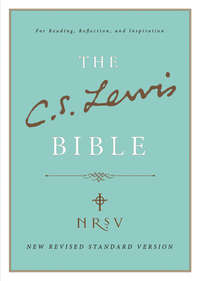
Читать книгу: «C. S. Lewis Bible: New Revised Standard Version»
THE
C. S. Lewis
BIBLE

NEW REVISED STANDARD VERSION

CONTENTS
Cover
Title Page
Notes and Introductions
Alphabetical List of the Books of the Bible
Abbreviations
Editors and Advisory Board
Preface: Why a C. S. Lewis Bible?, by Douglas Gresham
Introduction: C. S. Lewis and the Bible, by Jerry Root
C. S. Lewis as a Guide for Bible Reading
How to Read The C. S. Lewis Bible
The Spiritual Journey of C. S. Lewis, by Jerry Root
Editor’s Note
To the Reader
OLD TESTAMENT
Genesis
Exodus
Leviticus
Numbers
Deuteronomy
Joshua
Judges
Ruth
1 Samuel
2 Samuel
1 Kings
2 Kings
1 Chronicles
2 Chronicles
Ezra
Nehemiah
Esther
Job
Psalms
Proverbs
Ecclesiastes
Song of Solomon
Isaiah
Jeremiah
Lamentations
Ezekiel
Daniel
Hosea
Joel
Amos
Obadiah
Jonah
Micah
Nahum
Habakkuk
Zephaniah
Haggai
Zechariah
Malachi
NEW TESTAMENT
Matthew
Mark
Luke
John
Acts
Romans
1 Corinthians
2 Corinthians
Galatians
Ephesians
Philippians
Colossians
1 Thessalonians
2 Thessalonians
1 Timothy
2 Timothy
Titus
Philemon
Hebrews
James
1 Peter
2 Peter
1 John
2 John
3 John
Jude
Revelation
Afterword and Indexes
Afterword: Reflections on Scripture, by C. S. Lewis
Indexes
Index by Source
Index by Scripture Reference
Concordance
About the Author
Copyright
About the Publisher
Notes and Introductions
Alphabetical List of the Books of the Bible
Abbreviations
Editors and Advisory Board
Preface: Why a C. S. Lewis Bible?, by Douglas Gresham
Introduction: C. S. Lewis and the Bible, by Jerry Root
C. S. Lewis as a Guide for Bible Reading
How to Read The C. S. Lewis Bible
The Spiritual Journey of C. S. Lewis, by Jerry Root
Editor’s Note
To the Reader
ALPHABETICAL LIST
OF THE BOOKS OF THE BIBLE
Acts
Amos
1 Chronicles
2 Chronicles
Colossians
1 Corinthians
2 Corinthians
Daniel
Deuteronomy
Ecclesiastes
Ephesians
Esther
Exodus
Ezekiel
Ezra
Galatians
Genesis
Habakkuk
Haggai
Hebrews
Hosea
Isaiah
James
Jeremiah
Job
Joel
John
1 John
2 John
3 John
Jonah
Joshua
Jude
Judges
1 Kings
2 Kings
Lamentations
Leviticus
Luke
Malachi
Mark
Matthew
Micah
Nahum
Nehemiah
Numbers
Obadiah
1 Peter
2 Peter
Philemon
Philippians
Proverbs
Psalms
Revelation
Romans
Ruth
1 Samuel
2 Samuel
Song of Solomon
1 Thessalonians
2 Thessalonians
1 Timothy
2 Timothy
Titus
Zechariah
Zephaniah
ABBREVIATIONS
The following abbreviations are used for the books of the Bible:
OLD TESTAMENT
| Gen | Genesis | |
| Ex | Exodus | |
| Lev | Leviticus | |
| Num | Numbers | |
| Deut | Deuteronomy | |
| Josh | Joshua | |
| Judg | Judges | |
| Ruth | Ruth | |
| 1 Sam | 1 Samuel | |
| 2 Sam | 2 Samuel | |
| 1 Kings | 1 Kings | |
| 2 Kings | 2 Kings | |
| 1 Chr | 1 Chronicles | |
| 2 Chr | 2 Chronicles | |
| Ezra | Ezra | |
| Neh | Nehemiah | |
| Esth | Esther | |
| Job | Job | |
| Ps(s) | Psalms | |
| Prov | Proverbs | |
| Eccl | Ecclesiastes | |
| Song | Song of Solomon | |
| Isa | Isaiah | |
| Jer | Jeremiah | |
| Lam | Lamentations | |
| Ezek | Ezekiel | |
| Dan | Daniel | |
| Hos | Hosea | |
| Joel | Joel | |
| Am | Amos | |
| Ob | Obadiah | |
| Jon | Jonah | |
| Mic | Micah | |
| Nah | Nahum | |
| Hab | Habakkuk | |
| Zeph | Zephaniah | |
| Hag | Haggai | |
| Zech | Zechariah | |
| Mal | Malachi |
NEW TESTAMENT
| Mt | Matthew | |
| Mk | Mark | |
| Lk | Luke | |
| Jn | John | |
| Acts | Acts of the Apostles | |
| Rom | Romans | |
| 1 Cor | 1 Corinthians | |
| 2 Cor | 2 Corinthians | |
| Gal | Galatians | |
| Eph | Ephesians | |
| Phil | Philippians | |
| Col | Colossians | |
| 1 Thess | 1 Thessalonians | |
| 2 Thess | 2 Thessalonians | |
| 1 Tim | 1 Timothy | |
| 2 Tim | 2 Timothy | |
| Titus | Titus | |
| Philem | Philemon | |
| Heb | Hebrews | |
| Jas | James | |
| 1 Pet | 1 Peter | |
| 2 Pet | 2 Peter | |
| 1 Jn | 1 John | |
| 2 Jn | 2 John | |
| 3 Jn | 3 John | |
| Jude | Jude | |
| Rev | Revelation |
In the notes to the books of the Old Testament, the following abbreviations are used:
| Ant. | Josephus, Antiquities of the Jews | |
| Aram | Aramaic | |
| Ch(s) | Chapter(s) | |
| Cn | Correction; made where the text has suffered in transmission and the versions provide no satisfactory restoration, but where the Standard Bible Committee agrees with the judgment of competent scholars as to the most probable reconstruction of the original text. | |
| Gk | Septuagint; Greek version of the Old Testament | |
| Heb | Hebrew of the consonantal Masoretic Text of the Old Testament | |
| Josephus | Flavius Josephus (Jewish historian, about A.D. 37 to about 95) | |
| Macc. | The book(s) of the Maccabees | |
| Ms(s) | Manuscript(s) | |
| MT | The Hebrew of the pointed Masoretic text of the Old Testament | |
| OL | Old Latin | |
| Q Ms(s) | Manuscript(s) found at Qumran by the Dead Sea | |
| Sam | Samaritan Hebrew text of the Old Testament | |
| Syr | Syriac Version of the Old Testament | |
| Syr H | Syriac Version of Origen’s Hexapla | |
| Tg | Targum | |
| Vg | Vulgate; Latin Version of the Old Testament |
EDITORS AND ADVISORY BOARD
Project Editors
Marlene Baer Hekkert and Michael G. Maudlin
Managing Editor
Patricia Klein
Consulting Editors
Douglas Gresham and Jerry Root
Production Editor
Suzanne Quist
ADVISORY BOARD
Gayne Anacker is vice president of the C. S. Lewis Foundation and professor of philosophy at California Baptist University.
Sarah Arthur is a founding board member of the award-winning Michigan C. S. Lewis Festival and the author of numerous youth resources on C. S. Lewis, including Walking through the Wardrobe.
Devin Brown is a Lilly Scholar and a professor of English at Asbury University, where he teaches a class on C. S. Lewis. He is the author of Inside Narnia, Inside Prince Caspian, and Inside the Voyage of the Dawn Treader.
Michael J. Christensen is director of the Shalom Initiative for Prophetic Leadership and Community Development and affiliate associate professor of spirituality and religious studies at Drew University. He is also an ordained United Methodist minister and the author of C. S. Lewis on Scripture.
Fr. Andrew Cuneo is a priest in the Orthodox Church and has taught English literature at Hillsdale College. He obtained his M.Phil. and D.Phil. in English from Merton College at the University of Oxford.
Lyle Dorsett is the Billy Graham Professor of Evangelism at Beeson Divinity School and was the former head of the Marion E. Wade Center at Wheaton College. He is also the author of And God Came In: The Extraordinary Story of Joy Davidman and Seeking the Secret Place: The Spiritual Formation of C. S. Lewis.
Colin Duriez has written several books on C. S. Lewis and the Inklings, including The C. S. Lewis Encyclopedia, The Inklings Handbook (with the late David Porter), J. R. R. Tolkien and C. S. Lewis: The Gift of Friendship, and A Field Guide to Narnia. He has also appeared as a commentator on C. S. Lewis on DVD and on television, including productions for the BBC and PBS.
Bruce L. Edwards is professor of English and Africana studies at Bowling Green State University (Ohio) and has served as a C. S. Lewis Foundation Fellow at the Kilns in Oxford, England. He is also the editor of C. S. Lewis: Life, Works, and Legacy.
Paul Ford is a professor of systematic theology and liturgy at St. John’s Seminary, is an internationally recognized authority on the life and writings of C. S. Lewis, and is the award-winning author of Companion to Narnia and editor of Words to Live By: A Dictionary for the Mere Christian and Yours, Jack: Spiritual Direction from C. S. Lewis.
Garry Friesen is a professor of Bible at Multnomah Bible College, where he teaches a course on C. S. Lewis. His Ph.D. is from Dallas Seminary, where he did a master’s thesis on Lewis’s view of Scripture. Garry mentors six college students at his house, which has a Narnia theme that brings hundreds every year for a tour. He is an elder at Imago Dei Community and has just finished twenty years’ work on a C. S. Lewis Scripture index with ten thousand entries.
Walter Hooper is a trustee and literary adviser of the estate of C. S. Lewis. In 1963 he served briefly as Lewis’s private secretary, and after Lewis’s death he devoted himself to Lewis’s memory, eventually taking up residence in Oxford, England, where he now lives.
Reed Jolley is a pastor at Santa Barbara Community Church and contributor to C. S. Lewis: Lightbearer in the Shadowlands.
Don King is professor of English at Montreat College, editor of the Christian Scholar’s Review, and the author of three books, including C. S. Lewis, Poet: The Legacy of His Poetic Impulse.
Art Lindsley is a senior fellow at the C. S. Lewis Institute and is the author of C. S. Lewis’s Case for Christ.
Marjorie Lamp Mead is associate director of the Marion E. Wade Center, Wheaton College (Illinois). She is coeditor of Brothers and Friends: The Diaries of Major Warren Hamilton Lewis and C. S. Lewis: Letters to Children, as well as coauthor of A Reader’s Guide Through the Wardrobe and A Reader’s Guide to Caspian.
Earl Palmer was the former senior pastor of University Presbyterian Church and is a speaker at the C. S. Lewis Institute.
Jerry Root wrote both his M.A. thesis and Ph.D. dissertation on C. S. Lewis. He has been teaching college and graduate courses on C. S. Lewis for over thirty years. He currently teaches at Wheaton College (Illinois) and is a visiting professor at Biola University and Talbot Graduate School of Theology. He is the author of C. S. Lewis and a Problem of Evil and coeditor of The Quotable Lewis.
Revd. Dr. Jeanette Sears was formerly the president of the Oxford C. S. Lewis Society and is currently a tutor in doctrine and church history at Trinity College, Bristol, England. She has a Ph.D. in theology (Manchester), was a Kennedy Scholar at Harvard, and is an Anglican priest, novelist, and author of The Oxford of J. R. R Tolkien and C. S. Lewis.
Dick Staub is an award-winning broadcaster, writer, and speaker whose work focuses on understanding faith and culture and interpreting each to the other. The Kindlings organization he oversees (www.TheKindlings.com) is inspired by the intellectual, creative, and spiritual legacy of C. S. Lewis and the Inklings.
James E. Taylor teaches philosophy at Westmont College in Santa Barbara, California. He directed the Philosophy Symposium at the C. S. Lewis Foundation’s Oxbridge 2008 Summer Institute in Oxford and Cambridge.
Dr. Michael Ward is chaplain of St. Peter’s College, Oxford, and author of Planet Narnia and The Narnia Code and coeditor of The Cambridge Companion to C. S. Lewis.
PREFACE
WHY A C. S. LEWIS BIBLE?
by Douglas Gresham
It seems to me that many annotated Bibles are exercises in one man, or one committee of men, presenting their own wisdom and the results of their own biblical studies to the public at large, and while I ascribe to them the very best motives in the world, there still seems to me to be just a touch of arrogance attached to such an endeavour. After all, what is being said is “I/We have studied the Bible for years and I/we have achieved such wisdom therefrom that you need to read my/our comments in order to understand the Bible as deeply and as well as I/we do, which it is of vital importance for you to do.”
However, this annotated Bible is very different. This is a case of the understanding of a man who never thought of himself as a theologian but always regarded himself as a rank amateur in such matters, and yet is now, more than forty-five years after his death, regarded as one of the leading theologians of his day. This is a man who never presented himself as any kind of psychologist and yet now is thought of as a man who understood human thinking and humanity better than any other writer of his time. This is a man who never imagined himself to be a biblical scholar and yet who read and memorised a chapter of the Bible every single day. He is a man who left those of us who have read all his works with one everlasting regret, it is that he did not write more, far more, than he did. And it is not he who has put his thoughts and understandings into this work, but a group of fine scholars, many years after his death, for C. S. Lewis, known as “Jack” by his family and friends, has become one of the most studied and respected writers of the twentieth century.
In all of Jack’s published works, again and again we find great gems of wisdom and knowledge; passages keep appearing that leave us stunned and amazed at the great depth of comprehension that this man exhibited. In the thousands of letters of his enormous correspondence, again and again we find words of warm, compassionate advice to people all over the world who had approached him by mail with a problem. Others, desperate under the thrall of some horrific experience, turned to Jack for solace. He responded not with merely trite and easy utterances glibly borrowed from some self-help book found in a library of such dreary tomes, but with cogent and well-thought-out answers to their problems and difficulties, were they spiritual, emotional, or merely mundane. In the pages of the published volumes of his letters1 we find such wisdom on so many matters that in today’s world of specialisation it is hard to believe that one man could be so knowledgeable and so understanding about so many topics of human striving. The truth is that he wasn’t, or at least he wasn’t all by himself.
As Sir Isaac Newton wisely said: “If I have seen further it is only by standing on the shoulders of giants.” And Jack himself would have been the first to admit that much of his almost unbelievable wealth of knowledge and understanding of so many things of the world came from his voracious reading habits. Since his early childhood, Jack would devour books—books of all kinds, shapes, sizes, and content, and he remembered almost all that he had ever read. Jack knew that the wisdom of the world was all to be found within the pages of books, and he sopped it up like a sponge.
However, there was more than merely worldly wisdom in what Jack read, for the Holy Spirit of God is also present in all great literature. Furthermore, Jack had guidance—guidance that he checked and perused every day, and guidance that he sought and entreated every day. For as well as being a man who relentlessly studied the Bible, Jack was also a man who prayed, continually seeking the wisdom and guidance of the Holy Spirit. He put the problems of others before his maker as often if not more often, and as earnestly if not more earnestly, as he put his own. To seek out the real origins of the godly compassion, understanding, and wisdom with which Jack’s writings are filled would take many years of study and deep thought. We are fortunate indeed that there are scholars today who have been prepared to devote their lives, or at least a goodly portion of them, to just such an endeavour. What you hold in your hands is the assiduous work of many scholars who, with great skill, have brought together hundreds of things that Jack has written from the Narnian chronicles, his scholarly essays, his Christian apologetic works, and even his letters to friends and strangers, to show us how, through the torturous paths of life and literature, they all lead back to the One True Source, the Bible.
Every quote from Jack in this volume can be associated with what he himself learned and took away from certain passages of Scripture, processed within his powerful intellect, and then used in his works, to entertain and always to teach as well the things so vital to human thinking and survival. How often have we read a passage from one of Jack’s books and thought Yes! as the ring of pure truth vibrates with that delightful, familiar chill down our spines and we pause in our reading and gaze sightlessly and unfocused out of the window for a moment to let that truth settle in our minds.
There are two main additions to the knowledge and understanding that we can gain from the study of this Bible. One is just how much of Jack’s thinking was directly and powerfully influenced by his own biblical study—how his mind was challenged and instructed by the Maker of all that is by the texts of His book. And the second is just how an honest mind, working with the guidance of God, along with the benefit of years of careful reading and with the purest of motivation, can make the sometimes seemingly complex and even obscure meanings hidden within the biblical texts suddenly become simple and glaringly obvious to those of us with lesser minds. If you are one whose intellect is greater than Jack’s was, whose education is better than Jack’s was, whose reading is wider than Jack’s was, and whose faith is stronger than Jack’s was, I would very much like to meet you; but don’t bother with this book as you will know already all that it teaches, but for those of us who live on this planet, this is indeed a very valuable work.
1. The Collected Letters of C. S. Lewis, vols. 1–3 (New York: HarperCollins, 2000, 2004, 2006).
INTRODUCTION
C. S. LEWIS AND THE BIBLE
by Jerry Root
As a liberally educated Oxford don and later Cambridge professor, C. S. Lewis was well aware of the fact that to understand Western culture—let alone culture in general—one ought to know the Bible. He believed that no other book had such a profound influence on the literature of the world as this one book, for even the Quran instructed its followers to know the Gospels and the Psalms. He clearly saw the profound value of the Bible as a religious book and wrote,
Unless the religious claims of the Bible are again acknowledged, its literary claims will, I think, be given only “mouth honour” and that decreasingly. For it is, through and through, a sacred book. . . . It demands incessantly to be taken on its own terms: it will not continue to give literary delight very long except to those who go to it for something quite different.2
Once Lewis became a theist, even before he became a Christian, he began his lifelong practice of daily Bible reading. For Lewis, Bible reading was as natural to his daily routine as eating or sleeping. From the time of his conversion, the atheist turned Christian most often read passages prescribed in the Anglican prayer book, but his method of reading, study, and meditation varied. Sometimes he simply read from cover to cover the King James Version (also known as the Authorized Standard Version) or the Moffat translation; and as a medievalist he was also familiar with the Coverdale Bible. Sometimes, as his published letters indicate, he would focus for a time on a particular book of the Bible such as Romans or the Psalms. Often, as a trained classical scholar he would read frequently from the Greek text of the New Testament. No matter what section of the Bible captured his attention at any given time, this one thing must be said about Lewis: he was a man of the Book. Toward the end of his life Lewis was asked what he thought of the practice of daily devotions. He answered,
We have our New Testament regimental orders upon the subject. I would take it for granted that everyone who becomes a Christian would undertake this practice. It is enjoined upon us by Our Lord; and since they are His commands, I believe in following them. It is always just possible that Jesus Christ meant what He said when He told us to seek the secret place and to close the door.3
Lewis faithfully got into the Bible each day, and it is clear from all he wrote that the Bible got into him. In his writing, Lewis sought to focus on what he called “mere Christianity”—that is, those things most central to Christian faith and teaching, and that which is most central to the Bible. From the Scriptures, all that is essential to faith and practice is drawn. As spiritual questions arise out of the text, Lewis intersected with those questions and developed profound apologetics for the faith, including his well-known commentary on whether Jesus was a “liar, lunatic, or the Son of God.”
C. S. LEWIS AS A GUIDE FOR BIBLE READING
Lewis’s popularity as a writer who transcends all Christian traditions is evidence of how widely he has become a trusted voice and a spiritual guide for those confronted with life’s biggest questions. His years of faithful Bible study as well as his ability to state things clearly and imaginatively reveal that Lewis had the ability to open more than wardrobe doors. His wide background of reading literature of the Western world informed his perspective so that in his one voice we can hear the echo of many voices. Lewis’s uniquely informed knowledge of the terrain of human thought, culture, and experience makes his commentary particularly helpful. He is a valuable guide for any reader who wants to grow in an understanding of Scripture and therefore wants to grow in his or her own life of faith.
Though Lewis wrote only one book that could in any way be construed as something approximating a Bible commentary—Reflections on the Psalms—much of his writing is very much informed by his study of the Bible. It is precisely in this way that Lewis’s own words can become a helpful commentary or guide for Bible reading and study. Someone might ask, “Why is it necessary to have anyone guide a reading of the Bible?” The answer, in part, is that the very history of Jewish-Christian thought has always had respect for biblical guides and teachers. This is as obvious as the record of rabbinical teaching and as proximate as the most recent Sunday-morning sermon given at any church in virtually every country of the world. Certainly anyone who has ever read the Bible more than once knows that a single read through the Scriptures does not leave every question answered. In fact, multiple reads of the text provide enriched and deepening understanding at each new reading. It is a book with layers upon layers of insight. It stands to reason that, if more can be discovered from the text, those who have gone further in the study of the text can benefit those of us who are still learning and teachable. In this way, Lewis is a helpful guide.
In Lewis’s fiction and nonfiction works alike he reminds readers how biblical wisdom is necessary for everyday life. Lewis wrote, “Man approaches God most nearly when he is in one sense least like God. For what can be more unlike than fullness and need, sovereignty and humility, righteousness and penitence, limitless power and cry for help?”4 The world is complex, and none of us, on his or her own, is sufficient for the demands of any given day. We need help. The Scriptures give wisdom for those knowing they need more than their own cleverness to negotiate their way through life’s labyrinth.
As a guide, Lewis points out that there is an arrogance embedded in the belief that one can get a last word about God or, for that matter, a last word about the Bible. How is it possible that finite minds—not to mention fallen minds—could ever gain a final and finished grasp of the Omniscient? Certainly we can have a sure word about God: the Bible leaves no door open to relativism. But we cannot have a last word about God, for the Bible leaves no door open to that kind of absolutism that believes it has God fully figured out. It is at this point that Lewis becomes a particularly good guide to the reader of Scripture. Lewis will not let his readers forget that sure words are obtainable while the last words are not. There is in much of his writing a sense of the wonder of the majesty and glory of God that awakens wonder and awe. Lewis never seems to forget that he is small and God is enormous. Application of this fact can be seen in a number of ways.
Lewis was adamant that the Bible, properly read, opens one up to a wider understanding of the world, full of the wonders and wisdom of God. This is something he sought, and he commented, “I believe in Christianity as I believe that the Sun has risen not only because I see it but because by it I see everything else.”5 Lewis believed that the Bible does not close the minds of its readers. On the contrary, it opens them up to the presence and wonder of God as He has displayed His glory everywhere. For example, in reading other books, one’s own understanding of Scripture is bound to deepen. As Lewis observed, “There is nothing in literature which does not, in some degree, percolate into life.”6 The questions of the human heart, embedded in the literature of the world, allow us to seek answers in the Scriptures and thus be impressed once again by their enduring wisdom.
Here again, as a man of letters, Lewis is valuable as a guide because he reminds his readers that literature can open up the Scriptures to us in fresh ways. When reading Lewis’s fiction work— The Chronicles of Narnia—one cannot help but notice that his heroes are all flawed in some way or another. Edmund yields to temptation. Digory struggles to obey. And when Caspian is made King of Narnia, Aslan—the Christ figure of the Narnian books—speaks to him: “You come from the Lord Adam and the Lady Eve,” says Aslan. “And that is both honour enough to erect the head of the poorest beggar, and shame enough to bow the shoulders of the greatest emperor in earth. Be content.”7
Such insight from Lewis sends the reader back to the biblical text with new eyes to see things he or she might otherwise have missed. For instance, to read Proverbs after reading Lewis, one cannot help but notice the dramatic contrasts within that book. A reader will be struck by the contrasting of the wise man with the fool; the righteous man with the wicked man; the industrious man with the sluggard. Proverbs marks the lines of demarcation that Lewis reminds us run through every human heart. Nobody would take us seriously if we claimed to be wise, or righteous, or industrious, for these qualities still elude us. And yet, certainly, we must be weary of being the fool, and the wicked man, and the sluggard.
Lewis also reminds readers to knock down their images of God. He once wrote: “reality is iconoclastic.”8 It is one of the biggest ideas occurring throughout his published work. What did he mean by the phrase? An iconoclast is an idol breaker. I may have an image of God in my mind shaped by my reading, sermons I’ve heard, or conversations in which I’ve participated. Pieces of the puzzle come together and take a more robust shape. Nevertheless, the image of a given moment, helpful as it may be, begins to compete against my having a growing understanding of God. Lewis reminds us that God wants to knock out the walls of the temples we build for Him because He desires to give us more of Himself. Lewis wrote, more than once, that he wanted God, not his idea of God.9 Lewis will not let his readers forget that good thought is dynamic thought and it must not become stagnant. In this way, he will be a helpful guide for the reading of the Scriptures. And in light of this, it is important to remember that Lewis’s own words are not the last words, either, but they can lead us back to Scripture to seek answers and truth.
How to Read The C. S. Lewis Bible
Imagine if C. S. Lewis were your Oxford tutor or Bible teacher. What would he say, and how would he teach and inspire you? He’d ask the tough questions. He’d make you wrestle with Scripture. He wouldn’t let you get off easy. The C. S. Lewis Bible was developed in order to put his wisdom and insight side-by-side with the Scriptures so that readers might benefit from the years Lewis gave to close personal study of the Bible as it informed his own writing.
In over six hundred readings paired alongside relevant passages in the Bible, C. S. Lewis is offered as a companion and guide to a reader’s daily study of Scripture. As you come across one of these readings within the Bible text, imagine Lewis sitting alongside you, making observations on Scripture. As Lewis did in his daily study, wrestle with the Scriptures, allow his questions to make you dig deeper in the text to look for answers, and set aside time to pause and reflect.
One can deduce from Lewis’s own practices that there are many ways to read The C. S. Lewis Bible—or any other Bible, for that matter. It can, and perhaps ought to be, read cover to cover—as you might read any other book. In fact, the Bible can be read, at a speaking speed, in approximately eighty hours. This means it takes no more than thirteen minutes per day to read through the Bible from start to finish in a year; this is less time than is given over to commercials in one hour of television. Another way is to study one book of the Bible per month, reading that book over and over, each day, in that given month, taking notes on it and exploring its context in greater depth. Furthermore, the Bible could be read thematically. To do this, while reading it through from start to finish, follow a particular theme throughout. Mark down references as you note the frequency of the theme each time it is mentioned. Follow themes like the love of God, the promises of eternal life, our obligation to the poor, the sanctity of life, our responsibility for the environment, and other topics to keep you engaged with the text and to discover what God’s word says on that theme. Each read through the Bible will give you a topical reference tool for studying, in depth, God’s wisdom concerning that particular idea.
The Bible is the most important book ever written. If The C. S. Lewis Bible will encourage you to read it faithfully, then the work of the editors has been worthwhile. It has not been their design to give you more of Lewis any more than a person who puts a frame on a Rembrandt wants to give you more of a frame. The goal of the editors is that the readers of this Bible will become more enamored with the God of the Bible. Lewis is merely a tool to accomplish that end. The editors are convinced that Lewis himself would have had it no other way.
2. C. S. Lewis, “The Literary Impact of the Authorised Version” (1950), in Selected Literary Essays, ed. Walter Hooper (Cambridge: Cambridge Univ. Press, 1969), p. 144.
3. C. S. Lewis, “Cross-Examination” (1963), in God in the Dock: Essays on Theology and Ethics, ed. Walter Hooper (Grand Rapids, MI: Eerdmans, 1970), p. 266.
4. C. S. Lewis, The Four Loves (New York: Harcourt, 1960), p. 14.
5. C. S. Lewis, “Is Theology Poetry?” (1944), in The Weight of Glory: And Other Addresses, ed. Walter Hooper (New York: Touchstone, 1996), p. 106.
6. C. S. Lewis, The Allegory of Love: A Study in Medieval Tradition (Oxford: Oxford Univ. Press, 1936), p. 130.
7. C. S. Lewis, Prince Caspian: The Return to Narnia (New York: Macmillan Publishing Co., 1951), p. 182.
8. C. S. Lewis, A Grief Observed (London: Faber and Faber, 1966), pp. 25, 56, 60.
9. C. S. Lewis, A Grief Observed (London: Faber and Faber, 1966), p. 55.
THE SPIRITUAL JOURNEY OF C. S. LEWIS
by Jerry Root
C live Staples Lewis was born November 29, 1898, in Belfast, Ireland. His father was a lawyer, and his mother was a university graduate with a degree in mathematics. He was preceded in birth by his brother Warren Hamilton Lewis, who was a constant friend and companion.
When Lewis was a boy his mother became ill. In the days of her sickness Lewis was told that if he prayed for his mother she would recover. She didn’t. He was later told that if he prayed harder and with more sincerity she would get better. Then, when he was nine years old, she died of cancer. In some ways the young Lewis felt responsible for her death because maybe he could have prayed harder. In time, Lewis came to believe that if God did exist it wasn’t very important, and eventually he abandoned his childhood faith altogether.
Lewis had what might be called spiritual experiences in his youth that haunted him throughout his early life. Most of these came through his reading of romantic literature. He was particularly affected by stories of Norse mythology and medieval knights and their acts of chivalry. One gets the impression that God was wooing Lewis to himself by awakening a longing in him that, if properly followed, would lead Lewis back to faith. Still, Lewis seemed to keep these longings separate from his intellectual life and, at that time, called himself an atheist. Nevertheless, he later observed that the first great problem in life is how one could fit romantic longings of the heart together with the robust intellectual quests of reason. This was certainly Lewis’s desire: to find the object of his deepest longing and have it be intellectually coherent and satisfying.
Lewis’s formal school experiences were difficult for him. Although he was an intelligent and successful student, he was often bullied and found himself the object of scorn and ridicule. When he was a teenager he was sent to Surrey, England, to be tutored by the senior Lewis’s old headmaster, William T. Kirkpatrick, affectionately called the Great Knock. Lewis was to study Greek, Latin, and logic in preparation for his university entrance exams. Those days with Kirkpatrick were idyllic for Lewis. It was during that time in his life he discovered a book titled Phantastes, by George MacDonald. The book recounts the adventures of a man named Anodos (Greek for “no way”). Anodos must go on a pilgrim quest through a fairyland, but “No Way” must be given a way or path. As Anodos follows on his pilgrimage, Lewis found his one quest for the object of his deepest longing also rekindled. Lewis would later write that his imagination was baptized by reading MacDonald.
But what was it Lewis most longed for? During this time in his life he went through what he called the dialectic of desire. He would have his longings awakened by some experience, and with raised expectations he would tether his heart to that object, only to be disappointed when it did not fulfill him. He would untether his desire only to retether it to something else and be disappointed once again. In time he wondered if his deepest desire was really for a mere earthly object. Perhaps he wanted something more.
Lewis sat for “responsions”—the entrance exam to Oxford University—and passed all but the mathematics paper. He was accepted to the university provided that he passed the math section at a later date—something that in fact he failed to do. However, his student career was interrupted by the First World War, and his sense of duty to his adopted country drove Lewis into enlistment in the British Army. He trained for the war in the Officer’s Training Corps at Keble College and was made a lieutenant of the Somerset Light Infantry, arriving at the front in the trenches of the valley of the Somme, on his nineteenth birthday. During this time he began to read the works of G. K. Chesterton and discovered a plausible apologetic for the Christian faith. As he wrote in his autobiography, Surprised by Joy, all of his reading began to close in on him. He was discovering that the authors he most enjoyed were Christians. After the war he found to his delight that the university had waived, for returning officers, the requirement for passing responsions, and he returned to Oxford. Lewis received three degrees—in classics, literature, and philosophy. Later, he would win a teaching post at Magdalen College, Oxford. It was during his early years at Oxford that Lewis began the more serious business of reconsidering the claims of Christianity.
Lewis had many intellectual barriers he had to hurdle, and slowly he passed over each one, moving from his atheism and materialism, through a period of agnosticism and idealism, until he finally became a theist. And it was at this time in his life that Lewis felt he could go no further. He believed he could no more know God personally than Hamlet could know Shakespeare. Nearly two years later Lewis did in fact convert to Christianity. One of his friends at Oxford was J. R. R.
Tolkien, author of The Hobbit and The Lord of the Rings. Tolkien was a Christian, and Lewis says he was one of the human causes of his conversion; in essence it was Tolkien who led Lewis to faith in Christ. Lewis revisited the Hamlet-Shakespeare analogy and decided it was a good one. Certainly Hamlet, a character in a play, could never break out of the play and introduce himself to the author. But Shakespeare, the author, could have written himself into the play as Shakespeare the character and thereby made an introduction between author and character possible. And Lewis believed that something like this actually occurred in history when God the Son became a man.
Lewis’s conversion to faith was followed by a life of spiritual discipline. He spent time daily in Bible study and prayer. He committed himself to a community of faith and even went to a spiritual director to be discipled. Furthermore, he gave of his resources—both money and time—in service to Christ. He took what he had, his pen and his brilliant mind, and harnessed the gifts God gave him for service to Christ. All who have read his works are the beneficiaries.
EDITOR’S NOTE

On Scripture: C. S. Lewis generally referred to the Authorized Standard Version (King James Version) of the Bible in his writings. He also read regularly and studied from the Greek text.
On grammar: During the time of C. S. Lewis’s writing, English speakers and writers often used the word should where today it is more common to use the word would. In places where the grammar is incorrect, we have placed a bracket next to the word should to provide greater understanding of Lewis’s writings.
On abbreviations: C. S. Lewis had a habitual style of using shorthand or abbreviations in his writings. Following is an explanation of each abbreviation:
cd. = could
v. = very
wd. = would
wh. = which
Xianity = Christianity
TO THE READER
This preface is addressed to you by the Committee of translators, who wish to explain, as briefly as possible, the origin and character of our work. The publication of our revision is yet another step in the long, continual process of making the Bible available in the form of the English language that is most widely current in our day. To summarize in a single sentence: the New Revised Standard Version of the Bible is an authorized revision of the Revised Standard Version, published in 1952, which was a revision of the American Standard Version, published in 1901, which, in turn, embodied earlier revisions of the King James Version, published in 1611.
In the course of time, the King James Version came to be regarded as “the Authorized Version.” With good reason it has been termed “the noblest monument of English prose,” and it has entered, as no other book has, into the making of the personal character and the public institutions of the English-speaking peoples. We owe to it an incalculable debt.
Yet the King James Version has serious defects. By the middle of the nineteenth century, the development of biblical studies and the discovery of many biblical manuscripts more ancient than those on which the King James Version was based made it apparent that these defects were so many as to call for revision. The task was begun, by authority of the Church of England, in 1870. The (British) Revised Version of the Bible was published in 1881–1885; and the American Standard Version, its variant embodying the preferences of the American scholars associated with the work, was published, as was mentioned above, in 1901. In 1928 the copyright of the latter was acquired by the International Council of Religious Education and thus passed into the ownership of the Churches of the United States and Canada that were associated in this Council through their boards of education and publication.
The Council appointed a committee of scholars to have charge of the text of the American Standard Version and to undertake inquiry concerning the need for further revision. After studying the questions whether or not revision should be undertaken, and if so, what its nature and extent should be, in 1937 the Council authorized a revision. The scholars who served as members of the Committee worked in two sections, one dealing with the Old Testament and one with the New Testament. In 1946 the Revised Standard Version of the New Testament was published. The publication of the Revised Standard Version of the Bible, containing the Old and New Testaments, took place on September 30, 1952. A translation of the Apocryphal/Deuterocanonical Books of the Old Testament followed in 1957. In 1977 this collection was issued in an expanded edition, containing three additional texts received by Eastern Orthodox communions (3 and 4 Maccabees and Psalm 151). Thereafter the Revised Standard Version gained the distinction of being officially authorized for use by all major Christian churches: Protestant, Anglican, Roman Catholic, and Eastern Orthodox.
The Revised Standard Version Bible Committee is a continuing body, comprising about thirty members, both men and women. Ecumenical in representation, it includes scholars affiliated with various Protestant denominations, as well as several Roman Catholic members, an Eastern Orthodox member, and a Jewish member who serves in the Old Testament section. For a period of time, the Committee included several members from Canada and from England.
Because no translation of the Bible is perfect or is acceptable to all groups of readers, and because discoveries of older manuscripts and further investigation of linguistic features of the text continue to become available, renderings of the Bible have proliferated. During the years following the publication of the Revised Standard Version, twenty-six other English translations and revisions of the Bible were produced by committees and by individual scholars—not to mention twenty-five other translations and revisions of the New Testament alone. One of the latter was the second edition of the RSV New Testament, issued in 1971, twenty-five years after its initial publication.
Following the publication of the RSV Old Testament in 1952, significant advances were made in the discovery and interpretation of documents in Semitic languages related to Hebrew. In addition to the information that had become available in the late 1940s from the Dead Sea texts of Isaiah and Habakkuk, subsequent acquisitions from the same area brought to light many other early copies of all the books of the Hebrew Scriptures (except Esther), though most of these copies are fragmentary. During the same period early Greek manuscript copies of books of the New Testament also became available.
In order to take these discoveries into account, along with recent studies of documents in Semitic languages related to Hebrew, in 1974 the Policies Committee of the Revised Standard Version, which is a standing committee of the National Council of the Churches of Christ in the U.S.A., authorized the preparation of a revision of the entire RSV Bible.
For the Old Testament the Committee has made use of the Biblia Hebraica Stuttgartensia (1977; ed. sec. emendata, 1983). This is an edition of the Hebrew and Aramaic text as current early in the Christian era and fixed by Jewish scholars (the “Masoretes”) of the sixth to the ninth centuries. The vowel signs, which were added by the Masoretes, are accepted in the main, but where a more probable and convincing reading can be obtained by assuming different vowels, this has been done. No notes are given in such cases, because the vowel points are less ancient and reliable than the consonants. When an alternative reading given by the Masoretes is translated in a footnote, this is identified by the words “Another reading is.”
Departures from the consonantal text of the best manuscripts have been made only where it seems clear that errors in copying had been made before the text was standardized. Most of the corrections adopted are based on the ancient versions (translations into Greek, Aramaic, Syriac, and Latin), which were made prior to the time of the work of the Masoretes and which therefore may reflect earlier forms of the Hebrew text. In such instances a footnote specifies the version or versions from which the correction has been derived and also gives a translation of the Masoretic Text. Where it was deemed appropriate to do so, information is supplied in footnotes from subsidiary Jewish traditions concerning other textual readings (the Tiqqune Sopherim, “emendations of the scribes”). These are identified in the footnotes as “Ancient Heb tradition.”
Occasionally it is evident that the text has suffered in transmission and that none of the versions provides a satisfactory restoration. Here we can only follow the best judgment of competent scholars as to the most probable reconstruction of the original text. Such reconstructions are indicated in footnotes by the abbreviation Cn (“Correction”), and a translation of the Masoretic Text is added.
For the Apocryphal/Deuterocanonical Books of the Old Testament, the Committee has made use of a number of texts. For most of these books, the basic Greek text from which the present translation was made is the edition of the Septuagint prepared by Alfred Rahlfs and published by the Württemberg Bible Society (Stuttgart, 1935). For several of the books, the more recently published individual volumes of the Göttingen Septuagint project were utilized. For the book of Tobit, it was decided to follow the form of the Greek text found in codex Sinaiticus (supported as it is by evidence from Qumran); where this text is defective, it was supplemented and corrected by other Greek manuscripts. For the three Additions to Daniel (namely, Susanna, the Prayer of Azariah and the Song of the Three Jews, and Bel and the Dragon) the Committee continued to use the Greek version attributed to Theodotion (the so-called “Theodotion-Daniel”). In translating Ecclesiasticus (Sirach), while constant reference was made to the Hebrew fragments of a large portion of this book (those discovered at Qumran and Masada as well as those recovered from the Cairo Geniza), the Committee generally followed the Greek text (including verse numbers) published by Joseph Ziegler in the Göttingen Septuagint (1965). But in many places the Committee has translated the Hebrew text when this provides a reading that is clearly superior to the Greek; the Syriac and Latin versions were also consulted throughout and occasionally adopted. The basic text adopted in rendering 2 Esdras is the Latin version given in Biblia Sacra, edited by Robert Weber (Stuttgart, 1971). This was supplemented by consulting the Latin text as edited by R. L. Bensly (1895) and by Bruno Violet (1910), as well as by taking into account the several Oriental versions of 2 Esdras, namely, the Syriac, Ethiopic, Arabic (two forms, referred to as Arabic 1 and Arabic 2), Armenian, and Georgian versions. Finally, since the Additions to the Book of Esther are disjointed and quite unintelligible as they stand in most editions of the Apocrypha, we have provided them with their original context by translating the whole of the Greek version of Esther from Robert Hanhart’s Göttingen edition (1983).
For the New Testament the Committee has based its work on the most recent edition of The Greek New Testament, prepared by an interconfessional and international committee and published by the United Bible Societies (1966; 3rd ed. corrected, 1983; information concerning changes to be introduced into the critical apparatus of the forthcoming 4th edition was available to the Committee). As in that edition, double brackets are used to enclose a few passages that are generally regarded to be later additions to the text, but which we have retained because of their evident antiquity and their importance in the textual tradition. Only in very rare instances have we replaced the text or the punctuation of the Bible Societies’ edition by an alternative that seemed to us to be superior. Here and there in the footnotes, the phrase “Other ancient authorities read,” identifies alternative readings preserved by Greek manuscripts and early versions. In both Testaments alternative renderings of the text are indicated by the word “Or.”
As for the style of English adopted for the present revision, among the mandates given to the Committee in 1980 by the Division of Education and Ministry of the National Council of Churches of Christ (which now holds the copyright of the RSV Bible) was the directive to continue in the tradition of the King James Bible, but to introduce such changes as are warranted on the basis of accuracy, clarity, euphony, and current English usage. Within the constraints set by the original texts and by the mandates of the Division, the Committee has followed the maxim, “As literal as possible, as free as necessary.” As a consequence, the New Revised Standard Version (NRSV) remains essentially a literal translation. Paraphrastic renderings have been adopted only sparingly, and then chiefly to compensate for a deficiency in the English language—the lack of a common gender third person singular pronoun.
During the almost half a century since the publication of the RSV, many in the churches have become sensitive to the danger of linguistic sexism arising from the inherent bias of the English language towards the masculine gender, a bias that in the case of the Bible has often restricted or obscured the meaning of the original text. The mandates from the Division specified that, in references to men and women, masculine-oriented language should be eliminated as far as this can be done without altering passages that reflect the historical situation of ancient patriarchal culture. As can be appreciated, more than once the Committee found that the several mandates stood in tension and even in conflict. The various concerns had to be balanced case by case in order to provide a faithful and acceptable rendering without using contrived English. Only very occasionally has the pronoun “he” or “him” been retained in passages where the reference may have been to a woman as well as to a man; for example, in several legal texts in Leviticus and Deuteronomy. In such instances of formal, legal language, the options of either putting the passage in the plural or of introducing additional nouns to avoid masculine pronouns in English seemed to the Committee to obscure the historic structure and literary character of the original. In the vast majority of cases, however, inclusiveness has been attained by simple rephrasing or by introducing plural forms when this does not distort the meaning of the passage. Of course, in narrative and in parable no attempt was made to generalize the sex of individual persons.
Another aspect of style will be detected by readers who compare the more stately English rendering of the Old Testament with the less formal rendering adopted for the New Testament. For example, the traditional distinction between shall and will in English has been retained in the Old Testament as appropriate in rendering a document that embodies what may be termed the classic form of Hebrew, while in the New Testament the abandonment of such distinctions in the usage of the future tense in English reflects the more colloquial nature of the koine Greek used by most New Testament authors except when they are quoting the Old Testament.
Careful readers will notice that here and there in the Old Testament the word LORD (or in certain cases GOD) is printed in capital letters. This represents the traditional manner in English versions of rendering the Divine Name, the “Tetragrammaton” (see the notes on Exodus 3:14, 15), following the precedent of the ancient Greek and Latin translators and the long established practice in the reading of the Hebrew Scriptures in the synagogue. While it is almost if not quite certain that the Name was originally pronounced “Yahweh,” this pronunciation was not indicated when the Masoretes added vowel sounds to the consonantal Hebrew text. To the four consonants YHWH of the Name, which had come to be regarded as too sacred to be pronounced, they attached vowel signs indicating that in its place should be read the Hebrew word Adonai meaning “Lord” (or Elohim meaning “God”). Ancient Greek translators employed the word Kyrios (“Lord”) for the Name. The Vulgate likewise used the Latin word Dominus (“Lord”). The form “Jehovah” is of late medieval origin; it is a combination of the consonants of the Divine Name and the vowels attached to it by the Masoretes but belonging to an entirely different word. Although the American Standard Version (1901) had used “Jehovah” to render the Tetragrammaton (the sound of Y being represented by J and the sound of W by V, as in Latin), for two reasons the Committees that produced the RSV and the NRSV returned to the more familiar usage of the King James Version. (1) The word “Jehovah” does not accurately represent any form of the Name ever used in Hebrew. (2) The use of any proper name for the one and only God, as though there were other gods from whom the true God had to be distinguished, began to be discontinued in Judaism before the Christian era and is inappropriate for the universal faith of the Christian Church.
It will be seen that in the Psalms and in other prayers addressed to God, the archaic second person singular pronouns (thee, thou, thine) and verb forms (art, hast, hadst) are no longer used. Although some readers may regret this change, it should be pointed out that in the original languages neither the Old Testament nor the New makes any linguistic distinction between addressing a human being and addressing the Deity. Furthermore, in the tradition of the King James Version one will not expect to find the use of capital letters for pronouns that refer to the Deity—such capitalization is an unnecessary innovation that has only recently been introduced into a few English translations of the Bible. Finally, we have left to the discretion of the licensed publishers such matters as section headings, cross-references, and clues to the pronunciation of proper names.
This new version seeks to preserve all that is best in the English Bible as it has been known and used through the years. It is intended for use in public reading and congregational worship, as well as in private study, instruction, and meditation. We have resisted the temptation to introduce terms and phrases that merely reflect current moods, and have tried to put the message of the Scriptures in simple, enduring words and expressions that are worthy to stand in the great tradition of the King James Bible and its predecessors.
In traditional Judaism and Christianity, the Bible has been more than a historical document to be preserved or a classic of literature to be cherished and admired; it is recognized as the unique record of God’s dealings with people over the ages. The Old Testament sets forth the call of a special people to enter into covenant relation with the God of justice and steadfast love and to bring God’s law to the nations. The New Testament records the life and work of Jesus Christ, the one in whom “the Word became flesh,” as well as describes the rise and spread of the early Christian Church. The Bible carries its full message, not to those who regard it simply as a noble literary heritage of the past or who wish to use it to enhance political purposes and advance otherwise desirable goals, but to all persons and communities who read it so that they may discern and understand what God is saying to them. That message must not be disguised in phrases that are no longer clear, or hidden under words that have changed or lost their meaning; it must be presented in language that is direct and plain and meaningful to people today. It is the hope and prayer of the translators that this version of the Bible may continue to hold a large place in congregational life and to speak to all readers, young and old alike, helping them to understand and believe and respond to its message.
For the Committee,
BRUCE M. METZGER
OLD
TESTAMENT
GENESIS
Chapter 1
Chapter 2
Chapter 3
Chapter 4
Chapter 5
Chapter 6
Chapter 7
Chapter 8
Chapter 9
Chapter 10
Chapter 11
Chapter 12
Chapter 13
Chapter 14
Chapter 15
Chapter 16
Chapter 17
Chapter 18
Chapter 19
Chapter 20
Chapter 21
Chapter 22
Chapter 23
Chapter 24
Chapter 25
Chapter 26
Chapter 27
Chapter 28
Chapter 29
Chapter 30
Chapter 31
Chapter 32
Chapter 33
Chapter 34
Chapter 35
Chapter 36
Chapter 37
Chapter 38
Chapter 39
Chapter 40
Chapter 41
Chapter 42
Chapter 43
Chapter 44
Chapter 45
Chapter 46
Chapter 47
Chapter 48
Chapter 49
Chapter 50
1 In the beginning when God created[1] the heavens and the earth, 2the earth was a formless void and darkness covered the face of the deep, while a wind from God[2] swept over the face of the waters. 3Then God said, “Let there be light”; and there was light. 4And God saw that the light was good; and God separated the light from the darkness. 5God called the light Day, and the darkness he called Night. And there was evening and there was morning, the first day.
6 And God said, “Let there be a dome in the midst of the waters, and let it separate the waters from the waters.” 7So God made the dome and separated the waters that were under the dome from the waters that were above the dome. And it was so. 8God called the dome Sky. And there was evening and there was morning, the second day.
9 And God said, “Let the waters under the sky be gathered together into one place, and let the dry land appear.” And it was so. 10God called the dry land Earth, and the waters that were gathered together he called Seas. And God saw that it was good. 11Then God said, “Let the earth put forth vegetation: plants yielding seed, and fruit trees of every kind on earth that bear fruit with the seed in it.” And it was so. 12The earth brought forth vegetation: plants yielding seed of every kind, and trees of every kind bearing fruit with the seed in it. And God saw that it was good. 13And there was evening and there was morning, the third day.
For reflection: Genesis 1:1
No philosophical theory which I have yet come across is a radical improvement on the words of Genesis, that “In the beginning God made Heaven and Earth.”
—from Miracles
14 And God said, “Let there be lights in the dome of the sky to separate the day from the night; and let them be for signs and for seasons and for days and years, 15and let them be lights in the dome of the sky to give light upon the earth.” And it was so. 16God made the two great lights—the greater light to rule the day and the lesser light to rule the night—and the stars. 17God set them in the dome of the sky to give light upon the earth, 18to rule over the day and over the night, and to separate the light from the darkness. And God saw that it was good. 19And there was evening and there was morning, the fourth day.
20 And God said, “Let the waters bring forth swarms of living creatures, and let birds fly above the earth across the dome of the sky.” 21So God created the great sea monsters and every living creature that moves, of every kind, with which the waters swarm, and every winged bird of every kind. And God saw that it was good. 22God blessed them, saying, “Be fruitful and multiply and fill the waters in the seas, and let birds multiply on the earth.” 23And there was evening and there was morning, the fifth day.
24 And God said, “Let the earth bring forth living creatures of every kind: cattle and creeping things and wild animals of the earth of every kind.” And it was so. 25God made the wild animals of the earth of every kind, and the cattle of every kind, and everything that creeps upon the ground of every kind. And God saw that it was good.
CREATION’S SONG
In the darkness something was happening at last. A voice had begun to sing. It was very far away and Digory found it very hard to decide from what direction it was coming. Sometimes it seemed to come from all directions at once. Sometimes he almost thought it was coming out of the earth beneath them. Its lower notes were deep enough to be the voice of the earth herself. There were no words. There was hardly even a tune. But it was, beyond comparison, the most beautiful noise he had ever heard. It was so beautiful he could hardly bear it. . . .
Then two wonders happened at the same moment. One was that the voice was suddenly joined by other voices; more voices than you could possibly count. They were in harmony with it, but far higher up the scale: cold, tingling, silvery voices. The second wonder was that the blackness overhead, all at once, was blazing with stars. They didn’t come out gently one by one, as they do on a summer evening. One moment there had been nothing but darkness; next moment a thousand, thousand points of light leaped out—single stars, constellations, and planets, brighter and bigger than any in our world. There were no clouds. The new stars and the new voices began at exactly the same time. If you had seen and heard it . . . you would have felt quite certain that it was the stars themselves who were singing, and that it was the First Voice, the deep one, which had made them appear and made them sing. . . .
And as its beams shot across the land the travelers could see for the first time what sort of place they were in. It was a valley through which a broad, swift river wound its way, flowing eastward toward the sun. Southward there were mountains, northward there were lower hills. But it was a valley of mere earth, rock and water; there was not a tree, not a bush, not a blade of grass to be seen. The earth was of many colors; they were fresh, hot and vivid. They made you feel excited; until you saw the Singer himself, and then you forgot everything else.
—from The Magician’s Nephew
For reflection  Genesis 1:1–19
26 Then God said, “Let us make humankind[3] in our image, according to our likeness; and let them have dominion over the fish of the sea, and over the birds of the air, and over the cattle, and over all the wild animals of the earth,[4] and over every creeping thing that creeps upon the earth.”
27 So God created humankind[3] in his image,
in the image of God he created them;[5]
male and female he created them.
28God blessed them, and God said to them, “Be fruitful and multiply, and fill the earth and subdue it; and have dominion over the fish of the sea and over the birds of the air and over every living thing that moves upon the earth.” 29God said, “See, I have given you every plant yielding seed that is upon the face of all the earth, and every tree with seed in its fruit; you shall have them for food. 30And to every beast of the earth, and to every bird of the air, and to everything that creeps on the earth, everything that has the breath of life, I have given every green plant for food.” And it was so. 31God saw everything that he had made, and indeed, it was very good. And there was evening and there was morning, the sixth day.
2 Thus the heavens and the earth were finished, and all their multitude. 2And on the seventh day God finished the work that he had done, and he rested on the seventh day from all the work that he had done. 3So God blessed the seventh day and hallowed it, because on it God rested from all the work that he had done in creation.
For reflection: Genesis 2:3
I don’t believe that good work is ever done in a hurry.
—from a letter to Arthur Greeves, July 11, 1916
CREATED IN GOD’S IMAGE
There is hidden or flaunted, a sword between the sexes till an entire marriage reconciles them. It is arrogance in us to call frankness, fairness, and chivalry “masculine” when we see them in a woman; it is arrogance in them to describe a man’s sensitiveness or tact or tenderness as “feminine.” But also what poor, warped fragments of humanity most mere men and mere women must be to make the implications of that arrogance plausible. Marriage heals this. Jointly the two become fully human. “In the image of God created He them.” Thus, by a paradox, this carnival of sexuality leads us out beyond our sexes.
—from A Grief Observed
For reflection Genesis 1:27
UNDER NEW MANAGEMENT
Creation seems to be delegation through and through. He will do nothing simply of Himself which can be done by creatures. I suppose this is because He is a giver. And He has nothing to give but Himself. And to give Himself is to do His deeds—in a sense, and on varying levels to be Himself—through the things He has made.
—from Letters to Malcolm: Chiefly on Prayer
For reflection Genesis 2:19
4 These are the generations of the heavens and the earth when they were created.
In the day that the LORD[6] God made the earth and the heavens, 5when no plant of the field was yet in the earth and no herb of the field had yet sprung up—for the LORD God had not caused it to rain upon the earth, and there was no one to till the ground; 6but a stream would rise from the earth, and water the whole face of the ground— 7then the LORD God formed man from the dust of the ground,[7] and breathed into his nostrils the breath of life; and the man became a living being. 8And the LORD God planted a garden in Eden, in the east; and there he put the man whom he had formed. 9Out of the ground the LORD God made to grow every tree that is pleasant to the sight and good for food, the tree of life also in the midst of the garden, and the tree of the knowledge of good and evil.
10 A river flows out of Eden to water the garden, and from there it divides and becomes four branches. 11The name of the first is Pishon; it is the one that flows around the whole land of Havilah, where there is gold; 12and the gold of that land is good; bdellium and onyx stone are there. 13The name of the second river is Gihon; it is the one that flows around the whole land of Cush. 14The name of the third river is Tigris, which flows east of Assyria. And the fourth river is the Euphrates.
15 The LORD God took the man and put him in the garden of Eden to till it and keep it. 16And the LORD God commanded the man, “You may freely eat of every tree of the garden; 17but of the tree of the knowledge of good and evil you shall not eat, for in the day that you eat of it you shall die.”
18 Then the LORD God said, “It is not good that the man should be alone; I will make him a helper as his partner.” 19So out of the ground the LORD God formed every animal of the field and every bird of the air, and brought them to the man to see what he would call them; and whatever the man called every living creature, that was its name. 20The man gave names to all cattle, and to the birds of the air, and to every animal of the field; but for the man[8] there was not found a helper as his partner. 21So the LORD God caused a deep sleep to fall upon the man, and he slept; then he took one of his ribs and closed up its place with flesh. 22And the rib that the LORD God had taken from the man he made into a woman and brought her to the man. 23Then the man said,
“This at last is bone of my bones
and flesh of my flesh;
this one shall be called Woman,[9]
for out of Man [10] this one was taken.”
24Therefore a man leaves his father and his mother and clings to his wife, and they become one flesh. 25And the man and his wife were both naked, and were not ashamed.
3 Now the serpent was more crafty than any other wild animal that the LORD God had made. He said to the woman, “Did God say, ‘You shall not eat from any tree in the garden’?” 2The woman said to the serpent, “We may eat of the fruit of the trees in the garden; 3but God said, ‘You shall not eat of the fruit of the tree that is in the middle of the garden, nor shall you touch it, or you shall die.’” 4But the serpent said to the woman, “You will not die; 5for God knows that when you eat of it your eyes will be opened, and you will be like God,[11] knowing good and evil.” 6So when the woman saw that the tree was good for food, and that it was a delight to the eyes, and that the tree was to be desired to make one wise, she took of its fruit and ate; and she also gave some to her husband, who was with her, and he ate. 7Then the eyes of both were opened, and they knew that they were naked; and they sewed fig leaves together and made loincloths for themselves.
YOU WILL BE LIKE GOD
We do not know how many of these creatures God made, nor how long they continued in the Paradisal state. But sooner or later they fell. Someone or something whispered that they could become as gods—that they could cease directing their lives to their Creator and taking all their delights as uncovenanted mercies, as “accidents” (in the logical sense) which arose in the course of a life directed not to those delights but to the adoration of God. As a young man wants a regular allowance from his father which he can count on as his own, within which he makes his own plans (and rightly, for his father is after all a fellow creature), so they desired to be on their own, to take care for their own future, to plan for pleasure and for security, to have a meum from which, no doubt, they would pay some reasonable tribute to God in the way of time, attention, and love, but which, nevertheless, was theirs not His. They wanted, as we say, to “call their souls their own.” But that means to live a lie, for our souls are not, in fact, our own. They wanted some corner in the universe of which they could say to God, “This is our business, not yours.” But there is no such corner. They wanted to be nouns, but they were, and eternally must be, mere adjectives.
—from The Problem of Pain
For reflection Genesis 3:1–5
8 They heard the sound of the LORD God walking in the garden at the time of the evening breeze, and the man and his wife hid themselves from the presence of the LORD God among the trees of the garden. 9But the LORD God called to the man, and said to him, “Where are you?” 10He said, “I heard the sound of you in the garden, and I was afraid, because I was naked; and I hid myself.” 11He said, “Who told you that you were naked? Have you eaten from the tree of which I commanded you not to eat?” 12The man said, “The woman whom you gave to be with me, she gave me fruit from the tree, and I ate.” 13Then the LORD God said to the woman, “What is this that you have done?” The woman said, “The serpent tricked me, and I ate.” 14The LORD God said to the serpent,
For reflection: Genesis 3:1–7
Man is now a horror to God and to himself and a creature ill-adapted to the universe not because God made him so but because he has made himself so by the abuse of his free will.
—from The Problem of Pain
“Because you have done this,
cursed are you among all animals
and among all wild creatures;
upon your belly you shall go,
and dust you shall eat
all the days of your life.
15 I will put enmity between you and the woman,
and between your offspring and hers;
he will strike your head,
and you will strike his heel.”
16To the woman he said,
“I will greatly increase your pangs in childbearing;
in pain you shall bring forth children,
yet your desire shall be for your husband,
and he shall rule over you.”
17And to the man[12] he said,
“Because you have listened to the voice of your wife,
THE COST OF FREEDOM
God has made it a rule for Himself that He won’t alter people’s character by force. He can and will alter them—but only if the people will let Him. In that way He has really and truly limited His power. Sometimes we wonder why He has done so, or even wish that He hadn’t. But apparently He thinks it worth doing. He would rather have a world of free beings, with all its risks, than a world of people who did right like machines because they couldn’t do anything else. The more we succeed in imagining what a world of perfect automatic beings would be like, the more, I think, we shall see His wisdom.
—from “‘The Trouble with “X,”’” God in the Dock
For reflection Genesis 3:1–13
and have eaten of the tree
about which I commanded you,
‘You shall not eat of it,’
cursed is the ground because of you;
in toil you shall eat of it all the days of your life;
18 thorns and thistles it shall bring forth for you;
and you shall eat the plants of the field.
19 By the sweat of your face
you shall eat bread
until you return to the ground,
for out of it you were taken;
you are dust,
and to dust you shall return.”
20 The man named his wife Eve,[13] because she was the mother of all living. 21And the LORD God made garments of skins for the man[14] and for his wife, and clothed them.
22 Then the LORD God said, “See, the man has become like one of us, knowing good and evil; and now, he might reach out his hand and take also from the tree of life, and eat, and live forever”— 23therefore the LORD God sent him forth from the garden of Eden, to till the ground from which he was taken. 24He drove out the man; and at the east of the garden of Eden he placed the cherubim, and a sword flaming and turning to guard the way to the tree of life.
4 Now the man knew his wife Eve, and she conceived and bore Cain, saying, “I have produced[15] a man with the help of the LORD.” 2Next she bore his brother Abel. Now Abel was a keeper of sheep, and Cain a tiller of the ground. 3In the course of time Cain brought to the LORD an offering of the fruit of the ground,4and Abel for his part brought of the firstlings of his flock, their fat portions. And the LORD had regard for Abel and his offering, 5but for Cain and his offering he had no regard. So Cain was very angry, and his countenance fell. 6The LORD said to Cain, “Why are you angry, and why has your countenance fallen? 7If you do well, will you not be accepted? And if you do not do well, sin is lurking at the door; its desire is for you, but you must master it.”
For reflection: Genesis 4:3–16
All men alike stand condemned, not by alien codes of ethics, but by their own, and all men therefore are conscious of guilt.
—from The Problem of Pain
8 Cain said to his brother Abel, “Let us go out to the field.”[16] And when they were in the field, Cain rose up against his brother Abel, and killed him. 9Then the LORD said to Cain, “Where is your brother Abel?” He said, “I do not know; am I my brother’s keeper?” 10And the LORD said, “What have you done? Listen; your brother’s blood is crying out to me from the ground! 11And now you are cursed from the ground, which has opened its mouth to receive your brother’s blood from your hand. 12When you till the ground, it will no longer yield to you its strength; you will be a fugitive and a wanderer on the earth.” 13Cain said to the LORD, “My punishment is greater than I can bear! 14Today you have driven me away from the soil, and I shall be hidden from your face; I shall be a fugitive and a wanderer on the earth, and anyone who meets me may kill me.” 15Then the LORD said to him, “Not so![17] Whoever kills Cain will suffer a sevenfold vengeance.” And the LORD put a mark on Cain, so that no one who came upon him would kill him. 16Then Cain went away from the presence of the LORD, and settled in the land of Nod,[18] east of Eden.
17 Cain knew his wife, and she conceived and bore Enoch; and he built a city, and named it Enoch after his son Enoch. 18To Enoch was born Irad; and Irad was the father of Mehujael, and Mehujael the father of Methushael, and Methushael the father of Lamech. 19Lamech took two wives; the name of the one was Adah, and the name of the other Zillah. 20Adah bore Jabal; he was the ancestor of those who live in tents and have livestock. 21His brother’s name was Jubal; he was the ancestor of all those who play the lyre and pipe. 22Zillah bore Tubal-cain, who made all kinds of bronze and iron tools. The sister of Tubal-cain was Naamah.
For reflection: Genesis 4:16
To walk out of His will is to walk into nowhere.
—from Perelandra
23 Lamech said to his wives:
“Adah and Zillah, hear my voice;
you wives of Lamech, listen to what I say:
I have killed a man for wounding me,
a young man for striking me.
24 If Cain is avenged sevenfold,
truly Lamech seventy-sevenfold.”
25 Adam knew his wife again, and she bore a son and named him Seth, for she said, “God has appointed[19] for me another child instead of Abel, because Cain killed him.” 26To Seth also a son was born, and he named him Enosh. At that time people began to invoke the name of the LORD.
5 This is the list of the descendants of Adam. When God created humankind,[20] he made them[21] in the likeness of God. 2Male and female he created them, and he blessed them and named them “Humankind”[20] when they were created.
3 When Adam had lived one hundred thirty years, he became the father of a son in his likeness, according to his image, and named him Seth. 4The days of Adam after he became the father of Seth were eight hundred years; and he had other sons and daughters. 5Thus all the days that Adam lived were nine hundred thirty years; and he died.
6 When Seth had lived one hundred five years, he became the father of Enosh. 7Seth lived after the birth of Enosh eight hundred seven years, and had other sons and daughters. 8Thus all the days of Seth were nine hundred twelve years; and he died.
9 When Enosh had lived ninety years, he became the father of Kenan. 10Enosh lived after the birth of Kenan eight hundred fifteen years, and had other sons and daughters. 11Thus all the days of Enosh were nine hundred five years; and he died.
12 When Kenan had lived seventy years, he became the father of Mahalalel. 13Kenan lived after the birth of Mahalalel eight hundred and forty years, and had other sons and daughters. 14Thus all the days of Kenan were nine hundred and ten years; and he died.
15 When Mahalalel had lived sixty-five years, he became the father of Jared. 16Mahalalel lived after the birth of Jared eight hundred thirty years, and had other sons and daughters. 17Thus all the days of Mahalalel were eight hundred ninety-five years; and he died.
18 When Jared had lived one hundred sixty-two years he became the father of Enoch. 19Jared lived after the birth of Enoch eight hundred years, and had other sons and daughters. 20Thus all the days of Jared were nine hundred sixty-two years; and he died.
21 When Enoch had lived sixty-five years, he became the father of Methuselah. 22Enoch walked with God after the birth of Methuselah three hundred years, and had other sons and daughters. 23Thus all the days of Enoch were three hundred sixty-five years. 24Enoch walked with God; then he was no more, because God took him.
25 When Methuselah had lived one hundred eighty-seven years, he became the father of Lamech. 26Methuselah lived after the birth of Lamech seven hundred eighty-two years, and had other sons and daughters. 27Thus all the days of Methuselah were nine hundred sixty-nine years; and he died.
28 When Lamech had lived one hundred eighty-two years, he became the father of a son; 29he named him Noah, saying, “Out of the ground that the LORD has cursed this one shall bring us relief from our work and from the toil of our hands.” 30Lamech lived after the birth of Noah five hundred ninety-five years, and had other sons and daughters. 31Thus all the days of Lamech were seven hundred seventy-seven years; and he died.
32 After Noah was five hundred years old, Noah became the father of Shem, Ham, and Japheth.
6 When people began to multiply on the face of the ground, and daughters were born to them, 2the sons of God saw that they were fair; and they took wives for themselves of all that they chose. 3Then the LORD said, “My spirit shall not abide[22] in mortals forever, for they are flesh; their days shall be one hundred twenty years.” 4The Nephilim were on the earth in those days—and also afterward—when the sons of God went in to the daughters of humans, who bore children to them. These were the heroes that were of old, warriors of renown.
5 The LORD saw that the wickedness of humankind was great in the earth, and that every inclination of the thoughts of their hearts was only evil continually. 6And the LORD was sorry that he had made humankind on the earth, and it grieved him to his heart. 7So the LORD said, “I will blot out from the earth the human beings I have created—people together with animals and creeping things and birds of the air, for I am sorry that I have made them.” 8But Noah found favor in the sight of the LORD.
9 These are the descendants of Noah. Noah was a righteous man, blameless in his generation; Noah walked with God. 10And Noah had three sons, Shem, Ham, and Japheth.
11 Now the earth was corrupt in God’s sight, and the earth was filled with violence. 12And God saw that the earth was corrupt; for all flesh had corrupted its ways upon the earth. 13And God said to Noah, “I have determined to make an end of all flesh, for the earth is filled with violence because of them; now I am going to destroy them along with the earth. 14Make yourself an ark of cypress[22] wood; make rooms in the ark, and cover it inside and out with pitch. 15This is how you are to make it: the length of the ark three hundred cubits, its width fifty cubits, and its height thirty cubits. 16Make a roof[23] for the ark, and finish it to a cubit above; and put the door of the ark in its side; make it with lower, second, and third decks. 17For my part, I am going to bring a flood of waters on the earth, to destroy from under heaven all flesh in which is the breath of life; everything that is on the earth shall die. 18But I will establish my covenant with you; and you shall come into the ark, you, your sons, your wife, and your sons’ wives with you. 19And of every living thing, of all flesh, you shall bring two of every kind into the ark, to keep them alive with you; they shall be male and female. 20Of the birds according to their kinds, and of the animals according to their kinds, of every creeping thing of the ground according to its kind, two of every kind shall come in to you, to keep them alive. 21Also take with you every kind of food that is eaten, and store it up; and it shall serve as food for you and for them.” 22Noah did this; he did all that God commanded him.
7 Then the LORD said to Noah, “Go into the ark, you and all your household, for I have seen that you alone are righteous before me in this generation. 2Take with you seven pairs of all clean animals, the male and its mate; and a pair of the animals that are not clean, the male and its mate; 3and seven pairs of the birds of the air also, male and female, to keep their kind alive on the face of all the earth. 4For in seven days I will send rain on the earth for forty days and forty nights; and every living thing that I have made I will blot out from the face of the ground.” 5And Noah did all that the LORD had commanded him.
NATURE’S CONDITION
We ask how the Nature created by a good God comes to be in this [depraved] condition? By which question we may mean either how she comes to be imperfect—to leave “room for improvement” as the schoolmasters say in their reports—or else, how she comes to be positively depraved. If we ask the question in the first sense, the Christian answer (I think) is that God, from the first, created her such as to reach her perfection by a process in time. He made an Earth at first “without form and void” and brought it by degrees to its perfection. In this, as elsewhere, we see the familiar pattern—descent from God to the formless Earth and reascent from the formless to the finished. In that sense a certain degree of “evolutionism” or “developmentalism” is inherent in Christianity. So much for Nature’s imperfection; her positive depravity calls for a very different explanation. According to the Christians this is all due to sin: the sin both of men and of powerful, non-human beings, supernatural but created. The unpopularity of this doctrine arises from the widespread Naturalism of our age—the belief that nothing but Nature exists and that if anything else did she is protected from it by a Maginot Line—and will disappear as this error is corrected. To be sure, the morbid inquisitiveness about such beings which led our ancestors to a pseudo-science of Demonology, is to be sternly discouraged: our attitude should be that of the sensible citizen in wartime who believes that there are enemy spies in our midst but disbelieves nearly every particular spy story. We must limit ourselves to the general statement that beings in a different, and higher “Nature” which is partially interlocked with ours have, like men, fallen and have tampered with things inside our frontier. The doctrine, besides proving itself fruitful of good in each man’s spiritual life, helps to protect us from shallowly optimistic or pessimistic views of Nature. To call her either “good” or “evil” is boys’ philosophy. We find ourselves in a world of transporting pleasures, ravishing beauties, and tantalising possibilities, but all constantly being destroyed, all coming to nothing. Nature has all the air of a good thing spoiled.
The sin, both of men and of angels, was rendered possible by the fact that God gave them free will: thus surrendering a portion of His omnipotence (it is again a deathlike or descending movement) because He saw that from a world of free creatures, even though they fell, He could work out (and this is the reascent) a deeper happiness and a fuller splendour than any world of automata would admit.
—from Miracles
For reflection Genesis 6:1–7
6 Noah was six hundred years old when the flood of waters came on the earth. 7And Noah with his sons and his wife and his sons’ wives went into the ark to escape the waters of the flood. 8Of clean animals, and of animals that are not clean, and of birds, and of everything that creeps on the ground, 9two and two, male and female, went into the ark with Noah, as God had commanded Noah. 10And after seven days the waters of the flood came on the earth.
11 In the six hundredth year of Noah’s life, in the second month, on the seventeenth day of the month, on that day all the fountains of the great deep burst forth, and the windows of the heavens were opened. 12The rain fell on the earth forty days and forty nights. 13On the very same day Noah with his sons, Shem and Ham and Japheth, and Noah’s wife and the three wives of his sons entered the ark, 14they and every wild animal of every kind, and all domestic animals of every kind, and every creeping thing that creeps on the earth, and every bird of every kind—every bird, every winged creature. 15They went into the ark with Noah, two and two of all flesh in which there was the breath of life. 16And those that entered, male and female of all flesh, went in as God had commanded him; and the LORD shut him in.
17 The flood continued forty days on the earth; and the waters increased, and bore up the ark, and it rose high above the earth. 18The waters swelled and increased greatly on the earth; and the ark floated on the face of the waters. 19The waters swelled so mightily on the earth that all the high mountains under the whole heaven were covered; 20the waters swelled above the mountains, covering them fifteen cubits deep. 21And all flesh died that moved on the earth, birds, domestic animals, wild animals, all swarming creatures that swarm on the earth, and all human beings; 22everything on dry land in whose nostrils was the breath of life died. 23He blotted out every living thing that was on the face of the ground, human beings and animals and creeping things and birds of the air; they were blotted out from the earth. Only Noah was left, and those that were with him in the ark. 24And the waters swelled on the earth for one hundred fifty days.
8 But God remembered Noah and all the wild animals and all the domestic animals that were with him in the ark. And God made a wind blow over the earth, and the waters subsided; 2the fountains of the deep and the windows of the heavens were closed, the rain from the heavens was restrained, 3and the waters gradually receded from the earth. At the end of one hundred fifty days the waters had abated; 4and in the seventh month, on the seventeenth day of the month, the ark came to rest on the mountains of Ararat. 5The waters continued to abate until the tenth month; in the tenth month, on the first day of the month, the tops of the mountains appeared.
6 At the end of forty days Noah opened the window of the ark that he had made 7and sent out the raven; and it went to and fro until the waters were dried up from the earth. 8Then he sent out the dove from him, to see if the waters had subsided from the face of the ground; 9but the dove found no place to set its foot, and it returned to him to the ark, for the waters were still on the face of the whole earth. So he put out his hand and took it and brought it into the ark with him. 10He waited another seven days, and again he sent out the dove from the ark; 11and the dove came back to him in the evening, and there in its beak was a freshly plucked olive leaf; so Noah knew that the waters had subsided from the earth. 12Then he waited another seven days, and sent out the dove; and it did not return to him any more.
13 In the six hundred first year, in the first month, on the first day of the month, the waters were dried up from the earth; and Noah removed the covering of the ark, and looked, and saw that the face of the ground was drying. 14In the second month, on the twenty-seventh day of the month, the earth was dry. 15Then God said to Noah, 16“Go out of the ark, you and your wife, and your sons and your sons’ wives with you. 17Bring out with you every living thing that is with you of all flesh—birds and animals and every creeping thing that creeps on the earth—so that they may abound on the earth, and be fruitful and multiply on the earth.” 18So Noah went out with his sons and his wife and his sons’ wives. 19And every animal, every creeping thing, and every bird, everything that moves on the earth, went out of the ark by families.
20 Then Noah built an altar to the LORD, and took of every clean animal and of every clean bird, and offered burnt offerings on the altar. 21And when the LORD smelled the pleasing odor, the LORD said in his heart, “I will never again curse the ground because of humankind, for the inclination of the human heart is evil from youth; nor will I ever again destroy every living creature as I have done.
22 As long as the earth endures,
seedtime and harvest, cold and heat,
summer and winter, day and night,
shall not cease.”
9 God blessed Noah and his sons, and said to them, “Be fruitful and multiply, and fill the earth. 2The fear and dread of you shall rest on every animal of the earth, and on every bird of the air, on everything that creeps on the ground, and on all the fish of the sea; into your hand they are delivered. 3Every moving thing that lives shall be food for you; and just as I gave you the green plants, I give you everything. 4Only, you shall not eat flesh with its life, that is, its blood. 5For your own lifeblood I will surely require a reckoning: from every animal I will require it and from human beings, each one for the blood of another, I will require a reckoning for human life.
6 Whoever sheds the blood of a human,
by a human shall that person’s blood be shed;
for in his own image
God made humankind.
7And you, be fruitful and multiply, abound on the earth and multiply in it.”
8 Then God said to Noah and to his sons with him, 9“As for me, I am establishing my covenant with you and your descendants after you, 10and with every living creature that is with you, the birds, the domestic animals, and every animal of the earth with you, as many as came out of the ark.[24] 11I establish my covenant with you, that never again shall all flesh be cut off by the waters of a flood, and never again shall there be a flood to destroy the earth.” 12God said, “This is the sign of the covenant that I make between me and you and every living creature that is with you, for all future generations: 13I have set my bow in the clouds, and it shall be a sign of the covenant between me and the earth. 14When I bring clouds over the earth and the bow is seen in the clouds, 15I will remember my covenant that is between me and you and every living creature of all flesh; and the waters shall never again become a flood to destroy all flesh. 16When the bow is in the clouds, I will see it and remember the everlasting covenant between God and every living creature of all flesh that is on the earth.” 17God said to Noah, “This is the sign of the covenant that I have established between me and all flesh that is on the earth.”
18 The sons of Noah who went out of the ark were Shem, Ham, and Japheth. Ham was the father of Canaan. 19These three were the sons of Noah; and from these the whole earth was peopled.
20 Noah, a man of the soil, was the first to plant a vineyard. 21He drank some of the wine and became drunk, and he lay uncovered in his tent. 22And Ham, the father of Canaan, saw the nakedness of his father, and told his two brothers outside. 23Then Shem and Japheth took a garment, laid it on both their shoulders, and walked backward and covered the nakedness of their father; their faces were turned away, and they did not see their father’s nakedness. 24When Noah awoke from his wine and knew what his youngest son had done to him, 25he said,
“Cursed be Canaan;
lowest of slaves shall he be to his brothers.”
26He also said,
“Blessed by the LORD my God be Shem;
and let Canaan be his slave.
27 May God make space for [25] Japheth,
and let him live in the tents of Shem;
and let Canaan be his slave.”
NOAH’S DRUNKENNESS
The wine of the Bible was real fermented wine and alcoholic. The repeated references to the sin of drunkenness in the Bible, from Noah’s first discovery of wine down to the warnings in St. Paul’s epistles make this perfectly plain. The other theory cd. be (honestly) held only by a v. ignorant person. One can understand the bitterness of some “temperance” fanatics if one has ever lived with a drunkard: what one finds it harder to excuse is any educated person telling us such lies about history.
—from a letter to Mrs. Johnson, May 14, 1955
For reflection Genesis 9:20–21
28 After the flood Noah lived three hundred fifty years. 29All the days of Noah were nine hundred fifty years; and he died.
10 These are the descendants of Noah’s sons, Shem, Ham, and Japheth; children were born to them after the flood.
2 The descendants of Japheth: Gomer, Magog, Madai, Javan, Tubal, Meshech, and Tiras. 3The descendants of Gomer: Ashkenaz, Riphath, and Togarmah. 4The descendants of Javan: Elishah, Tarshish, Kittim, and Rodanim.[26] 5From these the coastland peoples spread. These are the descendants of Japheth[27] in their lands, with their own language, by their families, in their nations.
6 The descendants of Ham: Cush, Egypt, Put, and Canaan. 7The descendants of Cush: Seba, Havilah, Sabtah, Raamah, and Sabteca. The descendants of Raamah: Sheba and Dedan. 8Cush became the father of Nimrod; he was the first on earth to become a mighty warrior. 9He was a mighty hunter before the LORD; therefore it is said, “Like Nimrod a mighty hunter before the LORD.” 10The beginning of his kingdom was Babel, Erech, and Accad, all of them in the land of Shinar. 11From that land he went into Assyria, and built Nineveh, Rehoboth-ir, Calah, and 12Resen between Nineveh and Calah; that is the great city. 13 Egypt became the father of Ludim, Anamim, Lehabim, Naphtuhim, 14Pathrusim, Casluhim, and Caphtorim, from which the Philistines come. [28]
15 Canaan became the father of Sidon his firstborn, and Heth, 16and the Jebusites, the Amorites, the Girgashites, 17the Hivites, the Arkites, the Sinites, 18the Arvadites, the Zemarites, and the Hamathites. Afterward the families of the Canaanites spread abroad. 19And the territory of the Canaanites extended from Sidon, in the direction of Gerar, as far as Gaza, and in the direction of Sodom, Gomorrah, Admah, and Zeboiim, as far as Lasha. 20These are the descendants of Ham, by their families, their languages, their lands, and their nations.
21 To Shem also, the father of all the children of Eber, the elder brother of Japheth, children were born. 22The descendants of Shem: Elam, Asshur, Arpachshad, Lud, and Aram. 23The descendants of Aram: Uz, Hul, Gether, and Mash. 24Arpachshad became the father of Shelah; and Shelah became the father of Eber. 25To Eber were born two sons: the name of the one was Peleg,[29] for in his days the earth was divided, and his brother’s name was Joktan. 26Joktan became the father of Almodad, Sheleph, Hazarmaveth, Jerah, 27Hadoram, Uzal, Diklah, 28Obal, Abimael, Sheba, 29Ophir, Havilah, and Jobab; all these were the descendants of Joktan. 30The territory in which they lived extended from Mesha in the direction of Sephar, the hill country of the east. 31These are the descendants of Shem, by their families, their languages, their lands, and their nations.
32 These are the families of Noah’s sons, according to their genealogies, in their nations; and from these the nations spread abroad on the earth after the flood.
11 Now the whole earth had one language and the same words. 2And as they migrated from the east,[30] they came upon a plain in the land of Shinar and settled there. 3And they said to one another, “Come, let us make bricks, and burn them thoroughly.” And they had brick for stone, and bitumen for mortar. 4Then they said, “Come, let us build ourselves a city, and a tower with its top in the heavens, and let us make a name for ourselves; otherwise we shall be scattered abroad upon the face of the whole earth.” 5The LORD came down to see the city and the tower, which mortals had built. 6And the LORD said, “Look, they are one people, and they have all one language; and this is only the beginning of what they will do; nothing that they propose to do will now be impossible for them. 7Come, let us go down, and confuse their language there, so that they will not understand one another’s speech.” 8So the LORD scattered them abroad from there over the face of all the earth, and they left off building the city. 9Therefore it was called Babel, because there the LORD confused [31] the language of all the earth; and from there the LORD scattered them abroad over the face of all the earth.
10 These are the descendants of Shem. When Shem was one hundred years old, he became the father of Arpachshad two years after the flood; 11and Shem lived after the birth of Arpachshad five hundred years, and had other sons and daughters.
12 When Arpachshad had lived thirty-five years, he became the father of Shelah; 13and Arpachshad lived after the birth of Shelah four hundred three years, and had other sons and daughters.
14 When Shelah had lived thirty years, he became the father of Eber; 15and Shelah lived after the birth of Eber four hundred three years, and had other sons and daughters.
16 When Eber had lived thirty-four years, he became the father of Peleg; 17and Eber lived after the birth of Peleg four hundred thirty years, and had other sons and daughters.
18 When Peleg had lived thirty years, he became the father of Reu; 19and Peleg lived after the birth of Reu two hundred nine years, and had other sons and daughters.
20 When Reu had lived thirty-two years, he became the father of Serug; 21and Reu lived after the birth of Serug two hundred seven years, and had other sons and daughters.
22 When Serug had lived thirty years, he became the father of Nahor; 23and Serug lived after the birth of Nahor two hundred years, and had other sons and daughters.
24 When Nahor had lived twenty-nine years, he became the father of Terah; 25and Nahor lived after the birth of Terah one hundred nineteen years, and had other sons and daughters.
26 When Terah had lived seventy years, he became the father of Abram, Nahor, and Haran.
27 Now these are the descendants of Terah. Terah was the father of Abram, Nahor, and Haran; and Haran was the father of Lot. 28Haran died before his father Terah in the land of his birth, in Ur of the Chaldeans. 29Abram and Nahor took wives; the name of Abram’s wife was Sarai, and the name of Nahor’s wife was Milcah. She was the daughter of Haran the father of Milcah and Iscah. 30Now Sarai was barren; she had no child.
31 Terah took his son Abram and his grandson Lot son of Haran, and his daughter-in-law Sarai, his son Abram’s wife, and they went out together from Ur of the Chaldeans to go into the land of Canaan; but when they came to Haran, they settled there. 32The days of Terah were two hundred five years; and Terah died in Haran.
12 Now the LORD said to Abram, “Go from your country and your kindred and your father’s house to the land that I will show you. 2I will make of you a great nation, and I will bless you, and make your name great, so that you will be a blessing. 3I will bless those who bless you, and the one who curses you I will curse; and in you all the families of the earth shall be blessed.”[32]
ABRAHAM’S CALL
A vocation is a terrible thing. To be called out of nature into the supernatural life is at first (or perhaps not quite at first—the wrench of the parting may be felt later) a costly honour. Even to be called from one natural level to another is loss as well as gain. Man has difficulties and sorrows which the other primates escape. But to be called up higher still costs still more. “Get thee out of thy country, and from thy kindred, and from thy father’s house,” said God to Abraham (Genesis 12, 1). It is a terrible command; turn your back on all you know. The consolation (if it will at that moment console) is very like that which the Psalmist offers to the bride: “I will make of thee a great nation.” This “turn your back” is of course terribly repeated, one may say aggravated, by Our Lord—“he that hateth not father and mother and his own life.” He speaks, as so often in the proverbial, paradoxical manner; hatred (in cold prose) is not enjoined; only the resolute, the apparently ruthless, rejection of natural claims when, and if, the terrible choice comes to that point. (Even so, this text is, I take it, profitable only to those who read it with horror. The man who finds it easy enough to hate his father, the woman whose life is a long struggle not to hate her mother, had probably best keep clear of it.)
—from Reflections on the Psalms
For reflection Genesis 12:1–3
4 So Abram went, as the LORD had told him; and Lot went with him. Abram was seventy-five years old when he departed from Haran. 5Abram took his wife Sarai and his brother’s son Lot, and all the possessions that they had gathered, and the persons whom they had acquired in Haran; and they set forth to go to the land of Canaan. When they had come to the land of Canaan, 6Abram passed through the land to the place at Shechem, to the oak[33] of Moreh. At that time the Canaanites were in the land. 7Then the LORD appeared to Abram, and said, “To your offspring[34] I will give this land.” So he built there an altar to the LORD, who had appeared to him. 8From there he moved on to the hill country on the east of Bethel, and pitched his tent, with Bethel on the west and Ai on the east; and there he built an altar to the LORD and invoked the name of the LORD. 9And Abram journeyed on by stages toward the Negeb.
10 Now there was a famine in the land. So Abram went down to Egypt to reside there as an alien, for the famine was severe in the land. 11When he was about to enter Egypt, he said to his wife Sarai, “I know well that you are a woman beautiful in appearance; 12and when the Egyptians see you, they will say, ‘This is his wife’; then they will kill me, but they will let you live. 13Say you are my sister, so that it may go well with me because of you, and that my life may be spared on your account.” 14When Abram entered Egypt the Egyptians saw that the woman was very beautiful. 15When the officials of Pharaoh saw her, they praised her to Pharaoh. And the woman was taken into Pharaoh’s house. 16And for her sake he dealt well with Abram; and he had sheep, oxen, male donkeys, male and female slaves, female donkeys, and camels.
17 But the LORD afflicted Pharaoh and his house with great plagues because of Sarai, Abram’s wife. 18So Pharaoh called Abram, and said, “What is this you have done to me? Why did you not tell me that she was your wife? 19Why did you say, ‘She is my sister,’ so that I took her for my wife? Now then, here is your wife, take her, and be gone.” 20And Pharaoh gave his men orders concerning him; and they set him on the way, with his wife and all that he had.
13 So Abram went up from Egypt, he and his wife, and all that he had, and Lot with him, into the Negeb.
2 Now Abram was very rich in livestock, in silver, and in gold. 3He journeyed on by stages from the Negeb as far as Bethel, to the place where his tent had been at the beginning, between Bethel and Ai, 4to the place where he had made an altar at the first; and there Abram called on the name of the LORD. 5Now Lot, who went with Abram, also had flocks and herds and tents, 6so that the land could not support both of them living together; for their possessions were so great that they could not live together, 7and there was strife between the herders of Abram’s livestock and the herders of Lot’s livestock. At that time the Canaanites and the Perizzites lived in the land.
8 Then Abram said to Lot, “Let there be no strife between you and me, and between your herders and my herders; for we are kindred. 9Is not the whole land before you? Separate yourself from me. If you take the left hand, then I will go to the right; or if you take the right hand, then I will go to the left.” 10Lot looked about him, and saw that the plain of the Jordan was well watered everywhere like the garden of the LORD, like the land of Egypt, in the direction of Zoar; this was before the LORD had destroyed Sodom and Gomorrah. 11So Lot chose for himself all the plain of the Jordan, and Lot journeyed eastward; thus they separated from each other. 12Abram settled in the land of Canaan, while Lot settled among the cities of the Plain and moved his tent as far as Sodom. 13Now the people of Sodom were wicked, great sinners against the LORD.
14 The LORD said to Abram, after Lot had separated from him, “Raise your eyes now, and look from the place where you are, northward and southward and eastward and westward; 15for all the land that you see I will give to you and to your offspring[35] forever. 16I will make your offspring like the dust of the earth; so that if one can count the dust of the earth, your offspring also can be counted. 17Rise up, walk through the length and the breadth of the land, for I will give it to you.” 18So Abram moved his tent, and came and settled by the oaks[36] of Mamre, which are at Hebron; and there he built an altar to the LORD.
14 In the days of King Amraphel of Shinar, King Arioch of Ellasar, King Chedorlaomer of Elam, and King Tidal of Goiim, 2these kings made war with King Bera of Sodom, King Birsha of Gomorrah, King Shinab of Admah, King Shemeber of Zeboiim, and the king of Bela (that is, Zoar). 3All these joined forces in the Valley of Siddim (that is, the Dead Sea).[37] 4Twelve years they had served Chedorlaomer, but in the thirteenth year they rebelled. 5In the fourteenth year Chedorlaomer and the kings who were with him came and subdued the Rephaim in Ashteroth-karnaim, the Zuzim in Ham, the Emim in Shaveh-kiriathaim, 6and the Horites in the hill country of Seir as far as El-paran on the edge of the wilderness; 7then they turned back and came to En-mishpat (that is, Kadesh), and subdued all the country of the Amalekites, and also the Amorites who lived in Hazazon-tamar. 8Then the king of Sodom, the king of Gomorrah, the king of Admah, the king of Zeboiim, and the king of Bela (that is, Zoar) went out, and they joined battle in the Valley of Siddim 9with King Chedorlaomer of Elam, King Tidal of Goiim, King Amraphel of Shinar, and King Arioch of Ellasar, four kings against five. 10Now the Valley of Siddim was full of bitumen pits; and as the kings of Sodom and Gomorrah fled, some fell into them, and the rest fled to the hill country. 11So the enemy took all the goods of Sodom and Gomorrah, and all their provisions, and went their way; 12they also took Lot, the son of Abram’s brother, who lived in Sodom, and his goods, and departed.
13 Then one who had escaped came and told Abram the Hebrew, who was living by the oaks[38] of Mamre the Amorite, brother of Eshcol and of Aner; these were allies of Abram. 14When Abram heard that his nephew had been taken captive, he led forth his trained men, born in his house, three hundred eighteen of them, and went in pursuit as far as Dan. 15He divided his forces against them by night, he and his servants, and routed them and pursued them to Hobah, north of Damascus. 16Then he brought back all the goods, and also brought back his nephew Lot with his goods, and the women and the people.
17 After his return from the defeat of Chedorlaomer and the kings who were with him, the king of Sodom went out to meet him at the Valley of Shaveh (that is, the King’s Valley). 18And King Melchizedek of Salem brought out bread and wine; he was priest of God Most High.[39] 19He blessed him and said,
“Blessed be Abram by God Most High,[39]
maker of heaven and earth;
20 and blessed be God Most High,[39]
who has delivered your enemies into your hand!”
And Abram gave him one-tenth of everything. 21Then the king of Sodom said to Abram, “Give me the persons, but take the goods for yourself.” 22But Abram said to the king of Sodom, “I have sworn to the LORD, God Most High,[39] maker of heaven and earth, 23that I would not take a thread or a sandal-thong or anything that is yours, so that you might not say, ‘I have made Abram rich.’ 24I will take nothing but what the young men have eaten, and the share of the men who went with me—Aner, Eshcol, and Mamre. Let them take their share.”
15 After these things the word of the LORD came to Abram in a vision, “Do not be afraid, Abram, I am your shield; your reward shall be very great.” 2But Abram said, “O Lord GOD, what will you give me, for I continue childless, and the heir of my house is Eliezer of Damascus?”[40] 3And Abram said, “You have given me no offspring, and so a slave born in my house is to be my heir.” 4But the word of the LORD came to him, “This man shall not be your heir; no one but your very own issue shall be your heir.” 5He brought him outside and said, “Look toward heaven and count the stars, if you are able to count them.” Then he said to him, “So shall your descendants be.” 6And he believed the LORD; and the LORD [41] reckoned it to him as righteousness.
7 Then he said to him, “I am the LORD who brought you from Ur of the Chaldeans, to give you this land to possess.” 8But he said, “O Lord GOD, how am I to know that I shall possess it?” 9He said to him, “Bring me a heifer three years old, a female goat three years old, a ram three years old, a turtledove, and a young pigeon.” 10He brought him all these and cut them in two, laying each half over against the other; but he did not cut the birds in two. 11And when birds of prey came down on the carcasses, Abram drove them away.
12 As the sun was going down, a deep sleep fell upon Abram, and a deep and terrifying darkness descended upon him. 13Then the LORD [42] said to Abram, “Know this for certain, that your offspring shall be aliens in a land that is not theirs, and shall be slaves there, and they shall be oppressed for four hundred years; 14but I will bring judgment on the nation that they serve, and afterward they shall come out with great possessions. 15As for yourself, you shall go to your ancestors in peace; you shall be buried in a good old age. 16And they shall come back here in the fourth generation; for the iniquity of the Amorites is not yet complete.”
17 When the sun had gone down and it was dark, a smoking fire pot and a flaming torch passed between these pieces. 18On that day the LORD made a covenant with Abram, saying, “To your descendants I give this land, from the river of Egypt to the great river, the river Euphrates, 19the land of the Kenites, the Kenizzites, the Kadmonites, 20the Hittites, the Perizzites, the Rephaim, 21the Amorites, the Canaanites, the Girgashites, and the Jebusites.”
THE RIGHT RELATIONSHIP
What God cares about is not exactly our actions. What he cares about is that we should be creatures of a certain kind or quality—the kind of creatures He intended us to be—creatures related to Himself in a certain way. I do not add “and related to one another in a certain way,” because that is included: if you are right with Him you will inevitably be right with all your fellow-creatures, just as if all the spokes of a wheel are fitted rightly into the hub and the rim they are bound to be in the right positions to one another. And as long as a man is thinking of God as an examiner who has set him a sort of paper to do, or as the opposite party in a sort of bargain—as long as he is thinking of claims and counter-claims between himself and God—he is not yet in the right relation to Him. He is misunderstanding what he is and what God is. And he cannot get into the right relation until he has discovered the fact of our bankruptcy.
—from Mere Christianity
For reflection Genesis 15:1–21
16 Now Sarai, Abram’s wife, bore him no children. She had an Egyptian slave-girl whose name was Hagar, 2and Sarai said to Abram, “You see that the LORD has prevented me from bearing children; go in to my slave-girl; it may be that I shall obtain children by her.” And Abram listened to the voice of Sarai. 3So, after Abram had lived ten years in the land of Canaan, Sarai, Abram’s wife, took Hagar the Egyptian, her slave-girl, and gave her to her husband Abram as a wife. 4He went in to Hagar, and she conceived; and when she saw that she had conceived, she looked with contempt on her mistress. 5Then Sarai said to Abram, “May the wrong done to me be on you! I gave my slave-girl to your embrace, and when she saw that she had conceived, she looked on me with contempt. May the LORD judge between you and me!” 6But Abram said to Sarai, “Your slave-girl is in your power; do to her as you please.” Then Sarai dealt harshly with her, and she ran away from her.
7 The angel of the LORD found her by a spring of water in the wilderness, the spring on the way to Shur. 8And he said, “Hagar, slave-girl of Sarai, where have you come from and where are you going?” She said, “I am running away from my mistress Sarai.” 9The angel of the LORD said to her, “Return to your mistress, and submit to her.” 10The angel of the LORD also said to her, “I will so greatly multiply your offspring that they cannot be counted for multitude.” 11And the angel of the LORD said to her,
“Now you have conceived and shall bear a son;
you shall call him Ishmael,[43]
for the LORD has given heed to your affliction.
12 He shall be a wild ass of a man,
with his hand against everyone,
and everyone’s hand against him;
and he shall live at odds with all his kin.”
13So she named the LORD who spoke to her, “You are El-roi”;[44] for she said, “Have I really seen God and remained alive after seeing him?”[45] 14Therefore the well was called Beer-lahai-roi;[46] it lies between Kadesh and Bered.
15 Hagar bore Abram a son; and Abram named his son, whom Hagar bore, Ishmael. 16Abram was eighty-six years old when Hagar bore him[47] Ishmael.
17 When Abram was ninety-nine years old, the LORD appeared to Abram, and said to him, “I am God Almighty; [48] walk before me, and be blameless. 2And I will make my covenant between me and you, and will make you exceedingly numerous.” 3Then Abram fell on his face; and God said to him, 4“As for me, this is my covenant with you: You shall be the ancestor of a multitude of nations. 5No longer shall your name be Abram,[49] but your name shall be Abraham;[50] for I have made you the ancestor of a multitude of nations. 6I will make you exceedingly fruitful; and I will make nations of you, and kings shall come from you. 7I will establish my covenant between me and you, and your offspring after you throughout their generations, for an everlasting covenant, to be God to you and to your offspring[51] after you. 8And I will give to you, and to your offspring after you, the land where you are now an alien, all the land of Canaan, for a perpetual holding; and I will be their God.”
9 God said to Abraham, “As for you, you shall keep my covenant, you and your offspring after you throughout their generations. 10This is my covenant, which you shall keep, between me and you and your offspring after you: Every male among you shall be circumcised. 11You shall circumcise the flesh of your foreskins, and it shall be a sign of the covenant between me and you. 12Throughout your generations every male among you shall be circumcised when he is eight days old, including the slave born in your house and the one bought with your money from any foreigner who is not of your offspring. 13Both the slave born in your house and the one bought with your money must be circumcised. So shall my covenant be in your flesh an everlasting covenant. 14Any uncircumcised male who is not circumcised in the flesh of his foreskin shall be cut off from his people; he has broken my covenant.”
15 God said to Abraham, “As for Sarai your wife, you shall not call her Sarai, but Sarah shall be her name. 16I will bless her, and moreover I will give you a son by her. I will bless her, and she shall give rise to nations; kings of peoples shall come from her.” 17Then Abraham fell on his face and laughed, and said to himself, “Can a child be born to a man who is a hundred years old? Can Sarah, who is ninety years old, bear a child?” 18And Abraham said to God, “O that Ishmael might live in your sight!” 19God said, “No, but your wife Sarah shall bear you a son, and you shall name him Isaac.[52] I will establish my covenant with him as an everlasting covenant for his offspring after him. 20As for Ishmael, I have heard you; I will bless him and make him fruitful and exceedingly numerous; he shall be the father of twelve princes, and I will make him a great nation. 21But my covenant I will establish with Isaac, whom Sarah shall bear to you at this season next year.” 22And when he had finished talking with him, God went up from Abraham.
23 Then Abraham took his son Ishmael and all the slaves born in his house or bought with his money, every male among the men of Abraham’s house, and he circumcised the flesh of their foreskins that very day, as God had said to him. 24Abraham was ninety-nine years old when he was circumcised in the flesh of his foreskin. 25And his son Ishmael was thirteen years old when he was circumcised in the flesh of his foreskin. 26That very day Abraham and his son Ishmael were circumcised; 27and all the men of his house, slaves born in the house and those bought with money from a foreigner, were circumcised with him.
18 The LORD appeared to Abraham[53] by the oaks[54] of Mamre, as he sat at the entrance of his tent in the heat of the day. 2He looked up and saw three men standing near him. When he saw them, he ran from the tent entrance to meet them, and bowed down to the ground. 3He said, “My lord, if I find favor with you, do not pass by your servant. 4Let a little water be brought, and wash your feet, and rest yourselves under the tree. 5Let me bring a little bread, that you may refresh yourselves, and after that you may pass on—since you have come to your servant.” So they said, “Do as you have said.” 6And Abraham hastened into the tent to Sarah, and said, “Make ready quickly three measures [55] of choice flour, knead it, and make cakes.” 7Abraham ran to the herd, and took a calf, tender and good, and gave it to the servant, who hastened to prepare it. 8Then he took curds and milk and the calf that he had prepared, and set it before them; and he stood by them under the tree while they ate.
9 They said to him, “Where is your wife Sarah?” And he said, “There, in the tent.” 10Then one said, “I will surely return to you in due season, and your wife Sarah shall have a son.” And Sarah was listening at the tent entrance behind him. 11Now Abraham and Sarah were old, advanced in age; it had ceased to be with Sarah after the manner of women. 12So Sarah laughed to herself, saying, “After I have grown old, and my husband is old, shall I have pleasure?” 13The LORD said to Abraham, “Why did Sarah laugh, and say, ‘Shall I indeed bear a child, now that I am old?’ 14Is anything too wonderful for the LORD? At the set time I will return to you, in due season, and Sarah shall have a son.” 15But Sarah denied, saying, “I did not laugh”; for she was afraid. He said, “Oh yes, you did laugh.”
16 Then the men set out from there, and they looked toward Sodom; and Abraham went with them to set them on their way. 17The LORD said, “Shall I hide from Abraham what I am about to do, 18seeing that Abraham shall become a great and mighty nation, and all the nations of the earth shall be blessed in him?[56] 19No, for I have chosen[57] him, that he may charge his children and his household after him to keep the way of the LORD by doing righteousness and justice; so that the LORD may bring about for Abraham what he has promised him.” 20Then the LORD said, “How great is the outcry against Sodom and Gomorrah and how very grave their sin! 21I must go down and see whether they have done altogether according to the outcry that has come to me; and if not, I will know.”
22 So the men turned from there, and went toward Sodom, while Abraham remained standing before the LORD.[58] 23Then Abraham came near and said, “Will you indeed sweep away the righteous with the wicked? 24Suppose there are fifty righteous within the city; will you then sweep away the place and not forgive it for the fifty righteous who are in it? 25Far be it from you to do such a thing, to slay the righteous with the wicked, so that the righteous fare as the wicked! Far be that from you! Shall not the Judge of all the earth do what is just?” 26And the LORD said, “If I find at Sodom fifty righteous in the city, I will forgive the whole place for their sake.” 27Abraham answered, “Let me take it upon myself to speak to the Lord, I who am but dust and ashes. 28Suppose five of the fifty righteous are lacking? Will you destroy the whole city for lack of five?” And he said, “I will not destroy it if I find forty-five there.” 29Again he spoke to him, “Suppose forty are found there.” He answered, “For the sake of forty I will not do it.” 30Then he said, “Oh do not let the Lord be angry if I speak. Suppose thirty are found there.” He answered, “I will not do it, if I find thirty there.” 31He said, “Let me take it upon myself to speak to the Lord. Suppose twenty are found there.” He answered, “For the sake of twenty I will not destroy it.” 32Then he said, “Oh do not let the Lord be angry if I speak just once more. Suppose ten are found there.” He answered, “For the sake of ten I will not destroy it.” 33And the LORD went his way, when he had finished speaking to Abraham; and Abraham returned to his place.
HE WANTS OUR PARTICIPATION
Praying for particular things,” said I, “always seems to me like advising God how to run the world. Wouldn’t it be wiser to assume that He knows best?” “On the same principle,” said he, “I suppose you never ask a man next to you to pass the salt, because God knows best whether you ought to have salt or not. And I suppose you never take an umbrella, because God knows best whether you ought to be wet or dry.” “That’s quite different,” I protested. “I don’t see why,” said he. “The odd thing is that He should let us influence the course of events at all. But since He lets us do it in one way I don’t see why He shouldn’t let us do it in the other.”
—from “Scraps,” God in the Dock
For reflection Genesis 18:16–33
19 The two angels came to Sodom in the evening, and Lot was sitting in the gateway of Sodom. When Lot saw them, he rose to meet them, and bowed down with his face to the ground. 2He said, “Please, my lords, turn aside to your servant’s house and spend the night, and wash your feet; then you can rise early and go on your way.” They said, “No; we will spend the night in the square.” 3But he urged them strongly; so they turned aside to him and entered his house; and he made them a feast, and baked unleavened bread, and they ate. 4But before they lay down, the men of the city, the men of Sodom, both young and old, all the people to the last man, surrounded the house; 5and they called to Lot, “Where are the men who came to you tonight? Bring them out to us, so that we may know them.” 6Lot went out of the door to the men, shut the door after him, 7and said, “I beg you, my brothers, do not act so wickedly. 8Look, I have two daughters who have not known a man; let me bring them out to you, and do to them as you please; only do nothing to these men, for they have come under the shelter of my roof.” 9But they replied, “Stand back!” And they said, “This fellow came here as an alien, and he would play the judge! Now we will deal worse with you than with them.” Then they pressed hard against the man Lot, and came near the door to break it down. 10But the men inside reached out their hands and brought Lot into the house with them, and shut the door. 11And they struck with blindness the men who were at the door of the house, both small and great, so that they were unable to find the door.
12 Then the men said to Lot, “Have you anyone else here? Sons-in-law, sons, daughters, or anyone you have in the city—bring them out of the place. 13For we are about to destroy this place, because the outcry against its people has become great before the LORD, and the LORD has sent us to destroy it.” 14So Lot went out and said to his sons-in-law, who were to marry his daughters, “Up, get out of this place; for the LORD is about to destroy the city.” But he seemed to his sons-in-law to be jesting.
15 When morning dawned, the angels urged Lot, saying, “Get up, take your wife and your two daughters who are here, or else you will be consumed in the punishment of the city.” 16But he lingered; so the men seized him and his wife and his two daughters by the hand, the LORD being merciful to him, and they brought him out and left him outside the city. 17When they had brought them outside, they[59] said, “Flee for your life; do not look back or stop anywhere in the Plain; flee to the hills, or else you will be consumed.” 18And Lot said to them, “Oh, no, my lords; 19your servant has found favor with you, and you have shown me great kindness in saving my life; but I cannot flee to the hills, for fear the disaster will overtake me and I die. 20Look, that city is near enough to flee to, and it is a little one. Let me escape there—is it not a little one?—and my life will be saved!” 21He said to him, “Very well, I grant you this favor too, and will not overthrow the city of which you have spoken. 22Hurry, escape there, for I can do nothing until you arrive there.” Therefore the city was called Zoar.[60] 23The sun had risen on the earth when Lot came to Zoar.
24 Then the LORD rained on Sodom and Gomorrah sulfur and fire from the LORD out of heaven; 25and he overthrew those cities, and all the Plain, and all the inhabitants of the cities, and what grew on the ground. 26But Lot’s wife, behind him, looked back, and she became a pillar of salt.
27 Abraham went early in the morning to the place where he had stood before the LORD; 28and he looked down toward Sodom and Gomorrah and toward all the land of the Plain and saw the smoke of the land going up like the smoke of a furnace.
29 So it was that, when God destroyed the cities of the Plain, God remembered Abraham, and sent Lot out of the midst of the overthrow, when he overthrew the cities in which Lot had settled.
30 Now Lot went up out of Zoar and settled in the hills with his two daughters, for he was afraid to stay in Zoar; so he lived in a cave with his two daughters. 31And the firstborn said to the younger, “Our father is old, and there is not a man on earth to come in to us after the manner of all the world. 32Come, let us make our father drink wine, and we will lie with him, so that we may preserve offspring through our father.” 33So they made their father drink wine that night; and the firstborn went in, and lay with her father; he did not know when she lay down or when she rose. 34On the next day, the firstborn said to the younger, “Look, I lay last night with my father; let us make him drink wine tonight also; then you go in and lie with him, so that we may preserve offspring through our father.” 35So they made their father drink wine that night also; and the younger rose, and lay with him; and he did not know when she lay down or when she rose. 36Thus both the daughters of Lot became pregnant by their father. 37The firstborn bore a son, and named him Moab; he is the ancestor of the Moabites to this day. 38The younger also bore a son and named him Ben-ammi; he is the ancestor of the Ammonites to this day.
20 From there Abraham journeyed toward the region of the Negeb, and settled between Kadesh and Shur. While residing in Gerar as an alien, 2Abraham said of his wife Sarah, “She is my sister.” And King Abimelech of Gerar sent and took Sarah. 3But God came to Abimelech in a dream by night, and said to him, “You are about to die because of the woman whom you have taken; for she is a married woman.” 4Now Abimelech had not approached her; so he said, “Lord, will you destroy an innocent people? 5Did he not himself say to me, ‘She is my sister’? And she herself said, ‘He is my brother.’ I did this in the integrity of my heart and the innocence of my hands.” 6Then God said to him in the dream, “Yes, I know that you did this in the integrity of your heart; furthermore it was I who kept you from sinning against me. Therefore I did not let you touch her. 7Now then, return the man’s wife; for he is a prophet, and he will pray for you and you shall live. But if you do not restore her, know that you shall surely die, you and all that are yours.”
8 So Abimelech rose early in the morning, and called all his servants and told them all these things; and the men were very much afraid. 9Then Abimelech called Abraham, and said to him, “What have you done to us? How have I sinned against you, that you have brought such great guilt on me and my kingdom? You have done things to me that ought not to be done.” 10And Abimelech said to Abraham, “What were you thinking of, that you did this thing?” 11Abraham said, “I did it because I thought, There is no fear of God at all in this place, and they will kill me because of my wife. 12Besides, she is indeed my sister, the daughter of my father but not the daughter of my mother; and she became my wife. 13And when God caused me to wander from my father’s house, I said to her, ‘This is the kindness you must do me: at every place to which we come, say of me, He is my brother.’” 14Then Abimelech took sheep and oxen, and male and female slaves, and gave them to Abraham, and restored his wife Sarah to him. 15Abimelech said, “My land is before you; settle where it pleases you.” 16To Sarah he said, “Look, I have given your brother a thousand pieces of silver; it is your exoneration before all who are with you; you are completely vindicated.” 17Then Abraham prayed to God; and God healed Abimelech, and also healed his wife and female slaves so that they bore children. 18For the LORD had closed fast all the wombs of the house of Abimelech because of Sarah, Abraham’s wife.
21 The LORD dealt with Sarah as he had said, and the LORD did for Sarah as he had promised. 2Sarah conceived and bore Abraham a son in his old age, at the time of which God had spoken to him. 3Abraham gave the name Isaac to his son whom Sarah bore him. 4And Abraham circumcised his son Isaac when he was eight days old, as God had commanded him. 5Abraham was a hundred years old when his son Isaac was born to him. 6Now Sarah said, “God has brought laughter for me; everyone who hears will laugh with me.” 7And she said, “Who would ever have said to Abraham that Sarah would nurse children? Yet I have borne him a son in his old age.”
8 The child grew, and was weaned; and Abraham made a great feast on the day that Isaac was weaned. 9But Sarah saw the son of Hagar the Egyptian, whom she had borne to Abraham, playing with her son Isaac.[61] 10So she said to Abraham, “Cast out this slave woman with her son; for the son of this slave woman shall not inherit along with my son Isaac.” 11The matter was very distressing to Abraham on account of his son. 12But God said to Abraham, “Do not be distressed because of the boy and because of your slave woman; whatever Sarah says to you, do as she tells you, for it is through Isaac that offspring shall be named for you. 13As for the son of the slave woman, I will make a nation of him also, because he is your offspring.” 14So Abraham rose early in the morning, and took bread and a skin of water, and gave it to Hagar, putting it on her shoulder, along with the child, and sent her away. And she departed, and wandered about in the wilderness of Beer-sheba.
15 When the water in the skin was gone, she cast the child under one of the bushes. 16Then she went and sat down opposite him a good way off, about the distance of a bowshot; for she said, “Do not let me look on the death of the child.” And as she sat opposite him, she lifted up her voice and wept. 17And God heard the voice of the boy; and the angel of God called to Hagar from heaven, and said to her, “What troubles you, Hagar? Do not be afraid; for God has heard the voice of the boy where he is. 18Come, lift up the boy and hold him fast with your hand, for I will make a great nation of him.” 19Then God opened her eyes and she saw a well of water. She went, and filled the skin with water, and gave the boy a drink.
20 God was with the boy, and he grew up; he lived in the wilderness, and became an expert with the bow. 21He lived in the wilderness of Paran; and his mother got a wife for him from the land of Egypt.
22 At that time Abimelech, with Phicol the commander of his army, said to Abraham, “God is with you in all that you do; 23now therefore swear to me here by God that you will not deal falsely with me or with my offspring or with my posterity, but as I have dealt loyally with you, you will deal with me and with the land where you have resided as an alien.” 24And Abraham said, “I swear it.”
25 When Abraham complained to Abimelech about a well of water that Abimelech’s servants had seized, 26Abimelech said, “I do not know who has done this; you did not tell me, and I have not heard of it until today.” 27So Abraham took sheep and oxen and gave them to Abimelech, and the two men made a covenant. 28Abraham set apart seven ewe lambs of the flock. 29And Abimelech said to Abraham, “What is the meaning of these seven ewe lambs that you have set apart?” 30He said, “These seven ewe lambs you shall accept from my hand, in order that you may be a witness for me that I dug this well.” 31Therefore that place was called Beer-sheba;[62] because there both of them swore an oath. 32When they had made a covenant at Beer-sheba, Abimelech, with Phicol the commander of his army, left and returned to the land of the Philistines. 33Abraham [63] planted a tamarisk tree in Beer-sheba, and called there on the name of the LORD, the Everlasting God.[64] 34And Abraham resided as an alien many days in the land of the Philistines.
22 After these things God tested Abraham. He said to him, “Abraham!” And he said, “Here I am.” 2He said, “Take your son, your only son Isaac, whom you love, and go to the land of Moriah, and offer him there as a burnt offering on one of the mountains that I shall show you.” 3So Abraham rose early in the morning, saddled his donkey, and took two of his young men with him, and his son Isaac; he cut the wood for the burnt offering, and set out and went to the place in the distance that God had shown him. 4On the third day Abraham looked up and saw the place far away. 5Then Abraham said to his young men, “Stay here with the donkey; the boy and I will go over there; we will worship, and then we will come back to you.” 6Abraham took the wood of the burnt offering and laid it on his son Isaac, and he himself carried the fire and the knife. So the two of them walked on together. 7Isaac said to his father Abraham, “Father!” And he said, “Here I am, my son.” He said, “The fire and the wood are here, but where is the lamb for a burnt offering?” 8Abraham said, “God himself will provide the lamb for a burnt offering, my son.” So the two of them walked on together.
9 When they came to the place that God had shown him, Abraham built an altar there and laid the wood in order. He bound his son Isaac, and laid him on the altar, on top of the wood. 10Then Abraham reached out his hand and took the knife to kill [65] his son. 11But the angel of the LORD called to him from heaven, and said, “Abraham, Abraham!” And he said, “Here I am.” 12He said, “Do not lay your hand on the boy or do anything to him; for now I know that you fear God, since you have not withheld your son, your only son, from me.” 13And Abraham looked up and saw a ram, caught in a thicket by its horns. Abraham went and took the ram and offered it up as a burnt offering instead of his son. 14So Abraham called that place “The LORD will provide”;[66] as it is said to this day, “On the mount of the LORD it shall be provided.” [67]
WHEN OBEDIENCE IS TESTED
One right act includes all other righteousness, and that the supreme cancelling of Adam’s fall, the movement “full speed astern” by which we retrace our long journey from Paradise, the untying of the old, hard knot, must be when the creature, with no desire to aid it, stripped naked to the bare willing of obedience, embraces what is contrary to its nature, and does that for which only one motive is possible. Such an act may be described as a “test” of the creature’s return to God: hence our fathers said that troubles were “sent to try us.” A familiar example is Abraham’s “trial” when he was ordered to sacrifice Isaac. With the historicity or the morality of that story I am not now concerned, but with the obvious question, “If God is omniscient He must have known what Abraham would do, without any experiment; why, then, this needless torture?” But as St. Augustine points out, whatever God knew, Abraham at any rate did not know that his obedience could endure such a command until the event taught him: and the obedience which he did not know that he would choose, he cannot be said to have chosen. The reality of Abraham’s obedience was the act itself; and what God knew in knowing that Abraham “would obey” was Abraham’s actual obedience on that mountain top at that moment. To say that God “need not have tried the experiment” is to say that because God knows, the thing known by God need not exist.
—from The Problem of Pain
For reflection Genesis 22:1–19
15 The angel of the LORD called to Abraham a second time from heaven, 16and said, “By myself I have sworn, says the LORD: Because you have done this, and have not withheld your son, your only son, 17I will indeed bless you, and I will make your offspring as numerous as the stars of heaven and as the sand that is on the seashore. And your offspring shall possess the gate of their enemies, 18and by your offspring shall all the nations of the earth gain blessing for themselves, because you have obeyed my voice.” 19So Abraham returned to his young men, and they arose and went together to Beer-sheba; and Abraham lived at Beer-sheba.
20 Now after these things it was told Abraham, “Milcah also has borne children, to your brother Nahor: 21Uz the firstborn, Buz his brother, Kemuel the father of Aram, 22Chesed, Hazo, Pildash, Jidlaph, and Bethuel.” 23Bethuel became the father of Rebekah. These eight Milcah bore to Nahor, Abraham’s brother. 24Moreover, his concubine, whose name was Reumah, bore Tebah, Gaham, Tahash, and Maacah.
23 Sarah lived one hundred twenty-seven years; this was the length of Sarah’s life. 2And Sarah died at Kiriath-arba (that is, Hebron) in the land of Canaan; and Abraham went in to mourn for Sarah and to weep for her. 3Abraham rose up from beside his dead, and said to the Hittites, 4“I am a stranger and an alien residing among you; give me property among you for a burying place, so that I may bury my dead out of my sight.” 5The Hittites answered Abraham, 6“Hear us, my lord; you are a mighty prince among us. Bury your dead in the choicest of our burial places; none of us will withhold from you any burial ground for burying your dead.” 7Abraham rose and bowed to the Hittites, the people of the land. 8He said to them, “If you are willing that I should bury my dead out of my sight, hear me, and entreat for me Ephron son of Zohar, 9so that he may give me the cave of Machpelah, which he owns; it is at the end of his field. For the full price let him give it to me in your presence as a possession for a burying place.” 10Now Ephron was sitting among the Hittites; and Ephron the Hittite answered Abraham in the hearing of the Hittites, of all who went in at the gate of his city, 11“No, my lord, hear me; I give you the field, and I give you the cave that is in it; in the presence of my people I give it to you; bury your dead.” 12Then Abraham bowed down before the people of the land. 13He said to Ephron in the hearing of the people of the land, “If you only will listen to me! I will give the price of the field; accept it from me, so that I may bury my dead there.” 14Ephron answered Abraham, 15“My lord, listen to me; a piece of land worth four hundred shekels of silver—what is that between you and me? Bury your dead.” 16Abraham agreed with Ephron; and Abraham weighed out for Ephron the silver that he had named in the hearing of the Hittites, four hundred shekels of silver, according to the weights current among the merchants.
17 So the field of Ephron in Machpelah, which was to the east of Mamre, the field with the cave that was in it and all the trees that were in the field, throughout its whole area, passed 18to Abraham as a possession in the presence of the Hittites, in the presence of all who went in at the gate of his city. 19After this, Abraham buried Sarah his wife in the cave of the field of Machpelah facing Mamre (that is, Hebron) in the land of Canaan. 20The field and the cave that is in it passed from the Hittites into Abraham’s possession as a burying place.
24 Now Abraham was old, well advanced in years; and the LORD had blessed Abraham in all things. 2Abraham said to his servant, the oldest of his house, who had charge of all that he had, “Put your hand under my thigh 3and I will make you swear by the LORD, the God of heaven and earth, that you will not get a wife for my son from the daughters of the Canaanites, among whom I live, 4but will go to my country and to my kindred and get a wife for my son Isaac.” 5The servant said to him, “Perhaps the woman may not be willing to follow me to this land; must I then take your son back to the land from which you came?” 6Abraham said to him, “See to it that you do not take my son back there. 7The LORD, the God of heaven, who took me from my father’s house and from the land of my birth, and who spoke to me and swore to me, ‘To your offspring I will give this land,’ he will send his angel before you, and you shall take a wife for my son from there. 8But if the woman is not willing to follow you, then you will be free from this oath of mine; only you must not take my son back there.” 9So the servant put his hand under the thigh of Abraham his master and swore to him concerning this matter.
10 Then the servant took ten of his master’s camels and departed, taking all kinds of choice gifts from his master; and he set out and went to Aram-naharaim, to the city of Nahor. 11He made the camels kneel down outside the city by the well of water; it was toward evening, the time when women go out to draw water. 12And he said, “O LORD, God of my master Abraham, please grant me success today and show steadfast love to my master Abraham. 13I am standing here by the spring of water, and the daughters of the townspeople are coming out to draw water. 14Let the girl to whom I shall say, ‘Please offer your jar that I may drink,’ and who shall say, ‘Drink, and I will water your camels’—let her be the one whom you have appointed for your servant Isaac. By this I shall know that you have shown steadfast love to my master.”
15 Before he had finished speaking, there was Rebekah, who was born to Bethuel son of Milcah, the wife of Nahor, Abraham’s brother, coming out with her water jar on her shoulder. 16The girl was very fair to look upon, a virgin, whom no man had known. She went down to the spring, filled her jar, and came up. 17Then the servant ran to meet her and said, “Please let me sip a little water from your jar.” 18“Drink, my lord,” she said, and quickly lowered her jar upon her hand and gave him a drink. 19When she had finished giving him a drink, she said, “I will draw for your camels also, until they have finished drinking.” 20So she quickly emptied her jar into the trough and ran again to the well to draw, and she drew for all his camels. 21The man gazed at her in silence to learn whether or not the LORD had made his journey successful.
22 When the camels had finished drinking, the man took a gold nose-ring weighing a half shekel, and two bracelets for her arms weighing ten gold shekels, 23and said, “Tell me whose daughter you are. Is there room in your father’s house for us to spend the night?” 24She said to him, “I am the daughter of Bethuel son of Milcah, whom she bore to Nahor.” 25She added, “We have plenty of straw and fodder and a place to spend the night.” 26The man bowed his head and worshiped the LORD 27and said, “Blessed be the LORD, the God of my master Abraham, who has not forsaken his steadfast love and his faithfulness toward my master. As for me, the LORD has led me on the way to the house of my master’s kin.”
28 Then the girl ran and told her mother’s household about these things. 29Rebekah had a brother whose name was Laban; and Laban ran out to the man, to the spring. 30As soon as he had seen the nose-ring, and the bracelets on his sister’s arms, and when he heard the words of his sister Rebekah, “Thus the man spoke to me,” he went to the man; and there he was, standing by the camels at the spring. 31He said, “Come in, O blessed of the LORD. Why do you stand outside when I have prepared the house and a place for the camels?” 32So the man came into the house; and Laban unloaded the camels, and gave him straw and fodder for the camels, and water to wash his feet and the feet of the men who were with him. 33Then food was set before him to eat; but he said, “I will not eat until I have told my errand.” He said, “Speak on.”
34 So he said, “I am Abraham’s servant. 35The LORD has greatly blessed my master, and he has become wealthy; he has given him flocks and herds, silver and gold, male and female slaves, camels and donkeys. 36And Sarah my master’s wife bore a son to my master when she was old; and he has given him all that he has. 37My master made me swear, saying, ‘You shall not take a wife for my son from the daughters of the Canaanites, in whose land I live; 38but you shall go to my father’s house, to my kindred, and get a wife for my son.’ 39I said to my master, ‘Perhaps the woman will not follow me.’ 40But he said to me, ‘The LORD, before whom I walk, will send his angel with you and make your way successful. You shall get a wife for my son from my kindred, from my father’s house. 41Then you will be free from my oath, when you come to my kindred; even if they will not give her to you, you will be free from my oath.’
42 “I came today to the spring, and said, ‘O LORD, the God of my master Abraham, if now you will only make successful the way I am going! 43I am standing here by the spring of water; let the young woman who comes out to draw, to whom I shall say, “Please give me a little water from your jar to drink,” 44and who will say to me, “Drink, and I will draw for your camels also”—let her be the woman whom the LORD has appointed for my master’s son.’
45 “Before I had finished speaking in my heart, there was Rebekah coming out with her water jar on her shoulder; and she went down to the spring, and drew. I said to her, ‘Please let me drink.’ 46She quickly let down her jar from her shoulder, and said, ‘Drink, and I will also water your camels.’ So I drank, and she also watered the camels. 47Then I asked her, ‘Whose daughter are you?’ She said, ‘The daughter of Bethuel, Nahor’s son, whom Milcah bore to him.’ So I put the ring on her nose, and the bracelets on her arms. 48Then I bowed my head and worshiped the LORD, and blessed the LORD, the God of my master Abraham, who had led me by the right way to obtain the daughter of my master’s kinsman for his son. 49Now then, if you will deal loyally and truly with my master, tell me; and if not, tell me, so that I may turn either to the right hand or to the left.”
50 Then Laban and Bethuel answered, “The thing comes from the LORD; we cannot speak to you anything bad or good. 51Look, Rebekah is before you, take her and go, and let her be the wife of your master’s son, as the LORD has spoken.”
52 When Abraham’s servant heard their words, he bowed himself to the ground before the LORD. 53And the servant brought out jewelry of silver and of gold, and garments, and gave them to Rebekah; he also gave to her brother and to her mother costly ornaments. 54Then he and the men who were with him ate and drank, and they spent the night there. When they rose in the morning, he said, “Send me back to my master.” 55Her brother and her mother said, “Let the girl remain with us a while, at least ten days; after that she may go.” 56But he said to them, “Do not delay me, since the LORD has made my journey successful; let me go that I may go to my master.” 57They said, “We will call the girl, and ask her.” 58And they called Rebekah, and said to her, “Will you go with this man?” She said, “I will.” 59So they sent away their sister Rebekah and her nurse along with Abraham’s servant and his men. 60And they blessed Rebekah and said to her,
“May you, our sister, become
thousands of myriads;
may your offspring gain possession
of the gates of their foes.”
61Then Rebekah and her maids rose up, mounted the camels, and followed the man; thus the servant took Rebekah, and went his way.
62 Now Isaac had come from[68] Beer-lahai-roi, and was settled in the Negeb. 63Isaac went out in the evening to walk [69] in the field; and looking up, he saw camels coming. 64And Rebekah looked up, and when she saw Isaac, she slipped quickly from the camel, 65and said to the servant, “Who is the man over there, walking in the field to meet us?” The servant said, “It is my master.” So she took her veil and covered herself. 66And the servant told Isaac all the things that he had done. 67Then Isaac brought her into his mother Sarah’s tent. He took Rebekah, and she became his wife; and he loved her. So Isaac was comforted after his mother’s death.
25 Abraham took another wife, whose name was Keturah. 2She bore him Zimran, Jokshan, Medan, Midian, Ishbak, and Shuah. 3Jokshan was the father of Sheba and Dedan. The sons of Dedan were Asshurim, Letushim, and Leummim. 4The sons of Midian were Ephah, Epher, Hanoch, Abida, and Eldaah. All these were the children of Keturah. 5Abraham gave all he had to Isaac. 6But to the sons of his concubines Abraham gave gifts, while he was still living, and he sent them away from his son Isaac, eastward to the east country.
7 This is the length of Abraham’s life, one hundred seventy-five years. 8Abraham breathed his last and died in a good old age, an old man and full of years, and was gathered to his people. 9His sons Isaac and Ishmael buried him in the cave of Machpelah, in the field of Ephron son of Zohar the Hittite, east of Mamre, 10the field that Abraham purchased from the Hittites. There Abraham was buried, with his wife Sarah. 11After the death of Abraham God blessed his son Isaac. And Isaac settled at Beer-lahai-roi.
12 These are the descendants of Ishmael, Abraham’s son, whom Hagar the Egyptian, Sarah’s slave-girl, bore to Abraham. 13These are the names of the sons of Ishmael, named in the order of their birth: Nebaioth, the firstborn of Ishmael; and Kedar, Adbeel, Mibsam, 14Mishma, Dumah, Massa, 15Hadad, Tema, Jetur, Naphish, and Kedemah. 16These are the sons of Ishmael and these are their names, by their villages and by their encampments, twelve princes according to their tribes. 17(This is the length of the life of Ishmael, one hundred thirty-seven years; he breathed his last and died, and was gathered to his people.) 18They settled from Havilah to Shur, which is opposite Egypt in the direction of Assyria; he settled down [70] alongside of[71] all his people.
19 These are the descendants of Isaac, Abraham’s son: Abraham was the father of Isaac, 20and Isaac was forty years old when he married Rebekah, daughter of Bethuel the Aramean of Paddan-aram, sister of Laban the Aramean. 21Isaac prayed to the LORD for his wife, because she was barren; and the LORD granted his prayer, and his wife Rebekah conceived. 22The children struggled together within her; and she said, “If it is to be this way, why do I live?”[72] So she went to inquire of the LORD. 23And the LORD said to her,
“Two nations are in your womb,
and two peoples born of you shall be divided;
the one shall be stronger than the other,
the elder shall serve the younger.”
24When her time to give birth was at hand, there were twins in her womb. 25The first came out red, all his body like a hairy mantle; so they named him Esau. 26Afterward his brother came out, with his hand gripping Esau’s heel; so he was named Jacob.[73] Isaac was sixty years old when she bore them.
27 When the boys grew up, Esau was a skillful hunter, a man of the field, while Jacob was a quiet man, living in tents. 28Isaac loved Esau, because he was fond of game; but Rebekah loved Jacob.
29 Once when Jacob was cooking a stew, Esau came in from the field, and he was famished. 30Esau said to Jacob, “Let me eat some of that red stuff, for I am famished!” (Therefore he was called Edom.[74]) 31Jacob said, “First sell me your birthright.” 32Esau said, “I am about to die; of what use is a birthright to me?” 33Jacob said, “Swear to me first.”[75] So he swore to him, and sold his birthright to Jacob. 34Then Jacob gave Esau bread and lentil stew, and he ate and drank, and rose and went his way. Thus Esau despised his birthright.
26 Now there was a famine in the land, besides the former famine that had occurred in the days of Abraham. And Isaac went to Gerar, to King Abimelech of the Philistines. 2The LORD appeared to Isaac [76] and said, “Do not go down to Egypt; settle in the land that I shall show you. 3Reside in this land as an alien, and I will be with you, and will bless you; for to you and to your descendants I will give all these lands, and I will fulfill the oath that I swore to your father Abraham. 4I will make your offspring as numerous as the stars of heaven, and will give to your offspring all these lands; and all the nations of the earth shall gain blessing for themselves through your offspring, 5because Abraham obeyed my voice and kept my charge, my commandments, my statutes, and my laws.”
6 So Isaac settled in Gerar. 7When the men of the place asked him about his wife, he said, “She is my sister”; for he was afraid to say, “My wife,” thinking, “or else the men of the place might kill me for the sake of Rebekah, because she is attractive in appearance.” 8When Isaac had been there a long time, King Abimelech of the Philistines looked out of a window and saw him fondling his wife Rebekah. 9So Abimelech called for Isaac, and said, “So she is your wife! Why then did you say, ‘She is my sister’?” Isaac said to him, “Because I thought I might die because of her.” 10Abimelech said, “What is this you have done to us? One of the people might easily have lain with your wife, and you would have brought guilt upon us.” 11So Abimelech warned all the people, saying, “Whoever touches this man or his wife shall be put to death.”
12 Isaac sowed seed in that land, and in the same year reaped a hundredfold. The LORD blessed him, 13and the man became rich; he prospered more and more until he became very wealthy. 14He had possessions of flocks and herds, and a great household, so that the Philistines envied him. 15(Now the Philistines had stopped up and filled with earth all the wells that his father’s servants had dug in the days of his father Abraham.) 16And Abimelech said to Isaac, “Go away from us; you have become too powerful for us.”
17 So Isaac departed from there and camped in the valley of Gerar and settled there. 18Isaac dug again the wells of water that had been dug in the days of his father Abraham; for the Philistines had stopped them up after the death of Abraham; and he gave them the names that his father had given them. 19But when Isaac’s servants dug in the valley and found there a well of spring water, 20the herders of Gerar quarreled with Isaac’s herders, saying, “The water is ours.” So he called the well Esek, [77] because they contended with him. 21Then they dug another well, and they quarreled over that one also; so he called it Sitnah.[78] 22He moved from there and dug another well, and they did not quarrel over it; so he called it Rehoboth, [79] saying, “Now the LORD has made room for us, and we shall be fruitful in the land.”
23 From there he went up to Beer-sheba. 24And that very night the LORD appeared to him and said, “I am the God of your father Abraham; do not be afraid, for I am with you and will bless you and make your offspring numerous for my servant Abraham’s sake.” 25So he built an altar there, called on the name of the LORD, and pitched his tent there. And there Isaac’s servants dug a well.
26 Then Abimelech went to him from Gerar, with Ahuzzath his adviser and Phicol the commander of his army. 27Isaac said to them, “Why have you come to me, seeing that you hate me and have sent me away from you?” 28They said, “We see plainly that the LORD has been with you; so we say, let there be an oath between you and us, and let us make a covenant with you 29so that you will do us no harm, just as we have not touched you and have done to you nothing but good and have sent you away in peace. You are now the blessed of the LORD.” 30So he made them a feast, and they ate and drank. 31In the morning they rose early and exchanged oaths; and Isaac set them on their way, and they departed from him in peace. 32That same day Isaac’s servants came and told him about the well that they had dug, and said to him, “We have found water!” 33He called it Shibah;[80] therefore the name of the city is Beer-sheba[81] to this day.
34 When Esau was forty years old, he married Judith daughter of Beeri the Hittite, and Basemath daughter of Elon the Hittite; 35and they made life bitter for Isaac and Rebekah.
27 When Isaac was old and his eyes were dim so that he could not see, he called his elder son Esau and said to him, “My son”; and he answered, “Here I am.” 2He said, “See, I am old; I do not know the day of my death. 3Now then, take your weapons, your quiver and your bow, and go out to the field, and hunt game for me. 4Then prepare for me savory food, such as I like, and bring it to me to eat, so that I may bless you before I die.”
5 Now Rebekah was listening when Isaac spoke to his son Esau. So when Esau went to the field to hunt for game and bring it, 6Rebekah said to her son Jacob, “I heard your father say to your brother Esau, 7‘Bring me game, and prepare for me savory food to eat, that I may bless you before the LORD before I die.’ 8Now therefore, my son, obey my word as I command you. 9Go to the flock, and get me two choice kids, so that I may prepare from them savory food for your father, such as he likes; 10and you shall take it to your father to eat, so that he may bless you before he dies.” 11But Jacob said to his mother Rebekah, “Look, my brother Esau is a hairy man, and I am a man of smooth skin. 12Perhaps my father will feel me, and I shall seem to be mocking him, and bring a curse on myself and not a blessing.” 13His mother said to him, “Let your curse be on me, my son; only obey my word, and go, get them for me.” 14So he went and got them and brought them to his mother; and his mother prepared savory food, such as his father loved. 15Then Rebekah took the best garments of her elder son Esau, which were with her in the house, and put them on her younger son Jacob; 16and she put the skins of the kids on his hands and on the smooth part of his neck. 17Then she handed the savory food, and the bread that she had prepared, to her son Jacob.
18 So he went in to his father, and said, “My father”; and he said, “Here I am; who are you, my son?” 19Jacob said to his father, “I am Esau your firstborn. I have done as you told me; now sit up and eat of my game, so that you may bless me.” 20But Isaac said to his son, “How is it that you have found it so quickly, my son?” He answered, “Because the LORD your God granted me success.” 21Then Isaac said to Jacob, “Come near, that I may feel you, my son, to know whether you are really my son Esau or not.” 22So Jacob went up to his father Isaac, who felt him and said, “The voice is Jacob’s voice, but the hands are the hands of Esau.” 23He did not recognize him, because his hands were hairy like his brother Esau’s hands; so he blessed him. 24He said, “Are you really my son Esau?” He answered, “I am.” 25Then he said, “Bring it to me, that I may eat of my son’s game and bless you.” So he brought it to him, and he ate; and he brought him wine, and he drank. 26Then his father Isaac said to him, “Come near and kiss me, my son.” 27So he came near and kissed him; and he smelled the smell of his garments, and blessed him, and said,
“Ah, the smell of my son
is like the smell of a field that the LORD has blessed.
28 May God give you of the dew of heaven,
and of the fatness of the earth,
and plenty of grain and wine.
29 Let peoples serve you,
and nations bow down to you.
Be lord over your brothers,
and may your mother’s sons bow down to you.
Cursed be everyone who curses you,
and blessed be everyone who blesses you!”
30 As soon as Isaac had finished blessing Jacob, when Jacob had scarcely gone out from the presence of his father Isaac, his brother Esau came in from his hunting. 31He also prepared savory food, and brought it to his father. And he said to his father, “Let my father sit up and eat of his son’s game, so that you may bless me.” 32His father Isaac said to him, “Who are you?” He answered, “I am your firstborn son, Esau.” 33Then Isaac trembled violently, and said, “Who was it then that hunted game and brought it to me, and I ate it all [82] before you came, and I have blessed him?—yes, and blessed he shall be!” 34When Esau heard his father’s words, he cried out with an exceedingly great and bitter cry, and said to his father, “Bless me, me also, father!” 35But he said, “Your brother came deceitfully, and he has taken away your blessing.” 36Esau said, “Is he not rightly named Jacob? [83] For he has supplanted me these two times. He took away my birthright; and look, now he has taken away my blessing.” Then he said, “Have you not reserved a blessing for me?” 37Isaac answered Esau, “I have already made him your lord, and I have given him all his brothers as servants, and with grain and wine I have sustained him. What then can I do for you, my son?” 38Esau said to his father, “Have you only one blessing, father? Bless me, me also, father!” And Esau lifted up his voice and wept.
39 Then his father Isaac answered him:
“See, away from[84] the fatness of the earth shall your home be,
and away from [85] the dew of heaven on high.
40 By your sword you shall live,
and you shall serve your brother;
but when you break loose, [86]
you shall break his yoke from your neck.”
41 Now Esau hated Jacob because of the blessing with which his father had blessed him, and Esau said to himself, “The days of mourning for my father are approaching; then I will kill my brother Jacob.” 42But the words of her elder son Esau were told to Rebekah; so she sent and called her younger son Jacob and said to him, “Your brother Esau is consoling himself by planning to kill you. 43Now therefore, my son, obey my voice; flee at once to my brother Laban in Haran, 44and stay with him a while, until your brother’s fury turns away— 45until your brother’s anger against you turns away, and he forgets what you have done to him; then I will send, and bring you back from there. Why should I lose both of you in one day?”
46 Then Rebekah said to Isaac, “I am weary of my life because of the Hittite women. If Jacob marries one of the Hittite women such as these, one of the women of the land, what good will my life be to me?”
28 Then Isaac called Jacob and blessed him, and charged him, “You shall not marry one of the Canaanite women. 2Go at once to Paddan-aram to the house of Bethuel, your mother’s father; and take as wife from there one of the daughters of Laban, your mother’s brother. 3May God Almighty [87] bless you and make you fruitful and numerous, that you may become a company of peoples. 4May he give to you the blessing of Abraham, to you and to your offspring with you, so that you may take possession of the land where you now live as an alien—land that God gave to Abraham.” 5Thus Isaac sent Jacob away; and he went to Paddan-aram, to Laban son of Bethuel the Aramean, the brother of Rebekah, Jacob’s and Esau’s mother.
6 Now Esau saw that Isaac had blessed Jacob and sent him away to Paddan-aram to take a wife from there, and that as he blessed him he charged him, “You shall not marry one of the Canaanite women,” 7and that Jacob had obeyed his father and his mother and gone to Paddan-aram. 8So when Esau saw that the Canaanite women did not please his father Isaac, 9Esau went to Ishmael and took Mahalath daughter of Abraham’s son Ishmael, and sister of Nebaioth, to be his wife in addition to the wives he had.
GOD’S UNAVOIDABLE PRESENCE
What can you ever really know of other people’s souls—of their temptations, their opportunities, their struggles? One soul in the whole creation you do know: and it is the only one whose fate is placed in your hands. If there is a God, you are, in a sense alone with Him. You cannot put Him off with speculations about your next door neighbours or memories of what you have read in books. What will all that chatter and hearsay count (will you even be able to remember it?) when the anaesthetic fog which we call “nature” or “the real world” fades away and the Presence in which you have always stood becomes palpable, immediate, and unavoidable?
—from Mere Christianity
For reflection Genesis 28:16
10 Jacob left Beer-sheba and went toward Haran. 11He came to a certain place and stayed there for the night, because the sun had set. Taking one of the stones of the place, he put it under his head and lay down in that place. 12And he dreamed that there was a ladder [88] set up on the earth, the top of it reaching to heaven; and the angels of God were ascending and descending on it. 13And the LORD stood beside him [89] and said, “I am the LORD, the God of Abraham your father and the God of Isaac; the land on which you lie I will give to you and to your offspring; 14and your offspring shall be like the dust of the earth, and you shall spread abroad to the west and to the east and to the north and to the south; and all the families of the earth shall be blessed [90] in you and in your offspring. 15Know that I am with you and will keep you wherever you go, and will bring you back to this land; for I will not leave you until I have done what I have promised you.” 16Then Jacob woke from his sleep and said, “Surely the LORD is in this place—and I did not know it!” 17And he was afraid, and said, “How awesome is this place! This is none other than the house of God, and this is the gate of heaven.”
18 So Jacob rose early in the morning, and he took the stone that he had put under his head and set it up for a pillar and poured oil on the top of it. 19He called that place Bethel;[91] but the name of the city was Luz at the first. 20Then Jacob made a vow, saying, “If God will be with me, and will keep me in this way that I go, and will give me bread to eat and clothing to wear, 21so that I come again to my father’s house in peace, then the LORD shall be my God, 22and this stone, which I have set up for a pillar, shall be God’s house; and of all that you give me I will surely give one-tenth to you.”
29 Then Jacob went on his journey, and came to the land of the people of the east. 2As he looked, he saw a well in the field and three flocks of sheep lying there beside it; for out of that well the flocks were watered. The stone on the well’s mouth was large, 3and when all the flocks were gathered there, the shepherds would roll the stone from the mouth of the well, and water the sheep, and put the stone back in its place on the mouth of the well.
4 Jacob said to them, “My brothers, where do you come from?” They said, “We are from Haran.” 5He said to them, “Do you know Laban son of Nahor?” They said, “We do.” 6He said to them, “Is it well with him?” “Yes,” they replied, “and here is his daughter Rachel, coming with the sheep.” 7He said, “Look, it is still broad daylight; it is not time for the animals to be gathered together. Water the sheep, and go, pasture them.” 8But they said, “We cannot until all the flocks are gathered together, and the stone is rolled from the mouth of the well; then we water the sheep.”
9 While he was still speaking with them, Rachel came with her father’s sheep; for she kept them. 10Now when Jacob saw Rachel, the daughter of his mother’s brother Laban, and the sheep of his mother’s brother Laban, Jacob went up and rolled the stone from the well’s mouth, and watered the flock of his mother’s brother Laban. 11Then Jacob kissed Rachel, and wept aloud. 12And Jacob told Rachel that he was her father’s kinsman, and that he was Rebekah’s son; and she ran and told her father.
13 When Laban heard the news about his sister’s son Jacob, he ran to meet him; he embraced him and kissed him, and brought him to his house. Jacob[92] told Laban all these things, 14and Laban said to him, “Surely you are my bone and my flesh!” And he stayed with him a month.
15 Then Laban said to Jacob, “Because you are my kinsman, should you therefore serve me for nothing? Tell me, what shall your wages be?” 16Now Laban had two daughters; the name of the elder was Leah, and the name of the younger was Rachel. 17Leah’s eyes were lovely,[93] and Rachel was graceful and beautiful. 18Jacob loved Rachel; so he said, “I will serve you seven years for your younger daughter Rachel.” 19Laban said, “It is better that I give her to you than that I should give her to any other man; stay with me.” 20So Jacob served seven years for Rachel, and they seemed to him but a few days because of the love he had for her.
21 Then Jacob said to Laban, “Give me my wife that I may go in to her, for my time is completed.” 22So Laban gathered together all the people of the place, and made a feast. 23But in the evening he took his daughter Leah and brought her to Jacob; and he went in to her. 24(Laban gave his maid Zilpah to his daughter Leah to be her maid.) 25When morning came, it was Leah! And Jacob said to Laban, “What is this you have done to me? Did I not serve with you for Rachel? Why then have you deceived me?” 26Laban said, “This is not done in our country—giving the younger before the firstborn. 27Complete the week of this one, and we will give you the other also in return for serving me another seven years.” 28Jacob did so, and completed her week; then Laban gave him his daughter Rachel as a wife. 29(Laban gave his maid Bilhah to his daughter Rachel to be her maid.) 30So Jacob went in to Rachel also, and he loved Rachel more than Leah. He served Laban[94] for another seven years.
31 When the LORD saw that Leah was unloved, he opened her womb; but Rachel was barren. 32Leah conceived and bore a son, and she named him Reuben;[95] for she said, “Because the LORD has looked on my affliction; surely now my husband will love me.” 33She conceived again and bore a son, and said, “Because the LORD has heard [96] that I am hated, he has given me this son also”; and she named him Simeon. 34Again she conceived and bore a son, and said, “Now this time my husband will be joined [97] to me, because I have borne him three sons”; therefore he was named Levi. 35She conceived again and bore a son, and said, “This time I will praise [98] the LORD”; therefore she named him Judah; then she ceased bearing.
30 When Rachel saw that she bore Jacob no children, she envied her sister; and she said to Jacob, “Give me children, or I shall die!” 2Jacob became very angry with Rachel and said, “Am I in the place of God, who has withheld from you the fruit of the womb?” 3Then she said, “Here is my maid Bilhah; go in to her, that she may bear upon my knees and that I too may have children through her.” 4So she gave him her maid Bilhah as a wife; and Jacob went in to her. 5And Bilhah conceived and bore Jacob a son. 6Then Rachel said, “God has judged me, and has also heard my voice and given me a son”; therefore she named him Dan.[99] 7Rachel’s maid Bilhah conceived again and bore Jacob a second son. 8Then Rachel said, “With mighty wrestlings I have wrestled [100] with my sister, and have prevailed”; so she named him Naphtali.
9 When Leah saw that she had ceased bearing children, she took her maid Zilpah and gave her to Jacob as a wife. 10Then Leah’s maid Zilpah bore Jacob a son. 11And Leah said, “Good fortune!” so she named him Gad.[101] 12Leah’s maid Zilpah bore Jacob a second son. 13And Leah said, “Happy am I! For the women will call me happy”; so she named him Asher. [102]
14 In the days of wheat harvest Reuben went and found mandrakes in the field, and brought them to his mother Leah. Then Rachel said to Leah, “Please give me some of your son’s mandrakes.” 15But she said to her, “Is it a small matter that you have taken away my husband? Would you take away my son’s mandrakes also?” Rachel said, “Then he may lie with you tonight for your son’s mandrakes.” 16When Jacob came from the field in the evening, Leah went out to meet him, and said, “You must come in to me; for I have hired you with my son’s mandrakes.” So he lay with her that night. 17And God heeded Leah, and she conceived and bore Jacob a fifth son. 18Leah said, “God has given me my hire[103] because I gave my maid to my husband”; so she named him Issachar. 19And Leah conceived again, and she bore Jacob a sixth son. 20Then Leah said, “God has endowed me with a good dowry; now my husband will honor[104] me, because I have borne him six sons”; so she named him Zebulun. 21Afterwards she bore a daughter, and named her Dinah.
22 Then God remembered Rachel, and God heeded her and opened her womb. 23She conceived and bore a son, and said, “God has taken away my reproach”; 24and she named him Joseph,[105] saying, “May the LORD add to me another son!”
25 When Rachel had borne Joseph, Jacob said to Laban, “Send me away, that I may go to my own home and country. 26Give me my wives and my children for whom I have served you, and let me go; for you know very well the service I have given you.” 27But Laban said to him, “If you will allow me to say so, I have learned by divination that the LORD has blessed me because of you; 28name your wages, and I will give it.” 29Jacob said to him, “You yourself know how I have served you, and how your cattle have fared with me. 30For you had little before I came, and it has increased abundantly; and the LORD has blessed you wherever I turned. But now when shall I provide for my own household also?” 31He said, “What shall I give you?” Jacob said, “You shall not give me anything; if you will do this for me, I will again feed your flock and keep it: 32let me pass through all your flock today, removing from it every speckled and spotted sheep and every black lamb, and the spotted and speckled among the goats; and such shall be my wages. 33So my honesty will answer for me later, when you come to look into my wages with you. Every one that is not speckled and spotted among the goats and black among the lambs, if found with me, shall be counted stolen.” 34Laban said, “Good! Let it be as you have said.” 35But that day Laban removed the male goats that were striped and spotted, and all the female goats that were speckled and spotted, every one that had white on it, and every lamb that was black, and put them in charge of his sons; 36and he set a distance of three days’ journey between himself and Jacob, while Jacob was pasturing the rest of Laban’s flock.
37 Then Jacob took fresh rods of poplar and almond and plane, and peeled white streaks in them, exposing the white of the rods. 38He set the rods that he had peeled in front of the flocks in the troughs, that is, the watering places, where the flocks came to drink. And since they bred when they came to drink, 39the flocks bred in front of the rods, and so the flocks produced young that were striped, speckled, and spotted. 40Jacob separated the lambs, and set the faces of the flocks toward the striped and the completely black animals in the flock of Laban; and he put his own droves apart, and did not put them with Laban’s flock. 41Whenever the stronger of the flock were breeding, Jacob laid the rods in the troughs before the eyes of the flock, that they might breed among the rods, 42but for the feebler of the flock he did not lay them there; so the feebler were Laban’s, and the stronger Jacob’s. 43Thus the man grew exceedingly rich, and had large flocks, and male and female slaves, and camels and donkeys.
31 Now Jacob heard that the sons of Laban were saying, “Jacob has taken all that was our father’s; he has gained all this wealth from what belonged to our father.” 2And Jacob saw that Laban did not regard him as favorably as he did before. 3Then the LORD said to Jacob, “Return to the land of your ancestors and to your kindred, and I will be with you.” 4So Jacob sent and called Rachel and Leah into the field where his flock was, 5and said to them, “I see that your father does not regard me as favorably as he did before. But the God of my father has been with me. 6You know that I have served your father with all my strength; 7yet your father has cheated me and changed my wages ten times, but God did not permit him to harm me. 8If he said, ‘The speckled shall be your wages,’ then all the flock bore speckled; and if he said, ‘The striped shall be your wages,’ then all the flock bore striped. 9Thus God has taken away the livestock of your father, and given them to me.
10 “During the mating of the flock I once had a dream in which I looked up and saw that the male goats that leaped upon the flock were striped, speckled, and mottled. 11Then the angel of God said to me in the dream, ‘Jacob,’ and I said, ‘Here I am!’ 12And he said, ‘Look up and see that all the goats that leap on the flock are striped, speckled, and mottled; for I have seen all that Laban is doing to you. 13I am the God of Bethel,[106] where you anointed a pillar and made a vow to me. Now leave this land at once and return to the land of your birth.’” 14Then Rachel and Leah answered him, “Is there any portion or inheritance left to us in our father’s house? 15Are we not regarded by him as foreigners? For he has sold us, and he has been using up the money given for us. 16All the property that God has taken away from our father belongs to us and to our children; now then, do whatever God has said to you.”
17 So Jacob arose, and set his children and his wives on camels; 18and he drove away all his livestock, all the property that he had gained, the livestock in his possession that he had acquired in Paddan-aram, to go to his father Isaac in the land of Canaan.
19 Now Laban had gone to shear his sheep, and Rachel stole her father’s household gods. 20And Jacob deceived Laban the Aramean, in that he did not tell him that he intended to flee. 21So he fled with all that he had; starting out he crossed the Euphrates,[107] and set his face toward the hill country of Gilead.
22 On the third day Laban was told that Jacob had fled. 23So he took his kinsfolk with him and pursued him for seven days until he caught up with him in the hill country of Gilead. 24But God came to Laban the Aramean in a dream by night, and said to him, “Take heed that you say not a word to Jacob, either good or bad.”
25 Laban overtook Jacob. Now Jacob had pitched his tent in the hill country, and Laban with his kinsfolk camped in the hill country of Gilead. 26Laban said to Jacob, “What have you done? You have deceived me, and carried away my daughters like captives of the sword. 27Why did you flee secretly and deceive me and not tell me? I would have sent you away with mirth and songs, with tambourine and lyre. 28And why did you not permit me to kiss my sons and my daughters farewell? What you have done is foolish. 29It is in my power to do you harm; but the God of your father spoke to me last night, saying, ‘Take heed that you speak to Jacob neither good nor bad.’ 30Even though you had to go because you longed greatly for your father’s house, why did you steal my gods?” 31Jacob answered Laban, “Because I was afraid, for I thought that you would take your daughters from me by force. 32But anyone with whom you find your gods shall not live. In the presence of our kinsfolk, point out what I have that is yours, and take it.” Now Jacob did not know that Rachel had stolen the gods.[108]
33 So Laban went into Jacob’s tent, and into Leah’s tent, and into the tent of the two maids, but he did not find them. And he went out of Leah’s tent, and entered Rachel’s. 34Now Rachel had taken the household gods and put them in the camel’s saddle, and sat on them. Laban felt all about in the tent, but did not find them. 35And she said to her father, “Let not my lord be angry that I cannot rise before you, for the way of women is upon me.” So he searched, but did not find the household gods.
36 Then Jacob became angry, and upbraided Laban. Jacob said to Laban, “What is my offense? What is my sin, that you have hotly pursued me? 37Although you have felt about through all my goods, what have you found of all your household goods? Set it here before my kinsfolk and your kinsfolk, so that they may decide between us two. 38These twenty years I have been with you; your ewes and your female goats have not miscarried, and I have not eaten the rams of your flocks. 39That which was torn by wild beasts I did not bring to you; I bore the loss of it myself; of my hand you required it, whether stolen by day or stolen by night. 40It was like this with me: by day the heat consumed me, and the cold by night, and my sleep fled from my eyes. 41These twenty years I have been in your house; I served you fourteen years for your two daughters, and six years for your flock, and you have changed my wages ten times. 42If the God of my father, the God of Abraham and the Fear[109] of Isaac, had not been on my side, surely now you would have sent me away empty-handed. God saw my affliction and the labor of my hands, and rebuked you last night.”
43 Then Laban answered and said to Jacob, “The daughters are my daughters, the children are my children, the flocks are my flocks, and all that you see is mine. But what can I do today about these daughters of mine, or about their children whom they have borne? 44Come now, let us make a covenant, you and I; and let it be a witness between you and me.” 45So Jacob took a stone, and set it up as a pillar. 46And Jacob said to his kinsfolk, “Gather stones,” and they took stones, and made a heap; and they ate there by the heap. 47Laban called it Jegar-sahadutha:[110] but Jacob called it Galeed.[111] 48Laban said, “This heap is a witness between you and me today.” Therefore he called it Galeed, 49and the pillar[112] Mizpah,[113] for he said, “The LORD watch between you and me, when we are absent one from the other. 50If you ill-treat my daughters, or if you take wives in addition to my daughters, though no one else is with us, remember that God is witness between you and me.”
51 Then Laban said to Jacob, “See this heap and see the pillar, which I have set between you and me. 52This heap is a witness, and the pillar is a witness, that I will not pass beyond this heap to you, and you will not pass beyond this heap and this pillar to me, for harm. 53May the God of Abraham and the God of Nahor”—the God of their father—“judge between us.” So Jacob swore by the Fear [114] of his father Isaac, 54and Jacob offered a sacrifice on the height and called his kinsfolk to eat bread; and they ate bread and tarried all night in the hill country.
55 [115] Early in the morning Laban rose up, and kissed his grandchildren and his daughters and blessed them; then he departed and returned home.
32 Jacob went on his way and the angels of God met him; 2and when Jacob saw them he said, “This is God’s camp!” So he called that place Mahanaim.[116]
3 Jacob sent messengers before him to his brother Esau in the land of Seir, the country of Edom, 4instructing them, “Thus you shall say to my lord Esau: Thus says your servant Jacob, ‘I have lived with Laban as an alien, and stayed until now; 5and I have oxen, donkeys, flocks, male and female slaves; and I have sent to tell my lord, in order that I may find favor in your sight.’”
6 The messengers returned to Jacob, saying, “We came to your brother Esau, and he is coming to meet you, and four hundred men are with him.” 7Then Jacob was greatly afraid and distressed; and he divided the people that were with him, and the flocks and herds and camels, into two companies, 8thinking, “If Esau comes to the one company and destroys it, then the company that is left will escape.”
9 And Jacob said, “O God of my father Abraham and God of my father Isaac, O LORD who said to me, ‘Return to your country and to your kindred, and I will do you good,’ 10I am not worthy of the least of all the steadfast love and all the faithfulness that you have shown to your servant, for with only my staff I crossed this Jordan; and now I have become two companies. 11Deliver me, please, from the hand of my brother, from the hand of Esau, for I am afraid of him; he may come and kill us all, the mothers with the children. 12Yet you have said, ‘I will surely do you good, and make your offspring as the sand of the sea, which cannot be counted because of their number.’”
13 So he spent that night there, and from what he had with him he took a present for his brother Esau, 14two hundred female goats and twenty male goats, two hundred ewes and twenty rams, 15thirty milch camels and their colts, forty cows and ten bulls, twenty female donkeys and ten male donkeys. 16These he delivered into the hand of his servants, every drove by itself, and said to his servants, “Pass on ahead of me, and put a space between drove and drove.” 17He instructed the foremost, “When Esau my brother meets you, and asks you, ‘To whom do you belong? Where are you going? And whose are these ahead of you?’ 18then you shall say, ‘They belong to your servant Jacob; they are a present sent to my lord Esau; and moreover he is behind us.’” 19He likewise instructed the second and the third and all who followed the droves, “You shall say the same thing to Esau when you meet him, 20and you shall say, ‘Moreover your servant Jacob is behind us.’” For he thought, “I may appease him with the present that goes ahead of me, and afterwards I shall see his face; perhaps he will accept me.” 21So the present passed on ahead of him; and he himself spent that night in the camp.
22 The same night he got up and took his two wives, his two maids, and his eleven children, and crossed the ford of the Jabbok. 23He took them and sent them across the stream, and likewise everything that he had. 24Jacob was left alone; and a man wrestled with him until daybreak. 25When the man saw that he did not prevail against Jacob, he struck him on the hip socket; and Jacob’s hip was put out of joint as he wrestled with him. 26Then he said, “Let me go, for the day is breaking.” But Jacob said, “I will not let you go, unless you bless me.” 27So he said to him, “What is your name?” And he said, “Jacob.” 28Then the man[117] said, “You shall no longer be called Jacob, but Israel,[118] for you have striven with God and with humans,[119] and have prevailed.” 29Then Jacob asked him, “Please tell me your name.” But he said, “Why is it that you ask my name?” And there he blessed him. 30So Jacob called the place Peniel, [120] saying, “For I have seen God face to face, and yet my life is preserved.” 31The sun rose upon him as he passed Penuel, limping because of his hip. 32Therefore to this day the Israelites do not eat the thigh muscle that is on the hip socket, because he struck Jacob on the hip socket at the thigh muscle.
33 Now Jacob looked up and saw Esau coming, and four hundred men with him. So he divided the children among Leah and Rachel and the two maids. 2He put the maids with their children in front, then Leah with her children, and Rachel and Joseph last of all. 3He himself went on ahead of them, bowing himself to the ground seven times, until he came near his brother.
SUMMONED BY GOD
In some sense, as dark to the intellect as it is unendurable to the feelings, we can be both banished from the presence of Him who is present everywhere and erased from the knowledge of Him who knows all. We can be left utterly and absolutely outside—repelled, exiled, estranged, finally and unspeakably ignored. On the other hand, we can be called in, welcomed, received, acknowledged. We walk everywhere on the razor edge between these two incredible possibilities. Apparently, then, our lifelong nostalgia, our longing to be reunited with something in the universe from which we now feel cut off, to be on the inside of some door which we have always seen from the outside, is no mere neurotic fancy, but the truest index of our real situation. And to be at last summoned inside would be both glory and honor beyond all our merits and also the healing of that old ache.
—from “The Weight of Glory,” The Weight of Glory
For reflection Genesis 32:26–30
4 But Esau ran to meet him, and embraced him, and fell on his neck and kissed him, and they wept. 5When Esau looked up and saw the women and children, he said, “Who are these with you?” Jacob said, “The children whom God has graciously given your servant.” 6Then the maids drew near, they and their children, and bowed down; 7Leah likewise and her children drew near and bowed down; and finally Joseph and Rachel drew near, and they bowed down. 8Esau said, “What do you mean by all this company that I met?” Jacob answered, “To find favor with my lord.” 9But Esau said, “I have enough, my brother; keep what you have for yourself.” 10Jacob said, “No, please; if I find favor with you, then accept my present from my hand; for truly to see your face is like seeing the face of God—since you have received me with such favor. 11Please accept my gift that is brought to you, because God has dealt graciously with me, and because I have everything I want.” So he urged him, and he took it.
12 Then Esau said, “Let us journey on our way, and I will go alongside you.” 13But Jacob said to him, “My lord knows that the children are frail and that the flocks and herds, which are nursing, are a care to me; and if they are overdriven for one day, all the flocks will die. 14Let my lord pass on ahead of his servant, and I will lead on slowly, according to the pace of the cattle that are before me and according to the pace of the children, until I come to my lord in Seir.”
15 So Esau said, “Let me leave with you some of the people who are with me.” But he said, “Why should my lord be so kind to me?” 16So Esau returned that day on his way to Seir. 17But Jacob journeyed to Succoth, [121] and built himself a house, and made booths for his cattle; therefore the place is called Succoth.
18 Jacob came safely to the city of Shechem, which is in the land of Canaan, on his way from Paddan-aram; and he camped before the city. 19And from the sons of Hamor, Shechem’s father, he bought for one hundred pieces of money [122] the plot of land on which he had pitched his tent. 20There he erected an altar and called it El-Elohe-Israel. [123]
34 Now Dinah the daughter of Leah, whom she had borne to Jacob, went out to visit the women of the region. 2When Shechem son of Hamor the Hivite, prince of the region, saw her, he seized her and lay with her by force. 3And his soul was drawn to Dinah daughter of Jacob; he loved the girl, and spoke tenderly to her. 4So Shechem spoke to his father Hamor, saying, “Get me this girl to be my wife.”
5 Now Jacob heard that Shechem[124] had defiled his daughter Dinah; but his sons were with his cattle in the field, so Jacob held his peace until they came. 6And Hamor the father of Shechem went out to Jacob to speak with him, 7just as the sons of Jacob came in from the field. When they heard of it, the men were indignant and very angry, because he had committed an outrage in Israel by lying with Jacob’s daughter, for such a thing ought not to be done.
FORGIVENESS DEFERRED
Last week, while at prayer, I suddenly discovered—or felt as if I did—that I had really forgiven someone I have been trying to forgive for over thirty years. Trying and praying that I might. When the thing actually happened—sudden as the longed-for cessation of one’s neighbor’s radio—my feeling was “But this is so easy. Why didn’t you do it ages ago?”
—from Letters to Malcolm: Chiefly on Prayer
For reflection Genesis 33:3–4
8 But Hamor spoke with them, saying, “The heart of my son Shechem longs for your daughter; please give her to him in marriage. 9Make marriages with us; give your daughters to us, and take our daughters for yourselves. 10You shall live with us; and the land shall be open to you; live and trade in it, and get property in it.” 11Shechem also said to her father and to her brothers, “Let me find favor with you, and whatever you say to me I will give. 12Put the marriage present and gift as high as you like, and I will give whatever you ask me; only give me the girl to be my wife.”
13 The sons of Jacob answered Shechem and his father Hamor deceitfully, because he had defiled their sister Dinah. 14They said to them, “We cannot do this thing, to give our sister to one who is uncircumcised, for that would be a disgrace to us. 15Only on this condition will we consent to you: that you will become as we are and every male among you be circumcised. 16Then we will give our daughters to you, and we will take your daughters for ourselves, and we will live among you and become one people. 17But if you will not listen to us and be circumcised, then we will take our daughter and be gone.”
18 Their words pleased Hamor and Hamor’s son Shechem. 19And the young man did not delay to do the thing, because he was delighted with Jacob’s daughter. Now he was the most honored of all his family. 20So Hamor and his son Shechem came to the gate of their city and spoke to the men of their city, saying, 21“These people are friendly with us; let them live in the land and trade in it, for the land is large enough for them; let us take their daughters in marriage, and let us give them our daughters. 22Only on this condition will they agree to live among us, to become one people: that every male among us be circumcised as they are circumcised. 23Will not their livestock, their property, and all their animals be ours? Only let us agree with them, and they will live among us.” 24And all who went out of the city gate heeded Hamor and his son Shechem; and every male was circumcised, all who went out of the gate of his city.
25 On the third day, when they were still in pain, two of the sons of Jacob, Simeon and Levi, Dinah’s brothers, took their swords and came against the city unawares, and killed all the males. 26They killed Hamor and his son Shechem with the sword, and took Dinah out of Shechem’s house, and went away. 27And the other sons of Jacob came upon the slain, and plundered the city, because their sister had been defiled. 28They took their flocks and their herds, their donkeys, and whatever was in the city and in the field. 29All their wealth, all their little ones and their wives, all that was in the houses, they captured and made their prey. 30Then Jacob said to Simeon and Levi, “You have brought trouble on me by making me odious to the inhabitants of the land, the Canaanites and the Perizzites; my numbers are few, and if they gather themselves against me and attack me, I shall be destroyed, both I and my household.” 31But they said, “Should our sister be treated like a whore?”
35 God said to Jacob, “Arise, go up to Bethel, and settle there. Make an altar there to the God who appeared to you when you fled from your brother Esau.” 2So Jacob said to his household and to all who were with him, “Put away the foreign gods that are among you, and purify yourselves, and change your clothes; 3then come, let us go up to Bethel, that I may make an altar there to the God who answered me in the day of my distress and has been with me wherever I have gone.” 4So they gave to Jacob all the foreign gods that they had, and the rings that were in their ears; and Jacob hid them under the oak that was near Shechem.
5 As they journeyed, a terror from God fell upon the cities all around them, so that no one pursued them. 6Jacob came to Luz (that is, Bethel), which is in the land of Canaan, he and all the people who were with him, 7and there he built an altar and called the place El-bethel,[125] because it was there that God had revealed himself to him when he fled from his brother. 8And Deborah, Rebekah’s nurse, died, and she was buried under an oak below Bethel. So it was called Allon-bacuth.[126]
9 God appeared to Jacob again when he came from Paddan-aram, and he blessed him. 10God said to him, “Your name is Jacob; no longer shall you be called Jacob, but Israel shall be your name.” So he was called Israel. 11God said to him, “I am God Almighty:[127] be fruitful and multiply; a nation and a company of nations shall come from you, and kings shall spring from you. 12The land that I gave to Abraham and Isaac I will give to you, and I will give the land to your offspring after you.” 13Then God went up from him at the place where he had spoken with him. 14Jacob set up a pillar in the place where he had spoken with him, a pillar of stone; and he poured out a drink offering on it, and poured oil on it. 15So Jacob called the place where God had spoken with him Bethel.
16 Then they journeyed from Bethel; and when they were still some distance from Ephrath, Rachel was in childbirth, and she had hard labor. 17When she was in her hard labor, the midwife said to her, “Do not be afraid; for now you will have another son.” 18As her soul was departing (for she died), she named him Ben-oni;[128] but his father called him Benjamin.[129] 19So Rachel died, and she was buried on the way to Ephrath (that is, Bethlehem), 20and Jacob set up a pillar at her grave; it is the pillar of Rachel’s tomb, which is there to this day. 21Israel journeyed on, and pitched his tent beyond the tower of Eder.
22 While Israel lived in that land, Reuben went and lay with Bilhah his father’s concubine; and Israel heard of it.
Now the sons of Jacob were twelve. 23The sons of Leah: Reuben (Jacob’s firstborn), Simeon, Levi, Judah, Issachar, and Zebulun. 24The sons of Rachel: Joseph and Benjamin. 25The sons of Bilhah, Rachel’s maid: Dan and Naphtali. 26The sons of Zilpah, Leah’s maid: Gad and Asher. These were the sons of Jacob who were born to him in Paddan-aram.
27 Jacob came to his father Isaac at Mamre, or Kiriath-arba (that is, Hebron), where Abraham and Isaac had resided as aliens. 28Now the days of Isaac were one hundred eighty years. 29And Isaac breathed his last; he died and was gathered to his people, old and full of days; and his sons Esau and Jacob buried him.
36 These are the descendants of Esau (that is, Edom). 2Esau took his wives from the Canaanites: Adah daughter of Elon the Hittite, Oholibamah daughter of Anah son[130] of Zibeon the Hivite, 3and Basemath, Ishmael’s daughter, sister of Nebaioth. 4Adah bore Eliphaz to Esau; Basemath bore Reuel; 5and Oholibamah bore Jeush, Jalam, and Korah. These are the sons of Esau who were born to him in the land of Canaan.
6 Then Esau took his wives, his sons, his daughters, and all the members of his household, his cattle, all his livestock, and all the property he had acquired in the land of Canaan; and he moved to a land some distance from his brother Jacob. 7For their possessions were too great for them to live together; the land where they were staying could not support them because of their livestock. 8So Esau settled in the hill country of Seir; Esau is Edom.
9 These are the descendants of Esau, ancestor of the Edomites, in the hill country of Seir. 10These are the names of Esau’s sons: Eliphaz son of Adah the wife of Esau; Reuel, the son of Esau’s wife Basemath. 11The sons of Eliphaz were Teman, Omar, Zepho, Gatam, and Kenaz. 12(Timna was a concubine of Eliphaz, Esau’s son; she bore Amalek to Eliphaz.) These were the sons of Adah, Esau’s wife. 13These were the sons of Reuel: Nahath, Zerah, Shammah, and Mizzah. These were the sons of Esau’s wife, Basemath. 14These were the sons of Esau’s wife Oholibamah, daughter of Anah son [131] of Zibeon: she bore to Esau Jeush, Jalam, and Korah.
15 These are the clans [132] of the sons of Esau. The sons of Eliphaz the firstborn of Esau: the clans[132] Teman, Omar, Zepho, Kenaz, 16Korah, Gatam, and Amalek; these are the clans [132] of Eliphaz in the land of Edom; they are the sons of Adah. 17These are the sons of Esau’s son Reuel: the clans [132] Nahath, Zerah, Shammah, and Mizzah; these are the clans[132] of Reuel in the land of Edom; they are the sons of Esau’s wife Basemath. 18These are the sons of Esau’s wife Oholibamah: the clans [132] Jeush, Jalam, and Korah; these are the clans [132] born of Esau’s wife Oholibamah, the daughter of Anah. 19These are the sons of Esau (that is, Edom), and these are their clans.[132]
20 These are the sons of Seir the Horite, the inhabitants of the land: Lotan, Shobal, Zibeon, Anah, 21Dishon, Ezer, and Dishan; these are the clans [133] of the Horites, the sons of Seir in the land of Edom. 22The sons of Lotan were Hori and Heman; and Lotan’s sister was Timna. 23These are the sons of Shobal: Alvan, Manahath, Ebal, Shepho, and Onam. 24These are the sons of Zibeon: Aiah and Anah; he is the Anah who found the springs [134] in the wilderness, as he pastured the donkeys of his father Zibeon. 25These are the children of Anah: Dishon and Oholibamah daughter of Anah. 26These are the sons of Dishon: Hemdan, Eshban, Ithran, and Cheran. 27These are the sons of Ezer: Bilhan, Zaavan, and Akan. 28These are the sons of Dishan: Uz and Aran. 29These are the clans [133] of the Horites: the clans [133] Lotan, Shobal, Zibeon, Anah, 30Dishon, Ezer, and Dishan; these are the clans [133] of the Horites, clan by clan [135] in the land of Seir.
31 These are the kings who reigned in the land of Edom, before any king reigned over the Israelites. 32Bela son of Beor reigned in Edom, the name of his city being Dinhabah. 33Bela died, and Jobab son of Zerah of Bozrah succeeded him as king. 34Jobab died, and Husham of the land of the Temanites succeeded him as king. 35Husham died, and Hadad son of Bedad, who defeated Midian in the country of Moab, succeeded him as king, the name of his city being Avith. 36Hadad died, and Samlah of Masrekah succeeded him as king. 37Samlah died, and Shaul of Rehoboth on the Euphrates succeeded him as king. 38Shaul died, and Baal-hanan son of Achbor succeeded him as king. 39Baal-hanan son of Achbor died, and Hadar succeeded him as king, the name of his city being Pau; his wife’s name was Mehetabel, the daughter of Matred, daughter of Me-zahab.
40 These are the names of the clans [133] of Esau, according to their families and their localities by their names: the clans [133] Timna, Alvah, Jetheth, 41Oholibamah, Elah, Pinon, 42Kenaz, Teman, Mibzar, 43Magdiel, and Iram; these are the clans[133] of Edom (that is, Esau, the father of Edom), according to their settlements in the land that they held.
37 Jacob settled in the land where his father had lived as an alien, the land of Canaan. 2This is the story of the family of Jacob.
Joseph, being seventeen years old, was shepherding the flock with his brothers; he was a helper to the sons of Bilhah and Zilpah, his father’s wives; and Joseph brought a bad report of them to their father. 3Now Israel loved Joseph more than any other of his children, because he was the son of his old age; and he had made him a long robe with sleeves.[136] 4But when his brothers saw that their father loved him more than all his brothers, they hated him, and could not speak peaceably to him.
5 Once Joseph had a dream, and when he told it to his brothers, they hated him even more. 6He said to them, “Listen to this dream that I dreamed. 7There we were, binding sheaves in the field. Suddenly my sheaf rose and stood upright; then your sheaves gathered around it, and bowed down to my sheaf.” 8His brothers said to him, “Are you indeed to reign over us? Are you indeed to have dominion over us?” So they hated him even more because of his dreams and his words.
9 He had another dream, and told it to his brothers, saying, “Look, I have had another dream: the sun, the moon, and eleven stars were bowing down to me.” 10But when he told it to his father and to his brothers, his father rebuked him, and said to him, “What kind of dream is this that you have had? Shall we indeed come, I and your mother and your brothers, and bow to the ground before you?” 11So his brothers were jealous of him, but his father kept the matter in mind.
12 Now his brothers went to pasture their father’s flock near Shechem. 13And Israel said to Joseph, “Are not your brothers pasturing the flock at Shechem? Come, I will send you to them.” He answered, “Here I am.” 14So he said to him, “Go now, see if it is well with your brothers and with the flock; and bring word back to me.” So he sent him from the valley of Hebron.
He came to Shechem, 15and a man found him wandering in the fields; the man asked him, “What are you seeking?” 16“I am seeking my brothers,” he said; “tell me, please, where they are pasturing the flock.” 17The man said, “They have gone away, for I heard them say, ‘Let us go to Dothan.’” So Joseph went after his brothers, and found them at Dothan. 18They saw him from a distance, and before he came near to them, they conspired to kill him. 19They said to one another, “Here comes this dreamer. 20Come now, let us kill him and throw him into one of the pits; then we shall say that a wild animal has devoured him, and we shall see what will become of his dreams.” 21But when Reuben heard it, he delivered him out of their hands, saying, “Let us not take his life.” 22Reuben said to them, “Shed no blood; throw him into this pit here in the wilderness, but lay no hand on him”—that he might rescue him out of their hand and restore him to his father. 23So when Joseph came to his brothers, they stripped him of his robe, the long robe with sleeves [137] that he wore; 24and they took him and threw him into a pit. The pit was empty; there was no water in it.
25 Then they sat down to eat; and looking up they saw a caravan of Ishmaelites coming from Gilead, with their camels carrying gum, balm, and resin, on their way to carry it down to Egypt. 26Then Judah said to his brothers, “What profit is it if we kill our brother and conceal his blood? 27Come, let us sell him to the Ishmaelites, and not lay our hands on him, for he is our brother, our own flesh.” And his brothers agreed. 28When some Midianite traders passed by, they drew Joseph up, lifting him out of the pit, and sold him to the Ishmaelites for twenty pieces of silver. And they took Joseph to Egypt.
NO COMFORT
LEWIS, GRIEVING THE DEATH OF HIS WIFE, JOY:
And no one ever told me about the laziness of grief. Except at my job—where the machine seems to run on much as usual—I loathe the slightest effort. Not only writing but even reading a letter is too much. Even shaving. What does it matter now whether my cheek is rough or smooth? They say an unhappy man wants distractions—something to take him out of himself. Only as a dog-tired man wants an extra blanket on a cold night; he’d rather lie there shivering than get up and find one. It’s easy to see why the lonely become untidy, finally, dirty and disgusting.
—from A Grief Observed
For reflection Genesis 37:34–35
29 When Reuben returned to the pit and saw that Joseph was not in the pit, he tore his clothes. 30He returned to his brothers, and said, “The boy is gone; and I, where can I turn?” 31Then they took Joseph’s robe, slaughtered a goat, and dipped the robe in the blood. 32They had the long robe with sleeves[137] taken to their father, and they said, “This we have found; see now whether it is your son’s robe or not.” 33He recognized it, and said, “It is my son’s robe! A wild animal has devoured him; Joseph is without doubt torn to pieces.” 34Then Jacob tore his garments, and put sackcloth on his loins, and mourned for his son many days. 35All his sons and all his daughters sought to comfort him; but he refused to be comforted, and said, “No, I shall go down to Sheol to my son, mourning.” Thus his father bewailed him. 36Meanwhile the Midianites had sold him in Egypt to Potiphar, one of Pharaoh’s officials, the captain of the guard.
38 It happened at that time that Judah went down from his brothers and settled near a certain Adullamite whose name was Hirah. 2There Judah saw the daughter of a certain Canaanite whose name was Shua; he married her and went in to her. 3She conceived and bore a son; and he named him Er. 4Again she conceived and bore a son whom she named Onan. 5Yet again she bore a son, and she named him Shelah. She[138] was in Chezib when she bore him. 6Judah took a wife for Er his firstborn; her name was Tamar. 7But Er, Judah’s firstborn, was wicked in the sight of the LORD, and the LORD put him to death. 8Then Judah said to Onan, “Go in to your brother’s wife and perform the duty of a brother-in-law to her; raise up offspring for your brother.” 9But since Onan knew that the offspring would not be his, he spilled his semen on the ground whenever he went in to his brother’s wife, so that he would not give offspring to his brother. 10What he did was displeasing in the sight of the LORD, and he put him to death also. 11Then Judah said to his daughter-in-law Tamar, “Remain a widow in your father’s house until my son Shelah grows up”—for he feared that he too would die, like his brothers. So Tamar went to live in her father’s house.
12 In course of time the wife of Judah, Shua’s daughter, died; when Judah’s time of mourning was over,[139] he went up to Timnah to his sheepshearers, he and his friend Hirah the Adullamite. 13When Tamar was told, “Your father-in-law is going up to Timnah to shear his sheep,” 14she put off her widow’s garments, put on a veil, wrapped herself up, and sat down at the entrance to Enaim, which is on the road to Timnah. She saw that Shelah was grown up, yet she had not been given to him in marriage. 15When Judah saw her, he thought her to be a prostitute, for she had covered her face. 16He went over to her at the roadside, and said, “Come, let me come in to you,” for he did not know that she was his daughter-in-law. She said, “What will you give me, that you may come in to me?” 17He answered, “I will send you a kid from the flock.” And she said, “Only if you give me a pledge, until you send it.” 18He said, “What pledge shall I give you?” She replied, “Your signet and your cord, and the staff that is in your hand.” So he gave them to her, and went in to her, and she conceived by him. 19Then she got up and went away, and taking off her veil she put on the garments of her widowhood.
20 When Judah sent the kid by his friend the Adullamite, to recover the pledge from the woman, he could not find her. 21He asked the townspeople, “Where is the temple prostitute who was at Enaim by the wayside?” But they said, “No prostitute has been here.” 22So he returned to Judah, and said, “I have not found her; moreover the townspeople said, ‘No prostitute has been here.’” 23Judah replied, “Let her keep the things as her own, otherwise we will be laughed at; you see, I sent this kid, and you could not find her.”
24 About three months later Judah was told, “Your daughter-in-law Tamar has played the whore; moreover she is pregnant as a result of whoredom.” And Judah said, “Bring her out, and let her be burned.” 25As she was being brought out, she sent word to her father-in-law, “It was the owner of these who made me pregnant.” And she said, “Take note, please, whose these are, the signet and the cord and the staff.” 26Then Judah acknowledged them and said, “She is more in the right than I, since I did not give her to my son Shelah.” And he did not lie with her again.
27 When the time of her delivery came, there were twins in her womb. 28While she was in labor, one put out a hand; and the midwife took and bound on his hand a crimson thread, saying, “This one came out first.” 29But just then he drew back his hand, and out came his brother; and she said, “What a breach you have made for yourself!” Therefore he was named Perez. [140] 30Afterward his brother came out with the crimson thread on his hand; and he was named Zerah. [141]
39 Now Joseph was taken down to Egypt, and Potiphar, an officer of Pharaoh, the captain of the guard, an Egyptian, bought him from the Ishmaelites who had brought him down there. 2The LORD was with Joseph, and he became a successful man; he was in the house of his Egyptian master. 3His master saw that the LORD was with him, and that the LORD caused all that he did to prosper in his hands. 4So Joseph found favor in his sight and attended him; he made him overseer of his house and put him in charge of all that he had. 5From the time that he made him overseer in his house and over all that he had, the LORD blessed the Egyptian’s house for Joseph’s sake; the blessing of the LORD was on all that he had, in house and field. 6So he left all that he had in Joseph’s charge; and, with him there, he had no concern for anything but the food that he ate.
For reflection: Genesis 39:1–6
Obedience is the key to all doors: feelings come (or don’t come) and go as God pleases. We can’t produce them at will and mustn’t try.
—from a letter to Mary Van Deusen, December 7, 1950
Now Joseph was handsome and good-looking. 7And after a time his master’s wife cast her eyes on Joseph and said, “Lie with me.” 8But he refused and said to his master’s wife, “Look, with me here, my master has no concern about anything in the house, and he has put everything that he has in my hand. 9He is not greater in this house than I am, nor has he kept back anything from me except yourself, because you are his wife. How then could I do this great wickedness, and sin against God?” 10And although she spoke to Joseph day after day, he would not consent to lie beside her or to be with her. 11One day, however, when he went into the house to do his work, and while no one else was in the house, 12she caught hold of his garment, saying, “Lie with me!” But he left his garment in her hand, and fled and ran outside. 13When she saw that he had left his garment in her hand and had fled outside, 14she called out to the members of her household and said to them, “See, my husband[142] has brought among us a Hebrew to insult us! He came in to me to lie with me, and I cried out with a loud voice; 15and when he heard me raise my voice and cry out, he left his garment beside me, and fled outside.” 16Then she kept his garment by her until his master came home, 17and she told him the same story, saying, “The Hebrew servant, whom you have brought among us, came in to me to insult me; 18but as soon as I raised my voice and cried out, he left his garment beside me, and fled outside.”
19 When his master heard the words that his wife spoke to him, saying, “This is the way your servant treated me,” he became enraged. 20And Joseph’s master took him and put him into the prison, the place where the king’s prisoners were confined; he remained there in prison. 21But the LORD was with Joseph and showed him steadfast love; he gave him favor in the sight of the chief jailer. 22The chief jailer committed to Joseph’s care all the prisoners who were in the prison, and whatever was done there, he was the one who did it. 23The chief jailer paid no heed to anything that was in Joseph’s care, because the LORD was with him; and whatever he did, the LORD made it prosper.
40 Some time after this, the cupbearer of the king of Egypt and his baker offended their lord the king of Egypt. 2Pharaoh was angry with his two officers, the chief cupbearer and the chief baker, 3and he put them in custody in the house of the captain of the guard, in the prison where Joseph was confined. 4The captain of the guard charged Joseph with them, and he waited on them; and they continued for some time in custody. 5One night they both dreamed—the cupbearer and the baker of the king of Egypt, who were confined in the prison—each his own dream, and each dream with its own meaning. 6When Joseph came to them in the morning, he saw that they were troubled. 7So he asked Pharaoh’s officers, who were with him in custody in his master’s house, “Why are your faces downcast today?” 8They said to him, “We have had dreams, and there is no one to interpret them.” And Joseph said to them, “Do not interpretations belong to God? Please tell them to me.”
9 So the chief cupbearer told his dream to Joseph, and said to him, “In my dream there was a vine before me, 10and on the vine there were three branches. As soon as it budded, its blossoms came out and the clusters ripened into grapes. 11Pharaoh’s cup was in my hand; and I took the grapes and pressed them into Pharaoh’s cup, and placed the cup in Pharaoh’s hand.” 12Then Joseph said to him, “This is its interpretation: the three branches are three days; 13within three days Pharaoh will lift up your head and restore you to your office; and you shall place Pharaoh’s cup in his hand, just as you used to do when you were his cupbearer. 14But remember me when it is well with you; please do me the kindness to make mention of me to Pharaoh, and so get me out of this place. 15For in fact I was stolen out of the land of the Hebrews; and here also I have done nothing that they should have put me into the dungeon.”
16 When the chief baker saw that the interpretation was favorable, he said to Joseph, “I also had a dream: there were three cake baskets on my head, 17and in the uppermost basket there were all sorts of baked food for Pharaoh, but the birds were eating it out of the basket on my head.” 18And Joseph answered, “This is its interpretation: the three baskets are three days; 19within three days Pharaoh will lift up your head—from you!—and hang you on a pole; and the birds will eat the flesh from you.”
REFLECTIONS ON POTIPHAR
Reflection on the story raised in my mind a problem I never happened to have thought of before: why was Joseph imprisoned, and not killed, by Potiphar? Surely it seems extraordinarily mild treatment for attempted rape of a great lady by a slave? Or must one assume that Potiphar, tho’ ignorant of the lady’s intention to make him a cuckold, was aware in general . . . that her stories about the servants were to be taken with a grain of salt—that his real view was “I don’t suppose for a moment that Joseph did anything of the sort, but I foresee there’ll be no peace till I get him out of the house”? One is tempted to begin to imagine the whole life of the Potiphar family: e.g. how often had he heard similar stories from her before?
—from a letter to his brother, February 25, 1940
For reflection Genesis 39:1–20
20 On the third day, which was Pharaoh’s birthday, he made a feast for all his servants, and lifted up the head of the chief cupbearer and the head of the chief baker among his servants. 21He restored the chief cupbearer to his cupbearing, and he placed the cup in Pharaoh’s hand; 22but the chief baker he hanged, just as Joseph had interpreted to them. 23Yet the chief cupbearer did not remember Joseph, but forgot him.
41 After two whole years, Pharaoh dreamed that he was standing by the Nile, 2and there came up out of the Nile seven sleek and fat cows, and they grazed in the reed grass. 3Then seven other cows, ugly and thin, came up out of the Nile after them, and stood by the other cows on the bank of the Nile. 4The ugly and thin cows ate up the seven sleek and fat cows. And Pharaoh awoke. 5Then he fell asleep and dreamed a second time; seven ears of grain, plump and good, were growing on one stalk. 6Then seven ears, thin and blighted by the east wind, sprouted after them. 7The thin ears swallowed up the seven plump and full ears. Pharaoh awoke, and it was a dream. 8In the morning his spirit was troubled; so he sent and called for all the magicians of Egypt and all its wise men. Pharaoh told them his dreams, but there was no one who could interpret them to Pharaoh.
9 Then the chief cupbearer said to Pharaoh, “I remember my faults today. 10Once Pharaoh was angry with his servants, and put me and the chief baker in custody in the house of the captain of the guard. 11We dreamed on the same night, he and I, each having a dream with its own meaning. 12A young Hebrew was there with us, a servant of the captain of the guard. When we told him, he interpreted our dreams to us, giving an interpretation to each according to his dream. 13As he interpreted to us, so it turned out; I was restored to my office, and the baker was hanged.”
14 Then Pharaoh sent for Joseph, and he was hurriedly brought out of the dungeon. When he had shaved himself and changed his clothes, he came in before Pharaoh. 15And Pharaoh said to Joseph, “I have had a dream, and there is no one who can interpret it. I have heard it said of you that when you hear a dream you can interpret it.” 16Joseph answered Pharaoh, “It is not I; God will give Pharaoh a favorable answer.” 17Then Pharaoh said to Joseph, “In my dream I was standing on the banks of the Nile; 18and seven cows, fat and sleek, came up out of the Nile and fed in the reed grass. 19Then seven other cows came up after them, poor, very ugly, and thin. Never had I seen such ugly ones in all the land of Egypt. 20The thin and ugly cows ate up the first seven fat cows, 21but when they had eaten them no one would have known that they had done so, for they were still as ugly as before. Then I awoke. 22I fell asleep a second time [143] and I saw in my dream seven ears of grain, full and good, growing on one stalk, 23and seven ears, withered, thin, and blighted by the east wind, sprouting after them; 24and the thin ears swallowed up the seven good ears. But when I told it to the magicians, there was no one who could explain it to me.”
25 Then Joseph said to Pharaoh, “Pharaoh’s dreams are one and the same; God has revealed to Pharaoh what he is about to do. 26The seven good cows are seven years, and the seven good ears are seven years; the dreams are one. 27The seven lean and ugly cows that came up after them are seven years, as are the seven empty ears blighted by the east wind. They are seven years of famine. 28It is as I told Pharaoh; God has shown to Pharaoh what he is about to do. 29There will come seven years of great plenty throughout all the land of Egypt. 30After them there will arise seven years of famine, and all the plenty will be forgotten in the land of Egypt; the famine will consume the land. 31The plenty will no longer be known in the land because of the famine that will follow, for it will be very grievous. 32And the doubling of Pharaoh’s dream means that the thing is fixed by God, and God will shortly bring it about. 33Now therefore let Pharaoh select a man who is discerning and wise, and set him over the land of Egypt. 34Let Pharaoh proceed to appoint overseers over the land, and take one-fifth of the produce of the land of Egypt during the seven plenteous years. 35Let them gather all the food of these good years that are coming, and lay up grain under the authority of Pharaoh for food in the cities, and let them keep it. 36That food shall be a reserve for the land against the seven years of famine that are to befall the land of Egypt, so that the land may not perish through the famine.”
37 The proposal pleased Pharaoh and all his servants. 38Pharaoh said to his servants, “Can we find anyone else like this—one in whom is the spirit of God?” 39So Pharaoh said to Joseph, “Since God has shown you all this, there is no one so discerning and wise as you. 40You shall be over my house, and all my people shall order themselves as you command; only with regard to the throne will I be greater than you.” 41And Pharaoh said to Joseph, “See, I have set you over all the land of Egypt.” 42Removing his signet ring from his hand, Pharaoh put it on Joseph’s hand; he arrayed him in garments of fine linen, and put a gold chain around his neck. 43He had him ride in the chariot of his second-in-command; and they cried out in front of him, “Bow the knee!”[144] Thus he set him over all the land of Egypt. 44Moreover Pharaoh said to Joseph, “I am Pharaoh, and without your consent no one shall lift up hand or foot in all the land of Egypt.” 45Pharaoh gave Joseph the name Zaphenath-paneah; and he gave him Asenath daughter of Potiphera, priest of On, as his wife. Thus Joseph gained authority over the land of Egypt.
46 Joseph was thirty years old when he entered the service of Pharaoh king of Egypt. And Joseph went out from the presence of Pharaoh, and went through all the land of Egypt. 47During the seven plenteous years the earth produced abundantly. 48He gathered up all the food of the seven years when there was plenty[145] in the land of Egypt, and stored up food in the cities; he stored up in every city the food from the fields around it. 49So Joseph stored up grain in such abundance—like the sand of the sea—that he stopped measuring it; it was beyond measure.
50 Before the years of famine came, Joseph had two sons, whom Asenath daughter of Potiphera, priest of On, bore to him. 51Joseph named the firstborn Manasseh,[146] “For,” he said, “God has made me forget all my hardship and all my father’s house.” 52The second he named Ephraim, [147] “For God has made me fruitful in the land of my misfortunes.”
53 The seven years of plenty that prevailed in the land of Egypt came to an end; 54and the seven years of famine began to come, just as Joseph had said. There was famine in every country, but throughout the land of Egypt there was bread. 55When all the land of Egypt was famished, the people cried to Pharaoh for bread. Pharaoh said to all the Egyptians, “Go to Joseph; what he says to you, do.” 56And since the famine had spread over all the land, Joseph opened all the storehouses,[148] and sold to the Egyptians, for the famine was severe in the land of Egypt. 57Moreover, all the world came to Joseph in Egypt to buy grain, because the famine became severe throughout the world.
42 When Jacob learned that there was grain in Egypt, he said to his sons, “Why do you keep looking at one another? 2I have heard,” he said, “that there is grain in Egypt; go down and buy grain for us there, that we may live and not die.” 3So ten of Joseph’s brothers went down to buy grain in Egypt. 4But Jacob did not send Joseph’s brother Benjamin with his brothers, for he feared that harm might come to him. 5Thus the sons of Israel were among the other people who came to buy grain, for the famine had reached the land of Canaan.
6 Now Joseph was governor over the land; it was he who sold to all the people of the land. And Joseph’s brothers came and bowed themselves before him with their faces to the ground. 7When Joseph saw his brothers, he recognized them, but he treated them like strangers and spoke harshly to them. “Where do you come from?” he said. They said, “From the land of Canaan, to buy food.” 8Although Joseph had recognized his brothers, they did not recognize him. 9Joseph also remembered the dreams that he had dreamed about them. He said to them, “You are spies; you have come to see the nakedness of the land!” 10They said to him, “No, my lord; your servants have come to buy food. 11We are all sons of one man; we are honest men; your servants have never been spies.” 12But he said to them, “No, you have come to see the nakedness of the land!” 13They said, “We, your servants, are twelve brothers, the sons of a certain man in the land of Canaan; the youngest, however, is now with our father, and one is no more.” 14But Joseph said to them, “It is just as I have said to you; you are spies! 15Here is how you shall be tested: as Pharaoh lives, you shall not leave this place unless your youngest brother comes here! 16Let one of you go and bring your brother, while the rest of you remain in prison, in order that your words may be tested, whether there is truth in you; or else, as Pharaoh lives, surely you are spies.” 17And he put them all together in prison for three days.
18 On the third day Joseph said to them, “Do this and you will live, for I fear God: 19if you are honest men, let one of your brothers stay here where you are imprisoned. The rest of you shall go and carry grain for the famine of your households, 20and bring your youngest brother to me. Thus your words will be verified, and you shall not die.” And they agreed to do so. 21They said to one another, “Alas, we are paying the penalty for what we did to our brother; we saw his anguish when he pleaded with us, but we would not listen. That is why this anguish has come upon us.” 22Then Reuben answered them, “Did I not tell you not to wrong the boy? But you would not listen. So now there comes a reckoning for his blood.” 23They did not know that Joseph understood them, since he spoke with them through an interpreter. 24He turned away from them and wept; then he returned and spoke to them. And he picked out Simeon and had him bound before their eyes. 25Joseph then gave orders to fill their bags with grain, to return every man’s money to his sack, and to give them provisions for their journey. This was done for them.
26 They loaded their donkeys with their grain, and departed. 27When one of them opened his sack to give his donkey fodder at the lodging place, he saw his money at the top of the sack. 28He said to his brothers, “My money has been put back; here it is in my sack!” At this they lost heart and turned trembling to one another, saying, “What is this that God has done to us?”
29 When they came to their father Jacob in the land of Canaan, they told him all that had happened to them, saying, 30“The man, the lord of the land, spoke harshly to us, and charged us with spying on the land. 31But we said to him, ‘We are honest men, we are not spies. 32We are twelve brothers, sons of our father; one is no more, and the youngest is now with our father in the land of Canaan.’ 33Then the man, the lord of the land, said to us, ‘By this I shall know that you are honest men: leave one of your brothers with me, take grain for the famine of your households, and go your way. 34Bring your youngest brother to me, and I shall know that you are not spies but honest men. Then I will release your brother to you, and you may trade in the land.’”
35 As they were emptying their sacks, there in each one’s sack was his bag of money. When they and their father saw their bundles of money, they were dismayed. 36And their father Jacob said to them, “I am the one you have bereaved of children: Joseph is no more, and Simeon is no more, and now you would take Benjamin. All this has happened to me!” 37Then Reuben said to his father, “You may kill my two sons if I do not bring him back to you. Put him in my hands, and I will bring him back to you.” 38But he said, “My son shall not go down with you, for his brother is dead, and he alone is left. If harm should come to him on the journey that you are to make, you would bring down my gray hairs with sorrow to Sheol.”
43 Now the famine was severe in the land. 2And when they had eaten up the grain that they had brought from Egypt, their father said to them, “Go again, buy us a little more food.” 3But Judah said to him, “The man solemnly warned us, saying, ‘You shall not see my face unless your brother is with you.’ 4If you will send our brother with us, we will go down and buy you food; 5but if you will not send him, we will not go down, for the man said to us, ‘You shall not see my face, unless your brother is with you.’” 6Israel said, “Why did you treat me so badly as to tell the man that you had another brother?” 7They replied, “The man questioned us carefully about ourselves and our kindred, saying, ‘Is your father still alive? Have you another brother?’ What we told him was in answer to these questions. Could we in any way know that he would say, ‘Bring your brother down’?” 8Then Judah said to his father Israel, “Send the boy with me, and let us be on our way, so that we may live and not die—you and we and also our little ones. 9I myself will be surety for him; you can hold me accountable for him. If I do not bring him back to you and set him before you, then let me bear the blame forever. 10If we had not delayed, we would now have returned twice.”
11 Then their father Israel said to them, “If it must be so, then do this: take some of the choice fruits of the land in your bags, and carry them down as a present to the man—a little balm and a little honey, gum, resin, pistachio nuts, and almonds. 12Take double the money with you. Carry back with you the money that was returned in the top of your sacks; perhaps it was an oversight. 13Take your brother also, and be on your way again to the man; 14may God Almighty [149] grant you mercy before the man, so that he may send back your other brother and Benjamin. As for me, if I am bereaved of my children, I am bereaved.” 15So the men took the present, and they took double the money with them, as well as Benjamin. Then they went on their way down to Egypt, and stood before Joseph.
16 When Joseph saw Benjamin with them, he said to the steward of his house, “Bring the men into the house, and slaughter an animal and make ready, for the men are to dine with me at noon.” 17The man did as Joseph said, and brought the men to Joseph’s house. 18Now the men were afraid because they were brought to Joseph’s house, and they said, “It is because of the money, replaced in our sacks the first time, that we have been brought in, so that he may have an opportunity to fall upon us, to make slaves of us and take our donkeys.” 19So they went up to the steward of Joseph’s house and spoke with him at the entrance to the house. 20They said, “Oh, my lord, we came down the first time to buy food; 21and when we came to the lodging place we opened our sacks, and there was each one’s money in the top of his sack, our money in full weight. So we have brought it back with us. 22Moreover we have brought down with us additional money to buy food. We do not know who put our money in our sacks.” 23He replied, “Rest assured, do not be afraid; your God and the God of your father must have put treasure in your sacks for you; I received your money.” Then he brought Simeon out to them. 24When the steward [150] had brought the men into Joseph’s house, and given them water, and they had washed their feet, and when he had given their donkeys fodder, 25they made the present ready for Joseph’s coming at noon, for they had heard that they would dine there.
26 When Joseph came home, they brought him the present that they had carried into the house, and bowed to the ground before him. 27He inquired about their welfare, and said, “Is your father well, the old man of whom you spoke? Is he still alive?” 28They said, “Your servant our father is well; he is still alive.” And they bowed their heads and did obeisance. 29Then he looked up and saw his brother Benjamin, his mother’s son, and said, “Is this your youngest brother, of whom you spoke to me? God be gracious to you, my son!” 30With that, Joseph hurried out, because he was overcome with affection for his brother, and he was about to weep. So he went into a private room and wept there. 31Then he washed his face and came out; and controlling himself he said, “Serve the meal.” 32They served him by himself, and them by themselves, and the Egyptians who ate with him by themselves, because the Egyptians could not eat with the Hebrews, for that is an abomination to the Egyptians. 33When they were seated before him, the firstborn according to his birthright and the youngest according to his youth, the men looked at one another in amazement. 34Portions were taken to them from Joseph’s table, but Benjamin’s portion was five times as much as any of theirs. So they drank and were merry with him.
44 Then he commanded the steward of his house, “Fill the men’s sacks with food, as much as they can carry, and put each man’s money in the top of his sack. 2Put my cup, the silver cup, in the top of the sack of the youngest, with his money for the grain.” And he did as Joseph told him. 3As soon as the morning was light, the men were sent away with their donkeys. 4When they had gone only a short distance from the city, Joseph said to his steward, “Go, follow after the men; and when you overtake them, say to them, ‘Why have you returned evil for good? Why have you stolen my silver cup? [151] 5Is it not from this that my lord drinks? Does he not indeed use it for divination? You have done wrong in doing this.’”
6 When he overtook them, he repeated these words to them. 7They said to him, “Why does my lord speak such words as these? Far be it from your servants that they should do such a thing! 8Look, the money that we found at the top of our sacks, we brought back to you from the land of Canaan; why then would we steal silver or gold from your lord’s house? 9Should it be found with any one of your servants, let him die; moreover the rest of us will become my lord’s slaves.” 10He said, “Even so; in accordance with your words, let it be: he with whom it is found shall become my slave, but the rest of you shall go free.” 11Then each one quickly lowered his sack to the ground, and each opened his sack. 12He searched, beginning with the eldest and ending with the youngest; and the cup was found in Benjamin’s sack. 13At this they tore their clothes. Then each one loaded his donkey, and they returned to the city.
14 Judah and his brothers came to Joseph’s house while he was still there; and they fell to the ground before him. 15Joseph said to them, “What deed is this that you have done? Do you not know that one such as I can practice divination?” 16And Judah said, “What can we say to my lord? What can we speak? How can we clear ourselves? God has found out the guilt of your servants; here we are then, my lord’s slaves, both we and also the one in whose possession the cup has been found.” 17But he said, “Far be it from me that I should do so! Only the one in whose possession the cup was found shall be my slave; but as for you, go up in peace to your father.”
PILGRIM STATUS
About death, I go through different moods, but the times when I can desire it are never, I think, those when this world seems harshest. On the contrary, it is just when there seems to be most of Heaven already here that I come nearest to longing for the patria. It is the bright frontispiece [which] whets one to read the story itself. All joy (as distinct from mere pleasure, still more amusement) emphasises our pilgrim status: always reminds, beckons, awakes desire. Our best havings are wantings.
—from a letter to Dom Bede Griffiths OSB, November 5, 1954
For reflection Genesis 49:33–50:3
25 by the God of your father, who will help you,
by the Almighty [170] who will bless you
with blessings of heaven above,
blessings of the deep that lies beneath,
blessings of the breasts and of the womb.
26 The blessings of your father
are stronger than the blessings of the eternal mountains,
the bounties [171] of the everlasting hills;
may they be on the head of Joseph,
on the brow of him who was set apart from his brothers.
27 Benjamin is a ravenous wolf,
in the morning devouring the prey,
and at evening dividing the spoil.”
28 All these are the twelve tribes of Israel, and this is what their father said to them when he blessed them, blessing each one of them with a suitable blessing.
29 Then he charged them, saying to them, “I am about to be gathered to my people. Bury me with my ancestors—in the cave in the field of Ephron the Hittite, 30in the cave in the field at Machpelah, near Mamre, in the land of Canaan, in the field that Abraham bought from Ephron the Hittite as a burial site. 31There Abraham and his wife Sarah were buried; there Isaac and his wife Rebekah were buried; and there I buried Leah— 32the field and the cave that is in it were purchased from the Hittites.” 33When Jacob ended his charge to his sons, he drew up his feet into the bed, breathed his last, and was gathered to his people.
50 Then Joseph threw himself on his father’s face and wept over him and kissed him. 2Joseph commanded the physicians in his service to embalm his father. So the physicians embalmed Israel; 3they spent forty days in doing this, for that is the time required for embalming. And the Egyptians wept for him seventy days.
4 When the days of weeping for him were past, Joseph addressed the household of Pharaoh, “If now I have found favor with you, please speak to Pharaoh as follows: 5My father made me swear an oath; he said, ‘I am about to die. In the tomb that I hewed out for myself in the land of Canaan, there you shall bury me.’ Now therefore let me go up, so that I may bury my father; then I will return.” 6Pharaoh answered, “Go up, and bury your father, as he made you swear to do.”
7 So Joseph went up to bury his father. With him went up all the servants of Pharaoh, the elders of his household, and all the elders of the land of Egypt, 8as well as all the household of Joseph, his brothers, and his father’s household. Only their children, their flocks, and their herds were left in the land of Goshen. 9Both chariots and charioteers went up with him. It was a very great company. 10When they came to the threshing floor of Atad, which is beyond the Jordan, they held there a very great and sorrowful lamentation; and he observed a time of mourning for his father seven days. 11When the Canaanite inhabitants of the land saw the mourning on the threshing floor of Atad, they said, “This is a grievous mourning on the part of the Egyptians.” Therefore the place was named Abel-mizraim; [172] it is beyond the Jordan. 12Thus his sons did for him as he had instructed them. 13They carried him to the land of Canaan and buried him in the cave of the field at Machpelah, the field near Mamre, which Abraham bought as a burial site from Ephron the Hittite. 14After he had buried his father, Joseph returned to Egypt with his brothers and all who had gone up with him to bury his father.
15 Realizing that their father was dead, Joseph’s brothers said, “What if Joseph still bears a grudge against us and pays us back in full for all the wrong that we did to him?” 16So they approached [173] Joseph, saying, “Your father gave this instruction before he died, 17“Say to Joseph: I beg you, forgive the crime of your brothers and the wrong they did in harming you.’ Now therefore please forgive the crime of the servants of the God of your father.” Joseph wept when they spoke to him. 18Then his brothers also wept,[174] fell down before him, and said, “We are here as your slaves.” 19But Joseph said to them, “Do not be afraid! Am I in the place of God? 20Even though you intended to do harm to me, God intended it for good, in order to preserve a numerous people, as he is doing today. 21So have no fear; I myself will provide for you and your little ones.” In this way he reassured them, speaking kindly to them.
22 So Joseph remained in Egypt, he and his father’s household; and Joseph lived one hundred ten years. 23Joseph saw Ephraim’s children of the third generation; the children of Machir son of Manasseh were also born on Joseph’s knees.
24 Then Joseph said to his brothers, “I am about to die; but God will surely come to you, and bring you up out of this land to the land that he swore to Abraham, to Isaac, and to Jacob.” 25So Joseph made the Israelites swear, saying, “When God comes to you, you shall carry up my bones from here.” 26And Joseph died, being one hundred ten years old; he was embalmed and placed in a coffin in Egypt.
[1] Or when God began to create or In the beginning God created
[2] Or while the spirit of God or while a mighty wind
[3] Heb adam
[4] Syr: Heb and over all the earth
[5] Heb him
[6] Heb YHWH, as in other places where “LORD” is spelled with capital letters (see also Ex 3.14–15 with notes)
[7] Or formed a man (Heb adam) of dust from the ground (Heb adamah)
[8] Or for Adam
[9] Heb ishshah
[10] Heb ish
[11] Or gods
[12] Or to Adam
[13] InHeb Eve resembles the word for living
[14] Or for Adam
[15] Theverb in Heb resembles the word for Cain
[16] SamGk Syr Compare Vg: MT lacks Let us go out to the field
[17] GkSyr Vg: Heb Therefore
[18] That is Wandering
[19] Theverb in Heb resembles the word for Seth
[20] Heb adam
[21] Heb him
[22] Meaning of Heb uncertain
[23] Or window
[24] Gk: Heb adds every animal of the earth
[25] Heb yapht, a play on Japheth
[26] Heb Mss Sam Gk See 1 Chr 1.7: MT Dodanim
[27] Compare verses 20, 31. Heb lacks These are the descendants of Japheth
[28] Cn: Heb Casluhim, from which the Philistines come, and Caphtorim
[29] That is Division
[30] Or migrated eastward
[31] Heb balal, meaning to confuse
[32] Or by you all the families of the earth shall bless themselves
[33] Or terebinth
[34] Heb seed
[35] Heb seed
[36] Or terebinths
[37] Heb Salt Sea
[38] Or terebinths
[39] Heb El Elyon
[40] Meaning of Heb uncertain
[41] Heb he
[42] Heb he
[43] That is God hears
[44] Perhaps God of seeing or God who sees
[45] Meaning of Heb uncertain
[46] That is the Well of the Living One who sees me
[47] Heb Abram
[48] Traditional rendering of Heb El Shaddai
[49] That is exalted ancestor
[50] Here taken to mean ancestor of a multitude
[51] Heb seed
[52] That is he laughs
[53] Heb him
[54] Or terebinths
[55] Heb seahs
[56] Or and all the nations of the earth shall bless themselves by him
[57] Heb known
[58] Another ancient tradition reads while the LORD remained standing before Abraham
[59] Gk Syr Vg: Heb he
[60] That is Little
[61] Gk Vg: Heb lacks with her son Isaac
[62] That is Well of seven or Well of the oath
[63] Heb He
[64] Or the LORD, El Olam
[65] Or to slaughter
[66] Or will see; Heb traditionally transliterated Jehovah Jireh
[67] Or he shall be seen
[68] Syr Tg: Heb from coming to
[69] Meaning of Heb word is uncertain
[70] Heb he fell
[71] Or down in opposition to
[72] Syr: Meaning of Heb uncertain
[73] That is He takes by the heel or He supplants
[74] That is Red
[75] Heb today
[76] Heb him
[77] That is Contention
[78] That is Enmity
[79] That is Broad places or Room
[80] A word resembling the word for oath
[81] That is Well of the oath or Well of seven
[82] Cn: Heb of all
[83] That is He supplants or He takes by the heel
[84] Or See, of
[85] Or and of
[86] Meaning of Heb uncertain
[87] Traditional rendering of Heb El Shaddai
[88] Or stairway or ramp
[89] Or stood above it
[90] Or shall bless themselves
[91] That is House of God
[92] Heb He
[93] Meaning of Heb uncertain
[94] Heb him
[95] That is See, a son
[96] Heb shama
[97] Heb lawah
[98] Heb hodah
[99] That is He judged
[100] Heb niphtal
[101] That is Fortune
[102] That is Happy
[103] Heb sakar
[104] Heb zabal
[105] That is He adds
[106] Cn: Meaning of Heb uncertain
[107] Heb the river
[108] Heb them
[109] Meaning of Heb uncertain
[110] In Aramaic The heap of witness
[111] In Hebrew The heap of witness
[112] Compare Sam: MT lacks the pillar
[113] That is Watchpost
[114] Meaning of Heb uncertain
[115] Ch 32.1 in Heb
[116] Here taken to mean Two camps
[117] Heb he
[118] That is The one who strives with God or God strives
[119] Or with divine and human beings
[120] That is The face of God
[121] That is Booths
[122] Heb one hundred qesitah
[123] That is God, the God of Israel
[124] Heb he
[125] That is God of Bethel
[126] That is Oak of weeping
[127] Traditional rendering of Heb El Shaddai
[128] That is Son of my sorrow
[129] That is Son of the right hand or Son of the South
[130] SamGk Syr: Heb daughter
[131] Gk Syr: Heb daughter
[132] Or chiefs
[133] Or chiefs
[134] Meaning of Heb uncertain
[135] Or chief by chief
[136] Traditional rendering (compare Gk): a coat of many colors; meaning of Heb uncertain
[137] See note on 37.3
[138] Gk:Heb He
[139] Heb when Judah was comforted
[140] That is A breach
[141] That is Brightness; perhaps alluding to the crimson thread
[142] Heb he
[143] Gk Syr Vg: Heb lacks I fell asleep a second time
[144] Abrek, apparently an Egyptian word similar in sound to the Hebrew word meaning to kneel
[145] Sam Gk: MT the seven years that were
[146] That is Making to forget
[147] From a Hebrew word meaning to be fruitful
[148] Gk Vg Compare Syr: Heb opened all that was in (or, among) them
[149] Traditional rendering of Heb El Shaddai
[150] Heb the man
[151] GkCompare Vg: Heb lacks Why have you stolen my silver cup?
[152] Or be agitated
[153] Heb the God
[154] Or Saul
[155] Compare Sam Gk Num 26.24; 1 Chr 7.1: MT Iob
[156] Gk: Heb Hushim
[157] Heb He
[158] Sam Gk Compare Vg: MT He removed them to the cities
[159] Heb Israel
[160] Traditional rendering of Heb El Shaddai
[161] Heb from his knees
[162] you here is singular in Heb
[163] Or mountain slope (Heb shekem, a play on the name of the town and district of Shechem)
[164] Gk Syr Tg: Heb he
[165] Or until Shiloh comes or until he comes to Shiloh or (with Syr) until he comes to whom it belongs
[166] Gk Vg Syr: Heb From Asher
[167] Or that gives beautiful words
[168] Meaning of Heb uncertain
[169] Heb the arms of his hands
[170] Traditional rendering of Heb Shaddai
[171] Cn Compare Gk: Heb of my progenitors to the boundaries
[172] That is mourning (or meadow) of Egypt
[173] Gk Syr: Heb they commanded
[174] Cn: Heb also came
EXODUS
Chapter 1
Chapter 2
Chapter 3
Chapter 4
Chapter 5
Chapter 6
Chapter 7
Chapter 8
Chapter 9
Chapter 10
Chapter 11
Chapter 12
Chapter 13
Chapter 14
Chapter 15
Chapter 16
Chapter 17
Chapter 18
Chapter 19
Chapter 20
Chapter 21
Chapter 22
Chapter 23
Chapter 24
Chapter 25
Chapter 26
Chapter 27
Chapter 28
Chapter 29
Chapter 30
Chapter 31
Chapter 32
Chapter 33
Chapter 34
Chapter 35
Chapter 36
Chapter 37
Chapter 38
Chapter 39
Chapter 40
1 These are the names of the sons of Israel who came to Egypt with Jacob, each with his household: 2Reuben, Simeon, Levi, and Judah, 3Issachar, Zebulun, and Benjamin, 4Dan and Naphtali, Gad and Asher. 5The total number of people born to Jacob was seventy. Joseph was already in Egypt. 6Then Joseph died, and all his brothers, and that whole generation. 7But the Israelites were fruitful and prolific; they multiplied and grew exceedingly strong, so that the land was filled with them.
8 Now a new king arose over Egypt, who did not know Joseph. 9He said to his people, “Look, the Israelite people are more numerous and more powerful than we. 10Come, let us deal shrewdly with them, or they will increase and, in the event of war, join our enemies and fight against us and escape from the land.” 11Therefore they set taskmasters over them to oppress them with forced labor. They built supply cities, Pithom and Rameses, for Pharaoh. 12But the more they were oppressed, the more they multiplied and spread, so that the Egyptians came to dread the Israelites. 13The Egyptians became ruthless in imposing tasks on the Israelites, 14and made their lives bitter with hard service in mortar and brick and in every kind of field labor. They were ruthless in all the tasks that they imposed on them.
15 The king of Egypt said to the Hebrew midwives, one of whom was named Shiphrah and the other Puah, 16“When you act as midwives to the Hebrew women, and see them on the birthstool, if it is a boy, kill him; but if it is a girl, she shall live.” 17But the midwives feared God; they did not do as the king of Egypt commanded them, but they let the boys live. 18So the king of Egypt summoned the midwives and said to them, “Why have you done this, and allowed the boys to live?” 19The midwives said to Pharaoh, “Because the Hebrew women are not like the Egyptian women; for they are vigorous and give birth before the midwife comes to them.” 20So God dealt well with the midwives; and the people multiplied and became very strong. 21And because the midwives feared God, he gave them families. 22Then Pharaoh commanded all his people, “Every boy that is born to the Hebrews[1] you shall throw into the Nile, but you shall let every girl live.”
2 Now a man from the house of Levi went and married a Levite woman. 2The woman conceived and bore a son; and when she saw that he was a fine baby, she hid him three months. 3When she could hide him no longer she got a papyrus basket for him, and plastered it with bitumen and pitch; she put the child in it and placed it among the reeds on the bank of the river. 4His sister stood at a distance, to see what would happen to him.
5 The daughter of Pharaoh came down to bathe at the river, while her attendants walked beside the river. She saw the basket among the reeds and sent her maid to bring it. 6When she opened it, she saw the child. He was crying, and she took pity on him. “This must be one of the Hebrews’ children,” she said. 7Then his sister said to Pharaoh’s daughter, “Shall I go and get you a nurse from the Hebrew women to nurse the child for you?” 8Pharaoh’s daughter said to her, “Yes.” So the girl went and called the child’s mother. 9Pharaoh’s daughter said to her, “Take this child and nurse it for me, and I will give you your wages.” So the woman took the child and nursed it. 10When the child grew up, she brought him to Pharaoh’s daughter, and she took him as her son. She named him Moses,[2] “because,” she said, “I drew him out[3] of the water.”
11 One day, after Moses had grown up, he went out to his people and saw their forced labor. He saw an Egyptian beating a Hebrew, one of his kinsfolk. 12He looked this way and that, and seeing no one he killed the Egyptian and hid him in the sand. 13When he went out the next day, he saw two Hebrews fighting; and he said to the one who was in the wrong, “Why do you strike your fellow Hebrew?” 14He answered, “Who made you a ruler and judge over us? Do you mean to kill me as you killed the Egyptian?” Then Moses was afraid and thought, “Surely the thing is known.” 15When Pharaoh heard of it, he sought to kill Moses.
But Moses fled from Pharaoh. He settled in the land of Midian, and sat down by a well. 16The priest of Midian had seven daughters. They came to draw water, and filled the troughs to water their father’s flock. 17But some shepherds came and drove them away. Moses got up and came to their defense and watered their flock. 18When they returned to their father Reuel, he said, “How is it that you have come back so soon today?” 19They said, “An Egyptian helped us against the shepherds; he even drew water for us and watered the flock.” 20He said to his daughters, “Where is he? Why did you leave the man? Invite him to break bread.” 21Moses agreed to stay with the man, and he gave Moses his daughter Zipporah in marriage. 22She bore a son, and he named him Gershom; for he said, “I have been an alien[4] residing in a foreign land.”
23 After a long time the king of Egypt died. The Israelites groaned under their slavery, and cried out. Out of the slavery their cry for help rose up to God. 24God heard their groaning, and God remembered his covenant with Abraham, Isaac, and Jacob. 25God looked upon the Israelites, and God took notice of them.
3 Moses was keeping the flock of his father-in-law Jethro, the priest of Midian; he led his flock beyond the wilderness, and came to Horeb, the mountain of God. 2There the angel of the LORD appeared to him in a flame of fire out of a bush; he looked, and the bush was blazing, yet it was not consumed. 3Then Moses said, “I must turn aside and look at this great sight, and see why the bush is not burned up.” 4When the LORD saw that he had turned aside to see, God called to him out of the bush, “Moses, Moses!” And he said, “Here I am.” 5Then he said, “Come no closer! Remove the sandals from your feet, for the place on which you are standing is holy ground.” 6He said further, “I am the God of your father, the God of Abraham, the God of Isaac, and the God of Jacob.” And Moses hid his face, for he was afraid to look at God.
7 Then the LORD said, “I have observed the misery of my people who are in Egypt; I have heard their cry on account of their taskmasters. Indeed, I know their sufferings, 8and I have come down to deliver them from the Egyptians, and to bring them up out of that land to a good and broad land, a land flowing with milk and honey, to the country of the Canaanites, the Hittites, the Amorites, the Perizzites, the Hivites, and the Jebusites. 9The cry of the Israelites has now come to me; I have also seen how the Egyptians oppress them. 10So come, I will send you to Pharaoh to bring my people, the Israelites, out of Egypt.” 11But Moses said to God, “Who am I that I should go to Pharaoh, and bring the Israelites out of Egypt?” 12He said, “I will be with you; and this shall be the sign for you that it is I who sent you: when you have brought the people out of Egypt, you shall worship God on this mountain.”
For reflection: Exodus 3:1–6
We can always say we have been the victims of an illusion; if we disbelieve in the supernatural this is what we always shall say.
—from “Miracles,” God in the Dock
13 But Moses said to God, “If I come to the Israelites and say to them, ‘The God of your ancestors has sent me to you,’ and they ask me, ‘What is his name?’ what shall I say to them?” 14God said to Moses, “I AM WHO I AM.”[5] He said further, “Thus you shall say to the Israelites, ‘I AM has sent me to you.’” 15God also said to Moses, “Thus you shall say to the Israelites, ‘The LORD,[6] the God of your ancestors, the God of Abraham, the God of Isaac, and the God of Jacob, has sent me to you’:
This is my name forever,
and this my title for all generations.
16Go and assemble the elders of Israel, and say to them, ‘The LORD, the God of your ancestors, the God of Abraham, of Isaac, and of Jacob, has appeared to me, saying: I have given heed to you and to what has been done to you in Egypt. 17I declare that I will bring you up out of the misery of Egypt, to the land of the Canaanites, the Hittites, the Amorites, the Perizzites, the Hivites, and the Jebusites, a land flowing with milk and honey.’ 18They will listen to your voice; and you and the elders of Israel shall go to the king of Egypt and say to him, ‘The LORD, the God of the Hebrews, has met with us; let us now go a three days’ journey into the wilderness, so that we may sacrifice to the LORD our God.’ 19I know, however, that the king of Egypt will not let you go unless compelled by a mighty hand.[7] 20So I will stretch out my hand and strike Egypt with all my wonders that I will perform in it; after that he will let you go. 21I will bring this people into such favor with the Egyptians that, when you go, you will not go empty-handed; 22each woman shall ask her neighbor and any woman living in the neighbor’s house for jewelry of silver and of gold, and clothing, and you shall put them on your sons and on your daughters; and so you shall plunder the Egyptians.”
4 Then Moses answered, “But suppose they do not believe me or listen to me, but say, ‘The LORD did not appear to you.’” 2The LORD said to him, “What is that in your hand?” He said, “A staff.” 3And he said, “Throw it on the ground.” So he threw the staff on the ground, and it became a snake; and Moses drew back from it. 4Then the LORD said to Moses, “Reach out your hand, and seize it by the tail”—so he reached out his hand and grasped it, and it became a staff in his hand— 5“so that they may believe that the LORD, the God of their ancestors, the God of Abraham, the God of Isaac, and the God of Jacob, has appeared to you.”
6 Again, the LORD said to him, “Put your hand inside your cloak.” He put his hand into his cloak; and when he took it out, his hand was leprous,[8] as white as snow. 7Then God said, “Put your hand back into your cloak”—so he put his hand back into his cloak, and when he took it out, it was restored like the rest of his body— 8“If they will not believe you or heed the first sign, they may believe the second sign. 9If they will not believe even these two signs or heed you, you shall take some water from the Nile and pour it on the dry ground; and the water that you shall take from the Nile will become blood on the dry ground.”
10 But Moses said to the LORD, “O my Lord, I have never been eloquent, neither in the past nor even now that you have spoken to your servant; but I am slow of speech and slow of tongue.” 11Then the LORD said to him, “Who gives speech to mortals? Who makes them mute or deaf, seeing or blind? Is it not I, the LORD? 12Now go, and I will be with your mouth and teach you what you are to speak.” 13But he said, “O my Lord, please send someone else.” 14Then the anger of the LORD was kindled against Moses and he said, “What of your brother Aaron the Levite? I know that he can speak fluently; even now he is coming out to meet you, and when he sees you his heart will be glad. 15You shall speak to him and put the words in his mouth; and I will be with your mouth and with his mouth, and will teach you what you shall do. 16He indeed shall speak for you to the people; he shall serve as a mouth for you, and you shall serve as God for him. 17Take in your hand this staff, with which you shall perform the signs.”
18 Moses went back to his father-in-law Jethro and said to him, “Please let me go back to my kindred in Egypt and see whether they are still living.” And Jethro said to Moses, “Go in peace.” 19The LORD said to Moses in Midian, “Go back to Egypt; for all those who were seeking your life are dead.” 20So Moses took his wife and his sons, put them on a donkey, and went back to the land of Egypt; and Moses carried the staff of God in his hand.
21 And the LORD said to Moses, “When you go back to Egypt, see that you perform before Pharaoh all the wonders that I have put in your power; but I will harden his heart, so that he will not let the people go. 22Then you shall say to Pharaoh, ‘Thus says the LORD: Israel is my firstborn son. 23I said to you, “Let my son go that he may worship me.” But you refused to let him go; now I will kill your firstborn son.’”
24 On the way, at a place where they spent the night, the LORD met him and tried to kill him. 25But Zipporah took a flint and cut off her son’s foreskin, and touched Moses’[9] feet with it, and said, “Truly you are a bridegroom of blood to me!” 26So he let him alone. It was then she said, “A bridegroom of blood by circumcision.”
27 The LORD said to Aaron, “Go into the wilderness to meet Moses.” So he went; and he met him at the mountain of God and kissed him. 28Moses told Aaron all the words of the LORD with which he had sent him, and all the signs with which he had charged him. 29Then Moses and Aaron went and assembled all the elders of the Israelites. 30Aaron spoke all the words that the LORD had spoken to Moses, and performed the signs in the sight of the people. 31The people believed; and when they heard that the LORD had given heed to the Israelites and that he had seen their misery, they bowed down and worshiped.
5 Afterward Moses and Aaron went to Pharaoh and said, “Thus says the LORD, the God of Israel, ‘Let my people go, so that they may celebrate a festival to me in the wilderness.’” 2But Pharaoh said, “Who is the LORD, that I should heed him and let Israel go? I do not know the LORD, and I will not let Israel go.” 3Then they said, “The God of the Hebrews has revealed himself to us; let us go a three days’ journey into the wilderness to sacrifice to the LORD our God, or he will fall upon us with pestilence or sword.” 4But the king of Egypt said to them, “Moses and Aaron, why are you taking the people away from their work? Get to your labors!” 5Pharaoh continued, “Now they are more numerous than the people of the land[10] and yet you want them to stop working!” 6That same day Pharaoh commanded the taskmasters of the people, as well as their supervisors, 7“You shall no longer give the people straw to make bricks, as before; let them go and gather straw for themselves. 8But you shall require of them the same quantity of bricks as they have made previously; do not diminish it, for they are lazy; that is why they cry, ‘Let us go and offer sacrifice to our God.’ 9Let heavier work be laid on them; then they will labor at it and pay no attention to deceptive words.”
10 So the taskmasters and the supervisors of the people went out and said to the people, “Thus says Pharaoh, ‘I will not give you straw. 11Go and get straw yourselves, wherever you can find it; but your work will not be lessened in the least.’” 12So the people scattered throughout the land of Egypt, to gather stubble for straw. 13The taskmasters were urgent, saying, “Complete your work, the same daily assignment as when you were given straw.” 14And the supervisors of the Israelites, whom Pharaoh’s taskmasters had set over them, were beaten, and were asked, “Why did you not finish the required quantity of bricks yesterday and today, as you did before?”
15 Then the Israelite supervisors came to Pharaoh and cried, “Why do you treat your servants like this? 16No straw is given to your servants, yet they say to us, ‘Make bricks!’ Look how your servants are beaten! You are unjust to your own people.”[11] 17He said, “You are lazy, lazy; that is why you say, ‘Let us go and sacrifice to the LORD.’ 18Go now, and work; for no straw shall be given you, but you shall still deliver the same number of bricks.” 19The Israelite supervisors saw that they were in trouble when they were told, “You shall not lessen your daily number of bricks.” 20As they left Pharaoh, they came upon Moses and Aaron who were waiting to meet them. 21They said to them, “The LORD look upon you and judge! You have brought us into bad odor with Pharaoh and his officials, and have put a sword in their hand to kill us.”
22 Then Moses turned again to the LORD and said, “O LORD, why have you mistreated this people? Why did you ever send me? 23Since I first came to Pharaoh to speak in your name, he has mistreated this people, and you have done nothing at all to deliver your people.”
6 Then the LORD said to Moses, “Now you shall see what I will do to Pharaoh: Indeed, by a mighty hand he will let them go; by a mighty hand he will drive them out of his land.”
2 God also spoke to Moses and said to him: “I am the LORD. 3I appeared to Abraham, Isaac, and Jacob as God Almighty,[12] but by my name ‘The LORD’[13] I did not make myself known to them. 4I also established my covenant with them, to give them the land of Canaan, the land in which they resided as aliens. 5I have also heard the groaning of the Israelites whom the Egyptians are holding as slaves, and I have remembered my covenant. 6Say therefore to the Israelites, ‘I am the LORD, and I will free you from the burdens of the Egyptians and deliver you from slavery to them. I will redeem you with an outstretched arm and with mighty acts of judgment. 7I will take you as my people, and I will be your God. You shall know that I am the LORD your God, who has freed you from the burdens of the Egyptians. 8I will bring you into the land that I swore to give to Abraham, Isaac, and Jacob; I will give it to you for a possession. I am the LORD.’” 9Moses told this to the Israelites; but they would not listen to Moses, because of their broken spirit and their cruel slavery.
10 Then the LORD spoke to Moses, 11“Go and tell Pharaoh king of Egypt to let the Israelites go out of his land.” 12But Moses spoke to the LORD, “The Israelites have not listened to me; how then shall Pharaoh listen to me, poor speaker that I am?”[14] 13Thus the LORD spoke to Moses and Aaron, and gave them orders regarding the Israelites and Pharaoh king of Egypt, charging them to free the Israelites from the land of Egypt.
14 The following are the heads of their ancestral houses: the sons of Reuben, the firstborn of Israel: Hanoch, Pallu, Hezron, and Carmi; these are the families of Reuben. 15The sons of Simeon: Jemuel, Jamin, Ohad, Jachin, Zohar, and Shaul,[15] the son of a Canaanite woman; these are the families of Simeon. 16The following are the names of the sons of Levi according to their genealogies: Gershon,[16] Kohath, and Merari, and the length of Levi’s life was one hundred thirty-seven years. 17The sons of Gershon:[16] Libni and Shimei, by their families. 18The sons of Kohath: Amram, Izhar, Hebron, and Uzziel, and the length of Kohath’s life was one hundred thirty-three years. 19The sons of Merari: Mahli and Mushi. These are the families of the Levites according to their genealogies. 20Amram married Jochebed his father’s sister and she bore him Aaron and Moses, and the length of Amram’s life was one hundred thirty-seven years. 21The sons of Izhar: Korah, Nepheg, and Zichri. 22The sons of Uzziel: Mishael, Elzaphan, and Sithri. 23Aaron married Elisheba, daughter of Amminadab and sister of Nahshon, and she bore him Nadab, Abihu, Eleazar, and Ithamar. 24The sons of Korah: Assir, Elkanah, and Abiasaph; these are the families of the Korahites. 25Aaron’s son Eleazar married one of the daughters of Putiel, and she bore him Phinehas. These are the heads of the ancestral houses of the Levites by their families.
26 It was this same Aaron and Moses to whom the LORD said, “Bring the Israelites out of the land of Egypt, company by company.” 27It was they who spoke to Pharaoh king of Egypt to bring the Israelites out of Egypt, the same Moses and Aaron.
28 On the day when the LORD spoke to Moses in the land of Egypt, 29he said to him, “I am the LORD; tell Pharaoh king of Egypt all that I am speaking to you.” 30But Moses said in the LORD’s presence, “Since I am a poor speaker,[17] why would Pharaoh listen to me?”
7 The LORD said to Moses, “See, I have made you like God to Pharaoh, and your brother Aaron shall be your prophet. 2You shall speak all that I command you, and your brother Aaron shall tell Pharaoh to let the Israelites go out of his land. 3But I will harden Pharaoh’s heart, and I will multiply my signs and wonders in the land of Egypt. 4When Pharaoh does not listen to you, I will lay my hand upon Egypt and bring my people the Israelites, company by company, out of the land of Egypt by great acts of judgment. 5The Egyptians shall know that I am the LORD, when I stretch out my hand against Egypt and bring the Israelites out from among them.” 6Moses and Aaron did so; they did just as the LORD commanded them. 7Moses was eighty years old and Aaron eighty-three when they spoke to Pharaoh.
8 The LORD said to Moses and Aaron, 9“When Pharaoh says to you, ‘Perform a wonder,’ then you shall say to Aaron, ‘Take your staff and throw it down before Pharaoh, and it will become a snake.’” 10So Moses and Aaron went to Pharaoh and did as the LORD had commanded; Aaron threw down his staff before Pharaoh and his officials, and it became a snake. 11Then Pharaoh summoned the wise men and the sorcerers; and they also, the magicians of Egypt, did the same by their secret arts. 12Each one threw down his staff, and they became snakes; but Aaron’s staff swallowed up theirs. 13Still Pharaoh’s heart was hardened, and he would not listen to them, as the LORD had said.
14 Then the LORD said to Moses, “Pharaoh’s heart is hardened; he refuses to let the people go. 15Go to Pharaoh in the morning, as he is going out to the water; stand by at the river bank to meet him, and take in your hand the staff that was turned into a snake. 16Say to him, ‘The LORD, the God of the Hebrews, sent me to you to say, “Let my people go, so that they may worship me in the wilderness.” But until now you have not listened. 17Thus says the LORD, “By this you shall know that I am the LORD.” See, with the staff that is in my hand I will strike the water that is in the Nile, and it shall be turned to blood. 18The fish in the river shall die, the river itself shall stink, and the Egyptians shall be unable to drink water from the Nile.’” 19The LORD said to Moses, “Say to Aaron, ‘Take your staff and stretch out your hand over the waters of Egypt—over its rivers, its canals, and its ponds, and all its pools of water—so that they may become blood; and there shall be blood throughout the whole land of Egypt, even in vessels of wood and in vessels of stone.’”
20 Moses and Aaron did just as the LORD commanded. In the sight of Pharaoh and of his officials he lifted up the staff and struck the water in the river, and all the water in the river was turned into blood, 21and the fish in the river died. The river stank so that the Egyptians could not drink its water, and there was blood throughout the whole land of Egypt. 22But the magicians of Egypt did the same by their secret arts; so Pharaoh’s heart remained hardened, and he would not listen to them, as the LORD had said. 23Pharaoh turned and went into his house, and he did not take even this to heart. 24And all the Egyptians had to dig along the Nile for water to drink, for they could not drink the water of the river.
25 Seven days passed after the LORD had struck the Nile.
8 [18] Then the LORD said to Moses, “Go to Pharaoh and say to him, ‘Thus says the LORD: Let my people go, so that they may worship me. 2If you refuse to let them go, I will plague your whole country with frogs. 3The river shall swarm with frogs; they shall come up into your palace, into your bedchamber and your bed, and into the houses of your officials and of your people,[19] and into your ovens and your kneading bowls. 4The frogs shall come up on you and on your people and on all your officials.’” 5[20]And the LORD said to Moses, “Say to Aaron, ‘Stretch out your hand with your staff over the rivers, the canals, and the pools, and make frogs come up on the land of Egypt.’” 6So Aaron stretched out his hand over the waters of Egypt; and the frogs came up and covered the land of Egypt. 7But the magicians did the same by their secret arts, and brought frogs up on the land of Egypt.
SEEING IS NOT ALWAYS BELIEVING
I have known only one person in my life who claimed to have seen a ghost.
It was a woman; and the interesting thing is that she disbelieved in the immortality of the soul before seeing the ghost and still disbelieves after having seen it. She thinks it was a hallucination. In other words, seeing is not believing. This is the first thing to get clear in talking about miracles. Whatever experiences we may have, we shall not regard them as miraculous if we already hold a philosophy which excludes the supernatural. Any event which is claimed as a miracle is, in the last resort, an experience received from the senses; and the senses are not infallible. We can always say we have been the victims of an illusion; if we disbelieve in the supernatural this is what we always shall say. Hence, whether miracles have really ceased or not, they would certainly appear to cease in Western Europe as materialism became the popular creed. For let us make no mistake. If the end of the world appeared in all the literal trappings of the Apocalypse, if the modern materialist saw with his own eyes the heavens rolled up and the great white throne appearing, if he had the sensation of being himself hurled into the Lake of Fire, he would continue forever, in that lake itself, to regard his experience as an illusion and to find the explanation of it in psycho-analysis, or cerebral pathology. Experience by itself proves nothing. If a man doubts whether he is dreaming or waking, no experiment can solve his doubt, since every experiment may itself be part of the dream. Experience proves this, or that, or nothing, according to the preconceptions we bring to it.
—from “Miracles,” God in the Dock
For reflection Exodus 7–13
8 Then Pharaoh called Moses and Aaron, and said, “Pray to the LORD to take away the frogs from me and my people, and I will let the people go to sacrifice to the LORD.” 9Moses said to Pharaoh, “Kindly tell me when I am to pray for you and for your officials and for your people, that the frogs may be removed from you and your houses and be left only in the Nile.” 10And he said, “Tomorrow.” Moses said, “As you say! So that you may know that there is no one like the LORD our God, 11the frogs shall leave you and your houses and your officials and your people; they shall be left only in the Nile.” 12Then Moses and Aaron went out from Pharaoh; and Moses cried out to the LORD concerning the frogs that he had brought upon Pharaoh.[21] 13And the LORD did as Moses requested: the frogs died in the houses, the courtyards, and the fields. 14And they gathered them together in heaps, and the land stank. 15But when Pharaoh saw that there was a respite, he hardened his heart, and would not listen to them, just as the LORD had said.
16 Then the LORD said to Moses, “Say to Aaron, ‘Stretch out your staff and strike the dust of the earth, so that it may become gnats throughout the whole land of Egypt.’” 17And they did so; Aaron stretched out his hand with his staff and struck the dust of the earth, and gnats came on humans and animals alike; all the dust of the earth turned into gnats throughout the whole land of Egypt. 18The magicians tried to produce gnats by their secret arts, but they could not. There were gnats on both humans and animals. 19And the magicians said to Pharaoh, “This is the finger of God!” But Pharaoh’s heart was hardened, and he would not listen to them, just as the LORD had said.
20 Then the LORD said to Moses, “Rise early in the morning and present yourself before Pharaoh, as he goes out to the water, and say to him, ‘Thus says the LORD: Let my people go, so that they may worship me. 21For if you will not let my people go, I will send swarms of flies on you, your officials, and your people, and into your houses; and the houses of the Egyptians shall be filled with swarms of flies; so also the land where they live. 22But on that day I will set apart the land of Goshen, where my people live, so that no swarms of flies shall be there, that you may know that I the LORD am in this land. 23Thus I will make a distinction[22] between my people and your people. This sign shall appear tomorrow.’” 24The LORD did so, and great swarms of flies came into the house of Pharaoh and into his officials’ houses; in all of Egypt the land was ruined because of the flies.
25 Then Pharaoh summoned Moses and Aaron, and said, “Go, sacrifice to your God within the land.” 26But Moses said, “It would not be right to do so; for the sacrifices that we offer to the LORD our God are offensive to the Egyptians. If we offer in the sight of the Egyptians sacrifices that are offensive to them, will they not stone us? 27We must go a three days’ journey into the wilderness and sacrifice to the LORD our God as he commands us.” 28So Pharaoh said, “I will let you go to sacrifice to the LORD your God in the wilderness, provided you do not go very far away. Pray for me.” 29Then Moses said, “As soon as I leave you, I will pray to the LORD that the swarms of flies may depart tomorrow from Pharaoh, from his officials, and from his people; only do not let Pharaoh again deal falsely by not letting the people go to sacrifice to the LORD.”
30 So Moses went out from Pharaoh and prayed to the LORD. 31And the LORD did as Moses asked: he removed the swarms of flies from Pharaoh, from his officials, and from his people; not one remained. 32But Pharaoh hardened his heart this time also, and would not let the people go.
9 Then the LORD said to Moses, “Go to Pharaoh, and say to him, ‘Thus says the LORD, the God of the Hebrews: Let my people go, so that they may worship me. 2For if you refuse to let them go and still hold them, 3the hand of the LORD will strike with a deadly pestilence your livestock in the field: the horses, the donkeys, the camels, the herds, and the flocks. 4But the LORD will make a distinction between the livestock of Israel and the livestock of Egypt, so that nothing shall die of all that belongs to the Israelites.’” 5The LORD set a time, saying, “Tomorrow the LORD will do this thing in the land.” 6And on the next day the LORD did so; all the livestock of the Egyptians died, but of the livestock of the Israelites not one died. 7Pharaoh inquired and found that not one of the livestock of the Israelites was dead. But the heart of Pharaoh was hardened, and he would not let the people go.
8 Then the LORD said to Moses and Aaron, “Take handfuls of soot from the kiln, and let Moses throw it in the air in the sight of Pharaoh. 9It shall become fine dust all over the land of Egypt, and shall cause festering boils on humans and animals throughout the whole land of Egypt.” 10So they took soot from the kiln, and stood before Pharaoh, and Moses threw it in the air, and it caused festering boils on humans and animals. 11The magicians could not stand before Moses because of the boils, for the boils afflicted the magicians as well as all the Egyptians. 12But the LORD hardened the heart of Pharaoh, and he would not listen to them, just as the LORD had spoken to Moses.
13 Then the LORD said to Moses, “Rise up early in the morning and present yourself before Pharaoh, and say to him, ‘Thus says the LORD, the God of the Hebrews: Let my people go, so that they may worship me. 14For this time I will send all my plagues upon you yourself, and upon your officials, and upon your people, so that you may know that there is no one like me in all the earth. 15For by now I could have stretched out my hand and struck you and your people with pestilence, and you would have been cut off from the earth. 16But this is why I have let you live: to show you my power, and to make my name resound through all the earth. 17You are still exalting yourself against my people, and will not let them go. 18Tomorrow at this time I will cause the heaviest hail to fall that has ever fallen in Egypt from the day it was founded until now. 19Send, therefore, and have your livestock and everything that you have in the open field brought to a secure place; every human or animal that is in the open field and is not brought under shelter will die when the hail comes down upon them.’” 20Those officials of Pharaoh who feared the word of the LORD hurried their slaves and livestock off to a secure place. 21Those who did not regard the word of the LORD left their slaves and livestock in the open field.
22 The LORD said to Moses, “Stretch out your hand toward heaven so that hail may fall on the whole land of Egypt, on humans and animals and all the plants of the field in the land of Egypt.” 23Then Moses stretched out his staff toward heaven, and the LORD sent thunder and hail, and fire came down on the earth. And the LORD rained hail on the land of Egypt; 24there was hail with fire flashing continually in the midst of it, such heavy hail as had never fallen in all the land of Egypt since it became a nation. 25The hail struck down everything that was in the open field throughout all the land of Egypt, both human and animal; the hail also struck down all the plants of the field, and shattered every tree in the field. 26Only in the land of Goshen, where the Israelites were, there was no hail.
27 Then Pharaoh summoned Moses and Aaron, and said to them, “This time I have sinned; the LORD is in the right, and I and my people are in the wrong. 28Pray to the LORD! Enough of God’s thunder and hail! I will let you go; you need stay no longer.” 29Moses said to him, “As soon as I have gone out of the city, I will stretch out my hands to the LORD; the thunder will cease, and there will be no more hail, so that you may know that the earth is the LORD’s. 30But as for you and your officials, I know that you do not yet fear the LORD God.” 31(Now the flax and the barley were ruined, for the barley was in the ear and the flax was in bud. 32But the wheat and the spelt were not ruined, for they are late in coming up.) 33So Moses left Pharaoh, went out of the city, and stretched out his hands to the LORD; then the thunder and the hail ceased, and the rain no longer poured down on the earth. 34But when Pharaoh saw that the rain and the hail and the thunder had ceased, he sinned once more and hardened his heart, he and his officials. 35So the heart of Pharaoh was hardened, and he would not let the Israelites go, just as the LORD had spoken through Moses.
10 Then the LORD said to Moses, “Go to Pharaoh; for I have hardened his heart and the heart of his officials, in order that I may show these signs of mine among them, 2and that you may tell your children and grandchildren how I have made fools of the Egyptians and what signs I have done among them—so that you may know that I am the LORD.”
3 So Moses and Aaron went to Pharaoh, and said to him, “Thus says the LORD, the God of the Hebrews, ‘How long will you refuse to humble yourself before me? Let my people go, so that they may worship me. 4For if you refuse to let my people go, tomorrow I will bring locusts into your country. 5They shall cover the surface of the land, so that no one will be able to see the land. They shall devour the last remnant left you after the hail, and they shall devour every tree of yours that grows in the field. 6They shall fill your houses, and the houses of all your officials and of all the Egyptians—something that neither your parents nor your grandparents have seen, from the day they came on earth to this day.’” Then he turned and went out from Pharaoh.
7 Pharaoh’s officials said to him, “How long shall this fellow be a snare to us? Let the people go, so that they may worship the LORD their God; do you not yet understand that Egypt is ruined?” 8So Moses and Aaron were brought back to Pharaoh, and he said to them, “Go, worship the LORD your God! But which ones are to go?” 9Moses said, “We will go with our young and our old; we will go with our sons and daughters and with our flocks and herds, because we have the LORD’s festival to celebrate.” 10He said to them, “The LORD indeed will be with you, if ever I let your little ones go with you! Plainly, you have some evil purpose in mind. 11No, never! Your men may go and worship the LORD, for that is what you are asking.” And they were driven out from Pharaoh’s presence.
12 Then the LORD said to Moses, “Stretch out your hand over the land of Egypt, so that the locusts may come upon it and eat every plant in the land, all that the hail has left.” 13So Moses stretched out his staff over the land of Egypt, and the LORD brought an east wind upon the land all that day and all that night; when morning came, the east wind had brought the locusts. 14The locusts came upon all the land of Egypt and settled on the whole country of Egypt, such a dense swarm of locusts as had never been before, nor ever shall be again. 15They covered the surface of the whole land, so that the land was black; and they ate all the plants in the land and all the fruit of the trees that the hail had left; nothing green was left, no tree, no plant in the field, in all the land of Egypt. 16Pharaoh hurriedly summoned Moses and Aaron and said, “I have sinned against the LORD your God, and against you. 17Do forgive my sin just this once, and pray to the LORD your God that at the least he remove this deadly thing from me.” 18So he went out from Pharaoh and prayed to the LORD. 19The LORD changed the wind into a very strong west wind, which lifted the locusts and drove them into the Red Sea;[23] not a single locust was left in all the country of Egypt. 20But the LORD hardened Pharaoh’s heart, and he would not let the Israelites go.
21 Then the LORD said to Moses, “Stretch out your hand toward heaven so that there may be darkness over the land of Egypt, a darkness that can be felt.” 22So Moses stretched out his hand toward heaven, and there was dense darkness in all the land of Egypt for three days. 23People could not see one another, and for three days they could not move from where they were; but all the Israelites had light where they lived. 24Then Pharaoh summoned Moses, and said, “Go, worship the LORD. Only your flocks and your herds shall remain behind. Even your children may go with you.” 25But Moses said, “You must also let us have sacrifices and burnt offerings to sacrifice to the LORD our God. 26Our livestock also must go with us; not a hoof shall be left behind, for we must choose some of them for the worship of the LORD our God, and we will not know what to use to worship the LORD until we arrive there.” 27But the LORD hardened Pharaoh’s heart, and he was unwilling to let them go. 28Then Pharaoh said to him, “Get away from me! Take care that you do not see my face again, for on the day you see my face you shall die.” 29Moses said, “Just as you say! I will never see your face again.”
For reflection: Exodus 11:1
“How could we endure to live and let time pass if we were always crying for one day or one year to come back if we did not know that every day in a life fills the whole life with expectation and memory and these are that day?”
—from Out of the Silent Planet
11 The LORD said to Moses, “I will bring one more plague upon Pharaoh and upon Egypt; afterwards he will let you go from here; indeed, when he lets you go, he will drive you away. 2Tell the people that every man is to ask his neighbor and every woman is to ask her neighbor for objects of silver and gold.” 3The LORD gave the people favor in the sight of the Egyptians. Moreover, Moses himself was a man of great importance in the land of Egypt, in the sight of Pharaoh’s officials and in the sight of the people.
4 Moses said, “Thus says the LORD: About midnight I will go out through Egypt. 5Every firstborn in the land of Egypt shall die, from the firstborn of Pharaoh who sits on his throne to the firstborn of the female slave who is behind the handmill, and all the firstborn of the livestock. 6Then there will be a loud cry throughout the whole land of Egypt, such as has never been or will ever be again. 7But not a dog shall growl at any of the Israelites—not at people, not at animals—so that you may know that the LORD makes a distinction between Egypt and Israel. 8Then all these officials of yours shall come down to me, and bow low to me, saying, ‘Leave us, you and all the people who follow you.’ After that I will leave.” And in hot anger he left Pharaoh.
9 The LORD said to Moses, “Pharaoh will not listen to you, in order that my wonders may be multiplied in the land of Egypt.” 10Moses and Aaron performed all these wonders before Pharaoh; but the LORD hardened Pharaoh’s heart, and he did not let the people of Israel go out of his land.
12 The LORD said to Moses and Aaron in the land of Egypt: 2This month shall mark for you the beginning of months; it shall be the first month of the year for you. 3Tell the whole congregation of Israel that on the tenth of this month they are to take a lamb for each family, a lamb for each household. 4If a household is too small for a whole lamb, it shall join its closest neighbor in obtaining one; the lamb shall be divided in proportion to the number of people who eat of it. 5Your lamb shall be without blemish, a year-old male; you may take it from the sheep or from the goats. 6You shall keep it until the fourteenth day of this month; then the whole assembled congregation of Israel shall slaughter it at twilight. 7They shall take some of the blood and put it on the two doorposts and the lintel of the houses in which they eat it. 8They shall eat the lamb that same night; they shall eat it roasted over the fire with unleavened bread and bitter herbs. 9Do not eat any of it raw or boiled in water, but roasted over the fire, with its head, legs, and inner organs. 10You shall let none of it remain until the morning; anything that remains until the morning you shall burn. 11This is how you shall eat it: your loins girded, your sandals on your feet, and your staff in your hand; and you shall eat it hurriedly. It is the passover of the LORD. 12For I will pass through the land of Egypt that night, and I will strike down every firstborn in the land of Egypt, both human beings and animals; on all the gods of Egypt I will execute judgments: I am the LORD. 13The blood shall be a sign for you on the houses where you live: when I see the blood, I will pass over you, and no plague shall destroy you when I strike the land of Egypt.
14 This day shall be a day of remembrance for you. You shall celebrate it as a festival to the LORD; throughout your generations you shall observe it as a perpetual ordinance. 15Seven days you shall eat unleavened bread; on the first day you shall remove leaven from your houses, for whoever eats leavened bread from the first day until the seventh day shall be cut off from Israel. 16On the first day you shall hold a solemn assembly, and on the seventh day a solemn assembly; no work shall be done on those days; only what everyone must eat, that alone may be prepared by you. 17You shall observe the festival of unleavened bread, for on this very day I brought your companies out of the land of Egypt: you shall observe this day throughout your generations as a perpetual ordinance. 18In the first month, from the evening of the fourteenth day until the evening of the twenty-first day, you shall eat unleavened bread. 19For seven days no leaven shall be found in your houses; for whoever eats what is leavened shall be cut off from the congregation of Israel, whether an alien or a native of the land. 20You shall eat nothing leavened; in all your settlements you shall eat unleavened bread.
21 Then Moses called all the elders of Israel and said to them, “Go, select lambs for your families, and slaughter the passover lamb. 22Take a bunch of hyssop, dip it in the blood that is in the basin, and touch the lintel and the two doorposts with the blood in the basin. None of you shall go outside the door of your house until morning. 23For the LORD will pass through to strike down the Egyptians; when he sees the blood on the lintel and on the two doorposts, the LORD will pass over that door and will not allow the destroyer to enter your houses to strike you down. 24You shall observe this rite as a perpetual ordinance for you and your children. 25When you come to the land that the LORD will give you, as he has promised, you shall keep this observance. 26And when your children ask you, ‘What do you mean by this observance?’ 27you shall say, ‘It is the passover sacrifice to the LORD, for he passed over the houses of the Israelites in Egypt, when he struck down the Egyptians but spared our houses.’” And the people bowed down and worshiped.
28 The Israelites went and did just as the LORD had commanded Moses and Aaron.
29 At midnight the LORD struck down all the firstborn in the land of Egypt, from the firstborn of Pharaoh who sat on his throne to the firstborn of the prisoner who was in the dungeon, and all the firstborn of the livestock. 30Pharaoh arose in the night, he and all his officials and all the Egyptians; and there was a loud cry in Egypt, for there was not a house without someone dead. 31Then he summoned Moses and Aaron in the night, and said, “Rise up, go away from my people, both you and the Israelites! Go, worship the LORD, as you said. 32Take your flocks and your herds, as you said, and be gone. And bring a blessing on me too!”
33 The Egyptians urged the people to hasten their departure from the land, for they said, “We shall all be dead.” 34So the people took their dough before it was leavened, with their kneading bowls wrapped up in their cloaks on their shoulders. 35The Israelites had done as Moses told them; they had asked the Egyptians for jewelry of silver and gold, and for clothing, 36and the LORD had given the people favor in the sight of the Egyptians, so that they let them have what they asked. And so they plundered the Egyptians.
37 The Israelites journeyed from Rameses to Succoth, about six hundred thousand men on foot, besides children. 38A mixed crowd also went up with them, and livestock in great numbers, both flocks and herds. 39They baked unleavened cakes of the dough that they had brought out of Egypt; it was not leavened, because they were driven out of Egypt and could not wait, nor had they prepared any provisions for themselves.
40 The time that the Israelites had lived in Egypt was four hundred thirty years. 41At the end of four hundred thirty years, on that very day, all the companies of the LORD went out from the land of Egypt. 42That was for the LORD a night of vigil, to bring them out of the land of Egypt. That same night is a vigil to be kept for the LORD by all the Israelites throughout their generations.
43 The LORD said to Moses and Aaron: This is the ordinance for the passover: no foreigner shall eat of it, 44but any slave who has been purchased may eat of it after he has been circumcised; 45no bound or hired servant may eat of it. 46It shall be eaten in one house; you shall not take any of the animal outside the house, and you shall not break any of its bones. 47The whole congregation of Israel shall celebrate it. 48If an alien who resides with you wants to celebrate the passover to the LORD, all his males shall be circumcised; then he may draw near to celebrate it; he shall be regarded as a native of the land. But no uncircumcised person shall eat of it; 49there shall be one law for the native and for the alien who resides among you.
50 All the Israelites did just as the LORD had commanded Moses and Aaron. 51That very day the LORD brought the Israelites out of the land of Egypt, company by company.
13 The LORD said to Moses: 2Consecrate to me all the firstborn; whatever is the first to open the womb among the Israelites, of human beings and animals, is mine.
3 Moses said to the people, “Remember this day on which you came out of Egypt, out of the house of slavery, because the LORD brought you out from there by strength of hand; no leavened bread shall be eaten. 4Today, in the month of Abib, you are going out. 5When the LORD brings you into the land of the Canaanites, the Hittites, the Amorites, the Hivites, and the Jebusites, which he swore to your ancestors to give you, a land flowing with milk and honey, you shall keep this observance in this month. 6Seven days you shall eat unleavened bread, and on the seventh day there shall be a festival to the LORD. 7Unleavened bread shall be eaten for seven days; no leavened bread shall be seen in your possession, and no leaven shall be seen among you in all your territory. 8You shall tell your child on that day, ‘It is because of what the LORD did for me when I came out of Egypt.’ 9It shall serve for you as a sign on your hand and as a reminder on your forehead, so that the teaching of the LORD may be on your lips; for with a strong hand the LORD brought you out of Egypt. 10You shall keep this ordinance at its proper time from year to year.
11 “When the LORD has brought you into the land of the Canaanites, as he swore to you and your ancestors, and has given it to you, 12you shall set apart to the LORD all that first opens the womb. All the firstborn of your livestock that are males shall be the LORD’s. 13But every firstborn donkey you shall redeem with a sheep; if you do not redeem it, you must break its neck. Every firstborn male among your children you shall redeem. 14When in the future your child asks you, ‘What does this mean?’ you shall answer, ‘By strength of hand the LORD brought us out of Egypt, from the house of slavery. 15When Pharaoh stubbornly refused to let us go, the LORD killed all the firstborn in the land of Egypt, from human firstborn to the firstborn of animals. Therefore I sacrifice to the LORD every male that first opens the womb, but every firstborn of my sons I redeem.’ 16It shall serve as a sign on your hand and as an emblem[24] on your forehead that by strength of hand the LORD brought us out of Egypt.”
17 When Pharaoh let the people go, God did not lead them by way of the land of the Philistines, although that was nearer; for God thought, “If the people face war, they may change their minds and return to Egypt.” 18So God led the people by the roundabout way of the wilderness toward the Red Sea.[25] The Israelites went up out of the land of Egypt prepared for battle. 19And Moses took with him the bones of Joseph who had required a solemn oath of the Israelites, saying, “God will surely take notice of you, and then you must carry my bones with you from here.” 20They set out from Succoth, and camped at Etham, on the edge of the wilderness. 21The LORD went in front of them in a pillar of cloud by day, to lead them along the way, and in a pillar of fire by night, to give them light, so that they might travel by day and by night. 22Neither the pillar of cloud by day nor the pillar of fire by night left its place in front of the people.
14 Then the LORD said to Moses: 2Tell the Israelites to turn back and camp in front of Pi-hahiroth, between Migdol and the sea, in front of Baal-zephon; you shall camp opposite it, by the sea. 3Pharaoh will say of the Israelites, “They are wandering aimlessly in the land; the wilderness has closed in on them.” 4I will harden Pharaoh’s heart, and he will pursue them, so that I will gain glory for myself over Pharaoh and all his army; and the Egyptians shall know that I am the LORD. And they did so.
5 When the king of Egypt was told that the people had fled, the minds of Pharaoh and his officials were changed toward the people, and they said, “What have we done, letting Israel leave our service?” 6So he had his chariot made ready, and took his army with him; 7he took six hundred picked chariots and all the other chariots of Egypt with officers over all of them. 8The LORD hardened the heart of Pharaoh king of Egypt and he pursued the Israelites, who were going out boldly. 9The Egyptians pursued them, all Pharaoh’s horses and chariots, his chariot drivers and his army; they overtook them camped by the sea, by Pi-hahiroth, in front of Baal-zephon.
For reflection: Exodus 14:8
In all discussions of Hell we should keep steadily before our eyes the possible damnation, not of our enemies nor our friends (since both of these disturb the reason) but of ourselves.
—from The Problem of Pain
10 As Pharaoh drew near, the Israelites looked back, and there were the Egyptians advancing on them. In great fear the Israelites cried out to the LORD. 11They said to Moses, “Was it because there were no graves in Egypt that you have taken us away to die in the wilderness? What have you done to us, bringing us out of Egypt? 12Is this not the very thing we told you in Egypt, ‘Let us alone and let us serve the Egyptians’? For it would have been better for us to serve the Egyptians than to die in the wilderness.” 13But Moses said to the people, “Do not be afraid, stand firm, and see the deliverance that the LORD will accomplish for you today; for the Egyptians whom you see today you shall never see again. 14The LORD will fight for you, and you have only to keep still.”
15 Then the LORD said to Moses, “Why do you cry out to me? Tell the Israelites to go forward. 16But you lift up your staff, and stretch out your hand over the sea and divide it, that the Israelites may go into the sea on dry ground. 17Then I will harden the hearts of the Egyptians so that they will go in after them; and so I will gain glory for myself over Pharaoh and all his army, his chariots, and his chariot drivers. 18And the Egyptians shall know that I am the LORD, when I have gained glory for myself over Pharaoh, his chariots, and his chariot drivers.”
19 The angel of God who was going before the Israelite army moved and went behind them; and the pillar of cloud moved from in front of them and took its place behind them. 20It came between the army of Egypt and the army of Israel. And so the cloud was there with the darkness, and it lit up the night; one did not come near the other all night.
21 Then Moses stretched out his hand over the sea. The LORD drove the sea back by a strong east wind all night, and turned the sea into dry land; and the waters were divided. 22The Israelites went into the sea on dry ground, the waters forming a wall for them on their right and on their left. 23The Egyptians pursued, and went into the sea after them, all of Pharaoh’s horses, chariots, and chariot drivers. 24At the morning watch the LORD in the pillar of fire and cloud looked down upon the Egyptian army, and threw the Egyptian army into panic. 25He clogged[26] their chariot wheels so that they turned with difficulty. The Egyptians said, “Let us flee from the Israelites, for the LORD is fighting for them against Egypt.”
26 Then the LORD said to Moses, “Stretch out your hand over the sea, so that the water may come back upon the Egyptians, upon their chariots and chariot drivers.” 27So Moses stretched out his hand over the sea, and at dawn the sea returned to its normal depth. As the Egyptians fled before it, the LORD tossed the Egyptians into the sea. 28The waters returned and covered the chariots and the chariot drivers, the entire army of Pharaoh that had followed them into the sea; not one of them remained. 29But the Israelites walked on dry ground through the sea, the waters forming a wall for them on their right and on their left.
30 Thus the LORD saved Israel that day from the Egyptians; and Israel saw the Egyptians dead on the seashore. 31Israel saw the great work that the LORD did against the Egyptians. So the people feared the LORD and believed in the LORD and in his servant Moses.
15 Then Moses and the Israelites sang this song to the LORD:
“I will sing to the LORD, for he has triumphed gloriously;
horse and rider he has thrown into the sea.
2 The LORD is my strength and my might,[27]
and he has become my salvation;
this is my God, and I will praise him,
my father’s God, and I will exalt him.
3 The LORD is a warrior;
the LORD is his name.
4 “Pharaoh’s chariots and his army he cast into the sea;
his picked officers were sunk in the Red Sea.[28]
5 The floods covered them;
they went down into the depths like a stone.
6 Your right hand, O LORD, glorious in power—
your right hand, O LORD, shattered the enemy.
7 In the greatness of your majesty you overthrew your adversaries;
you sent out your fury, it consumed them like stubble.
8 At the blast of your nostrils the waters piled up,
the floods stood up in a heap;
the deeps congealed in the heart of the sea.
9 The enemy said, ‘I will pursue, I will overtake,
I will divide the spoil, my desire shall have its fill of them.
I will draw my sword, my hand shall destroy them.’
10 You blew with your wind, the sea covered them;
they sank like lead in the mighty waters.
11 “Who is like you, O LORD, among the gods?
Who is like you, majestic in holiness,
awesome in splendor, doing wonders?
12 You stretched out your right hand,
the earth swallowed them.
13 “In your steadfast love you led the people whom you redeemed;
you guided them by your strength to your holy abode.
14 The peoples heard, they trembled;
pangs seized the inhabitants of Philistia.
15 Then the chiefs of Edom were dismayed;
trembling seized the leaders of Moab;
all the inhabitants of Canaan melted away.
16 Terror and dread fell upon them;
by the might of your arm, they became still as a stone
until your people, O LORD, passed by,
until the people whom you acquired passed by.
17 You brought them in and planted them on the mountain of your own possession,
the place, O LORD, that you made your abode,
the sanctuary, O LORD, that your hands have established.
18 The LORD will reign forever and ever.”
19 When the horses of Pharaoh with his chariots and his chariot drivers went into the sea, the LORD brought back the waters of the sea upon them; but the Israelites walked through the sea on dry ground.
20 Then the prophet Miriam, Aaron’s sister, took a tambourine in her hand; and all the women went out after her with tambourines and with dancing. 21And Miriam sang to them:
“Sing to the LORD, for he has triumphed gloriously;
horse and rider he has thrown into the sea.”
22 Then Moses ordered Israel to set out from the Red Sea,[29] and they went into the wilderness of Shur. They went three days in the wilderness and found no water. 23When they came to Marah, they could not drink the water of Marah because it was bitter. That is why it was called Marah.[30] 24And the people complained against Moses, saying, “What shall we drink?” 25He cried out to the LORD; and the LORD showed him a piece of wood;[31] he threw it into the water, and the water became sweet.
There the LORD [32] made for them a statute and an ordinance and there he put them to the test. 26He said, “If you will listen carefully to the voice of the LORD your God, and do what is right in his sight, and give heed to his commandments and keep all his statutes, I will not bring upon you any of the diseases that I brought upon the Egyptians; for I am the LORD who heals you.”
27 Then they came to Elim, where there were twelve springs of water and seventy palm trees; and they camped there by the water.
16 The whole congregation of the Israelites set out from Elim; and Israel came to the wilderness of Sin, which is between Elim and Sinai, on the fifteenth day of the second month after they had departed from the land of Egypt. 2The whole congregation of the Israelites complained against Moses and Aaron in the wilderness. 3The Israelites said to them, “If only we had died by the hand of the LORD in the land of Egypt, when we sat by the fleshpots and ate our fill of bread; for you have brought us out into this wilderness to kill this whole assembly with hunger.”
ENOUGH FOR EACH DAY
The great thing, as you have obviously seen, (both as regards pain and financial worries) is to live from day to day and hour to hour not adding the past or future to the present. As one lived in the Front Line “They’re not shelling us at the moment, and it’s not raining, and the rations have come up, so let’s enjoy ourselves.” In fact, as Our Lord said, “Sufficient unto the day.”
—from a letter to Mary Willis Shelburne, October 20, 1957
For reflection Exodus 16:1–35
4 Then the LORD said to Moses, “I am going to rain bread from heaven for you, and each day the people shall go out and gather enough for that day. In that way I will test them, whether they will follow my instruction or not. 5On the sixth day, when they prepare what they bring in, it will be twice as much as they gather on other days.” 6So Moses and Aaron said to all the Israelites, “In the evening you shall know that it was the LORD who brought you out of the land of Egypt, 7and in the morning you shall see the glory of the LORD, because he has heard your complaining against the LORD. For what are we, that you complain against us?” 8And Moses said, “When the LORD gives you meat to eat in the evening and your fill of bread in the morning, because the LORD has heard the complaining that you utter against him—what are we? Your complaining is not against us but against the LORD.”
9 Then Moses said to Aaron, “Say to the whole congregation of the Israelites, ‘Draw near to the LORD, for he has heard your complaining.’” 10And as Aaron spoke to the whole congregation of the Israelites, they looked toward the wilderness, and the glory of the LORD appeared in the cloud. 11The LORD spoke to Moses and said, 12“I have heard the complaining of the Israelites; say to them, ‘At twilight you shall eat meat, and in the morning you shall have your fill of bread; then you shall know that I am the LORD your God.’”
13 In the evening quails came up and covered the camp; and in the morning there was a layer of dew around the camp. 14When the layer of dew lifted, there on the surface of the wilderness was a fine flaky substance, as fine as frost on the ground. 15When the Israelites saw it, they said to one another, “What is it?”[33] For they did not know what it was. Moses said to them, “It is the bread that the LORD has given you to eat. 16This is what the LORD has commanded: ‘Gather as much of it as each of you needs, an omer to a person according to the number of persons, all providing for those in their own tents.’” 17The Israelites did so, some gathering more, some less. 18But when they measured it with an omer, those who gathered much had nothing over, and those who gathered little had no shortage; they gathered as much as each of them needed. 19And Moses said to them, “Let no one leave any of it over until morning.” 20But they did not listen to Moses; some left part of it until morning, and it bred worms and became foul. And Moses was angry with them. 21Morning by morning they gathered it, as much as each needed; but when the sun grew hot, it melted.
22 On the sixth day they gathered twice as much food, two omers apiece. When all the leaders of the congregation came and told Moses, 23he said to them, “This is what the LORD has commanded: ‘Tomorrow is a day of solemn rest, a holy sabbath to the LORD; bake what you want to bake and boil what you want to boil, and all that is left over put aside to be kept until morning.’” 24So they put it aside until morning, as Moses commanded them; and it did not become foul, and there were no worms in it. 25Moses said, “Eat it today, for today is a sabbath to the LORD; today you will not find it in the field. 26Six days you shall gather it; but on the seventh day, which is a sabbath, there will be none.”
27 On the seventh day some of the people went out to gather, and they found none. 28The LORD said to Moses, “How long will you refuse to keep my commandments and instructions? 29See! The LORD has given you the sabbath, therefore on the sixth day he gives you food for two days; each of you stay where you are; do not leave your place on the seventh day.” 30So the people rested on the seventh day.
31 The house of Israel called it manna; it was like coriander seed, white, and the taste of it was like wafers made with honey. 32Moses said, “This is what the LORD has commanded: ‘Let an omer of it be kept throughout your generations, in order that they may see the food with which I fed you in the wilderness, when I brought you out of the land of Egypt.’” 33And Moses said to Aaron, “Take a jar, and put an omer of manna in it, and place it before the LORD, to be kept throughout your generations.” 34As the LORD commanded Moses, so Aaron placed it before the covenant,[34] for safekeeping. 35The Israelites ate manna forty years, until they came to a habitable land; they ate manna, until they came to the border of the land of Canaan. 36An omer is a tenth of an ephah.
17 From the wilderness of Sin the whole congregation of the Israelites journeyed by stages, as the LORD commanded. They camped at Rephidim, but there was no water for the people to drink. 2The people quarreled with Moses, and said, “Give us water to drink.” Moses said to them, “Why do you quarrel with me? Why do you test the LORD?” 3But the people thirsted there for water; and the people complained against Moses and said, “Why did you bring us out of Egypt, to kill us and our children and livestock with thirst?” 4So Moses cried out to the LORD, “What shall I do with this people? They are almost ready to stone me.” 5The LORD said to Moses, “Go on ahead of the people, and take some of the elders of Israel with you; take in your hand the staff with which you struck the Nile, and go. 6I will be standing there in front of you on the rock at Horeb. Strike the rock, and water will come out of it, so that the people may drink.” Moses did so, in the sight of the elders of Israel. 7He called the place Massah[35] and Meribah,[36] because the Israelites quarreled and tested the LORD, saying, “Is the LORD among us or not?”
8 Then Amalek came and fought with Israel at Rephidim. 9Moses said to Joshua, “Choose some men for us and go out, fight with Amalek. Tomorrow I will stand on the top of the hill with the staff of God in my hand.” 10So Joshua did as Moses told him, and fought with Amalek, while Moses, Aaron, and Hur went up to the top of the hill. 11Whenever Moses held up his hand, Israel prevailed; and whenever he lowered his hand, Amalek prevailed. 12But Moses’ hands grew weary; so they took a stone and put it under him, and he sat on it. Aaron and Hur held up his hands, one on one side, and the other on the other side; so his hands were steady until the sun set. 13And Joshua defeated Amalek and his people with the sword.
14 Then the LORD said to Moses, “Write this as a reminder in a book and recite it in the hearing of Joshua: I will utterly blot out the remembrance of Amalek from under heaven.” 15And Moses built an altar and called it, The LORD is my banner. 16He said, “A hand upon the banner of the LORD![37] The LORD will have war with Amalek from generation to generation.”
18 Jethro, the priest of Midian, Moses’ father-in-law, heard of all that God had done for Moses and for his people Israel, how the LORD had brought Israel out of Egypt. 2After Moses had sent away his wife Zipporah, his father-in-law Jethro took her back, 3along with her two sons. The name of the one was Gershom (for he said, “I have been an alien[38] in a foreign land”), 4and the name of the other, Eliezer[39] (for he said, “The God of my father was my help, and delivered me from the sword of Pharaoh”). 5Jethro, Moses’ father-in-law, came into the wilderness where Moses was encamped at the mountain of God, bringing Moses’ sons and wife to him. 6He sent word to Moses, “I, your father-in-law Jethro, am coming to you, with your wife and her two sons.” 7Moses went out to meet his father-in-law; he bowed down and kissed him; each asked after the other’s welfare, and they went into the tent. 8Then Moses told his father-in-law all that the LORD had done to Pharaoh and to the Egyptians for Israel’s sake, all the hardship that had beset them on the way, and how the LORD had delivered them. 9Jethro rejoiced for all the good that the LORD had done to Israel, in delivering them from the Egyptians.
10 Jethro said, “Blessed be the LORD, who has delivered you from the Egyptians and from Pharaoh. 11Now I know that the LORD is greater than all gods, because he delivered the people from the Egyptians,[40] when they dealt arrogantly with them.” 12And Jethro, Moses’ father-in-law, brought a burnt offering and sacrifices to God; and Aaron came with all the elders of Israel to eat bread with Moses’ father-in-law in the presence of God.
13 The next day Moses sat as judge for the people, while the people stood around him from morning until evening. 14When Moses’ father-in-law saw all that he was doing for the people, he said, “What is this that you are doing for the people? Why do you sit alone, while all the people stand around you from morning until evening?” 15Moses said to his father-in-law, “Because the people come to me to inquire of God. 16When they have a dispute, they come to me and I decide between one person and another, and I make known to them the statutes and instructions of God.” 17Moses’ father-in-law said to him, “What you are doing is not good. 18You will surely wear yourself out, both you and these people with you. For the task is too heavy for you; you cannot do it alone. 19Now listen to me. I will give you counsel, and God be with you! You should represent the people before God, and you should bring their cases before God; 20teach them the statutes and instructions and make known to them the way they are to go and the things they are to do. 21You should also look for able men among all the people, men who fear God, are trustworthy, and hate dishonest gain; set such men over them as officers over thousands, hundreds, fifties, and tens. 22Let them sit as judges for the people at all times; let them bring every important case to you, but decide every minor case themselves. So it will be easier for you, and they will bear the burden with you. 23If you do this, and God so commands you, then you will be able to endure, and all these people will go to their home in peace.”
24 So Moses listened to his father-in-law and did all that he had said. 25Moses chose able men from all Israel and appointed them as heads over the people, as officers over thousands, hundreds, fifties, and tens. 26And they judged the people at all times; hard cases they brought to Moses, but any minor case they decided themselves. 27Then Moses let his father-in-law depart, and he went off to his own country.
19 On the third new moon after the Israelites had gone out of the land of Egypt, on that very day, they came into the wilderness of Sinai. 2They had journeyed from Rephidim, entered the wilderness of Sinai, and camped in the wilderness; Israel camped there in front of the mountain. 3Then Moses went up to God; the LORD called to him from the mountain, saying, “Thus you shall say to the house of Jacob, and tell the Israelites: 4You have seen what I did to the Egyptians, and how I bore you on eagles’ wings and brought you to myself. 5Now therefore, if you obey my voice and keep my covenant, you shall be my treasured possession out of all the peoples. Indeed, the whole earth is mine, 6but you shall be for me a priestly kingdom and a holy nation. These are the words that you shall speak to the Israelites.”
MEETING WITH GOD
This talk of “meeting” is, no doubt, anthropomorphic; as if God and I could be face to face, like two fellow-creatures, when in reality He is above me and within me and below me and all about me. That is why it must be balanced by all manner of metaphysical and theological abstractions. But never, here or anywhere else, let us think that while anthropomorphic images are a concession to our weakness, the abstractions are the literal truth. Both are equally concessions; each singly misleading, and the two together mutually corrective. Unless you sit to it very tightly, continually murmuring “Not thus, not thus, neither is this Thou,” the abstraction is fatal. It will make the life of lives inanimate and the love of loves impersonal. The naïf image is mischievous chiefly in so far as it holds unbelievers back from conversion. It does believers, even at its crudest, no harm.
—from Letters to Malcolm: Chiefly on Prayer
For reflection Exodus 19:7–25
7 So Moses came, summoned the elders of the people, and set before them all these words that the LORD had commanded him. 8The people all answered as one: “Everything that the LORD has spoken we will do.” Moses reported the words of the people to the LORD. 9Then the LORD said to Moses, “I am going to come to you in a dense cloud, in order that the people may hear when I speak with you and so trust you ever after.”
When Moses had told the words of the people to the LORD, 10the LORD said to Moses: “Go to the people and consecrate them today and tomorrow. Have them wash their clothes 11and prepare for the third day, because on the third day the LORD will come down upon Mount Sinai in the sight of all the people. 12You shall set limits for the people all around, saying, ‘Be careful not to go up the mountain or to touch the edge of it. Any who touch the mountain shall be put to death. 13No hand shall touch them, but they shall be stoned or shot with arrows;[41] whether animal or human being, they shall not live.’ When the trumpet sounds a long blast, they may go up on the mountain.” 14So Moses went down from the mountain to the people. He consecrated the people, and they washed their clothes. 15And he said to the people, “Prepare for the third day; do not go near a woman.”
16 On the morning of the third day there was thunder and lightning, as well as a thick cloud on the mountain, and a blast of a trumpet so loud that all the people who were in the camp trembled. 17Moses brought the people out of the camp to meet God. They took their stand at the foot of the mountain. 18Now Mount Sinai was wrapped in smoke, because the LORD had descended upon it in fire; the smoke went up like the smoke of a kiln, while the whole mountain shook violently. 19As the blast of the trumpet grew louder and louder, Moses would speak and God would answer him in thunder. 20When the LORD descended upon Mount Sinai, to the top of the mountain, the LORD summoned Moses to the top of the mountain, and Moses went up. 21Then the LORD said to Moses, “Go down and warn the people not to break through to the LORD to look; otherwise many of them will perish. 22Even the priests who approach the LORD must consecrate themselves or the LORD will break out against them.” 23Moses said to the LORD, “The people are not permitted to come up to Mount Sinai; for you yourself warned us, saying, ‘Set limits around the mountain and keep it holy.’” 24The LORD said to him, “Go down, and come up bringing Aaron with you; but do not let either the priests or the people break through to come up to the LORD; otherwise he will break out against them.” 25So Moses went down to the people and told them.
20 Then God spoke all these words:
2 I am the LORD your God, who brought you out of the land of Egypt, out of the house of slavery; 3you shall have no other gods before[42] me.
4 You shall not make for yourself an idol, whether in the form of anything that is in heaven above, or that is on the earth beneath, or that is in the water under the earth. 5You shall not bow down to them or worship them; for I the LORD your God am a jealous God, punishing children for the iniquity of parents, to the third and the fourth generation of those who reject me, 6but showing steadfast love to the thousandth generation[43] of those who love me and keep my commandments.
7 You shall not make wrongful use of the name of the LORD your God, for the LORD will not acquit anyone who misuses his name.
8 Remember the sabbath day, and keep it holy. 9Six days you shall labor and do all your work. 10But the seventh day is a sabbath to the LORD your God; you shall not do any work—you, your son or your daughter, your male or female slave, your livestock, or the alien resident in your towns. 11For in six days the LORD made heaven and earth, the sea, and all that is in them, but rested the seventh day; therefore the LORD blessed the sabbath day and consecrated it.
12 Honor your father and your mother, so that your days may be long in the land that the LORD your God is giving you.
13 You shall not murder.[44]
14 You shall not commit adultery.
15 You shall not steal.
16 You shall not bear false witness against your neighbor.
17 You shall not covet your neighbor’s house; you shall not covet your neighbor’s wife, or male or female slave, or ox, or donkey, or anything that belongs to your neighbor.
18 When all the people witnessed the thunder and lightning, the sound of the trumpet, and the mountain smoking, they were afraid[45] and trembled and stood at a distance, 19and said to Moses, “You speak to us, and we will listen; but do not let God speak to us, or we will die.” 20Moses said to the people, “Do not be afraid; for God has come only to test you and to put the fear of him upon you so that you do not sin.” 21Then the people stood at a distance, while Moses drew near to the thick darkness where God was.
For reflection: Exodus 20:18–21
We may ignore, but we can nowhere evade the presence of God. The world is crowded with Him. He walks everywhere incognito. And the incognito is not always hard to penetrate. The real labor is to remember, to attend. In fact, to come awake. Still more, to remain awake.
—from Letters to Malcolm: Chiefly on Prayer
22 The LORD said to Moses: Thus you shall say to the Israelites: “You have seen for yourselves that I spoke with you from heaven. 23You shall not make gods of silver alongside me, nor shall you make for yourselves gods of gold. 24You need make for me only an altar of earth and sacrifice on it your burnt offerings and your offerings of well-being, your sheep and your oxen; in every place where I cause my name to be remembered I will come to you and bless you. 25But if you make for me an altar of stone, do not build it of hewn stones; for if you use a chisel upon it you profane it. 26You shall not go up by steps to my altar, so that your nakedness may not be exposed on it.”
21 These are the ordinances that you shall set before them:
2 When you buy a male Hebrew slave, he shall serve six years, but in the seventh he shall go out a free person, without debt. 3If he comes in single, he shall go out single; if he comes in married, then his wife shall go out with him. 4If his master gives him a wife and she bears him sons or daughters, the wife and her children shall be her master’s and he shall go out alone. 5But if the slave declares, “I love my master, my wife, and my children; I will not go out a free person,” 6then his master shall bring him before God.[46] He shall be brought to the door or the doorpost; and his master shall pierce his ear with an awl; and he shall serve him for life.
7 When a man sells his daughter as a slave, she shall not go out as the male slaves do. 8If she does not please her master, who designated her for himself, then he shall let her be redeemed; he shall have no right to sell her to a foreign people, since he has dealt unfairly with her. 9If he designates her for his son, he shall deal with her as with a daughter. 10If he takes another wife to himself, he shall not diminish the food, clothing, or marital rights of the first wife.[47] 11And if he does not do these three things for her, she shall go out without debt, without payment of money.
12 Whoever strikes a person mortally shall be put to death. 13If it was not premeditated, but came about by an act of God, then I will appoint for you a place to which the killer may flee. 14But if someone willfully attacks and kills another by treachery, you shall take the killer from my altar for execution.
15 Whoever strikes father or mother shall be put to death.
16 Whoever kidnaps a person, whether that person has been sold or is still held in possession, shall be put to death.
17 Whoever curses father or mother shall be put to death.
18 When individuals quarrel and one strikes the other with a stone or fist so that the injured party, though not dead, is confined to bed, 19but recovers and walks around outside with the help of a staff, then the assailant shall be free of liability, except to pay for the loss of time, and to arrange for full recovery.
CORRECTING AND HARMONIZING
There are two ways in which the human machine goes wrong. One is when human individuals drift apart from one another, or else collide with one another and do one another damage, by cheating or bullying. The other is when things go wrong inside the individual—when the different parts of him (his different faculties and desires and so on) either drift apart or interfere with one another. You can get the idea plain if you think of us as a fleet of ships sailing in formation. The voyage will be a success only, in the first place, if the ships do not collide and get in one another’s way; and, secondly, if each ship is seaworthy and has her engines in good order. As a matter of fact, you cannot have either of these two things without the other. If the ships keep on having collisions they will not remain seaworthy very long. On the other hand, if their steering gears are out of order they will not be able to avoid collisions. Or, if you like, think of humanity as a band playing a tune. To get a good result, you need two things. Each player’s individual instrument must be in tune and also each must come in at the right moment so as to combine with all the others.
But there is one thing we have not yet taken into account. We have not asked where the fleet is trying to get to, or what piece of music the band is trying to play. The instruments might be all in tune and might all come in at the right moment, but even so the performance would not be a success if they had been engaged to provide dance music and actually played nothing but Dead Marches. And however well the fleet sailed, its voyage would be a failure if it were meant to reach New York and actually arrived at Calcutta.
Morality, then, seems to be concerned with three things. Firstly, with fair play and harmony between individuals. Secondly, with what might be called tidying up or harmonising the things inside each individual. Thirdly, with the general purpose of human life as a whole: what man was made for: what course the whole fleet ought to be on: what tune the conductor of the band wants it to play.
—from Mere Christianity
For reflection Exodus 20:1–26
20 When a slaveowner strikes a male or female slave with a rod and the slave dies immediately, the owner shall be punished. 21But if the slave survives a day or two, there is no punishment; for the slave is the owner’s property.
22 When people who are fighting injure a pregnant woman so that there is a miscarriage, and yet no further harm follows, the one responsible shall be fined what the woman’s husband demands, paying as much as the judges determine. 23If any harm follows, then you shall give life for life, 24eye for eye, tooth for tooth, hand for hand, foot for foot, 25burn for burn, wound for wound, stripe for stripe.
26 When a slaveowner strikes the eye of a male or female slave, destroying it, the owner shall let the slave go, a free person, to compensate for the eye. 27If the owner knocks out a tooth of a male or female slave, the slave shall be let go, a free person, to compensate for the tooth.
28 When an ox gores a man or a woman to death, the ox shall be stoned, and its flesh shall not be eaten; but the owner of the ox shall not be liable. 29If the ox has been accustomed to gore in the past, and its owner has been warned but has not restrained it, and it kills a man or a woman, the ox shall be stoned, and its owner also shall be put to death. 30If a ransom is imposed on the owner, then the owner shall pay whatever is imposed for the redemption of the victim’s life. 31If it gores a boy or a girl, the owner shall be dealt with according to this same rule. 32If the ox gores a male or female slave, the owner shall pay to the slaveowner thirty shekels of silver, and the ox shall be stoned.
33 If someone leaves a pit open, or digs a pit and does not cover it, and an ox or a donkey falls into it, 34the owner of the pit shall make restitution, giving money to its owner, but keeping the dead animal.
35 If someone’s ox hurts the ox of another, so that it dies, then they shall sell the live ox and divide the price of it; and the dead animal they shall also divide. 36But if it was known that the ox was accustomed to gore in the past, and its owner has not restrained it, the owner shall restore ox for ox, but keep the dead animal.
22 [48] When someone steals an ox or a sheep, and slaughters it or sells it, the thief shall pay five oxen for an ox, and four sheep for a sheep.[49] The thief shall make restitution, but if unable to do so, shall be sold for the theft. 4When the animal, whether ox or donkey or sheep, is found alive in the thief’s possession, the thief shall pay double.
2[50] If a thief is found breaking in, and is beaten to death, no bloodguilt is incurred; 3but if it happens after sunrise, bloodguilt is incurred.
5 When someone causes a field or vineyard to be grazed over, or lets livestock loose to graze in someone else’s field, restitution shall be made from the best in the owner’s field or vineyard.
6 When fire breaks out and catches in thorns so that the stacked grain or the standing grain or the field is consumed, the one who started the fire shall make full restitution.
7 When someone delivers to a neighbor money or goods for safekeeping, and they are stolen from the neighbor’s house, then the thief, if caught, shall pay double. 8If the thief is not caught, the owner of the house shall be brought before God,[51] to determine whether or not the owner had laid hands on the neighbor’s goods.
9 In any case of disputed ownership involving ox, donkey, sheep, clothing, or any other loss, of which one party says, “This is mine,” the case of both parties shall come before God;[52] the one whom God condemns[53] shall pay double to the other.
10 When someone delivers to another a donkey, ox, sheep, or any other animal for safekeeping, and it dies or is injured or is carried off, without anyone seeing it, 11an oath before the LORD shall decide between the two of them that the one has not laid hands on the property of the other; the owner shall accept the oath, and no restitution shall be made. 12But if it was stolen, restitution shall be made to its owner. 13If it was mangled by beasts, let it be brought as evidence; restitution shall not be made for the mangled remains.
14 When someone borrows an animal from another and it is injured or dies, the owner not being present, full restitution shall be made. 15If the owner was present, there shall be no restitution; if it was hired, only the hiring fee is due.
16 When a man seduces a virgin who is not engaged to be married, and lies with her, he shall give the bride-price for her and make her his wife. 17But if her father refuses to give her to him, he shall pay an amount equal to the bride-price for virgins.
18 You shall not permit a female sorcerer to live.
19 Whoever lies with an animal shall be put to death.
20 Whoever sacrifices to any god, other than the LORD alone, shall be devoted to destruction.
21 You shall not wrong or oppress a resident alien, for you were aliens in the land of Egypt. 22You shall not abuse any widow or orphan. 23If you do abuse them, when they cry out to me, I will surely heed their cry; 24my wrath will burn, and I will kill you with the sword, and your wives shall become widows and your children orphans.
25 If you lend money to my people, to the poor among you, you shall not deal with them as a creditor; you shall not exact interest from them. 26If you take your neighbor’s cloak in pawn, you shall restore it before the sun goes down; 27for it may be your neighbor’s only clothing to use as cover; in what else shall that person sleep? And if your neighbor cries out to me, I will listen, for I am compassionate.
28 You shall not revile God, or curse a leader of your people.
29 You shall not delay to make offerings from the fullness of your harvest and from the outflow of your presses.[54]
The firstborn of your sons you shall give to me. 30You shall do the same with your oxen and with your sheep: seven days it shall remain with its mother; on the eighth day you shall give it to me.
31 You shall be people consecrated to me; therefore you shall not eat any meat that is mangled by beasts in the field; you shall throw it to the dogs.
23 You shall not spread a false report. You shall not join hands with the wicked to act as a malicious witness. 2You shall not follow a majority in wrongdoing; when you bear witness in a lawsuit, you shall not side with the majority so as to pervert justice; 3nor shall you be partial to the poor in a lawsuit.
4 When you come upon your enemy’s ox or donkey going astray, you shall bring it back.
5 When you see the donkey of one who hates you lying under its burden and you would hold back from setting it free, you must help to set it free.[54]
6 You shall not pervert the justice due to your poor in their lawsuits. 7Keep far from a false charge, and do not kill the innocent and those in the right, for I will not acquit the guilty. 8You shall take no bribe, for a bribe blinds the officials, and subverts the cause of those who are in the right.
9 You shall not oppress a resident alien; you know the heart of an alien, for you were aliens in the land of Egypt.
10 For six years you shall sow your land and gather in its yield; 11but the seventh year you shall let it rest and lie fallow, so that the poor of your people may eat; and what they leave the wild animals may eat. You shall do the same with your vineyard, and with your olive orchard.
For reflection: Exodus 23:1–11
Legal and economic equality are absolutely necessary remedies for the Fall, and protection against cruelty.
—from “Equality,” Present Concerns
12 Six days you shall do your work, but on the seventh day you shall rest, so that your ox and your donkey may have relief, and your homeborn slave and the resident alien may be refreshed. 13Be attentive to all that I have said to you. Do not invoke the names of other gods; do not let them be heard on your lips.
14 Three times in the year you shall hold a festival for me. 15You shall observe the festival of unleavened bread; as I commanded you, you shall eat unleavened bread for seven days at the appointed time in the month of Abib, for in it you came out of Egypt.
No one shall appear before me empty-handed.
16 You shall observe the festival of harvest, of the first fruits of your labor, of what you sow in the field. You shall observe the festival of ingathering at the end of the year, when you gather in from the field the fruit of your labor. 17Three times in the year all your males shall appear before the Lord GOD.
18 You shall not offer the blood of my sacrifice with anything leavened, or let the fat of my festival remain until the morning.
19 The choicest of the first fruits of your ground you shall bring into the house of the LORD your God.
You shall not boil a kid in its mother’s milk.
20 I am going to send an angel in front of you, to guard you on the way and to bring you to the place that I have prepared. 21Be attentive to him and listen to his voice; do not rebel against him, for he will not pardon your transgression; for my name is in him.
22 But if you listen attentively to his voice and do all that I say, then I will be an enemy to your enemies and a foe to your foes.
23 When my angel goes in front of you, and brings you to the Amorites, the Hittites, the Perizzites, the Canaanites, the Hivites, and the Jebusites, and I blot them out, 24you shall not bow down to their gods, or worship them, or follow their practices, but you shall utterly demolish them and break their pillars in pieces. 25You shall worship the LORD your God, and I[55] will bless your bread and your water; and I will take sickness away from among you. 26No one shall miscarry or be barren in your land; I will fulfill the number of your days. 27I will send my terror in front of you, and will throw into confusion all the people against whom you shall come, and I will make all your enemies turn their backs to you. 28And I will send the pestilence[56] in front of you, which shall drive out the Hivites, the Canaanites, and the Hittites from before you. 29I will not drive them out from before you in one year, or the land would become desolate and the wild animals would multiply against you. 30Little by little I will drive them out from before you, until you have increased and possess the land. 31I will set your borders from the Red Sea[57] to the sea of the Philistines, and from the wilderness to the Euphrates; for I will hand over to you the inhabitants of the land, and you shall drive them out before you. 32You shall make no covenant with them and their gods. 33They shall not live in your land, or they will make you sin against me; for if you worship their gods, it will surely be a snare to you.
24 Then he said to Moses, “Come up to the LORD, you and Aaron, Nadab, and Abihu, and seventy of the elders of Israel, and worship at a distance. 2Moses alone shall come near the LORD; but the others shall not come near, and the people shall not come up with him.”
For reflection: Exodus 24:3
In the perfect and eternal world the Law will vanish. But the results of having lived faithfully under it will not.
—from Letters to Malcolm: Chiefly on Prayer
3 Moses came and told the people all the words of the LORD and all the ordinances; and all the people answered with one voice, and said, “All the words that the LORD has spoken we will do.” 4And Moses wrote down all the words of the LORD. He rose early in the morning, and built an altar at the foot of the mountain, and set up twelve pillars, corresponding to the twelve tribes of Israel. 5He sent young men of the people of Israel, who offered burnt offerings and sacrificed oxen as offerings of well-being to the LORD. 6Moses took half of the blood and put it in basins, and half of the blood he dashed against the altar. 7Then he took the book of the covenant, and read it in the hearing of the people; and they said, “All that the LORD has spoken we will do, and we will be obedient.” 8Moses took the blood and dashed it on the people, and said, “See the blood of the covenant that the LORD has made with you in accordance with all these words.”
9 Then Moses and Aaron, Nadab, and Abihu, and seventy of the elders of Israel went up, 10and they saw the God of Israel. Under his feet there was something like a pavement of sapphire stone, like the very heaven for clearness. 11God[58] did not lay his hand on the chief men of the people of Israel; also they beheld God, and they ate and drank.
12 The LORD said to Moses, “Come up to me on the mountain, and wait there; and I will give you the tablets of stone, with the law and the commandment, which I have written for their instruction.” 13So Moses set out with his assistant Joshua, and Moses went up into the mountain of God. 14To the elders he had said, “Wait here for us, until we come to you again; for Aaron and Hur are with you; whoever has a dispute may go to them.”
15 Then Moses went up on the mountain, and the cloud covered the mountain. 16The glory of the LORD settled on Mount Sinai, and the cloud covered it for six days; on the seventh day he called to Moses out of the cloud. 17Now the appearance of the glory of the LORD was like a devouring fire on the top of the mountain in the sight of the people of Israel. 18Moses entered the cloud, and went up on the mountain. Moses was on the mountain for forty days and forty nights.
25 The LORD said to Moses: 2Tell the Israelites to take for me an offering; from all whose hearts prompt them to give you shall receive the offering for me. 3This is the offering that you shall receive from them: gold, silver, and bronze, 4blue, purple, and crimson yarns and fine linen, goats’ hair, 5tanned rams’ skins, fine leather,[59] acacia wood, 6oil for the lamps, spices for the anointing oil and for the fragrant incense, 7onyx stones and gems to be set in the ephod and for the breastpiece. 8And have them make me a sanctuary, so that I may dwell among them. 9In accordance with all that I show you concerning the pattern of the tabernacle and of all its furniture, so you shall make it.
10 They shall make an ark of acacia wood; it shall be two and a half cubits long, a cubit and a half wide, and a cubit and a half high. 11You shall overlay it with pure gold, inside and outside you shall overlay it, and you shall make a molding of gold upon it all around. 12You shall cast four rings of gold for it and put them on its four feet, two rings on the one side of it, and two rings on the other side. 13You shall make poles of acacia wood, and overlay them with gold. 14And you shall put the poles into the rings on the sides of the ark, by which to carry the ark. 15The poles shall remain in the rings of the ark; they shall not be taken from it. 16You shall put into the ark the covenant[60] that I shall give you.
17 Then you shall make a mercy seat[61] of pure gold; two cubits and a half shall be its length, and a cubit and a half its width. 18You shall make two cherubim of gold; you shall make them of hammered work, at the two ends of the mercy seat.[62] 19Make one cherub at the one end, and one cherub at the other; of one piece with the mercy seat[62] you shall make the cherubim at its two ends. 20The cherubim shall spread out their wings above, overshadowing the mercy seat[62] with their wings. They shall face one to another; the faces of the cherubim shall be turned toward the mercy seat.[62] 21You shall put the mercy seat[62] on the top of the ark; and in the ark you shall put the covenant[60] that I shall give you. 22There I will meet with you, and from above the mercy seat,[62] from between the two cherubim that are on the ark of the covenant,[60] I will deliver to you all my commands for the Israelites.
23 You shall make a table of acacia wood, two cubits long, one cubit wide, and a cubit and a half high. 24You shall overlay it with pure gold, and make a molding of gold around it. 25You shall make around it a rim a handbreadth wide, and a molding of gold around the rim. 26You shall make for it four rings of gold, and fasten the rings to the four corners at its four legs. 27The rings that hold the poles used for carrying the table shall be close to the rim. 28You shall make the poles of acacia wood, and overlay them with gold, and the table shall be carried with these. 29You shall make its plates and dishes for incense, and its flagons and bowls with which to pour drink offerings; you shall make them of pure gold. 30And you shall set the bread of the Presence on the table before me always.
31 You shall make a lampstand of pure gold. The base and the shaft of the lampstand shall be made of hammered work; its cups, its calyxes, and its petals shall be of one piece with it; 32and there shall be six branches going out of its sides, three branches of the lampstand out of one side of it and three branches of the lampstand out of the other side of it; 33three cups shaped like almond blossoms, each with calyx and petals, on one branch, and three cups shaped like almond blossoms, each with calyx and petals, on the other branch—so for the six branches going out of the lampstand. 34On the lampstand itself there shall be four cups shaped like almond blossoms, each with its calyxes and petals. 35There shall be a calyx of one piece with it under the first pair of branches, a calyx of one piece with it under the next pair of branches, and a calyx of one piece with it under the last pair of branches—so for the six branches that go out of the lampstand. 36Their calyxes and their branches shall be of one piece with it, the whole of it one hammered piece of pure gold. 37You shall make the seven lamps for it; and the lamps shall be set up so as to give light on the space in front of it. 38Its snuffers and trays shall be of pure gold. 39It, and all these utensils, shall be made from a talent of pure gold. 40And see that you make them according to the pattern for them, which is being shown you on the mountain.
26 Moreover you shall make the tabernacle with ten curtains of fine twisted linen, and blue, purple, and crimson yarns; you shall make them with cherubim skillfully worked into them. 2The length of each curtain shall be twenty-eight cubits, and the width of each curtain four cubits; all the curtains shall be of the same size. 3Five curtains shall be joined to one another; and the other five curtains shall be joined to one another. 4You shall make loops of blue on the edge of the outermost curtain in the first set; and likewise you shall make loops on the edge of the outermost curtain in the second set. 5You shall make fifty loops on the one curtain, and you shall make fifty loops on the edge of the curtain that is in the second set; the loops shall be opposite one another. 6You shall make fifty clasps of gold, and join the curtains to one another with the clasps, so that the tabernacle may be one whole.
25 When Moses saw that the people were running wild (for Aaron had let them run wild, to the derision of their enemies), 26then Moses stood in the gate of the camp, and said, “Who is on the LORD’s side? Come to me!” And all the sons of Levi gathered around him. 27He said to them, “Thus says the LORD, the God of Israel, ‘Put your sword on your side, each of you! Go back and forth from gate to gate throughout the camp, and each of you kill your brother, your friend, and your neighbor.’” 28The sons of Levi did as Moses commanded, and about three thousand of the people fell on that day. 29Moses said, “Today you have ordained yourselves[80] for the service of the LORD, each one at the cost of a son or a brother, and so have brought a blessing on yourselves this day.”
30 On the next day Moses said to the people, “You have sinned a great sin. But now I will go up to the LORD; perhaps I can make atonement for your sin.” 31So Moses returned to the LORD and said, “Alas, this people has sinned a great sin; they have made for themselves gods of gold. 32But now, if you will only forgive their sin—but if not, blot me out of the book that you have written.” 33But the LORD said to Moses, “Whoever has sinned against me I will blot out of my book. 34But now go, lead the people to the place about which I have spoken to you; see, my angel shall go in front of you. Nevertheless, when the day comes for punishment, I will punish them for their sin.”
35 Then the LORD sent a plague on the people, because they made the calf—the one that Aaron made.
33 The LORD said to Moses, “Go, leave this place, you and the people whom you have brought up out of the land of Egypt, and go to the land of which I swore to Abraham, Isaac, and Jacob, saying, ‘To your descendants I will give it.’ 2I will send an angel before you, and I will drive out the Canaanites, the Amorites, the Hittites, the Perizzites, the Hivites, and the Jebusites. 3Go up to a land flowing with milk and honey; but I will not go up among you, or I would consume you on the way, for you are a stiff-necked people.”
THE CLAIMS OF MORAL LAW
The Holiness of God is something more and other than moral perfection: His claim upon us is something more and other than the claim of moral duty. I do not deny it: but this conception, like that of corporate guilt, is very easily used as an evasion of the real issue. God may be more than moral goodness: He is not less. The road to the promised land runs past Sinai. The moral law may exist to be transcended: but there is no transcending it for those who have not first admitted its claims upon them, and then tried with all their strength to meet that claim, and fairly and squarely faced the fact of their failure.
—from The Problem of Pain
For reflection Exodus 32:1–35
4 When the people heard these harsh words, they mourned, and no one put on ornaments. 5For the LORD had said to Moses, “Say to the Israelites, ‘You are a stiff-necked people; if for a single moment I should go up among you, I would consume you. So now take off your ornaments, and I will decide what to do to you.’” 6Therefore the Israelites stripped themselves of their ornaments, from Mount Horeb onward.
OUR DILEMMA
This is the terrible fix we are in. If the universe is not governed by an absolute goodness, then all our efforts are in the long run hopeless. But if it is, then we are making ourselves enemies to that goodness every day, and are not in the least likely to do any better tomorrow, and so our case is hopeless again. We cannot do without it, and we cannot do with it. God is the only comfort, He is also the supreme terror: the thing we most need and the thing we most want to hide from. He is our only possible ally, and we have made ourselves His enemies. Some people talk as if meeting the gaze of absolute goodness would be fun. They need to think again. They are still only playing with religion. Goodness is either the great safety or the great danger—according to the way you react to it. And we have reacted the wrong way.
—from Mere Christianity
For reflection Exodus 33:17–20
7 Now Moses used to take the tent and pitch it outside the camp, far off from the camp; he called it the tent of meeting. And everyone who sought the LORD would go out to the tent of meeting, which was outside the camp. 8Whenever Moses went out to the tent, all the people would rise and stand, each of them, at the entrance of their tents and watch Moses until he had gone into the tent. 9When Moses entered the tent, the pillar of cloud would descend and stand at the entrance of the tent, and the LORD would speak with Moses. 10When all the people saw the pillar of cloud standing at the entrance of the tent, all the people would rise and bow down, all of them, at the entrance of their tent. 11Thus the LORD used to speak to Moses face to face, as one speaks to a friend. Then he would return to the camp; but his young assistant, Joshua son of Nun, would not leave the tent.
12 Moses said to the LORD, “See, you have said to me, ‘Bring up this people’; but you have not let me know whom you will send with me. Yet you have said, ‘I know you by name, and you have also found favor in my sight.’ 13Now if I have found favor in your sight, show me your ways, so that I may know you and find favor in your sight. Consider too that this nation is your people.” 14He said, “My presence will go with you, and I will give you rest.” 15And he said to him, “If your presence will not go, do not carry us up from here. 16For how shall it be known that I have found favor in your sight, I and your people, unless you go with us? In this way, we shall be distinct, I and your people, from every people on the face of the earth.”
17 The LORD said to Moses, “I will do the very thing that you have asked; for you have found favor in my sight, and I know you by name.” 18Moses said, “Show me your glory, I pray.” 19And he said, “I will make all my goodness pass before you, and will proclaim before you the name, ‘The LORD’;[81] and I will be gracious to whom I will be gracious, and will show mercy on whom I will show mercy. 20But,” he said, “you cannot see my face; for no one shall see me and live.” 21And the LORD continued, “See, there is a place by me where you shall stand on the rock; 22and while my glory passes by I will put you in a cleft of the rock, and I will cover you with my hand until I have passed by; 23then I will take away my hand, and you shall see my back; but my face shall not be seen.”
34 The LORD said to Moses, “Cut two tablets of stone like the former ones, and I will write on the tablets the words that were on the former tablets, which you broke. 2Be ready in the morning, and come up in the morning to Mount Sinai and present yourself there to me, on the top of the mountain. 3No one shall come up with you, and do not let anyone be seen throughout all the mountain; and do not let flocks or herds graze in front of that mountain.” 4So Moses cut two tablets of stone like the former ones; and he rose early in the morning and went up on Mount Sinai, as the LORD had commanded him, and took in his hand the two tablets of stone. 5The LORD descended in the cloud and stood with him there, and proclaimed the name, “The LORD.”[82] 6The LORD passed before him, and proclaimed,
“The LORD, the LORD,
a God merciful and gracious,
slow to anger,
and abounding in steadfast love and faithfulness,
7 keeping steadfast love for the thousandth generation,[83]
forgiving iniquity and transgression and sin,
yet by no means clearing the guilty,
but visiting the iniquity of the parents
upon the children
and the children’s children,
to the third and the fourth generation.”
8And Moses quickly bowed his head toward the earth, and worshiped. 9He said, “If now I have found favor in your sight, O Lord, I pray, let the Lord go with us. Although this is a stiff-necked people, pardon our iniquity and our sin, and take us for your inheritance.”
10 He said: I hereby make a covenant. Before all your people I will perform marvels, such as have not been performed in all the earth or in any nation; and all the people among whom you live shall see the work of the LORD; for it is an awesome thing that I will do with you.
11 Observe what I command you today. See, I will drive out before you the Amorites, the Canaanites, the Hittites, the Perizzites, the Hivites, and the Jebusites. 12Take care not to make a covenant with the inhabitants of the land to which you are going, or it will become a snare among you. 13You shall tear down their altars, break their pillars, and cut down their sacred poles[84] 14(for you shall worship no other god, because the LORD, whose name is Jealous, is a jealous God). 15You shall not make a covenant with the inhabitants of the land, for when they prostitute themselves to their gods and sacrifice to their gods, someone among them will invite you, and you will eat of the sacrifice. 16And you will take wives from among their daughters for your sons, and their daughters who prostitute themselves to their gods will make your sons also prostitute themselves to their gods.
17 You shall not make cast idols.
18 You shall keep the festival of unleavened bread. Seven days you shall eat unleavened bread, as I commanded you, at the time appointed in the month of Abib; for in the month of Abib you came out from Egypt.
19 All that first opens the womb is mine, all your male[85] livestock, the firstborn of cow and sheep. 20The firstborn of a donkey you shall redeem with a lamb, or if you will not redeem it you shall break its neck. All the firstborn of your sons you shall redeem.
No one shall appear before me empty-handed.
21 Six days you shall work, but on the seventh day you shall rest; even in plowing time and in harvest time you shall rest. 22You shall observe the festival of weeks, the first fruits of wheat harvest, and the festival of ingathering at the turn of the year. 23Three times in the year all your males shall appear before the LORD God, the God of Israel. 24For I will cast out nations before you, and enlarge your borders; no one shall covet your land when you go up to appear before the LORD your God three times in the year.
25 You shall not offer the blood of my sacrifice with leaven, and the sacrifice of the festival of the passover shall not be left until the morning.
26 The best of the first fruits of your ground you shall bring to the house of the LORD your God.
You shall not boil a kid in its mother’s milk.
27 The LORD said to Moses: Write these words; in accordance with these words I have made a covenant with you and with Israel. 28He was there with the LORD forty days and forty nights; he neither ate bread nor drank water. And he wrote on the tablets the words of the covenant, the ten commandments.[86]
THE BIG REVEAL
We are always completely, and therefore equally, known to God. That is our destiny whether we like it or not. But though knowledge never varies, the quality of our being known can. . . . Ordinarily to be known by God is to be, for this purpose, in the category of things. We are, like earthworms, cabbages, and nebulae, objects of Divine knowledge. But when we (a) became aware of the fact—the present fact, not the generalization—and (b) assent with all our will to be so known, then we treat ourselves, in relation to God, not as things but as persons. We have unveiled. Not that any veil could have baffled His sight. The change is in us. The passive changes to the active. Instead of merely being known, we show, we tell, we offer ourselves to view.
To put ourselves this on a personal footing with God could, in itself and without warrant. be nothing but presumption and illusion. But we are taught that it is not; that it is God who gives us that footing. For it is by the Holy Spirit that we cry “Father.” By unveiling, by confessing our sins and “making known” our requests. we assume the high rank of persons before Him. And He, descending. becomes a Person to us.
—from Letters to Malcolm: Chiefly on Prayer
For reflection Exodus 34:29–35
29 Moses came down from Mount Sinai. As he came down from the mountain with the two tablets of the covenant[87] in his hand, Moses did not know that the skin of his face shone because he had been talking with God. 30When Aaron and all the Israelites saw Moses, the skin of his face was shining, and they were afraid to come near him. 31But Moses called to them; and Aaron and all the leaders of the congregation returned to him, and Moses spoke with them. 32Afterward all the Israelites came near, and he gave them in commandment all that the LORD had spoken with him on Mount Sinai. 33When Moses had finished speaking with them, he put a veil on his face; 34but whenever Moses went in before the LORD to speak with him, he would take the veil off, until he came out; and when he came out, and told the Israelites what he had been commanded, 35the Israelites would see the face of Moses, that the skin of his face was shining; and Moses would put the veil on his face again, until he went in to speak with him.
35 Moses assembled all the congregation of the Israelites and said to them: These are the things that the LORD has commanded you to do:
2 Six days shall work be done, but on the seventh day you shall have a holy sabbath of solemn rest to the LORD; whoever does any work on it shall be put to death. 3You shall kindle no fire in all your dwellings on the sabbath day.
4 Moses said to all the congregation of the Israelites: This is the thing that the LORD has commanded: 5Take from among you an offering to the LORD; let whoever is of a generous heart bring the LORD’s offering: gold, silver, and bronze; 6blue, purple, and crimson yarns, and fine linen; goats’ hair, 7tanned rams’ skins, and fine leather;[88] acacia wood, 8oil for the light, spices for the anointing oil and for the fragrant incense, 9and onyx stones and gems to be set in the ephod and the breastpiece.
10 All who are skillful among you shall come and make all that the LORD has commanded: the tabernacle, 11its tent and its covering, its clasps and its frames, its bars, its pillars, and its bases; 12the ark with its poles, the mercy seat,[89] and the curtain for the screen; 13the table with its poles and all its utensils, and the bread of the Presence; 14the lampstand also for the light, with its utensils and its lamps, and the oil for the light; 15and the altar of incense, with its poles, and the anointing oil and the fragrant incense, and the screen for the entrance, the entrance of the tabernacle; 16the altar of burnt offering, with its grating of bronze, its poles, and all its utensils, the basin with its stand; 17the hangings of the court, its pillars and its bases, and the screen for the gate of the court; 18the pegs of the tabernacle and the pegs of the court, and their cords; 19the finely worked vestments for ministering in the holy place, the holy vestments for the priest Aaron, and the vestments of his sons, for their service as priests.
20 Then all the congregation of the Israelites withdrew from the presence of Moses. 21And they came, everyone whose heart was stirred, and everyone whose spirit was willing, and brought the LORD’s offering to be used for the tent of meeting, and for all its service, and for the sacred vestments. 22So they came, both men and women; all who were of a willing heart brought brooches and earrings and signet rings and pendants, all sorts of gold objects, everyone bringing an offering of gold to the LORD. 23And everyone who possessed blue or purple or crimson yarn or fine linen or goats’ hair or tanned rams’ skins or fine leather,[88] brought them. 24Everyone who could make an offering of silver or bronze brought it as the LORD’s offering; and everyone who possessed acacia wood of any use in the work, brought it. 25All the skillful women spun with their hands, and brought what they had spun in blue and purple and crimson yarns and fine linen; 26all the women whose hearts moved them to use their skill spun the goats’ hair. 27And the leaders brought onyx stones and gems to be set in the ephod and the breastpiece, 28and spices and oil for the light, and for the anointing oil, and for the fragrant incense. 29All the Israelite men and women whose hearts made them willing to bring anything for the work that the LORD had commanded by Moses to be done, brought it as a freewill offering to the LORD.
30 Then Moses said to the Israelites: See, the LORD has called by name Bezalel son of Uri son of Hur, of the tribe of Judah; 31he has filled him with divine spirit,[90] with skill, intelligence, and knowledge in every kind of craft, 32to devise artistic designs, to work in gold, silver, and bronze, 33in cutting stones for setting, and in carving wood, in every kind of craft. 34And he has inspired him to teach, both him and Oholiab son of Ahisamach, of the tribe of Dan. 35He has filled them with skill to do every kind of work done by an artisan or by a designer or by an embroiderer in blue, purple, and crimson yarns, and in fine linen, or by a weaver—by any sort of artisan or skilled designer.
36 Bezalel and Oholiab and every skillful one to whom the LORD has given skill and understanding to know how to do any work in the construction of the sanctuary shall work in accordance with all that the LORD has commanded.
2 Moses then called Bezalel and Oholiab and every skillful one to whom the LORD had given skill, everyone whose heart was stirred to come to do the work; 3and they received from Moses all the freewill offerings that the Israelites had brought for doing the work on the sanctuary. They still kept bringing him freewill offerings every morning, 4so that all the artisans who were doing every sort of task on the sanctuary came, each from the task being performed, 5and said to Moses, “The people are bringing much more than enough for doing the work that the LORD has commanded us to do.” 6So Moses gave command, and word was proclaimed throughout the camp: “No man or woman is to make anything else as an offering for the sanctuary.” So the people were restrained from bringing; 7for what they had already brought was more than enough to do all the work.
8 All those with skill among the workers made the tabernacle with ten curtains; they were made of fine twisted linen, and blue, purple, and crimson yarns, with cherubim skillfully worked into them. 9The length of each curtain was twenty-eight cubits, and the width of each curtain four cubits; all the curtains were of the same size.
10 He joined five curtains to one another, and the other five curtains he joined to one another. 11He made loops of blue on the edge of the outermost curtain of the first set; likewise he made them on the edge of the outermost curtain of the second set; 12he made fifty loops on the one curtain, and he made fifty loops on the edge of the curtain that was in the second set; the loops were opposite one another. 13And he made fifty clasps of gold, and joined the curtains one to the other with clasps; so the tabernacle was one whole.
14 He also made curtains of goats’ hair for a tent over the tabernacle; he made eleven curtains. 15The length of each curtain was thirty cubits, and the width of each curtain four cubits; the eleven curtains were of the same size. 16He joined five curtains by themselves, and six curtains by themselves. 17He made fifty loops on the edge of the outermost curtain of the one set, and fifty loops on the edge of the other connecting curtain. 18He made fifty clasps of bronze to join the tent together so that it might be one whole. 19And he made for the tent a covering of tanned rams’ skins and an outer covering of fine leather.[91]
20 Then he made the upright frames for the tabernacle of acacia wood. 21Ten cubits was the length of a frame, and a cubit and a half the width of each frame. 22Each frame had two pegs for fitting together; he did this for all the frames of the tabernacle. 23The frames for the tabernacle he made in this way: twenty frames for the south side; 24and he made forty bases of silver under the twenty frames, two bases under the first frame for its two pegs, and two bases under the next frame for its two pegs. 25For the second side of the tabernacle, on the north side, he made twenty frames 26and their forty bases of silver, two bases under the first frame and two bases under the next frame. 27For the rear of the tabernacle westward he made six frames. 28He made two frames for corners of the tabernacle in the rear. 29They were separate beneath, but joined at the top, at the first ring; he made two of them in this way, for the two corners. 30There were eight frames with their bases of silver: sixteen bases, under every frame two bases.
31 He made bars of acacia wood, five for the frames of the one side of the tabernacle, 32and five bars for the frames of the other side of the tabernacle, and five bars for the frames of the tabernacle at the rear westward. 33He made the middle bar to pass through from end to end halfway up the frames. 34And he overlaid the frames with gold, and made rings of gold for them to hold the bars, and overlaid the bars with gold.
35 He made the curtain of blue, purple, and crimson yarns, and fine twisted linen, with cherubim skillfully worked into it. 36For it he made four pillars of acacia, and overlaid them with gold; their hooks were of gold, and he cast for them four bases of silver. 37He also made a screen for the entrance to the tent, of blue, purple, and crimson yarns, and fine twisted linen, embroidered with needlework; 38and its five pillars with their hooks. He overlaid their capitals and their bases with gold, but their five bases were of bronze.
37 Bezalel made the ark of acacia wood; it was two and a half cubits long, a cubit and a half wide, and a cubit and a half high. 2He overlaid it with pure gold inside and outside, and made a molding of gold around it. 3He cast for it four rings of gold for its four feet, two rings on its one side and two rings on its other side. 4He made poles of acacia wood, and overlaid them with gold, 5and put the poles into the rings on the sides of the ark, to carry the ark. 6He made a mercy seat[92] of pure gold; two cubits and a half was its length, and a cubit and a half its width. 7He made two cherubim of hammered gold; at the two ends of the mercy seat[93] he made them, 8one cherub at the one end, and one cherub at the other end; of one piece with the mercy seat[93] he made the cherubim at its two ends. 9The cherubim spread out their wings above, overshadowing the mercy seat[93] with their wings. They faced one another; the faces of the cherubim were turned toward the mercy seat.[93]
10 He also made the table of acacia wood, two cubits long, one cubit wide, and a cubit and a half high. 11He overlaid it with pure gold, and made a molding of gold around it. 12He made around it a rim a handbreadth wide, and made a molding of gold around the rim. 13He cast for it four rings of gold, and fastened the rings to the four corners at its four legs. 14The rings that held the poles used for carrying the table were close to the rim. 15He made the poles of acacia wood to carry the table, and overlaid them with gold. 16And he made the vessels of pure gold that were to be on the table, its plates and dishes for incense, and its bowls and flagons with which to pour drink offerings.
17 He also made the lampstand of pure gold. The base and the shaft of the lampstand were made of hammered work; its cups, its calyxes, and its petals were of one piece with it. 18There were six branches going out of its sides, three branches of the lampstand out of one side of it and three branches of the lampstand out of the other side of it; 19three cups shaped like almond blossoms, each with calyx and petals, on one branch, and three cups shaped like almond blossoms, each with calyx and petals, on the other branch—so for the six branches going out of the lampstand. 20On the lampstand itself there were four cups shaped like almond blossoms, each with its calyxes and petals. 21There was a calyx of one piece with it under the first pair of branches, a calyx of one piece with it under the next pair of branches, and a calyx of one piece with it under the last pair of branches. 22Their calyxes and their branches were of one piece with it, the whole of it one hammered piece of pure gold. 23He made its seven lamps and its snuffers and its trays of pure gold. 24He made it and all its utensils of a talent of pure gold.
25 He made the altar of incense of acacia wood, one cubit long, and one cubit wide; it was square, and was two cubits high; its horns were of one piece with it. 26He overlaid it with pure gold, its top, and its sides all around, and its horns; and he made for it a molding of gold all around, 27and made two golden rings for it under its molding, on two opposite sides of it, to hold the poles with which to carry it. 28And he made the poles of acacia wood, and overlaid them with gold.
29 He made the holy anointing oil also, and the pure fragrant incense, blended as by the perfumer.
38 He made the altar of burnt offering also of acacia wood; it was five cubits long, and five cubits wide; it was square, and three cubits high. 2He made horns for it on its four corners; its horns were of one piece with it, and he overlaid it with bronze. 3He made all the utensils of the altar, the pots, the shovels, the basins, the forks, and the firepans: all its utensils he made of bronze. 4He made for the altar a grating, a network of bronze, under its ledge, extending halfway down. 5He cast four rings on the four corners of the bronze grating to hold the poles; 6he made the poles of acacia wood, and overlaid them with bronze. 7And he put the poles through the rings on the sides of the altar, to carry it with them; he made it hollow, with boards.
8 He made the basin of bronze with its stand of bronze, from the mirrors of the women who served at the entrance to the tent of meeting.
9 He made the court; for the south side the hangings of the court were of fine twisted linen, one hundred cubits long; 10its twenty pillars and their twenty bases were of bronze, but the hooks of the pillars and their bands were of silver. 11For the north side there were hangings one hundred cubits long; its twenty pillars and their twenty bases were of bronze, but the hooks of the pillars and their bands were of silver. 12For the west side there were hangings fifty cubits long, with ten pillars and ten bases; the hooks of the pillars and their bands were of silver. 13And for the front to the east, fifty cubits. 14The hangings for one side of the gate were fifteen cubits, with three pillars and three bases. 15And so for the other side; on each side of the gate of the court were hangings of fifteen cubits, with three pillars and three bases. 16All the hangings around the court were of fine twisted linen. 17The bases for the pillars were of bronze, but the hooks of the pillars and their bands were of silver; the overlaying of their capitals was also of silver, and all the pillars of the court were banded with silver. 18The screen for the entrance to the court was embroidered with needlework in blue, purple, and crimson yarns and fine twisted linen. It was twenty cubits long and, along the width of it, five cubits high, corresponding to the hangings of the court. 19There were four pillars; their four bases were of bronze, their hooks of silver, and the overlaying of their capitals and their bands of silver. 20All the pegs for the tabernacle and for the court all around were of bronze.
21 These are the records of the tabernacle, the tabernacle of the covenant,[94] which were drawn up at the commandment of Moses, the work of the Levites being under the direction of Ithamar son of the priest Aaron. 22Bezalel son of Uri son of Hur, of the tribe of Judah, made all that the LORD commanded Moses; 23and with him was Oholiab son of Ahisamach, of the tribe of Dan, engraver, designer, and embroiderer in blue, purple, and crimson yarns, and in fine linen.
24 All the gold that was used for the work, in all the construction of the sanctuary, the gold from the offering, was twenty-nine talents and seven hundred thirty shekels, measured by the sanctuary shekel. 25The silver from those of the congregation who were counted was one hundred talents and one thousand seven hundred seventy-five shekels, measured by the sanctuary shekel; 26a beka a head (that is, half a shekel, measured by the sanctuary shekel), for everyone who was counted in the census, from twenty years old and upward, for six hundred three thousand, five hundred fifty men. 27The hundred talents of silver were for casting the bases of the sanctuary, and the bases of the curtain; one hundred bases for the hundred talents, a talent for a base. 28Of the thousand seven hundred seventy-five shekels he made hooks for the pillars, and overlaid their capitals and made bands for them. 29The bronze that was contributed was seventy talents, and two thousand four hundred shekels; 30with it he made the bases for the entrance of the tent of meeting, the bronze altar and the bronze grating for it and all the utensils of the altar, 31the bases all around the court, and the bases of the gate of the court, all the pegs of the tabernacle, and all the pegs around the court.
39 Of the blue, purple, and crimson yarns they made finely worked vestments, for ministering in the holy place; they made the sacred vestments for Aaron; as the LORD had commanded Moses.
2 He made the ephod of gold, of blue, purple, and crimson yarns, and of fine twisted linen. 3Gold leaf was hammered out and cut into threads to work into the blue, purple, and crimson yarns and into the fine twisted linen, in skilled design. 4They made for the ephod shoulder-pieces, joined to it at its two edges. 5The decorated band on it was of the same materials and workmanship, of gold, of blue, purple, and crimson yarns, and of fine twisted linen; as the LORD had commanded Moses.
6 The onyx stones were prepared, enclosed in settings of gold filigree and engraved like the engravings of a signet, according to the names of the sons of Israel. 7He set them on the shoulder-pieces of the ephod, to be stones of remembrance for the sons of Israel; as the LORD had commanded Moses.
8 He made the breastpiece, in skilled work, like the work of the ephod, of gold, of blue, purple, and crimson yarns, and of fine twisted linen. 9It was square; the breastpiece was made double, a span in length and a span in width when doubled. 10They set in it four rows of stones. A row of carnelian,[95] chrysolite, and emerald was the first row; 11and the second row, a turquoise, a sapphire,[96] and a moonstone; 12and the third row, a jacinth, an agate, and an amethyst; 13and the fourth row, a beryl, an onyx, and a jasper; they were enclosed in settings of gold filigree. 14There were twelve stones with names corresponding to the names of the sons of Israel; they were like signets, each engraved with its name, for the twelve tribes. 15They made on the breastpiece chains of pure gold, twisted like cords; 16and they made two settings of gold filigree and two gold rings, and put the two rings on the two edges of the breastpiece; 17and they put the two cords of gold in the two rings at the edges of the breastpiece. 18Two ends of the two cords they had attached to the two settings of filigree; in this way they attached it in front to the shoulder-pieces of the ephod. 19Then they made two rings of gold, and put them at the two ends of the breastpiece, on its inside edge next to the ephod. 20They made two rings of gold, and attached them in front to the lower part of the two shoulder-pieces of the ephod, at its joining above the decorated band of the ephod. 21They bound the breastpiece by its rings to the rings of the ephod with a blue cord, so that it should lie on the decorated band of the ephod, and that the breastpiece should not come loose from the ephod; as the LORD had commanded Moses.
22 He also made the robe of the ephod woven all of blue yarn; 23and the opening of the robe in the middle of it was like the opening in a coat of mail,[97] with a binding around the opening, so that it might not be torn. 24On the lower hem of the robe they made pomegranates of blue, purple, and crimson yarns, and of fine twisted linen. 25They also made bells of pure gold, and put the bells between the pomegranates on the lower hem of the robe all around, between the pomegranates; 26a bell and a pomegranate, a bell and a pomegranate all around on the lower hem of the robe for ministering; as the LORD had commanded Moses.
27 They also made the tunics, woven of fine linen, for Aaron and his sons, 28and the turban of fine linen, and the headdresses of fine linen, and the linen undergarments of fine twisted linen, 29and the sash of fine twisted linen, and of blue, purple, and crimson yarns, embroidered with needlework; as the LORD had commanded Moses.
30 They made the rosette of the holy diadem of pure gold, and wrote on it an inscription, like the engraving of a signet, “Holy to the LORD.” 31They tied to it a blue cord, to fasten it on the turban above; as the LORD had commanded Moses.
32 In this way all the work of the tabernacle of the tent of meeting was finished; the Israelites had done everything just as the LORD had commanded Moses. 33Then they brought the tabernacle to Moses, the tent and all its utensils, its hooks, its frames, its bars, its pillars, and its bases; 34the covering of tanned rams’ skins and the covering of fine leather,[97] and the curtain for the screen; 35the ark of the covenant[98] with its poles and the mercy seat;[99] 36the table with all its utensils, and the bread of the Presence; 37the pure lampstand with its lamps set on it and all its utensils, and the oil for the light; 38the golden altar, the anointing oil and the fragrant incense, and the screen for the entrance of the tent; 39the bronze altar, and its grating of bronze, its poles, and all its utensils; the basin with its stand; 40the hangings of the court, its pillars, and its bases, and the screen for the gate of the court, its cords, and its pegs; and all the utensils for the service of the tabernacle, for the tent of meeting; 41the finely worked vestments for ministering in the holy place, the sacred vestments for the priest Aaron, and the vestments of his sons to serve as priests. 42The Israelites had done all of the work just as the LORD had commanded Moses. 43When Moses saw that they had done all the work just as the LORD had commanded, he blessed them.
40 The LORD spoke to Moses: 2On the first day of the first month you shall set up the tabernacle of the tent of meeting. 3You shall put in it the ark of the covenant,[100] and you shall screen the ark with the curtain. 4You shall bring in the table, and arrange its setting; and you shall bring in the lampstand, and set up its lamps. 5You shall put the golden altar for incense before the ark of the covenant,[100] and set up the screen for the entrance of the tabernacle. 6You shall set the altar of burnt offering before the entrance of the tabernacle of the tent of meeting, 7and place the basin between the tent of meeting and the altar, and put water in it. 8You shall set up the court all around, and hang up the screen for the gate of the court. 9Then you shall take the anointing oil, and anoint the tabernacle and all that is in it, and consecrate it and all its furniture, so that it shall become holy. 10You shall also anoint the altar of burnt offering and all its utensils, and consecrate the altar, so that the altar shall be most holy. 11You shall also anoint the basin with its stand, and consecrate it. 12Then you shall bring Aaron and his sons to the entrance of the tent of meeting, and shall wash them with water, 13and put on Aaron the sacred vestments, and you shall anoint him and consecrate him, so that he may serve me as priest. 14You shall bring his sons also and put tunics on them, 15and anoint them, as you anointed their father, that they may serve me as priests: and their anointing shall admit them to a perpetual priesthood throughout all generations to come.
16 Moses did everything just as the LORD had commanded him. 17In the first month in the second year, on the first day of the month, the tabernacle was set up. 18Moses set up the tabernacle; he laid its bases, and set up its frames, and put in its poles, and raised up its pillars; 19and he spread the tent over the tabernacle, and put the covering of the tent over it; as the LORD had commanded Moses. 20He took the covenant[100] and put it into the ark, and put the poles on the ark, and set the mercy seat[99] above the ark; 21and he brought the ark into the tabernacle, and set up the curtain for screening, and screened the ark of the covenant;[100] as the LORD had commanded Moses. 22He put the table in the tent of meeting, on the north side of the tabernacle, outside the curtain, 23and set the bread in order on it before the LORD; as the LORD had commanded Moses. 24He put the lampstand in the tent of meeting, opposite the table on the south side of the tabernacle, 25and set up the lamps before the LORD; as the LORD had commanded Moses. 26He put the golden altar in the tent of meeting before the curtain, 27and offered fragrant incense on it; as the LORD had commanded Moses. 28He also put in place the screen for the entrance of the tabernacle. 29He set the altar of burnt offering at the entrance of the tabernacle of the tent of meeting, and offered on it the burnt offering and the grain offering as the LORD had commanded Moses. 30He set the basin between the tent of meeting and the altar, and put water in it for washing, 31with which Moses and Aaron and his sons washed their hands and their feet. 32When they went into the tent of meeting, and when they approached the altar, they washed; as the LORD had commanded Moses. 33He set up the court around the tabernacle and the altar, and put up the screen at the gate of the court. So Moses finished the work.
34 Then the cloud covered the tent of meeting, and the glory of the LORD filled the tabernacle. 35Moses was not able to enter the tent of meeting because the cloud settled upon it, and the glory of the LORD filled the tabernacle. 36Whenever the cloud was taken up from the tabernacle, the Israelites would set out on each stage of their journey; 37but if the cloud was not taken up, then they did not set out until the day that it was taken up. 38For the cloud of the LORD was on the tabernacle by day, and fire was in the cloud[101] by night, before the eyes of all the house of Israel at each stage of their journey.
[1] Sam Gk Tg: Heb lacks to the Hebrews
[2] Heb Mosheh
[3] Heb mashah
[4] Heb ger
[5] Or I AM WHAT I AM or I WILL BE WHAT I WILL BE
[6] The word “LORD” when spelled with capital letters stands for the divine name, YHWH, which is here connected with the verb hayah, “to be”
[7] Gk Vg: Heb no, not by a mighty hand
[8] A term for several skin diseases; precise meaning uncertain
[9] Heb his
[10] Sam: Heb The people of the land are now many
[11] Gk Compare Syr Vg: Heb beaten, and the sin of your people
[12] Traditional rendering of Heb El Shaddai
[13] Heb YHWH; see note at 3.15
[14] Heb me? I am uncircumcised of lips
[15] Or Saul
[16] Also spelled Gershom; see 2.22
[17] Heb am uncircumcised of lips; see 6.12
[18] Ch 7.26 in Heb
[19] Gk: Heb upon your people
[20] Ch 8.1 in Heb
[21] Or frogs, as he had agreed with Pharaoh
[22] Gk Vg: Heb will set redemption
[23] Or Sea of Reeds
[24] Or as a frontlet; meaning of Heb uncertain
[25] Or Sea of Reeds
[26] Sam Gk Syr: MT removed
[27] Or song
[28] Or Sea of Reeds
[29] Or Sea of Reeds
[30] That is Bitterness
[31] Or a tree
[32] Heb he
[33] Or “It is manna” (Heb man hu, see verse 31)
[34] Or treaty or testimony; Heb eduth
[35] That is Test
[36] That is Quarrel
[37] Cn: Meaning of Heb uncertain
[38] Heb ger
[39] Heb Eli, my God; ezer, help
[40] The clause because . . . Egyptians has been transposed from verse 10
[41] Heb lacks with arrows
[42] Or besides
[43] Or to thousands
[44] Or kill
[45] Sam Gk Syr Vg: MT they saw
[46] Or to the judges
[47] Heb of her
[48] Ch 21.37 in Heb
[49] Verses 2, 3, and 4 rearranged thus: 3b, 4, 2, 3a
[50] Ch 22.1 in Heb
[51] Or before the judges
[52] Or the judges condemn
[53] Meaning of Heb uncertain
[54] Meaning of Heb uncertain
[55] Gk Vg: Heb he
[56] Or hornets: Meaning of Heb uncertain
[57] Or Sea of Reeds
[58] Heb He
[59] Meaning of Heb uncertain
[60] Or treaty, or testimony; Heb eduth
[61] Or a cover
[62] Or the cover
[63] Meaning of Heb uncertain
[64] Or treaty, or testimony; Heb eduth
[65] Or the cover
[66] Or treaty, or testimony; Heb eduth
[67] The identity of several of these stones is uncertain
[68] Or lapis lazuli
[69] Meaning of Heb uncertain
[70] Gk: Heb sashes, Aaron and his sons
[71] Or treaty, or testimony; Heb eduth
[72] Or the cover
[73] Or it
[74] Or treaty, or testimony; Heb eduth
[75] Or with the spirit of God
[76] Or the cover
[77] Heb he
[78] Or treaty, or testimony; Heb eduth
[79] Or fashioned it with a graving tool; Meaning of Heb uncertain
[80] Gk Vg Compare Tg: Heb Today ordain yourselves
[81] Heb YHWH; see note at 3.15
[82] Heb YHWH; see note at 3.15
[83] Or for thousands
[84] Heb Asherim
[85] Gk Theodotion Vg Tg: Meaning of Heb uncertain
[86] Heb words
[87] Or treaty, or testimony; Heb eduth
[88] Meaning of Heb uncertain
[89] Or the cover
[90] Or the spirit of God
[91] Meaning of Heb uncertain
[92] Or a cover
[93] Or the cover
[94] Or treaty, or testimony; Heb eduth
[95] The identification of several of these stones is uncertain
[96] Or lapis lazuli
[97] Meaning of Heb uncertain
[98] Or treaty, or testimony; Heb eduth
[99] Or the cover
[100] Or treaty, or testimony; Heb eduth
[101] Heb it
LEVITICUS
Chapter 1
Chapter 2
Chapter 3
Chapter 4
Chapter 5
Chapter 6
Chapter 7
Chapter 8
Chapter 9
Chapter 10
Chapter 11
Chapter 12
Chapter 13
Chapter 14
Chapter 15
Chapter 16
Chapter 17
Chapter 18
Chapter 19
Chapter 20
Chapter 21
Chapter 22
Chapter 23
Chapter 24
Chapter 25
Chapter 26
Chapter 27
1 The LORD summoned Moses and spoke to him from the tent of meeting, saying: 2Speak to the people of Israel and say to them: When any of you bring an offering of livestock to the LORD, you shall bring your offering from the herd or from the flock.
3 If the offering is a burnt offering from the herd, you shall offer a male without blemish; you shall bring it to the entrance of the tent of meeting, for acceptance in your behalf before the LORD. 4You shall lay your hand on the head of the burnt offering, and it shall be acceptable in your behalf as atonement for you. 5The bull shall be slaughtered before the LORD; and Aaron’s sons the priests shall offer the blood, dashing the blood against all sides of the altar that is at the entrance of the tent of meeting. 6The burnt offering shall be flayed and cut up into its parts. 7The sons of the priest Aaron shall put fire on the altar and arrange wood on the fire. 8Aaron’s sons the priests shall arrange the parts, with the head and the suet, on the wood that is on the fire on the altar; 9but its entrails and its legs shall be washed with water. Then the priest shall turn the whole into smoke on the altar as a burnt offering, an offering by fire of pleasing odor to the LORD.
10 If your gift for a burnt offering is from the flock, from the sheep or goats, your offering shall be a male without blemish. 11It shall be slaughtered on the north side of the altar before the LORD, and Aaron’s sons the priests shall dash its blood against all sides of the altar. 12It shall be cut up into its parts, with its head and its suet, and the priest shall arrange them on the wood that is on the fire on the altar; 13but the entrails and the legs shall be washed with water. Then the priest shall offer the whole and turn it into smoke on the altar; it is a burnt offering, an offering by fire of pleasing odor to the LORD.
14 If your offering to the LORD is a burnt offering of birds, you shall choose your offering from turtledoves or pigeons. 15The priest shall bring it to the altar and wring off its head, and turn it into smoke on the altar; and its blood shall be drained out against the side of the altar. 16He shall remove its crop with its contents[1] and throw it at the east side of the altar, in the place for ashes. 17He shall tear it open by its wings without severing it. Then the priest shall turn it into smoke on the altar, on the wood that is on the fire; it is a burnt offering, an offering by fire of pleasing odor to the LORD.
2 When anyone presents a grain offering to the LORD, the offering shall be of choice flour; the worshiper shall pour oil on it, and put frankincense on it, 2and bring it to Aaron’s sons the priests. After taking from it a handful of the choice flour and oil, with all its frankincense, the priest shall turn this token portion into smoke on the altar, an offering by fire of pleasing odor to the LORD. 3And what is left of the grain offering shall be for Aaron and his sons, a most holy part of the offerings by fire to the LORD.
4 When you present a grain offering baked in the oven, it shall be of choice flour: unleavened cakes mixed with oil, or unleavened wafers spread with oil. 5If your offering is grain prepared on a griddle, it shall be of choice flour mixed with oil, unleavened; 6break it in pieces, and pour oil on it; it is a grain offering. 7If your offering is grain prepared in a pan, it shall be made of choice flour in oil. 8You shall bring to the LORD the grain offering that is prepared in any of these ways; and when it is presented to the priest, he shall take it to the altar. 9The priest shall remove from the grain offering its token portion and turn this into smoke on the altar, an offering by fire of pleasing odor to the LORD. 10And what is left of the grain offering shall be for Aaron and his sons; it is a most holy part of the offerings by fire to the LORD.
11 No grain offering that you bring to the LORD shall be made with leaven, for you must not turn any leaven or honey into smoke as an offering by fire to the LORD. 12You may bring them to the LORD as an offering of choice products, but they shall not be offered on the altar for a pleasing odor. 13You shall not omit from your grain offerings the salt of the covenant with your God; with all your offerings you shall offer salt.
14 If you bring a grain offering of first fruits to the LORD, you shall bring as the grain offering of your first fruits coarse new grain from fresh ears, parched with fire. 15You shall add oil to it and lay frankincense on it; it is a grain offering. 16And the priest shall turn a token portion of it into smoke—some of the coarse grain and oil with all its frankincense; it is an offering by fire to the LORD.
3 If the offering is a sacrifice of well-being, if you offer an animal of the herd, whether male or female, you shall offer one without blemish before the LORD. 2You shall lay your hand on the head of the offering and slaughter it at the entrance of the tent of meeting; and Aaron’s sons the priests shall dash the blood against all sides of the altar. 3You shall offer from the sacrifice of well-being, as an offering by fire to the LORD, the fat that covers the entrails and all the fat that is around the entrails; 4the two kidneys with the fat that is on them at the loins, and the appendage of the liver, which he shall remove with the kidneys. 5Then Aaron’s sons shall turn these into smoke on the altar, with the burnt offering that is on the wood on the fire, as an offering by fire of pleasing odor to the LORD.
6 If your offering for a sacrifice of well-being to the LORD is from the flock, male or female, you shall offer one without blemish. 7If you present a sheep as your offering, you shall bring it before the LORD 8and lay your hand on the head of the offering. It shall be slaughtered before the tent of meeting, and Aaron’s sons shall dash its blood against all sides of the altar. 9You shall present its fat from the sacrifice of well-being, as an offering by fire to the LORD: the whole broad tail, which shall be removed close to the backbone, the fat that covers the entrails, and all the fat that is around the entrails; 10the two kidneys with the fat that is on them at the loins, and the appendage of the liver, which you shall remove with the kidneys. 11Then the priest shall turn these into smoke on the altar as a food offering by fire to the LORD.
12 If your offering is a goat, you shall bring it before the LORD 13and lay your hand on its head; it shall be slaughtered before the tent of meeting; and the sons of Aaron shall dash its blood against all sides of the altar. 14You shall present as your offering from it, as an offering by fire to the LORD, the fat that covers the entrails, and all the fat that is around the entrails; 15the two kidneys with the fat that is on them at the loins, and the appendage of the liver, which you shall remove with the kidneys. 16Then the priest shall turn these into smoke on the altar as a food offering by fire for a pleasing odor.
All fat is the LORD’s. 17It shall be a perpetual statute throughout your generations, in all your settlements: you must not eat any fat or any blood.
4 The LORD spoke to Moses, saying, 2Speak to the people of Israel, saying: When anyone sins unintentionally in any of the LORD’s commandments about things not to be done, and does any one of them:
3 If it is the anointed priest who sins, thus bringing guilt on the people, he shall offer for the sin that he has committed a bull of the herd without blemish as a sin offering to the LORD. 4He shall bring the bull to the entrance of the tent of meeting before the LORD and lay his hand on the head of the bull; the bull shall be slaughtered before the LORD. 5The anointed priest shall take some of the blood of the bull and bring it into the tent of meeting. 6The priest shall dip his finger in the blood and sprinkle some of the blood seven times before the LORD in front of the curtain of the sanctuary. 7The priest shall put some of the blood on the horns of the altar of fragrant incense that is in the tent of meeting before the LORD; and the rest of the blood of the bull he shall pour out at the base of the altar of burnt offering, which is at the entrance of the tent of meeting. 8He shall remove all the fat from the bull of sin offering: the fat that covers the entrails and all the fat that is around the entrails; 9the two kidneys with the fat that is on them at the loins; and the appendage of the liver, which he shall remove with the kidneys, 10just as these are removed from the ox of the sacrifice of well-being. The priest shall turn them into smoke upon the altar of burnt offering. 11But the skin of the bull and all its flesh, as well as its head, its legs, its entrails, and its dung— 12all the rest of the bull—he shall carry out to a clean place outside the camp, to the ash heap, and shall burn it on a wood fire; at the ash heap it shall be burned.
13 If the whole congregation of Israel errs unintentionally and the matter escapes the notice of the assembly, and they do any one of the things that by the LORD’s commandments ought not to be done and incur guilt; 14when the sin that they have committed becomes known, the assembly shall offer a bull of the herd for a sin offering and bring it before the tent of meeting. 15The elders of the congregation shall lay their hands on the head of the bull before the LORD, and the bull shall be slaughtered before the LORD. 16The anointed priest shall bring some of the blood of the bull into the tent of meeting, 17and the priest shall dip his finger in the blood and sprinkle it seven times before the LORD, in front of the curtain. 18He shall put some of the blood on the horns of the altar that is before the LORD in the tent of meeting; and the rest of the blood he shall pour out at the base of the altar of burnt offering that is at the entrance of the tent of meeting. 19He shall remove all its fat and turn it into smoke on the altar. 20He shall do with the bull just as is done with the bull of sin offering; he shall do the same with this. The priest shall make atonement for them, and they shall be forgiven. 21He shall carry the bull outside the camp, and burn it as he burned the first bull; it is the sin offering for the assembly.
22 When a ruler sins, doing unintentionally any one of all the things that by commandments of the LORD his God ought not to be done and incurs guilt, 23once the sin that he has committed is made known to him, he shall bring as his offering a male goat without blemish. 24He shall lay his hand on the head of the goat; it shall be slaughtered at the spot where the burnt offering is slaughtered before the LORD; it is a sin offering. 25The priest shall take some of the blood of the sin offering with his finger and put it on the horns of the altar of burnt offering, and pour out the rest of its blood at the base of the altar of burnt offering. 26All its fat he shall turn into smoke on the altar, like the fat of the sacrifice of well-being. Thus the priest shall make atonement on his behalf for his sin, and he shall be forgiven.
27 If anyone of the ordinary people among you sins unintentionally in doing any one of the things that by the LORD’s commandments ought not to be done and incurs guilt, 28when the sin that you have committed is made known to you, you shall bring a female goat without blemish as your offering, for the sin that you have committed. 29You shall lay your hand on the head of the sin offering; and the sin offering shall be slaughtered at the place of the burnt offering. 30The priest shall take some of its blood with his finger and put it on the horns of the altar of burnt offering, and he shall pour out the rest of its blood at the base of the altar. 31He shall remove all its fat, as the fat is removed from the offering of well-being, and the priest shall turn it into smoke on the altar for a pleasing odor to the LORD. Thus the priest shall make atonement on your behalf, and you shall be forgiven.
FACING OUR SIN SQUARELY
It is not for me to decide whether you should confess your sins to a priest or not . . . but if you do not, you should at least make a list on a piece of paper, and make a serious act of penance about each one of them. There is something about the mere words, you know, provided you avoid two dangers, either of sensational exaggeration—trying to work things up and make melodramatic sins out of small matters—or the opposite danger of slurring things over. It is essential to use the plain simple, old-fashioned words that you would use about anyone else. I mean words like theft, or fornication, or hatred instead of “I did not mean to be dishonest,” or “I was only a boy then,” or “I lost my temper.” I think that this steady facing of what one does know and bringing it before God, without excuses, and seriously asking for Forgiveness and Grace, and resolving as far as in one lies to do better, is the only way in which we can ever begin to know the fatal thing which is always there, and preventing us from becoming perfectly just to our wife or husband, or being a better employer or employee. If this process is gone through, I do not doubt that most of us will come to understand and to share these old words like “contrite,” “miserable” and “intolerable.”
—from “‘Miserable Offenders,’” God in the Dock
For reflection Leviticus 4:27–31
32 If the offering you bring as a sin offering is a sheep, you shall bring a female without blemish. 33You shall lay your hand on the head of the sin offering; and it shall be slaughtered as a sin offering at the spot where the burnt offering is slaughtered. 34The priest shall take some of the blood of the sin offering with his finger and put it on the horns of the altar of burnt offering, and pour out the rest of its blood at the base of the altar. 35You shall remove all its fat, as the fat of the sheep is removed from the sacrifice of well-being, and the priest shall turn it into smoke on the altar, with the offerings by fire to the LORD. Thus the priest shall make atonement on your behalf for the sin that you have committed, and you shall be forgiven.
5 When any of you sin in that you have heard a public adjuration to testify and—though able to testify as one who has seen or learned of the matter—do not speak up, you are subject to punishment. 2Or when any of you touch any unclean thing—whether the carcass of an unclean beast or the carcass of unclean livestock or the carcass of an unclean swarming thing—and are unaware of it, you have become unclean, and are guilty. 3Or when you touch human uncleanness—any uncleanness by which one can become unclean—and are unaware of it, when you come to know it, you shall be guilty. 4Or when any of you utter aloud a rash oath for a bad or a good purpose, whatever people utter in an oath, and are unaware of it, when you come to know it, you shall in any of these be guilty. 5When you realize your guilt in any of these, you shall confess the sin that you have committed. 6And you shall bring to the LORD, as your penalty for the sin that you have committed, a female from the flock, a sheep or a goat, as a sin offering; and the priest shall make atonement on your behalf for your sin.
7 But if you cannot afford a sheep, you shall bring to the LORD, as your penalty for the sin that you have committed, two turtledoves or two pigeons, one for a sin offering and the other for a burnt offering. 8You shall bring them to the priest, who shall offer first the one for the sin offering, wringing its head at the nape without severing it. 9He shall sprinkle some of the blood of the sin offering on the side of the altar, while the rest of the blood shall be drained out at the base of the altar; it is a sin offering. 10And the second he shall offer for a burnt offering according to the regulation. Thus the priest shall make atonement on your behalf for the sin that you have committed, and you shall be forgiven.
11 But if you cannot afford two turtledoves or two pigeons, you shall bring as your offering for the sin that you have committed one-tenth of an ephah of choice flour for a sin offering; you shall not put oil on it or lay frankincense on it, for it is a sin offering. 12You shall bring it to the priest, and the priest shall scoop up a handful of it as its memorial portion, and turn this into smoke on the altar, with the offerings by fire to the LORD; it is a sin offering. 13Thus the priest shall make atonement on your behalf for whichever of these sins you have committed, and you shall be forgiven. Like the grain offering, the rest shall be for the priest.
14 The LORD spoke to Moses, saying: 15When any of you commit a trespass and sin unintentionally in any of the holy things of the LORD, you shall bring, as your guilt offering to the LORD, a ram without blemish from the flock, convertible into silver by the sanctuary shekel; it is a guilt offering. 16And you shall make restitution for the holy thing in which you were remiss, and shall add one-fifth to it and give it to the priest. The priest shall make atonement on your behalf with the ram of the guilt offering, and you shall be forgiven.
17 If any of you sin without knowing it, doing any of the things that by the LORD’s commandments ought not to be done, you have incurred guilt, and are subject to punishment. 18You shall bring to the priest a ram without blemish from the flock, or the equivalent, as a guilt offering; and the priest shall make atonement on your behalf for the error that you committed unintentionally, and you shall be forgiven. 19It is a guilt offering; you have incurred guilt before the LORD.
6 [2] The LORD spoke to Moses, saying: 2When any of you sin and commit a trespass against the LORD by deceiving a neighbor in a matter of a deposit or a pledge, or by robbery, or if you have defrauded a neighbor, 3or have found something lost and lied about it—if you swear falsely regarding any of the various things that one may do and sin thereby— 4when you have sinned and realize your guilt, and would restore what you took by robbery or by fraud or the deposit that was committed to you, or the lost thing that you found, 5or anything else about which you have sworn falsely, you shall repay the principal amount and shall add one-fifth to it. You shall pay it to its owner when you realize your guilt. 6And you shall bring to the priest, as your guilt offering to the LORD, a ram without blemish from the flock, or its equivalent, for a guilt offering. 7The priest shall make atonement on your behalf before the LORD, and you shall be forgiven for any of the things that one may do and incur guilt thereby.
8[3] The LORD spoke to Moses, saying: 9Command Aaron and his sons, saying: This is the ritual of the burnt offering. The burnt offering itself shall remain on the hearth upon the altar all night until the morning, while the fire on the altar shall be kept burning. 10The priest shall put on his linen vestments after putting on his linen undergarments next to his body; and he shall take up the ashes to which the fire has reduced the burnt offering on the altar, and place them beside the altar. 11Then he shall take off his vestments and put on other garments, and carry the ashes out to a clean place outside the camp. 12The fire on the altar shall be kept burning; it shall not go out. Every morning the priest shall add wood to it, lay out the burnt offering on it, and turn into smoke the fat pieces of the offerings of well-being. 13A perpetual fire shall be kept burning on the altar; it shall not go out.
14 This is the ritual of the grain offering: The sons of Aaron shall offer it before the LORD, in front of the altar. 15They shall take from it a handful of the choice flour and oil of the grain offering, with all the frankincense that is on the offering, and they shall turn its memorial portion into smoke on the altar as a pleasing odor to the LORD. 16Aaron and his sons shall eat what is left of it; it shall be eaten as unleavened cakes in a holy place; in the court of the tent of meeting they shall eat it. 17It shall not be baked with leaven. I have given it as their portion of my offerings by fire; it is most holy, like the sin offering and the guilt offering. 18Every male among the descendants of Aaron shall eat of it, as their perpetual due throughout your generations, from the LORD’s offerings by fire; anything that touches them shall become holy.
19 The LORD spoke to Moses, saying: 20This is the offering that Aaron and his sons shall offer to the LORD on the day when he is anointed: one-tenth of an ephah of choice flour as a regular offering, half of it in the morning and half in the evening. 21It shall be made with oil on a griddle; you shall bring it well soaked, as a grain offering of baked[4] pieces, and you shall present it as a pleasing odor to the LORD. 22And so the priest, anointed from among Aaron’s descendants as a successor, shall prepare it; it is the LORD’s—a perpetual due—to be turned entirely into smoke. 23Every grain offering of a priest shall be wholly burned; it shall not be eaten.
24 The LORD spoke to Moses, saying: 25Speak to Aaron and his sons, saying: This is the ritual of the sin offering. The sin offering shall be slaughtered before the LORD at the spot where the burnt offering is slaughtered; it is most holy. 26The priest who offers it as a sin offering shall eat of it; it shall be eaten in a holy place, in the court of the tent of meeting. 27Whatever touches its flesh shall become holy; and when any of its blood is spattered on a garment, you shall wash the bespattered part in a holy place. 28An earthen vessel in which it was boiled shall be broken; but if it is boiled in a bronze vessel, that shall be scoured and rinsed in water. 29Every male among the priests shall eat of it; it is most holy. 30But no sin offering shall be eaten from which any blood is brought into the tent of meeting for atonement in the holy place; it shall be burned with fire.
7 This is the ritual of the guilt offering. It is most holy; 2at the spot where the burnt offering is slaughtered, they shall slaughter the guilt offering, and its blood shall be dashed against all sides of the altar. 3All its fat shall be offered: the broad tail, the fat that covers the entrails, 4the two kidneys with the fat that is on them at the loins, and the appendage of the liver, which shall be removed with the kidneys. 5The priest shall turn them into smoke on the altar as an offering by fire to the LORD; it is a guilt offering. 6Every male among the priests shall eat of it; it shall be eaten in a holy place; it is most holy.
7 The guilt offering is like the sin offering, there is the same ritual for them; the priest who makes atonement with it shall have it. 8So, too, the priest who offers anyone’s burnt offering shall keep the skin of the burnt offering that he has offered. 9And every grain offering baked in the oven, and all that is prepared in a pan or on a griddle, shall belong to the priest who offers it. 10But every other grain offering, mixed with oil or dry, shall belong to all the sons of Aaron equally.
11 This is the ritual of the sacrifice of the offering of well-being that one may offer to the LORD. 12If you offer it for thanksgiving, you shall offer with the thank offering unleavened cakes mixed with oil, unleavened wafers spread with oil, and cakes of choice flour well soaked in oil. 13With your thanksgiving sacrifice of well-being you shall bring your offering with cakes of leavened bread. 14From this you shall offer one cake from each offering, as a gift to the LORD; it shall belong to the priest who dashes the blood of the offering of well-being. 15And the flesh of your thanksgiving sacrifice of well-being shall be eaten on the day it is offered; you shall not leave any of it until morning. 16But if the sacrifice you offer is a votive offering or a freewill offering, it shall be eaten on the day that you offer your sacrifice, and what is left of it shall be eaten the next day; 17but what is left of the flesh of the sacrifice shall be burned up on the third day. 18If any of the flesh of your sacrifice of well-being is eaten on the third day, it shall not be acceptable, nor shall it be credited to the one who offers it; it shall be an abomination, and the one who eats of it shall incur guilt.
19 Flesh that touches any unclean thing shall not be eaten; it shall be burned up. As for other flesh, all who are clean may eat such flesh. 20But those who eat flesh from the LORD’s sacrifice of well-being while in a state of uncleanness shall be cut off from their kin. 21When any one of you touches any unclean thing—human uncleanness or an unclean animal or any unclean creature—and then eats flesh from the LORD’s sacrifice of well-being, you shall be cut off from your kin.
22 The LORD spoke to Moses, saying: 23Speak to the people of Israel, saying: You shall eat no fat of ox or sheep or goat. 24The fat of an animal that died or was torn by wild animals may be put to any other use, but you must not eat it. 25If any one of you eats the fat from an animal of which an offering by fire may be made to the LORD, you who eat it shall be cut off from your kin. 26You must not eat any blood whatever, either of bird or of animal, in any of your settlements. 27Any one of you who eats any blood shall be cut off from your kin.
28 The LORD spoke to Moses, saying: 29Speak to the people of Israel, saying: Any one of you who would offer to the Lord your sacrifice of well-being must yourself bring to the LORD your offering from your sacrifice of well-being. 30Your own hands shall bring the LORD’s offering by fire; you shall bring the fat with the breast, so that the breast may be raised as an elevation offering before the LORD. 31The priest shall turn the fat into smoke on the altar, but the breast shall belong to Aaron and his sons. 32And the right thigh from your sacrifices of well-being you shall give to the priest as an offering; 33the one among the sons of Aaron who offers the blood and fat of the offering of well-being shall have the right thigh for a portion. 34For I have taken the breast of the elevation offering, and the thigh that is offered, from the people of Israel, from their sacrifices of well-being, and have given them to Aaron the priest and to his sons, as a perpetual due from the people of Israel. 35This is the portion allotted to Aaron and to his sons from the offerings made by fire to the LORD, once they have been brought forward to serve the LORD as priests; 36these the LORD commanded to be given them, when he anointed them, as a perpetual due from the people of Israel throughout their generations.
37 This is the ritual of the burnt offering, the grain offering, the sin offering, the guilt offering, the offering of ordination, and the sacrifice of well-being, 38which the LORD commanded Moses on Mount Sinai, when he commanded the people of Israel to bring their offerings to the LORD, in the wilderness of Sinai.
8 The LORD spoke to Moses, saying: 2Take Aaron and his sons with him, the vestments, the anointing oil, the bull of sin offering, the two rams, and the basket of unleavened bread; 3and assemble the whole congregation at the entrance of the tent of meeting. 4And Moses did as the LORD commanded him. When the congregation was assembled at the entrance of the tent of meeting, 5Moses said to the congregation, “This is what the LORD has commanded to be done.”
6 Then Moses brought Aaron and his sons forward, and washed them with water. 7He put the tunic on him, fastened the sash around him, clothed him with the robe, and put the ephod on him. He then put the decorated band of the ephod around him, tying the ephod to him with it. 8He placed the breastpiece on him, and in the breastpiece he put the Urim and the Thummim. 9And he set the turban on his head, and on the turban, in front, he set the golden ornament, the holy crown, as the LORD commanded Moses.
10 Then Moses took the anointing oil and anointed the tabernacle and all that was in it, and consecrated them. 11He sprinkled some of it on the altar seven times, and anointed the altar and all its utensils, and the basin and its base, to consecrate them. 12He poured some of the anointing oil on Aaron’s head and anointed him, to consecrate him. 13And Moses brought forward Aaron’s sons, and clothed them with tunics, and fastened sashes around them, and tied headdresses on them, as the LORD commanded Moses.
14 He led forward the bull of sin offering; and Aaron and his sons laid their hands upon the head of the bull of sin offering, 15and it was slaughtered. Moses took the blood and with his finger put some on each of the horns of the altar, purifying the altar; then he poured out the blood at the base of the altar. Thus he consecrated it, to make atonement for it. 16Moses took all the fat that was around the entrails, and the appendage of the liver, and the two kidneys with their fat, and turned them into smoke on the altar. 17But the bull itself, its skin and flesh and its dung, he burned with fire outside the camp, as the LORD commanded Moses.
18 Then he brought forward the ram of burnt offering. Aaron and his sons laid their hands on the head of the ram, 19and it was slaughtered. Moses dashed the blood against all sides of the altar. 20The ram was cut into its parts, and Moses turned into smoke the head and the parts and the suet. 21And after the entrails and the legs were washed with water, Moses turned into smoke the whole ram on the altar; it was a burnt offering for a pleasing odor, an offering by fire to the LORD, as the LORD commanded Moses.
22 Then he brought forward the second ram, the ram of ordination. Aaron and his sons laid their hands on the head of the ram, 23and it was slaughtered. Moses took some of its blood and put it on the lobe of Aaron’s right ear and on the thumb of his right hand and on the big toe of his right foot. 24After Aaron’s sons were brought forward, Moses put some of the blood on the lobes of their right ears and on the thumbs of their right hands and on the big toes of their right feet; and Moses dashed the rest of the blood against all sides of the altar. 25He took the fat—the broad tail, all the fat that was around the entrails, the appendage of the liver, and the two kidneys with their fat—and the right thigh. 26From the basket of unleavened bread that was before the LORD, he took one cake of unleavened bread, one cake of bread with oil, and one wafer, and placed them on the fat and on the right thigh. 27He placed all these on the palms of Aaron and on the palms of his sons, and raised them as an elevation offering before the LORD. 28Then Moses took them from their hands and turned them into smoke on the altar with the burnt offering. This was an ordination offering for a pleasing odor, an offering by fire to the LORD. 29Moses took the breast and raised it as an elevation offering before the LORD; it was Moses’ portion of the ram of ordination, as the LORD commanded Moses.
30 Then Moses took some of the anointing oil and some of the blood that was on the altar and sprinkled them on Aaron and his vestments, and also on his sons and their vestments. Thus he consecrated Aaron and his vestments, and also his sons and their vestments.
31 And Moses said to Aaron and his sons, “Boil the flesh at the entrance of the tent of meeting, and eat it there with the bread that is in the basket of ordination offerings, as I was commanded, ‘Aaron and his sons shall eat it’; 32and what remains of the flesh and the bread you shall burn with fire. 33You shall not go outside the entrance of the tent of meeting for seven days, until the day when your period of ordination is completed. For it will take seven days to ordain you; 34as has been done today, the LORD has commanded to be done to make atonement for you. 35You shall remain at the entrance of the tent of meeting day and night for seven days, keeping the LORD’s charge so that you do not die; for so I am commanded.” 36Aaron and his sons did all the things that the LORD commanded through Moses.
HE REVEALS HIMSELF WHEN WE WORSHIP
God does not only “demand” praise as the supremely beautiful and all-satisfying Object. He does apparently command it as lawgiver. The Jews were told to sacrifice. We are under an obligation to go to church. But this was a difficulty only because . . . I did not see that it is in the process of being worshipped that God communicates His presence to men. It is not of course the only way. But for many people at many times the “fair beauty of the LORD” is revealed chiefly or only while they worship Him together. Even in Judaism the essence of the sacrifice was not really that men gave bulls and goats to God, but that by their so doing God gave Himself to men; in the central act of our own worship of course this is far clearer—there it is manifestly, even physically, God who gives and we who receive. The miserable idea that God should in any sense need, or crave for, our worship like a vain woman wanting compliments, or a vain author presenting his new books to people who never met or heard of him, is implicitly answered by the words “If I be hungry I will not tell thee” (Psalm 50, 12). Even if such an absurd Deity could be conceived, He would hardly come to us, the lowest of rational creatures, to gratify His appetite. I don’t want my dog to bark approval of my books. Now that I come to think of it, there are some humans whose enthusiastically favourable criticism would not much gratify me.
—from Reflections on the Psalms
For reflection Leviticus 9:1–6
9 On the eighth day Moses summoned Aaron and his sons and the elders of Israel. 2He said to Aaron, “Take a bull calf for a sin offering and a ram for a burnt offering, without blemish, and offer them before the LORD. 3And say to the people of Israel, ‘Take a male goat for a sin offering; a calf and a lamb, yearlings without blemish, for a burnt offering; 4and an ox and a ram for an offering of well-being to sacrifice before the LORD; and a grain offering mixed with oil. For today the LORD will appear to you.’” 5They brought what Moses commanded to the front of the tent of meeting; and the whole congregation drew near and stood before the LORD. 6And Moses said, “This is the thing that the LORD commanded you to do, so that the glory of the LORD may appear to you.” 7Then Moses said to Aaron, “Draw near to the altar and sacrifice your sin offering and your burnt offering, and make atonement for yourself and for the people; and sacrifice the offering of the people, and make atonement for them; as the LORD has commanded.”
8 Aaron drew near to the altar, and slaughtered the calf of the sin offering, which was for himself. 9The sons of Aaron presented the blood to him, and he dipped his finger in the blood and put it on the horns of the altar; and the rest of the blood he poured out at the base of the altar. 10But the fat, the kidneys, and the appendage of the liver from the sin offering he turned into smoke on the altar, as the LORD commanded Moses; 11and the flesh and the skin he burned with fire outside the camp.
12 Then he slaughtered the burnt offering. Aaron’s sons brought him the blood, and he dashed it against all sides of the altar. 13And they brought him the burnt offering piece by piece, and the head, which he turned into smoke on the altar. 14He washed the entrails and the legs and, with the burnt offering, turned them into smoke on the altar.
15 Next he presented the people’s offering. He took the goat of the sin offering that was for the people, and slaughtered it, and presented it as a sin offering like the first one. 16He presented the burnt offering, and sacrificed it according to regulation. 17He presented the grain offering, and, taking a handful of it, he turned it into smoke on the altar, in addition to the burnt offering of the morning.
18 He slaughtered the ox and the ram as a sacrifice of well-being for the people. Aaron’s sons brought him the blood, which he dashed against all sides of the altar, 19and the fat of the ox and of the ram—the broad tail, the fat that covers the entrails, the two kidneys and the fat on them,[5] and the appendage of the liver. 20They first laid the fat on the breasts, and the fat was turned into smoke on the altar; 21and the breasts and the right thigh Aaron raised as an elevation offering before the LORD, as Moses had commanded.
22 Aaron lifted his hands toward the people and blessed them; and he came down after sacrificing the sin offering, the burnt offering, and the offering of well-being. 23Moses and Aaron entered the tent of meeting, and then came out and blessed the people; and the glory of the LORD appeared to all the people. 24Fire came out from the LORD and consumed the burnt offering and the fat on the altar; and when all the people saw it, they shouted and fell on their faces.
10 Now Aaron’s sons, Nadab and Abihu, each took his censer, put fire in it, and laid incense on it; and they offered unholy fire before the LORD, such as he had not commanded them. 2And fire came out from the presence of the LORD and consumed them, and they died before the LORD. 3Then Moses said to Aaron, “This is what the LORD meant when he said,
‘Through those who are near me
I will show myself holy,
and before all the people
I will be glorified.’”
And Aaron was silent.
4 Moses summoned Mishael and Elzaphan, sons of Uzziel the uncle of Aaron, and said to them, “Come forward, and carry your kinsmen away from the front of the sanctuary to a place outside the camp.” 5They came forward and carried them by their tunics out of the camp, as Moses had ordered. 6And Moses said to Aaron and to his sons Eleazar and Ithamar, “Do not dishevel your hair, and do not tear your vestments, or you will die and wrath will strike all the congregation; but your kindred, the whole house of Israel, may mourn the burning that the LORD has sent. 7You shall not go outside the entrance of the tent of meeting, or you will die; for the anointing oil of the LORD is on you.” And they did as Moses had ordered.
8 And the LORD spoke to Aaron: 9Drink no wine or strong drink, neither you nor your sons, when you enter the tent of meeting, that you may not die; it is a statute forever throughout your generations. 10You are to distinguish between the holy and the common, and between the unclean and the clean; 11and you are to teach the people of Israel all the statutes that the LORD has spoken to them through Moses.
12 Moses spoke to Aaron and to his remaining sons, Eleazar and Ithamar: Take the grain offering that is left from the LORD’s offerings by fire, and eat it unleavened beside the altar, for it is most holy; 13you shall eat it in a holy place, because it is your due and your sons’ due, from the offerings by fire to the LORD; for so I am commanded. 14But the breast that is elevated and the thigh that is raised, you and your sons and daughters as well may eat in any clean place; for they have been assigned to you and your children from the sacrifices of the offerings of well-being of the people of Israel. 15The thigh that is raised and the breast that is elevated they shall bring, together with the offerings by fire of the fat, to raise for an elevation offering before the LORD; they are to be your due and that of your children forever, as the LORD has commanded.
16 Then Moses made inquiry about the goat of the sin offering, and—it had already been burned! He was angry with Eleazar and Ithamar, Aaron’s remaining sons, and said, 17“Why did you not eat the sin offering in the sacred area? For it is most holy, and God[6] has given it to you that you may remove the guilt of the congregation, to make atonement on their behalf before the LORD. 18Its blood was not brought into the inner part of the sanctuary. You should certainly have eaten it in the sanctuary, as I commanded.” 19And Aaron spoke to Moses, “See, today they offered their sin offering and their burnt offering before the LORD; and yet such things as these have befallen me! If I had eaten the sin offering today, would it have been agreeable to the LORD?” 20And when Moses heard that, he agreed.
11 The LORD spoke to Moses and Aaron, saying to them: 2Speak to the people of Israel, saying:
From among all the land animals, these are the creatures that you may eat. 3Any animal that has divided hoofs and is cleft-footed and chews the cud—such you may eat. 4But among those that chew the cud or have divided hoofs, you shall not eat the following: the camel, for even though it chews the cud, it does not have divided hoofs; it is unclean for you. 5The rock badger, for even though it chews the cud, it does not have divided hoofs; it is unclean for you. 6The hare, for even though it chews the cud, it does not have divided hoofs; it is unclean for you. 7The pig, for even though it has divided hoofs and is cleft-footed, it does not chew the cud; it is unclean for you. 8Of their flesh you shall not eat, and their carcasses you shall not touch; they are unclean for you.
9 These you may eat, of all that are in the waters. Everything in the waters that has fins and scales, whether in the seas or in the streams—such you may eat. 10But anything in the seas or the streams that does not have fins and scales, of the swarming creatures in the waters and among all the other living creatures that are in the waters—they are detestable to you 11and detestable they shall remain. Of their flesh you shall not eat, and their carcasses you shall regard as detestable. 12Everything in the waters that does not have fins and scales is detestable to you.
13 These you shall regard as detestable among the birds. They shall not be eaten; they are an abomination: the eagle, the vulture, the osprey, 14the buzzard, the kite of any kind; 15every raven of any kind; 16the ostrich, the nighthawk, the sea gull, the hawk of any kind; 17the little owl, the cormorant, the great owl, 18the water hen, the desert owl,[7] the carrion vulture, 19the stork, the heron of any kind, the hoopoe, and the bat.[8]
20 All winged insects that walk upon all fours are detestable to you. 21But among the winged insects that walk on all fours you may eat those that have jointed legs above their feet, with which to leap on the ground. 22Of them you may eat: the locust according to its kind, the bald locust according to its kind, the cricket according to its kind, and the grasshopper according to its kind. 23But all other winged insects that have four feet are detestable to you.
24 By these you shall become unclean; whoever touches the carcass of any of them shall be unclean until the evening, 25and whoever carries any part of the carcass of any of them shall wash his clothes and be unclean until the evening. 26Every animal that has divided hoofs but is not cleft-footed or does not chew the cud is unclean for you; everyone who touches one of them shall be unclean. 27All that walk on their paws, among the animals that walk on all fours, are unclean for you; whoever touches the carcass of any of them shall be unclean until the evening, 28and the one who carries the carcass shall wash his clothes and be unclean until the evening; they are unclean for you.
29 These are unclean for you among the creatures that swarm upon the earth: the weasel, the mouse, the great lizard according to its kind, 30the gecko, the land crocodile, the lizard, the sand lizard, and the chameleon. 31These are unclean for you among all that swarm; whoever touches one of them when they are dead shall be unclean until the evening. 32And anything upon which any of them falls when they are dead shall be unclean, whether an article of wood or cloth or skin or sacking, any article that is used for any purpose; it shall be dipped into water, and it shall be unclean until the evening, and then it shall be clean. 33And if any of them falls into any earthen vessel, all that is in it shall be unclean, and you shall break the vessel. 34Any food that could be eaten shall be unclean if water from any such vessel comes upon it; and any liquid that could be drunk shall be unclean if it was in any such vessel. 35Everything on which any part of the carcass falls shall be unclean; whether an oven or stove, it shall be broken in pieces; they are unclean, and shall remain unclean for you. 36But a spring or a cistern holding water shall be clean, while whatever touches the carcass in it shall be unclean. 37If any part of their carcass falls upon any seed set aside for sowing, it is clean; 38but if water is put on the seed and any part of their carcass falls on it, it is unclean for you.
39 If an animal of which you may eat dies, anyone who touches its carcass shall be unclean until the evening. 40Those who eat of its carcass shall wash their clothes and be unclean until the evening; and those who carry the carcass shall wash their clothes and be unclean until the evening.
41 All creatures that swarm upon the earth are detestable; they shall not be eaten. 42Whatever moves on its belly, and whatever moves on all fours, or whatever has many feet, all the creatures that swarm upon the earth, you shall not eat; for they are detestable. 43You shall not make yourselves detestable with any creature that swarms; you shall not defile yourselves with them, and so become unclean. 44For I am the LORD your God; sanctify yourselves therefore, and be holy, for I am holy. You shall not defile yourselves with any swarming creature that moves on the earth. 45For I am the LORD who brought you up from the land of Egypt, to be your God; you shall be holy, for I am holy.
For reflection: Leviticus 11:44–45
We actually are, at present, creatures whose character must be, in some respects, a horror to God, as it is, when we really see it, a horror to ourselves. This I believe to be a fact: and I notice that the holier a man is, the more fully he is aware of that fact.
—from The Problem of Pain
46 This is the law pertaining to land animal and bird and every living creature that moves through the waters and every creature that swarms upon the earth, 47to make a distinction between the unclean and the clean, and between the living creature that may be eaten and the living creature that may not be eaten.
12 The LORD spoke to Moses, saying: 2Speak to the people of Israel, saying:
If a woman conceives and bears a male child, she shall be ceremonially unclean seven days; as at the time of her menstruation, she shall be unclean. 3On the eighth day the flesh of his foreskin shall be circumcised. 4Her time of blood purification shall be thirty-three days; she shall not touch any holy thing, or come into the sanctuary, until the days of her purification are completed. 5If she bears a female child, she shall be unclean two weeks, as in her menstruation; her time of blood purification shall be sixty-six days.
6 When the days of her purification are completed, whether for a son or for a daughter, she shall bring to the priest at the entrance of the tent of meeting a lamb in its first year for a burnt offering, and a pigeon or a turtledove for a sin offering. 7He shall offer it before the LORD, and make atonement on her behalf; then she shall be clean from her flow of blood. This is the law for her who bears a child, male or female. 8If she cannot afford a sheep, she shall take two turtledoves or two pigeons, one for a burnt offering and the other for a sin offering; and the priest shall make atonement on her behalf, and she shall be clean.
13 The LORD spoke to Moses and Aaron, saying: 2 When a person has on the skin of his body a swelling or an eruption or a spot, and it turns into a leprous[9] disease on the skin of his body, he shall be brought to Aaron the priest or to one of his sons the priests. 3The priest shall examine the disease on the skin of his body, and if the hair in the diseased area has turned white and the disease appears to be deeper than the skin of his body, it is a leprous[9] disease; after the priest has examined him he shall pronounce him ceremonially unclean. 4But if the spot is white in the skin of his body, and appears no deeper than the skin, and the hair in it has not turned white, the priest shall confine the diseased person for seven days. 5The priest shall examine him on the seventh day, and if he sees that the disease is checked and the disease has not spread in the skin, then the priest shall confine him seven days more. 6The priest shall examine him again on the seventh day, and if the disease has abated and the disease has not spread in the skin, the priest shall pronounce him clean; it is only an eruption; and he shall wash his clothes, and be clean. 7But if the eruption spreads in the skin after he has shown himself to the priest for his cleansing, he shall appear again before the priest. 8The priest shall make an examination, and if the eruption has spread in the skin, the priest shall pronounce him unclean; it is a leprous[9] disease.
9 When a person contracts a leprous[9] disease, he shall be brought to the priest. 10The priest shall make an examination, and if there is a white swelling in the skin that has turned the hair white, and there is quick raw flesh in the swelling, 11it is a chronic leprous[9] disease in the skin of his body. The priest shall pronounce him unclean; he shall not confine him, for he is unclean. 12But if the disease breaks out in the skin, so that it covers all the skin of the diseased person from head to foot, so far as the priest can see, 13then the priest shall make an examination, and if the disease has covered all his body, he shall pronounce him clean of the disease; since it has all turned white, he is clean. 14But if raw flesh ever appears on him, he shall be unclean; 15the priest shall examine the raw flesh and pronounce him unclean. Raw flesh is unclean, for it is a leprous[9] disease. 16But if the raw flesh again turns white, he shall come to the priest; 17the priest shall examine him, and if the disease has turned white, the priest shall pronounce the diseased person clean. He is clean.
18 When there is on the skin of one’s body a boil that has healed, 19and in the place of the boil there appears a white swelling or a reddish-white spot, it shall be shown to the priest. 20The priest shall make an examination, and if it appears deeper than the skin and its hair has turned white, the priest shall pronounce him unclean; this is a leprous[9] disease, broken out in the boil. 21But if the priest examines it and the hair on it is not white, nor is it deeper than the skin but has abated, the priest shall confine him seven days. 22If it spreads in the skin, the priest shall pronounce him unclean; it is diseased. 23But if the spot remains in one place and does not spread, it is the scar of the boil; the priest shall pronounce him clean.
24 Or, when the body has a burn on the skin and the raw flesh of the burn becomes a spot, reddish-white or white, 25the priest shall examine it. If the hair in the spot has turned white and it appears deeper than the skin, it is a leprous[9] disease; it has broken out in the burn, and the priest shall pronounce him unclean. This is a leprous[10] disease. 26But if the priest examines it and the hair in the spot is not white, and it is no deeper than the skin but has abated, the priest shall confine him seven days. 27The priest shall examine him the seventh day; if it is spreading in the skin, the priest shall pronounce him unclean. This is a leprous[10] disease. 28But if the spot remains in one place and does not spread in the skin but has abated, it is a swelling from the burn, and the priest shall pronounce him clean; for it is the scar of the burn.
29 When a man or woman has a disease on the head or in the beard, 30the priest shall examine the disease. If it appears deeper than the skin and the hair in it is yellow and thin, the priest shall pronounce him unclean; it is an itch, a leprous[10] disease of the head or the beard. 31If the priest examines the itching disease, and it appears no deeper than the skin and there is no black hair in it, the priest shall confine the person with the itching disease for seven days. 32On the seventh day the priest shall examine the itch; if the itch has not spread, and there is no yellow hair in it, and the itch appears to be no deeper than the skin, 33he shall shave, but the itch he shall not shave. The priest shall confine the person with the itch for seven days more. 34On the seventh day the priest shall examine the itch; if the itch has not spread in the skin and it appears to be no deeper than the skin, the priest shall pronounce him clean. He shall wash his clothes and be clean. 35But if the itch spreads in the skin after he was pronounced clean, 36the priest shall examine him. If the itch has spread in the skin, the priest need not seek for the yellow hair; he is unclean. 37But if in his eyes the itch is checked, and black hair has grown in it, the itch is healed, he is clean; and the priest shall pronounce him clean.
38 When a man or a woman has spots on the skin of the body, white spots, 39the priest shall make an examination, and if the spots on the skin of the body are of a dull white, it is a rash that has broken out on the skin; he is clean.
40 If anyone loses the hair from his head, he is bald but he is clean. 41If he loses the hair from his forehead and temples, he has baldness of the forehead but he is clean. 42But if there is on the bald head or the bald forehead a reddish-white diseased spot, it is a leprous[10] disease breaking out on his bald head or his bald forehead. 43The priest shall examine him; if the diseased swelling is reddish-white on his bald head or on his bald forehead, which resembles a leprous[10] disease in the skin of the body, 44he is leprous,[10] he is unclean. The priest shall pronounce him unclean; the disease is on his head.
45 The person who has the leprous[10] disease shall wear torn clothes and let the hair of his head be disheveled; and he shall cover his upper lip and cry out, “Unclean, unclean.” 46He shall remain unclean as long as he has the disease; he is unclean. He shall live alone; his dwelling shall be outside the camp.
47 Concerning clothing: when a leprous[10] disease appears in it, in woolen or linen cloth, 48in warp or woof of linen or wool, or in a skin or in anything made of skin, 49if the disease shows greenish or reddish in the garment, whether in warp or woof or in skin or in anything made of skin, it is a leprous[10] disease and shall be shown to the priest. 50The priest shall examine the disease, and put the diseased article aside for seven days. 51He shall examine the disease on the seventh day. If the disease has spread in the cloth, in warp or woof, or in the skin, whatever be the use of the skin, this is a spreading leprous[10] disease; it is unclean. 52He shall burn the clothing, whether diseased in warp or woof, woolen or linen, or anything of skin, for it is a spreading leprous[10] disease; it shall be burned in fire.
53 If the priest makes an examination, and the disease has not spread in the clothing, in warp or woof or in anything of skin, 54the priest shall command them to wash the article in which the disease appears, and he shall put it aside seven days more. 55The priest shall examine the diseased article after it has been washed. If the diseased spot has not changed color, though the disease has not spread, it is unclean; you shall burn it in fire, whether the leprous[11] spot is on the inside or on the outside.
56 If the priest makes an examination, and the disease has abated after it is washed, he shall tear the spot out of the cloth, in warp or woof, or out of skin. 57If it appears again in the garment, in warp or woof, or in anything of skin, it is spreading; you shall burn with fire that in which the disease appears. 58But the cloth, warp or woof, or anything of skin from which the disease disappears when you have washed it, shall then be washed a second time, and it shall be clean.
59 This is the ritual for a leprous[11] disease in a cloth of wool or linen, either in warp or woof, or in anything of skin, to decide whether it is clean or unclean.
14 The LORD spoke to Moses, saying: 2This shall be the ritual for the leprous[11] person at the time of his cleansing:
He shall be brought to the priest; 3the priest shall go out of the camp, and the priest shall make an examination. If the disease is healed in the leprous[11] person, 4the priest shall command that two living clean birds and cedarwood and crimson yarn and hyssop be brought for the one who is to be cleansed. 5The priest shall command that one of the birds be slaughtered over fresh water in an earthen vessel. 6He shall take the living bird with the cedarwood and the crimson yarn and the hyssop, and dip them and the living bird in the blood of the bird that was slaughtered over the fresh water. 7He shall sprinkle it seven times upon the one who is to be cleansed of the leprous[11] disease; then he shall pronounce him clean, and he shall let the living bird go into the open field. 8The one who is to be cleansed shall wash his clothes, and shave off all his hair, and bathe himself in water, and he shall be clean. After that he shall come into the camp, but shall live outside his tent seven days. 9On the seventh day he shall shave all his hair: of head, beard, eyebrows; he shall shave all his hair. Then he shall wash his clothes, and bathe his body in water, and he shall be clean.
10 On the eighth day he shall take two male lambs without blemish, and one ewe lamb in its first year without blemish, and a grain offering of three-tenths of an ephah of choice flour mixed with oil, and one log[12] of oil. 11The priest who cleanses shall set the person to be cleansed, along with these things, before the LORD, at the entrance of the tent of meeting. 12The priest shall take one of the lambs, and offer it as a guilt offering, along with the log[12] of oil, and raise them as an elevation offering before the LORD. 13He shall slaughter the lamb in the place where the sin offering and the burnt offering are slaughtered in the holy place; for the guilt offering, like the sin offering, belongs to the priest: it is most holy. 14The priest shall take some of the blood of the guilt offering and put it on the lobe of the right ear of the one to be cleansed, and on the thumb of the right hand, and on the big toe of the right foot. 15The priest shall take some of the log[12] of oil and pour it into the palm of his own left hand, 16and dip his right finger in the oil that is in his left hand and sprinkle some oil with his finger seven times before the LORD. 17Some of the oil that remains in his hand the priest shall put on the lobe of the right ear of the one to be cleansed, and on the thumb of the right hand, and on the big toe of the right foot, on top of the blood of the guilt offering. 18The rest of the oil that is in the priest’s hand he shall put on the head of the one to be cleansed. Then the priest shall make atonement on his behalf before the LORD: 19the priest shall offer the sin offering, to make atonement for the one to be cleansed from his uncleanness. Afterward he shall slaughter the burnt offering; 20and the priest shall offer the burnt offering and the grain offering on the altar. Thus the priest shall make atonement on his behalf and he shall be clean.
21 But if he is poor and cannot afford so much, he shall take one male lamb for a guilt offering to be elevated, to make atonement on his behalf, and one-tenth of an ephah of choice flour mixed with oil for a grain offering and a log[12] of oil; 22also two turtledoves or two pigeons, such as he can afford, one for a sin offering and the other for a burnt offering. 23On the eighth day he shall bring them for his cleansing to the priest, to the entrance of the tent of meeting, before the LORD; 24and the priest shall take the lamb of the guilt offering and the log[13] of oil, and the priest shall raise them as an elevation offering before the LORD. 25The priest shall slaughter the lamb of the guilt offering and shall take some of the blood of the guilt offering, and put it on the lobe of the right ear of the one to be cleansed, and on the thumb of the right hand, and on the big toe of the right foot. 26The priest shall pour some of the oil into the palm of his own left hand, 27and shall sprinkle with his right finger some of the oil that is in his left hand seven times before the LORD. 28The priest shall put some of the oil that is in his hand on the lobe of the right ear of the one to be cleansed, and on the thumb of the right hand, and the big toe of the right foot, where the blood of the guilt offering was placed. 29The rest of the oil that is in the priest’s hand he shall put on the head of the one to be cleansed, to make atonement on his behalf before the LORD. 30And he shall offer, of the turtledoves or pigeons such as he can afford, 31one[14] for a sin offering and the other for a burnt offering, along with a grain offering; and the priest shall make atonement before the LORD on behalf of the one being cleansed. 32This is the ritual for the one who has a leprous[15] disease, who cannot afford the offerings for his cleansing.
33 The LORD spoke to Moses and Aaron, saying:
Бесплатный фрагмент закончился.