Читать книгу: «After Anna»


Copyright
Published by HarperCollinsPublishers
1 London Bridge Street
London SE1 9GF
www.harpercollins.co.uk
First published by HarperCollinsPublishers 2015
Copyright © Alex Lake 2015
Alex Lake asserts the moral right to be identified as the author of this work
Cover layout design © HarperCollinsPublishers 2015
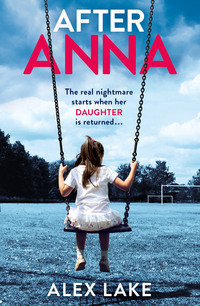
Cover photographs © Shutterstock.com (sky); Cherie Chapman (girl on swing)
A catalogue record for this book is available from the British Library
This is a work of fiction. Any references to real people, living or dead, real events, businesses, organizations and localities are intended only to give the fiction a sense of reality and authenticity. All names, characters, places and incidents are either the product of the author’s imagination or are used fictitiously, and their resemblance, if any, to real-life counterparts is entirely coincidental.
All rights reserved under International and Pan-American Copyright Conventions. By payment of the required fees, you have been granted the non-exclusive, non-transferable right to access and read the text of this e-book on-screen. No part of this text may be reproduced, transmitted, down-loaded, decompiled, reverse engineered, or stored in or introduced into any information storage and retrieval system, in any form or by any means, whether electronic or mechanical, now known or hereinafter invented, without the express written permission of HarperCollins e-books
Ebook Edition © JULY 2015 ISBN: 9780008150907
Version 2020-07-10
To my three musketeers: O, F and A
Contents
Cover
Title Page
Copyright
Dedication
Prologue
PART ONE: BEFORE
Chapter 1: Life Is Complicated
Chapter 2: The First Hours
Chapter 3: The First Day
Chapter 4: The Second Day
Chapter 5: The Third Day
Chapter 6: The Fourth Day
Chapter 7: The Fifth Day
Chapter 8: The Sixth Day
Chapter 9: The Seventh Day
PART TWO: AFTERWARDS
Chapter 10: Back Home
Chapter 11: Not Over Yet
Chapter 12: Losing Control
Chapter 13: Legal Questions, Moral Questions
Chapter 14: Doll’s House
Chapter 15: Home Time
Chapter 16: A Necessary Evil
Chapter 17: War of the Roses
Chapter 18: A Month Later
Chapter 19: Two Months Later
Chapter 20: An Hour Later
Keep Reading …
Acknowledgements
About the Author
Also by Alex Lake
About the Publisher
Prologue
It was easier than you had expected. The girl came without complaint. You spotted her as she left the school, alone, looking around, clearly bereft of a parent to pick her up. Who would do that? Who would be so negligent as to leave a five-year-old in such a vulnerable position? It was appalling, it really was.
But it was good for you.
Not so good for her, and definitely not so good for her poor, soon-to-be grief-stricken, self-hating parents, but good for you.
No one saw you. You were sure of that. You’d been watching them closely. Watching them mill around the school gates, waiting for their spoiled progeny to emerge so they could pepper them with inane questions.
How was your day? What did you learn? Were you a good girl, my princess? Were you a brave boy?
They were raising a generation of precious, weak children, who thought the world revolved around them, that it would adapt itself to their whims, would always allow them to win and never force them to struggle. It was a silent disaster, and it was creeping into every corner of society and no one was doing anything about it.
Except you. You are going to do your part to stop it, however small that part is.
And it starts with the girl.
She is yours now. Now, and forever. You like things to be yours. You have never been good at sharing. You would rather destroy something than share it. You know it is not your most attractive trait, but you don’t fight it. There is no point. It has always been that way.
And you will not share her. She is yours. Vanished into your car; traceless.
It has gone very, very well. As well as could have been expected.
You have to admit to being a little bit pleased.
You have to admit that you allowed yourself a pat on the back.
Have you been lucky, even? Maybe. You need luck. Everyone does. You are no different, at least not in that regard. In some others, yes. In some other ways, you are very different. Better. More clear-sighted. More decisive.
So maybe it wasn’t luck, after all. No, you don’t think it was. It was down to good planning. Yes, you prefer that. It was down to good planning. And ability, of course. Nerve and skill. It was you who’d done it, you who’d made it happen. Luck was not part of it.
Not that you are becoming complacent. That would not do. That way, disaster lies. Complacency is the path to failure. And you did not take the girl, did not get this far, to fail at the last.
So now she sleeps, the girl, dark-haired and beautiful and young, she sleeps in the back seat of your car. She is drugged, hidden away from prying eyes until the time comes for you to use her for the purpose for which you took her. For the purpose that meant you had to take her. It is a shame she has to be involved in this; a shame that she will pay the price for what others have done. It isn’t fair, you know that, but then the world isn’t fair. Life isn’t fair. You know that, too. Fair doesn’t come into it. Does the wolf slaying the lamb worry about fairness? About wounded innocence? No, it cares only about its hunger. There is no fair or unfair for the wolf. The wolf takes what it needs, and its need is the only justification necessary. Right, wrong; fair, unfair: they play no part in its world.
And they play no part in yours either. There is only strong or weak, winner or loser. The cry of it’s not fair is just a tool the weak use to constrain the strong. You cannot let it influence your actions.
And you don’t. You didn’t. You won’t.
Fair does not come into this.
Fair is for the weak.
For the losers.
As you drive away you allow yourself a smile. Apart from anything else, this is going to be fun.
PART ONE: BEFORE
1
Life is Complicated
i.
She was going to be late. Again.
Julia Crowne looked up at the clock on the wall of the boardroom. It was one of those Swiss railway clocks, with the blocky minute and hour hands. She happened to know that it was not an imitation; it was the real thing. It went with the polished wood of the oval conference table and the comfortable leather chairs. Nothing but the best for the boardroom. The clients they met in here were reassured by that kind of thing.
Two forty p.m. The meeting about the custody of a child was supposed to be over by now, but it had not gone well, mainly because her client, town councillor Carol Prowse, was being unreasonable. It was understandable, since she had come home to find her husband, Jordi, a poet and part-time English teacher, in bed with one of his former students, but it was not making things easy.
Under the table Julia’s foot tapped nervously. She had to pick up her five-year-old daughter, Anna, from school at three p.m., and she couldn’t be late. They had an appointment at three thirty to collect a cocker spaniel puppy from a woman who had been surprised when she woke one morning to plaintive cries and came downstairs to find that her dog – who had been suffering from a mysterious listlessness for the last week – was producing puppies at an astonishing rate.
The woman was a nurse and she worked the late shift; she had agreed to wait until three thirty, but that was as long as she could hold on. Julia and Anna had spent hours getting ready for the puppy: buying the bed, choosing where to put it, selecting the name (Anna had settled on Bella, which Julia thought was a fine name for a puppy), stocking up on dog treats, planning where they would take her for walks, and Julia did not want to have to deal with the disappointment that would follow if she had to tell Anna that the puppy would not be coming home that evening after all.
Even more than that, Julia needed the puppy to be a source of nothing but joy and affection, because she was going to be facing her own custody battle soon enough and, if it was anything like Carol Prowses’s, Anna would need all the distractions she could get.
Julia hadn’t found Brian in bed with one of his students – thankfully, since he taught in a junior school – or with anyone else, for that matter. If she had she probably wouldn’t have cared, which was exactly the problem. She liked Brian. She thought he was a good man and a good dad and a good husband – well, an OK man and an OK dad and an OK husband – but she just wasn’t inspired by him; no, it was worse, she wasn’t interested in him. He was like a work acquaintance that she knew in passing but didn’t really care about. The kind of acquaintance whose troubles you might hear about – did you hear Brian’s getting a divorce? – and think it was a shame but it wasn’t really any of your business. That was how she felt about Brian. He just didn’t belong in her life anymore.
It hadn’t always been like that. For a while she had kept a photo of her and Brian on the first day of their honeymoon on her desk at work. They were on a white sandy beach on the Greek island of Milos. They had just finished eating a meal of grilled fish and the sun was setting behind them. She’d asked the waiter – a Greek fisherman who doubled up as a beachfront restaurant owner in the evening – to take it.
Afterwards, they stood, arm in arm, facing the sea.
This is heaven, she said. It’s amazing. The world is such a magical place.
Brian laughed. You sound like you’ve been smoking too much dope. Like when we used to get stoned and stare up at the stars.
But this is real, Julia said. It really is heaven. Our feet in the water, nothing to worry about for the next two weeks. And nothing to do right now but go back to our room …’ she kissed Brian’s cheek, taking note of his muscular arms and flat stomach, then ran her hand through his salt-stiff hair, ‘where we can see if we can find a way to spend a few hours of our honeymoon.’
They were so at ease with each other then, so tight, so intertwined. But that was all gone now. Somewhere along the way they had taken different paths, started seeking different things in life. They hadn’t noticed at the time, hadn’t seen that they were slowly diverging, until it was too late. Looking back, Julia thought it had started around the time Anna was born. She was their only child, and the only one they were likely to have given how hard it had been to get her, and she deserved a dad who invented wild stories and made treasure hunts and drew and painted and created with her. A dad who injected energy and wonder and awe into her world.
Brian loved her, of course he did. He doted on her. But he never suggested that they try anything new, that they go camping on an island in a lake or to the seaside or to see a play. He didn’t build an obstacle course in the garden or put on plays in an Anna-sized theatre or assemble a trampoline and hold the Crowne Mini Olympics. Instead, he bought her the same pink Lego sets and Disney-branded dolls that every other girl her age owned. He was content for Anna to live her life in the narrow suburban confines he had allowed himself to become enmeshed in. It was too normal for Anna, and, for that matter, for Julia. She wanted more, and Brian could not provide it.
He was, truth be told, a bit boring, although Julia would never have put it that way to him.
Or at least, she hadn’t intended to, but when she’d told him a month back that she was considering their future together – specifically, whether they had one – he’d not taken it well, and they’d spiralled into a vicious argument. She’d ended up saying things she now regretted, but once things are said they have a habit of staying that way, and all you can do is live with the consequences.
You’re a bit, you know, a bit – she’d been thinking boring, but she managed to find a euphemism just in time – a bit mainstream.
Her attempt to soften the blow didn’t work. Brian clenched his jaw.
Mainstream? he’d replied. You mean boring, don’t you?
Stupidly, with two glasses of white wine lubricating her anger, she’d nodded.
She said a few more things she hadn’t been planning to share, like the fact that she didn’t want her life to drift by, empty of inspiration and wonder. Or the fact that she was sick of doing the same things every weekend, going to the same places every holiday, eating at the same restaurants. She wanted more, she wanted adventure and romance and colour.
You’re just having a bloody midlife crisis, Brian said. I thought it was me that was supposed to get scared about life leaking away and spend our savings on a sports car and have an affair with a bimbo.
And then she said the thing she really regretted.
I wish you would, she’d said. At least I could find something interesting in a man who had some fight in him. You’re ready for the pipe and slippers phase already.
What, he said, suddenly red-faced. What did you say?
She repeated herself. That you’re ready for your pipe and slippers. Julia found it odd that this, of all she’d said, was the thing that he was particularly exercised by, but his reply enlightened her.
Not that, he said. Not the bloody pipe and slippers. You said you could find something interesting in a man with some fight in him. So I’m not even interesting to you?
Julia realized that she hadn’t been making that statement – it had just kind of slipped out – but now it was said it was exactly what she meant. So she nodded.
You can think I’m boring, Brian replied, and lacking inspiration, or whatever it is you’ve read on Facebook that you should be looking for, I can accept that. What I can’t accept is you saying that there’s nothing about me that deserves your interest. Not your respect, and not, heaven forbid, your love, but your interest. If that’s the case it really is over.
And she had agreed. She told him he had put it well. That he really understood the situation.
Since then they had barely spoken. Brian slept in the guest room; she stayed in their room. On the few occasions they had been unable to avoid sharing words they had not discussed their future, until about ten days ago, when she had told him she’d made up her mind. She wanted a divorce.
Which was what Carol Prowse wanted, and would get. The problem was that she also wanted her husband only to have custody of their nine-year-old son when supervised. Her demand was ridiculous and vindictive, and it would never be granted.
Jordi Prowse had shaken his head when Julia said it, and now he was laughing.
‘Forget it,’ he said. His hair was greying at the temples and he had a relaxed, easy manner. ‘That’s simply unthinkable. There’s no grounds for that.’
There was a long pause. Carol Prowse looked at Julia. ‘That’s not what my lawyer thinks.’
That was what her lawyer thought, but it was not what Councillor Prowse wanted her to say. Julia glanced again at the time. Two fifty. She needed to wrap this up.
‘Given the age of the girls you were having an affair with I think that there are grounds to argue that you are not fit to be left in charge of a child,’ she said. ‘Moral grounds.’
His lawyer, an old friend of Julia’s called Marcie Lyon, shook her head. ‘There’s no way that’ll fly,’ she said. ‘You know that.’
Jordi grinned. ‘You’re just feeling humiliated,’ he said. ‘So you’re making empty threats.’
Carol Prowse stiffened in her chair. Julia had been here before, this could get ugly. It was the way that custody battles went. Both parties went in with the best intentions to reach an amicable settlement; both parties ended up locked in a battle for their kids, which ripped whatever was left of their relationship to pieces. But she couldn’t wait around to see this one. She looked at the clock again. ‘I think,’ she said, ‘that we might have achieved all we are going to achieve today. I would suggest that Ms Lyon and I meet later in the week to discuss the case.’
Jordi West shrugged. ‘Sure,’ he said. ‘You can meet and discuss how stupid her—’, he nodded at his wife ‘proposal is.’
Julia smiled. ‘We’ll discuss many things, I’m sure,’ she said. ‘Can we consider this meeting over?’
She had to get out of the room. She had accepted that she was not going to make it in time to pick up the puppy – it was a twenty-five-minute drive to the school, then another half hour to the lady’s house – but now she had a more pressing concern. She needed to call the school and tell them she was running late so they could hold Anna back. She got to her feet, aware that she was rushing the three other people in the room. Marcie gave her an odd look as she left; Jordi didn’t look at either Julia or her client.
Carol Prowse shook her head. ‘Can you believe that?’ she said. ‘He’s so damn arrogant.’
Julia could see that her client was in the mood to debrief, and normally she would have provided the sympathetic support she wanted, but right now that was simply not an option. She nodded agreement. ‘I’m sorry,’ she said. ‘I have to go. It’s my day to pick up my daughter from school.’
God, it sounded lame. This was the problem. She was expected to be a model professional, focused on her career, which meant she was at the beck and call of her clients, as well as being a model parent, which meant she was at the beck and call of her daughter. It was impossible to be both, but that didn’t lessen the expectation any.
In the corridor she took her phone from her bag and pressed the button.
The screen was black. It was out of battery.
She swore quietly. She fished around in her bag for a charger. Not there; of course not. It was in the car. She could run up to her office and call from there, but it was on the other side of the building. No – the quickest way was to get to the car and charge it there.
She hurried down the corridor. She didn’t doubt everything would be fine, but she still didn’t like the feeling of being late to pick up her daughter.
ii.
As she drove away from the office, Julia tapped her finger on the logo at the centre of the screen of her phone, even though she knew it would not shorten whatever process it went through when it switched on. She did the same thing when waiting for a lift; if it was slower to arrive than expected she would press the call button again. And sometimes again.
Won’t come any faster, some wag might say, and she’d reply, with a thin smile, well, you never know.
Come on, she thought. Come on.
This had happened before, resulting in an uncomfortable encounter with Mrs Jameson, the retired teacher who stayed after school with the children whose parents had neglected to turn up on time. It was going to happen again today. There’d be the stern, disappointed look, then the gentle reminder of school policy.
Mrs Crowne, I realize you are busy but could I remind you that the school cannot provide after-hours childcare without prior arrangements being made. If you need such assistance then we can provide it, but you must inform us ahead of time so that we can make the necessary arrangements.
I’m sorry, she’d mumble, feeling like she was back at school herself, hauled in front of the head teacher for smoking or wearing her skirt an inch too short, but my case ran over and I would have called but my phone ran out of juice and thank you Mrs Jameson for being so flexible. I appreciate it, I really do.
And then she’d leave, feeling like a terrible parent but wondering why, since Anna would be perfectly fine, babbling away in the back seat, telling Julia about her day and asking what was for dinner and could they read The Twits again that night, and Julia would be shaking her head and thinking I’m not a bad mother, just a busy one.
And she was about to get busier. When she and Brian separated she would have to pick up almost every day, and God knew how she was going to do that. At least now she had Edna, Brian’s mum, to help: she took Anna on Mondays and Wednesdays, and Brian normally got out of school early enough to get her on Fridays, which left Julia with two days on which she had to cram her meetings into the morning and spend the evenings catching up on emails. From time to time, if she was going to be late, she could give Edna a call; in fact she had tried that morning, but Edna was out so she had left a message, a message that Edna had ignored. And then, damn it, in the dash from one meeting to another she had stupidly let her phone run out of battery. Mental note: always keep the phone charged on Tuesdays and Thursdays.
And maybe other days as well. She doubted she would be able to rely on Edna after the divorce; behind her sweetness, Edna was a traditional matriarch, and Julia had never felt that she liked her son’s wife all that much.
Anyway, it would be what it would be. Whatever happened, Julia could take it. That was the price she would have to pay for the life she wanted.
Finally, her phone beeped as it booted up. She found the school’s number and pressed send. It rang through to the answering service pick up.
‘This is Julia Crowne,’ she said. ‘I’m running a little late, but I should be there—’, she glanced at the clock on the dashboard ‘around three twenty. Anyway, just to let you know, I’m coming.’
Ten minutes later she arrived at the school. As she pulled up outside the school gates, her phone rang. She unplugged it from the car and opened the door.
‘Hello,’ she said. ‘This is Julia.’
‘Mrs Crowne,’ a voice said. ‘This is Karen, from Westwood School.’
‘Oh,’ Julia said. ‘Don’t worry. I’m here. I just arrived.’
‘Mrs Crowne,’ Karen said, her voice uncertain, ‘do you have Anna with you?’
‘No,’ she said. ‘I’m coming to pick her up. I left a message.’
‘I thought that was what you said,’ Karen murmured. ‘Mrs Crowne, I think there’s been a mix-up.’
A mix-up. Not words you wanted to hear in connection with your five-year-old daughter.
Julia stopped. She stared at the cast iron school gates. Both were adorned with the school crest: an owl clutching a scroll above the letters ‘WS’.
‘What do you mean?’ she said, her voice tightening with the beginnings of worry. ‘What kind of mix-up?’
‘Anna’s not here,’ Karen said, her tone retreating into something official, something protected. ‘We thought she’d left with you.’
iii.
Julia broke the connection. She ran through the gates to the school entrance and pushed open the worn green door, then ran along the corridor in the direction of the administrative offices. Karen, the school secretary, tall and thin, with a head of tight black curls, was standing outside the office door, her face drained of colour.
‘Mrs Crowne,’ she said. ‘I’m sure everything’s ok. Perhaps your husband picked her up.’
The twitchy, alert look in her eyes belied the calm reassurance of her tone. Julia’s stomach fluttered, then contracted. She had a sudden, violent urge to vomit.
‘I’ll check,’ she said. She dialled Brian’s number.
‘Hello.’ His voice was hard; his dislike of her deliberate and obvious. ‘What do you want?’
Julia licked her lips. They were very dry. ‘Brian,’ she said. ‘Is Anna with you?’
‘Of course not. I’m at school. It’s your day to pick her up.’
‘I know,’ Julia paused, ‘but she’s not here.’
There was a long silence.
‘What do you mean she’s not there?’ The hardness in his voice had softened into concern. ‘Where is she?’
‘I don’t know,’ Julia said, wanting, even in this situation, to add a sarcastic obviously. ‘Maybe your mum picked her up?’ She almost smiled with relief. This was the answer, after all, of course it was. Edna, her grandmother, had come on the wrong day. The relaxation was almost palpable, like the glow from a stiff drink.
‘It wasn’t mum,’ Brian said. ‘She’s at home. She called an hour or so ago to ask about something. She wanted to know where the stopcock for the mains was. Apparently, there was some kind of leak in the kitchen.’
The hopeful glow faded. Julia swallowed; her mouth powder dry. ‘Then I don’t know where she is.’
They were words you never wanted or expected to say to your husband or wife or anybody at all about your five-year-old daughter. Five-year-old children were supposed to have known whereabouts at all times: with one or the other parent, at school, at a friend’s house, with a select few relatives, who, in Anna’s case, were Brian’s mum Edna, or, occasionally, when they were back from Portland, Oregon, Brian’s brother Simon and his wife Laura, these being the extent of their relatively small family circle.
‘You don’t know where she is?’ Brian asked, his voice caught between anger and panic. ‘You’d better find her!’
‘I know.’
‘And it’s nearly half past three! How come you’re just calling now?’
‘I was a bit late,’ Julia said. ‘I just got here. I thought the school would be – I thought she’d be here.’
‘Did you let them know you’d be late?’
‘No, I … my phone was dead. I just assumed … ’, her voice tailed off.
‘Jesus,’ Brian said. ‘She could be anywhere. In thirty minutes, she could be anywhere. She could have wandered … ’ he paused. ‘I’ll be there as soon as I can. Start looking for her. Search the grounds and the streets nearby.’
‘OK.’ She felt frozen, unable to think. ‘We’ll search for her.’ She looked again at Karen, who nodded.
‘I’ll tell the cleaning staff to help,’ Karen said. ‘And Julia – don’t worry. She’ll turn up, I’m sure. She’s probably in someone’s garden, or the newsagent, or somewhere like that.’
Julia nodded, but the words were not at all reassuring. They were little more than meaningless sounds.
‘Brian,’ she said. ‘I have to go. I have to get started.’
‘One more thing,’ Brian said. ‘Call the police.’ He hesitated. ‘In fact, I’ll call them. You start looking for her. Start looking for Anna.’
The line went dead. Julia’s hand dropped to her side. Her phone, loosely gripped between her thumb and forefinger, dropped to the floor.
Oh, God,’ she said. ‘Oh, God.’
2
The First Hours
i.
These were the crucial hours.
If you had been seen then the police would learn about that soon enough. First, they would check the immediate area, then they would drive the route to the girl’s house to see if she had set off for home alone. When they didn’t find her they would contact all the parents and staff who had been there at three p.m. and ask them what they had seen. Then they would interview the family. They always looked close to home first, not that they would find anything.
And, of course, they would check the school’s CCTV. You knew you weren’t on that. All they would see was the girl walking out of shot and into oblivion.
Of course, there was always the possibility that there was a camera in the area you hadn’t spotted. You’d checked carefully, but it was possible.
And if there was, or if they had seen you, and realized who you were, then the police would be here soon enough, knocking on your door.
But that was OK. You had a plan for that. For these first hours the girl was elsewhere, stashed in your neighbour’s garage; your neighbour who was in Alicante for the fortnight, and who had left you their house keys because you’re our only neighbour so you can keep an eye on the place in case anything happens.
Something had happened, but not something they could have imagined.
You’d backed into their garage and unloaded her, then put your car away. No one would have seen. There was no one to see. No prying eyes. No spying eyes. It gave you comfort that you were invisible to the world, allowed you to get on with your life unobserved. Not just now, with the girl, but the other times as well.
And now the girl lay there, sleeping on the floor of a large doll’s house that the father had built for his kids, his braying, noisy kids, who had outgrown it. It was just big enough for her to lie full length in, her feet by a small table, her head on a bag of sand, which was destined to re-fill the sand pit that the two spoilt kids who loved to disturb your afternoon peace played in.
She could stay there until midnight. That was when you would bring her inside and introduce her to her new home.
Her temporary new home.
She wouldn’t be here for too long.
ii.
Julia ran out of the green front door of the school. Ahead of her were the gates, still open from when she had come in. They were supposed to be kept locked at all times. Supposed to be. The problem was that things that were supposed to be often weren’t. She was supposed to have been there to pick up her daughter, but that didn’t help much now.
She pictured the school at the end of the day. Kids in uniforms pouring out of the school doors, the younger ones heading straight for the parents outside the gates, the older ones running into the playground for a last few minutes of fun before home and dinner and bedtime, the teachers hanging back, making sure that everything went as it should, which it would, because it always did. Every child would be accounted for, either picked up by whoever was supposed to be there for them or held back inside the sanctuary of the school because their adult was late. No one slipped through the cracks, not at this small, fee-paying private school. The parents here could be relied on to make sure that their children were properly looked after, that they were not left waiting and vulnerable. The chance of a mistake was vanishingly small.
But it was not impossible.
Julia pictured a small, dark-haired girl with a pink Dora the Explorer backpack and new black leather shoes walking out of the gate with the other pupils and looking around for her mother, frowning when she didn’t see her. And then maybe walking a little further down the street, perhaps thinking that she could find the familiar black Volkswagen Golf her mum drove. And then, a hand tapping her on the shoulder, a large, man’s hand, with thick fingers and black hair sprouting from the point where the hand met the wrist – Julia blinked the vision away. She had to stay calm, or at least calm enough to look for her daughter.
‘She’s fine’, she said, talking to herself. ‘She’s fine. She’s just waiting somewhere.’
The words didn’t make her feel any better. There was a ball of fear and panic knotted somewhere between her stomach and her sternum so big and real and hard that it was making it difficult to draw breath and to keep her head from dizzying.
But she had to act. She had to do something. And the quicker the better. She ran towards the iron gates. She would start outside the school. If Anna was in the building or the school grounds then she was probably OK. She could wait to be found. If she was outside – well, she needed to be found as soon as possible. Outside were cars and dogs and buses and people who might have an interest in an unaccompanied five-year-old girl that they shouldn’t have.
‘Anna!’ she shouted. ‘Anna! Where are you?’
She heard a similar call from inside the school, as Karen started her search.
‘Anna!’ Julia shouted. ‘It’s Mummy! Where are you, darling?’
She exited the gate and faced her first decision. Left or right? Left, towards the village centre, or right, towards a small development of overpriced cookie-cutter commuter boxes surrounded by scrubby fields? Boxes with closed doors and sheds and hiding places, boxes that were unoccupied and unobserved during the day when the inhabitants were at work or at school, boxes into which a girl could be smuggled. So, left or right? It was normally such a small decision. If you got it wrong you could backtrack and try again. But this time it felt bigger, more important. This time it was not just left or right: it was towards Anna or away from her.
But do something, Julia thought. Standing still is the worst option.
She went left, towards the village. It was more likely Anna had wandered that way, gone towards people and the newsagents and the recently opened old-fashioned sweet shop that sold sweets in quarter pounds and half pounds from jars behind the counter. The Village Sweete Shoppe, it was called, and Anna loved it.
The narrow, tree-lined road to the village curved left then descended a small gradient. The houses along the road were old and large and concealed behind high sandstone walls and thick foliage, which was both a good and a bad thing: it was unlikely that Anna would have been able to get into the gardens, but if, for some reason she was in there, she would be impossible to see.
These were the thoughts Julia had now. She saw once innocent gardens as threats to her daughter. The whole world was twisted into a sick new configuration. It made her head spin.
‘Anna!’ Julia was surprised at how loud her voice could go. She hadn’t used it like that for years. Even when she and Brian were in full flow she didn’t turn it up this much. ‘Anna! It’s Mummy! If you can hear me, just say something. I’ll come and get you!’
There was no reply. Just the distant barking of a dog (is it barking at Anna? Julia wondered) and the noise of a car engine (where’s that car going? she thought. Who’s in it?) and somewhere, incongruously, a pop song being played at loud volume.
She ran down the hill, her heels clicking on the pavement. ‘Anna!’ she shouted. ‘Anna!’
There was a rustle in a thick rhododendron bush to her left. Julia stopped and pulled back the branches. The inside was cool and smelled of wet earth.
‘Anna?’ she said. ‘Is that you?’
There was another rustle, deeper in the bush. Julia pushed her way in; her heart thudding.
‘Anna’ she called. ‘Anna!’
The rustle came again, then a blackbird emerged from the other side of the bush. It looked at Julia, then took flight and vanished into the branches of a sycamore tree.
Julia stood up. To her left was a driveway leading to a covered porch. A man in his sixties, with grey hair and walking cane, was standing in the doorway, looking at her.
‘Everything OK?’ he asked. ‘I heard you shouting.’
‘It’s my daughter,’ Julia said. ‘I can’t find her.’
The man frowned. ‘Oh dear,’ he said. ‘What does she look like?’
‘She’s five. Dark hair. She has a pink rucksack and she’s in uniform.’
‘Is she at the school? Westwood?’
Julia nodded. ‘Have you seen her?’
‘No. But I could help you look?’ He lifted his walking stick. ‘I’m not very mobile, but I could drive around and look for her.’
Julia looked at him, suspicion clouding her mind. Did he have Anna? Was this some double bluff? She caught herself; he was just someone trying to help, and she needed all the help she could get at the moment. Probably, anyway. She’d mention him to the police later, if it came to that.
‘That would be wonderful,’ Julia said. ‘Maybe I should drive, too.’
‘You can probably look more closely on foot. I’ll take my car, though. And my wife is home. She’ll take the other car. What’s her name, if we do see her?’
‘Anna. Just stay with her and call the police.’
‘OK,’ the man said. ‘Good luck.’
‘Thank you,’ Julia said. She pulled herself out from the bush, wincing, as a twig or thorn or branch scratched her bare calf, then carried on towards the village.
As she ran, she examined everything – every hedge, every fence, every parked car – but felt she was seeing nothing. She didn’t trust her eyes, didn’t trust that Anna might not appear where she had just looked, and so she found herself checking the same places two, three times before allowing herself to move on. Part of her knew it was unnecessary and irrational, but she couldn’t help it; the stakes were just too high, the consequences of missing her daughter – who must be somewhere nearby – were too awful for her to allow herself to make a mistake and miss what was – what might be – in front of her nose.
She’d heard that when the police searched for evidence, when they got one of those lines of people to sweep a field or moor or wasteland, they never let the people who were involved – that is, the people who were looking for their loved ones – join in. Apparently, if you were too close to whoever was lost your searching abilities were compromised in some important way. Perhaps it was that you wanted to find whatever it was too much to maintain the calm, patient detachment required.
Whether that was true or not, she certainly did not feel calm or patient. What she felt was panic, a panic that threatened to overwhelm her and leave her in a heap on the pavement. It took a monumental effort for her not to put her face in her hands, sink to her knees, and start to pray.
‘Oh my God,’ she muttered. ‘Oh my God, oh my God, oh my God.’ Then, for a moment, the panic rose and did take over and she stopped, her head craned forward, her gaze sweeping from left to right.
‘Anna!’ she screamed. ‘ANNA!’
She began to sprint. She had an image of Anna in The Village Sweete Shoppe, sitting on a stool by the window with a black liquorice stick staining her hand, her lips blackened with its juice. That was where her daughter was, she was sure of it. That was where Anna would have gone. There was nowhere else: Anna didn’t know anywhere else, really. At five, her world was the house and garden, school, the houses of some friends, and a few places that she visited with her parents. One of those was the sweet shop.
They went there sometimes after school. Julia didn’t give her daughter too many chocolates or crisps or ice cream or other junk food, but for some reason the stuff in The Village Sweete Shoppe felt different, more wholesome. It was the experience as much as anything: talking to the proprietor, weighing the various choices – pear drops, Everton mints, cola cubes – and counting out the price. It was old-fashioned, the way it had been when Julia was a child, when she had taken her pocket money on a Saturday morning and gone with her dad to the local newsagent and chosen the sweets she wanted, and she liked the thought that her childhood and her daughter’s shared something.
They went there, once or twice every month. They left the car parked outside the school gates, walked down the hill, and went to buy sweets. It was about the only thing they ever did straight after school, the only thing that Anna knew. And she loved it.
So she was there, Julia knew it and as she sprinted she knew she was going to get there and find her daughter and sweep her up into a protective embrace from which she thought she might not ever let her go.
The bell above the door jangled. Julia took a couple of quick steps into the shop, looking wildly from corner to corner.
‘Hello,’ the owner, a retired postal worker called Celia, said. ‘Can I help?’
‘Has my daughter been in?’ Julia asked.
The owner thought for a second, trying to place Julia. ‘Your daughter’s Anna, isn’t she? A dark-haired little girl? Likes chocolate mice?’
‘That’s her. Has she been in?’
The owner shook her head. ‘No,’ she said. ‘She’s a bit young to come in on her own.’
‘Are you sure?’
‘I’ve been here all afternoon. Hardly anyone has been in, and I’d remember her, especially if she was alone.’ Celia leaned forwards. ‘Is everything OK?’
Julia looked past the foot-long lollipops and chocolate rabbits to the street outside the shop window. Anna wasn’t here. She was somewhere out there.
Somewhere. Out. There.
Now the panic did take hold. She turned back to the Celia, her legs weakening.
‘I’ve lost her,’ she said. ‘I’ve lost my daughter.’
iii.
It happens to every parent, one time or another. Perhaps in a supermarket, perhaps in the library, perhaps in the back garden.
You look around and your child is not there.
‘Billy!’ you shout, then, a little louder. ‘Billy!’
And Billy replies, and comes toddling into view, holding a bag of flour, or a book, or with a worm in the grip of his pudgy hands. Or maybe he doesn’t, and you have that sudden lurch of fear, that tightness in the back, and loose feeling in your stomach, and you look around a little wildly, before running to the end of the aisle or to the kids’ books section or to the back gate, and there he is. Little Billy; safe and sound.
And you swear you’re going to make sure you don’t let them out of your sight again, not for a second, because a second is all it takes.
And a second is all it takes. In one second, a kid can step out from behind a parked car or be shoved into a van or even just walk round a corner and get lost enough that it takes you ten agonizing minutes to find them, which, although agonizing, is the best possible outcome. You find them sitting on a bench chatting to a kindly stranger or playing with some kids they met or just wandering about absorbed in all the things they are seeing on their own for the first time.
And then you really swear that you aren’t going to let them out of your sight again, because, in that ten minutes your mind races to the worst possible conclusions: they’ve fallen in the canal, they’ve been hit by a car, they’ve been abducted.
And that’s the one that bothers you the most. They’ve been taken. Picked off the street in a neglectful moment and taken. Gone forever. Alive or dead, it doesn’t matter. You won’t ever see them again, but you won’t ever be able to stop looking. And you won’t ever forgive yourself.
But, of course, even when you’re contemplating that horrific, tortured possibility, a still, calm voice at the back of your mind is telling you not to worry, that everything is ok, that it’ll all work out because it always does.
Except it doesn’t. Not always.
And you know that. Which is the most frightening thing of all.
Julia ran out of The Village Sweete Shoppe. She glanced left and right: the same choice again. Left into the village or right, back to the school. She turned left and jogged down the hill. If there was news at the school someone would phone her. At least this time her phone was charged.
A woman of her age, with short hair and an expensive-looking bag, was walking towards her. Without thinking, Julia caught her eye.
Julia, like many English women of her age and social class, had an aversion to both making a scene and bothering people that bordered on the pathological. She would no more have asked a stranger for help – to lend her money, perhaps, or let her use their mobile phone, or get assistance changing a car wheel – than she would have walked unannounced into their kitchen, opened their fridge, and made herself a salad.
This, though, was different. It was not a time to worry about social proprieties.
‘Excuse me,’ Julia said. ‘I’m looking for my daughter. She’s five, she has dark hair and a pink rucksack, and she’s in school uniform. Have you seen her?’
‘No,’ the woman replied. Her face took on an odd expression, a mixture of concern and sympathy that Julia found discomfiting. ‘Has she been missing long?’
‘Not that long. Twenty minutes. Maybe more.’
The expression deepened into a frown. ‘Gosh. That’s a long time.’
‘I know,’ Julia said. ‘Would you keep an eye out for her?’
‘Of course. I’ll help you.’ She gestured to the village car park. ‘I’ll look around the car park and check the library. There’s a playground round the back. She might be there.’
‘Thank you,’ Julia said. ‘Her name is Anna,’ she added. She set off down the slope. On the right was a pub; on the left a post office, although neither seemed the same as it had the last time she had seen them. Then they had been simple buildings, parts of the infrastructure of the village, communal places that offered warmth and light. Now they were threatening; places where Anna might be kept hidden.
She put her head around the post office door. There was a queue of four waiting for the one open booth.
‘Excuse me,’ she said, aware of her breathlessness. ‘I’m looking for someone. My daughter. Anna. Maybe you’ve seen her in the village?’
‘What’s she look like?’ a man in paint-splattered overalls asked.
Julia gave the description. It was already horribly familiar: dark hair, rucksack, school uniform. It fitted many five-year-old girls, but that didn’t matter, because there was one element that marked Anna out from all the others.
‘She’d have been alone,’ Julia said.
After a sympathetic pause – Julia was already starting to hate sympathetic pauses – followed shaking heads, murmured negatives: she hadn’t been in, and they hadn’t seen her.
Julia ran across the road to the Black Bear pub. It was dark inside, the windows grimy, the smell of smoke still lingering despite the ban on inside smoking. There were only three customers: an underage couple skulking in the corner and a man at the bar.
There was a woman tending the pumps. Julia walked over to her.
‘Excuse me,’ she said. ‘I’m looking for my daughter. She’s five.’
‘A bit young to be in here, love,’ the woman said. She was in her early fifties, Julia guessed, but looked older. She had heavily tattooed forearms and a lined face and was wearing a push-up bra.
‘I thought, maybe, she wandered in,’ Julia said. ‘I’ve lost her.’
The man at the bar looked up from his newspaper, his nose and cheeks red with broken capillaries.
‘Not seen her,’ he said. He patted the stool next to him. ‘I’ll buy you a drink, though, darling.’
The woman behind the bar – probably the landlady – shook her head in disapproval, but she didn’t say anything. She probably didn’t want to upset a regular. Couldn’t afford to. The pub was shabby; it didn’t look as if it was doing so well.
‘Can’t help you, love,’ she said. ‘Not seen her.’
Julia nodded thanks and left. She was glad to emerge into the sunshine. Next door was a bakery specializing in local dairy products and artisan breads. On the other side, a café.
‘Excuse me,’ she said. ‘I’m looking for a little girl. My daughter.’
The man behind the counter raised an eyebrow. He had dark, curly hair and dark eyes, and huge, flour-dusted hands.
‘What does she look like?’ he asked, in a Scottish accent.
Julia told him. He shook his head, then leaned over the counter, addressing the café side of the building.
‘’Scuse me,’ he said. ‘This lady’s looking for a wee lass. Her bairn. Anyone seen a girl on her own?’
No one had, but one lady got to her feet.
‘I’ll help you look,’ she said.
Others joined her, and the patrons of the café spilled onto the main street of the village. They organized themselves and headed in different directions.
Julia looked around for somewhere else to search. A river ran through the bottom part of the village, and, where it disappeared into a copse, there was a small depression where the council had once put a few benches. It wasn’t obvious why; it was damp and dark and only occasionally occupied, at least during the daytime. The beer cans and cigarette butts that littered it suggested that it saw more action in the evening. It was just the kind of place teenagers would have been drawn to: a bit off to the side, away from the action, the fast-flowing river beside it conferring a hint of danger and exoticism.
Julia crossed the road and walked towards the railings at the edge. She didn’t think Anna would be there, and she wasn’t, but she leaned over the railings and looked down at the water anyway. The river had been artificially narrowed and the water sped up before disappearing into a tunnel under the main road. There was a damp crisp packet by her right foot. She kicked it and it fluttered down into the water, then was swept away.
If that had been Anna, she thought, then stopped herself. She wouldn’t have come down here. She just wouldn’t. She wouldn’t have got this far, not on her own. She wouldn’t have dared. She must be closer to the school.
She headed back to the main road. As she reached the pavement, her phone rang. It was Brian.
‘Where are you?’ he asked. ‘Have you found her?’
‘I’m in the village. And no. Where are you?’
‘I’m just arriving at the school. The police are already here, it looks like.’
‘Do you see Anna? Is she with them?’
‘No,’ he said. ‘She isn’t.’
‘What should I do, Brian? Should I keep looking down here?’
There was a long pause. ‘I don’t know. We need to talk. I’ll come down to the village and pick you up.’
She stood on the pavement. It was cobbled, and she could feel the hard curves of the stones through the thin soles of her shoes. It was the only thing that felt solid; the shops and cars and people that surrounded her seemed slippery, ungraspable, unreal.
‘Anna,’ she shouted. ‘Anna!’ It was as much a wail of loss as a call that she expected an answer to; she realized when she tasted the tears on her lips that she was crying.
Her phone rang. She didn’t recognize the number.
‘Mrs Crowne?’ a voice said. ‘This is Jo Scott. I was wondering whether you were still coming?’
For a moment, Julia could not work out who the woman was, then she remembered. The dog woman. The woman with Bella, Anna’s puppy.
‘Oh,’ she said. ‘I’m sorry. Something came up. Can I call you back?’
There was a pause. An irritated pause, Julia thought.
‘Ok,’ the woman said. ‘Call me back. But I have to leave for work now, so it’ll have to be another day for the puppy.’
As Julia hung up a car pulled up next to her. It was Brian.
‘Hi,’ he said. ‘Get in. The police are at the school and they want to talk to you.’
iv.
They pulled up at the school and got out of the car. As they walked towards the door, Julia reached out for Brian’s hand. It was a while since they’d touched in any but the most perfunctory way and she was surprised how much reassurance it gave her, how much she needed to feel another human being.
She squeezed his fingers.
He looked at her, eyes narrowed, and pulled his hand away.
‘Brian,’ she said. ‘Please.’
‘Now’s not the time,’ he said. ‘You need to talk to the cops.’
Mrs Jacobsen, the headmistress, approached them. She was accompanied by a uniformed officer. He nodded at Julia. He had a bustling, efficient presence. At the far end of the corridor another officer was talking to a woman in jeans and a sweatshirt.
‘Mrs Crowne,’ he said. ‘I’m PC Davis. We received a report that your daughter is missing?’
‘Yes,’ Julia said. The presence of the police officer was as disturbing as it was reassuring. If the police were here, then this was real. She felt her legs weaken. ‘I don’t know where she is. Help me find her. Please.’
PC Davis nodded. ‘We will, Mrs Crowne. I’m sure that she’s close by. That’s normally the case in these situations. There are quite a few members of the school staff out looking for her,’ he said. ‘Now, you were in the village?’
‘Yes,’ she replied. ‘Anna – there’s a sweet shop she likes, that we sometimes go to after school. I thought she might be there.’
‘Is there any reason you thought she might have gone there?’ PC Davis asked. ‘Has she done this before? Walked away from the house, or the school?’
‘No,’ Julia said. ‘Never. She knows not to.’
PC Davis nodded again. ‘Have you traced the route back to your house?’ he said. ‘Often when a child is missing from school they have simply gone home alone.’
‘She wouldn’t have done that,’ Julia said. ‘We live three miles away. I doubt she even knows the way.’
‘Maybe not,’ PC Davis said. ‘But children sometimes decide that they are ready for something when we don’t expect it. We need to check the route to your house.’
‘No,’ Julia said. She knew Anna, and she did not think for a second that she was merrily strolling home on her own. ‘I don’t want to waste time.’
‘Mrs Crowne,’ PC Davis said. ‘We need to check whether Anna left on her own. I understand your concern, but we have to be systematic in our approach. Could you give me your address?’
‘Of course,’ Brian said. He gave the address.
‘Thank you,’ PC Davis said. ‘We’ll send a car to drive the route.’
‘What else are you going to do?’ Julia asked. ‘Anna could be hurt, or in danger.’
‘We’re going to do everything we can, Mrs Crowne,’ PC Davis said. ‘But we have to take this one step at a time.’
Julia stared at him. She didn’t like him, this burly officer who thought of this as a process, as a problem that could be solved with a step by step approach, when it was her daughter, her only child, who was five-years-old and missing, now for almost forty minutes.
Forty minutes. Yes, she might be on the route home, or playing in a local park, but what if she wasn’t? What if someone had taken her? She could be forty miles away by now.
‘What can we do?’ Julia said. ‘How can we help?’
‘Call around,’ PC Davis replied. ‘Anyone you can think of. Anna’s friends’ mothers, relatives. Anyone who might have picked her up. Think if there’s anywhere else she might be? Does anyone else ever pick her up? A relative maybe?’
‘Her grandma, on Mondays and Wednesdays,’ Julia said.
‘Is there any possibility she came today, by mistake?’
‘No,’ Brian said. ‘I spoke to my mother about two p.m.. She was at home. The kitchen was flooded.’
‘Anyone else?’ PC Davis asked.
‘No,’ Julia said. ‘Only myself or Brian or Edna pick her up, and she knows not to go with strangers.’
‘Could another parent have seen her alone and taken her home? Maybe tried to call you?’
‘I don’t think so.’ Julia looked at her phone. ‘There are no missed calls.’
‘It is possible, though,’ PC Davis said. ‘Who would be the most likely to do something like that?’
Julia looked down. Her shoes were scuffed from the search in the village. ‘Perhaps Dawn Swift’s mum, Gemma. Or maybe Sheila Parks.’
‘Could you call and ask them?’
Julia nodded and found Gemma Swift’s number on her phone. Gemma picked up on the second ring.
‘Hi Julia,’ Gemma said. ‘How’s it going?’
She hesitated for a moment, hoping that Gemma would fill the gap with a declaration that Anna was with her and she hoped Julia didn’t mind but she’d brought her home when she saw she was alone at the school and she’d meant to call but the girls wanted a snack and then the dog had to be fed, and you know how things can get away from you.
‘Are you there, Julia?’ Gemma said.
‘Yes. Gemma, did you happen to see Anna at school today?’
‘No. Why?’
‘I was late. And when I got here she was gone.’
‘What do you mean, gone?’
‘She wasn’t at the school. I can’t find her.’
‘Oh my God.’ The horror in Gemma’s voice was like a sudden blow to the stomach. It crystallized everything that was bad about this situation into one moment, and it left Julia short of breath.
This is real now, she thought. This is the real thing.
‘Jules,’ Gemma said. ‘Can I help?’
‘I don’t think so. The police are here.’
‘I’ll call round some people,’ she said. ‘The more people looking the better.’
Julia was suddenly sick of this conversation, sick of everything it meant.
‘I have to go,’ she said. ‘Thanks Gemma.’
‘Could you call the other person you mentioned?’ PC Davis said. ‘And anyone else that springs to mind. In the meantime, I’m going to radio in for some more officers.’
Julia nodded. Mrs Jacobsen gestured towards her office.
‘You can go in there,’ she said. ‘Have some privacy.’
Fifteen minutes later the door to Mrs Jacobsen’s office opened. PC Davis came in. He had the false smile of someone who had bad news but wanted to be reassuring.
‘We did not find Anna on the way to your house,’ he said. He paused, ‘so we have to consider the possibility that she’s a little further afield.’
Julia reached for Brian’s hand again. This time he took it.
‘What does that mean?’ Julia asked. ‘Where’s Anna? Where’s my daughter?’
PC Davis shuffled uncomfortably from foot to foot.
Бесплатный фрагмент закончился.