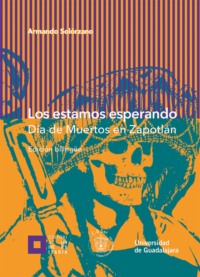
Читать книгу: «Los estamos esperando»


Ricardo Villanueva Lomelí
Rectoría General
Héctor Raúl Solís Gadea
Vicerrectoría Ejecutiva
Guillermo Arturo Gómez Mata
Secretaría General
Jorge Galindo García
Rectoría del Centro Universitario del Sur
Missael Robles Robles
Coordinación del Corporativo de Empresas Universitarias
Sayri Karp Mitastein
Dirección de la Editorial
Solórzano, Armando, autor
Los estamos esperando: Día de Muertos en Zapotlán = We are waiting for you: Día de Muertos in Zapotlán/Armando Solórzano. —1a ed.— Guadalajara, Jalisco: Editorial Universitaria: Universidad de Guadalajara. Centro Universitario del Sur, 2020.
248 páginas; ilustraciones (algunas color)
Incluye referencias bibliográficas.
Texto en español e inglés
ISBN en trámite
1. Día de los fieles difuntos-Zapotlán el Grande, Jalisco 2. Zapotlán el Grande, Jalisco-Vida social y costumbres 3. Zapotlán el Grande, Jalisco-Religión I. t. II. Serie
394.260 972 35 .S68 DD21
GT4995 .A4 .S68 LC
Primera edicción electrónica, 2020
Textos
© Armando Solórzano
© Adolfo Espinoza de los Monteros Cárdenas
Fotografías
© Armando Solórzano
Coordinación editorial
Iliana Ávalos González
Jefatura de diseño
Paola Vázquez Murillo
Cuidado editorial
Editorial Universitaria
Diagramación y diseño
Estudio Tangente
D.R. © 2020, Universidad de Guadalajara

Editorial Universitaria
José Bonifacio Andrada 2679
Colonia Lomas de Guevara
44657 Guadalajara, Jalisco
www.editorial.udg.mx
01 800 UDG LIBRO
ISBN en trámite
Junio de 2020
Se prohíbe la reproducción, el registro o la transmisión parcial o total de esta obra por cualquier sistema de recuperación de información, existente o por existir, sin el permiso previo por escrito del titular de los derechos correspondientes.
Diseño epub:
Hipertexto – Netizen Digital Solutions

Índice
Acknowledgments
Reconocimientos
Presentation
Presentación
Adolfo Espinoza de los Monteros Cárdenas
Introduction
Introducción
Armando Solórzano
Chapter | Capítulo 1
The uniqueness of the Día de Muertos in Zapotlán
Lo distintivo en la celebración del Día de Muertos en Zapotlán
Adolfo Espinoza de los Monteros
Chapter | Capítulo 2
Cultural and religious syncretism
Sincretismo cultural y religioso
Chapter | Capítulo 3
The living and the dead upon meeting in the cemetery
Vivos y muertos al encuentro en el cementerio
Chapter | Capítulo 4
Skulls
Calaveras
Chapter | Capítulo 5
Dancing opens the way from life to death
Danzar abre el camino de la vida a la muerte
Chapter | Capítulo 6
Pan de muerto savoring nostalgia
Pan de muerto para degustar la nostalgia
Chapter | Capítulo 7
Altars
Altares
Chapter | Capítulo 8
Offerings for life and memory
Ofrendas por la vida y la memoria
Chapter | Capítulo 9
The Catrina walks through Zapotlán
La Catrina se pasea por Zapotlán
Chapter | Capítulo 10
Theater
Teatro
Chapter | Capítulo 11
Life goes on
La vida sigue
Footnotes
Notas al pie
Acknowledgments
This book belongs to all, especially to those who have passed away. On a visit to my parents’ grave in Zapotlán, Jalisco, I was fortunate to meet María Guadalupe Velazco Cuevas, director of the Miguel Hidalgo cemetery. On the exemplary care with which she maintains the tombs’ impeccable condition, Lupita added: “I take care of all the dead ones alike. I feel that all the dead are my children”. Since then, she has been a source of information for this volume.
I owe much to Martin Benito Montiel, who has a great passion for the tradition of the Día de Muertos in Zapotlán. His objective is to find the differences between the celebration of the Día de Muertos in Zapotlán and the celebrations of the dead in the rest of the world. He is not a trinitarian. He understands life in terms of fours: four cardinal points, four seasons, four heavens, four spiritual drinks, and four types of corn. In the same way, I also want to acknowledge Mr. Enrique Hernandez, who literally knows everything about the old cemetery in Zapotlan. His interviews granted me new insights into the complexities of dealing with the dead and the diversity of philosophies that attempt to explain the mystery of dying.
Latino students at the University of Utah’s Photography Department helped me improve my photography. Kim Mazza and Julio Ramírez shared ideas, cameras, lenses, and Photoshop techniques. Since childhood, I have always admired the local photographers of Zapotlán, especially don Julio Gómez García y don Benjamín Cárdenas, who were very meticulous about their work but never wanted to share their professional secrets with me. In the last fifteen years, I have had several conversations with José Luis Salvador Martínez, from whom I learned that even with a modest camera, one is able to capture the emotions and feelings of the people. I send my gratitude to Professor José de Jesús Guzmán for granting me access to cultural-religious events. Without him I would not have encountered the people who you now see in the photos of this book. All photographic and printing equipment I used was financed in part by the Department of Family and Consumer Studies and by the Ethnic Studies Division at the University of Utah. They granted me a sabbatical to finish writing and designing this work, and I am grateful for their support.
Professor Kevin R. Rathunde at the University of Utah provided me with literature to support the methodological underpinnings of this book. It is not just a matter of taking a picture. For a picture to become art or an educational tool it is necessary for it to have a purpose, an intention to see the world beyond its appearance, and to avoid unnecessary and repetitive recreation of reality. I owe many thanks to Professor Rafael Vázquez Gutiérrez at the University of Guadalajara, who reviewed portions of the manuscript and made valuable suggestions. Tom Gelsinon developed the fluidity and clarity of the text’s English prose, and I’m grateful for the time and energy he invested in editing the manuscript. In the same way, Rogelio Ballesteros, at Instituto Amigos del Sol in Oaxaca, made sure that the spanish text is impeccable; I value our professional relationship, and appreciate even more his unconditional friendship. I will be eternally grateful to the University of Guadalajara Press for its efforts to publish this work and the energy invested in its artistic design..
My apologies to the people I interrupted while they were honoring their deceased at the cemetery. The photographs in this book are my small offering of compensation and an opportunity to resurrect the ones that you love. Thank you also to the people who didn’t allow me to take pictures at the various sites and ceremonies where the Día de Muertos is celebrated. Your loved ones live in our collective memory. The photo does not matter.
Reconocimientos
Este libro pertenece a todos, especialmente a los muertos. En una visita a la tumba de mis padres en Zapotlán, Jalisco, tuve la fortuna de conocer a María Guadalupe Velazco Cuevas, directora del Cementerio Municipal Miguel Hidalgo. Unido al esmero que pone en el cuidado de las tumbas, ella comentó: “Yo cuido a todos los muertitos por igual. Siento que todos los muertos son mis hijos e hijas.” Y desde entonces ella se convirtió en una fuente de información inagotable.
Mucho le debo a Benito Montiel por estudiar a fondo la tradición del Día de Muertos en Zapotlán. Su pasión es distinguir los muertos de Zapotlán de los muertos de todo el universo. Él no es trinitario. Lo explica todo en términos de cuatro: cuatro puntos cardinales, cuatro espíritus, cuatro estaciones del año, cuatro cielos, cuatro ponches y cuatro tipos de maíz. Deseo reconocer también al señor Enrique Hernández quien literalmente sabe todo del Panteón Viejo de Zapotlán. Sus entrevistas iluminaron la complejidad que existe en la celebración del Día de Muertos y de los propios muertos, a los que se les ha cubierto de mitologías e historias.
Mi trabajo fotográfico se ha enriquecido gracias a estudiantes latinos de fotografía en la Universidad de Utah como Kim Mazza y Julio Ramírez, quienes han compartido sus ideas, cámaras, lentes y técnicas en Photoshop. Desde pequeño siempre admiré a los fotógrafos de Zapotlán, en especial a don Julio Gómez García y a don Benjamín Cárdenas quienes eran muy celosos de su trabajo y nunca quisieron compartir sus secretos de profesión. En los últimos quince años he mantenido varias conversaciones con José Luis Salvador Martínez, de quien he aprendido que con una cámara no tan profesional se puede captar la esencia del pueblo. Mi agradecimiento se aplica también al profesor José de Jesús Martínez, “El profe Chuy”, por abrirme las puertas a los eventos culturales y religiosos de Zapotlán. Todo el equipo fotográfico y de impresión que utilizo ha sido financiado en parte por el Departamento de Estudios de la Familia y del Consumidor y por el Departamento de Estudios Étnicos de la Universidad de Utah. Ellos también me concedieron un semestre sabático para terminar de escribir y diseñar este trabajo. Mi gratitud por siempre.
El profesor Kevin R. Rathunde de la Universidad de Utah me ha proporcionado la literatura que avala el desarrollo metodológico de este libro, pues no basta con tomar una fotografía, lo que hace que ésta se convierta en arte y en instrumento pedagógico es la intención, la manera distinta del ver el mundo, y sobre todo, evitar que la cámara repita inútilmente la realidad. Gracias también al profesor Rafael Vázquez Gutiérrez de la Universidad de Guadalajara quien revisó parte del manuscrito e hizo invaluables sugerencias. Tom Gelsinon contribuyó enormemente en la edición del texto en inglés. Lo mismo hizo Rogelio Ballesteros del Instituto Amigos del Sol en Oaxaca. Rogelio se hizo cargo de editar el texto en español y lo hizo por pura amistad. La Editorial Universitaria utilizó todos los medios a su alcance para que este libro viera la luz, y por eso le estaré eternamente agradecido.
Mil disculpas a todas las personas que interrumpí mientras honraban a sus muertitos en el panteón. Que las fotografías de este libro sean una compensación y una oportunidad para volver a la vida a los seres que tanto amaron. Gracias, muchas gracias también a las personas que no me autorizaron tomarles una fotografía en las ceremonias donde se celebraba el Día de Muertos. El recuerdo de sus seres queridos lo llevamos en nuestra conciencia colectiva; la foto no importa.

Presentation
Adolfo Espinoza de los Monteros Cárdenas
The Centro Universitario del Sur (CUSUR), an extension of the Universidad de Guadalajara, is comprised of 21 municipalities and maintains constant communication with their authorities and local civil societies. It takes as its mission the development of individuals and the communities they form. Accordingly, two priorities frame the academic work of CUSUR: the promotion of economic development and the fostering of cultural foundations that give rise to social identities and individual subjectivities
Culture shapes our perceptions of the world, the way we understand “the other,” and engenders in us a sense of historical responsibility and respect for people. In congruence with these principles, during my tenure as Director of the Centro Universitario (2008-2013), I had the joy and honor to create two programs that sought to preserve and promote the culture of Zapotlan, thereby advancing the mission and academic purpose of the Centro.
The first project was the creation of the CUSUR, Theater Company, which to this day plays a critical role in the celebration of the Día de Muertos and gives local artists opportunities to enhance and share their talents. The second consisted of the creation of the “Hugo Gutiérrez Vega Colloquium,” a site for intellectual inquiry and research specifically in the areas of the humanities, social sciences, and cultural studies as they pertain to Jalisco and its southern region. Furthermore, I had the pleasure of supporting the civil association “Faith, Tradition, Art, and Indigenous Culture of Zapotlan A.C.” which fostered harmonious connection and collaboration among the many folkloric dance groups in the city.
In this context, Dr. Solórzano shared with us his intention to write a book on the celebration of the Día de Muertos in Zapotlán. We did not hesitate to support his idea, since CUSUR was already involved in the partial financing and organization of this annual event. His project coincided with one of our academic objectives: the dissemination of knowledge not only within academic spheres, but within popular spheres as well. This goal allows people to recognize themselves as creators of their history and to validate their culture, regardless of their economic, ideological, religious or political positions. Holding steadfastly to these premises, we believe that responsible and committed scholarship plays an integral role in the social transformations we seek for our communities.
Thus, Armando Solórzano offers us in this book an important photographic documentation of this celebration, a complex and ancient celebration that vividly demonstrates the syncretism created by the amalgamation of indigenous beliefs and European Christianity in the valley of Zapotlán. He narrates and analyzes how religious, cultural, and spiritual intermixing gave life to this unique celebration in our state, which seeks to recreate and maintain the collective consciousness of the Tlayacanque people, who strive to answer the essential questions about life and its twin sister, death.
Photography is one of the most relevant methods in contemporary research, in part because it can be interpreted as a historical document, an analytical text, and art. Fueled by the proliferation of cameras in cellular phones and other mass technologies, photography has lost meaning; because of its transient nature it is easily destroyed as soon as the electronic devices run out of memory or because the photos are replaced for new ones that will also face the same destiny. But as art and as an object of knowledge, photography opens up new possibilities for analysis and brings the observer to interpret reality in a different way. More important is the fact that photography is a vital instrument in the study of the history of anonymous people, of people who have been marginalized by dominant cultural-religious practices. Through photography, we capture peoples’ history, their daily lives, their interactions. Therefore, this book is an unfinished work; it is an invitation for people to discover themselves and give their meaning to each photograph, page after page. It is also a call to recreate the history of our people and an instrument that unites us in a collective consciousness that shapes the identity of the zapotlenses. The book is an exhortation to recreate the complex dualities of life and death, and to transform them into symbols of freedom and transcendence.
To write this book, the author collected thousands of photographs over four years. Systematically, he sorted the photographs into different thematic categories and selected those most representative of the people and their celebration. With each photo, there is a short text that invites the reader to reflect beyond the images shown in the pages.
The methodology and research techniques employed in the creation of this work are based on the principles of qualitative research. Under this paradigm, photography becomes a relevant source in the reconstruction of the history and culture of minority groups pushed to the margins of society. In accordance with these principles, this work aims to open dialogue between academicians, researchers, communities excluded from formal education, as well as the people who create and recreate culture and express it in popular language.
From the beginning, we wanted to reach a vast and diverse audience. We know that many native people of Zapotlan reside in the United States and Canada; some speak exclusively the english language. Our english-speaking readers are also included in this bilingual edition that will facilitate an understanding of the culture and the ancestral celebrations, and the idiosyncrasies of the people.
The Centro Universitario del Sur, through the administration over which I presided, is pleased to finance this publication and to reaffirm its academic commitment to the ancestral culture of Zapotlán. And just as our ancestors climbed to the roofs of their houses to invite their dead to visit them, so the Centro Universitario del Sur, from the top of the academic peak tells the inhabitants of Zapotlan and the southern region of Jalisco: “Come to our classrooms soon, we are waiting for you”.
Presentación
Adolfo Espinoza de los Monteros Cárdenas
El Centro Universitario del Sur (CUSUR) extiende su territorio a veintiún municipios de Jalisco y mantiene una comunicación constante con sus autoridades y la sociedad civil, su misión apunta al desarrollo de las comunidades y las personas que viven en ellas. En concordancia con lo anterior, dos de las prioridades que enmarcan su quehacer académico son promover el desarrollo económico y cimentar las bases culturales que llevan a la formación de la identidad e idiosincrasias sociales, pues es la cultura la que define a una sociedad y a los agentes que la conforman.
Desde mi perspectiva la cultura moldea la percepción que tenemos del mundo, nuestra manera de acceder al otro y de alimentar el espíritu con la sensibilidad que hace posible vivir respentando a los demás y con responsabilidad histórica. En este sentido, durante mi estancia como rector del CUSUR (2008-2013) y en cumplimiento con su misión y tareas, tuve la dicha y fortaleza de crear dos programas que afianzarían la preservación y promoción cultural de Zapotlán.
El primero de estos proyectos fue la creación de la Compañía de Teatro del CUSUR, la cual juega un papel determinante en la celebración del Día de Muertos y en la promoción de talentos artísticos locales. El segundo proyecto que se concretó fue la “Cátedra Hugo Gutiérrez Vega”, con la intención de apuntalar el área de las humanidades, las ciencias sociales y el desarrollo cultural en el sur de Jalisco y el estado. Por otro lado, tuve la oportunidad de impulsar la asociación civil “Fe, Tradición, Arte y Cultura Indígena de Zapotlán A.C.”, cuya función es promover la armonía entre los diversos grupos y escuelas de danzas que existen en la ciudad.
En ese contexto el doctor Solórzano, colega generacional, compartió con su servidor y el CUSUR su intención de elaborar un libro sobre la celebración del Día de Muertos en Zapotlán. Desde el primer momento no dudamos en apoyar su idea pues el CUSUR estaba ya involucrado en el financiamiento y organización de esta festividad. El trabajo que nos propuso se alineaba con uno de nuestros objetivos como institución educativa: divulgar el conocimiento y hacerlo accesible a la población con materiales educativos en los que las personas se reconozcan como autores de su propia historia y se les reconozca su experiencia de vida independientemente de su posición económica, ideológica, religiosa o política. Congruentes con estas premisas compartimos el criterio de que una investigación responsable y comprometida debe ser diseminada en las comunidades a fin de que sirva como elemento de transformación social.
Así, el doctor Armando Solórzano nos ofrece en este libro una importante documentación fotográfica de este festejo milenario y complejo que refleja el sincretismo de creencias indigenistas y del cristianismo europeo que germinó en este valle de Zapotlán. En estas páginas se narra y analiza cómo el mestizaje religioso, cultural y espiritual dio vida a una celebración única en nuestro estado, que busca recrear y mantener la conciencia colectiva del pueblo tlayacanque quien se esfuerza por responder a las preguntas esenciales sobre la vida y su hermana gemela, la muerte, que animan su existencia.
La fotografía es uno de los métodos más relevantes de la investigación moderna. Puede ser un documento histórico, un texto analítico o una pieza de arte. Dada la proliferación de cámaras fotográficas a través de celulares y otras tecnologías masivas, también ha perdido relevancia por ser visceral y permitir que tan pronto como se registra sea destruida. Pero como objeto artístico o de conocimiento, la fotografía obliga a su observador a interpretar la realidad de una manera distinta. Más importante es el hecho de que es un elemento vital en el estudio de la historia de la gente anónima, de los pueblos que han sido marginados por sus prácticas culturales y religiosas, pues capta la historia personal, la cotidianidad de la gente y su rutina. Por eso, este libro es una obra inconclusa, una invitación para que las personas se descubran en él y hagan su propia interpretación de la fotografía página tras página. También es un llamado a recrear la historia de nuestra gente, un instrumento que nos une en una conciencia colectiva en la que los zapotlenses descubren cómo nuestros ancestros entendieron el sentido de la vida y de la muerte, y es también una insinuación para recrear esa dualidad como símbolo de libertad y trascendencia.
Para la realización de este libro se recopilaron miles de fotografías a lo largo de cuatro años y se seleccionaron las más representativas de las celebraciones y personajes que participan en este evento. Cada una de ellas se acompaña de textos breves que invitan al lector a reflexionar más allá de las imágenes.
La metodología de trabajo y generación del contenido para este libro se fundamentaron en los principios que rigen la investigación cualitativa, dentro de la cual se establece que la fotografía es una fuente determinante en la reconstrucción de la historia y cultura de grupos minoritarios y poblaciones que han sido históricamente marginadas. Así, esta obra pretende abrir el diálogo entre académicos, investigadores, grupos excluidos del ambiente educativo y de las comunidades que crean y recrean la cultura en un lenguaje popular.
Desde el principio se planteó el objetivo de que este libro llegara a un público vasto y diverso. Sabemos que muchos de los hijos ausentes de esta tierra residen en Estados Unidos y Canadá, algunos hablan exclusivamente el idioma inglés. A nuestros lectores angloparlantes va también dirigida esta obra bilingüe que facilitará el entendimiento de la idiosincrasia, la cultura y las celebraciones ancestrales de sus coterráneos.
El CUSUR, a través de la administración que me tocó presidir, se complace en financiar esta publicación y en reafirmar nuestro compromiso de abrir las puertas a una cultura zapotlense milenaria y de proyectarla a una dimensión universal. Y así como nuestros antepasados subían al techo de sus casas para invitar a sus muertos a convivir con ellos, así la Universidad desde lo más alto de la cima académica les dice a los habitantes de Zapotlán y de la región del sur de Jalisco: “Vengan pronto a nuestras aulas, los estamos esperando”.
Introduction
Armando Solórzano
My first experience with death happened when I was five years old. A truck from the Industrial Company of Atenquique, carrying fourty workers, turned over crushing and dismembering all. As an acolyte, I assisted the priest who was providing the last rites. The priest ordered me to gather the arms, legs, and heads that had been torn from the bodies and which were scattered everywhere. I disobeyed him. I had not the courage to do it and went back home. That night I did not sleep. The images of death dramatically altered my mind forever.
Two weeks later I witnessed the birth of life. Standing at the top of a mountain of corn that my father had in the storage house, I saw a cow’s intestines coming out of her body. I ran to my mother and shared the experience. My punishment was to pray five Our Fathers and five Hail Marys because I had sinned by seeing a cow giving birth. In those two weeks I entered into the greatest mystery of creation: life and death.
The explanations provided from this corner of the universe, from Zapotlán, were morbid and incomplete. From an early age I took refuge in philosophy and theology to gain an understanding of these most basic aspects of human existence. Both disciplines completely denied the indigenous mythologies of the local indigenous in example the Tlayacanques. To them, death is not an abstraction, but a reality which one loves, hates, and interact on daily basis. Above all, death is always respected. Many rituals were practiced in the community of Zapotlán of my time: blessings of the coffins, novenas, exorcism to remove evil spirits from houses, processions to the cemetery, litanies, holy water to cleanse sins, tea of lechuguilla (made from the agave plant), and especially the use of red onions to prevent the virus of death from taking over one’s body. For me, everything made sense but nothing had meaning. The celebration of the Día de Muertos was almost imperceptible. The people were tired from celebrating the Fair of Zapotlán and had no energy left to visit the dead ones. Over time the Día de Muertos began to take relevance because the people rediscovered in this celebration the foundation of their identity and destiny.
Nowadays, and as in other areas of Mexico, the celebration of the Dead in Zapotlán is manifested in vigils, popular and folk ceremonies, food and culinary traditions, the creation of altars, visits to cemeteries, the decoration of graves, theater, the personification of catrinas, and the artistic representations of skeletons. The Día de Muertos has become one of the most important celebrations to recover the worldview of the ancient inhabitants of the valley of Zapotlán. It reflects the syncretism that took place when the Tlayacanques were converted to Catholicism in the sixteenth century. This seems to follow the Mexican and Central American trend where indigenous cosmological elements were thought to be obliterated, but in fact were perpetuated in Catholic symbols and ceremonies centered on the dead.1
In a time when the love for life seems to have lost its value, when death takes catastrophic numbers in wars, narco trafficking, abortion, interracial conflicts, and death penalties in hegemonic societies, the celebration of the Día de Muertos becomes more relevant and necessary. In fact, this celebration has opened new perspectives in environmentalist movements in the United States, in the creation of marginalized group identities, and in critical studies that analyze relations of power, immigration, and political protest.2 In the same manner, the celebration of the Día de Muertos in Zapotlán can be reoriented toward the creation of community values, the reaffirmation of indigenous practices and worldviews, the reorganization of religious-popular ceremonies where the people take control of their spiritual journeys, and above all, the reaffirmation of our ancestral values rooted in mother earth and the eternal dance of life.
Celebration of the dead in pre-Hispanic Mexico
Before the arrival of Europeans on this continent, the indigenous people lived in civilizations that contemplated the purpose of life and death. In the Maya, Aztec, and Olmec cosmologies, human beings were created by gods/goddesses who never separated from their creations. During their lifetimes people kept in contact with their gods through rituals and ceremonies. At the end of life, they returned to live in harmony and to serve the gods from which they came.
For the indigenous people, there was an affinity between living and dying: the way you live is the way you die. This wisdom is reflected in our popular saying: “Como es la vida es la muerte”. There were seven ways of dying that corresponded to similar ways of living. Life in the supernatural world depended on the circumstances of a person’s death. Thus, a person could die of natural causes or normal illness, die in their childhood, die on the battlefield, or die while performing their every-day duties. The type of death determined the god/goddess that you ended up leaving with in the supernatural world. Those who died young went to a place where there were many trees, fruits, and plants. The children’s soul took the form of a hummingbird that went about slurping the nectar from the flowers. Those who died by drowning went to Tlaloc, the god of rain. Women who died during childbirth went to the Sun where they continued giving life to the universe.
It was believed that once a person died, their soul had to travel for four years until arriving at its final destination. During those years the soul has to endure cold weather, fatigue, exhaustion, and walk on the snow and the thorns of the road.3 Surviving relatives made sure the deceased had enough food, clothing, and energy to endure the journey. They buried their people fully dressed, with the instruments they used in their earthly life, and placed food in their coffins as a reassurance of their survival in the afterlife.
Fray Bernardino de Sahagún, one of the Spanish friars who documented the conditions of the indigenous people, wrote in detail about the ceremonies offered for the deceased: “During the fifth day (of the fourteenth month) they used to make small arrows in honor of the dead… and placed them on their graves, together they also placed a couple of sweet tamales. These offerings remained on the graves all day; at sunset candlewood was left, and on the spot the candlewood and arrows were burnt. The resulting charcoal and ashes were buried in the graves of the dead.”4 Essential to this ceremony was the use of amaranth in the making of tamales. All the tamales cooked for this occasion needed to be consumed since they can’t be saved for the following day.
The commemoration of the death took place during the ninth month of the year. The indigenous people climbed to the roofs of their houses, fervently prayed to their own kin, and invited the departed to visit them: “come quickly for we are waiting for you”.5 The invitation had a dual purpose: on one hand, it was to honor and remember the departed; on the other, it was an occasion for the living to humble themselves and do penance.
These celebrations were based on the belief that once a year, the gods and goddesses allowed the dead to come back to the natural word to visit their relatives. The ones living in this world recognized them, fed them, and asked for advice of how to arrive in the spirit world without major pains or tribulations. At the end of the day, the deceased returned as intermediaries who would ask the gods to give their relatives a dignified death and to prepare the path for a peaceful transition.
Syncretism
European colonizers and Catholic friars failed in their attempt to completely convert the indigenous people to Catholicism. They certainly evangelized the naturals of Mexico, Central America, and South America, who didn’t freely accept the doctrines, the tactics of evangelization, and the decimation of the population.6 What emerged in post-Hispanic America was a hybrid religion shaped by the confrontation between Christianity and the spiritual-religious practices of the indigenous people. This syncretic religion combined the folk components of pre-Columbian polytheistic religions with the Catholicism of the Spanish colonizers.
The most vivid and energizing expression of this syncretism can be experienced in the celebration of the Día de Muertos in Mexico and Mesoamerica. Before the arrival of the colonizers, the indigenous people of the continent based their socio-political organizations on a polytheistic cosmology where the gods/goddesses lived in an intimate connection with the men and women they created. This cosmology emphasized order and harmony, and the bond between the supernatural and the natural worlds. Fundamental to their beliefs were the concern for the dead, the existence of the afterlife, and the journey people embark upon after they pass away. This overwhelming concern with death brought the anthropologist Hugo G. Nutini to declare: “The Mesoamerican cult of the dead was more intense than the Catholic cult of the dead introduced in New Spain by the mendicant friars.”7
The colonizers didn’t celebrate the Día de Muertos but rather All Saints Day. This latter commemoration was instituted by Pope Gregory I in the year 601. His intention was to suppress the Festival of Samain that was practiced in the Celtic countries. Similarly, the mendicant friars who came to the New Continent attempted to subdue the religious-spiritual practices of the natives. With partial success, the friars incorporated All Saints Day within their liturgical calendar in Mexico. It took approximately hundred fifty years for this celebration to take a full form.
In the middle of the seventeenth century, the friars explained to the native people that the saints were Catholic men and women who lived exemplary lives, that they were martyrs for the sake of the gospel, and that they spread the word of God throughout the world. Their lives, the friars said, should be emulated and followed as an example of a virtuous life. Underlying the notion of saint or sainthood was the belief that the saints will act as intercessors or supplicants between men and God.
These teachings undermined important beliefs of the native people. For them, the intermediaries were the dead, the ones who departed to the supernatural world and served the gods and goddesses. Men and women who died occupied a special place in their worldview. Their lives should be emulated because they dedicated their existence to satisfy the desires of their gods. As a response and complementing All Saints Day, the native people, in cooperation with more sympathetic friars, recreated the celebration of the Día de Muertos. Thus, the syncretism was evident when the indigenous people proclaimed that their deceased were saints too.
Contrary to interpretations that the culture and religiosity of the native people was destroyed by the colonizers, the Día de Muertos proves that their culture survived, took new forms, and was incorporated into the christianity that was emerging on the continent. Author Ken Dowden asserts that the history of the end of “paganism” is the history of the beginning of christianity.8 Such a history didn’t take place in the new continent where “pagan” rituals and catholic ceremonies intertwined and gave birth to new practices. It can be argued that since 1222 the Catholic Church in Europe had some ceremonies to commemorate the Día de Muertos, but this celebration had a different meaning. On November second, the priest or the sexton would ring the church bells to console the souls of those who were in purgatory.9 When the indigenous people celebrated the Día de Muertos, they didn’t believe in purgatory or in individual salvation. Their ceremonies had a more communal approach, and their deceased were neither saved nor condemned, but their gods, and the celebration had the intention to make the deceased to find the right path, never forget the natural world they inhabited, and to visit their in kind once a year.
The naturals made of the Día de Muertos a communal celebration that united not only the living but also the departed members of their communities. It was an occasion for “homecoming, remembering, and propitiating the dead.”10As a result it empowered kinship relationships and it brought a sense of destiny and transcendence. The community “became the cosmological center of existence.” Life and death issues were in the hands of the people. The natives brought back their gods/goddesses without fear of excommunication or being marginalized in their communities. The Día de Muertos became a sacred time when the living and the dead shared an indissoluble unity, a harmonized universe. Most importantly, the people became the performers of sacred rituals and ceremonies that connected them with the sources of life.
Further evidence of this syncretism in the Día de Muertos is provided by the fact that when the spaniards arrived on our continent, they found that the native people celebrated two feasts for the deceased: the “Little Feast of the Dead” (Fiesta de los Niños Muertos) in honor of those who died young, and the “Great Feast of the Dead” (Gran Fiesta de los Muertos).11 Children had a special place in the cosmology of the native people since they could plead before the gods to help and protect their loved ones in the natural world. The indigenous people in Mexico and Mesoamerica prepared special ceremonies for those who died in their infancy. These celebrations slowly vanished over time, but were later recovered in the celebration of the niños inocentes, or Día de los Inocentes. that takes place on December 28. On this day, the graves of the children are decorated with flowers and toys. This religious-cultural celebration commemorates also the killing of infants in Bethlehem (Judea) ordained by the King Herod in his desire to kill the recently born Jesus of Nazareth.
The most popular tradition in the celebration of the Dia de Muertos is the consumption of the pan de muerto. In pre-Hispanic times, the essential and irreplaceable ingredient in the making of the bread was amaranth seeds. The amaranth is a tall plant, with abundant foliage and red flowers. It’s a native plant of this continent and it was used by the indigenous people for its nutritional and spiritual power. Amaranth was “a means of communion with the gods.”12 According to several reports from the Spanish missionaries, the naturals made dough out of the amaranth’s seeds; the dough represented the flesh and bones of the gods. Once baked, the natives ate the dough to enter into communion with their almighty gods/goddesses. In this way the human and the supernatural forces maintained their unity and relationship. After witnessing the spiritual power that the natives gave to the amaranth plant, the Franciscan friars suggested to the Spanish Crown that the cultivation of this crop in the New Continent should be eliminated.
The celebration of the Día de Muertos is a triumph of a mestizo religion. This was possible because the native people were more religious/spiritual than the spaniard colonizers who tried to convert them to Christianity. Antonio Caso established that Mexican and Mesoamerican people in prehispanic America were essentially religious, their civilizations were driven by transcendental beliefs and those foundations were used by the Spaniards to advance their teachings on Christianity.13
Origin and form of the celebration
Local writers, scholars, and journalists have not written much or analyzed the celebration of the Día de Muertos in this city. The few articles on this subject are primarily narrative or anecdotal. There is an absence of inductive or deductive analysis, and the efforts to connect with the Nahuatl tradition or precolumbian sources have been insignificant. The existing literature is strongly influenced by western theologies and philosophies, and by post-colonial interpretations.
Questions regarding the origin of life, the meaning of death, and the raison d’être, have been central concerns in the indigenous cosmologies of the zaplotenses. In fact, the oldest historical vestiges found in the ceremonial centers of Zapotlán are related to tombs and instruments that were used in the cult of death. An example is the tomb of a Tzapotleco chief from the pre-classic period (1800-100 BC). Inside the grave, archeologists found clay figures, pottery, and fourteen female figures, which according to Esteban Cibrián, constituted the chief’s harem.14
Although this interpretation is open to different considerations,15 the fact is that the graves found in Zapotlán maintained a strong resemblance to the graves of indigenous groups who worshiped Tlaloc, the god of rain, from which it follows that the Tzapotlecos also had Tlaloc as one of their gods and hoped to meet him after their death. In prehispanic Tzapotlán tombs and burials were carefully planned and reflected the worldview of the Tlayacanques: “The corpse was placed in the tomb in a huddled position and completely wrapped. They also put the ofrendas and the figure of a small dog who would lead the deceased to the current of the river that separates this world from the world of the dead.”16 These dogs had the ability to break through the soil, to hold their breath for a long period of time, and to help the deceased to arrive to their final destination without any detour.
Since pre-Columbian times in Zapotlán the people used clay thurifers to worship the gods and the deceased. These mud censers were designed with the figure of a god and a goddess; the natives used incense or copalli to produce a cloud that would rise and bring the pleasant smell to the gods. Many of these censers were also used as burial urns where the heart of the victims, offered to the gods, were placed.
These practices were too foreign to the colonizers who, after arriving in the Valley of Tzapotlán in 1522, tried to suppress them. Following their arrival, the Franciscan friars created guilds or mercedes to transform the traditions of the natives, to organize them economically, and to evangelize them. They created four guilds; one of which was called “Las Ánimas.” The main objective was to pray for the salvation of the souls of the natives who had died, and also, to teach them the trilogy of life, death, and resurrection. By 1828, the friars had created several chapels along the valley. The Chapel of All Saints was one of the most important, and although there is no definitive evidence, we can suggest that the celebration of the dead in Zapotlán had already undergone a major transformation. In the Mercedes of Las Ánimas, the natives were allowed to celebrate their deceased with their traditions but the Franciscans added prayers and rituals of their own belief. Years later, in the Chapel of All Saints, a major transformation took place: a syncretism emerged with great force. There was a clear distinction between the celebration of All Saints Day and the celebration of the Día de Muertos: the first was an ecclesiastical celebration, the second an indigenous commemoration. Although separated, the two festivities included rituals of Catholicism and indigenous traditions. The Día de Muertos of the Tlayacanques showed that their culture was alive and survived the onslaught of the spaniards who entered the valley more than three hundred years earlier. Cibrián Guzmán, a chronicler of Zapotlán, captured this phenomenon and attributed the great success of the indigenous people of Zapotlán, during colonial times, to their ability to adapt to the celebrations of the Catholic Church. But it was more than an adaptation: the indigenous people embedded in the Catholic Church their ancient folklore and traditions. This amalgamation was reflected in a religion that consolidated three cultures: indigenous, Christian and Hispanic.17
Out of this amalgamation emerged the alabados or prayers of exaltation. This form of praise is the oldest and most popular tradition that remains alive in the celebration of the Día de Muertos en Zapotlán. It has its origin in the Tlayacanques and their need to create a cross to represent the crucifixion and death of Jesus. The cross had to be made of wood, a material that the natives carried on their shoulders from the nearest forests. When wood was scarce, they made the symbol of the cross with their hats, which they placed pointing to the four cardinal points of the town. The alabados is a popular praise; a monotonous chant that encapsulates the veneration of the cross and the Virgin Mary who witnessed Jesus’ ruthless crucifixion. The earliest verses of the alabados are reflected in the following popular chants.
| Praise thousand times | Be that way forever |
| the Holy Wood | and for ever and ever, |
| of the Cross where Jesus | so forever |
| made possible our remedy. | worship the Holy Cross. |
| And the sacred passion | Amen precious olive tree, |
| of the supreme Redeemer, | amen hidden cedar, |
| that being essentially God | amen risen palm tree |
| died to save his people. | cypress of the lofty Church. |
| And the sacred pains | Amen, tree of life, |
| of the Queen of Heaven, | amen all the way to heaven, |
| that for being a pious Mother | for all eternity |
| accompanied him in his sorrows. | your praise we chant.18 |
It is interesting to note that the same ritual that the naturals of Zapotlán performed —of creating a cross and the songs that went with it— were very similar to the rituals used by other indigenous groups in Mesoamerica. Part of the ceremony for the dead consisted in cutting a middle-size tree “with two thick lower branches in the form of a cross.” This “tree-cross” was brought to the gate of the cemetery, and after the funeral ceremony, was erected for the reverence of the people. This life-death tree-cross was covered with multicolored paper. At the foot of the tree, people placed their offerings of amaranth, candy, and traditional foods. After twenty days the tree was burned and the ashes were sprinkled on the cemetery.19
An important tradition that survived in the Día de Muertos in Zapotlán is the use of cempasúchil (marigolds), a yellow flower used to embellish the cemeteries, the crosses, the altars of the dead, and the necklaces that people wore. According to the native’s tradition, the yellow color symbolizes death and pain. However, this meaning undergoes a metamorphosis in less than eight days. In the celebration of the patron saint of the town, Saint Joseph, which ends October 23, the same flowers have a different meaning. The marigold symbolizes maturity, the time when the corn reaches its fullness, and above all it means the Indian commitment to Saint Joseph who has saved them from earthquakes and other calamities. Thus, the people use the same flower for different purposes. On the Día de Muertos, marigold flowers become small suns that illuminate the path and provide a pleasant smell that the deceased follow until they reconnect with the living. The flowers are used to create a yellow carpet that the deceased can follow to the summit of their altar.
The altars to honor the dead have three levels, and on each of these are placed human shaped “dolls” which are made out of bread. The levels represent the three persons of the Holy Trinity, and the “dolls” signify the souls of the deceased. These dolls are known in the market as pan de muerto which is made from flour, amaranth seeds, dried fruit, and jelly. It is very sweet bread that helps to alleviate the pain and sadness of the people. At the cemetery, people leave the bread on the grave and expect the deceased to come and eat it. The bread disappears late in the evening when the cemetery closes. The birds come, pick up the bread, and fly away into the red sky that crowns the Zapotlán lagoon. Some people believe that these birds are the very souls of their deceased who eat the bread in their way back to God after visiting their relatives.
In the celebration of the Día de Muertos in Zapotlán people use candles, incense, yellow flowers, fresh water, sodas and liqueur. It is a feast to please the deceased. On the altars there are also skulls. This is a very old tradition taken from the Aztecs who kept the skulls of conquered prominent people. These skulls were exhibited by the Aztecs in the celebrations they organized for the deceased warriors and symbolized life, death, and rebirth. In Zapotlán, as in the rest of the nation, the “literary calaveras,” are also prominent. These short and festive verses are composed to satirize the politicians or well-known people in the city. They tend to be “light and irreverent, without regard to the social hierarchy or the political importance of the characters portrayed.”20 The irreverence is explained in that death has no favorites, it doesn’t distinguish hierarchies of people: it takes away all alike.
The unique image and symbolism of the Catrín and the Catrina, seems to take a different slant in Zapotlán. Instead of representing a parody of the upper classes and the annihilating power of death, the figure of the dandy is used to disguise the spirit of evil, the devil and his perversions. In her story “El Catrín de ‘El Verde,” (“The dandy from “The Green Saloon”) Gutiérrez Arias depicts a gallant character who seduces the most desired prostitute of the brothel, Yesenia. After taking her to a lonely place, the catrin becomes a monster: he is transformed into Lucifer who butchers and incinerates her: “In a few minutes everything had turned into ashes”. Under these parameters, the character of the catrin belongs to the literature of death and not to the literature of the Día de Muertos.21
In the interpretation of the history of Zapotlán, and reflected in a subtle way in the celebration of the Día de Muertos, there is a tendency to consider the indigenous people and their traditions as pagan or illegitimate. One of the most prolific chroniclers of the city wrote: “Obviously the rites practiced by the indigenous were merely manifestations of their pagan customs, these customs suffered a juxtaposition and were redefined by the religious practices of the colonial times.”22 The widely recognized writer from Zapotlán, Refugio Barragán de Toscano, seems to share these feelings in her novel Los hijos del Bandido o Los subterráneos del Nevado. For this writer, the indigenous race is “slave of their customs and traditions; customs that have their origin in the fanaticism of their vulgar beliefs dating to ancient times.”23
The adjective “pagan” was imposed by the Spanish conquerors on the native people because of their beliefs and polytheistic religion. However, many of these “pagan” elements were redefined by the Spanish friars and included in the mestizo Catholicism that emerged in Zapotlán. Thus, the indigenous people understood and accepted the symbol of the cross because it resembled the four cardinal points that were central to their beliefs. At the time of the foundation of Zapotlán in 1533, the town was delineated by four Franciscan crosses that were placed at its East, West, North, and South boundaries. The four points of the cross also represent the four sacred elements of the natives: water, air, earth and fire. From the point of view of the europeans and western culture, the practices of the native people were archaic and blasphemous; consequently they dehumanized the indigenous people by ascribing them to the category of savages or pagans. In our days however, the paganism of the naturals lives in the midst of a “civilized culture” and to certain extent redefines it. Thus, one of the first crosses made for Zapotlán’s Sacred Heart Church, includes indigenous symbols of the precolonial era mixed with elements of western Christianity.
Бесплатный фрагмент закончился.