Читать книгу: «Witch Hunt»
SYD MOORE
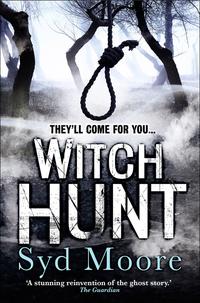
Witch Hunt

Copyright
This novel is entirely a work of fiction. The names, characters and incidents portrayed in it are the work of the author’s imagination. Any resemblance to actual persons, living or dead, events or localities is entirely coincidental.
Published by AVON
A Division of HarperCollinsPublishers
1 London Bridge Street,
London SE1 9GF
www.harpercollins.co.uk
Copyright © Syd Moore 2012
Syd Moore asserts the moral right to be identified as the author of this work
A catalogue record for this book is available from the British Library
Version 1
FIRST EDITION
All rights reserved under International and Pan-American Copyright Conventions. By payment of the required fees, you have been granted the non-exclusive, non-transferable right to access and read the text of this e-book on-screen. No part of this text may be reproduced, transmitted, downloaded, decompiled, reverse engineered, or stored in or introduced into any information storage and retrieval system, in any form or by any means, whether electronic or mechanical, now known or hereinafter invented, without the express written permission of HarperCollins e-books.
Source ISBN: 9781847562692
Ebook Edition © October 2012 ISBN: 9780007478484
Version: 2018-06-29
For those who were prevented from telling their story. And for Granddad York.
‘Besides, when any Errour is committed
Whereby wee may Incurre or losse or shame,
That wee ourselves thereof may be acquitted
Wee are too ready to transferre the blame
Upon some Witch: That made us does the same.
It is the vulgar Plea that weake ones use
I was bewitch’d: I could nor will: nor chuse.
But my affection was not caus’d by Art:
The witch that wrought on mee was in my brest.’
Sir Francis Hubert Quoted in Witchcraft in Tudor and Stuart England by Alan MacFarlane
‘The tools of conquest do not necessarily come with bombs and explosions and fallout. There are weapons that are simply thoughts, ideas, prejudices, to be found only in the minds of men. For the record, prejudices can kill and suspicion can destroy. A thoughtless, frightened search for a scapegoat has a fallout all its own for the children yet unborn.’
Rod Serling, creator of The Twilight Zone and civil rights activist
Table of Contents
Title Page
Copyright
Dedication
Epigraph
Prologue
Chapter One
Chapter Two
Chapter Three
Chapter Four
Chapter Five
Chapter Six
Chapter Seven
Chapter Eight
Chapter Nine
Chapter Ten
Chapter Eleven
Chapter Twelve
Chapter Thirteen
Chapter Fourteen
Chapter Fifteen
Chapter Sixteen
Chapter Seventeen
Chapter Eighteen
Chapter Nineteen
Chapter Twenty
Chapter Twenty-One
Chapter Twenty-Two
Chapter Twenty-Three
Chapter Twenty-Four
Chapter Twenty-Five
Chapter Twenty-Six
Chapter Twenty-Seven
Chapter Twenty-Eight
Chapter Twenty-Nine
Chapter Thirty
Chapter Thirty-One
Chapter Thirty-Two
Chapter Thirty-Three
Chapter Thirty-Four
Chapter Thirty-Five
Chapter Thirty-Six
Chapter Thirty-Seven
Chapter Thirty-Eight
Chapter Thirty-Nine
Chapter Forty
Chapter Forty-One
Chapter Forty-Two
Chapter Forty-Three
Chapter Forty-Four
Chapter Forty-Five
Chapter Forty-Six
Chapter Forty-Seven
Chapter Forty-Eight
Note to the Reader
Q & A with Syd Moore
For discussion
Acknowledgements
About the Author
By the same author
About the Publisher
Prologue
They told me not to come.
He said ‘Twill do no good. Nay more.’ And he tried to touch my shoulder and bring me back into the court but I was too quick and ran pushing through the crowd. Some saw me and stepped aside, unwilling to be touched, as if they might catch my sin. Others shrieked.
I made off through the side lane.
And then I came here.
I have put on my cap and wrapped a shawl over too. So none may see me.
Though I see all.
And I see them: bound and tethered in a pen.
Like sheep.
Then there are the others, the eager spectators.
So many cluster before me, edging their way forward, craning to get a good view, that I can only catch glimpses through the space between my neighbours’ shoulders. On their faces some have smiles. The girl beside me, only two or three years younger than I, licks her lips and stands up on her toes. Her father, in starched lace and black, pulls her back down and, with a stare, admonishes her excitement. But the woman beside him, whom I saw at a stall selling nuts for the crowd, has a face full of glory. Her eyes are wide in anticipation. In her hands she has a knife and fingers it greedily. She will try to get some hair from the dead for keepsakes to sell on.
A hush falls over the crowd as the first is helped up to the scaffold. I can see from the way she stumbles it is Old Mother Clarke. Her ancient face is creased with lines of age and knots of confusion. Two of the men assisting the execution have taken an arm each to support her, for she cannot stand firm with but one leg. She staggers forward and clutches the man on her right to steady herself as the hangman puts the noose over her head.
A woman at the front of the crowd near the gallows hurls something rotten. It hits Mother Clarke on the chin and she looks about to throw some rebuke back but before she can open her mouth comes the push. Her wizened frame drops and cracks as the noose does its work. Quickly. Thank God. And she is turned off.
Next it is Anne Leech. Younger than Mother Clarke, she wrestles with the hangman as much as she can with her hands and feet bound. There is little way to fight. But she will not go without one. One of the throng of eager spectators, a man with a red beard and broad shoulders, goads her and calls ‘Witch. You will go to the Devil now.’ Anne always had more spirit than others and she spits at him and calls out a curse. The crowd starts to move, excited by the show, laughing as the hangman roughly slips over the noose. But Anne is angry and wild. She begins to bring down a curse on the hangman, but cannot finish: a shove from behind stops her words. But it does not stop her life and she twists and turns on the end of the line like a fish from the brook. The hangman speaks to the man at his side and points to the cross beam. The rope is coming apart. He calls for a ladder but not in time for the rope to unravel and Anne falls with it to the ground, catching the side of the scaffold as she goes down.
The crowd surges forward to watch. She is picked up and shown. To their delight they see she has dashed out an eye and is carried back up to the third noose and hanged once more. A deep red drip from her face darkens her dress yet still the twitching goes on. A girl at the front runs forward to pull on her legs but she is stopped by the broad-shouldered man.
Above Anne the hangman and his men throw up another rope. Elizabeth Clarke is being taken down. I cannot see where they take her corpse.
And there is another witch now on the platform. I do not know her name. She has soiled herself with fear. It is hot and her face is greasy with sweat. As she is brought to Elizabeth’s noose she falls down in a fainting fit and is dragged over to the side. The hangman calls for a pitcher of water to rouse her. She must be awake to see her end.
And then she is there on the scaffold. Her long black locks move gently as she turns to the noose. I gasp as I see her watch Anne’s feet jerking without rhythm to her side. But she says nothing. She is solemn. Silent. Unhearing of the jeers of the crowd come to witness her end. But I see her eyes searching over the faces.
For a moment I think perhaps our eyes meet and I see in them a movement, a quick darting, a widening of the whites. Does she see me? I raise up my face and move back my shawl, bolder now, unconcerned about what the spectators may do if they recognise me. My confidence is short-lived: I pull back suddenly and flinch as the noose comes down over her slender white neck. Her mouth opens and I think she is about to speak but I cannot be sure because she has been pushed from the stool. The noose has strung tight. Her neck snaps to an unnatural angle, the feet kick out and then are still.
And I fall to my knees and am sick across the cobbles.
Oh God have mercy, what have I done?
What have I done?
Chapter One
11th October, 2012
It was the night that I bumped into Joe. So I guess, you could say that it wasn’t ALL bad. I mean, it was terrible. There was no getting away from it: painful, gut-churning and all the rest. But at least something good came from it.
And when I say I bumped into Joe I mean exactly that. Literally. I was drunk, but in my defence I had had a seriously bad day. Anyway, there I was, coming down from the high giddy arc of a – even if I do say so myself – quite magnificent thrashing pirouette.
I know. At my age: thirty-three going on fifteen. Ridiculous.
Though to be fair, I had checked with the fount of all knowledge, Maggie Haines, beforehand.
‘Am I too old to slam in the moshpit?’ I had been swaying even then. Maggie, my dear friend, sometimes boss and celebrated editor of arts magazine, Mercurial, had peered at me and wriggled her button nose. Her face had a distinctly kittenish appearance, which was thoroughly misleading. The pretty feline exterior concealed a steely determination and unsettling intelligence that had notched up two degrees and an MA and which had far more in common with panthers than domestic cats. I knew Maggie would give it to me straight – no messing. She was sober and had a grim look about her. And she hadn’t wanted us to go to the club at all. In fact she’d been dead set on getting me straight home; I think I must have already been in a right old state when we’d left the pub. We were on the way to the local cab rank just a couple of blocks down when I heard the music coming from the basement of a venue and decided we should all go in. She’d said no. In fact she’d said ‘No way,’ and tried to wrap me up in her embrace and physically carry me down the road. But Jules, Maggie’s hubby, put a staying hand on her arm and said, ‘Let her.’ Then he’d turned to me and said, ‘Just for a bit, Sadie, okay?’
This time, though, Maggie looked like she was coming back with a firm ‘no’, but Jules convinced her (I think he’d had a few drinks and was starting to liven up a bit himself).
‘Look around you, Sadie,’ he said in answer to my question, with a grin that was only half-formed. There was sympathy in it and hints of condescension, but I didn’t care. I followed his lead and stole a wider glance at the club. Stifling and dimly lit, it was packed full of sweaty bodies in varying states of inebriation and spatial coordination. The outfit on stage was playing at full pelt and the throng of clubbers clustered at their feet were going for it.
‘Go on then,’ Jules said. ‘But we’ll go straight home afterwards. Pogo is de rigueur here. Don’t worry about your age. It’s a punk covers band. We’re surrounded by middle-aged spread. That bloke down the front with the red mohican looks past sixty.’
He was right. The place was jammed with bald heads and beer bellies. Not a pretty sight. The majority of blokes were in the full throes of midlife crisis, desperately trying to hold on to their proudly misspent youth. The band themselves would have averaged about fifty-five in a ‘10 Years Younger’ age poll. Though if you went on energy levels alone, you’d put them in their early twenties. They were setting the crowd on fire.
Saying that, you can’t go wrong with the Buzzcocks, can you?
So, once I’d been granted permission, I launched myself into the front of the crowd and for about three minutes and twenty seconds I was able to submerge myself in the thumped-up beat and drag my head away from the awful images reeling in my head. Ironically the only time my thoughts stilled that day were as my body whirled and whirled.
For that, I will always salute thee, Punk Rock.
So, what happened was this; the alcohol had interfered with my sense of perspective and, in addition, boosted my energy. The result was a grand overshooting of the moshpit. In fact, I think if Joe hadn’t been there with his mates, I probably would have landed flat on my arse amongst the broken glass at the edge of the dance floor.
That would not have been a great look.
But he was.
A six-foot-something, human monolith, standing there, very upright, radiating principle and that good old-fashioned honesty of his. You could suss his confidence from the way he owned his space. He was firm. Unfazed. And, luckily, ready to cushion my fall. I remember the way he propped me back up and looked at me, and, because he was out of his usual context, I had a split second of objectivity. I took in the regulation cropped brown hair, the round wholesome eyes and not-so-designer stubble, casual t-shirt, jeans, trainers. He could have been a manual labourer: a carpenter or a builder. He had a pint in his hand and a cheeky grin on his face that gave him dimples. I remember thinking ‘Not bad at all,’ and then doing some hurried shoe shuffle on the floor to correct my balance and retrieve what shreds were left of my dignity. And then he said, ‘Nice of you to drop in on me like this, Sadie.’
I recognised the voice and looked closer and said, ‘Oh. Joe?’
And he laughed and said, ‘One and the same.’
But after that, it’s just fragments.
I must have talked to him and his mates for a bit till I returned to the dance floor, pulling Joe greedily and then taking him with me. I don’t think he particularly wanted to dance. In fact, even though my perception was pretty clouded, I got the impression he was just going on bodyguard duty for me.
Then I rebounded back to Maggie and Jules and introduced him. I think they were saying that they wanted to go but I wanted to stay, and made some big dramatic thing of finding my drink and downing it in one. I bet that’s what pushed me over the edge, because the next moment I was in the toilets revisiting the dignified spread that had been supplied earlier at the pub.
When I came back Maggie and Jules had got my coat and Joe had got his.
Maggie said, ‘I dunno – he’s offered to drive us home. How many has he had?’
I laughed and said, ‘Not likely to have had any, Mags. He’s a copper.’ Then I got twisted up in my coat and Jules frowned.
I think Joe must have heard all that because he leant over and flashed his warrant card and said, ‘It’s all right, I’m not over the limit. She’s off her head and needs to go.’
And I put my arm round his shoulders and said, ‘But I haven’t been cunting at all Drinkstable.’ Then I hiccupped.
When I woke up in the back of Joe’s car we were outside my flat. Maggie and Jules had already been dropped off. Joe brought me up the stairs of my small flat. I think he even carried me into my bedroom, laid me on the bed and took my shoes off. And that was over and above the call of duty to be sure.
I remember trying to kiss him. And that he pulled away and said, ‘Not tonight, Sadie. I would but I can’t.’ Then he did that phone thing that people do with their hands – an L-shape like an old receiver – you call me or I’ll call you.
I think he was sympathetic.
But when he closed the door I started bawling. And I carried on doing that till I passed out.
What a mess.
To be expected I suppose.
After all, it’s not every day you bury your mum.
Chapter Two
Tuesday, 17th October
It began like a drip in a far off place. A vast echoing chamber. Or a faltering trickle into a dark yawning cave. First sibilance. Just off a hiss. Followed by a wheezy gasping sound. ‘Ssss – rhey.’
Was it drawing closer or becoming louder? It was certainly getting clearer, wafting to me on an unfelt breeze. ‘Sorr- rhey.’ Puffed out in tones of torment. Fleshed out with a sob.
Falling on my ears, with a cold snatch of breath I got it. The single word. And it was on my lips. ‘Sorry.’
Then I was sitting up in bed, awake. Fully alert. Despite the lightness of the cotton nightie sweat had pooled under my breasts. I was gulping down air as if I had only just reached the surface of some dark, subterranean lake. The bed sheet was twisted around my legs like a boa constrictor trying to eat me alive and my heart was banging like mad.
What was that?
Had I said that? Or was someone in the flat?
I strained to listen into its depths.
The hum of the fridge. The trees shushing in the breeze outside my window. The sound of roadworks further up the hill. A door slamming in the neighbour’s flat. The deceleration of a train pulling into Chalkwell station.
But nothing else. No one in the flat.
It must have been me.
Well, I knew I had just articulated the word – said it out loud as I was coming into consciousness. But I had a notion that I was merely repeating someone else’s plaintive cries.
Sorry.
It had happened several times since the funeral. Each time I had woken up from a nightmare I couldn’t remember, with the absolute conviction I was not on my own.
But then, the mind has a funny way of dealing with grief.
And of course, I was sorry.
Terribly.
The guilt was almost unbearable.
I knew Mum had been trying to talk to me. That last time we were alone at the hospice. I’d walked in to find her sleeping, so had kissed her on her forehead. Her hair was spread like a black fan across her pillow. She had been a young mum, and if you looked past the lines the illness had carved on her face, with her perfect semi-circles of long dark lashes and her thick black hair, she was still as serene and beautiful as a Renaissance Madonna.
But she’d woken at my touch and when she realised it was me she’d made a big thing of trying to meet my eyes. At first I thought she said, ‘Sadie – fit.’ It was difficult to tell. Her speech was much impaired since the last stroke. She’d been left with paralysis on the left side of her face and was unable to move her left arm.
‘You okay, Mum?’
She was frustrated. ‘Ift.’
I said nothing, waiting for her to try another attempt.
She struggled up a bit. I reached behind her and helped her sit up onto the pillows, plumping them carefully as she rested her neck.
She took a breath and looked at me. Her mouth opened, tongue lolling to the front. ‘Gift.’
‘A gift?’
She nodded.
‘Okay. Who for?’
She moved her good hand in my direction. ‘You.’
‘You have a gift for me?’ I looked at the bedside table. Glass, hand cream, anglepoise lamp.
‘No. Come.’ She paused for breath. ‘To … you.’
‘I have a gift coming?’
She expelled a lungful of air and shuddered. I could see the frustration scratching across her face. ‘Speak Dan.’
Dan was my mum’s boyfriend of about twelve years. A nice chap with a heart of gold. But he’d gone AWOL a couple of days before and Mum was in a real state about it, naturally. The poor woman was totally incapacitated, unable to do anything to find out where he was.
Thing was, Mum and Dan had a lot of things in common. They were both educators; both furious campaigners for human rights; and they both loved me. But, and this was a big but, they had both experienced long periods of depression. Mum’s strokes had been a result of high blood pressure, which, in turn, it was suggested, had been brought about by her often high state of anxiety. See, Mum didn’t have bouts of sadness, she had episodes of deep clinical depression, some of which developed into psychosis and paranoia. Just like Dan. In fact, that’s where they had met – in a private clinic. Therefore we were all concerned about his absence. I shook my head and said, ‘We still can’t find him, Mum. He’s not at work. He must have had to go somewhere urgently.’
Mum did a shrugging sort of action with her good side and said, ‘Sadie.’ She made a move that looked like she was trying to shake her head, making an effort to form her lips and shape the words. Though her dark eyes were alert I couldn’t understand her, so I took her good hand and placed a pencil in it. Mum’s elegant fingers groped for the pad of paper that never left her side. It took her a while.
Her writing was getting worse. When she finished I tried to decipher what she’d written. I could make out a ‘B’ then an ‘O’ but the figure after it could have either been an ‘X’ or a ‘K’.
I looked at Mum. ‘Box?’
Mum’s lips suckered in. She looked more fragile than ever. Then she let out a wail and started to judder, her head shaking back and forth. It was so frustrating for her.
With the functioning side of her face she tried to speak. ‘Earme.’ Working hard to take in a good breath of air, she swallowed and said, ‘Portent.’ She was really het up. I hated to see her like that but I just couldn’t understand her meaning.
‘Sorry, sorry.’ I focused on the writing. Perhaps it wasn’t an X but an O and a K? ‘Book?’
She made a sound like the air going out of a balloon. I leant in and smiled at her. She was sweating and her hair was messed up. I pushed a couple of black strands away from her eyes. Despite everything, she still had only a dusting of grey.
Stiff creases divided her forehead. Her good hand was clenched into a fist. She was working out how to say what she needed to tell me.
I cut in, trying to relieve her of the effort. ‘Okay, the book. I know you don’t like the idea but Mum …’
She made a strangled sort of sound, then slumped back into her pillows, giving up communicating. But her hand crept into mine. I squeezed it. Gently.
See, I finally got my book commissioned ten days previously. It wasn’t life-changing but it was definitely a good deal. In between the various loops and curves of my volatile career as a freelance journalist, I had been writing a book on the Essex witches.
Mum always said she thought we were distantly related to one. And there was this song, an old Essex folk ballad, The Weeping Willow, which Mum thought was connected to an ancestor. And there was a game in the playground: the kids would form a circle around one blindfolded child, the ‘witch’, and then you’d all dance around. When the verse ended the blindfolded child would try to catch one of the circle dancers. Whoever they caught was out. I can’t remember all of it but there are a couple of verses that stick:
They kicked them off and laid them down
And put them in the cold hard ground
The summer wind blew long and chill
The Divil bade her do his will
Pale and wild pale and wild
The witch did down the child
She picked her up and put her down
The willow’s leaves wrapped round and round
Her evil cries filled the air
And so did end the bad affair
Pale and wild pale and wild
The witch did up end the child
I think it was the song that got me interested, even as a child. That, my mother’s proud connection to it, and the fact that Essex had so many witches. There was folklore and myths about them everywhere I turned. And, if I’m honest, I did seek them out. I was always a bit of a spooky girl, fascinated by rather macabre stories and shrunken heads. My dad tried to get me interested in Roald Dahl, but to his great disappointment I quickly cast off Charlie and the Chocolate Factory in favour of Tales of the Unexpected. As I got older, I started delving into the witch hunts. It turned out to be rather sobering. In fact I soon became both horrified and hooked. The statistics were phenomenal: between 1580 to 1690 the combined total of indictments for witchcraft in Hertford, Kent, Surrey and Sussex was 222. In Essex alone over the same amount of time it was 492 – although recent studies put the number at 503. More than most other counties in the UK, by a long stretch. All those poor souls put to death by superstition. And did we know their names? No. We knew about the Witchfinders: James I, Matthew Hopkins, John Stearne. But if you were asked to name one of their many victims you’d be lost.
When I read about their stories I was revolted. They stayed with me. I just couldn’t get them out of my head.
I’d been a freelance writer for several years and I guess a book is always floating somewhere in the back of your mind. But it seemed almost like the idea just sprang into my mind, fully formed, like it had been nestling in the shadows all the time. I spent some time on a synopsis and had pitched it to a fair few publishers. I knew Mum was proud of me – she had wanted to write herself and even considered going into publishing when she was a teenager. She once told me she did work experience but had been put off. She wouldn’t say why. But she was pleased, I think, in that way that parents are, that I was doing what she had failed to. Anyway, the book was not met with the unbridled enthusiasm I had expected. In fact, I had had a series of rejection letters and was just about to go back to the drawing board, when I got a call from Emma of Portillion Books. She loved my sample chapter, and what she called my ‘fresh new unstuffy voice’. The proposal, she said, had been presented in an acquisitions meeting and got a rapturous reception. Consequently, I had been given a contract.
I was elated.
But there was a fly in the ointment: Portillion Books were the literary part of the Robert Cutt empire. The owner of a fleet of fast food restaurants, a football club, a few social networking sites, several magazines and two new private academies in London, Cutt was a powerful tycoon and a generous donor to the Conservative Party. The current rumour was that he was hoping to be made a Lord with a view to fast-tracking to a cabinet position. Political commentators were speculating that the Department of Culture, Media and Sport had already reserved him a parking space.
In our house Cutt’s name was a swear word. He wasn’t known for his great pay and conditions and cracked, as in broke, most of the unions his workers had been affiliated to. Plus, he was generally a bit of a git. Ruthless, you know the sort – did well out of the banking crisis. You could see corruption all over his face whenever his mug was in the papers.
I came from a firmly socialist background. Mum, a History teacher, and Dad, with his background in trade unions, constantly railed against continued control and acquisition of British media till Dad departed when I was sixteen. Dan had been less vehement when he came on the scene in my early twenties, but only fractionally. Unsurprisingly, Cutt was our antichrist.
But I was desperate to get my book published and I kind of felt that I’d have to swallow down my righteous outrage to get the witches’ stories out. It was a compromise, true, but I was prepared to make it. A whole chunk of me didn’t like or approve of that, but I was weak. And okay, okay, if I’m honest, there was the ego thing going on. It was, I justified to myself, only the book wing of Cutt’s empire, after all.
Mum, on the other hand … When I’d sprung it on her she’d had a mixed reaction. At first she was over the moon to hear I’d at long last got a book deal, but then, when I told her who it was with, her expression dimmed. She’d started trying to say something about jewellery. I don’t know if she was making some point about wealth or something but whatever it was she’d got so distressed that the nurse, Sally, had to come in and sedate her. It was horrible. I didn’t ever want to see that again.
So you can see why, on that particular day, when she was really not looking very well at all, I was trying really hard to sound upbeat and positive about it all.
‘I’m due to meet Emma next week.’ My voice sounded purposefully cheery. ‘I’m so excited. I’ll get the contract, then as soon as I sign it they’ll give me part of my advance. Isn’t that great? I mean it’s so tough being freelance. A lump sum will really help out. And it’s my chance to get the stories of the witches out there. Maybe I can find our ancestral witch. And if we are related, then surely it’s a kind of duty too?’
Mum was frowning and doing her best to say something, but I didn’t want to hear what she had to say. I wanted her just to listen and be proud of me and to say it was okay.
And it wasn’t only that which made me fill up every inch of breathing and conversation space in her room in the hospice that afternoon. No. At the back of my mind there was the notion that what she truly wanted to tell me was that she loved me and I couldn’t let her. Don’t get me wrong – we did tell each other quite often, but there was something in the atmosphere that afternoon that made me desperately not want to hear it. Almost as if I did then there would be finality in the words. For if she told me she loved me and I told her I loved her too everything would be harmonious, and she would be able to slip off away into the everworld, her work here done.
And I didn’t want that. I wasn’t ready to lose her just yet. So I didn’t let her speak.
God, if only I had. I should have. I should have let her tell me.
She so wanted to. In fact, she was struggling with all her might to tell me.
And now, I know what it was, I am ashamed.
She was seriously worried – rightly so.
If I’d let her speak she would have told me the truth. Then maybe I would have been forewarned. And forewarned is, as they say, forearmed.
But I didn’t, did I?
I gabbled on and on until the nurse came in and had to administer the drugs. And then Mum was tired. When I came back in, she had fallen asleep. So I went home.
And it was that night, as the moon sailed upwards, my mother, along with her unspoken words, finally let go.
But I couldn’t.
And now I was haunted by my stupid stupid actions. Hearing the word ‘sorry’ in my dreams, waking up to unknown sobs.
I moved my legs off the bed and crept into the shower.
Unfortunately there are some stains that just won’t wash away.
Chapter Three
I thought grief would be the worst thing.
Though Mum’s health had been on a steep decline, and I more or less expected it, when death actually came it still shocked me.
During the first few days after she went, there had been pain. Then the sharpness of it eroded, and I was left with this sense of great guilt. Which was worse. Though this guilt was an energiser. It could have made me go round the bend it was so great. But I found a way of handling it – as soon as it came upon me in the mornings, I went into action, hoping that physical exertion might knock regret from its number one spot at the forefront of my mind. It kind of felt that if I didn’t do that, then it would engulf me entirely. Then I could see myself just sitting in the flat, crying and crying on my own. I didn’t want that. Mum wouldn’t have wanted that. So I went with the extreme activity option.
That morning, after I had rinsed as much shame as I could out of my hair, I combed it out in front of the living room mirror. In my twenties I’d earned the nickname ‘Lois Lane’ amongst my friends and peers, partly because I shared a terrier-like commitment to my cub reporter’s role on the local rag. It wasn’t quite the Daily Planet, but I was proud of what I did and used to talk about it non-stop. But there was also a physical resemblance to the actress in the TV series of Superman, Teri Hatcher. We were both dark, had well-defined eyebrows and had short, sassy bobs. I didn’t mind the comparison.
In the mirror today, a pale reflection stared back. I looked worse than I’d expected: my eyes, though grey, had a purple darkness about them – the surrounding skin was dry and blotchy and pink from bouts of unscheduled weeping. My hair, black like Mum’s, was broken up with russet lowlights though there was a good inch of regrowth that needed attention. And I was thinner. Maybe half a stone less than I was two weeks ago. Most people wouldn’t mind that, but it made me look gaunt: although Dad was unusually tall (six foot three), my slight frame had come from the maternal line.
Jeez. In the harsh daylight I looked like I could have been in a car crash. In fact, I thought, as I went into the bedroom and dried myself, that was far too generous. In this light, I could pass for a junkie who had been in a car crash. I made a mental note to buy some decent food, and get a haircut. Then I threw on my ‘uniform’: black jeans, black shirt, suit jacket (to lend it formality) and trainers (comfy).
Once dried and dressed I returned to the living room and got my laptop out. As I powered it up, I could hear scratching above me in the loft. It had been going on for a few days now. I needed to call out pest control; I added it to my list of things to do. It was probably rats but didn’t help at all with my state of mind – it sounded like my conscience itching.
I had enough time to go through some emails before I needed to set out for the offices of Mercurial for an appointment with Maggie.
I padded round my flat, cooking up a strong coffee and installing myself in the living room. Despite its modest dimensions, I did love the place. Tucked under the eaves of a 1970s purpose-built block, I had a smallish bedroom, bathroom and kitchen, and a very spacious living room that doubled as a dining room and study. It was sparsely furnished. I’d not taken much with me when I split up with Christopher, my last long-term boyfriend. Just the high quality stereo, a very comfy leather armchair and this gorgeous antique mirror he bought me from Camden Lock market. I knew the ornate rococo decoration and black stains on the bevelled plate were at odds with the modern minimal interiors he admired, so it was a kind of testament to his initial affection. He made no effort to keep it when we were divvying up our joint goods so I’d kept it in storage until I got this flat, then hung it in pride of place over the mantelpiece, where I gazed at it from my writing desk. This was an old glass dining table, which I had shoved towards the floor-to-ceiling windows that led out onto my balcony.
Our block had a particularly glorious vista – looking over the railway station to the beach, yacht club and tidal plains of the estuary. Chalkwell was a good location. I’d chosen it for its transport links to London. My relocation didn’t happen overnight as I still had a lot of work in London and had to make the trip into town at least two or three times a week. But it was only a forty-five-minute journey from here and I’d always liked the place; mostly populated by elderly couples and families, it felt safe and as a newly single young woman, that was a primary concern. When I first saw the flat, it was the view that got me. Sunny mornings would see the front room filled with the unimpeded honey rays that crept up over Southend’s pier (the longest pleasure pier in the world, don’t you know). And, if you were lucky in the evenings you’d get a front seat view of Mother Nature’s chosen sunset, framed lovingly by the tops of the oaks in the front garden.
That morning’s clouds, however, were wearing the same dark grey shroud they had done since the funeral. It seemed everything had muted itself in respect.
I took a look at the incoming tide and sat down at the desk, ready to click on the internet icon.
The big life stuff, the events that change your life – the births, the deaths, the crises, always start in a small way, I’ve found, with a twinge or a rumble or blip. And that’s more or less how this story began. In a very ordinary, mundane manner.
I ignored the strong pull of my guilt trip and went straight into email. There was a message from one of my local news contacts asking me if I could interview a couple about a fundraising effort. I replied that I could fit it in within the next two days, noted the address and then scrolled down past the offers of Viagra to an email from someone called Felix Knight at Portillion Publishing. The Felix guy was introducing himself ahead of tomorrow’s meeting. My editor Emma, he explained, had been promoted into another division and he had been handed responsibility for my book. He was extremely excited about it, looking forward to meeting me and suggested that, after a formal introduction in the office, we have lunch at a nearby restaurant.
I liked the sound of Felix but, to be frank, I was happy to work with anyone who was happy to work with me. I replied that that would be ‘fantastic’ and I was very much looking forward to meeting him too.
My next email was an old friend expressing condolences. I clicked on the link and went through to Facebook. Then I did the standard reply: ‘Thank you. Yes, it’s been crap, but I’m getting on with life.’ I had to deal with it this way – if I went into detail I was worried that I’d unleash a torrent of real grief that might wash me away. I was about to shut down, when a message box popped up on the screen.
Unusually, it had no name attached. There was still the regular green dot in the top left-hand corner and the other function symbols across the toolbar. But no name. I looked down at the message.
‘Are you there?’ It read.
Of course I bloody am, I thought. But I simply wrote, ‘Yes.’ Then I waited, curious to see who it was.
Nothing happened for a few seconds then the words ‘Where are you?’ appeared.
What did that mean? Most of my Facebook friends knew I had moved out of the Smoke eighteen months ago.
A little irritated by the stupidity of the question, I chucked it back at the unknown messenger. ‘Where are you?’ and sat back to see the response.
There was a bit of a time delay. I glanced at my watch. I couldn’t spend long on this joker as I should be getting my stuff together to leave fairly soon.
Then the words popped up on the screen, ‘I can hear you but I can’t see you.’
Mmm. Weird. I regarded the screen for a moment then retyped: ‘Where are you?’
A breeze outside nudged the oak leaves against the window. They sounded like little metallic fingertips on the panes.
The reply came up: ‘I do not know. Everything is dark here.’
Okay, this was getting creepy. What to do? Coming up with no good reply, I sat still and contemplated the screen.
My correspondent was typing. ‘There is only blackness,’ they wrote.
Then underneath that, ‘I am scared.’
That stopped me.
Was this a joke? An inappropriate friend trying to freak me out? Some random viral marketing ploy? I tried to think of a way to respond without looking stupid if it was a prank. Though, at the back of my mind, I was wondering about what to do if it wasn’t.
‘Who are you?’ I tapped out on the keys and hit enter.
‘I’m sorry,’ they replied.
I stopped and looked at it. Then I swallowed. The words had been on my lips just an hour ago.
Then another line of text: ‘Hush.’
Hush? That was an odd choice of word.
Quickly, more text appeared. ‘He may come back.’
Now cynicism was overruled by a more concerning impulse.
‘Who might?’ I wrote. ‘Who might be coming back?’
The screen was still for a moment, then the words ‘Oh God’ tapped out on the screen.
Without letting my head intervene in my now more emotional response, I wrote ‘Where are you? Are you okay?’ But when I hit enter this time my screen died and turned to black.
I cursed and looked down at the on button. My battery had run out.
I hastily reached for the power cable and plugged it in. The computer took several frustrating seconds to reboot and when I returned to the site there was nothing there. No box. No evidence of our conversation. I scrolled down my list of online friends. There was no one I didn’t recognise.
I could have left it alone, but a part of me felt responsible. After all, this hadn’t been a chat room – it had been a dialogue with one other person. A private communication sent only to me. I was troubled but not yet scared. Just worried that I hadn’t stepped up to my civic duty if indeed, this was a genuine message. Crap. This had to be the last thing I needed right now – more guilt.
I bit my lip then made a decision, pulled out my mobile and dialled the one person who I could possibly pass this on to. I was in no fit state to get involved with anyone else’s business right now.
He answered pretty quickly. ‘Hello, Sadie. How are you feeling?’
So thoughtful, always concerned about others. You could see why he’d entered the police force. He was a nice bloke. And he’d been a good friend. In fact, before I met Christopher, he’d been more than just a friend. I’d met Joe six years ago, whilst covering some high-ranking officer’s retirement. It was lucky I had taken the job. I’d hooked it on impulse as Mum was on a bit of a low and I wanted to spend more time with her. As soon as I met him, there was an instant connection: we ended up drunkenly eating chips on the seafront and watching the moon set over Canvey Island. He had a really lovely smile (those dimples were just gorgeous) and a kooky sense of humour that chimed with mine. One thing had led to another and another. We were both due some time off so I didn’t leave his flat for two days and nights. We followed it up with the usual sort of thing – trips to the cinema, dinner, a fabulous weekend break in the country. It was great. But I knew I had to go back to London, and somehow, despite the fact it wasn’t that far away, I think I had it in my mind that it was only a holiday romance, something casual. Not that we ever discussed it, but he was four years younger than me. It doesn’t seem much now, but at the time I was twenty-seven, and twenty-three seemed way too young to be serious. When he went off to Carlisle for training and Mum felt better I returned to my life in the metropolis. We texted each other a few times, but he backed off completely when I started seeing Christopher. Yet he still had a physical effect on me. I’d bumped into him a couple of times since I’d moved back and could never stop myself stealing furtive glances at his sinewy frame. Even now I had to do my best to sound together and competent, instead of breathy and slightly chaotic.
‘Hi Joe, I’m okay.’
‘Glad to hear it,’ he said. ‘You must have had a bad hangover after the other night.’ I could tell he was smiling as he spoke. Voices sound more distinct when mouths are pulled wide. Then, remembering the specific occasion of my last major bender, he took his voice down a note and hastily added, ‘Understandable of course.’
I took it in my stride. ‘I’m okay, honestly. Thanks for, er, helping out. I’m sorry if I, er, embarrassed you …’ Oh God, there was that image – me catching his lapel, pulling him down, slobbering all over him. I pushed the mortifying grope from my mind and concentrated on the present issue.
Joe was generous. ‘Think nothing of it.’ It was a full stop on the matter.
Gallant too. You absolute gem, I thought.
‘Listen,’ I said, changing the subject super quick. ‘I’ve just had a weird thing happen.’ And I explained about the messaging.
I hadn’t expected him to laugh, but that’s what he did. It left me feeling stupid and gauche.
‘Someone’s having you on, Sadie,’ was his conclusion. ‘You wouldn’t believe the number of calls we get about this sort of stuff. Texts, emails. It’s all part of new generation cyber-crime.’
Now I was cross, bordering on outraged. Not at him. At the unknown idiot who had virtually freaked me. ‘Well, who would do that to me? Especially now. When, you know, I’m a little more fragile than …’
Joe’s voice piped up, the perfect example of good victim support training, ‘Don’t take it personally. You’re probably a random selection. There’s some bored teenager chuckling away in his bedroom right now. In future, don’t respond. If you don’t engage them, they’ll get bored and move on to something else.’
It seemed like sensible advice, so I agreed not to.
‘Is there anything else I can do you for, Ms Asquith?’ Was it me or was there a teensy bit of hope in his voice?
The question was open-ended, leaving it up to me to pick up the ball and run. I told him, ‘Right this minute, no, just the dodgy internet business. But I’ll call you soon. For a drink maybe?’ He said that would be nice and I thanked him for his advice.
‘Glad to be of service to the public, madam.’ He was very jovial. ‘Now take care of yourself and feel free to phone me if this sort of thing happens again.’
I told him I definitely would and hung up, a little thrill rippling through me.
Now I was fifteen minutes behind schedule.
I had stuff to get on with so slammed the laptop shut, got my things together then whizzed out the door.
The gloomy October morning had bled into a gloomy October afternoon. The light breeze had notched up into a strong south-easterly wind and was whipping rubbish into tiny twisters, screeching through the bare branches of the sycamores that bordered the wide Georgian avenues of Southend’s conservation area. Everybody on the street was buttoned up, faces down, slanting diagonally into its oncoming draughts.
The offices of Mercurial, a quarterly arts magazine, were nestled between an ancient accountancy firm and a design agency. I liked working for them. They were cool: as a freelance writer who specialised in Essex affairs, kudos was rather thin on the ground, and the mag’s cachet rubbed off on me.
It was now eighteen months that I’d been living in the borough of Southend. Initially, my move had been born out of an urge to be closer to Mum. Her health was going downhill and although Dan was around, I wanted to be there for her too. Then after I split up with Christopher, London quickly lost some of its shine and I accelerated the relocation.
It had been good for me. Though I kept my hand in with my old bosses in London, I had enjoyed rediscovering my old patch. Southend had grown and changed. Lots of things were going on and Mercurial reflected that. They were good to know – always had an ear to the ground – and I had actually grown very fond of the staff at the office. For a bunch of artistic individuals they were all pretty down to earth.
I’d known Maggie for nigh on twenty-five years, as we’d attended the same high school. Though you’d never believe it to look at her now, she was actually far more rebellious than I in our youth: we shared clothes; a couple of boyfriends and several cigarettes down the bottom of the sports field, promptly losing touch when we left school and went on to different universities. When our paths crossed again, a couple of years ago, she invited me for lunch and we soon ping-ponged into regular friends again.
I think it was on our third or fourth lunch date, as we knocked back a few glasses of plonk, that Maggie suggested I wrote a small piece for her mag. I leapt at the chance and once the shrewd editor – rather than the friend – worked out that I was as good as I said I was, she began feeding me more assignments.
Mags was what my dad would call a good egg: helping
a lot over the past few months and especially kind when Mum died.
She was sucking on the end of a biro, squinting at a document several pages in length, in the small box room she called her office. The sash window was a couple of inches open. Still, the air was thick with the stink of cigarettes and Yves St Laurent’s Paris.
‘You’ll have to get an air freshener. You must be getting through bottles of perfume,’ I said as I sauntered in and threw my satchel on the floor. ‘And it’s against the law now, you know.’
Maggie’s tangle of pillar-box red hair jerked up. She dropped the pen on the mound of paper. ‘Shit, Sadie! Can’t you knock before you come in?’
She looked funny like that – all indignant eyes and open mouth. ‘Everyone else has to go outside for a fag,’ I chastised her half-heartedly.
She shrugged, relaxing now and held her hands up in mock surrender. ‘I’m giving up. Seriously. Did you know it’s bad for you?’
I said I hadn’t heard that.
‘Just got really into this submission,’ she was justifying herself. ‘New writer. Very good. All about the internet: Facebook, Twitter, blah blah, Generation Z’s youthful rebellion.’
I sauntered over to a filing cabinet that stood by the window. It was sprayed gold and decorated in what was probably a radical artwork but to my uninformed eye looked like bog-standard graffiti. It was very Mercurial. The gurgles from the coffee maker on top indicated it was ready to pour.
‘Interesting spin,’ I said and took two mugs from the shelf above. ‘I think I just experienced some of that, myself.’ Maggie didn’t answer so I coughed and nodded at the coffee. ‘I’m presuming this is for me? Mags, would you like one too?’
She grunted an affirmation and grudgingly gathered up the sheaf of paper, stapling the top right-hand corner and dumping it on an in-tray already several centimetres high.
‘Might as well close that window too,’ she shivered and pulled a fluffy purple cardigan tight over her shoulders. ‘I thought it’d be warmer this week.’
I placed the mugs on her desk, and brought the window down with more force than I intended resulting in a loud bang. Maggie tutted. I ignored her. ‘They say it might turn nice for the weekend.’
Maggie cast her eyes through the windowpane at the fluttering leaves of the sycamores. A plastic bag whipped up from the street and caught a branch directly outside. ‘If only the wind would drop.’ She grimaced and came back to me. ‘How are you going?’
I plucked out my standard response. ‘Coping with it,’ I told her.
She accepted that without further comment. ‘Have you been to the house yet?’
She was referring to my mum’s. ‘I thought I’d wait until I saw Dan.’
Maggie’s eyes narrowed. ‘He’s not turned up then?’
I shook my head. I was still livid that he hadn’t been at the funeral. That was another reason why I let off so much steam that night at the club. But beyond the anger there was concern. Or perhaps it was the other way round?
Yesterday I’d nipped into Mum’s hospice to fetch the last of her belongings and had seen one of the day shift nurses, Sally. Her husband, Michael, had once worked at Dan’s school and Mum had known Sally socially prior to her last illness. Not well, but enough to pass the time of day. We had wondered if that might make it awkward but her familiar face reassured Mum. We’d had a chat and she, too, asked about Dan, reminding me that Mum had a key to his flat on her keychain and suggesting that I pop into his place to check it out. We’d phoned endlessly and I’d knocked on his door with no joy, trying to find him before Mum … well, before things came to a head.
‘He’ll need your support more than ever now,’ Sally said. She was a homely woman, with an immense bosom, and an extraordinarily generous nature. I guess you have to be when you’re in that job.
‘I know,’ I had said and promised to go there.
‘And,’ she said. ‘Please do me a favour. I was talking to Doctor Jarvis about Dan going off like this. He said it’d be an idea to check his medication. Can you bring back a bottle, if there’s a spare somewhere, and he’ll have a look? Just to be sure.’
I had told her I would and was planning on swinging by his place after I’d finished up here at Mercurial.
‘Oh dear,’ Maggie was saying though her voice kept steady. ‘Do you want to talk about it?’
I could be upfront with Maggie. ‘No,’ I said. ‘I’m going to check his flat later. To be honest I’d rather talk work.’
‘Okay. Well, let me know if you need anything, yeah?’ Maggie straightened herself out and put on her professional head. The set of her jaw was firm and ready for business. ‘Right,’ she said. ‘Fire.’
I tasted the coffee and removed my notebook from my bag. ‘You mentioned another Essex Girls’ piece?’
I’d been fascinated with our regional stereotype for a very long time. Firstly because, as a grey-eyed, raven-haired Essex chick, I adored the leggy, booby, blonde ideal. Surrounded by Barbies and Pippas from an early age I’d cottoned onto the fact that this was the generally accepted notion of beauty. I couldn’t believe it when, as I made more excursions beyond the county’s limits, I discovered it was considered vulgar and stupid and a lot lot worse. The realisation left me feeling cheated and rather annoyed.
Later, as I left the borough I’d lived in all my life to venture North for uni, I found that not only being a joke, mentioning my home county often resulted in humiliation and embarrassment. My surname, Asquith, which I thought sounded a little posh, however did little to temper the constant barrage of wisecracks that I faced, as an Essex Girl called Mercedes, and as a consequence I shortened it to Sadie. Most people called me by that name these days, apart from my dad who stubbornly stuck to my full moniker. Anyway, the whole Essex thing was as exasperating as it was formative and as a consequence of this battle I went on into journalism, ‘to get my voice heard without shouting’, as my mum used to put it.
Although I didn’t relate the writing to my county or my gender I kept an edgy, working-class feel to my tirades. Luckily, people liked them and I was able to make a living from my rants.
Returning to my roots, Maggie indulged me and published a series of articles in which I challenged the negative connotations attached to the stereotype of the Essex Girl.
‘Essex isn’t like other counties. Its daughter isn’t like those of Hertfordshire, Herefordshire or Surrey,’ I had written. ‘She isn’t demure, self-effacing or seeking a husband. She’s audacious, loud, drops her vowels and has fun. Like Essex itself, the Girl is unique. It’s about time we showed some filial pride.’
Got a good reception, that one. Circulation went up. Maggie commissioned another one, and another, then another.
In an attempt to trace the etymology of Essex Girl my last feature harked back to the dark days of the witch hunts and examined whether there was a link between Essex’s reputation as ‘Witch County’ and the genesis of Essex Girl. The two areas collided and, after further consideration, I concluded that there was and readers and commentators alike had not stopped filling up the web forum ever since.
Many comments spilt over into other sites, forums, newspapers and magazines. Positive or intensely outraged, Maggie didn’t care how they reacted, just that they did. ‘This is the kind of thing Mercurial needs. It’s getting our name out there into a broader market. We need more, and I’ll up your rate. Just give me something good and meaty,’ she’d said on the phone a couple of weeks back.
So here I was, with something perhaps a little on the sketchy side, but definitely spicy.
Maggie took a tentative swig of her coffee then blew on it. ‘Go on then – spill it. What you got for Mama?’
‘Okay.’ I flicked open my notepad and traced my notes to the relevant entry.
‘I’m delving deeper into the witch hunts. You know this book deal? Well, I’m churning up a lot of good stuff. I think I can funnel some articles over to you.’ I glanced up to catch a reaction. Maggie was nodding, her tongue licking her top lip, so I ploughed on.
‘Why did Essex lose so many women to the witch hunts?’
Maggie snorted. ‘Did we? It’s a long time ago. Some people might say “so what?”’
I leant in to her. ‘Yes, we did. Significantly more. It’s the sheer volume that warrants attention.’
Maggie picked up the biro and took a drag on the end. ‘You didn’t go into that in your last article did you?’
I shook my head. ‘No, it was more about the witches themselves and the qualities they shared with the contemporary Essex Girl …’
Maggie cut in. ‘Yep, yep. They “were poor, dumb and ‘loose’ as in not controlled by, or protected by men”.’ She was quoting my article. I got her point – she knew it back to front. ‘So why exactly did it happen then? To the extent it did here? I assumed that Essex and its inhabitants already had a reputation for being thick, flat and uninteresting?’
I coughed. ‘No, not at all. Up until the witch hunts, Essex was seen as the “English Goshen”.’
‘I last heard that word in Sunday School. Fertile land and Israelites. Now don’t go all religious on me, Sadie. We’re not the Church Times.’
I sighed. I hated having to explain things to her. She had such a high IQ and always made me feel like I was rambling. ‘Goshen also means place of plenty. And that’s a pretty fair description: Essex has an interesting geology. Sits at the southernmost point of the ice sheet that covered the rest of the island. Soil’s full of mineral deposits brought down from up north via the glacier.’
Maggie pulled a face then converted it into a smile. ‘Geology’s a bit of a turn off for our readership …’
I held my hand up. ‘Hang on. Let me get to the point – it was perfect for farming, for cattle, for livestock. It’s surrounded by rivers and the North Sea for fishing. Until the 1600s it was seen as a pretty cool place to be. But after that it changes a bit.’
Maggie’s eyes blinked. ‘Because?’
I cleared my throat. ‘Well, this is where I come in. I think a) because it was quite the revolutionary county in the Civil War. Backed parliament. Wanted reform. Was seen as the “radical” county. And b) because of the extent of the witch hunts.’
‘Which were because?’ She cocked her head to one side and sat back in her chair.
‘Lots of things, I think. One was class aggression – you look at the European witch hunts and they had it in for all different types of people: aristocrats got burnt at the stake and their lands neatly confiscated by the Church. But in the Essex witch hunts the victims are mostly poor. At the same time you’ve got a mini Ice Age, crop failures, Civil War, a general breakdown of law and order. Indictments in Essex were already higher than elsewhere in the country. Then suddenly in 1644 the numbers spike dramatically. It was down to Matthew Hopkins, whose dick must have fallen off or something.’
Maggie raised an eyebrow. ‘Language, darling.’
‘Well, he’s got serious issues with women. Killed more than any of the other Witchfinders put together. Decided to call himself the Witchfinder General and got rid of whole families of,’ I lifted my fingers to draw imaginary quotation marks, ‘“witches” in his brief career from 1644 to 1647. Some sources suggest that he was from Lancashire, others from Essex or Suffolk. That he worked in shipping as a clerk and spent some time in Amsterdam learning his official trade, where he witnessed several witch trials.’
I looked up to catch her expression. ‘And?’ she said, eyebrows furrowed, not giving anything away.
‘So he comes back and starts on Essex Girls in Manningtree. That’s where he was based. There and Mistley. The Thorn Inn is where he had his headquarters.’ I jerked my chair closer to the desk. ‘Killed a good hundred more people than Harold Shipman, who I might add, we can draw comparisons with – he also enjoyed murdering older women living on their own. But, like I said, it’s thought that Hopkins killed more. Possibly making him the number one serial killer of all time. Conservative estimates look to about 350-odd victims. And,’ I drew breath for emphasis, ‘he was only twenty-six or twenty-seven when he snuffed it. That was in 1647. In 1692 you get the Salem witch hunts – and guess where they were?’
Бесплатный фрагмент закончился.