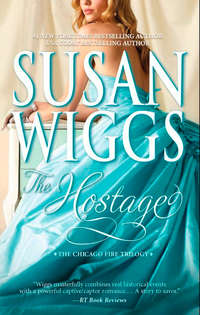
Читать книгу: «The Hostage»
Praise for the novels of Susan Wiggs
“Susan Wiggs paints the details of human relationships with the finesse of a master.”
—Jodi Picoult, New York Times bestselling author
“Once more, Ms. Wiggs demonstrates her ability to bring readers a story to savor that has them impatiently awaiting each new novel.”
—RT Book Reviews on The Hostage
“A thrilling blend of adventure and romance…Wiggs provides a delicious story for us to savor.”
—Oakland Press on The Mistress
“Susan Wiggs delves deeply into her characters’ hearts and motivations to touch our own.”
—RT Book Reviews on The Mistress
“A quiet page-turner that will hold readers spellbound as the relationships, characters and story unfold. Fans of historical romances will naturally flock to this skillfully executed trilogy, and general women’s fiction readers should find this story enchanting as well.”
—Publishers Weekly on The Firebrand
“Wiggs is one of our best observers of stories of the heart. Maybe that is because she knows how to capture emotion on virtually every page of every book.”
—Salem Statesman-Journal
“Susan Wiggs writes with bright assurance, humor and compassion.”
—Luanne Rice, New York Times bestselling author
The Hostage
Susan Wiggs
The Chicago Fire Trilogy

www.mirabooks.co.uk
Also by Susan Wiggs
Contemporary Romances
HOME BEFORE DARK
THE OCEAN BETWEEN US
SUMMER BY THE SEA
TABLE FOR FIVE
LAKESIDE COTTAGE
JUST BREATHE
The Lakeshore Chronicles
SUMMER AT WILLOW LAKE
THE WINTER LODGE
DOCKSIDE
SNOWFALL AT WILLOW LAKE
FIRESIDE
LAKESHORE CHRISTMAS
THE SUMMER HIDEAWAY
Historical Romances
THE LIGHTKEEPER
THE DRIFTER
The Tudor Rose Trilogy
AT THE KING’S COMMAND
THE MAIDEN’S HAND
AT THE QUEEN’S SUMMONS
Chicago Fire Trilogy
THE HOSTAGE
THE MISTRESS
THE FIREBRAND
Calhoun Chronicles
THE CHARM SCHOOL
THE HORSEMASTER’S DAUGHTER
HALFWAY TO HEAVEN
ENCHANTED AFTERNOON
A SUMMER AFFAIR
For Lisa and Bruce, with love
Part One
And the wind raging, and the fire burning, and London and Paris and Portland outdone, and no Milton and no Dante on earth to put the words together.
—Chicago Tribune
(burned before distribution)
Prologue
Chicago
8 October 1871
It was the hottest October anyone could remember. Less than an inch of rain had fallen in three months. Livestock died of thirst, their bloated carcasses splayed beside sunbaked mudholes. The unseasonable warmth made women regard baking day with special loathing and small children cranky with prickly heat. Laboring men paused in their work, looked up at the sky and remarked to each other that they’d surely welcome a breath of winter.
Drought and dry windstorms kept the fire companies frantically busy; engineers and pipemen were called on to put out as many as six fires a day, battling the flames that fed on unpainted frame cottages, rickety shanties with roofs of tar and shake, and the endless supply of woodchips from Chicago’s lumber mills.
Into the restless stream of hot prairie wind floated a single spark.
Later, some would say the spark came from a stove chimney. Many believed the gossip that the unfortunate placement of a lantern near a cow in Mrs. O’Leary’s barn had caused the mayhem. Others would swear, in the terrible aftermath, that the hand of God himself started it all, while still others accused the Devil. Some even blamed a hail of comets that rained from the night sky. In the great charred ruin of the city, fingers would point and recriminations would echo across courtrooms, in the city hall and at hearings before the Board of Fire.
But the fact was, a single spark, dipping and swirling like a drunken ballerina, rode an updraft of wind that night. It sailed high over a neighborhood of wood frame houses, barns packed with timothy hay, sheds full of coal and wood shavings for tinder, sidewalks constructed of knotty spruce and pine-block roadways.
The West Division neighborhood was a rabbit warren of narrow, miserable alleys and makeshift shanties, a place no respectable person would ever visit. But it was home to day laborers and women with too many babies, to shopkeepers and immigrants, to drunks and dreamers, loose women and strict Catholics. And in the tacked-together neighborhood they bore their children, worshiped, ate, drank, fought, loved and buried their dead.
The dry, blowing heat prompted some folks to find their beds early, while others tried to drown their discomfort in drink and song. The thin, lively whine of fiddle music and the thump of hobnail boots on plank floors emanated from some of the cottages. Noise flooded through open windows and caused flimsy walls to reverberate with the hectic celebration.
And high in the wild night sky, the spark looped and changed direction, pushed along by the wind blowing in from the broad and empty Illinois prairie.
The spark entered a barn where five milk cows and a horse stood tethered with their heads lowered, and a calf lay curled on a bed of straw.
The tiny ember dropped onto a store of musty hay, and when the wind breathed on it, a small circle of orange appeared.
No one saw the pool of flame spread like spilled water, dripping down and over the stacked hay, igniting the crisp, dry wood shavings from Bateham’s Planing Mill. No one saw the river of fire flowing along the worn plank floor. No one noticed the horse’s nostrils dilate in fear or heard the animal emit a high-pitched whistle of alarm.
Finally, a drayman with a wooden leg, who happened to be loitering across the street, noticed the deep-toned, unnatural light and headed clumsily for the barn. The cows, tied by their halters, stood unmoving even when Pegleg Sullivan came crashing into the barn and untied them. The calf, with its hide on fire and its tether hanging in the wood shavings, plowed into Pegleg and half dragged him out into the yard.
Tall, graceful fronds of flame bloomed at the side of the barn. Stark orange light licked across the beaten earth of the yard between house and shed.
Finally, a man’s voice broke the night. “Kate, the barn’s afire!”
In Box Number 342, at the corner of Canalport Avenue and Halsted Street, the first alarm sounded.
And over the sleeping faces of the children in the West Division of Chicago, a strange and rusty glow of light flickered.
Chapter One
“What’s the matter with Deborah?” asked Phoebe Palmer, standing in the middle of a cluttered suite of rooms at Miss Emma Wade Boylan’s School for Young Ladies. Lacy petticoats and beribboned unmentionables littered the divans and ottomans of the fringed, beaded and brocaded salon. “She won’t even let her maid in to attend her,” Phoebe added.
“I’ll see what’s keeping her.” Lucy Hathaway pushed open the door to an adjoining chamber. Deborah’s dress, which she had worn to Aiken’s Opera House the previous night, lay slumped in a heap of tulle and silk on the floor. A mound of sheets lay scattered over the bed, while the smell of expensive perfume and despair hung in the air.
“Deborah, are you all right?” Lucy asked softly. She went to the window, parting the curtain to let in a bit of the waning evening light. In the distance, some of the taller buildings and steeples of distant Chicago stabbed the horizon. The sky was tinged dirty amber by the smoke and soot of industry. But closer to Amberley Grove, the genteel suburb where the school was located, the windswept evening promised to be a lovely one.
“Deborah, we’ve been pestering you for hours to get ready. Aren’t you coming with us tonight?” Lucy persisted. Though the engagement bore the humble name of an evangelical reading, everyone knew it was simply an excuse for the cream of society to get together on the Sabbath. Though weighty spiritual issues might be discussed, lighter matters such as gossip and romance would be attended to with appropriate religious fervor. Tonight’s particular social event had an added drama that had set tongues to wagging all week long. The intensely desired Dylan Kennedy was looking for a wife.
“Please, dear,” Lucy said. “You’re scaring me, and ordinarily nothing scares me.”
Huddled on the bed, Deborah couldn’t find the words to allay her friend’s concern. She was trying to remember what her life had been like just twenty-four hours ago. She was trying to recall just who she was, tallying up the pieces of herself like items in a ledger book. A cherished only daughter. Fiancée of the most eligible man in Chicago. A privileged young woman poised on the threshold of a charmed life.
Everything had fallen apart last night, and she had no idea how to put it all back together.
“Make her hurry, do,” Phoebe said, waltzing in from the next room with a polished silk evening dress pressed to her front. “Miss Boylan’s coach will call for us in half an hour. Imagine! Dylan Kennedy is finally going to settle on a wife.” She preened in front of a freestanding cheval glass, patting her glossy brown hair. “Isn’t that deliciously romantic?”
“It’s positively barbaric,” said Lucy. “Why should we be paraded in front of men like horses at auction?”
“Because,” Kathleen O’Leary said, joining them in Deborah’s chamber, “Miss Boylan promised you would all be there. Three perfect young ladies,” she added with a touch of Irish irony. She reached for the curtain that shrouded the bed. “Are you all right, then, miss?” she asked. “I’ve been trying like the very devil to attend to you all day.” The maid put out a pale, nervous hand and patted the miserable mound of blankets.
Deborah felt assaulted by her well-meaning friends. She wanted to yell at them, tell them to leave her alone, but she had no idea how to assert her own wishes. No one had ever taught her to behave in such a fashion; it was considered unladylike in the extreme. She shrank back into the covers and pretended not to hear.
“She doesn’t answer,” Lucy said, her voice rising with worry.
“Please, Deborah,” Phoebe said. “Talk to us. Are you ill?”
Deborah knew she would have no peace until she surrendered. With slow, painstaking movements, she made herself sit up, leaning against a bank of Belgian linen pillows. Three faces, as familiar as they were dear to her, peered into hers. They looked uncommonly beautiful, perhaps because they were all so different. Blackhaired Lucy, carrot-topped Kathleen and Phoebe with her light brown curls. Their faces held the winsome innocence and anticipation Deborah herself had felt only yesterday.
“I’m not ill,” she said softly, in a voice that barely sounded like her own.
“You look like hell,” Lucy said with her customary bluntness.
Because I have been there.
“I’ll send for the doctor.” Kathleen started toward the door.
“No!” Deborah’s sharp voice stopped the maid in her tracks. A doctor was unthinkable. “That is,” she forced herself to say, “I assure you, I am not in the least bit ill.” To prove her point, she forced herself out of bed and stood barefoot in the middle of the room.
“Well, that’s a relief.” With brisk bossiness, Phoebe took her hand and gave it a friendly, aggressive tug. Deborah stumbled along behind her and stepped into the brightly lit salon.
“I imagine you’re simply overcome because you’ll be a married woman a fortnight from now.” Phoebe dropped her hand and smiled dreamily. “You are so fabulously lucky. How can you keep to your bed at such a magical time? If I were engaged to the likes of Philip Ascot, I should be pacing the carpets with excitement. The week before my sister married Mr. Vanderbilt, my mother used to joke that she needed an anchor to keep her feet on the ground.”
Deborah knew Phoebe didn’t mean for the words to hurt. Deborah was a motherless daughter, the saddest sort of creature on earth, and at a time like this the sense of loss gaped like an unhealed wound. She wondered what a young woman with a mother would do in this situation.
“So,” Lucy said, “let’s hurry along. We don’t want to be late.”
Through a fog of indifference, Deborah surveyed the suite cluttered with combs, atomizers, lacy underclothes, ribbons, masses of petticoats—a veritable explosion of femininity. It was the sort of scene that used to delight her, but everything was different now. Suddenly these things meant nothing to her. She had the strangest notion of being encased in ice, watching her friends through a wavy, frozen wall. The sense of detachment and distance hardened with each passing moment. She used to be one of the young ladies of Miss Boylan’s famous finishing school, merry and certain of her place in the glittering world of Chicago’s debutantes. It all seemed so artificial now, so pointless. She felt alienated from her friends and from the contented, foolish girl she used to be.
“And what about you, dear Kathleen?” Phoebe asked, aiming a pointed glance at the red-haired maid. Phoebe took every chance to remind Kathleen that she was merely the hired help, there at the sufferance of more privileged young women like herself. “What do you plan to do tonight?”
Kathleen O’Leary’s face turned crimson. She had the pale almost translucent skin of her Irish heritage, and it betrayed every emotion. “You’ve left me a fine mess to be tidying up, miss. And won’t that keep me busy ‘til cock-crow.” Saucy as ever, she exaggerated her brogue on purpose.
“You should come with us, Kathleen.” Lucy, whose family had raised her to be a free thinker, didn’t care a fig for social posturing, but she knew that important people would be attending. The politicians, industrialists and social reformers were valuable contacts for her cause—rights for women.
“Really, Lucy,” scolded Phoebe. “Only the best people in town are invited. Dr. Moody’s readings are strictly for—”
“The invitation was extended to every young lady at Miss Boylan’s,” Lucy, who was both wealthy and naive enough to be an egalitarian, reminded her.
“Stuff and nonsense,” Kathleen said, her blush deepening.
“Perhaps you should attend,” Phoebe said, a calculating gleam in her eye. “It might be fun to surprise everyone with a lady of mystery.”
The old Deborah would have joined in the ruse with pleasure. Lively, intelligent Kathleen always added a sense of fun to the sometimes tedious routine of social climbing. But it was all too much to think about now, and she passed a shaking hand over her forehead. The celluloid hairpins she hadn’t bothered to remove last night exaggerated the headache that made her grit her teeth. The pain hammered so hard at her temples that the pins seemed to pulse with a life of their own.
“Phoebe’s right, Kathleen,” Lucy was saying. “It’ll be such fun. Please come.”
“I’ve not a stitch to wear that wouldn’t mark me as an imposter,” Kathleen said, but the protest failed to mask the yearning in her voice. She had always harbored an endless fascination with high society.
“Yes, you have.” Deborah forced herself out of her torpor. “You shall wear my new dress. I won’t be needing it.”
“Your Worth gown?” Phoebe demanded. At her father’s insistence, Deborah’s gowns all came from the Salon de Lumière in Paris. “For mercy’s sake, you’ve never even worn it yourself.”
“I’m not going.” Deborah kept her voice as calm as she could even though she felt like screaming. “I must go into the city to see my father.” She wasn’t sure when she had made the decision, but there it was. She had a matter of utmost importance to discuss with him, and she could not put it off any longer.
“You can’t go into the city tonight,” Phoebe said. “Don’t be silly. Who would chaperone you?”
“Just come with us,” Lucy said, her voice gentle. “Come to the reading, and we’ll take you to see your father afterward. Philip Ascot will be in attendance, won’t he? He’ll be expecting you. What on earth shall we tell him?”
The name of her fiancé rushed over Deborah like a chill wind. “I’ll send my regrets.”
“You aren’t yourself at all.” Lucy touched her arm, her light brush of concern almost powerful enough to shatter Deborah. “We shall go mad with worry if you don’t tell us what’s wrong.”
Phoebe stuck out her foot so Kathleen could button her kid leather boot. “Was it last night’s opera? You were fine when you left, but you stayed in bed all day long. Didn’t you like Don Giovanni?”
Deborah turned away, a wave of nausea rolling over her. The notes of the Mozart masterpiece were forever burned into her.
“It’s your bloody flux, isn’t it?” Kathleen whispered, ignoring Phoebe’s boot. “You’ve always suffered with the heavy pains. Let me stay behind and fix you a posset.”
“It’s not the flux,” Deborah said.
Lucy planted her palm flat against the door. “This isn’t like you. If something’s wrong, you should tell us, dear.”
Nothing’s wrong. She tried to eke out the words, but they wouldn’t come, because they were a lie. Everything was wrong and nothing could ever be the same. But how did she explain that, even to her best friends?
“It’s of a private nature,” she said faintly. “Please. I’ll explain it all when I return.”
“Oh, so you’re going to be mysterious, are you?” Phoebe sputtered. “You’re just trying to make yourself the center of attention, if you ask me.”
“No one asked you,” Lucy said wearily.
Phoebe sputtered some more, but no one was listening. Though she had come up through school with the rest of them, Phoebe had set herself apart from the others. Nearly as rich as Deborah and nearly as blue-blooded as Lucy, she had concluded that the two “nearlys” added up to much loftier status than her friends enjoyed. She was a terrible and unrepentant snob, generally benign, though her remarks to Kathleen O’Leary sometimes brandished the sharp edge of malice. Phoebe alone understood that one did not simply abandon an exclusive social event. But this merely proved the inferiority of a girl like Deborah Sinclair. New-money people simply didn’t understand the importance of attending the right sort of functions with the right sort of people.
“I’d best go ring for my driver,” Deborah said.
Lucy moved away from the door. “It won’t be the same without you.”
Deborah bit her lip, afraid that the sympathy from her best friend would break through the icy barrier she had painstakingly erected between control and madness. “Help Kathleen with the gown,” she said, hoping to divert everyone’s attention to the masquerade.
After sending for her coach, Deborah buttoned on a simple blue serge dress and tugged a shawl around her shoulders. Pushing her feet into Italian kid leather boots, she didn’t bother with the buttoning. Instead, she wound the ribbons haphazardly around her ankles and then jammed on a hat.
In the main salon, the others dressed more carefully. Eyes shining with forbidden pleasure, Kathleen stepped into the French gown, her homespun bloomers disappearing beneath layers of fancy petticoats. The gown of emerald silk and her Irish coloring gave her the look of a Celtic princess, and her face glowed with an excitement Deborah could no longer share.
Before leaving, Deborah stepped back and surveyed the scene, seeing it for the first time through the eyes of an outsider. Over her father’s protests she had left his opulent, gilded mansion for the solid gothic halls of Miss Boylan’s. Her father believed the very best young ladies were educated at home. But once he learned a Hathaway and a Palmer would be in attendance, he had relented and allowed Deborah to complete her education with finishing school. She looked with fondness upon Lucy, Kathleen and Phoebe, who were her closest companions and sometimes, she thought, her only friends. The four of them had shared everything—their hopes and dreams, their broken hearts and romantic triumphs.
Finally Deborah had encountered something she could not share with her friends. She could not. It was too devastating. Besides, she must tell her father. She must. Please God, she prayed silently. Let him understand. Just this once.
“Have a wonderful time this evening,” she said, her hand on the door handle. “I shall want to hear all about Kathleen’s debut when I return.” She forced the words past a throat gone suddenly tight with terror.
Kathleen rushed to the door. “Miss Deborah, are you certain that—”
“Absolutely.” The word was a mere gust of air.
“Let the poor thing go,” Phoebe said in a distracted voice. She lifted her arm with the sinuous grace of a ballerina and drew on a silken glove. “If you stand around arguing all evening, we’ll be late.”
She and Lucy launched into a squabble over how Kathleen should wear her hair, and Deborah took the opportunity to slip out into the tall, cavernous hall and down to the foyer, where her driver waited. Outside, she saw the school’s large, cumbersome rockaway carriage being hitched to four muscular horses. The school crest adorned the black enamel doors.
Deborah’s private Bismarck-brown clarence, with its gleaming glass panes front and rear, waited at the curb. Thanks to her father’s habit of flaunting his wealth, the expensive vehicle, with its experienced driver and Spanish coach horse, was always at her disposal. Within a few minutes, she was under way.
She gripped a leather strap at the side of the interior of the coach, bracing herself against the rocking motion. As they pulled away from the school, with its ponderous, pretentious turrets and wrought iron gates, she felt like Rapunzel escaping her tower prison. Small farms sped past, squat houses hugged low against the prairie landscape of withered orchards and wind-torn cornfields. Lights glimmered in windows and the sight of them pierced her. She pictured the families within, gathering around the table for supper. She had only seen such families from afar, but imagined they shared an easy intimate warmth she had never felt growing up in the cold formality of her father’s house.
She cast away the yearning. All her life she had enjoyed the advantages most women never dared to dream about. Arthur Sinclair had crafted and aligned his daughter’s future with the same precise attention to detail with which he put together his business transactions. His rivals vilified him for his aggression and ambition, but Deborah knew little of commerce. Her father preferred it that way.
The drive into Chicago was swift. Jeremy, who had served as her personal driver since she was three years old, drove expertly through the long, straight roads that crisscrossed the city. Jeremy lived in a garden cottage along the north branch of the Chicago River. He had a plump wife and a grown daughter who had recently wed. Deborah wondered what Jeremy did when he returned home to them, late at night. Did he touch his sleeping wife or just light a lamp and look at her for a moment? Did she awaken, or sigh in her sleep and turn toward the wall?
Deborah knew she was using her meandering thoughts to keep her mind off the ordeal to come. She shifted restlessly on the seat and cupped her hands around her eyes to see through the glass as Chicago came into view. Ordinarily, the air was cool closer to the lake, but this evening, the day’s heat hung well past sundown.
The whitish fuzz of gaslight illuminated the long, straight main thoroughfares. The coach crossed the river, rolling past the elegant hotel where the reading party was to take place. Well-dressed people were already gathering. Liveried doormen rushed to and fro beneath a scalloped canvas awning that flapped in a violent wind. Huge potted shrubs flanked the gilt-and-glass doorway, and inside, a massive chandelier glowed like the sun. The gilded cage of high society was the only world Deborah had ever known, yet it was a world in which she no longer felt safe. She couldn’t imagine herself walking into the hotel now.
Traditionally set for the second Sunday of the month, the lively readings and discussions ordinarily held a delicious appeal for her. She loved seeing people dressed in their finery, happily sipping cordials as they laughed and conversed. She loved the easy pleasures of glib talk and gossip. But last night the magic had been stolen from Deborah.
No matter. Tonight she vowed to reclaim her soul.
She shivered, knowing that skipping the social engagement was only the first act of defiance she would commit tonight. She had never before carried out a rebellion, and she didn’t know if she could accomplish it.
As the carriage wended its way up Michigan Avenue, Jeremy had to slow down before an onslaught of pedestrians, drays, teams and whole family groups. They seemed to be heading for the Rush Street bridge that spanned the river. Despite the lateness of the hour, crowds had gathered at the small stadium of the Chicago White Stockings.
Rapping on the curved windshield, Deborah called out, “Is everything all right, Jeremy?”
He didn’t answer for a few moments as he negotiated the curve toward River Street, heading for the next bridge to the west. They encountered more crowds, bobbing along in the scant illumination of the coach lamps. Deborah twisted around on the cushioned bench to look through the rear window. The pedestrians were, for the most part, a well-dressed crowd, and though no one dawdled, no one hurried, either. They resembled a dining party or a group coming out of the theater. Yet it seemed unusual to see so many people out on a Sunday night.
“They say there’s a big fire in the West Division,” Jeremy reported through the speaking tube. “Plenty of folks had to evacuate. I’ll have you home in a trice, miss.”
She knew Kathleen’s family lived in the West Division, where they kept cows for milking. She prayed the O’Learys would be all right. Poor Kathleen. This was supposed to be an evening of pranks, pretenses and fun, but a big fire could change all that.
She wondered if Dr. Moody’s lecture would be canceled because of the fire. Probably not. The Chicago Board of Fire boasted the latest in fire control, including hydrants, steam pump engines and an intricate system of alarms and substations. Many of the stone and steel downtown buildings were considered fireproof. The city’s elite would probably gather in the North Division to gossip the night away as the engineers and pumpers brought the distant blaze under control.
She stared out at the unnatural bloom of light in the west. Her breath caught—not with fear but with wonder at the impressive sight. In the distance, the horizon burned bright as morning. Yet the sky lacked the innocent quality of daylight, and in the area beyond the river, brands of flame fell from the sky, thick as snow in a blizzard.
Apprehension flashed through her, but she put aside the feeling. The fire would stop when it reached the river. It always did. The greater problem, in Deborah’s mind, was getting her father to understand and accept her decision.
The coach rolled to a halt in front of the stone edifice of her father’s house. Surrounded by yards and gardens, the residence and its attendant outbuildings took up nearly a whole block. There was a trout pond that was used in the winter for skating. The mansion had soaring Greek revival columns and a mansard roof, fashionably French. A grand cupola with a slender lightning rod rose against the sky. A graceful porch, trimmed with painted woodwork, wrapped around the front of the house, with a wide staircase reaching down to the curved drive.
“You’re home, miss,” Jeremy announced, his footsteps crunching on the gravel drive as he came to help her down.
Not even in a moment of whimsy had Deborah ever thought of the house on Huron Avenue as a home. The huge, imposing place more closely resembled an institution, like a library or perhaps a hospital. Or an insane asylum.
Squelching the disloyal thought, she sat in the still swaying carriage while Jeremy lowered the steps, opened the door and held out his hand toward her. Wild gusts of wind pushed dead leaves along the gutters and walkways.
Even through her glove she could feel that Jeremy’s fingers were icy cold, and she regarded him with surprise. Despite a studiously dispassionate expression, a subtle tension tightened his jaw and his eyes darted toward the firelit sky.
“You’d best hurry home to your wife,” she said. “You’ll want to make certain she’s all right.”
“Are you sure, miss?” Jeremy opened the iron gate. “It’s my duty to stay and—”
“Nonsense.” It was the one decision she could make tonight that was unequivocal. “Your first duty is to your family. Go. I would do nothing but worry all night if you didn’t.”
He sent her a grateful bob of his head, and as he swept open the huge, heavy front door for her, the braid on his livery cap gleamed in the false and faraway light. Deborah walked alone into the vestibule of the house, feeling its formidable presence. Staff members hastened to greet her—three maids in black and white, two house-men in navy livery, the housekeeper tall and imposing, the butler impeccably dignified. As she walked through the formal gauntlet of servants, their greetings were painstakingly respectful—eyes averted, mouths unsmiling.
Arthur Sinclair’s servants had always been well-fed and -clothed, and most were wise enough to understand that not every domestic in Chicago enjoyed even these minor privileges. To his eternal pain and shame, Arthur Sinclair had once been a member of their low ranks. So, though he never spoke of it, he understood all too well the plight of the unfortunate.
She prayed he would be as understanding with his own daughter. She needed that now.
“Is my father at home?” she inquired.
“Certainly, miss. Upstairs in his study,” the butler said. “Would you like Edgar to announce you?”
“That won’t be necessary, Mr. Marlowe. I’ll go right up.” She walked between the ranks of silent servants, surrendering her hat and gloves to a maid as she passed. She sensed their unspoken questions about her plain dress and shawl, the disheveled state of the hair she had not bothered to comb. The stiff, relentless formality was customary, yet Deborah had never enjoyed being the object of the staff’s scrutiny. “Thank you,” she said. “That will be all.”
“As you wish.” Marlowe bowed and stepped back.
With a flick of her hand and a jingle of the keys tied at her waist, the housekeeper led the others away. Through the doors that quickly opened and shut, Deborah could see that valuables were being packed away into trunks and crates. A precaution, she supposed, because of the fire.
Standing alone in the soaring vestibule, with its domed skylight three storeys up, Deborah immediately and unaccountably felt cold. The house spread out in an endless maze of rooms—salons and seasonal parlors, the music room, picture gallery, dining room, ballroom, conservatory, guest suites she had never counted. This was, in every sense of the word, a monument to a merchant prince; its sole purpose to proclaim to the world that Arthur Sinclair had arrived.
Dear God, thought Deborah. When did I grow so cynical?
Actually, she knew the precise moment it had happened. But that was not something she would reveal to anyone but herself.
Misty gaslight fell across the black-and-white checkered marble floor. An alabaster statue of Narcissus, eternally pouring water into a huge white marble basin situated in the extravagant curve of the grand staircase, greeted her with a blank-eyed stare.
Beside the staircase was something rather new—a mechanical lift. In principle it worked like the great grain elevators at the railroad yards and lakefront. A system of pulleys caused the small car to rise or lower. Her father had a lame leg, having been injured in the war a decade ago, and he had a hard time getting up and down the stairs.
To Deborah, the lift resembled a giant bird cage. Though costly gold-leaf gilding covered the bars, they were bars nonetheless. The first time she stood within the gilded cage, she had felt an unreasoning jolt of panic, as if she were a prisoner. The sensation of being lifted by the huge thick cables made her stomach lurch. After that first unsettling ride, she always chose to take the stairs.
The hand-carved rail of the soaring staircase was waxed and buffed to a high sheen. Her hand glided over its satisfying smoothness, and she remembered how expert she had been at sliding down this banister. It was her one act of defiance. No matter how many times her nanny or her tutor, or even her father, reprimanded her, she had persisted in her banister acrobatics. It was simply too irresistible to prop her hip on the rail, balance just so at the top, then let the speed gather as she slid down. Her landings had never been graceful, and she’d borne the bruises to prove it, but the minor bumps had always seemed a small price to pay in exchange for a few crazy moments of a wild ride.
Unlike so many other things, her father had never been able to break her of the habit. He governed her sternly in all matters, but within her dwelt a stubborn spark of exuberance he had never been able to snuff.
Deborah started up the stairs. The study housed Arthur Sinclair’s estate offices, and he worked there until late each night, devoting the same fervor to his business as a monk to his spiritual meditations. He regarded the accumulation of wealth and status as his means to salvation. But there was one thing all his money and influence could not buy—the sense of belonging to the elite society that looked down on his kind. Acquiring that elusive quality would take more than money. For that he needed Deborah.
She shuddered, though the house was overly warm, and took the steps slowly. She passed beautifully rendered oil portraits in gaudily expensive gold-leafed frames. The paintings depicted venerable ancestors, some dating back to the Mayflower and further. But the pictures were of strangers plucked from someone else’s family tree. She used to make up stories about the stern-faced aristocrats who stared, eternally frozen, from the gleaming frames. One was an adventurer, another a sailor, yet another a great diplomat. They were all men who had done something with their lives rather than living off the bounty of their forebears.
She would never understand why her father considered it less honorable to have earned rather than inherited a fortune. She had asked him once, but hadn’t understood his reply. “I wish to have a feeling of permanence in the world,” he had said. “A feeling that I have acquired the very best of everything. I want to achieve something that will last well beyond my own span of years.”
It was a mad quest, using money to obtain the things other families took generations to collect and amass, but he regarded it as his sacred duty.
She reached the top of the stairs and paused, her hand on the carved newel post. She glanced back, her gaze following the luxurious curve of the banister. Through the inlaid glass dome over the entryway, an eerie glow flickered in the sky. The fire. She hoped the engineers would get it under control soon.
But she forgot all about the fire on the other side of the river as she started down the hall toward her father’s study. A chill rippled through her again, carrying an inner warning: One did not contradict the wishes of Arthur Sinclair.
Chapter Two
Tom Silver arrived in Chicago with murder on his mind. Heaved up by wind-driven waves, the deck of the steam trawler shifted under his feet. He knew it would be hard going to get to shore in the dinghy, but he didn’t care. He had a job to do.
Yet when he saw the city in flames, he paused in putting spare cartridges in his belt loops and gaped at the fiery orange dome over the sky. The unnatural arch of light and flame was so eerie that, just for a moment, he forgot everything, including the deadly purpose in his heart.
“Hey, Lightning,” he called, thumping his foot on deck to summon his companion, who was in the engine room. “Come have a look at this.”
The lake steamer Suzette chugged toward its final destination at Government Pier. Its point was marked by a lighthouse beacon, but Tom had a hard time keeping his mind on navigation. The sight of the burning city clutched at his gut, made his heart pump hard in his chest. He couldn’t help thinking about the tragedies that would strike tonight with the swift, indifferent brutality of fate. Fire was like that—random and merciless.
And damned inconvenient, given his purpose tonight. He had come hundreds of miles, from the vast and distant reaches of Lake Superior, to hunt down Arthur Sinclair. He wouldn’t let a fire stop him.
The smell of steam and hot oil wafted up through the fiddley, and the clank of machinery crescendoed as a hatch opened. “What the hell is going on, eh?” asked Lightning Jack, emerging through the narrow opening. He shaded his eyes and squinted at the city. “Parbleu, that is one big fire.”
“I guess I’ll get a closer look tonight,” Tom said, making his way down to the engine room.
Drawing back on a lever, he tamped down the boiler and then climbed abovedecks to help Lightning Jack drop anchor in the deep water. Though it was late, he had to shade his eyes against the light of the conflagration. People had gathered on the long fingerlike pier. Boats shuttled between the mouth of the river and the long dock. At the Sands, the fire reared so close that people drove wagons into the lake to escape the leaping flames. But their backs were all turned to the lake. Like Tom, they were mesmerized by the spectacle of the city in flames.
The skeletal tower of the Great Central elevator, surrounded by smokestacks, threw a long black shadow on the churning water. The fire tore across the city with the prairie wind, hot and muscular, feeding on the close-set structures.
Tom had seen any number of fires in his lifetime, but never one like this. Never one in which the wind seemed to bear the flames in its arms. Never one that moved with such furious speed. Flames covered the homes and businesses like blankets, building by building, block after block. He could see the deadly veil of crimson covering the West Division and pushing relentlessly at the edge of the river.
Tom Silver did not know Chicago well, for he had spent little time here, but it was the largest city he had ever seen. It was shaped by the lakefront and the branches of the river, which were constantly busy with commercial traffic. Ten railroads converged on Chicago, sixteen bridges spanned the river and canal, and hundreds of thousands of people made their home there.
Now its heart was on fire. This was the inferno, like the dreaded one in the Old Testament stories he used to read to Asa.
The thought of Asa brought Tom’s grim purpose back into focus. Tonight he would have his revenge. Nothing—not even the flames of hell—would stop him.
“You going to wait this out?” Lightning Jack asked, seeming to read Tom’s thoughts.
“Makes no sense to wait,” Tom pointed out. “If the fire spreads to the North Division before I get there, I’ll lose him for sure.”
“Then you had best be quick. It could be a convenience, eh? If the house burns, you won’t have to worry about evidence being found.”
Tom studied his oldest friend, his mentor, the man who had raised him. Lightning Jack duBois had found Tom, a five-year-old abandoned in a cabin in the north woods, sitting blank-eyed next to the stiff corpse of his mother. She had died of starvation, and Tom’s fate was not far behind, except that the tough old voyageur had intervened.
Since that long ago day, Tom had given Jack all his loyalty and trust. Just as Asa had trusted Tom.
“What is that look, eh?” Lightning Jack made a face. “You want to abandon the plan?”
“You know better than that.” Tom felt hard, driven. The killing would be a purification ritual, a way to wash his soul clean of the black rage that consumed him. At least, that was what he kept telling himself.
Lightning Jack’s brow drew down in a scowl. “It is no crime, but retribution.”
Arthur Sinclair was a murderer, though no doubt his soft white hands were unsoiled, even in his own eyes. He employed underlings to do his work for him, but he was just as guilty as if he had slain seven souls with his bare hands.
“I still think you should let me go with you,” Lightning Jack said, resting his hand on the handle of his hunting knife.
“No.” Tom buckled on his cartridge belt. Truth was, Lightning Jack lacked a cool head. He tended to let passion get the best of him, and rage made him reckless. He despised Arthur Sinclair with a virulence that poisoned his heart, for his heart was the thing Sinclair had taken from him.
Tom’s hatred for Sinclair was different. Colder, more precise. The clarity of his hatred made him better equipped to kill. Lightning Jack was too volatile. He wore his grief for Asa like a hair shirt, and it made him wild and vulnerable.
“Shipping traffic’s heavy,” Tom pointed out. “You’d best stay here and look after the Suzette.“
“Spectators, I’m guessing,” Lightning Jack said. “Refugees. Like ants swarming in a flood. They have nowhere to go.”
Tom scanned the shoreline, picking out a train depot by a breakwater, towers and smokestacks, all pulsating in firelight. People trapped at the lakeshore waved their arms, signaling to the passing boats.
Lightning Jack watched as Tom holstered the Colt police revolver they’d bought at the Soo Locks. “Do you have enough cartridges?” Lightning asked.
“Jesus, how many times do you want me to shoot him?” Tom opened his buckskin jacket to reveal the row of ammunition in his belt loops.
“Seven,” Lightning said as Tom tied the thin leather strap of the holster around his thigh. “Go now. Time is short. I’ll keep the Suzette ready to weigh anchor.”
Tom lowered the dinghy into the water and began to pull toward the shore. The lake boiled with wind-whipped waves that crested and sloshed over the sides. Some of the boats he passed were gearing up to rescue refugees from the fire. If he were a better man, he would join the rescue effort. But he wasn’t here to save anyone. He was what circumstances had made of him, and in his heart there was no room for anything but hatred.
Every now and then he glanced over his shoulder at the waterworks north of the river. The structure still seemed to be intact, its gothic spire a black arrow against the noxious orange sky. Maybe the tower was close enough to the lake to survive the fire. So long as the pumps and bellows of the waterworks remained safe, the flames could be brought under control.
Yet he could not help noticing it was a losing battle. The high wind howled and stormed with hellish fury. Firebrands rained harder and thicker from the sky, sparking up blazes each place they touched. By the time he found the Sinclair mansion, the fire would not be far behind.
Tom tied up at a rubble-built bulkhead, securing the dinghy beneath an outcropping of rock. Under the circumstances, he had to be cautious. A panicked victim of the fire would not think twice about stealing a rowboat, and it was a long swim back to the steamer.
He hauled himself out and scrambled up the embankment. Emerging onto a brick-strewn street, he immediately felt a blast of the fire’s hot breath. His caribou hide shirt and trousers would protect him from the flying sparks—for a while, at least.
A couple of distant explosions startled him as he made his way along the north bank of the river. He passed banks and hotels, McCormack’s Reaper Works, shops and theaters, parks and boulevards. People looked out the windows of nearly every tall building, their gazes turned toward the fire. Eerily, the night grew lighter with each passing moment. He could pick out street signs and people standing in groups, talking excitedly. A short distance away, tugboats on the river screamed for the bridges to be turned to let them through, but the huge crowds gathered on the shore prevented the bridge operators from doing their job. The fire from the west blew toward the forest of masts and rigging. Good thing Lightning Jack had agreed to lay-to offshore. There was no safe place in the city tonight.
This was unfamiliar territory to Tom, but he knew where Sinclair lived. He had studied the location on a map, and the route was branded on his memory.
He had not reckoned on having to navigate a sea of humanity, though. Men, women, children and livestock surged along the main thoroughfares, pushing toward the lake. Overloaded carts, drays, mule trucks and express wagons clogged the roadways. In his entire life, Tom hadn’t seen so many people. Some were dressed in nightclothes, others in evening wear. Carts and carriages clattered past with little heed for the safety of the pedestrians. Men dragged trunks behind them; women clutched quilts and kettles and drawers stuffed with belongings. People fled, their arms filled with books and mementos, bundled clothes, odd-shaped bags and even a metal safe or two.
What did a person save when faced with losing everything? Tom wondered. Priceless antiques, irreplaceable photographs, quilts and curios made by the hands of loved ones long dead. And money, of course. There was always that.
The rumble of collapsing buildings drowned out the shouting and caused children and horses to panic. Everywhere he looked, Tom saw carts running out of control or crashing into buildings or trees and left abandoned. One carriage, with a crest on its door that read “The Emma Wade Boylan School,” lay on its side, the team still struggling in its traces.
Three young women, dressed in silks and lace, quarreled on the boardwalk near the fallen carriage.
“I say we leave them,” the brown-haired woman said.
“We’ll not abandon the horses,” the black-haired one retorted. “We must—”
“Move aside.” Tom yanked his bowie knife out of the top of his boot. Feminine gasps greeted the sight of the glittering blade, and they fell back, clearly horrified. He sliced through the traces that bound the horses to the coach, then slapped the beasts’ rumps to drive them off down the street.
The well-dressed woman gaped at him. “He…you…the horses!”
Her companion said, “Now what shall we do?”
The redhead lifted her gaze to the flaming sky. “Pray,” she said.
Tom didn’t wait around to see the outcome of the argument. He had a job to do.
As the crowd and the smoke pressed upon him, he felt a sharp hunger for the harsh, empty majesty of the north woods wilderness. Soon, he told himself. In just a short while, he would be back where he belonged. But first he had to find his target—the house on Huron Avenue. Then he could head home to Isle Royale. There, he would try his best to endure a life that had been irrevocably changed by Arthur Sinclair.
He wondered what it would feel like to kill the man who had killed Asa. Would his heart exult in dark, cleansing joy? Would he be filled with pure glee? Would the satisfaction of revenge drive away the loss and betrayal that had consumed him since the disaster? Perhaps he would feel nothing at all. He would welcome the numbness. Feeling nothing would be a blessing after the months of suffering through soul-killing grief.
Tom had killed in the war. As a courier, he’d been used by General Whitcomb of the 21st Michigan in the way a hunter used bloodhounds. But being in the war had not given him a taste for murder.
He pressed on harder, faster, seared by the blowing heat. He passed a lanky boy burdened with a shaggy dog that kept trying to escape its young master’s arms. The boy was about fourteen, the age Asa had been when he died. Tom tried not to see the struggling youth, tried not to hear the kid saying “Easy, Shep. Take it easy. I’ll keep you safe.” He tried not to remember the way a boy’s rounded face could look so damned earnest and protective. Tom felt relieved when the youth and his dog veered off toward the lake.
If he had lived, Asa would have been fifteen in the spring. He would have had his birthday in March, and maybe Tom would have given him a bowie knife or deer rifle to mark his step toward manhood. The two of them would have sat by the stove, tying flies or playing checkers. Even now, months after the accident, Tom could picture the complete absorption in Asa’s face when he worked on a fishing fly. He could still hear Asa’s laughter in his heart.
I miss you, Asa.
Turning down a nearly deserted side street, he walked faster, breathing hard as anticipation built, tasting smoke and ash in his throat. The smell of burning timber and the sight of falling cinders reminded him of being in the thick of battle. He never should have gone to war. Lightning Jack had warned him that it would steal his spirit.
Just as he had warned Asa about working at the mine.
Asa hadn’t listened any better than Tom had, in his youth. Bored by the routine of island life and winters spent under the tutelage of a demanding scholar, Tom had run away to join the fighting. What he had seen and done during those dark years had turned his soul to ice. Only the gift of Asa had dragged Tom back into the light. Now that Asa was gone, there was nothing to keep him from falling into darkness once again.
Firebrands and cinders rained thickly over the streets, and each brand ignited a new fire. Men posted on rooftops tried to defend some of the larger buildings, but the bright dervishes of flame made a mockery of their efforts. Distant explosions pocked the night, each greeted by frightened screams.
At a broad street, the crowd flowed northward, following a long strip of green space bordering the lake. Family members shouted at one another to hurry. Tom broke off from the surging refugees and headed in the opposite direction.
“Hey, mister,” someone hollered in a hoarse voice. “You don’t want to go that way. The fire crossed over the North Branch.”
Tom ignored the warning, though the news startled him. Only a fire of demonic proportions could cross a river as wide as the branches of the Chicago. The fire department would have no hope of stopping it now. He wondered if he would be able to reach the Sinclair mansion before the fire did.
He felt mildly startled to find himself alone on a deserted street. The fire raged through buildings on either side—one appeared to be a woodworking mill, the other a brewery. Strange, he thought dispassionately. The city was burning and no one was sticking around to defend it.
He passed into darkness as he headed north, away from the fire, and sensed a change in the atmosphere as he emerged onto Dearborn. The wide boulevard, flanked by stone pilasters and tall wrought iron fences, lay in perfect splendor, though smoke lay thick in the air. Broad lawns, some with coach houses and outbuildings, surrounded the opulent mansions. The homes resembled majestic fortresses with handsome gables and half-wheel windows three storeys up. Skylights and cupolas graced the rooflines. Through a broad bay window he saw a family sitting in a parlor, playing cards while a woman played piano. At some of the other houses, people gathered at the windows to watch the fire.
Yet the sky behind the sedate facades glowed with that ominous and unnatural orange tinge, spangled by flying sparks. These fine houses were not long for this world. He hoped like hell he’d have no trouble finding Sinclair’s house, and that his quarry would be at home. He had to consider the possibility that Arthur Sinclair had evacuated his house, but there was a good chance the wealthy industrialist might stay put. Judging by the spectators watching out the windows of the grand mansions, the rich felt safe from the flames. Men like Sinclair thought they were invincible, that their money could buy them anything, even protection from death.
Stupid fools.
Бесплатный фрагмент закончился.