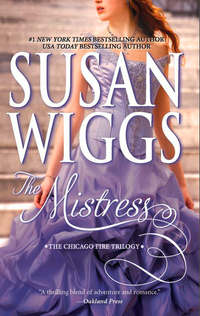
Читать книгу: «The Mistress»
Praise for the novels of Susan Wiggs
“Susan Wiggs paints the details of
human relationships with the finesse of a master.”
—Jodi Picoult, New York Times bestselling author
“Wiggs provides a delicious story for us to savor.”
—Oakland Press on The Mistress
“Susan Wiggs delves deeply into her characters’
hearts and motivations to touch our own.”
—RT Book Reviews on The Mistress
“Once more, Ms. Wiggs demonstrates her ability
to bring readers a story to savor that has them
impatiently awaiting each new novel.”
—RT Book Reviews on The Hostage
“A quiet page-turner that will hold readers
spellbound as the relationships, characters
and story unfold. Fans of historical romances
will naturally flock to this skillfully executed trilogy,
and general women’s fiction readers should
find this story enchanting as well.”
—Publishers Weekly on The Firebrand
“Wiggs is one of our best observers
of stories of the heart. Maybe that is because
she knows how to capture emotion on
virtually every page of every book.”
—Salem Statesman-Journal
“Susan Wiggs writes with bright assurance,
humor and compassion.”
—Luanne Rice, New York Times bestselling author
The Mistress
The Chicago Fire Trilogy
Susan Wiggs

www.mirabooks.co.uk
To my third-grade teacher, Mrs. Marge Green,
who taught me cursive writing
and told me the story of Mrs. O’Leary’s cow.
Acknowledgments
Thanks to Joyce, Betty and Barb, for favors too numerous to count; to friends near and far, including Jamie for brainstorming a trading scam, and Jodi for therapeutic e-mail conversations; thanks to Jill for the Bunco book, and to the wonderful Martha Keenan, who always edits above and beyond the call of duty.
Special thanks to the Chicago Historical Society, one of the richest resources ever to make itself available to a writer.
Also by Susan Wiggs
Contemporary Romances
HOME BEFORE DARK
THE OCEAN BETWEEN US
SUMMER BY THE SEA
TABLE FOR FIVE
LAKESIDE COTTAGE
JUST BREATHE
The Lakeshore Chronicles
SUMMER AT WILLOW LAKE
THE WINTER LODGE
DOCKSIDE
SNOWFALL AT WILLOW LAKE
FIRESIDE
LAKESHORE CHRISTMAS
THE SUMMER HIDEAWAY
Historical Romances
THE LIGHTKEEPER
THE DRIFTER
The Tudor Rose Trilogy
AT THE KING’S COMMAND
THE MAIDEN’S HAND
AT THE QUEEN’S SUMMONS
Chicago Fire Trilogy
THE HOSTAGE
THE MISTRESS
THE FIREBRAND
Calhoun Chronicles
THE CHARM SCHOOL
THE HORSEMASTER’S DAUGHTER
HALFWAY TO HEAVEN
ENCHANTED AFTERNOON
A SUMMER AFFAIR
One dark night,—
when people were in bed,
Old Mrs. Leary lit a lantern in her shed;
The cow kicked it over, winked its eye and
said”There’ll be a hot time
in the old town tonight.”
~Anon.,
quoted in the Chicago Evening Post
The Contact
What is the chief end of man?
—to get rich.
In what way?
—dishonestly if we can;
honestly if we must.
Mark Twain, 1871
The Setup
It was beautiful and simple
as all truly great swindles are.
~O. Henry
Annual income twenty pounds,
annual expenditure nineteen six,
result happiness.
~Charles Dickens
Prologue
Chicago
October 8, 1871
She looked older than her years from a lifetime of toil. The routine struggles of making her way in the world wore on her like the fading dye of her dimity dress. Up at dawn for the milking, feeding the hungry mouths that depended on her for every breath they took, keeping house, seeing to the livestock and navigating the unseen reefs and rocky shoals of everyday living had stolen her youth.
On a hot October night following a hot October day, Catherine O’Leary put the children down early. She washed up after supper, plunging her chapped and chafed hands into the tepid water. A high prairie wind roared through the shantytown that comprised her small world, across the river from the quiet, stately mansions of the grain barons and merchant princes. Her children had learned to sleep despite the boisterous, frequent celebrations of the McLaughlins next door. The neighbors were welcoming a cousin newly arrived from Ireland, and the thin, lively whine of fiddle music flooded through the open windows, causing the walls to vibrate. As she washed, Catherine tapped her sore, bare foot to match the rhythm of hobnail boots on plank floors emanating from the adjacent cottage.
Shadows deepened across the beaten-earth yard leading to the cow barn that housed the source of the family’s livelihood. Her husband was out back now, feeding and watering the animals. The dry, blowing heat caused brown leaves to erupt in restless swirls through the air. The wind picked up, sounding like the chug of a locomotive coming on fast.
Catherine dried her hands on her apron as Patrick returned from the barn, his shoulders bowed with exhaustion. She saw a flicker in the sky, a star winking its eye perhaps, but her attention was all for her husband. This week he had worked hard, laying in supplies for the winter—three tons of timothy hay, another two tons of coal, wood shavings for kindling from Bateham’s Planing Mill. Baking in the arid heat, the shavings curled and rustled when the aggressive wind stirred them. In this heat it was hard to imagine that winter was only weeks away.
She gave Patrick his supper of potatoes and pickled cabbage, wishing he’d had time to eat with her and the children. But families like the O’Learys did not have that luxury. Imagine, sitting down like the Quality, with enough room for everyone around the same table.
She took off her apron and kerchief. Pumping fresh water into the sink, she bathed her face and neck, and finally her sore foot; a cow had stepped on it that morning and she had been limping around all day. She drew the curtains and peeled her bodice to the waist, giving herself a more thorough washing. She braided her thick red hair, then went to check on the children. Scattered like puppies in the restless heat, the little ones lay uncovered on rough sheets she had sprinkled with water to keep them cool. There was another daughter, Kathleen, firstborn and first to leave the reluctant arms of her parents to work as a lady’s maid at Chicago’s finest school for young ladies. Perhaps in the turreted stone building by the lake, Kathleen suffered less from the heat than they did here in the West Division.
Ah, Kathleen, there was a fine young article, Catherine thought fondly. By hook or by crook, she’d make good. The Lord in his wisdom had given her the brains and the looks to do it. She wouldn’t turn out like her mother, overworked, tired, old before her time.
The sounds of revelry next door swelled, then quieted, mingling with the howl of the wind. Through the coarse weave of the sackcloth curtains, Catherine noticed a flash of light in the window.
“Let us to bed, Mother,” her husband said softly. Patrick kissed her and put out the lamp. Settling her weary head on the pillow, she listened to the rustling and breathing of her children. Then she nestled into the strong soft cradle of her husband’s arms, sighed and thought that maybe this was what all the toil was for. This one sweet moment of inexpressible bliss.
A knock at the door drew Catherine O’Leary back from the comfortable edge of sleep. The McLaughlins’ fiddle wailed on and the bodhran thumped out an ancient tribal rhythm. Two of the children awakened and started whispering. Frowning, she propped herself up on one elbow and prodded Patrick. “Are you awake, then?” she asked.
“Aye, just. I’ll see who it is.”
She lay still, hearing the low murmur of masculine voices followed by the sound of the door swishing shut. Her sore foot throbbed heatedly under the thin sheet.
“It was Daniel Sullivan with Father Campbell, come to call,” Patrick said, returning. “I told them we were already abed, and not in a state for entertaining company.”
“God preserve us for turning away a priest,” Catherine said, “but ‘tisn’t he who has to do the milking at dawn.” Feeling guilty for criticizing a priest, she drew aside a corner of the curtain to see the two men leaving.
Daniel often took an evening walk to escape the stifling heat of his cottage, even smaller and more cramped than the O’Leary place. He had one wooden leg, and as he walked along the pine plank sidewalk, his gait had the curious cadence of a heartbeat. He kept his head down, for his wooden leg tended to wedge itself into the cracks between the boards if he wasn’t careful.
She was about to settle back down for the night when she noticed a sweeping gust of wind lifting the priest’s long black cassock, revealing skinny white legs and drawers of a startling green hue. “Now there’s a sight you don’t see every day,” she muttered.
Outside the wooden cottage, high in the hot night sky, a spark from someone’s stove chimney looped and whirled, pushed along by the wind gusting in from the broad and empty Illinois prairie. The spark entered the O’Learys’ barn, where the milk cows and a horse stood tethered with their heads lowered, and a calf slept on a bed of straw.
The glowing ember dropped onto the hay, and the wind fanned it until it bloomed, then burned in a hot, steady circle of orange. The flames spread like spilled kerosene, rushing down and over the bales of hay and lighting the crisp, dry wood shavings. Within moments, a river of fire flowed across the barn floor.
It was full dark the next time Catherine awakened, once again by a knock at the door. More visitors? No, this knocking had the rapid tattoo of alarm. Patrick hurried to answer. Catherine drew aside the tattered curtain divider to look in on the children. Over their sweet, slumbering faces, an eerie glow of light glimmered.
“Sweet Jesus,” she whispered, racing to the window and tearing back the curtain.
A column of flame roared up the side of the barn. Firelight streamed across the yard between house and shed.
Catherine O’Leary opened the cottage door to an inferno. Her husband ran toward her, his face stark in the flame-lit night.
He said what she already knew, voicing the fear that made her heart sink like a stone in her chest: “See to the children. The barn’s afire.”
Chapter One
Under a French gown of emerald silk, Kathleen O’Leary wore homespun bloomers that had seen better days. She told herself not to worry about what lay beneath her sumptuous costume. It was what the world saw on the surface that mattered, particularly tonight.
Next Friday, she would go down on her knees and admit the ruse to Father Campbell in the confessional, but Friday was far away. At the present moment, she meant to enjoy herself entirely, for it was a night of deceptions and she was at its heart.
The mechanical gilt elevator speeding them up to the third-floor salon of the Hotel Royale was only partially responsible for the swift rush of anticipation that tingled along her nerves. She clasped hands with her two companions, Phoebe Palmer and Lucy Hathaway, and gave them a squeeze. “Think we’ll get away with it?” she whispered.
Lucy sent her a dark-eyed wink. “With looks like that, you could get away with robbing the Board of Trade.”
Kathleen would have pinched herself if she hadn’t been holding on so tightly to her friends’ hands. She couldn’t believe she was actually committing such an audacious act. Going to a social affair to which she wasn’t invited. In a dress from Paris that didn’t belong to her. Wearing jewels worth a king’s ransom. To meet people who, if they knew who she really was, would not consider her fit to black their boots.
The bellman pushed up the brake lever and cranked open the door. With only a swift glance, Kathleen recognized him as an Irishman. He had the sturdy features and mild, deferential demeanor of a recent immigrant. Phoebe swept past him, not even seeing the small man.
“Mayor Mason will not be seeking another term,” Phoebe was saying in a breathless voice that seemed fashioned solely for gossip. “Mrs. Wendover is having a flaming love affair with a student at Rush Medical College.” She enumerated the tidbits on her fingers, intent on bringing Kathleen up to date with the guests she was about to meet. “And Mr. Dylan Kennedy is just back from the Continent.”
“Remind me again. Who is Dylan Kennedy?” Lucy asked in a bored voice. She had never been one to be overly impressed by the upper classes—probably because she came from one of the oldest families of the city, and she understood their foibles and flaws.
“Don’t you know?” Phoebe patted a brown curl into place. “He’s only the richest, most handsome man in Chicago. It’s said he came back to look for a wife.” She led the way down the carpeted hall. “He might even begin courting someone in earnest this very night. Isn’t that deliciously romantic?”
“It’s not deliciously anything,” Lucy Hathaway said with a skeptical sniff. “If he needs to pick something, he should go to the cattle auction over at the Union Stockyards.”
Kathleen said nothing, but privately she agreed with Phoebe for once. Dylan Francis Kennedy was delicious. She had glimpsed him a week earlier at a garden party at the Sinclair mansion, where her mistress, Miss Deborah Sinclair, lived when not away at finishing school. Kathleen had stolen a few moments from tending to her duties to look out across the long, groomed garden, and there, by an ornate gazebo, had stood the most wonderful-looking man she had ever seen. In perfectly tailored trousers that hugged his narrow hips, and a charcoal-black frock coat that accentuated the breadth of his shoulders, he had resembled a prince in a romantic story. Of course, it was a glimpse from afar. Up close, he probably wasn’t nearly as…delicious.
She spied a door painted with the words Ladies’ Powder Room and gave Lucy’s hand a tug. “Could we, please?” she said. “I think I need a moment to compose myself.” She spoke very carefully, disguising the soft brogue of her everyday speech.
Phoebe tapped an ivory-ribbed fan smartly on the palm of her gloved hand. “Chickening out?”
“In a pig’s eye,” Kathleen said, a shade of the dreaded brogue slipping out. She was always provoked and challenged by Phoebe Palmer, who belonged to one of Chicago’s leading families. Phoebe, in turn, thought Kathleen far too cheeky and familiar with her betters and did her best to put the maid in her place.
That, in fact, was part of the challenge tonight. Lucy swore Kathleen could pass for a member of the upper crust. Phoebe didn’t believe anyone would be fooled by the daughter of Irish immigrants. Lucy asserted that it would be an interesting social experiment. They had even made a wager on the outcome. Tomorrow night, Crosby’s Opera House was scheduled to open, and the cream of Chicago society would be in attendance. If Kathleen managed to get herself invited, Phoebe would donate one hundred dollars to Lucy’s dearest cause—suffrage for women.
“You can gild that lily all you like,” Phoebe had said to Lucy as they were getting ready for the evening. “But anyone with half a brain will know she’s just a common weed.”
“Half a brain,” Lucy had laughed and whispered in Kathleen’s ear, which burned with a blush. “That leaves out most of the people at the soiree.”
They stepped into the powder room decked with gilt-framed mirrors and softly lit by the whitish glow of gaslight sconces. The three young ladies stood together in front of the tall center mirror—Lucy, with her black hair and merry eyes, Phoebe, haughty and sure of herself, and Kathleen, regarding her reflection anxiously, wondering if the vivid red of her hair and the scattering of freckles over her cheeks and nose would be a dead giveaway. Her long bright ringlets spilled from a set of sterling combs, and the flush of nervousness in her cheeks was not unbecoming. Perhaps she could pull this off after all.
“Lord, but I wish Miss Deborah had come,” she said, leaning forward and turning her head to one side to examine her diamond-and-emerald drop earrings. The costly baubles swayed with an unfamiliar tug. Other than girlish games of dress-up, which she had played with Deborah when she’d first gone to work as a maid at the age of twelve, Kathleen had never worn jewelry in her life. The eldest of five, she had never even received the traditional cross at her First Communion. Her parents simply hadn’t had the money.
“Deborah wasn’t well,” Phoebe reminded her. “Besides, if she had come, then you wouldn’t have had her fabulous gown to wear, or her Tiffany jewels, and you’d be sitting at the school all alone tonight.”
“Cinderella sifting through the ashes,” Kathleen said tartly. “You’d have loved that.”
“Not really,” Phoebe said, and just for a moment her haughty mask fell away. “I do wish you well, Kathleen. Please know that.”
Kathleen was startled by the moment of candor. Perhaps, she thought, there were some things about the upper classes she would never understand. But that had not stopped her from wanting desperately to be one of them. And tonight was the perfect opportunity.
The well-tended young ladies of Miss Emma Wade Boylan’s School received scores of invitations to social events in Chicago. Miss Boylan had a reputation for finishing a young woman with charm and panache, and charging her patrons dearly for the privilege. In return, Miss Boylan transformed raw, wealthy girls into perfect wives and hostesses. A bride from Boylan’s was known to be the ideal ornament to a successful man.
The gathering tonight was special, and well attended by members of the elite group informally known as the Old Settlers. As it was a Sunday, there would be no dancing ball, so it was dubbed an evangelical evening, featuring a famous preacher, the Reverend Mr. Dwight L. Moody.
Proper Catholics were supposed to turn a deaf ear to evangelists, but Kathleen had always been challenged by the notion of being proper. Besides, the lecture was nothing more than an excuse for people to get together and gossip and flirt on a Sunday night. Everyone—except perhaps the Reverend himself—knew that. It was all part of the elaborate mating ritual of the upper class, and it fascinated Kathleen. Many a night she had stayed back at the school, paging through Godey’s Lady’s Book, studying the color fashion plates and wondering what it would be like to join the rare, privileged company of the elite.
Tonight, fate or simple happenstance held out the opportunity. Miss Deborah had taken ill and had gone home to her father. As a lark, Phoebe and Lucy had decided to try what Lucy termed a “social experiment.”
Lucy swore that people were easily led and swayed by appearances, and there was no real distinction between the classes. A poor girl dressed as a princess would be as warmly received as royalty. Phoebe, on the other hand, believed that class was something a person was born with, like straight teeth or brown hair, and that people of distinction could spot an imposter every time.
Kathleen was their willing subject for the experiment. She had always been intrigued by rich people, having lived outside their charmed circle, looking in, for most of her life. At last she would join their midst, if only for a few hours.
“Are you hoping for a private moment with Mr. Kennedy?” Lucy asked Phoebe teasingly.
“He will surely be the handsomest man in attendance tonight,” Phoebe said. “But you’re welcome to him. I have a different ambition.”
“What is wrong with him?” Kathleen asked, remembering the godlike creature she had watched in the gazebo. She knew that if Phoebe had wanted Dylan Kennedy for herself, she would have had him by now. “What aren’t you telling us?”
“The fault is not with Mr. Kennedy, but with our dearest Phoebe,” Lucy said, her voice both chiding and affectionate. “She has set a standard no mortal man can possibly meet.”
“What is it that you want?” Kathleen asked.
“A duke,” Phoebe whispered, nearly swooning with the admission.
Kathleen burst out laughing. “And where do you suppose you’ll be finding one of those? Beneath a toadstool?” She feigned a mincing walk and stuck her nose in the air. “You may call me ‘your highness’ and be sure you scrape the floor when you bow.”
Lucy swallowed an outburst of laughter. “Isn’t a royal title against the law?”
“In this country,” Phoebe said with an offended sniff. “And it’s ‘Your Grace.’”
“You mean you would leave the States in your quest for a title?”
Phoebe stared at her as if she had gone daft. “I would leave the planet in order to marry a title.”
“But why?” Kathleen demanded.
“I wouldn’t expect you to understand. Honestly, you’ve never known your place, Kathleen O’Leary. Deborah spoiled you from the start.”
“That’s because Deborah is smart enough to see that divisions of class are artificial,” Lucy said. “As I intend to prove to you tonight.”
“Let’s not quarrel.” No matter how hard-pressed, Kathleen always found it easier to tolerate Phoebe’s snobbishness than to try to reason with her.
She checked inside her beaded silken reticule. As ornate as the crown jewels, the evening bag was anchored by a tasseled cord to her waist, the crystal beads catching the light each time she moved. As a lady’s maid, she knew the contents of a proper reticule: calling cards, a tiny vial of smelling salts in case she felt faint, a lace-edged handkerchief, a comb and hairpin, a coin or two.
Because she was Irish, she could not deny a superstitious streak in herself. Before leaving the school tonight, she had snatched up a talisman to carry her through the evening. It was a mass card from St. Brendan’s Church, printed in honor of her grandmother, Bridget Cavanaugh. The sturdy old woman had died three months earlier, and Kathleen ached with missing her. It seemed appropriate and oddly comforting to slip the holy card into her reticule, as if Gran were a little cardboard saint carried in her pocket. She lifted her chin and squared her shoulders. “I am as ready as a sinner on Fat Tuesday.”
She and her friends slowly approached the salon, their footfalls silent on the carpet patterned with swirling ferns. Kathleen savored every moment, every sensation, knowing that memories of this night would sustain her through all the long years to come. She tried to memorize the plush feel of the thick carpet beneath her feet, which were clad in silk slippers made to match the Worth gown. She felt the rich, heavy weight of the emerald-and-diamond collar around her neck, and the tug of the matching earrings. She listened to the polite, cultured burble of conversation in the grand salon. To her, the mingling voices sounded like a chorus of angels. Everything even smelled rich, she reflected fancifully. French perfume, Havana cigars, fine brandy, Macassar hair oil.
They reached the arched doorway flanked by tall potted plants. The breeze through an open window let in a hot gust of air, causing the ferns to nod as if in obeisance. The uncertain luster of the moon polished the spires and dome of the courthouse in the next block. Far to the west, the sky flickered and glowed with heat lightning. It was a night made for magic. Of that, Kathleen felt certain.
She paused between Phoebe and Lucy. Under her breath, she said the word prism and left her mouth pursed. Miss Boylan taught that prism was the most becoming word a young lady could utter, for it caused the mouth to shape itself into a perfect bow, so attractive in company.
The trouble was, Phoebe and Lucy, rigorously trained by Miss Boylan, also said prism, and the three of them made the mistake of looking at one another.
Lucy burst out laughing first and Phoebe stayed sober the longest, but eventually they all erupted into gales of mirth. Trapped and exposed beneath the archway, they were unable to hide from the disapproval of long-nosed society matrons and haughty gentlemen peering at them through gold-rimmed lorgnettes.
“Oh, that went well,” Phoebe said, hiccuping away the last of her laughter.
“A most discreet entrée,” Lucy agreed. She linked arms with Kathleen. “We must proceed as if nothing has happened.”
“Welcome, ladies, welcome!” A jovial man in a beautifully tailored claw-hammer coat came forward, acting the host. “And your happiness is most welcome indeed.” He made a gallant bow from the waist. “I was afraid the evening was going to get stodgy on me, but you’ve rescued us from that.”
“Thank you ever so kindly, Mr. Pullman,” Phoebe replied with an effortless curtsy. “We’re honored to be included in tonight’s affair.”
“Everyone’s welcome.” He spread his arms to show off an impressively heavy watch chain anchored to a solid gold fob. “Do come in, come in.”
“Mr. Pullman,” Lucy said, “I’d like you to meet my friend Kate O’Leary from Baltimore.” She winked and dropped her voice to a whisper. “You know, the Learys of Baltimore. They have just recently arrived in town for an extended visit.”
George Pullman, famed entrepreneur whose palatial rail cars were described as “wonders of the age,” fixed a keen, assessing eye on Kathleen.
Her mouth went dry. Her bones stiffened to cold stone and her cheeks were touched with the fire of humiliation. What a fool she was, to think she could pull this off. She was about to be found out and publicly unveiled by one of the most famous men in Chicago. She wanted to turn and run, but she could not seem to move her feet. She did the only thing she could think of. Summoning her best smile, she sank into an oft-practiced curtsy.
“How do you do, Mr. Pullman,” she said with soft, precise diction. Not a trace of the Irish brogue that rolled unabashed through the cottage where she’d grown up. Not a flat, coarse vowel to be heard. Not a single waver of movement in the curtsy.
“Of the Baltimore Learys,” he said at last, clearly fooled by Lucy’s ruse. “My dear, you quite take my breath away.” He seemed sincere. Then, remembering himself, he added, “You all do. My compliments to Miss Boylan.” He moved on to greet someone else.
Kathleen didn’t realize she had been holding her breath until she nearly burst, letting out a sigh of relief.
“I told you we’d fool everyone,” Lucy said, gritting her teeth in a smile.
“Humph.” Phoebe moved into the midst of the gathering like a ship under full sail. “George Pullman’s money is as new as the Sinclair fortune. It takes generations of refinement to hone one’s taste.”
Phoebe Palmer never missed a chance to remind anyone who would listen that “old” money was far superior to “new.” She considered it gauche for a family to get rich all in one lifetime rather than accumulating wealth over generations. Such things mattered to people like the Palmers.
Phoebe spent a moment scanning the crowd, her nose lifted high in the air. A hound on the scent, she sought out the most prestigious guests in the salon: Mr. Randolph Higgins, Mr. Robert Todd Lincoln, Miss Consuelo Ybarra, Mrs. Arabella Field. Then she focused on her quarry—Kim, Lord de Vere, son of the duke of Kilbride. A circle of fawning, fascinated Americans surrounded the carelessly, almost effeminately, toothsome young lord. Phoebe sought out Mr. Pullman to request a formal introduction.
Kathleen and Lucy exchanged a glance and had to struggle against another attack of the giggles. “Her great dream is to be a penny princess,” Lucy explained. “British peers with bankrupt dukedoms and such often come to the States looking for a rich girl to marry. Then they use the girl’s fortune to rebuild their estates.”
“And she allows this?” Kathleen could see no benefit in the deal for a young woman.
“See for yourself.”
Phoebe had turned herself into a simpering, self-ingratiating creature, begging for scraps at the skinny, chinless lord’s side.
“What is wrong with a nice red-blooded American millionaire?” Kathleen asked.
“The fact that he’s male,” Lucy said with a grin, always quick to air her views. In favor of universal suffrage, birth control, free love and equal rights for women, she made no secret of her radical ideas. Try as she might, Miss Boylan had not been able to lecture such notions out of Lucy Hathaway’s head.
“One day you’ll meet a man who will make you beg forgiveness for saying that,” Kathleen warned her.
“One day hell will ice over, too,” Lucy said. “But I don’t expect either event to occur in my lifetime. However, I was hoping to meet an interesting man tonight.” Her scrutiny fixed itself on Mr. Randolph Higgins. A newcomer to Chicago, he was tall, broad and almost inhumanly attractive. “I’ve been thinking of taking a lover. Just to see what the fuss is all about.”
Kathleen sucked in a shocked breath. “Really, Miss—”
Lucy clutched at Kathleen’s arm. “Heavenly days,” she said.
A chill of nervousness curled in Kathleen’s gut. “What?”
“It’s Philip Ascot.”
“What the devil’s he doing here?” Instinctively Kathleen hunched her shoulders, wishing she could hide. Philip Ascot IV was the fiancé of her mistress, Deborah Sinclair. Since Deborah was unwell tonight, Kathleen certainly hadn’t expected him to attend. She peered at the young man suspiciously. Not a single blond hair nor a thread of clothing was out of place. He smiled politely while greeting Reverend Moody, a white-mustached, bombastic man, the only one present who believed his purpose this night was to save souls.
“I’ll be found out for certain,” Kathleen said, deflating in her beautiful dress.
“Will you?” Lucy lifted one dark eyebrow. “Are you sure he’d recognize you?”
“I’ve worked for his fiancée for years,” she said. “He has seen me a hundred times or more.”
“Then we’ll simply have to brazen it out,” said Lucy. “Come on. Just act as if you own the place.”
Somehow, Kathleen found the poise to cross the room with a smooth, proprietary grace. Judging by the polite greetings drifting toward her and Lucy, she began to realize that she was carrying off the ruse. Mimicry had always been a gift of hers, helping her to absorb the same lessons in elocution, dancing, French and flower arranging her mistress had suffered through.
The difference was, Kathleen didn’t consider the lessons a punishment. She loved every moment of them. She loved knowing which fork to use, which foot to put forward in a curtsy, learning how to say pas de quoi and shaping her mouth around the word prism before entering a room. It all seemed so lovely and refined to Kathleen. She couldn’t fathom why Deborah detested her lessons so much. But then, her mistress had always been a quiet, circumspect young woman, overshadowed by her domineering father and, increasingly, by her high-society fiancé.
“Philip Ascot, as I live and breathe,” Lucy said, approaching the fair-haired man and holding out her hand.
“Miss Lucy,” he said, gallantly lifting her hand to his mouth. “You look fetching, as always.”
“This is my dear friend Kate from Baltimore.” Lucy took back her hand and presented Kathleen, pushing lightly but insistently at the small of her back.
Though she kept a social smile on her face, Kathleen felt sick. This was it. The moment of truth. Philip had only to take one look at her and he would recognize his fiancée’s maid. He would expose her right down to her homespun bloomers and the calluses on her gloved hands. Too late, Kathleen remembered that he had given Deborah the diamond-and-emerald earrings last Christmas.
Sweet Jesus and the bald apostles. She was in for it now.
Philip made a formal bow and took her hand. Through her peau de soie glove, she felt the brief touch of his lips. Then he lifted his gaze to hers. “Enchanted, Miss Kate. What a pleasure indeed to meet you.” He stared at her intently, a dashing smile on his face. But to Kathleen’s shock, there was not a flicker of recognition in that stare. Only…an interest that was just a shade shy of polite. As quickly as she could, she freed herself from his touch.
“We are quite surprised to see you here, since Deborah is ill,” Lucy commented. She had always been a plain-speaking sort; she got away with it because she was descended from a famous, blue-blooded family and was worth a fortune.
“Ill, you say?” He lifted an eyebrow. “This is the first I’ve heard of it.” He shrugged, dismissing the mention of the woman he was soon to marry. “Another fit of melancholia, I presume. I’ll look in on her tomorrow, perhaps.” With a broad, cold grin he turned his attention to Kathleen. “So how long are you with us?”
Kathleen wondered why she had never recognized the vaguely predatory air that lurked just beneath the surface of this man’s polished exterior. Perhaps, she realized with mild amazement, it was because she had never been the object of his interest before. When she was merely a maid, he paid her no more attention than a piece of furniture.
“Only a short while, Mr. Ascot,” she said evasively. “Now you must excuse us.” Without waiting for a reply, she took Lucy’s arm and steered her away. As they moved toward the refreshment table, her cheeks felt as if they were on fire.
“You’re trembling,” said Lucy. “Are you all right?”
“I’ve just had a rather rude awakening. I’ve been in the company of that man dozens of times, because of Miss Deborah. But he’s never even seen me before. He didn’t recognize these earrings, even though he picked them out. Not that I would want his attention, but it’s a wee bit disconcerting to know I attracted all the notice of a potted palm.”
“He’s an insufferable snob,” Lucy said, curling her lip. “I have never been fond of him.”
Neither had Kathleen, but she felt strange and hollow inside to know her existence was so insignificant to people like Philip Ascot. And he wasn’t the only one. Earlier, Phoebe had ignored the elevator operator. Lucy had accepted a glass of lemonade from the tray of a passing waiter with the same lack of regard. Lucy, who hadn’t a mean bone in her body, blandly smiled her thanks, but didn’t actually see the neatly dressed waiter, didn’t wonder what his name was, where he came from, whether his shiny shoes pinched his feet, or if he had a sweetheart or a wife.
To the upper crust, people like the waiter—even personal maids like Kathleen O’Leary—were ignored. Not out of malice, but out of sheer obliviousness.
Imagine going through life being invisible. As if she didn’t exist at all. The very thought chilled and horrified her. It was more than vanity that made Kathleen want to be noticed. It was a keen sense of survival. If she was invisible, how could her life possibly matter? She wished she could march through her days with the conviction of Lucy, or the self-importance of Phoebe, or even the quiet gentility of Deborah.
Instead, she found herself at an unhappy crossroads. Because of her education, stolen from the tutors and governesses hired for her mistress, Kathleen no longer fit in with the working classes. Yet due to the circumstances of her birth, she didn’t fit in with the privileged set, either.
Tonight, she decided, casting away the chilly shadows of doubt, tonight she would be a true lady, no one would be the wiser and Lucy would win her bet with Phoebe. Bolstered by that conviction, she resolved to set aside her doubts once and for all, and enjoy the evening.
She gave herself over to the experience, laughing and flirting with surprising ease and enjoyment. She met Mr. Cyrus McCormick, whose reaper works had made an even bigger fortune than Pullman’s Palace Cars. She exchanged pleasantries with Mrs. Asgarth, pretended to follow a lengthy gossip session delivered by Mrs. Cornelia Wendover and traded a promising smile with Andrew Ames, a slender, timid gentleman who owned a seat on the Chicago Board of Trade.
Even though it was the Sabbath, and the purpose of the evening involved the salvation of the soul, no one seemed to remember that. Helping herself to a flute of champagne, she took a drink, thrilled by the bubbly texture and tart flavor of it. Relaxing more by the moment, she began to feel truly accepted in the rare company of Old Settlers, estate tycoons, captains of industry and transportation moguls. She loved their power, their confidence, their unabashed flaunting of the fine things they owned. She admired the women in their Parisian gowns and Russian jewels. She envied the patina of culture that lingered on those who had spent time traveling abroad.
What a contrast this made with the society of her old neighborhood. In the West Division, there would be Mass on Sunday night, and afterward, perhaps a ceili with a fiddle band, plenty of cheap drink and dancing until everyone ran with sweat. As a small girl, she used to love a good ceili, but as she was drawn more and more into the orbit of the very rich, she had come to see the wild, Celtic celebrations as somewhat…barbaric.
Conscience-stricken by the disloyal thought, she plunged her hand into her reticule and secretly drew out her grandmother’s mass card. The painting of Saint Bridget, her face bright with a martyr’s glow, glared up at her accusingly. And what manner of colleen are ye, then, ashamed of yer own flesh and blood? Gran’s voice seemed as close as a whisper in her ear. With a start, Kathleen dropped the card on the carpeted floor.
Before she could retrieve it, the heel of a large foot, clad in a shining leather shoe with a gleaming white spat, came down on a corner of the card, pinning it in place.
Sweet Mary, she would burn in hell for certain, letting some tycoon trample her poor Gran.
The owner of the foot didn’t seem to know he was snuffing out a saint.
Kathleen wondered if she could slip the card out from under the foot without attracting his notice. Feigning a casual pose, she put out a dainty toe and attempted to drag the card toward her. No luck; the larger male foot held it pinned in place. She would have to stoop to pick it up.
Working as discreetly as a pickpocket, she unscrewed one of her earrings and dropped it on the floor.
“Oh, dear,” she murmured. “I’ve lost—”
The gentleman turned.
“—my earring—” She broke off and stared. It was him.
Black-haired, blue-eyed and utterly captivating, Dylan Francis Kennedy had the sort of face Kathleen pictured when she and Deborah stayed up late to read forbidden, romantic tales of chivalry and daring. A wealth of curling, glossy hair set off the chiseled masculine jawline. The artful curves of his cheekbones and gently cleft chin were echoed by the shape of a mouth that made Kathleen remember Phoebe’s description of him: delicious.
Unfortunately, at the moment, the delicious Dylan Kennedy stooped and picked up both the diamond earring and Gran’s holy card.
“Yours?” he asked, lifting an eyebrow.
“Thank you kindly, sir.” Brazen it out, she told herself. In one swift movement she slid the card into the reticule, not bothering to secure the drawstring. But before she could take back the earring, he held it away from her.
With a smile that struck her absolutely speechless, Mr. Kennedy said, “Allow me.”
Chapter Two
“Absolutely not,” Kathleen whispered after a long, awkward silence. She was aghast that this person would even consider such a thing. Letting a man put an earring on her, in a roomful of the best people in Chicago, would expose her as a fraud entirely. No proper lady would ever allow such a liberty. “Thank you for retrieving my earring. I shall retire to the powder room to put it back on.” She held out her gloved hand.
His smile, and the merry gleam in his eyes, should have warned her. “My dear young lady,” he said, “where is the fun in that?”
“Fun?” she squeaked.
“Isn’t that why you’re here?” He lifted an eyebrow, a dark curve that made him look more intriguing than ever. “For fun?”
Kathleen tried to gather her composure. In her fondest imaginings, she’d had clever conversations with dozens of men, had bantered and matched wits with people of breeding and quality. When no one was looking, she had practiced smiling, flirting, laughing, offering quips and amusing anecdotes. For the life of her, she could not think of one clever thing to say at this moment. But she was not about to let herself be struck dumb by a handsome man.
“I thought saving souls was on the agenda tonight,” she said. “That should be fun enough for you.”
“I’m a Catholic,” he said smoothly. “Not a sober, pinch-mouthed Protestant. They don’t believe in having fun. Not in this life, anyway.”
His admission stunned her. The highest ranks of society normally looked down upon those of the Catholic faith. Only a certain privileged few could admit to it and still keep their place in society. That was one reason Lucy had picked Baltimore as Kathleen’s fictional hometown. There, some of the oldest families were descended from venerable Catholic clans from centuries ago, which made them acceptable to socialites.
“Do I shock you?” he asked.
“Certainly not. Sir.” She deliberately emphasized the formal address. She knew that in this society, a person kept certain things secret. What could his blunt admission mean? That he knew the mass card for what it was and saw through her ruse? Or that he felt a genuine affinity for her because they had something in common?
His laughter was low and rich, a sound she thought she would never tire of hearing. “I beg your pardon. It’s unforgivable for me to indulge in an intimate conversation with you before I’ve even introduced myself.” His bow was perfectly correct. As if posing for a photograph, he leaned forward from the waist, one hand behind his back and the other held out palm up, as if in supplication. “Dylan Francis Kennedy, at your service.”
She wondered if it was better to pretend ignorance or to admit she had known who he was all along. No, she couldn’t do that. He’d ask where she had seen him before and she’d be forced to admit that she had been spying on him at the Sinclair mansion. “How do you do,” she said. “I am—”
“Kate.” He winked at her. “Your friend Miss Hathaway gave me permission to call you Kate. She said you were far too modest to demand a formal address.”
She narrowed her eyes, skeptical of his dashing charm. “For all the gossip I’ve heard about you, I would expect informality.”
“Now I am intrigued. What gossip?”
“That you are heir to a Boston shipping fortune, just back from a lengthy tour of the Continent,” she said.
“You must have seen that in the Tribune.”
“And that you are looking for a wife,” she added.
He laughed. “Ever since that nonsense was published, I’ve been inundated by ambitious matrons trotting out their rich daughters. Not that I wouldn’t enjoy a parade of maidens, mind you—” he winked at her “—but I think I’ve narrowed the scope of my search.”
She sniffed. “Then I shan’t tell you the rest. You’ll get a head swelled full of pride.”
He chuckled. “Did your gossips say what manner of wife I’m seeking?”
“No, but I heard you’ve left a trail of broken hearts scattered across half the continent.”
“Patently untrue. I am the one who is brokenhearted. In all my travels, I have been asking for the unattainable.” He smiled sadly. “A woman of rare accomplishment and depth,” he said. “One who has red hair, flashing eyes and knows all the words to the Ave Maria.”
“You are an unforgivable tease, sir,” she choked out, thoroughly intrigued.
He touched her elbow, leaning forward and lowering his voice. “I never tease. But don’t worry. Your secret is safe with me.”
“Which secret?” she blurted out. She was usually in control of her tongue, but his touch, even the light cradle of his hand at her elbow, disconcerted her.
“There’s more than one?” He had the most alluring manner.
She bit her lip, thinking fast. Then she gave him the most dazzling smile she could muster. “Every woman has secrets,” she said. “The more, the better.”
He constantly seemed as if he were on the verge of laughter. “My dear Kate, I was speaking of your true identity.”
She gasped. “If you know my true identity, why do you still deign to speak to me?”
“Because I want to put this earring on you. And if there’s any deigning to be done, then it is you who has to deign because it’s clear to everyone in this room that you outrank me.”
“Outrank?”
“I knew you’d be too modest,” he gently chided her. “Lucy warned me.”
“She did?”
“Yes. She said you’d never flaunt your family tree nor the wealth that shakes from its branches like autumn leaves.” He chuckled. “You see? I am insufferably vulgar, mentioning bloodlines and money in the same sentence.”
“This is America,” she said, hoping her relief didn’t show. “We’re free to talk of anything we like.”
“And we do, don’t we?” Still seeming to hover on the brink of laughter, he gestured at the exalted company in the room. The men wore custom-tailored suits and boiled collars so crisp that the edges seemed to cut their necks, and the women progressed through the conversation groups as if in the midst of a competitive sport.
Dylan Kennedy’s suit, Kathleen observed, had the distinguished gentility of several seasons of age and wear, which made him look far more comfortable and natural in his role as lord of the manor. Not for him the spit shine and polish of new money, but the honored ease of generations of wealth. Next to him, even the English lord appeared bourgeois.
Then he did a most unexpected thing. Placing his hand under her elbow in a proprietary fashion, he guided her through an archway of the big salon to a smaller room with French windows flanked by garish faux marble pillars.
“Where are we going?” she asked.
“Sightseeing.”
“But I—” She broke off as he opened one of the tall, hinged windows, revealing a view that stopped her in her tracks. “Oh, my,” she said when she could breathe again. “That is quite a sight.” She took a step out onto the small, curved balcony. The windstorm that had been chasing through the city all evening blew even stronger now, howling between the tall downtown buildings and whipping up the surface of the lake like buckwheat batter.
From this perspective, facing south and east, she could see the curve of the river as it widened to join the vast, churning lake. Only a block or two distant, she noticed the dome and spires of the ornate courthouse, and beyond that, the gothic steeple of St. Brendan’s, the church of her girlhood. There, in a pious, sincere whisper, she had taken her first communion, accepted her confirmation and confessed her weekly sins. She expected that one day she would be married there under the gazebo in the little prayer garden, and buried there as well.
Tearing her mind from the moribund notion, she examined the perfect parallel lines of the streetlamps along Lake, Water and Randolph Streets. At the mouth of the river, giant grain elevators made ghostly silhouettes against the night sky. Every few seconds, the lighthouse at Government Pier lazily blinked its beam in her direction. And far to the south and west, the day seemed to linger, as if the sun had forgotten to set.
She smiled at the fanciful notion, thinking of her family in the West Division. Her mother would probably use the extra daylight to do chores. She was that industrious.
“Why do you smile?” Dylan Kennedy asked, his voice low and intimate.
“It’s a beautiful sight, Mr. Kennedy. No wonder Chicagoans are so proud of their city.”
“It’s called the Queen of the Prairie,” he said. “And you must call me Dylan.”
A shiver of the forbidden passed over her. “I mustn’t.”
“Why not?”
“I scarcely know you.”
“You can’t be so formal with me after I do this.”
“Do what?”
“This.” Without further warning, he stepped very close to her, moving in so that she was trapped between a marble balustrade and his tall form. “Hold very still,” he whispered.
“But—”
“Sh. Be still.”
Her senses filled with the nearness of him. He had the most delicate touch of any man she could imagine. With the finesse of a gifted musician, the light fingering of a master violinist on the neck of his instrument, Dylan Kennedy placed one hand under her chin, turning her face to one side. She didn’t know if it was her imagination, or if it was real, but she felt the fine brush of that delicate finger across her jaw as she turned her head.
“I confess I don’t have much practice applying jewelry to a lady,” he whispered, “but I am a willing pupil.”
“Mr.…Dylan, please. If you would hand me the earring, I could—”
“And spoil my chance to be near the most beautiful woman in Chicago?” His mouth was very close to her ear. She could feel the warm eddy of his breath over her skin. The sensation was so pleasant that, just for a moment, she closed her eyes. Then she felt his fingers gently manipulating her earlobe. Sweet Mary, what was happening to her? A man was touching her earlobe and she could do nothing but let her insides turn to melted butter. She held perfectly still, in a state of rapture, as he worked the tiny screw of the earring so that the teardrop-shaped jewel hung once again from her ear.
Then, all too soon, he stepped back. “Beautiful,” he said, his bluer-than-sky eyes shining.
“You,” said Kathleen in her haughtiest voice, “are a wicked man.”
“True,” he said. “That’s why you find me so interesting.”
“What makes you believe I find you interesting?”
“Let me think.” He stroked his chin, pretending great concentration. “You followed me to this private balcony, as if for an assignation.”
“I most certainly did not. You—you commandeered me as if I were a prisoner of war.”
He laughed. “A prisoner of love, my dear.”
“You’ve proved nothing except that you’re even more wicked than I thought.”
“Sweet Kate, you are fascinated.”
She couldn’t help herself. She laughed. “You are the most arrogant, conceited—”
“But I’m right about you.”
“You have not the first idea about me.” She left the balcony, edging back toward the carpeted room.
He took her arm to stop her retreat. “My first idea was that you blushed the moment you met me.”
“I didn’t.”
“Oh, Kate. It wasn’t just a blush.” Bolder than ever, he touched the neckline of her gown, tracing the wide, U-shaped décolletage with a slow, deliberate caress. “You were seashell pink from here—” he traced his finger over the tops of her breasts and then upward, mapping the rise of her collarbone, the dip at the base of her throat, and then the side of her neck, up to the crest of her cheek and temple “—to here,” he concluded with a low, liquid laugh. “I swear, I never saw a woman blush like that.” He leaned forward and blew the whispered words into her ear. “Do you blush all over, Miss Kate? Do you blush with your whole body?”
Finally, finally, he had pushed her over the edge. Forgetting the drawing room manners she had donned along with the Worth gown, Kathleen drew back her arm and walloped him one. It was not an openhanded, ladylike slap designed to put him in his place, but a full-fisted roundhouse punch of the sort used in saloon brawls in Conley’s Patch.
He went down like a heap of unmortared brick. The thud of his body brought several people rushing over from the main salon.
“What happened?” Mr. McCormick asked, his walrus mustache twitching as he sank down beside Dylan Kennedy.
Kathleen braced herself. Now Dylan would reveal her for exactly what she was—a lowborn immigrant’s daughter, with crude manners, no sense of humor and a wicked punch. A fraud.
But he surprised her. Shaking his head and running an exploratory hand along the length of his jaw, he stared straight at Kathleen and said, “I fell.”
McCormick stepped back. “So I see.”
Dylan took his proffered hand and stood up. “I swear, I never fell so hard in my life.” As he spoke, his gaze never left Kathleen.
And to her mortification, she felt herself heat with an uncontrollable blush. She didn’t speak, and neither did Dylan Kennedy, but her thoughts rang loudly through her head: He’s right. I do blush with my whole body.
“Can you believe it?” Lucy Hathaway said excitedly, later in the powder room. “It’s you.”
“What’s me?” asked Kathleen.
“The woman Dylan Kennedy is interested in.”
“Fiddlesticks.” Kathleen took a clean linen towel from the brass serving tray on the counter and dabbed at her overheated face.
“She’s right.” Phoebe spoke with grudging admiration. “It is you. Dylan Kennedy wants you.”
“How can you know that?”
Phoebe gave her a tight smile. “I have made a careful study of him since he arrived in Chicago.”
Lucy laughed. “You mean you inspected his pedigree to see if he’d be a suitable husband for you.”
“I most certainly did. Is there something wrong with that?”
“Well, is he a suitable husband?” Kathleen demanded. Discreetly, she studied the hand that had just socked Dylan Kennedy. The knuckles were bright red. She put her one glove back on before the others noticed.
Phoebe fussed with the organza rosettes on her gown, then turned and fluffed out her bustle. “He is certainly rich enough. They say he has two million from his family’s shipping fortune. And he is stunningly handsome. I suppose you noticed that right off.”
He is a god that walks the earth, thought Kathleen. She bit her lip to keep from saying it aloud.
Phoebe ticked off his attributes on her fingers. “He comes from the East Coast, attended Harvard, traveled abroad. People say he is involved in shipping down the Saint Lawrence to Chicago. One of the most lucrative trade routes there is. No wonder he’s such a catch.”
“So you marry him,” Kathleen suggested.
Lucy shook her head. “She’s holding out for a duke, though Lord only knows why.”
“Then you marry him,” Kathleen said, amazed to be having this conversation.
“I shan’t be marrying anyone,” Lucy said. “I intend to devote my life to the cause of equal rights for women.” She grinned at Kathleen. “You’re elected.”
Kathleen laughed to cover a sudden jolt of ungovernable yearning. “I’m a maid,” she reminded her friends. “I hang Miss Sinclair’s clothes in closets and do her hair for a living. My mother milks cows.” She spoke flippantly, but underneath it all she felt a familiar mortification. She had always harbored the secret belief that she’d been born into the wrong life. Being in the company of Chicago’s best people tonight was a delight beyond compare, yet at the same time it held the razor sharp edge of frustration. The night gave her a taste of a life she could never have. Meeting a man like Dylan Kennedy merely twisted the knife.
“Not tonight,” Phoebe insisted. “Tonight you are a privileged young lady from Baltimore. Your ancestors were the founding fathers of the colony of Maryland.” Lacking her customary meanness, Phoebe took both of Kathleen’s hands in hers. “I didn’t think this would work, but so far you’ve made people believe our story. Initially I wanted to win my bet with Lucy, but I’ve changed my mind.”
“You have?” Kathleen was amazed. This was a side to Phoebe she had rarely seen. She wasn’t sure she trusted it.
“Tonight, Kate, I want to see you win. Don’t tell me you forgot about the invitation to the opera. That was the wager, or have you forgotten?”
He made me forget my own name, Kathleen thought wistfully.
The door to the powder room swished inward. Mrs. Lincoln, whose father-in-law had been the Great Emancipator, bustled in. A maid followed behind her, eyes cast down to the floor.
Phoebe pretended to be helping Kathleen on with her other elbow-length glove. “These are simply too cunning,” she said loudly. “Did they come from Paris as well? I’ve heard you get all your gowns and gloves from the Salon de Lumière.”
Before Kathleen could answer, Mrs. Lincoln put out her plump arms like a pair of wings. “My wrap,” she said to the maid. “And do hurry.”
“Is something amiss, Mrs. Lincoln?” Lucy asked.
“We’ve been hearing rumors of a great fire all evening. Robert wishes to go home early and secure the house.”
Kathleen felt no alarm about the report. Fires were a common occurrence, especially during the current drought. The city engineers always managed to contain them eventually. She and the others wished Mrs. Lincoln a good evening, then returned to the party.
“Remember your goal,” Lucy whispered to Kathleen. “You must get yourself invited to the opening of the opera house tomorrow night. If you do that, we’ll never be plagued by Phoebe’s snobbery again.” She hastened away to the main salon to hear the lecture, finding a seat that was suspiciously close to Mr. Higgins.
Time was running out, Kathleen realized, edging into the back of the room. While it was perfectly true that everyone here was cordial to her, she had yet to secure the invitation that would prove…She frowned, taking a seat on a divan across the room from where Reverend Moody was preparing to hold forth. Just what would it prove?
That she looked becoming in an expensive gown?
That Chicago society lacked a discriminating sense of who was worthy and who was not?
That the entire social structure upon which America was founded was a lie?
She smiled privately at the thought. Lucy would certainly love that conclusion. The truth was probably closer to her first thought, which was fine with Kathleen. Invitation or not, she intended to enjoy the rest of the evening. Tomorrow—and reality—would come soon enough.
She observed a group of men discussing the effect of the current drought on grain futures, and wished she could join in the speculation. Matters of commerce fascinated her, and she knew plenty from her shameless eavesdropping on her employer’s financial advisors. It was yet another way she had turned herself into a misfit, for the world didn’t need a woman from the labor classes who understood high finance. Yet she couldn’t simply stifle her interest or quiet her mind.
Reverend Moody spoke in a loud voice, and his words discomfited her. He preached of humility and honesty, and here she was, the greatest of liars.
Pretending to need a breath of fresh air, she slipped through the archway to the smaller salon. In one corner, a group of men stood smoking cigars and speaking in low tones. They didn’t notice her. The door to the balcony where Dylan Kennedy had practically seduced her stood ajar. She stepped out, and was struck by two impressions.
First, the wind had picked up strength and a curious heat, while moonlight imbued the scene with pearly blue magic.
And second, she was not alone.
“I just knew you couldn’t stay away,” Dylan Kennedy crowed.
She stepped back toward the door. “I had no idea you were out here.”
“Of course you didn’t,” he said teasingly, blocking her retreat. “But now that you’re here, I’m ready for you.”
She blinked. “Whatever do you mean?”
“I’ve been waiting for your apology.”
She flexed her hand unconsciously. “I am sorry you gave me cause to hit you.”
“Is that as close as you’ll come to apologizing?”
“It’s more than you deserve.”
“Then I accept.”
A gust of wind lifted her skirts, causing the green silk to bell out like a hot air balloon. Kathleen pressed her arms to her sides, not so much out of modesty as fear that he would catch a glimpse of her rough muslin bloomers. She did not want to explain why an heiress would wear such a thing under a Worth original. The strong draft tampered with the twisted silk cord of her reticule, and she felt it slip down her shoulder.
Бесплатный фрагмент закончился.