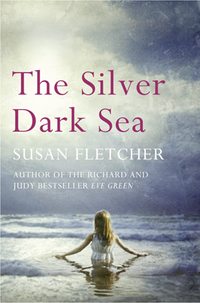
Читать книгу: «The Silver Dark Sea»
SUSAN FLETCHER
The Silver Dark Sea

Table of Contents
Title Page
The Fishman of Sye
Chapter One
Chapter Two
The North Wind
Chapter Three
The Seals with Human Hearts
Chapter Four
The Giants and what became of them
Chapter Five
The Loss of the Anne-Rosa
Chapter Six
The Message in a Bottle
Chapter Seven
The Wild Sheep and the Stormy Night
Chapter Eight
The Man of Sea Shanties
Chapter Nine
Kitty and the Jellyfish
Chapter Ten
The Silvered Nights
Chapter Eleven
The Puffins and the Mother
Chapter Twelve
The Blonde and the Bounty Inn
Chapter Thirteen
The Imps at the Farm called Wind Rising
Chapter Fourteen
The Sly Tide, or the Perigean Spring Tide, or the Highest Tide of all
Chapter Fifteen
The Claw and the Prediction
Chapter Sixteen
The Nurse and the Wasted Heart
Chapter Seventeen
The Twins, the Fishman, and the Lighthouse-Keeper’s Son
Chapter Eighteen
The Widow and the Man from Sye
Chapter Nineteen
The Stranger, Celia and the Night-Time Sea
Chapter Twenty
The Woman with the Inland Life
Acknowledgements
About the Author
From the reviews of The Silver Dark Sea
By the Same Author
Copyright
About the Publisher

The Fishman of Sye
Once, there was a man. He was bearded and kind. He lived on an island in a stone-walled house with a tap that dripped, and a small peat fire. He had no friends to speak of. All his family were gone.
In his youth, he had been strong. He’d carried hay bales in one hand and lifted bags of grain up into the highest rafters. His farm had been neat and his pigs were fat; his shoulders browned in good weather. A handsome man, also. He loved a girl with sun-coloured hair and sometimes she’d smile as she passed him, so that his heart fluttered and his mouth ached. But above all else, he was shy. He’d blush when he heard her name; he’d stumble and not speak for days. She is too pretty, he thought to himself. And in time the sun-haired girl went away. She married another and the seasons blew on. Time passed. His beard greyed.
In the evenings he’d think of her. He’d sit by the fire and say I am old, now. How did it happen? The years had gone too quickly. His life had flown by, leaf-dry.
No children, no wife.
What a small life …
One night he was so sad he could not sleep. The loss kept him wide-eyed. He lay on his back, stared at the ceiling; the sea unfolded in the dark. And the day that followed, he left his home. He walked to the north of the island where the grass was wind-bent, where the skies were fast and the sea thundered. Why was he here? He didn’t know. But the wind tugged at his coat and foam skittered across the cold sand and the gulls above him called out no! No! He found himself on a stony shore.
I am so tired, he thought. I am so tired of being me. I am tired of being alone.
He thought of all the wasted years. Why had he never spoken of love? Why didn’t I tell her? Or see the wide world? He hadn’t stepped off the island, not once. It all seemed too late, now – too late.
He cried. He wept like a child.
But then he opened his eyes.
He opened them and saw a curious thing.
There was a man in the water. Not driftwood? Or weed? No – it was certainly a man. He bobbed, on the waves. He had black hair – wet, bluish-black – and a beard, and very pale skin. His eyes were round like a seal’s were. He did not blink or turn away.
Who is …?
Who might swim, in such waters? With these waves that were crashing like glass? And with a north wind blowing as strongly as this? Yet this sleek-haired man did not struggle. He was not drowning or asking for help. He simply floated. He seemed to smile, as he floated there. And then he raised his arms – he raised them above him, pressed his palms together as if he was in prayer – and he threw those arms forwards so that his fingertips broke the water and his head and body followed in an arc. He dived into the sea, and was gone.
Briefly, there was nothing.
Then, in his wake, there was a tail – a huge, silver-flashing tail. It raised itself up, like a mirror. And it sank down where the black-haired man had been.
The pig farmer stood very still.
He blinked, shook his head. A fish? Or a man? Neither? Or both? And at that moment, at that precise moment, as the sea rushed onto the stones at Sye and as a lone gull settled on the rocks nearby, he heard a voice very clearly. It was not a human’s voice. It did not feel as if someone was standing next to him; it was a deep, soft voice that seemed to be all around him so that the farmer turned, and kept turning.
It said this: there is hope.
The voice came off the cliffs. It rose up from the stones. He looked, but there was only the foam, fizzing, and the white lace of broken water where the tail had been.
That night, the farmer sat by his peat fire with a rug wrapped around him. He knew what he had seen. He’d seen a kind, human face and then a fish’s tail. He also knew what he had heard.
In the days that followed, he spoke of it. Do you know what I saw? At the cove called Sye? Some laughed at him, of course. But others listened with shining eyes for their own hearts were tired, or partly so, and they longed for this to be true. Hadn’t there been a legend, once? In a leather-bound book? They thought so. There had been a story just like the pig farmer’s story – of kind eyes and a raised silvery tail.
Oh, how they wanted to believe it. They longed for this half-man, half-fish.
They wanted to hear there is hope for themselves as they stood by an evening sea.
The storms, in time, passed away. Winter moved into a dappled spring. And one day, as the farmer rubbed the bristled backs of his pigs, he heard a voice behind him. A woman’s voice – warm and shy. Excuse me? Hello?
Her hair was no longer sun-coloured for she was older, also. But he knew who she was.
They married. She mended the broken tap in his house so that it did not drip. She rubbed his joints with linseed oil in the evenings and he combed her long, snow-white hair. He told her about the Fishman of Sye. I saw him – with my own eyes … And she nodded, believing him. For what wasn’t possible? What could not come to be? She had spent her whole life missing him – and she was with him, now.
They lived long lives together. Happy ones, too – they would sit outside his house as the sun lowered and whisper of their happiness. My darling wife … My love. They are buried in the churchyard, side by side. They are in the furthest corner, near the blackthorn trees, and if you are ever on that island you can see them if you wish to, lay some flowers down.
* * *
There is hope.
It’s strange, as all myths are. It is a familiar story, too, for many parents have whispered the tale of the Fishman to their children at night, or at bath-time, or on car journeys to pass the hours. He is ageless, they say, and cannot die. He lives as the fish do, in the quiet, thick-green depths, but sometimes he will surface and look over to the land. Even now, there is an islander who says he’s seen the Fishman – his loving smile, his scales that catch the light as he dives. Others say, too, that if you ever feel comforted, or if you ever hear there is hope or words like it – all will be well or you are not alone – as you walk by the sea or as you lower one foot down into a boat, or as you watch the tarpaulin on the log-pile shake in the wind, or as you go to draw the curtains in the evening and pause because the last light on the water is beautiful, like gold, or as you find your boots reflected in the wet, firm, low-tide sand it means the Fishman is passing. He is offshore, watching the island. It means he knows you are hurting – and he does not wish you to be.
It was hard to have faith in that part. When I heard there is hope on a coastline, it was my own self, speaking – me, as my own comfort, trying to keep myself afloat. But what harm does it do, to believe in such stories? Mostly I think that it is better to.
One
There are stories that come from the sea and those are good stories. They are the best I have heard, by far. I know stories, but none are better than those I was told in coastal homes, with sour-smelling oilskins drying by the fire or the pale chalk of whale-bones standing on their ends. I smiled into my hands, as I listened. A brown-eyed man would ask have I told you about …? I’d reply no – tell me … And we’d lean forward towards each other so that our chairs creaked. Salt on the windowpanes.
Stories of loss, mostly. Of the love that came before that loss.
I crawled inside them, cave-like, and held my breath as I looked up.
There were too many stories to count. The sea brought them in, daily. Like the wide, glassy straps of weed that came ashore on the highest tides, they caught the light and beckoned me. A story? I’d come closer and kneel. I’d stare, as they were told. And they were always more beautiful than I thought they’d be when I first heard them, or found them in the sand.
That’s how I imagine it. It’s the best explanation I can give. There were so many stories on that island that it felt like they came in on the tide. Every day, there was something. On every pebbled cove or beach there were gifts left by the sea – plastic bottles, nylon ropes, shoes, a tyre, cottonbuds, the spokes of an umbrella, a sodden child’s toy. Worthless? To some, maybe. But they were treasures, to others. A parched curve of driftwood could be dragged home and kept; a message in a cola bottle might change a life. At the beach called Lock-and-Key, there were lone wellington boots set upside down on its fence-posts – boots that had been washed up on that beach and were useless without their other, missing halves – and I’ve heard them called unsightly, this row of coloured boots. But I came to like them. I ran my hand across them when I walked on Lock-and-Key. I felt like I was one of them – weathered, and waiting. Fading and softening and watching the sea.
That’s me, perhaps: the forager. I’d be drawn to the shards, to what life leaves behind. As if I had nothing, I gathered what other people would pass by or step over – a mussel shell, still hinged, or a length of sky-blue rope. I trod along the line of weed and plucked, bird-like, at the shinier things. And in that same way I hoarded all the stories that reflected the light and dazzled me – like the whale that answered the foghorn, or the phosphorescent night. There was a tale of grief I heard – with puffins in it, of all things – and I fell upon that tale as if it were unsalted water, water I could drink. It nourished me, somehow. A tale, too, about a single lantern that bobbed on the horizon every Christmas Night.
So yes – it was like beachcombing. It was all treasure to me. In my kitchen, I kept shells; I stuck briny feathers in vases. And in my head I laid out the stories the islanders told me – the caves, the Fishman, the flakes of silver, the seals who are wiser than humans, the girl who floated like a patchwork star.
I was born inland. I grew up where the wildest water was a puddle, or a filmy pond in a park. Stories were harder to come by there. Trees bowed with the rain, and I found sparks of beauty in a flowerbed or a pigeon’s trembling, iridescent neck but it was not enough. I hungered for more – I sensed, always, that there was something more than this life that I was living. And then I fell in love when I thought I never would, and I came to live on an island so that the lines by my eyes deepened and my hair thickened with salt and ghostly-white crabs flitted over my feet and buried themselves in the damp sand, and every sea was different from the sea that had come before it – pummelling, or silent, or brown-coloured and flat. And the man I loved would tell me his stories. In time, others did. They poured whisky into my glass and settled beside me. They opened old books, said look … I have known people who believed absolutely that a gull could talk our language, and that the souls of their drowned friends could be found in the rattle and foam.
I heard her voice in the water. I did.
And I’ve felt his hand on my hand, on that boat. You have my word.
I do have their words – I do. I swagger with the weight of my wordy, priceless stash. And when I re-tell their stories now, I know that some people mock me or mock the island, and they shake their heads at the impossibilities – a Fishman? OK, right … I understand that – for I was, briefly, like them; I too have had my private doubts. But so much has been lost and found. So many things have come to pass that have no explanation and I half-wonder if you cannot believe in such stories unless you have lived or stayed in a house by the sea – until you have lost washing to a sea breeze or been bruised by the rain drumming on your anorak hood whilst trying to guide a dinghy in, in the blackest night. Until you have waited for a boat that does not come. Or until that boat is found but its crew is not. It is another way of living and not all can stand it. There is the word salt-bitten; it comes when hope is lost.
No, you cannot trust the sea – even now. Even with our satellites that tell us where we are. Even with our sonars, radars and computerised charts. Even with our space travel and vaccinations and our atom bombs and cloned sheep, and even though we can make a new human life in a Petri dish, we still cannot reach the furthest sea floor. We cannot breathe underwater or decode whale song. We cannot find a body, when it goes overboard. We may know that a human heart has ventricles and can be shocked into beating again, but we do not have the words for what immense and extraordinary emotions it can feel – what heights and depths, together. Love is too small a word – too small.
Abigail Coyle used to tell me, we only know the foam … A sweep of her arm, over the sea. And I’d walk home understanding her.
We do not know it all. That’s what I’d tell myself, when standing waist-deep in water. When I sat on a boat I’d think of what was beneath me – the deep, deep chasms, the secrets and the dark.

This island is small, neatly shaped. Its cliffs are high as towers and streaked with white from the roosting birds. These cliffs echo with bird calls and to look up at them from a rocking boat is to feel tiny, and cold. Feathers come down and settle by your feet. They drift on the water like dreams.
There aren’t many trees, on this island. Nor are there many houses, but there are some; they all have missing tiles, damp window frames and peeling paint. Their names are blunt: Wind Rising, or Crest. Calor gas bottles stand by back doors.
There is litter on the beaches. The wheel-arches of cars are brown with rust.
Strands of grey fleece shake on wire.
There is a lighthouse, too. It stands at the north end of the island and swings its slow, pale beam over the fields, the bedroom walls and the night-time sea.
Let us call it Parla. Names do not matter, as they never truly do in the tales I know. What matters are the people themselves – the souls who have lived on this island and how they have felt on its sand and rocks. Many generations of firm, resolute people have mended their nets here, or pressed their knees onto sheep as they’ve sheared them. The men have caught gannets for eating; women have gathered seaweed at low tide, with baskets strapped to their backs and their skirts hitched up. They have fed their children kale and sour milk, sang their sea songs, and they’ve lived in fear of God and the waves. That was years ago. But there are still photos – blurred, soft-edged.
Now, the Parlans live by other means – sheep, tourists, sponge cakes, crafts that they sell on the internet and send to the mainland in protective wrap. One woman knits teacosies and baby clothes; another paints in an attic room with skylights that close themselves suddenly in the gusty, north-westerly winds. No-one eats gannets these days. But they still have their own vegetable patches, and still reach for eggs under downy behinds. They still stand on the headland from time to time with their arms held out, and let their coats fill up with the wind. They still drink too much, or some do. They know the moon’s cycle as their forefathers did.
And the sea. They still know the sea or as much as any human can. It is part of them, in their blood; it shapes their lives as the sea shapes a stone over the months and years. Some cannot sleep inland. They cannot be where there aren’t sea sounds – for Parla is never, ever quiet. Even in calm weather there is the lap lap lap against the quayside or the clack of mussel shells as the water rises over them. At Tap Hole, when the tide is rough or at its highest, the sea sprays through the single hole in its roof – a puff and a splattering, like a whale’s breath. Near the harbour, there are cliffs which are curved to make a bowl of water so that the sea is trapped, or nearly; it says stash, stash, as it tries to get out. The water here is weedy. There is an oily shine to the sea, at The Stash – and rubbish. Once, a rubber duck – and no-one knew why. A well-travelled duck, they called it. George Moss took it back for his son and it sits by their bath, even now.
The youngest Bright daughter – in her mid-sixties – remembers the single wave that rose up against the lighthouse one winter, when she was a girl. It smacked against the lantern’s glass. It struck the tower with such a deep, thundering boom that she had felt it inside her – under her ribs. She’d held the wall, in fear. It woke something in her, that shuddering wave – a womanly knowledge that she both wanted and was scared of, but had no name for. She knows it all much better, now.
Maybe that’s the sea telling stories of its own. Like me it has a lust for them; it cannot stop saying listen to this … Listen to me … After all, think of the tales it has – the deaths, the near-deaths, the curious lives. Even now, as I am telling this, there is the handclap of a wave that falls back into itself and the gentle hiss that follows. Soon, a sprawled, moon-blue jellyfish will rise to the surface and give two slow clenches. Against the black water, it will glow.
Before he died, Tom Bundy said I have never known silence. Never. He had been born in the fields at Wind Rising. Each hour of his life had had the sea in it. His early death did, too.
* * *
Can you hear it? The water? It breathes, as you breathe.
I want you to hear the whole island – as it is now, at this very moment. There is the sea’s stirring, always. But also, there are many sounds on Parla which are more than the waves, more than stones being moved by them. The sheep bleat, throatily. A wooden gate squeaks open. There are tiny bells on a piece of string which dance, and call out sing-sing-sing. In a house with herbs on its windowsill a kettle is boiling – its metal lid is starting to rattle, and there are footsteps coming to it and a woman is saying I’m here, I’m here … to the kettle, as if the kettle understands her. She lifts it up with a tea-towel; there is the sound of a mug filling up. Elsewhere, a dog scratches its ear. On the quayside, a child crouches; she watches a crab creep in a red plastic bucket, tapping the sides with its claws. The old pig farm, empty now, creaks in the late afternoon sun. There is also washing on a clothesline – four pillowcases which snap at themselves, and a pair of striped socks. The line itself bounces in the breeze – up and down.
There is the tick-tick of computer keys.
A mobile phone lights up and thrums across a table, before dropping to the floor.
There is a man in his bathroom, cleaning his ears of sand with a flannel’s tip. He hums, as he does so – dum-di-dum …
And there is a mother telling a story. She has her child in front of her, in his dinosaur pyjamas. He sucks the end of a white cloth, holding the cloth with both hands and he listens to her with eyes like the world. Have I told you the story of the silver in the fields? She is Hester – a true Bundy, with the dark Bundy eyes – and she knows her stories. She has the voice for telling them. She is Parlan, after all.
Can you hear these things? Each of them?
A gull is calling out – ark ark ark! It stands on the chimney of a cream-walled house.
And can you hear this: the brush of legs through long grass? At this moment, a young man is walking. He wears jeans which are damp and frayed at the hem. The lace on his left boot is undone, and its plastic ends tap against rocks as he goes. There is sheep dung pressed underneath this same boot; he feels it with each footstep so when he comes to a stile he puts this boot on the step and scrapes his sole against it. He twists his leg, checks. Then he climbs over the stile and briefly, as he climbs, he looks over to the house with the washing line. He narrows his eyes to see it – the striped socks, the yellow front door. He sniffs, steps down.
Brush brush. Through the grass.
It is early evening. This young man is fair-haired, freckled. He has caught the sun today – his cheekbones are pink, and his scalp feels sore. It has been the first day of sun in a long, long time and he’d not expected it. None of them had. He knows, in time, his skin will peel.
He is Sam Lovegrove, and he is twenty-two, and when he reaches the coast path he heads west.
The sea glints. In the distance, he sees Bundy Head.
To his right, the cove called Sye appears. It starts to show itself. As he walks, the cove widens and he looks down into it. It is a fleeting glance, nothing more, for he does not expect to see anything. Nobody goes to Sye – it is a small beach, with no sand to speak of; its high cliffs make it shaded and cool. Who might go there, and so late in the day? No-one. And so he glances, that’s all. A sweep of the eyes. But there is something down there today.
He stops. He stops so sharply that his right foot slips.
Sam takes two small steps towards the edge. What is …?
Then he says oh shit. Oh God. Oh my God …
* * *
Me, the forager. Or the salvager, perhaps – crouching in the wet sand to gather what is left. Is that what stories are? The debris of a life? The remains that can be dried, passed on so that a little of that life is passed on too, in its way? I have lost so much. So much I have never had, and so much of Parla I have looked for meaning in. And I miss it – I miss the island. I miss its pebbled strands, its button-eyed voles, and the weightless bones of cuttlefish that fitted the palms of my hands. I miss the people who I called family, or tried to; I miss how magical a winter’s night sky could be for I’d never seen a falling star until I stood on that island, and I’ve not seen one since. And I miss him above all others – how I miss that one man. But at least I have my stories, sand-covered. A well-told story takes me back to Lock-and-Key.
Oh, the stories. So many.
A thousand strange things have been washed up on Parla’s shores – loo seats, dolphins, a list of dreams in a sealed plastic bag. But it has never had a story which begins with Sam Lovegrove saying oh shit, oh God on a Wednesday evening as he runs down to the beach with his sunburnt shoulders and his left bootlace slapping back and forth, back and forth.
And it’s never had this: a man, half-naked. He is lying on his front, his face against the shingle. He is dead-looking – still, white-skinned.
I know some wonderful stories – but this is the beginning of the best of all.
Two
He stumbles down to the beach. A steep path through gorse leads him there. He jumps onto the stones and the noise is sudden – the crunch of his heels, the clatter of rock against rock. He staggers, and then falls. Sam lands on all fours. The stones are powdery and the dark cracks between them are darker with old weed. He stares for a moment. Then he rights himself.
On, towards the shoreline. Over brownish wrack.
Oh God, he says. Oh …
It is not plastic, or sacking.
It is a human body. It lies at the water’s edge. Its upper half is out of the water; its legs are still being lapped at by the tide. It lies on its front and the head is turned so that the man’s right cheek (it is definitely a man) is pressed into the stones, and his right arm is raised above his head. He wears a white vest, or part of one. Sodden, dark-grey shorts.
Black hair. A black beard.
Shit …
Sam looks away. He breathes heavily through pursed lips. He tries to steady himself, puts his hand on his chest. Could he turn, go? No-one need know. No-one has seen me coming here. And wouldn’t the sea come back and take it? Carry it out? Sam shakes. His hands are shaking and he thinks, a dead body … He has not seen one before.
But he cannot turn and go. He must stay; he knows he must.
He looks back. The man’s skin is white. It is perfectly white, like fish meat. The arms are thick, muscled. His back, too, is strong-looking – there is a deep groove where his spine is.
He is tall. Was. Was tall.
Oh … His stomach clenches. He half-bends, as if he will vomit, and he expects this – he braces, locks his jaw. But nothing comes.
The body lies ahead of Sam. He tries to calm himself for he knows what he must do. He knows what needs to be done, right now, and so he lifts his left foot and steps towards it. He brings his right foot to join his left.
No smell. Would there not be a smell?
And flies, he thinks. There are no flies.
Carefully, Sam comes in. He draws level with the body and starts to lower down. He is tentative, scared of falling or getting too close. The stones shift, as his weight does, and he thinks and what about the eyes? He has found dead sheep before. They lose their eyes to gulls – the soft, jellied flesh is the first part to be eaten – and Sam feels nauseous again. His tongue tightens. But he has no choice: he has to see the face. He knows this but he does not want to and he is shaking as he crouches down. His breath is fast and his heart is thumping against his ribs so that they hurt and he does not want the eyes to have been pecked away or sucked out by fish. He does not want the mouth to be open, as if still fighting for breath.
Oh God oh God …
Sam puts his palms down on the stones. He brings his face alongside the dead man’s face. Nose to nose.
The man opens his eyes. Not fully, not wide – but his eyelids flicker and there are two black crescent moons of eye.
Sam yells. Falls.
He scrambles backwards, crab-like, shouting holy fuck oh my God, and as he tries to stand his left foot slips and the stones give way so he turns onto his front and crawls frantically on his hands and knees, and then he finally clambers up the beach and turns around.
There is the sea, and a gull’s screaming, and there is a sound which is coming from Sam – a whimpering, a half-sob. His grips his hair with both his hands. Not dead is what he thinks. Not dead not dead, oh Jesus. He looks at the skin, the beard, the mouth which is moving now as if trying to speak or trying to clear itself of salt or sand or pebbles and the eyelids still flicker, and the right hand flinches. The fingers find a stone and try to close upon it.
Shit. Listen. I’m going to get help, Sam tells him. I am. I’ll come back.
He sees a whorl in the man’s beard, as if a thumb has been pressed there – familiar, in its way. A shell, or a rose.
Sam stumbles through the grass. His feet snag on roots and old wire; the sheep lift up from their resting places and bleat at him, and move. His breathing is loud as he runs towards the lane. He knows the house with the striped socks on the line is to his left and that a woman will be inside it, but he cannot go to her. Not her, of all people. He does not look across.
Down the hill. Past the ragwort, and the rusting tractor.
Past the sheet of corrugated iron that is half-lost in grass.
He turns right at the sign that says Wind Rising. He runs up the drive and the dog barks as she sees him, and the rooster stretches up and flaps his wings. Sam bangs on the back door which swings open on its own so he hurries inside saying Ian? Ian? The kitchen smells of casserole and coffee and dog hair and Ian is standing there, very still, with the kettle in his hand.
* * *
A man?
A man.
Dead?
No. I thought he was, but he’s alive. He opened his eyes.
Washed up? Are you sure he’s not just … Ian shrugs. I don’t know … Lying there? Sunbathing, or …
No, he’s washed up. Sam’s hands grip the back of a chair.
Is he hurt?
Don’t know. Probably. He is pale, Ian – properly white. I really thought he was dead. Oh God …
Ian sighs, holds up a hand to stop the boy talking. OK. Fine. I’ll get Jonny. And Nathan’s in the barn. He’s big, you say?
Looks it. And heavy. Arms like … He holds his hands apart, showing him.
Ian takes a sip of coffee. He holds it in his mouth for a moment before swallowing. He takes a second sip, puts the mug down. Then he pulls on a jumper and walks towards the door, talking under his breath, but as he reaches it he turns to see Sam’s still standing there, holding the chair. Coming?
Ian, listen …
The older man pauses.
He’s dark-haired. There’s a mark in his beard – like a whorl. I didn’t look too closely –
Ian’s eyes are hard. Let’s just get there. OK?
* * *
Four men make their way across the fields as the sun starts to dip. They move quickly, without talking. The sheep move away from them, find a safe place and then glance back.
The Lovegrove boy leads the way. His shirt is darker under the arms; his forehead is lined for his age. He looks over his shoulder once or twice to check he is still being followed. The farmer from Wind Rising is next – greying at the temples, breathing through his mouth. He is Ian Bundy and he has the family build – stocky, short-legged. His son, too, has it. And they both have the family colouring – brown eyes, sallow skin, hair that is almost black. Jonny chews as he jogs – gum, which he snaps in his mouth with his tongue until his father says get rid of that. The younger man scowls, throws the gum into grass. The fourth man sees him do it. He is Nathan Bundy. He, too, is dark-eyed, but the summer has lightened his hair and it is long so that it brushes his collar and curls by his ears. He’s the tallest of them. He has marks on his arms from barbed wire; he hasn’t shaven for days. Nathan says nothing as they make their way to the cove called Sye.
Brush-brush – their legs through the grass.
They all have their thoughts, their worries.
A ewe watches them. The men crest the hill so that they are, briefly, four dark shapes against the sky, four silhouettes – and the ewe sees this. She shakes her ears, lowers her head. She tears, steadily, at the grass.
There, says Sam. He does not need to point.
Ian squints.
The man is still lying there. His right arm is still raised and his legs are parted. Christ. He’s big.
Told you.
The tide is lower now. There is a metre or more of shingle between the sea and the man’s bare feet. Ian makes his way down through the gorse, onto the stones which are dry, chalky to touch. He says, steady – talking to himself as if he were a horse or a dog. He holds his arms out for balance; his feet slip between the stones as he goes. He wonders when he was last at Sye and doesn’t know. He is never on beaches. He hates finding sand between his toes or in his mouth.
Ian sees the black hair. The beard.
He kneels, presses his thumb against the man’s cold neck. Can you hear me? Hey?
Is there a pulse? Jonny stands over him.
A moment. Then, yep.
Sure?
Yes – got one. Let’s roll him over.
All four of them crouch, put their hands on his body. After three?
Ian counts.
As they roll the man over he makes a sound – a groan, as if in pain. There is a creak, too, as if his ribs are being released or a bone which was pressed upon can return to its right place. Grit sticks to his cheek. There is weed splayed on his chest, like a hand.
Ian stares for a moment. Then he reaches, takes the weed away. We need to get him to Tabitha’s. We’ll carry him.
Can we? I mean – Sam shrugs – he’s huge.
He is, but there are four of us. We’ll manage – have to. Ian taps the man’s face twice, calls hey! Hello? As he does this he sees the twirl of hair in his beard, the rosette, and he rests back on his heels, wipes his nose with the back of his hand so that Nathan puts his hand on his brother’s arm. Ian?
Let’s get going.
They take hold of the stranger and lift him into the air.
It is as if they carry an upturned boat. The man is on his back, being moved head-first, with Ian and Sam beneath his shoulders. Their hands take care of his head, arms and neck. Behind them, his right thigh is resting on Jonny’s shoulder and his left thigh is pressed against Nathan’s ear. The men all move slowly, saying careful and easy, now.
When they reach the coastal path they move faster.
Nathan thinks, I was in the barn … An hour ago, he’d been sitting on the spare tractor wheel in the barn at Wind Rising, filling the last few sacks with fleece. He’d been on his own, thinking of his wife. The farm cat had padded by, and the beams had creaked, and he’d been inhaling the smells he had known all his life – wood-dust, hay, diesel, sweat – when his brother had marched in saying a man’s been found. Washed up. At Sye. Ian said it as if it happened all the time – like the ferry arriving or fences blowing down. An hour ago Nathan had been alone in the barn and now he is carrying a half-dead man who’s barely dressed, cold-skinned and fish-smelling.
Things change quickly. But he has known that for years. Four years, or nearly.
He can hear the man’s breath, as they carry him. His thigh is heavy, and his lower leg hangs from the knee and swings. His heel knocks gently against Nathan’s back.
* * *
In the garden at Crest, a woman stands. She is blonde, wearing denim shorts, and she has a clothes peg in her mouth. One by one she takes her washing down. She lifts off tea-towels, a bra, two striped socks. The sun is lowering, and it glints off the windows. She pauses, looks. There is still beauty, she thinks – the light on the water.
Another woman – grey-haired, not blonde – makes her way past the island’s church, poking at the weeds with her walking stick. She glances to her left. There are the Bundy men and the boy from the harbour carrying something high in the air. What? A boat? Part of a machine? The sun is in her eyes so she cannot tell.
The church glints, also. From inside, its windows are jewel-coloured – ruby, emerald, a deep royal blue. These colours lie down on the tiled floor.
On the west coast, the sinking sun catches the row of single, rubber boots that stand upside down on fence-posts. None match; none are the same size. They shine in a line, looking wistful. They cast their strange shadows on the scrubby grass behind.
And at the same time – at this exact, same moment as the stained-glass windows glow, unseen, and as the widow from Crest takes her washing inside – the men come to a stile. They stumble, hiss watch it! The man they carry hears this. His head lolls. He feels the rock of his body and the fingers pressing into him, and there is the brush of legs through the grass. He smells sweat, sheep, salty air.
He says a word. It is sea, or a word like it.
When he opens his eyes, all he can see is sky.
Tabitha looks at the clock on her kitchen wall. It is past eight. This means, to her, that she can pour herself a small glass of sweet, pink wine so she goes to her fridge and opens it. She loves the sound of a cork coming out. She likes the cool bottle, and choosing the glass from her shelf – for none of her glasses are the same. Small rituals. Everybody has them. Her mother always tapped a wooden spoon twice against a saucepan, having stirred it; her father had names for the weight that would lower itself down the stairwell, and in doing so, turn the lamp.
She sips.
Berries. Vanilla, maybe.
Her home is Lowfield. It is small, cream-walled and south-facing – and it’s a house with no logic, for the kitchen leads into the bedroom and the bath is in a room of its own, far away from the loo. Things creak. Floors slope. She says it has character, as most Parlan houses have – and why would she want a bland home? With paper lampshades and plastic chairs? She has furniture from her childhood here – a linen chest, a grandfather clock. Tabitha touches the clock as she passes it, her wine in her other hand.
There is logic in its name, at least. Lowfield – for it sits in a hollow, a nest of grassy mounds. Three sides of the house look out onto banks of gorse, bramble and grazing sheep; on those three sides, it is fully sheltered from the wind. When Tabitha moved here in her early thirties she had lain in her bed and thought where is the noise? The rumbling? The spray on the windowpanes? For these were the things she was used to. Her childhood had been in the lighthouse-keeper’s quarters and so any inland sleeping place seemed eerie to her, and still. Surely an island home should rattle in the wind? When she came to Lowfield, a storm passed overhead one night and she knew nothing of it. She only learnt of the storm the next morning: as she stood in the garden in her dressing gown and looked at the fallen fence-post – upended, with black earth at the base of it – she told herself this will make a good home. A safe place. It also makes a good place for the tired and sick to come.
That was thirty years ago. Now, her waist has thickened. She has pouches of skin beneath her eyes and when she walks in her slippers she hears herself – the padding on the wooden floors, the slow pace. I walk as if I’m old. It has happened so quickly, or seems to have done. It seems like a day or two ago that she’d worn a red bikini, jumped from the sea wall.
Briefly, Tabitha feels sad. She has her regrets – but Lowfield is not one of them. It is hers; she has spent half of her lifetime here. It feels nurturing, as a home should. Cupped by the Parlan land.
The only room with a view of the sea is what she calls the mending room. She’s always called it this. Surgery feels too grand for it: a white-painted room, linoleum floor, a small cabinet of pills and liquids that islanders have prescriptions for and others which she keeps just in case. A table and chair face the door. Behind them, she has a poster of the musculature of the human body – reddish and gruesome, which the children love. On the table, Tabitha keeps an African violet; she likes its dark, furred leaves.
This room has seen plenty, that’s for sure. It holds its secrets – small ones, and ones that have changed a life and other lives. She, Tabitha, knows all of them. Lorcan, also, must have heard some strange confessions over the years – he walks with the weight of what he’s been told, or so it looks, for he has lumbar pain that she gives him codeine for and a stern telling-off when he carries too many hymn books. They go to him for their souls; for their bodies they come to Lowfield, and so here it is that Tabitha listens to hearts and takes temperatures and tends to the wounds that come from a life of farming, or the sea – a half-severed thumb from the shearing blades, or rope-burn that has broken the skin. She knows who has high blood pressure, who does not sleep, and who is on the contraceptive pill. She knows who drinks too much, whose skin flakes under their clothes, who takes pills to thin their blood, who has athlete’s foot, cold sores, piles. She knows of Sam’s migraines, of her own sister’s painful joints. And Tabitha has brought babies into the world, in her time – all five of the Lovegrove children and three of her own family have slid like eels into her waiting hands.
Tabitha sips. She thinks all those secrets … Once, newly qualified, she’d believed that everything was curable – every human pain. But she was wrong to think it. Guilt, heartbreak – what cures them? Or simply makes them bearable? Nothing on her shelves.
Still – she views this room as safety. She wants each person who steps into it to feel cared for. With the pot-plant and the pressed bed linen, she has always tried for that.
In the far corner, there is an iron-framed single bed. Tabitha goes to it, sits down. She pushes her slippers off with her toes, swings her legs up and nestles back. From here, she can see the finger of land called Litty, the nettle patch which no-one has ever mowed or dug up because of the voles that live there. The tiny, tufty-eared Parlan vole – it is its own species, and rare, and she has seen one or two in her time or at least the nettles swaying where a vole has darted from. Beyond Litty, there is the water. The sea – scattered with light. What view was ever better than this?
She wiggles her toes in their polka-dot socks.
Tabitha drinks her pink wine.
* * *
You knock.
No, you. I can’t take my hand away, it’s under his head – see?
Ian curses. He is aching. He has carried a thousand sheep in his life, slung round his neck like a collar and he’s carried boat engines and tractor wheels and his own kids when they were young – but not this weight, and not so far. I’m too old for this, he thinks.
He kicks at Tabitha’s door. Three kicks, low down near the doorframe – all too hard.
The men shift. They are steaming like horses, sweat on their top lips and brows. The man they carry groans overhead so that Ian says, hurry up …
The kicking must have startled her for when Tabitha unlocks the door, she peers around it as if unsure of what she might find. But then she sees Ian. She sees all of them, widens her eyes. Looks like you’d better come in, she says.
She leans against the wall to let them pass.
The room smells of disinfectant and a false, lavender scent which comes from a bottle plugged into the wall. Put him on the bed.
He goes down heavily.
All four men exhale. Then they stretch, step away. Nathan straightens and his back clicks. Jonny rotates his right shoulder and says Jesus. What do you think he weighs?
Tabitha is by the bed. Foremost, she is the nurse – not the aunt, not the great-aunt or the friend – and she busies herself with what a nurse must do, lifting the man’s head and arranging the pillow beneath it. She takes his wrist, watches the wall clock as she does so. With her eyes still on the clock she asks who is he? Do we know him?
Ian says no.
What happened?
Sam found him.
Where?
At Sye.
On the stones?
Just lying there, says Sam. I thought he was dead.
She nods; the man’s pulse is good. Tabitha can feel the warm bloom of his breath against her arm. She feels the edge of the vest he wears, finds it is cold and hardening with salt – so she opens a nearby drawer, lifts scissors out. When had she last used them? For what? On whom?
She cuts away his clothing. The chest that appears is dark with hair. Has he spoken?
Jonny shrugs. He’s muttered a bit –
He tried to say something, Nathan tells her.
So he’s been conscious?
Yes.
He didn’t lose it at any point?
Not since we’ve been with him.
Any wounds?
His hands – Ian points.
She looks. Ian’s right – the fingernails are torn, and three of his knuckles are bruised. When she turns the hands over, she finds his palms are dirtied, rough and red-coloured. Pinheads of blood. Grains of sand. Grazes.
From what?
Rope, maybe? Hard to say. And here …
There is more, too. On his left hand, in the soft web of flesh between the thumb and forefinger, there is a very different wound. It is neither fresh nor old. It is reddish-brown. Perfectly round, like an eye.
Tabitha cannot know what caused such marks. But hands mend and mend quickly; hands do not worry her too much. It is his head that Tabitha turns to now: the head, which she always thought of as a world in its own right – with its seas and land and weather, its mysteries that, in fact, no human brain can fathom. She snaps on latex gloves. Slowly, she starts to feel through his hair. She searches for cuts, or swellings, or a tender part that will make him wince. His hair is so thick she must move it aside, in sections. Where there is scalp, she presses it; like this she makes her way round his head – from ear to ear, from brow to nape. His eyes half-open. His lips move, as if he dreams.
No sign of swelling, she says.
That’s good. Right? Sam is anxious.
Yes, Sam – it’s good.
She peels off the gloves. There is a woollen blanket at the foot of the bed and she pulls it up over her patient, over his long, muscular legs. It does not reach beyond his chest so she tucks it round him, brings his arms to his sides. There is, Tabitha thinks, a strong smell in the room – of sweat, from the men, and cigarette smoke, but also fish and brine and an earthiness. Sheep.
She turns to them. You needn’t stay. It’s late.
He’s OK? He’s not dying?
No, he’s not dying. A childish question from Sam. He stands there – awkward, thin, with sunburn and his unbrushed hair. Tabitha had delivered this boy. That day feels like yesterday. She remembers his mother in this room, refusing to lie down or to sit – she’d paced the room as an animal might. And then Samuel came out as she’d crouched on the floor, gripping the table legs, with Tabitha saying one more! That’s it! How long ago was that? Two decades and more. She feels sorry for him, suddenly. He is both so old and so young.
He’s dehydrated, and he’s exhausted. And I’ll give him a tetanus jab for the sake of it. But other than that, he seems alright. She shrugs. We’ll see what happens when he wakes. It’s sleep he needs, now.
They look at each other, briefly.
Ian moves first. He slaps his thighs once, rises up from the chair saying right. That’ll do me. Come on, Jonny.
Jonny follows his father, walking in the low, rhythmic way that young men seem to – nonchalant, easy. He says see you, Uncle Nathan. He does not speak to Sam as he passes him. He brushes the leaves of the African violet; his draught moves the unpinned corner of a poster on mental health.
The two men walk out into the garden and are gone.
Sam waits for a moment further. Then, will you be alright?
Alright?
I mean, here – on your own. With this man who …
Tabitha smiles. I’ll be fine, Sam. I’ve dealt with far worse than a sleeping man, I can promise you that. Will you tell your father what happened? I’ll call him in the morning. When he was born, Sam Lovegrove had been jaundiced. His skin had the hue of iodine, or old tea, and he had been so small. Now he is – what? Six foot?
Are you sure?
Honestly. Go.
So he, too, goes. He steps into the fading light.
It means that Nathan is left. He stands against the wall by the door, hands in his pockets, one ankle crossed over the other. His head is down as if looking at the floor, but his eyes are looking through his hair at the stranger who lies asleep on the bed beneath a blue blanket. It is a gaze of intent – a hunter’s look, or a detective’s.
I thought you’d linger, the nurse says.
* * *
He can smell the latex gloves and the glass of pink wine, and Nathan can smell fish in this room. The tang of it.
His aunt moves carefully. Plump Aunt Tab, with her pearl earrings and cotton-pale hair. She clicks her tongue, as she works – half-humming – and this is a sound that is hers, entirely. She seems to half-hum all the time. When he was a boy, Nathan would hear his aunt before he saw her because of this sound or her bicycle bell. She still has that bicycle. It has a wicker basket, a slight squeak, and he feels like a boy when he sees his aunt on it – leaning forwards with the effort. Tabitha, who warms a room by entering it with her cheery only me!
What do you think? he asks her.
She has her back to him. She is standing on her tiptoes, reaching up to the top shelf of a cabinet. With her fingertips she coaxes down a plastic tub that has envelopes in. These envelopes have transparent windows through which he can see needles.
What do I think? Well … She considers it. It’s strange, that’s for sure. Where has he come from?
A swimmer, maybe. Got tired.
Maybe. I’ll call Rona – see if a guest is missing.
Tabitha places a needle in a metal dish. It chimes like a bell. Then Nathan watches as she moves to a second cabinet, takes a small key from her pocket and unlocks it. Inside, there are vials.
Tab? Don’t you think …? But he can’t say it. Nathan isn’t even sure what he is trying to say except that he is shaken, confused, and that he does not like what’s happened and does not want to be here but nor can he take his eyes off the iron-framed bed in the corner of the room, or leave. His aunt tilts her head. She is waiting for more words from him, and he has seen his mother stand like this. He has looked for his mother in a crowd and found her because of the way she has tilted her head, as a bird might listen for worms. They have the same nose, too. They aren’t close and never have been. But they are sisters in how they speak, and move.
Don’t I think … what?
Doesn’t matter.
But it does – it does. And Tabitha knows this for she puts the vial down and comes towards him. She puts her hand on the back of his hand and says I know what you’re thinking. I thought it too. When I opened the door and saw the four of you holding this man in the air, I saw his hair and his beard, and I thought … She pauses, smiles. But –
He nods.
We’ll find out who he is. When he wakes up, we’ll ask him.
Nathan knows there are many words that were never said, and must be said one day – but he cannot say them now. Not late in the evening and not in this room.
He feels tired, suddenly – bone-tired, heavy.
Go, says Tabitha. She squeezes his upper arm.
* * *
Nathan walks back through the fields. It is past nine. The sky is eerie – not light, not dark. At the north of the island the lighthouse is awake and it finds him – five half-seconds every minute of being dazzled, white. He climbs over fences, ducks under wires.
Last night there had been a northerly wind and last night he had not slept. All night, he had lain awake. I should have known, he thinks.
He thinks, too, how sore his back is from the man’s weight. He thinks of the words he’d been trying to say, as they carried him – sea? It had sounded like sea, which isn’t so odd since he must have been in it for a long time, at least. Whoever he is, he has swum – lungfuls of salt, salty-eyed. And as Nathan walks up the driveway to his home he thinks, suddenly, of the time when he and his younger brother had caught a crab off Litty’s pier with a piece of string and a chicken bone – the biggest crab they’d ever seen. It was huge, orange-mottled. They’d wanted to keep it as a pet – and so they’d charged home, put it in the bathroom sink and hidden side by side in the airing cupboard, waiting for Hester to come to clean her teeth. Two screams from their sister – one at the crab, and one as they burst out at her with a shouted boo! He hears it now – her screaming. And he can hear his brother’s laughter – bright, like piano scales. He can see that crab.
He sniffs. Nathan looks up at the house in the distance. There is a light on at Crest. It is the kitchen light, he can tell, and he pictures Maggie at that moment – cracking an egg against a glass bowl or rinsing vegetables. She holds her hair back with a pencil, sometimes. Perhaps she is doing that now.
And Nathan thinks, too, of his wife.
When was the last time a person was washed ashore? A living person? It’s not happened in his lifetime. The sea takes lives; it doesn’t give them. There are no stories of a sea-given life.
I will wake up tomorrow. I will have dreamt this.
As Nathan reaches High Haven, he slows. The wind-chimes stir. Its lights are on and the windows are open and the curtains drift in and out, in and out, like ghosts.
* * *
By the harbour wall, Sam vomits. He has both hands against the stones, his legs apart. Afterwards, he spits. He wipes his mouth with his sleeve, steps away from it. Above him, a waning moon.
At Wind Rising, Ian goes to the fridge. He finds a bottle of beer and pulls it out by the neck. He shuts the fridge with his foot, twists the cap and drinks with his eyes closed.
When it is nearly midnight, Tabitha leaves the mending room. She has given a tetanus injection, and she’s rubbed antiseptic cream on his hands. She’s filled a glass of water and in his half-sleep, the man has drunk it – spilling some so that Tabitha had to wipe his chin, mother-like. She leaves him sleeping on his side.
Бесплатный фрагмент закончился.