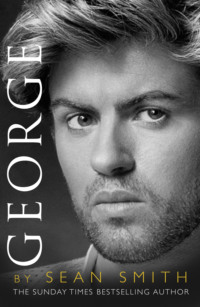
Читать книгу: «George: A Memory of George Michael»

Copyright
HarperCollinsPublishers
1 London Bridge Street
London SE1 9GF
www.harpercollins.co.uk
First published by HarperCollinsPublishers 2017
SECOND EDITION
Text © Sean Smith 2017
Jacket design by Claire Ward © HarperCollinsPublishers Ltd 2017
Jacket photograph © John Swannell, Camera Press London
A catalogue record of this book is available from the British Library
Sean Smith asserts the moral right to be identified as the author of this work
While every effort has been made to trace the owners of copyright material reproduced herein and secure permissions, the publishers would like to apologise for any omissions and will be pleased to incorporate missing acknowledgements in any future edition of this book.
All rights reserved under International and Pan-American Copyright Conventions. By payment of the required fees, you have been granted the nonexclusive, non-transferable right to access and read the text of this e-book on screen. No part of this text may be reproduced, transmitted, downloaded, decompiled, reverse engineered, or stored in or introduced into any information storage retrieval system, in any form or by any means, whether electronic or mechanical, now known or hereinafter invented, without the express written permission of HarperCollins e-books.
Find out about HarperCollins and the environment at
www.harpercollins.co.uk/green
Source ISBN: 9780008155643
Ebook Edition © November 2017 ISBN: 9780008155650
Version: 2018-05-22
Also by Sean Smith
Adele
Kim
Tom Jones: The Life
Kylie
Gary
Alesha
Tulisa
Kate
Robbie
Cheryl
Victoria
Justin: The Biography
Britney: The Biography
J.K. Rowling: A Biography
Jennifer: The Unauthorized Biography
Royal Racing
The Union Game
Sophie’s Kiss (with Garth Gibbs)
Stone Me! (with Dale Lawrence)
Dedication
For David and Marian
Contents
Cover
Title Page
Copyright
Also by Sean Smith
Dedication
Part One: Georgios Kyriacos Panayiotou
1 Yogi
2 Daydreamer
3 Black Magic
4 Executive Decisions
5 Call Me George
6 Vision of the Future
Part Two: At the Top of a Dream
7 Hey Sucker
8 Butch Cassidy and the Sundance Kid
9 Fantastic Reaction
10 Making It Big
11 The Trip of a Lifetime
12 The Final
13 Going Solo
Part Three: You Have Been Loved
14 No Pictures
15 Somebody to Love
16 A Beautiful Reminder
17 Waltz Away Dreaming
18 Cruise Control
19 Shoot the Dog
20 Angels and Demons
21 Conviction
22 Into the White Light
Encore
George’s Stars
Life and Times
Acknowledgements
Select Bibliography
List of Searchable Terms
Picture Section
About the Publisher
Part One
1
Yogi
The boy who would grow up to become George Michael had an unruly shock of black curly hair, a sensitive nature and the weight of parental hopes on his shoulders. He was much loved and indulged, in keeping with his status as the only male child in a Greek-Cypriot household, but was aware of his responsibilities from a young age. He needed to make something of his life.
His mother and father toiled long hours to give their family the best possible life. He witnessed his beloved mum endlessly scrubbing her hands to rid them of the smell from the local fish and chip shop where she worked extra hours to help provide for her son and his two elder sisters. Their labours eventually paid off and by the time George was a teenager, they lived in an affluent neighbourhood and he could treat his girlfriend to a drive in his dad’s swanky Rolls-Royce. That luxury had been a million miles away when he was born Georgios Panayiotou in a modest house in Church Lane, an unprepossessing street in East Finchley, North London.
His beginnings were only relatively humble, however, especially when compared to his father’s start in life as one of seven children sharing a house in the rural Cypriot village of Patriki on the north-eastern Karpas Peninsula of the island, about twenty miles from the fishing port of Famagusta. In 2004, George released a song called ‘Round Here’, a nostalgic contemplation of his origins. It began with the memorable line: ‘My daddy got here on the gravy train’, which suggested his father had an easy time of it, making lots of money for very little effort. Perhaps he was having a gentle joke at his father’s expense, because that certainly wasn’t the case.
Patriki was not a place for an ambitious young man like Kyriacos Panayiotou to make his fortune. There was no easy money to be had in Cyprus where, traditionally, the men rolled up their sleeves and worked as farm labourers and fishermen while the women stayed home and raised often very large families. In this conventional community, the father of the house was very much the boss.
Nowadays, Cyprus is a wonderful destination for tourists, thrilled to sample its rich history and legends, its fabulous Mediterranean cuisine, to gaze at calm seas, olive and lemon groves and bask in the countless hours of warm sunshine. This, as the tourist guides will tell you, is Aphrodite’s island, where in Greek mythology the goddess of love was born in the sea foam and drifted to the eastern shore in a seashell. One of the most famous paintings of all, Botticelli’s The Birth of Venus, depicts her arrival.
Cyprus, historically, had always been vulnerable to military aggression. It was a gateway to both East and West and therefore of great strategic value. The island was still part of the British Empire when Kyriacos was growing up. In the early 1950s, when he left school and started trying to find work, tensions were tightening between the majority Greek population and the Turkish communities.
When he was eighteen, Kyriacos took the bold step of seeking to establish a new life overseas. He chose to try his luck in Britain. In the post-war years, the United Kingdom was suffering from a chronic labour shortage and sought to recruit workers from Commonwealth countries by encouraging immigration with promises of a better life.
He found an ally in his cousin, Dimitrios Georgiou, known to his friends as Jimmy, who was an apprentice tailor and looking to build a career abroad. Kyriacos had little training to fall back on – just the work he had been able to pick up as a waiter back home. Jimmy’s son, Andros Georgiou, explained, ‘Our fathers came off the banana boat together. Though they didn’t admit it, part of the reason they came was to flee National Service. They arrived in London with less than a pound in their pockets.’
Although the comment is slightly tongue-in-cheek, it’s true that the young men avoided being called up for two years in the military, which was the law at that time. Leaving such a tight community was a wrench for both of them, and they would always try to send a few pounds back to their families from the little they earned in London. They arrived in Britain in 1953 at a time of some optimism that a new age was beginning, best epitomised by the Coronation in June of the new Queen, Elizabeth II. At Epsom, Gordon Richards finally won the Derby and in August the Ashes were regained. And rationing was coming to an end at last.
The cousins headed for the burgeoning Greek-Cypriot community in North London where they could find cheap lodgings. Jimmy found work as a tailor’s assistant in South London while Kyriacos made do with menial jobs in shops and restaurants. They both enjoyed the freedom of their new adventure. Aware that his name was a mouthful for prospective employers, neighbours and, most importantly girlfriends, Kyriacos Panayiotou decided to call himself Jack Panos. He worked hard and played hard, having no shortage of female admirers around the coffee shops and dancehalls of North London.
The age of rock and roll was just beginning, when the sound of Bill Haley & His Comets and later Elvis Presley made going out so much more fun than it used to be. Jack revelled in his new freedom, far away from the disapproval of his father. He also looked the part with a fifties-style quiff and chiselled movie-star looks. ‘When he was very young, my dad was very handsome,’ recalled the adult George in his autobiography, published when he was still in his twenties.
At one dance, Jack met a radiantly pretty local girl called Lesley Harrison, who lived at home with her family in one of a labyrinth of then depressing and poor streets between Archway and Highgate. Lulot Street was a typical example, consisting of a line of Victorian terraced houses with outside toilets that George later described as ‘very working class’. His grandfather, George Harrison, had worked for the Post Office as a telephone mechanic. The street itself was demolished in the 1970s to make way for modern flats. In ‘Round Here’, George was perhaps more accurate in his description of his mother, saying she had a ‘real bad start to the game’.
Lesley was always well spoken with a soft and easy manner – she never sounded as if she should be behind the bar of the Queen Vic. According to George, it was only when her own mother – George’s grandmother, Daisy – died that she discovered she was half Jewish. Apparently, she had been disowned by her wealthy Jewish family for marrying a gentile.
The families who lived in her neighbourhood of North London were back then very old-fashioned in their views regarding immigrants. Greeks were placed firmly in the unwelcome category. George would later hear stories of those days from his parents: ‘There were places that would say, “No blacks, no Irish, no Greeks, no dogs” kind of thing.’ That attitude failed to deter Lesley, who fell in love with her dancing partner. ‘My parents were rock and roll dancers,’ George explained. ‘They met at a dance and my father used to throw my mother all over the show.’
They were good enough to enter competitions, and one teenage girlfriend of George remembers him showing her an old black-and-white photograph of his parents dancing. She recalls, ‘They looked amazing, with glamorous hairstyles and clothes like something out of the movie Hairspray. I remember wishing that we learned how to dance like that, proper couples dancing, not just disco.’
Lesley was clearly very proud of her darkly handsome boyfriend. She even entered his picture in a competition run by the now defunct Reveille magazine called ‘Search for a TV Star’. He reached the final and his photograph was published with the memorable caption: ‘Jack Panos is chased down the street by girls wherever he goes’. That may have been a slight exaggeration, but his son would be very impressed by his dad’s achievements, which were kept hidden when he was growing up.
Jack and Lesley were married in 1958. Her father didn’t attend for the simple reason, according to George, that the groom was Greek: ‘In those times, he saw that as absolutely the same as marrying someone of a completely different colour.’ One unavoidable fact was that Lesley from Lulot Street was now Lesley Panayiotou. It was a bold and strong-minded thing to do at the time, following your heart and hoping for a better life.
Jack was twenty-three and his new wife twenty-one. Their prospects didn’t look good as they settled down to married life. The young couple’s carefree dancing days ended to a certain extent when they faced up to the responsibility of raising their first child, a girl they named Panayiota but who everyone called Yioda. Their first daughter was born that October in the maternity annexe of the Royal Free Hospital in the Liverpool Road. At the time, Jack was working on the counter in a grocer’s and they were living in Kentish Town, one of a number of homes around North London in which they had rooms before they managed to buy their own house.
Almost exactly two years later, in October 1960, Lesley gave birth to a second daughter, Melanie, which is a name that sounds very English but is derived from ‘Melania’, the Greek for ‘dark’. Jack was now a waiter and they had moved a few neighbourhoods away to Muswell Hill.
The couple longed for a male child and their wish was eventually granted on 25 June 1963. They named him Georgios Kyriacos. The Greek pronunciation of Georgios is ‘Yorios’, which was a bit difficult for his elder sisters, so they called their brother Yogi, a pet name that stuck with him during his early years.
By the time of his son’s birth, Jack had worked his way up to be an assistant manager in a local restaurant. It would be many years before Georgios fully appreciated his father’s work ethic and commitment to improving the status of his family. ‘The honest truth is that the average Greek-Cypriot is a lot more hard-working than the average English man,’ he observed somewhat controversially. He described his father as the ‘absolute archetypal 1950s immigrant from Cyprus – very determined and every single member of his family made something of themselves. They were typical immigrants that worked their arses off and reaped the rewards.’
On his mum’s side, Georgios never knew his Uncle Colin, her elder brother. He died, aged thirty-eight, in January 1964 from an overdose of barbiturates at the house in Lulot Street when his nephew was six months old. His death certificate grimly contained the words ‘schizophrenia’ and ‘did kill himself’. The tragedy was hidden from Georgios growing up, but much later, as George Michael, he wrote a very personal song, ‘My Mother Had a Brother’, in which he revealed that his uncle was a gay man who had been unable to declare his sexuality because of the times in which he was born. He also said Colin killed himself on the day he was born, but this was dramatic licence.
The family moved yet again, to a small flat above a launderette in Holmstall Parade in Edgware, which was a small group of shops on the main A5 road with a bingo hall on the corner. The flat had a view of a dusty and shabby backyard on one side and the busy road on the other. It was hardly a step up from the familiar streets of North London that Lesley had been loathe to leave, but it better suited Jack’s ambitions.
While still very much London, Edgware had a more suburban feel to it than the old haunts of Archway and Kentish Town. The media liked to talk of ‘Swinging London’ and the ‘Swinging Sixties’ in terms of young Britain finding a new and exciting culture, finally free from the shackles of the Second World War. Jack and Lesley, however, were faced with a much more uninspiring life, trying to save enough to drag themselves out of their working-class monotony while keeping three young children clothed and fed.
At least now they were in the catchment area of a good school. Roe Green Infant and Junior Schools were in Princes Avenue, Kingsbury, less than a mile away from the flat. The junior school boasted the motto ‘Be The Best You Can Be’, a sentiment that resonated in the Panayiotou household and one that, professionally, George Michael was destined to follow.
In the summer of 1968, just before Yogi was due to start school, Jack took his family to Cyprus for the first time. He had not been back there for fifteen years and much had changed. The country had achieved independence in 1960 and joined the Commonwealth a year later. But it was not a stable time and the year of his son’s birth had seen the beginning of violence between Greek and Turkish Cypriots. Greece wanted to absorb Cyprus back into the motherland – a policy known as Enosis – which inevitably led to bloodshed and the destruction of property on both sides. The adult George Michael would remember standing in front of the gates that led to the Turkish sector in Famagusta and being warned by his dad not to go in there because he might legally be shot by the armed patrols.
Jack’s cousin Jimmy and his young family went along on the holiday as well. The two men would still try to see each other in London at weekends despite their work commitments and Georgios became particularly close to Jimmy’s son, Andros, a friendship that would continue into adulthood.
During his time away, Jack’s father had died. The adult George would later comment that he was in little doubt that the grandfather he never knew was extremely strict with his children. He had a very old-fashioned Greek attitude that almost certainly included a degree of physical punishment: ‘I never met my grandfather because he died before my parents met, but everything I have heard points to the fact that he was loved and respected but feared.’ Jack, too, expected his children to be well behaved and respectful of elders, but he didn’t rule by fear. ‘He’s in no way a violent man – he’s a very gentle man,’ said George. Young Georgios received a clip from his father on just two occasions growing up. On the first, he was whining to his tired and overworked dad about a torch he wanted. He was, he admitted, like a dog with a bone and wouldn’t stop going on about it. The second would be a few years later while on another family holiday to Cyprus.
On his return from his first Cyprus trip, Georgios, aged five years and three months, faced his first day of school. To a small boy, Roe Green seemed enormous and forbidding. By a stroke of luck, he walked through the gates at the same time as another Greek-Cypriot boy, Michael Salousti. They were both terrified, leaving their mums watching anxiously as their teacher gathered together her small charges to take them into class. The two boys quickly hooked up with a couple of other Greek-Cypriot children, including George Georgiades, whose parents were also in the catering trade and knew Jack: by coincidence, the two best friends Georgios had at primary school were called George and Michael.
They asked him if his mother was Cypriot as well and he was quick to correct them: ‘No, she’s not. My dad is only.’ He also told them he was ‘special’ when they asked him about the flaky eczema on his legs. His mum had thoughtfully told him to say that so he wouldn’t worry about the condition, which he endured as a youngster.
His new friends called him Yogi and, though he was shy at first, Georgios soon settled into a happy daily routine. Often, if his mother was working in the fish and chip shop, he would go round to the Georgiades’ house after school for his tea and a play before Lesley came to pick him up. The boys would enjoy fish fingers or beans on toast and then sit round and sing along to an LP of The Sound of Music, which they loved. The soundtrack to the popular Julie Andrews film was the second-biggest-selling album of the decade and every home seemed to have a copy. The Georgiades household was no exception, and Yogi would happily join his pal at the coffee table in the lounge to sing ‘Do-Re-Mi’, their favourite tune, which so memorably began with ‘Doe a deer, a female deer’.
The year after Georgios began at Roe Green proved to be a turning point in the fortunes of his family. His father went into partnership with two others in his first restaurant, called Angus Pride, in Station Road, a busy and cosmopolitan street the other side of the Edgware Road. He also had his eye on buying a house in one of the tidy streets that ran between the school and the flat where they were living at the time. He found a three-bedroom, semi-detached house in Redhill Drive, Burnt Oak, which he secured with a mortgage of £4,000. Nowadays it would cost more than half a million.
Redhill Drive is a wide and quiet residential street and a good location to bring up a young family. While the brown, slightly drab-looking house was quite modest at the time, it represented a huge step up the social ladder for his family, in effect from working class to lower middle class. The improvement in status didn’t mean they had an easier life. Lesley was permanently exhausted as she juggled looking after three children with various jobs that included shifts at the restaurant. Jack was mostly absent because of the long hours he spent at work turning the business into a success. He may not have been at home as much as his young son would have liked. He may not have been there to take Georgios to the park as often as the other dads. But he set an example that would prove invaluable. He gave his son the gift of determination.
2
Daydreamer
Georgios was thrilled to have his own room at last at the back of the house, overlooking the garden and, beyond, an old overgrown tennis court that everyone called ‘the field’. The patch of green would prove a happy hunting ground for a young boy interested in nature or just wanting to while away some time picking blackberries or kicking a ball around with friends.
While Georgios did not particularly like his next-door neighbour on one side, a woman he regarded as a ‘real old cow’, he got on famously with the O’Reillys. They were a large Irish Catholic family who lived on the other side. He would often play in the field with their son Kevin and was happy to be watched by Mrs Maureen O’Reilly if his mum was busy. He called her ‘Auntie’. In the Greek-Cypriot community, boys would refer to other mums that way as a mark of respect and regard. Georgios would always do that. Maureen thought Yogi was a lovely little boy with his black curly hair and little glasses. She still recalls him knocking on the front door one day. He had a big grey cat in his arms. ‘Auntie, my cat is dead,’ he told her mournfully, gazing sadly at the motionless creature. ‘Oh, Yogi,’ said Mrs O’Reilly, ‘I am so sorry. Is your mother in? Why don’t you go and tell her?’
In the 2005 documentary A Different Story, George remembered living in the house. He would lie in bed each morning waiting for the sun to come out so that he could go and explore. One summer day, he rose early, crept out of the house and was nowhere to be seen when his mother called him down to breakfast. A frantic search followed until he was spotted in his pyjamas in the field, collecting all manner of bugs that Lesley might not have welcomed into the house. In some ways, Yogi was much more like a young Gerald Durrell than a budding Elton John.
Redhill Drive was one of those streets where everyone knew each other. Yogi made friends with another little boy called David Mortimer, who lived a few doors away. Their mothers had started chatting in the street one day when they were walking with their sons. It turned out that David was also at Roe Green but was a year older, so they saw little of each other at school but in the evenings would play together; it was the start of a lifelong friendship.
As he grew up, leaving the infants’ and moving on to the junior school, Yogi grew in confidence. Michael Salousti recalls, ‘He looked quite eccentric with his curly hair and glasses. He had quite a funny sort of fuzzy hair but, always, a really nice happy smile. He was sensitive though and was very conscientious about teasing other children.’ Yogi was always quite stocky and big for his age, so, while he would never get into scraps at school, he was perfectly happy to stand up to bullies if they were picking on another boy. Michael adds, ‘We were both bigger kids and would stop kids being bullied. We weren’t heavy-handed about it. It was more a case of trying to explain to another boy, “Why would you want to bully that youngster?”’ It would be stretching the point to suggest that Georgios had a social conscience at such a young age, but he did show kindness, particularly to one boy who was smaller and always the target for the class tormentors.
He thrived at junior school under the watchful eye of his form teacher, Mrs Anne Ash. These were the days when pupils had to show their teachers the utmost respect. In return, Mrs Ash treated the boys and girls with consideration: ‘She was a lovely teacher,’ recalls Michael. ‘Things may have changed now but there was no rudeness back then. There was no talking while she was talking.’ Georgios was a very polite boy. Every morning he would greet his teacher, ‘Good morning, Mrs Ash’, and she would respond courteously, ‘Good morning, Georgios.’
He joined the school choir and sang in the Harvest Festival and Christmas concerts in front of proud parents, including Jack and Lesley, who would crowd into the school hall. This was not, however, the start of a golden school singing career for Georgios. The teacher in charge of the choir would not stand for any indiscipline and she was very tough on any talking. On one occasion, Georgios forgot the golden rule and was whispering away to Michael at the back of the class when the teacher pointed them out and dismissed them from the choir there and then. He was not particularly upset: growing up, Georgios had shown very little interest in music. He didn’t care for the Greek folk music his father would insist on playing around the house. Indeed, Jack’s only artistic talent seemed to be an ability to balance a plate or a drink on his head while dancing.
Georgios wasn’t the least bit sporty, although he could run fast as a boy. He was more of a geek, read a lot for his age, was articulate, and useful at arithmetic and algebra. He was always a bit lazy academically, bright enough to do the minimum and still pass all his exams. He was never much of a team player, didn’t follow a football team and didn’t join in the games of rounders or French cricket at break times or in the park after school. His principal interest was still nature until an event occurred, one he later described as ‘very strange’: he fell down the staircase at school when he was running for lunch. It was his Damascus moment.
He told Greek television, ‘I had a very bad fall, cracked my head and, in the year consequent to the accident, not only my interests but my abilities seemed to change. Before the accident, I was very interested in nature and biology. I was a fairly good mathematician and obsessively read books all the time. But after the accident, literally within two weeks, I brought home a violin – unfortunately a violin – and within months was obsessed with music. I had lost the ability to do any maths and lost my interest in nature and bugs, insects and stuff. So, my interests changed dramatically after that event. Not my personality though. But I have to believe that I wouldn’t have been a musician. It is possible that a flight of stairs contributed to musical history.’
Interestingly, in that particular interview George Michael was asked the questions in Greek but responded in English. As a boy he joined his sisters for Greek lessons at weekends but didn’t enjoy them, mainly because they were held on a Saturday when he had far better things to do aged seven or eight than to learn a very difficult foreign language. Every weekend a ‘crappy little van’ would collect them and other local children and drive a few miles to Willesden, where they would sit in a classroom for private lessons. Georgios gave the impression of making progress, but in reality after two years he could speak only a few words, although he did understand more than he let on. He was at a disadvantage compared to his friends at school who had two Greek-speaking parents. Lesley never bothered much with the language and she always spoke English to her children. It might have been different if Jack had been able to spend more time at home with them when they were growing up.
Jack’s determination to provide a better life for his family was beginning to pay off in terms of the presents he could buy his children and the holidays they could now afford more easily. Georgios loved the bicycle he was given on his seventh birthday. It was purple and blue and his most prized possession. He could now cycle up the road to see his pal David, who had actually moved to another house further up the same street, to the ‘posh end’ as George would later laughingly describe it.
You can often tell how well a family is doing by the things they chuck away. One afternoon after school Georgios was messing about in the garage when he came across an old wind-up gramophone that his mother had thrown out. It was the sort of retro piece of equipment that would be highly desirable now, but then it was just a dusty old antique. The record player became his principal preoccupation, especially when his mum gave him three old 45s to play – two tracks from The Supremes, the premier sixties girl band, and one from the leading British vocalist of the age, Tom Jones.
He would come home from Roe Green and, instead of dashing out to the field, he would hide away in his bedroom with his music: ‘I was totally obsessed with the idea of the records. I loved them as things and just being able to listen to music was incredible.’ George Michael would never have much in common with Tom Jones, the epitome of Welsh masculinity, but some of the later dance tracks of Wham! would have an affinity with the easy soulfulness of Motown. Lesley would have loved to dance to them if she hadn’t been so busy in the chip shop. At least Tom and Diana Ross were much cooler early influences than the Julie Andrews songbook.
For his next birthday, his parents bought him a cassette player with a microphone and he was able to tape the latest hits from the radio. He loved recording things; he and David became ‘The Music Makers of the World’, the name they gave themselves, and prepared to take pop by storm from the comfort of their homes in Redhill Drive. They also started to make their own tapes, of funny moments and little sketches that would have them howling with shared laughter. It was a pastime that Georgios continued to enjoy through much of his life.
Georgios had never bought a record. That was to change on the annual trip to Cyprus when he was ten and splashed out on ‘The Right Thing to Do’ by Carly Simon, which was a minor hit in the UK in 1973 when it was the follow-up to her best-known track, ‘You’re So Vain’. Carly Simon was one of the hugely popular group of female singer-songwriters of the early seventies that included Joni Mitchell and Carole King. They combined catchy melodies with heartfelt, introspective lyrics that often told a story of damaged love. She was the perfect choice for a sensitive boy like Georgios Panayiotou who, regardless of any future image, was always in touch with his feelings. ‘The Right Thing to Do’ was a song about Carly’s relationship with her then husband, James Taylor, another acclaimed musician of that age. The sentiment is a romantic one – ‘Loving you’s the right thing to do’ – but there’s a tinge of realism, of fading attraction and the need for reassurance … ‘Hold me in your hands like a bunch of flowers’.
This particular trip to Cyprus also marked the second time Georgios received a scolding from his father. He was with his cousin Andros when they developed a taste for nicking things from a local shop. They began by stealing sweets, some they ate while others they hoarded. Eventually their thieving got out of hand when they made off with a carton of Dinky toy cars. The shopkeeper realised it was them, found their stash and told their parents. Jack without further ado smacked his son around the legs, which effectively prevented Georgios from becoming Cyprus’s most wanted.
At least Georgios paid for ‘The Right Thing to Do’. Carly Simon had a touch more credibility than his other favourite record of that year: ‘Daydreamer’ by teenage heart-throb David Cassidy, who made a successful transition from television actor to pop star. David first found fame as Keith in the popular early seventies sitcom The Partridge Family. He sang lead vocals on a number of hits as part of the TV cast, including the number one ‘I Think I Love You’, before breaking through as a solo artist with hit singles ‘How Can I Be Sure’ and ‘Could It Be Forever’.
For a while, when ‘Daydreamer’ was at the top of the charts, Cassidy’s face stared down from the walls of a million adoring young teenage girls. He was blue-eyed, with immaculate teeth and hair, and, most of all, he was non-threatening; he was clean-cut and safe. Georgios liked both the song and the image of Cassidy. He never forgot the first time he saw the American star on television, heading a football on the roof of the LWT building on the South Bank. The camera panned to the ground below and there were thousands of girls screaming at him. He saw the adulation that Cassidy’s fame brought him and, although he was only ten, realised he wanted that for himself. Georgios longed to be put on a pedestal and adored from afar – famous but untouchable.
For a while Cassidy seemed to be on Top of the Pops every week. The long-running programme was essential viewing on Thursday evenings, and the following day it would be a major topic of conversation in the playground. He would join his friends to sing along to most of the chart hits, as did boys and girls all over the country.
On one rainy autumnal day the weather was too dismal to go outside, so everyone had to stay in the classroom for break. At that age, the boys tended to stick together at one end of the room and the girls would be grouped at the other. Georgios and Michael Salousti sat underneath a table and proceeded to give a rousing rendition of ‘Daydreamer’. ‘We were just singing away, minding our own business,’ Michael recalls. ‘You can imagine the scene – a bunch of kids making a lot of noise. We thought we couldn’t be heard amongst all the chatter. We didn’t notice, however, when it all went very quiet. Mrs Ash had walked in and there we were still singing, “I’m just a Daydreamer, I’m walking in the rain …”
‘Suddenly, all we could hear were the other children laughing away. And there was Mrs Ash looking down at us, trying her best not to chuckle away as well. You could tell she was desperate to burst into laughter. So we had to creep out from under the table completely red-faced and embarrassed.’
Georgios didn’t regard this as his first public singing performance, preferring to remember the less awkward gang shows that he took part in as a member of the local scout troupe. They used to meet in a hall near the school and he would wander down every week with Kevin O’Reilly from next door.
Mostly, his musical tastes were very much middle-of-the-road and focused on the charts and what was playing on Radio 1. This was an age of flamboyance and the rather feminine world of glam rock, where pop stars seemed most worried about blow-drying their hair and pouting for the camera – and that was just the men. Image ruled as acts such as The Sweet, Mud and Gary Glitter hogged the charts. There was little room for autobiographical contemplation in the lyrics of hits like ‘Tiger Feet’ and ‘Blockbuster’.
The ten-year-old Georgios Panayiotou was impressed, but the three acts that had most impact on him then were Queen, Roxy Music and Elton John. They had much more credibility among music critics. Queen first appeared on Top of the Pops in March 1974, performing their debut hit ‘Seven Seas of Rhye’. Georgios became an instant fan, much to the amusement of his friend Michael, who would tease him about it: ‘I used to laugh at it. I would say, “Queen are rubbish, Georgios. Who likes Queen? Nobody likes Queen.”’ Surprisingly perhaps, he did not choose a Queen track when he appeared on Desert Island Discs in 2007, although he didn’t forget all his childhood favourites. He picked ‘Do the Strand’, released by Roxy Music when he was ten.
None of his friends were particular fans of Elton John. He was never an artist that inspired great devotion, but over the years he was a huge influence on the music of George Michael. The melodies of the suburban superstar from Pinner were a pleasure best enjoyed in quieter moments. He liked the catchy hit ‘Crocodile Rock’ and could often be heard singing, ‘I remember when rock was young, me and Suzie had so much fun’ in the garden. He much preferred it to the more aggressive ‘Saturday Night’s Alright for Fighting’ that often ended Elton’s shows.
The man born Reg Dwight had become one of the biggest superstars in the world despite a less-than-promising appearance. He was chubby, short-sighted, with an ongoing fixation with his hair, or lack of it, but was an aspirational figure for an impressionable ten-year-old boy from the suburbs – who was chubby, short-sighted and struggling with his hair.
At that age, Georgios pretty much liked everything in the charts, and that even included The Wombles; they featured in a school project he devised. ‘He could be very inspirational about certain things,’ observes Michael. ‘In our last year at junior school, we were put into groups and had to come up with a social project. So Georgios had the idea that we should all be Wombles. They were really popular at the time, clearing rubbish and keeping Britain tidy. The idea was to make things from the rubbish you collected. Georgios was very much the lead and took it upon himself to do the whole thing. He decided he wanted to be Orinoco, who was basically the most popular character. I had to make do with Uncle Bulgaria.
‘The best part was devising banners and posters with Mrs Ash that explained why you should keep the school tidy. We put them up around the school. It was such a success that we got commended by the headmaster in assembly.’
Once Georgios felt comfortable, he had the confidence and ability to take control and make something a success. It was one of the traits he inherited from his father.
Before he left Roe Green, further evidence of the precocious artistic nature of Georgios Panayiotou came to light. He contributed two poems to the junior school’s 1974 yearbook. They demonstrate a highly developed and mature sense of rhythm and imagination in someone so young. Neither is particularly cheery. The first, ‘The Story of a Horse’, is signed by Georgios Panayiotou, 4S. It began:
Once there was a lonely horse, weeping on a stack of hay
The gun was ready, the bullet was hot, the horse had broken a
leg that day
The second, entitled ‘Sounds in the Night’, was a freestyle verse signed Professor WhatsIsname (Alias G. Panayiotou 4S):
… Now what have I forgotten to tell you, I’m sure something slipped my
Tongue. Ah! Now I remember, you’ll guess what I have
To say to you … I am BLIND!!!
Georgios didn’t have far to go when he started senior school at Kingsbury High: it’s next door to Roe Green. He would not be settling in for the long haul, however. Jack had plans to take his family up to the next stage of middle-class Englishness: he wanted them to move to the countryside.
In January 1975, Jack bought a house on Oakridge Avenue, Radlett, that would be the family home for Georgios throughout his teenage years. The detached four-bedroom white house was simply stunning, although it required a great deal of initial building work to convert it into the spacious, stylish, open-plan Mediterranean-style mansion that Jack had set his heart on. It was at the end of the road; just green fields lay beyond, with trails that were a dog walker’s paradise. The back route into the centre of the pretty Hertfordshire town and its railway station was a brisk ten-minute walk.
They couldn’t move in immediately, so had to live in the flat above the restaurant in Station Road for a few months. Being able to eat in the Angus Pride all the time wasn’t ideal for his waistline and Georgios, who was prone to gaining a few extra pounds, was on the chubby side when they finally moved.
The restaurant was proving to be a great success. Some people found Jack Panos a little brash and extrovert, but his son was very gracious about what he called his dad’s ‘heroic effort’. Inevitably, Georgios was the product of both his father and his very English mother. Jack was an astute businessman; material wealth mattered to him. Lesley was a kind and generous soul who cared little for money. Georgios, too, was never motivated by money – much easier not to be when you have some – but he had his father’s strong will to succeed. He was, however, raised in very much a female household, spending most of his time with his mum and two sisters. The two girls also had a profound and underestimated influence on him: Yioda was thoughtful, serious and contained. Melanie was much more flamboyant and extrovert; she was also something of a mother hen where her kid brother was concerned. Georgios would prove to be a mix of both personalities.
The sisters had it much tougher than the son of the house, although he was indulged rather than spoiled. The girls were not even allowed to have boyfriends. And if they went out together, perhaps to the ice rink, then their younger brother would have to go along, too. A close friend observed that the sisters did have some difficult times dealing with their tough, patriarchal dad, particularly during their teenage years. As a boy, Georgios felt guilty that he always seemed to get his way whereas his two ‘wonderful’ sisters never did. He recalled, ‘I was always the one who was going to get the easy ride.’
Georgios would have to change schools when they eventually moved. As part of Jack’s master plan of social improvement for his family, he was keen to send his son to private school, but this was not greeted with any enthusiasm. In an early indication of his stubbornness and resolution, Georgios refused, feeling he would be more comfortable in a state school. He would soon be an adolescent teenager with the usual anxieties of that age; it would be hard enough in any new school but particularly one where he was concerned he would feel out of place: ‘My friends would have called me a sissy. Plus I would have been intimidated by it and I really didn’t want to be with those kinds of people.’
Faced with his son’s immovable ‘force field’, Jack relented and let Georgios have his way. Instead, he was enrolled in Bushey Meads School in Coldharbour Lane, Bushey, five miles away from his new home. There, he would soon meet someone who was to change his life.
3
Black Magic
Georgios was clearly a bit lost. He was carrying his violin case in his left hand and peering through thick-lensed glasses at his unfamiliar surroundings, trying to ignore the playground sniggers that inevitably follow when a new boy faces his first day at a strange school. The golden rule is not to stand out, but with his wild hair he was fighting a losing battle on that score from day one.
Then came the embarrassment of being introduced to his new classmates by a teacher struggling to get her tongue around the name Georgios Panayiotou. He fully expected there to be no takers when the teacher asked for a volunteer to show him around and make sure he knew where to go and what to do. To his surprise, a hand shot up from the back of the class. ‘I’ll do it, Miss. Give him to me.’ It was a tanned, very good-looking boy called Andrew Ridgeley, who chose that day to do something to alter their destinies.
At first, there was no indication that the two would hit it off, until break time, that is, when the lads were playing a juvenile playground game called ‘King of the Wall’. Andrew was the reigning king and goaded the seemingly shy and brooding Georgios to have a go at dislodging him. He got his comeuppance when the stocky new boy pulled him off, clambered over him and established himself as the reigning monarch. It was a simple thing but earned him the glimmer of respect needed to establish a proper friendship. They simply clicked and were a stronger unit together than they were individually.
Jack and Lesley didn’t care for their son’s new pal when he brought him home. They thought him too cocky and sure of himself for someone so young. Jack commented, ‘He was extremely confident.’ Andrew noticed their initial frostiness: ‘His parents didn’t like me for quite a while. There was always a bit of tense air when I went round there.’
Lesley, in particular, was worried he might be a bad influence on her Yogi. Andrew failed to call her ‘Auntie Lesley’, a mark of respect that would have got him on her right side immediately. While he seemed very relaxed, in reality he was very impressed with how much money his new friend’s family had. The house in Oakridge Avenue was undeniably a beautiful home. He also noticed that Georgios seemed very unaffected by his affluent surroundings and certainly didn’t bring any kind of superior attitude to school.
Andrew didn’t appreciate at first that the Panayiotous had dragged themselves up from a humble start to this more opulent lifestyle. Although his parents had had more educational opportunities, they too had worked hard and faced many battles to improve their family’s position. Now they were a well-established and distinctly middle-class family living in Bushey.
Andrew and Georgios were second-generation immigrants and there are some striking similarities in their heritage. Both their fathers came on a ‘banana boat’ to the UK and arrived in the 1950s with nothing, although Albert Mario Ridgeley had received a privileged education at the English school in the ancient Egyptian port of Alexandria, where he was born. His mother was Italian and his father an Egyptian Jew, and from an early age he had to deal with a lot of racially based prejudice.
Andrew has always been appreciative of his father: ‘He is a very liberal man and I grew up under the impression that everyone was equal because I was never taught anything different.’ For his part, Albert considered his family to be the main motivation of his life. He explained, ‘People should realise the family is the basis of all human society and should play an important part in day-to-day lives.’ It’s a view that would always resonate with the Panayiotous.
Albert had a spell in the RAF, studied Russian and German at St Andrews University and married a teacher called Jenny. He was working for a Surrey camera company when their two sons were born: first, Andrew in January 1963 and then Paul a year later. The elder Ridgeley boy was almost six months older than Georgios. The Ridgeleys moved from Windlesham to Bushey when Andrew was five, and became pillars of the local community. Jenny went back to work and became a teacher at the Bushey Heath Primary School, where she also served as a governor.
Albert was a tireless volunteer for good causes. He was at one time treasurer of Bushey Old People’s Welfare Committee and a part-time voluntary ambulance driver as well as working tirelessly on behalf of the local Rotary club. One of Andrew’s school friends and neighbours remarked, ‘Everyone loved Andrew’s dad. He was a really lovely man, a real gentleman. He was one of those people about whom my parents would have said, “He is a nice man, that Mr Ridgeley.”’
Bushey was very much a small world. Andrew Ridgeley grew up in a very solid and respectable family unit, and the subsequent public image he cultivated, as a pleasure-seeking playboy of pop, didn’t reflect his upbringing.
Georgios was always welcome in the Ridgeley household in Bushey and hit it off with younger brother Paul, not least because he too had a drum kit in his bedroom. Georgios had been given drums for Christmas in 1975, a present that Lesley came to regret as she listened daily to the incessant beat of her son playing along to the hits on Radio 1.
To a certain extent, Lesley was correct in worrying that the confident Andrew would exert an influence on her son, although how bad that was is open to doubt. He was a leader. He probably brought out Georgios’ lazy side because he too cared little for school and neither boy would think twice about skipping a day here and there. Even though his mum was a teacher, Andrew was looking forward to leaving school at the earliest opportunity. While Georgios was no school lover either, he didn’t want to upset his parents and resolved to stay and pass his exams, just in case he needed qualifications.
The two boys would just sit around and chat about how they were going to be famous. Their musical taste was very similar and they discovered that they both owned a copy of Goodbye Yellow Brick Road, arguably Elton John’s most celebrated work. It was a double album, so that was practically a whole afternoon taken care of, whichever house they were in.
Andrew didn’t much mind how he made it and would have been perfectly pleased to achieve his ambition through being a footballer. He already looked like a young pop star though, even in his green blazer. Today, he would probably be the youngest competitor on Britain’s Got Talent or The X Factor, charming everyone with his youthful charisma and being told by Simon Cowell that he has a great future.
Georgios wasn’t there yet. He was a work in progress, although, encouraged by Andrew, he did begin to take more care of his appearance. His sister Melanie, who wanted to be a stylist, cut his hair into something more manageable and then he persuaded his parents that he wasn’t too young for contact lenses. They agreed, provided he didn’t wear them all the time.
He now had a nickname. On his first visit to Oakridge Avenue, Andrew heard his sisters refer to their brother as ‘Yorg’. Mischievously, he took the name back to school and told classmates that, at home, Georgios was known as ‘Yoghurt’. It was a bit of schoolboy fun but the name stuck. He was now called Yoghurt, or ‘Yog’ for short, which, unsurprisingly, he preferred. From the start, he called his friend ‘Andy’.
Yog went to his first live gig in May 1976 when he joined his mother and sisters to see Elton John at Earls Court. He thought it was ‘fantastic’. He couldn’t get over the size of the show: ‘He was spot on, brilliant, especially considering how big Earls Court is.’ Elton didn’t perform ‘Crocodile Rock’ on the Louder than Concorde (But Not Quite as Pretty) tour but he did sing a ballad that would have a much greater impact on the career of George Michael. ‘Don’t Let the Sun Go Down on Me’ was an instant classic and its sad sentiment of rejection perfectly fitted the themes of George’s own more introspective songs. Time and time again in the future George Michael would infuse his slower songs with the melancholy of loss.
Two other more obscure Elton compositions from 1976 would also feature in the future repertoire of George Michael. Again, both ‘Idol’ and the exquisite, elegiac ‘Tonight’ are ballads. It seemed Elton’s songs were particularly suited to George’s pure vocals and sensitive interpretation.
Gradually, Yog was coming out of his shell. It wasn’t easy, joining a school a year after his contemporaries. Cliques had already been formed and if it hadn’t been for Andrew he might have remained an outsider. He was still in his friend’s shadow, however, when the following year they both went to the Watford Empire one Saturday afternoon to see a new film that was receiving plenty of publicity. It was Saturday Night Fever and Yog was transfixed. He was determined to be John Travolta or, more precisely, his character in the film, Tony Manero, who had a dead-end job in a hardware store by day and then was transformed into the strutting, white-suited king of the dance floor at night.
The soundtrack, stacked full of disco classics, became the soundtrack to life in Oakridge Avenue, with George either belting out the beat to ‘Stayin’ Alive’ on his drums or trying to copy some of Travolta’s steps. As ‘Yog Manero’ he felt confident enough to start going to school discos with Andrew, who was in his element.
‘He really was a great dancer,’ observed Andrew. ‘It was then he began to express his physicality and his sexuality.’ In effect, Georgios Panayiotou was able to perform and stand out in the crowd by acting a role. In this case, he was a flamboyant disco champion. They went out and bought trendy clothes, including dungarees, a must-have for any disco dancer. Yog had to earn money for such luxuries by taking on babysitting or doing jobs around the house and garden.
Andrew decided it was time Yoghurt had a girlfriend. He was coming up to fifteen and getting more kisses from his mum and sisters than from any of the teenage girls around school. In class, Georgios had caught the eye of a very pretty girl with a fashionable frizzy perm called Lesley Bywaters, who clearly enjoyed his company. But he was doing nothing to take it any further than the occasional coy glance and tentative smile. It was time his more dynamic buddy took charge.
Andrew got together with Lesley’s friends to engineer a meeting between the two teenagers by the ice cream van in the playground at break time. Andrew was very firm with Yog, saying that this would be the opportunity to make his move and ask Lesley out on a date. He had done his homework and knew that Lesley liked Georgios. She recalls, ‘He just really had the best personality. You wouldn’t have found a wittier, funnier guy. When we were in a group in class, he was always amusing. He was very intelligent and would make us all cry laughing. Yog was hilarious.’
Despite his tentative makeover, at this time in his life the teenage Georgios was not blessed with the natural good looks and charm of Andrew Ridgeley. ‘He was certainly a bit chubby,’ observes Lesley. ‘He didn’t like that and could get very upset about it. He was never huge but he was uncomfortable about being a little bit portly.’
That didn’t bother her as she nervously made her way towards their assignation. It was not a dazzling conversation in the manner of a Hollywood rom-com: ‘We kind of muttered and mumbled. He sort of said let’s go out on a date and that was it and we kind of shuffled off. Obviously he liked me and I liked him.’
On the evening of their first date, Georgios arrived at the door with a box of Black Magic chocolates. They weren’t for Lesley, however; they were for her mother, Joyce: ‘He gave them to my mum and she was so delighted. He was a real gentleman. And I remember her saying to me later, “Oh, what a lovely boy!” It was very grown up. His mum had so obviously said that he had to make a good impression and should take the mother a box of something.’
For their first date, Yog took her for dinner to the Angus Pride, where she was introduced to his mother and father: ‘We walked in and they were both there. His mum was so lovely to me. She was really friendly and smiley and so excited that her son had brought a girl. She was chuffed because her name was Lesley and, of course, that was my name as well: the two Lesleys. I remember warming to her more than his dad, who seemed terribly scary. He wasn’t really, but I was fifteen and he seemed old.’
The family restaurant may have been a surprising and mature choice for a first date, but at least the food was far better than burger and chips in a fast-food chain. This was a proper date. They both had steak, which was delicious, but Lesley was ill at ease throughout the meal: ‘I felt very self-conscious,’ she recalls.
The evening went well enough though for them to start dating properly – although, more often than not, Andrew would tag along as well. Lesley didn’t mind this, not seeing three as being a crowd. She was one of the Bushey Meads group who had grown up together and she had known Andrew since primary-school days. She didn’t find him cocky or brash: ‘He was just a nice lad – always a good laugh.’
Both boys looked older than they were and had little trouble getting into discos. Teenage girls like Lesley would be let in as a matter of course. So the three musketeers were happy to jump onto the number 142 bus and head down the Edgware Road and into town for a night of dancing at Cherry’s nightclub.
Lesley, who had no idea that her slightly overweight boyfriend could shake some moves, was astonished: ‘He was a very good dancer and I was very surprised. Him and Andrew went mad and I was just hanging back, thinking, “Blimey!”’
Yog had moved on from ‘Stayin’ Alive’ and his favourite dancing track now was the timeless classic ‘You Make Me Feel (Mighty Real)’ by Sylvester. ‘He loved that,’ recalls Lesley. ‘He was absolutely mad on that.’ The song, which featured Sylvester’s distinctive light falsetto gospel voice, became one of the great anthems of disco when it was released in 1978, reaching the top ten in the UK in October. Every club played it at least once a night.
Sylvester James Jr, known affectionately as the Queen of Disco, was at the forefront of many cataclysmic events that hit society in the twentieth century – racial discrimination, gay rights and a truly sad demise from AIDS (acquired immune deficiency syndrome). He was from a comfortably-off, middle-class black family in Los Angeles and, from a young age, was open about his sexuality, celebrating his feminine androgynous side in the Castro area of San Francisco, where he settled. The author Vince Aletti memorably described him as ‘gay in a fuck you way’. Sylvester became friends with Harvey Milk, the ‘Mayor of Castro’, who was the first openly gay man to be elected to public office and was portrayed so memorably by Sean Penn in the film Milk.
Sylvester’s life and career had some interesting similarities to the one that George Michael would later lead. He sued his record company, he was arrested by police and his partner, an architect, contracted the HIV virus and died from complications associated with AIDS in 1987.
A year later, Sylvester too succumbed to the condition at the age of forty-one. The freedom and joie de vivre of the seventies in the gay community had given way to fear and sadness as so many friends and family were buried, and society and in particular the media sought to come to terms with what was happening. Sylvester left his estate to be split between two charities, the AIDS Emergency Fund and Project Open Hand, which was founded in the mid-eighties to serve nutritious meals with love and a smile to those living with the condition.
Such matters were far removed from the suburban world of Georgios Panayiotou and his friends at Bushey Meads. George Michael would later say that he had his first homosexual stirrings when he was fourteen, but he told no one and was happy to be dating Lesley. He would invite her back to the house in Oakridge Avenue; on the first occasion it was much to the surprise of his elder sisters. ‘I remember the first time, walking casually past his sisters and Yog saying to them, “Oh, this is Lesley”. I think they were quite interested that he had actually managed to hook a girlfriend. I was so worried that I would run into his parents, because you are at that age. So we shuffled off to his bedroom, which sounds really suspect but it wasn’t at all. We listened to music and there was a bit of kissing but that was it.’
He took her to see the another disco classic of 1978, Thank God It’s Friday, at the Odeon, Edgware Road, which featured the incomparable Donna Summer singing the Oscar-winning ‘Last Dance’ and the Commodores performing ‘Too Hot Ta Trot’. Whenever the film was showing, cinemas around the country would turn into disco halls for the night. Lesley observes, ‘Literally, everyone was dancing in the aisles – including us.’
Yog loved all the cheesiest tunes of the time. He liked the hits of ELO and would sing along to ‘Evil Woman’ and ‘Mr Blue Sky’. One of his party pieces in the common room at school was singing ‘When You’re in Love with a Beautiful Woman’, a UK number one for Dr. Hook. There was nothing cool about his tastes and he was not going to surprise everyone by putting Lou Reed or Iggy Pop on the turntable.
Classmates got used to seeing Yog and Lesley together. ‘We were quite excited about it. I think people thought it was rather sweet because he hadn’t dated anyone before and I hadn’t dated anyone in school,’ she remembers. They would walk down to the baker’s at the end of the road during lunch periods or share tuck-shop duties. They were happy times for Lesley because her boyfriend was always entertaining, quite often unintentionally: ‘We were singing along in the tuck room and Yog was giving it the full treatment when a big box of Crunchie bars fell on his head and knocked him to the floor.’
He liked nothing better than playing along to his favourite tracks on the drum kit in his bedroom at Oakridge Avenue. Lesley recalls, ‘He was very into the drums. We did a summer concert at school – something they did every year – and Yog did a drum solo. To be honest, it was very boring.’
He was listed in the programme for the concert in the school’s main hall in July 1978 under his name, Georgios Panayiotou. He was performing his ‘own composition’. Afterwards he inscribed Lesley’s programme in his distinctive left-handed scrawl: ‘nominated for an Oscar for his marvellous contribution to the Bushey Meads Musical Appreciation Society for the old, blind and deaf all over the world’. He signed it with the Greek version of his name, spelt out in capitals.

Lesley was thrilled and went off on her summer holidays happy to be his girlfriend. That is, until she met Mark from Chipping Sodbury: ‘I was on my summer holiday with my parents and my cousin and I met this bloke. I really had a bit of a crush on him. It was never going anywhere. We didn’t have any mobiles or computers or anything. There was no way we would be in contact again. But I came back to Bushey and my heart was full of Mark.’
Poor Yog had no idea he was about to be thrown over until he received a phone call from Joyce Bywaters. Lesley recalls, ‘It’s very funny, looking back. I got my mum to phone him and dump him. Isn’t that awful! It was a nightmare really because I didn’t know what to do. I don’t think there was any particular bad feeling because I still saw him on occasion after that and we got on all right. I don’t think he was heartbroken.’
Lesley was the first girlfriend of Georgios Panayiotou. They were young teenagers and sex was not on the agenda. Bizarrely, he later said that he had lost his virginity before he even had a girlfriend. He claimed he was just twelve when an older girl jumped on him. ‘She was a right old dog,’ he said, ungallantly. He hated the whole thing and told no one, not even to win bragging rights over classmates at school. A subsequent girlfriend observed that she could well believe that he had experienced something he found traumatic. He certainly didn’t want to try sex again for a very long time.
Georgios was prone to sudden bursts of moodiness. In an interview with Chris Evans in 1996, George Michael said he had been at a party with Lesley and was sitting between her legs when she leaned forward, took off his thick glasses and told him, ‘Haven’t you got beautiful eyes.’ He thought she was taking the ‘piss out of me’ and, so he said, he got up, left the party immediately and went straight home. The incident was an early indication of just how quickly Georgios Panayiotou could switch moods, a characteristic he took with him when he became George Michael superstar. His future manager, Simon Napier-Bell, described it memorably: ‘He could shoot mistrust from his eyes like fire from a flamethrower.’
For her part, Lesley can remember the party but hasn’t a clue what he was talking about. Sometimes it happens like that, especially as teenagers. Georgios, egged on by Andrew, had his revenge of sorts at Lesley’s sixteenth birthday party at her house the following April. The drink was flowing and everyone was having a great time. Lesley glanced out the window and there in the garden were the two future stars of Wham! They were peeing into the fishpond.
4
Executive Decisions
Yog was surprisingly coy about his musical talents. He was dismissive about his abilities, perhaps as a result of being teased. He always seemed concerned that the instrument was uncool in some way, even though he was comfortably the best violinist in Bushey Meads and played lead violin throughout his school career. He impressed the new music teacher, Joy Mendelsohn, when he was a fourteen-year-old O-level student: ‘He was very good, although it wasn’t his favourite instrument. He probably wanted to give it up but I wouldn’t let him.’ The young musicians weren’t playing Beethoven or Bruch; Joy would arrange popular tunes like ‘Trains and Boats and Planes’ and ‘King of the Road’ as well as many old Beatles hits to suit their capabilities. They would perform at end-of-term and Christmas concerts in the big school hall. ‘Now, I wish he’d done the arrangements,’ laughs Joy. She was, nevertheless, pleased with her interpretation one year of Slade’s perennial favourite, ‘Merry Christmas Everybody’.
Yog would lead about six first violins and six second violins, depending on who was available. He made an impression on Joy because he could play so many instruments and was a quick learner: ‘He had a natural talent. The others would have to work at it. He could be quite self-deprecating, though.’
He much preferred the drums to the violin and had proper percussion lessons at school that led to that enthusiastic drum solo at one of the concerts. He also played some guitar, another ability he also kept hidden. Joy’s job was to try and get Yog to overcome a natural shyness: ‘He would never show off his talent,’ she recalls simply.
Not many students took music seriously at Bushey Meads; Andrew, for instance, was never interested. Yog was one of just four pupils in Joy’s first O-level class, which, in the 1970s, consisted of exclusively classical set works. He would spend a lot of time in the new music block taking advantage of the individual practice rooms. He had a superb ear for music: ‘He excelled at anything to do with listening to music and he was able to write out rhythms,’ Joy remembers. ‘If I played him something, he could sing it back to me or write it down and notate. He was lazy about his homework, but then he was a boy.’
Yog was one of only two students who went on to study music theory at A-level. Unfortunately that small number meant that the school could not justify Joy continuing to teach them, so he would join Ruth Woodhead, who played the flute, for lessons twice a week at the Watford School of Music in Nascot Wood Road. Ruth was another student who had grown up in Bushey and knew everyone from primary-school days. In fact, Andrew Ridgeley proposed to her at Ashfield Junior School when she was eight. She turned him down, considering him to be a particularly naughty boy: ‘I always remember him being at the back of the class and being called to sit at the front and behave himself.’
For their trips to Watford, Yog’s mum Lesley would pick them both up from school and drive them the four miles to their lessons. Ruth was as shy as Yog in company and was quite in awe of his smartly dressed mother with the nice hair. Neither of the two teenagers enjoyed their music theory, which was very heavy going, and conducted by an elderly, old-fashioned teacher. There was the occasional laugh: Yog, in particular, had a fit of the giggles when they were discussing the pheasant-plucking song in class.
After struggling through it for a year, Yog gave up music theory. He realised it had no place in his future plans. But, like many other things in his life, he kept his accomplishments and intellect hidden. That did not mean he did not have confidence in his abilities. He knew he was good and was certain that he could have a career in music. ‘It was always just music,’ observed his father, Jack.
He did have one last hurrah for Joy, when he starred in the Christmas pantomime – her version of Aladdin containing lots of in-jokes about teachers and students. It was all good fun and instantly forgettable, except that it gave everyone at school the first opportunity to hear Yog sing, although the songs would never feature in the George Michael back catalogue.
He played a character called Wazir. ‘He really came into his own,’ says Joy, fondly. ‘I wrote him awful songs to sing. It was all very corny. “Wazir was here” – and all that sort of thing. But I think everyone thought he was good, both as an actor and a singer.’
Bushey Meads may have been slow to realise he could sing, but commuters outside Green Park Tube station in Central London already knew. From the age of fifteen, Yog would bunk off school, usually on a Friday, to meet up with his childhood pal David Mortimer to try their luck in the bustling world of busking.
Even though Andrew was now his best buddy, he still saw David regularly and they would rendezvous at his house in Burnt Oak before heading off into the West End with a microphone and David’s twelve-string guitar. While Andrew dabbled a little with guitar, David took his music seriously and was a more than useful musician.
Yog and David were not the most successful busking duo; it wasn’t as simple as merely choosing a spot and getting on with it. No sooner had they found a promising place than the police would appear out of nowhere and move them on, so it was very difficult to make any money. Green Park was their favourite station because they might manage twenty minutes before uniform showed up. ‘We were actually very good,’ maintained Yog. ‘We just got crap money because to make money you had to get these pitches where the police would leave you alone. But to have those you had to arrive at 5.30 in the morning, which was beyond the call of duty for me, even at fifteen. Sometimes the little money we made would be nicked.’
It was good practice to sing in public. They would perform a selection of very middle-of-the-road standards by The Beatles, Elton John and Queen and try and sneak in a few bits and pieces they had tentatively written together, although that would generally mean people turning round, wondering what on earth they were listening to.
Busking was an adventure and far better than school. On one occasion, however, they were alarmed to see a large skinhead wearing a bright red Fred Perry jumper careering down the escalator. He was obviously fleeing the long arm of the law. Yog recalled how funny it was: ‘There was no one else about and there’s me and Dave singing “Hey Jude” and he comes charging over and says to me, “Give us your fucking jumper.” And I’m like, “This is my favourite jumper actually.” “Give us your fucking jumper!” So I am standing there, taking off my best jumper and thinking, “This is so humiliating.” I am thinking, “Dave, hit him with your guitar.” But eventually I have to swap it.’ Poor Yog then had the humiliating ride on the Tube home wearing a red jumper three sizes too big for him; he had to wear it because it was a freezing cold day. David, naturally, was laughing his head off at his friend’s embarrassment even though Yog muttered unconvincingly, ‘I quite like it, actually.’
At least they usually made enough for a night out. It became their Friday routine: Yog would keep his fashionable clothes at David’s house and change into what he assumed was the latest trendy outfit before heading out clubbing. As usual, he never had trouble getting into places because he looked older than he was.
Georgios Panayiotou was a different person away from Bushey Meads. From an early age he could keep different aspects of his life entirely separate; he could compartmentalise. His friends outside school had no idea that he was enthusiastically embracing pantomimes, reading books and playing the violin. While, for their part, his classmates little realised that he was at last making a start on the music career he wanted for himself.
Andrew had been pushing for them to start a band from almost the first day they met. ‘Let’s get a band together’ would be his daily refrain. Yog kept putting him off and being sensible about it, telling him he wasn’t going to do anything about it until after O-levels, all of which he passed comfortably. After that, he delayed even more by saying he wanted to take his A-levels first.
A further obstacle was that Andrew was hardly ever around after he left Bushey Meads. He enrolled at Cassio College in Langley Road, Watford, met a new circle of friends and revelled in the environment of a sixth-form college where he was treated as an adult. Yog was unimpressed: ‘Suddenly, he was a serious fashion victim. He was wearing really outrageous clothes that looked absolutely terrible and taking drugs and stuff.’ George Michael later confided that he was put off trying LSD after learning that Andrew had a very bad experience after trying the hallucinogenic drug for the first time. Andrew subsequently avoided a drug-influenced lifestyle, much preferring alcohol as the stimulant of choice.
Although it was still great to dance to, the allure of disco was fading for the two suburban soul boys. They had never embraced punk in any shape or form so they were looking for a new direction to spark their interest. They found it in a relatively short-lived revival of ska music, a variation of reggae that originated in Jamaica in the late fifties and early sixties. It was pioneered by the legendary Prince Buster, a former boxer and gang leader who made the new sound popular throughout the world and had a breakthrough hit in 1967 in the UK with his song ‘Al Capone’.
The new take on ska became known as 2 Tone, an edgier sound masterminded by Jerry Dammers, the songwriter and keyboard player with The Specials, a collective from Coventry. He wanted to create something that could represent harmony at a time when racial conflict and the exploits of National Front extremists were gathering far too many headlines. He started his own label, 2 Tone Records, which featured a logo that defined the style and fashion of the movement: a figure sporting a black suit with a white shirt, black tie, white socks, black loafers and sunglasses, all topped off with a porkpie hat. This uniform would be the basis for much of what George Michael wore throughout his professional career. The enterprising Dammers signed many of the bands that became synonymous with 2 Tone, including The Selecter, Bad Manners, The Beat and, most famously, Madness with the ‘nutty sound’ of Camden Town.
For Andrew and Yog, 2 Tone was a winning combination of music and fashion. It also seemed to be a gateway to instant success for this raft of previously unheard-of groups. In 1979, The Specials reached the top ten with ‘Gangsters’, a reworking of ‘Al Capone’, and ‘A Message to You, Rudy’. Madness changed their name from Morris and the Minors to Madness in honour of Prince Buster’s song ‘Madness is Gladness’. Their first hit was called ‘Prince’ and their second a reworking of his song ‘One Step Beyond’.
Andrew and Yog were fans of both bands, but they needed to jump on the bandwagon or miss out altogether. Eventually Andrew had had enough of his friend’s hesitation and insisted they have a rehearsal the following night. Yog finally relented, but only if David Mortimer came up from Edgware. Fortunately, he could make it, and their first tentative steps towards stardom were made in the living room in Oakridge Avenue.
They made quite a noise; luckily, Jack was working in the restaurant that Saturday night. Yog’s mother Lesley tactfully suggested that perhaps in future, if they were going to continue, they might alternate rehearsals between Radlett and Andrew’s home in Bushey.
They came up with their signature tune at the very first rehearsal. ‘Rude Boy’ was their idea of a 2 Tone anthem. Yog scrawled the lyrics on a scrap of paper. Basically, it consisted of Andrew and Yog chanting the title and it was very catchy.
Rude boy rude boy rude boy rude boy
Rude boy rude boy rude boy rude boy
Rude boy rude boy rude boy rude boy
This ain’t your party
No one invited you …
The boys started rehearsing more seriously in preparation for their first live gig. They recruited Andrew’s younger brother Paul on drums and classmate Andy Leaver on guitar. Their first choice as bassist dropped out, but the Ridgeleys used to live across the road from another Bushey Meads old boy, Jamie Gould, who was a few years older, owned a Rickenbacker bass and was already playing in a band. He enjoyed reggae, so was happy to join them. They were now six in number, which may have seemed an extravagance, but Madness too were a sextet.
Andrew and Yog had equal standing as leaders of the group. They were both singers and the intention was for them to share the vocals. Jamie gives a surprising verdict on their capabilities: ‘I would have said that Andrew was actually the better singer at the time. It was obvious that Yog was quite focused on everything. He worked at it. He had an exceptional voice but Andrew was the one whose voice rang out over the top of everything. He had a more powerful voice.’
The two singers would bicker constantly like an old married couple in a television sitcom. The rest of the boys would let them get on with it. Andy Leaver was very popular: ‘He was really bubbly and happy. Just a lovely chap,’ recalls Jamie, who used to spend most of rehearsals jamming with Paul. The younger Ridgeley had developed into an excellent drummer, modelling his technique on Stewart Copeland, the virtuoso drummer with The Police. He had provided the distinctive beat on their many hits that included two number ones in 1979: ‘Message in a Bottle’ and ‘Walking on the Moon’.
Sometimes Yog would sit down and play the drums, always good for getting rid of some frustrations. Rehearsals were a bit of a trial for everyone. Jamie observes, ‘It often got to the point where you thought it was pointless. You would come in and rehearse for two hours and had played just two three-minute songs!’
By November 1979, despite the constant arguments, they were ready for their first gig. They played a very short set after the fireworks on Bonfire Night at the St Andrew’s Methodist Church Hall in Bushey Heath, known to all locally as the Scout Hut. The hall, which was about ten years old, was a typical village space in that it played host to all sorts of activities, including a youth club, Sunday school and a bridge club; the boys wondered what the mysteriously named ‘Wives Club’ might be. The dark wooden floor was laid out as a badminton court with a stage at one end where the band set up.
An exuberant and noisy rendition of ‘Rude Boy’ was the highlight of the night. They did well enough to be asked back. The band were also given permission to practise from time to time at the hall, which gave their parents a rest. Prospects looked even brighter when a young A&R man called Michael Burdett came to watch them rehearse. Michael had been taken on as a talent scout by Sparta Florida Music Group, a small music publishing company based in Knightsbridge. His job was to find the next big thing, although that was proving quite difficult. His bosses had already passed on one unsigned band he was keen on: they were from Dublin and called U2.
The history of pop music is, of course, littered with missed opportunities, so Michael continued to see new bands practically every night. His girlfriend’s younger sister knew Paul Ridgeley, so he agreed to drift over to the Scout Hut one evening, have a listen and maybe offer some advice. He was happy to do that even though he was only nineteen and still a novice himself.
Michael immediately liked the band who, as yet, didn’t have a name: ‘The two singers immediately impressed me. There was something about their commitment to performance that I’d only seen before in well-known, more successful bands. Andrew was warm, intelligent, good-looking and great company. He already looked like a terrific performer and had a good voice. The other singer, who seemed slightly more serious but just as committed, was introduced to me as Yoghurt. Together they had real chemistry. They weren’t the finished product by any means, but I couldn’t get “Rude Boy” out of my head.’
Michael thought the band had real potential, but he also enjoyed spending time with them. Andy Leaver had a knack of keeping spirits up with what Michael describes as his ‘comedic, self-deprecating manner’. Yog was the most serious: ‘He seemed to prefer one-to-one conversations to being in a large group. In those one-to-one chats, he was just delightful and had a certain empathetic quality to him.’
Michael started going to more rehearsals, usually at Radlett or at Andrew’s parents’ new house in Bushey, and recorded them: ‘I wanted to listen back so I could hear where they were going wrong, or more importantly, where they were going right.’ He played these very early recordings to his bosses at Sparta Florida, but they passed on the band. He had been hoping they would provide a little seed money so that the band could make a proper demo, but they could not be persuaded.
Plan B was for everyone to share the expense of recording time at a real studio. They each put in £12 to pay for it, and soon after New Year 1980 Michael found a sixteen-track facility in the picturesque village of Wheathampstead, just north of St Albans. He was able to book the time at the Profile Recording Studios under the band’s chosen name. They had written a song called ‘The Executive’ and decided to call themselves that. Michael wasn’t so sure: ‘I wasn’t a fan of the name and expressed disappointment. I can see that Andrew was probably already imagining them in bowler hats, looking quite dapper and, of course, that might have worked.’
Yog’s very first day in a recording studio began in an exciting fashion. The boys had piled into a van driven by saxophonist Noel Castelle, another local musician, who had agreed to play sax at the session. The van skidded across the road and narrowly missed traffic before swerving back amid much shouting and honking of horns. It could have been a disaster. Everyone arrived for the big day thoroughly shaken.
Fortunately, things improved after that near disaster. Michael brought a friend, Simon Hanhart, along to help with engineering and song structures. He was a trainee engineer at the Marquee Studios behind Wardour Street. He would subsequently become one of the most respected producers in the business, working with David Bowie, Marillion and the London Symphony Orchestra, as well as producing the acclaimed BBC charity record ‘Perfect Day’, which featured an all-star cast, including Elton John, U2 and the song’s composer, Lou Reed.
Here he was helping his mate on a chilly morning in the middle of the Hertfordshire countryside. They decided to record two songs. ‘Rude Boy’ was the first. Andrew and Yog set about laying down their harmonies like seasoned professionals. ‘They weren’t fazed at all,’ recalls Michael. At the end, everyone gathered behind the microphone and made party sounds, shouting and whooping and clinking bottles.
Unusually, the second track was an instrumental version of Beethoven’s ‘Für Elise’, featuring David on lead guitar and Yog and Andrew vocally improvising and chanting on the off-beat, which was the style with ska music at the time. On the day, the version ends memorably with David making a small mistake and exclaiming, ‘Oh, shit!’
Michael observes, ‘It was a good fun day and none of them seemed overwhelmed. I remember Yog in particular asking questions about recording techniques. The only downside of the experience was the facilities at the studio. The reverb would only work on one side of the stereo, so they were never fully mixed.’
Simon and Michael were not unhappy, however, because the two tracks clearly showed The Executive’s potential. Afterwards, everyone adjourned to The Cherry Tree pub in Wheathampstead to unwind and discuss the day. All agreed it was a good experience. Now all they had to do was persuade a record company to sign them.
5
Call Me George
Jack Panos never tired of telling his son that he couldn’t sing. His opinion did nothing to shake Yog’s resolve. Now that he’d enjoyed his first taste of real recording, he was more eager than ever to make it work and still keen to win his sceptical father’s approval.
One chilly day after school, he enthusiastically played the demo to his father: ‘Rude Boy’ blared out from the sound system of Jack’s new Rolls-Royce. The atmosphere inside the car was no warmer. Hearing his son incessantly chanting ‘Rude Boy’ didn’t change Jack’s view that his son was being naive and wasting precious time with his musical obsession. Yet again, he was making his well-worn point that this was not a career option.
For Yog, who invariably treated his father with great respect despite being a teenager, this seemed like the final straw, especially when Jack casually observed, ‘All seventeen-year-olds want to be pop stars.’ He exploded: ‘No, Dad! All twelve-year-olds want to be pop stars.’
Michael Burdett was much more confident than Jack Panos that Andrew and Yog would succeed. Over the next month or two he booked meetings with A&R managers at leading record companies in London, including WEA, Virgin, EMI, Chrysalis and Island. They all passed, but he kept trying.
An optimistic Yog, meanwhile, went back to school after the winter break to continue his A-levels. One of the rites of passage for English students in the UK is a coach trip to Stratford-upon-Avon, and the sixth form of Bushey Meads was no exception. In February 1980, Yog dutifully joined the other A-level pupils to see Ronald Eyre’s production of Othello. The anguished Moor of Venice was played by Donald Sinden, who managed successfully to bridge the gap between critical acclaim and being a much-loved comedy and television figure.
Yog did not care much for Shakespeare. He found the Bard a bore and Sinden’s perfectly enunciated performance did not change his mind. The trip wasn’t a complete waste of time, however, because his eye was caught by an older girl from school, who was brunette, slim and statuesque. Her name was Helen Tye and, in Yog’s opinion, she should definitely have been a model. He was delighted, therefore, to discover on his return to school that she would be in his painting class even though she was in the upper sixth.
At first, Yog was taking three subjects at A-level: English, Art and Music Theory, and it was widely assumed that he would go on to university. His parents were keen for him to be the first in the family to make that academic leap forward. He clearly had the intellect, although it never figured in his future plans at all.
He enjoyed the art lessons, particularly because Helen was at the easel next to him. She was struck by his precise eye for detail when painting a landscape, although it was obvious he wasn’t really interested in art as a career subject. His conversation was full of music and his excitement at the prospect of a record deal for The Executive. She observes, ‘He was absolutely clear the whole time I knew him that he was going to have a career in music.’
Helen liked him right from the start. He was not some sort of classroom Adonis but someone who was fun to talk to and much more interesting than the other boys: ‘You could have a lively discussion with him about a lot of different subjects. When you are that age, most boys seemed to be either boring or weird.’ For his part, Yog too liked their conversations. ‘He was an intelligent person and I think he enjoyed being around somebody who had thoughts and opinions,’ she adds.
They both had a social conscience and strong views about fairness and equality. As teenagers, they liked to complain about the views of their parents and would have voted Labour if they had been old enough. Helen explains, ‘We were both at a state school at a time when the prevailing culture was in favour of higher taxation in order to pay for housing and education. The National Health Service, for example, was taken totally for granted. Student loans would have been something a bit American and unthinkable. I think we relished being a bit provocative against our parents. We were spoilt brats, really, because we both came from middle-class, pretty well-to-do families.’
Helen also felt empathy with Yoghurt – the name the majority at school still called him – because they were both partial outsiders. She explains, ‘My mother is Swedish so I have never really felt a hundred per cent English. It’s a ridiculous generalisation but I didn’t feel most of the English people I met were very interesting. At the time Bushey was very white and very suburban. There was no diversity at all really, so even somebody who was Greek was exotic. He spoke with this very North London accent which is a bit different somehow to the Bushey accent. And he was just like an ordinary bloke – except that he wasn’t ordinary at all.’
Yog hadn’t dated anyone since Lesley Bywaters, and that was more than a year before, so it was time to try again. He correctly foresaw that a date with Helen would do wonders for his credibility as a budding pop star and that they would look good together.
‘Do you like dancing?’ he asked her casually, paintbrush in hand. ‘Yeah, of course,’ she answered. He told her that there was a disco close to his dad’s restaurant and wondered if she might like to go with him. She did. ‘Call me George,’ he said.
He had decided that he would start calling himself George Panos, which he thought sounded a lot better than Georgios Panayiotou. He couldn’t opt for Yoghurt or Yog as that made him sound like the bassist in a heavy-metal band.
Helen and the new ‘George’ started dating. George’s dancing was getting better all the time and while The Executive were a 2 Tone band, he still liked nothing better than showing off his latest moves to ‘Boogie Wonderland’ by Earth, Wind & Fire or ‘Contact’, a big disco hit for Edwin Starr that had the cheesy chorus hook, ‘Eye to eye, contact’. George proved very adept at the hand movements and the stare.
An evening out would always finish with dinner at the Angus Pride. He told Helen she could order what she liked, although he himself was going through a very picky stage with his eating: ‘He always ordered the same thing. It was like a deep-fried, very thin fillet of pork. He didn’t like green vegetables. So he would have that and then he would have taramasalata with pitta bread. It wasn’t a very healthy diet! I would try different things because the food was excellent there.’
Jack would come out into the restaurant at some point and walk about the tables, saying hello to people and having a friendly word, eventually making his way over to his son and his new girlfriend. ‘He was always very pleasant to me,’ remembers Helen, who was a crucial two years older than his first girlfriend when she met George’s father and less in awe. ‘He was somewhat preoccupied, in the same way that my mother would be. Business owners are always busy and preoccupied and not really “people” people in the same way.’
Jack did cause great excitement in her street on the occasion he drove George round to give them both a lift to the restaurant. He was behind the wheel of his silvery blue Rolls-Royce with its personalised KP number plate, proof indeed that he had become a successful man. The net-curtain-twitchers had a field day. Helen had never been in a Rolls before and felt very grand as they made their way serenely to Edgware.
Most of the time George’s mother Lesley would ferry them about in her less-impressive brown Triumph Herald. Helen got on famously with his mum and enjoyed the times she spent in the kitchen of their Radlett home, chatting away to Lesley and the two sisters, Yioda and Melanie.
Lesley no longer took George to school every day. He was happy to catch the bus. But he was still her boy and she would do anything for him. ‘She was an angel and was devoted to him,’ observes Helen, who thought his mother was wonderful from the first time George invited her over to the house.
‘They had a big open kitchen with a large table in it and she would always say, “Have a cup of tea and are you hungry?” And George would answer, “Yes, can you fry me an egg?” She was just super-nice. She was genuinely interested in having a conversation with George and with me. She treated us like adults and she wanted to know what we thought about things. I think that was a real eye-opener for me. She was very empathetic and just treated us as people she would enjoy having dinner with.’
Helen’s observations about Lesley Panayiotou reveal why her son regarded his mother – and not Andrew, David or Andros – as his best friend: ‘She treated her son with respect. She spoke to him as if he had interesting things to say … and so he did.’
Helen also got on well with his sisters: ‘They were very different. Melanie was more glamorous. She had beautiful long black hair and was very into makeup and hair. Yioda was very sort of natural and didn’t care what she looked like. She was more of a tomboy. Melanie was fun-loving and fashion-conscious whereas Yioda was more thoughtful and intellectual. I really liked both of them and we would have long conversations.’
It was fortunate for George that Melanie was so keen on hair styling, because she was continually asked to practise on her brother. If there was one aspect of his looks that he felt insecure about, it was his hair. Helen observes, ‘His hair was a big saga. He just didn’t like it. He didn’t like the way it was naturally. Melanie was forever styling and changing his hair.’
His unruly mop became more of an issue when for the first time he had to face up to having his picture taken for publicity purposes. To everyone’s excitement, Arista had shown interest in the demo tape and had asked the obvious question: ‘What do The Executive look like?’
Michael Burdett came round to the house in Radlett and took a number of pictures of the six band members inside and out in the garden. He placed them on the stairs in a direct imitation of the well-known Madness picture that had publicised ‘One Step Beyond’. Yog’s hair was moderately wild but he had shaved off the teenage beard he was growing; The Executive was beginning to look like a proper band.
Arista approved of the pictures and still seemed interested. Meanwhile, Michael’s publishing company Sparta Florida wanted to secure publishing rights for the song ‘Rude Boy’ and offered a contract to Andrew and Yog that even Michael, their own employee, thought was embarrassing – especially as they weren’t actually offering a financial advance. Fortunately, Jack, despite his cynicism, knew a record producer who ate in his restaurant and was able to get some proper advice for the boys. They turned it down.
Jack was also there when Michael organised an evening when the band’s parents could be told how things were progressing and what a life in the spotlight might mean. It was a little presumptuous but these were young men swept along by the excitement of it all. Jack was as downbeat as ever about the prospects, although he did promise a celebratory dinner at his restaurant if a deal was ever signed.
Just when a breakthrough seemed within touching distance, Arista cooled – so much so that they stopped taking Michael Burdett’s calls. It was disappointing.
At least George’s relationship with Helen was progressing nicely. He was a romantic boyfriend who enjoyed kissing and holding hands as they waited for the bus. One of the first presents he gave Helen was a cassette of songs by the beautiful country star Crystal Gayle, including her signature hit ‘Don’t It Make My Brown Eyes Blue’ and ‘Talking in Your Sleep’, a plaintiff song of betrayal, which were slower numbers they both enjoyed dancing to when everyone was getting their breath back at the disco.
George’s favourite ballad when he was sixteen was the Don McLean version of the Roy Orbison classic ballad, ‘Crying’. Surprisingly perhaps, it never featured in George Michael’s repertoire, although its melancholic lyric was ideal for his soaring vocal. The sentiment of love and loss is one he would return to many times in his own songwriting.
For the moment he was happy smooching with Helen to the record, which was one of the biggest number ones of 1980. But he never put pressure on her to take their relationship to the next stage, which was one of the things she most liked about him: ‘We were still at school and I felt we were still quite innocent. He would put his arm around me and was affectionate, but he wasn’t pushy the way some boys of that age were.’
She found herself falling for George in a big way. Even her mother liked him and she was, in Helen’s teenage opinion, notoriously hard to please. She ran her own successful import business and had brought Helen and her brother Martin up as a single parent when she divorced. Helen recalls, ‘I wasn’t sure she would like him because she could be critical, but he just had a very easy manner with her.’
One of the great myths about George was that he had low self-esteem. That was absolutely untrue. If it had been the case, he wouldn’t have had the courage to stand up to his father. ‘I don’t know where that came from,’ observes Helen. ‘He was always confident.’ Unassuming modesty perhaps was being mistaken for a poor self-image.
One indication that Helen really liked George was that she always paid for everything. He never had any money. Now that he was dating as well as rehearsing and going to school, he had little time for taking on the small jobs around the neighbourhood that would have given him some spending money. Shelling out money for nothing in a Greek-Cypriot household was not the prescribed way, so he was never going to get a handout from his dad. He would have to get a job and earn his own money – something Jack never tired of telling his son.
Helen had a job working as an usherette at the Watford Palace Theatre: ‘I always had more money than him and used to pay for the bus fare into town. It wasn’t just his parents saying to him, “Why don’t you get a job?” My mum used to complain to me, “He hasn’t got a job”!’
They went to see a couple of shows at the theatre where she worked, and afterwards they would go to the bar and she’d introduce him to her workmates. Everyone thought the teenage couple looked good together.
George seemed to like to keep certain areas of his life separate from others. He never invited Helen to any of the band’s rehearsals. In his mind, that was strictly for the boys in the way it might have been were they a six-a-side football team. That would never happen, though, because George was not at all sporty.
They did socialise with David Mortimer and sometimes with his cousin Andros, two key people who travelled with George through much of his life. They didn’t see much of Andrew, who had his own set of friends from college, so it was rarely a threesome when they went out, as had been the case with his previous girlfriend, Lesley. Helen liked David in particular: ‘He was a sweet person. It seemed to me he was very much in awe of George and wasn’t as confident or as direct in what he wanted to do as George was.’
She may not have been to rehearsals but Helen did see The Executive perform their 2 Tone set at the Scout Hut: ‘It was very kind of stylised. I think people really loved it or didn’t like it that much. But even though I liked it, it didn’t get to me on an emotional level.’ The Executive’s showstopper, ‘Rude Boy’, left her cold: ‘I think there were a bunch of beer-drinking guys who thought it was really cool – much more than the girls.’
By coincidence, The Executive was joined for live gigs by Tony Bywaters, elder brother of Lesley and an accomplished guitarist. He used to help out because, other than Jamie Gould, ‘none of them could play guitar very well’. His involvement was another indication of the small suburban world of Bushey. He was struck by George and Andrew’s ‘schoolboy get-up-and-go’. He recalls, ‘They both just knew they were going to be famous. They just knew it.’
It hadn’t crossed George’s mind at this stage that he might need backing singers, so he never suggested that role for Helen. He did think she had a nice voice when he heard her sing along to things in his room, but she had no desire to perform in public and hated people staring at her. That was a problem for her when she dressed up in the 2 Tone gear George liked her to wear.
They made a striking pair on the number 142. George usually wore a white shirt matched with what his girlfriend thought were old man’s trousers. Helen, 5ft 10in tall, in a black-and-white dress, white tights and white stiletto heels, looked amazing but ‘felt so stupid’. She recalls, ‘I was very self-conscious. I felt it wasn’t really me at all.’
George liked it and encouraged Helen to follow a career in modelling. He persuaded Melanie to give her a makeover and went with her to a modelling agency in Central London to find out what the next step might be. But she planned to go to university, not parade up and down a catwalk.
George’s interest in how Helen looked and, perhaps more importantly, how they looked together, was the first fascinating indication of his professional interest in being seen with models and using them in his videos when he became George Michael. Helen, for her part, thought George might be just as well-suited to being an actor, especially after she saw him perform as Wazir in the school pantomime. But nothing was ever going to deviate him from his music master plan.
A year can be a big age gap in your teens. A month after George turned seventeen in June 1980, Helen celebrated her eighteenth birthday. On the day, she planned to hold a very grown-up dinner party at home for her closest friends and naturally she wanted her boyfriend to be there. George didn’t want to go. Her friends had all sat their A-levels and were now planning the next big step of leaving home for university and he would have felt left out. They never really socialised with Helen’s crowd and he had little to do with them at school. ‘Sometimes he was shy with people he didn’t know,’ she observes.
Instead, he came round during the day and gave her the new Roxy Music album Flesh and Blood as a present. It contained two of their best-known hits, ‘Oh Yeah’, and another imaginative song about yearning, ‘Over You’. Helen was about to go to Sweden to visit family for the summer, so she was pleased she would have the album with her to remind her of George. At least, she would have done if he hadn’t immediately asked her if he could borrow it. ‘I loved the album. I said OK, but I wasn’t at all happy about it because I had just been given it. It really put me out because I wanted to keep it!’
They had been dating for five months when Helen went off to Sweden for five weeks, but things were not the same between them when she got back. She was looking forward to starting a new chapter in her life at university while George was pressing on with The Executive. George had also reconnected with a girl called Jane who he’d first fancied at the age of twelve when he saw her ice-skating at the Queensway rink in London. She didn’t notice him.
Jane, now a buxom teenager, came to one of The Executive gigs in the summer and decided she liked the look of the swarthy singer, with no recollection of their first encounter, five years previously. George would later famously suggest in a song that he two-timed Helen with Jane. That may or may not have been the case, but he told Helen about Jane. Any desire he had to date another girl wasn’t the single reason they split up. They went to The King Stag pub in Bournehall Road, Bushey, for a grown-up conversation. Helen was now eighteen so could enjoy a rum and coke legally, while George was seventeen with stubble and looked, as ever, twenty-five.
Helen remembers it vividly: ‘I was just saying I’m going to university, you’re not. You might want to go out with other people. I might want to go out with other people. I think it was quite realistic and quite mature in that way.’
And that was that, although it was one of those conversations that afterwards made you want to beat your forehead against the wall and wish you hadn’t been so bloomin’ grown-up about things: ‘I knew there were going to be big changes in my life and that our worlds were very different at this point, but I did feel very sad. It was the first break-up of my life. I was very, very fond of him. I was in love with him.’
George now had no girlfriend and he was soon to have no band either. The Executive was falling apart. Niggles and ill feeling began to fester. Helen Tye may have thought David Mortimer sweet, but Jamie Gould found him far too cocky and decided to play full-time with his other band.
Michael Burdett continued to attend rehearsals and even help with songwriting duties, before drifting off to pursue his own musical career. He became a well-known composer for television and co-wrote the theme music for both MasterChef and Homes Under the Hammer. Then Andy Leaver had to leave due to ill health. The Executive soldiered on as a four-piece and even recorded another set of demos that included the Andy Williams hit ‘Can’t Get Used to Losing You’, which would subsequently be recorded by 2 Tone band The Beat.
The Executive’s version was not enough to win them any more attention than their original demo. David and Paul were also getting itchy feet. Andrew’s brother had matured into a brilliant drummer and was much in demand by other bands. David was considering offers of work abroad.
As a four-piece they played a gig at Cassio College with George on bass guitar but it was not a success. He forgot many of the notes and had to sing them instead. Nobody seemed to mind, but the enthusiasm for 2 Tone was waning.
Andrew had one last try at generating some interest when he came across another regular in his favourite local pub, The Three Crowns on the High Road in Bushey. By coincidence, Mark Dean’s mum and dad lived a few doors down from the Ridgeleys in Chiltern Avenue. Their son had made a mercurial start to a career in the music business and had the chat and the sharp suits to show for his initial success. He had quickly become established when he found work with And Son Music Ltd, which handled publishing for The Jam. He had been noticed by the legendary music impresario Bryan Morrison as well as impressing many with his ability to spot talent. Keen to pursue the then fashion for mod revivals, he signed the band Secret Affair, who had a top-twenty hit with a song called ‘Time for Action’.
Mark was definitely on the up when the boy from his street thrust a tape of The Executive into his hand. Grudgingly, he listened to it, declared it to be ‘rubbish’ and dropped it in the bin. It was time for The Executive to pack it in.
Бесплатный фрагмент закончился.