Читать книгу: «The Day it Rained Forever»
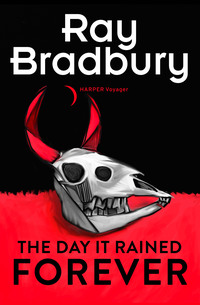
THE DAY IT RAINED FOREVER
Ray Bradbury

Copyright
HarperVoyager An imprint of HarperCollinsPublishers Ltd. 1 London Bridge Street London, SE1 9GF
www.harpervoyagerbooks.co.uk
First published in Great Britain by Rupert Hart-Davis 1959
Published in Penguin Books 1963
Copyright © Ray Bradbury 1959
Cover design by Mike Topping.
Cover layout design © HarperCollinsPublishers 2014
Cover photographs © Shutterstock.com
Ray Bradbury asserts the moral right to be identified as the author of this work.
A catalogue copy of this book is available from the British Library.
This novel is entirely a work of fiction. The names, characters and incidents portrayed in it are the work of the author’s imagination. Any resemblance to actual persons, living or dead, events or localities is entirely coincidental.
All rights reserved under International and Pan-American Copyright Conventions. By payment of the required fees, you have been granted the nonexclusive, nontransferable right to access and read the text of this e-book on-screen. No part of this text may be reproduced, transmitted, downloaded, decompiled, reverse-engineered, or stored in or introduced into any information storage and retrieval system, in any form or by any means, whether electronic or mechanical, now known or hereinafter invented, without the express written permission of HarperCollins e-books.
HarperCollinsPublishers has made every reasonable effort to ensure that any picture content and written content in this ebook has been included or removed in accordance with the contractual and technological constraints in operation at the time of publication.
Ebook Edition © JULY 2014 ISBN: 9780007539819
Version: 2019–01–15
Dedication
FOR
RUPERT HART-DAVIS
IN MEMORY OF
THE TERRIBLE SKIRMISH
THE TEMPORARY LOSS
BUT OUR INEVITABLE VICTORY
AT THE MIRABELLE
Table of Contents
Cover
Title Page
Copyright
Dedication
The Day it Rained Forever
In a Season of Calm Weather
The Dragon
The End of the Beginning
The Wonderful Ice-Cream Suit
Fever Dream
Referent
The Marriage Mender
The Town Where No One Got Off
Icarus Montgolfier Wright
Almost the End of the World
Dark They were and Golden-eyed
The Smile
Here there be Tygers
The Headpiece
Perchance to Dream
The Time of Going Away
The Gift
The Little Mice
The Sunset Harp
A Scent of Sarsaparilla
And the Rock Cried Out
The Strawberry Window
Keep Reading
About the Author
Also by the Author
About the Publisher
The Day it Rained Forever
THE hotel stood like a hollowed dry bone under the very centre of the desert sky where the sun burned the roof all day. All night, the memory of the sun stirred in every room like the ghost of an old forest fire. Long after dusk, since light meant heat, the hotel lights stayed off. The inhabitants of the hotel preferred to feel their way blind through the halls in their never-ending search for cool air.
This one particular evening Mr Terle, the proprietor, and his only boarders, Mr Smith and Mr Fremley, who looked and smelled like two ancient rags of cured tobacco, stayed late on the long veranda. In their creaking glockenspiel rockers, they gasped back and forth in the dark, trying to rock up a wind.
‘Mr Terle …? Wouldn’t it be really nice … some day … if you could buy … air conditioning …?’
Mr Terle coasted a while, eyes shut.
‘Got no money for such things, Mr Smith.’
The two old boarders flushed; they hadn’t paid a bill now in twenty-one years.
Much later, Mr Fremley sighed a grievous sigh. ‘Why, why don’t we all just quit, pack up, get outa here, move to a decent city? Stop this swelterin’ and fryin’ and sweatin’.’
‘Who’d buy a dead hotel in a ghost town?’ said Mr Terle, quietly. ‘No. No, we’ll just set here and wait, wait for that great day, January 29th.’
Slowly, all three men stopped rocking.
January 29th.
The one day in all the year when it really let go and rained.
‘Won’t wait long.’ Mr Smith tilted his gold railroad watch like the warm summer moon in his palm. ‘Two hours and nine minutes from now it’ll be January 29th. But I don’t see nary a cloud in ten thousand miles.’
‘It’s rained every January 29th since I was born!’ Mr Terle stopped, surprised at his own loud voice. ‘If it’s a day late this year, I won’t pull God’s shirt-tail.’
Mr Fremley swallowed hard and looked from east to west across the desert towards the hills. ‘I wonder … will there ever be a gold rush hereabouts again?’
‘No gold,’ said Mr Smith. ‘And what’s more, I’ll make you a bet – no rain. No rain tomorrow or the day after the day after tomorrow. No rain all the rest of this year.’
The three old men sat staring at the big sun-yellowed moon that burned a hole in the high stillness.
After a long while, painfully, they began to rock again.
The first hot morning breezes curled the calendar pages like a dried snakeskin against the flaking hotel front.
The three men, thumbing their braces up over their hat-rack shoulders, came barefoot downstairs to blink out at that idiot sky.
‘January 29th …’
‘Not a drop of mercy there.’
‘Day’s young.’
‘I’m not.’ Mr Fremley turned and went away.
It took him five minutes to find his way up through the delirious hallways to his hot, freshly baked bed.
At noon, Mr Terle peered in.
‘Mr Fremley …?’
‘Damn desert cactus, that’s us!’ gasped Mr Fremley, lying there, his face looking as if at any moment it might fall away in a blazing dust on the raw plank floor. ‘But even the best damn cactus got to have just a sip of water before it goes back to another year of the same damn furnace. I tell you I won’t move again, I’ll lie here an’ die if I don’t hear more than birds pattin’ around up on that roof!’
‘Keep your prayers simple and your umbrella handy,’ said Mr Terle, and tiptoed away.
At dusk, on the hollow roof a faint pattering sounded.
Mr Fremley’s voice sang out mournfully, from his bed.
‘Mr Terle, that ain’t rain! That’s you with the garden hose sprinklin’ well-water on the roof! Thanks for tryin’, but cut it out, now.’
The pattering sound stopped. There was a sigh from the yard below.
Coming around the side of the hotel a moment later, Air Terle saw the calendar fly out and down in the dust.
‘Damn January 29th!’ cried a voice. ‘Twelve more months! Have to wait twelve more months, now!’
Mr Smith was standing there in the doorway. He stepped inside and brought out two dilapidated suitcases and thumped them on the porch.
‘Mr Smith!’ cried Mr Terle. ‘You can’t leave after thirty years!’
‘They say it rains twenty days a month in Ireland,’ said Mr Smith. ‘I’ll get a job there and run around with my hat off and my mouth open.’
‘You can’t go!’ Mr Terle tried frantically to think of something; he snapped his fingers. ‘You owe me nine thousand dollars rent!’
Mr Smith recoiled; his eyes got a look of tender and unexpected hurt in them.
‘I’m sorry.’ Mr Terle looked away. ‘I didn’t mean that. Look now – you just head for Seattle. Pours two inches a week there. Pay me when you can, or never. But do me a favour: wait till midnight. It’s cooler then, anyhow. Get you a good night’s walk towards the city.’
‘Nothin’ll happen between now and midnight.’
‘You got to have faith. When everything else is gone, you got to believe a thing’ll happen. Just stand here, with me, you don’t have to sit, just stand here and think of rain. That’s the last thing I’ll ever ask of you.’
On the desert, sudden little whirlwinds of dust twisted up, sifted down. Mr Smith’s eye scanned the sunset horizon.
‘What do I think? Rain, oh you rain, come along here? Stuff like that?’
‘Anything. Anything at all!’
Mr Smith stood for a long time between his two mangy suitcases and did not move. Five, six minutes ticked by. There was no sound, save the two men’s breathing in the dusk.
Then at last, very firmly, Mr Smith stooped to grasp the luggage handles.
Just then, Mr Terle blinked. He leaned forward, cupping his hand to his ear.
Mr Smith froze, his hands still on the luggage.
From away among the hills, a murmur, a soft and tremulous rumble.
‘Storm coming!’ hissed Mr Terle.
The sound grew louder; a kind of whitish cloud rose up from the hills.
Mr Smith stood tall on tiptoe.
Upstairs, Mr Fremley sat up like Lazarus.
Mr Terle’s eyes grew wider and yet wider to take hold of what was coming. He held to the porch rail like the captain of a long-becalmed vessel feeling the first stir of some tropic breeze that smelled of lime and the ice-cool white meat of coconut. The smallest wind stroked over his aching nostrils as over the flues of a white-hot chimney.
‘There!’ cried Mr Terle. ‘There!’
And over the last hill, shaking out feathers of fiery dust, came the cloud, the thunder, the racketing storm.
Over the hill, the first car to pass in twenty days flung itself down the valley with a shriek, a thud, and a wail.
Mr Terle did not dare to look at Mr Smith.
Mr Smith looked up, thinking of Mr Fremley in his room.
Mr Fremley, at the window, looked down and saw the car expire and die in front of the hotel.
For the sound that the car made was curiously final. It had come a very long way on blazing sulphur roads, across salt flats abandoned ten million years ago by the shingling-off of waters. Now, with wire-ravellings like cannibal hair sprung up from seams, with a great eyelid of canvas top thrown back and melted to spearmint gum over rear seat, the auto, a Kissel car, vintage 1924, gave a final shuddering as if to expel its ghost upon the air.
The old woman in the front seat of the car waited patiently, looking in at the three men and the hotel as if to say, Forgive me, my friend is ill; I’ve known him a long while, and now I must see him through his final hour. So she just sat in the car waiting for the faint convulsions to cease and for the great relaxation of all the bones which signifies that the final process is over. She must have sat a full half-minute longer listening to her car, and there was something so peaceful about her that Mr Terle and Mr Smith leaned slowly towards her. At last she looked at them with a grave smile and raised her hand.
Mr Fremley was surprised to see his hand go out the window above, waving back to her.
On the porch, Mr Smith murmured, ‘Strange. It’s not a storm. And I’m not disappointed. How come?’
But Mr Terle was down the path and to the car.
‘We thought you were … that is …’ He trailed off. ‘Terle’s my name, Joe Terle.’
She took his hand and looked at him with absolutely clear and unclouded light-blue eyes like water that has melted from snow a thousand miles off and come a long way, purified by wind and sun.
‘Miss Blanche Hillgood,’ she said, quietly. ‘Graduate of the Grinnell College, unmarried teacher of music, thirty years high-school glee club and student orchestra conductor, Green City, Iowa, twenty years private teacher of piano, harp, and voice, one month retired and living on a pension and now, taking my roots with me, on my way to California.’
‘Miss Hillgood, you don’t look to be going anywhere from here.’
‘I had a feeling about that.’ She watched the two men circle the car, cautiously. She sat like a child on the lap of a rheumatic grandfather, undecided. ‘Is there nothing we can do?’
‘Make a fence of the wheels, dinner-gong of the brake drums, the rest’ll make a fine rock garden.’
Mr Fremley shouted from the sky. ‘Dead? I say, is the car dead? I can feel it from here! Well – it’s way past time for supper!’
Mr Terle put out his hand. ‘Miss Hillgood, that there is Joe Terle’s Desert Hotel, open twenty-six hours a day. Gila monsters and road runners please register before going upstairs. Get you a night’s sleep, free, we’ll knock our Ford off its blocks and drive you to the city come morning.’
She let herself be helped from the car. The machine groaned as if in protest at her going. She shut the door carefully, with a soft click.
‘One friend gone, but the other still with me. Mr Terle, could you please bring her in out of the weather?’
‘Her, ma’am?’
‘Forgive me, I never think of things but what they’re people. The car was a man, I suppose, because it took me places. But a harp, now, don’t you agree, is female?’
She nodded to the rear seat of the car. There, tilted against the sky like an ancient scrolled leather ship-prow cleaving the wind, stood a case which towered above any driver who might sit up in front and sail the desert calms or the city traffics.
‘Mr Smith,’ said Mr Terle, ‘lend a hand.’
They untied the huge case and hoisted it gingerly out between them.
‘What you got there?’ cried Mr Fremley from above.
Mr Smith stumbled. Miss Hillgood gasped. The case shifted in the two men’s arms.
From within the case came a faint musical humming.
Mr Fremley, above, heard. It was all the answer he needed. Mouth open, he watched the lady and the two men and their boxed friend sway and vanish in the cavernous porch below.
‘Watch out!’ said Mr Smith. ‘Some damn fool left his luggage here –’ He stopped. ‘Some damn fool? Me!’
The two men looked at each other. They were not perspiring any more. A wind had come up from somewhere, a gentle wind that fanned their shirt collars and flapped the strewn calendar gently in the dust.
‘My luggage …’ said Mr Smith.
Then they all went inside.
‘More wine, Miss Hillgood? Ain’t had wine on the table in years.’
‘Just a touch, if you please.’
They sat by the light of a single candle which made the room an oven and struck fire from the good silverware and the un-cracked plates as they talked and drank warm wine and ate.
‘Miss Hillgood, get on with your life.’
‘All my life,’ she said, ‘I’ve been so busy running from Beethoven to Bach to Brahms, I never noticed I was twenty-nine. Next time I looked up I was forty. Yesterday, seventy-one. Oh, there were men; but they’d given up singing at ten and given up flying when they were twelve. I always figured we were born to fly, one way or other, so I couldn’t stand most men shuffling along with all the iron in the earth in their blood. I never met a man who weighed less than nine hundred pounds. In their black business suits, you could hear them roll by like funeral wagons.’
‘So you flew away?’
‘Just in my mind, Mr Terle. It’s taken sixty years to make the final break. All that time I grabbed on to piccolos and flutes and violins because they make streams in the air, you know, like streams and rivers on the ground. I rode every tributary and tried every fresh-water wind from Handel on down to a whole slew of Strausses. It’s been the far way around that’s brought me here.’
‘How’d you finally make up your mind to leave?’ asked Mr Smith.
‘I looked around last week and said, “Why, look, you’ve been flying alone ! No one in all Green City really cares if you fly or how high you go. It’s always, ‘Fine, Blanche,’ or ‘Thanks for the recital at the PTA tea, Miss H.’ But no one really listening.” And when I talked a long time ago about Chicago or New York, folks swatted me and laughed. “Why be a little frog in a big pond when you can be the biggest frog in all Green City!” So I stayed on, while the folks who gave me advice moved away or died or both. The rest had wax in their ears. Just last week I shook myself and said, “Hold on! Since when do frogs have wings?”’
‘So now you’re headin’ west?’ said Mr Terle.
‘Maybe to play in pictures or in that orchestra under the stars. But somewhere I just must play at last for someone who’ll hear and really listen …’
They sat there in the warm dark. She was finished, she had said it all now, foolish or not – and she moved back quietly in her chair.
Upstairs someone coughed.
Miss Hillgood heard, and rose.
It took Mr Fremley a moment to ungum his eyelids and make out the shape of the woman bending down to place the tray by his rumpled bed.
‘What you all talking about down there just now?’
‘I’ll come back later and tell you word for word,’ said Miss Hillgood. ‘Eat now. The salad’s fine.’ She moved to leave the room.
He said, quickly, ‘You goin’ to stay?’
She stopped half out of the door and tried to trace the expression on his sweating face in the dark. He, in turn, could not see her mouth or eyes. She stood a moment longer, silently, then went on down the stairs.
‘She must not’ve heard me,’ said Mr Fremley.
But he knew she had heard.
Miss Hillgood crossed the downstairs lobby to fumble with the locks on the upright leather case.
‘I must pay you for my supper.’
‘On the house,’ said Mr Terle.
‘I must pay,’ she said, and opened the case.
There was a sudden flash of gold.
The two men quickened in their chairs. They squinted at the little old woman standing beside the tremendous heart-shaped object which towered above her with its shining columbined pedestal atop which a calm Grecian face with antelope eyes looked serenely at them even as Miss Hillgood looked now.
The two men shot each other the quickest and most startled of glances, as if each had guessed what might happen next. They hurried across the lobby, breathing hard, to sit on the very edge of the hot velvet lounge, wiping their faces with damp handkerchiefs.
Miss Hillgood drew a chair under her, rested the golden harp gently back on her shoulder, and put her hands to the strings.
Mr Terle took a breath of fiery air and waited.
A desert wind came suddenly along the porch outside, tilting the chairs so they rocked this way and that like boats on a pond at night.
Mr Fremley’s voice protested from above. ‘What’s goin’ on down there?’
And then Miss Hillgood moved her hands.
Starting at the arch near her shoulder, she played her fingers out along the simple tapestry of wires towards the blind and beautiful stare of the Greek goddess on her column, and then back. Then, for a moment, she paused and let the sounds drift up through the baked lobby air and into all the empty rooms.
If Mr Fremley shouted, above, no one heard. For Mr Terle and Mr Smith were so busy jumping up to stand riven in the shadows, they heard nothing save the storming of their own hearts and the shocked rush of all the air in their lungs. Eyes wide, mouths dropped, in a kind of pure insanity, they stared at the two women there, the blind Muse proud on her golden pillar, and the seated one, gentle eyes closed, her small hands stretched forth on the air.
Like a girl, they both thought wildly, like a little girl putting her hands out of a window to feel what? Why, of course, of course!
To feel the rain.
The echo of the first shower vanished down remote causeways and roof-drains, away.
Mr Fremley, above, rose from his bed as if pulled round by his ears.
Miss Hillgood played.
She played and it wasn’t a tune they knew at all, but it was a tune they had heard a thousand times in their long lives, words or not, melody or not. She played and each time her fingers moved, the rain fell pattering through the dark hotel. The rain fell cool at the open windows and the rain rinsed down the baked floorboards of the porch. The rain fell on the rooftop and fell on hissing sand, it fell on rusted car and empty stable and dead cactus in the yard. It washed the windows and laid the dust and filled the rain-barrels and curtained the doors with beaded threads that might part and whisper as you walked through. But more than anything, the soft touch and coolness of it fell on Mr Smith and Mr Terle. Its gentle weight and pressure moved them down and down until it had seated them again. By its continuous budding and prickling on their faces, it made them shut up their eyes and mouths and raise their hands to shield it away. Seated there, they felt their heads tilt slowly back to let the rain fall where it would.
The flash flood lasted a minute, then faded away as the fingers trailed down the loom, let drop a few last bursts and squalls and then stopped.
The last chord hung in the air like a picture taken when lightning strikes and freezes a billion drops of water on their downward flight. Then the lightning went out. The last drops fell through darkness in silence.
Miss Hillgood took her hands from the strings, her eyes still shut.
Mr Terle and Mr Smith opened their eyes to see those two miraculous women, way over there across the lobby, somehow come through the storm untouched and dry.
They trembled. They leaned forward as if they wished to speak. They looked helpless, not knowing what to do.
And then a single sound from high above in the hotel corridors drew their attention and told them what to do.
The sound came floating down feebly, fluttering like a tired bird beating its ancient wings.
The two men looked up and listened.
It was the sound of Mr Fremley.
Mr Fremley, in his room, applauding.
It took five seconds for Mr Terle to figure out what it was. Then he nudged Mr Smith and began, himself, to beat his palms together. The two men struck their hands in mighty explosions. The echoes ricocheted around about in the hotel caverns above and below, striking walls, mirrors, windows, trying to fight free of the rooms.
Miss Hillgood opened her eyes now, as if this new storm had come on her in the open, unprepared.
The men gave their own recital. They smashed their hands together so fervently it seemed they had fistfuls of firecrackers to set off, one on another. Mr Fremley shouted. Nobody heard. Hands winged out, banged shut again and again until fingers puffed up and the old men’s breath came short and they put their hands at last on their knees, a heart pounding inside each one.
Then, very slowly, Mr Smith got up and still looking at the harp, went outside and carried in the suitcases. He stood at the foot of the lobby stairs looking for a long while at Miss Hillgood. He glanced down at her single piece of luggage resting there by the first tread. He looked from her suitcase to her and raised his eyebrows, questioningly.
Miss Hillgood looked at her harp, at her suitcase, at Mr Terle, and at last back to Mr Smith.
She nodded once.
Mr Smith bent down and with his own luggage under one arm and her suitcase in the other, he started the long slow climb up the stairs in the gentle dark. As he moved, Miss Hillgood put the harp back on her shoulder and either played in time to his moving or he moved in time to her playing, neither of them knew which.
Half up the flight, Mr Smith met Mr Fremley who, in a faded robe, was testing his slow way down.
Both stood there, looking deep into the lobby at the one man on the far side in the shadows, and the two women farther over, no more than a motion and a gleam. Both thought the same thoughts.
The sound of the harp playing, the sound of the cool water falling every night and every night of their lives, after this. No spraying the roof with the garden hose now, any more. Only sit on the porch or lie in your night bed and hear the falling … the falling … the falling Mr Smith moved on up the stair; Mr Fremley moved down.
The harp, the harp. Listen, listen!
The fifty years of drought were over.
The time of the long rains had come.
In a Season of Calm Weather
GEORGE and Alice Smith detrained at Biarritz one summer noon and in an hour had run through their hotel on to the beach into the ocean and back out to bake upon the sand.
To see George Smith sprawled burning there, you’d think him only a tourist flown fresh as iced lettuce to Europe and soon to be transhipped home. But here was a man who loved art more than life itself.
‘There …’ George Smith sighed. Another ounce of perspiration trickled down his chest. Boil out the Ohio tap-water, he thought, then drink down the best Bordeaux. Silt your blood with rich French sediment so you’ll see with native eyes!
Why? Why eat, breathe, drink everything French? So that, given time, he might really begin to understand the genius of one man.
His mouth moved, forming a name.
‘George?’ His wife loomed over him. ‘I know what you’ve been thinking. I can read your lips.’
He lay perfectly still, waiting.
‘And?’
‘Picasso,’ she said.
He winced. Some day she would learn to pronounce that name.
‘Please,’ she said. ‘Relax. I know you heard the rumour this morning, but you should see your eyes – your tic is back. All right, Picasso’s here, down the coast a few miles away, visiting friends in some small fishing town. But you must forget it or our vacation’s ruined.’
‘I wish I’d never heard the rumour,’ he said honestly.
‘If only,’ she said, ‘you liked other painters.’
Others? Yes, there were others. He could breakfast most congenially on Caravaggio still-lifes of autumn pears and midnight plums. For lunch: those fire-squirting, thick-wormed Van Gogh sunflowers, those blooms a blind man might read with one rush of scorched fingers down fiery canvas. But the great feast? The paintings he saved his palate for? There, filling the horizon, like Neptune risen, crowned with limewood, alabaster, coral, paintbrushes clenched like tridents in horn-nailed fists, and with fishtail vast enough to fluke summer showers out over all Gibraltar – who else but the creator of Girl Before a Mirror and Guernica?
‘Alice,’ he said, patiently, ‘how can I explain? Coming down on the train I thought, Good Lord, it’s all Picasso country!’
But was it really, he wondered. The sky, the land, the people, the flushed-pink bricks here, scrolled electric-blue ironwork balconies there, a mandolin ripe as a fruit in some man’s thousand fingerprinting hands, billboard tatters blowing like confetti in night winds – how much was Picasso, how much George Smith staring round the world with wild Picasso eyes? He despaired of answering. That old man had distilled turpentine and linseed oil so thoroughly through George Smith that they shaped his being, all Blue Period at twilight, all Rose Period at dawn.
‘I keep thinking,’ he said aloud, ‘if we saved our money …’
‘We’ll never have five thousand dollars.’
‘I know,’ he said quietly. ‘But it’s nice thinking we might bring it off some day. Wouldn’t it be great to just step up to him, say “Pablo, here’s five thousand! Give us the sea, the sand, that sky, or any old thing you want, we’ll be happy.…” ’
After a moment, his wife touched his arm.
‘I think you’d better go in the water now,’ she said.
‘Yes,’ he said. ‘I’d better do just that.’
White fire showered up when he cut the water.
During the afternoon George Smith came out and went into the ocean with the vast spilling motions of now warm, now cool people who at last, with the sun’s decline, their bodies all lobster colours and colours of broiled squab and guinea hen, trudged for their wedding-cake hotels.
The beach lay deserted for endless mile on mile save for two people. One was George Smith, towel over shoulder, out for a last devotional.
Far along the shore another shorter, square-cut man walked alone in the tranquil weather. He was deeper tanned, his close-shaven head dyed almost mahogany by the sun, and his eyes were clear and bright as water in his face.
So the shoreline stage was set, and in a few minutes the two men would meet. And once again Fate fixed the scales for shocks and surprises, arrivals and departures. And all the while these two solitary strollers did not for a moment think on coincidence, that unswum stream which lingers at man’s elbow with every crowd in every town. Nor did they ponder the fact that if man dares dip into that stream he grabs a wonder in each hand. Like most they shrugged at such folly, and stayed well up the bank lest Fate should shove them in.
The stranger stood alone. Glancing about, he saw his alone-ness, saw the waters of the lovely bay, saw the sun sliding down the late colours of the day, and then half-turning spied a small wooden object on the sand. It was no more than the slender stick from a lime ice-cream delicacy long since melted away. Smiling he picked the stick up. With another glance around to re-insure his solitude, the man stooped again and holding the stick gently with light sweeps of his hand began to do the one thing in all the world he knew best how to do.
He began to draw incredible figures along the sand. He sketched one figure and then moved over and still looking down, completely focused on his work now, drew a second and a third figure, and after that a fourth and a fifth and a sixth.
George Smith, printing the shoreline with his feet, gazed here, gazed there, and then saw the man ahead. George Smith, drawing nearer, saw that the man, deeply tanned, was bending down. Nearer yet, and it was obvious what the man was up to. George Smith chuckled. Of course, of course … along on the beach this man – how old? Sixty-five? Seventy? – was scribbling and doodling away. How the sand flew! How the wild portraits flung themselves out there on the shore! How …
George Smith took one more step and stopped, very still.
The stranger was drawing and drawing and did not seem to sense that anyone stood immediately behind him and the world of his drawings in the sand. By now he was so deeply enchanted with his solitudinous creation that depth-bombs set off in the bay might not have stopped his flying hand nor turned him round.
George Smith looked down at the sand. And, after a long while, looking, he began to tremble.
For there on the flat shore were pictures of Grecian lions and Mediterranean goats and maidens with flesh of sand like powdered gold and satyrs piping on hand-carved horns and children dancing, strewing flowers along and along the beach with lambs gambolling after and musicians skipping to their harps and lyres, and unicorns racing youths towards distant meadows, woodlands, ruined temples and volcanoes. Along the shore in a never-broken line, the hand, the wooden stylus of this man bent down in fever and raining perspiration, scribbled, ribboned, looped around over and up, across, in, out, stitched, whispered, stayed, then hurried on as if this travelling bacchanal must flourish to its end before the sun was put out by the sea. Twenty, thirty yards or more the nymphs and dryads and summer founts sprang up in unravelled hieroglyphs. And the sand, in the dying light, was the colour of molten copper on which was now slashed a message that any man in any time might read and savour down the years. Everything whirled and poised in its own wind and gravity. Now wine was being crushed from under the grape-blooded feet of dancing vintners’ daughters, now steaming seas gave birth to coin-sheathed monsters while flowered kites strewed scent on blowing clouds … now … now … now….
The artist stopped.
George Smith drew back and stood away.
The artist glanced up, surprised to find someone so near. Then he simply stood there, looking from George Smith to his own creations flung like idle footprints down the way. He smiled at last and shrugged as if to say, Look what I’ve done; see what a child? You will forgive me, won’t you? One day or another we are all fools … you, too, perhaps? So allow an old fool this, eh? Good! Good!
But George Smith could only look at the little man with the sun-dark skin and the clear sharp eyes, and say the man’s name once, in a whisper, to himself.
They stood thus for perhaps another five seconds, George Smith staring at the sand-frieze, and the artist watching George Smith with amused curiosity. George Smith opened his mouth, closed it, put out his hand, took it back. He stepped towards the picture, stepped away. Then he moved along the line of figures, like a man viewing a precious series of marbles cast up from some ancient ruin on the shore. His eyes did not blink, his hand wanted to touch but did not dare to touch. He wanted to run but did not run.
He looked suddenly at the hotel. Run, yes! Run! What? Grab a shovel, dig, excavate, save a chunk of this all too crumbling sand? Find a repair-man, race him back here with plaster-of-paris to cast a mould of some small fragile part of these? No, no. Silly, silly. Or …? His eyes flicked to his hotel window. The camera! Run, get it, get back, and hurry along the shore, clicking, changing film, clicking unti l…
George Smith whirled to face the sun. It burned faintly on his face, his eyes were two small fires from it. The sun was half underwater and, as he watched, it sank the rest of the way in a matter of seconds.
The artist had drawn nearer and now was gazing into George Smith’s face with great friendliness as if he were guessing every thought. Now he was nodding his head in a little bow. Now the ice-cream stick had fallen casually from his fingers. Now he was saying good night, good night. Now he was gone, walking back down the beach towards the south.
George Smith stood looking after him. After a full minute, he did the only thing he could possibly do. He started at the beginning of the fantastic frieze of satyrs and fauns and wine-dipped maidens and prancing unicorns and piping youths and he walked slowly along the shore. He walked a long way, looking down at the free-running bacchanal. And when he came to the end of the animals and men he turned round and started back in the other direction, just staring down as if he had lost something and did not quite know where to find it. He kept on doing this until there was no more light in the sky, or on the sand, to see by.
He sat down at the supper table.
‘You’re late,’ said his wife. ‘I just had to come down alone. I’m ravenous.’
‘That’s all right,’ he said.
‘Anything interesting happen on your walk?’ she asked.
‘No,’ he said.
‘You look funny; George, you didn’t swim out too far, did you, and almost drown? I can tell by your face. You did swim out too far, didn’t you?’
‘Yes,’ he said.
‘Well,’ she said, watching him closely. ‘Don’t ever do that again. Now – what’ll you have?’
He picked up the menu and started to read it and stopped suddenly.
‘What’s wrong?’ asked his wife.
He turned his head and shut his eyes for a moment.
‘Listen.’
She listened.
‘I don’t hear anything,’ she said.
‘Don’t you?’
‘No. What is it?’
‘Just the tide,’ he said, after a while, sitting there, his eyes still shut. ‘Just the tide, coming in.’
The Dragon
THE night blew in the short grass on the moor; there was no other motion. It had been years since a single bird had flown by in the great blind shell of sky. Long ago a few small stones had simulated life when they crumbled and fell into dust. Now only the night moved in the souls of the two men bent by their lonely fire in the wilderness; darkness pumped quietly in their veins and ticked silently in their temples and their wrists.
Firelight fled up and down their wild faces and welled in their eyes in orange tatters. They listened to each other’s faint, cool breathing and the lizard blink of their eyelids. At last, one man poked the fire with his sword.
‘Don’t, idiot; you’ll give us away!’
‘No matter,’ said the second man. ‘The dragon can smell us miles off, anyway. God’s breath, it’s cold. I wish I was back at the castle.’
‘It’s death, not sleep, we’re after ’
‘Why? Why? The dragon never sets foot in the town!’
‘Quiet, fool! He eats men travelling alone from our town to the next!’
‘Let them be eaten and let us get home!’
‘Wait now; listen!’
The two men froze.
They waited a long time, but there was only the shake of their horses’ nervous skin like black velvet tambourines jingling the silver stirrup buckles, softly, softly.
‘Ah.’ The second man sighed. ‘What a land of nightmares. Everything happens here. Someone blows out the sun; it’s night. And then, and then, oh, God, listen! This dragon, they say his eyes are fire. His breath a white gas; you can see him burn across the dark lands. He runs with sulphur and thunder and kindles the grass. Sheep panic and die insane. Women deliver forth monsters. The dragon’s fury is such that tower walls shake back to dust. His victims, at sunrise, are strewn hither and thither on the hills. How many knights, I ask, have gone for this monster and failed, even as we shall fail?’
‘Enough of that!’
‘More than enough! Out here in this desolation I cannot tell what year this is!’
‘Nine hundred years since the Nativity.’
‘No, no,’ whispered the second man, eyes shut. ‘On this moor is no Time, is only Forever. I feel if I ran back on the road the town would be gone, the people yet unborn, things changed, the castles unquarried from the rocks, the timbers still uncut from the forests; don’t ask how I know, the moor knows, and tells me. And here we sit alone in the land of the fire dragon, God save us!’
‘Be you afraid, then gird on your armour!’
‘What use? The dragon runs from nowhere; we cannot guess its home. It vanishes in fog, we know not where it goes. Aye, on with our armour, we’ll die well-dressed.’
Half into his silver corselet, the second man stopped again and turned his head.
Across the dim country, full of night and nothingness from the heart of the moor itself, the wind sprang full of dust from clocks that used dust for telling time. There were black suns burning in the heart of this new wind and a million burnt leaves shaken from some autumn tree beyond the horizon. This wind melted landscapes, lengthened bones like white wax, made the blood roil and thicken to a muddy deposit in the brain. The wind was a thousand souls dying and all time confused and in transit. It was a fog inside of a mist inside of a darkness, and this place was no man’s place and there was no year or hour at all, but only these men in a faceless emptiness of sudden frost, storm, and white thunder which moved behind the great falling pane of green glass that was the lightning. A squall of rain drenched the turf, all faded away until there was unbreathing hush and the two men waiting alone with their warmth in a cool season.
‘There,’ whispered the first man. ‘Oh, there .. .’
Miles off, rushing with a great chant and a roar – the dragon.
In silence, the men buckled on their armour and mounted their horses. The midnight wilderness was split by a monstrous gushing as the dragon roared nearer, nearer; its flashing yellow glare spurted above a hill and then, fold on fold of dark body, distantly seen, therefore indistinct, flowed over that hill and plunged vanishing into a valley.
‘Quick!’
They spurred their horses forward to a small hollow.
‘This is where it passes!’
They seized their lances with mailed fists, and blinded their horses by flipping the visors down over their eyes.
‘Lord!’
‘Yes, let us use His name.’
On the instant, the dragon rounded a hill. Its monstrous amber eye fed on them, fired their armour in red glints and glitters. With a terrible wailing cry and a grinding rush it flung itself forward.
‘Mercy, God!’
The lance struck under the unlidded yellow eye, buckled, tossed the man through the air. The dragon hit, spilled him over, down, ground him under. Passing, the black brunt of its shoulder smashed the remaining horse and rider a hundred feet against the side of a boulder, wailing, wailing, the dragon shrieking, the fire all about, around, under it, a pink, yellow, orange sun-fire with great soft plumes of blinding smoke.
‘Did you see it?’ cried a voice. ‘Just like I told you!’
‘The same! The same! A knight in armour, by the Lord Harry! We hit him!’
‘You goin’ to stop?’
‘Did once; found nothing. Don’t like to stop on this moor. I get the willies. Got a feel, it has.’
‘But we hit something !’
‘Gave him plenty of whistle; chap wouldn’t budge.’
A steaming blast cut the mist aside.
‘We’ll make Stokely on time. More coal, eh, Fred?’
Another whistle shook dew from the empty sky. The night train, in fire and fury, shot through a gully, up a rise, and vanished over cold earth, towards the north, leaving black smoke and steam to dissolve in the numbed air minutes after it had passed and gone for ever.
The End of the Beginning
HE stopped the lawnmower in the middle of the yard because he felt that the sun at just that moment had gone down and the stars come out. The fresh-cut grass that had showered his face and body died softly away. Yes, the stars were there, faint at first, but brightening in the clear desert sky. He heard the porch screen-door tap shut and felt his wife watching him as he watched the night.
‘Almost time,’ she said.
He nodded; he did not have to check his watch. In the passing moments he felt very old, then very young, very cold, then very warm, now this, now that. Suddenly, he was miles away. He was his own son talking steadily, moving briskly to cover his pounding heart and the resurgent panics as he felt himself slip into fresh uniform, check food supplies, oxygen-flasks, pressure helmet, space-suiting and turn, as every man on earth tonight turned, to gaze at the swiftly filling sky.
Then, quickly, he was back, once more, the father of the son, hands gripped to the lawnmower handle. His wife called, ‘Come sit on the porch.’
‘I’ve got to keep busy!’
She came down the steps and across the lawn. ‘Don’t worry about Robert; he’ll be all right.’
‘But it’s all so new,’ he heard himself say. ‘It’s never been done before. Think of it – a manned rocket going up tonight to build the first space-station. Good Lord, it can’t be done, it doesn’t exist, there’s no rocket, no proving-ground, no take-off time, no technicians. For that matter, I don’t even have a son named Bob. The whole thing’s too much for me!’
‘Then what are you doing out here, staring?’
He shook his head. ‘Well, late this morning, walking to the office, I heard someone laugh out loud. It shocked me so I froze in the middle of the street. It was me, laughing! Why? Because finally I really knew what Bob was going to do tonight; at last I believed it. Holy is a word I never use, but that’s how I felt stranded in all that traffic. Then, middle of the afternoon I caught myself humming. You know the song. A wheel in a wheel. Way in the middle of the air. I laughed again. The space-station, of course, I thought. The big wheel with hollow spokes where Bob’ll live six or eight months, then get along to the moon. Walking home, I remembered more of the song. Little wheel run by faith, Big wheel run by the grace of God. I wanted to jump, yell, and flame-out myself!’
His wife touched his arm. ‘If we stay out here, let’s at least be comfortable.’
They placed two wicker rockers in the centre of the lawn and sat quietly as the stars dissolved out of darkness in pale crushings of rock-salt strewn from horizon to horizon.
‘Why,’ said his wife, at last, ‘it’s like waiting for the fireworks at Sisley Field every year.’
‘Bigger crowd tonight….’
‘I keep thinking – a billion people watching the sky right now, their mouths all open at the same time.’
They waited, feeling the earth move under their chairs.
‘What time is it now?’
‘Eleven minutes to eight.’
‘You’re always right; there must be a clock in your head.’
‘I can’t be wrong, tonight. I’ll be able to tell you one second before they blast off. Look! The ten-minute warning!’
On the western sky they saw four crimson flares open out, float shimmering down the wind, above the desert, then sink silently to the extinguishing earth.
In the new darkness, the husband and wife did not rock in their chairs.
After a while, he said, ‘Eight minutes.’ A pause. ‘Seven minutes.’ What seemed a much longer pause. ‘Six …’
His wife, her head back, studied the stars immediately above her and murmured, ‘Why?’ She closed her eyes. ‘Why the rockets, why tonight? Why all this? I’d like to know.’
He examined her face, pale in the vast powdering light of the Milky Way. He felt the stirring of an answer, but let his wife continue.
‘I mean it’s not that old thing again, is it, when people asked why men climbed Mount Everest and they said, “Because it’s there”? I never understood. That was no answer to me.’
Five minutes, he thought. Time ticking … his wrist-watch … a wheel in a wheel … little wheel run by … big wheel run by … way in the middle of … four minutes! … the men snug in the rocket by now, the hive, the control board lit like Christmas morning….
His lips moved.
‘All I know is it’s really the end of the beginning. The Stone Age, Bronze Age, Iron Age; from now on we’ll lump all those together under one big name for when we walked on Earth and heard the birds at morning and cried with envy. Maybe we’ll call it the Earth Age, or maybe the Age of Gravity. Millions of years we fought gravity. When we were amoebas and fish we struggled to get out of the sea without gravity crushing us. Once safe on the shore we fought to stand upright without gravity breaking our new invention, the spine; tried to walk without stumbling, run without falling. A billion years, Gravity kept us home, mocked us with wind and clouds, cabbage-moths and locusts. That’s what’s so god-awful big about tonight … it’s the end of old man Gravity and the Age we’ll remember him by, for once and all. I don’t know where they’ll divide the Ages, at the Persians who dreamt of flying-carpets, or the Chinese who all unknowing celebrated birthdays and New Years with strung ladyfingers and high skyrockets, or some minute, some incredible second in the next hour. But we’re in at the end of a billion years’ trying, the end of something long and to us humans, anyway, honourable.’
Three minutes … two minutes, fifty-nine seconds … two minutes fifty-eight seconds.…
‘Yes …’ He could hardly hear his wife’s voice. ‘Yes … I believe that’s true.’
Two minutes, he thought. Ready? Ready? Ready? The far radio voice calling. Ready! Ready! Ready! The quick faint replies from the humming rocket. Check! Check! Check!
Tonight, he thought, even if we fail with this first, we’ll send a second and a third ship and move on out to all the planets and, later, all the stars. We’ll just keep going until the big words like immortal and for ever take on meaning. Big words, yes, that’s what we want. Continuity. Since our tongues first moved in our mouths, we’ve asked, What does it all mean? No other question made sense, with death breathing down our necks. But just let us settle in on ten thousand worlds spinning around ten thousand alien suns and the question will fade away. Man will be endless and infinite, even as space is endless and infinite. Man will go on, as space goes on, for ever. Individuals will die, as always, but our history will reach as far as we’ll ever need to see into the future, and with the knowledge of our survival for all time to come, we’ll know security and thus the answer we’ve always searched for. Gifted with life, the least we can do is preserve and pass on the gift to infinity. That’s a goal worth shooting for.
The wicker chairs whispered ever so softly on the grass.
One minute.
‘One minute,’ he said, aloud.
‘Oh!’ His wife moved suddenly, to seize his hands. ‘I hope that Bob…
‘He’ll be all right!’
‘Oh, God, take care.…’
Thirty seconds.
‘Watch, now.’
Fifteen, ten, five …
‘Watch!’
Four, three, two, one.
‘There! There! Oh, there, there!’
They both cried out. They both stood. The chairs toppled back, fell flat on the lawn. The man and his wife swayed, their hands struggled to find each other, grip hold. They saw the brightening colour in the sky and, ten seconds later, the great uprising comet burn the air, put out the stars, and rush away in firelight to become another star in the returning profusion of the Milky Way. The man and wife held each other as if they had stumbled on the rim of an incredible cliff that faced an abyss so deep and dark there seemed no end to it. Staring up, they heard themselves sobbing and crying. Only after a long time were they able to speak.
‘It got away, it did, didn’t it?’
‘Yes …’
‘It’s all right, isn’t it?’
‘Yes … yes …’
‘It didn’t fall back…?’
‘No, no, it’s all right, Bob’s all right, it’s all right.’
They stood away from each other at last.
He touched his face with his hand and looked at his wet fingers. ‘I’ll be damned,’ he said, ‘I’ll be damned.’
They waited another five and then ten minutes until the darkness in their heads, the retina, ached with a million specks of fiery salt. Then they had to close their eyes.
‘Well,’ she said, ‘now let’s go in.’
He could not move. Only his hand reached a long way out by itself to find the lawnmower handle. He saw what his hand had done and said, ‘There’s just a little more to do.…’
‘But you can’t see.’
‘Well enough,’ he said.’ I must finish this. Then we’ll sit on the porch awhile before we turn in.’
He helped her put the chairs on the porch and sat her down and then walked back out to put his hands on the guidebar of the lawnmower. The lawnmower. A wheel in a wheel. A simple machine which you held in your hands, which you sent on ahead with a rush and a clatter, while you walked behind with your quiet philosophy. Racket, followed by warm silence. Whirling wheel, then soft footfall of thought.
I’m a billion years old, he told himself; I’m one minute old. I’m one inch, not ten thousand miles, tall. I look down and can’t see my feet they’re so far off and gone away below.
He moved the lawnmower. The grass, showering up, fell softly around him; he relished and savoured it and felt that he was all mankind bathing at last in the fresh waters of the fountain of youth.
Thus bathed, he remembered the song again, about the wheels and the faith and the grace of God being way up there in the middle of the sky where that single star, among a million motionless stars, dared to move and keep on moving.
Then he finished cutting the grass.
The Wonderful Ice-Cream Suit
IT was summer twilight in the city and out front of the quiet-clicking pool-hall three young Mexican-American men breathed the warm air and looked around at the world. Sometimes they talked and sometimes they said nothing at all, but watched the cars glide by like black panthers on the hot asphalt or saw trolleys loom up like thunderstorms, scatter lightning, and rumble away into silence.
‘Hey,’ sighed Martinez, at last. He was the youngest, the most sweetly sad of the three. ‘It’s a swell night, huh? Swell.’
As he observed the world it moved very close and then drifted away and then came close again. People, brushing by, were suddenly across the street. Buildings five miles away suddenly leaned over him. But most of the time everything, people, cars, and buildings, stayed way out on the edge of the world and could not be touched. On this quiet warm summer evening, Martinez’s face was cold.
‘Nights like this you wish … lots of things.’
‘Wishing,’ said the second man, Villanazul, a man who shouted books out loud in his room, but spoke only in whispers on the street. ‘Wishing is the useless pastime of the unemployed.’
‘Unemployed?’ cried Vamenos, the unshaven. ‘Listen to him! We got no jobs, no money!’
‘So,’ said Martinez, ‘we got no friends.’
‘True.’ Villanazul gazed off towards the green plaza where the palm-trees swayed in the soft night wind. ‘Do you know what I wish? I wish to go into that plaza and speak among the businessmen who gather there nights to talk big talk. But dressed as I am, poor as I am, who would listen? So, Martinez, we have each other. The friendship of the poor is real friendship. We –’
But now a handsome young Mexican with a fine thin moustache strolled by. And on each of his careless arms hung a laughing woman.
‘Madre mía!’ Martinez slapped his own brow. ‘How does that one rate two friends?’
‘It’s his nice new white summer suit.’ Vamenos chewed a black thumbnail. ‘He looks sharp.’
Martinez leaned out to watch the three people moving away, and then the tenement across the street, in one fourth-floor window of which, far above, a beautiful girl leaned out, her dark hair faintly stirred by the wind. She had been there for ever, which was to say, for six weeks. He had nodded, he had raised a hand, he had smiled, he had blinked rapidly, he had even bowed to her, on the street, in the hall when visiting friends, in the park, downtown. Even now, he put his hand up from his waist and moved his fingers. But all the lovely girl did was let the summer wind stir her dark hair. He did not exist. He was nothing.
‘Madre mía!’ He looked away and down the street where the man walked his two friends around a corner. ‘Oh, if I had just one suit, one! I wouldn’t need money if I looked okay.’
‘I hesitate to suggest,’ said Villanazul, ‘that you see Gomez. But he’s been talking some crazy talk for a month now, about clothes. I keep on saying I’ll be in on it to make him go away. That Gomez.’
‘Friend,’ said a quiet voice.
‘Gomez!’ Everyone turned to stare.
Smiling strangely, Gomez pulled forth an endless thin yellow ribbon which fluttered and swirled on the summer air.
‘Gomez,’ said Martinez, ‘what you doing with that tape-measure?’
Gomez beamed. ‘Measuring people’s skeletons.’
‘Skeletons!’
‘Hold on.’ Gomez squinted at Martinez. ‘gCaramba! Where you been all my life! Let’s try you !’
Martinez saw his arm seized and taped, his leg measured, his chest encircled.
‘Hold still!’ cried Gomez. ‘Arm – perfect. Leg – chest – perfectamente! Now, quick, the height! There! Yes! Five foot five! You’re in! Shake!’ Pumping Martinez’s hand he stopped suddenly. ‘Wait. You got … ten bucks?’
‘I have!’ Vamenos waved some grimy bills. ‘Gomez, measure me!’
‘All I got left in the world is nine dollars and ninety-two cents.’ Martinez searched his pockets. ‘That’s enough for a new suit? Why?’
‘Why? Because you got the right skeleton, that’s why!’
‘Señor Gomez, I don’t hardly know you –’
‘Know me? You’re going to live with me! Come on!’
Gomez vanished into the pool-room. Martinez, escorted by the polite Villanazul, pushed by an eager Vamenos, found himself inside.
‘Dominguez!’ said Gomez.
Dominguez, at a wall-telephone, winked at them. A woman’s voice squeaked on the receiver.
‘Manulo!’ said Gomez.
Manulo, a wine bottle tilted bubbling to his mouth, turned.
Gomez pointed at Martinez.
‘At last we found our fifth volunteer!’
Dominguez said, ‘I got a date, don’t bother me –’ and stopped. The receiver slipped from his fingers. His little black telephone book full of fine names and numbers went quickly back into his pocket. ‘Gomez, you – ?’
‘Yes, yes! Your money, now! Ándale!’
The woman’s voice sizzled on the dangling phone.
Dominguez glanced at it, uneasily.
Manulo considered the empty wine bottle in his hand and the liquor-store sign across the street.
Then, very reluctantly, both men laid ten dollars each on the green velvet pool-table.
Villanazul, amazed, did likewise, as did Gomez, nudging Martinez. Martinez counted out his wrinkled bills and change. Gomez flourished the money like a royal flush.
‘Fifty bucks! The suit costs sixty! All we need is ten bucks!’
‘Wait,’ said Martinez. ‘Gomez, are we talking about one suit? Uno?’
‘Uno!’ Gomez raised a finger. ‘One wonderful white ice-cream summer suit! White, white as the August moon!’
‘But who will own this one suit?’
‘Me!’ said Manulo.
‘Me!’ said Dominguez.
‘Me!’ said Villanazul.
‘Me!’ cried Gomez. ‘And you, Martinez. Men, let’s show him. Line up!’
Villanazul, Manulo, Dominguez, and Gomez rushed to plant their backs against the pool-room wall.
‘Martinez, you too, the other end, line up! Now, Vamenos, lay that billiard cue across our heads!’
‘Sure, Gomez, sure!’
Martinez, in line, felt the cue tap his head and leaned out to see what was happening. ‘Ah!’ he gasped.
The cue lay flat on all their heads, with no rise or fall, as Vamenos slid it, grinning, along.
‘We’re all the same height!’ said Martinez.
‘The same!’ Everyone laughed.
Gomez ran down the line rustling the yellow tape-measure here and there on the men so they laughed even more wildly.
‘Sure!’ he said. ‘It took a month, four weeks, mind you, to find four guys the same size and shape as me, a month of running around measuring. Sometimes I found guys with five-foot-five skeletons, sure, but all the meat on their bones was too much or not enough. Sometimes their bones were too long in the legs or too short in the arms. Boy, all the bones! I tell you! But now, five of us, same shoulders, chests, waists, arms, and as for weight? Men!’
Manulo, Dominguez, Villanazul, Gomez, and at last, Martinez stepped on to the scales which flipped ink-stamped cards at them as Vamenos, still smiling, wildly fed pennies. Heart pounding, Martinez read the cards.
‘One hundred thirty-five pounds … one thirty-six … one thirty-three … one thirty-four … one thirty-seven … a miracle!’
‘No,’ said Villanazul, simply, ‘Gomez.’
They all smiled upon that genius who now circled them with his arms.
‘Are we not fine?’ he wondered. ‘All the same size, all the same dream – the suit. So each of us will look beautiful at least one night each week, eh?’
‘I haven’t looked beautiful in years,’ said Martinez. ‘The girls run away.’
‘They will run no more, they will freeze,’ said Gomez, ‘when they see you in the cool white summer ice-cream suit.’
‘Gomez,’ said Villanazul, ‘just let me ask one thing.’
‘Of course, compadre.’
‘When we get this nice new white ice-cream summer suit, some night you’re not going to put it on and walk down to the Greyhound bus in it and go live in El Paso for a year in it, are you?’
‘Villanazul, Villanazul, how can you say that?’
‘My eye sees and my tongue moves,’ said Villanazul. ‘How about the Everybody Wins! Punchboard Lotteries you ran and you kept running when nobody won? How about the United Chili Con Carne and Frijole Company you were going to organize and all that ever happened was the rent ran out on a two-by-four office?’
‘The errors of a child now grown,’ said Gomez. ‘Enough! In this hot weather, someone may buy the special suit that is made just for us that stands waiting in the window of SHUMWAY’S SUNSHINE SUITS! We have fifty dollars. Now we need just one more skeleton!’
Martinez saw the men peer around the pool-hall. He looked where they looked. He felt his eyes hurry past Vamenos, then come reluctantly back to examine his dirty shirt, his huge nicotined fingers.
‘Me!’ Vamenos burst out, at last. ‘My skeleton, measure it, it’s great! Sure, my hands are big, and my arms, from digging ditches! But –’
Just then Martinez heard passing on the sidewalk outside, that same terrible man with his two girls, all laughing and yelling together.
He saw anguish move like the shadow of a summer cloud on the faces of the other men in this pool-room.
Slowly Vamenos stepped on to the scales and dropped his penny. Eyes closed, he breathed a prayer.
‘Madre mía, please …’
The machinery whirred, the card fell out. Vamenos opened his eyes.
‘Look! One thirty-five pounds! Another miracle!’
The men stared at his right hand and the card, at his left hand and a soiled ten-dollar bill.
Gomez swayed. Sweating, he licked his lips. Then, his hand shot out, seized the money.
‘The clothing store! The suit! Andale!’
Yelling, everyone ran from the pool-room.
The woman’s voice was still squeaking on the abandoned telephone. Martinez, left behind, reached out and hung the voice up. In the silence, he shook his head. ‘Santos, what a dream! Six men,’ he said, ‘one suit. What will come of this? Madness? Debauchery? Murder? But I go with God. Gomez, wait for me!’
Martinez was young. He ran fast.
Mr Shumway, of SHUMWAY’S SUNSHINE SUITS, paused while adjusting a tie-rack, aware of some subtle atmospheric change outside his establishment.
‘Leo,’ he whispered to his assistant. ‘Look …’
Outside, one man, Gomez, strolled by, looking in. Two men. Manulo and Dominguez, hurried by, staring in. Three men, Villanazul, Martinez, and Vamenos, jostling shoulders, did the same.
‘Leo,’ Mr Shumway swallowed. ‘Call the police!’
Suddenly, six men filled the doorway.
Martinez, crushed among them, his stomach slightly upset, his face feeling feverish, smiled so wildly at Leo that Leo let go the telephone.
‘Hey,’ breathed Martinez, eyes wide. ‘There’s a great suit, over there!’
‘No.’ Manulo touched a lapel. ‘This one!’
‘There is only one suit in all the world!’ said Gomez, coldly. ‘Mr Shumway, the ice-cream white, size thirty-four, was in your window just an hour ago! It’s gone! You didn’t –’
‘Sell it?’ Mr Shumway exhaled. ‘No, no. In the dressing-room. It’s still on the dummy.’
Martinez did not know if he moved and moved the crowd or if the crowd moved and moved him. Suddenly they were all in motion. Mr Shumway, running, tried to keep ahead of them.
‘This way, gents. Now which of you …?’
‘All for one, one for all!’ Martinez heard himself say, and laughed wildly. ‘We’ll all try it on!’
‘All?’ Mr Shumway clutched at the booth curtain as if his shop were a steamship that had suddenly tilted in a great swell. He stared.
That’s it, thought Martinez, look at our smiles. Now, look at the skeletons behind our smiles! Measure here, there, up, down, yes, do you see?
Mr Shumway saw. He nodded. He shrugged.
‘All!’ He jerked the curtain. ‘There! Buy it, and I’ll throw in the dummy, free!’
Martinez peered quietly into the booth, his motion drawing the others to peer, too.
The suit was there.
And it was white.
Martinez could not breathe. He did not want to. He did not need to. He was afraid his breath would melt the suit. It was enough, just looking.
But at last he took a great trembling breath and exhaled, whispering, ‘Ay. Ay, caramba!’
‘It puts out my eyes,’ murmured Gomez.
‘Mr Shumway.’ Martinez heard Leo hissing. ‘Ain’t it dangerous precedent, to sell it? I mean, what if everybody bought one suit for six people?’
‘Leo,’ said Mr Shumway, ‘you ever hear one single fifty-nine-dollar suit make so many people happy at the same time before?’
‘Angels’ wings,’ murmured Martinez. ‘The wings of white angels.’
Martinez felt Mr Shumway peering over his shoulder into the booth. The pale glow filled his eyes.
‘You know something, Leo?’ he said, in awe. ‘That’s a suit !’
Gomez, shouting, whistling, ran up to the third-floor landing and turned to wave to the others who staggered, laughed, stopped, and had to sit down on the steps below.
‘Tonight!’ cried Gomez. ‘Tonight you move in with me, eh? Save rent as well as clothes, eh? Sure! Martinez, you got the suit?’
‘Have I?’ Martinez lifted the white gift-wrapped box high. ‘From us to us! Ay-hah!’
‘Vamenos, you got the dummy?’
‘Here!’
Vamenos, chewing an old cigar, scattering sparks, slipped. The dummy, falling, toppled, turned over twice, and banged down the stairs.
‘Vamenos! Dumb! Clumsy!’
They seized the dummy from him. Stricken, Vamenos looked about as if he’d lost something.
Manulo snapped his fingers. ‘Hey, Vamenos, we got to celebrate ! Go borrow some wine!’
Vamenos plunged downstairs in a whirl of sparks.
The others moved into the room with the suit, leaving Martinez in the hall to study Gomez’s face.
‘Gomez, you look sick.’
‘I am,’ said Gomez. ‘For what have I done?’ He nodded to the shadows in the room working about the dummy. ‘I pick Dominguez, a devil with the women. All right. I pick Manulo, who drinks, yes, but who sings as sweet as a girl, eh? Okay. Villanazul reads books. You, you wash behind your ears. But then what do I do? Can I wait? No! I got to buy that suit! So the last guy I pick is a clumsy slob who has the right to wear my suit –’ He stopped, confused. ‘Who gets to wear our suit one night a week, fall down in it, or not come in out of the rain in it! Why, why, why did I do it !’
‘Gomez,’ whispered Villanazul from the room. ‘The suit is ready. Come see if it looks as good using your light bulb.’
Gomez and Martinez entered.
And there on the dummy in the centre of the room was the phosphorescent, the miraculously white-fired ghost with the incredible lapels, the precise stitching, the neat button-holes. Standing with the white illumination of the suit upon his cheeks, Martinez suddenly felt he was in church. White! White! It was white as the whitest vanilla ice-cream, as the bottled milk in tenement halls at dawn. White as a winter cloud all alone in the moonlit sky late at night. Seeing it here in the warm summer night room made their breath almost show on the air. Shutting his eyes, he could see it printed on his lids. He knew what colour his dreams would be this night.
‘White …’ murmured Villanazul. ‘White as the snow on that mountain near our town in Mexico which is called the Sleeping Woman.’
‘Say that again,’ said Gomez.
Villanazul, proud yet humble, was glad to repeat his tribute.
‘… white as the snow on the mountain called –’
‘I’m back!’
Shocked, the men whirled to see Vamenos in the door, wine bottles in each hand.
‘A party! Here! Now tell us, who wears the suit first tonight? Me?’
‘It’s too late!’ said Gomez.
‘Late! It’s only nine-fifteen!’
‘Late?’ said everyone, bristling. ‘Late?’
Gomez edged away from these men who glared from him to the suit to the open window.
Outside and below it was, after all, thought Martinez, a fine Saturday night in a summer month and through the calm warm darkness the women drifted like flowers on a quiet stream. The men made a mournful sound.
‘Gomez, a suggestion.’ Villanazul licked his pencil and drew a chart on a pad. ‘You wear the suit from nine-thirty to ten, Manulo till ten-thirty, Dominguez till eleven, myself till eleven-thirty, Martinez till midnight, and –’
‘Why me last?’ demanded Vamenos, scowling.
Martinez thought quickly and smiled. ‘After midnight is the best time, friend.’
‘Hey,’ said Vamenos, ‘that’s right. I never thought of that. Okay.’
Gomez sighed. ‘All right. A half-hour each. But from now on, remember, we each wear the suit just one night a week. Sundays we draw straws for who wears the suit the extra night.’
‘Me!’ laughed Vamenos. ‘I’m lucky!’
Gomez held on to Martinez tight.
‘Gomez,’ urged Martinez, ‘you first. Dress.’
Gomez could not tear his eyes from that disreputable Vamenos. At last, impulsively, he yanked his shirt off over his head. ‘Ay-yeah!’ he howled. ‘Ay-yeee!’
Whisper rustle … the clean shirt.
‘Ah…!’
How clean the new clothes feel, thought Martinez, holding the coat ready. How clean they sound, how clean they smell!
Whisper … the pants … the tie, rustle … the braces. Whisper … now Martinez let loose the coat which fell in place on flexing shoulders.
‘Olé!’
Gomez turned like a matador in his wondrous suit-of-lights.
‘Olé, Gomez, olé!’
Gomez bowed and went out the door.
Martinez fixed his eyes to his watch. At ten sharp he heard someone wandering about in the hall as if they had forgotten where to go. Martinez pulled the door open and looked out.
Gomez was there, heading for nowhere.
He looks sick, thought Martinez. No, stunned, shook up, surprised, many things.
‘Gomez! This is the place!’
Gomez turned around and found his way through the door.
‘Oh, friends, friends,’ he said. ‘Friends, what an experience! This suit! This suit!’
‘Tell us, Gomez!’ said Martinez.
‘I can’t, how can I say it!’ He gazed at the heavens, arms spread, palms up.
‘Tell us, Gomez!’
‘I have no words, no words. You must see, yourself! Yes, you must see –’ And here he lapsed into silence, shaking his head until at last he remembered they all stood watching him. ‘Who’s next? Manulo?’
Manulo, stripped to his shorts, leapt forward.
‘Ready!’
All laughed, shouted, whistled.
Manulo ready, went out the door. He was gone twenty-nine minutes and thirty seconds. He came back holding to doorknobs, touching the wall, feeling his own elbows, putting the flat of his hand to his face.
‘Oh, let me tell you,’ he said. ‘Compadres, I went to the bar, eh, to have a drink? But no, I did not go in the bar, do you hear? I did not drink. For as I walked I began to laugh and sing. Why, why? I listened to myself and asked this. Because. The suit made me feel better than wine ever did. The suit made me drunk, drunk! So I went to the Guadalajara Refritería instead and played the guitar and sang four songs, very high! The suit, ah, the suit!’
Dominguez, next to be dressed, moved out through the world, came back from the world.
The black telephone book! thought Martinez. He had it in his hands when he left! Now, he returns, hands empty! What? What?
‘On the street,’ said Dominguez, seeing it all again, eyes wide, ‘on the street I walked, a woman cried, “Dominguez, is that you?” Another said, “Dominguez? No, Quetzalcoatl, the Great White God come from the East,” do you hear? And suddenly I didn’t want to go with six women or eight, no. One, I thought. One! And to this one, who knows what I would say? “Be mine!” or “Marry me!” Caramba! This suit is dangerous! But I did not care! I live, I live! Gomez, did it happen this way with you?’
Gomez, still dazed by the events of the evening, shook his head. ‘No, no talk. It’s too much. Later. Villanazul…?’
Villanazul moved shyly forward.
Villanazul went shyly out.
Villanazul came shyly home.
‘Picture it, ’ he said, not looking at them, looking at the floor, talking to the floor. ‘The Green Plaza, a group of elderly business men gathered under the stars and they are talking, nodding, talking. Now one of them whispers. All turn to stare. They move aside, they make a channel through which a white hot light burns its way as through ice. At the centre of the great light is this person. I take a deep breath. My stomach is jelly. My voice is very small, but it grows louder. And what do I say? I say, “Friends. Do you know Carlyle’s Sartor Resartus? In that book we find his Philosophy of Suits.…” ’
And at last it was time for Martinez to let the suit float him out to haunt the darkness.
Four times he walked around the block. Four times he paused beneath the tenement porches, looking up at the window where the light was lit. A shadow moved, the beautiful girl was there, not there, away and gone, and on the fifth time, there she was, on the porch above, driven out by the summer heat, taking the cooler air. She glanced down. She made a gesture.
At first he thought she was waving to him. He felt like a white explosion that had riveted her attention. But she was not waving. Her hand gestured and the next moment a pair of dark-framed glasses sat upon her nose. She gazed at him.
Ah, ah, he thought, so that’s it. So! Even the blind may see this suit! He smiled up at her. He did not have to wave. And at last, she smiled back. She did not have to wave either. Then, because he did not know what else to do, and he could not get rid of this smile that had fastened itself to his cheeks, he hurried, almost ran, around the corner, feeling her stare after him. When he looked back, she had taken off her glasses and gazed now with the look of the nearsighted at what, at most, must be a moving blob of light in the great darkness here. Then, for good measure he went around the block again, through a city so suddenly beautiful he wanted to yell, then laugh, then yell again.
Returning, he drifted, oblivious, eyes half-closed, and seeing him in the door the others saw not Martinez but themselves come home. In that moment, they sensed that something had happened to them all.
‘You’re late!’ cried Vamenos, but stopped. The spell could not be broken.
‘Somebody tell me,’ said Martinez. ‘Who am I?’
He moved in a slow circle through the room.
Yes, he thought, yes, it’s the suit, yes, it had to do with the suit and them all together in that store on this fine Saturday night and then here, laughing and feeling more drunk without drinking, as Manulo said himself, as the night ran and each slipped on the pants and held, toppling, to the others and, balanced, let the feeling get bigger and warmer and finer as each man departed and the next took his place in the suit until now here stood Martinez all splendid and white as one who gives orders and the world grows quiet and moves aside.
‘Martinez, we borrowed three mirrors while you were gone. Look!’
The mirrors, set up as in the store, angled to reflect three Martinezes and the echoes and memories of those who had occupied this suit with him and known the bright world inside this thread and cloth. Now, in the shimmering mirror, Martinez saw the enormity of this thing they were living together and his eyes grew wet. The others blinked. Martinez touched the mirrors. They shifted. He saw a thousand, a million white-armoured Martinezes march off into eternity, reflected, reflected, for ever, indomitable, and unending.
He held the white coat out on the air. In a trance, the others did not at first recognize the dirty hand that reached to take the coat. Then:
‘Vamenos!’
‘Pig!’
‘You didn’t wash!’ cried Gomez. ‘Or even shave, while you waited! Compadres, the bath!’
‘The bath!’ said everyone.
‘No!’ Vamenos flailed. ‘The night air! I’m dead!’
They hustled him yelling out and down the hall.
Now here stood Vamenos, unbelievable in white suit, beard shaved, hair combed, nails scrubbed.
His friends scowled darkly at him.
For it was not true, thought Martinez, that when Vamenos passed by, avalanches itched on mountain-tops. If he walked under windows, people spat, dumped garbage, or worse. Tonight now, this night, he would stroll beneath ten thousand wide-opened windows, near balconies, past alleys. Suddenly the world absolutely sizzled with flies. And here was Vamenos, a fresh-frosted cake.
‘You sure look keen in that suit, Vamenos,’ said Manulo sadly.
‘Thanks.’ Vamenos twitched, trying to make his skeleton comfortable where all their skeletons had so recently been. In a small voice, Vamenos said, ‘Can I go now?’
‘Villanazul!’ said Gomez. ‘Copy down these rules.’
Villanazul licked his pencil.
‘First,’ said Gomez, ‘don’t fall down in that suit, Vamenos!’
‘I won’t.’
‘Don’t lean against buildings in that suit.’
‘No buildings.’
‘Don’t walk under trees with birds in them, in that suit. Don’t smoke. Don’t drink –’
‘Please,’ said Vamenos, ‘can I sit down in this suit?’
‘When in doubt, take the pants off, fold them over a chair.’
‘Wish me luck,’ said Vamenos.
‘Go with God, Vamenos.’
He went out. He shut the door.
There was a ripping sound.
"Vamenos!’ cried Martinez.
He whipped the door open.
Vamenos stood with two halves of a handkerchief torn in his hands, laughing.
‘Rrrip! Look at your faces! Rrrip!’ He tore the cloth again. ‘Oh, oh, your faces, your faces! Ha!’
Roaring, Vamenos slammed the door, leaving them stunned and alone.
Gomez put both hands on top of his head and turned away. ‘Stone me. Kill me. I have sold our souls to a demon!’
Villanazul dug in his pockets, took out a silver coin and studied it for a long while.
‘Here is my last fifty cents. Who else will help me buy back Vamenos’s share of the suit?’
‘It’s no use.’ Manulo showed them ten cents. ‘We got only enough to buy the lapels and the buttonholes.’
Gomez, at the open window, suddenly leaned out and yelled, ‘Vamenos! No!’
Below on the street, Vamenos, shocked, blew out a match, and threw away an old cigar butt he had found somewhere. He made a strange gesture to all the men in the window above, then waved airily and sauntered on.
Somehow, the five men could not move away from the window. They were crushed together there.
‘I bet he eats a hamburger in that suit,’ mused Villanazul. ‘I’m thinking of the mustard.’
‘Don’t!’ cried Gomez. ‘No, no!’
Manulo was suddenly at the door.
‘I need a drink, bad.’
‘Manulo, there’s wine here, that bottle, on the floor –’
Manulo went out and shut the door.
A moment later, Villanazul stretched with great exaggeration and strolled about the room.
‘I think I’ll walk down to the plaza, friends.’
He was not gone a minute when Dominguez, waving his black book at the others, winked, and turned the doorknob.
‘Dominguez,’ said Gomez.
‘Yes?’
‘If you see Vamenos, by accident,’ said Gomez, ‘warn him away from Mickey Murillo’s Red Rooster Café. They got fights not only on TV but out front of the TV, too.’
‘He wouldn’t go into Murillo’s,’ said Dominguez. ‘That suit means too much to Vamenos. He wouldn’t do anything to hurt it.’
‘He’d shoot his mother first,’ said Martinez.
‘Sure he would.’
Martinez and Gomez, alone, listened to Dominguez’s footsteps hurry away down the stairs. They circled the undressed window dummy.
For a long while, biting his lips, Gomez stood at the window, looking out. He touched his shirt pocket twice, pulled his hand away, and then at last pulled something from the pocket. Without looking at it, he handed it to Martinez.
‘Martinez, take this.’
‘What is it?’
Martinez looked at the piece of folded pink paper with print on it, with names and numbers. His eyes widened.
‘A ticket on the bus to El Paso, three weeks from now!’
Gomez nodded. He couldn’t look at Martinez. He stared out into the summer night.
‘Turn it in. Get the money,’ he said. ‘Buy us a nice white panama hat and a pale blue tie to go with the white ice-cream suit, Martinez. Do that.’
‘Gomez –’
‘Shut up. Boy, is it hot in here! I need air.’
‘Gomez. I am touched. Gomez –’
But the door stood open. Gomez was gone.
Mickey Murillo’s Red Rooster Café and Cocktail Lounge was squashed between two big brick buildings and, being narrow, had to be deep. Outside, serpents of red and sulphur-green neon fizzed and snapped. Inside, dim shapes loomed and swam away to lose themselves in a swarming night sea.
Martinez, on tiptoe, peeked through a flaked place on the red-painted front window.
He felt a presence on his left, heard breathing on his right. He glanced in both directions.
‘Manulo! Villanazul!’
‘I decided I wasn’t thirsty,’ said Manulo. ‘So I took a walk.’
‘I was just on my way to the plaza,’ said Villanazul, ‘and decided to go the long way round.’
As if by agreement the three men shut up now and turned together to peer on tiptoe through various flaked spots on the window.
A moment later, all three felt a new very warm presence behind them and heard still faster breathing.
‘Is our white suit in there?’ asked Gomez’s voice.
‘Gomez!’ said everybody, surprised. ‘Hi!’
‘Yes!’ cried Dominguez, having just arrived to find his own peephole. ‘There’s the suit! And, praise God, Vamenos is still in it!’
‘I can’t see!’ Gomez squinted, shielding his eyes. ‘What’s he doing?’
Martinez peered. Yes! There, way back in the shadows, was a big chunk of snow, and the idiot smile of Vamenos winking above it, wreathed in smoke.
‘He’s smoking!’ said Martinez.
‘He’s drinking!’ said Dominguez.
‘He’s eating a taco!’ reported Villanazul.
‘A juicy taco,’ added Manulo.
‘No,’ said Gomez. ‘No, no, no …’
‘Ruby Escadrillo’s with him!’
‘Let me see that!’ Gomez pushed Martinez aside.
Yes, there was Ruby! Two hundred pounds of glittering sequins and tight black satin on the hoof, her scarlet fingernails clutching Vamenos’s shoulder. Her cow-like face, floured with powder, greasy with lipstick, hung over him!
Бесплатный фрагмент закончился.