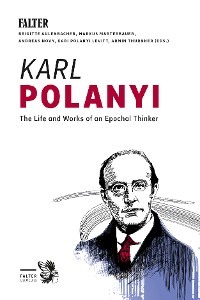
Читать книгу: «Karl Polanyi»
On 8 May 2018, the International Karl Polanyi Society was founded in Vienna. This marked the beginning of a new phase of engagement with a thinker who had already come to be regarded as a centennial figure in the Anglo-Saxon world.
This book serves as an introduction to The Great Transformation, Polanyi’s magnum opus and one of the most important works of the 20th century. It helps us to understand the background to Karl Polanyi’s intellectual career, sketches the lives of his family members, describes the milieus of Budapest, Vienna, London and New York, which were such informative influences in his life, and sheds light on his relationship with contemporaries such as Keynes, Mises and Hayek.
Renowned Polanyi researchers, including, most notably his daughter Kari Polanyi Levitt, elucidate Polanyian concepts such as ‘fictitious commodities’ and apply his analysis to an era when everything seems to be subjected to the mechanics of the market.
BRIGITTE AULENBACHER, MARKUS MARTERBAUER, ANDREAS NOVY, KARI POLANYI LEVITT, ARMIN THURNHER (EDS.)
KARL
POLANYI
The Life and Works of an Epochal Thinker
Translated by Jan-Peter Herrmann and Carla Welch
The translation has been funded by the Rosa-Luxemburg-Stiftung.
FALTER VERLAG
© 2020 Falter Verlagsgesellschaft m.b.H.
1011 Vienna, Marc-Aurel-Straße 9
T: +43/1/536 60-0, E: bv@falter.at, W: www.falter.at
All rights reserved. No unauthorized copying
ISBN ePub: 978-3-85439-344-3
ISBN Kindle: 978-3-85439-357-3
ISBN Print edition: 978-3-85439-689-5
1st digital edition: Zeilenwert GmbH 2020
TABLE OF CONTENT
Brigitte Aulenbacher, Andreas Novy: Acknowledgements
Marguerite Mendell: Foreword
Armin Thurnher: Foreword of the German edition
I. The Renaissance
Brigitte Aulenbacher, Veronika Heimerl, Andreas Novy: The Limits of a Market Society
Armin Thurnher: ‘Many graze on Polanyi’s pasture’
Michael Burawoy: Fictitious Commodities and the Three Waves of Marketization
II. The Personal and the Historical
Michael Burawoy: ‘Wherever my father lived he was engaged in whatever was going on’. Shaping The Great Transformation: a conversation with Kari Polanyi Levitt
Michael Brie, Claus Thomasberger: Freedom in a Threatened Society
Veronika Helfert: Born a Rebel, Always a Rebel
Andreas Novy: From Development Economist to Trailblazer of the Polanyi Renaissance
Franz Tödtling: From Physical Chemistry to the Philosophy of Knowledge
Michael Mesch: Milieus in Karl Polanyi’s Life
Gareth Dale: Karl Polanyi in Budapest
Robert Kuttner: Karl Polanyi and the Legacy of Red Vienna
Sabine Lichtenberger: ‘The Earliest Beginnings of His Later Teaching Life’
III. Intellectual Debates
Andreas Novy, Richard Bärnthaler: The Great Transformation: Reflections on a Liberal Illusion
Andreas Novy: Friedrich Hayek and Karl Polanyi. Defining Freedom: What Kind of Freedom? And Whose Freedom?
Peter Rosner: Karl Polanyi, Ludwig von Mises and the Issue of Planning
Kari Polanyi Levitt: Karl Polanyi and Ludwig von Mises: Contested Views on World Development
Elisabeth Springler: Karl Polanyi and John Maynard Keynes: Two Men Bucking the Mainstream
Michael Brie: Karl Polanyi and Nancy Fraser in Dialogue
IV. Understanding Contemporary Capitalism
Margaret Somers, Fred Block: Polanyi’s Prescience: Covid-19, Market Utopianism, and the Reality of Society
Karina Becker, Sophie Bose: ‘You, as a German, are worth nothing at all’
Markus Wissen: Why Polanyi Dubbed Nature a ‘Fictitious Commodity’
Brigitte Aulenbacher: Care Markets: From Careless to Caring Capitalism?
Michele Cangiani: Knowledge as ‘Fictitious Commodity’ and the Knowledge Society
Hans-Jürgen Urban: The Second Great Transformation
V. Polanyi Today
Andreas Novy, Brigitte Aulenbacher: It’s Time for Change!
Markus Marterbauer, Andreas Novy: Why Polanyi in Vienna Today?
Brigitte Aulenbacher, Fabienne Décieux and Christian Leitner: Brush Up Your Polanyi
Polanyi Research International: Four cities, three continents and four institutions dedicated to the work and influence of Karl Polanyi
Authors
ACKNOWLEDGEMENTS
BRIGITTE AULENBACHER AND ANDREAS NOVY
Karl Polanyi was engaged as a journalist, educator and scientist and his work provides a wide range of economic, cultural, historical and anthropological perspectives on industrial civilisation and capitalist market societies. How mankind can survive both, this most pressing question of his times, has not lost its significance. This book addresses academic and non-academic audiences, strives to be of interest to those who have never heard of Karl Polanyi, but also to long-standing experts from diverse disciplines. It aims to inspire public and scientific debates as well as teaching within and beyond universities. And it seeks to give intellectual support to initiatives, movements and policymakers that strive to put the economy in its place. Such a collective effort cannot succeed without generous support.
To begin with, this book would not have been possible without the generous and ongoing support from Falter, the leading Viennese weekly and our co-editor Armin Thurnher. Originally published as a supplement to Falter, it brings together a unique combination of texts, photos and graphics. The enlarged and revised German and English book edition have maintained this light and stimulating style of a weekly.
The publication emerged in the context of the foundation of the International Karl Polanyi Society (IKPS) in Vienna in 2018. IKPS, from the start, aimed to provide accessible debates on contemporary challenges, inspired by the thought of Karl Polanyi. We would like to thank the Vienna Chamber of Labour and our co-editor Markus Marterbauer for hosting and funding the inaugural conference of the IKPS as well as further activities and publications. Karl Polanyi had a strong affinity to popular education and the work of the Chamber of Labour. No other location better symbolises Polanyi’s ambition: There is the need for clear ethical and political positioning, without abdicating the necessity of gathering diverse perspectives and stimulating controversies to better grasp current problems and identify potential alternatives.
It is a great honour that Kari Polanyi Levitt accepted the invitation to co-edit the English version of the book. With her amazing work on the legacy of her father she has become a driving force of the renaissance of Polanyi’s oeuvre. As an honorary president of the International Karl Polanyi Society she has stimulated vivid and pluralist contemporary discussions in the Polanyi community without abdicating a proper reading of her father’s work. We thank her for her many inspiring ideas, her important contributions and her ongoing collaboration.
It is difficult to apply for funding for the translation of a book that is neither directed solely to an academic publication nor a broader popular segment of readers. Therefore, we would like to thank the Rosa-Luxemburg-Stiftung and Michael Brie for their generous support. We would also like to thank Jan-Peter Herrmann and Carla Welch for facing the challenges of the academic and journalistic style of the book and providing a thoughtful and precise translation. Last but not least, we would like to express our gratitude to Tobias Eder and Melissa Erhardt who contributed to the copy-editing of the texts and the work on the literature.
Without all this support, it would not have been possible to publish this edition.
FOREWORD
MARGUERITE MENDELL
In 1988, two years after an international conference hosted by the Hungarian Academy of Sciences in Budapest to commemorate Karl Polanyi’s centenary, Kari Polanyi Levitt and I established the Karl Polanyi Institute of Political Economy at Concordia University Montreal. The Institute would provide a space to continue the interdisciplinary dialogue begun in Budapest, inspired by the life and works of Karl Polanyi. Yet the translation of The Great Transformation into Hungarian would have to wait 13 years. Within Hungarian academic circles at the time, Polanyi was largely known for his work in economic anthropology and economic history, with some exceptions. Situating his work politically generated much debate, especially following the publication of Polányi Károly: Fasizmus, Demokrácia, ipari Társadalom (Fascism, Democracy and Industrial Civilisation. Unpublished Work of Karl Polanyi.), a collection of Polanyi’s writings translated into Hungarian, edited by myself and Kari Polanyi and launched at the Budapest conference. I recall this period because it created an international Polanyi community of scholars, students, activists, public intellectuals that ushered in the Polanyi renaissance over the next two decades, marked by the fall of the Berlin Wall in 1989, the Seattle protests in 1999 and the 2008-2009 global financial crisis. Cutting across these events and the growing interest in the work of Karl Polanyi and into the 21st century, is climate change and the threat to planetary survival.
Spaces for Polanyi-inspired dialogue have since established in Seoul and Budapest in 2014 and most recently in Vienna in 2018. What we refer to as sister institutes in North America, Europe and Asia, are contributing to a broad, international Polanyi conversation, each with its own mandate and institutional anchors. The Institute in Seoul is a cooperative, with members drawn from all sectors of society. In Budapest, Polanyi dialogue is integrated into an academic programme at the Karl Polanyi Research Center for Global Social Studies within Corvinus University. The International Karl Polanyi Society established in Vienna in 2018, a unique collaboration between universities in Austria and the Vienna Chamber of Labour, is dedicated to widening the Polanyi conversation between academics and social actors on challenges and transformations of the 21st century. The Polanyi Institute in Montreal, the repository of the Karl Polanyi Archive has received visiting researchers and has hosted seminars and biennial international Polanyi conferences for over three decades.
This volume, a remarkable collection of short essays on Karl Polanyi, first appeared in German as a supplement to the weekly Vienna newspaper Falter. It includes several papers presented at the inaugural conference of the International Karl Polanyi Society in May 2018 as well as invited contributions, providing readers with an extraordinary opportunity to discover or rediscover the breadth of the work and influence of Karl Polanyi. Many essays will introduce German authors to an English readership for the first time. The numerous short sketches navigate across many Polanyi themes. The volume covers a wide spectrum of themes, from the reasons for the renewed interest in Polanyi today to the revisiting of fundamental concepts in Polanyi’s writings, from the compatibility and differences between Polanyi and key 20th century theorists such as von Mises, Hayek and Keynes to the impact of Polanyi’s life and engagement in Red Vienna on his thought and lifelong commitment to democratic socialism, and the contemporary relevance of his early writings on freedom and democracy. Biographical essays introduce readers to Polanyi’s early life in Austria and Hungary and the social, political and cultural upheavals of the times. A rare contribution on Karl Polanyi’s relationship to his brother Michael and an engaging interview with his daughter Kari Polanyi deepen our understanding of the formative influences that shaped Polanyi’s thinking throughout his life.
Essays in this volume also explore the resonance of Polanyi’s concepts and analysis to critical issues such as the commodification of care, the emancipatory and destructive impact of technology in the digital age, the search for alternatives rooted in solidarity and community and their capacity to counter a market-driven global agenda. Essays on the rise of right-wing populism as a powerful counter-movement to neoliberalism and the growing threat to freedom recall Polanyi’s writings on fascism as a countermovement to market liberalism.
This volume is published as we face the gravest crisis of our times. The Covid-19 pandemic has revealed the weakness and destructive power of capitalism. As thousands perish from the virus, as the global economy lurches on the edge of collapse, as government spending soars in unimaginable magnitude and as a desperately awaited vaccine must emerge as a global public good, Polanyi-influenced debate assumes an urgency. The publication of this volume of essays in English translation comes at a time of deep societal disruption that no one could have predicted. How societies will respond to this global crisis requires a reset of priorities. The challenges of the pandemic summon a global response, a global countermovement to restore our habitation, in Polanyi’s words. Any attempt to resume business as usual is futile. Nothing is usual anymore. Polanyi’s vision for economic democracy and freedom in a complex society is realisable if the many countermovements around the world insist, through their collective actions, that nothing less is acceptable.
I wish to extend my congratulations to the editors of this important volume. And I wish to commend Falter for publishing this as a supplement to a weekly newspaper and bringing these ideas to a large public and now to English-speaking readers. Polanyi was a scholar, a journalist, a public educator and an academic in the later years of his life. He was a public intellectual. His years as a journalist began in Vienna. It is more than fitting that Falter is publishing this exceptional collection dedicated to the life and works of Karl Polanyi.
References
Polanyi, Karl (1944/2001): The Great Transformation: The Political and Economic Origins of Our Time. Boston: Beacon Press.
Polányi, Károly (1986): Fasizmus, Demokrácia, ipari Társadalom. Budapest: Gondolat.
FOREWORD OF THE GERMAN EDITION
ARMIN THURNHER
No one would deny that we are currently witnessing a great transformation. Globalisation, digitalisation, neoliberalisation, climate change – who isn’t tired of hearing these buzzwords? One dramatic effect of the current sea change is expressed by the helplessness of traditional left-wing politics. In a time that would provide unprecedented opportunities for political intervention the left is no longer certain who it should refer to, who its historical role models should be. Consequently, with some delay, the work of Karl Polanyi has once again entered the spotlight.
On 8 May 2018, the International Karl Polanyi Society was founded in Vienna. At the founding conference, which took place in the Chamber of Labour, numerous substantial lectures were delivered on the subject, some of which were documented and compiled in a supplement to the Vienna newspaper Falter, entitled ‘Transformation of Capitalism? Karl Polanyi, the Rediscovery of an Economist’ (‘Transformation des Kapitalismus? Karl Polanyi, Wiederentdeckung eines Ökonomen’). The conference location was no coincidence, as Polanyi considered the accomplishments of Red Vienna to be one of the high points of western civilisation.
The initiative for the present volume, which is based on that supplement, came from the President and vice-President of the International Karl Polanyi Society, Andreas Novy and Brigitte Aulenbacher, who developed the concept together with Markus Marterbauer, Michael Mesch and Reinhold Russinger from the Vienna Chamber of Labour, and the author of this text. Through their contacts, they greatly contributed to the fact that the A-list of Polanyi researchers became involved in this book. And that economist Kari Polanyi Levitt, the daughter of Karl Polanyi’s and custodian of his estate and honorary president of the International Karl Polanyi Society, also features in this volume in the form of a lengthy interview about her father.
New texts include the introduction to Polanyi’s work. Some contributions were revised, others substantially expanded, such as that by Michael Mesch about the biographical milieus in Karl Polanyi’s life. The book’s intention is to help initiate a renewed engagement – including in the German-speaking world – with a thinker who has come to be regarded as a centennial figure in the Anglo-Saxon world.
Karl Polanyi offers no political directions, but analyses. He is widely referenced in the debates across the Anglo-Saxon left. In these politically precarious times, in which so-called political advisors set the tone and social media teams dominate public discourse, Karl Polanyi’s work provides a more substantial kind of food for thought. In this sense, this book seeks to take our thinking and our debates a step further.
The book reflects on the renaissance of Polanyi’s works. What makes Polanyi’s ideas so popular in the current situation, even going as far as to earn him the title ‘personality of our century’? Well, this is most likely down to the fact that the era he analysed, the rise of the unbridled market society, displays such striking similarities with our own time. But what is this ‘market society’? And do the counter-movements we are now seeing among those groups in society that fit the description of ‘völkisch (i.e. ethno-nationalist) populists’ not coincide with the patterns Polanyi analysed? And what is the relationship between the print media across the Anglo-Saxon world and the renaissance of Karl Polanyi?
It reconstructs his life and works. Who would be better placed to tell us about Karl Polanyi’s life than his daughter Kari Polanyi Levitt? In order to improve our understanding of Karl Polanyi, the person, we need to find out more about the people who were close to him: his wife Ilona Duczyńska, his brother Michael and of course his daughter Kari. Polanyi was born in Vienna and grew up in Budapest; the situation for Hungarian Jews was marked by uncertainty, with waves of anti-Semitism occurring from the late 19th century onward. As many others during the 20th century, Polanyi ended up moving from one place to another: Vienna, London and the United States were subsequent stations in his life.
The book presents some import issues of his and our times. As a conservative critic of Polanyi’s magnum opus The Great Transformation once said: great books can also be pernicious books. But how did The Great Transformation come about and what was Polanyi’s motivation for writing it? How are his words all too often misunderstood by those reading them today, despite their best intentions? How does Polanyi’s work relate to the writings of his influential contemporaries Ludwig von Mises, Friedrich Hayek and John Maynard Keynes? What do Polanyian terms like ‘fictitious commodities’ actually mean? And lastly, how does Polanyi’s analysis help us to understand care, digitalisation and science in an era when everything is subordinated to the market?
Last but not least, it asks: Why Polanyi now? The Great Transformation is regarded as one of the most important books of the 20th century; at least it has been since the London Times put it on its list of greatest books. That was in 1977, in other words 33 years after the book was first published. In the same year, the first German translation of Polanyi’s magnum opus appeared. We present some annotated excerpts from the book, which provide us with an insight into Karl Polanyi’s thinking, ideas that have been the inspiration for so much research and scholarly debate. A map of the world provides an overview of Polanyi Institutes across the globe. We also include information about how to become a member of the Vienna-based Karl Polanyi Society.
I The Renaissance
THE LIMITS OF A MARKET SOCIETY
Or: Why ‘Polanyi ought to be considered the (most influential) personality of our century’.
BRIGITTE AULENBACHER, VERONIKA HEIMERL, ANDREAS NOVY
In his appraisal of Karl Polanyi’s works, internationally renowned French economist Robert Boyer states that ‘Polanyi ought to be considered the (most influential) personality of our century’. What makes his cultural, social and economic history of capitalism so relevant for today? In his magnum opus, The Great Transformation, published in 1944, Polanyi studied 19th-century economic liberalism, the stock market crash of 1929 and the Great Depression, as well as the struggle between communism, fascism and democracy for a new social order. Why was there a rediscovery of these reflections from the late 1980s onward – and especially following 1989 – in the context of a new phase of globalisation? And is it legitimate to speak of a veritable Polanyi renaissance today? There are four aspects in particular that highlight why Polanyi’s critique of capitalism is so unique.
The destructive power of the market
Karl Polanyi was not only a pioneer of the critique of capitalism, but also an unconventional thinker. As a journalist, popular educator, and scholar, his style was in part essay-like, which makes his writings as comprehensible as they are emphatic. Informed by a profound knowledge in the areas of law, economic and social sciences, philosophy and anthropology, his work as a whole covers a wide range and his magnum opus, too, traverses the specialisations of the various scholarly disciplines. As a result, he successfully redefines the relationship between economy and society.
In an elaborate historical reconstruction, he shows how economic activity in pre-industrial societies was part of social and cultural life. Economic interests (such as the drive for profits and price-setting) were usually subordinated to social and political motives (such as status and the stabilisation of an existing social order). The exchange on markets represented only one of many economic institutions. Redistribution via a central power continues to exist today in the form of social security and the tax system; but even in agrarian communities some sort of central storage of goods (i.e. crops) was fundamental for the economy. Reciprocity was part of family life and the household economy, even extending into neighbourhoods and the community. And yet, to this day, reciprocity still underpins the bond in fraternities and forms the basis of nepotism and partisanship.
According to Polanyi, the emergence of industrial capitalism changes the subordinate status of economic matters. For the first time in the history of liberal (economic) thought, the idea of a ‘self-regulating market’ becomes the guiding concept for structuring the relationship between the economy and society. The relations are reversed: market principles and mechanisms begin to dominate first the economy and ultimately society as a whole. This ‘means no less than the running of society as an adjunct to the market. Instead of economy being embedded in social relations, social relations are embedded in the economic system.’ (Polanyi 1944/2001, p. 60) However, Polanyi does not set out to present a comprehensive critique of the market perse. He appreciates the accomplishments resulting from technological advance and the liberal canon of values, which in turn establishes the right to nonconformity and the rule of law. He does, however, put forward a very strident critique of a development in which markets come to determine social life.
In financial market capitalism – as it emerged after 1989 and survived even the 2008/9 crisis – this power of the market has asserted itself to an unprecedented extent, encroaching upon just about all areas of human life. Everything is for sale, everything can become a commodity: financialisation and its consequences for the health-care sector, the housing sector, and many other areas has come to affect everyday social life as a whole. Commodification – i.e. turning something into a commodity – extends to all ‘elements’ that might be relevant in economic terms, including those which are not intended for such a purpose: land as a metaphor for nature, labour as the epitome of human activity, money as a means of exchange – they are all just ‘fictitious commodities’ (Polanyi 1944/2001, p. 71). When subordinated and subjected to the dynamics of the ‘market economy’ in a ‘market society’, they thereby threaten the very substance of society. When work is simply a commodity among others, collective bargaining agreements become obsolete and precarisation inevitable. When short-term business interests are more important than climate protection, the ecological foundations of our civilisation are at risk. Yet it is not only the immediately discernible developments that affect the substance of society, but also the more subtle mechanisms by which human beings are forced to adjust to ‘market society’. For these mechanisms suggest a new level of individual freedom for those who successfully play along: self-employed ‘entrepreneurs’, or rather, one-person companies, e.g. as so-called ‘Me Inc.’ (in German: ‘Ich-AG’), Best Agers, etc. Finally, there are other elements to which Polanyi’s concept of ‘fictitious commodities’ can be applied: knowledge becomes a commodity when universities are increasingly run as businesses whose quality is measured by the marketability of their research and teaching results, or when indigenous knowledge is patented and becomes a resource for pharma-industrial production.
The reorganisation of society
History does not repeat itself. In this sense, the current social struggles around law and order and the restructuring of society cannot be compared to the upheavals resulting from economic crisis, fascism and war which Polanyi witnessed in his time. That said, the current crisis has certainly intensified as a result of the financial crisis of 2008/9 and the subsequent compensation for private losses with public resources. After progressive forces initially formed worldwide protest movements, namely in the form of Occupy Wall Street and many others, for some time now we have been witnessing right-wing populist parties becoming stronger, illiberal democracies emerging and authoritarian regimes consolidating. Once again – as in Polanyi’s day – the failure of the free-market ideology is being followed by the reorganisation of society. The direction of this reorganisation, however, remains contested. Its potential scope ranges from a social-ecological transformation that transcends capitalism and establishes a society based on solidarity without the compulsion for growth all the way to very real developments towards an authoritarian capitalism in dynamic emerging economies, but also even within the European Union. Reactionary law-and-order concepts and the return to traditional gender relations and national identities can coincide with both neoliberal approaches and those critical of globalisation.
Karl Polanyi sought to capture such developments with the concept of the ‘double movement’ (Polanyi 1944/2001, pp. 79, 137–138, 148 ff.). In his view, social history from the 19th century onward is the result of a ‘double movement’, that is to say, one ‘movement’ through which the concept of the ‘self-regulating market’ was asserted, and a ‘counter-movement’ in which social groups and state institutions sought to protect themselves in different ways against the negative dynamics of the market economy. The fear of a commodification of land, labour, money and knowledge turns into a diffuse fear for the future. This can be harnessed to create new progressive alliances, as exemplified by Bernie Sanders in the United States and Ada Colau in Barcelona. That said, a nationalist policy of stricter border control can also be read as a reaction to the competition on global labour markets. Karl Polanyi’s integrated analysis provides inspiring starting points for reflecting on the impact of economic upheavals on political and social developments.
The visions of a just and free society
Although it may be asserted that, in the future, capitalism will be an unviable system for a growing part of the population, in both ecological and economic terms, that does not tell us anything about the potential alternatives. Karl Polanyi’s thoughts about a just and free society proceeded from the notion that humankind – as he firmly believed at the time – would never again embark on a path of radical economic liberalisation after the experience of dictatorship and war. Against this backdrop, he considered industrial society to be an adequate basis from which a just and free society could eventually emerge. As for the first point, we have by now been disabused: financial market capitalism has once again taken economic liberalisation to new extremes. Concerning the second point, the industrialisation of life in social and ecological terms has become a problem in its own right, one which is not rooted in the ‘market economy’ alone. This has triggered a critique of civilisation of a different sort, one that addresses both destructive and emancipatory potentials of technological developments: the sharing economy can create a culture of the commons and shared use or establish platforms as new monopolies. Knowledge can be accessible to all via Wikipedia or facilitate – through standardisation – the emergence of global educational corporations which expropriate and concentrate knowledge. Robots can make work easier, and yet technology allows for total surveillance.
This is precisely what makes Polanyi’s pluralist, socialist vision of ‘Freedom in a Complex Society’ (Polanyi 1944/2001, p. 257) so relevant when it comes to contemplating a post-capitalist society based on emancipation and solidarity. In contrast to Polanyi’s times, however, nowadays we look back at a history of (state-)socialism, which distorted and discredited the original socialist idea of equality, freedom, solidarity. Contemplating a reorganisation of society in an emancipatory sense also implies addressing the historical experience of state-socialist dictatorships and searching for paths towards a new society which combine the freedom of the individual with social justice and opportunities for everyone to develop and realise their full potential.
Karl Polanyi’s crucial contribution, which he elaborates on in the last pages of The Great Transformation and which is certainly worth rediscovering, consists of a passionate appeal against dogmatism and simplification. It is a plea for dialectics and pragmatism. The criticism of a misguided faith in the self-regulating forces of the market must not lead to a rejection of markets as such. The critique of excessive individualism inherent in liberal thought must not let us forget the importance of the right to non-conformity and the protection of minorities. At the same time, there is no way around the fact that a society can only be built based on ‘planning’, ‘regulation’, and ‘control’ (Polanyi 1944/2001, p. 265) and a state capable of acting, otherwise it is the law of the jungle that governs: digital platforms displace their competitors through tax and social dumping; cycling remains a niche for the environmentally conscious while flying continues to be subsidised. In short, without ‘planning’, ‘regulation’, and ‘control’, that ‘freedom in a complex society’ is simply not possible, at least not if it is to be more than the individual freedom of the privileged.
Why Polanyi ought to be considered the personality of the century
Karl Polanyi deserves to be assigned a central role in the 21st century because his thinking is helpful in the search for constructive, solidarity-based alternatives. Polanyi is, of course, not the only pioneering, unconventional thinker to look to in these times of massive change for a comprehensive critique of the system and a concrete diagnosis of the times. The aim is not to pit Polanyi against Marx, Weber, Adorno, Keynes, or many others. Thinking in unconventional ways means assuming distinct perspectives in order to avoid becoming disoriented in the diversity of current dynamics. That said, there are many good reasons for the renaissance of Polanyi: his work invites us to reconceive the relation between the economy and society. Polanyi helps us discern the dangers facing a society in which material self-interest is considered the only valid social interest: Is it worthwhile? Does it pay off? Can we afford this and that? Moreover, Polanyi helps us to once again embed such economic reflections in the greater social and ecological context. It is the only way of turning the social needs of the many into the main driver of the economy, instead of orientating it towards catering for the individual interests of the few.
And, finally, Polanyi also invites us – not least based on his own biography – to return to the beginnings of the 20th century and learn from history: from the struggle for democracy and women’s rights, for the welfare state and against war. The great victories (against fascism and in building international understanding) and gradual successes (the many small changes in legislation, changed routines and cultural givens such as increasing progress toward gender equality, the broad acceptance of homosexuality, the growing responsiveness to the needs of the disabled) may serve as a source of inspiration for confronting the increasingly powerful right-wing populists and authoritarian forces. Indeed, it might just all change for the better: ‘[…] creating more abundant freedom for all’ (Polanyi 1944/2001, p. 268) is possible. ‘Freedom for all’ remains the ultimate goal of concrete utopias.
References
Robert Boyer in the last part (“Karl Polanyi – Wirtschaft als Teil des menschlichen Kulturschaffens”, Engl.: “Karl Polanyi – The economy as a part of human cultural activity”) of the film by Ilan Ziv (“Der Kapitalismus” – “Capitalism”), which aired on the French/German public TV station Arte.
Polanyi, Karl (1944/2001): The Great Transformation: The Political and Economic Origins of Our Time. Boston: Beacon Press.
‘MANY GRAZE ON POLANYI’S PASTURE’
The works of Karl Polanyi in German- and English-language media over the past five years.
ARMIN THURNHER
Many texts, including those featuring in this volume, suggest that the financial crisis of 2008 placed Polanyi’s work back in the limelight. There is some truth to such a notion. Yet, how Polanyi’s renaissance came about is rather different in the German- and English-speaking worlds. While in the UK and the United States, the left actually debates Polanyi and important newspapers and magazines with a serious audience address and discuss the man and his work, in Germany and Austria there is some coverage in newspapers, whereas journals and magazines hardly ever mention him at all. Correspondingly, neither Der Spiegel nor magazines such as Profil, Weltwoche or Brand eins mentioned the name Karl Polanyi once over the past five years. There were two mentions in Die Zeit, but no substantial article on the subject. It is exclusively publications specialising in politics, like the Blätter für deutsche und internationale Politik, that have featured lengthy pieces on Polanyi or ideas based on his work. Some of these were from the Anglo-Saxon world, authored, for example, by Robert Reich or Nancy Fraser, the latter of whom is discussed in more detail in this volume.
Polanyi’s magnum opus, The Great Transformation, appeared in 1944, and it took another 33 years before it was published in German. Only very few people outside of economic expert circles were familiar with the name Polanyi. If nothing else, at least that has changed completely. Today, he is frequently cited en passent, so to speak, as political scientist Ulrich Brand recently did in an interview with the Austrian paper Falter. ‘How far does degrowth have to go?’, was the question, to which Brand responded:
‘To say it with Karl Polanyi: we need to initiate the social-political and intellectual countermovement against a continuing ignorant consumption of natural resources, which are taken for granted, and an imperial lifestyle. That will allow for learning processes which I have already observed among some of my students: they don’t even want to have a car anymore, nor do some of them want to get on a plane anymore. All they want is a good life. This might give us a clearer picture of the outlook: a growing part of society wants this alternative lifestyle.’ (Falter, 1 May 2018).
In 2009, the renowned paper Die Zeit, with its academic middle-class readership, wrote that if one believed the ideas of the ‘forgotten economist (sic) Karl Polanyi’, one had to recognise the fact that ‘industrial civilisation may well lead to the ruin of humankind’ (16 July). Polanyi was only mentioned in one other instance, namely as an admonisher of ‘climate change, economic and financial crises’ (Die Zeit, 15 September 2011). The few weekly papers that did not ignore Polanyi, include the Wirtschaftswoche. ‘Today you have students attending advanced seminars in economics who have not read Adam Smith or Friedrich August von Hayek. They don’t know who Francois Quesnay or Carl Menger were, nor what Albert O. Hirschman or Karl Polanyi stand for.’ (12 October 2018)
Readers of daily newspapers were slightly better off in this respect. The Neue Zürcher Zeitung was indeed correct to write, in 2016: ‘Schumpeter, Galbraith, Hayek and Friedman may have achieved equally high-profile publicity as Keynes or Piketty. However, this is not the case with Karl Polanyi, Tibor Scitovsky, Albert O. Hirschman and Peter L. Berger’ (29 September). And yet, Austrian broadsheet newspapers have surprisingly contributed to the Polanyi renaissance quite considerably. In Die Presse of 15 November 2016, social and economic historian Ernst Langthaler contextualised his detailed article on The Great Transformation with current affairs, namely the rise of Donald Trump to the presidency of the United States. ‘What sounds like an op-ed article on Donald Trump’s victory during the US presidential elections was essentially conceived, said and written down more than 70 years ago. In his 1944 book The Great Transformation, Karl Polanyi addressed one of the most pressing questions of his time: the rise of fascism which – together with communism – earned the 20th century the title of the “Age of Extremes” (Eric Hobsbawm), writes Langthaler, without, however, classifying Trump as a fascist. He considers him to be a national populist, whose success can, however, be explained with Polanyi’s category of countermovement.
Der Standard is another paper that sporadically quotes Polanyi, e.g. in an article by Wolfgang Müller-Funk, who called for a European politics in the sense of a ‘European muddling through’ on 13 May 2016. For ‘its collapse would unleash those forces of democratic self-destruction that have already become such a dramatic challenge for Europe. It would lead precisely to the regression and complete marginalisation of the semi-continent described by Karl Polanyi just before the end of World War II.’
Likewise, several Austrian papers reported on the tribute to Kari Polanyi Levitt in the form of a commemorative plaque at her former family home in Vienna, and on this occasion also used the opportunity to expand on Karl Polanyi’s work at the same time. By and large, the reception in Austrian media publications remains non-committal, although there are exceptions every now and then: for example, Der Standard published a comprehensive Polanyi portrait including an interview with Kari Polanyi Levitt by Tanja Traxler on the occasion of the Polanyi Conference in Linz on 18 January 2017. Other reports were published by the Wiener Zeitung, such as an op-ed article by economist Sigrid Stagl on 29 August 2017 calling for ‘new rules for economic activity in the Anthropocene’.
As for German and Swiss daily papers, in a nutshell, Polanyi is either honoured or derisively criticised, depending on the specific political orientation of the respective paper. The conservative Neue Zürcher Zeitung remains surprisingly neutral and frequently quotes Polanyi in its more elaborate essays; for example, urban planners Robert Kaltenbrunner and Olaf Schnur appear quite at home using the term ‘commodification’ – in reference to Polanyi (16 April 2014).
The Süddeutsche Zeitung and taz clearly sympathise with Polanyi. In an article for the Süddeutsche of 18 June 2018, political scientist Claus Leggewie reviews the Polanyi-related works by Gareth Dale and Robert Kuttner. And English literature professor Jeremy Adler writes on the subject of Brexit:
‘The correct diagnosis comes from Hayek's opponent Karl Polanyi. The economic historian regarded the “free market” as a myth because it was in fact based on countless laws: “The laissez-faire was planned”. The one-sided preference of the market undermined democracy. A natural economy is socially embedded. According to Polanyi, Hayek confused the disease with the cure. Fascism stems from “a market economy that does not function”.’ (Süddeutsche Zeitung, 24 August 2018)
For economic sociologist Jens Beckert, then, The Great Transformation is the most important book he has come across, full stop (Süddeutsche Zeitung, 14 June 2016). Unsurprisingly, when quoting Polanyi, the taz expresses agreement with his positions, or rather assumes the reference to him to be entirely natural and self-explanatory (e.g. in the case of author and political scientist Franz Walter on 6 April 2013).
Among the most interesting coverage of Polanyi is that by the conservative Frankfurter Allgemeine Zeitung (FAZ). Although the main thrust of the FAZ and its Sunday edition, the Frankfurter Allgemeinen Sonntagszeitung (FAS), is that students of Polanyi cling to his theory only out of concern for the general helplessness of the left, it is still a paper in which there is comprehensive, at times even sympathetic engagement with Polanyi.
Here, US economist Shoshana Zuboff states, with reference to Polanyi’s analysis of the market’s destructiveness:
‘Google brings us to the precipice of a new development in the scope of the market economy. A fourth fictional commodity is emerging as a dominant characteristic of market dynamics in the 21st century. “Reality” is about to undergo the same kind of fictional transformation and be reborn as “behavior”. This includes the behavior of creatures, their bodies, and their things. It includes actual behavior and data about behavior.’ (FAZ, 30 April 2014)
Economist Carl Christian von Weizsäcker in turn cites Polanyi in his economics of migration (FAZ, 12 January 2016).
Likewise, economic editor Rainer Hank notes at the end of his Polanyi portrait, rather positively: ‘Many of today’s critics of capitalism graze on Polanyi’s pasture. The critique of “economism” and “capitalism in its pure form”, the admonition to maintain reasonable measure, which resounds on a daily basis from politicians ranging from Sahra Wagenknecht to Volker Kauder, has its origin here. When Chancellor Merkel demands a “democracy that conforms to the market”, today’s friends of Polanyi would, by contrast, demand a “market that conforms to democracy”.’ (FAS, 24 August 2018)
It should be added that the very same editor, with regard to Polanyi’s legacy, distorts his differentiated critique of capitalism, as well as accusing him of ‘anti-capitalist romanticism’ (FAS, 13 January 2013). Yet Hank keeps returning to Polanyi, be it in the context of his review of Dickens (FAS, 16 March 2014), or in a philippic against critics of capitalism who, in his view, are unaware that they are Polanyi’s heirs (FAS, 24 August 2014).
In his FAZ article titled, ‘Why intellectuals don’t like capitalism’, multi-millionaire and historian Rainer Zitelmann enlightens readers about the reason for middle-class publicists’ intuitive mistrust: ‘One of the reasons why many intellectuals lack an understanding of capitalism is its character as spontaneously evolved social order. In contrast to socialism, capitalism is not an intellectual construct that is imposed on reality, but an order that evolved largely spontaneously, rather growing “from the bottom upward” than being decreed from above. Historically, it has evolved like languages have evolved. Languages were not invented, constructed and conceived, but are the result of uncontrolled, spontaneous processes’ (18 May 2018).
It is hardly possible to misunderstand Polanyi and his school of thought any more profoundly, for in the latter’s view, precisely the opposite is true: laissez-faire was planned.
The picture is entirely different when we consider the UK and US. In the UK, the reason for this is simple: Jeremy Corbyn’s economic policy is based on and orientated towards Polanyi. However, this is not the only reason why conservative media like The Economist have covered Polanyi (‘The great transformation: Corbynomics would change Britain – but not in the way most people think’, 17 May 2018); long before Corbyn, political scientist Adrian Pabst had apodictically established in an article in the left-of-centre Guardian that Polanyi, not Keynes, was ‘the only economist to grasp the real limitations of capitalism and socialism’ (9 November 2008). The Guardian states in an editorial: ‘Corbynomics has been framed in such moral (Polanyian, A.T.) terms – and that is a very good thing’ – what is lacking is the courage to produce concrete examples (27 May 2018).
More recently, UK-based economist Ann Pettifor, co-initiator of Jubilee 2000, an organisation demanding debt relief for the poorest countries, gave the German left-leaning daily paper taz an interview in which she explained the current political situation with reference to Polanyi:
‘Trump certainly represents a substantial part of society. He represents the fearful, people who have been unsettled by the economic crisis. The banks were bailed out, while the ordinary population was subjected to austerity and told they had to make sacrifices. Wages today are still lower than they were before the crisis. Ordinary people lost their houses, they see their jobs being threatened by competition from China, and the banks in Washington are doing better than ever before. As Karl Polanyi already explained as early as the 1930s, people will vote for a strong man if they feel that they need to be protected. It is a reaction to an unregulated economy. The strong man promises to build a wall on the border with Mexico and fight against the Chinese. In France, we are witnessing the revolt of a similar segment of disadvantaged citizens (…) The election of an authoritarian leader does not solve the problems of the population, it aggravates them. This is what people will discover. In both the US and Great Britain, pensions have largely been privatised, money is managed by shadow banks who use it for speculation. What exactly is it that they do with pensions? No one knows, there is no transparency. Nor any kind of oversight. Mister Blackrock manages six billion dollars’ worth of such funds. What do we know about Blackrock?’ (taz, 12 January 2019)
In the United States, Polanyi’s position is equally unchallenged. The New York Times cites his work and includes his magnum opus in a list of the most important books written in emigration, alongside those of Hannah Arendt, Theodor W. Adorno and Thomas Mann (1 February 2017); or it quotes from it, as does Pankaj Mishra in an article about Indian prime minister Modi (14 November 2016).
Consumer publications like the New Yorker dedicate 15-page essays to Polanyi’s theses (‘Is Capitalism a Threat to Democracy’ – a review of Robert Kuttner’s book on Polanyi). The influential New York Review of Books published a review by Robert Kuttner of Gareth Dale’s Polanyi biography, titled ‘The Man from Red Vienna’.
The fact that Bernie Sanders’ market-critical ideas were substantiated in reference to Polanyi is almost self-explanatory (‘Polanyi for President’, Dissent Magazine, Spring 2016). Dissent Magazine, situated politically somewhere between communitarian and social democratic, also published several other texts on Polanyi, including, for instance, ‘The Elusive Karl Polanyi’ (Spring 2017), and ‘The Return of Karl Polanyi’ (Spring 2014).
Debates about neoliberalism struggle to avoid reference to Polanyi. In The New Republic, the fiercely embattled and unkempt leftist magazine, English political scientist William Davies proclaims:
‘This ideal of separate political and economic realms has been widely criticized, not only by Marxists on the grounds that it provides a cover for class exploitation (…), but notably also by Karl Polanyi, who argued that it was only ever an illusion. From Polanyi’s perspective, the state is never entirely absent from the economic realm, but is constantly at work in manufacturing and enforcing the economic freedoms that proponents of laissez-faire treat as “natural”.’ (13 July 2017)
Or, as Steven Han succinctly wrote in an article on poverty in the US in the left flagship magazine The Nation: ‘“Laissez-faire was planned”, as Karl Polanyi once put it.’ (18 April 2018)
Young neo-Marxists kicked against the pricks in the magazine Jacobin, calling Polanyi’s proposals a kind of welfare capitalism: while they certainly represented a step forward, they still did not go far enough for true socialists. That said, such irony may be out of place given the current political struggles in both the UK and the US. The magazine more recently issued a critique of Polanyi (Jacob Hamburger, ‘The Unholy Family’, Jacobin 1/2018) based on Melinda Cooper’s book Family Values, denying that he had truly presented an alternative to much-criticised neoliberalism, arguing that the structure of the nuclear family was inherent to both, socialism (or social democracy) and neoliberalism. That said, the main takeaway is that Polanyi’s work is still alive and kicking, it is being referenced and passionately discussed as a guidepost for present-day left politics. This could serve as an example for our own left (not least in its media presence). This book seeks to contribute to this effort.
Annotation 1
This summary takes into consideration neither online media (such as, for example, orf. at, which has given Polanyi ample credit) nor radio stations like Ö1, a broadcaster that has repeatedly engaged with Polanyi, nor TV series (The German-French TV station Arte reported on Polanyi in a six-part documentary on major economists).
Annotation 2
This summary is intended as non-judgemental. It seeks not to point out the correct or incorrect perception of Polanyi’s ideas, but to depict (in an inevitably inconclusive form) the coverage in consumer publications and newspapers in the German- and English-speaking world over the past five years.
FICTITIOUS COMMODITIES AND THE THREE WAVES OF MARKETIZATION
On the nature of fictitious commodities and how public goods are turned into private capital. Reading and expanding on Karl Polanyi.1
MICHAEL BURAWOY
Following the financial crisis in 2008, various new progressive protest movements emerged around the globe, at least initially. Subsequently, we also saw a rise in right-wing populist forces. Based on Karl Polanyi’s book, The Great Transformation, I analyse ‘marketization’ from the standpoint of the social movements which it engenders. I distinguish between three historical waves of these movements against marketization.
The fictitious commodity: from commodification to excommodification
Karl Polanyi’s The Great Transformation, first published in 1944, it is a searing account of the threat posed by the over-extended market to the survival of society – a threat so dire that, on pain of death, it would precipitate society’s self-defence. To understand the lived experience of marketization and the possibility of its reversal Polanyi’s concept of ‘fictitious commodity’ is especially useful. In this concept, Polanyi focuses on the destructive character of commodification.
Polanyi contends that labour, land and money – in terms of production factors – were never conceived in order to be bought or sold, and that their unregulated commodification (their transformation into commodities) destroys their ‘true’ or ‘essential’ character. When labour power is exchanged without protection against injury or sickness, unemployment or over-employment, or below-subsistence wages, the labour that can be extracted rapidly declines, and it veers towards uselessness. Equally, when land, or more broadly nature, is subject to commodification then it can no longer support the basic necessities for human life. Finally, when money is used to make money, for example through currency speculation, then its value becomes so uncertain that it can no longer be used as a means of exchange, putting businesses out of business and generating economic crises. Today we have to add a fourth fictitious commodity – knowledge – a factor of production that is not only an essential ingredient of the modern economy but crucial to the production of the other three factors.
How do fictitious commodities partake in shaping the lived experience of marketization? What is it about the commodification of labour, land, money and knowledge that contributes to social movements? Polanyi points to the act of exchange itself as violating the essential nature of land, money and labour. It is true that trafficking of human beings or trading of human organs may arouse such abhorrence that they can lead to social movements, but they are unlikely to be movements of those who are trafficked or who sell their organs. Alternatively, social movements may be a response to the lifting of protections won against commodification, as when welfare benefits are reduced, trade unions are decertified, labour laws violated or withdrawn.
There are, however, other ways of attributing movement responses to commodification distinct from the process of exchange itself. Polanyi devotes little attention to the processes through which entities are turned into commodities, processes of disembedding the commodity from its social integument. Marx’s original ‘primitive accumulation’ focused on land expropriation for the creation of a labour force dependent on wage labour. Today the dispossession of peasantries is designed to commodify land rather than create a dependent labour force. Whatever the goal, land expropriation has generated much determined resistance. Equivalently, the expropriation of knowledge from the craft worker has historically generated much labour protest. Today, however, it is not only the deskilling of the worker that is at stake, but the appropriation and commodification of the product, namely knowledge itself. In the privatization of universities, for example, dispossession involves turning knowledge from a public good into a sellable asset. This, too, is the source of much protest.
Fictitious Commodities as Sources of Social Movements
| Inequality | |
| Ex-Commodification | LABOR (precarity) |
| Commodification | MONEY (debt) |
| Dispossession | |
| Ex-Commodification | NATURE (destruction) |
| Commodification | KNOWLEDGE (privatization) |
In addition to the dispossession that produces the commodity, another source of social movements is the growing inequality that follows from commodification. For example, in the sale of labour power ‘precarity’ or insecurity has become the dominant experience of increasing proportions of the population. The commodification of labour power has been compounded by the commodification of money, making money from money by gambling on debt.
Another process Polanyi overlooked is the process of excommodification – the expulsion of entities from the market, entities that were formerly commodities but no longer. Excommodification captures the idea that there are lots of useful things that, to their detriment, are expelled from the market. In the face of excommodification, commodification can be a very attractive prospect. In relation to labour, in many places, and increasingly all over the world, expanding reservoirs of surplus labour make it a privilege to be exploited. Vast populations are exiled or confined to the informal sector of the economy where they eke out a hand to mouth existence. In relation to nature it is its incorporation into a capitalist economy that is so wasteful, yet often the absence of the market is responsible for its undervaluation. We are able to plunder nature because it has insignificant market value. Very different are knowledge and money where commodification leads not to waste but to distorted utilization – the production of knowledge is geared to those who can pay for it while the production of different types of money is used to create profit from debt.
Moving beyond the characteristics of fictitious commodities it is important to examine their interrelations in specific historical contexts. Indeed, social movements have to be understood not as a reaction to the (ex)commodification of a single fictitious commodity, but as responses to the articulation of the (ex)commodification of labour, money, nature and knowledge. In the Arab Spring uprising, the intersection of the precarity of labour and indebtedness due to micro-finance proved to be a motive for protest; the student movement can be analysed in terms of precarity of labour and privatization of knowledge production; environmental movements lie at the intersection of the destruction or commodification of nature and the precarity of labour. This framework of fictitious commodities provides an account of the underlying forces driving protest. The articulation of the (ex) commodification of fictitious commodities can also be used to understand different historical periods of marketization.
Polanyi believed that we would never again experiment with market fundamentalism
In truth Polanyi pays little attention to fictitious commodities, more concerned to develop his majestic history that begins with the advance of marketization at the end of the 18th century and ends in the 1930s with a countermovement that brings about new forms of state regulation – both those that advance freedoms, such as the New Deal and social democracy and those that restrict freedoms, such as Fascism and Stalinism. The double threat – on the one hand to the survival of society and, then, to freedom ravaged by the reaction to the destruction of society – led Polanyi to believe that humanity would never again experiment with market fundamentalism. Polanyi was wrong. Beginning in 1973 there developed a new round of market fundamentalism which has had far reaching consequences for the history of capitalism and the specificity of the contemporary period.
Three waves of marketization and the countermovements
Indeed, looking back on the history of capitalism that Polanyi analyses and its development to this day, one can see three waves of marketization, each with their associated, real or (in the case of the third wave) potential countermovement. Referring to English history – the main focus of Polanyi’s analysis – the first wave can be said to begin at the end of the 18th century with the Speenhamland Law of 1795 which became a critical obstacle to the development of a national labour market that would only crystallize with the New Poor Law of 1834. The abolishment of the Speenhamland Law and the unleashing of market forces generated countermovements through which society sought to protect itself: the formation of a working class though the factory movement, cooperatives, trade unions, Chartism and the formation of a political party, factory laws and social legislation.
The second wave of marketization began after the First World War with a renewed ascendancy of the market that included the recommodification of labour, and the opening up of free trade based on the gold standard. This worked very well for imperial countries like the US and UK, but for competing countries such as Italy and Germany the constraints of rigid exchange rates resulted in catastrophic decline in the economy and rampant inflation that led them to break with the international economy and turn to a reactionary regime of market regulation. This redounded back to the US and the rest of Europe with the Depression that was only counteracted by state intervention and market regulation, in this case of a progressive character. With the defeat of Fascism in the Second World War, the more liberal regimes prevailed. Even in the USSR there was a certain liberalization in the 1950s. In advanced capitalism this period was ruled by Keynesianism and ‘embedded liberalism’ in economics and the end of ideology in sociology, only to be burst open by the upswing of social movements in the 1960s.
The third wave, not anticipated by Polanyi, begins in 1973 with the energy crisis, subsequently described as the Washington Consensus with a major impetus from the Thatcher and Reagan administrations in the form of a renewed assault on labour. Over time it has become an era of the recommodification of money with the ascendancy of finance and the deepening commodification of nature, that is of air, land and water. This third-wave marketization led to and was given new energy by the collapse of state socialism. Structural adjustment came to Latin America at the very time it was emerging from dictatorship, prompting experiments in participatory democracy. Indeed, whereas in core countries the waves of marketization have succeeded one another over two centuries, more peripheral countries have had to face these waves in rapid succession, making them all the more explosive.
There have been national reactions to market expansion – whether in the form of Islamic nationalism or shades of socialism in Latin America – but they cannot reverse third-wave marketization as this requires a planetary response to the global reach of finance capital and the looming environmental catastrophe that threatens the whole earth. Indeed, finance capital is the force behind the precariatisation of labour – both its recommodification and, correlatively, its excommodification – as well as the rising levels of debt, not just at the level of the individual but also of the community, the city, the state, and even the region. Finance capital has commodified and propelled knowledge into production and together they have incorporated nature as an accumulation strategy of capital (Smith 2007, pp. 16–36). A countermovement will have to assume a global character, couched in terms of human rights since the survival of the human species is at stake.
The question arises where exactly we are on the curve of third-wave marketization. Optimists have argued that third-wave marketization has already begun to reverse itself and that we are climbing towards the confinement of marketization. Others think that commodification has been far from halted. Many, including myself, thought that the economic crisis of 2008 and the reshuffling of world power offered an opportunity for a countermovement, but this proved to be illusory. It is possible that the countermovement is still in the distant future just as it is also possible that there will never be a countermovement with the aim of limiting marketization.
References
Burawoy, Michael (2015): Facing an unequal world. In: Current Sociology, Vol. 63(1), pp. 5–34.
Smith, Neil (2007): Nature as accumulation strategy. Socialist Register Vol.43: Coming to terms with nature. pp. 16-36.
II The Personal and the Historical
‘WHEREVER MY FATHER LIVED HE WAS ENGAGED IN WHATEVER WAS GOING ON’
Shaping The Great Transformation: a conversation with Kari Polanyi Levitt.1
MICHAEL BURAWOY
Karl Polanyi has become a canonical thinker in sociology and beyond. His book The Great Transformation, has become a classic that touches on almost every subfield of sociology. Its influence extends far beyond sociology to economics, political science, geography and anthropology. Being a critique of the market economy for the way it destroys the fabric of society, it has gained ever more followers over the last four decades of neoliberal thought and practice. The book is simultaneously an investigation of the sources and consequences of commodification and an account of counter-movements against commodification – movements that gave rise to fascism and Stalinism as well as social democracy. Hence it has obvious relevance to our present global context. In this interview with his daughter Kari Polanyi Levitt, she describes the life of her father, and the influences leading to The Great Transformation. She also points to the special relation her father had with her mother, Ilona Duczynska, herself a lifelong political activist and intellectual. Here Kari Polanyi Levitt traces the four phases of Karl Polanyi’s life (1886–1964): the Hungarian phase, the Austrian phase, the English phase and then the North American phase. Kari Polanyi Levitt is an economist in her own right, living in Montreal, author of numerous publications, including From the Great Transformation to the Great Financialization (2013), and the edited collection The Life and Work of Karl Polanyi (1990).
Michael Burawoy: Let’s start at the beginning. We are used to thinking of Karl Polanyi as Hungarian, but he was actually born in Vienna, right?
KARI POLANYI LEVITT: Yes, that’s right. Interestingly, my father and I were both born in Vienna and my mother was born in a small town not far from Vienna – which of course was the great centre of intellectual life, the great metropolis of the Austro-Hungarian Empire. The family, that is the mother and father of Karl Polanyi, started in Vienna. Karl’s mother, Cecilia Wohl, was sent by her father from Vilna, then in Russia, to Vienna to learn a trade. As a result of her education she spoke Russian and German. She met Karl’s father, a young Hungarian Jewish engineer – Mihály Pollacsek – in Vienna. He spoke Hungarian and German. So the family started as a German-speaking family.
And, not that long ago, I learned from correspondence that my father never learned Hungarian until he entered the Gymnasium in Budapest. My father’s Hungarian period, which is of course very important, was also shaped by a Russian influence – that came politically through Russian socialists, very different from the social democrats of that time. It was a socialism more oriented toward the countryside, the peasantry. It had anarchist elements. Communes, of course, were very much part of that political formation. And I would have to say that this Russian influence was balanced on his father’s side, who was an anglophile. And if there were two important literary figures in the life of my father it was Shakespeare – he took a volume of his collected English writings with him to the war – and, of all the great Russian writers, I would say Dostoyevsky.
And then there was the influence of Russian émigré revolutionaries, among them a man called Klatchko.
POLANYI LEVITT: Yes, Samuel Klatchko was an extraordinary figure. He lived in Vienna. He was the unofficial emissary connecting Russian revolutionaries with international and European ones. He came from a Jewish family in Vilna and spent his youth in a Russian commune in Kansas. The commune didn’t last very long. It eventually broke up, and they say that he drove 3,000 cattle to Chicago and after that he visited the International Ladies Garment Workers Union in New York. He was an activist. The Kansas commune was named after a Russian figure called Nikolai Tchaikovsky. But when Klatchko came to Vienna he formed a close friendship with the Pollacsek family and he looked after Russian folks who came to buy Marxist literature, or whatever they came to Vienna for. And my father told me – which I have never forgotten – that these men made a huge impression on him, and also on his cousin Irvin Szabo who played an important part in Hungarian intellectual life; he was also a kind of anarchist socialist. Some of them didn’t have shoes and they had their feet tied up in newspapers. My father was immensely impressed by the heroism and the courage of these people. And altogether my father had a… I was going to say ‘romantic’, but in any case, a huge respect for these revolutionaries – and particularly for Bakunin who, I suppose, is the greatest figure of all, a man who broke out of every prison in Europe.
And the social revolutionary sympathy continued throughout his life, which explains in part the ambiguity he would have towards the Bolsheviks.
POLANYI LEVITT: Yes, it continued throughout his life. It explains the antagonistic relationship to the social democrats of Russia, who after all included what would become the Bolshevik majority faction.
Your father was already politically active when he was a student. Is that correct?
POLANYI LEVITT: Yes, he was a founding president of a student movement, known as the Galileo Circle, whose journal was Szabad Gondolat, meaning “Free Thought.” It was against the monarchy, the aristocracy, the church, against the Austro-Hungarian Empire. It was not a socialist movement, although many of its participants were socialists. And finally, it included also young people from the gymnasiums, as well as from universities. It gave, I read somewhere, up to 2,000 literacy classes a year. So its main activity was education.
And then there was World War I.
POLANYI LEVITT: He was a cavalry officer in the war, on the Russian front. The situation was horrible. It was equally horrible for the Austro-Hungarians as for the Russians. He contracted typhus, which is a terrible illness. Eventually, he told me, when his horse tripped and fell on top of him, he thought that he was going to die but he woke up in a military hospital in Budapest.
And at the end of the war there was the Hungarian Revolution.
POLANYI LEVITT: The Hungarian Revolution of 1918 ended the war, with the First Republic and Count Karolyi as the first president in the autumn of that year. Therefore it’s usually called the Aster or Chrysanthemum Revolution, or after some other flower denoting autumn. It was then followed by the short-lived Revolution of the Councils, which ended in August of 1919 when it was defeated in a counter-revolution that led Hungarian intellectuals, activists, communists, socialists, liberals into exile in Vienna. Including my father.
So your father left before the end of the revolution, right?
POLANYI LEVITT: Yes, he left before the end.
How did he view the Hungarian Revolution?
POLANYI LEVITT: He was ambivalent, as were many others. I think they initially welcomed the formation of the councils all over the country. But when the councils decided on a wholesale nationalization of business – of everything – I think he thought it was going to have a very bad end. Which it did, in reality.
So the leaders of the Hungarian Communist Party fled from Budapest to Vienna?
POLANYI LEVITT: Yes. The Communist Party in exile had two leaders, Bela Kun and George Lukács. There was a certain rivalry between the two. And here’s a funny story that involved my mother who spent the year 1919 in Moscow, where she – because of her linguistic abilities and education – worked in the office with Karl Radek, organizing the meetings of the Second Communist International. Eventually, when she returned to Vienna, she was given some financial assistance to deliver to the exiled Hungarian Communists there. It was in the form of a diamond, and it was put in a tube of toothpaste. But the interesting thing is that she was to deliver it to Lukács, because as the son of a banker he was perhaps thought to be more reliable than Kun.
But at this point your mother and father had not met. In fact, they would meet in Vienna in the following year, 1920. Is that right?
POLANYI LEVITT: It was a fateful meeting – in a villa put at the disposal of Hungarian communists and leftist émigrés by a Viennese well-wisher. As the darling of this company of young men, according to my mother, no one would have expected that she would be attracted to a gentleman ten years older than her, whose life appeared to be behind him – who was depressed, and scribbling notes in the corner …
But they were very different characters, these two. One is more the activist and the other is more the intellectual; one spends her time in the trenches and the other in the study.
POLANYI LEVITT: Yes and no. You know, my father wherever he lived was engaged in whatever was going on. He wrote articles for the general public, for whomever would read what he had to say – published by whoever would publish whatever it was. In Hungary it was like that. In Vienna it was like that. In England too. So, he was really engaged with the present. He was an intellectual, yes. But he was not an intellectual with an idée fixe, an obsession which they nurture, and who, wherever they go – from one place to another – take the same idea with them. No, no. Not at all. My mother had really started her activities with a very high-profile participation as a remarkable young woman in the Hungarian Revolution: in a way, there was nothing she could do for the rest of her life that quite equalled that. And there was a certain sadness about her. You know, when you achieve at a very early age what you really aspire to do – which is to play an obviously important role in history, in this case, in the communist socialist movement – whatever you do for the rest of your life never quite lives up to that.
So they both had their sad experiences but then in 1923, something very special happened. You were born! And your parents were rejuvenated.
POLANYI LEVITT: Yes, according to his own account, my birth helped to pull my father out of depression, which was, like all such things, a private experience. Nevertheless, he wrote a lot about it. He wrote about what he felt was the responsibility of his generation for all the awful things that had happened, particularly the terrible, meaningless, stupid war. He wrote a lot about the First World War – how it really changed very little. It was never very clear – according to him – what it was really about. It was just a terrible massacre. A human disaster. And he felt the responsibility of his generation. And that sense of responsibility – social responsibility for the state of the world, the state of the country – I wonder whether it was an attribute of that generation, and whether that sense of responsibility has passed. Do we still have people – including intellectuals – who bear a sense of responsibility for our society, in the way he and many others of his generation did?
This was a very special generation, indeed, and for many reasons. But one of the reasons was Red Vienna – the socialist reconstruction of Vienna from 1918 to 1933, overlapping the years that your father was also in Vienna.
POLANYI LEVITT: Yes, Red Vienna was an amazing episode in history – a remarkable experiment in municipal socialism. It was really a situation in which workers were privileged, and were privileged socially – in terms of the services, in terms of the wonderful collective tenements that were built; Karl-Marx-Hof, of course, being the outstanding example. But not only that. The atmosphere and the cultural level were very unusual, marked by the fact that somebody like Karl Polanyi, who had no status and was not employed by any university, gave public lectures on socialism and other matters. He could challenge the market-oriented thinking of Ludwig von Mises in an established financial journal. Mises would reply, and my father would respond. There was an intellectual life outside the university, in the community.
What do you remember of this period?
POLANYI LEVITT: I was only a child, but I do remember the wonderful summer camps in the most desirable lakes in Salzburg that were all organized by the socialist movement. And the people came from all over the world to look at Red Vienna, as an example of modern urbanism at its best. Although neither of my parents had great affection for social democracy, both of them conceded later in life that those years in Vienna – so-called Red Vienna – were remarkable, and laudable. It was the only time I ever heard my mother say anything laudable about social democrats. My father, as a matter of fact, was no big enthusiast either.
In 1922 your father wrote his famous article on socialist calculation, which is a sort of celebration of another vision of socialism – Guild Socialism – that was also influenced by Vienna’s municipal socialism.
POLANYI LEVITT: Well, look. At that time there was no country in the world that had a socialist economy, right? Russia was emerging out of a brutal civil war. So, there was an intellectual debate on the possibility of organizing a socialist national economy. And Mises fired the first shot. He was the one who wrote the article to say that this was impossible – because without price making markets, there was no rational way of allocating resources. I’m sure most of you who study economics are familiar with this argument. And then Polanyi challenged this with a model of associational cooperative socialism, based partly on Otto Bauer, and partly on G.D.H. Cole.
What was your father’s view of the Russian Revolution of 1917, when he was in Vienna?
POLANYI LEVITT: Well, first of all, the first Russian Revolution in 1917 – the February Revolution – was the one that ended the war. His view was that this was wonderful, because like just about everyone in Hungary he wanted the war to end. The war was extremely unpopular. Then the war finished. The initial Russian Revolution was welcomed, I think.
What about the October Revolution?
POLANYI LEVITT: For Polanyi both the February and October Revolutions were bourgeois revolutions. They were the last wave that followed the French Revolution and had crossed Europe – and had finally reached the most backward country in Europe, which was Russia. So that’s how he put it.
So the true revolution comes later with the move toward collectivization and five-year plans?
POLANYI LEVITT: Yes. I think he would say that socialism came only with the Five-Year Plan, after 1928 or 1929. Prior to that, Russia was a predominately peasant country, an agricultural country. We now have an interesting article written in Bennington in 1940, which has recently come to light. There he talks about Russia’s internal dilemma. To put it simply: the working class, which was the basis of the Communist Party, controlled the cities and was dependent on the peasantry, who controlled food supply in the rural areas. But then there was an external dilemma: it was not possible for Russian peasants to export their grain because international markets had collapsed in the Great Depression, grain being the principal export commodity of Russia at the time. This contributed to the decision to undertake the accelerated industrialization of Europe’s most backward country – and to undertake it as a socialist project of nationalization – not only of industry, but also of agriculture.
Бесплатный фрагмент закончился.