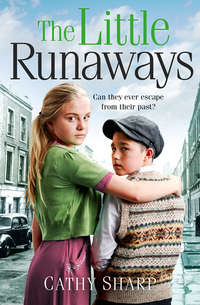
Читать книгу: «The Little Runaways»


Copyright
Harper
An imprint of HarperCollinsPublishers Ltd
The News Building
1 London Bridge Street
London SE1 9GF
www.harpercollins.co.uk
First published in Great Britain by Harper 2016
Copyright © HarperCollinsPublishers 2016
Cover layout design © HarperCollinsPublishers Ltd 2016
Cover photographs © Henry Steadman (children); Mary Evans Picture Library (East End background)
Cathy Sharp asserts the moral right to be identified as the author of this work.
A catalogue copy of this book is available from the British Library.
This novel is entirely a work of fiction. The names, characters and incidents portrayed in it are the work of the author’s imagination. Any resemblance to actual persons, living or dead, events or localities is entirely coincidental.
All rights reserved under International and Pan-American Copyright Conventions. By payment of the required fees, you have been granted the non-exclusive, non-transferable right to access and read the text of this e-book on screen. No part of this text may be reproduced, transmitted, down-loaded, decompiled, reverse engineered, or stored in or introduced into any information storage and retrieval system, in any form or by any means, whether electronic or mechanical, now known or hereinafter invented, without the express written permission of HarperCollins.
Source ISBN: 9780008118471
Ebook Edition © March 2016 ISBN: 9780008118488
Version: 2016-01-13
Contents
Cover
Title Page
Copyright
Chapter One
Chapter Two
Chapter Three
Chapter Four
Chapter Five
Chapter Six
Chapter Seven
Chapter Eight
Chapter Nine
Chapter Ten
Chapter Eleven
Chapter Twelve
Chapter Thirteen
Chapter Fourteen
Chapter Fifteen
Chapter Sixteen
Chapter Seventeen
Chapter Eighteen
Chapter Nineteen
Chapter Twenty
Chapter Twenty-One
Chapter Twenty-Two
Chapter Twenty-Three
Chapter Twenty-Four
Chapter Twenty-Five
Chapter Twenty-Six
Chapter Twenty-Seven
Chapter Twenty-Eight
Chapter Twenty-Nine
Chapter Thirty
Chapter Thirty-One
Chapter Thirty-Two
Chapter Thirty-Three
Chapter Thirty-Four
Chapter Thirty-Five
Chapter Thirty-Six
Chapter Thirty-Seven
Chapter Thirty-Eight
Chapter Thirty-Nine
Chapter Forty
Chapter Forty-One
Chapter Forty-Two
Chapter Forty-Three
Chapter Forty-Four
Chapter Forty-Five
Chapter Forty-Six
Chapter Forty-Seven
Chapter Forty-Eight
Chapter Forty-Nine
Chapter Fifty
Chapter Fifty-One
Chapter Fifty-Two
Chapter Fifty-Three
Chapter Fifty-Four
Chapter Fifty-Five
Chapter Fifty-Six
Chapter Fifty-Seven
Chapter Fifty-Eight
Chapter Fifty-Nine
Extract from The Christmas Orphans
About the Author
Also by Cathy Sharp
About the Publisher
ONE
Nancy stared out of the kitchen window at the piles of rubble across the street, where six houses had once stood. The space was due to be developed soon, and weeds grew between the cracks in the concrete, giving it a desolate air that echoed the feeling in her young heart. Every one of those terraced houses had been bombed during the terrible Blitz that had decimated the area round her home. Poplar and Bethnal Green had caught it as much as anywhere, because of their close proximity to the Docks. Other people said it was a miracle that the houses this side of the street had escaped the bombs, but Nancy wished that hers had been demolished that same night. Perhaps then she wouldn’t be here, living in fear and misery, waiting for Pa to return from his job in the machinery works down by the Docks.
It was the 23rd of December 1947. Soon it would be the special, holy day that families looked forward to spending together – not that it would make any difference in this house. Nancy knew she would receive no presents from her parents and the only small gift her brother had was the colouring book and crayons she’d bought with what she’d taken from the housekeeping pot. Nancy felt no guilt for spending the few pennies on a gift and some sweets. If she hadn’t walked all over the market to save money buying their Christmas dinner of scrag end of lamb, which she’d make into a tasty casserole with carrots, onions and potatoes, there would have been nothing left – and if she hadn’t spent it on Terry, her mother would have taken it for drink.
Tears stung her eyes but she rubbed them away with the backs of her hands, which were red and stung from the soda she’d put in the water to soak Terry’s sheets. He’d wet the bed again and if Pa came home and smelled stale urine he’d belt Terry, Ma and her – no, he’d reserve a different kind of punishment for her; one that turned her stomach sour and made her burn with resentment. What Pa did to her wasn’t right, for all he claimed it was his due for feeding and housing them all.
‘Any other man would put that useless slut out on the street and her brats with her. Think yourself lucky that I let you stay, and that idiot brother of yours,’ Pa had sneered when Nancy protested at his behaviour the previous night.
‘Terry isn’t an idiot.’ Nancy defended her brother fiercely. ‘He might be a bit odd sometimes, but he can’t help that …’
Pa leaned in close so that she caught the stink of beer on his breath. ‘You listen to me, and listen good, girl. Breathe a word of what goes on to anyone outside this house and I’ll have him put away somewhere he’ll never see the light of day again.’
His threats terrified Nancy, because she knew he didn’t care for any of them, not even his wife. She glanced across the kitchen to where her mother sat nursing a bottle of beer, clutching it to her as if it was her very existence, her lifeless hair hanging about her face in greasy strands and her eyes dead as they stared into nothingness. She’d been like this since the night of that terrible raid when the Blitz was at its height during December 1940 – the night they’d lost all their family and friends.
Nancy shivered as she recalled how they’d hurried through the dark streets, the sound of the sirens already loud, fleeing for the shelter. The drone of the planes heading up the river was terrifyingly near. Ma was carrying Terry, who was not yet four, and Nancy was running to keep up with her, Bear clutched to her chest and a bag with a flask and sandwiches over her shoulder.
‘Hurry up, Nance. If they start droppin’ them bloody bombs we’ll be caught like rats in a trap.’
Nancy had run and run until her chest hurt, hurtling into the shelter after all the other frightened people, and almost tumbling down the last of the steep stone steps. She and Ma had huddled together as the raid went on for what seemed like hours, Terry whimpering and grizzling, even though she’d remembered to bring Bear, the much-loved teddy that had once been hers. She’d given him a drop of sweet tea in his bottle and he’d quietened, holding his chubby arms out to her.
‘Nance cuddle,’ he’d said, and she’d taken him in her arms, crooning a nursery rhyme softly against his ear as she waited for the all clear.
It had been morning before they were finally allowed to go home … and when they did everything had changed. The sound of fire engines and ambulances screaming through the streets assaulted their ears, and the sky was red, flames still shooting skyward. When they approached their home, where two rows of terraced houses had stood facing each other across a narrow lane, only one row still remained intact. All the others had been damaged in some way or other, and the three opposite that had housed Gran and Grandda, Auntie Freda and Uncle Jim and their two young sons, and Auntie Molly were gone, nothing left but a pile of rubble. Smoke was still drifting from the blackened heap into the sky, though the firemen had put out the flames.
Ma had run at one of the men pulling at bits of wood and bricks in a fruitless attempt to discover anyone under the rubble, hitting at him in her terror, her eyes wild with fear and grief.
‘Where are they? Where did they take them? I begged them to come to the shelter but they wouldn’t listen …’
He shook his head sadly. ‘If they were in the house when the bomb dropped they’ve had it, love. No one could survive under this lot. They took a couple of direct hits – the bloody Boche bastards! Why can’t they drop ’em on the Docks or the factories and leave the poor bloody people alone for a while?’
Ma had staggered away, her face ashen. She stood staring at the piles of rubble that had housed her parents, her sister’s family and her best friend, Molly, as if she couldn’t take it in. Feeling cold and wanting her breakfast, Nancy pulled at her mother’s arm.
‘Come away in, Ma. If they find them they will tell us …’
‘Get in yourself and look after your brother …’ Ma said furiously. ‘Leave me be, can’t you?’
Nancy had never known her mother like this before. She’d always been cheerful, out in the street as soon as her chores were done, chatting to her friends with her hair in wire curlers and a headscarf. Now she looked like a wild creature, blonde hair flying in the breeze, her children forgotten as she mourned all those she’d lost. It was to be the first of many changes.
‘Ma, hadn’t you better get the tea on?’ Nancy said now, trying to rouse her mother from her brown study. It didn’t do to dwell on the past, even though she missed her gran and her aunts, particularly Aunt Molly, who hadn’t truly been an aunt. If Molly Briggs had been alive Nancy could have talked to her about what was happening. She would have given Ma a good shake and told her to pull herself together.
‘You’ve still got your children and a home, Sheila Johnson, so think yerself lucky!’ Nancy could hear Molly’s voice challenging her mother but it was only in her head, because Molly had died in the rubble of her home.
Ma was still sitting there, just nursing what was probably an empty beer bottle. Nancy took the wet sheets out to the yard at the back and threw them over the line. She just hoped her father wouldn’t notice when he came back for his tea.
When Nancy got back to the kitchen she discovered that Terry was home from school, or wherever he’d been – more likely down the Docks, helping out with casual jobs. He’d cut a doorstep of bread himself and was getting dripping all over his chin and down his jacket, which was second-hand off the market but the best Nancy could get for the money her mother gave her from her meagre housekeeping.
‘Ma!’ Nancy shook her shoulder. ‘You need to get Pa’s supper on or he’ll be angry when he gets back. I’ve got all this ironing to do and the bedrooms need a turn-out.’
Ma lifted hopeless eyes to hers. ‘You can do the bedrooms tomorrow, Nance. Get your pa’s tea like a good girl. The chops are in the pantry and there’s some cabbage and cold taties you can fry together. I don’t feel well … I think I’ll go up and lie down.’
‘I’ve got lots to do tomorrow,’ Nancy said as her mother left the room but Ma didn’t answer.
What about me? Nancy wanted to shout and scream after her. Every day she had to look after her brother, get the shopping, go to school and clean the house and her mother did nothing but sit around all day in a daze. Pa would be furious if the house looked dirty or if his tea wasn’t to his liking, and the thought of her father in a temper made Nancy shake with fear. Terry would get a thrashing, and Ma would get a black eye … and she would be made to suffer his hateful touch again and again. Even the thought of it made her want to vomit.
It had started when Pa came back from the war with a wound to his leg that left him with a limp and in a permanent state of anger. Before that he’d been a bit rough sometimes, but he had never hit any of them that Nancy could recall. When he returned and found the way Ma had changed he started to lose his temper with her and then with Terry. He’d not taken much notice of Nancy at first, but then, when she was nearly eleven, just a couple of days before her birthday, he’d entered her bedroom and found her standing there with nothing on in front of the mirror.
Nancy had wanted to see if she had breasts yet. Her friend Janice was only three months older and she’d started to have breasts, but Nancy could see only a slight rounding and she was staring at herself in disappointment when Pa walked in.
‘What are you doing, girl?’
‘I was just going to have a wash.’ Nancy grabbed a towel and covered herself, not liking the way Pa was staring at her. ‘Go away and let me get dressed, Pa.’
‘No need for silliness, girlie,’ he said, a little smile curving his mouth. ‘I hadn’t realised what a big girl you’re getting … almost a little lady, aren’t you?’ He’d moved closer to her, reaching out to pat her bottom as she scampered to the bed to grab her underclothes and pull them on. ‘You don’t have to be shy with me, Nance. I’m your father. It’s all right for me to look at you like this … and to touch you, see. It wouldn’t be right for you to let a stranger see you naked, but I’m your dear old pa and you know I wouldn’t hurt you … not you …’
‘Go away, Pa!’
‘All right, I’ll go, but I shall come back soon. You’re nearly old enough to know what it’s all about. I’ll teach you things, sweet, secret things – and if you’re good I’ll buy you something nice. What would you like? Sweets or some ribbons for your hair?’
‘I don’t want anything.’
Nancy had known instinctively that it wasn’t right for Pa to look at her when she had no clothes on, and she didn’t like what he was saying or that funny way his mouth went loose and wet. It made her shudder inside. She’d been innocent then; she hadn’t realised what a beast he really was.
At first Pa had pleaded with her to let him touch her in places that made her recoil in horror, but when she was resolute in refusing he began to threaten, first Ma and then Terry. It didn’t take him long to realise that Terry was her weak spot. When he’d started to hit Terry for no reason she’d known she had to let Pa touch her, even though she hated it – but it hadn’t stopped at touching …
Nancy felt the acrid taste of vomit in her throat as she remembered what he’d done to her the previous night. She’d screamed and cried out, begging him to stop because he was hurting her, but he’d just gone on and on until she couldn’t fight any more. It was the first time he’d done that, but she knew it wouldn’t be the last and she wanted to run away and crawl into a big hole.
Why hadn’t Ma interfered ever? She must have known what was going on. Pa hadn’t bothered to hide it from her. He often touched Nancy’s bottom or slid a hand over her breast when Ma was in the kitchen; Nancy had small breasts now that she was nearly fourteen. How could Ma just sit there and let him do these things to her own daughter? How could he do them?
‘Nance …’ Terry came to her, his bread and dripping finished, the only evidence the grease on his chin. ‘What was Pa doin’ to you last night? I heard you call out and I wanted to come and stop him, but your door was locked.’
‘Nothing, Terry, love. You mustn’t come even if I scream out, all right? If you interfere Pa will thrash you – and I don’t want you to be hurt. Please promise me you won’t do anything silly.’
Terry looked at her strangely, and for a moment his eyes seemed to glaze over. He put out his hand to touch hers.
‘I hate Pa,’ he said. ‘He hurts Ma and me – but if he’s doin’ bad things to you I’ll hurt him. I won’t let him make you cry any more, Nance. You’re the only person in the world I love – except Ma, but she don’t know I’m here much.’
‘Ma doesn’t know anything much,’ Nancy said, and bent down to hug him, inhaling the boyish scent of him, soap from where she’d washed him that morning, and his own special scent; a clean decent smell, not like Pa’s … not like that salty sweet stench that she could always smell after he’d been doing things to her.
She wished she could take Terry and run away, somewhere they would be safe and Pa would never find them – but how would they live? She hated her father, wished that he would have an accident at work and never come home. Why hadn’t he been killed in the war like so many soldiers? Why did he have to come home and make all their lives a misery? It would have been better if one of the V2 bombs had fallen on the house and killed them all than to live this way.
If there was only some way she could make them all safe …
‘I’m not goin’ to let him hurt you no more,’ Terry said, and Nancy smiled. He was a good boy and she loved him. He’d never wet the bed until Pa started knocking him around. If it was just her and Terry she could be happy for the rest of their lives.
A cold shiver started at her nape as outside the kitchen door she heard the sound of brutish laughter and coarse voices, and she knew that Pa had started his celebrations early. By the sound of it he was drunk already.
TWO
Angela yawned, coming slowly awake to a feeling of luxury and excitement. She stretched in the comfort of the soft bed and then realised that she was home in her own room. It was Christmas and Mark Adderbury was coming to spend the day with them. A smile touched her lips, because she was aware of a sense of peace. Christmas Eve at St Saviour’s had been so lovely, with the staff and children singing carols and Mark playing Father Christmas to the excited orphans of Halfpenny Street. It had been a very special time at the children’s home in London’s East End and Angela felt warmed because she knew that much of that happiness had been brought about by her efforts as the Administrator – and Mark’s too, of course. In fact all the staff had played their parts in giving the children something they would always remember with pleasure, but for Angela it had been uplifting. She really believed that she had begun to come out of that dark place to which she’d been driven by the death of her beloved husband, John Morton.
John’s death in the terrible war that was still fresh in everyone’s minds had sent Angela into a spiral of despair. Outwardly, she’d carried on at her job in the military hospital, but inwardly she’d felt the bleakness of an emotional desert. When she’d given up the job and returned home some months after the end of the war because her mother had been unwell and asking for her, Angela had felt as if she had little left to live for. Mrs Hendry had soon recovered from her chill and become her usual self and Angela felt trapped in the senseless round of entertaining and mindless chatter from her mother’s social acquaintances. She’d wanted something to do, something worthwhile that would make her feel it was worth living again – and she’d asked Mark for help. He’d suggested the post at St Saviour’s and she’d taken it instantly, and it had turned out so much better than she would have believed.
The children had touched her heart, especially one little girl called Mary Ellen and her friend, the rebellious Billy Baggins, but they all needed love and care, and Angela had discovered that she had a great deal within her still to give. Her heart might grieve for John but it was not dead. She could love the children, therefore perhaps she could find love for a man once more – know the happiness that had been hers so briefly before the cruel war had taken John from her.
For a long time she’d thought it would never happen, but recently she’d become more aware of Mark, of his strength and his generosity of spirit. In his work as a psychiatrist Mark helped his patients to recover and although Angela had never been his patient, she had learned to trust him and respect his judgement. She’d turned to him for help after John died and he’d always been there for her, as a friend; it was only recently, since she’d started work at St Saviour’s, that she’d begun to feel there might be something more than friendship between them. A certain look in the eyes, a smile or the touch of his hand – but Angela had not been certain, either of Mark’s feelings or her own. Perhaps it was still too soon – but she was happy to know that he was coming to lunch and would be with them until late afternoon, when he had to leave to visit some cousins.
She still didn’t quite hit it off with Sister Beatrice, the nun who was Warden of St Saviour’s, though they had somehow weathered the storm and were beginning to know each other a little better. Sister Beatrice acknowledged that Angela had her uses, particularly in the matter of overseeing the new wing, which would provide much needed extra space. Perhaps one day she would realise that what Angela really wanted was to help her and the children.
Hearing a crash from downstairs in the kitchen, Angela glanced at her watch and realised it was just after seven. Surely it was too early to start cooking the turkey for dinner? They would not eat their special lunch before two and it was the custom for them to get up at about eight, have a leisurely breakfast of warm muffins and jam or poached eggs on toasted muffins, when fresh eggs were freely available, and then start to prepare the turkey. So why was her mother up so early?
Dressing quickly in trousers and an old jumper, Angela went down to investigate. Slim and lithe, she had dark ash-blonde hair and eyes that someone had once said were azure. Perhaps not the perfect beauty she’d been in her twenties, at thirty-four she was still attractive enough to turn heads when she walked into a room. She discovered her mother in a kitchen that looked oddly disorganised. As a rule everything was set out neatly, but pans were everywhere, including the one on the floor that had recently been dropped.
‘You’re up early,’ Angela said brightly. Her mother had her back turned to her and seemed to be intent on whatever she was doing. ‘I’m going to help with the cooking, Mum. You don’t need to start on the dinner yet.’
‘What do you know of cooking?’ Her mother turned round, staring at her in what Angela thought a strange, almost truculent, manner. ‘I cook dinner almost every day of the year. Why should I need your help today?’
‘Because Christmas is special. We always do it together – and you used to have help in the kitchen and with the cooking sometimes.’
‘Mrs Downs decided not to come in any more,’ Mrs Hendry said. ‘If she hadn’t I would have sacked her. She was rude and lazy – and I don’t need her help. I don’t need anyone’s help.’
Angela was puzzled. Her mother seemed angry, resentful, and she couldn’t think why. ‘Are you upset about something? Have I made you cross?’
‘Have I made you cross, she says …’ Her mother’s eyes seemed to glaze over for a moment, then she blinked and said, ‘You know very well what you did, Angela. I begged you not to go away, but you had no consideration for me. Oh no, my wishes did not even enter into the equation. I am not cross but your obvious lack of interest in my opinion hurt me.’
‘If I hurt you I am very sorry,’ Angela said. ‘It was simply that I couldn’t bear the emptiness of my life. You have such a good life, Mum, with your friends, your entertaining and your committees for the Church. You couldn’t know how bored and empty I felt with nothing worthwhile to do.’ She moved towards her mother and kissed her cheek. She seemed to smell very heavily of some expensive scent, and since she was wearing a very old dress covered by a pink and white spotted apron it seemed a little odd that she’d splashed herself so liberally with French perfume. ‘Sit down and let me make you a lovely cup of coffee. I’ll toast the muffins and then we can have some of that lovely jam we made in the summer.’
‘If you insist. I’ll have the Victoria plum jam – and a drop of cream and brandy in my coffee.’
‘Do we have cream?’ Angela investigated the contents of the large pantry. It made her shiver, because it was as cold as any refrigerator and kept even cream and butter really well. She found two glass jars of thick cream, which came from a local dairy farm and would be delicious with puddings and mince pies, also a jug of thinner cream, which she brought to table. ‘Are you sure you want brandy this early?’ she joked. ‘We don’t want to end up stuffing the turkey with the pudding instead of—’
‘Please credit me with some sense,’ her mother said sharply. She got up and fetched a brandy bottle from the dresser, and when Angela placed the beautiful French earthenware coffee bowl in front of her, she poured a liberal measure into hers and offered the bottle to Angela.
‘No, thank you,’ Angela said, smiling as she shook her head. ‘Not this early. I want to enjoy my dinner. I’ve been looking forward to this – I can hardly believe we’ve actually got a turkey this year. It seems ages since we could find one.’
‘Suit yourself,’ her mother said, and left the bottle on the table in front of her. ‘How long are you staying?’
‘Just until tomorrow after lunch.’
‘Hardly worth the bother coming down,’ her mother muttered. She tasted her coffee and then drank it all, but she didn’t touch the lovely golden muffin that Angela placed in front of her, even though it sizzled with fresh farm butter and there was a dish of plum jam set before her. ‘You eat it. I’m not hungry.’
‘Why don’t you sit and relax in the other room for a while?’ Angela looked at her mother, noticing that her cheeks were flushed and her eyes a little red. ‘Are you feeling a bit feverish, Mum?’
‘I’m perfectly all right, but I’ll go upstairs and get changed – if you insist on taking over.’
‘I’ll do the vegetables and various bits,’ Angela offered, but her mother wasn’t listening.
She frowned as she put an apron over her clothes. Going back into the pantry she saw that everything had been bought in preparation for this day, but although she noticed some sausages and jars of mincemeat, none of the usual Christmas fare had been prepared. It looked as if she was going to have to make a few things for after lunch herself. First she would get the vegetables done and make the stuffing for the turkey, which they had received as a gift from a grateful farmer her father had helped with a legal problem. At least there were plenty of ingredients and the turkey looked lovely.
She set to with a will and peeled, chopped and sorted the vegetables; then she made the stuffing and prepared the turkey for cooking. She had everything well underway when her father entered the kitchen. He looked apprehensive but his frown cleared as he saw that Angela was in charge.
‘Your mother not down yet?’
‘She had coffee but went back to her room to get changed.’
‘Have you everything you need? I did the shopping this year, because Phyllis didn’t have time. Have I forgotten anything?’
‘I don’t think so. I wondered why Mum hadn’t made any mince pies or sausage rolls – though I see there is a trifle on the shelves.’
‘Yes, a friend of mine made that for me as a gift,’ her father said. ‘Your mother was annoyed when I brought it home yesterday, but I said it would save her work – it is a sherry trifle and I know it will be delicious.’
‘It does look lovely,’ Angela said. ‘Do you know if Mother made any Christmas puddings this year?’
‘I believe she said she couldn’t get the ingredients.’
‘Then we shall have the trifle after dinner instead of a pudding. No one ever wants any tea anyway, just a few mince pies.’ She put down her knife. ‘Would you like some breakfast, Dad?’
‘I’ll have one of those muffins, but I can toast it myself; I often make my own breakfast these days. Shall I make us a cup of tea?’ he asked, and then frowned as he saw the brandy bottle on the table. ‘You didn’t use this best brandy in the mince pies, I hope?’
‘No, of course not. Mother had some in her coffee.’
He nodded, seemed about to say something and changed his mind. ‘Well, it is Christmas. I’ll make a cup of tea while you finish what you’re doing …’
Angela went back to making pastry. She watched him, a little surprised at how easily he seemed to toast his own muffin and make a cup of tea. In the past her mother had always done everything, except when they had a housekeeper.
‘Why did Mrs Downs stop coming in? I remember her as being a pleasant woman.’
‘She was – is,’ he said, looking up from spreading butter on his muffin. ‘She and Phyllis had words, I’m afraid, and Mrs Downs wouldn’t stay.’
‘Oh, I see.’ Angela wondered why it had come to that. ‘Unfortunate. You need to get someone else, Dad. I think the housework is too much for Mother with all the other things she does.’
‘Yes …’ Once again he hesitated, seeming as if he wanted to say more, but then he just shook his head. ‘Is there anything I can do to help – what about the washing up?’
‘Yes, all right, if you like,’ Angela said. ‘I want to prepare these ready for cooking. I see we have some nice dripping for the potatoes – did you get that too?’
‘Oh, a friend of mine got it for me from her butcher,’ her father said, rising to gather the various pots and tins she’d been using in her cooking. ‘I’m lucky in this village; there are a lot of people I count my friends.’
‘Yes, I know. You’ve helped many of them with small legal problems without charging them huge amounts of money.’ Angela had worked as a secretary for her father before the war, until she’d started her job at the military hospital, and she knew he made less money than he might have. His practice was successful, but he worked long hours and wasn’t the kind of man who wanted or set out to make a fortune.
‘It’s what life is all about,’ her father said. ‘Doing what you can for your friends – and I’ve been lucky. I’ve done well enough. We have a decent life, I think, don’t you?’
‘Yes, of course,’ she replied, wondering at the look in his eyes. ‘I never wanted more. I didn’t marry John for money. I had no idea his family were wealthy when he asked me.’
‘Comparatively wealthy,’ her father said with a wry smile. ‘Your mother hoped you would marry into the aristocracy and be really rich, Angela.’
‘I would only ever marry for love. I’m sorry if I let Mother down.’
‘You didn’t let me down. I only want you to be happy, my love.’
‘Yes, I know.’ Angela sighed with pleasure as she saw the tins filled with mince pies and sausage rolls ready for cooking. ‘All done, I can stop now and go up and change. Mark will be here in a few hours.’
‘Yes, you go, Angela. I’ll pop in and see how your mother is. She may have one of her headaches.’
Angela came downstairs after she’d changed to discover that her mother was in the kitchen and seemed more like her old self. She was just about to put the turkey into the oven.
‘Do you think it needs to go in yet?’ Angela asked. ‘It’s not nine o’clock yet and the turkey isn’t that big, Mum. Mark won’t be here until just before one and we want time for a few drinks first.’
‘Allow me to know my own cooking methods,’ her mother said, giving her an annoyed glance. ‘Where have you put the brandy bottle? I usually put a little in my mince pies.’
‘I’ve made them and put them in the pantry to keep cool until I cook them last thing,’ Angela said. ‘Dad thought perhaps you might have a headache? I think he took the brandy.’
Her mother made a rude sound that might have been laughter or derision. ‘What your father thinks and what he says is not always the same, believe me.’
‘What do you mean?’
‘Never mind. I dare say he hid the brandy. He’s rather greedy with it and won’t let me use it in the cooking. We’ll have a sherry instead.’ She crossed to the dresser and picked up the sweet sherry, pouring two large glasses, which she brought back to the table.
‘Happy Christmas, Angela. I am glad you could spare the time to visit – even though you seem to feel others need you more.’
‘Oh, Mum,’ Angela said, and took a tiny sip of her sherry. She noticed the strong smell of French perfume again. ‘That’s a new scent, isn’t it? Not your usual …’
‘It was expensive, too expensive for me as a rule. I was lucky to get it …’
‘On offer?’ Angela pulled a face. ‘You were lucky. There is so little decent stuff in the shops yet – those that do have any charge the earth for it. If it wasn’t a luxury in the first place the Government would fine them for profiteering.’
‘You can afford it; John left you well off, didn’t he?’
‘Yes, but I’ve invested my money for the future – or Daddy did for me.’
Her mother sniffed. ‘You could quite easily marry again, Angela. Your in-laws would gladly introduce you to their friends, if you would give up this foolish job of yours and go to stay with them.’
‘I love my job – and I have no wish to live with John’s parents. I am not sure I shall marry again, but if I do it will be because I can love again, not for position or money.’
‘Well, if you’re looking after the dinner I shall go down the road and have drinks with some friends of mine. Your father doesn’t want to come – but there’s nothing to stop me.’
Angela watched as her mother left. She wasn’t sure anyone would want visitors at this hour of the morning, because even her mother’s friends had dinner to cook, and excited grandchildren who would be opening their presents.
Angela noticed that her mother had drunk the large glass of sherry, but she wasn’t interested in hers. Placing it on the windowsill out of the way, she made a pot of coffee and took it through to the sitting room. Her father was reading a magazine but put it down as she entered. They sat in comfortable silence enjoying their coffee until she returned to the kitchen.
Angela was busy looking after the dinner most of the morning and hardly noticed that her mother was absent. Peeking in the oven at a quarter to one, she saw the turkey looked beautiful, golden brown but not burned; the pastries she’d made were cooked and ready and she was just putting the vegetables on when Mark arrived. He came into the kitchen, bearing gifts and a bottle of champagne, which he placed on the dresser.
‘Your father said you were busy cooking so I thought I would offer my services, Angela.’
He looked so handsome, dressed casually in light slacks, shirt and a V-neck sweater that her heart caught with pleasure when he smiled. She’d begun to like Mark more and more and it was good to have him here on this special day, not just as a formal guest, but as one of her family. He had a glass of sherry in his hand, which he sipped before placing it on the table. It was almost as if they lived together. Rather than having to leave everything to take formal drinks in the parlour, he was here offering to help – just as if he was her husband.
‘Well, I should like someone to lift the turkey out in about twenty minutes and set it to rest on the board. I’ve put the plates to warm and I’ve made some little starters of salmon mousse with cucumber salad. I had to use some of the tinned salmon you gave me to bring home. It wasn’t possible to buy fresh, but they taste nice just the same.’
‘Your father said you’ve had a lot to do, Angela. Apparently, your mother hasn’t been too well – a headache perhaps?’
Mark looked at her oddly. Angela wondered about that expression, because it made her feel that he was keeping something back; like the similar look in her father’s eyes earlier it aroused her suspicions, but she was too busy getting the food ready to pursue it. Her father came into the kitchen and was given the task of carrying the starters through to the dining room.
‘I hope Mum is ready for her dinner,’ she said. ‘If you’ll bring the turkey through when we’ve eaten the first course, Dad, I’ll fetch the rest.’
‘Your mother isn’t down,’ her father said, and sighed. ‘I’m sorry, Angela. She promised me it wouldn’t happen today but …’
‘What do you mean?’ Angela asked. ‘Is she lying on the bed?’
‘Yes …’
‘Another headache? Poor Mum. Is she coming down at all?’
‘I don’t think so. We’ll see later. We’ll eat our starter and then I’ll check if she wants to come down – or I can take her a tray up.’
‘I’ll do that. Mark, I’ll take Mum her starter up first and then we’ll eat …’
‘No, Angela,’ her father said, and touched her arm. ‘Leave it for now.’
‘Why …’ Angela looked from one to the other. ‘What do you know that I don’t? Please, tell me. I have to know.’
Her father glanced at Mark, then, ‘She’s right. I wanted to tell you before – oh, months ago, when it first started, but she begged me not to. It wasn’t so bad then, but recently it has got so much worse.’
‘Her headaches? Has she seen a doctor?’
‘Phyllis refuses all help. She will not admit there is a problem.’
‘What kind of problem? This is ridiculous. I’m not a child – I want to know what is going on. Please tell me.’
‘Mark thought you were too wrapped up in your grief and we shouldn’t worry you. And she seemed better for a while after you came home from Portsmouth …’
‘Angela …’ Mark looked at her uncomfortably. ‘You were so unhappy. I thought it might be more than you could bear …’
Angela was about to ask him what he meant when the door of the kitchen opened and her mother walked in. As she saw the lipstick smeared over her mother’s face, her hair all over the place and her crumpled dress, she started forward, hands outstretched.
‘Mum, what’s the matter?’
‘Who sh-haid anything whass the matter?’ her mother demanded in a belligerent tone. ‘Whass going on here? Let me through, I’ve got to dish-h up the dinner …’ She took a step forward, crashed into the table and then crumpled to the floor in a heap.
Angela stared at her father and then at Mark. The looks on their faces were identical: guilty but not surprised. ‘She’s drunk. How long has this been going on – and why haven’t I been told about it?’
‘You were still grieving,’ Mark said. ‘I didn’t want to put more pressure on you, Angela.’
‘Your mother didn’t want you to know, love,’ her father said. ‘It has been happening for some months, but she controlled it in between bouts of drinking, and I didn’t guess how bad it was until a few weeks ago, when things suddenly got much worse.’
‘Why did no one tell me?’ Angela felt anger mixed with sympathy for him and a kind of anguish that she couldn’t name for herself. Why did Mark think she was so fragile that she couldn’t face the truth? ‘If I’d been here perhaps I could have helped her.’
‘She wouldn’t let you. Besides, you have your own life, Angela. This is my problem. She’s my wife and I’ll cope with it.’
‘Mark – surely you could have given me a hint?’ Angela looked at him in reproach as her mother stirred and promptly vomited on the floor.
‘I’ll clear that up,’ she said. ‘Perhaps you could get Mother to bed between you – and then we shall have dinner. I’ll put some aside for her if she feels like it later.’
For a moment they both stared at her, and then Mark bent and lifted Phyllis in his arms. ‘I’ll carry her up and then you can look after her, Edward. I’m sorry, Angela. If I’d thought this would happen I would’ve warned you …’
‘Forgive me,’ her father said after Mark had left them. ‘There’s a lot more to tell you and to show you – but it will keep until Mark has gone. You shouldn’t blame him, Angela. She talked to him about it and I suppose he didn’t want to betray a confidence, though she isn’t his patient.’
‘Yes, I understand that,’ she said, but, left to herself to repair the damage and sort out the dinner she’d prepared so carefully before it ruined, Angela knew that she understood too well. Mark had been more concerned for her mental state than worried about giving her a hint of her mother’s failings. She had been close to despair at times during the years since her husband’s death – but surely Mark could see that she was much stronger now?
If he couldn’t see her for the woman she was, how could he respect her? She wasn’t some fragile flower that would bend in the wind, she was a strong woman who had known devastating grief and come through it.
Angela would rather have known the truth. She might not be able to do anything, but the last thing she wanted was to be treated as someone who couldn’t face reality. John’s death had devastated her, but the fact that her mother was an alcoholic was another matter – one that she was strong enough to accept.
THREE
It was early on Boxing Day but already Alice could hear the bitter quarrelling going on in her parents’ room. Did they never stop this relentless bickering? She sighed, glad that she was going to her friend Michelle’s home that day. Like her, Michelle worked at St Saviour’s, though she was a staff nurse while Alice was merely one of the carers. She didn’t think she could have stood being here all day if her mother was going to nag them the whole time. She stretched and yawned as Mavis slept on in the bed next to her. Mavis was also going out later to spend the day with her boyfriend, because she had several days off from her job at the factory.
Alice had opted to work on Christmas Day, because it was better than being at home with her mother, who made life miserable for her family on every day of the year and saw no reason to be any different at this special time. So Alice preferred her duty to being at home with her brothers, Joseph and Saul, her sister, Mavis, her father, who would probably get drunk by lunchtime, and her nagging mother. Besides, she didn’t particularly want to sit down to a meal and be watched by Mrs Cobb’s sharp and knowing eyes. One of these days her mother was going to ask questions Alice didn’t want to answer.
She’d missed a couple of periods and because of that she was sure that she was carrying Jack Shaw’s baby. Alice felt a shiver of fear run through her as she thought about the future. Had Jack died in the fierce fire at the boot factory, or had he somehow escaped? Billy Baggins had been there and he’d told the police that it was Arthur Baggins, his elder brother, and Jack Shaw that had broken in and blown up the safe. Someone else had set the factory on fire while they were inside, and the newspapers seemed to think it was someone with a grudge against Arthur and Jack, or the factory owners. Most people believed it must have been Jack who had died, although something inside Alice wasn’t ready to believe that.
How could he be dead? Surely she would know if he’d died; she would feel it inside – wouldn’t she? The last time Alice had seen him, he’d dumped her outside St Saviour’s and gone racing off in his car after telling her the Lee gang was going to kill him. All she knew for certain was that he hadn’t tried to contact her since, and she couldn’t help thinking that if he’d been alive he would surely have come back for her or at least sent her a letter. Jack had known Alice believed she was having his baby.
How could she know what he’d felt about that? Jack had pursued her, never leaving her alone, throwing off all her attempts to rebuff him, until she gave him what he wanted. Had she been a terrible fool to let him make love to her? Alice had thought she was in love with him, rejecting the offers to go out with Bob Manning, a soldier she’d met at a dance with her cousin Eric. Bob was a nice steady bloke with a good job in the Army, but he didn’t excite Alice the way Jack had – and so she’d been stupid and given herself to the wrong man. Now she was frightened, scared of what her mother would do when she discovered her daughter was pregnant.
What could she do if her mother threw her out? Their home was only three rooms in a shared house; it smelled awful when the toilet in the yard stank and it was cramped and often damp and cold, but it was still her home. Where would she go – and how could she manage with a job and a baby? That’s if she still had a job when Sister Beatrice discovered the truth. It was unlikely the strict nun would keep her on once her condition became noticeable.
Alice thought about the previous day at work. After all the excitement prior to Christmas Eve and the fun of carols, Father Christmas giving presents to all the children – not forgetting their carers – and the party afterwards, Sister had decreed that the day itself would be spent quietly in order to reflect on the true meaning of Christ’s birthday.
Alice had been happy just to be in the peaceful atmosphere at the home. The children all seemed satisfied to attend church or chapel in the morning and to spend their time eating a special dinner and reading or playing one of the new board games they’d been given. She herself had been asked to do Sally the carer’s job after breakfast was over and gather the smaller children together in the playroom, where she’d read one of Mr Markham’s lovely books to them for a while, and given the others puzzles to keep them happy. It was as she was getting the children ready for tea that Nan came up to her.
‘Some of the older children are going for a walk before supper. Jean will be going with them to make sure they don’t get into any trouble. I want you to keep the little ones amused until it is time for their beds.’
‘Yes, of course,’ Alice said. She liked the head carer and often wished her mother was a bit more like Nan. ‘They’ve been good all day.’
‘Well, that takes care of the little ones.’ Nan hesitated, then, ‘Is something bothering you, Alice? You know you can come to me for anything – don’t you?’
‘Yes, thank you, Nan,’ Alice said, but there was no way she could tell Nan what was really bothering her. ‘I’ll find some sort of game they can play quietly, because I know Sister doesn’t want them running around today.’
‘Off you go then, Alice – but don’t forget I’m always here if you need me.’
Alice walked away, feeling a little easier in her mind. If the worst came to the worst and Jack didn’t come back for her, perhaps she would talk to Nan about her problem … that’s if she really was having his baby. Yet why was she kidding herself? She couldn’t ignore the signs and they were all telling her she must have fallen for a baby either in late October or early November and she would have to accept her fate and find a way of coping with it.
If she worked extra hours she could perhaps stay out of her mother’s way, and earn a little extra money for when she needed it, because she knew her mother would be furious when she found out that Alice was pregnant. She would probably throw her out on the street and the thought terrified her.
Lying in her bed beside her sleeping sister that Boxing Day morning, Alice turned the problem over and over in her mind. Silent tears trickled down her face in the faint light of early morning. She felt so alone, so miserable. What was she going to do when her condition began to show?
Even though Nan had been so kind, Alice respected her and it would shame her to confess what she’d done. Michelle wouldn’t scold her but she couldn’t help her to find a home for herself and the child – and Sister Beatrice would give her the sack. Alice couldn’t think of anyone who would help her to find a place to live and have the child.
Alice had heard of those homes where girls like her went to have their illegitimate child. She had a vague idea that they weren’t very nice, and they made you give up your baby. Alice didn’t know how, but she wanted to keep hers. Even if it was possible to get rid of it – a shudder went through her, because she knew of a girl who had died of blood poisoning after visiting one of those backstreet butchers who got rid of unwanted children – she would never do that. She didn’t want to die – and she wasn’t going to kill her child. There must be someone she could turn to for advice – someone who would know what to do … perhaps Angela Morton.
Alice didn’t know their Administrator well, but she admired her for standing up to Sister Beatrice when Mary Ellen had been banned from going to the pantomime. Alice had never been to one as a child, and she knew how much it would mean to a kid from a poor home like her. It was rotten to take the best treat away from the girl and Alice had been on Angela’s side when she took Mary Ellen to the pictures when the other kids were at the pantomime. Alice didn’t know, of course, but she’d bet Sister Beatrice had had a few words to say about that!
Angela smiled and spoke whenever they met and she knew she was very friendly with Sally – but would she be sympathetic if Alice told her what a mess she was in? Angela could have no idea of the sort of family Alice came from so perhaps she would be like Sister Beatrice and take the moral ground. After all, she probably had a perfect family life at home and would think Alice a stupid girl who was no better than she ought to be.
Angela stared at her father in disbelief as he showed her the things he’d taken from her mother’s wardrobe. Besides a lot of empty gin bottles, there was an assortment of dresses, handbags, perfume, soaps, scarves and hats – and many of them were stolen, according to her father.
‘But why?’ she asked. ‘Why would Mother take things like this? The clothes wouldn’t fit her or me – it doesn’t make sense.’
‘I asked Mark about it and he said that she’s ill, Angela. Sometimes when she’s had a few drinks she goes out and takes things from shops: local shops, where we have an account. That’s how I found out about it. One of the managers telephoned me from his office in private; he didn’t want to go to the police and asked me to discover whether she still had the things she’d stolen. Of course when I found all this – I didn’t dare to ask if it all belonged to him. I simply arranged to pay for the items he’d lost, and then he asked if I would care to settle the account.’
‘Was it very bad?’ Angela asked, noticing the new lines about his eyes. No wonder he’d been looking worried the last few times she’d seen him. ‘I can help with money, of course.’
‘I’m all right for the moment,’ he said. ‘I’ve cancelled the accounts in her name and closed the joint account at the bank. I didn’t want to humiliate your mother, Angela – but I couldn’t let it continue.’
‘So the drinking isn’t the worst of it, then.’ Angela reached across the kitchen table to squeeze his hand. ‘I’m truly sorry – but what can we do? She needs help …’
‘Mark says there is a very good clinic in Switzerland that would help with all her problems – the only trouble is your mother will not hear of it. She insists that nothing is wrong with her and said she hadn’t realised she’d run up large bills and promised not to do it again.’
‘What about the stolen stuff?’
‘She absolutely refuses to acknowledge that she took anything.’
‘It makes things so difficult for you, Dad. What are you going to do?’
‘I can’t force her to go away. She is my wife and I must try to protect her as best I can. I’ve told her she can’t use the car in future and the bus only goes into town twice a week. I’ll try to make sure she doesn’t catch it unless I can go with her – what more can I do?’
‘I don’t know,’ Angela said. He’d closed his eyes, as if he found the worry almost unbearable. ‘What about you? Are you all right?’
‘Just a little tired,’ he said, but she had the feeling that he wasn’t telling her everything. ‘I’ve seen my doctor and he advises cutting down on work.’
‘You must try not to worry. If you need me I could come down at a couple of hours’ notice. You know I would stay if you thought it would help.’
‘I don’t think she would take any notice even of you, Angela. I had hoped that she would make an effort for Christmas – as she did for the dance she organised for your charity.’ He sighed deeply. ‘She used to have good days and I kept hoping – but her drinking is getting worse. She would only drink sherry or wine once, but now she will drink whatever she can get.’
‘I wish I could do more.’
‘Just being able to tell you has helped a lot,’ he said and smiled. ‘Mark has offered to advise her but so far she just refuses to listen.’
‘I see …’
Angela turned away to pour more coffee, distressed by the news of her mother’s illness. Mrs Phyllis Hendry was the last person to drink to excess or steal from shops – at least she always had been. Angela couldn’t imagine what had happened to change the rather snobbish, intelligent woman she loved but couldn’t quite like, into this person who drank too much and stole things. Yet Mark’s attitude had distressed her more – or perhaps hurt was a more apt word. Yes, she was hurt that he’d decided he couldn’t tell Angela in case it made her break down. Had he thought she would turn to drinking like her mother?
She felt a little diminished, too. She’d turned to Mark in her grief over John’s terrible death, sobbing out her pain on the shoulder he offered – but now she felt patronised. When he’d suggested the job at St Saviour’s she’d thought he trusted and respected her – but if he felt anything for Angela, he would not have hidden her mother’s secret from her. There was little Angela could do here, it seemed, but at least she could offer her father support.
‘If you need me – anything, you have only to call, Dad.’
‘Yes, I know,’ he said. ‘Now go up and talk to your mother. She’s feeling a little fragile – and ashamed. Try to make peace with her before you leave, my love.’
‘Yes, of course,’ Angela said and kissed his cheek. ‘I do love you, Daddy.’
‘I love you,’ he replied. ‘You’re the light of my life and always will be. Please don’t worry. I’ll manage somehow. Perhaps in time she will agree to go somewhere they can help her …’
Бесплатный фрагмент закончился.