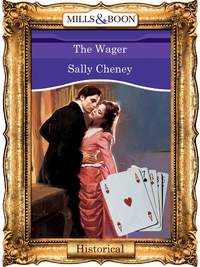
Читать книгу: «The Wager»
Table of Contents
Cover
Excerpt
Dear Reader
Title Page
About The Author
Dedication
Prologue
Chapter One
Chapter Two
Chapter Three
Chapter Four
Chapter Five
Chapter Six
Chapter Seven
Chapter Eight
Chapter Nine
Chapter Ten
Chapter Eleven
Chapter Twelve
Chapter Thirteen
Chapter Fourteen
Chapter Fifteen
Chapter Sixteen
Chapter Seventeen
Chapter Eighteen
Chapter Nineteen
Chapter Twenty
Chapter Twenty-One
Copyright
“I have given you my soul.
“Will you not give me anything in return?” Desmond murmured.
“I will play you a game of cards for it,” Marianne replied. “If you win, you may have me. I will come to your bed, willingly, wearing nothing but a smile of invitation. There will be no damnable tears.”
“And if you win?” he asked. “I get Kingsbrook.”
There was a stunned silence. One could almost see the workings in Desmond’s head as he tried to collect his faculties.
“You would get Kingsbrook?” he finally asked, very slowly and carefully.
“Or you would get me,” Marianne said. Desmond narrowed his eyelids and appeared to be considering very seriously. “You value yourself very highly, Miss Trenton, to put your worth equivalent to this grand estate.”
“Rather, Mr. Desmond,” the girl said coolly, “it is a question of how highly you value me…!”
Dear Reader,
This month, author Sally Cheney returns with her fifth historical for Harlequin, The Wager. Known for her ability to capture the flavor of 19th-century England, the author’s new title tells the story of a young woman who sets out to destroy the man who won her in a card game, only to fall in love with him in the process. We hope you enjoy it.
Beloved Outcast by Pat Tracy is a dramatic Western about an Eastern spinster who is hired by a man with a notorious reputation to tutor his adopted daughter. Affaire de Coeur recently labeled Pat as “one author definitely worth watching,” and we hope you agree. This talented author just keeps getting better and better.
Whether writing atmospheric Medievals or sexy Regencies, Deborah Simmons continues to delight readers. In this month’s Maiden Bride, the sequel to The Devil’s Lady, Nicholas de Laci transfers his blood lust to his enemy’s niece, Gillian, his future wife by royal decree. And fans of Romantic Times Career Achievement Award winner Veronica Sattler will be thrilled to see this month’s reissue of her Worldwide Library release, Jesse’s Lady. We hope you’ll enjoy this exciting story of a young heiress and her handsome guardian.
We hope you’ll keep a lookout for all four titles wherever Harlequin Historicals are sold.
Sincerely,
Tracy Farrell
Senior Editor
Please address questions and book requests to:
Harlequin Reader Service
U.S.: 3010 Walden Ave., P.O. Box 1325, Buffalo, NY 14269
Canadian: P.O. Box 609, Fort Erie, Ont. L2A 5X3
The Wager
Sally Cheney
 www.millsandboon.co.uk
SALLY CHENEY
was a bookstore owner before coming to her first love—writing. She has traveled extensively in the United States, but is happiest with the peaceful rural life in her home state of Idaho. When she is not writing, she is active in community affairs and enjoys cooking and gardening.
To Ursula, in appreciation for her invaluable input
Prologue
London, 1855
“One card.”
“Two.”
“I’ll play these.”
The cards were dealt around the table as requested. Finally the dealer snapped a number of cards off the deck for himself.
“Dealer takes three,” he announced.
The four men sat studying the little rectangles of pasteboard they held with expressions of varying degrees of grimness. The least forbidding of them seemed to be that of the dealer himself, his insouciance owing, no doubt, to the impressive pile of coins and banknotes on the table before him.
“Mr. Phillips, I believe the bid is to you,” he softly reminded the man at his side.
Mr. Phillips’s scowl deepened. “One pound,” he growled at last, adding a heavy coin to the kitty, challenging the player to his left with a scowl.
Mr. Abbot would have faced down his fellow gamester, despite his stern expression, if the gentleman dealing had given him one more face card, but with this hand…
Abbot sighed heavily and pushed his cards together. “Discretion dictates my retreat from the field of battle, I fear,” he said, laying the cards facedown in front of him.
“Mr. Carstairs?” the dealer prompted.
“I’m in,” the third man said sourly, removing several coins from the short stack left before him.
“The dealer meets the bet.” A banknote was added to the collection.
The four men—Phillips, Abbot, Carstairs and the dealer, Mr. Peter Desmond—were not close intimates. Friends was too strong a word. Even acquaintances was. It was not at all certain that if two of them met on the street in daylight they would recognize each other, or, if recognizing the other, would exchange greetings. They met several times a year to play cards. One or more of them always went away a loser, which did nothing to endear them to one another.
“Mr. Phillips? Do you wish to raise or call?” the dealer prompted now.
“I wish to do many things,” Phillips said. “But one’s wishes are not always granted, are they? I fold.”
“Well, Mr. Carstairs, once again it appears only you and I will play out the hand,” the man dealing said. His voice was low, his manner suave and perfectly charming.
Mr. Carstairs pictured his nose smashed and bleeding and wondered how suave and charming he would be then. Although the winners and losers varied with each game the four men played, Mr. Desmond usually left the table with money in his pocket, and Mr. Carstairs usually left with none in his.
“You have most of the money I brought with me, and I would like very much to recoup some of those losses. Let us waste no time. It is all or nothing, Desmond.”
Carstairs pushed the rest of his funds into the center of the table.
Desmond picked up the cigar smoldering in the ashtray at his elbow and put it to his lips as he carefully studied the cards he held and, even more carefully, the man sitting next to him. He squinted against the aromatic cloud of smoke he exhaled, but neither the smoke nor the squint could disguise the fact that he was a vividly handsome man, with dark brown hair, dark gray eyes and a set to his jaw suggesting an iron will.
He tapped the ash from the end of his cigar, then returned it to his mouth, holding it between his teeth. “Unfortunately, Mr. Carstairs, you are in no position to dictate terms,” he said, a silken smile on his lips. “I need only to increase your bet and you lose.”
He began to gather enough coins and bills to do exactly that, but Carstairs, almost frantically, stopped him. “Wait!” he cried. “I said all or nothing.”
“You did,” Desmond agreed. “And you have wagered all and have nothing left.”
“No, no. I have…”
“What, Mr. Carstairs?”
“I have…here, give me a piece of paper.”
“Now, Mr. Carstairs, you know our policy. We have agreed to play only for the monies we brought to the table.” The gentleman sounded genuinely grieved by the fact.
“Not money,” Carstairs murmured, finding a paper and pen on his own person and scribbling something as he spoke. “Better than money.” He reached inside his coat again, found a little pocketbook and, after rummaging through its contents for a moment, extracted a bent and tattered daguerreotype. He passed it and the paper across the table.
“Better than money? I doubt it,” Desmond said, picking up the items Mr. Carstairs had passed to him and studying them both. He raised one eyebrow and then looked up at his fellow gambler for confirmation. “Indeed?” he asked.
“I guarantee it,” Carstairs said firmly.
Desmond took the cigar from between his teeth and laid it carefully in the ashtray again. “I will admit you pique my curiosity.”
“You accept the wager, then?” Carstairs urged.
Desmond hesitated for another moment, but finally nodded. “Very well,” he said. “It might prove something of a…lark. My winnings against this.” He held up the paper and the daguerreotype. “What have you got, Mr. Carstairs?”
Carstairs smiled gloatingly and turned his cards over for the others to see.
“Full house!” he announced triumphantly, splaying the cards on the table before him.
Mr. Phillips and Mr. Abbot murmured in appropriate tones of awe.
Mr. Desmond studied the three knaves and the pair of twos and shook his head slightly.
“Well,” he said, “that beats three of a kind.” Carefully he laid down three threes.
Carstairs chuckled and reached across the table to claim the money.
“However,” the younger gentleman continued, “a full house does not beat four of a kind,” and he coolly laid down a fourth three.
Carstairs fell back in his chair as if he had been dealt a physical blow.
“Buck up, old man,” Desmond said, pulling the winnings across the table, including the scrap of paper and the sepia-toned photograph. “Here’s a little something to get you home.” He selected the heavy coin that had been Mr. Phillips’s last bet and tossed it across the table to the other man. “I would not want to discourage you from letting me win more money from you the next time. Ah, but this—” he picked up the picture and studied it gloatingly “—on this I will expect full payment.”
“Of course,” Carstairs said. “We are at your convenience.”
“What is that?” Mr. Phillips asked curiously, nodding toward Desmond and the picture he held.
“I thought we determined not to play for notes of debenture,” Abbot said reproachfully.
“Indeed we did. But Mr. Carstairs did not offer me a promissory note. It seems he has given me title to his ward, a Miss Marianne Trenton.”
The other two gentlemen laughed as Desmond took up his cigar again with a broad wink.
Chapter One
The night was warm for so early in the summer. The windows were open, inviting every passing breath of fresh air to enter, but they were few and far between and often merely flirted with the window shade.
A young girl sat on the end of the bed, fully dressed.
The ensemble she wore was too warm for the season and too complete for the hour, so it was not surprising if little droplets of sweat had gathered on her brow. But, in fact, the perspiration was there, and running down her back in hot, lazy rivulets, for another reason.
Marianne was waiting for her uncle Horace. His temper was usually vile, but he became violent if he lost at cards. And unfortunately, more often than not, when Horace Carstairs gambled he lost.
The man was not actually her uncle. After the death of her parents the previous year, her father to a hunting accident and her mother three months later to an influenza that found her in a weakened condition owing to her grief, the girl had been assigned by the court to Mr. Carstairs, whose misfortune it had been to be bequeathed some monies in her father’s will to clear an outstanding debt.
“I cannot take the girl,” Carstairs had objected. “I am unmarried. Surely you would not burden an old bachelor like myself with such a responsibility?”
But the court reminded Mr. Carstairs that with the girl a ward of the state, it could, in fact, dispose of her and her modest legacy as it saw fit. Carstairs might have objected further, but the judge agreed to pay him, as guardian, an annual stipend out of the girl’s inheritance.
Mr. Carstairs pursued various ventures in order to make money—some, but not all of them, legal—and being no more an astute businessman than he was a clever card player, he often found himself in need of extra cash. The payment the judge named appeared very attractive to him just then.
Thus it was that Marianne Trenton, so recently part of a loving home and family, had her grief compounded by suddenly becoming the ward of a man she did not know and soon found detestable.
Her schooling had been haphazard, and at the death of her parents, her formal education ended abruptly. But Marianne, alone and largely unnoticed in Mr. Carstairs’s house, became an avaricious reader—almost exclusively of the penny dreadfuls she was able to purchase with the small allowance her “uncle” afforded her.
Tonight, though, as she waited for her guardian, she was too distracted and tense to concentrate on her latest novel, Leonore, Jeune Fille. And when she finally heard Uncle Horace’s key grating in the lock, she jumped in alarm.
Fearfully she listened to her uncle’s progress through the house. She could hear him hanging his overcoat on the tree by the front door. He paused by the table in the foyer to look through the mail. She thought he might turn into the sitting room to read the paper, but after a pause, during which she could imagine him scanning the headlines, his footsteps continued to the stairs.
The heavy clump of shod feet on the risers sounded as if they were produced by a large man. Though relatively tall, Mr. Carstairs was not heavyset, but lean and lanky. His shoulders were narrow, his face, with its pursed lips, pinched nose and close-set eyes, long and thin. Yet his slow, heavy steps up the stairwell seemed almost to shake the house with their weight.
Marianne stiffened, the book in her hands entirely forgotten. If all had gone well tonight Uncle Horace would continue down the hall to his room, and she could finally undress and go to bed. But if he had lost, he would kick the door open and would be upon her before she could assume a position of defense. The amount of abuse she would suffer—the shouts of rage, the blows to her face and bodywould depend on the size of his losses.
His steps neared her door and slowed. Her green eyes opened wide; her breathing grew shallow and almost stopped. “Go on, go on,” she whispered, as he stopped and turned to her door. She sucked in her breath and held it, waiting for his boot to hit the thin panel that separated them.
Instead, there was a soft tap at her door.
Surprised, she released the breath she had been holding. “Come in,” she said.
The door opened slowly. Uncle Horace peeked carefully around the corner, for all the world as if he were making sure she was decent. Such a concern had never suggested itself to him before.
“You are still up,” he said.
“I am,” she replied.
“You were unable to sleep?”
“No, I was waiting…” Her voice trailed away to silence.
“Waiting? For me? I am touched, Marianne.”
She did not reply.
“I have been reviewing our situation here,” he continued when the brief pause indicated the girl was not going to speak. “You know that I am ill suited to raise a young woman, and I suspect you have not been happy here, alone so often, with no young people for companions, no chance to socialize. You are of an age when you should be socializing.”
The girl shifted her feet uncomfortably, one toe nudging the book she had dropped when Carstairs knocked. She had pictured herself of late in situations similar to the ones Leonore, the young heroine, encountered.
“I suppose—” she began.
But the man cut her off. “Perhaps it is time we looked into a new position for you. Something with broader perspectives.” He had half turned, his voice casual, as if he were speaking the thoughts as they occurred to him, but now he peered at her from the side, studying her face.
“Another position? You sound as if I should be seeking employment. Am I seeking employment, Uncle Horace?” she asked.
“No, no. I misspoke. You misunderstood. But another house, a broader acquaintance, that is what I am suggesting.”
“I am to visit someone? An old friend of mine, perhaps?” she said.
“Not exactly,” Carstairs said, hedging.
“Then what, exactly?”
“Not an old friend of yours. A gentleman of my acquaintance. You will be leaving at the end of the week.”
“Leaving?” If Marianne sounded more surprised than saddened by Carstairs’s announcement, it was due to the fact that leaving this house had been her fondest wish since the day she had entered.
“A coach will be by to collect you on Friday morning. You must be prepared to leave by then.”
“A coach? Where am I to go?” Marianne asked, making every effort to understand the frightening man who was her guardian.
“The gentleman has a private estate outside of Reading. I believe he intends for you to stay there.”
“I am to leave London?”
“It is not far,” Carstairs told her. “And you will doubtless be returning in a few weeks.”
Horace Carstairs was embarrassed to admit that until tonight he had never seen the possibilities Marianne presented. She was a fresh young girl, as far as he knew, a virgin. When Desmond was finished with her, Carstairs could sell her services again.
Surprisingly, especially if one knew Carstairs and the depths to which he was willing to descend in the name of business, that had not been his intention when he offered Marianne to the gentleman. He had honestly expected to win when he wrote his little IOU. He’d had three jacks and two twos. A full house would have won any of the other hands all night long. But it did not win that hand, and consequently Carstairs had finally realized the practical value Marianne represented.
“You need not worry about me,” Marianne said, in response to his promise she would soon be returning to him. “I will stay away as long as you like.”
“We shall see how things turn out,” Carstairs said.
“And who is this person I am to visit?” Marianne asked, at last coming to the question of most pressing interest.
But her guardian shook his head and shrugged his shoulders. “You do not know him,” he said.
“A philanthropic gentleman.” It was not a question. To Marianne it was an obvious statement of fact that any man who would take her away from Uncle Horace was a philanthropist.
But the next morning, when Marianne arose, she learned that Mr. Carstairs had left very early for Barnet, to collect on a loan.
She was confused and alarmed. Uncle Horace had left without telling her anything about her new placement or the situation facing her. When Bette first informed her of Mr. Carstairs’s unannounced business trip, the girl was not at all certain she had not dreamed the episode of the night before. It had gotten late, and perhaps she had fallen asleep. In her uncomfortable position at the foot of her bed she must have had a particularly vivid dream.
A letter arrived with the four o’clock post, though, which confirmed her flickering memory.
Miss Trenton,
Your guardian has by now, I am sure, informed you of your approaching relocation. I am looking forward to meeting you. My man will be there at seven o’clock Friday morning. The drive to Kingsbrook will take the better part of the day, so you will have to make an early start. Until then, je suis le tiens, ma biche.
P. Desmond.
Marianne, having quit her schooling after only a few French lessons, did not know Mr. Desmond had called her “his fawn,” nor did she realize how indecently familiar the gentleman had been in his concluding sentence.
She rose with the sun on Friday morning and was dressed to greet Mr. Desmond’s coachman when he rang the bell, a little before seven o’clock.
As Mr. Desmond had said in his letter, the trip to his home and lands outside of Reading took all of that morning and most of the afternoon. The day was unseasonably hot for so early in the summer. By eight o’clock Marianne regretted that she had chosen her three-piece ensemble, which required the jacket to look complete.
They stopped at a little roadside tavern for lunch. As always, Marianne’s finances were meager, and she was not sure she could afford to buy even the plainest meal on the menu. She was relieved, touched even, when the coachman produced two pound notes and told her Mr. Desmond had sent them, for any expenses she might incur along the way.
She therefore enjoyed her meal immensely, even drinking a glass of wine, and as a result was able to sleep very comfortably in the jogging, sweltering coach for the remainder of the journey.
She woke with a jerk when the coachman, who had identified himself as Rickers, opened the carriage door.
“Just ‘Rickers’?” Marianne had asked him doubtfully.
“Rickers usually suffices, miss, unless the missus gets impatient with me, as she does every now and again, and then it’s ‘Eus-tice!”’
“We’re there, miss,” he said now.
“There?” Marianne felt as if her wits had been scrambled by an eggbeater, which was a fair description of the coach ride and its effects.
“Kingsbrook.” With a flourish Rickers opened both doors of the coach, and Marianne caught her breath.
They had just crossed a wooden bridge over the brook after which the estate was no doubt called. Its banks were covered with moss and pretty pink centaury blossoms. The untamed beauty of the landscape continued into the park itself, which Marianne knew must be planted and cared for to some degree because of the buddleia and poppies, the dahlias and azaleas growing in such colorful beds among the shrubs and trees.
To complete the picture, a delicate doe tiptoed down to the brook, mindful but not fearful of their presence.
And then Marianne raised her eyes to the house and drew in her breath again. Kingsbrook Manor, rising from the ferns and meadows surrounding it, looked like a fairy-tale castle to the young girl. Then her breathing evened out, her wine-induced sleepiness lifted completely from her brain, leaving behind the dull throb of a headache, and she saw that of course the structure was not quite as awe-inspiring as she had first thought.
There were three stories, with tall windows all along the bottom floor, to the right and left of the big double doors set squarely in the middle. The upstairs windows were smaller, and the panes under the gables mere pigeonholes.
Rickers helped her down from the carriage, and as he accompanied her to the house, she realized some of the impression of overwhelming magnitude was due to the structure rising starkly from its wild setting. If it had been surrounded by a paved courtyard, with a wide, winding drive in front of it, it would not have startled the senses so, nor seemed so colossal.
Still, it was the largest private dwelling she had ever stayed in, and she had to force herself to keep her mouth from dropping open as she looked up at it.
At first Rickers seemed to be leading her aimlessly through the tall grass, but in a moment she realized there were flat, even stones under her feet. The path, like the beds of multicolored poppies, had been carefully and meticulously planned to convey the impression of artless natural beauty.
When they had nearly reached the doors, the path finally widened and the grass was cut back. Mr. Desmond had evidently made a minor concession to visitors and guests who might prefer civilization. There was a paved walkway around the house, and the flowers blooming near the windows were confined in planter boxes. But one had to be very near the structure before the illusion of a fairy castle in an enchanted glen was disturbed.
Rickers stopped before the large double doors.
“Mrs. River will get you situated,” the man said.
“Mrs. River?”
“Housekeeper here at Kingsbrook.”
“And where is Mr. Desmond?” Marianne asked. She was anxious to meet the gentleman, to thank him for his generosity.
“Oh, ‘e’s ‘ere about someplace, I would wager. Let Mrs. River show you around a bit and you’ll ‘ear about it when ‘imself gets in.” Rickers put her belongings down and touched his cap.
“Miss Trenton?” Startled, Marianne turned to face the speaker, a tall, angular woman, who had opened the door. With her hair turning gray at the temples and pulled back into a knot, she was not beautiful, but her face was interesting. Her eyes saw a great deal, Marianne suspected. Her ears heard more than what was said and her mouth spoke the truth. The girl instinctively liked Mrs. River the moment she saw her.
“Miss Trenton, I believe. We have been awaiting your arrival. Will you come in?” Judging from her icy tone, the housekeeper did not reciprocate with her own favorable impression.
“Yes. Thank you,” Marianne mumbled, reaching down for one of her bags.
“Leave them. James will take them up for you.”
Mrs. River turned sideways to allow Marianne to pass, and the girl stepped across the threshold into the dark receiving hall. “Mr. Desmond is…?”
“Mr. Desmond was attending to business this morning. He left instructions to serve tea when you arrived, and said that he would try to be back in time to join you. Tea is ready, Miss Trenton, but perhaps you would like a chance to freshen up first?”
Mrs. River had modified her unfriendly tones so that her voice was now perfectly expressionless. But if her eyes saw a great deal, they revealed certain things, too. Marianne felt a sinking sensation in her stomach at the housekeeper’s unmistakable disapproval of her.
She smiled sweetly, though, at the woman’s offer to freshen herself, and hoped it would mean a cool, damp washcloth—her head still ached a bit from her luncheon wine—and a brush. “I would like very much to wash my face and hands, if I could.”
“Certainly, Miss Trenton. Alice, show Miss Trenton to her rooms and then bring her down to the front sitting room when she is ready,” Mrs. River said, and Marianne was startled to see a maid in a dark skirt with a white cap and white apron suddenly materialize at her elbow.
“Yes, Mrs. River. Will you follow me, miss?” the maid inquired.
Alice led her through the receiving hall, up the stairs and along the balcony. “This is Mr. Desmond’s suite,” she said, clearing her throat. “And these—” she indicated the next door along, facing, like Mr. Desmond’s rooms, the front doors on the ground floor “—are your rooms.”
Rooms?
Indeed, the apartment Alice showed her was almost as large as the little cottage where she had grown up, in which she and her parents had lived comfortably.
“Is this all to be mine?” she gasped. “Am I to be in here—alone, I mean?”
“Well, yes, miss. That is, unless you bring…I mean, until such time as you should care to invite—anyone else in. I did not mean to suggest…” The little maid, barely older than Marianne, stammered uncomfortably, colored brilliantly and finally stopped talking altogether.
Marianne was too overcome by the proportions of her chambers to pay much attention the girl’s confusion. “I was not expecting anything so…grand,” she said softly, looking around her and finally turning wonder-filled eyes on the maid again.
Alice bobbed a curtsy and left her alone, unable to keep from shaking her head slightly as she closed the door. This young woman was not the sort of person she had been expecting, judging from the low-toned conversations between Mrs. River and Mrs. Rawlins she had overheard downstairs in the kitchen.
In her grand apartment, Marianne washed her face in a porcelain bowl, dried her hands on one of the fluffy towels set out in the private washroom, then rearranged her hair with the tortoiseshell brush, part of an elegant set placed in front of the large looking glass. She smiled into the mirror, then drew her face into more serious lines, trying to assume the proper expression of a deserving waif. Before she had the chance to practice her presentation any further, there was a nervous tapping at her door.
“Come in,” she called.
Alice slipped into the room. “He’s come, miss. Mrs. River sent me straight up to bring you. Mr. Desmond doesn’t like to be kept waiting, and in any case, Mrs. River said you would want to see him.”
“Mr. Desmond? By all means,” Marianne said, putting the brush down, smoothing her dress, checking her reflection one last time. At last she was going to meet the kindly old gentleman and have the chance to offer her heartfelt appreciation for his selfless benevolence.
Chapter Two
He was standing in front of one of the tall windows, looking out at the beautiful wild grounds, holding a teacup and saucer in his hand. The juxtaposition of savagery and civilization was curiously duplicated by the gentleman himself.
Mr. Peter Desmond was dressed in an elegant suit of clothing, of meticulous fit and the finest materials. The pants and jacket were so dark a blue as to be almost black, and the crisp white cravat and shirt were as representative of polite society as the delicate bone-china teacup he held.
But when he turned and looked at Marianne, his face and expression were as untamed and breathtaking as the scene outside the window.
He studied her for a moment without speaking. She was standing in a wash of variegated light, where the sun shone through a loosely woven lace curtain. Her traveling suit was of a light tan shade, to camouflage any dust clinging to the skirt or jacket, and with her dark golden hair and wide green eyes, she reminded him of a jungle cat. A young lioness, carefully stepping from the underbrush to suspiciously survey the landscape before her. The scene through the window behind her completed the image, with its suggestion of a tropical forest.
Her bosom rose and fell quickly and she watched him closely, a nervous creature ready to either attack or flee, depending on his next actions. The idea made him smile ever so slightly.
Marianne did not need the position of light and shadow to enhance the impression she got from the man, of a wild beast about to pounce. This was not the kindly older gentleman she had pictured to herself, with snowy white hair and palsied hand waiting to greet her. He was tanned and dark, as muscularly broad as Uncle Horace was narrow. His dark hair was too long, and his eyes, roving deliberately over her person, were a great deal too bold. His nose was straight and would have been prominent on his face if his brows had not been so black or his jawline not so pronounced.
When he turned to her, his black brows were drawn together in a thoughtful frown, almost a glower. In a moment, his fierce expression relaxed ever so slightly, but she did not feel any easier. She felt defenseless and somehow exposed as she stood before him, and the word that came to mind to best describe him was predator.
“Miss Trenton, how good of you to join me.” His voice was soft and low.
“Mr. D-Desmond,” she stammered. After a slight pause she remembered to execute an awkward little curtsy.
His smile deepened. The girl was perfect, just as Carstairs had described her. It was not Desmond’s habit, certainly, to gamble for young women, but doubtless among his varied business ventures Carstairs occasionally made certain “arrangements” between gentlemen visiting in the city and women of…free spirit. Desmond was amused that Carstairs had referred to her as his “ward.”
The proposition had intrigued him.
He had kept himself aloof from his neighbors since taking possession of Kingsbrook and so did not have any friends among the families living near him. When he was here on his estate he found himself virtually isolated from the surrounding community.
He did not regret the fact. He valued his privacy and saw enough of society in London and abroad to sate him. But the house did, on occasion, seem awfully silent, and it had occurred to him that having a woman in his home, in his bed, now and then, would compensate for any lack of ties to the local gentry.
Of course, bringing a mistress to stay with him in Kingsbrook would effectively bar him from any future ties with the local gentry, so just in case he ever wanted to court local favor, he could, as Mr. Carstairs had, present her as his ward. And she looked the part. From the outfit she wore, the style of her hair, even the youthful timbre of her voice, she almost seemed to be a schoolgirl.
“Come in, Miss Trenton. Sit down. Jenny has prepared an excellent tea for us. Let us not allow it to grow cold.” He motioned toward the short divan, and Marianne quickly sat, thankful for the offer to relieve the weight from the uncertain support of her knees.
Unexpectedly, Mr. Desmond joined her, in effect sitting down by her side.
“Tea?”
She nodded.
“Sugar? Milk? I do not see any lemon here. Shall I ring for Mrs. River?”
“Oh, no,” Marianne gasped. “Sugar and milk are fine. I like sugar and milk. I never put lemon in my tea. Well, sometimes I do, but I do not like it as well as sugar. And milk.”
“Sugar and milk it is then,” Desmond said, taking up a lump of sugar with silver tongs and pouring a measure of milk into the cup before passing it to her.
The cup rattled treacherously and Marianne set it down.
“And tell me, Miss Trenton…won’t you have a sandwich? Cress, I believe…how do you like Kingsbrook? Somewhat different from Londontown, is it not?”
Marianne, having taken one of the proffered sandwiches and bitten into it, could only nod.
“But then, that has been my goal. To make this place as unlike any town as possible.”
He smiled at her over his cup, and Marianne swallowed the bite of sandwich, which then became a heavy, solid lump in her throat. She swallowed again. “It appears you have succeeded,” she offered breathlessly at last.
“I hope you will not miss the bustle and noise of London,” Mr. Desmond said, his tone of perfect politeness not calming her nerves at all. “I find Kingsbrook very peaceful, though I suppose some could find the quiet oppressive.”
“Oh, not me, sir. I love the quiet, but then, Mr. Carstairs’s house was not frequented so often that it ‘bustled,’ anyway.”
Marianne gave a wavery smile, but Desmond had looked away. He did not want to hear about Carstairs nor the business that went on in his “house.”
“I see,” he said, choosing one of the tittle cakes from the tray Mrs. River had provided. He held the tray out to Marianne, but she shook her head. The idea of the colored icing mixing with the chewed watercress in her throat nearly made her gag.
“I hope by that you mean you will not find your change of abode too jarring,” Desmond continued, putting the tray down again.
“Not at all,” Marianne said, then, taking a breath, added, “in fact, I have been waiting the opportunity to thank you, Mr. Desmond, for your kindness in bringing me here. Kingsbrook is a lovely place and I shall endeavor to meet your expectations.”
“I am sure you will,” the gentleman said, smiling into her eyes and then allowing his gaze to slip down even farther.
“And you must tell me if there is anything I can do for you,” she offered.
“Oh, you may rely upon that,” he said, with a smile that did not brighten his dark eyes.
Another moment of silence ensued, during which he studied her and she studied her teacup.
“It was a long ride,” she mumbled at last, the only thing she could think of to say. “And warm. Very warm. Rickers warned me it would be warm today when he came this morning. And it was. And still is. Very warm. One does not notice it as much in the shade outside there, and, of course, inside here it is perfectly cool. But the ride itself was warm. And long.”
The dampness at her hairline would have seemed to refute her claim that the house was cool, but it, like her babbling, was a sign of her nervousness.
“Yes, I suppose the ride was exhausting,” the gentleman murmured, directly into her ear, so that his breath tickled the fine hairs at the base of her hairline. “You would probably like to rest and unpack before we get any better acquainted.”
“Yes. I…that would be lovely,” Marianne whispered. But she could still feel his breath on her neck and was not completely clear on what it was that would be lovely.
The gentleman smiled slowly. “Very well,” he said. He stood and offered his hand to assist her to her feet, a gesture that was not entirely superfluous, given her nervous state. “Rest yourself, Miss Trenton, and I will meet you at the supper table tonight.”
He reached behind her, and for one giddy moment Marianne thought he was going to embrace her. Instead, he pulled a cord hanging against the wall, hidden behind the draperies.
Mrs. River answered the summons promptly. “Mr. Desmond? You wished something?” she asked. She had stopped short the moment she entered the room and discovered the gentleman and the young woman in such close proximity, and her voice was decidedly chill.
“Miss Trenton is feeling exhausted after her trip from London. Take her upstairs and have Tilly or Alice draw a bath.”
“Certainly, sir. This way, Miss Trenton.”
Marianne left with Mrs. River, not sure if she would rather be in the company of the unfriendly housekeeper or stay with the unnerving Mr. Desmond. Either way, she suspected that by leaving Uncle Horace’s she had jumped from the frying pan directly into a roaring bonfire.
Following Mrs. River’s brisk orders, Tilly drew a bath, while Alice helped Miss Trenton unpack.
Tilly, the older maid, was a taciturn woman with lined face and dumpy figure. She did not even acknowledge Marianne’s presence. Alice offered her a shy smile when Mrs. River summoned her, but after a look at the housekeeper and her dour expression, the little maid withheld any other friendly overtures. With eyes downcast, she silently took the articles Marianne extracted from her bags.
Marianne regretted the coolness she sensed from the staff. But her rooms were very grand and the bath positively decadent in its luxuriance, and she tried to let her troubled thoughts float away with the fragrant steam. She followed the bath with a much-needed nap.
When Alice knocked on her door to announce dinner at half past eight, Marianne was already carefully dressed and prepared, if she ever would be, to dine with the master of the house.
Alice went ahead of her into the dining room, but passed through the door beyond, which led to the kitchen. Marianne found herself alone.
The long table was covered with white linen and set for two with china, crystal and silver, all shined so flawlessly that she could see the reflected image of her forest green gown as she paced, waiting for the disconcerting gentleman. The dining room was at the back of the house, and lined with long windows just as in the front. Darkness had fallen, and she could also glimpse her reflection in gaps between the imperfectly drawn drapes.
She was wearing one of the few dresses that she had brought from her home when she came to stay with Uncle Horace. As she touched the folds of the skirt, she remembered her mother saying it was too old for her, but that she would grow into it someday. And probably she would, though she had not yet. The sleeves were off her shoulders, the bodice was tight and the neckline dipped provocatively. It was a gown made for a mature figure, though with the aid of pins and tucks, and in the dim light, Marianne’s scant form appeared to fill it adequately.
Finally, after desperate thoughts began to present themselves about being left in here alone all night, or worse, being required to eat by herself at the forbidding table, the double doors to the dining room were thrown open and there stood Mr. Desmond.
“I thought you had forgotten me,” she exclaimed nervously. She had not meant to voice her thoughts, but somehow the words escaped her.
“Miss Trenton. Not at all. The afternoon got away from me, though. I did not even take time to dress for dinner.” He stopped to consider the picture the girl presented in her dark dress in the midst of the room filled with light and sparkle. The green gown called to mind his initial impression of the cat and the jungle. “I see now I should have.”
“Oh, no. You look wonderful.” A dull flush mounted the girl’s cheeks.
“Well, let us continue our admiration of each other over a bowl of soup. I assume you are hungry? I am starved, and I had more to eat at tea than half a cress sandwich.” Mr. Desmond stepped to the table and rang the little silver bell near one of the plates. Evidently his plate.
Mrs. River answered the summons. Marianne had the distinct impression Mr. Desmond’s house and life flowed along so elegantly and effortlessly because of the housekeeper’s careful attention.
“We are hungry, Mrs. River. Convey my apologies to Mrs. Rawlins for being late and see that supper is served immediately, if you will.”
Mrs. River murmured her acknowledgment and left.
Desmond held out a chair, and Marianne sat. A bowl of clear broth with a hint of onions appeared in front of her. She supposed she ate it, because after a while the dish was cleared away, replaced by a plate holding a lean slice of beef and a selection of hot vegetables. She saw Mr. Desmond eating, and she made a conscious effort to choose the same fork he picked up for whatever course was in front of them. But she honestly did not remember eating.
She did not recall anything about that meal except Mr. Desmond’s deepset eyes, which one discovered were dark gray if one was fortunate enough to be very close to him, and his soft, low voice, which was mesmerizing. He spoke of exotic parts of the world, places of which she had never even heard. He recited passages of literature, words full of fire and passion that brought the blood to her face.
The clock struck ten.
He told her she looked bewitching in her gown, with her hair arranged so.
The clock struck eleven.
Five minutes later it struck twelve.
“Listen to the quiet,” Desmond murmured, tilting his head as if he were hearing faint strains of stillness wafting to them on the night air. “The house is so solid it does not even creak in the night. And all the servants have gone to bed. Even Mrs. River. There have been times when I thought Mrs. River did not go to bed at all.” Desmond smiled and rose. “Let us follow their example,” he said, pulling Marianne gently to her feet.
He did not release her hand, but led her through the dim halls and up the darkened staircase. They turned on the landing and started along the balcony overlooking the front hall. Desmond stopped at one of the doors and opened it, drawing her inside. In the darkness, Marianne, being unfamiliar with the house, believed it was her room and stepped across the threshold.
Mr. Desmond followed with the candle, and by the time her senses registered the fact that it was the wrong room, he had closed the door behind them.
“This is not my room,” she told him, still believing he, like she, had made an understandable mistake.
“No, it is my room.”
At last, at long last, far past the time when such a reaction would have been understandable and advisable, Marianne felt the cold stab of panic in her heart.
“I think it will be better this way, do you not agree?” Desmond said, turning to engage the lock on the door. “By this arrangement, you may keep your rooms to yourself, where you can be alone and enjoy your privacy.”
Coolly he began to loosen the buttons of his pants. Horrified, Marianne watched him pull his trousers off completely, exposing long, dark, exceptionally hairy legs.
“Then when we are together,” he continued, speaking as casually as if they were exchanging opinions on the weather in a public salon, “we will be in here. Our rooms are even close enough that you may retire to your bed afterward, if you wish. Though I certainly hope you would choose to spend some nights with me.”
Marianne’s eyes were very large, though in the uncertain light of the single candle, Desmond may not have recognized the fear that filled them. Or perhaps he simply chose to ignore it, or to interpret it as something else. Desire, perhaps.
But it was fear in her eyes, in her mind, in her heart. She took a step away from him, but the distance she put between them was negligible, and without moving, he reached out and grasped her arm, encircling the slender limb with his long fingers. He pulled her against him and was excited to feel her heart pounding in her chest as rapidly as a sparrow’s.
“What—what are you doing?” she gasped, pulling her head back, but unable to free her arms.
He wrapped his own arms around her, holding her head with one hand as he bent toward her.
“I am taking you to paradise, my little fawn,” he murmured as he nuzzled the creamy indentation of her neck and kissed the pink lobe of her ear. “And I absolutely guarantee you will enjoy it more than anything old Carstairs has given you before.”
Suddenly his lips were on hers. For a moment, for a split second, Marianne was lost in the sensual pleasure of their warmth, their moistness, electrified by the feel of his tongue against her lips. His hand at her back, caressing the exposed skin of her shoulder blades, pressed her to him. She was aware of the tense strength of his thigh muscles as he worked his knee between her legs.
But as her legs were forced apart, as he drew his other hand up to the bodice of her dress, her head cleared with the realization of what he was doing, what he was going to do to her. She pulled away, trying to get her arms between them, turning her face away from his kisses.
“No, no!” she gasped.
He stopped his efforts for a moment and looked into her eyes with a puzzled expression.
“Your resistance is not very flattering, my dear. I would not have imagined this was the best way to get ahead in your profession.”
“I—I don’t know what you mean,” she whispered, unable to catch a full breath of air because of his tight embrace.
“I mean, you owe me this. I intend to collect on Carstairs’s wager.”
“Mr. Carstairs’s wager? What wager?”
“The wager he lost and I won. You, Miss Trenton.”
“Me? But I am Mr. Carstairs’s ward,” she gasped.
He smiled. Of course. Rather than being unskilled in her field, the girl was, quite to the contrary, very good. She was acting out her role of “ward.” Delightful.
With no further ado, Desmond picked her up in his arms and carried her to the big, dark, four-poster bed in the middle of the room.
“No…no, you mustn’t!” she cried. “Oh, please, no.”
But Desmond, believing it was all part of her “ward-andguardian” game, ignored her pleas as he pinned her arms with his left hand and with his right loosened the bodice of her dress. The buttons were frustratingly small and he was tempted to rip the material, but he focused his concentration on the little bits of obsidian and at last unhooked them all, without puiling any of them loose.
The dress fell open and he quickly pushed her confining undergarments out of the way.
As he freed her firm, young breasts, he released her arms, meaning to cup the tender morsels to his mouth. But the girl beneath him swung her freed hand, delivering a resounding slap to the side of his face.
Intoxicated by passion, Desmond only flinched in surprise and then chuckled. It was a dark sound, a sound without mercy, and Marianne’s heart clenched tightly.
“You are a little spitfire, are you not?” he said with a laugh.
He captured her hands again and started to pull at the material of her skirts and petticoats. He had expected cooperation, but the girl was very good, determined to make it exciting for him.
Her gown was like a maze. He would work his hand under one length of material only to find another blocking his path. But at last his fingers touched the smooth skin of her thigh, warm and yielding. He rubbed the inside of her leg delicately, trailing his palm over the silky skin, pushing aside confining undergarments here, as well. He nuzzled her exposed bosom, taking the tender mounds into his mouth.
By now he had raised all her skirts and petticoats out of the way. He was excited to feel the smooth, cool length of her bare legs against his own. He pushed his thigh between hers and began to rock gently.
At any moment she would begin to relax and respond. She would move beneath him, shifting to accommodate him. They would push against each other, the heat building between them, until they melted into one another.
With his lips against her ivory skin, he moaned softly, lost in the smell and feel of her. He expected to hear a soft murmur from her in response.
But she did not give voice to her passion. The form beneath him did not relax, did not move to accommodate him. She remained cold and stiff. She might have been petrified. And then he noticed a hitch in the rise and fall of her chest against his mouth.
He freed his hand from the intricacies of her undergarments and raised himself to look into her face.
Tears were streaming from under her clenched eyelids, wetting the hair at her temples and the pillow under her head. Her lips moved, and in the sudden stillness in the room he heard her murmur, “Please, no. Oh, dear Lord, please do not let him do this to me. Please, no.”
He released her hands and rolled off of her, sitting up on the edge of the bed. He glanced behind him and pushed his fingers through the wild tangle of his hair.
What did she mean by this? What was happening? This was not what Carstairs had promised him.
Desmond took a breath and told himself to think. His breathing became deeper and slower, as the fire in his loins cooled. What exactly had Carstairs promised him? The man had offered him his “ward.” His ward? Was it possible…?
“Marianne?” he said at last, very softly.
The girl did not open her eyes, but her lips stopped moving.
“How old are you, Marianne?” he asked.
There was a long pause, during which the girl hiccupped and Desmond gently smoothed away the tears on one of her cheeks with his thumb.
“Sixteen,” she whispered.
Sixteen? Was she as young as that? He studied her unlined face.
There was no question. He had been a blind fool.
“And you…you have nevei done this before, have you?”
She shook her head.
Desmond withdrew his hand from her face, almost expecting to see her cheek stained by his touch. He was suddenly filled with a great revulsion. A revulsion for Carstairs, who had delivered the young woman to him, fully aware of her probable fate. The wager had been offered and accepted with a mutual understanding as to what they were playing for.
But he also felt revulsion for himself. Carstairs was a pig, but what was he?
It was very silent for two or three minutes. The girl’s tears had ceased, though her sobs occasionally shook the mattress.
Desmond appeared to be completely lost in thought, totally unaware of the girl, but in fact he was consumed by thoughts of her, considering what her life must have been like, wondering what had brought her to this place tonight and where the path on which Carstairs had planted her would eventually lead her. If this was her first time, Carstairs must not have tried this ploy before. But since his wager had been accepted once, it would be again. Probably often. Until she was no longer worth the bet. Even though Desmond would not touch the girl again, if he sent her back he would be delivering her straight into a life of prostitution, into the the jaws of hell. He would be no better than Carstairs.
He grimaced. He was no better than Carstairs now, for he had brought her here expecting to collect his “winnings.”
“Mr. Desmond?” the girl whispered.
Desmond started in surprise and turned to look at her.
Her eyes were open, red rimmed and swollen, focused on him with an expression Desmond would have thought only executioners saw in the eyes of the condemned.
“Are you finished?” she asked.
“What?”
“Is it over? Can I go back to my room?”
“Yes. Go. Go,” he said hoarsely, turning his face so he would not have to watch her struggle from the bed.
She rolled to her side and swung her legs toward the edge. She had to work her way across the wide mattress before she could reach the floor, but at last she stood. Aware of the man on the bed behind her but not daring to look in his direction, she pushed her skirts down self-consciously and fumbled to refasten the bodice of her dress.
With slumped shoulders and heavy tread, she walked to the door and struggled to release the lock. He could not help raising his eyes to watch her when a relieved sigh signaled that she had finally succeeded. He saw her pull open the door of his room. Before stepping out into the hallway, she pushed the hair back from her face, squared her shoulders and raised her chin.
He was touched by her bravery and determination. But before his door shut her completely from view, he saw the line of her shoulders slump again as if with a terrible weight.
Desmond felt crushed with remorse. There was no question about the physical damage he had almost done to her, but what spiritual blow had he actually delivered?
He could not keep her here at Kingsbrook, subjecting himself to the accusations of her presence. But neither could he send her back to her former home.
He had played for a ward and he had won a ward, but now that he had her, what was he to do with her?
Бесплатный фрагмент закончился.